 Does anyone remember the first meeting they called?
I can, it was quite an anxious experience. Suddenly I had POWER! Power to take people away from doing something useful and have them sit around a table with me for a few hours. Outside of the work that kind of power would be considered a big deal.
The consequence of my anxiety was asking many questions like:
- Why do we need this meeting?
- Do all these people really need to be there?
- Is the journey from South to North Wales justifiable?
- What will it cost to put these people in a room for half a day?
- Is there an alternative way to achieve what we want to do?
The result was that lots of meetings never actually happened. There was often an alternative way to get things done, it just needed thinking about. That however was long time ago and I’m ashamed to say that I probably don’t put as much thought into calling meetings nowadays. Perhaps all that anxiety wasn’t such a bad thing?
The one thing still do quite often is a quick calculation of the cost of the meeting based roughly on salaries. Following the last weeks post about meetings being the symptom of bad organisation, Shirley Ayres mentioned that she also does this. Shirley takes it one step further by challenging those present with a question about are the outcomes of the meeting value for money? I might try a bit of that.
Ultimately there is great deal of power that comes with the ability to drag people away from what they are doing and into a meeting, it needs to be treated with respect.
So why do we have meetings? There’s plenty of advice available on how to have effective meetings, have a look at businessballs.com for useful and practical material.
Amongst this they have an interesting view on why we have meetings which is about understanding.
Essentially the most useful purpose of a meeting is that face to face contact between people which increases understanding and meaning. Quoting the research by Dr Albert Mehrabian they make some points about how people develop understanding:
- Written Word = 7% On this basis completely substituting meetings with emails will be challenging.
- Tone of spoken word = 38% Telephone conferences will improve things, but there is still potential for lots of misunderstanding.
- Facial expressions and non-verbal signals = 55% Face to face meetings stand a much better chance of achieving understanding and meaning. They also point out that meetings are the most effective way of; securing commitment, exchanging knowledge, creating new ideas and resolving conflict.
I’ve not seen any figures for how this works with video conferences. Face to face communication through facilities like Skype and FaceTime are normal business practice for many people. A video conference certainly feels more useful that a telephone conference, but is it as effective as a real time face to face meeting?
So it’s not just a social thing. The point about getting better understanding and meaning is a huge benefit and good incentive to have meetings. However, it doesn’t automatically follow that the benefits will happen just from meeting face to face. There is plenty more that needs to be in place to have a effective meeting, just scroll through the businessballs advice.
So, what’s the PONT?
- The improved understanding acquired through face to face meetings is a big incentive for holding meetings.
- The ability to call a meeting is powerful. Meetings use up lots of resources. Outcomes need to pass the value for money test.
- It’s worth remembering the ‘first time’ you called a meeting and using the same level of care and attention that went into planning that first meeting for all.
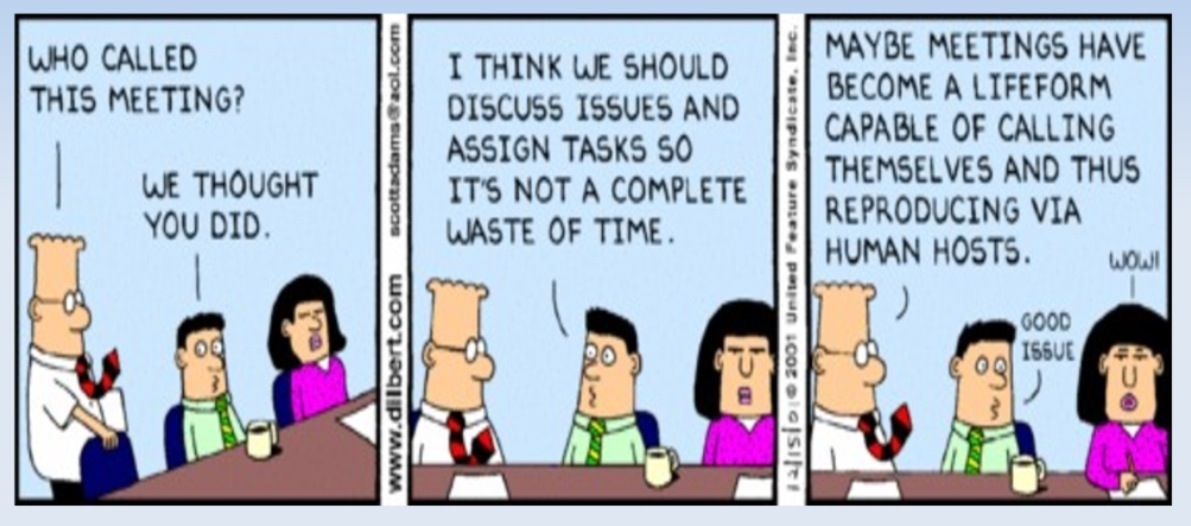
Picture Source: Dilbert by Scott Adams
Links to other posts: http://whatsthepont.com/2013/04/14/meetings-are-the-symptom-of-bad-organisation-yes-but-no-but-maybe/
 What's the PONT
Leave a comment