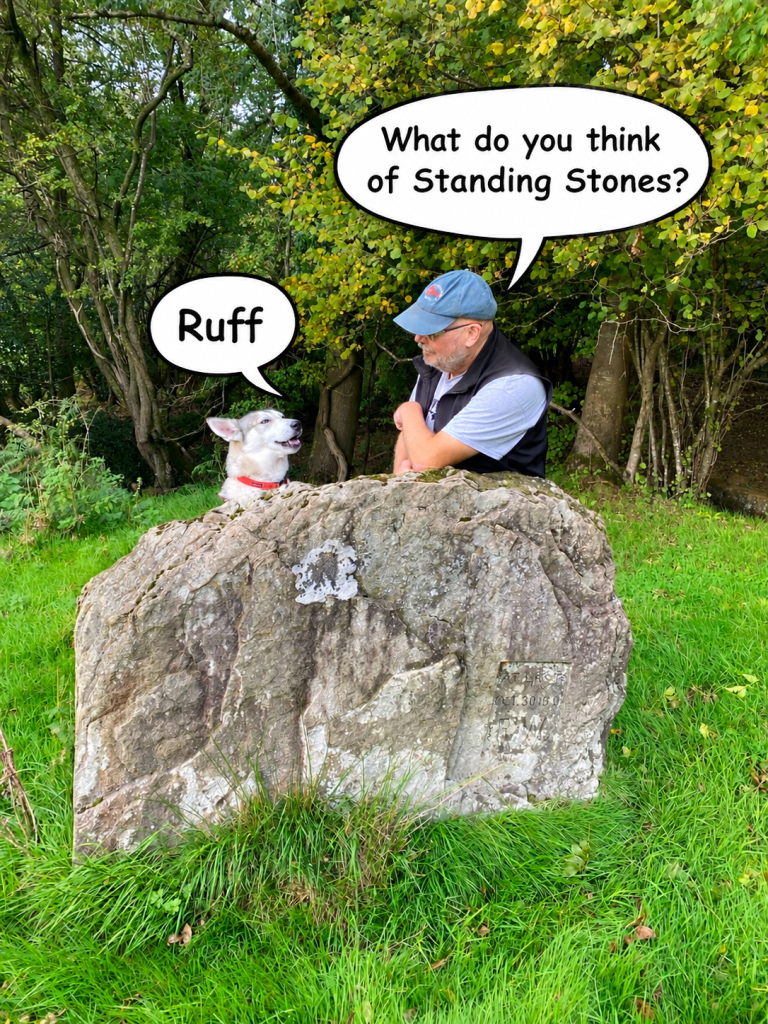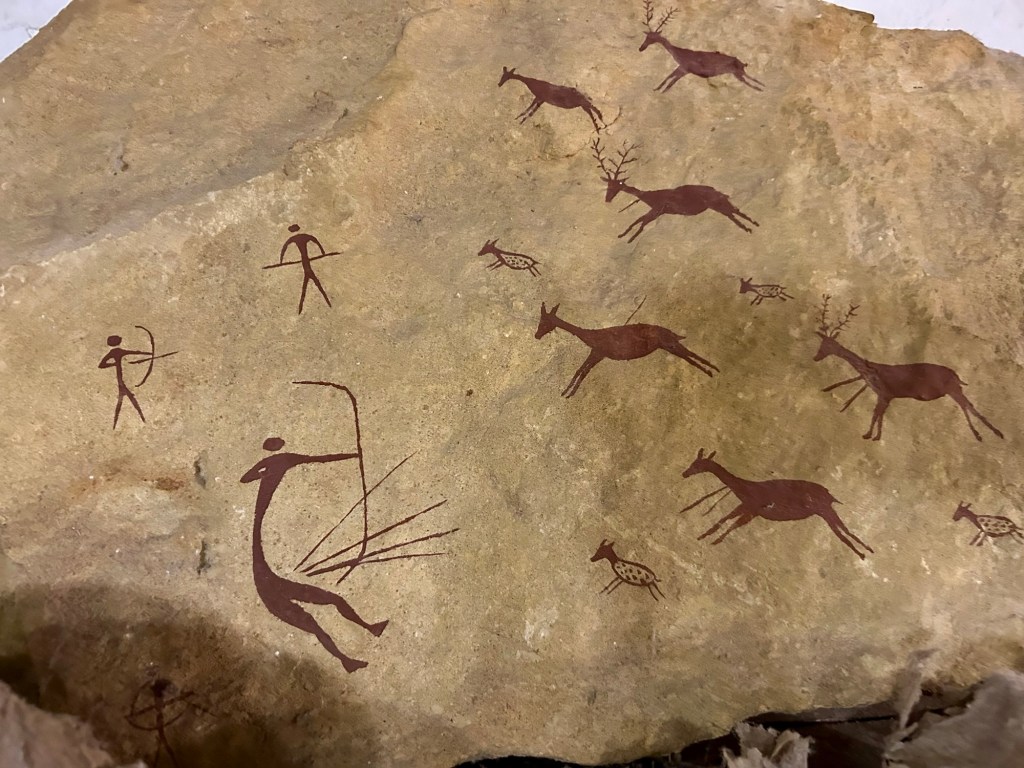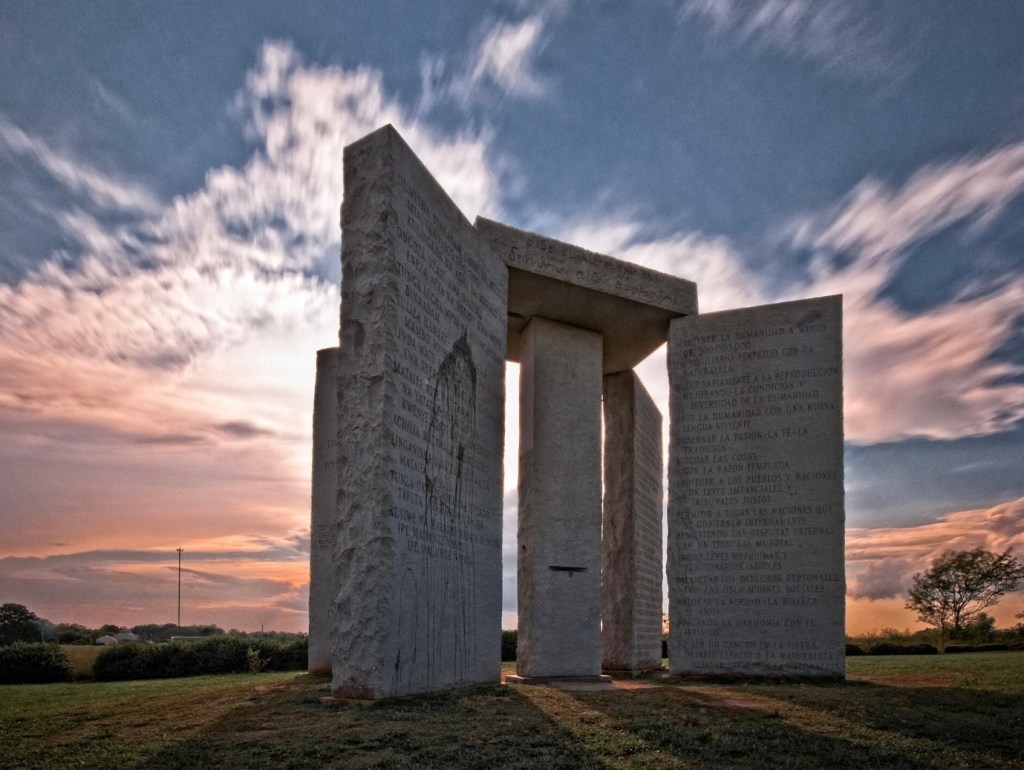
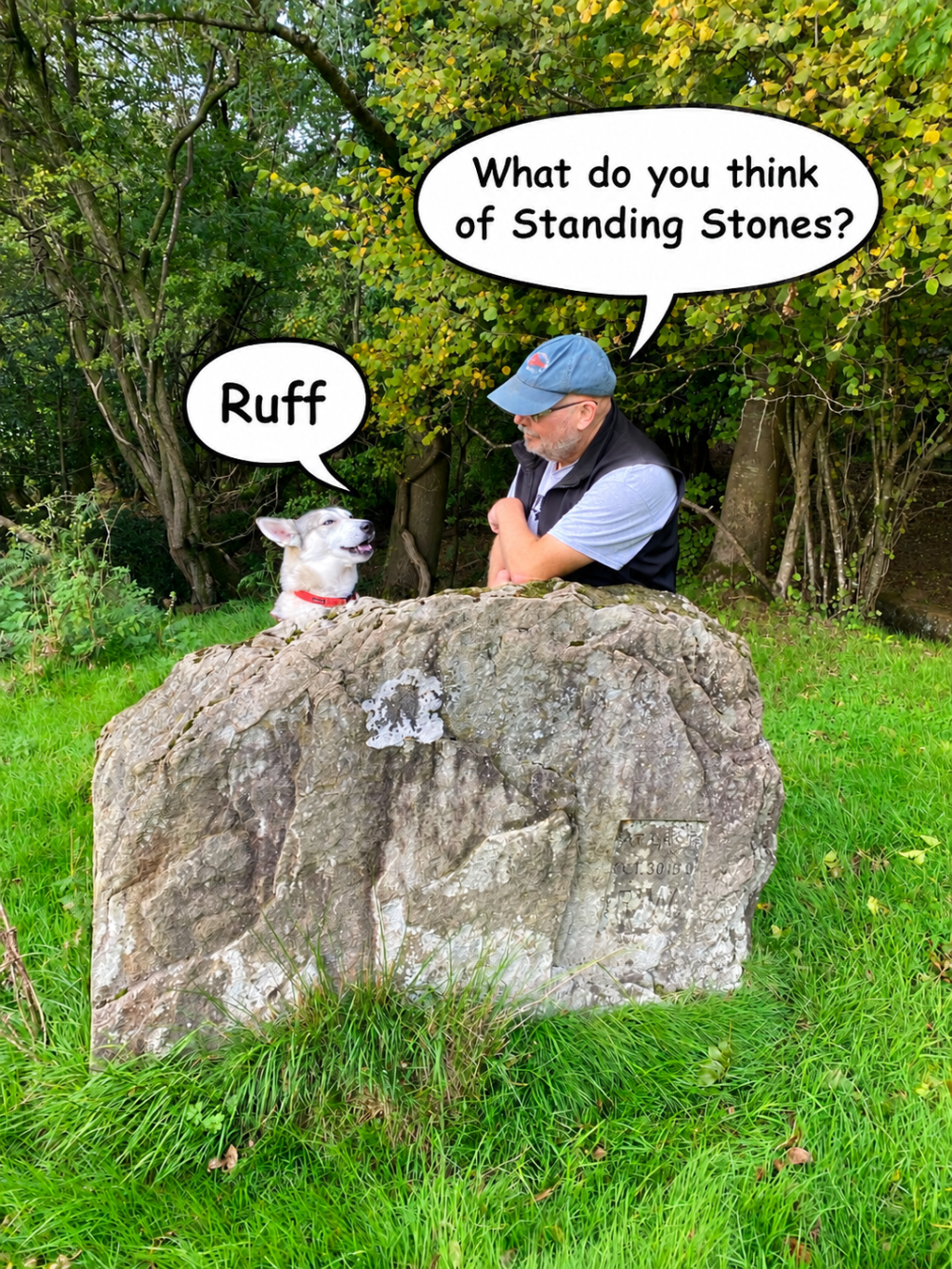
• A Stone, a Community, and a Question. Part 1 of thinking about big standing stones.
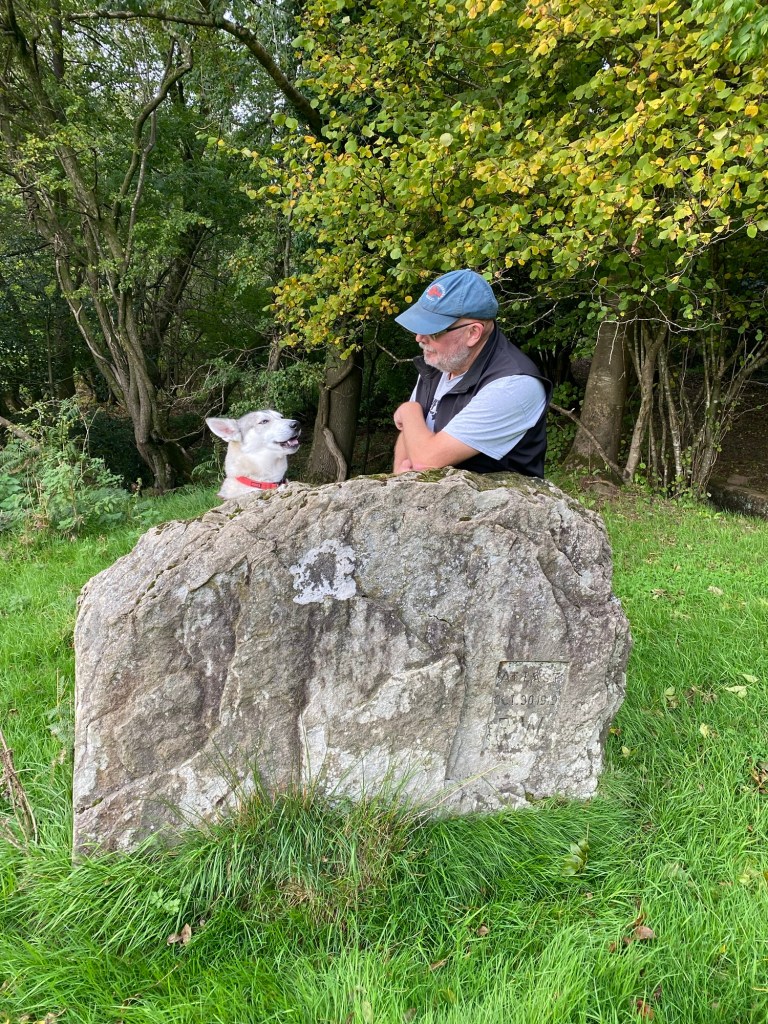
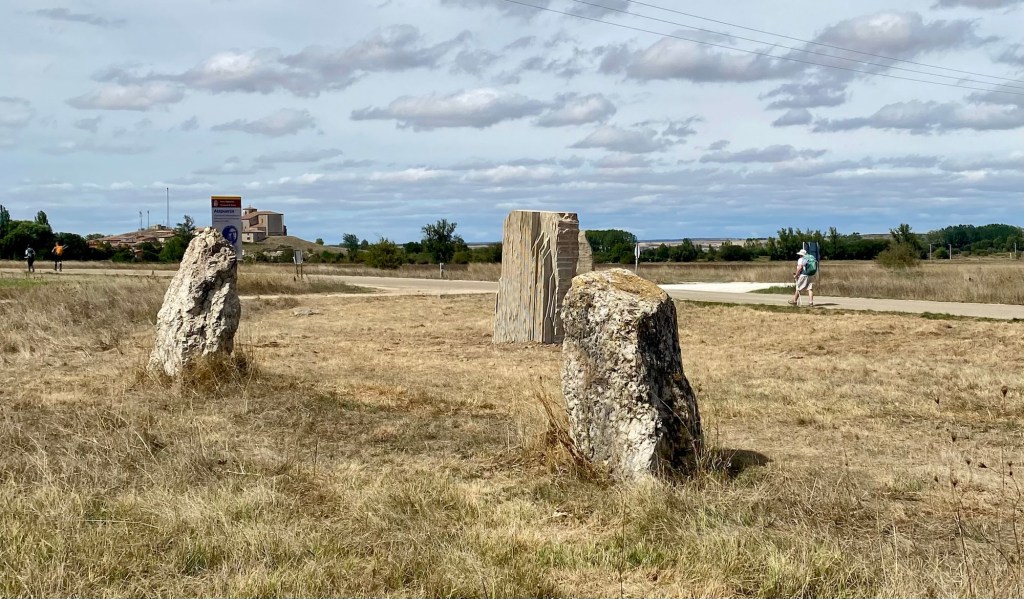
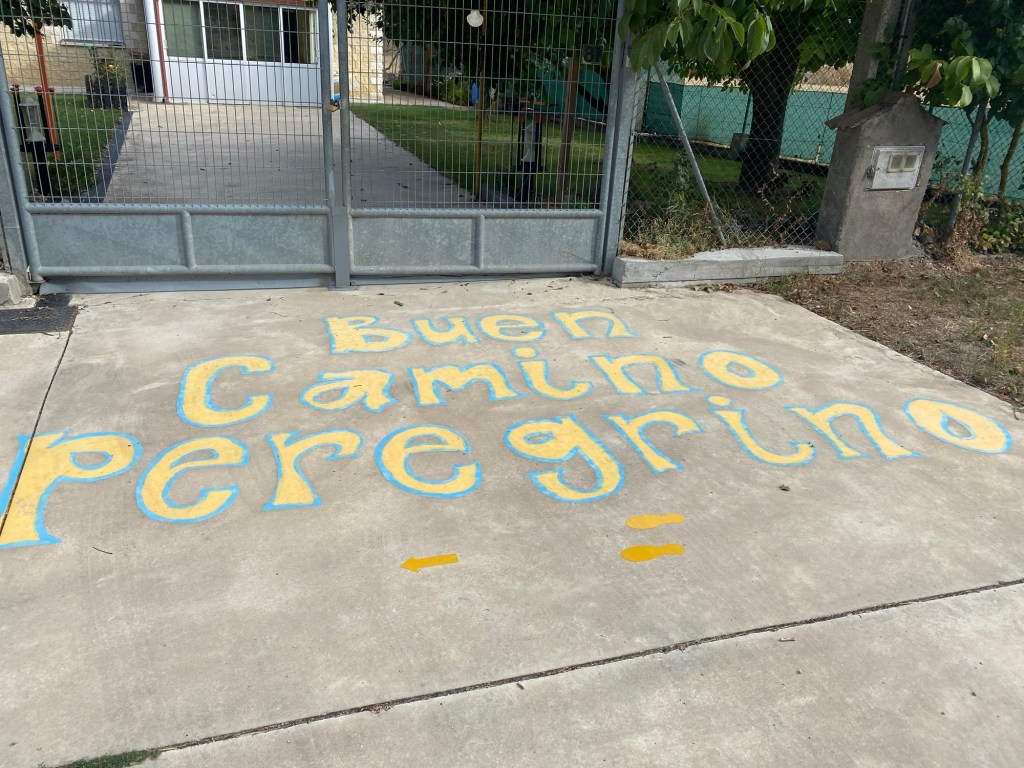
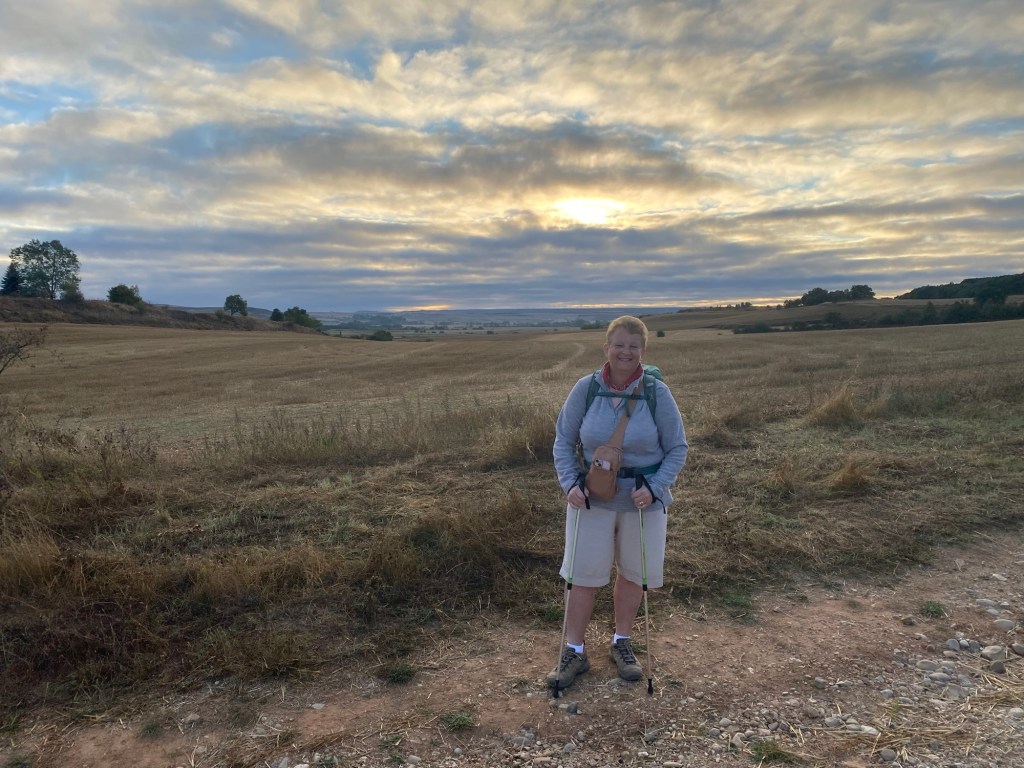
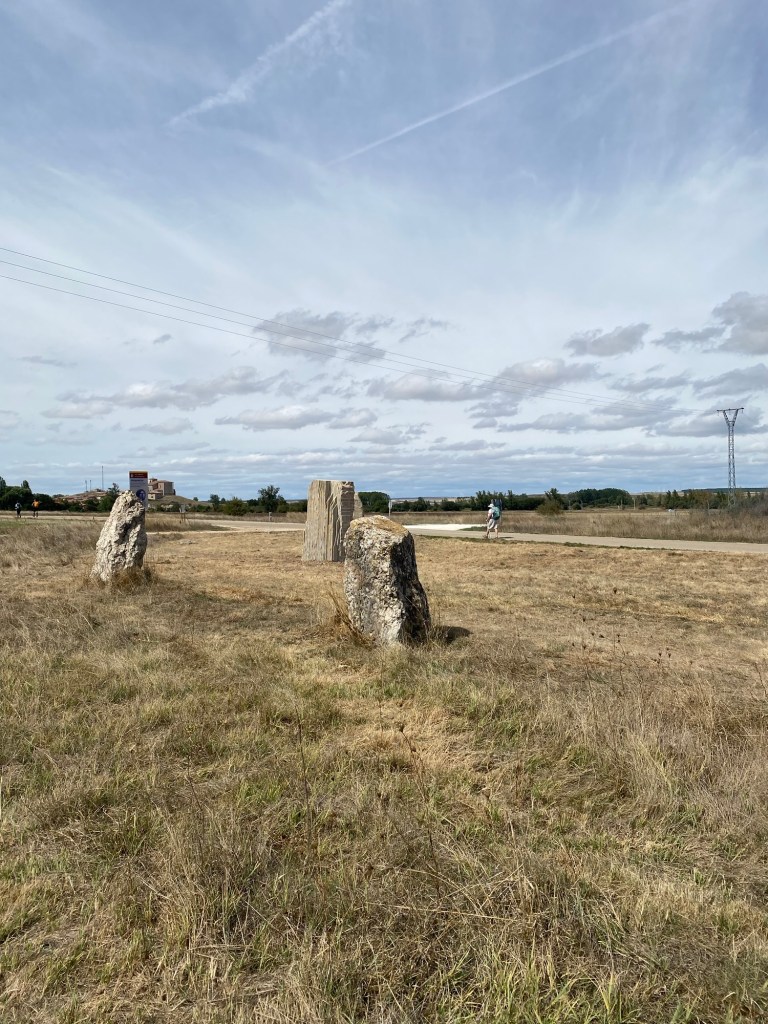
    A tableau. A Peregrino ignoring Me and some Standing Stones

    Have I mentioned the Camino de Santiago?

    I know the answer… “yes, now please move on…”

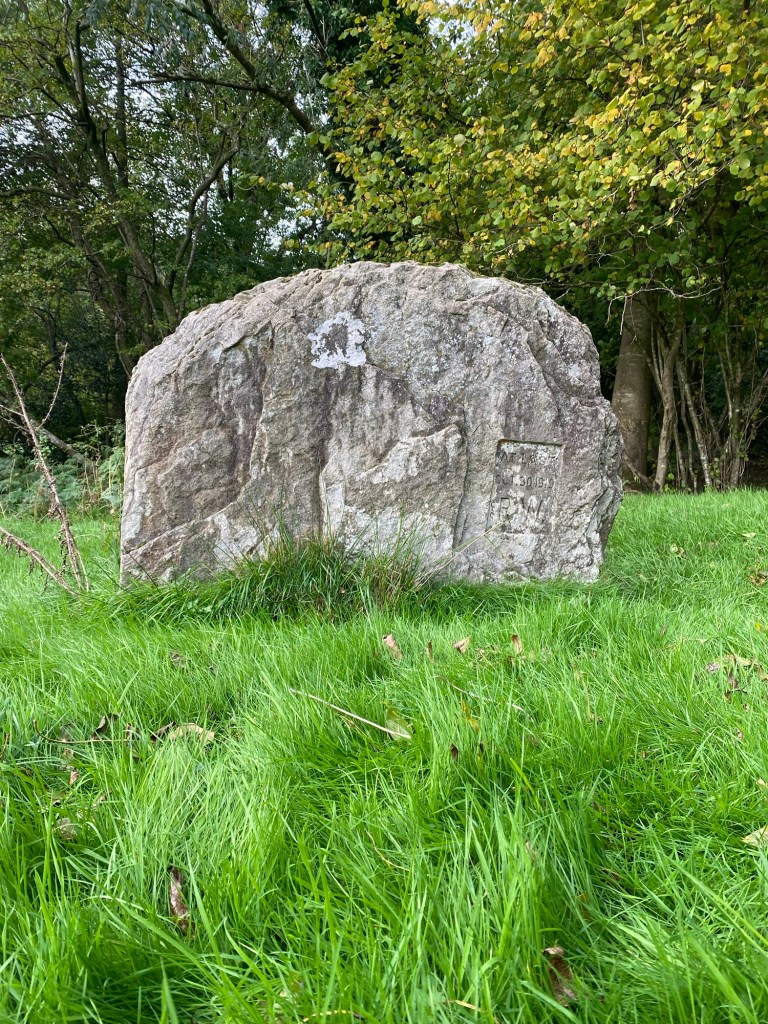
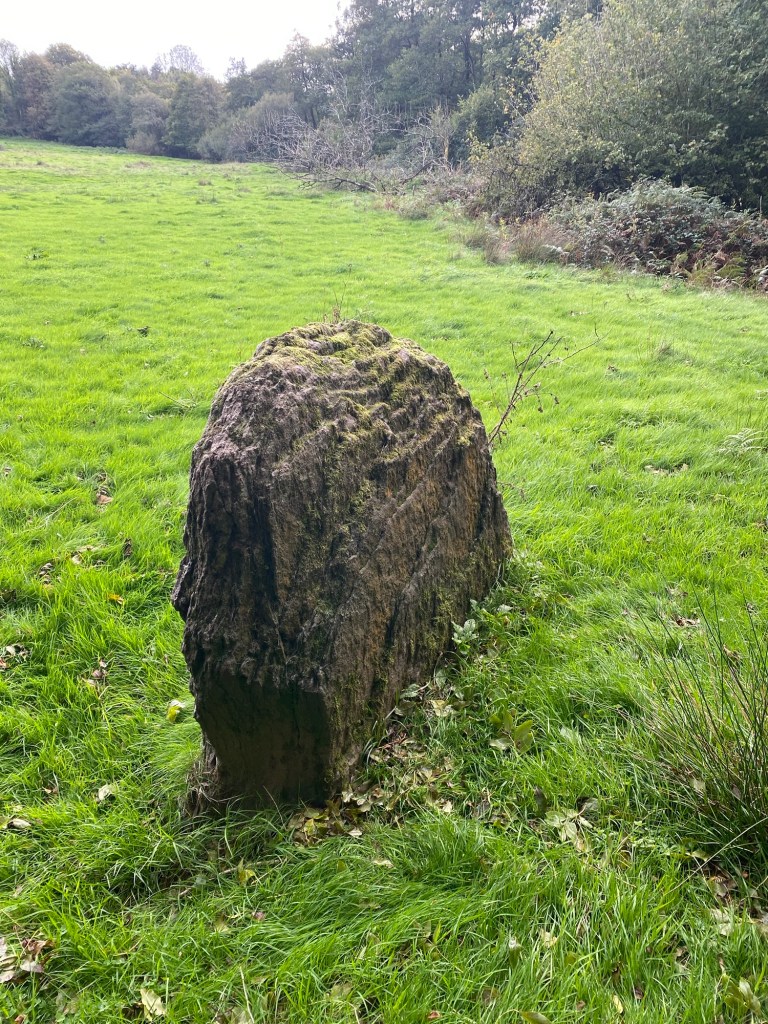
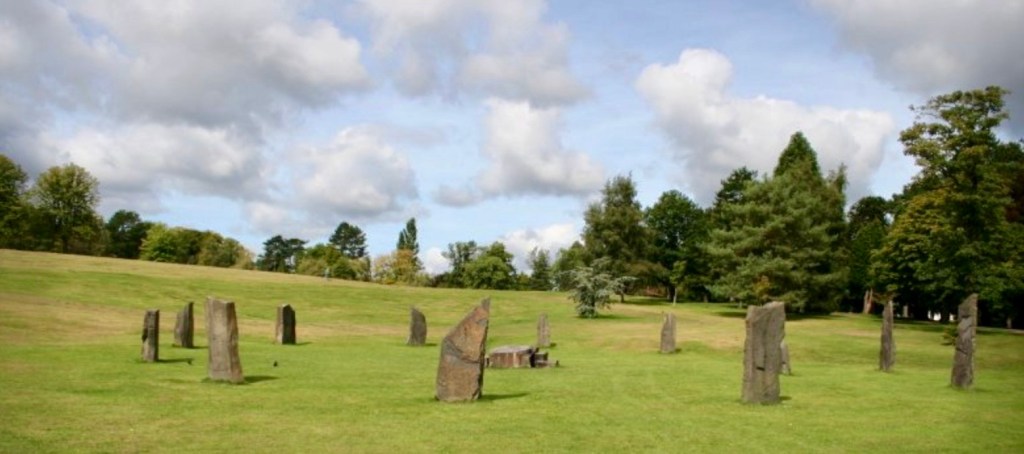
    So, how about a surprise encounter with some large(ish) standing stones in a field on the outskirts of Atapuerca, Northern Spain.

    Not an ancient ‘henge ’, Gorsedd Circle or actual prehistoric ritual worship site.

    But something that could trace it’s origins whaaayyy back to the previous Saturday, literally, 12th September 2026. That’s when the latest standing stone was erected.

    How in the name of Piltdown Man did I manage to miss that and arrive 5 days too late?

    Atapuerca, there was a lot going on.

    To be honest, I almost trudged past the standing stones at Atapuerca.

    It should have been the natural end of an 18km day of Camino walking, we were tired. However, ‘someone’ had managed to book accommodation in the village 2.5km further on at Olmos de Atapuerca, there was more to do.

    My joyful detour to run around the stones, looking for one to hug, was looked upon with a degree of disdain. And with some curiosity by two Dutch Peregrinos alongside at the time. They however pretty much ignored the stones and cheerfully headed for their (close by) accommodation in Atapuerca.

    The result was a less than satisfactory time spent with the stones and some below par photographs.

    But, enough of a seed was planted, and to be honest, I can’t shake off what I saw in that sun baked field outside of Atapuerca.

    Thank you ChatGPT

    That evening I spent some time translating the inscriptions from stones I’d managed to photograph.

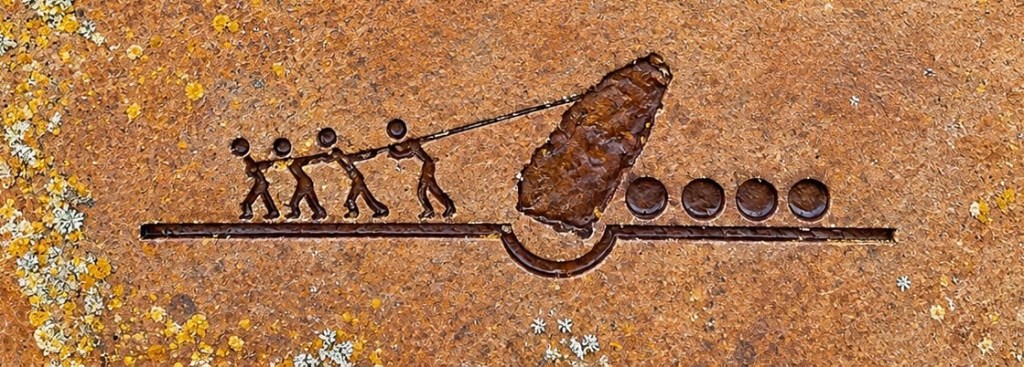
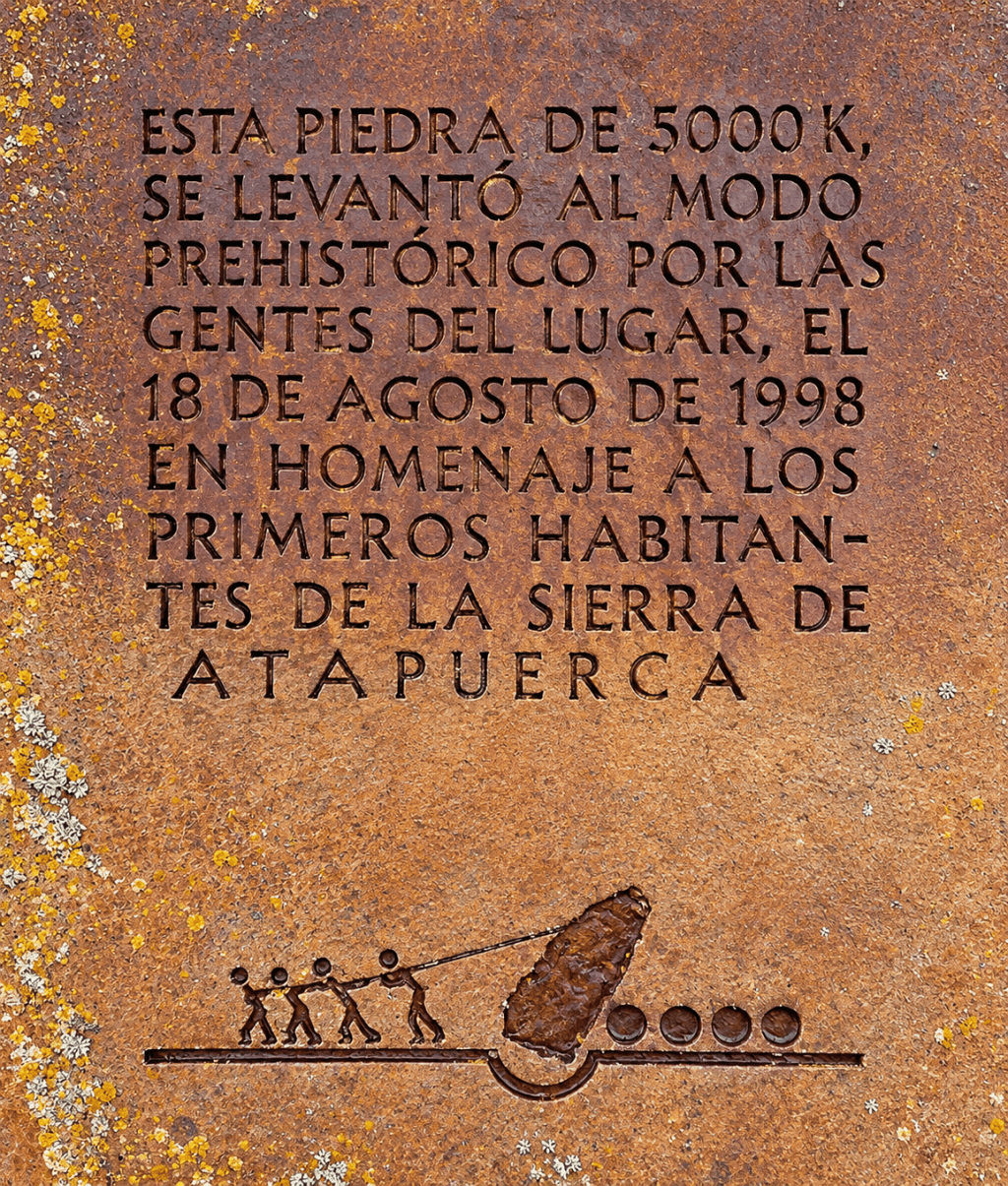
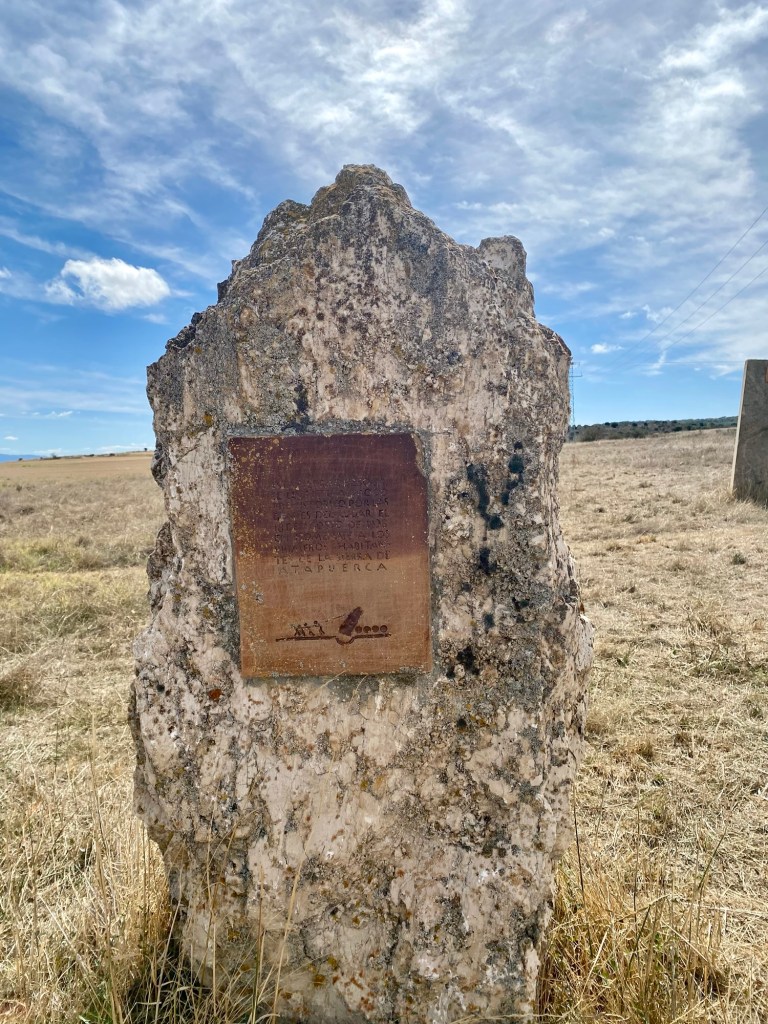
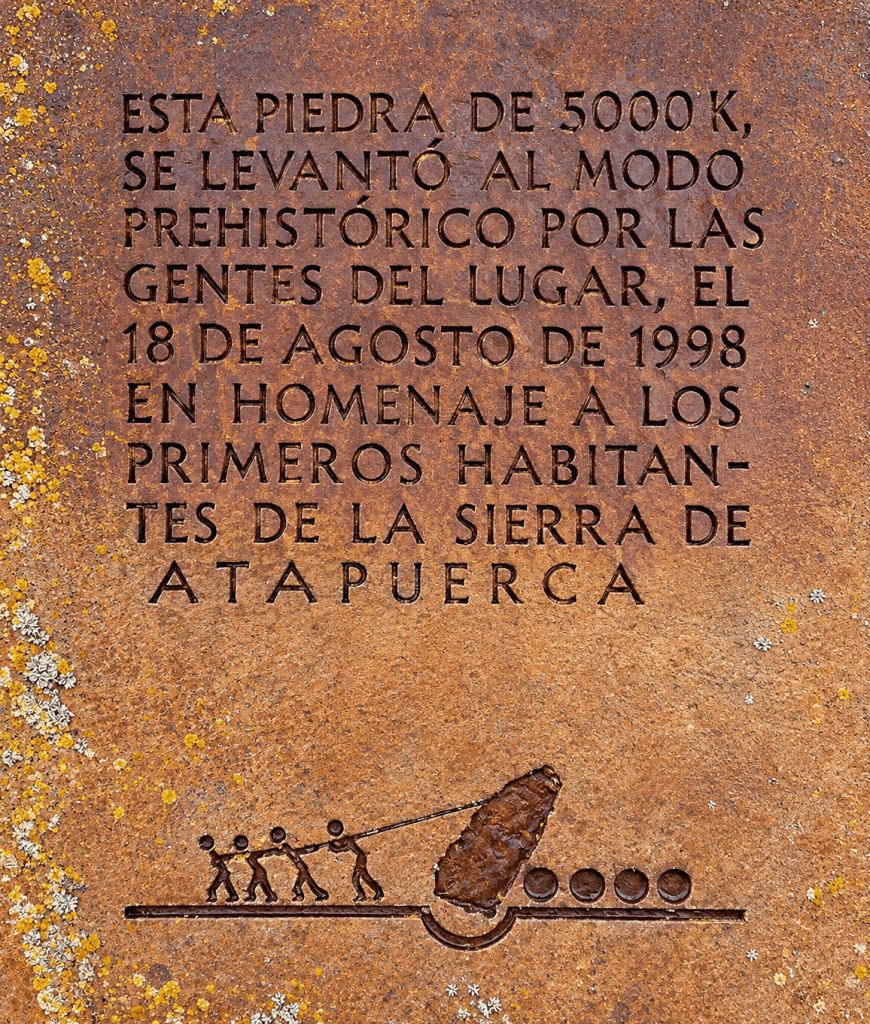
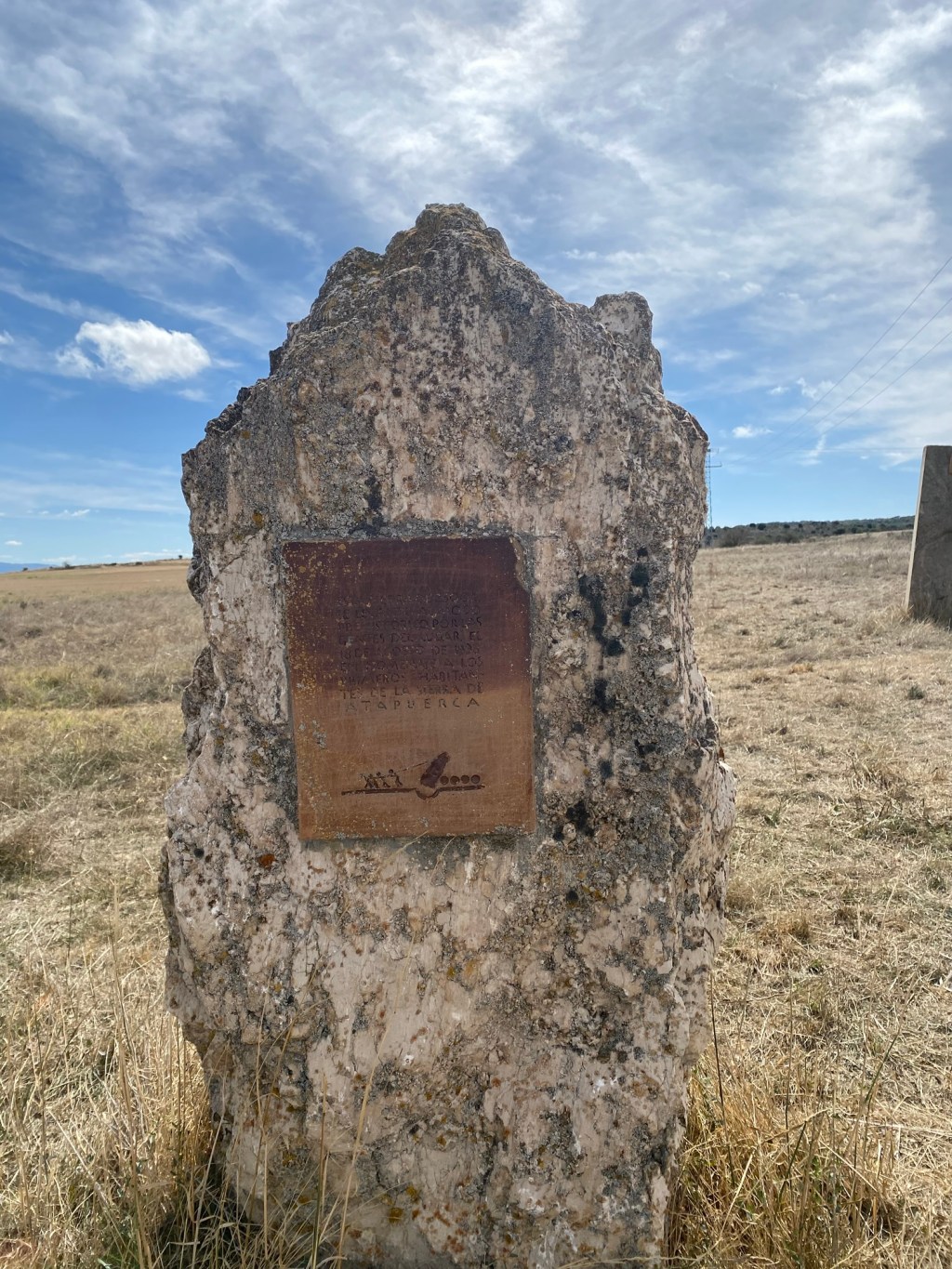
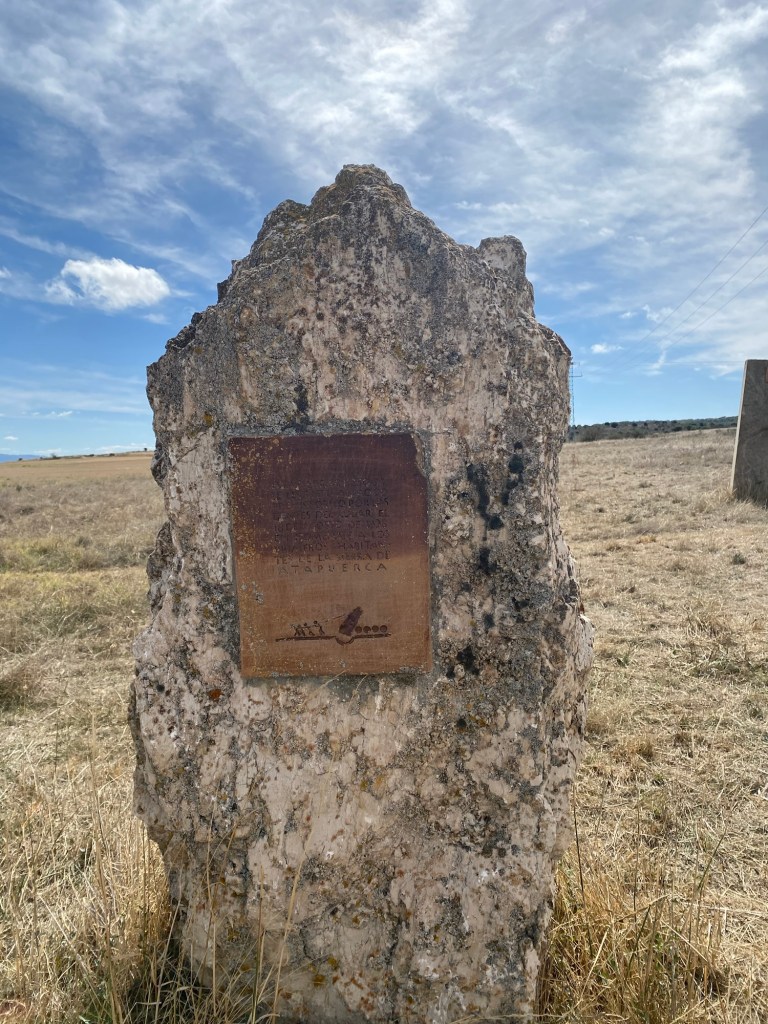
    This one captures the essence of what was going on, people using rollers and ropes to raise a large stone. The inscription:

    “Esta piedra de 5000 K se levantó al modo que las prehistóricas gentes del lugar el 18 de agosto de 1998 en homenaje a los primeros habitantes de la Sierra de Atapuerca.”

    “A 5,000 kg stone, raised in 1998 using methods associated with the prehistoric people of that place, in homage to the earliest inhabitants of the Sierra de Atapuerca.”

    That inscription pushed all of my buttons…

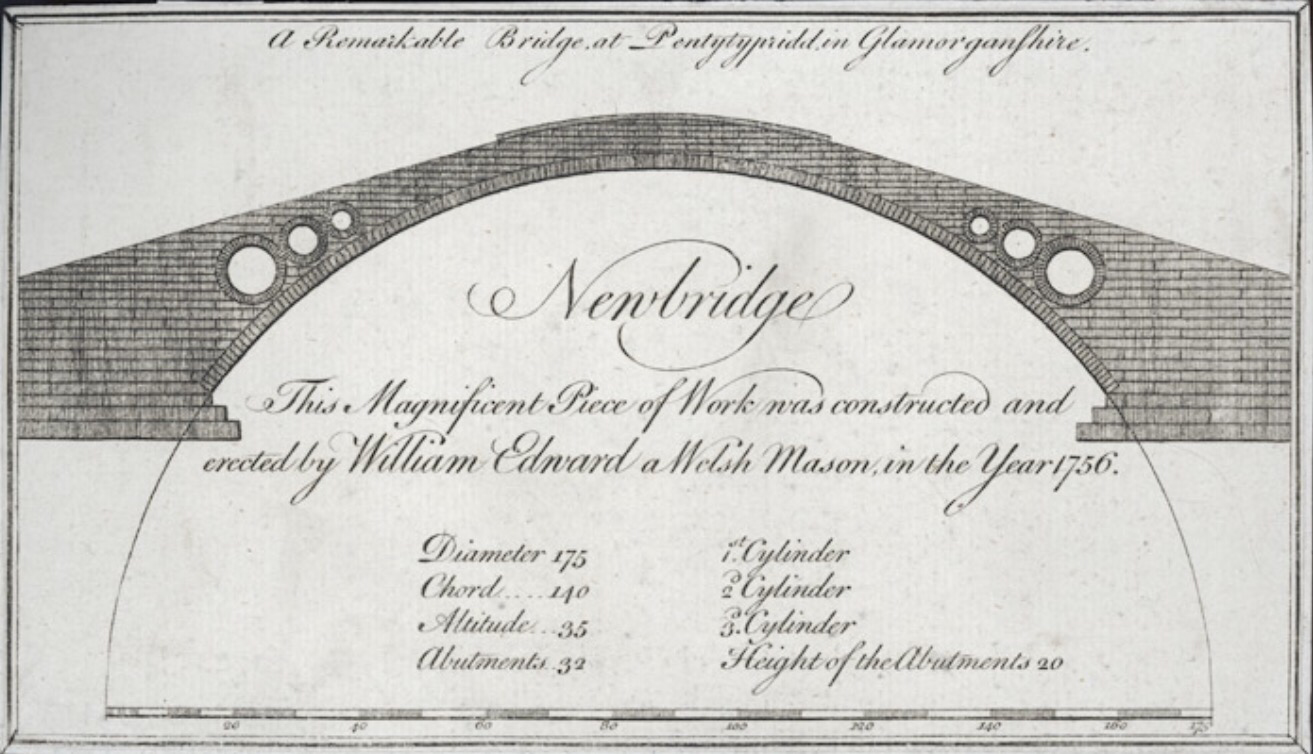
    Less prehistoric monument, More indestructible bridge.

    The stones at Atapuerca are very much a modern creation, deliberately connecting people from today with their ancestors, and descendants.

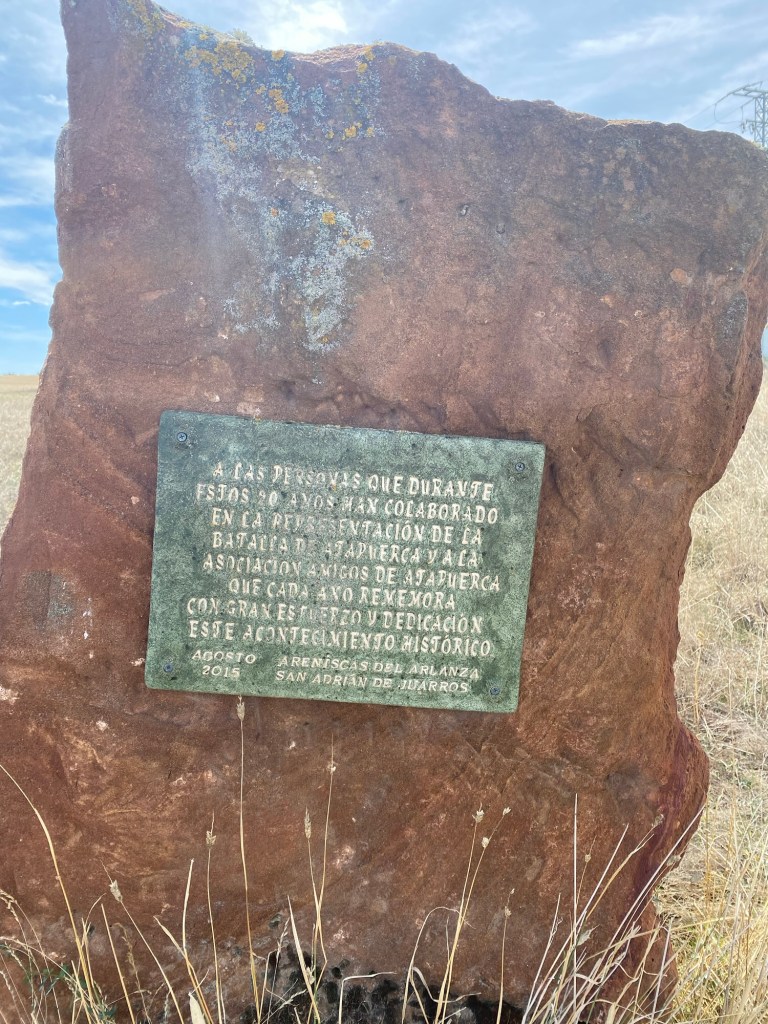
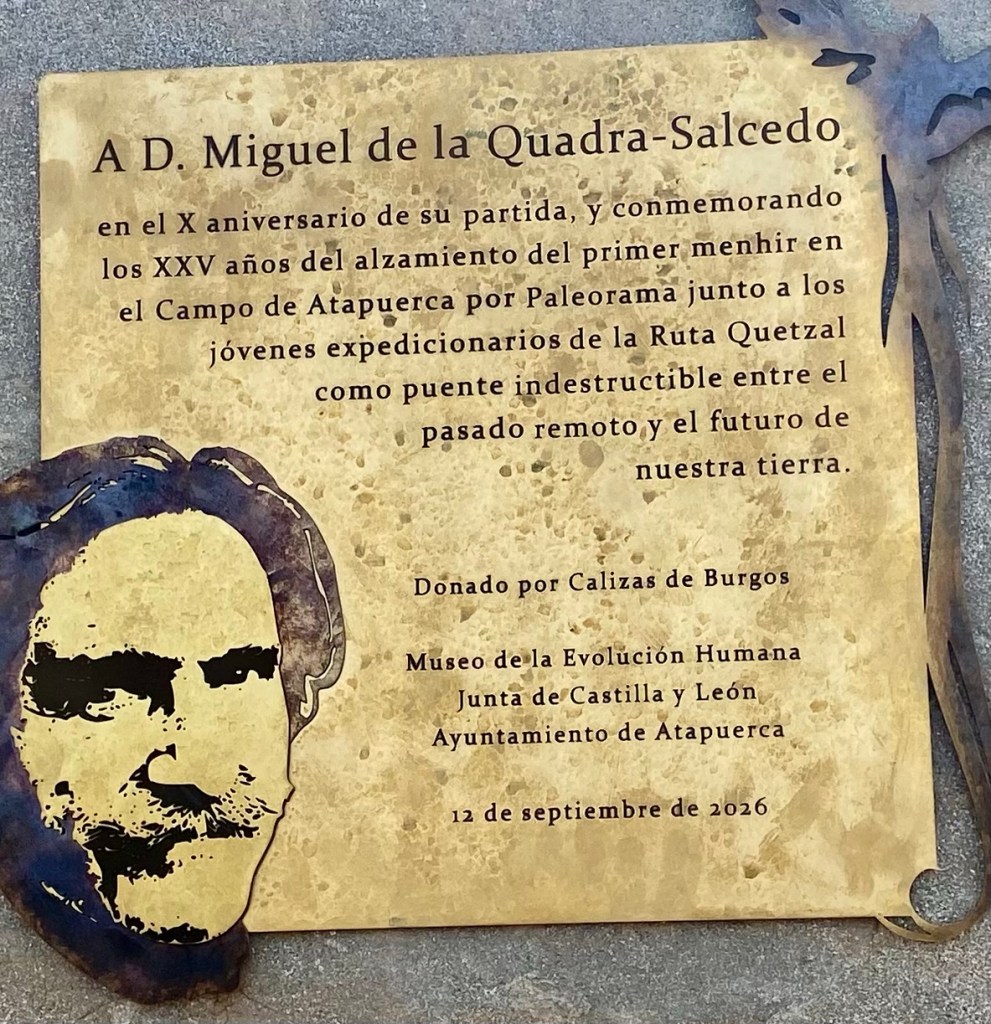
    The latest one is a memorial to Don Miguel de la Quadra-Salcedo, on the 10th anniversary of his death and commemorating the first stone raising in Atapuerca.

    There’s a specific part of the memorial that grabs my attention;

    “como puente indestructible entre el pasado remoto y el futuro de nuestra tierra.”

    “an indestructible bridge between the remote past and the future of our land.”

    When I mentioned my ‘buttons’, this is what I’m talking about;

    -A modern community deliberately connecting itself with prehistoric people,

    ⁃ People working together recreating the act of raising a large stone using historic techniques,

    ⁃ A monument created as a connection; an indestructible bridge, puente indestructible, pont anorchfygol..

    It immediately got me thinking about what might be possible…

    Can raising a standing stone connect contemporary people with their ancestors and simultaneously future generations?

    But…..but we do that already.

    This isn’t something we’ve forgotten about in Wales. I mentioned Gorsedd Circles earlier and there’s also the Caerwedros Talking Stone in Pembrokeshire.

    But, could we do more?

    Especially if the act of raising a stone was a spontaneous community effort. Using techniques that require lots of people to get involved.

    If communities once chose to raise standing stones, what’s stopping us doing it now?

    The question that has followed me home

    So, I’ve come home from the Camino with an idea (rather than a plan).

    Could a community in Wales do something similar?

    Not a replica of Atapuerca. Not a monument designed by somebody else and installed for local people to admire.

    A stone chosen, moved and raised by a community because that community wants to do it.

    What would happen if a community decided to raise a stone of its own, in its own place, for its own future?

    No What’s the PONT, today

    (but an indestructible bridge… maybe.)

    PS. I hope to shortly publish a Part 2 of this blog, Why do human beings raise stones? And a Part 3, Is it our ‘calling’ to raise (big) stones?

  • Camino de Santiago. Olmos de Atapuerca to Burgos.

    The last day of the current adventure.

    Heading to Burgos which has an enormously long riverside walk – at least 8km if you add in the less formal bits either end.

    It’s better than walking along the roads in my view.

    Here’s the 4-a-Day picture diary.

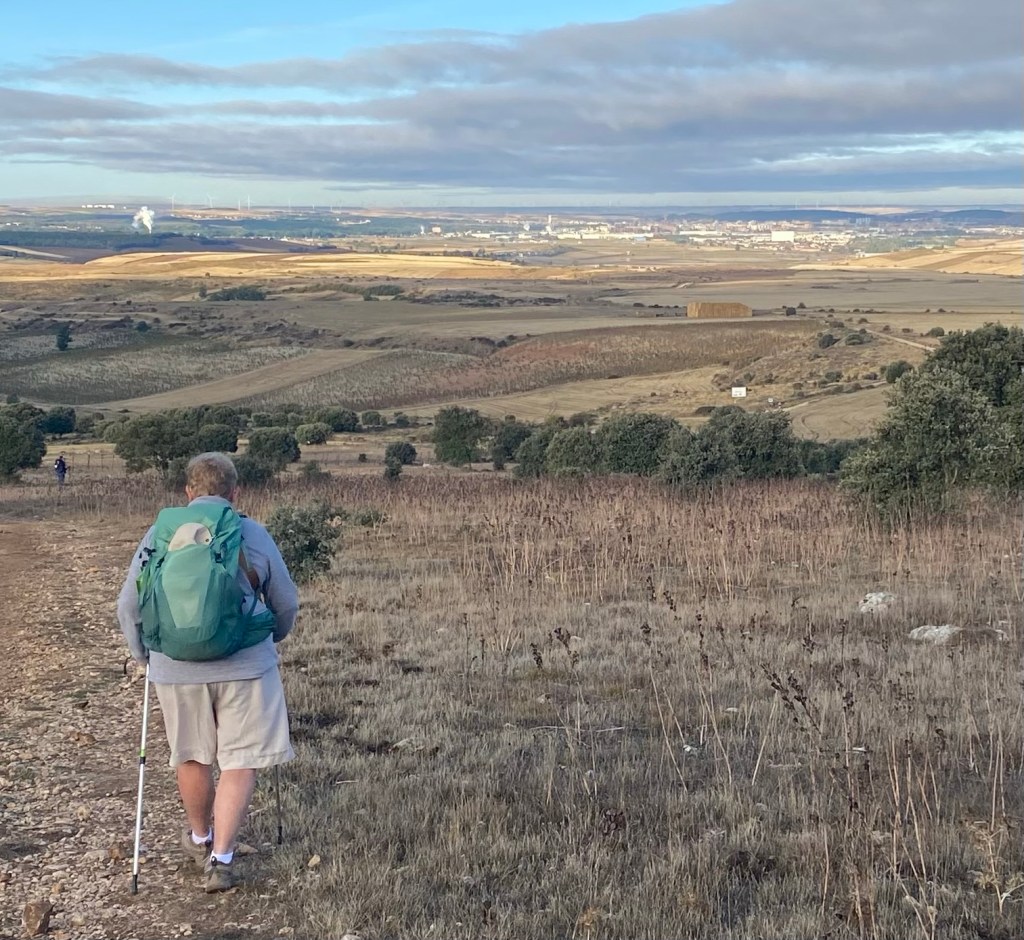
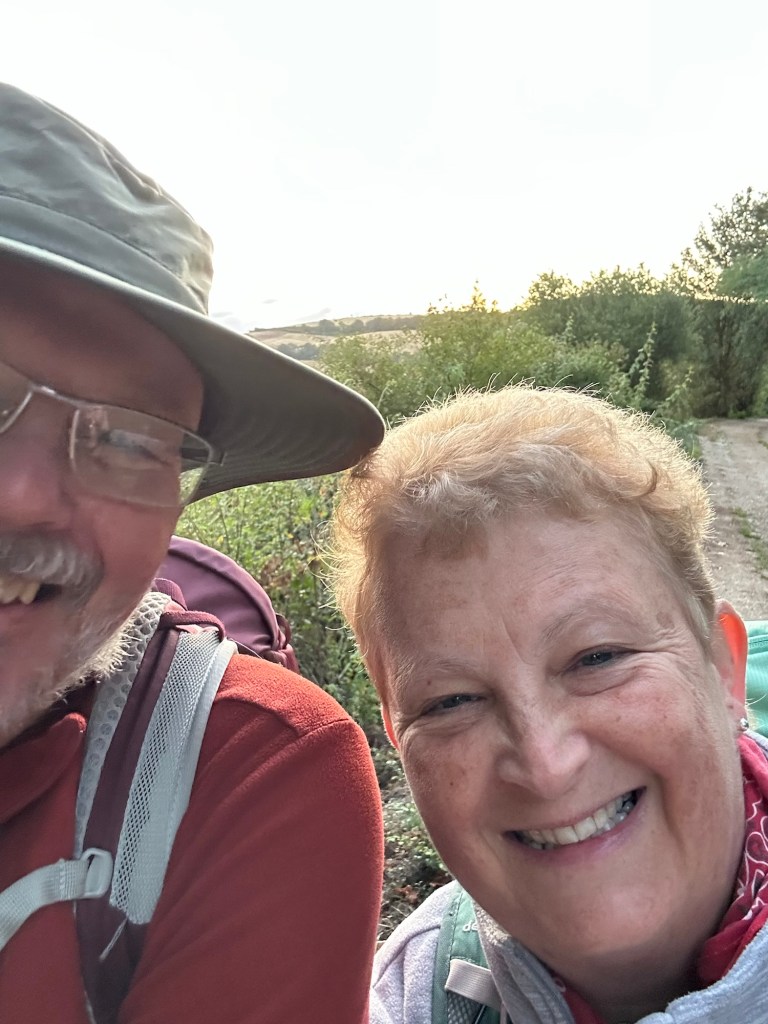
    Who? SB just after sunrise on the last day. Fully committed to an 18km (might be 20km) stroll into Burgos.

    We did meet some people from Switzerland and Australia last night staying in the same Casa Rural as us. The lady from Switzerland was familiar with Llandudno (North Wales) as her company HQ is located there.

    We had a good chat about the squeaky stairs in one of the grand hotels on the Llandudno sea front.

    It’s bizarre the things you can find to talk about.

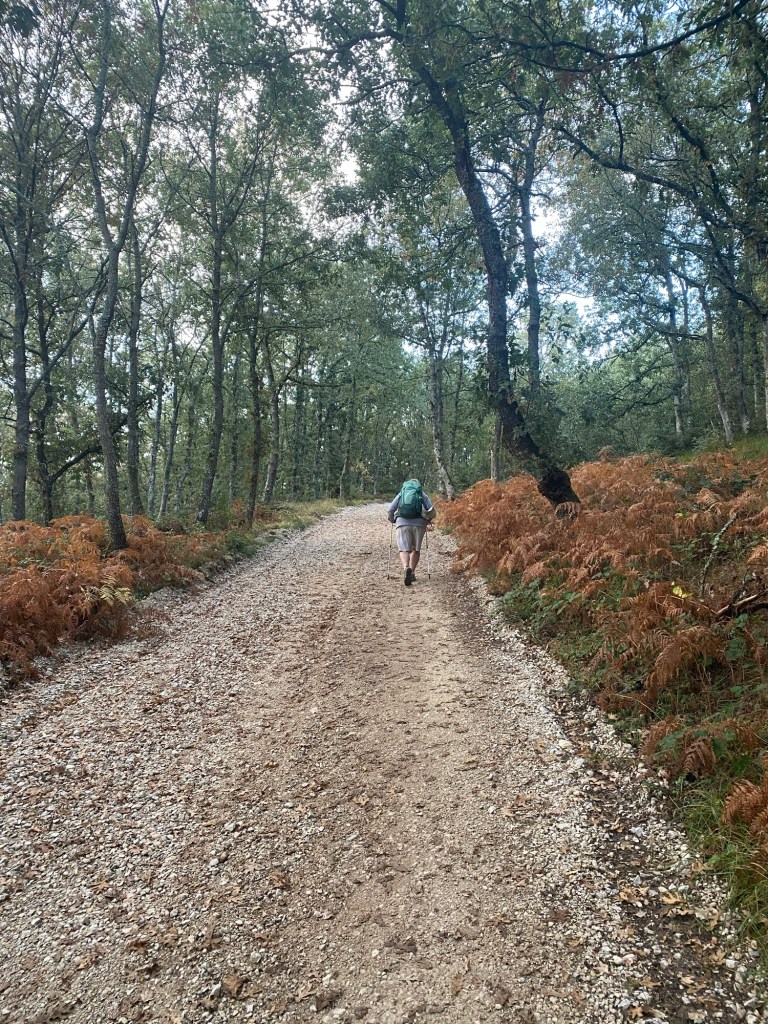
    What? Still walking.

    Up the side of the Atapuerca Mountains – which is notorious for a sharp quartzite rough stone path.

    That’s Burgos in the distance.

    Looking deceiving easy to get to.

    That plume of steam on the left is the Kronospan factory.

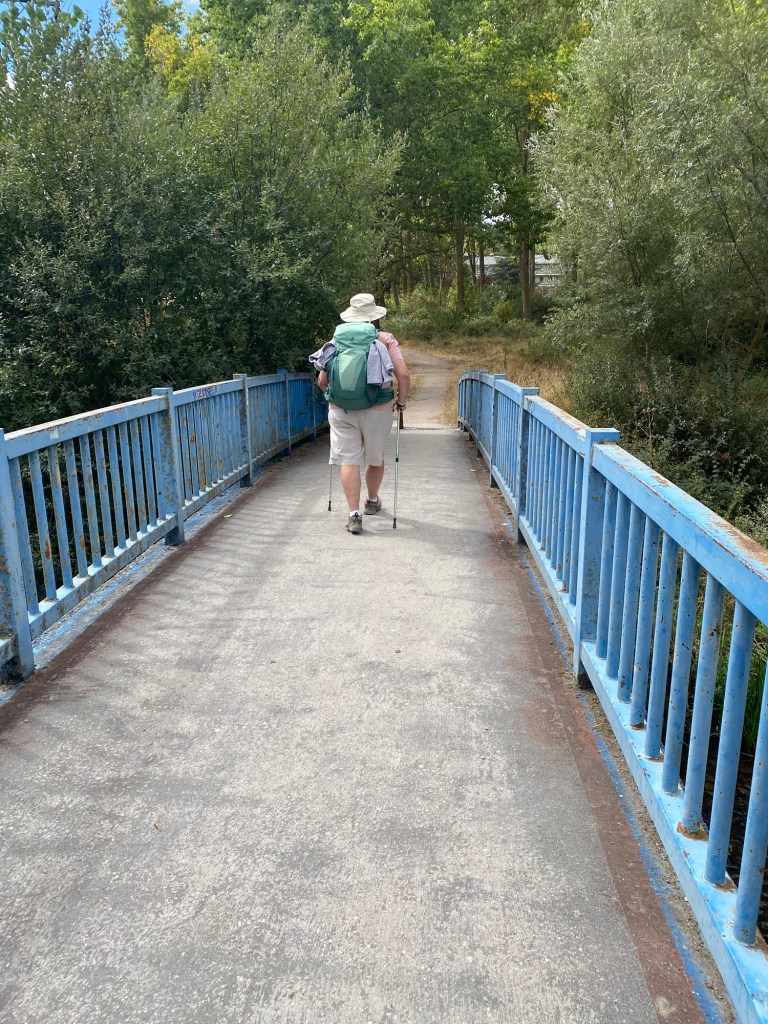
    The point where the ‘alternative’ Camino walk along the river starts.

    Where? The start of the aforementioned walk alongside the river.

    All these interesting side routes seem to go past a concrete batching plant.

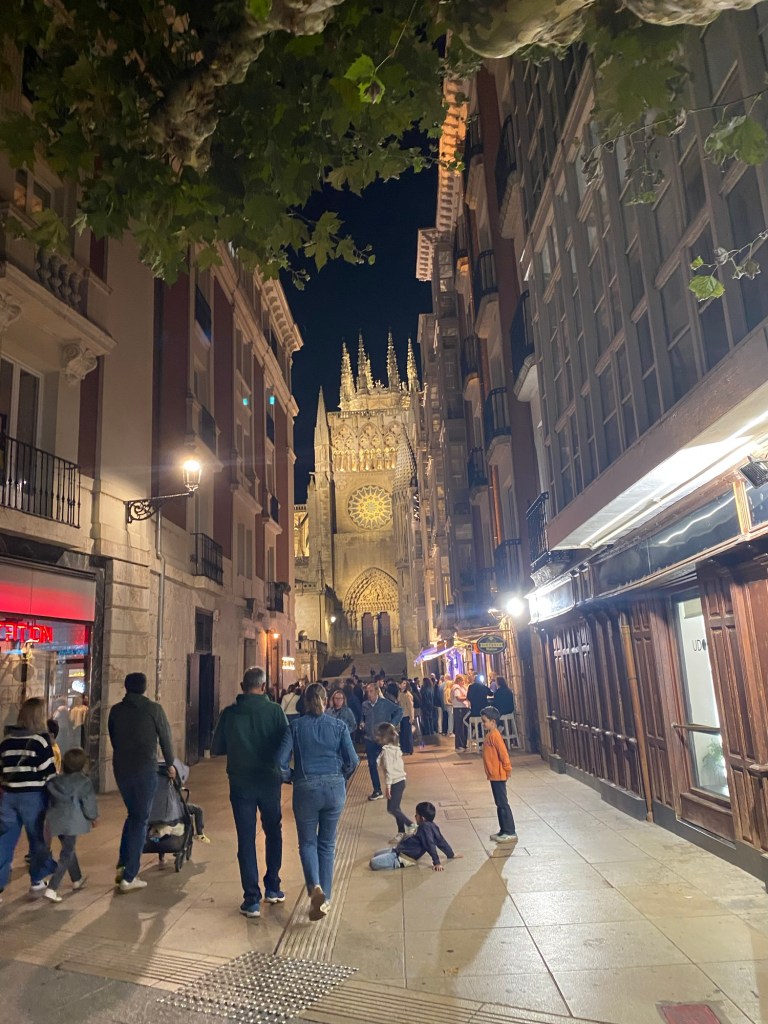
    Why? It’s a bit of a shock to the senses when you arrive in a city after walking through the countryside for a few days.

    Why didn’t I remember this and make adjustments?

    Especially as it was Friday nights, there was a music festival going on and it felt like Christmas, New Year and August Bank Holiday at home all rolled into one.

    EVERYONE (and their dogs) was out on the streets.

    So for next time we need to plan around local things for a smoother arrival.

    PS the pic is of Burgos Cathedral about 9.30pm on a Friday night.

    If you are from Cardiff imagine that scene on Church Street looking at St John’s, on an average Friday night.

    Bonus Pic. The people who live alongside the Camino – particularly in rural areas – really do seem to like Peregrinos.

    It helps.

  • Camino de Santiago. Villafranca Montes de Oca to Olmos de Atapuerca.

    Before anyone says anything – yes, I know Olmos de Atapuerca isn’t on the Camino.

    It ‘almos’ is though (ha ha ha) and apparently it used to be – the reason the route changed is unclear (to me).

    The reason we walked an extra 2.8 Km at the end of the day was entirely due to a communication error.

    When you are sat across the kitchen table in Wales, on a wet, dark, cold evening, ‘almost’ can totally sound like ‘Olmos’.

    “Will almost by Atapuerca be a good place to stay?” “… yeah sounds fine”

    I completely take the blame, and have been suitably punished.

    Let’s move on.

    The 4 a Day Picture Diary.

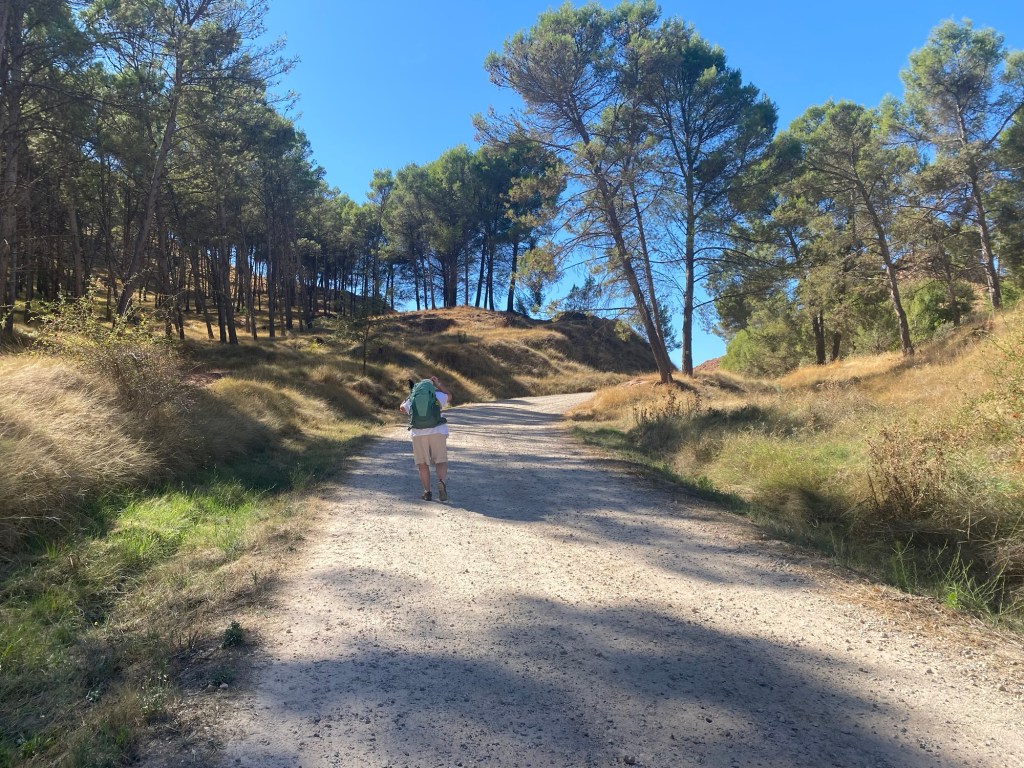
    Who? Here we are looking happy at the start of a reasonable slog up to almost 1200m.

    It was cool enough for a jumper.

    What? About 12km of the day was spent walking at about 1100m above sea level.

    Just for comparison, Y Wyddfa (Mt. Snowdon), the highest peak in Wales is 1085m.

    Lots of the walking was on forest tracks or in a wide fire break between large plantations of Pine trees. There were also plenty of Spanish Oaks.

    A nice break from parched fields.

    Where? We should have ended up at Atapuerca (near the Atapuerca Mountains).

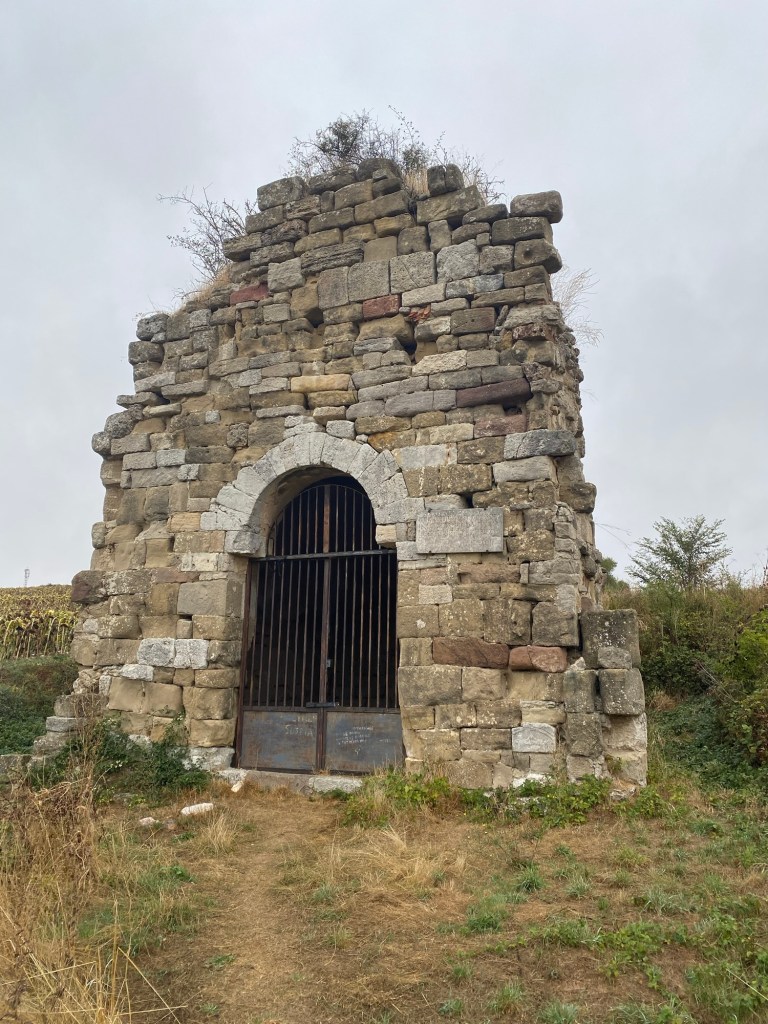
    Spotted on the edge of Atapuerca was a field of standing stones.

    Not any sort of Gorsedd Circle or wannabe Stonehenge, but something a bit more interesting.

    Atapuerca is the centre of a huge archeological dig looking at the origins of human civilisation.

    The stones are part of some experimental archeology the locals get involved in.

    From time to time the community raises a stone using ancient techniques.

    I so want to have a go at something like this.

    “an indestructible bridge between the remote past and the future of our land.”

    The Atapuerca stones aren’t just ancient-looking monuments. The inscription on the one above says that it was raised in 1998 in the manner of the prehistoric people of the place — a modern community deliberately recreating an ancient act.

    It got me wondering whether Welsh communities might one day want to do the same: raise their own stone, in their own place, by themselves, for their own future.

    PS I’m aware there are some already (eg Caerwedros Village Hall, Pembrokeshire) but could we do others?

    I can dream…

    Bonus pictures first.

    Some flowers. These are common all over the pasture land high up.

    Apparently the are Colchicum montanum, also known as Snack Catchers, also known as Shepherd Chasers, because they appear in the autumn to signify that Shepherds need to move their animals to lower pastures.

    Don’t eat them!

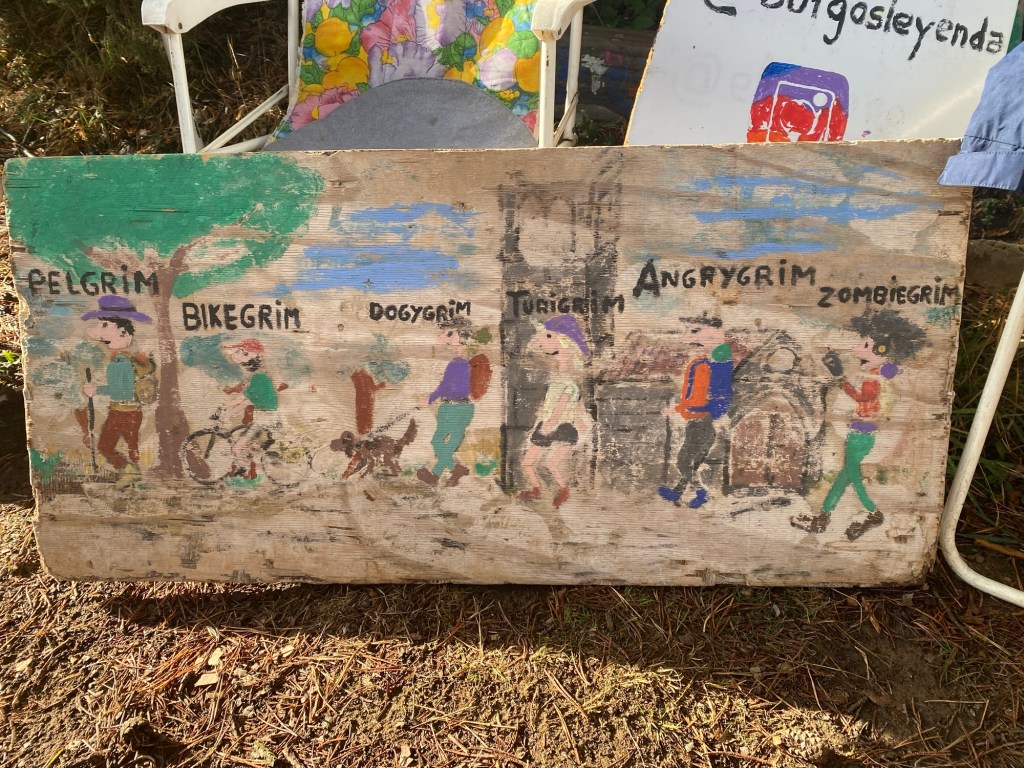
    A painting. This was the work of the chap who ran a pop up snack bar out of the back of his car high up in the forest.

    Mildly eccentric, but very welcoming and an entertaining break on the walk.

    He meets all sorts of Peregrinos (the only people) up there.

    And this is his artistic representation:

    All very clear stereotypes, including the ‘Zombiegrims’ – people glued to their smartphones.

    Why? This is a difficult one to talk about.

    I was aware we were going to come to this spot, but it still had a big impact upon me.

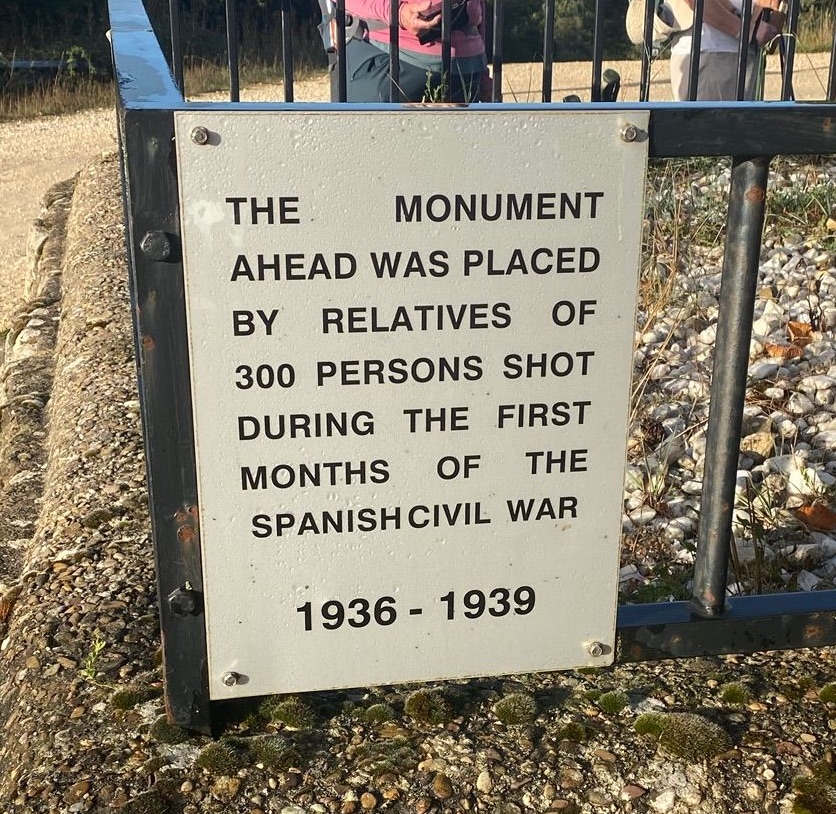
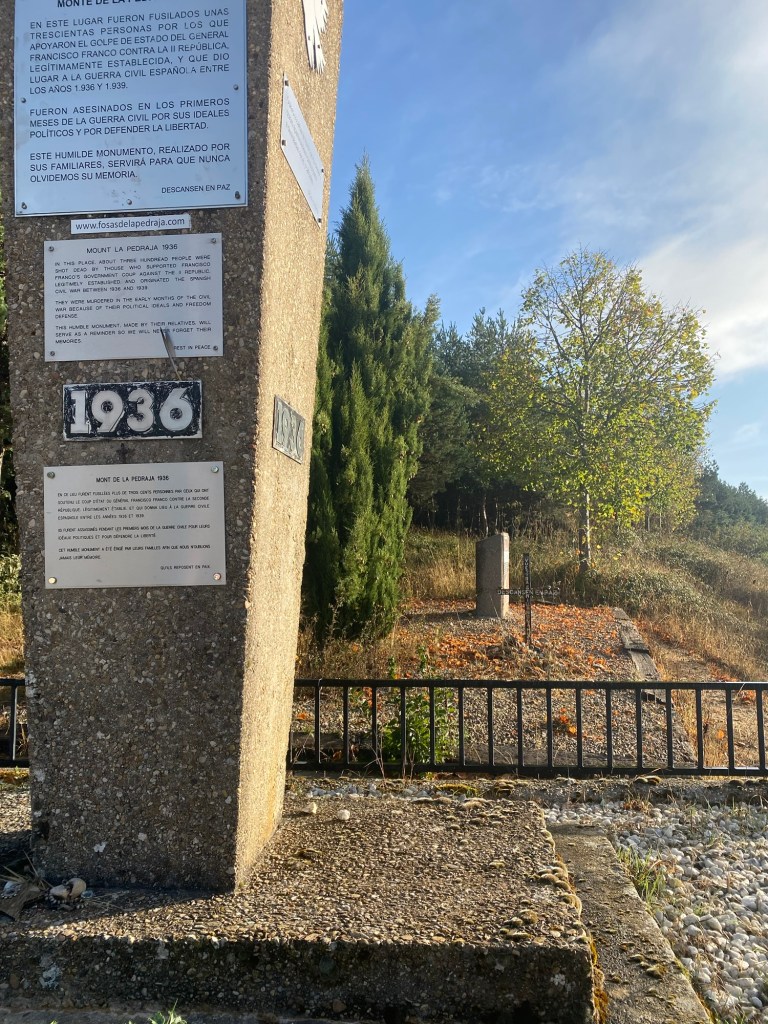
    It’s the site where 300 people were executed in 1936 for being opponents of Franco.

    This is the monument that relatives placed in the 1990s.

    I want to say more about it at some point in the future, but two things speak loudly to me: civil war has huge and long lasting impacts and, a mass grave for 104 people is a cruelly small piece of land, nothing like a grand military cemetery.

  • Camino de Santiago. Belorado to Villafranca Montes de Oca.

    Be careful what you wish for… Good advice from someone and, after a few days of ‘stinking hot’ weather it rained.

    Only a bit, but it was much cooler and I thought I heard my walking companion was say “this is pleasant” – but then they retracted the statement and later denied ever saying it.

    It was a short days walking which allowed for afternoon repairs and recuperation – in an ancient Monastery – now a hotel.

    Here’s the 4-a-Day pictures.

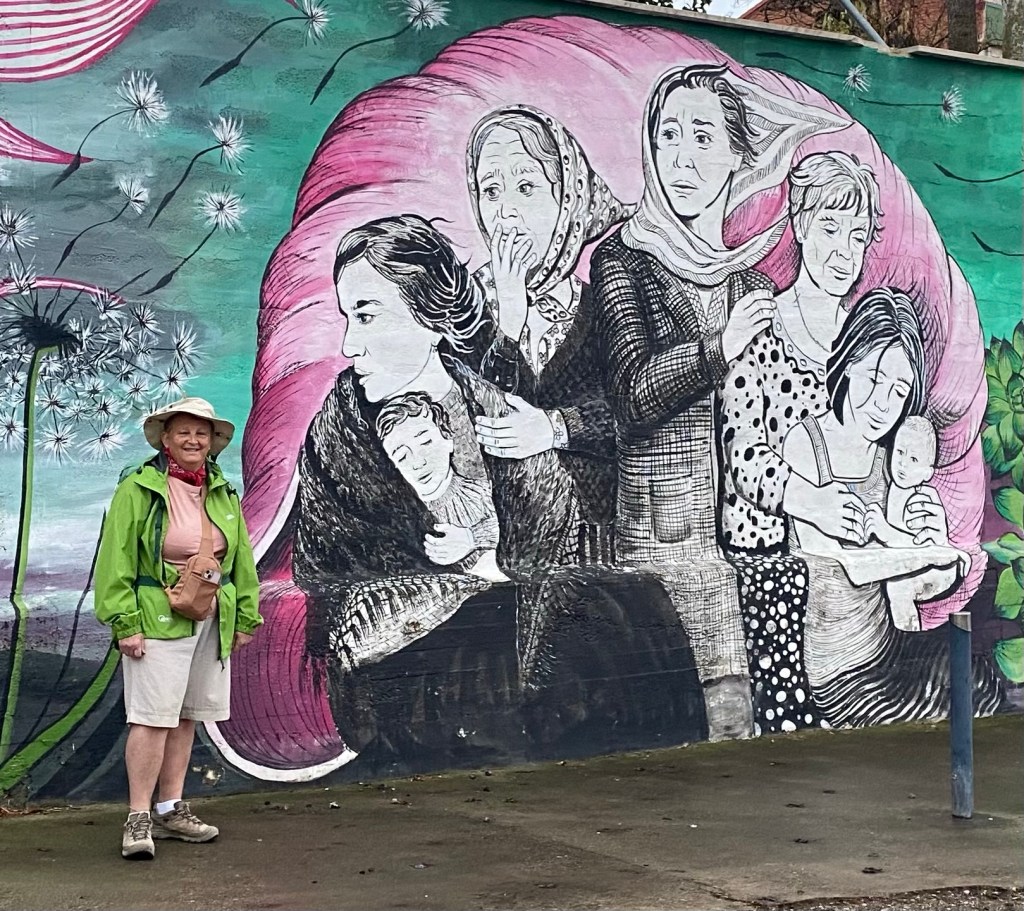
    Who? Here’s SB standing beside a mural in Belorado. I’m sure there’s deep meaning in this painting locally.

    However, for me it’s just a reminder of the worry and anxiety SB has created in her Facebook posts over how much she is suffering. That’s not the smile of someone who is suffering.

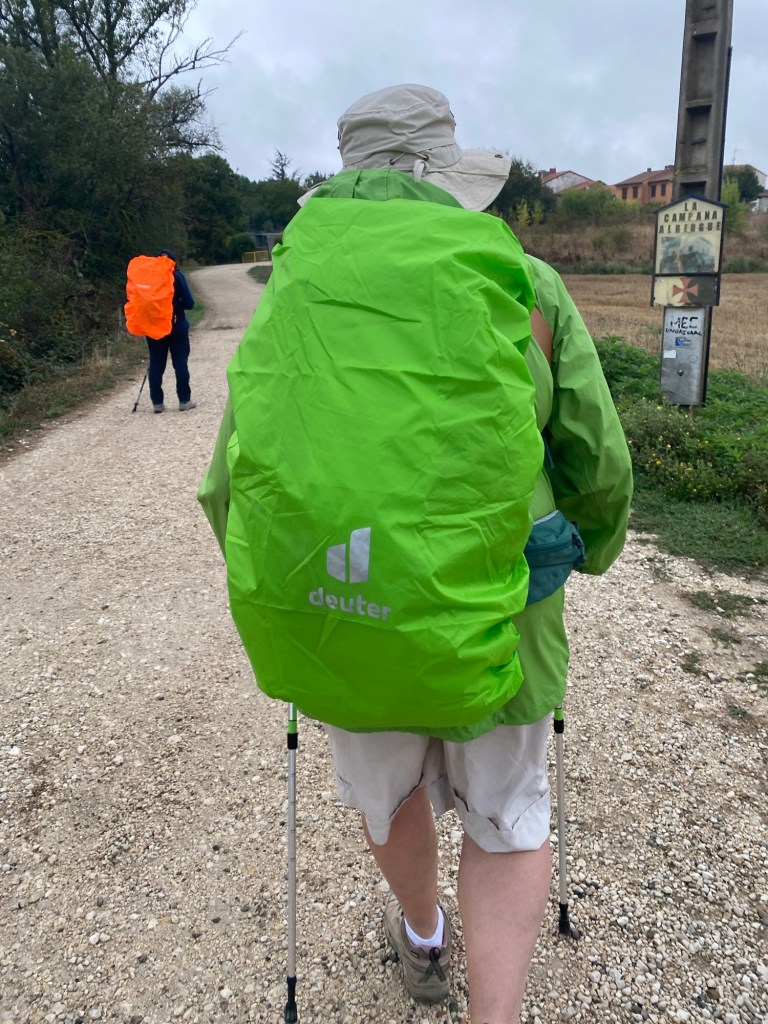
    What? Walking, but walking in the rain!

    A new experience on the Camino for us. Check out the snazzy rucksack rain cover.

    Sort of complements the snail analogy I reckon.

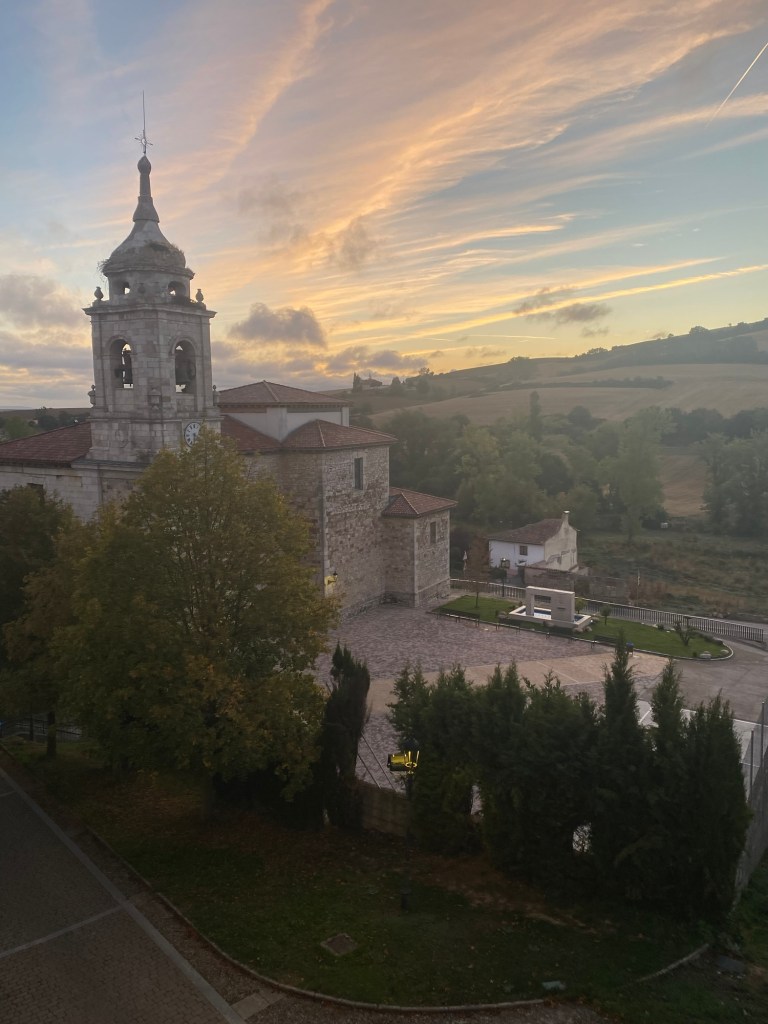
    Where? Here’s a view of the sunrise over the Church in Villafranca Montes de Oca.

    It’s a really historic place on the Camino, just before a climb into the mountains. Surprisingly cool, but it is almost 1000m above sea level.

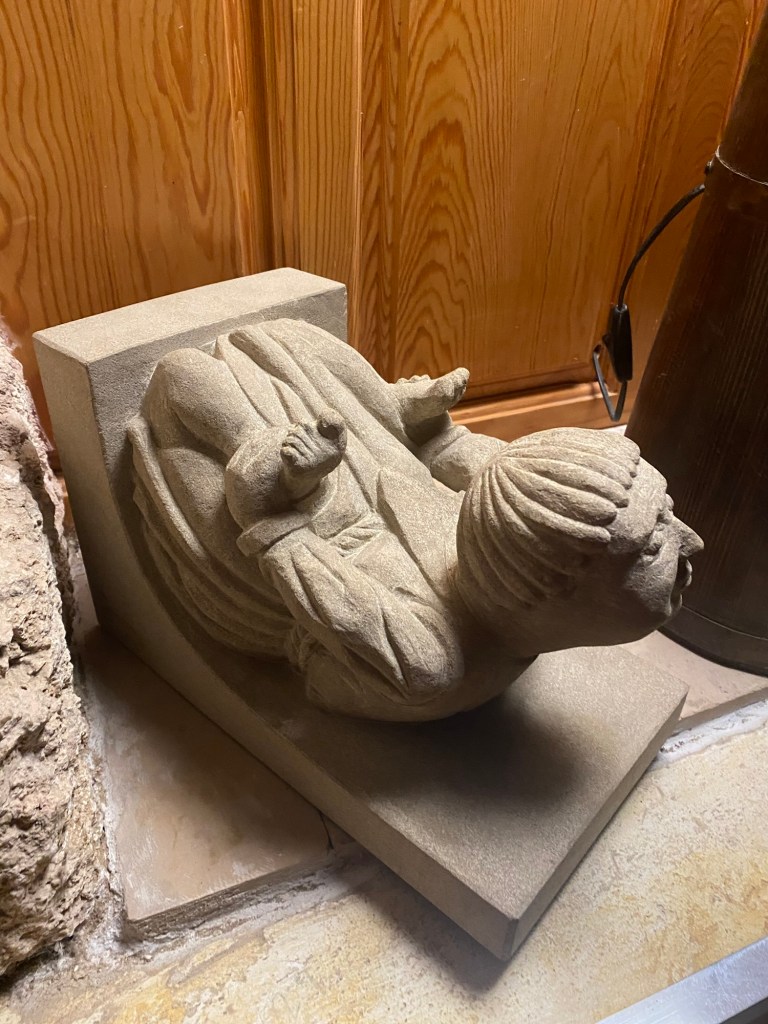
    Why? Why are there so many different types of stone in this ruin?

    Basically because it’s 2000+ years of the Circular Economy in stone.

    The picture is of all that remains of the Monestary of San Félix de Oca.

    What got me excited was the grey lump of stone in the bottom right. Apparently it was once a Roman funerary stone.

    So much recycling here.

    Bonus pics…

    What is going on here?

    My yoga teacher tells me it’s ‘Good example of Dhanurasana the – Bow pose’.

    Blimey, those Medieval Monks were bendy boys.

    And this.

    The Camino always provides – when you need it most – so they say.

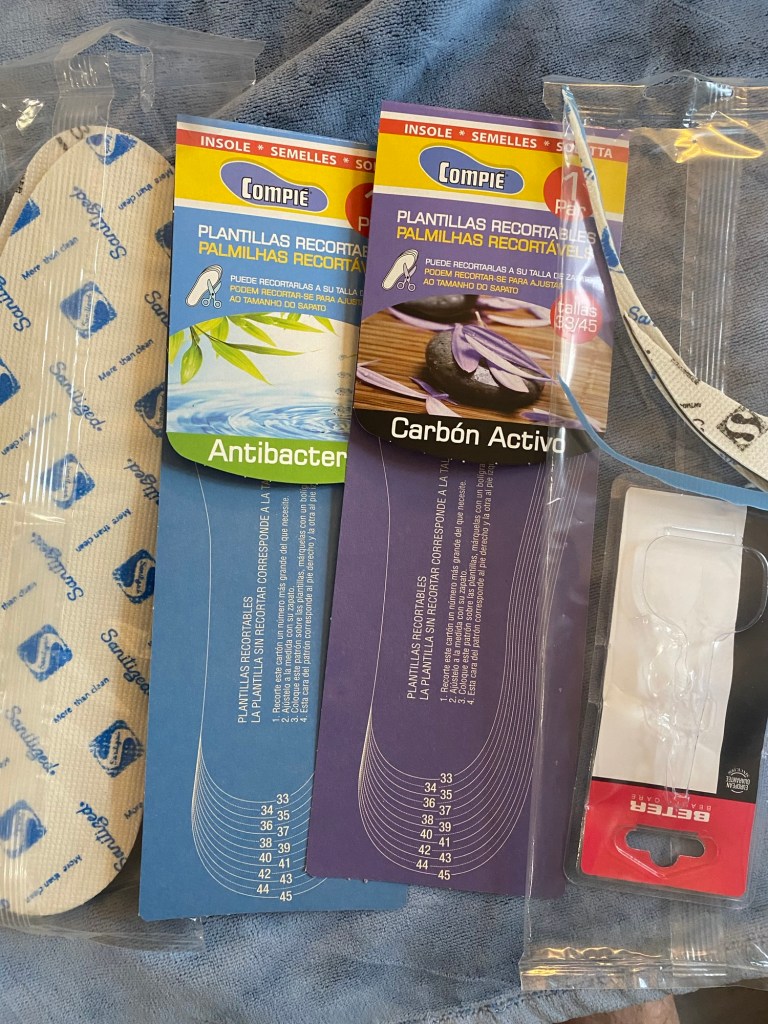
    The smallest and most unlikely (and only) shop in the village we stayed in had a decent stock of foot care products (including a modestly priced nail scissors).

    I got in just before closing and SB is now much more relaxed about her blisters. Hurrah!

  • Camino de Santiago. Santo Domingo de la Calzada to Belarado.

    It was a stinking hot day as pointed out by an Aussie Peregrino.

    Unseasonably warm peaking at 32 degrees C for most of the afternoon.

    Belarado our destination became Eldorado – a shimmering mirage in the distance – just beyond reach…

    Here’s the 4 a Day pics.

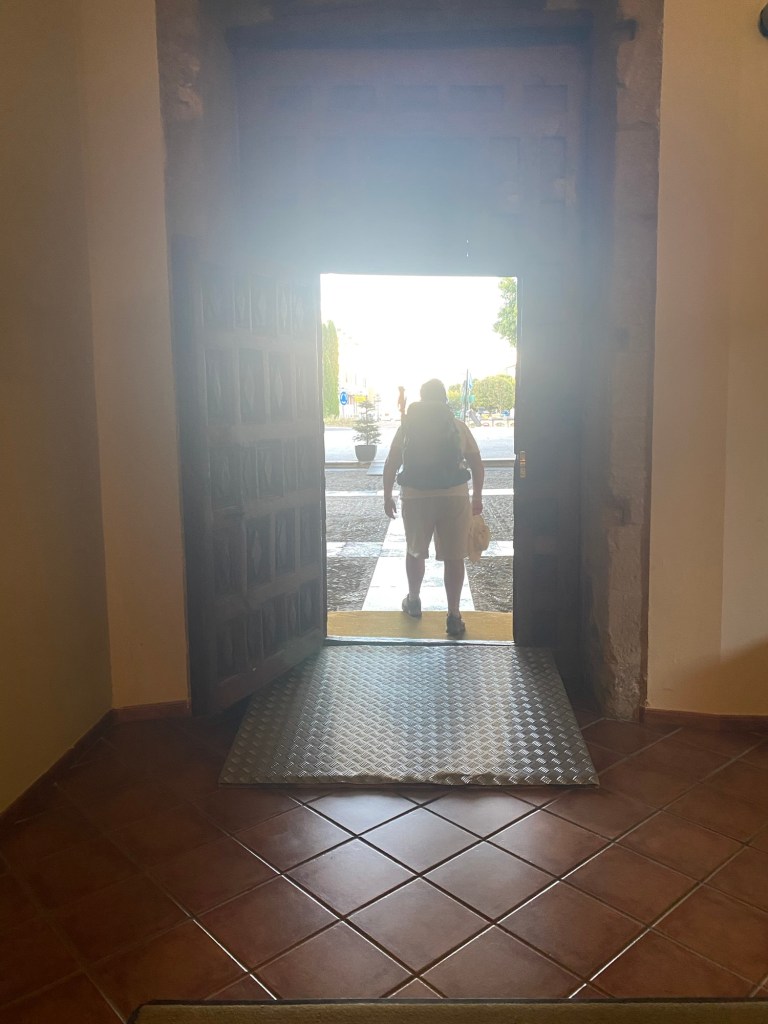
    Who? Here’s SB leaving our posh accommodation in an old Friary.

    It’s got a bit of a Jango Fett vibe I reckon.

    What? Walking. It was a long one – in the heat – that came in at just shy of 23Km.

    SB claims she was contracted to 21Km.

    I’ll not comment further.

    Other than to say it was a good job we’d checked into the accommodation online as neither of us could speak in a coherent manner at the end of the day.

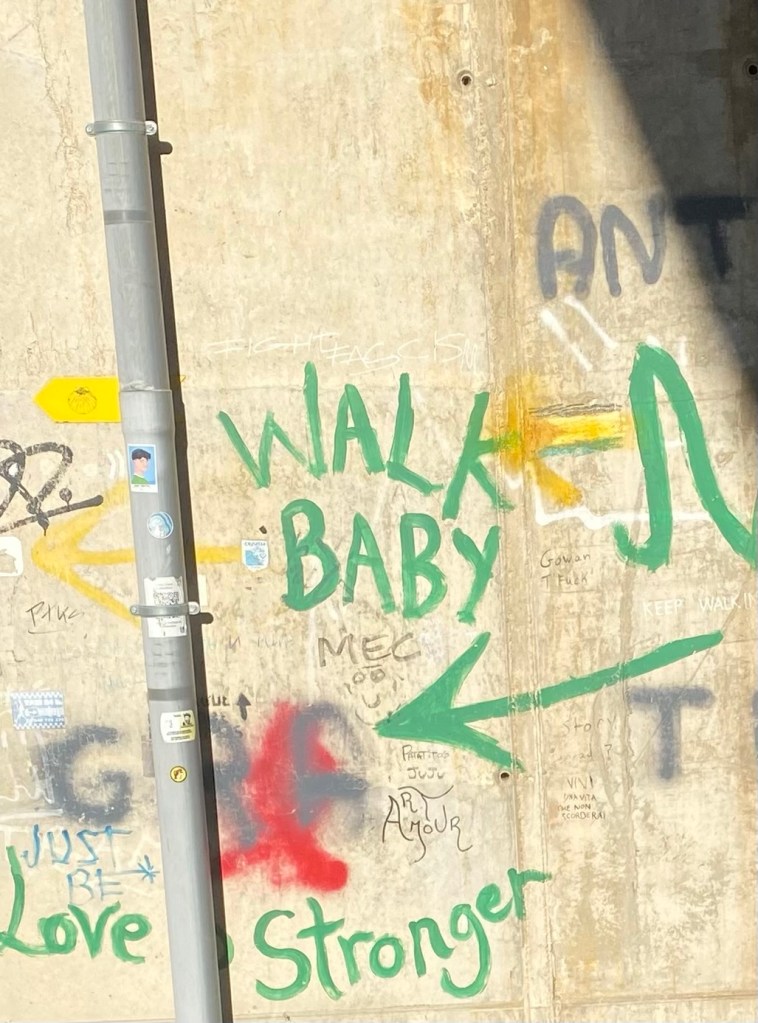
    The motivational graffiti helps (not really).

    Where? We crossed over from Rioja to Castile & Leon.

    A definite change in the landscape from vineyards to vast cereal and sunflower fields.

    It’s looking pretty parched.

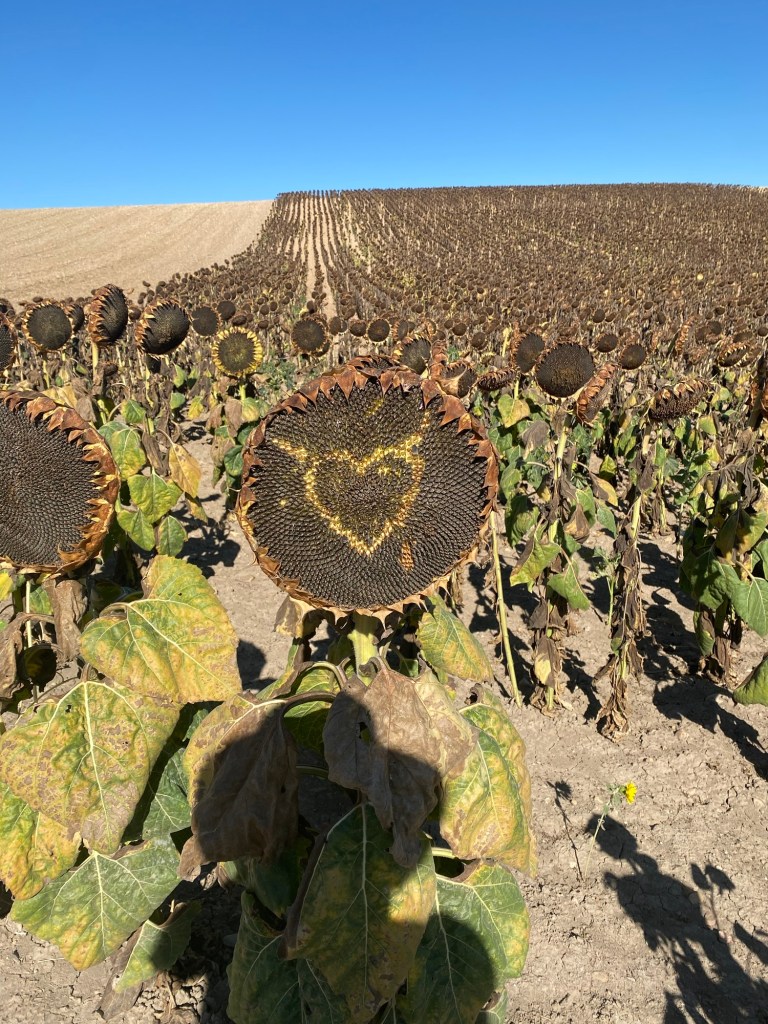
    Why? Sunflower Art is a bit of a thing along the Camino.

    How do people find the time?

    I bet one day one of those ‘instagrammers’ will write a wedding proposal in sunflower heads. Lovely.

    Bonus pics.

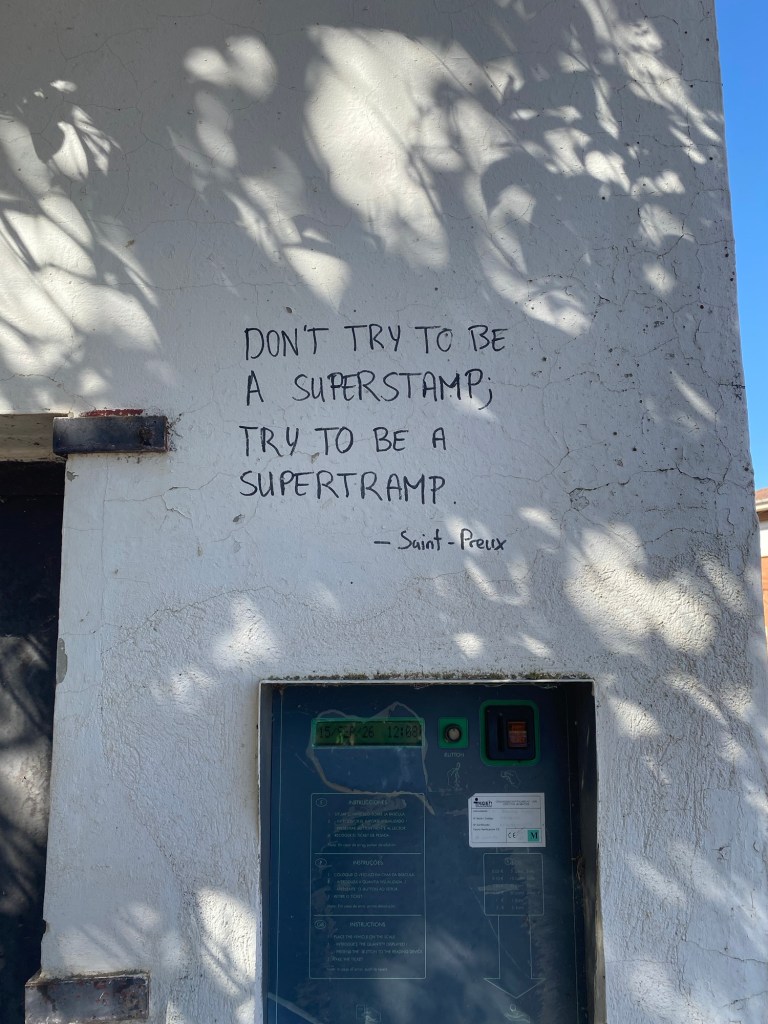
    “Don’t try to be a superstar, try to be a supertramp” Saint Preux.

    Turns out this is inspired by a 1974 album by French Artist Saint Preux.

    *Note to self. Must read Autobiography of a Supertamp by W.H.Davies.

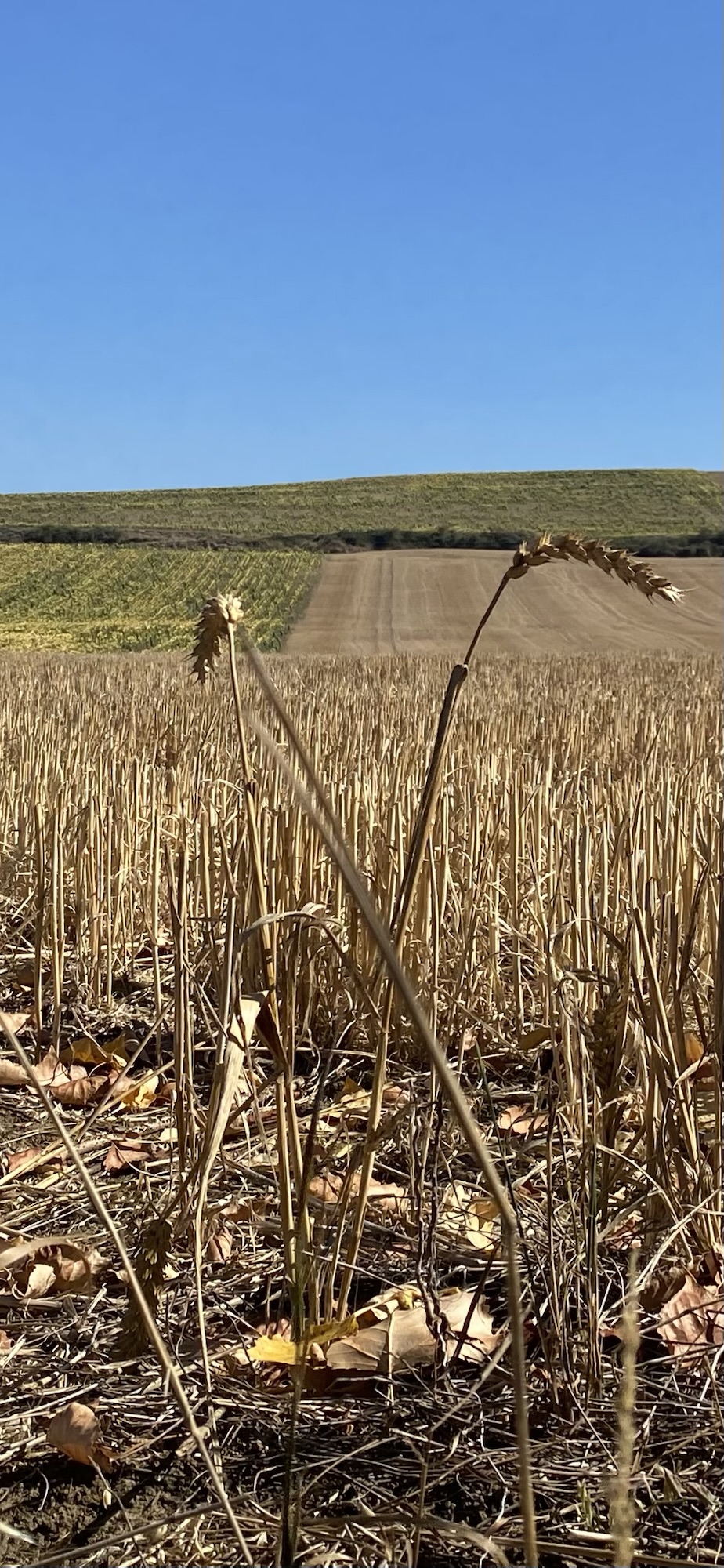
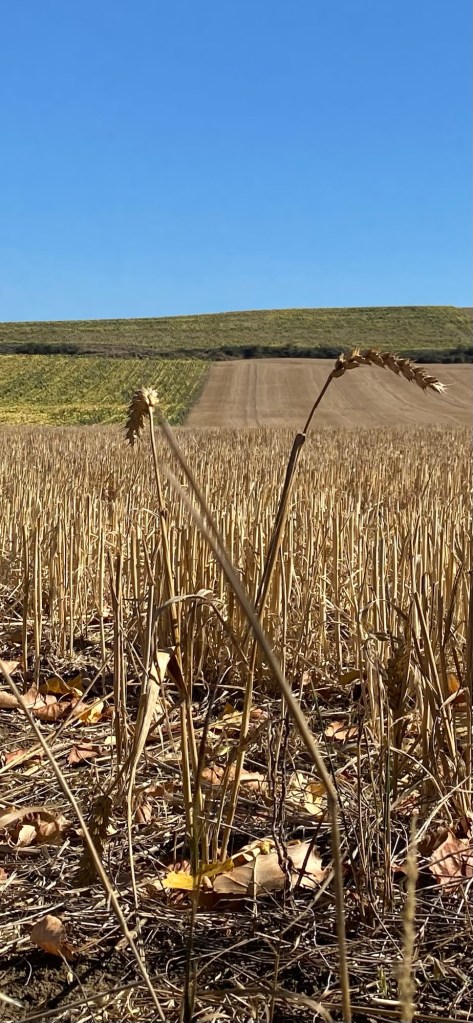
    Also, an artsy view of some corn stubble.

    Taken during a long rest whilst we renegotiate the walking contract to cover the last 1.5Km.

  • Camino de Santiago. Azofra to Santo Domingo de la Calzada.

    An early 7am start at Azofra to beat the heat of the day.

    Here it all is in 4 (approx) pictures.

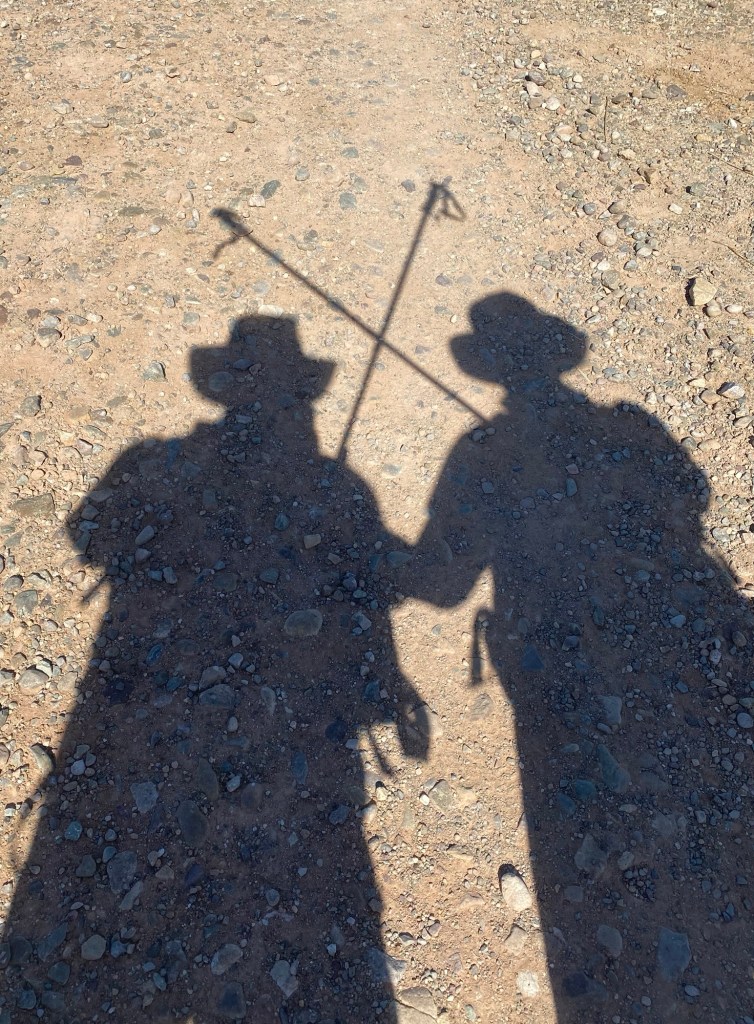
    Who? Me and SB, going full Sancho Panzer and Don Quixote. It’s too good an opportunity to miss with the sun at your back and the monotony of the road ahead. Ha ha, you’ve got to guess which one is Sancho and which one is Don.

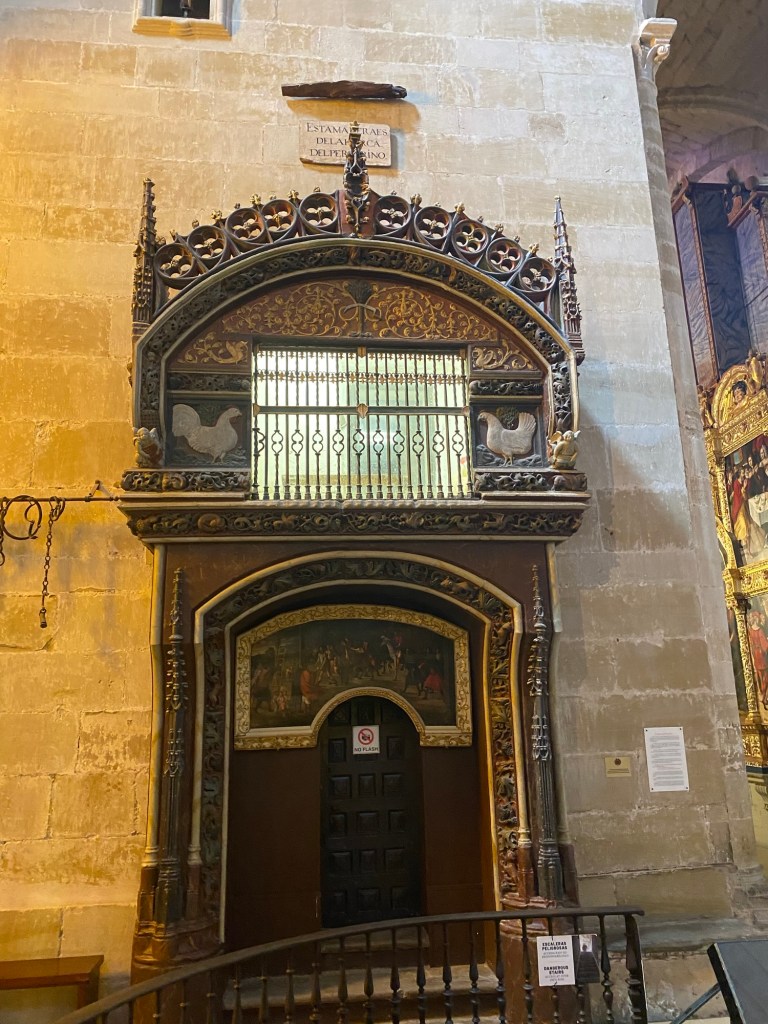
    Where? In the Cathedral of Santo Domingo – in the town named after him. He was a big deal in these parts. Rightly so. He built bridges for Pilgrims to get across rivers and performed multiple miracles.

    Bringing a dead (possibly cooked) hen and rooster back to life was one of his more interesting ones.

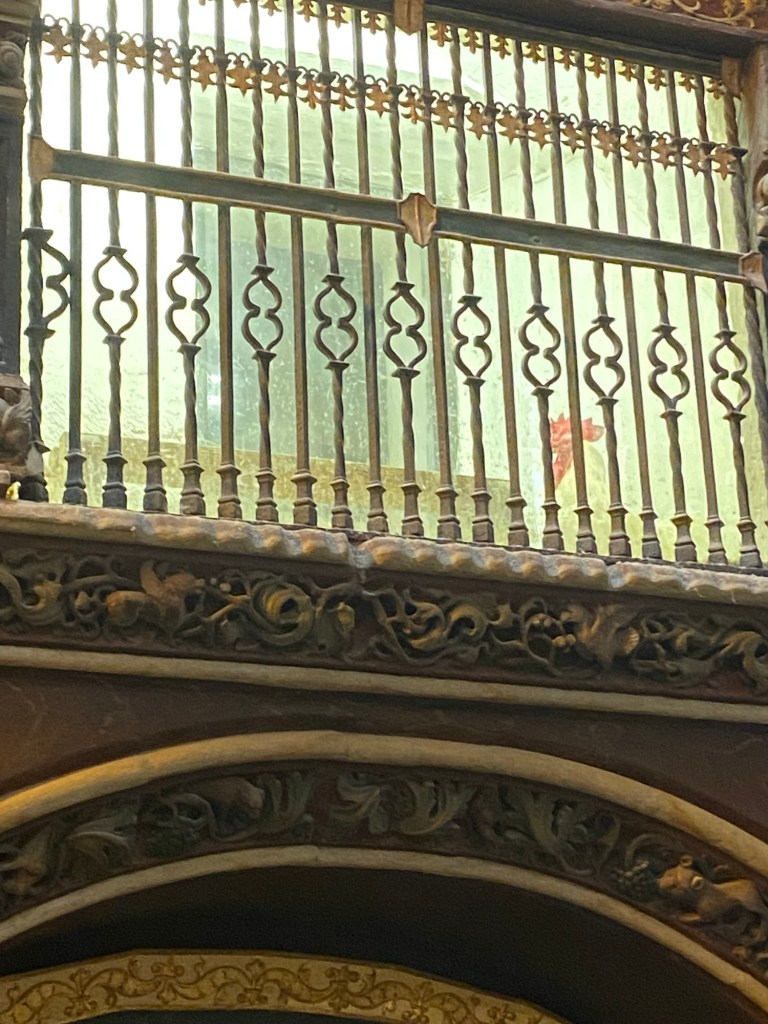
    Hence the live hen and rooster living in a bespoke gothic chicken coop in the Cathedral. I kid you not.

    It’s been well worth the trip just for the rooster going bezerk and crowing and SB panicking I’d pressed a wrong button on something. As if…

    Look carefully for the rooster

    What? Walking. And robustly debating the merits of having some of our luggage forwarded so we don’t have to carry it everywhere.

    SB is more of a purist on this topic and wants to suffer on her pilgrimage. I’m less committed.

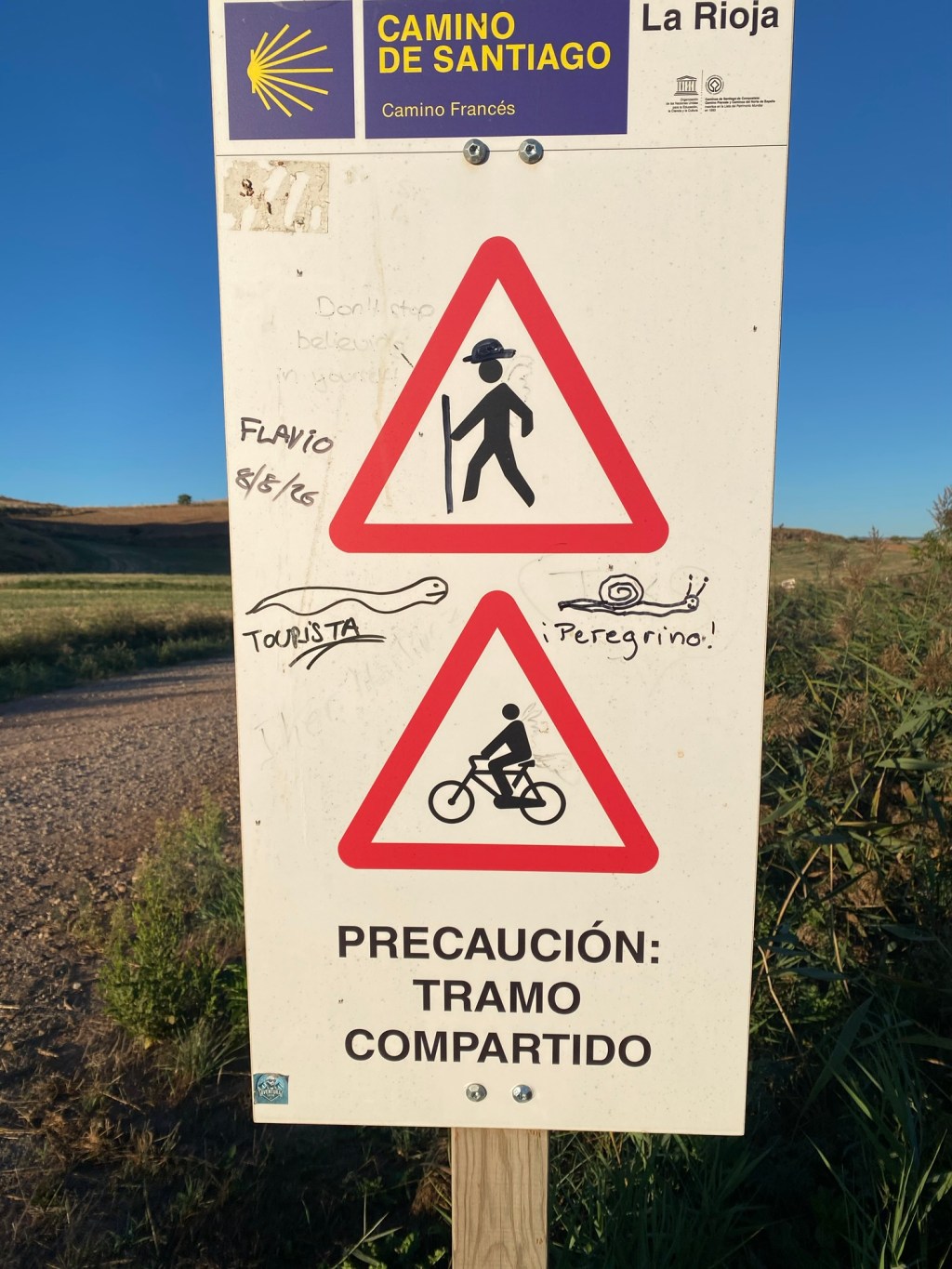
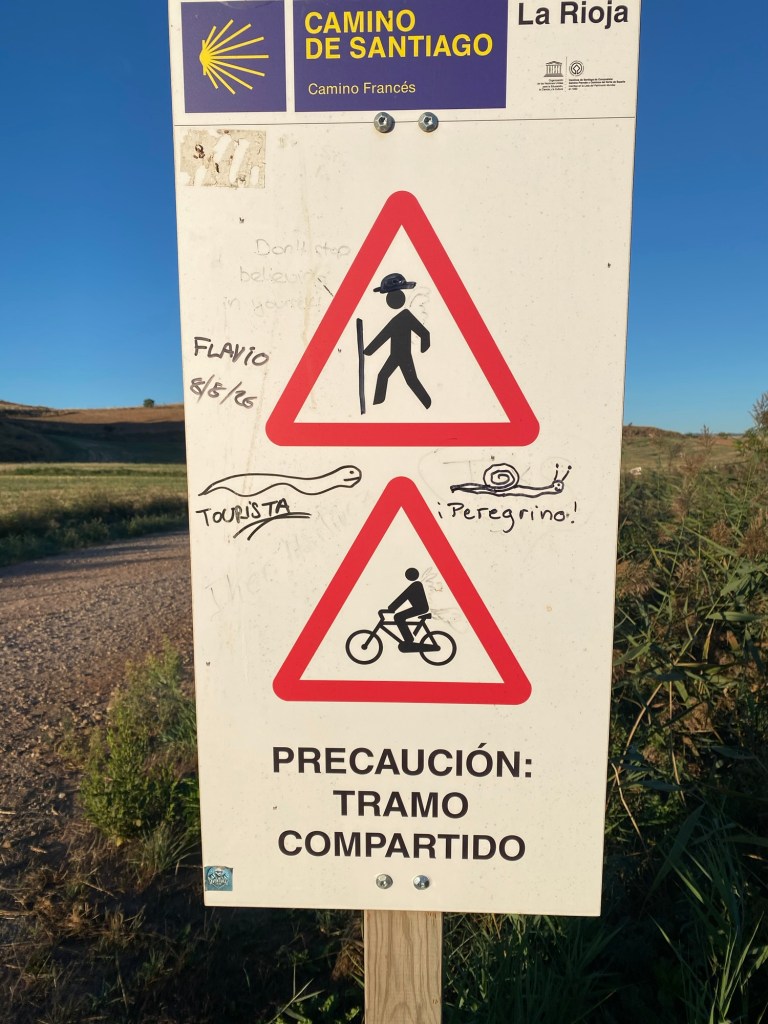
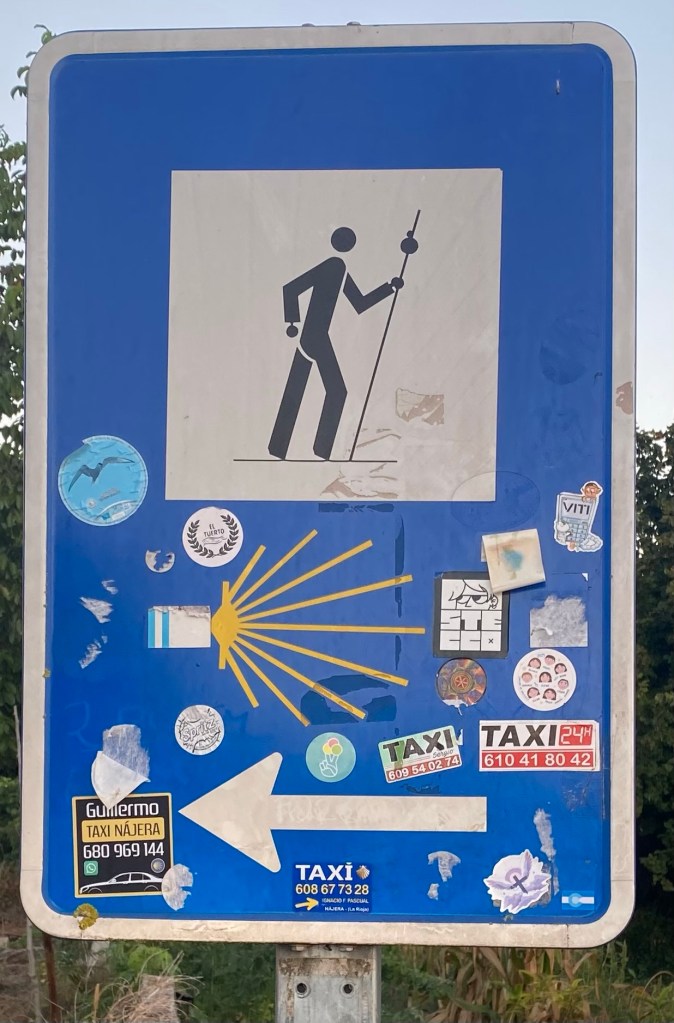
    Then we saw this sign… are we Tourista or Peregrino?

    Why? I’m back to the taxi adverts on everything question.

    Camino road signs are basically just a surface for taxi advert stickers. 4 on this one.

    Another thing to test the Perigrino.

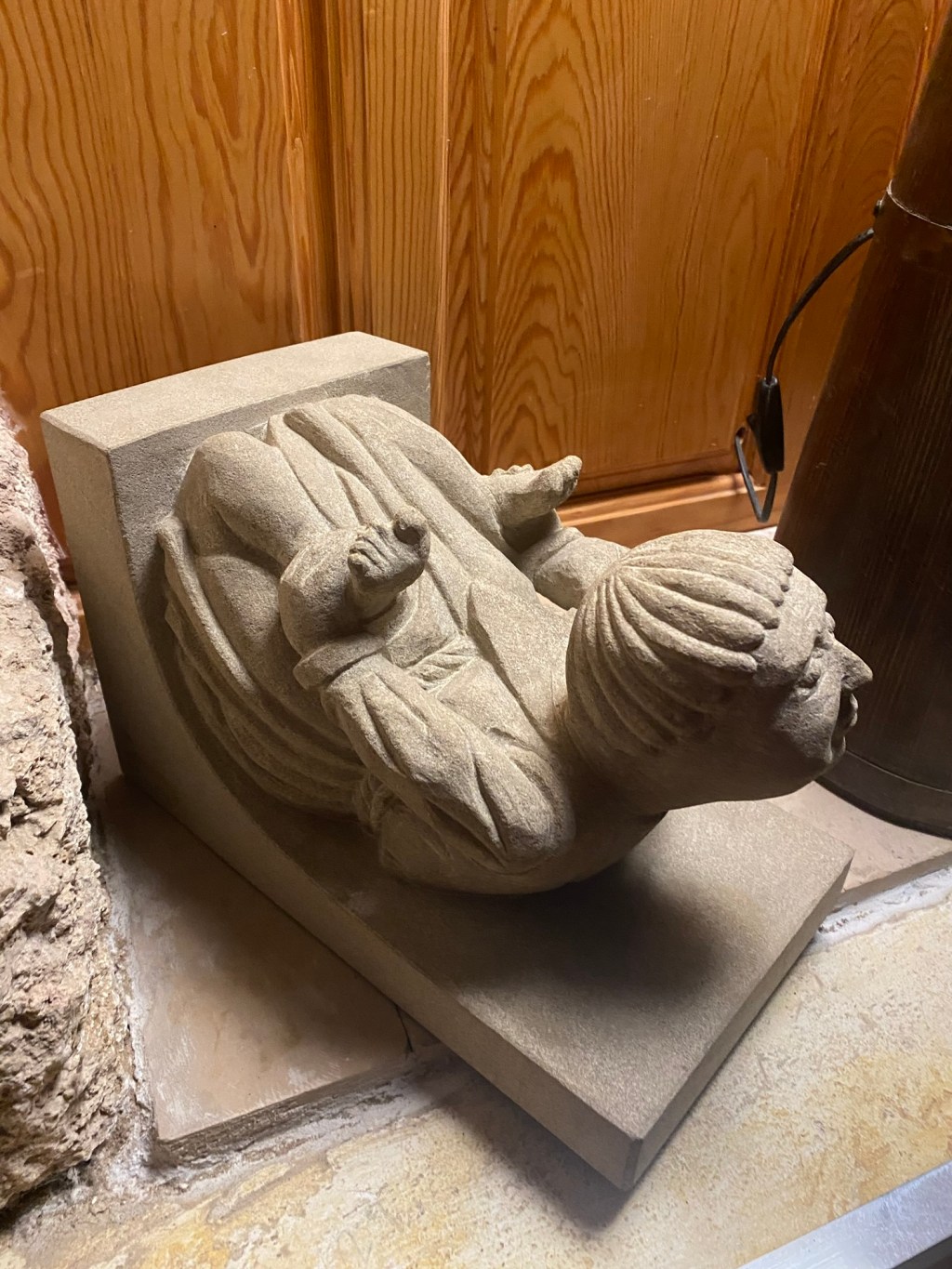
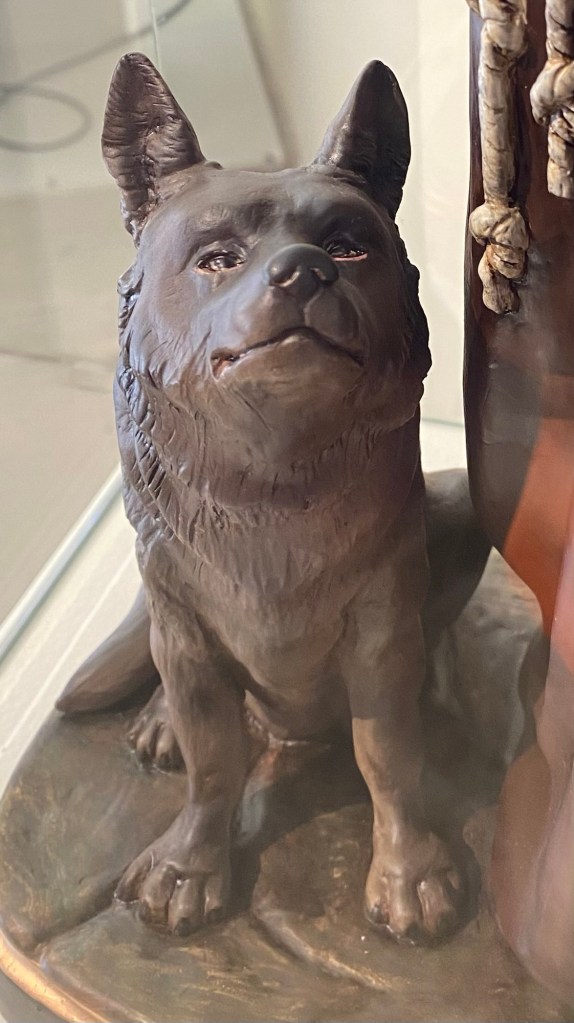
    Bonus pic. Santo Domingo’s dog. There’s a wierd and wonderful world of figurines and other bits and bobs you can buy at the Cathedral.

    Maybe it was something to do with receiving texts of my dog Tigz out with the Dog Walker, but I really wanted the reproduction of this one.

    Alas, we couldn’t carry it.

  • Camino de Santiago. Najera (via Bristol, Bilbao and Logrono) to Azofra

    Ola – we have returned to Spain and the Camino Frances.

    A bit later than planned (6 months) because of the new dog we wanted to settle in at home (she’s doing great).

    Who, What, Where & Why?

    So, here is the continuation of the 4-a-Day pictures I’ve been posting to document our travels.

    Apologies for the grammar, spelling, quality of pictures etc.

    This is all being done on my phone after a day of walking.

    Who?

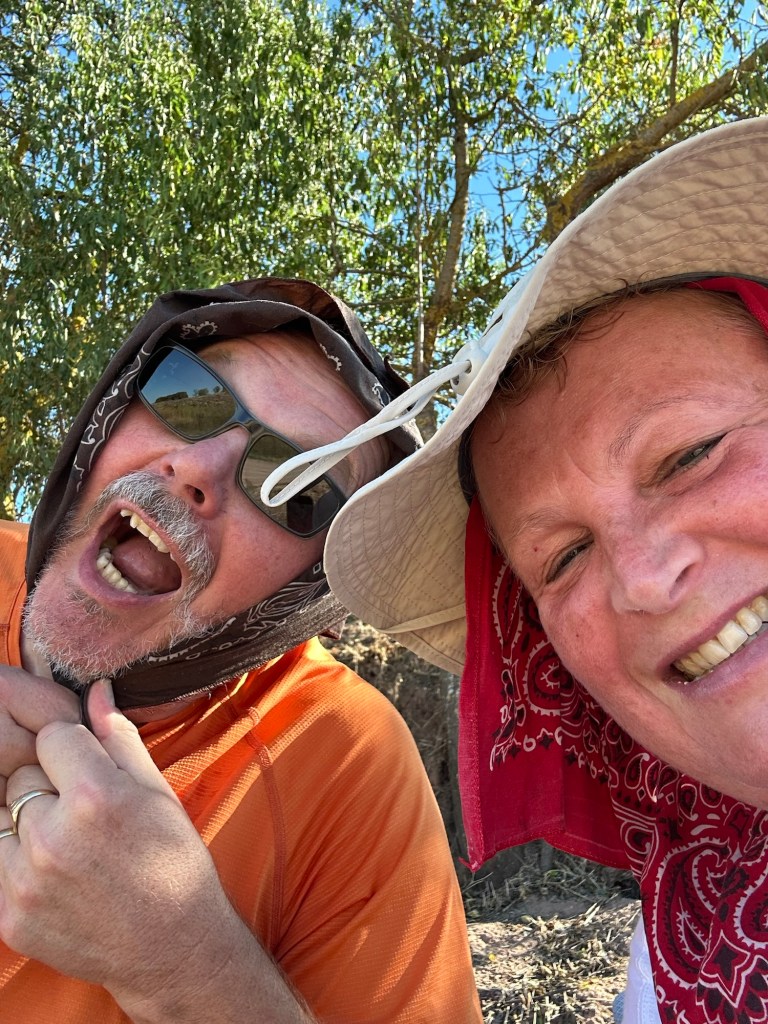
    Me & SB after getting up at 4.30am; driving to Bristol Airport, getting delayed by a crash on the Severn Bridge, having the flight delayed, panicking to get the transfer bus in Bilbao (with 3 mins to spare), a bus journey to Logrono (very smooth), then an unplanned taxi to Najera where we finished last time.

    This is what you look like at 4.30pm when it’s 31 degrees C. After walking up a hill.

    What?

    Walking the Camino de Santiago.

    This is what it’s all about – until the shade from the trees disappears…

    Where?

    This stretch was from Najera to Azofra. Only 7Km, but someone had the bright idea of deciding we should get into to swing of things on the afternoon of the first day.

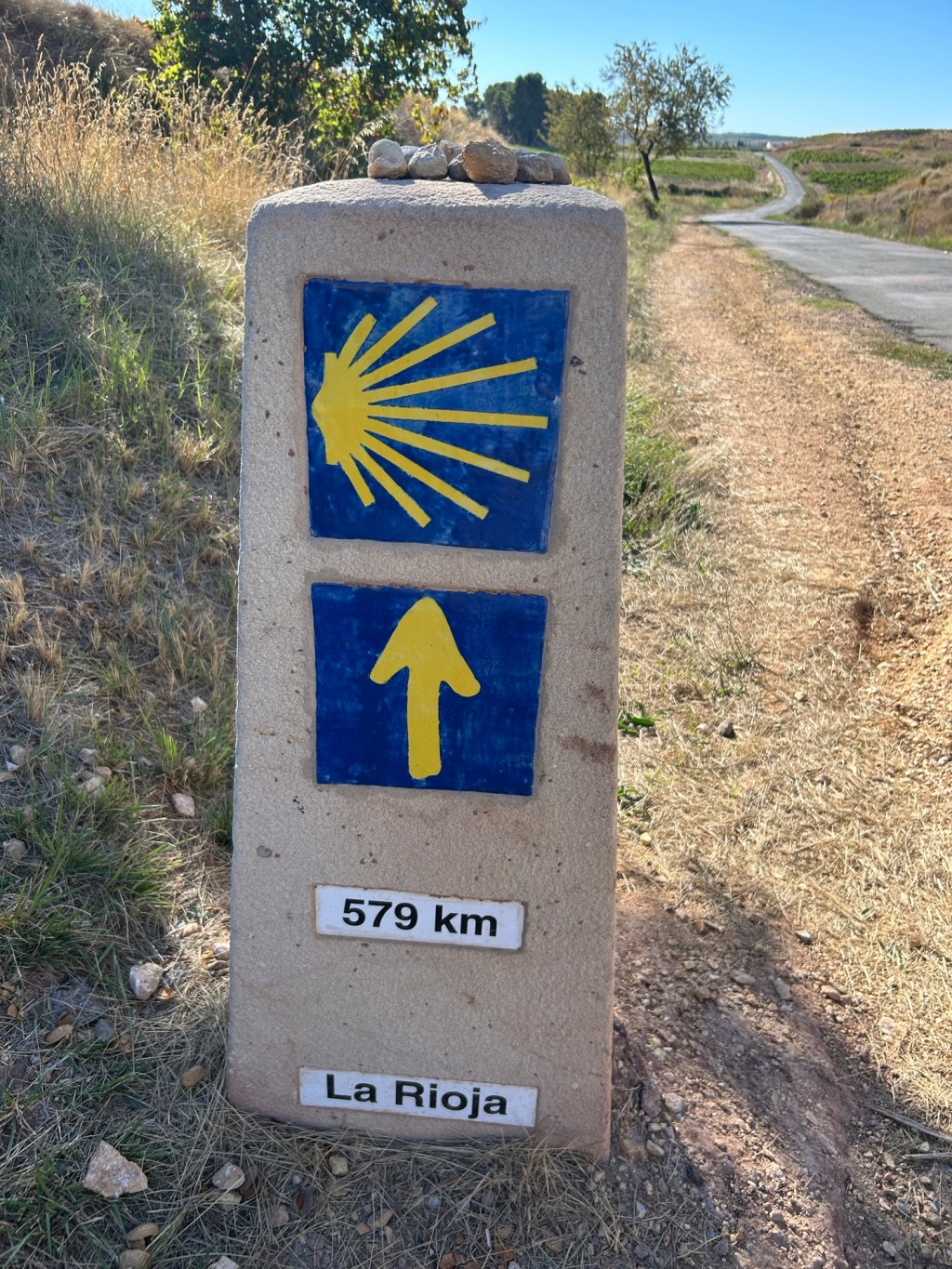
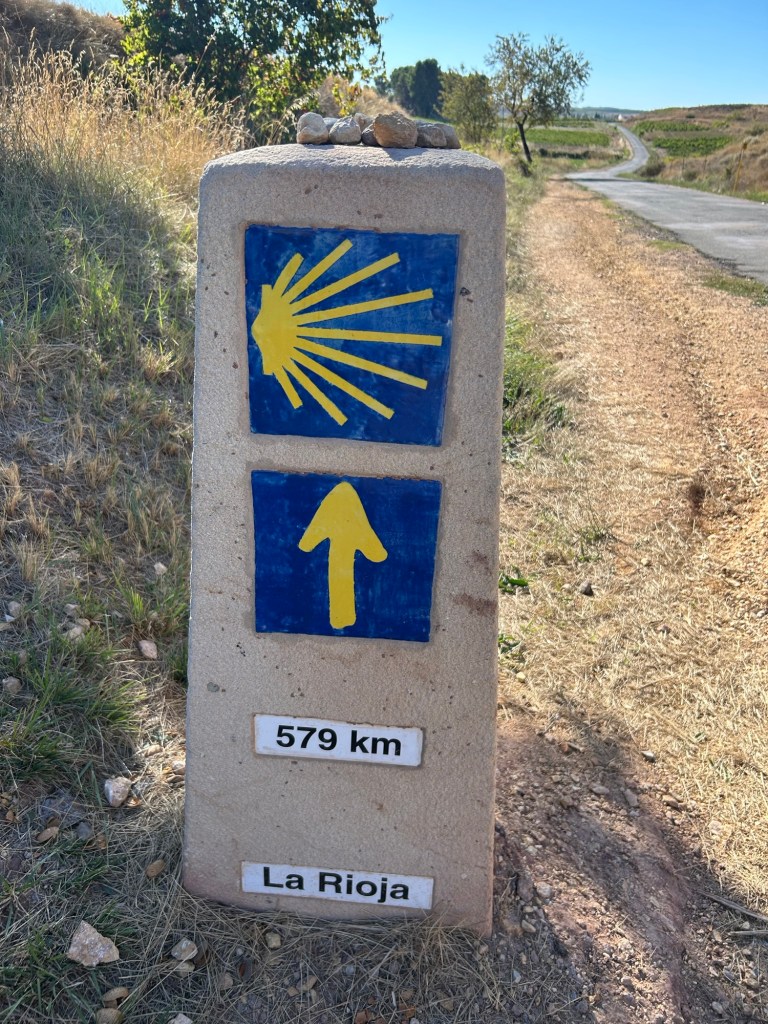
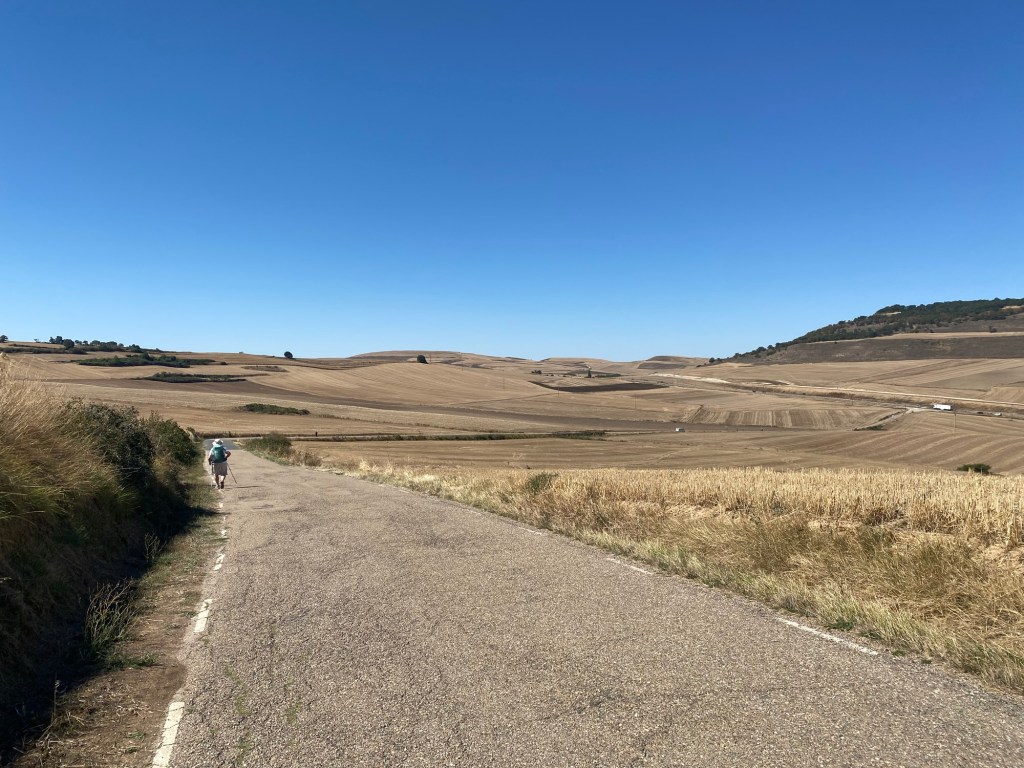
    I personally don’t find these road markers telling me how far it is to Santiago de Compostella particularly motivating.

    579 Km to go!

    Why?

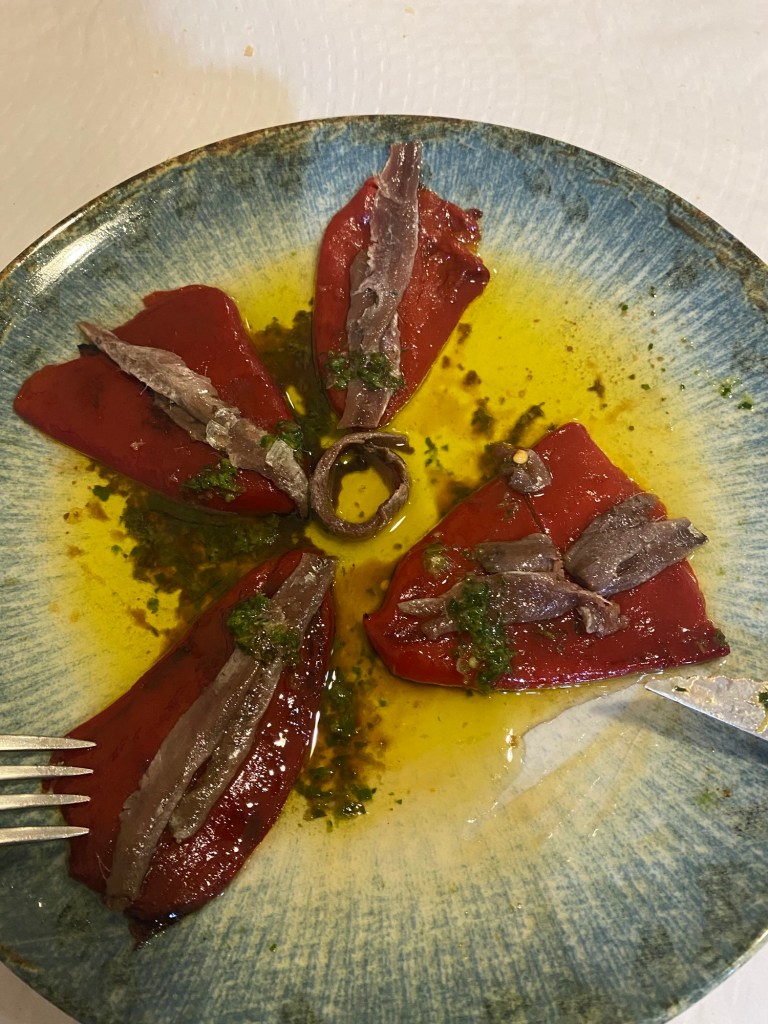
    It’s all about the snacks.

    I love anchovies.

    This dish of peppers and anchovies was one of the options as a starter on the Pilgrims Menu in Azofra last night (Bar Sevilla). Delicious.

    Bonus Picture

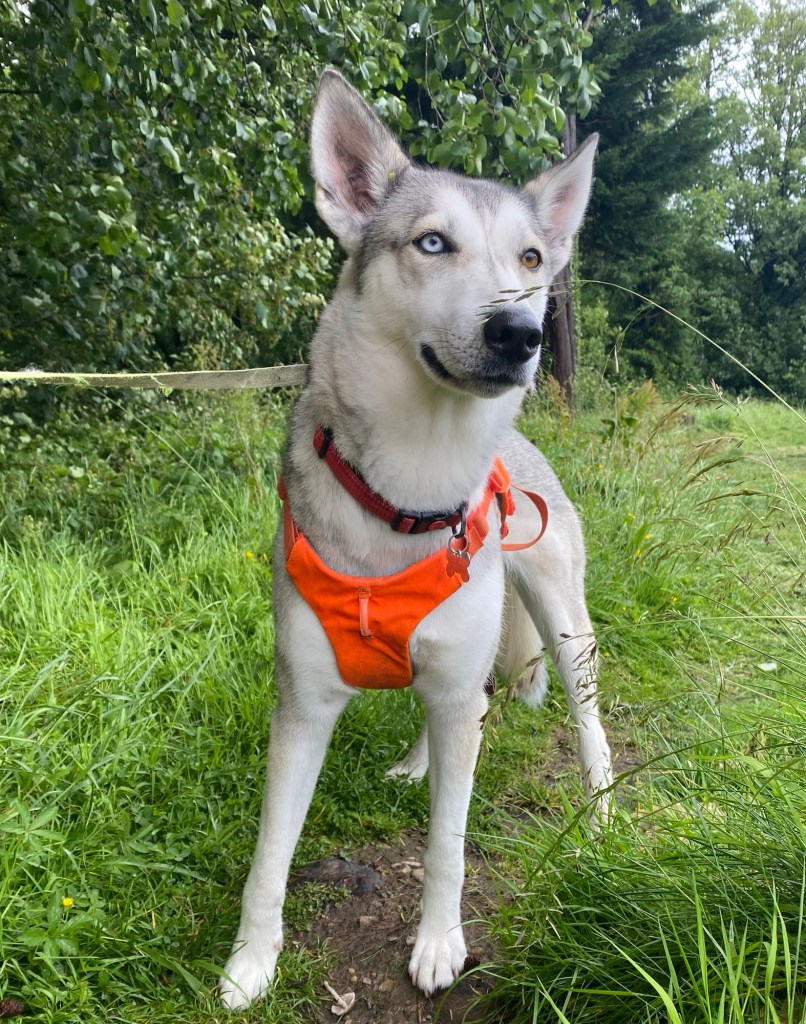
    Here’s the new dog we delayed things for. Tigz (Tiger Lilly).

    And also a picture of a Taxi advert.

    They are strategically positioned at places where your body is calling for a rest and a cold beverage.

    They are there to test your resolve – but no! – we are on a Pilgrimage.

    Keep walking!

    More tomorrow.

  • Because life hasn’t been bad enough… Could large cooperatives re-emerge in South Wales?
    South Wales Life was tough in the 1800’s

    You haven’t had it bad enough…

    About 12 years ago (in the shadow of Port Talbot Steel Works) I met someone from Mondragon University. They were explaining the economic and cultural miracle that is the Mondragon Corporation, the mega cooperative in the Basque Country.

    When I moaned about the lack of a similar cooperative ecosystem in South Wales their response was simple and brutal… “maybe it is because you haven’t had it bad enough”

    I was completely stunned by that statement.
    It felt like the 1984/85 Miners Strike and its aftermath for South Wales had been pretty bad.
    What did they mean by ‘bad enough’.

    The answer didn’t come immediately, it surfaced through the Churchill Fellowship I undertook in 2018, partly inspired by that ‘bad enough’ comment.

    How bad is bad enough?
    For me, the Mondragon Corporation is like the ‘Mother Ship’ of cooperatives.
    Formed in 1956 in the Basque town of Mondragon (yes, I’ve been there) by a Catholic Priest, Father José María Arizmendiarrieta, who was trying to make people’s lives better.

    At the time the region was seriously suffering from the consequences of opposing General Franco during the Spanish Civil War; poverty, economic decline and repression of political and cultural identity were the everyday experience for people.

    Life was hard.

    By any measure what was happening was ‘bad’. A situation that might well act as a catalyst and motivate action across communities, as described in this book chapter.

    Through his education work to develop a Technical College in the 1940’s Father Arizmendiarrieta ultimately inspired the creation of the first Mondragon worker cooperative.

    By the mid 2020’s the Mondragon Corporation was a federation of over a 100 worker coops, employing over 70,000 people and turning over £11 Billion annually.
    It sits at the heart of a wider ecosystem of cooperatives and social enterprises that helps shape regional economy and culture.

    Forgetting our past.
    Fast forward to conversation in 2018 with someone else I met from Mondragon University. They worked in the Business School and commented that outside of the typical things that Universities do; teaching students, research etc, one of their challenges was to educate current Mondragon cooperative members about cooperatives.

    In their view, there was a lack of understanding and appreciation of what it meant to be part of a workers cooperative.
    Given that Mondragon is the ‘Mothership of Cooperatives’ (in my view) I was again stunned.
    How could this be?
    Perhaps things had become ‘too good’?

    Different century, different country, same problems

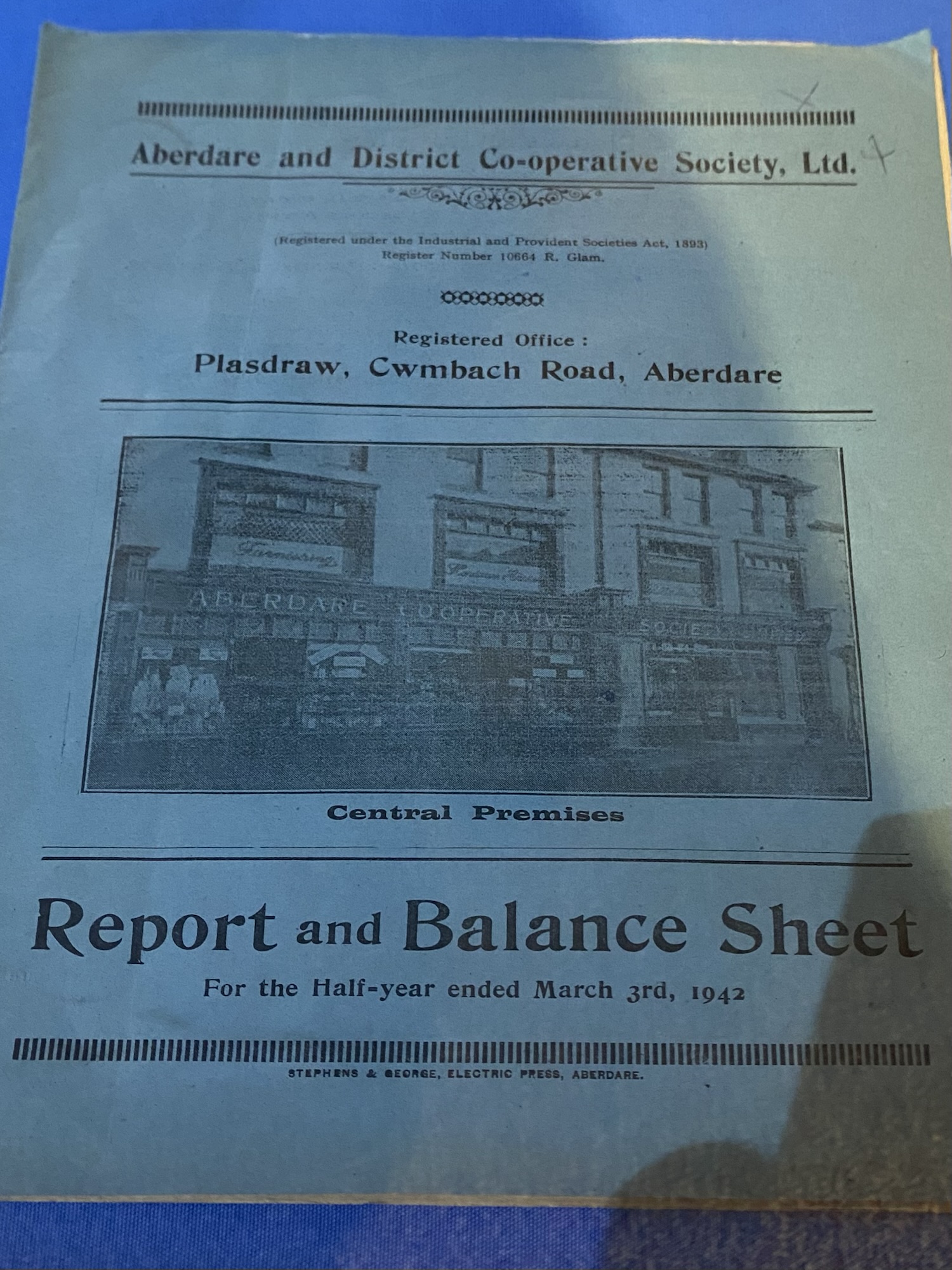
    Fast forward to a recent visit to the Cynon Valley Museum and jump back a hundred years to the Aberdare and District Cooperative Society.

    Historically the challenges faced by many people in the Cynon Valley have been by any measure ‘bad’.

    The origins of the Aberdare Coop can be traced back to the 1850’s compared to Mondragon which emerged in the 1950’s. But there is a lot in common around how they emerged – a tough life for people.

    And yes, the Aberdare Coop was based on retail / consumer provision, and Mondragon began with manufacturing, but stick with me on this.

    What I want to focus on is ‘The Wheatsheaf’, specifically the edition from September 1927.
    The Wheatsheaf was the newsletter of the Aberdare Coop and in that particularly issue, the front page detailed the challenges of educating Cooperative Members. Here’s the full text:

    “The Principles of Cooperation
    We are sorry to find that there is a depth of ignorance prevailing even amongst faithful and loyal members of our movement regarding the principles of co-operation. We cannot expect loyalty and steadfastness in the movement if our knowledge and conception of its principles are narrow and superficial. There is a great need of educating the members in the history of the development of the co-operative movement in our own country. We hope that greater efforts will be made again during the next winter session to emphasise the need of co-operative education and to organise study groups and classes in connection with our own Society.”

    Education might not be the only answer.
    There’s a few things rattling around my head here. Is education alone ‘enough’ when it comes to developing cooperatives and the people who run them?

    The Wheatsheaf flagged the issue in 1927 and the person I spoke to at Mondragon University said something similar in 2018.
    The Aberdare and District Cooperative Society was clearly doing a lot of good and made peoples lives better. But why did it disappear in 1988 and become part of the larger Cooperative Society?

    Many reasons have been cited like a changing society, out of town shopping outlets and the impact of the 1984/85 Miners Strike on finances. But I do wonder if there was something deeper… were things ‘bad enough’?
    If ‘things are generally ok’ does that undermine the need for a retail coop?

    I do wonder if the emergence (and longevity) of coops is connected to ‘tough times’ and when things are better, it’s harder to sustain that engagement and commitment in the substantial effort in what is effectively ‘running the business’?

    But what happens when we return to bad times? (because that’s how the world and history works)
    I’ve been reading this post from Dave Snowden that discusses a concept about human knowledge and collective memory.

    My clumsy summary would be: if someone in a group holds a skill or knowledge, does the group therefore retain that knowledge? The answer was a sort ‘yes, but’. You require the appropriate conditions for that skill or knowledge to be brought forward when it is needed (and that includes not loosing that individual in the first place).

    A happy ending.
    Where does this leave me? I was initially going to write a post focusing solely on why education about cooperatives is important – it is, I haven’t changed my view on that.

    But what I would say is that education sometimes isn’t enough. It needs to be linked to relevance (why does this matter to me and how is it going to make my life better) and the prevailing conditions. It’s also a very good idea to have ‘system memory’, someone who knows how these things work, so you can ‘activate’ them at a time of need.

    So, What’s the PONT?

    • Cooperative Education is a very good thing. From an economic, social and, I’d suggest, a moral standpoint. But sometimes education isn’t enough. There are other things that need to be present so that people can form Cooperatives and take control of their lives.
    • ‘Bad Times’ can stimulate remarkable responses that make life better. Like the consumer cooperatives of the late 1800’s. But what happens when ‘life gets better’ and society changes? The hard work of keeping a cooperative business running is a challenge.
    • Keeping community memory of the skills required to run a cooperative is important, for when the bad times return. It might be individuals, it might be museums, it might be small residual coops….but the important thing is not to loose the memory, skill or people.

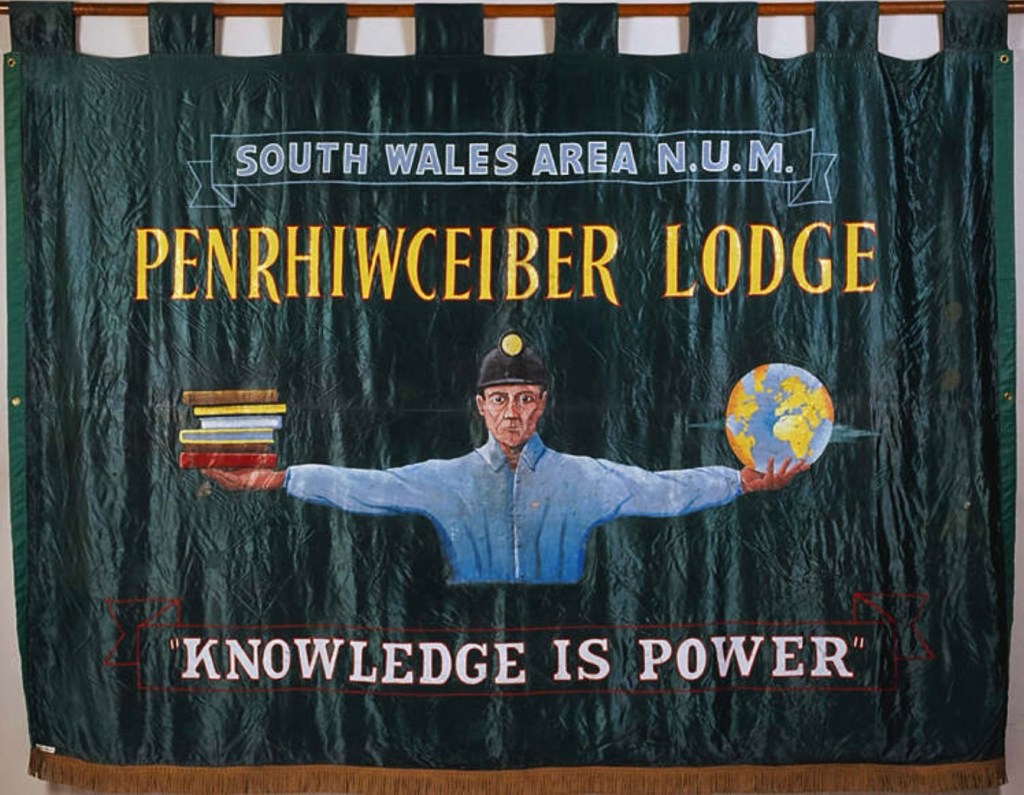
  • Knowledge is Power. And so is History
    Image courtesy of the Cynon Valley Museum

    People who aren’t interested.

    A person who manages one of our local museums recently shared this viewpoint; “it was great you visited, but (people like) you always will. Our target audience are the people who aren’t interested in what we do”

    That’s a pretty brutal reflection of the challenge museums face.

    It’s made me think about communications and engagement plans and strategies I’ve seen over the years. There’s usually been an assumption that people will somehow be ‘interested’. Even when they are (yes I’m using that awful description) “the hard to reach…”

    On reflection it feels like there was an element of ‘entitlement’, or indeed delusion in those approaches. Acknowledging that most people ‘aren’t interested’ has a far more honest and realistic feel to it.

    What is relevant now that mattered in the past?

    The Museum Manager then went on to talk about how do you get people to engage with history? I’ve interpreted their explanation as a two step approach:

    First – immediate relevance. You find something in people’s lives that they care about now.

    Second– historical connection. You look for something in history that will help them with their current challenges.

    Do those two things and you might draw people in and get the ‘not interested’, interested in history. It feels like a relatively straightforward and obvious thing to do.

    So this got me thinking. What are the things that currently matter to me, and people I know, and how could history be relevant? I’m genuinely trying to move beyond my local history geekiness here.

    What do the newspapers say? To help me in this quest I’ve browsing the newspaper headlines in the local shop. If what I read is to be believed, we live in Bonkers Broken Britain (apparently).

    What did stand out beyond those headlines was the Cost of Living Crisis. Everyone, including me, is rightly concerned with sky high costs on everything from; rent, electricity, gas, water and everyday grocery costs.

    So where might some history help here? One thing absolutely stands out for me here, and conveniently it’s on display at the Cynon Valley Museum, is Cooperatives.

    Hello Aberdare and District Cooperative Society.

    I’ve mentioned this in a previous post which talks about the astonishing things the communities of the South Wales Valleys did in the past – like build reservoirs.

    It’s hard to adequately put into words what the Aberdare and District Coop did, so please have a look at these articles written by the Cynon Valley Museum.

    Some of the numbers and facts that stand out for me include;

    • During the 1950/60s they had over 20 shops across the Valley.
    • They employed a lot of local people, on decent wages and conditions.
    • Their turnover was £8million in 1985, equivalent to over £30million nowadays.
    • They literally provided everything people needed – from cradle to grave – including servicing your car, repairing your watch and making radios.
    • At one point they had 180,000 members and provided 45% of all the retail activity in the district.

    There’s a lovely phrase in the Cynon Valley Museum article, “the Society seemed to work in everyone’s favour”.

    Everything was done in the interest of Members; local people. So when the ‘cost of living’ is a big concern, the local cooperative grocery shop (in which you have an interest as a member) is a means of easing that pressure.

    Cheaper groceries because there is no extraction of the profits to people beyond those who use the Coop. It all seems so bleedin’ obvious! And it’s local history.

    I should mention that my friend’s Dad worked for the Aberdare Coop. They speak about it with a huge fondness and pride, the bit that numbers don’t show. It was a massive part of local identity and social cohesion.

    What’s this got to do with knowledge and history?

    Going back to where I started this, the knowledge of what happened locally is almost forgotten. People only vaguely talk about the local cooperative, and don’t realise the power it had.

    I’d suggest that most of the people who are ‘not interested’ in the Cynon Valley Museum also know nothing about the Aberdare and District Cooperative Society, or do they…?

    There might just be the faintest memory of something your Gran used to do with collecting dividend stamps, or your Uncle getting the car properly serviced for a sensible price? So there might be a flicker of hope that we can recall a time when Knowledge was Power. The power to do amazing things that made life in communities better.

    For next time… There’s lots more I want to say about this topic so in the next post I want to talk specifically about knowledge and education in the Cooperative Movement.

    Oh, and don’t let me forget to say something about what is already happening in the Basque Country. The Mondragon Corporation is an example of cooperative economic control on a huge scale and they even have their own University. If only…

    Finally. I do wonder if the current Cost of Living Crisis is a trigger that might get people interested in history. We might realise what we were once capable of, and start doing those things again?

    PS. Do visit the Cynon Valley Museum, and also establish a local coop.

    So, What’s the PONT?

    1. Recognising that your target audience ‘aren’t interested’ in what you have to offer is a useful alternative approach to engagement. It really makes you think about how you do things.

    2. Understanding what actually matters now, and how history can relate to people’s current problems might stimulate people’s interest.

    3. Locally we have a huge history of people solving their cost of living crisis by forming retail cooperatives. That’s got to be relevant to the current day cost of living crisis?

    Both pictures from the Cynon Valley Museum

  • NATO Article 3. What Community Resilience means for Peace – and why we should pay attention.

    Article 5, the famous promise. Until recently I knew a bit about NATO Article 5, but had never heard of Article 3. Thanks to Dave Snowden I now know more. And it’s important because Article 3 might be the bit that needs us (local communities) the most.

    Civil Preparedness and National Resilience. Article 5 is the famous promise: an attack on one is an attack on all.

    Article 3 is quieter. It says NATO members must maintain and develop, individually and collectively, their capacity to resist armed attack. In plain language: don’t just rely on others turning up when things go wrong. Build the strength to cope, adapt and keep going (a possible definition of resilience I’ve mentioned before).

    That sounds like defence policy. But it is also about communities.  However, throughout most of my adult life the decline in local community cohesion and resilience is one of the phrases I’ve heard repeatedly. A worry.

    Things did not go to plan. When Russia invaded Ukraine in 2022 there was widespread expectation (outside of Ukraine) that everything would be over in a few days, and the Russian flag would be flying over Kiev. But it didn’t happen as planned.

    The story was not just about tanks, jets, missiles and soldiers. This paper ‘Vernacular security and Ukrainian civil society in wartime’ by Bohdana Kurylo at the London School of Economics provides an excellent analysis. It also introduced me to the concept of Defence as Emancipation. Which I want to come back to.

    Defence was about railway staff keeping trains moving under fire. Volunteers transporting families, food, medicines and pets. Local people filling sandbags, repairing damage, sharing information and checking on neighbours.

    Farmers towing away abandoned tanks with tractors became a symbol (see picture above). But the bigger lesson was more significant: resistance was not just something done by an army in front of civilians. It was something a society did as a whole.

    Ukraine changed the doctrine. This matters because NATO now describes resilience as the capacity to prepare for, resist, respond to and recover from shocks, including infrastructure failure, hybrid attack and armed conflict. Civil preparedness is not an optional extra. It supports continuity of government, essential services and military operations. The unglamorous stuff – energy, transport, communications, food, water, health and public trust turns out to be part of deterrence.

    This is where the community resilience conversation becomes much more than a local government workshop with sticky notes. If a country falls apart when the lights go out, the supply chain stutters, or people stop believing public information, then expensive military kit only gets you so far. The country behind the front line has to keep functioning.

    Whole of society preparedness doesn’t happen overnight. That capacity does not appear by magic in a crisis. It is built beforehand in community groups, local businesses, voluntary networks, public servants who know their patch. Trusted communications, practical skills and relationships that cross organisational boundaries. It lives in the neighbour who checks during a storm, the food bank volunteer, the local mechanic, the council officer who knows who to phone, and the community WhatsApp group that is useful rather than terrifying.

    None of this means turning civilians into soldiers.

    It means taking seriously the idea that peace is protected not only by armed forces but by societies that are harder to frighten, fracture or disable.

    A resilient community is less easy to manipulate. A trusted local network can move faster than a distant institution. People who know each other are better able to spot problems, share accurate information and keep essential life going. Vernacular security.

    What if there was a financial commitment? So here is the question I keep coming back to. If resilience is now part of defence doctrine, should some defence resilience investment go directly into community capacity?

    Not as a token consultation exercise, but as a serious part of national preparedness: funding the local institutions, relationships and practical skills that make societies harder to break.

    Oh, and just to spice up the conversation, 1.5% of UK GPD allocated to Article 3 spending (as outlined here) would be about £48 Billion (by my rough estimation). Now that would go a log way on building resilient communities…

    What’s the PONT?

    1. NATO Article 3 is not new, but Ukraine has made its meaning visible: resilience is a practical defence capability.
    2. Community resilience is not soft, fluffy or separate from national security. It is part of how a society resists shocks and keeps functioning.
    3. If we want peace, we should invest before crisis hits: in trust, local networks, civic infrastructure and the people who know how to get things done.

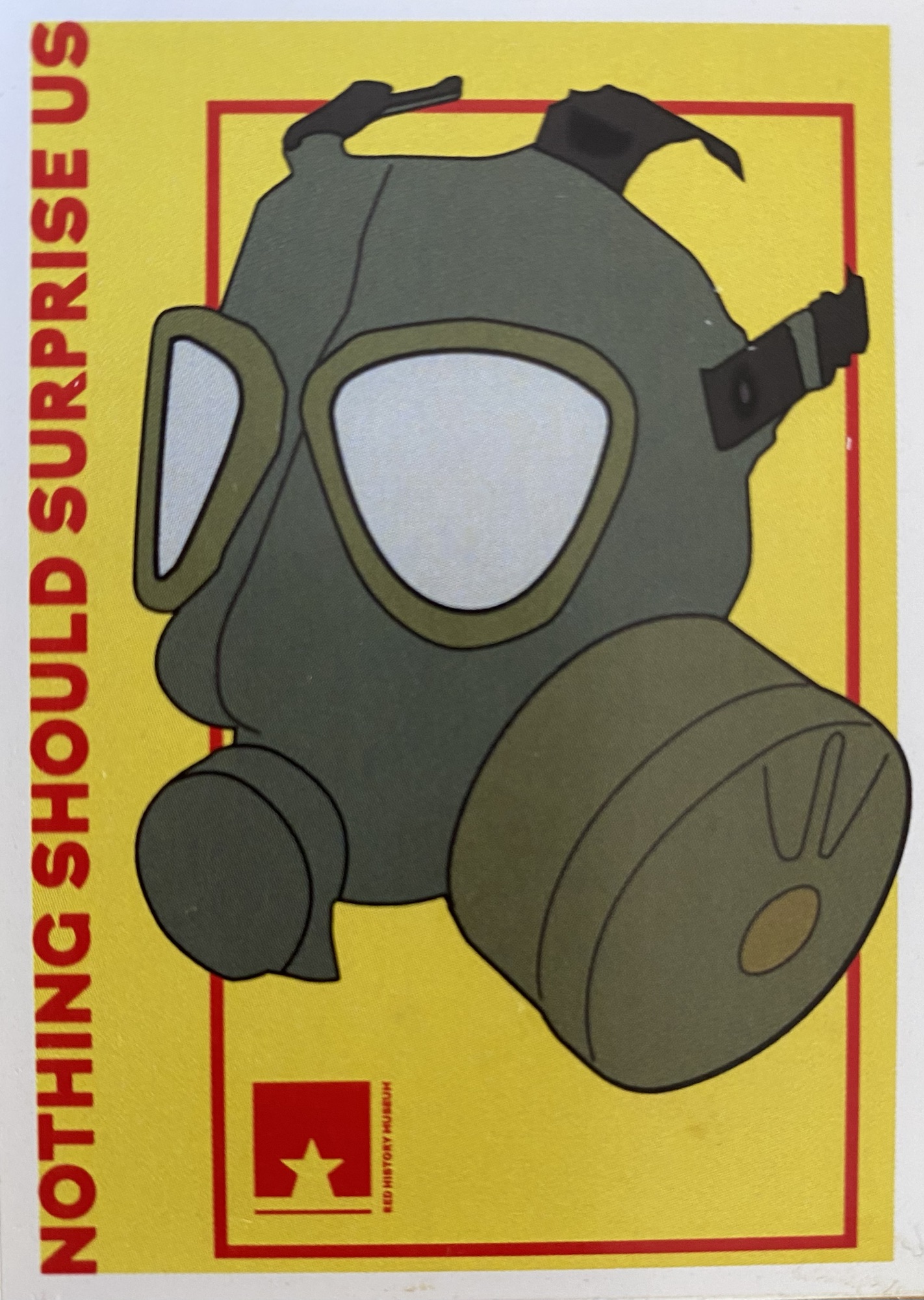
    My images: Ukraine Armed Forces Agricultural Division sticker given to to me and ‘Nothing Shall Surprise’ fridge magnet from a museum of Yugoslavian history.

  • Failing Fast. Everything is fine until someone (almost) looses an eye.

    I’ve failed spectacularly this week.

    I tried to adopt a dog.

    I thought I was doing something good.

    I thought I knew what I was doing.

    And it all went spectacularly wrong…

    Failure easy to say, hard to do. I’ve been committed to encouraging learning through failure for a while.

    Things like, ‘fail fast’, ‘learn the lessons’, ‘come back better’ have tripped off my tongue (and metaphorical pen).

    But sometimes the failure is so bad, it bites, deeply.

    Goodbye Mishka, hello Tigz, goodbye Ruby, hello (and goodbye) Jam.

    This story starts with my beloved Husky, Mishka. Mishka crossed the rainbow bridge at 13 years old in January (apologies, this is starting to sound like parts of the Husky subreddit).

    Mishka was a lovely, lovely old girl, living her best life.

    I spent a huge part of my life with Mishka, walking miles and miles.

    We would also spend time doing not very much together. An important pastime.
    I missed her terribly.

    Hello Tigz. Within a month a new Husky from the Rescue had arrived, Tigz (short for Tiger Lilly). I was desperate to replace what I’d loved and lost.

    Tigz is apparently 3 years old, with an unknown backstory. A stray found on the mountain that took 3 days to catch.

    And who was there to show Tigz the ropes and become a new best friend? Ruby, the ancient Pug who’d been a partner in crime with Mishka for 13 years.

    (Ancient) Ruby stepped in as an unlikely and occasionally uncooperative companion to a bouncy Husky for the next 5 months.

    From a skinny, shaky, skittish waif a proud confident Husky emerged.

    Did Ruby influence that? Who knows?

    Then Ruby crossed the rainbow bridge to be with Miskha.

    And it all went wrong.

    Hello Jam.

    Ruby crossing the bridge wasn’t unexpected.

    I was emotionally prepared.

    I knew what Tigz needed.

    I was going to fix it.

    Tigz needed a companion.

    Very rapidly (driven hard by me) a beautiful Lurcher cross called Jam arrived from the same Rescue Tigz had come from.

    She was energetic (highly), loving, got along with other dogs, a good physical match for Tigz, and it was going to be perfect…

    But it didn’t quite work out like that.

    Failure is fine until someone (almost) looses an eye.

    There are many reasons why things didn’t work out.

    A big one might be in the territory of them being too evenly matched and neither really having an off switch.

    Not the fault of either dog, just my bad choice to put them together, probably too soon.

    The idea of learning from small failures is fine until it becomes a big permanent failure, and someone (almost) looses an eye.

    If there was ever an example of analysing every mistake and torturing yourself for; bad choices, poor preparation, bad assumptions, a lack of awareness, no humility and too much ignorance, I’ve lived it this week. There have also been a few tears.

    I’m left thinking if there’s truth in the idea that ‘the harder you fail, the deeper the learning’?

    So is there a happy ending?

    Well, Tigz is ok. No permanent eye damage and it’s healing well. She seems to be returning to herself, going through a process of re-booting her Husky software back to factory settings.

    As for Jam, she’s still looking for her perfect humans and forever home, with a bit more understanding of how she is.

    In the words of people from the Rescue, “she will be ok, it’s been like a short term foster placement to understand her better”

    In my view she will be a perfect loving dog in the right place – just not with Tigz (and her useless Human, me).

    The absolute point of this post is to encourage anyone who is interested in a dog to have a look at Jam (and learn from my mistakes).

    She really is a lovely, lovely dog and will make a loving companion in the right home.

    Here’s a link. Adopt Jam / Hope Rescue

    Adopt Jam / Hope Rescue
  • Smorgasbord or Dashboard?

    How does a Board move from squeezing the data to having a conversation?

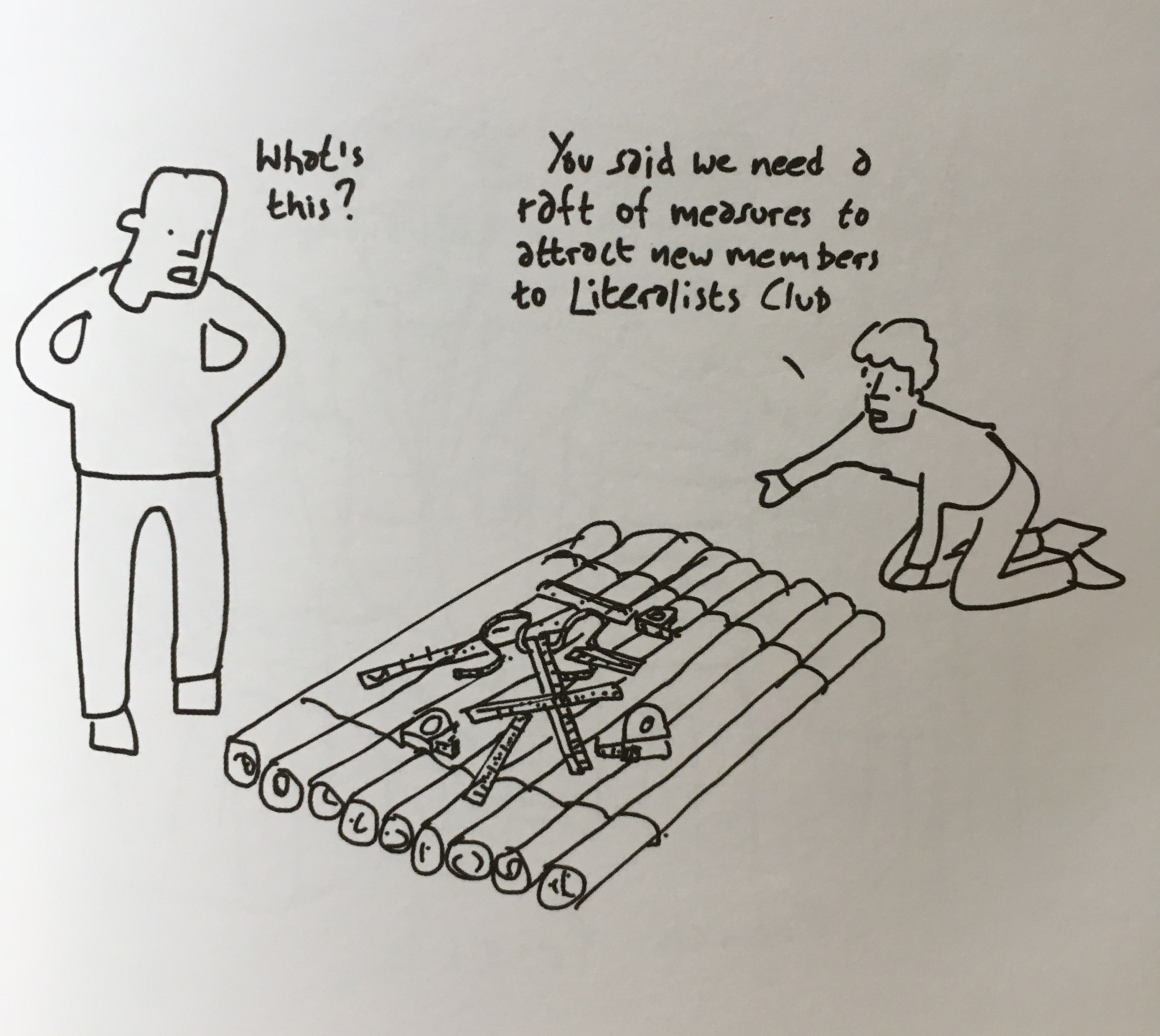
    Thank you to Moose Allain (@mooseallain.bsky.social) for the excellent illustration of how to use a raft of measures, to attract new members to the Literalists Club.

    Smorgasbord or Dashboard? This post is a bit of a gallop through some blogs I’ve written about measurement. Specifically how decision makers in organisations use the; data, information and knowledge that comes from measurement.

    What I’m aiming at is prompting a few thoughts with people attending the Housing Sector Disruptive Innovators Network session on ‘from Dashboards to Conversations’.

    In a complex world, certainty is an illusion… what I mean by this is that you can rarely rely upon a single hard, quantifiable number. There’s always more…

    Here goes with the blog post gallop.

    Picture of some dangerous olives.
    1. Start by questioning what you’re actually measuring — and why?

    The hard data Boards rely on is often just the pip of the olive. The hard woody bit at the center surrounded by lots of olive ‘flesh.

    The pip feels safe and objective, but it represents a tiny fraction of what could be known. Before accepting the numbers on the table, ask whose choices shaped what got counted in the first place, and what got left out?

    A materiality judgement is always a human judgement, with all the biases that entails.

    More details in this post : The dangerous olive of evidence.

    Picture of the head of a Cobra.
    1. Understand what kind of problem you’re dealing with

    Not everything is straightforward or even (just) complicated — some things are genuinely complex.

    The Cynefin Framework is useful here, helping you decide how to respond to the context or situation you are facing.

    In a complex situation many human and organisational challenges are beyond simple KPIs and line graphs.

    Things like Campbell’s Law and the Cobra Effect come into play. People will ‘game’ targets and measures, Campbell’s Law, and there are often unintended consequences, the Cobra Effect.

    The first conversation worth having with a Board is “what Cynefin domain are we in?” That should re-frame how you think about how and what you measure.

    More details in this post: Campbell’s Law and why outcome measurement is a dead Cobra.

    1. Don’t attack the data — extend the conversation

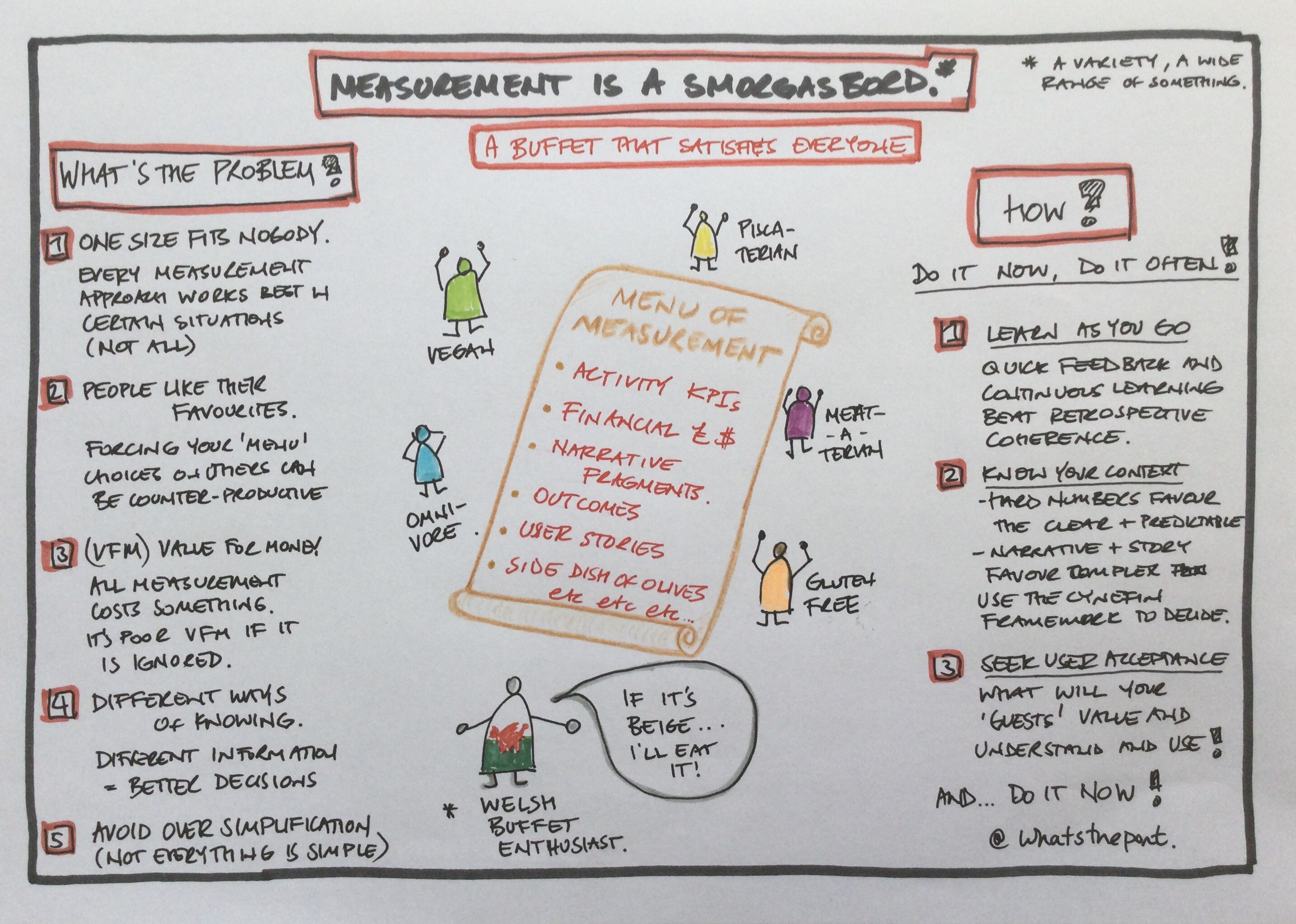
    The Smorgasbord approach. Rather than dismissing numbers offer more. “Here’s what the data shows — and here are some stories from people who’ve experienced this directly.”

    Position narrative not as the soft alternative to hard evidence, but as a different and an equally valid form of knowing.

    Decision-makers who feel their metrics are being challenged can get defensive; ones who feel they’re getting a richer picture might engage a bit more.

    More details in this post: Measurement is a Smorgasbord

    Wayne’s World. Most excellent organisational storytelling.
    1. Use authentic stories, not corporate ones

    A polished case study with the organisation as hero will be seen through immediately by many people. What can help shift perception in a Board room is a real, unvarnished story told in someone’s own words — with the rough edges still on it. Something that creates a moment of recognition at an emotional level that data alone rarely achieves.

    More details in this post: Cool story Bro… be cautious of organisational story telling.

    1. Be very careful how you frame and facilitate the narrative

    Emplotment is a concept anyone involved in organisational story telling will be familiar with.

    However, ‘plotting’ out a story cuts both ways. Story can open conversations up, but a curated narrative can also close them down.

    The goal is epistemic justice, allowing people to tell, and interpret their stories in their own way – without the interference of ‘mediators’.

    This helps decision-makers encounter the actual experiences of the people affected, not a version that’s been smoothed into a digestible message. The facilitation matters as much as the story itself.

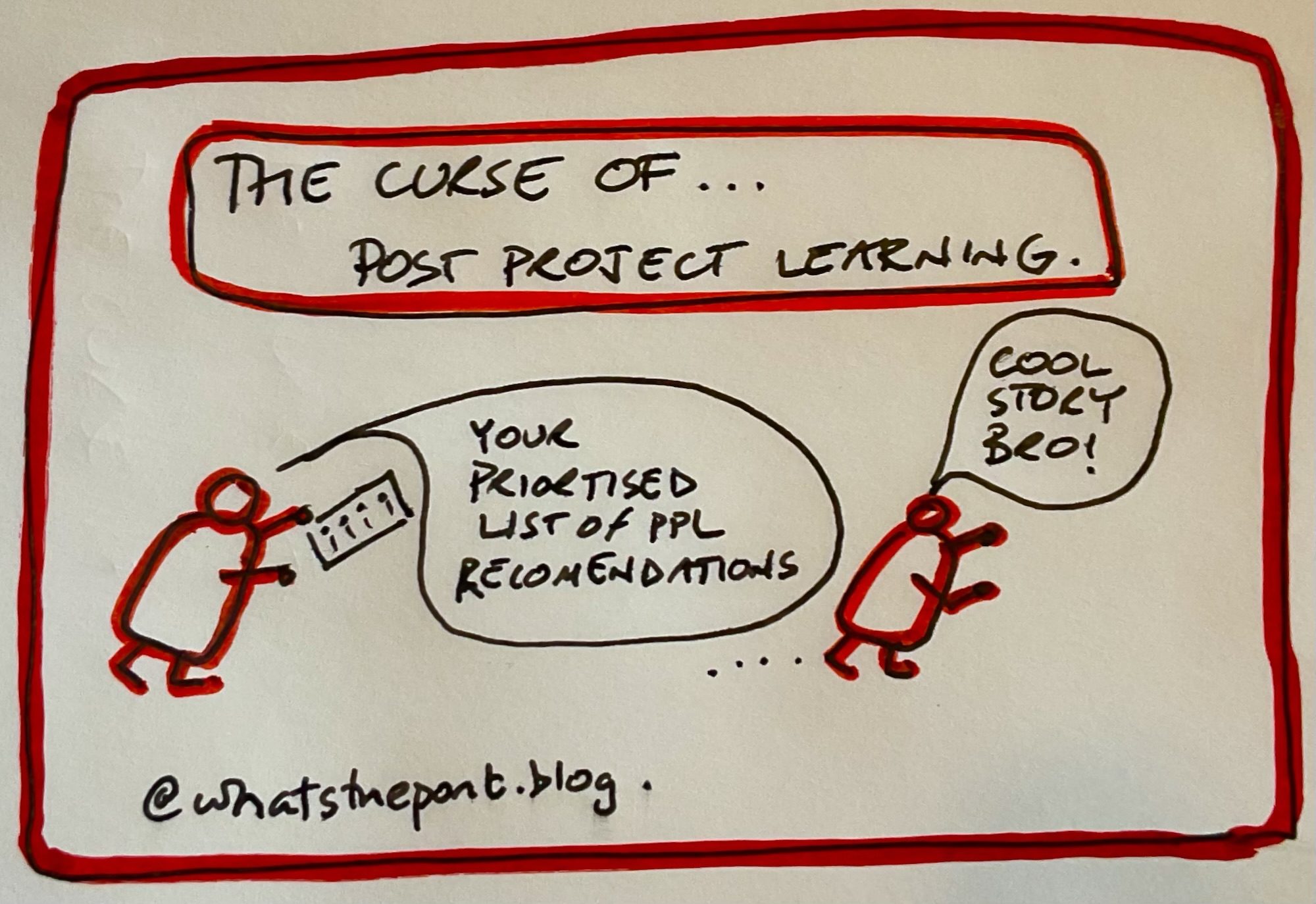
    More details in this post: Emplotment, the curse of post project learning (and corporate stories)

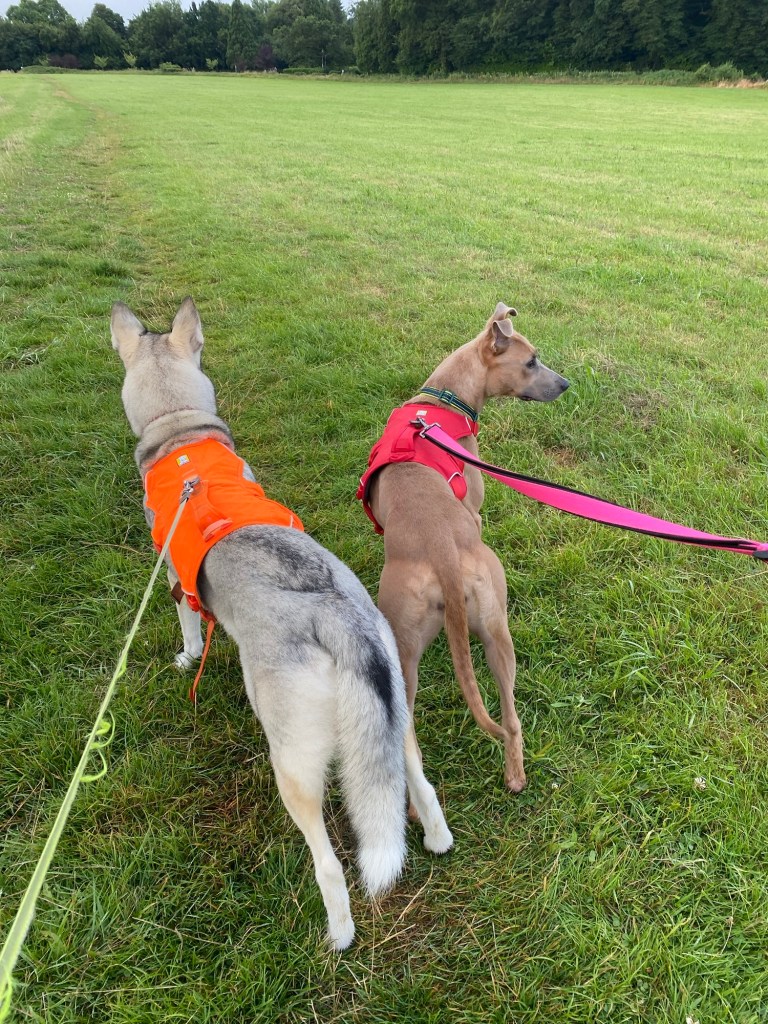
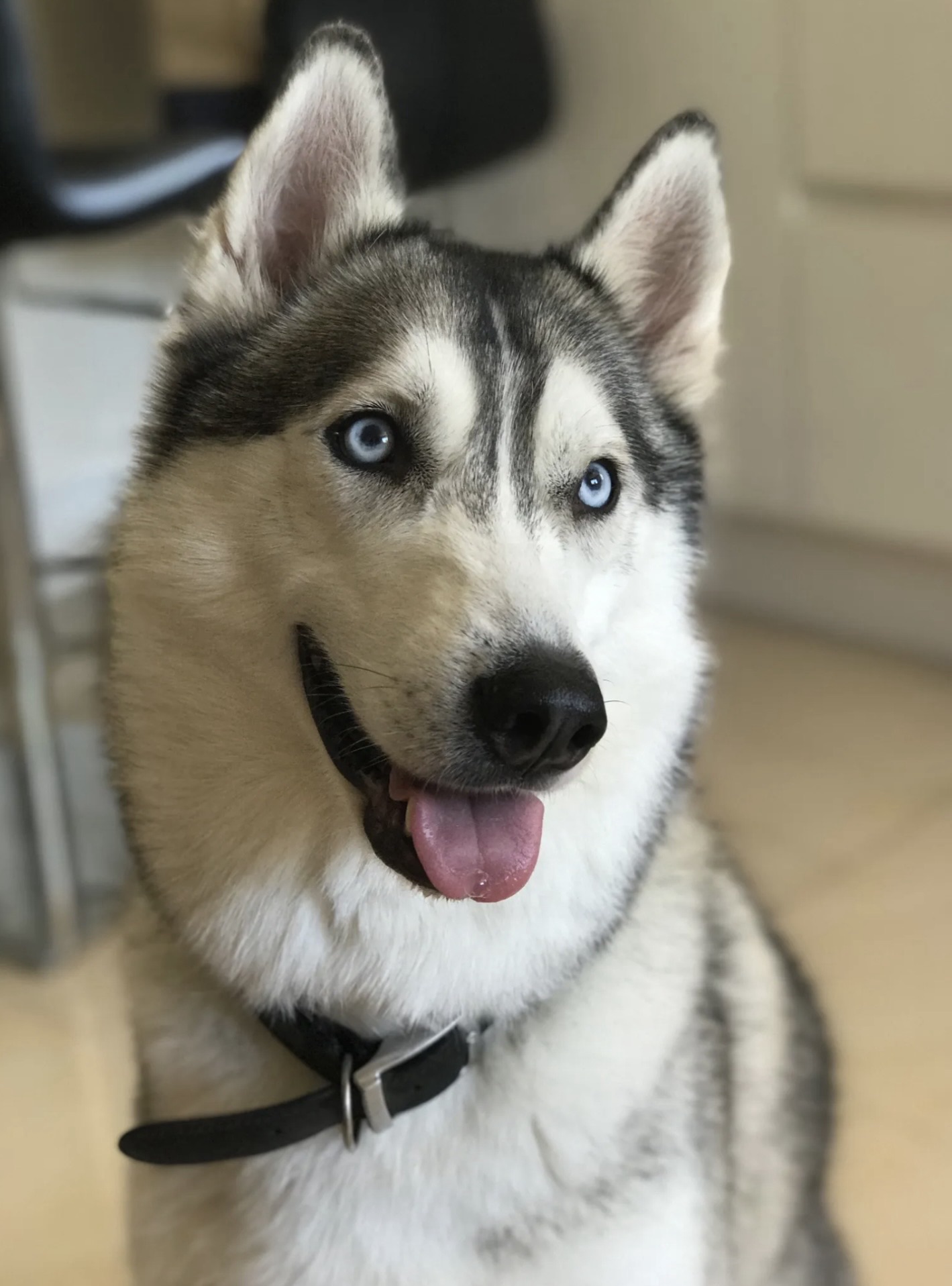
    Picture of a husky with a story to tell about crisps.
    1. Offer a different measure of success

    “The Story is the Measure” approach is something we should be aiming for. Real world stories people tell about their experiences.

    If they are changing in the right direction — more of the good ones, fewer of the bad ones — that’s a meaningful signal. An indicator of movement in the right direction.

    Stories and narrative won’t replace a balance sheet, but they can sit alongside one as a legitimate indicator that something real is shifting.

    More details in this post : The Tell of Captain Walker… Mad Max, ‘Poxyclips’ and Tribal Stories.

    1. Finally, the deeper point (pont) — and the hardest sell

    The real conversation you’re trying to create isn’t just about adding narrative to a dashboard.

    It’s about helping decision-makers accept that in a complex world, certainty is an illusion, and the hard data they find comforting is often measuring the wrong thing.

    That’s a significant shift in how power and accountability work in organisations — which is why it takes time, trust, and the right stories to get there.

    More details in this post: Obsessive Measurement Infinity Loops (OMI Loops).

  • Aberdare and Maerdy are closer than you think.

    There are a number of peculiarities you can acquire from growing up in the South Wales Valleys. One (from a time when most people travelled by car, bus or train) is that you think people in the next door Valley live a million miles away.

    Mostly because a visit next door required a drive up or down the Valley to a ‘crossing’ point.

    In reality, if I’d bothered to walk like my ancestors, I’d realise everything is actually very close by.

    Aberdare and Maerdy are physically quite close together, and both not that far from Merthyr.

    I’d imagine it might blow the mind of your average Maerdy dweller realising they could walk to the busy metropolis of Merthyr in a morning.

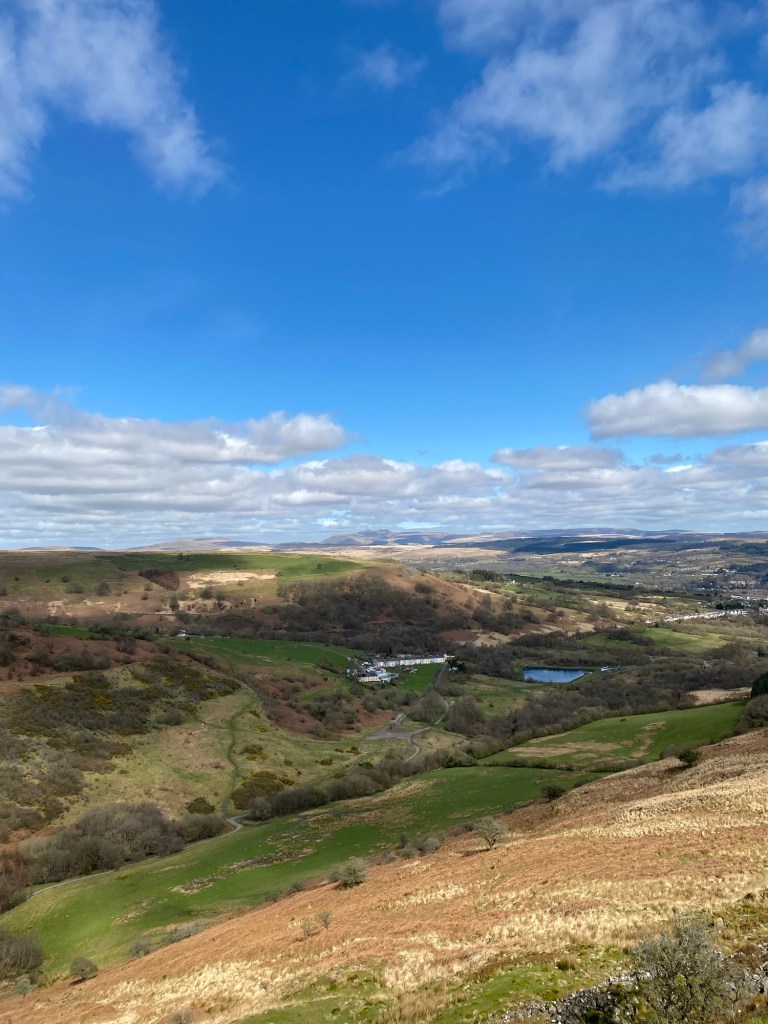
    Anyway, enough of winding up Maerdy people. Here’s a few pictures of a glorious Easter Ramble from Dare Valley Country Park to the site of Maerdy Colliery and back.

    Mostly for the purposes of not forgetting a few things I’d like to go back to.

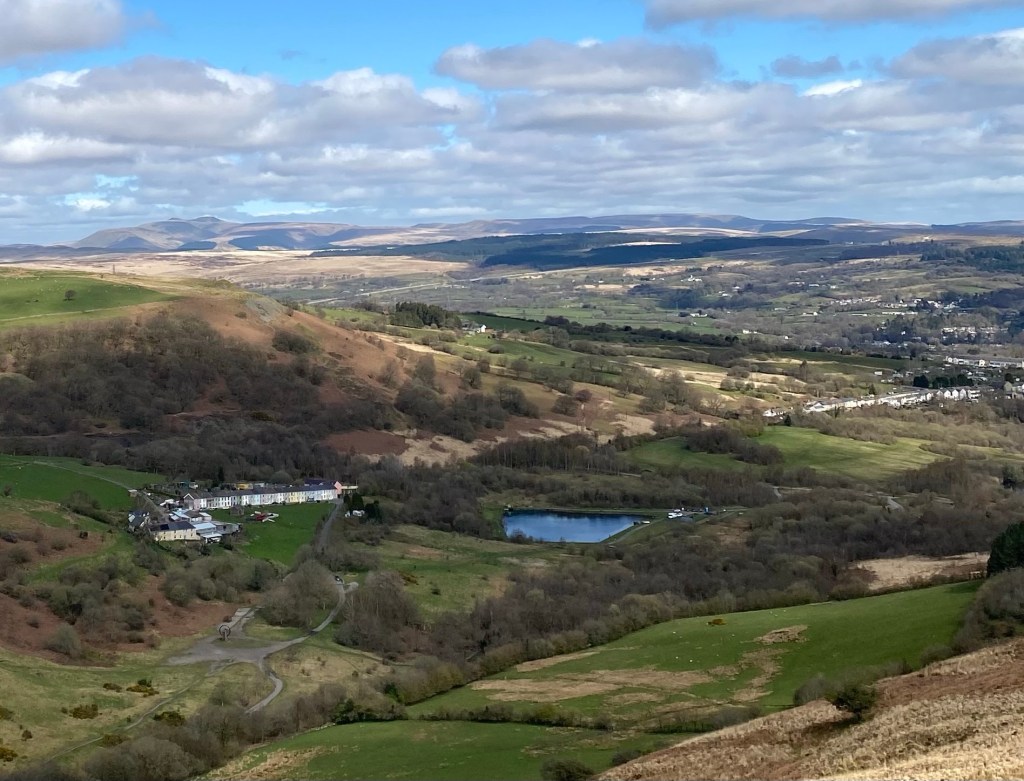
    Dare Valley Country Park. Yes, that’s Pen y Fan in the distance.

    In the foreground is the site of the Bwllfa Dare Colliery and Brickworks.

    The whole area was heavily industrialised for over 150 years until it became a country park in the 1970s.

    Well done Cynon Valley District Council. Proper future generations thinking.

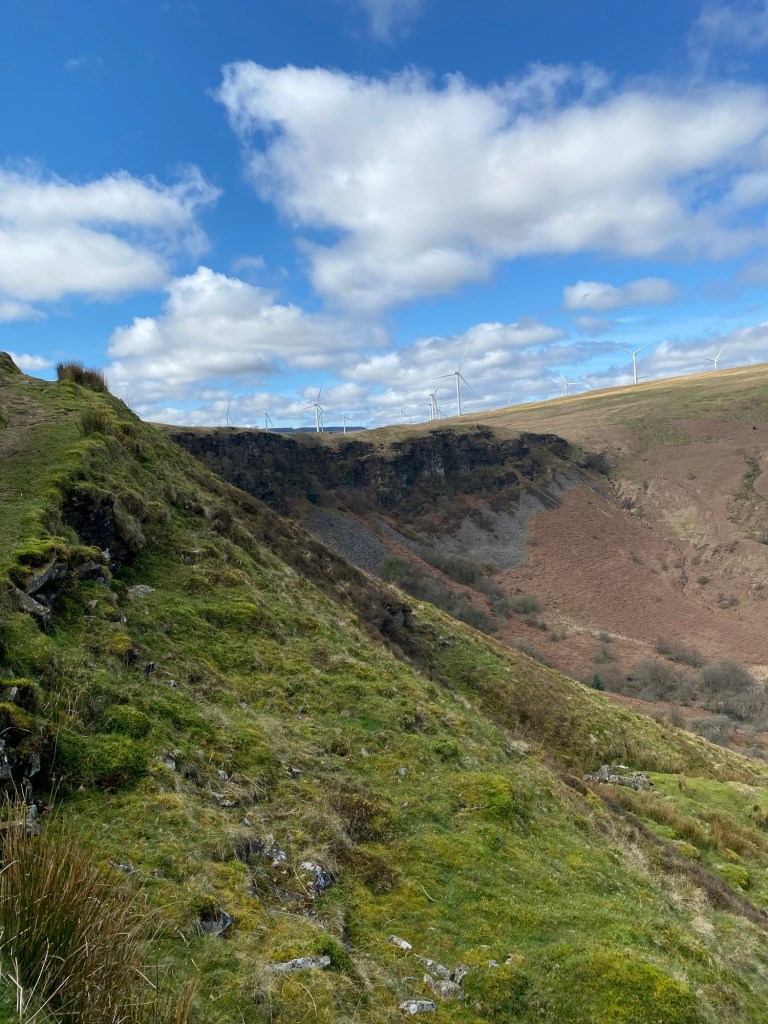
    The most southerly glacial corrie in the UK.

    The last ice age in the UK literally ended at Aberdare. I’ll leave that one with you.

    The crags know as the Darren is where the Afon Dar rises and the home of Peregrine Falcons.

    A convenient ‘food shop’ distance down to the Pigeon Lofts on Bwllfa Terrace (if you are a Peregrine Falcon).

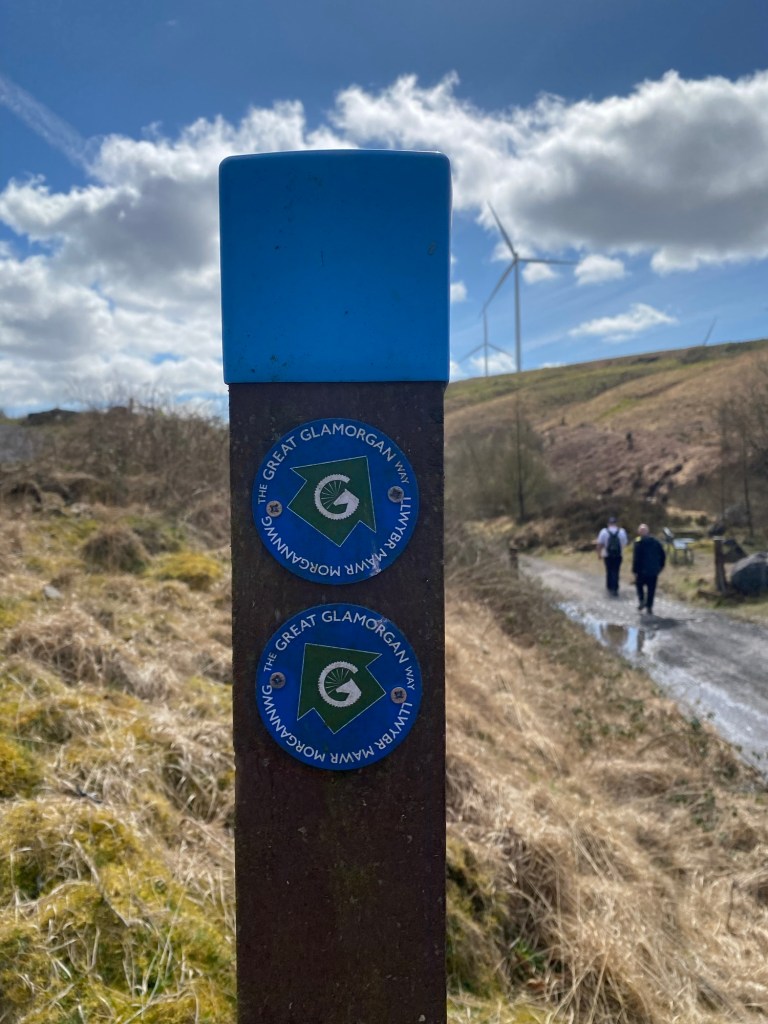
    The Great Glamorgan Way isn’t actually a single ‘way’. It’s about 14 different bridleways and cycle paths that cover the area from the coast at Ogmore up to the Heads of the Valleys. This sign was on the Pentre to Maerdy stretch.

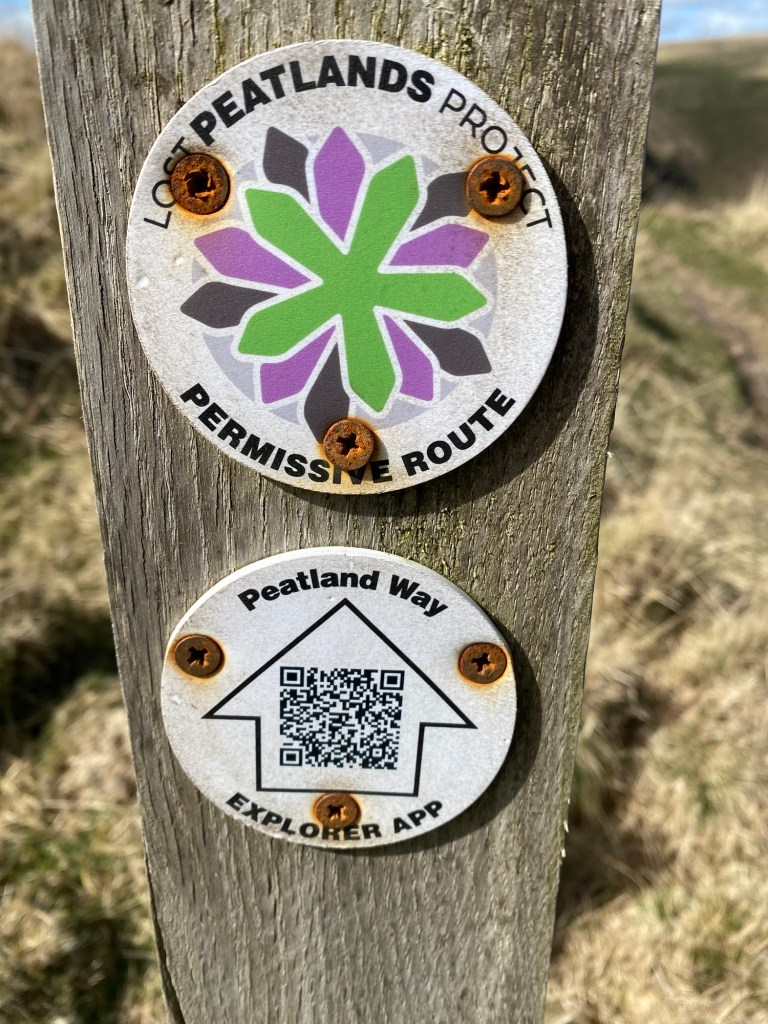
    On the topic of routes I know nothing about. Here’s one for the Lost Peatlands Project. With a lovely QR code, which was slightly ironic as there was absolutely no phone signal at that point to look up the QR code.

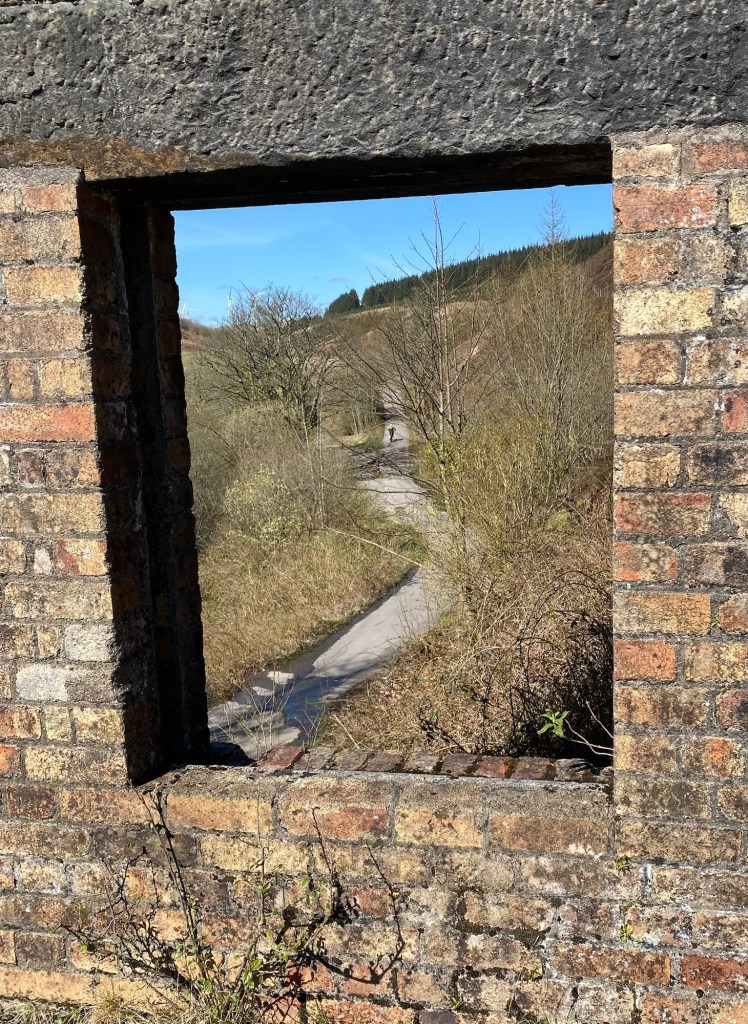
    View from the abandoned Pontypridd Water Company pump house up towards the reservoir.

    A poignant reminder of why investment in clean drinking water is a basic requirement of society.

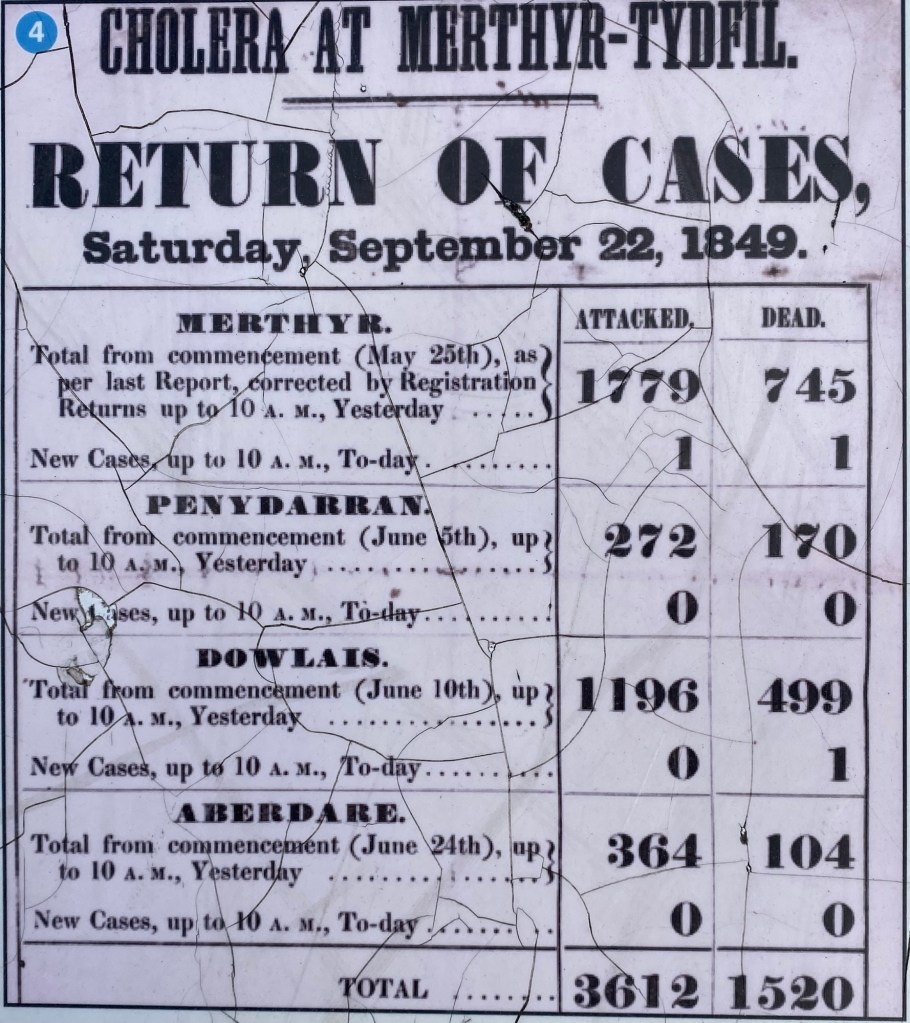
    This sign is part of a display in Aberdare town centre. I didn’t think we’d be walking so close to the infrastructure that was critical in the fight against cholera.

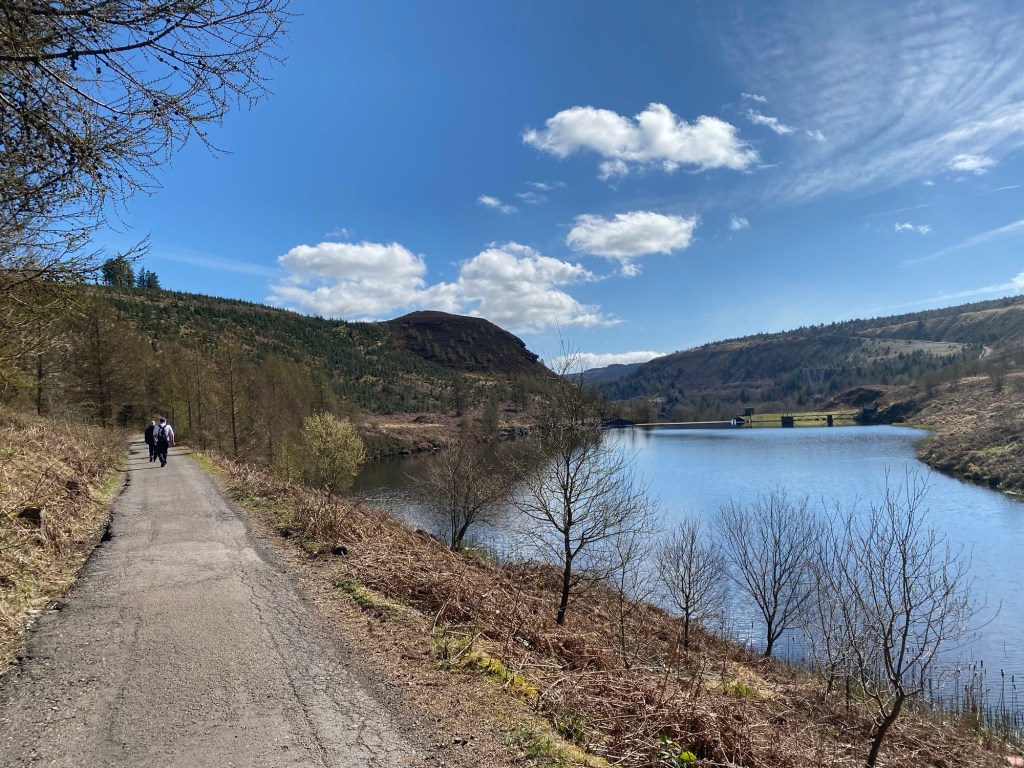
    Castel Nos Reservior. A beautiful asset in a beautiful location, delivering the basics of public health. Literally saving lives for over a 100 years.

    I did say this post was to remind me about going back to some things.

    Just to finish things off on here’s another gorgeous view.

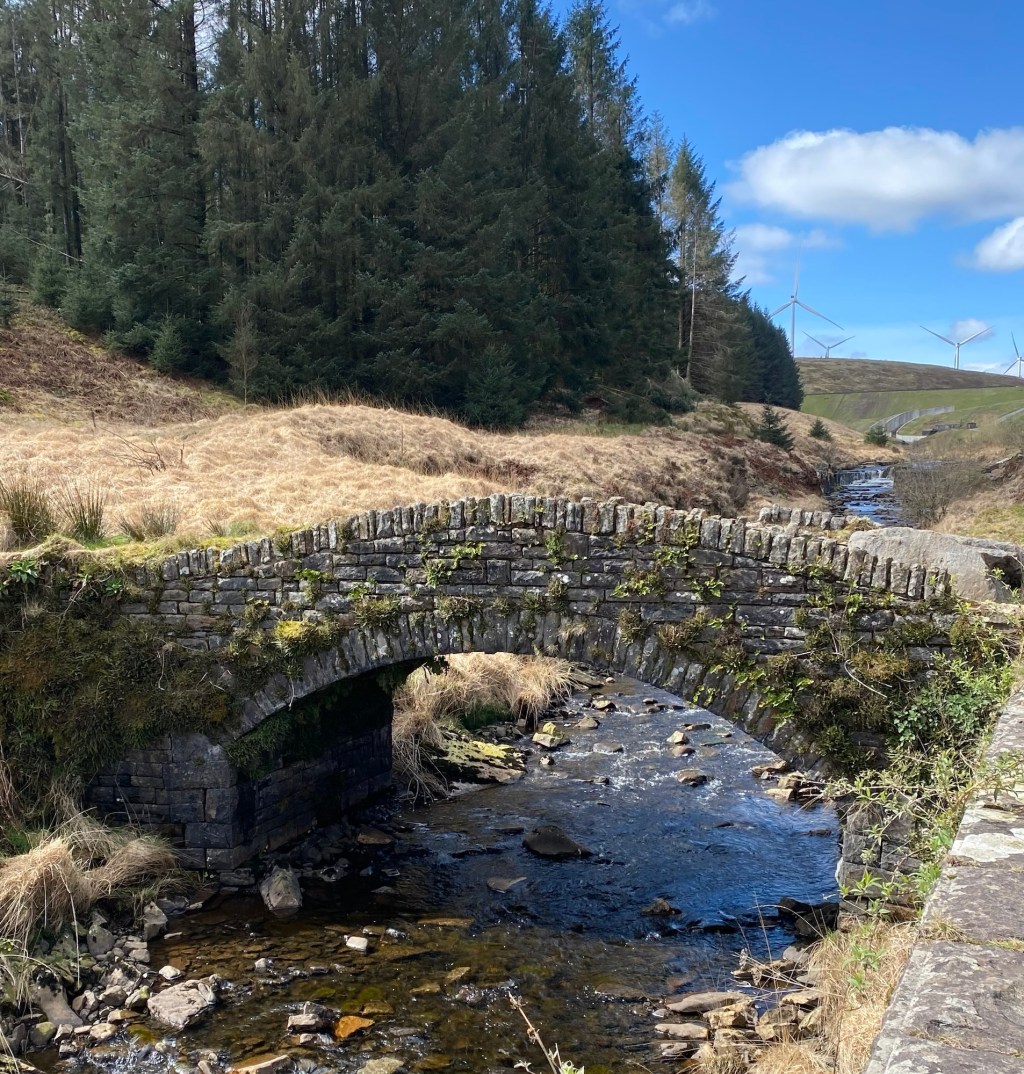
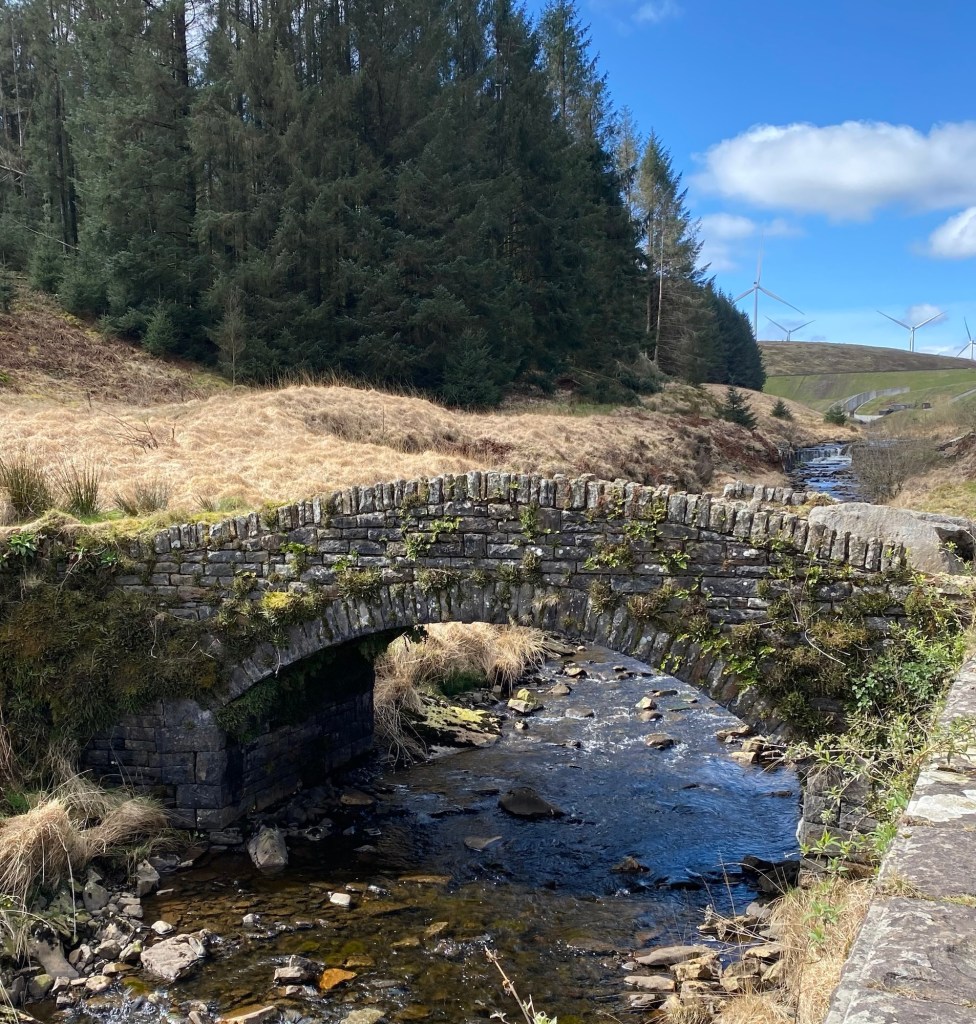
    Pont Lluest-wen Bridge.

    Possibly the highest bridge on the Rhondda Fawr River.

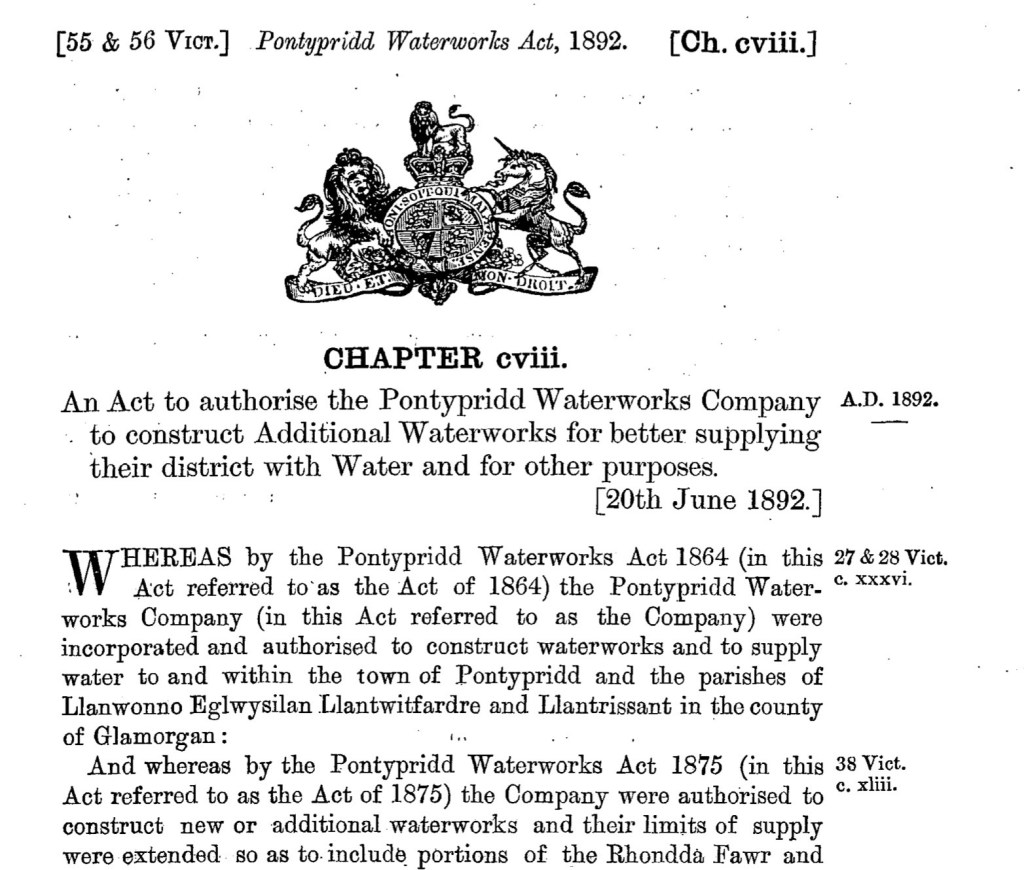
    It looks new(ish) and in incredibly good condition considering it gets a mention in the 1892 Pontypridd Waterworks Act of Parliament.

    Like I said, there’s a lot I would like to go back to here.

    Footnote. I’d forgotten that I wrote this about another drinking water reservoir supplying the South Wales Valleys. The Grwyne Fawr Reservoir built by the Abertillery District Water Board 1912-1928.

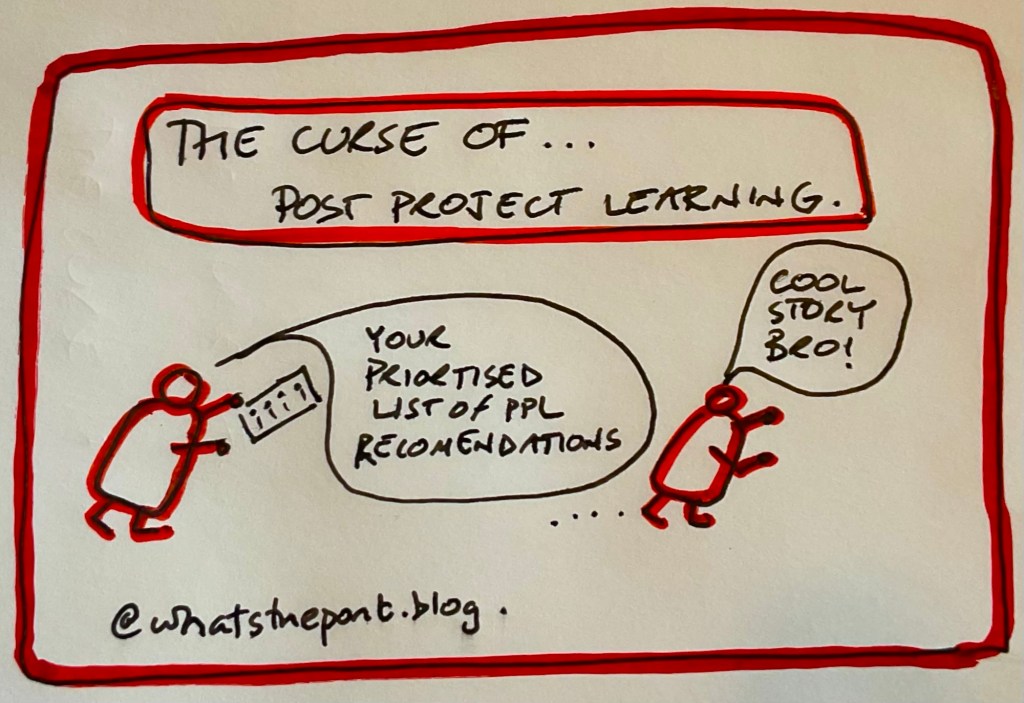
  • Emplotment. The curse of Post Project Learning.

    Emplotment. Monday morning I learnt a new word before breakfast; emplotment.

    I was reading The Compositor Removed by Dave Snowden which returns to the thorny topic of organisational storytelling.

    Dave talks about how ‘storytelling frameworks’ and jobs like ‘Chief Storytellers’ have altered (and degraded) long established human storytelling practices.

    The organisational storytelling approach steps away from authentic, natural human storytelling and into a ‘structured’ space where the message is constructed or curated. Often the organisation is painted as the ‘hero’ at the centre of the story.

    I’d recommend reading Dave’s post, or if you fancy something more shabby here’s Cool Story Bro, me expressing my dismay about some terrible corporate storytelling I experienced at a conference a few years back.

    Hello French Philosophers … bien sur, of course there had to be a French Philosopher somewhere here in the mix.

    Paul Ricœur is credited with having named emplotment as: the process of arranging a chronological sequence of events into a meaningful narrative with a plot.

    Emplotment often transforms a list of things that ‘just happened’ into a coherent story.

    It focuses on interpreting historical, personal or societal events by selecting significant details and organising them into a structured, understandable story.

    For me, the key words here are; selecting, organising, meaningful, understandable, plot and story.

    The leap to Post Project Learning (PPL). You might be wondering how I’ve connected employment and post project learning.

    It’s fairly straightforward in my head.

    PPLs are basically about finding out what happened, making sense of the facts and thinking about what you’ve learnt.

    The purpose of the exercise is to get people to do more of the good stuff and less of the bad stuff.

    The degree to which any of that (doing good/bad stuff) happens depends in part on how much ‘meaning’ the recommendations have to the people who do stuff.

    This is where emplotment comes in, which I will try to explain.

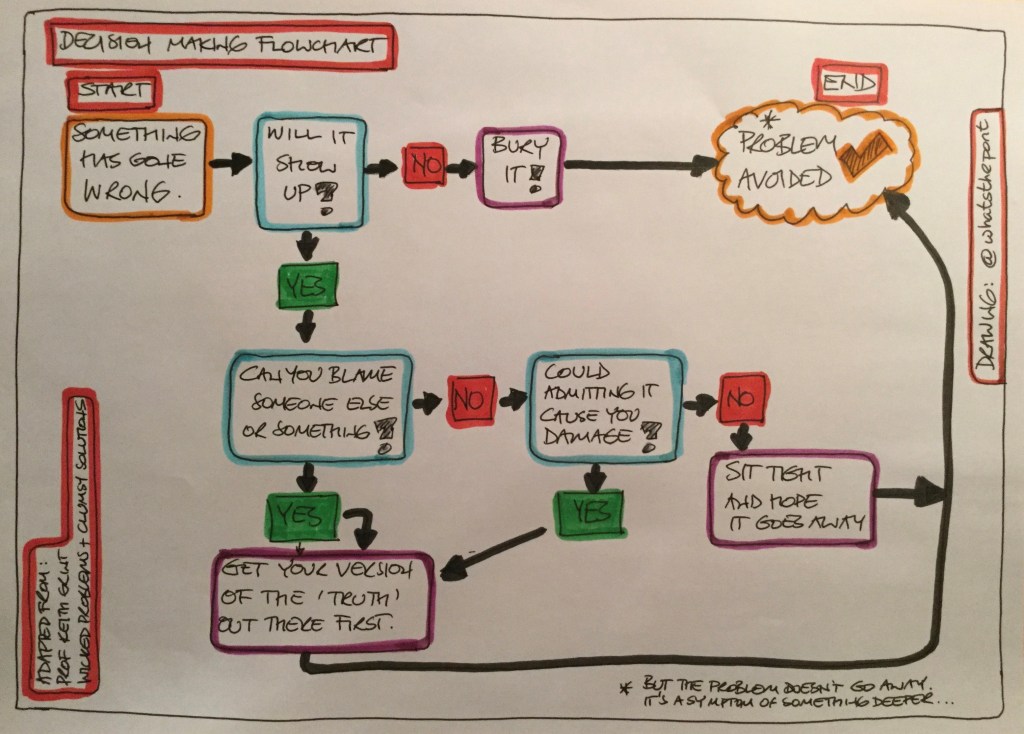
    First though, an example of emplotment I borrowed from Keith Grint.

    Who’s never curated a PPL? Look back at the words I picked out earlier (selecting, organising, meaningful, understandable, plot, story) and ask yourself this question (particularly facilitators)…

    “Have I ever been part of a PPL where the outputs have been curated to get a specific point across? Telling the story of what happened…”

    If the answer is yes or sometimes, I’m ok with that – up to a point.

    If the purpose of the PPL is to help people do more good stuff and less bad stuff, and if curating the story to create meaning and understanding helps, then that’s ok.

    But, it’s not ok when the curation is manipulated for other purposes – like pushing a false narrative or painting the organisation or leadership as heroes.

    This is essentially the curse of emplotment in PPLs. It serves a useful purpose, but is easy to get wrong.

    Bury or ignore anything that attracts blame. Going back to the flow chart graphic borrowed from Keith Grint there’s a key point about failure and blame.

    In lots of organisations, if something goes wrong the first instinct is to bury the evidence and avoid blame. In many PPL exercises this behaviour is repeated.

    Where things have gone wrong, that piece of the jigsaw is often conveniently overlooked, or ‘blame’ apportioned elsewhere.

    I don’t think I’m speaking heresy here.

    If emplotment and the motivation to avoid blame overlap in a PPL exercise, I think you are properly in ‘cursed’ territory.

    So what to do about it? There are many things to suggest here. First would be to go and read many things Dave Snowden has to say on the matter.

    Epistemic justice is an important concept here. Who decides the ‘meaning’ in what I am saying?

    Is it me, or is it a curator or facilitator that is doing it on my behalf; the ‘emploter’.

    Personally, I know what I think, and I’d rather do that ‘meaning thing’ myself, thank you very much.

    This also from Dave Snowden on Narrative and Epistemic Justice is another place to find out more.

    I’m probably going to return to this subject over the next few weeks.

    I’ve been asked to say something about using story to bring data to life in a Board setting.

    So I’d better get my story straight…

    So, What’s the PONT.

    • Post Project Learning exercises are important. We need to learn how to do less of the bad stuff and more of the good stuff.
    • Emplotment can help with moving from a list of bullet point recommendations to a convincing story that means something to people.
    • But be aware; emplotment, curation and facilitation can lead to missing things out and painting a picture that isn’t true for those who were actually involved. It’s potentially a curse that needs to be handled thoughtfully.
  • Hedgerows. Telling the story of Indigenous Governance and Lost Collective Memory.

    How we make decisions and remember things as society depends on a huge variety of things.

    Hedgerows, yes hedgerows, might just provide an interesting insight into the art of decision making and developing resilience.

    First, the Great Hedge of India. An impenetrable hedgerow 3700km long and 4m tall, built as a customs barrier dividing India to collect salt taxes.

    Existing between 1840 – 1879 at its peak it employed 14,000 people.

    It was a monumental piece of infrastructure.

    However, 100 years later it was lost from memory, with virtually zero physical evidence it ever existed.

    Second, Welsh Farm Hedgerows, Cloddiau. The stone and earth banks topped with trees and bushes that still exist across rural Wales.

    Cloddiau have been part of the landscape, for at least 400-500 years and probably longer. Ultimately they are a product of historic local decisions that still play a useful role today.

    Something as ordinary as a hedgerows might just give an insight into governance, longevity and community memory.

    What is governance?

    I like this definition from Fan Yang in Rethinking Governance.

    “Governance at its best is not control. It is the collective art of learning how to live together with each other, with place and with the future.”

    The article describes different types of governance approaches, including indigenous and western, which interest me in the context of hedgerows.

    Indigenous Governance involves things such as the idea that ‘land’ shapes laws, authority comes from relationships and “governance is embedded into daily life and long-term stewardship”.

    There are however difficulties in this approach around the ability to operate at scale.

    In this description I saw a lot a similarities with the stewardship of a common resource I observed around the Maine Lobster Fishery.

    “We are looking after this for our grandchildren…” was a commonly used phrase I wrote about.

    Western Governance involves things like legal rights, land as property (rather than a focus of relationships), large scale coordination and provision of infrastructure.

    Governance is a thing done by special people, in special places, using special language. Apologies, I’m overplaying it there, but you get my point, it’s not embedded in everyday life.

    One area of difficulty for western governance is around ecological stewardship. This struggles in a system that is focussed towards the creation of economic value and growth.

    The LinkedIn article by Fan Yang is well worth reading.

    The East India Company and the Great Hedge.

    The example of the East India Company building a 3700km long customs barrier hedgerow, to impose a salt tax on the local population, feels like it’s got Western Governance written all over it. As well as a few other descriptions.

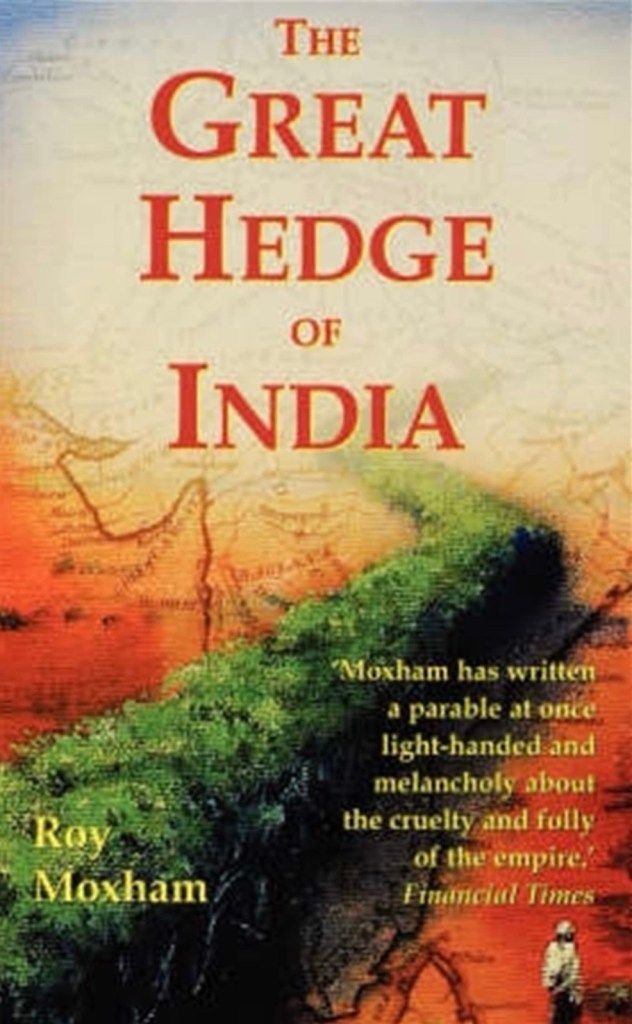
    I’d suggest having a read of the Great Hedge of India by Roy Moxham. At one level this is the story of multiple attempts to find evidence, physical or otherwise, of a massive piece of infrastructure.

    There was virtual no trace 100 years after the hedge was abandoned.

    This may partly be because a hedgerow will die and decompose, but it might be associated with the nature of the governance.

    The creation of the hedgerow wasn’t part of local indigenous decision making and governance. Perhaps this (western) approach to governance helped to erase the memory?

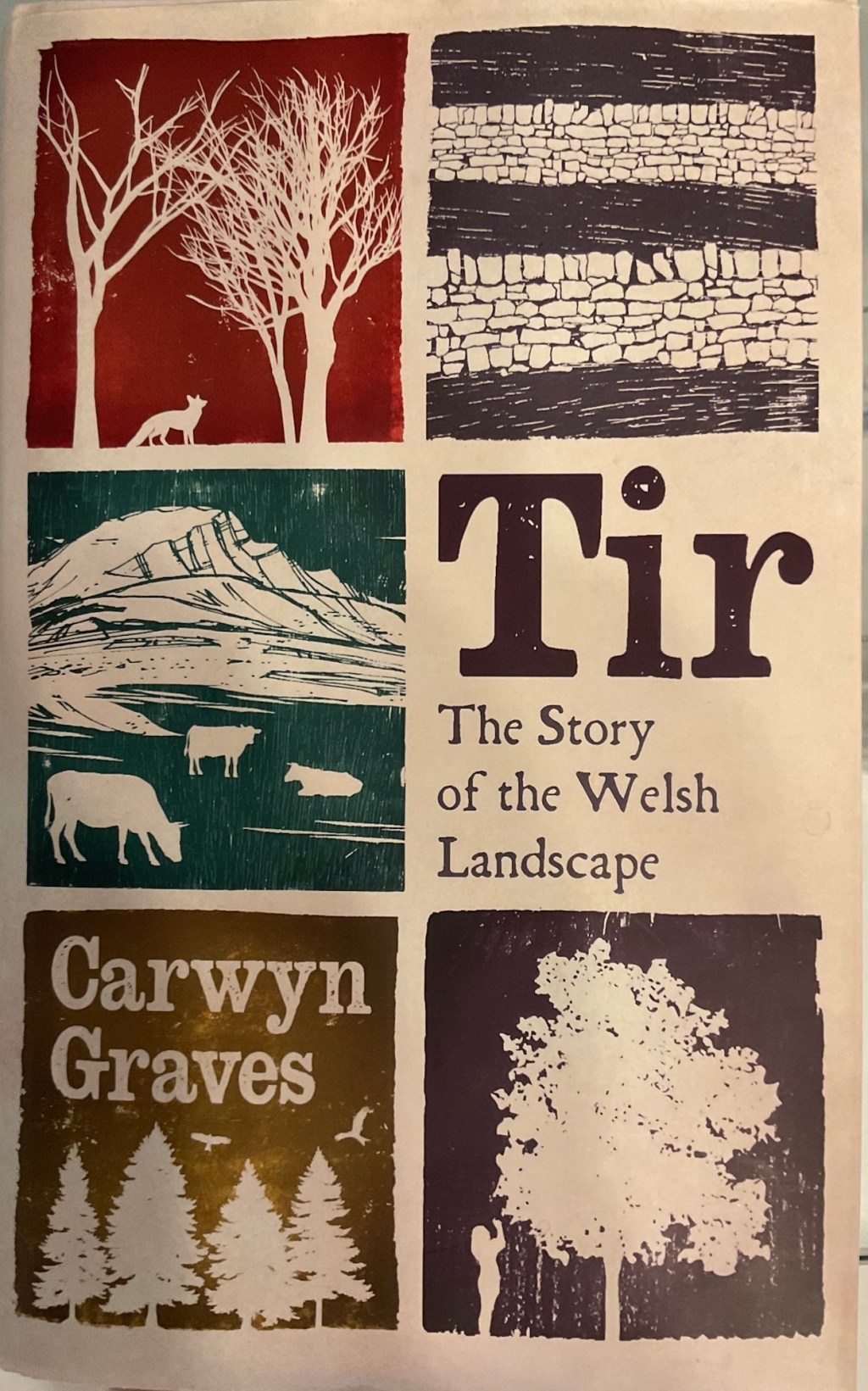
    Tir. The story of the Welsh Landscape.

    This is another book I highly recommend, written by Carwyn Graves.

    The chapter on hedgerows, cloddiau, describes a long association between the landscape, people (who were mostly farmers) and the barriers they built to define different uses for the land.

    The principal purpose of these barriers was to stop animals eating the fodder being grown to feed them during the winter, rather than ownership.

    A close read of the cloddiau chapter suggests to me a form of indigenous governance. The land defines how things are done, relationships and stewardship of the environment are important drivers of decision making.

    Something that is embedded in the day to day activities of local people.

    Whilst the current hedgerows / cloddiau might only be 400-500 years old, there’s a strong suggestion that they are based upon much older patterns of land stewardship. Possibly back to the Bronze Age.

    That shouts out indigenous wisdom, longevity and a bit of indigenous memory to me.

    And when it comes to memory, the fact that these hedgerows remain (even if they are scarce and fragmented), may say something about how indigenous governance can support longevity and resilience?

    So, What’s the PONT?

    PS. Thank you to friends who pointed me towards the Great Hedge (Lisa) and Tir (Ena).

  • I see your Groundhog Day. And I raise you a Hedgehog, and a Badger!

    It is the festival of Imbloc round these parts. The ancient Celtic festival at the beginning of February where we used to celebrate the midpoint between the Winter Solstice the Spring Equinox.

    Looking forward, with hope, to a time when Spring is beginning and things start to grow again.

    The exact timing of an early or late spring used to be a big deal and could mean the difference between survival, or not.

    It’s also time for Groundhog Day.

    Six more weeks of winter or spring?

    If you are familiar with the 1993 film Groundhog Day, you will know the story.

    The reaction of a Groundhog, Punxsutawney Pete is used to predict the weather. If the Groundhog comes out of its burrow on the 2nd February and sees its shadow (because it is sunny) there will be six more weeks of winter.
    If the Groundhog doesn’t see its shadow (no sun) there will be an early spring.

    I’m sure there’s no surprise to hear that this is all based on European folkelore and was carried to America and Punxsutawney by immigrants.

    The European versions involved a mixture of; Hedgehogs, Badgers, Snakes, Birds and even Bears. It all depends on what you’ve got living locally I guess.

    There’s something in Groundhog Day about understanding the origins of customs and practices, and occasionally going back to the original roots.

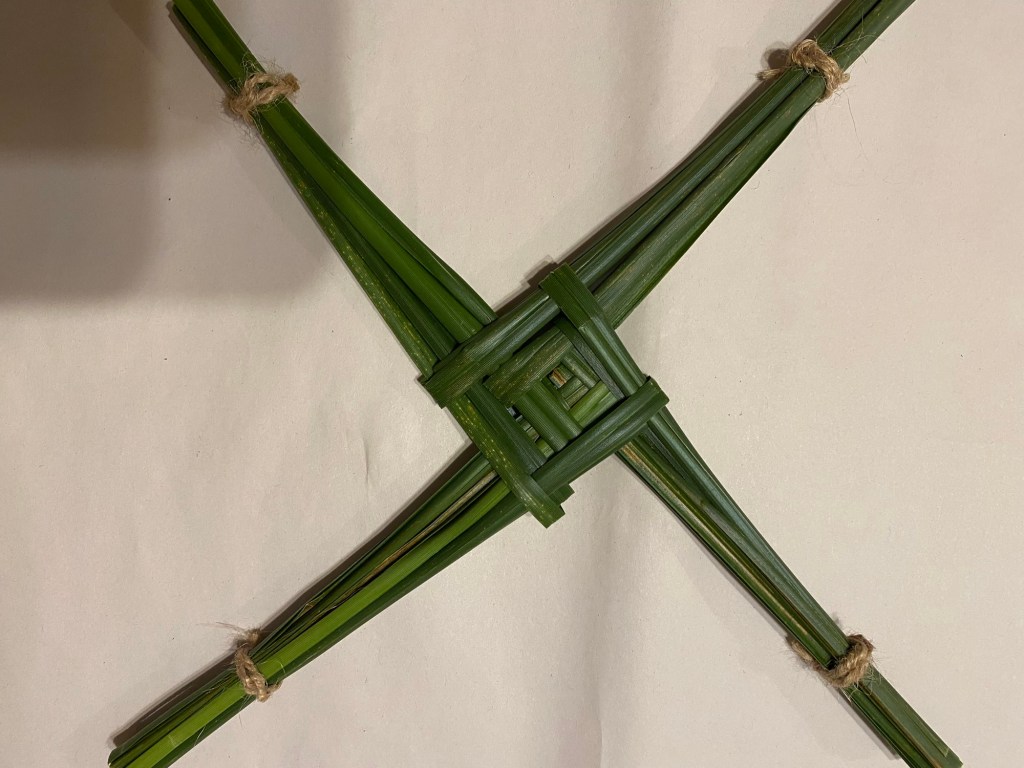
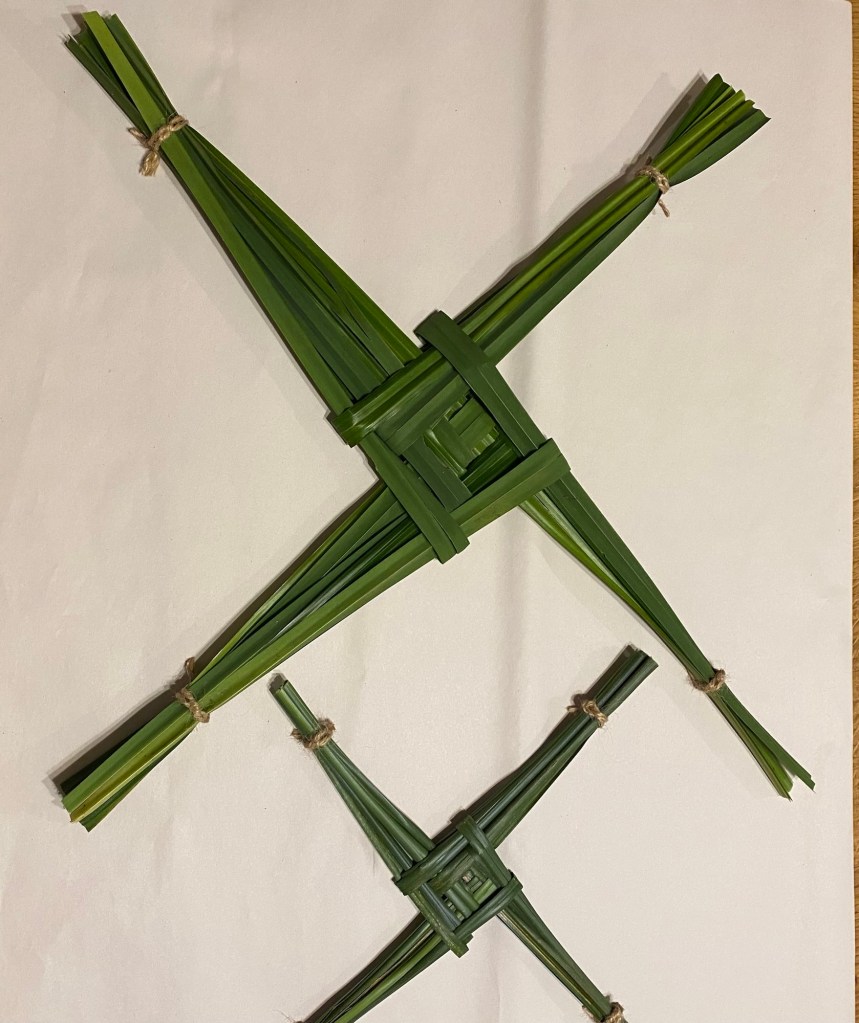
    Personally, I’m going to try and make a Saint Brigid’s cross out of rushes this evening, but that will require a walk to the local wetland / bog before it gets dark, and it’s raining.

    More on that shortly.

    But what about life on a tedious repeating loop?

    The other modern ‘meaning’ of Imbloc comes from the film Groundhog Day, a tedious activity or event that keeps on repeating, in a sort of loop.

    Apparently ‘Groundhog Day’ became a common expression after the film was released.

    Back in 2014 I wrote about Groundhog Day in the context of how the ‘tyranny of best practice’. How ‘best practice’ was being pushed constantly as the solution to all sorts of problems. I’m not sure much has changes, other than my level of tolerance…

    On one level the phrase ‘Groundhog Day’ captures the idea that life can feel like a monotonous series of the same things repeating themselves, if you let it.

    At one level our ancient ancestors might have worked this out by having distinct practices and festivals. Marking the progress and transition from one phase of the year to the next.

    Otherwise every day feels like the rest.

    Ancient wisdom is still wisdom.

    Just before moving on from Groundhog Day, I always used to think about what it would be like to live a day of my life over and over, doing whatever I wanted.

    Like the film, would I go through stages of; confusion, hedonism, despair and then ultimately enlightenment, based on finding joy in love for others and helping to make life better?

    Alas, I am deeply flawed, wrestling with confusion, hedonism and despair, but I’m working on the enlightenment bit.

    Back to Saint Brigid.

    There’s a ton of things to know about Saint Brigid of Kildare c.452 – c.525. But I’d like to focus on St Brigid’s cross, woven from rushes it is traditionally made in the evening of the 1st February and hung on your door for St Brigid to bless as she passes through.

    A blessing will help with all sorts of things like protecting the home from fire, evil and all sorts of other misfortunes. And unlike a smoke detector, it doesn’t need a battery.

    My main reason for doing this is to do something with others (my wife, who’s the only one who will indulge me in this sort of thing) rather than watching telly.

    A bit of Kama Muta (ancient wisdom from another culture) if you get my drift.

    So, What’s the PONT?

    • If you let it, life can feel like a repeating loop of the same old thing day after day.
    • Maybe our ancestors recognised this and marked changes and transitions with events and festivals linked to the natural world around them?
    • Try a bit of Kama Muta with your nearest and dearest. You might experience shared joy in some low quality amateur rush weaving.
    Do what you can with the materials available. The local bog was unfortunately lacking in quality rushes.

  • Innovation. The superpower of clever, lazy people.

    This might be controversial.

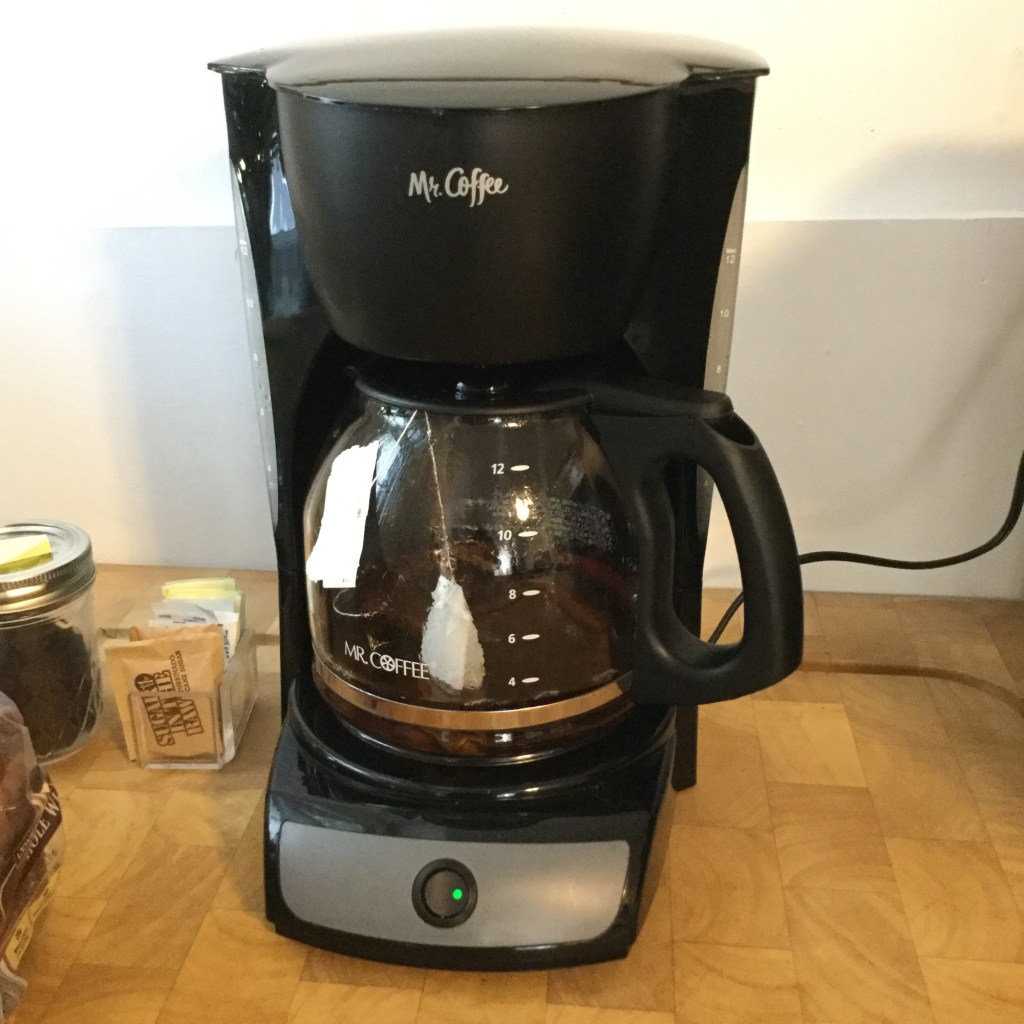
    In the picture there’s a tea bag in the coffee pot.

    But I don’t want to talk about that until the end of the post. What I want to say is…

    I reckon there is a case for handing over innovation to clever, lazy people.

    The reason? They are smart enough to work out how to do things better or differently, (innovation) and they are (highly) motivated by self interest. The benefit of making their own lives easier is a significant motivator – laziness in some people’s books.

    But, but, laziness isn’t one of our organisational values. This isn’t making a virtue of laziness. I can see the apoplectic faces if this was put on the agenda of an HR ‘ values’ meeting. Maybe it’s about re-defining and re-thinking how people do things left up to their own initiative.

    If you look at it from another perspective, laziness is more than just ‘the easy way to do something’. It could also be a ‘judicious use of resources’. Using wise and sensible judgement to make the most of the resources you have.

    Work smarter not harder is a mantra that’s often used. But, I bet there’s plenty of people who will have been labelled as ‘lazy’ or disruptive because their (better) approach didn’t follow a prescribed process.

    We’ve been labelling people as lazy for ages.

    There’s a long history of people linked to the quote, “if you’ve got a tough job to do, give it to a lazy person. They will find the easiest way to do it”

    A recent high profile person in the chain is Bill Gates, that also includes Walter Chrysler (founder of Chrysler Motors) and Frank Galbraith who studied workplace practices in the 1920s. This article in Quote Investigator gives an explanation of who might have said what. A mostly American view on the subject.

    Hello Field Marshall Helmuth von Moltke (the Elder).

    Personally I’m keen to look back into European history to see what we’ve got going on.

    And I’m delighted to say the Prussian Army were all over this stuff in the 1850s onwards. Field Marshal Helmuth von Moltke was known for changing military strategy and introduced ideas like decentralised command structures that are still used today.

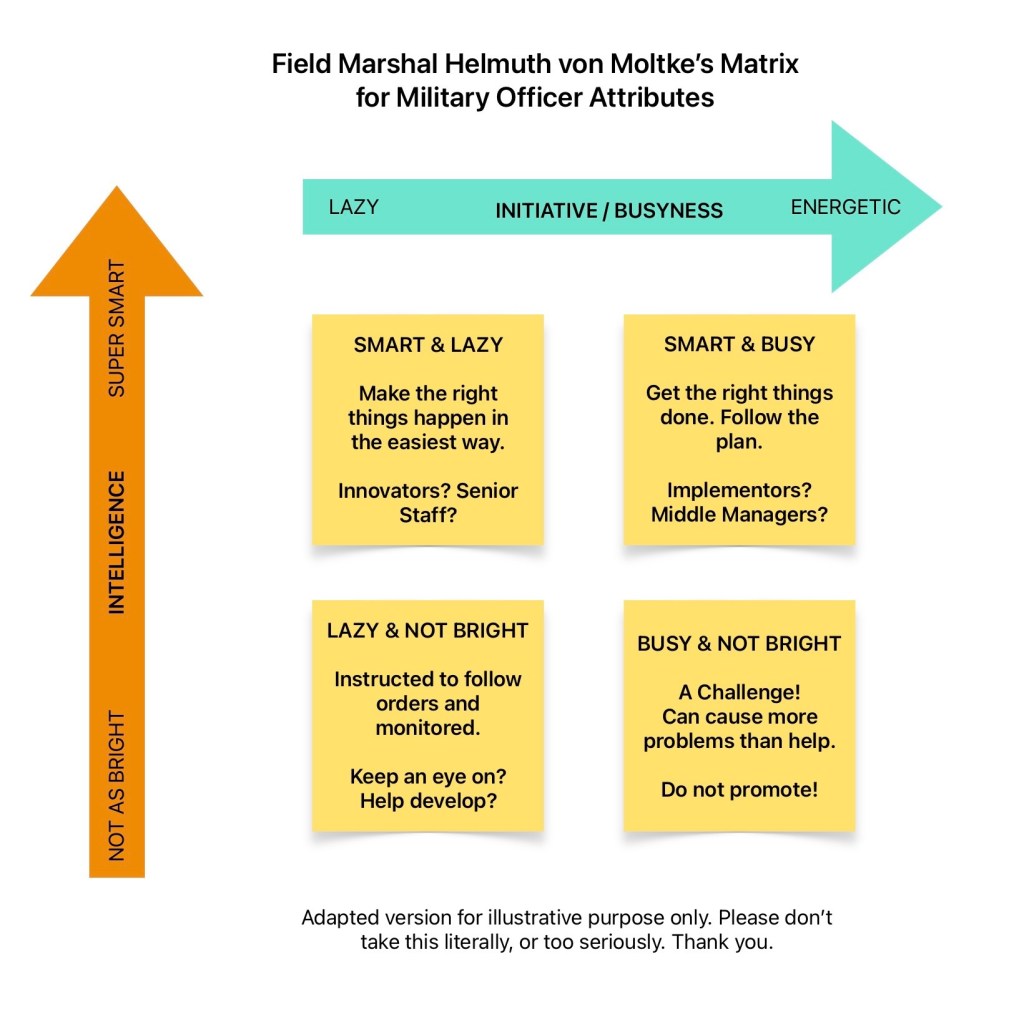
    Numerous versions of the matrix below circulate which describe how Officers would be considered for different positions in the Prussian Army.

    The point that Lazy & Smart people have highly beneficial attributes was not lost on von Moltke and one version on the matrix has them as ‘Commanders’ one needs to ‘discover’.

    Interestingly, the Busy & Not Bright are identified as people to ‘eliminate’ from the Officer group. They can cause more problems than they solve through their ‘wrong’ busyness.

    I wonder how many of these people will have been promoted rather than ‘eliminated’ in some organisations – ‘promote the problem to someone else’s department’?

    So, what’s this got to do with a coffee pot?

    This post started with me reading about The Trojan Room Coffee Pot Webcam. The first ever Internet webcam. I kid you not.

    The Trojan Room was part of the University of Cambridge Computing Department and in 1991 was where the coffee pot lived.

    To save people the hassle of walking to get a coffee and then find the pot was empty, two people installed a webcam linked to everyone’s desktop computer.

    It was the first webcam and became a bit of an Internet icon until it was retired in 2001.

    The people who work at Cambridge University Computer Department are undoubtedly smart.

    I’m wondering if this clever solution of avoiding an unnecessary walk with empty coffee cup in hand ( by looking at a webcam) would meet the definition of lazy?

    Or is it just being smart and judicious, making sensible use of your resources?

    Would Field Marshal von Moltke approve?

    The coffee pot in the picture is one I was using. I was staying in an apartment and couldn’t find a Tea Pot and as I’m not a coffee drinker I just used the coffee pot.

    It worked ok. I think on this occasion though me being lazy outweighed clever.

    One final thought.

    I’ve been browsing Reddit on this subject. There are dozens of examples of people who have done this sort of clever, lazy thing.

    I’m wondering, for my next ‘innovation challenge’, should I just ask Reddit; someone will know the answer. Or is that just really lazy?

    So, what’s the PONT?

    • The idea that lazy, clever people get hard jobs done easier has been around for ages; it works.
    • Busy & Not Bright People can cause more problems than you need. Don’t ’promote the problem’ to someone else’s department.
    • But, there is a stigma attached to the word lazy. Better to say ‘careful and judicious with use of personal resources’?

  • “Do it the Safety Way…” Health and Safety ‘singalongs’ 1970s style.

    I’m wondering how much is actually new in the World?

    Are TikTok Health and Safety educational videos really any different to approaches that have been served up in the past?

    While avoiding TikTok adverts on television (!) I’ve been rummaging around my most precious treasures, pretending to tidy up and de-clutter. This has unearthed some of my 1970s beermat collection, featuring of all things coal mining health and safety. I kid you not.

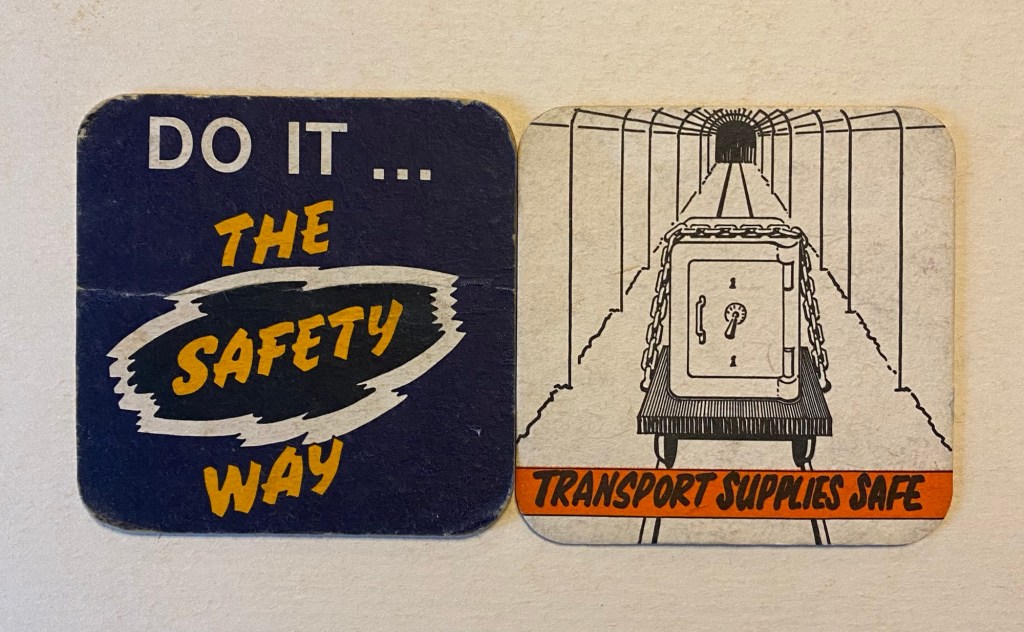
    Here’s a picture of some DO IT… THE SAFETY WAY beer-mats the National Coal Board (NCB) distributed to Miners Social Clubs in the 1970s.

    Let’s get crooner Max Bygraves to sing a Health and Safety song… In 1976 the NCB instigated a year long health and safety campaign for their collieries. Rightly so.

    Mining is a dangerous activity and in the 1970’s too many people were still being injured and dying in preventable accidents.

    One of the genius things the NCB did was commission all round entertainer Max Bygraves to sing a song accompanied by the Grimethorp Colliery Band.

    The song was written by Jack Birchall, an administrative officer at Bickershaw Colliery who won a competition in ‘Coal News’. It’s all beautifully detailed in this article by Iwan Fox in 4barsrest (a brass band community site).

    The NCB pressed over 250,000 45rpm vinyl copies of ‘Do it the Safety Way’ which were handed out to employees (especially trainees).

    There’s a brilliant bit of assumption going on here; i) that most people had access to record player at home, ii) the target audience (trainees) would listen to a middle age crooner rather than David Bowie or a Punk Band.

    I do encourage you to have a listen to the song.

    I don’t remember it ever being played at home. My mother thinks my father (ex NCB worker) had a copy and she knew some of the words when I played it to her. My search for treasure has now extended to a box of old 45’s somewhere in the shed…
    I’m also checking with a few ex-miner cousins to see if there’s anything in the claim it was played at the end of shifts over the Pit Head Baths tannoy system. If it did happened, I suspect it was just the once…

    I know that half the money I spend on advertising is wasted . I just don’t know which half… John Wanamaker.
    But did the campaign improve safety? As with any education / behaviour change / culture shift campaign that’s a hard one to answer.
    Do any students of Heath and Safety know if there was any evaluation of the effectiveness of this campaign?

    Given that it was a hugely important issue, funded by a massive industry I’d like to think so. I’d be interested to hear if anyone knows.
    However it has had an impact on me. It’s given me an ‘ear-worm’ I’ve been unable to shake off for 3 days.

    “Common sense saves accidents, do it the Safety Way…” (have a listen yourself)

    Bless you Max, bless you Grimethorp Colliery Band, bless you Jack Birchhall and bless you the NCB.

    I am now thinking more consciously about my behaviour around dangerous things in the shed (whilst looking for those 45rpm vinyl records).

    But would Max have done it on TikTok?

    I mentioned earlier that I’ve been trying to avoid TikTok, but not just recently. Justified by a bit of “I’ve got too much going on to fit in another time grabber” and a bit of pseudo-intellectual snobbishness.

    In an act of ‘research’ I’ve downloaded TikTok and had a look.

    Specifically I went searching for Health and Safety Educational Videos.

    No surprise, there were hundreds of them. Covering just about every H&S topic I could imagine and crossing the boundaries of The Good, The Bad and The Ugly.

    It did take me back to some of the things Dan Slee has said about TikTok and Public Services; you can’t ignore it, it’s where lots of people get thier information, so you it’s worth doing it right. This advice from Dan on do’s and don’ts for local government TikTok is well worth a look.

    Finally, I’m now wondering what Do It The Safety Way would have looked like on TikTok?

    Would Max Bygraves have crooned and the Grimethorp Colliery Band accompanied enthusiastically. Absolutely yes.

    So, What’s the PONT?

    1. Just like ‘love will find a way’, Health and Safety videos seem to ‘find a way’. There’s population explosion of them on TikTok.

    2. Just because it’s possible, doesn’t mean you should do it. It’s worth checking in with Dan Slee’s advice before publishing on TikTok.

    3. There’s not much new in the world. The NCB 1970’s Mines Health and Safety campaign used everything available at the time, from songs to beer-mats. “Do it the safety way…”

  • Trust emerges from doing things.

    Would you trust this person?

    I’m running a workshop on Trust in 2 weeks time. This is a post to:

    1. Get my thinking straight,
    2. Test a few of the things I want to say,
    3. Put things down on paper before I forget them.

    First things first though. I hope you appreciate the Father Christmas picture? As my concession to joining in with the seasonal vibe I’ve taken on a new part time job.

    For reasons beyond my control I’m spending a fair bit of time dressed up as Father Christmas. Dispensing good will and chocolate. So much so that I’m thinking of changing my LinkedIn picture to the above. Now that might be a wheeze…

    Trust: A system perspective.

    The other purpose of this post is to share the diagram of the framework I’m using in the workshop.

    The workshop is taking a systems perspective on trust, a complex adaptive systems perspective to be specific. Which I need to explain.

    Basically, lots of the ‘how to build trust’ explanations I’ve encountered talk about what you, me, and individuals or organisations needs to do to become trustworthy.

    From a bit of searching online I’ve been overwhelmed by ‘pillars of trust’, ‘trust wheels’, ‘trust triangles’ and words in all sorts of imaginative shapes telling me the behaviours and values I need to ‘grow’ to become more trusted.

    That feels a bit ‘one sided’, it’s not just about me… is it? There’s got to be more?

    Trust where you get your information about trust.

    I’ve based what I’m saying here on some solid academic research, Have a look at How and why humans trust: A meta-analysis and elaborated model by P.A.Hancock et al, published in Frontiers in Psychology 2023.

    What I like about this study is that it is a ‘meta – analysis’. Basically they are looking at what has been published on the topic and picking out the good stuff. Proper Academics and Researchers doing proper reliable, trustworthy stuff (unlike lots of AI slop).

    What is also reassuring (to me) is that out 2000 potential papers on the subject, only 338 passed the sifting criteria for inclusion.

    Before I dive into my summary, I just want to apologise for any over-simplification. I’m just trying to get a concept across.

    De-romanticising trust. As an antidote to the sugar coated, values heavy, trust quotes I’ve been overwhelmed by on LinkedIn, I’m using this definition from the academic paper: Trust is: “an individuals calculated exposure to the risk of harm from the actions of an influential other”.

    Not an ounce of flufflyness or ambiguity there…

    Trust: A system of 4 parts.

    Here goes… trust is influenced broadly by 4 things; The Context, The Players (people / organisations) that need to trust each other – ME and YOU for the purposes of the drawing, and Contact. I’ll explain each part as if I am drawing the diagram.

    Context is everything. The nature of trust will hugely depend upon context. There’s a big difference between buying a cup of coffee and investing 100’s of millions to acquire a company. The degree of thought put into the trust ‘calculation’ will vary accordingly.

    The meta-analysis talks about 2 things at play around context, the task and experience of collaboration.

    On a personal level, the context of a first date will be very different to a proposition of marriage. I hope you get my drift.

    • Task. The size, duration and difficulty of the task matters. For big, long term complicated things, there’s more at steak.
    • Collaboration. There’s a lot at play here but things like physical proximity, familiarity with the other party and a shared understanding / or common culture all have an influence

    Context really does matter with trust.

    My Character and Abilities (Trustee). This is where lots of trust material I’ve encountered focusses.

    • Competency. Am I competent to do what I say? Are my abilities a match with what you require? Am I predictable and reliable and actually do what I say?
    • Character. Do I have a ‘good’ reputation? Like it or not, things like race and physical appearance will feature in decision making for some people. There is also some thought that if you ‘like’ someone, you will trust them more than those you don’t (think about it).

    Your Character and Abilities (Trustor). This is important. It is always worth thinking about where the other people are ‘coming from’. If they come from an organisation where nobody trusts anyone, that’s a different proposition to a highly collaborative, high trust organisation.

    • Competency / Ability. Are you used to and experienced in taking risks and trusting people?
    • Character. As with the Trustee; age, gender and attractiveness do have an impact. Things like self confidence also play a part.

    Contact. You can have all these things in play, but, unless someone does something nothing happens. To use a football example, someone has to kick the ball off the centre spot.

    The point is that trust emerges from those actions between Trustee (Me) and Trustor (You). A process of social contact, that influences what happens next.

    Trust is built through micro-interactions. Apologies for the LinkedIn speak, but it does make a useful point.

    Ages ago Dave Snowden said something to me along the lines of “you build trust by doing trustworthy things”, which I wrote about in ‘What’s the First Rule of Organisational Trust Club?’

    Reflecting on the diagram I’ve drawn from the meta-analysis I think there’s an interesting fit with complex adaptive systems and the Cynefin Framework.

    The social contact and ‘micro-interactions’ are about probing, gathering data, making sense of it and responding. Exactly what you do in a complex situation.

    I should say more, but that’s for another post.

    So, What’s the PONT?

    1. Will this make any sense in a workshop on ‘how do you earn trust?’

    2. Is there enough information for attendees to develop some responses to case studies on earning trust?

    3. Should I change my LinkedIn profile picture and experience to reflect my temporary (part time) job status?

  • Exaptation. How a Psychedelic Rock Guitarist becomes a Counterterrorism Defence Consultant.

    And other innovation stories…

    This particular story about exaptation starts with Dave Snowden and ends with the guitarist from Steely Dan, ‘Skunk’ Baxter.

    Before we start you might like to listen to ‘Rikki don’t loose that number’ by Steely Dan (*highly recommended).

    To begin at the end…

    So, this week the You Tube algorithm pushed in my direction ‘Rikki don’t loose that number’ (featuring Skunk Baxter on guitar). No problem with that.

    There are plenty of things to say about Steely Dan, like one reference to them as ‘obscurantists’, which I’ll come back to in another post.

    Send it off in a letter to yourself. The lyrics of ‘Rikki don’t loose that number’ is where I’m focussing.

    I’ve been thinking that the lyrics might have influenced one of my behaviours, specifically ‘send it off in a letter to yourself’.

    Back in the days when ‘backing up your data’ was an irksome, but necessary, part of digital life I used to routinely send some things in emails to myself.

    Just for safekeeping, or as a reminder.

    Even in the current world of ‘automatic backups in the cloud’, I still email some things to myself.

    Yes, I know there are dozens of productivity tools that would do a better job for me. But, I get a curious sense of comfort from the manual act of ‘sending it off in a letter / email to myself’.

    Does it make me less efficient and productive? Who knows, and bottom line, I’m not that fussed.

    To be honest, the emails I send myself are probably the ones I enjoy the most.

    But enough of my peculiarities, the point here is the fact that I use emails for a purpose they weren’t really intended for. Instead of a straightforward communication tool, they have become a sort of comfort blanket / storage device.

    Not as romantic as ‘sending it off in a letter to yourself’, but I hope you get my drift.

    But is it expatation?

    Psychedelic Rock Guitarist Counterterrorism Consultant.

    This ‘repurposing’ of things is something where Jeff ‘Skunk’ Baxter has made a parallel career.

    Beyond being an accomplished guitarist he’s moved into the world of Defence Consulting.

    This article in Far Out Magazine explains how an interest in recording equipment and military data compression algorithms led to him developing a proposal for converting an anti-aircraft missle into a missle defence system (sounds complicated to me).

    The music scene has always been good at innovating, including taking things created for one use and repurposing them for something else. As Skunk (Jeff) pointed out, ‘turntables were originally used to just play records, until someone decided to create music with them’. It’s even got a name, Turntablism.

    This quote from Far Out magazine explains the link to Counterterrorism.

    “My big thing is to look at existing technologies and try to see other ways they can be used, which happens in music all the time and happens to be what terrorists are incredibly good at.”

    Now, that feels a bit more like exaptation.

    A flightless chicken.

    Exaptation and Flightless Chickens.

    My first introduction to the concept of exaptation came from Dave Snowden around 2012.

    At the time Dave explained exaptation using an example from biology, where the term originates. In the example, feathers that were originally developed as a cooling mechanism were used for the purposes of flight. A radical innovation.

    I’ve written a few things about exaptation including this on innovations during floods in Thailand where I was fascinated by how many things can be done with a simple plastic bottle.

    The Cynefin Wiki gives additional examples of exaptation and also uses the phrase ‘radical repurposing’.

    It’s always perplexed me that exaptation (or even radical repurposing) doesn’t find itself part of everyday innovation language.

    I wonder why?

    Finally, I’m not sure my example of sending emails to myself should make it onto the Cynefin Wiki Exaptation, but maybe something from Skunk Baxter will feature.

    Ironically, the chicken in the picture above considered himself to be the ‘coolest’ in our run, but was incapable of flying.

    For Donald (that was the Chicken’s name), maybe it was a bit of reverse exaptation, giving up flight to look cool?

    So, What’s the PONT?

    1. Exaptation is the act of using something for a purpose it wasn’t intended. Radical Repurposing.

    2. Exaptation can result in radical innovation. If you think about it and look around, you can probably identify examples.

    3. Given the impact, and potential of exaptation for innovation, why don’t we use it more explicitly?