
Now here’s an idea. Organise your Tax Inspectors along the lines of a 150 strong monkey colony. If they spend 42% of their time ‘social grooming’ don’t worry, that’s what’s needed to maintain community cohesion and a stable workforce.
This is not as strange as it seems. It’s all about the size of our brains, how many ‘faces’ we can remember, the number of people in your colony and Dunbar’s Number.
Dunbar’s Number of 150. Dunbar’s Number is the idea that 150 individuals is the maximum number of people that can form a stable social group. Research by Professor Robin Dunbar looked at the size of primate brains and the size of the communities they lived in. In essence, the idea is that brain size influences the size of the social group. The bigger the brain the better the memory. This translated to bigger brain equals more ‘faces’ remembered, which leads a bigger group you can live in. When this theory was extended to humans, the figure of approximately 150 was proposed.
Further work by Dunbar looked at the size of at various human communities over the millenia. These included; hunter gather tribes, medieval villages, church congregations, military companies, Christmas card lists and Facebook friends. Guess what, the size of these communities was roughly 150.
The ideas around community stability are linked to the ability of our brains to recognise people and have meaningful relationships with them. With more than 150 ‘faces’, individuals become difficult to remember and relationships and trust are weakened. As a result the community becomes less stable. Maintaining the stability of the community takes an effort. In some primate communities up to 42% of time is spent on ‘social grooming’ (picking fleas out of each others fur). For human communities, things like language support community cohesion more efficiently than hours spent picking fleas. Nowadays you could think of Facebook ‘likes’ and Twitter ‘favourites’ as the ‘social grooming’ equivalent of flea picking (there’s a lovely thought).
Where does the Monkeysphere fit in? The term ‘Monkeysphere’ was proposed by David Wong of cracked.com to describe the idea that people outside of the 150 you have a meaningful relationship with, don’t feature as ‘real people’ and in some ways ‘don’t really matter’.
This has interesting implications. What if you apply the monkeysphere concept to the workplace. What about those thousands of people who work in other massive departments. What if those people are going through a ‘downsizing programme’, how much do we really care?
How does that translate if those ‘outside my community of 150’ are people who are service users, citizens or customers? Is there a deeply seated bit of behaviour in us that means we only care for those in the community of 150 people we recognise and know? That could add up to a huge challenge for anyone involved in a customer facing roll. The cracked.com Monkeysphere article is controversial, but worth a look.

Back to the Swedish Tax Inspectors. A 2007 article from Sweden’s News in English reported that the tax offices were due be reorganised into units of 150 people, referencing Dunbar’s number, and apes. Unfortunately I can’t establish if it ever happened. But, what I do know is that the Swedish Tax Agency is the second most liked public institution in Sweden, next to the Consumer Protection Agency. Apparently 83% of Swedes have confidence in the Agency. If anyone knows if this has anything to do with how they are organised I would love to find out.
The Swedish Tax Inspectors aren’t alone in their enthusiasm for the magic number of 150. A while back I wrote about how GoreTex has 150 people as the maximum number for their work units. The 150 was arrived at through trial and error rather than a pre-meditated decision. In an interview, the late Bill Gore, founder of the company, talked about this and said, “We found again and again that things get clumsy at a hundred and fifty”.
In each factory they limit the number of employees to 150 so that “everyone knows everyone”. There is a sense of connection between people that reduces the need for a hierarchy and increases individual commitment to the group’s goals. The result is that GoreTex is a hugely successful global company and regularly features in the Fortune 100 Best Companies to work for.
Maybe there is something in having work groups of less than 150? Being able to remember everyone’s face leads to greater trust throughout the group, greater stability and better outcomes?
So, what’s the PONT?
- A stable social group is influenced by the relationships within it. The people you know, recognise and trust.
- Dunbar’s Number suggests that we are unlikely to be able to form meaningful relationships with more than 150 people.
- In the workplace, examples from organisations like GoreTex suggest that 150 is the upper limit for stable (and effective) groups of workers.
Picture Source: http://en.wikipedia.org/wiki/File:Grooming_monkeys_PLW_edit.jpg An adult monkey, the Olive Baboon (Papio anubis), grooms a kid at the Ngorongoro conservation Area in Tanzania.
Please have a look at the comments on this post. There is is very helpful information from Matt at Complex Care Wales, @ComplexWales.
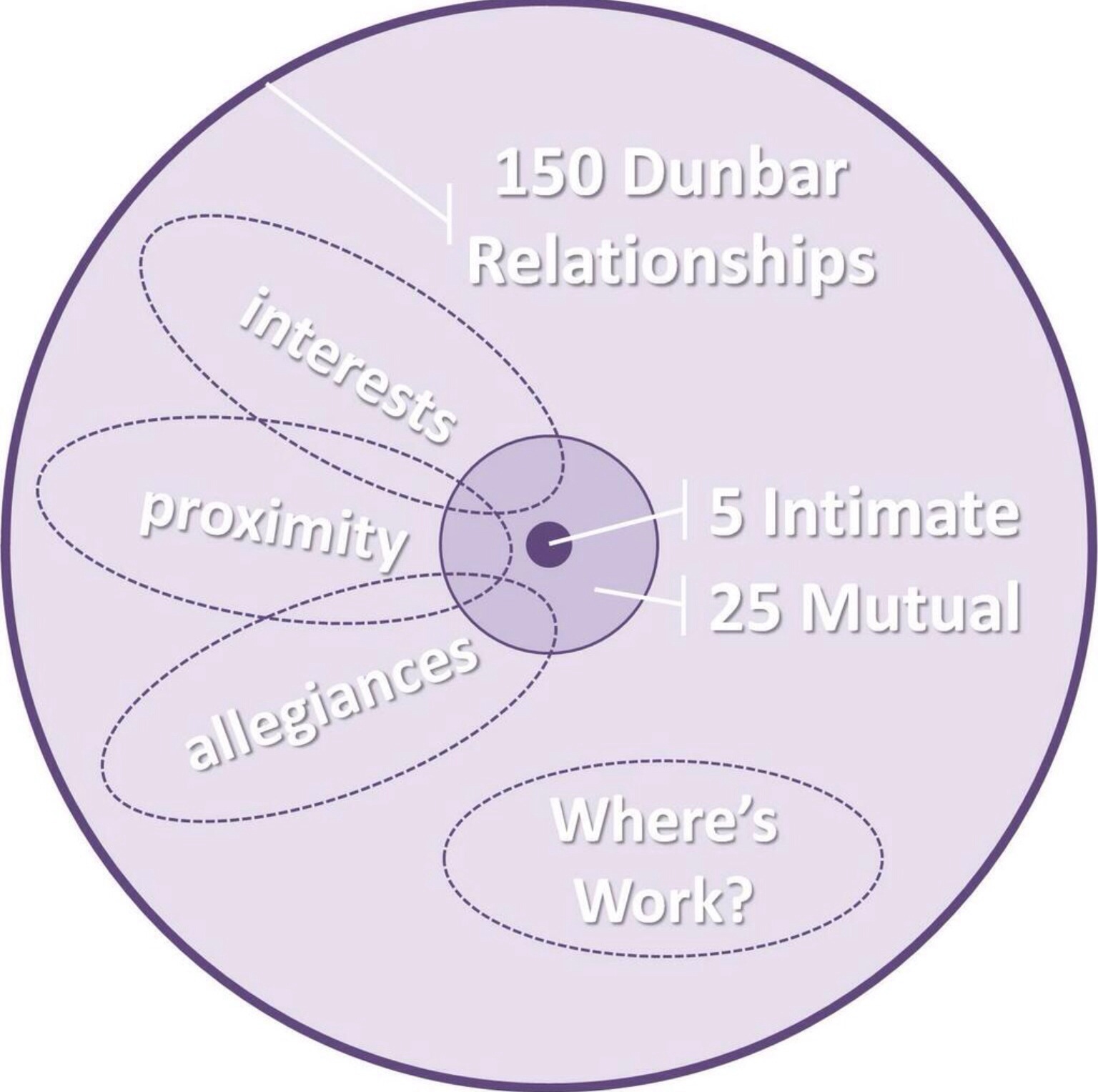 This graphic from Matt sums up things very nicley.
 What's the PONT
Leave a reply to Frank Sidebottom, 150 Swedish tax inspectors and some physio | weeklyblogclub Cancel reply