When does a Desire Path become a path of necessity? Not just something you choose for convenience.
This is a thinly disguised attempt to share the fact that I’ve been walking along a bit of the Camino de Santiago.
I’ve been told I’ve become the opposite of one of the characters in the film Fight Club.
‘What’s the first rule of Fight Club? You don’t talk about Fight Club!’
For me the first rule of Camino Club is, ‘I don’t shut up about the Camino’.
That’s according to my wife, and she was there every step of the way with me.
A return to Desire Paths. I went through a spell of having a lot to say about Desire Paths.
I even used to photograph examples and share them with like minded individuals on Reddit.
A Desire Path is basically an informal or unofficial footpath that people have created and use in favour of the official, planned and engineered footpath that someone else created for them.
It’s all about convenience, ease and the actual route people choose to take between A to B.
I wrote about them in this post where my focus was on user centred design in Public Services.
I’m not sure how the ‘desire path’ name came into being but other variations have been used to describe the same concept.
Sneckdowns is a lovely example that describes what happens to traffic movement in snow.
Vehicles leave tracks that show where people actually choose to drive rather than where the painted lines, signs and kerbs force them to.
There are some examples of Sneckdowns from Halifax, Nova Scotia in this post where I suggest they are the ultimate combination of user centred design and desire paths.
Convenience over Engineering. At the heart of my earlier posts was a question. Are things being designed with the needs of actual users in mind?
Is this way people would actually choose to do something?
In many respects a desire path is a perfect example of a design failure.
No, people did not choose to use your path, they made their own.
Necessity Paths on the Camino de Santiago. Have I mentioned I’ve been walking on the Camino de Santiago?
Anyway, here’s a picture of a path that’s not so much of a desire path, more of a necessity path.
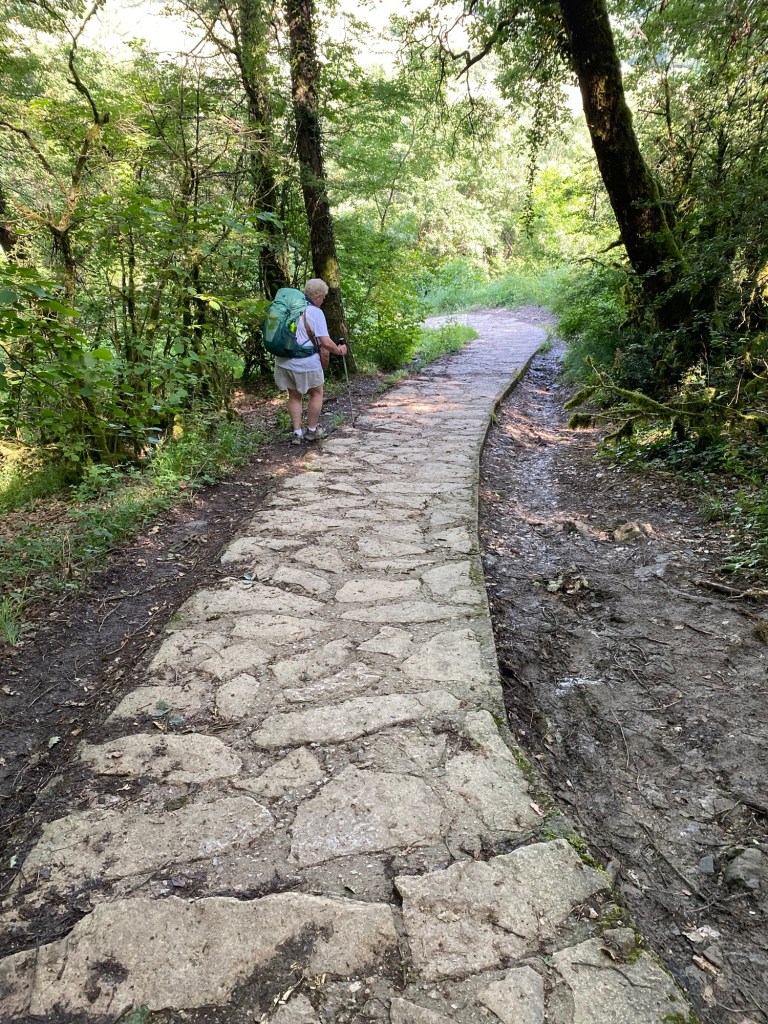
What this picture doesn’t quite convey is that this was a steepish descent and the surface of those stones was wet and slippery.
The Peregrino (because that’s what we call ourselves nowadays) in the photograph is taking their chances in the mud rather than risk the constructed path.
It was a safety choice rather than a convenience choice.
Less desire, more necessity.
To be fair, some cyclists did come past, brakes locked and cornering at the foot of the slope on a wing and a prayer.
Maybe it has actually been designed for adrenaline seeking cyclists?
That’s all I’m going to say on this.
Apart from, if the path had been designed by the people who actually walk along it, it might not have looked like it does today.
In the unlikely event that someone wants to upgrade it, don’t bother.
Spend your money on the descent to Zubiri.
We can live with this one.
The Zubiri descent is an ankle snapper and a morale killer.
Caminitos de Deseo. I’ve gone back to look at some of the things that used to interest me about Desire Paths.
Back in 2014 I found this excellent Spanish video. I encourage you to immerse yourself.
Since 2014 there’s a lot more You Tube material on Caminotis de Deso, with quite a bit of singing.
It’s got me wondering if ‘Desire Path’ did originate in Spain?
Walking long distance paths like the Camino de Santiago is a culturally embedded thing.
In some ways it’s like the meta path all others spring from.
I’ll stop now.
So, What’s the PONT?
1. What people actually want and designers actually design are often different. Desire Paths show that clearly.
2. Literally walking in someone else’s footsteps will give a designer a good understanding of what is required.
3. If anyone is thinking of upgrading that steep slippery paved path between Zubiri and Pamplona, don’t. Spend your money on the descent into Zubiri.
 What's the PONT
Leave a reply to June 20, 2025: desire lines – Chris Corrigan Cancel reply