Would you trust this person?

I’m running a workshop on Trust in 2 weeks time. This is a post to:
- Get my thinking straight,
- Test a few of the things I want to say,
- Put things down on paper before I forget them.
First things first though. I hope you appreciate the Father Christmas picture? As my concession to joining in with the seasonal vibe I’ve taken on a new part time job.
For reasons beyond my control I’m spending a fair bit of time dressed up as Father Christmas. Dispensing good will and chocolate. So much so that I’m thinking of changing my LinkedIn picture to the above. Now that might be a wheeze…
Trust: A system perspective.
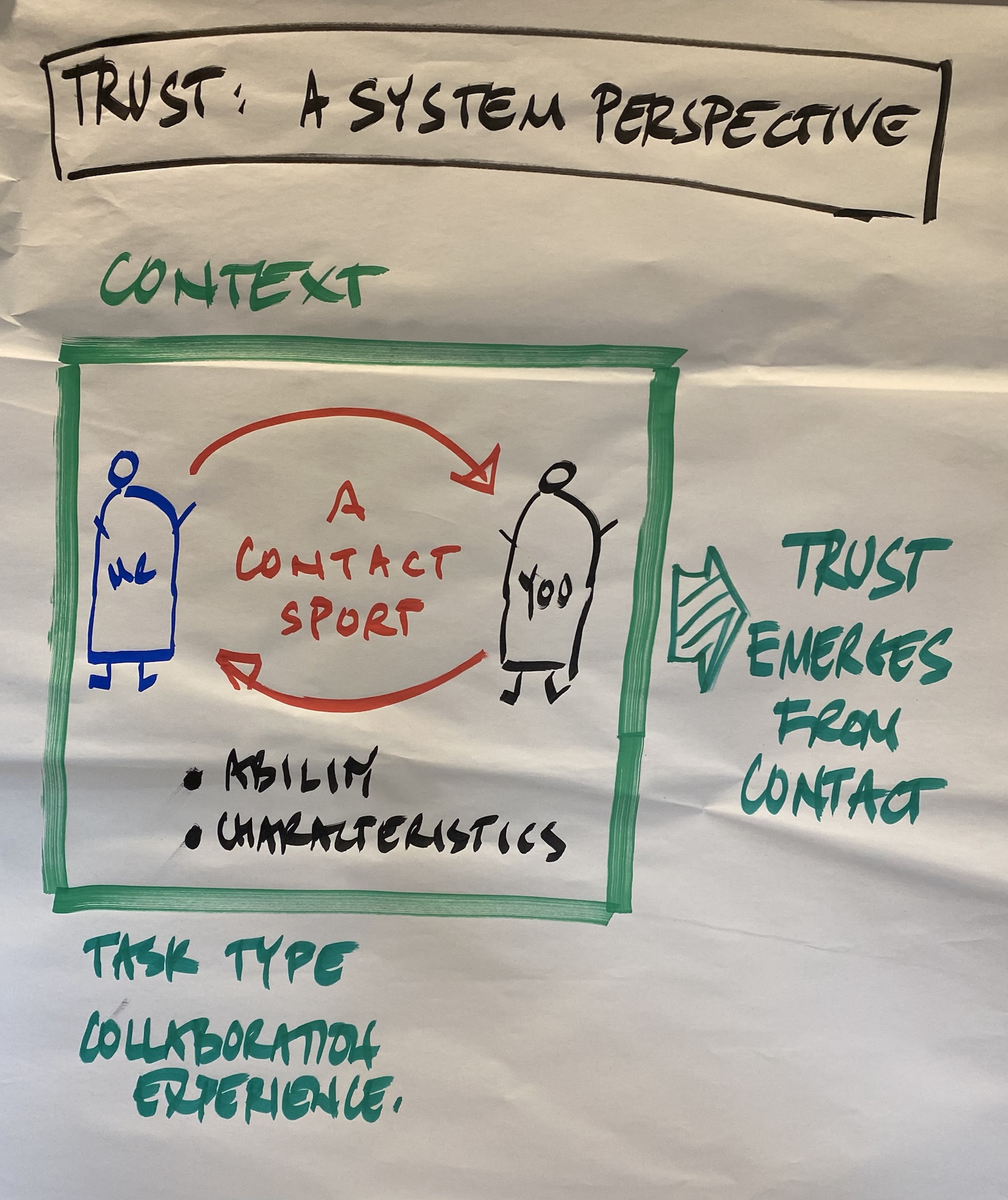
The other purpose of this post is to share the diagram of the framework I’m using in the workshop.
The workshop is taking a systems perspective on trust, a complex adaptive systems perspective to be specific. Which I need to explain.
Basically, lots of the ‘how to build trust’ explanations I’ve encountered talk about what you, me, and individuals or organisations needs to do to become trustworthy.
From a bit of searching online I’ve been overwhelmed by ‘pillars of trust’, ‘trust wheels’, ‘trust triangles’ and words in all sorts of imaginative shapes telling me the behaviours and values I need to ‘grow’ to become more trusted.
That feels a bit ‘one sided’, it’s not just about me… is it? There’s got to be more?
Trust where you get your information about trust.
I’ve based what I’m saying here on some solid academic research, Have a look at How and why humans trust: A meta-analysis and elaborated model by P.A.Hancock et al, published in Frontiers in Psychology 2023.
What I like about this study is that it is a ‘meta – analysis’. Basically they are looking at what has been published on the topic and picking out the good stuff. Proper Academics and Researchers doing proper reliable, trustworthy stuff (unlike lots of AI slop).
What is also reassuring (to me) is that out 2000 potential papers on the subject, only 338 passed the sifting criteria for inclusion.
Before I dive into my summary, I just want to apologise for any over-simplification. I’m just trying to get a concept across.
De-romanticising trust. As an antidote to the sugar coated, values heavy, trust quotes I’ve been overwhelmed by on LinkedIn, I’m using this definition from the academic paper: Trust is: “an individuals calculated exposure to the risk of harm from the actions of an influential other”.
Not an ounce of flufflyness or ambiguity there…
Trust: A system of 4 parts.
Here goes… trust is influenced broadly by 4 things; The Context, The Players (people / organisations) that need to trust each other – ME and YOU for the purposes of the drawing, and Contact. I’ll explain each part as if I am drawing the diagram.
Context is everything. The nature of trust will hugely depend upon context. There’s a big difference between buying a cup of coffee and investing 100’s of millions to acquire a company. The degree of thought put into the trust ‘calculation’ will vary accordingly.
The meta-analysis talks about 2 things at play around context, the task and experience of collaboration.
On a personal level, the context of a first date will be very different to a proposition of marriage. I hope you get my drift.
- Task. The size, duration and difficulty of the task matters. For big, long term complicated things, there’s more at steak.
- Collaboration. There’s a lot at play here but things like physical proximity, familiarity with the other party and a shared understanding / or common culture all have an influence
Context really does matter with trust.
My Character and Abilities (Trustee). This is where lots of trust material I’ve encountered focusses.
- Competency. Am I competent to do what I say? Are my abilities a match with what you require? Am I predictable and reliable and actually do what I say?
- Character. Do I have a ‘good’ reputation? Like it or not, things like race and physical appearance will feature in decision making for some people. There is also some thought that if you ‘like’ someone, you will trust them more than those you don’t (think about it).
Your Character and Abilities (Trustor). This is important. It is always worth thinking about where the other people are ‘coming from’. If they come from an organisation where nobody trusts anyone, that’s a different proposition to a highly collaborative, high trust organisation.
- Competency / Ability. Are you used to and experienced in taking risks and trusting people?
- Character. As with the Trustee; age, gender and attractiveness do have an impact. Things like self confidence also play a part.
Contact. You can have all these things in play, but, unless someone does something nothing happens. To use a football example, someone has to kick the ball off the centre spot.
The point is that trust emerges from those actions between Trustee (Me) and Trustor (You). A process of social contact, that influences what happens next.
Trust is built through micro-interactions. Apologies for the LinkedIn speak, but it does make a useful point.
Ages ago Dave Snowden said something to me along the lines of “you build trust by doing trustworthy things”, which I wrote about in ‘What’s the First Rule of Organisational Trust Club?’
Reflecting on the diagram I’ve drawn from the meta-analysis I think there’s an interesting fit with complex adaptive systems and the Cynefin Framework.
The social contact and ‘micro-interactions’ are about probing, gathering data, making sense of it and responding. Exactly what you do in a complex situation.
I should say more, but that’s for another post.
So, What’s the PONT?
1. Will this make any sense in a workshop on ‘how do you earn trust?’
2. Is there enough information for attendees to develop some responses to case studies on earning trust?
3. Should I change my LinkedIn profile picture and experience to reflect my temporary (part time) job status?
 What's the PONT
Leave a comment