Have you ever been to an engagement /consultation/staff development day and been asked to write down your ideas on ‘post it notes’ and then stick them on flip charts?
Someone then dutifully collects the forest of paper and promises to type them up and share the results.
Months later you get sent a document full of random bullet points that mean very little to you. Somewhere amongst the mess your brilliant idea is buried…..lost, forever.
There are similarities here with Crowdsourcing and the idea that ‘you have to move a lot of muck to find the golden nugget’. Asking a number of people to contribute ideas, even as part of an ‘engagement’ day, is a type of crowdsourcing. I reckon there are things that could be learnt from successful examples of crowdsourcing and applied here. Before that, it’s worth a look at how some brilliant ideas were originally rejected (even the Apple personal computer!).
Brilliant ideas that were originally rejected.
A quick internet search of ‘brilliant ideas that were originally rejected’ generates an impressive list of everyday products and services that were originally rejected. This list on greekchat.com might whet your appetite if you want to research some of the astonishing examples. A few of my favourites:
- “This ‘telephone’ has too many shortcomings to be seriously considered as a means of communication. The device is inherently of no value to us.” Western Union internal memo, 1876
- “Louis Pasteur’s theory of germs is ridiculous fiction”. Pierre Pachet, Professor of Physiology at Toulouse, 1872.
- “So we went to Atari and said, ‘Hey, we’ve got this amazing thing, even built with some of your parts, and what do you think about funding us? Or we’ll give it to you. We just want to do it. Pay our salary, we’ll come work for you.’ And they said, ‘No.’ So then we went to Hewlett-Packard, and they said, ‘Hey we don’t need you. You haven’t got through college yet.” Apple Computer Inc. founder Steve Jobs on attempts to get Atari and HP interested in his and Steve Wozniak’s personal computer.
So what has this got to do with Crowdsourcing?
In the recent post about crowdsourcing I used examples from Dell IdeaStorm and the Gulf of Mexico Oil Spill. One of the points I made was, that for Dell, there is a ratio of roughly 1:37 of ideas implemented to ideas submitted. In the case of the Gulf Oil Spill this was 1:1433. A bit like the ‘lost’ post it note in the engagement day, what are the chances of a brilliant idea being buried in the 1432 rejected? (In fact over 42,000 ideas were rejected).
This is a tricky situation to handle. How do you make sure the brilliant ideas don’t slip through the crowdsourcing net? There is no easy answer, but here are some thoughts based upon what I’ve learnt.
- Don’t throw anything away. Based upon the idea that there is ‘no such thing as a bad idea’, keep hold of everything. Treat them like precious gems and store them carefully.
- Let people see the collection. This serves many purposes one of which is to reassure people that their idea has been acknowledged. The ideas collection can provide inspiration for new ideas and learning from previous attempts. There is a lot that can be learnt from recovering ‘lost corporate memory’ and having the equivalent of a ‘museum of failed products and ideas’ to browse.
- Let people interact with the collection. Allow people to comment on ideas. If lots of people have a similar idea, allow them to work together to turn it into reality. The voting and commenting approaches seen in Dell IdeaStorm are a great way of testing ideas amongst a a community of experts and peers. Before the organisation tries to do something with the idea, it has had some robust evaluation and feasibility testing. Making this activity open and visible to all is essentail.
- Keep looking at the ideas. Remember that context is important. Circumstances change. Technology develops, materials become cheaper, attitudes change. A completely wrong idea from a few years ago might be brilliant today.
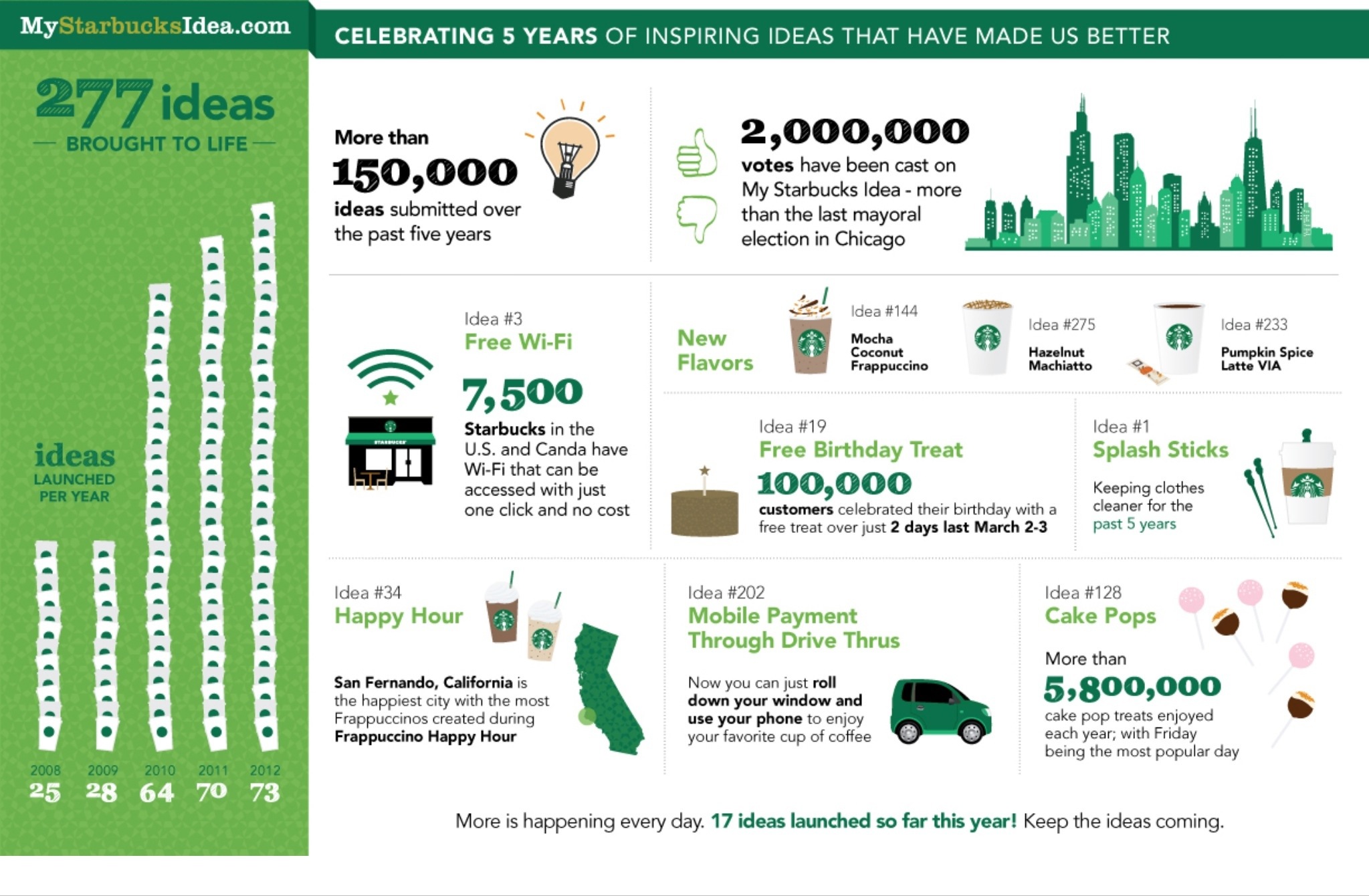
- Implement some ideas, and tell people. This sounds obvious, but it is good to see progress. Have a look at the MyStarBucks graphic which summarises the first 5 years of the scheme. This must help with keeping people motivated and involved, the ideas submitted to MyStarbucksIdea have certainly increased year on year.
Is there no such thing as a bad idea?
I have to say, “you don’t know until it’s been looked at … properly… which might involve trying it out”.
From the point of view of crowdsourcing, this means keeping hold of EVERY idea, and letting the crowd look at what is there. The benefit of the crowd extends beyond just coming up with the ideas, they can help to manage, refine and implement the ideas. Just as relevant to the ‘massive online social media driven commercial product’ as it is to the ‘post it’ notes from the staff development day.
So, whats the PONT?
- Ideas are like precious gems, you need to look after them, put them on show and polish occasionally.
- In addition to generating ideas, crowds can help to manage and implement them.
- There is no such thing as a bad idea, until you’ve had a good look at it….. this could take long time.
Picture Source:
MyStarbucksIdea: Graphic.http://www.businesswire.com/news/home/20130328006372/en/Starbucks-Celebrates-Five-Year-Anniversary-Starbucks-Idea#.Usk5QqWwird
 What's the PONT
Leave a comment