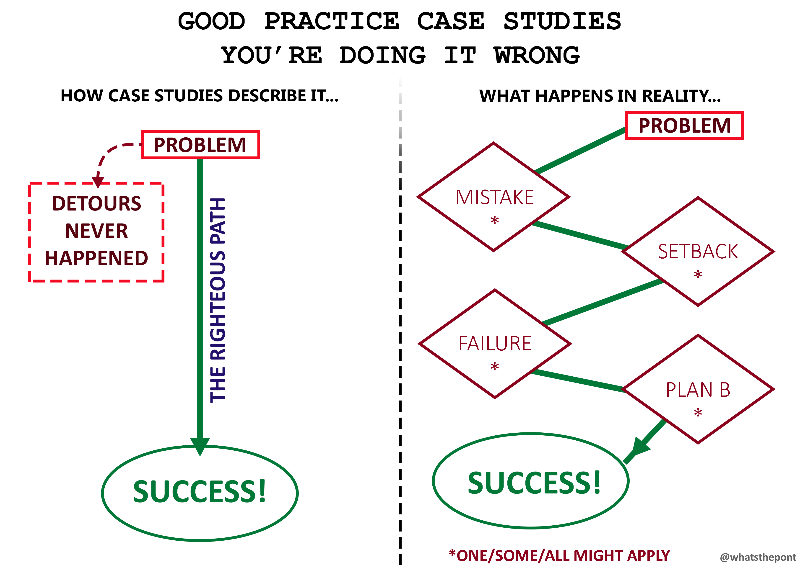
 Good practice case studies are like Hollywood movie trailers…… they only show you the best bits of what happened (with some exceptions).
Sorry if that’s upset anyone, I am trying to be helpful.
There is a great deal that can be learnt from the things that ‘didn’t quite go to plan’ (failure in many cases). However, in most examples you don’t generally get to find out about these golden nuggets of learning.
That’s a Bleak View of the World. Well, I do go to a lot of conferences and seminars, where I listen to lots of people presenting their good practice case studies. I also read lots of case studies on a variety of topics (for good reasons, it’s not an obsession or anything).
The one thing that strikes me about ‘Good Practice Case Study Land’ is that,……Nothing Every Goes Wrong!
OK, I’m exaggerating a bit, but things hardly ever seem to go wrong in case studies, particularly when they are written down and presented at a big conference, or even a modest workshop with colleagues. It’s not quite the world I experience where mistakes, errors and deviations are part of everyday life.
I’m not suggesting that the people who are presenting their ‘perfect’ good practice case studies are fibbing, or are committing any sort of terrible crime. To use the Hollywood Movie analogy, the case studies are just a ‘trailer’ for what actually happened.
When you condense weeks, months or even years of work down into 800 words or 15 minutes on stage you have to leave things out. Dropping the less glorious events (things that didn’t quite work to plan) feels like a very reasonable thing to do.
Did anyone suffer? The point I’m trying to get across is that by not including any of the things that didn’t work (or failed), we aren’t helping people who might want to learn from our experience. if they don’t know about our pitfalls, mistakes and failures, they will probably make them themselves. I think it would be nice if we saved them some suffering.
An unexpected benefit could be ‘helping’ those people who seek, ‘simple quick fixes’, understand that transferring good practice might be a little more complicated in reality. You might have experienced one of them, racing back from a conference (literally, in the car talking excitedly over the phone) insisting on the implementation of some latest ‘good practice’. Not fully recognising some of the complex issues (and failures) that sit behind the 15 minutes of highly polished case study they have experienced. If you are ever on the receiving end of some of this behaviour just ask, “……did they mention any failures or setbacks?”
So, what’s the PONT?
- Good Practice Case Studies are like Hollywood Movie Trailers – they show the best bits and there’s usually a lot more going on.
- It’s rarely a straight line from problem to solution. Failures and mistakes happen, which are golden learning opportunities – we need to share them.
- If you are presenting a good practice case study, do introduce some failure. People might like you more – honestly, it’s called the Pratfall Effect.
Disclaimer. For Matt Wyatt’s friend Gareth (who works on Oracle programming in the basement), the sequence in the graphic of things going wrong is not prescribed. It is only an illustration. These are things that might happen. You could have; just one of those things (an almost perfect project), all of those things, or 77 of them in a long line (a bit like Edison’s 1000’s of lightbulb attempts). It’s just to get the idea across. Apparently though there is a formula for failure and success in IT startups, mainly in California. Thanks to Dave Snowden for sharing this. For a successful Digital Startup you need to:
- Socialise the Idea (talk to people about it),
- Fail 3 times,
- Pivot (a sort of Plan B / do something completely different), and
- Success!
Finally: Thanks again to Matt Wyatt who put me onto this; Honest Trailers on You Tube by Screen Junkies. A warning….. you can easily lose hours of your life watching these ‘Honest’ Trailers for Hollywood blockbusters. Some of my favourites; The Hunger Games, Aladdin and Love Actually (link below).
These Honest Trailers helpfully remind us of the gap between the ‘glossy promise’ of the trailer and the actual reality of the movie. A bit like many good practice case studies. While you are enjoying them, have a think, do you have any examples of good practice case studies where the reality wasn’t quite as glossy? (please let me know).
 What's the PONT
Leave a comment