
This is not as tenuous as it sounds. Have a glance at the image above and ponder on this. It was originally drawn in the early 2000’s by Jeff Bezos, on a paper napkin. Described as the ‘virtuous cycle’ its been at the heart of Amazon’s approach, and part of them becoming one of the biggest companies in the world (in less than 20 years). You might not like some of what Amazon does, but there has to be ‘something’ in this ‘virtuous cycle’.
You might now be asking, “what has this got to do with learning and COVID-19?”. More specifically, what has it got to do with a Rapid Learning Engine? Let me try and explain.
Never waste a good idea (even if it’s someone else’s). A few years back, over a beer, I was explaining the Amazon virtuous cycle to my friend Clover. We were in a relatively posh pub (Y Mochyn Du), with paper napkins, so I was busily scribbling away. Clover loves that sort of thing, and might have even kept the napkin. What I was pitching to Clover was along the lines of “we could adapt this Amazon approach to share good practice across Wales”. Well, that idea never got beyond the pub front doors, but I am persistent. I never like to waste a good idea – even if it is someone else’s.
So what is the Amazon Virtuous Cycle? If you want a detailed explanation you can read ‘Amazon’s Virtuous Cycle in a Nutshell from FourWeekMBA.Com. Alternatively have look at the video below from Jeff Wilke, CEO of Amazon Worldwide Customer.
The ‘paper napkin’ sketch I copied at the start of the post, is fairly self explanatory. This ‘simplicity’ is claimed to be one of the great benefits of the approach. Something that can be sketched on a napkin, easily understood and shared. Here’s my explanation:
- Start with Customers and give them a great experience.
- This will ‘bring them back’ and hopefully people they talk to.
- More customers (more traffic) will attract more sellers.
- More sellers, equals a bigger selection of things to buy, which helps improve customer experience.
- Repeat the cycle.
This creates a ‘virtuous circle’ that continues to rotate with growth at the center of rapidly spinning ‘flywheel’. A consequence of growth is reduced costs of ‘running’ the flywheel, which can be passed on to further improve the customer experience. Other consequences have been the development of The Kindle and Amazon Web Services. It’s that simple!
So how could this apply to COVID-19 learning? Being able to clearly explain an approach always helps to get an idea off the ground. The Rapid Learning Engine hexagon below has emerged since this post, ‘is anyone deploying ‘Innovation and Learning’ people alongside COVID-19 Response Teams?’ There are a few assumptions that underpin this as a model of rapid learning.
- Useful knowledge exists in the world.
- This knowledge isn’t evenly distributed. Some people can’t access it because they are too busy, don’t know where to look, its too hard to get – lots of good reasons.
- Many people would find it useful to have access to this knowledge.
- Something that gathers together the ‘good stuff’ and provides some insight would ‘add value’.
- Provide this sort of knowledge and people will come back for more (they will also tell their friends about it).
- If people are engaging, you can also ask them to share what they know. This adds to the ‘knowledge store’.
- A bigger (and better) knowledge store attracts more people to engage and share.
- It’s as simple as that.
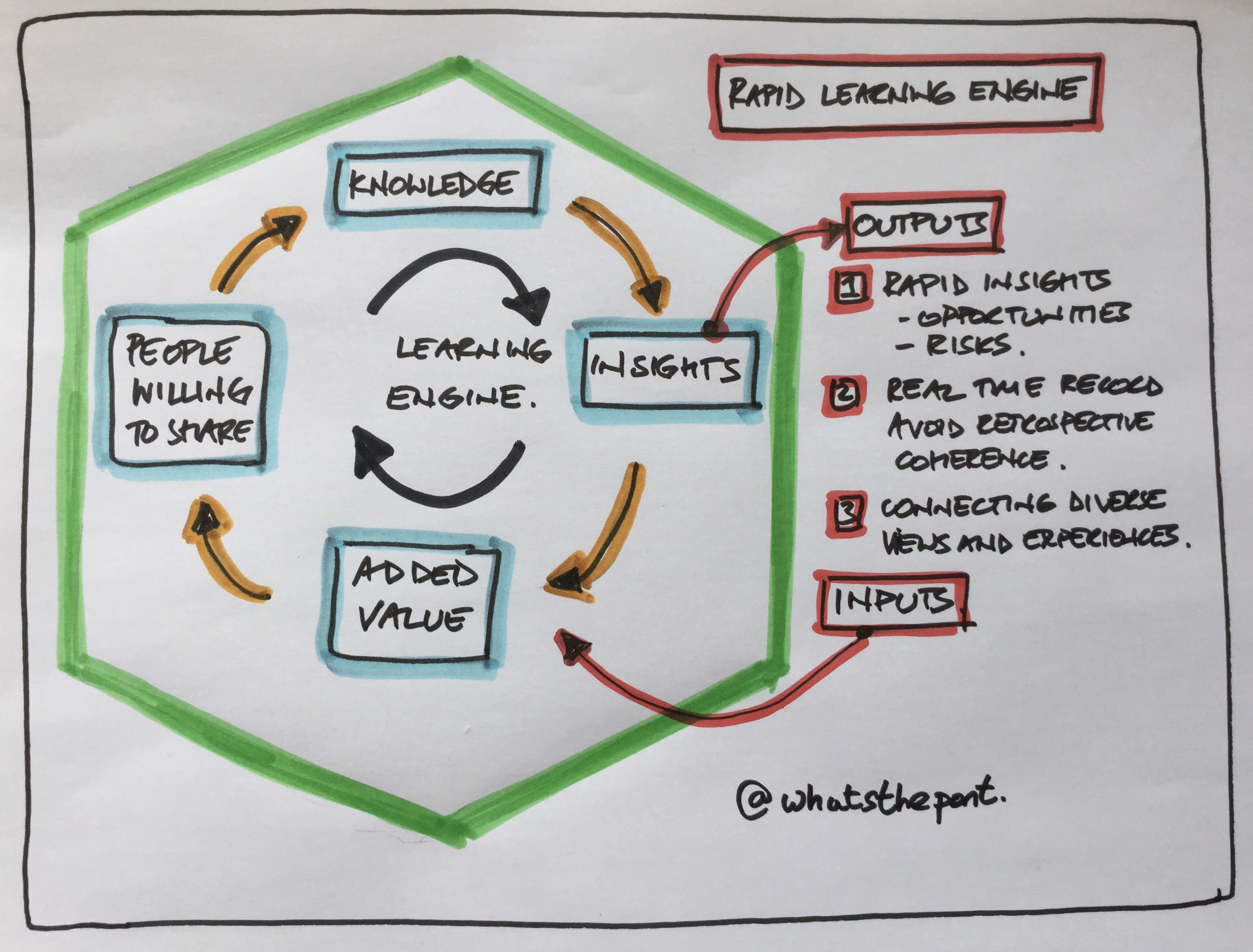
Thanks to Toby Lowe the approach has been given a name, Rapid Learning Engine. You can see explaining how it developed on this Northumbria University webinar about Human Learning Systems organised by Toby and Andy Brogan from Easier Inc.
Easy to Say, Hard to Do. Inevitably I’m going to quote Dave Snowden here – it wouldn’t feel like a proper Whats the PONT blog post if I didn’t. In this post on Rendering Knowledge (The 7 Principles of Knowledge Management) the first rule is: “Knowledge can only be volunteered it cannot be conscripted.”
Basically you cannot ‘squeeze’ knowledge out of people’s heads. They have to be willing to share what they know. You probably aren’t going to get a great deal of useful material if they don’t like or trust you.
This can be a bit of a problem if you are trying to gather information to fuel your Rapid Learning Engine. In a low trust, low sharing environment the engine it isn’t going to ‘spin’ very effectively.
Building trust and an open approach to sharing knowledge is a core requirement. Knowledge transfer is a social process, its a contact sport.
Beware of Silver Bullet Syndrome. I’ve been a bit twitchy about writing a post on the Amazon Virtuous Cycle and the Rapid Learning Engine. Firstly, not everyone loves Amazon and secondly, Silver Bullet Syndrome.
One of the things I’ve gone on about at length is the activity of picking up something that has been used elsewhere and applying it to your own situation, with the hope of similar success. You can have a read about it here in The Life Cycle of a Silver Bullet.
On the other hand, I might just be practicing a bit of exaptation. Taking something that was developed for one purpose (selling things online) and using it for a completely different purpose (rapid learning). I’d like to think I’m in the world of exaptation, others might think differently.
So. What’s the PONT?
- The paper napkin test is a useful measure. Is what you are trying to explain so clear and understandable that you can sketch it out on a paper napkin?
- Knowledge transfer is a social process built upon trust.
- The Rapid Learning Engine is built on trust. The greater the trust, the more rapidly we share knowledge.
 What's the PONT
Leave a reply to ComplexWales Cancel reply