Emplotment. Monday morning I learnt a new word before breakfast; emplotment.
I was reading The Compositor Removed by Dave Snowden which returns to the thorny topic of organisational storytelling.
Dave talks about how ‘storytelling frameworks’ and jobs like ‘Chief Storytellers’ have altered (and degraded) long established human storytelling practices.
The organisational storytelling approach steps away from authentic, natural human storytelling and into a ‘structured’ space where the message is constructed or curated. Often the organisation is painted as the ‘hero’ at the centre of the story.
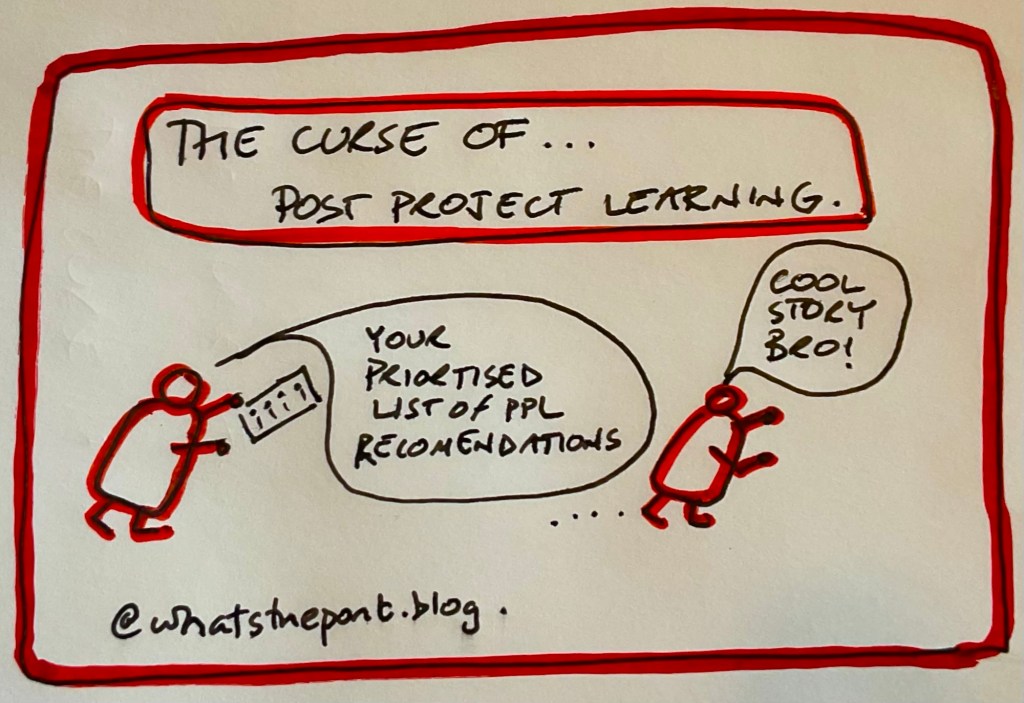
I’d recommend reading Dave’s post, or if you fancy something more shabby here’s Cool Story Bro, me expressing my dismay about some terrible corporate storytelling I experienced at a conference a few years back.
Hello French Philosophers … bien sur, of course there had to be a French Philosopher somewhere here in the mix.
Paul Ricœur is credited with having named emplotment as: the process of arranging a chronological sequence of events into a meaningful narrative with a plot.
Emplotment often transforms a list of things that ‘just happened’ into a coherent story.
It focuses on interpreting historical, personal or societal events by selecting significant details and organising them into a structured, understandable story.
For me, the key words here are; selecting, organising, meaningful, understandable, plot and story.
The leap to Post Project Learning (PPL). You might be wondering how I’ve connected employment and post project learning.
It’s fairly straightforward in my head.
PPLs are basically about finding out what happened, making sense of the facts and thinking about what you’ve learnt.
The purpose of the exercise is to get people to do more of the good stuff and less of the bad stuff.
The degree to which any of that (doing good/bad stuff) happens depends in part on how much ‘meaning’ the recommendations have to the people who do stuff.
This is where emplotment comes in, which I will try to explain.
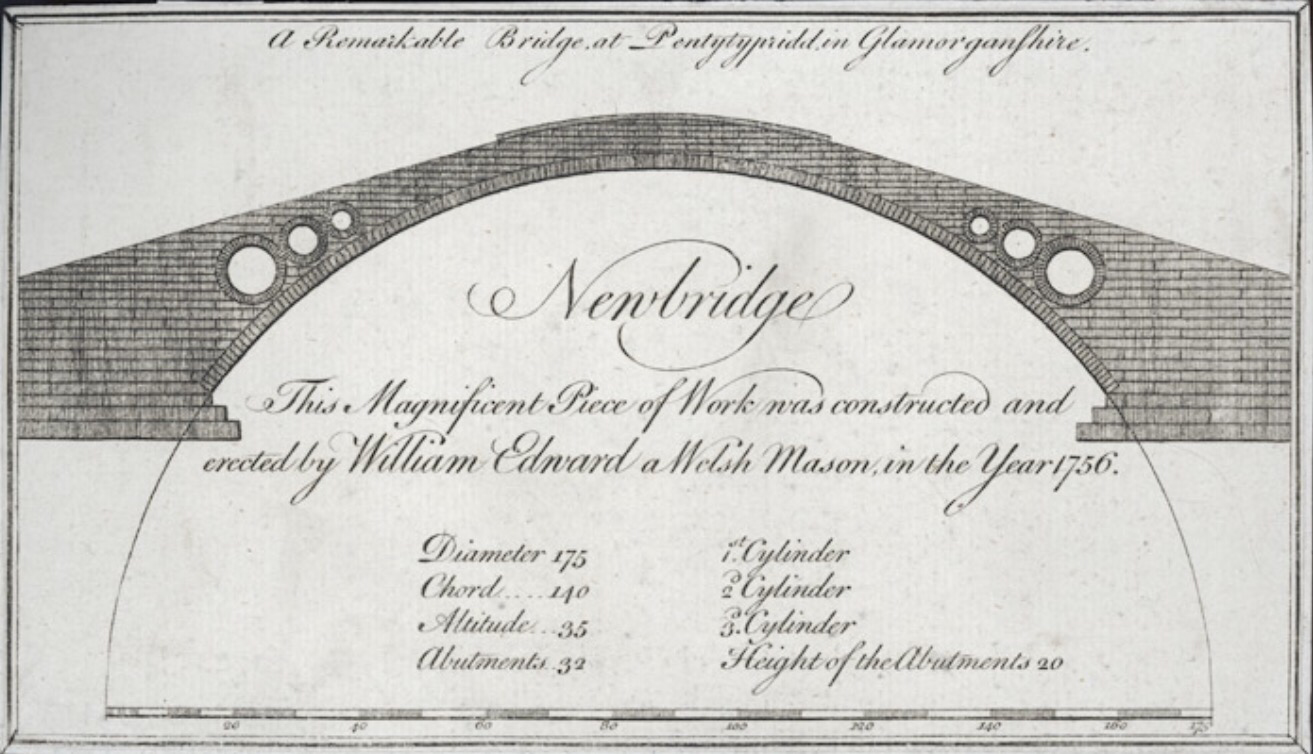
First though, an example of emplotment I borrowed from Keith Grint.
Who’s never curated a PPL? Look back at the words I picked out earlier (selecting, organising, meaningful, understandable, plot, story) and ask yourself this question (particularly facilitators)…
“Have I ever been part of a PPL where the outputs have been curated to get a specific point across? Telling the story of what happened…”
If the answer is yes or sometimes, I’m ok with that – up to a point.
If the purpose of the PPL is to help people do more good stuff and less bad stuff, and if curating the story to create meaning and understanding helps, then that’s ok.
But, it’s not ok when the curation is manipulated for other purposes – like pushing a false narrative or painting the organisation or leadership as heroes.
This is essentially the curse of emplotment in PPLs. It serves a useful purpose, but is easy to get wrong.
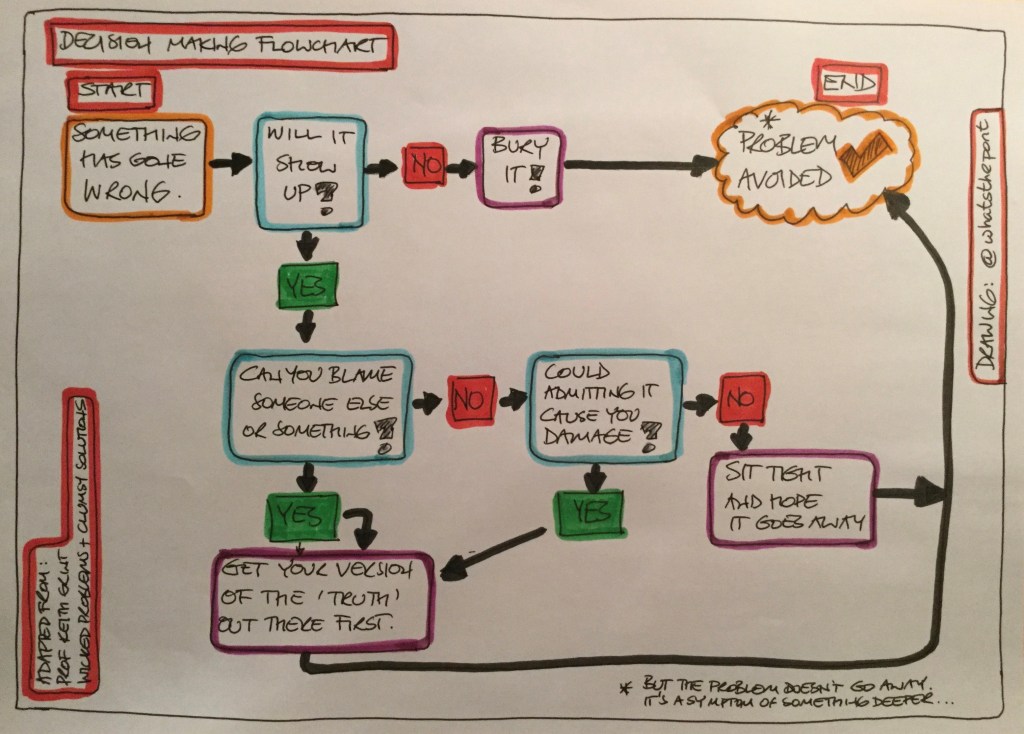
Bury or ignore anything that attracts blame. Going back to the flow chart graphic borrowed from Keith Grint there’s a key point about failure and blame.
In lots of organisations, if something goes wrong the first instinct is to bury the evidence and avoid blame. In many PPL exercises this behaviour is repeated.
Where things have gone wrong, that piece of the jigsaw is often conveniently overlooked, or ‘blame’ apportioned elsewhere.
I don’t think I’m speaking heresy here.
If emplotment and the motivation to avoid blame overlap in a PPL exercise, I think you are properly in ‘cursed’ territory.
So what to do about it? There are many things to suggest here. First would be to go and read many things Dave Snowden has to say on the matter.
Epistemic justice is an important concept here. Who decides the ‘meaning’ in what I am saying?
Is it me, or is it a curator or facilitator that is doing it on my behalf; the ‘emploter’.
Personally, I know what I think, and I’d rather do that ‘meaning thing’ myself, thank you very much.
This also from Dave Snowden on Narrative and Epistemic Justice is another place to find out more.
I’m probably going to return to this subject over the next few weeks.
I’ve been asked to say something about using story to bring data to life in a Board setting.
So I’d better get my story straight…
So, What’s the PONT.
- Post Project Learning exercises are important. We need to learn how to do less of the bad stuff and more of the good stuff.
- Emplotment can help with moving from a list of bullet point recommendations to a convincing story that means something to people.
- But be aware; emplotment, curation and facilitation can lead to missing things out and painting a picture that isn’t true for those who were actually involved. It’s potentially a curse that needs to be handled thoughtfully.
 What's the PONT
Leave a comment