I’ve had six conversations about innovation this week. Broadly summarised by the following quotes:
“Necessity is the mother of invention” Plato (apparently)
“Every revolution evaporates and leaves behind only the slime of a new bureaucracy” Franz Kafka.
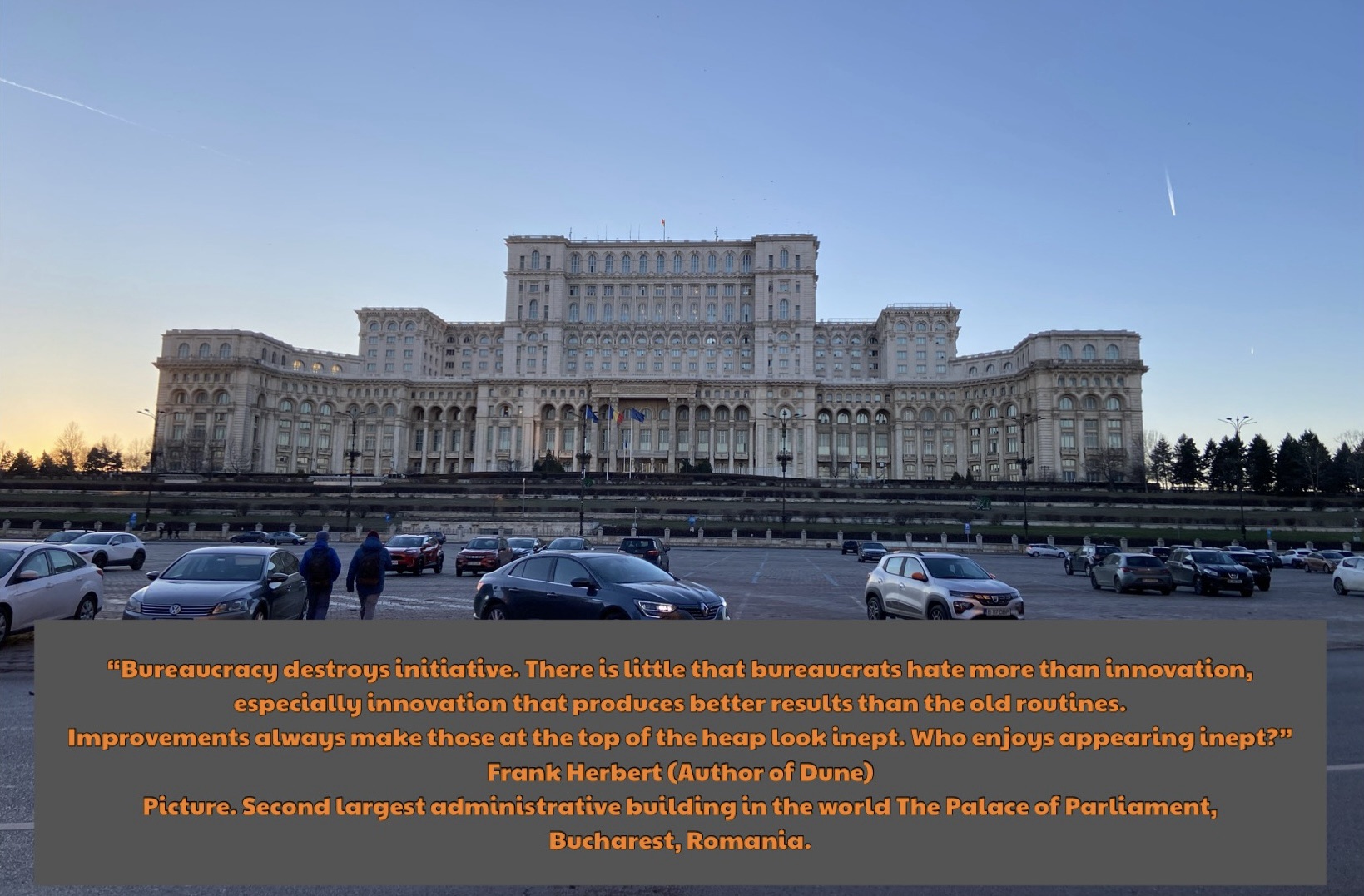
“Bureaucracy destroys initiative. There is little that bureaucrats hate more than innovation, especially innovation that produces better results than the old routines. Improvements always make those at the top of the heap look inept. Who enjoys appearing inept?” Frank Herbert, Author of Dune

Necessity is the mother of invention. I don’t want to dwell on this because it seems too bleedin’ obvious. Most people seem to recognise it as a truism which you can read about on Wikipedia. However, if you look into many bureaucracies the principle seems invisible.
Dave Snowden introduced me to the concept of exaptation, people innovating by using things for a purpose they weren’t intended for. There are some brilliant examples of innovative uses of plastic bottles, bags and shopping trolleys on the Thai Flood Hacks. Link here if you’re interested.
Revolutions that end up in Bureaucracy. This post was going to be about my recent experience of a cruise ship. The ‘house band’ were knocking out punk anthems and rock songs from my youth in a smooth jazzy style… (I kid you not).
I was in a bit of a state of distress at spoiled precious memories but on the other hand, at least they were keeping them going. Which is where the Kafka quote comes in. Is this where everything ends up? From revolution to bureaucracy; order, standardisation, control and management (until the next revolution)? At one level it feels inevitable and part of the circle of life.
Bureaucracy Kills Innovation. Getting back on track, I’ve been waiting a while to use the Frank Herbert quote, and I’m still not quite sure. I reckon that many (possibly most) bureaucracies do a pretty good job at killing innovation. Paul Taylor reminded me of a post I wrote over 10 years ago about Idea Antibodies. Something like an immune system that exists in organisations to ‘kill’ new ideas.
The point in the Frank Herbert quote that “Improvements always make those at the top of the heap look inept. Who enjoys appearing inept?” rings true. But not everyone at the ‘top of the heap’ is insecure or frightened to look like they don’t have all the answers (I hope). But where does this leave us? Does being in a big / bureaucratic organisation mean that innovation is dead?
Tumbleweed moments. Just before I get to any resolution, here’s another quick story. Back in 2021 I was on the fringes of a group designing a new Innovation Strategy (bureaucratic process).
I was asked for some thoughts and after carefully composing myself I said the following…
“The six moths between March and September 2020 (Covid) we were the most innovative we’ve ever been. People have told me that their ability to successfully innovate was party driven by the need (necessity) and mostly by the fact that they weren’t over burdened by strategy, bureaucratic processes and regulation. Do you need to consider that learning in your strategy?”
Anyway, there was a tumbleweed moment that lasted for what felt like 2 hours. Eventually someone piped up with a question about ‘how do we handle issues of intellectual property and commercialisation of innovations that are developed?’ Everyone got into the detail of discussing intellectual property (Process Stage 3, Step 6, Guidance Document 4, Paragraph 15.2), my question was forgotten and I was never invited to future meetings.
Bureaucracy getting it right? Over the years I have seen examples of big organisations doing effective things around innovation. From creating an environment that supports people to develop ideas, share them and turning them into actual innovations. One of the area’s that often surprises people when I tell them about it is the UK Ministry of Defence. The MoD GEMs scheme open to over 250,000 MoD Staff generated innovations that had a ‘return on investment’ of up to £20million a year. So innovation can be delivered within a huge organisation (bureaucracy).
My knowledge of GEMs is a bit dated, so I’m going to a session with IdeasUK on the 20th February (link here) to find out about the RAF Astra Scheme . An ideas / innovation scheme which aims to “unleash the ingenuity of our people to deliver meaningful change across the RAF”. I’m looking forward to seeing an alterative to the Dune World of Frank Herbert.
So, What’s The Pont?
- Necessity is the mother of invention, we’ve known that forever.
- Revolutions (radical new things) can stabilise into order and control as new bureaucracies form.
- Bureaucracies do tend to kill innovation – unless there’s a conscious effort do something meaningful and effective that unleashes the ingenuity of people.
 What's the PONT
Leave a reply to John Wade Cancel reply