
• A while back when I was writing Kaizen! Toast v Beer, Who Wins? I came across this quote “continuous improvement is the result of continuous involvement”. I couldn’t remember where and ended up  searching absolutely loads of websites offering advice on Kaizen, Lean manufacturing and employee engagement, including a few where you can buy it as a motivational poster (Amazon $33.99).

    As good as the quote is, I’d like to add in passion, West Midlands style, Ricoh in Telford to be exact.

    Recently I visited the Ricoh factory in Telford as part of an IdeasUK networking event. Ricoh in Telford have a very good reputation, which includes their employee engagement.  Following the visit three things stand out for me about how Ricoh achieve this success; passion, trust and involvement. These factors are all fundamental to their employee engagement and Kaizen continuous improvement approaches.

    Passion. I must admit that ‘passion’ wasn’t something I was expecting to encounter in a photocopier factory somewhere out west of Wolverhampton, but I did, in bucket loads. In fact I met Chris Nicholls the Manufacturing Division General Manager who is responsible for the company value of passion.

    Organisational values in my experience are pretty pointless unless they are demonstrated through behaviours, particularly by leaders. Chris and his Continuous Improvement Team demonstrate passion completely. They have passion for continuous improvement, passion for delivering a better product to the customers and passion for helping the employees do the best job they can. This was totally evident in everything they said and did and rubbed off on everyone they encountered, including visitors.

    Trust. Trust is a word that is frequently used in relation to employee engagement and continuous improvement. Easy to say, but hard to demonstrate. All I’ll say is that the approach I saw at Ricoh was completely based on trusting people. The expression, “you are the expert in your job, we trust you to do it’” was used on several occasions. It was fascinating watching how trust was demonstrated on the factory floor.  People would step in, help others, clean up, move potential blockages and just cover each others backs when they were busy. Total teamwork based on trusting your co-workers. The only other place where I’ve seen this level of trust and teamwork is in a Fire and Rescue Service.

    Involvement. Involving people in their jobs as well as a wider continuous improvement mindset across the organisation is key to engagement.  Perhaps the most striking example I saw was of one of the warehouse workers who was given an award for the best improvement idea that month. That was great, but in fact he’d had more improvement ideas in total than anyone else on site that year. This was remarkable when you consider he was actually an agency worker on a temporary contract. It’s fantastic that you can get that depth of involvement and engagement from someone who’s with you on a temporary basis. So often you hear the opposite about ‘temps’ being disengaged.

    Ricoh in Telford is an inspiring place and Chris Nicholls is putting some material together on the approach to engagement he’s developed there. It’s well worth following what he’s got to say on Twitter @ChrisNicholls12.

    Back to the quote, I know it’s not terribly fashionable to like motivational posters (all a bit 1990’s) but I do like “continuous improvement is the result of continuous involvement”. I think it effectively sums up the link between employee engagement and Kaizen quite nicely. Throw in some passion and it would be perfect. Employee Engagement = Kaizen + Passion.

    So, what’s the PONT?

    1. Continuous involvement (employee engagement) will deliver continuous improvement (Kaizen).
    2. Passion isn’t a word we use, or a behaviour we demonstrate enough in the workplace. Be passionate about what you do and you’ll probably achieve more.
    3. Trust people to do their jobs. They are the experts.
  • I’m just out of my decontamination shower after removing layers of ancient paint from an old sea chest. The chest is lined with an 1878 edition of The London reader of literature, science, art and general information, so there is a fair chance that the paint has a few toxic components, particularly the black base layer. I’m not daft (thanks to all that mandatory Health and Safety training) and know that such a job requires full PPE (Personal Protective Equipment). Full equipped with my mask, goggles, gloves and overalls I’ve been busy sanding the chest this afternoon but failed to pick up on a weak signal that was my eventual downfall and brought the job to a premature end.

    Due to my reduced vision with the goggles I failed to spot the tin of paint sitting on top of the cupboard which was dislodged by the electric extension cable, fell off the edge and straight onto me. Should have had a hard hat as well! I was so busy focussing on the microscopic airborne toxic dust particles that I missed the gallon tin of paint coming my way. Not such a weak signal in the end.

    This event reminded me of another dusty story I was told while I was in hospital with pneumonia last summer. One gentleman had worked in an iron foundry during the 1960/70’s and told me about how they would keep the place cool during the summer heat (not that common in South Wales). This involved removing the asbestos roof sheets to let in a breeze. Yes I did say asbestos; they also had drinking water supplied via lead plumbing. This place had just about every health and safety risk going. Workers had very little in the way of PPE; heat-resistant clothing was about the limit.  There were no dust extraction helmets or positive pressure masks, just eight hours a day of breathing what ever was in the foundry atmosphere. Back to the summer ventilation. Once the roof sheets had been removed, the sunlight would stream in and clearly show up just how thick with dust particles the air was inside the foundry building. The attached picture is far better than the reality he described.

    I was amazed when he told me what the workers did next. When crossing the foundry floor, they would avoid the sunlit patch (full of dust particles) and walk around it. The patterns of where they walked would also change as the sun changed position during the day. The different routes workers took were all clearly visible via the footprints in the significant quantities of dust and other debris on the floor. The dust was everywhere in the foundry, with not so weak signals like a 20mm thick layer of it on every solid surface. Incredible really that it wasn’t until it became obvious that it was airborne as well, that people did anything about it, even if that was actually a futile act of walking around the sunlit patch.

    This was ultimately 19th Century technology (being used in the late 20th Century) where the obvious risks were from physical injuries such as burns or crushing from heavy machinery. The effects of the dust particles on the workers was a not so weak signal that either hadn’t been detected or was just being conveniently ignored.  Interesting how things reverse themselves and this afternoon my over concentration on the airborne dust led to me to missing the obvious physical risk.

    For a much better explanation of weak signal detection and why it’s important, have look at this post from Dave Snowden and this guest post from Steve Holt on the Cognitive Edge site.

    So, what’s the PONT?

    1. In planning for the expected you can often miss or ignore the weak signals.
    2. You need to have wide awareness if you want to detect weak signals.
    3. Its one thing to spot weak signals, but another thing to act upon them (like the foundry dust).
  • The good old expression, shoot the messenger has been around for ages, but it’s still very relevant, particularly to me.

    Basically the (blameless) messenger, bearing bad news receives some form of punishment, just for being the unfortunate individual that delivered the message. Enough said, a pointless act, but it happens.

    Here’s how my situation plays out.  Friday night, out socialising with my wife when I am dispatched to phone the kids and check they are back home safely. My enquiries reveal that there has been an unfortunate incident involving teenagers, illicit drink and an elder brother videoing the embarrassing antics of his sibling which he is now sharing with their peer group. Oh joy.

    I convey the bad news to my wife, “darling, the lads have been a little over exuberant tonight….”  Massive failure on my part, and I end up full of metaphorical bullet holes, and apparently the cause of all the problems.

    So, here is my guide to avoiding being shot as the messenger. As relevant I think to the world of work, as it is to domestic situations.

    Narrow Expectations. Before you blurt out the message, just ask the question: “what were your expectations?” If expectations and reality are massively wide apart expect some gun smoke. This is where your opportunity to manage the message comes in. I’m not suggesting telling fibs, but warming people up a bit and narrowing the expectation gap can be useful.  Alternatively you can just run away, like I should have when I found out my wife’s expectation was that the kids were at the Baptist Chapel Youth Club (on a friday night?).

    Be Process Perfect. Don’t allow anyone to pick holes in your process or actions as the messenger.  There is an interesting phrase ad hominem  which is about undermining something by pointing out a negative characteristic or belief of the person supporting it. I’m talking about the same sort of thing here. Don’t give people the opportunity to undermine you as the messenger by following instructions and process perfectly.  In my case this was a rapidly delivered job. Phone kids (several times), also phone their friends, check in with grandma, make sure nothing is on Facebook, deliver threats about posting on Facebook etc. Quickly return to my wife with the message, without lingering at the bar for a fortifying drink, and most importantly, not having a laugh at the video myself. Perfect, I’ve done as I was told.

    Don’t wrestle with pigs. Because you will just get dirty and the pigs really enjoy it. This expression is attributed George Bernard Shaw  but I’ve seen it used to describe lots of situations. For me the gist is, don’t get involved in arguments or discussions where the other party isn’t prepared to hear bad news, however compelling the facts or evidence. In my situation this meant sticking to a clear explanation of the facts, not justifying anything, not blaming anyone and trying to extract myself as quickly as possible, by offering solutions.

    Disclaimer: I would like to point out that I would never make this wrestling comparison to any discussion with my wife; this is for illustrative purposes only.

    In the end, everything worked out fine. It actually was a bit of teenage over exuberance and we have a whole week of half term (oh joy) for the dust to settle.  Something else far more entertaining, (involving other people’s kids hopefully), is bound to have happened in the meanwhile. I’m sure that some of these lessons could be transferred into the world of work; after all, it’s not that different to dealing with truculent teenagers.

    So, what’s the PONT?

    1. As the messenger who delivers bad news, expect to get shot. So invest in some body armour.
    2. Manage the ‘expectation gap’ and be process perfect.
    3. Finally, under no circumstances wrestle with the pigs!

    “Please don’t shoot the Piano Player –he’s doing the best he can”, is from the 1860’s Wild West.

  • If you make things really easy to do, people will participate, in theory……..(more to it than that I know, but stick with me).

    Previously I’ve gone on about why I think people don’t engage on a much bigger scale with social media in the workplace. Once you remove the organisational barriers (like a lack of empowerment and trust), what else stops people participating? I have suggested that it’s down to a lack of confidence. Strange really when it seems that half the population is on Facebook, yet a much smaller percentage are involved in work based online communities of practice. Even if people do join up they mostly lurk, watching but not joining in and contributing, why? Is it lack of confidence?

    There is a big difference between going to the dance and actually joining in and well, dancing. Believe me; my wife drags me to salsa dances on a regular basis. I think it’s the same with social media. The controlled learning environment is fine, but doing it for real, ‘out in the wild’ is a whole different prospect (like salsa). The world of social media is as ‘out in the wild’ as it gets for many people, particularly if your work reputation is exposed. Confidence is everything, but how do you grow confidence?

    Here is an interesting take on confidence and micro-participation. Thanks to Mike (@artvoid) from The Knowledge Hub for introducing me to the concept.

    As I understand it, micro-participation is about making participation very easy and on a very small-scale. It’s basically at the level of a ‘like’ on Facebook. These are actions that require virtually no effort, but register your opinion and leave behind a mark.  It’s not just a Facebook thing; most people will be familiar with the like / promote / rate micro-participation activities from Amazon to Reddit to You Tube.

    The idea behind micro-participation is that once people are comfortable with this level of participation, they will move onto bigger things, commenting on content produced by others, joining discussions and eventually developing their own material and publishing it.  A great way of building up confidence, step by step.

    There’s not that much written about micro participation on the web, not even a Wikipedia entry. Slightly worrying, this may be so obvious that I’ve got it all wrong; it doesn’t feel like that though.

    One example is, microparticipation.com which focus upon promoting citizen involvement in government and democracy. They talk about the ideas of “participation at the convenience of participants” and draw together resources, examples, ideas and discussions about micro-participation. One of the examples on their site is FixMyStreet.com. This is a UK-based site which enables citizens to report issues to their local council, such as fly tipped waste, graffiti or potholes. I have used it, successfully, and would say that it is a great way of engaging and building confidence. A step above the like / promote / rate level and good confidence builder. microparticipation.com are looking for other examples, maybe 38 Degrees is an example they would be interested in?

    So what’s the PONT?

    1. Not everyone is confident using social media, especially in connection with work.
    2. Small and easy to do (low risk) things can help to build confidence.
    3. Micro-participation is a useful way of helping people to build confidence to use social media in the work environment.
  • This is all about HSBC, not to be confused with the 1980’s advertising campaign about another bank that liked to say yes…… I’ll stop now…..

    Recently I was at an IdeasUK networking event  about the use of social media in staff ideas schemes. A big part of the day was about what HSBC are doing.

    HSBC have developed a platform for the capture and management of staff ideas which builds upon social media ideas. If you’ve seen how things like Dell IdeaStorm works you’ll get it straight away. Like lots of social media, the HSBC platform is very open and easy to use system which encourages people to participate. People in the community can see what others have posted recently and the top / most popular ideas. You can also search though past ideas to check out if what you are thinking has been done before, or just look for inspiration. People can express an opinion by voting on suggestions and collaborate through the process of commenting. For very good reasons to do with security and financial services regulation the access to the platform is restricted to staff use only.

    Have a look at the presentation by James Shewry on the IdeasUK blog for a good explanation of how it works.

    A couple of things made me think about how this approach helps with staff engagement. These are to do with trust and giving people confidence to participate.

    The fact that staff are able to vote on suggestions and freely comment, for me, is a huge expression of trust. Staff are trusted to have an opinion, and express it in a sensible and useful way. If you feel you are trusted to freely express your views, that’s got to be good for engagement. Unfortunately not all organisations would take this approach, and others would introduce moderation processes and ‘checks and balances’ to ensure nothing ‘unsavory’ (criticism of management) appeared.

    Giving people the confidence to participate is a tricky one. I recently heard the expression ‘micro participation’ to describe the like / promote / demote button approach. Letting people take these ‘micro’ steps is a good way of building confidence and introducing people to the ‘two-way conversation’ world of social media.  Again, there are unfortunately a few organisations about that would be horrified at the thought of this type of ‘push button democracy’ in the hands of staff.

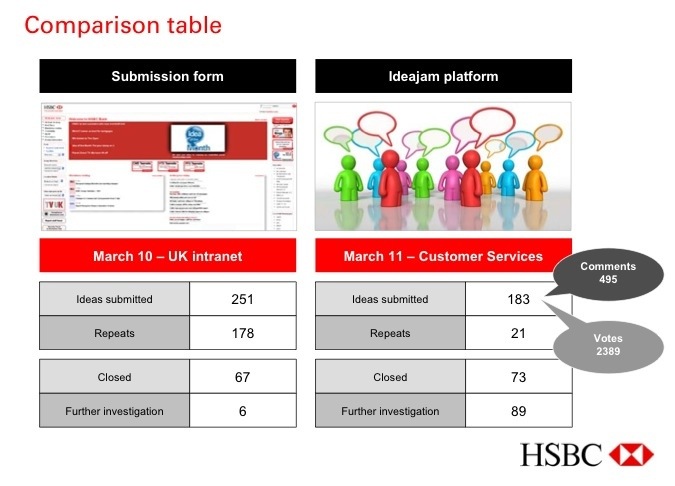
    Here is a slide from the HSBC presentation to illustrate what I’m saying:

    There were 183 ideas submitted in March 2011 which received almost 2400 votes and 495 comments. That seems like a pretty good number of staff being engaged in ideas to improve the organisation. Anyone who’s ever written a blog will know that comments are like gold dust, they give so much added value. Getting 495 comments on 183 ideas is very impressive and helpful.

    So what’s the PONT?

    1. Trusting staff and improving engagement go hand in hand.
    2. Using social media approaches to handle staff ideas gives an opportunity to build trust amoungst staff.
    3. It’s a win, win, win. Engaging this many staff in business improvement has got to be good for customers, good for staff and good for the bottom line.

    Linked post: Crowdsourcing, could this be the groovy new name for staff ideas schemes?

  • My lovely shed, defaced

    This week has been all about malicious compliance: filling in my tax return before the £100 fine; ‘helping’ my kids with home work (work out who is least willing and compliant here); completing my expenses form before the deadline; working out why some people are resistant to tagging for document management; and painting a room before the new carpet arrives on Monday.  I hate painting, possibly more than the form filling.

    My participation in painting is the perfect example of malicious compliance. I have to do it because…….. I think I should (lots of psychological stuff going on there); it’s too late, too much hassle and too expensive to get someone else in to do it; and above all my wife is telling me I must do it. Oh, and just to add a bit of spice (added complication), the kids will participate as it will be an excellent bonding opportunity. Great, I can’t wait.

    This is how it transpires, good intentions to start, plenty of good natured banter, and even some painting. Boredom creeps in and malicious acts emerge. Son number one ends up with paint flecks on the back of his head, son number two has a stripe of paint daubed across his face (Adam Ant / Braveheart style) and son number three resorts to hand painting the walls. Somehow the dog gets a glossy new coat (of gloss paint), I lose my cool, shout my head off and everyone disappears. Version two of this is a shockingly poor attempt at painting which rewards the kids with a dispirited thanks from me and the afternoon off them to play X-Box.

    Whichever scenario, same outcome; painting is completed by me and my wife, both deep in grudging, possibly malicious compliance, ‘reworking’ some of the earlier efforts.

    Malicious compliance doesn’t get much coverage on Wikipedia, but here goes:  ‘the behavior of a person who intentionally inflicts harm by strictly following the orders of management or following legal compulsions, knowing that compliance with the orders will cause a loss of some form resulting in damage to the manager’s business or reputation, or a loss to an employee or subordinate. In effect, it is a form of sabotage used to harm leadership or used by leadership to harm subordinates. A specific form of industrial action that utilizes this is work to rule’. There are some striking similarities here with the spot the meeting saboteur post from a while back.

    I think my painting experiences are a good parallel of what happens with compliance based activities in the rest of life. My form filling was at the very best grudgingly compliant. The bottom line is that it’s really hard to get anything worthwhile out of people when you have to force them to do it. Persuasion and engagement are everything. I addition I’m sure that my personal dislike of painting is picked up by the kids so it’s hardly a surprise that they don’t want to play along. I think I probably need to overcome my painting issues before I have any chance of inspiring others.

    So what’s the PONT?

    1. Making people comply with requests never gets the best results, much better if they want to do it.
    2. Grudging or malicious compliance could well leave you with a worse situation than no compliance at all (over-painting previous work confirms this).
    3. If you are not fully committed to the mission yourself, it’s unlikely to troops will fall in behind you.

    Thanks to Andrew, fellow dad at Under 16s rugby, who alerted me to the idea of malicious compliance.

    The picture I’ve used here is one of my own. The back of my lovely shed, defaced by son number three and my nieces, gloss paint too.

  • Recently someone important told me that Crowdsourcing was “old hat, and we’ve moved on from that”. What they had moved on to wasn’t explained but I don’t think we’ve even scratched the surface of Crowdsourcing in the world I occupy.

    Fortunately I went to an IdeasUK event last week which was focussed on how social media can be used in staff ideas schemes (incidentally this was on an upper floor of the HSBC tower in Canary Wharf. It was awesome…. just wanted to say that). Over the day I came around to thinking that staff ideas schemes are essentially a form of Crowdsourcing. If you look at the definition from the perspective of staff ideas schemes I think it works. Wikipedia tells us Crowdsourcing is:

    • the act of sourcing tasks (improvement ideas, innovations, different ways of doing things, developing solutions etc);
    • traditionally performed by specific individuals (executives, innovation team, head office types etc);
    • to a group of people or community, (people doing the job on the front line, anyone who knows how things work or what the customers want);
    •  through an open call, (just go and ask all staff, and listen to them).

    When you think about it there is nothing to stop any organisation implementing this approach (many successful ones already do). The availability of social media collaboration and sharing tools just make it easier. Two examples of organisations where this approach has been used more widely with customers are Dell with IdeaStorm and Psion with Ingenuity Working.

    On Dell IdeaStorm anyone can register and post an idea relevant to Dell. The rest of the community are then able to promote, demote and comment upon ideas, giving Dell an idea of what matters to people. Dell also provides updates on the progress of ideas which is explained in this Dell IdeaStorm from Idea to Reality video. The statistics for the engagement of people with IdeaStorm are impressive, in January 2012 the community had:

    • Contributed 16,640 ideas;
    • Promoted 750,642 times;
    • Posted 94,493 comments.

    Dell had implemented 480 of the ideas submitted over the five years since it was created. A great deal has been written on the web about IdeaStorm, which is probably an indicator of its significance in the context of Crowdsourcing and social media.

    Psion IngenuityWorking is an open innovation community hosted by Psion who manufacture mobile handheld computers (like the ones the delivery courier gets you to sign). The Forrester Groundswell Awards describe it as an “open online community, the ecosystem where Psion and its customers, resellers and developer partners meet, collaborate and work together to create the most customer-specific solutions in the industry”. It’s worth reading the Forrester article as it also reflects how highly the community rates itself. “With over 12,000 registered users in the community, the site receives over 60,000 visitors per month. Adoption has been so successful that it has more visitors to its community than its corporate website (psion.com).”  The CEO of Psion, John Conoley spoke at the Ideas UK last November and backed up the ideas of an open innovation business model, using the principles of social media and Crowdsourcing, with some impressive figures on what it had done for the bottom line.

    For me, it’s a very short step from what has been done by Dell and Psion to using these approaches within an organisation, with your own staff. This was something I saw at the visit to HSBC which I’ll be writing about next.

    There is some risk associated with Crowdsourcing, not everyone is a fan of it. Issues such as undermining the value of legitimate developers and designers and uncertainty over intellectual property copyright are all real issues.  Other factors such as ‘premature convergence’ by the crowd around a specific idea rather than letting multiple ‘safe to fail’ pilots fail’ pilots operate (Trojan Mice) have been mentioned by people like Dave Snowden. But I’m sure you can work that out for yourself.

    So, what’s the PONT?

    1. Staff idea schemes are effectively a form of Crowdsourcing.
    2. Social media approaches and platforms allow this to be done much more effectively and on a much larger scale.
    3. Crowdsourcing could be a groovy new name you could used if you want to jazz up or re-invigorate a flagging ideas scheme.

    PS. If you are wondering about the ‘Guess the Jellybeans’ graphic, this is relevant to some of the ideas behind Crowdsourcing. It’s worth having a look at The Wisdom of Crowds book by James Surowiecki for a good explanation of the jar of Jellybeans example, plus many others, and the principles of how the wisdom of the crowd works.

  • So, I’m standing in the queue waiting to pick up a package for my son’s birthday that has been lost by the delivery company for 7 days. Its 4 days before Christmas and his birthday is tomorrow. The guy at the head of the queue is absolutely freaking out.

    He’s got it all going on; raised voice, popping eyes, red face, puffed out chest, pointing finger and loads of insults about the delivery company, all of their employees, their close relations and probably family pets. The one thing he didn’t have going on was any sort of listening.

    Fair play to the clerk behind the counter he explained the difficulties which involved finding a single anonymous package amongst the 15,000 in the warehouse behind the desk.  A bit of an Indiana Jones and Raiders of the Lost Ark warehouse scene situation if you ask me. What Mr Freakout really missed was the offer from the clerk to find the package by 2pm that afternoon and personally deliver it to his home. It was too late by this stage; he was completely deaf to any solutions and stormed out almost taking the doors off their hinges. End result for him, a complete failure; no package, no prospect of the package in the near future and blood pressure at the point of exploding.

    Next up was a very calm lady clutching an iPad and a few bits of paper. “This is my parcel tracking number (handed over the slip of paper), and your online tracking facility tells me (iPad screen shot presented) that the package has been returned to this depot as your driver was intimidated by my dog, a Chihuahua”.  The clerk types in the number to a computer, leaves the desk and returns 30 seconds later with the package. The lady signs for the package and rapidly leaves with a smile.

    At this point the queue goes absolutely wild. People were on smart phones trying to call up the delivery company website or speaking to anyone who had access to a computer. Everyone wanted their parcel tracking number and a screen shot of the online tracking facility. The result was that the queue started to move rapidly. The tension went out of the room and people started to smile, even the overworked desk clerk. By the time it was my turn I had my tacking number written on a scrap of paper and the screen shot ready (my dog also prevented a driver delivering for 7 days – but that’s another story). The end result, I get my package, no fuss, no raised voices, everyone happy.

    So what’s the PONT?

    1. Aggression and threats get you nowhere, particularly if you stop listening.
    2. Knowledge is power.
    3. The customer really does know best, especially when it’s a backed up with a bit of mobile web.

    There is a sub plot to all this. Two days before I visited the parcel depot I left some terrible feedback on the customer comments section of their website (I’m ashamed to say I was ranting). This generated an auto response in ‘blah blah’ style promising to respond fully within 10 days. They did respond, it was equally ‘blah blah’ and meaningless.  A few days after collecting my parcel I contacted them again, this time in a far more positive mood, suggesting how they might improve the collection service at the depot by providing instruction notices and possibly even a computer terminal for people to locate their parcel tracking numbers. Literally within an hour I had a response thanking me for my helpful suggestions which would be considered as part of their review of the process in the New Year.  Funny that.

    This would never happen with Pat
  • Is there such a thing as the ‘best’ or ‘right’ number of people in a successful organisation?

    Last week I was at the Cardiff University Distinguished Lecture Series where I listened to Professor Robin Dunbar explain that around 150 people is the optimum number to  maintain the informal relationships and cohesiveness that allow a community to function effectively.  Dunbar’s number applies to physical as well as online communities and has been demonstrated through examples as diverse as medieval village populations, military company sizes, numbers on your Christmas card list and even the number of friends people have on Facebook. The evidence from evolutionary anthropology is compelling, go and have a look.

    The idea of 150 people as the optimum number for the world of work was illustrated through Gore-Tex. Dear to me as they keep me dry on a wet Welsh day. The other thing I know about Gore-Tex is that they are one of the Sunday Times best companies to work for and have a reputation for a good employee engagement.  What I didn’t realise is that it is a global concern (W.L.Gore & Associates) turning over $3 billion a year, employing over 9,500 people.

    The number of awards the company has won is impressive. For the 14th consecutive year in 2011, it was recognised as one of the Fortune 100 Best Companies to Work for. The number of people employed at each plant is also around the 150 mark. Bill Gore – the late founder of the company, found through trial and error that 150 employees per plant was most ideal. “We found again and again that things get clumsy at a hundred and fifty,” he told an interviewer some years ago.

    In each factory they limit the number of employees to 150 so that “everyone knows everyone”.  This sense of connection between people reduces the need for a hierarchy and increases individual commitment to the group’s goals.

    It is also interesting to see that the Lean Systems people are able to back up these numbers with some of their own calculations. This post on the Lean Organisation Blog puts the optimum number of people involved in a process at between 156 -166 based upon a basic unit of work teams of between 5-8  There is another link to Professor Dunbar here with 5 being the number of people with whom you have closest connections.

    As good as this idea is, there must be something more to it than just numbers. There have been plenty of poor military companies of 150 and a few dysfunctional organisations of 150 people. Having a closer look at W.L.Gore & Associates there are a other indicators of why they have such highly engaged people and a successful organisation. I’d suggest that a number these factors are the same as those which are key to the success of a medieval village, military company or online community of practice. It’s all about values and behaviours.

    The culture at Gore is well explained on their website and in numerous articles. It includes gems such as:

    “Leaders may be appointed, but are defined by ‘followership.’ More often, leaders emerge naturally by demonstrating special knowledge, skill, or experience that advances a business objective.” What a fantastic approach.

    Critically all Gore Associates adhere to four basic guiding principles articulated by Bill Gore:

    • Fairness to each other and everyone with whom we come in contact
    • Freedom to encourage, help, and allow other associates to grow in knowledge, skill, and scope of responsibility
    • Commitment The ability to make one’s own commitments and keep them
    • Consultation with other associates before undertaking actions that could impact the reputation of the company

    Alongside the optimum number of 150 people, it is necessary to have guiding principles (like those at Gore) and the right leadership to ensure employee engagement, and a successful organisation. It’s not just a numbers game, but it certainly helps.

    So, what’s the PONT?

    1. There is an optimum number of 150 to ensure a cohesive community, which can be applied to the workplace and employee engagement.
    2. Being part of something, sharing a common aim and connecting with your co-workers is a key part of engagement in a community.
    3. The optimum number alone will not ensure successful engagement. Factors such as trust, responsibility and leadership play a significant part.
  • This week I’ve been attending the Distinguished Lecture Series at Cardiff University where I heard Professor Robin Dunbar (yes, he of Dunbar’s number) talk about some incredibly interesting topics.  I aim to post a few things about the whole lecture series, but for the minute here is what’s grabbing me, the importance of laughter and humour in human relationships.

    I’ve been struggling with this for a while after someone suggested to me that humour in the workplace was about ‘hiding from the truth’, ’not dealing with difficult things’ and ‘not confronting our buried emotions’. Blimey, that’s all a bit distressing and depressing.  As I’ve always tried to have as much fun as I can in work, using humour and laughter, I must really be suppressing something huge!

    Fortunately Professor Dunbar said a few things that have lifted my spirits and put me back on track:

    • Laughter triggers the uptake of endorphins in the body which makes us feel happy;
    • Laughter increases our tolerance to pain (so it is the ‘best medicine’);
    • Laughing with other people helps to form emotional bonds with them;
    • The more we share a sense of humour with someone the more we feel engaged with them; and
    • Laughter turns strangers into friends (sounds like a strap line for some Christmas  drink advert, but it makes a lot of sense to me).

    I’m not doing credit here to what Professor Dunbar said and I would encourage you to watch the video.  What this has done however is given me the chance to relive one of my most epic failures, where an attempt to introduce humour into the workplace almost cost me a friend.

    My friend was having a great deal of trouble trying to get their superiors to make a decision. The process involved countless iterations of a business case, double and triple checking,  risk assessments, procurement policy checks and meetings to go over and over the same ground. You may be familiar with this, or have heard about a similar type of situation, its shocking, I know.

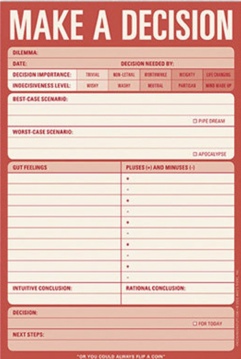
    Like all good friends I listened to their troubles over several weeks and tried to offer comfort and advice where I could. As it happens about this time I was on holidays in the US where I saw this ‘Make a Decision’ note pad and my friends predicament came straight  to mind. Perfect I think, a bit of humour is just the thing to get things moving.

    Make a Decision notepad. I laughed!
    Make a Decision notepad. I laughed!

    It sank like a lead balloon.

    The boxes to fill in on the ‘Make a Decision’ form were leapt upon with greedy enthusiasm, but when it got down to the detail there were totally bemused responses. “what do they mean by ‘apocalypse’ for worse case scenario? Do we have a corporate definition of apocalypse?”.  This might of course have been an elaborate double bluff, but I don’t think so. Some rapid diversion tactics were required and refocusing onto some familiar territory like, ‘updating the risk register’. Perfect, order restored.

    In our post project learning (over beer) my friend and I discussed where it had all gone wrong. Definitely the delivery method could have been better (they say comedy is all about the timing), but for this audience a blatant attempt at humour was probably just too alien.

    So, what’s the PONT?

    1. Humour and laughter are useful but you need to consider the audience. For some groups and settings it’s just too alien.
    2. Getting the delivery and timing right is important. Tabling the ‘Make a Decision’ form enthusiastically at a project update meeting was not the best option.
    3. Put yourself in their shoes. This was probably seen as highly threatening to the  group rather than something humorous. A real shame.

    Picture source (also available to purchase) http://www.perpetualkid.com/make-a-decision-notepad.aspx

  • Well, last week I got a taste of what I think it might be like to be an X-Factor contestant:

    Stand up in front of some highly experienced people;

    Deliver your best amateur effort;

    Listen carefully to what they have got to say about it;

    Then: laugh/cry/high-five/run away/smile graciously (delete as appropriate).

    No, it wasn’t the X Factor auditions. I was just getting this blog publically reviewed at the first meeting of WordPress Users Wales.

    I’ve had a fair bit of experience of reviewing products and services and giving feedback over the years but this was slightly different. There was no hiding place. Even with a blog you can choose to not accept comments, but in this situation it was totally live, unedited and you are completely exposed – along with the precious blog you’ve created.

    Fair play to the reviewers, all of the commentary was very constructive and delivered positively. I’m very grateful for the feedback and I’m doing my best to use it.

    A couple of observations though for anyone else thinking of doing it:

    1. Don’t be precious about your ‘baby’. You’ve asked for feedback, accept it;
    2. Don’t try to defend anything. It just doesn’t work. You stop listening to the really useful stuff and people stop providing it.
    3. Write it all down, or better still get someone else to write it down for you;
    4. Act on the advice. If people have bothered to think about what you’ve done, and let you know, show that you have listened.
    5. Oh, and have I mentioned, listen really hard.

    As an improvement technique I’m not sure that public review has the potential for widespread application. Maybe it is best left to the likes of the X Factor and blogs.

    So, what’s the PONT?

    1. Only do it if you really want to learn and improve.
    2. Listen really hard, don’t explain, defend or justify.
    3. Act on the advice.

    PS.  Hopefully anyone who’s reading who offered me feedback has seen some improvement on the page layout. Thank you!  Still plenty of distance to go though…..

  • The next time you see this blog it will be better it is now (hopefully).

    Tonight is going to be a bit of a watershed for me:

    It’s been five months since I started blogging;

    I’ve managed to produce 40 posts in that time; and

    Tonight I’m up for public review.

    I’ll be at the WordPress Users Wales Meet-Up in the Zen Room at Glamorgan University ATRiUM in Cardiff.

    What I’m hoping for is:

    • Face to face contact with some of the experts from the WordPress community in Wales;
    • An opportunity to learn from individuals who have, been there, seen it, done that and got the WordCamp T-shirts;
    • Share my experiences of ‘finding my blog voice’ (thanks to mrsmotivator.com) with anyone it might help; and
    • Make connections that will help me get through the next 6 months.

    Tomorrow (hopefully) this blog will be looking and working much better than it is now.

    I know change involves a fair bit of turbulence, but I am hoping to avoid this sort of damage to the Pont.

  • My treasured 1962 paperback version My treasured 1962 paperback version

    Why do we waste so much time on trivial things in work?

    This is an explanation I think should be on the syllabus of every management development programme and business school in the land.

    It’s like one of those fundamental truths that get overlooked, because it’s slightly inconvenient and uncomfortable. I said I’d write about this in the post on Bikeshedding, Parkinson’s Law of Triviality. It’s so relevant, even 60 years on, that it deserves a good airing.

    Here’s a link to a copy of the original 1955 essay in The Economist, which I’d highly recommend reading.  The article opens with the quote “work expands to fill the time available for its completion”. This is based upon two underlying laws:

    1. The law of multiplication of subordinates; and
    2. The law of multiplication of work.

    The basic theory is that an individual within a large administrative organisation will reach a point in their career where things start to get a bit ‘too much’ for them (as a ‘middle aged person’ I might recognise this phenomenon…). Rather than leave the job or share it with anyone else, they make the case for acquiring subordinates (good old empire building). Subordinates will lead to more subordinates and eventually there is a department to manage. However, the quantity of real work hasn’t actually increased very much (if at all).

    If the work hasn’t increased that much, what to people do? Parkinson suggests that, “they read the memos they send each other”. Just pause and have a think for a moment. Anyone experienced something similar? In the modern world this would be the pointless emails that clog up work life? Emails from the corporate centre and colleagues who sit across the desk from you? (and don’t get me started on the cc’d ones that undermine trust and drive me wild).

    The theory is great but Parkinson’s master stroke is his ‘Scientific Proof’. There are two examples he uses to illustrate his point, the numbers of Royal Navy Ships compared to Clerks and Admiralty Officials and staff at the Colonial Office.

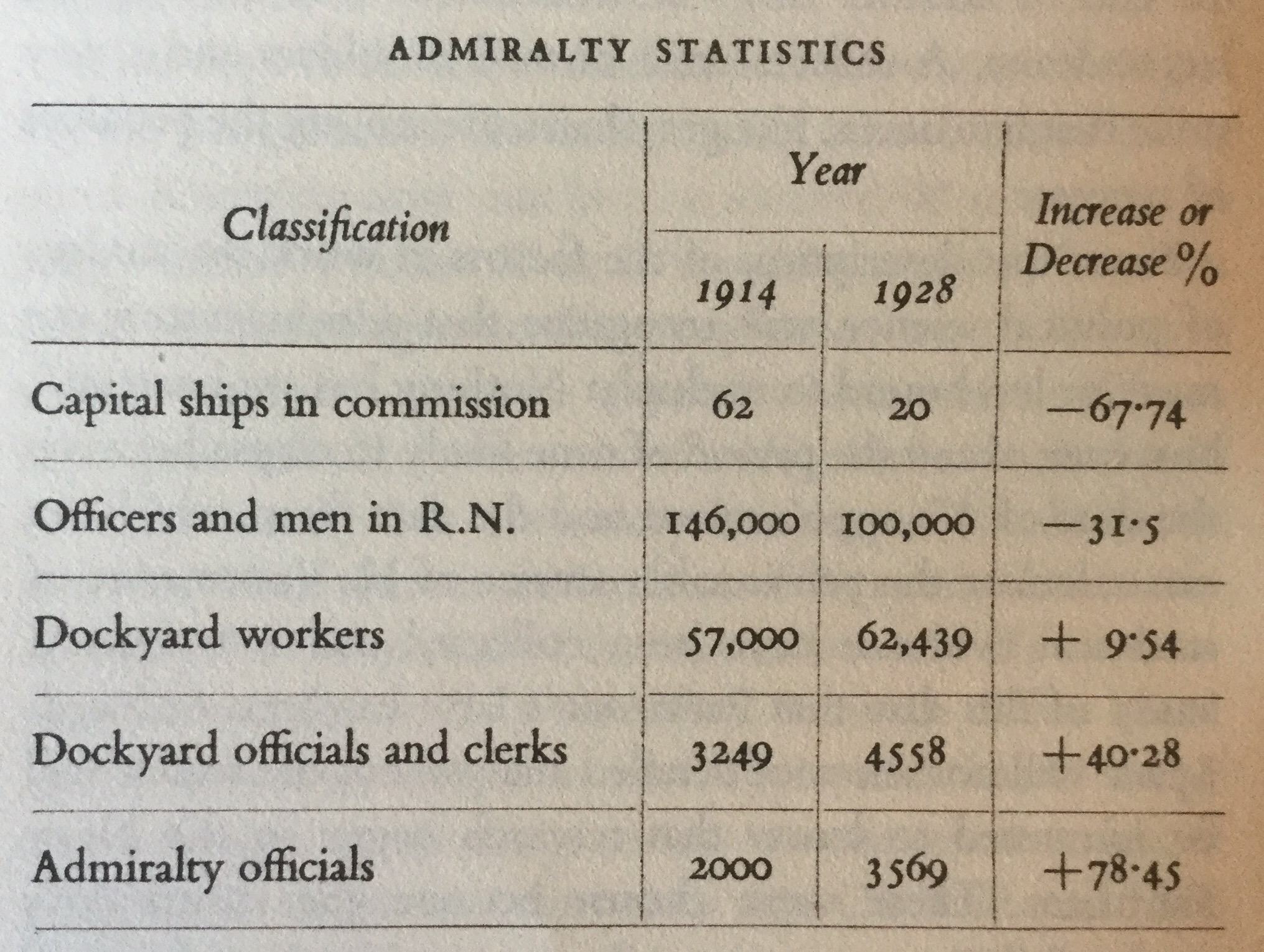
    Admiralty Statistics - More Admirals than Ships.... Admiralty Statistics – More Admirals than Ships….

    Between 1914 and 1928 he provides data to show the decline in number of ships (68%) and Ships Crew (31%) compared with the increase in Clerks (40%) and Admiralty Officials (78%).

    Have a look at the graphic attached. It’s also well worth looking at the original paper which gives some good reasons why this shouldn’t have happened.

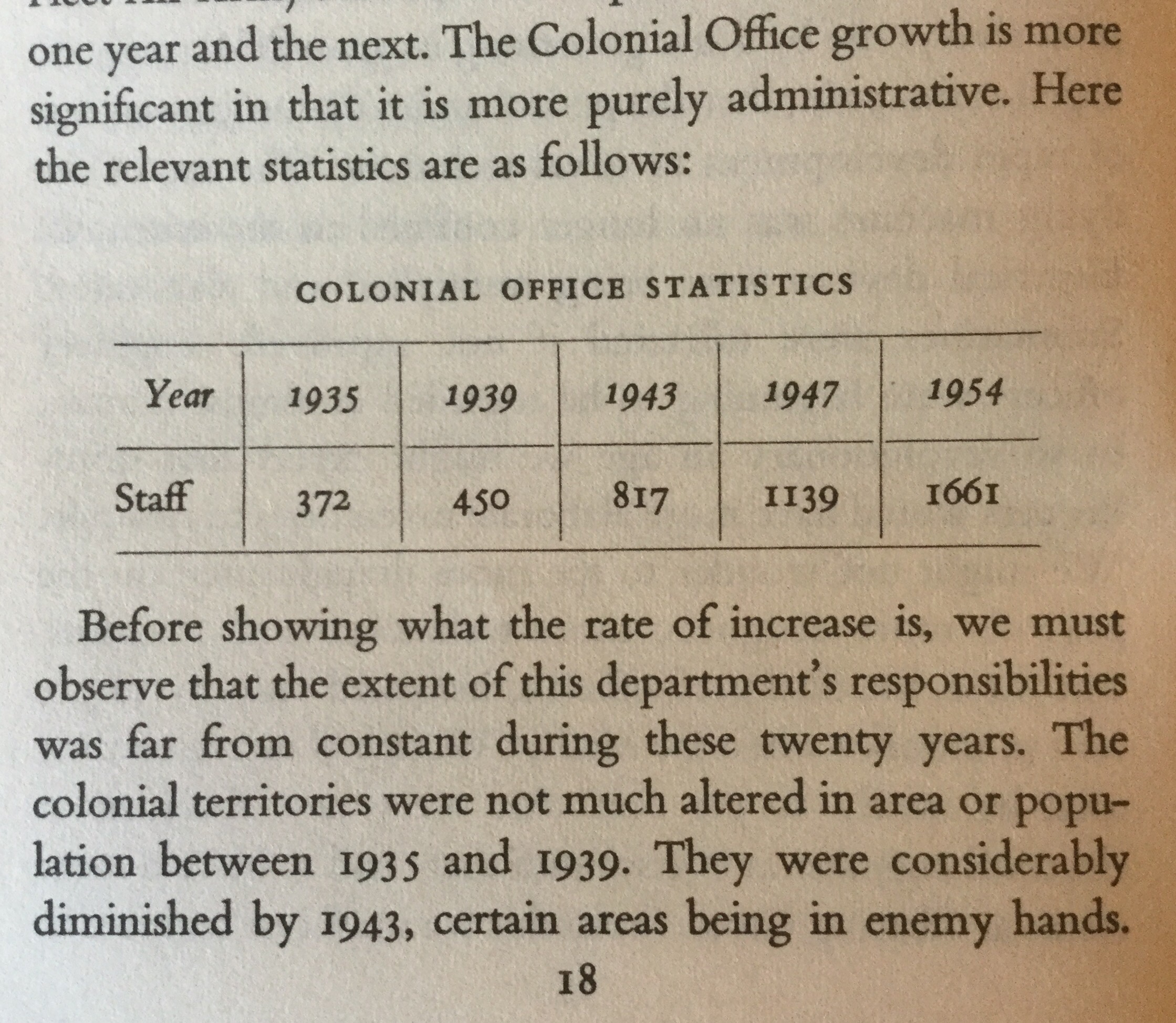
    The story from the Colonial Office is even starker. In essence, between 1935 and 1954 the staff increased from 372 to 1661, over 400%. At the time the responsibility of the Colonial Office was declining, and by the time of the end of British Empire the Department had its highest number of staff ever – even with “certain areas being in enemy hands” (you might have a similar example?).

    img_6365

    Although there is plenty of humour in this paper, it does make a serious point, and gives the evidence to support the theory.  It’s as relevant today as it was 60 years ago. Modern ‘management speak’ is all about ‘back office functions’ and efforts to make them more efficient.

    What needs to be recognised, and dealt with, are the processes that get you to that position in the first place “work expanding to fit the time available for its completion”. I also wonder if this pattern has altered in 60 years now that there is better gender balance in the work place. Do women feel such a need to pointlessly empires build as (some) men do?

    So, What’s the PONT?

    1. Lots of people have a tendency to ’empire build’, either consciously or sub consciously. This is what powers Parkinson’s Law.
    2. Once you’ve got lots of people, they need something to do, so the work expands to fit the resources available (time mostly, but it could also apply to floor space).
    3. Are the efforts of the ‘systems thinkers’ and the ‘Lean Office’ people all about trying to put right the impact of Parkinson’s Law?

    Image Sources: me, from the 1962 paperback version of the book.


  • Last week I was in Court, don’t get excited, it was as a witness for the prosecution. A couple of things made an impression upon me:

    Fantastic support from the Witness Support Team (I’ll say more about this again) and; the really high ceiling in the Court Room (it must have been 25ft / 8m tall).

    This got me wondering. The Court was built during the 1980’s so it wasn’t some historic accident, the design must have been deliberate. Why?

    The room was certainly impressive. Thankfully the Witness Support Team gave me a guided tour before I was called to give evidence so I knew what to expect. However, if I had just walked in I think I would have been pretty intimidated by the surroundings. Perhaps that’s the point?

    The built environment does influence the way you behave. If you watch Kevin McCloud on Grand Designs it’s certainly the case. In the courtroom this was reflected in what I did:

    • standing up straight;
    • wishing I’d worn a tie;
    • being very serious and measured with my answers; and
    • speaking in a deeper voice (all a bit Richard Burton I’d like to think).

    Conveniently, this has given me an opportunity to talk about how I think the environment is an important consideration for planning meetings and facilitation. It’s probably easiest to explain this in the context of a few environments I’ve encountered while facilitating.

    Comfy Sofas – The Best.  My finest ever facilitating hour happened by accident when a room was unavailable and we had to use a space where some sofas were being stored. The impact was incredible. Everyone was very relaxed, ideas were free-flowing, nobody misbehaved and we got the job finished before time. Unfortunately I don’t find sofas too often in the world I work in.

    Horseshoe of Chairs – Bog Standard.  The sort of thing you’ll get from anyone who’s been on a facilitation training course (or group therapy / rehab meeting).  This layout usually encourages everyone to participate as there is nowhere to hide and you are all equal. Nice.

    Sat Behind Tables / Desks – Not So Good. Frequently unavoidable. I’m not averse to moving furniture to achieve the ‘perfect facilitation environment’, but dragging a 12ft x 4ft oak board table around an 18ft x 12ft room defeats me.  I try to avoid these situations as being ‘protected’ by a table allows some people to ‘hide’ and not participate. I addition some people can behave badly, again using the table as ‘protection’.

    The Council Chamber – Nightmare. Just say no. Council Chambers have been the scene of my most epic failures. It’s like some individuals become a completely different person when you sit them in an Elected Members chair. It’s even worse somehow if the room has dark wood paneling. Previously mild-mannered individuals start referring to people they know as ‘Madame Chairwoman’ in a rather pompous tone. They also tend to behave in a much more serious and often confrontational manner.  Avoid at all costs if you are trying to facilitate a workshop.

    High ceilings, a witness-box  and formal seating certainly altered my behavior in Court. It’s great if you want serious and very well-behaved, but not so good when you are trying to brainstorm or develop a creative solution.

    So, what’s the PONT?

    1. Environment does affect people’s behavior.
    2. Don’t be afraid to change the environment to encourage or prevent certain behaviors.
    3. If you can’t change the environment and it’s not looking good, just say no.

    Just say no!

    Picture Source:

    http://www.magistrates-association.org.uk/pix/magistrate_court_diagram.gif

    http://www.grantfrancis.com/courtroomtv/Court_Room_Television/Court_Room_Television_files/shapeimage_1.png

  • A while back I wrote about why I thought lots of public servants  don’t use social media at work. I’ve also met people from the private sector who are prevented from using it for similar reasons, explained as ‘lost productivity’ or ‘security issues’.  Not a great position to take when  this infographic of Cisco research (via stoweboyd.com) suggests that 56%of young professionals would not take a job with an organisation that blocks Twitter and Facebook, or (more worryingly) will circumvent the policy.

    This is all very well, but this weekend I was brought ‘back down to earth’ with a bump.   It was a “get real strategy boy” moment for me as I was told, “this is the reason why public servants don’t use social media”……

    One of my associates is a front line public servant, and I really mean front line.  They are an experienced practitioner, who delivers a key service for the citizens. On a daily basis they are close up with the ‘filth and the fury’ (their description). Brought on by reading one of my posts they had a good old rant about “poxy communities of practice” CoPs.

    The gist of the rant was……

    1. Access to a community of practice (CoP) for their service area was being restricted by managers;
    2. The managers were acting as gatekeepers and drip feeding information on a ‘need to know’ basis;
    3. Cascaded communication referenced guidance documents and other resources on the CoP, which they don’t have access to;
    4. Trying to find out anything, or offer some experience would have to take place via one of the existing CoP members (usually line management);
    5. To become a member you would have to be ‘invited’ by an existing member;
    6. Wasn’t this just typical of the management in the organisation; and
    7. “they can stick their poxy CoP where the sun don’t shine”…..

    Blimey!  It’s an extremely disappointing tale, but not exactly surprising.

    This kind of controlling behaviour from managers seems to be rooted in an old-fashioned view of; knowledge is power. “I’m the boss so I must be cleverer than you lot and actually, you can’t be trusted to say or do the right thing”. This seems to be particularly the case with something as ‘dangerous’ as the Internet. Unfortunately a depressingly common mindset in some places (not all though!).

    The good news is that my ranting friend has a well established network amongst
    their professional colleagues. If they really want to find out something it’s ‘phone a friend’ time. This usually gets the desired result or, in desperate times they revert to the good old email contact list of a few trusted colleagues. So in spite of (rather than because of) the “poxy community of practice”, the knowledge gets transferred
    and the service gets delivered to the citizens.

    So, what’s the PONT?

    1. Personal networks built on trusting relationships can be far more effective at knowledge transfer than a ‘constructed’ community of practice.
    2. Lots of managers need to be re-educated away from a knowledge is power mindset and must start to learn to trust people.
    3. If you want to get the most out of knowledge transfer, ‘go to where the people are’; existing ‘natural systems’ do work.

    Links earlier posts:

    Why we don’t use social media at work:

    https://whatsthepont.wordpress.com/2011/06/29/why-don%e2%80%99t-we-use-social-media-at-work/

    How many people participate in CoPs?:

    https://whatsthepont.wordpress.com/2011/07/06/how-many-people-actually-participate-in-online-communities-of-practice/

    Go to where the people are:

    https://whatsthepont.wordpress.com/2011/07/01/go-to-where-the-people-are/

    Picture sources:

    http://funny-pictures-blog.com/2011/09/07/knowledge-is-power/

    http://angelakbar.blogspot.com/2011/04/knowledge-is-power.html

  • This week I’ve been spending some time ‘off island’ at the IdeasUK 25th annual conference.  It has been brilliant.

    IdeasUK is an unusual organisation. It was set up 25 years ago as a not for profit, membership led association, for organisations interested in staff suggestion schemes. Their original focus is still hugely relevant, particularly when you link it to the experience of their Membership in: employee engagement, staff empowerment, innovation, new/improved products, better service delivery and greater efficiency / better value for money. All very high on the agenda in the current climate.

    The conference brings together people interested in these areas, then it rolls in an Idea of the Year Award Ceremony, about 12 workshops and 3 keynotes all over 2 days (in fabulous Cardiff). It is an astonishing event, possibly the most diverse thing I’ve ever been to.

    Somehow they manage to successfully ‘hot house’ people from different countries and
    cultures (I have shared a lunch table with a Southern Baptist from Texas and a strict Muslim from Dubai); different sectors (private and public) and organisations (energy generation to distilling and banking to border protection).

    You can get to rub shoulders with someone who works on the production line in an aluminum smelting plant, runs a call centre at a Healthcare provider or directs a multibillion dollar research programme for a huge pharmaceutical company. Pretty diverse I think.

    What unites these people is their interest in ideas; how you generate them, manage
    them and turn them into something useful. What delights me is how everyone will
    openly share their knowledge and experience on the subject, a common ground that brings together some really interesting and inspiring people. I’m looking forward to next year already.

    By the way, the ‘Off Island’ expression refers to something I picked up at the conference. One of the Keynotes spoke about ‘Island Theory’. In essence he said
    that a species on an isolated island will become perfectly adapted to that environment. Species on the ‘mainland’ have to deal with competition from other species; as a result they are stronger, fitter, healthier etc. Organisations can often exist on ‘islands’, even if there is ‘in sector’ competition.  Going ‘off island’ to the ‘mainland’ involves exposure to organisations, cultures and ideas from outside of your sector, which has to be a good thing. The IdeasUK conference was certainly a ‘Off Island’ experience or me.  Over the next few posts I’ll share some more tdetails of what I learned.

    So, what’s the PONT?

    • Going ‘Off Island’ is essential if you want to experience some diversity, difference and new ideas.
    • Be open and prepared to share experience and knowledge. The more you give, the more you get back.
    • Just because someone is from a completely different and remote island, don’t assume they can’t teach you something. I saw some amazing connections and synergies  emerge over the 2 days.

    Links: IdeasUK website. http://www.ideasuk.com/

    Picture Source.  http://www.ideasuk.com/

  • Bikeshedding: Organisations spend too much time on trivial decisions. Parkinson’s Law of Triviality.

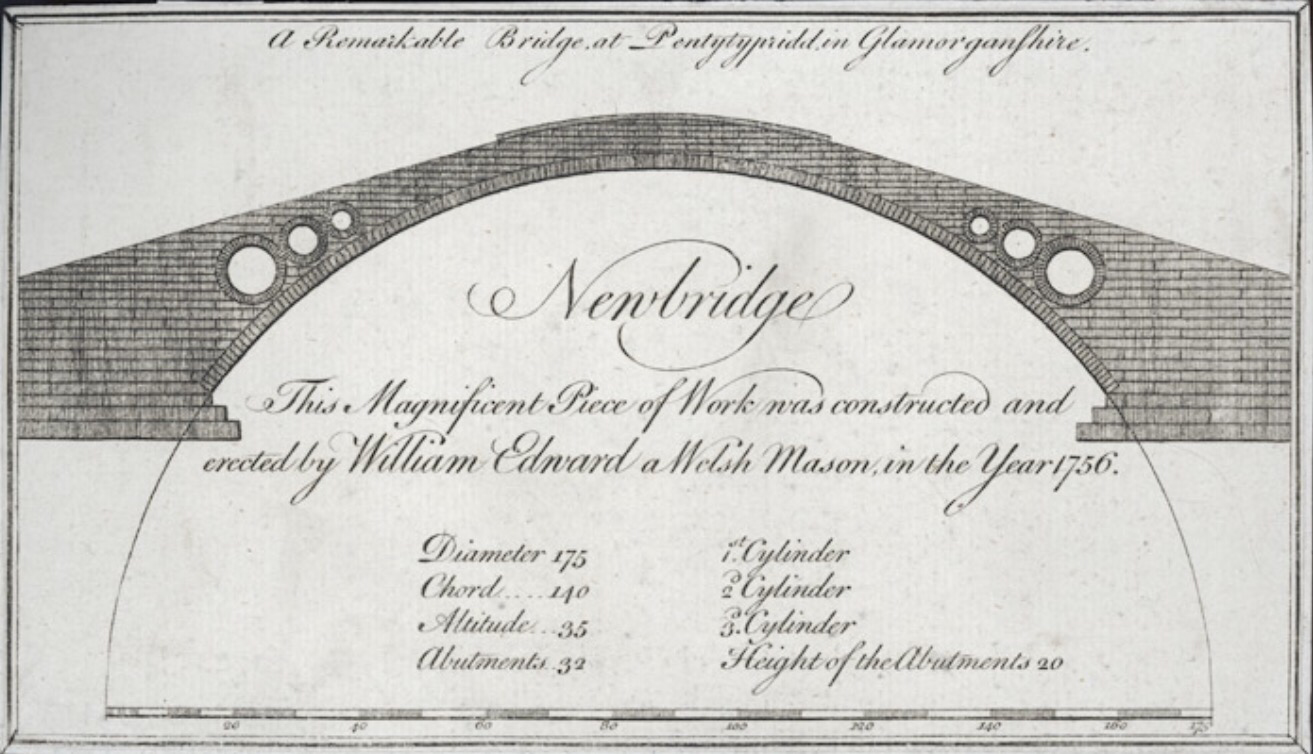
    Decision making has always been a challenge . Way back in 1957, to describe his ‘Law of Triviality’, Cyril Northcote Parkinson created the word bikeshedding.

    Parkinson was hugely experienced in the workings of Government and Academia. He was also responsible for a number of other ‘rules’ you might be familiar with like: Parkinsons Law No.1 ‘work expands to meet the time available for its completion explained here. He knew his stuff.

    The Law of Triviality: Organisations give disproportionate weight to trivial issues , also known as Bikeshedding is actually my favourite.

    You know this true. Just read through the committee minutes of many organisations (or partnerships) and you will get the point.

    So what exactly is bikeshedding? The precise definition for the Law of Triviality is: … ‘the amount of time a committee will spend discussing an item is inversely proportional to the importance of that issue’.

    In straightforward terms this means more time is spent on trivial matters that the big important stuff. The more complicated, costly or difficult the decision, the less time a decision making group (the committee) will spend on it. That’s quite concerning when you stop to think about the implications.

    img_5877
    Extract from Arthur Doler based on Parkinson’s Book.

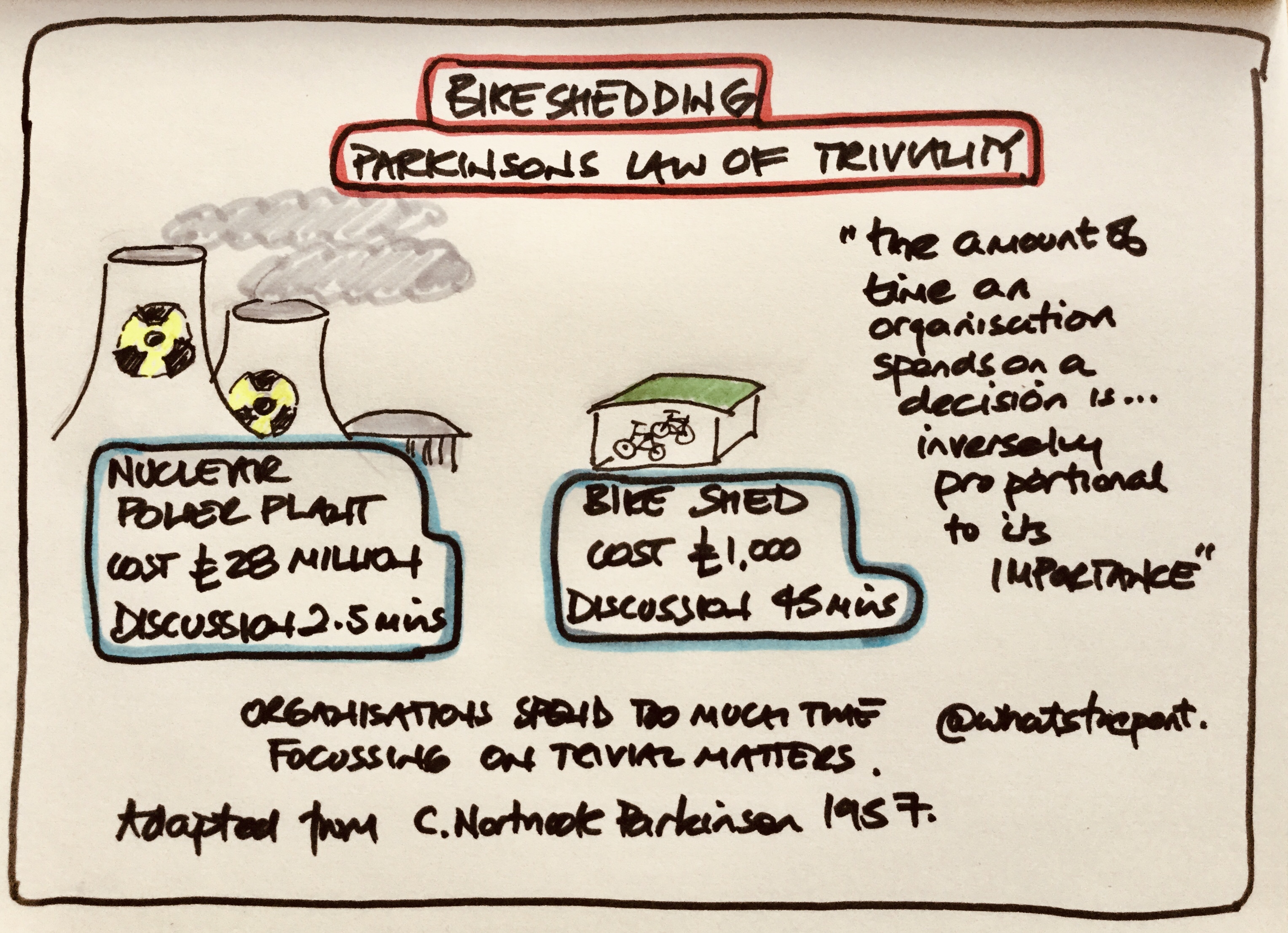
    Back in 1957 Parkinson used the example of a committee spending very little time to approve the construction of a nuclear power station. The committee then went on to spend hours debating the construction of a bike shed for the staff on the site – hence the word ‘bikeshedding’.

    The attached graphic is taken from a sildeshare presentation by Arthur Doler (link here) and uses data Parkinson gathered from the ‘Joint Welfare Committee’.

    At the Committee meeting the £10million nuclear reactor was discussed for 2.5 minutes and the the £350 bicycle shed was discussed for 45 minutes. It gets worse… the £21 a year budget for committee coffee was discussed for 75 minutes and never resolved. The video of Arthur delivering the presentation is below. It is worth watching; for an insight into how computer coders view user experience (UX).

    Why do we do bikeshedding? Some of the reasons that Parkinson attributed to this behaviour are linked to how people face up to big complicated decisions. Where things are uncertain or we don’t know the answers, we avoid exposing our lack of understanding to others. (This was 1957. There are probably other reasons, and a whole branch of Behavioural Psychology to explain this nowadays).

    As Parkinson describes it, the nuclear power plant is a very complicated issue and the average committee member is likely to be unable to fully understand the issues. As a result, the item receives very little discussion and the committee ‘trusts’ the experts. There are very few questions asked about the proposal as nobody wants to appear stupid by asking something that is blindingly obvious or makes them look ignorant.
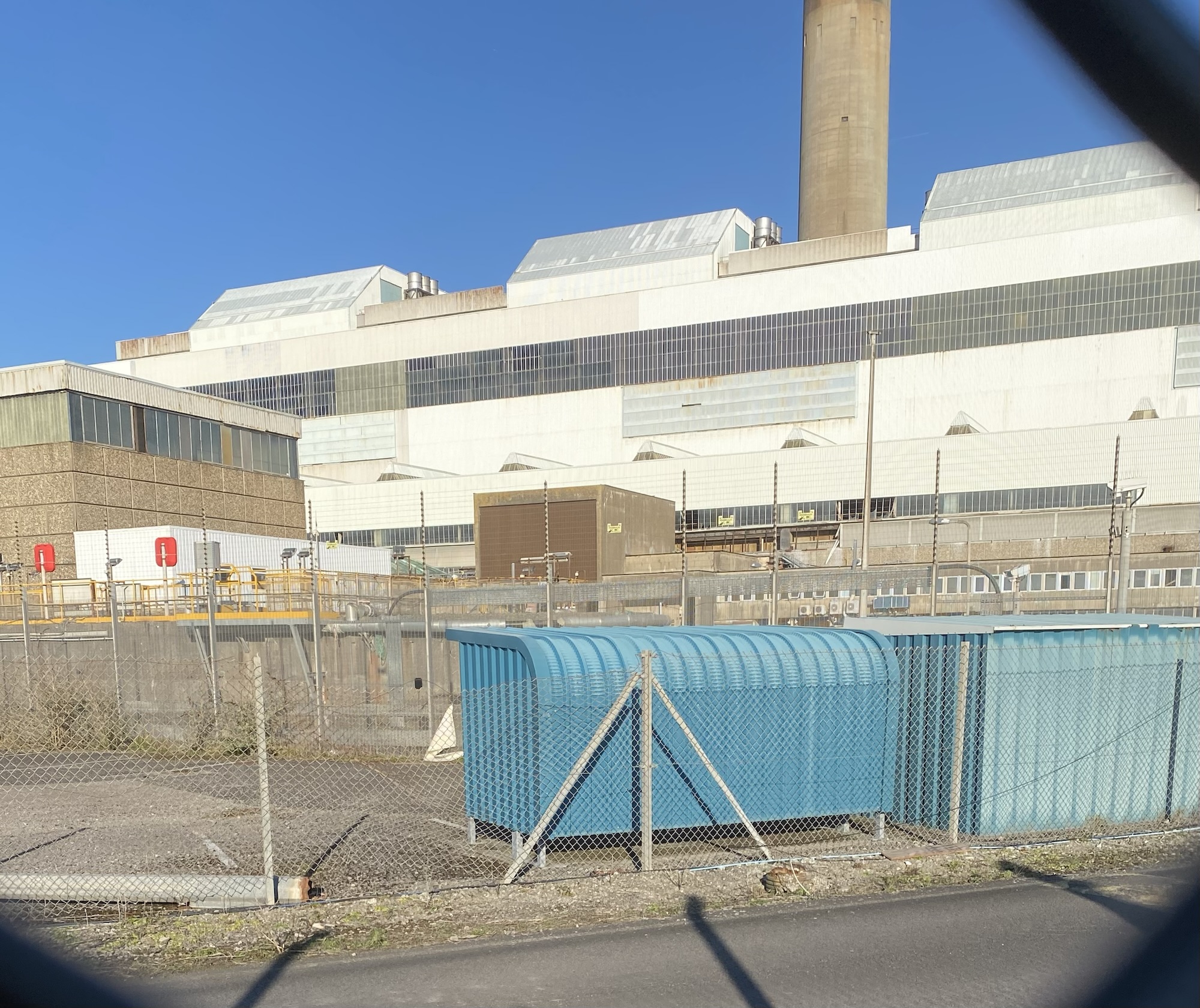
    Building a bike shed on the other hand, is something we can all understand. Committee members are more than happy to contribute anecdote, opinion and sometimes ideas, usually at great length.

    This was a 1957 example, and I suspect a nuclear power plant wouldn’t get away so lightly nowadays. People seem to have become far more willing to question expert opinion and authority. The accessibility of information via the internet also means that people are (or can be if they choose) much better informed. However, I think the principle of bikeshedding in decision making committees still applies to many of our complex, ‘modern’ issues.

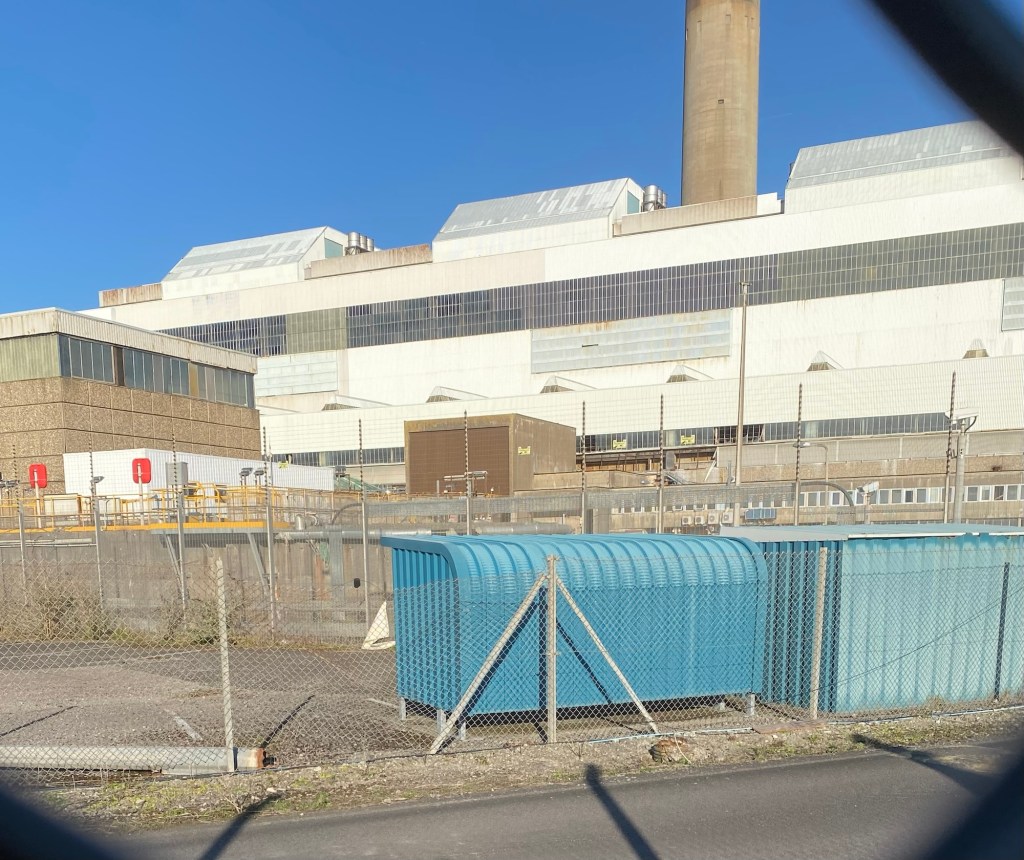
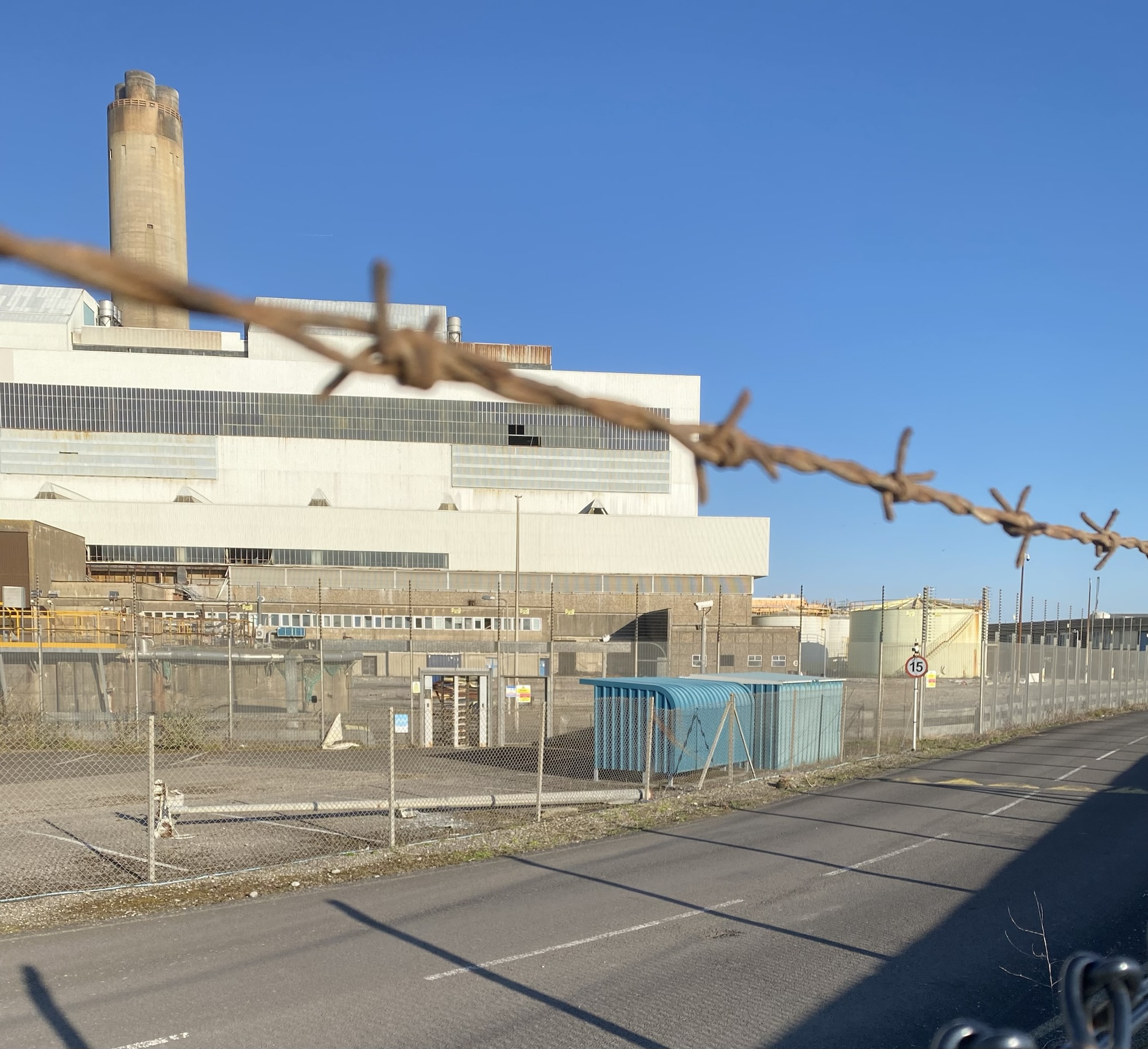
    My picture. A humble bikeshed in the foreground of the enormous Aberthaw (Coal) Power Station.

    Exploitation of bikeshedding through agenda management. Years ago I was involved in a committee where a very experienced Chair and Committee Clerk taught me many valuable lessons. There were things like: “put the important decisions at the end, they will have worn themselves out in the beginning and this stuff will fly through”. Along with, “never provide all of the answers, leave out some obvious but unimportant material, that will keep them busy talking for ages”.

    I now realised they were practicing an advanced from of ‘assisted bikeshedding’, manipulation of the agenda to ‘nudge’ the committee members in the direction they wanted. Scandalous!

    So, what’s the PONT?

    1. There is nothing much new in the world when it comes to human behaviour. Bikeshedding was described by Parkinson in 1957, and was probably around for ages before that.
    2. The reasons for bikeshedding are rooted in human behaviour. Helping people to overcome the fear of looking ignorant and asking good questions is part of dealing with it.
    3. Be vigilant with agenda management. You wouldn’t want to exploit a committee’s natural tendency towards bikeshedding. .
    img_5881

    The original version of this post was inspired by my father in law, who gave me a 1961 copy of one of Parkinson’s books, The Pursuit of Progress.

  • This is an example of what I think is great real-time engagement with customers. It’s
    about London Midland Trains and how they use Twitter, which I’ve mentioned before

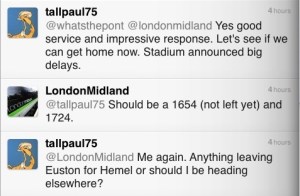
    The story is as follows. Our hero, is heading off to see his favourite football team play. He has to get across the city, which is a challenge on any day. The story unfolds…………(the tweets timeline starts with the earliest at the bottom of the box)

    Phase 1. Getting to the Game

    Today there has been an incident which has caused major problems, particularly for his transport provider of choice, London Midland Trains.

    So far so good.

    Alternative arrangements have been suggested over Twitter by London Midland Trains.

    A few adjustments to the travel plans  and he makes it to the game (with the help of ‘best wife’).

    Phase 2. Thinking about the journey home.
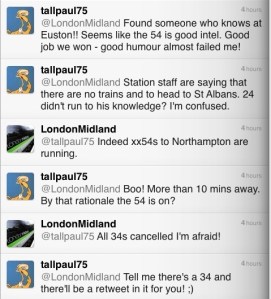
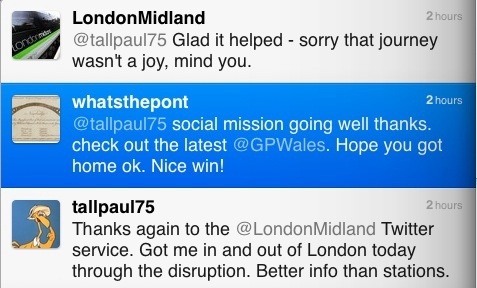
    Must admit, I’ve been in this situation myself a few times. Getting home isn’t really a priority until the game is over.

    It’s not looking good for our intrepid traveller.

    Phase 3. The setback.

    Things don’t look good at all.

    Then the London Midland Twitter folks come to the rescue and there’s route home possible. Phew!

    I find the ‘real time’ element of this amazing. One of the great benefits is that anyone else who is having problems travelling can also ‘listen in’ to the Twitter conversation and get the advice.

    Phase 4. The happy ending.

    Our hero gets home safely, AND the team wins (3 nil!), AND London Midland Twitter get a public thank you.

    Brilliant! A win, win, win situation.

    So, what’s the PONT?

    1. Real time customer support is achievable by using Twitter.
    2. In the end a potentially upset customer, understands your position and says thanks, in public.
    3. Just imagine the applications it could be used for across other public services.
  • Lately I’ve been spending time in committee meetings. We love our committee meetings here in Wales, although if you’d like an alternative view, here’s Seth’s Blog on “If committees told the truth”. The one thing committees are great for is spotting sabotage and the meeting saboteurs at work. I thought it would be helpful to update the spotting
    field sabotage guide
    so here goes with five of my recent favourites.

    What’s going on? This is an effective tactic for creating a general air of confusion and disorganisation. Just preface your contribution with any one of the following statements. You can see the despair in people’s eyes, especially the Clerk.

    • “I haven’t got a clue where we are on the agenda, but………”
    • “I’m not sure this is relevant here, but………
    • “This might have said by someone else before, but……”

    The Black Swan.  These are incredibly rare or improbable things. The Black Swan is a book that will explain all of this if you are interested (currently unread on my bookshelf). In the context of a committee meeting it is the astonishingly ‘off the topic’ question that just leaves people slack-jawed thinking “where on earth did that one come from?” It’s a massively effective sabotage technique for just messing things up and disrupting a discussion thread or line of questioning. For example have a look at this Tickling Slow Loris video, you’ll completely forget about this post.

    Repeat what just happened. This is a difficult one to pull off. Just calmly repeating what has been said or asked previously. It takes some nerves to remain stony faced and not give the game away. The end result is brilliant and well worth that same slack-jawed astonishment. Sometimes you’ll even get a different response to the same question, always interesting. This happened once to my Sister in a job interview (by committee). I think she was quite happy not to get the job with that organisation.

    Doing your Sudoku (or crossword). I’m all for multi-tasking, reading the papers for the next item is fine, but doing Sudoku is ridiculous. What’s even worse is when the Sudoku enthusiast is sitting in clear sight of someone giving a presentation.  A bit of a motivation killer really.

    Sleeping. Brilliant! The absolute best,especially when it’s combined with any of the above. It’s amazing how often this sabotage technique is used to maximum effect, even before midday. People are generally very reluctant to wake up the sleeper, or even mention it. The impact is huge though, saying everything you need to know about the meeting,“this meeting is really boring, look I’m asleep!”

    Obviously this has all been happening at a low-level, limited significance committee I’ve
    been attending; the ‘Village Hall, Repainting of the Bike Shed, Sub Committee’. You’d never see this sort of thing at any hugely important committee that oversees millions of pounds of expenditure and the activity of 100’s of people.

    So, what’s the PONT?

    1. The saboteurs are everywhere, highly skilled and you need to be vigilant.
    2. Some of the sabotage is so subtle that the saboteurs might not even know they are doing it.
    3. Challenge is hard to do (what are you trying to prove?). The people best placed to do this are probably peers.

    Links to previous posts:

    Picture source: http://www.spanishdict.com/answers/208914/la-palabra-del-da-la-comisin

  • The Scorpion and the Fox

    This is a post I’ve wanted to do for a while. It’s all about trust and links to the one I did about how low trust costs you money.

    In my day-to-day dealings I really want to follow the advice from people like US Politician Henry L. Stimson:

    “the only way to make a man trustworthy is to trust him”.

    Unfortunately ideology runs into the harsh realities of life and you end up having to make a few judgment calls about when and how much to trust some people. It’s a bit like the quandary my son faced when he was asked for money by a stranger at the railway station.

    The Scorpion and the Fox is a fable that is used to illustrate that the behavior of some animals is so irrepressible that they will act in a certain way, no matter what the consequences, death included. There’s plenty of material on the web where the fable is used to illustrate why some people cannot be trusted.

    It’s origins seem to go back as the 3rd century and involve a menagerie of scorpions, frogs, toads, turtles, snakes and people. I like the scorpion and the fox version, partly because I have difficulties with speaking frogs (it’s a Kermit thing), but mainly for the You Tube video I’ve linked to at the end.

    The Scorpion and the Fox story goes along the following lines:

    • A fox and a scorpion both need to cross a river.
    • The scorpion asks the fox for a ride on its back as it cannot swim.
    • The fox refuses saying “no you’ll sting me”.
    • The scorpion replies that it wouldn’t, as it would damage the both of them.
    • The fox agrees and allows the scorpion to ride on it’s back.
    • Half way across the river the scorpion stings the fox.
    • As the poison takes effect on the fox and it starts to sink it asks the scorpion, “Why?”
    • “Why did you sting me, now we are both going to die?”
    • The scorpion replies, “I couldn’t help myself, it’s in my nature”.

    Without compromising my desire to try to trust people, I think there is something in this about managing trust situations. Trust is good, but you need to reflect the nature of the ‘animal’ and the environment.

    So, what’s the PONT?

    1. If you go for the ‘trust everyone to do the right thing’ approach accept that you will feel some pain from time to time.
    2. To minimise the pain, it’s worth managing your exposure to reflect the risk from the person and the environment (if it’s going to fail, better to fail small and fail cheaply)
    3. On some occasions and in some situations (scorpions & swollen rivers) this might unfortunately mean saying no.

    Enjoy The Scorpion and the Fox video from Laurence Haughton

    Link to the video: http://www.youtube.com/watch?v=yu44zAcqnXg