This follows on from the last post about 38degrees, the use of social media and the idea of “go to where the people are”.
I was in a meeting with some colleagues talking about how get the public sector more
engaged with social media and how we should “go to where the people are” and absolutely not pursue a “build it and they will come” philosophy.
Kevin built the "Field of Dreams"……….. and they came
Obviously my cultural reference point for this is, ‘The Field of Dreams’ starring Kevin Costner. My colleague, of a similar age, completely got the reference point and we were nodding vigorously in agreement together. Ahhh, all so satisfying…….
Then the bombshell. The other colleague in the meeting, who is about 10/15 years
younger than us, said “I thought that was Wayne’s World 2 – WayneStock, build it and they will come”. Arrgghhh…… Not so satisfying now. Then a panic, didn’t they say something similar on South Park or in World of Warcraft? Must check it out with my kids.
As it turns out we all misquoted these films anyway, but we all knew what we were on
about.
So, what’s the PONT?
Be careful with references to popular culture; check out the
accuracy of quotes (some film geek will point out the error of your ways).
Acknowledge that colleagues might well have different points of reference
for popular culture, particularly those people from different timeframes (10
years plus = little common ground on music).
Oh yes, “go to where the people are”, don’t build it and hope they
will come.
Here’s an opportunity for fame and fortune for anyone with; a decent video camera, some willing buddies and a love of Kaizen (plus toast, but I don’t think that’s compulsory).
There’s a $500 prize in restaurant vouchers for the winning entry, plus the recognition that goes with winning.
Videos will be shown during the 2011 Northeast Shingo Prize Conference, October 5-6 in Springfield, MA. At the conference attendees will vote for their favourite video, so it needs to be a real crowd pleaser! The rules don’t seem to exclude anyone from outside of the US, but it’s worth checking. Entries need to be submitted by the 1st September 2011.
38 degrees – the angle beyond which an avalanche can happen. Clever!
This follows the last post about why lots of public sector people don’t use social media for work. From the comments you’ll see there are exceptions, with people like Helen Reynolds and her Yammer group moving things forward. Keep up the good work!
The phrase “go to where the people are…” is something I picked up at an event where I heard 38degrees speak. This is an organisation that uses the Internet and various social media platforms to help organise people and campaigns. They have claimed some significant scalps like the UK Government change of plans to sell off the forests.
About 750,000 people have been involved with 38 Degrees campaigns so far, approximately 30,000 them from Wales. One thing they mentioned that Facebook is the most popular platform for organising a campaign, used by about 60% of their groups. Some of the reasons why people use it seem to include; familiarity, easy to use, accessibility (its available to everyone) and it’s free! My heart sank at this point, …………..and also blocked by many public sector organisations.
Then some hope. Apparently the second most popular method used by people to organise themselves was the good old email distribution list (about 30% of what 38
Degrees had seen). The remaining activity (about 10%) is taken up with the likes of Twitter, Yammer, and bespoke websites like this one sosypant.com, a school campaign against the proposed closure of the sixth form.
This got me thinking about the struggle to engage with public servants in social
media and the current (over?) enthusiasm for developing bespoke websites and online communities of practice (OCoPs). I’m not convinced that as rush towards the ‘high end’ technology such as bespoke websites is the answer. Lots of reasons for my reluctance, like the getting people to engage with the new, but my biggest concern is around cost. So much of this can be done using free / low-cost options (think Facebook groups), or by making much better use of existing arrangements.
What we should do (like 38 Degrees say) is “go to where the people are”. The place where lots of people “are” at the moment is the good old email distribution lists. They exist, are accessible and people are comfortable with them. In particularly it seems those lists where everyone is visible, you can see who’s involved, and you know who you can trust are popular. Email distribution lists are already embedded in the day-to-day activities of most organisations. Lets use them with far more of a focus on learning and knowledge transfer, and not just for push communications. One final advantage is that they are not recognised as ‘social media’ and are below the radar of IT Departments and organisation security policies.
This has led me to shift my thinking, back to using a more stripped down approach to
promoting knowledge transfer with some of the groups I’m involved with. I’m
encouraging the resurrection of the email distribution list, and a ‘copy everyone in’ to your responses approach. Once people really scream about the inadequacies of this method, then think about introducing them to the likes of Yammer, LinkedIn Groups (for free!) or even a bespoke community of practice website. It’s an anti “build it and they will come” approach and totally in the spirit of “go to where the people are”.
So, what’s the PONT?
Social media platforms are extremely effective methods for people to
organise themselves and share information. They could be much more widely used in public service.
Using the good old email distribution list (with a focus on learning and sharing) is a means of building up some confidence and momentum before the leap into social media.
Don’t try and build it and hope they will come (because they probably wont) ………..go to where the people are!
Over the past eighteen months or so I’ve seen a couple of social media and Web 2.0 evangelists trying to engage public sector workers in the world of social media. It usually runs along the lines of…. “Hey people put your hands in the air if you have: a Twitter account?; a blog?; are on LinkedIn?; are part of an online community of practice ?…….”. At this point a look of panic will start to spread across their faces as they often get an almost zero response to each question. Then, they usually get desperate and throw in things like You Tube and Facebook. Then it all ends up with a rather feeble, “does anyone here use the Internet……? I will confess to having tried something similar myself and suffered those tumbleweed moments.
Within the workplace there is generally a low-level of participation in social media by public servants when compared with engagement by other groups. This is a real shame as social media is giving some organisations a real advantage and helping them to improve service delivery through much better learning and sharing of wisdom, knowledge, information and data (DIKW). Don’t take my word for it,have a look at The New Social Learning website or read the excellent book .
So why this lack of engagement with social media? There is probably a long list of the reasons why, but here are my personal views* on the top two:
The organisational fear factor. Lots of organisations block access
to anything that looks suspiciously like social media. It’s bizarre but you
hear many people say, “our organisation is on Twitter but I don’t know what we say because it’s blocked”. Even higher on the daftness scale is some departments who blog as part of their public engagement work yet, others in the same organisation cannot read what they say – unless they login at home. The blocking of access to social media seems to be based upon concerns about “IT security” (whatever that means) and a perception that staff “waste their time on the internet when they should be doing their job”.
Individual fear of being exposed, caught out and punished. It’s a brave employee that will identify themselves in a post on a public forum using their works email account. There is a deep-seated fear that your viewpoint or comments will be ‘used’ by the unscrupulous person or someone with an agenda. This fear runs very deep and is not without a fair bit of justification from what I’ve seen.
There are however some shining beacons of hope like Monmouthshire Council. People are treated like adults and have access to social media. They are doing things differently and improving the quality of services they deliver, they also get recognised for their efforts. They are clear about their position and things like their Digital Deal document makes a commitment to “using social media platforms to promote new forms of citizen engagement and inclusion”, good stuff!
So, what’s the PONT?
The structural IT and security barriers seem to be huge, but they shouldn’t be. Lots of organisations have already engaged successfully with social media, there must be a way around the barriers.
Lack of confidence and fear of being punished are huge barriers for people at an individual level. The answer here might lie in accepting there will be some ‘failures’ as part of the learning process and Leaders need to ‘lead the way’.
Treat people like adults and trust them. Both of the issues above have a great deal to do with trust and how we treat each other.
US Interstate 5 South (I5S). My 5s image, obscure maybe, but I like it.
I recently posted about the use of 5S and visual management in hospitals as a method for organising work and improving processes. 5s has evolved from Japanese manufacturing techniques and being widely applied to all sorts of activities, including public services. It’s an interesting area and I’m learning a lot about how it’s being used and possibly misused.
What’s intriguing how 5S and Kaizen seem to polarise views, a bit like Marmite, people love it or hate it, or here comes salvation or damnation. I wanted to share some of my learning which helps inform what I’m thinking. There are likely to be a few posts on this, so the Interstate 5 South, (I5S)* sign might reappear.
The types of things I’m hoping to cover are:
The links with complexity thinking, using the Cynefin Framework. This is a good
explanation of complexity thinking which is highly relevant to this topic;
Adoption versus adaptation of practice between situations. It’s not just about picking up simple best practice from one place and blindly implementing it elsewhere.
How the continuous improvement approach can help (or hinder) employee engagement
As a starter, here are two You Tube clips that illustrate very different perspectives:
Toyota 5s is a series of images showing how the 5s approach has been successful applied to their manufacturing process. Even the Cleaners Trolley gets the full 5S treatment. Not much you can argue with here, a hugely successful company and loads of clever people have written books and produced videos about how good their approach is. That’s all good, but how well does the approach travel? Is it relevant to other industries and practices?
Office 5s Gone Wrong This is a view on the potentially disastrous implications of blindly applying 5s in a non manufacturing environment, a Marketing Department. It’s hilarious and pretty close to reality if you believe this newspaper report about HMRC in North Tyneside. Putting tape around the pencils and staplers (and bananas!) on your desk apparently happened in some big public sector organisations. If you want to get into it a bit deeper into this Mark Graban posted the video with a transcript available on his blog post. If you want to learn more about 5s his leanblog is worth a look.
So, what’s the PONT?
5s does work well as an improvement approach for lots of processes
in lots of environments, particularly manufacturing..
There are some situations where its application needs careful consideration. You need to think about your own contex, why you are applying the tecnique and what you want to achieve.
Over zealous application of 5s, or any other improvement technique, can have disastrous consequences. (see office 5S video & HMRC article)
*You might be wondering about my 5s image, sorry it’s a bit obscure. All of the standard 5s images are just so serious and technical and to be honest they put me off. Anyway, I like Interstate 5 South, the picture reminds me of happy days on road trips in the US.
I sometimes wonder if I’ve been unknowingly attending unconferences for very many years, and just not recognising it. Are they just another version of meetings / workshops / seminars and conferences, that just happen to be ‘organisation free’? I also wonder if their current rise in popularity might be due to a bit of reinvention for the cool, trendy (and gullible)? And yes, I do fondly recall the ‘Open Space Technology’ movement and wonder what is so different?
Herding Cats. My recent attempt to explain the concept of an unconference has unfortunately caused confusion with some of my associates. So, I’ve turned to cats for some help, specifically herding cats. My associates instantly get the idea of herding cats, and from there, it’s a short jump to explaining unconferences.
Moving on swiftly, this is also a self-indulgent opportunity to link to the best ever cat video on the internet, ‘Herding Cats’.
Is an Unconference just an ‘Organisation Free Meeting’? Recently I mentioned my unconference observations to one of my more unreconstructed associates. They found the notion of an unconference extremely perplexing, if not a little disturbing, and demanded a detailed explanation.
To give my explanation a bit more credibility I quoted directly from a relevant website, one that lists the following unconference rules. This feels like a bit of a contradiction, like the anarchists club having a beautiful scribed policy folder with template agendas, but here goes:
Whoever comes are the right people,
Whatever happens is the only thing that could have,
Whenever it starts is the right time,
When it’s over, it’s over
The Law of Two Feet (“If you are not learning or contributing to a talk or presentation or discussion it is your responsibility to find somewhere where you can contribute or learn”).
Like all ‘laws’ or ‘principles’ at an Unconference, participants should feel free to break any or all of these rules if they feel that they are not contributing to the intellectual rigour or content of the event (a direct quote, honest).
“They don’t sound very organised to me Lovely Boy”
As I finished the last sentence of ‘how to run an Unconference’, I knew I was in trouble (the look in my colleagues eyes and his flared nostrils gave it away). So, very rapidly I explained how the unconferences I’d attended to had actually functioned…
“There was no structure, anyone who wanted could attend, there was no agenda and no clear idea of what everyone wanted to achieve. We worked things out as we went along, and once we got to an outcome we liked, we finished the unconference and went to the pub”.
There was Silence!
He slowly sucked air in between his teeth and then responded, …
UNCONFERENCE? … “That Lovely Boy…(dramatic pause)… sounds like every meeting, every conference or every bleedin workshop, I have attended in the last ten years!” He then stomped off, the law of two feet in action?
For balance, it’s worth a look at this Guardian article from April 2011, the future of council training. It talks about the rise of unconferences how they are, “Encouraging those determined to learn by attending out-of-hours unconferences, and paying for themselves to do so, are the kind of people who will be the innovators of the future, the ones equipped to lead through digital times, driven only by the need to deliver better, more efficient services”.
So, What’s PONT?
Maybe I have been unknowingly attending unconferences for years? The description of the rules and how they function is spookily familiar to a lot of practice I’ve experienced.
Unconferences will get more common here in Wales, it’s inevitable. Just look at how many are happening in London right now and predict how many will happen here in 5 years time (2016). A huge increase I reckon.
My colleague, Unreconstructed Man will fit right in at unconference. He’ll just make plenty of noise, stomp around a bit and get the whole unconference will follow his agenda.
An update for 2017. Recently I saw a quote about the use of Slack, the digital communication platform that allows collaboration and is being used as the alternative to email by a number of people (mostly cool, innovator types). The quote was a bit of a moan about Slack and went along the lines of, “it’s like taking part in an all day meeting, with no agenda and no idea of who will turn up, when they will turn up and how long for…”. That sounds uncannily like an unconference to me, a virtual unconference. I love progress.
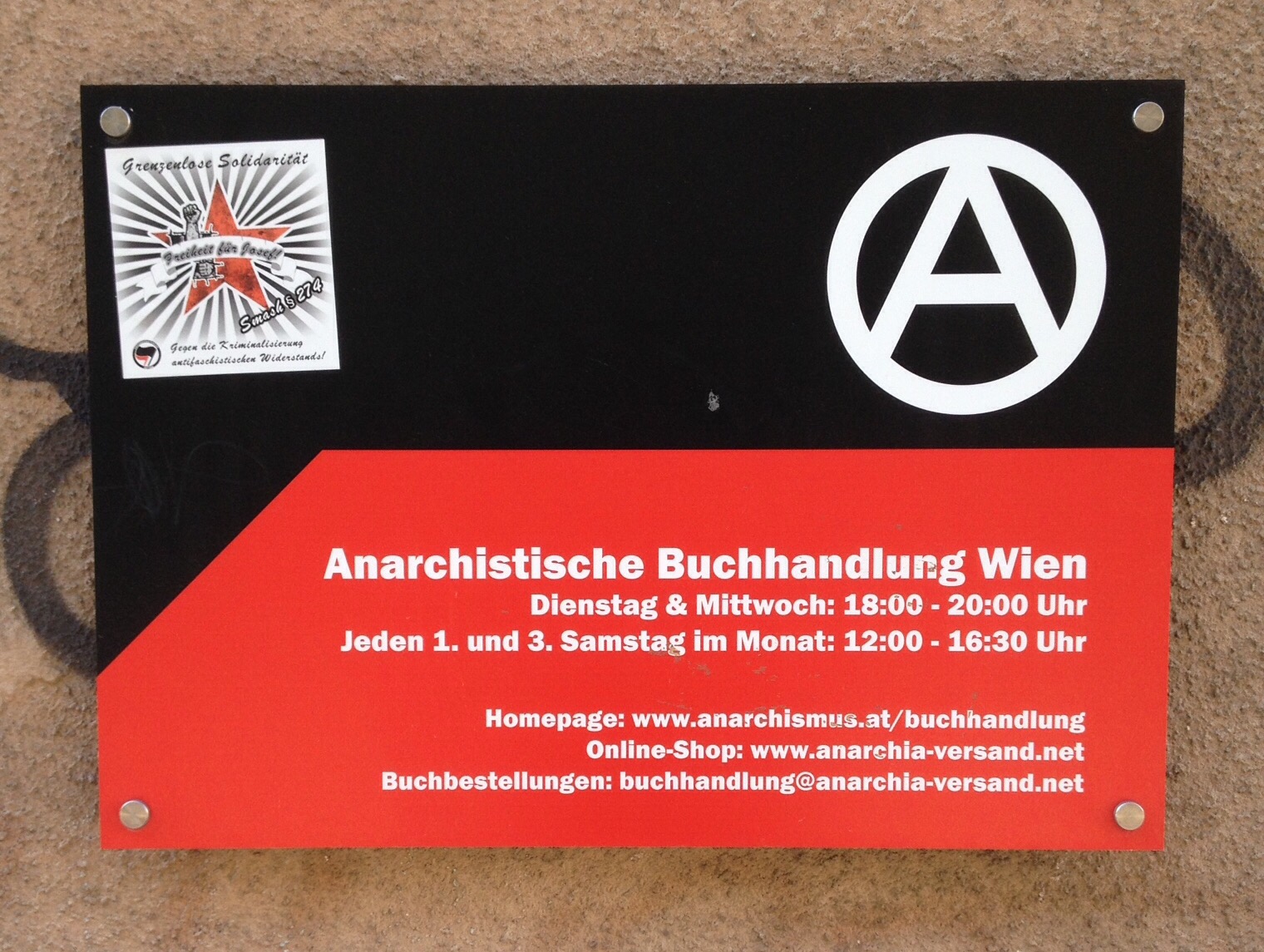
I do love this. Sign outside the Anarchists bookshop in Vienna. Very neat, very orderly. I stayed next door.
We’ve been trying to get people to wash their hands for ages.
This is another experience to come out of my visit to hospital. I couldn’t help notice how much effort had gone into 5S and visual management on one of the wards. Good news I thought as I’d heard a lot about how it is being used to improve effectiveness in hospitals.
5S (sort, set, shine, standardise, sustain) is a method for organising the workplace which has evolved from Japanese manufacturing techniques. It is now being widely applied to all sorts of activities, including public services, as part of an overall continuous improvement, Kaizen type approach. Also linked to this are visual management or control techniques which deliberately use visual signs or symbols to help improve a process.
Lots of people are into using these approaches as methods of improving process outcomes. A quick look at You Tube will get you an extract from Family Guy illustrating the need for 5s in hospitals, whilst some more serious videos give a good explanation of what 5s is all about, in straightforward terms.
Nice clear signs -‘Clean your hands here’. Who could avoid it? Picture source: Mine
The gist is, if you can see where things are and what needs doing, you’ll get the job done more efficiently, rather than wasting time looking for things. All good news and just the sort of approach that I wanted to see as a patient. The application of these approaches in hospitals has had many benefits, and there is plenty of evidence to prove it.
One of the things that interested me though was the longevity of these initiatives. Once the enthusiasts have left to evangelise elsewhere what happens? Well I might have got an answer from my stay on the ward. One of the successes of the 5S approach was the use of background sheets for hand sanitiser dispensers. These were a different colour to the hand sanitiser gel and allowed you to see if the translucent dispenser was empty. They also had a nice big “clean your hands” slogan prominently displayed. A really good visual management initiative in the fight against hospital acquired infections.
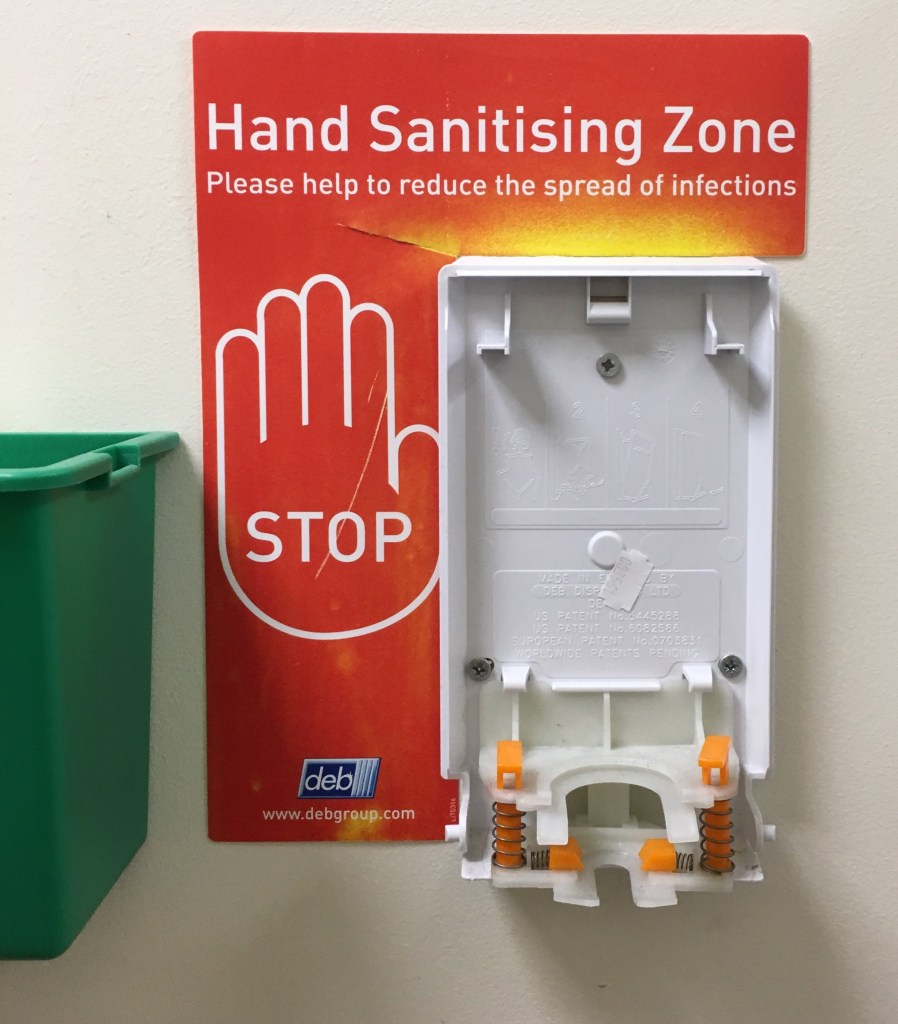
This specific application however relies upon the background sheet and the dispenser being positioned with the dispenser on top of the background sheet. But this is not what I saw during my stay. The background sheet and dispenser sat adjacent to each other. Completely not what was intended. No obvious reason why, maybe they had got new dispensers and this is how the maintenance people had fixed them? Whatever the reason, it wasn’t doing what was intended, and nobody seemed to notice. A great visual management initiative that seemed to have run into the sand.
So, what’s the PONT?
1. Things like 5S and visual management are good improvement techniques but they need people to own them.
2. Once the evangelists have gone away things can lose momentum.
3. For practices like this to succeed, everyone has to understand and believe. I suspect whoever placed the dispenser next to the background sheet, not on top of it, neither believed or understood.
Sanitising you hands isn’t a recent invention. If you are interested, there are thousands of pictures of hand sanitiser dispensers on Flickr. People do have diverse interests!
Oh dear. Everything was fine until the gel ran out. A temporary blip I;m sure. Picture source: It’s mine.
I’m recovering from pneumonia at the moment. The early stages involved five days in hospital and a fantastic opportunity for some ‘hands on’ NHS user experience. I’m not recommending anyone interested in the workings of the NHS gets sick, but it doesn’t half give you an insight.
As it turns out I’m a very straightforward / simple problem:
Send home with ‘industrial’ quantities of antibiotics.
TICK
7
See you in six weeks for a checkup.
TICK
8
All ‘ticks in boxes’?
JOB DONE
Apparently I’m a fit (oh yes), healthy (cool), handsome (I put that bit in), and YOUNG! (It’s all relative). The pneumonia is a common one, very treatable, and as such it isn’t of much interest to the medics.
They didn’t actually say I wasn’t very interesting,……. but it was obvious from
the ward rounds. My turn arrives, the medics work out its ‘in the bag’, and it’s all eyes darting down the list to whose next. Meanwhile the consultant goes through a few niceties with me. Anyone with complications like a heart attack, pneumoconiosis, blood clots, anything, and they were flocking around like vultures. At the centre is the consultant holding court, “now young Miss/Mr Brighteyes, your diagnosis would be….. “, it was like watching auditions for the next series of House. They really do love complicated stuff.
Anyway, I’m not complaining. It’s really good to be a simple problem, thanks for fixing me.
So, what’s the PONT?
Experts love to focus on the complicated things. That’s just the way it is.
This can leave some of the simple stuff unattended, and at risk of slipping into a chaotic state. Have a look at Cynefin Framework which explains this really well.
Being a patient is great place to observe what’s going on, but I wouldn’t recommend it as part of a routine business improvement technique.
The original image was a spotter & sniper. I've gone for something less provocative.
This is the follow-up from the earlier post dealing with field sabotage which was based on the guidance in The Simple Sabotage Field Manual .
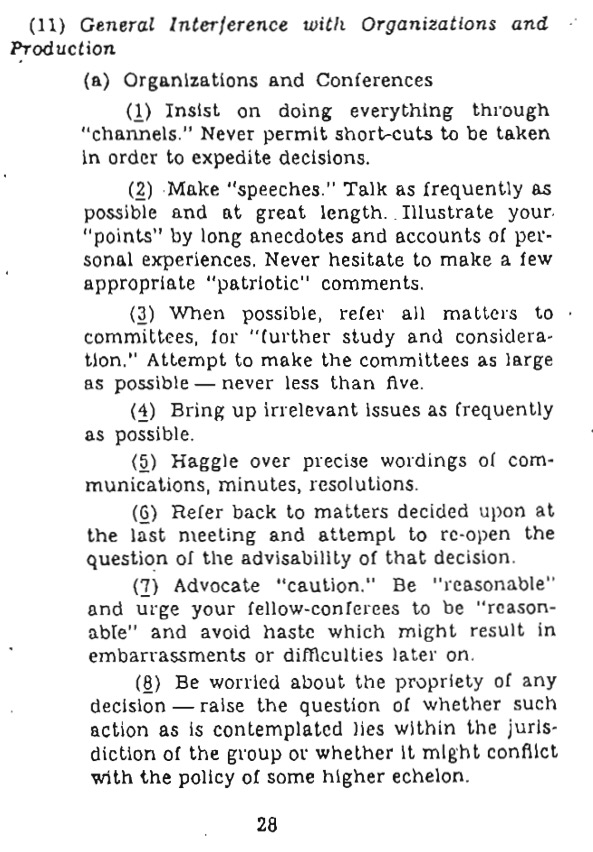
It’s my tick list, updated from the 1944 CIA field manual, section that covers; ‘general interference with organisations and production‘. It’s also got a few personal irritations thrown in.
Print it off and enjoy identifying the saboteurs in your meetings.
How to use it? If you spot a behavior, give the person a score between 1 and
10. 10 is an extreme example, a definite saboteur, 1 is a ‘good guy’. For anyone who scores more than 50 out of a 100, you might need to think about intervention, like corrective behavior techniques…….. NO! Only joking!
Please use this as intended, a bit of fun.
Spot the meeting saboteur checklist
No.
Behavior & Phrases Used
Score out of 10
Target (optional)
1
Returning to previous decisions or points dealt with earlier
2
“Let me play devil’s advocate……”
3
“We need to be very cautious here”.. when we obviously don’t
4
Not engaging in any practical activity
5
Quoting rules, policy and procedure
6
“I totally agree with what you are saying”, then
proceeding to disagree
7
Doing or saying nothing for long spells
8
Constant fiddling with a smart phone, laptop or some other device
9
Using the boss as a threat, constantly. “Mr Big / Ms Important said / wants / demands / thinks the following…..”
10
Making grandiose statements with nothing to back them up. Usually nothing to do with the point being
discussed
Office of Strategic Services (OSS) 1944 Simple Sabotage Field Manual A Timeless Classic
Answer: Read the Simple Sabotage Field Manual.
A while back I went to the inaugural meeting of a ‘community of practice’ (CoP). Like many CoP’s they had objective of, “sharing information and knowledge to improving our collective practice”. Nice! Nothing you can argue about there… or maybe not.
Astonishingly they spent well over an hour discussing who would be allowed to join, or in reality who to exclude from the Community of Practice. People ‘below a certain job grade’, ‘people from different disciplines’ and ‘people we don’t like’ (they didn’t actually say that, but I know what they meant). There were a lot of people included on the ‘list’.
The discussion was all neatly wrapped up in some pretty specific language around:
quotas of people each organisation could send;
first and second choices; standby lists;
different sub-groups permitted etc, and
the great momentum killer – voting rights.
This was a community of practice, what exactly they might ‘vote’ on was a complete mystery to me.
The Best Sabotage is Undetectable. I’m sure none of it was a deliberate attempt to sabotage the meeting, but it didn’t half bring this to mind – The Simple Sabotage Field Manual published in 1944 by a CIA predecessor, the OSS (Office of Strategic Services).
The manual is packed full of about things you might expect like; disrupting manufacturing, transportation and power production. The usual ‘sabotage’ stuff like putting sand in gear boxes, loosening connectors etc. There were also some fantastically creative sabotage measures like, taking a bag of moths to the cinema to ‘release during propaganda films’, brilliant!
Sabotage in the Modern Meeting. Page 28 is where it gets spooky, no clever tools or equipment, just guidance for behaviour in meetings that causes the maximum disruption. You will have seen this behaviour every day in many places, people enthusiastically applying sabotage instructions written in 1944, to modern-day meetings.
General Interference with Organisations and Production: Below is an unaltered extract from 1944, OSS Simple Sabotage Field Manual instructions, a copy of the original is at the end of the post.
Insist on doing everything through “channels.” Never permit short-cuts to be taken in order to expedite decisions.
Make “speeches.” Talk as frequently as possible and at great length. Illustrate your “points” by long anecdotes and accounts of personal experiences. Never hesitate to make a few appropriate “patriotic” comments.
When possible, refer all matters to committees, for “further study and consideration.” Attempt to make the committees as large as possible — never less than five.
Bring up irrelevant issues as frequently as possible.
Haggle over precise wordings of communications, minutes, resolutions.
Refer back to matters decided upon at the last meeting and attempt to re-open the question of the advisability of that decision.
Advocate “caution.” Be“reasonable” and urge your fellow-conferees to be “reasonable” and avoid haste which might result in embarrassments or difficulties later on.
Be worried about the propriety of any decision — raise the question of whether such action as is contemplated lies within the jurisdiction of the group or whether it might conflict with the policy of some higher echelon.
It leaves me a bit speechless, written in 1944 and still being enthusiastically applied by people almost 80 years later. Maybe we should be telling them the war is over.
So, what’s the PONT?
Watch out for saboteurs, they are more highly trained than you think.
They might not even know they are doing it (the “let me play devils advocate” merchants are the worst) which makes them really hard to deal with.
Deploy a few anti-saboteur techniques. I think I’ll have a go a describing some in the next few posts. This might involve my own ‘Spot the Saboteur’ Checklist. Once you identify them you can start to deploy counter measures.
I love You Tube, it a great resource for sharing and learning but sadly not widely used by public services (in many organisations it’s blocked, like most social media). I’m also quite interested in beer, so this grabbed my attention, particularly when you throw in Kaizen.
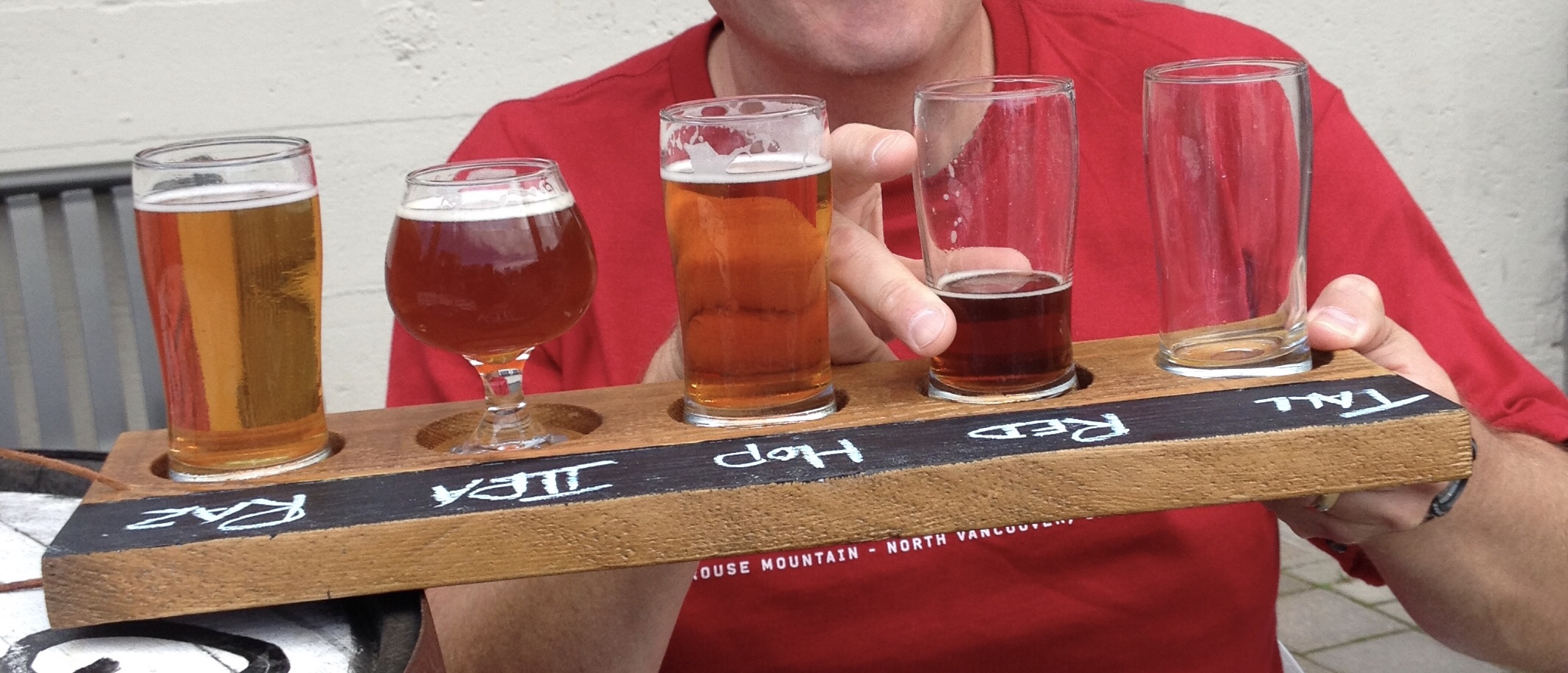
Amongst the dozens of You Tube videos on Kaizen, these two really caught my attention, Kaizen Toast and Kaizen Beer! Both practically explain the principles of Kaizen but from slightly different angles. I thought it would be a bit of fun to compare them and see which one wins, so here goes.
As the enlightened know, we will need some quantitative data and some contextual narrative information for this. The numbers are accurate, but not always believable, the narrative is believable, but not always accurate. If we put them together we will get something accurate, believable and overall convincing.
Toast v Beer Kaizen – Metrics Table (17 June 2011)
Indicator
TOAST!
BEER!
Why use this indicator?
Views
59,177
5,129
More might mean better?
Likes
19
9
User feedback, excellent
Dislikes
5
2
More customer feedback, even better
Comments #
13
4
Level of feeling & opinion generated
Comments +\-ve
40\60 ish
90\10 ish
Hmm, hard to judge what they mean
Duration
5.12 min / 30 mins
9.30 min
Too long = boring (potentially)
Awards
Shingo
No
Someone else thinks it’s good
Wales shaped Toast, how good is this. Genius!
Well, Toast looks like the winner, but let’s consider the narrative behind the numbers.
Toast Kaizen, is produced by the Greater Boston Manufacturing Partnership and is presented by their Shingo Prize recipient Bruce Hamilton. The video gives an introduction to Toast Kaizen, applying Kaizen to a familiar setting, the kitchen, and a familiar process, making toast. If you want the full 30min version (available in 11 languages) you’ll need to buy it ($99). A quality You Tube video which Kaizen enthusiasts and learners will no doubt enjoy.
Beer Kaizen! , this is a very funny take on the world of Kaizen, focussing on a ‘work activity’ I can really understand, drinking beer with my friends. The 9.30 mins flew by and I think I actually learned a lot about Kaizen. My personal beer distribution system is now worthy of a Six Sigma Black Belt. Even an untrained operative (kids friends), or reluctant/resistant workers (my kids) can now successfully serve me up a beer. Actually the video is a homage to the Toast Kaizen video, but it does the trick very cleverly.
So what’s the PONT?
Hopefully you’ve picked up a bit of learning about Kaizen by watching those videos. Lots of things on YouTube are great resource, it’s not all keyboard cat (excellent though it is!).
Humour is used in both of these videos, a great way of getting learning transferred.
Different things work for different audiences (beer for me), I think that both videos are winners, nice one guys.