
• Recently I posted about the rule of 1% for online participation and why I think it still applies in many  of the online communities I frequent. This is a ‘note to self’ and a plea to a few people I know with the ‘build it and they will come’ philosophy for online knowledge sharing. I admire the commitment, but it is worth thinking about how you move beyond 1% participation. That’s got to be good for the business case and the return on investment figures. It also avoids the sad faces when things get closed down after 12 months because not many people turned up and hardly anyone stuck around.

    There are two really good sources of information I’ve found on this, both on the sponge.com website. Sponge is a service that provides a platform for online Q&A communities. It also has a very helpful blog that talks about engagement and participation in online communities. Given what they do, I think they are in a good position to provide this view.

    The first source to mention is 6 reasons why we participate in online communities. These are all things many of us will recognise, but maybe not think about when we set up our online communities. Check out the post for further explanation and links to research behind each of the reasons why people participate:

    1. Anticipated Reciprocity
    2. Reputation
    3. Sense of Efficacy
    4. Altruism
    5. Sense of Belonging
    6. Emotional Connection

    The second post is about motivation in online community participation. The standout message for me is summarised by the graphic they use. Basically, participation will peak early on for reasons to do with newness and then decline. Whether or not that decline becomes permanent or grows and stabilises depends upon the degree of extrinsic and intrinsic motivation within the community. I’ve seen this happen, in both online and offline communities. Looking at this from a 1% rule of participation perspective, the lower line in this graphic could represent the 1% of people actively participating to keep the community alive.

    The extrinsic motivation factors mentioned in the post are things like rewards and quizzes, great for getting things started. When it gets down to intrinsic motivation, the post identifies three things; learning, self-expression and fun. Look at the explanation in the sponge post, but from my own perspective here’s an observation on how this might apply to the world I know:

    1. Learning. This is great, the primary reason why online knowledge sharing communities get established. It’s just a case of making sure that people can learn as well as share. This might require someone actively posting material for others to learn from and respond to. What we need to avoid is this just being activity by the eager 1%.
    2. Self Expression. This sort of answers the point above. If people are able to express themselves through posting comments and their own material we could get a virtuous circle  developing. The big barrier is still however the confidence to post material. Something I’ve talked about before, but things like micro-participation and private discussion groups will help to build confidence and more significantly, trust.
    3. Fun. This is a tricky one. There is a bit of an ‘anti fun’ movement in parts of the world I know. Regardless of that, I think we should persevere. I’m open to suggestions on how to inject some fun into an online community on for example….. refuse collection vehicle maintenance…….. there must be a way.

    Thankfully there are some shining lights I know of. Here is a link to a post by Helen Reynolds about an online community that’s doing very well, Monmouthshire Foster Carers. They seem to have the intrinsic motivation factors I’ve been talking about which is great.

    So, what’s the PONT?

    1. Anticipate a significant drop in participation during the early stages of and online community (I’ve seen it take some people by surprise).
    2. Online communities need careful thought in their design of you want people to participate and the community to grow and be sustainable.
    3. Think carefully about how you support the intrinsic motivation around: learning, self-expression and fun (any pointers on fun please let me know). How do you get better than 1% participation?

    Picture source: Graph sponge.com website

  • This week has been about failures in communication.  I’ve ended up with 16 feet of timber for fence posts, excellent. Unfortunately it wasn’t in the shape of the two 8 foot lengths I needed. I got four 4 foot lengths. It might as well have been firewood.

    I could put this down to a sophisticated act of malicious compliance by my kids, but I’m hoping they aren’t that cruel. I’ve rationalised it as a massive communication failure on my part. This is how the story unfolds.

    In the final stages of shed building I’m fencing off an area and needed two extra posts. Fortunately my father in law had two spare 8 foot post that would do the job perfectly. There is a minor hurdle to cross, they are 10 miles away and are just a little bit too long to fit in the car. There is good news however; two of the kids are due at their Grandfathers to help with some chores, bringing the posts home will be no problem…….

    I thought I had a very clear conversation with the kids that went along the lines of….”fold the seats in the car flat and slide in the posts, cut enough off the post so that it will fit neatly inside the car, don’t forget to take the saw, not my best one, take a sheet to cover the car seats, drive safely, avoid the busy motorway, blah blah blah”. I was going on a bit.

    Obviously that’s not what they heard. Things got worse as only one of them actually went on the visit to Granddad. When he returned he had the posts, in neat 4 foot lenghts that fitted very easily in the car, without the need to fold down seats.

    Son number two informed me of this fact when I walked in from work (please remind me to ask for the money back from the extra ‘Dignity and Respect’ classes I’ve been sending him to), “Dad, you’ll never guess what that donkeys gone and done?….. He’s only chopped your posts in half! “

    It was truly one of those ‘I don’t know whether to laugh or cry’ moments……my only hope is that for the future we all learn to communicate more clearly AND LISTEN PROPERLY!

    The whole sorry affair did remind me of that cartoon of the tree and the swing that gets used in various training sessions about poor communication in IT project management. I used to think that this sort of situation could never happen. Now I’m convinced it probably does. Hopeful the kids can learn the lessons from our little low risk venture and avoid a massive failure in the future. Apparently we do learn quickest from failure…… ahhh…. that makes me (and my 4 foot posts) so much happier.

    So what’s the PONT?

    1. I would have been better sticking to the key facts and not over complicating the message with non critical information.
    2. I should have checked back that the message had been received and understood. If not, I needed to try again until it was.
    3. If I ever find out this was a sophisticated act of malicious compliance, I will seek revenge (and it will be hideous).

    Picture source: The tree and swing cartoon has been used by lots of people. This article unravels some of the history.  http://blog.thingsdesigner.com/index.php?/archives/354-The-infamous-software-designdevelopment-process-tree-swing-comic.html

  •  Single tweet, massive impact.

    Situation.

    • 30th April 2012 a 9 year old school pupil starts the NeverSeconds blog as a writing project with her dad.
    • Martha writes about what she gets for school lunch and takes photographs.
    • This is done with the approval of the school.
    • The blog also acts as a link to raising money for a school meals charity.
    • Blog gets some good attention, kids from other places send pictures of their own school meals and they are posted.
    • June 2012, negative press articles attract the attention of those responsible for providing the meals, the Local Council.
    • Thursday 14th June Martha is told to stop taking photographs of school dinners by the Council.
    • Martha publishes this on the blog in a ‘Goodbye’ message.
    • The world of social media, twitter in particular, erupts.

    Social Media Impact

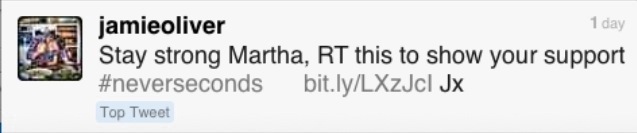
    • A very prominent school meals campaigner (Jamie Oliver) sends a message of support and encourages his 2.3 million followers to retweet it.
    • Twitter gets very busy with people talking about ‘#neverseconds’.
    • The story is picked up by television, radio and newspapers.
    • Politicians become involved, some via twitter.
    • Considerable pressure is put on the Local Council.
    • Friday 15th June the Council reverses the ban and Martha is allowed to use photographs of the school meals in NeverSeconds.
    • This all happens within a 24 hour timeframe.
    • ……and the world of social media erupts even further.

    A few numbers

    • Never Seconds blog had received in excess of 4,500,000 page view by 11am on Saturday 16th June (still climbing).
    • The page view counter on Saturday morning was flicking over at rate too fast to count. It was about 200 views per minute (12,000 / hour) when it had slowed down a bit.
    • The ‘#neverseconds’ hash tag attracted thousands of tweets.
    • The donations to the school meals charity have reached over £45,000, the fastest rate of donations they have experienced; and it’s still going on.
    • There are 2 more weeks until the end of term, plenty of time for more school dinner blog posts.

    Some thoughts

    • The council has received a massive amount of publicity in a very short space of time. Most of it negative, using phrases like ‘bully’. It’s going to be an interesting day back at work on Monday.
    • Will this improve the quality of school meals? Particularly once social media has gone away? Who knows, but the fear of a return to this level of exposure might be a big motivation.
    • What happens next for Never Seconds and Martha?

    So what’s the PONT?

    1. Censorship is a risky activity in the world of social media. It backfired hugely for this council (even if they do claim good reasons).
    2. The speed and scale of social media will cause problems for most organisations. Most public services aren’t equipped for this sort of 24/7 media pressure.
    3. As an example of ‘citizen voice’ from within a group of generally ‘quiet’ people (primary school kids), this is a pretty loud and high impact. As part the ‘digital natives’ entering wider society and the world of work, there is an interesting future ahead for public services.

    Interesting Links: Council Statement. http://www.argyll-bute.gov.uk/node/38630

    Infographic:  http://awesome.good.is/transparency/web/1105/lunch/flat.html Do students eat like prisoners? Well worth looking at.


    Also have a look at the Streisand effect. http://en.wikipedia.org/wiki/Streisand_effect.  An attempt to hide or remove a piece of information online has the unintended consequence of publicising the information more widely.

  • I am totally inspired at the moment. Of all things it’s about physics, education and blogging, all thanks to Alessio Bernardelli.

    Last night Alessio spoke at a WordPress Users Wales meeting about his blog and how he’s been using blogging in education. Here is his blog, please go and visit you won’t be disappointed (check out The Hidden Particles of Fishy Tank, brilliant).

    Just to give you a taste of why I found it so inspirational, here’s an example of the sort of thing he does.

    Last year he was teaching physics to Year 12 students (16/17 year olds). The subject area was photoelectricity and energy levels. As a past A Level physics student it rings distant bells but I don’t recall it being particularly exciting….. How wrong could I be?

    What Alessio got the pupils to do, was write an ‘Ode to Photoelectricity’, a poem. Not what we did back in the day, but something that certainly gets you thinking, and requires considerably more effort than a ‘cut and paste’ from Wikipedia. So far so good. Next, the poems are posted as blogs, and the homework ‘marked’ (opened up for comments). This is great, everyone gets to see what everyone else is doing, and you get some helpful feedback. This is more than just learning physics; it’s acquiring the ‘giving and receiving feedback’ skill that just about every workplace I’ve experienced  values greatly.

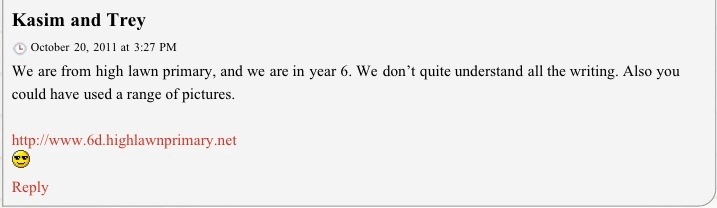
    What happens next is even better. The assignment was about energy levels and photon emissions. This would also be blogged and then reviewed by the Year 6 (10/11 year old) kids in the local primary school. This is a real challenge in terms of understanding the science, and also the ability to communicate what you understand (great life skills again).

    The best way to see the impact of this is to view the outputs via Alessio’s post on collaboration cross phase through blogging. Have a look at this very scientific presentation from some of the pupils. Standard power point stuff; similar to what many of us get served daily at work.

    The solitary response from Year 6 pupils says it all.

    As a contrast here is a link to another piece of homework, which makes full use of colour and animation to communicate the message. The comments speak for themselves, here’s a selection.

    Interestingly, today I was at a conference where the message was being given that public service organisations in Wales need to develop a culture of accepting challenge and feedback. Perhaps Alessio is already developing these people for the future by teaching them physics in a fun and inspiring was. He certainly inspired me, thanks Alessio.

    So, what’s the PONT?

    1. Inspiring teachers really do make a difference.
    2. Having fun at what you do is a key component to learning and engagement.
    3. Blogging is much more than just broadcasting your views.  Looking for, accepting and giving feedback is a skill lots of people (I know) could usefully develop.
  • Image source: Nina Mercado https://unsplash.com/photos/e9YFrEBWit8

    Please drop your car off between 8-10am and collect between 4-6pm… This is on the heels of recent posts about customer services. This morning, in the pouring rain and a howling gale, I dropped my mother’s car off at the garage for repairs. I hadn’t been there for about 7 years but was instantly reminded of why I stopped – shocking organisation, which resulted in hassled staff and poor customer service.

    Looking at what was going on I couldn’t help thinking, they could do with some Lean thinking here. A bit of Gemba Mat wouldn’t go amiss either. Admittedly it wasn’t a Toyota dealership, but I’m sure the manufacturers they represent would employ some sort of Lean thinking. Why on earth hadn’t it found its way out here?

    This is what I experienced:

    • Lack of signs. The service department and sales were opposite sides of a main road. There was nothing obvious to say this and I initially went to the wrong place.
    • Drop off time. I was only offered 8.30am as was everyone else. This had negative consequences.
    • At drop off time the area around the Garage is highly congested with people dropping off vehicles, commuter traffic and the local kids heading to school.
    • There aren’t enough ‘service’ parking spaces at the garage. You either need to park on the main highway or in a nearby street.
    • If you are being collected, your lift will have to park some distance away; a big deal if it’s raining like today.
    • Everyone booking in at 8.30am leads to long queues and delays at the booking desk.
    • People are hassled because they are running late, this translates into irritation with the booking clerk.
    • The booking clerk gets annoyed, and a vicious circle develops with the next customer in line.
    • Just to add the icing on the cake, the detailed ‘what is wrong with the car’ information I had provided over the phone hasn’t found its way onto the partly prepared paperwork, so they ask you all the same questions again. Fine when you know your vehicle intimately, not so good when dropping off your mother’s car.
    • Finally, ‘if you want an update, please call after 2pm’.
    • Now proceed to work….. “Have a nice day”….. No thanks to the garage.

    I know there is a better way.

    I’ve experienced it in other garages.

    Had the garage taken even a cursory look at the process they would have seen so much opportunity to improve the flow and end up with happier customers and (I’m sure) happier and more engaged staff.

    My suggestions to improve:

    • Multiple booking in slots during the day. Even a morning and afternoon session would reduce the congestion and have considerable benefits.
    • Better signs – let people know what’s happening and where. All pretty straightforward visual management / 5s activity.
    • Please, please, please use the diagnostic information you get over the phone.

    I do find it amazing that this was the customer facing end of a highly efficient manufacturing organisation that uses approaches like lean, yet it doesn’t seem to travel beyond the factory gates. I wonder why?

    So, What’s the PONT?

    1. Some systems and processes are set up in a way that they cause blockages which results in an inefficient service and customer dissatisfaction.
    2. Customer dissatisfaction can have a negative impact on staff which leads to a ‘vicious circle’ developing.
    3. There are straightforward techniques like Gemba Mat which help improve processes and flow. They are widely used in vehicle manufacturing and could be adapted and applied by car dealers…….. please have a go.

    But there is hope at the end of this tale. I’ve just come across the book featured in the picture. ‘Creating Lean Dealers’ by David Brunt & John Kiff. It was a Shingo Prize winner for research award in 2010 so well worth a read. I’m going to recommend it when I pick up the car, today hopefully.

    “Car manufacturing has been transformed by lean over the last 20 years, yet car dealerships have remained virtually untouched – until now. “

  • Here is an irritating situation. It’s 11.30pm on a Friday night in Cardiff Bus station. You have a 7am flight from Heathrow and the coach driver is getting all chesty about putting your carefully dismantled and beautifully bagged up bicycle into the luggage compartment. Apparently it’s in the  small print rules of the online booking form. It is at his discretion to decide if he allows the luggage on or not. Just to cap it off he threateningly announces that the bus will get full up at Bristol, and he will probably remove your bike off there. Welsh customer service at its worst!

    A very anxious journey to Bristol followed, where the bus did not fill up. My only guess is that the Bristol University Canoe Club failed to turn up with their kayaks. That’s the only way that luggage hold was going to become overcrowded, in my opinion (sorry un-necessary sarcasm here).

    If ever there was a clear-cut example of the need to do away with petty rules and useless officials this guy was it.

    During the anxious journey (while Geof was willing him a painful death through the power of telepathy) I was pondering, had we done anything wrong to wind him up? What can we do to make things better?

    Had we done anything wrong?  All I could think of here was our over enthusiasm to help. Bounding forward with two oversized bags full of bicycles was obviously the wrong thing to do. Helping him to lift them into the luggage compartment must have insulted his manly prowess in some way. Suggesting that they could slide into the special tall compartment, where every other bus driver shoves them, was totally in the territory of “don’t tell me how to do my job sonny”. Finally, never ever lean into the luggage compartment to help pull bike bags forward. This (apparently) breaches so many health and safety rules that it’s lucky the police weren’t called to arrest us.

    What we should have done?  I spent the rest of the trip carefully studying the driver as he picked up other passengers. This guy was master of his universe. What he wanted was a dutifully compliant person who bowed down to his superior knowledge and respected his position. The way to get ahead was to shuffle forward with your head bowed and not make eye contact with him. Offer your paperwork and maintain an air of complete helplessness and deference. Bend down to his superior position and bingo you are on the bus in no time. No hassle, not quoting of the (pointless) rules in the small print and no threats of ejection at the next stop.

    Sometimes in the face of petty officialdom you just have to pucker up and take your medicine. You aren’t going to win against ‘the rules’ so it’s not worth fighting – well not this battle anyway.

    By the way the experience at Heathrow Terminal 5 with the BA baggage people was fantastic; they didn’t bat at eyelid at bikes in large bags. Likewise First Great Western Trains were equally helpful on the way home, the platform staff at Reading in particular. Interestingly the driver on the bus link between Heathrow and Reading was also good. No fuss about loading the bike bags from him, in fact he was quite happy for us to actually put them in the hold. How can there be such a difference in people working for the same organisation?  Yes you’ve guessed who…… National Express.

    So, what’s the PONT?

    1. Sometimes, when you have no other choices, you have to endure poor customer service. It’s not right, but it happens unfortunately.
    2. When faced with petty officialdom, if you can’t challenge and win the battle you may have to settle for deference and compliance with the rules…… sacrifice the battle to win the war.
    3. We will definitely be using the train next time even if it costs lots more. And joy of joys, National Express has sent an email asking for some customer feedback. Ha ha ha Geof will be completing that one……. look out!

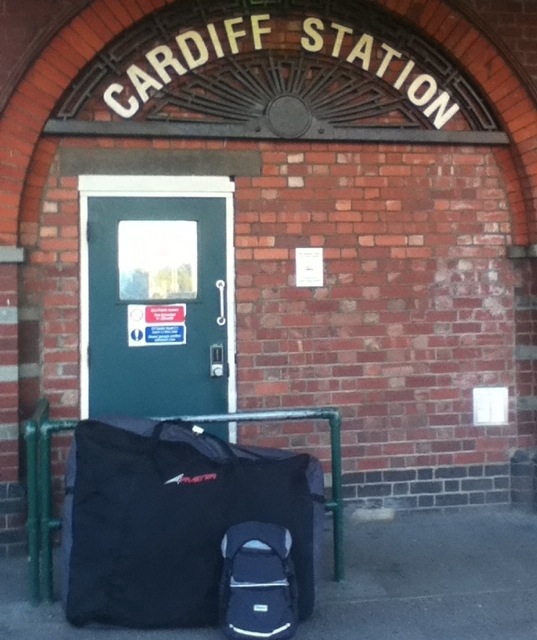
    Picture: “does my bike look big in this?”…… a beautifully packed bike at Cardiff Rail Station. Future transport method of choice.

  • Recently I visited 3 Berlin museums in a single day, impressive I know, 6 hours of intensive learning and culture. These were all good learning experiences; however the best one was delivered by someone Welsh, Shaun from Aberystwyth!  I’m not being biased here, there are good reasons I’ll explain. I’m not going to give you a ‘Trip Advisor’ review, these are my personal criteria for deciding what makes a good experience at a museum, here goes:

    1. Attendant Interaction. Did the museum attendants engage with me? Did they make me think or did they intimidate and make me want to leave?

    2. Go backwards factor. Did I find myself going back to things I‘d already seen, for a second look? Zig-zagging my way around museums is an annoying personality trait, but the more I retrace my steps the better my experience.

    3. Boring my family later. The more facts I can remember, to regurgitate to the family after the visit, the better the museum. Poor Geof, my cycling companion suffered this time.

    Here are the scores for each of the establishments I visited:

    Deutsches Historisches Museum The DHM is a traditional state run museum with free entry. It felt like most of the museums I’ve ever visited; lots of interesting things in glass cases with explanation cards for you to read. I visited the section covering 1918 to the present day and to be honest, by the time I’d made it to the Berlin Wall display I’d had enough.

    Attendants: Impeccably dressed in smart uniforms. However there was no interaction. They just stood by with that intimidating “touch anything and you get thrown out” expression.

    The tour: Very linear. Start at the beginning and dutifully “read” your way to the end, wasn’t tempted to retrace my steps once.

    Remembering facts: One key fact about the Trümmerfrau, the ‘rubble women’ who helped reconstruct German cities after the war.

    Overall score, a solid 6 out of 10. Most memorable thing, the intimidating attendants.

    DDR Museum This was about the years of Soviet occupation in East Germany from 1945 until 1989. It is privately funded and claims to be one of the most interactive museums in the world. I won’t argue with that, it was fantastic, well worth the 6€ entry fee.

    Attendants: If there were any I didn’t notice them. I was too busy opening doors, listening to covert recordings and sitting in the Trabant honking the horn. The place was packed, and everyone was so involved, I’d argue that you didn’t need Attendants.

    The tour: This was ‘zig-zag’ heaven for me. There was no obvious linear path and I retraced my steps on several occasions. At the final door I headed back in for another view of a typical East German sitting room. I must admit it looked pretty similar a South Wales Valleys sitting room circa 1970’s……..

    Remembering Facts:  Plenty to ponder on here. Strange things keep coming back to me like how long it took for your Trabant to arrive (16 years) and the impact of lignite (brown coal) opencast mining.

    Overall score, an 8.5 out of 10. The museum shop at the end was a bit too earnest.

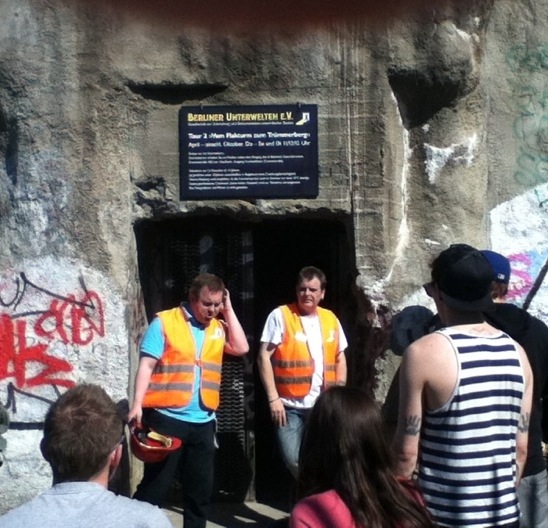
    Flak Tower Walking Tour  This was a tour of one of the partly demolished Flak Towers built to deter bombers in 1941. You know it’s going to be serious stuff when they insist upon checking you have sensible shoes before they will sell you a ticket and recommend a warm coat because it will be cold. This cost 10€, was run by a ‘not for profit’ organisation and couldn’t have been more professional.

    Remembering facts:  Unfortunately poor Geof now knows more about the Flak Towers than he ever wanted to. I soaked it up like a sponge (3m thick walls, 100,000 cubic meters of concrete etc etc) and regurgitated it all to him, and my wife, kids, colleagues and complete strangers since I’ve got back home.

    The tour: I did stay in line for this one. The environment was quite scary and it was very reassuring to have a Health and Safety Attendant at the back making sure nobody got lost.

    Attendants: Absolutely brilliant and I’m not just saying that because he was Welsh. This was someone who loved the job. He was passionate about the subject, knew it in incredible detail and was happy telling you all about it. This was knowledge exchange and learning at its best.

    Overall score, 11 out of 10. It was that good. All German museums should have a Welsh attendant.

    So what’s the PONT?

    1. The contrast between what I learnt from listening to and interacting with Shaun at the Flak Tower and reading cards in glass cases at the DHM was huge.

    2. The acts of looking and reading feels much harder to do than listening to someone explaining and asking questions. 90 minutes at the Flak Tower flew past, even in the cold and dark.

    3. People make a massive difference. An engaged and passionate guide at the Flak Tower turned a good experience into a fantastic one I’ll not forget for a long time, thanks Shaun.

  • After wondering in previous posts about how many people actually participate in online communities of practice, my son helpfully pointed me in the direction of the 1% rule of Internet culture. Fantastic, this felt like the world of 90% lurkers I recognise.

    Then the BBC goes and burst my bubble. In their online spring briefing they pronounce that participation rates in online activities are much higher, more like 77%. I’m confused; almost 8 out of 10 people actively participating? This doesn’t feel like the world I inhabit.

    The 1% rule or the 90–9–1 principle is a hypothesis that more people will lurk in a virtual community than will participate. It’s been around since the mid 2000’s and has been likened to the 80/20 rule (Pareto principle), where 20% of a group will deliver 80% of the activity.

    For online communities the 1% rule states:

    • 1% of people will actually create content;
    • 9% of people edit, modify or comment on that content; and
    • 90% of people will view the content without contributing.

    Based upon my experience this feels about right and seems to be a very plausible hypothesis. It could also apply to some of the offline communities I’ve experienced.

    The BBC Internet Blog article presents the findings of a survey of over 7500 adult internet users that was gathered over an 18 month period. One of the key points author Holly Goodier makes is, “digital participation now is best characterised through the lens of choice. These are the decisions we take about whether, when, with whom and around what, we will participate. Because participation is now much more about who we are, than what we have, or our digital skill.”

    What I took from the article was that improvements in ‘ease of participation’ mean that there are no longer the technical barriers like there used to be. The other thing it says to me is, the content has to be good – something you want to / are motivated to engage and participate (no surprises there).

    The BBC findings have generated a bit of debate. In this article by Bobbie Johnson on GIGAOM he argues that the BBC are comparing ‘apples with oranges’ to arrive at the 77% participation figure. In reality people (like me and many I know) use different parts of the internet for different things and the rule of 1% still applies when you look at things broadly. Not everyone agrees with him though and someone has commented, “The BBC are never wrong and you’re clearly are…”.  Oh dear, might be a lesson here…… be careful about criticising the BBC.

    Coming back to my world of online communities and why I think the rule of 1% still applies:

    • Professional knowledge sharing in an online community of practice is quite a bit different to a discussion thread about what a Radio 1 DJ is saying. When your professional reputation is on public display, most people I know will stay hidden with the 90% lurkers;
    • Micro-participation is still developing in this world, it’s not quite the ‘done thing’ to ‘like’ a case study about social services or refuse vehicle maintenance; and
    • There is still a lack of confidence to participate, and some organisations still don’t encourage it. Perhaps courses like social media for the terrified delivered by digitalandpeople.co.uk, which is aimed at civil servants, will help to increase the 1% and reduce the lurkers

    So what’s the PONT?

    1. The rule of 1% is very useful when thinking about how many people will actually participate in an online community of practice.
    2. Content is Queen/King. If what is being said is interesting and highly relevant, you may well get higher participation rates (a bit like non virtual real world communities).
    3. In the world of professional knowledge sharing lots of people still need to build their confidence before they will participate.
  • This might seem like an odd admission but…… I have always dreamed of having a boss that would take me out walking in the Brecon Beacons once a month.

    There, I’ve said it. Now let me explain why……

    I’ve got a new neighbour, who’s doing lots of renovation work on the property including fence building. Whilst I was busy constructing my shed (subject of a previous post on malicious compliance), I popped over to help with fixing the rails between the fence posts. It wasn’t a particularly difficult or strenuous job, but it was just a bit easier with two people. What it did allow was a bit of conversation between us. In the space of 45 minutes we covered a huge range of things, many of which I can’t remember now, other than walking away thinking, “he’s a decent bloke, we are going to get on well as neighbours”.

    What also struck me was the difference between this interaction and the ‘sherry and twiglets’ experience we had when the previous neighbour had organised a meet and greet session before she left. There was nothing wrong with the event (the twiglets were excellent), I just didn’t have the same level of conversation or make the same sort of connection as I had whilst fence building. Doing things together seemed to enable a different type of conversation and the development of a deeper relationship.

    This got me thinking, and then a few things happened to reinforce what I’d experienced;

    • I watched my Mother, Son and Niece bake cakes together.  A shared (very messy) activity if ever there was one,
    • The re-commencing of lunchtime walks in the park with a colleague who has been away for a while (welcome back btw), and
    • I heard someone talk about ‘walking and coaching’ in a meeting to establish a South Wales network for the EMCC (European Mentoring and Coaching Council).

    Walking and coaching intrigued me and following a quick search, much to my joy, I’ve found out that there are people doing it and it is a legitimate business pastime. Have a look at this site by The Walking Coach and Mike from Mentoring for Change who gives a good explanation of why walk and coach. I’ve been extremely happy at learning this. My desire to go walking with my boss isn’t just another peculiar fantasy of mine. It’s a legitimate business activity about coaching, mentoring; and for me building a better relationship and understanding of other people while sharing an activity.

    When you think about it, why wouldn’t coaching in the context of walking be an eminently sensible thing to do? I know plenty of people who will happily spend a few hours in coaching sessions sat in hotel lobbies, meeting rooms and other peculiar sedentary locations. Why not get out there in the fresh air and have a walk when you are doing it. It seems like a win, win to me (just remember to wear some decent shoes though).

    I’m sure there is theory and technique around how to get the most out of walking and coaching, finding that out is my next challenge. I’m the meanwhile; I’m off cycling for a week in Germany with my friend Geof. Not sure how this is going to work, it’s definitely a shared activity, but I can barely breathe most of the time, let alone talk.

    So, what’s the PONT?

    1. Sharing a physical activity with someone does help generate a different level of conversation and help increase understanding and develop relationships.
    2. Walking and talking informally can achieve this (have a walk in the park with a colleague at lunchtime),
    3. Walking and coaching (much to my joy) is a legitimate business activity. Have a think about it as an alternative to hotel lobbies or stuffy meeting rooms. Best of all though, try some joint fence building (or cake baking).
  • One of my pastimes is checking out the abandoned flipcharts I find in the variety of offices and meeting rooms I get to frequent. It’s quite a revealing pastime (possibly about me unfortunately). Occasionally you do stumble across sensitive material, obviously this goes straight in the confidential waste bin, or back into the hands of the originator. However, it’s the other material on flipcharts that fascinates me. I reckon you can get a useful insight into an organisation from the debris gets left behind on the flipcharts. The more frantic the scribbles, the more I like it.  Line & box diagrams, mind maps, dodgy graphs, stick people and bullet points all feature. Whatever form it takes it’s all a great informal record of organisational life. The real story of what’s going on from the hands of the people who know the place best.

    This helpfully gives me an opportunity to talk about some recent experiences where a drawing has helped focus a discussion.

    Twice recently I’ve sat in meetings, slightly bored and detached from the action (a familiar situation for many I suspect). What this allowed was the opportunity for a bit of observation and testing a theory of mine about the impact of flipchart drawings.

    Meeting 1. Business Process Review.  Nine people sat around a table discussing a document management process. It felt like something from a Dilbert cartoon. The alpha males and females (3 people) were vying for superiority, while two others were doing the best they could to get heard. The rest were in various stages of disengagement.  Plenty of arm waving and use of technical language to demonstrate ‘one’s own cleverness’ was going on. What looked obvious to me was that there were at least two versions of the truth being spoken about, and a contractor (supposed to be delivering the solution) looking confused, frustrated and increasingly desperate.

    Eventually some bright spark suggested the contractor draw the process on a flipchart. Bingo! Suddenly everyone was talking about the same thing and rapid progress was achieved. It took 40 minutes to get to this point and 10 minutes to agree some action.

    Meeting 2. Comparing Supplier Costs. Thinking about it now, this was a completely daft situation.  A group of 7 people were trying to compare two sets of figures. Most people had the first set of figures. Only one person had a copy of the second, and had only shared them verbally. The discussion was passionate and detailed, with strongly held views about the figures, but completely pointless.

    Eventually someone wrote down the figures on a flipchart. It immediately became obvious where the issues where. This was incredibly not in the place where people had been expressing strongly held views! The group then got around to concentrating on the most important issues and developing options. Again, this one took about 40 minutes (of wasted time) before someone wrote on the flipchart and focused the discussion.

    A few things I learnt from observing these events:

    • Some people love to talk and express an opinion, no matter how irrelevant;
    • A lack of a clear objective or point of focus allows the misguided (or even the meeting saboteurs I previously mentioned) to flourish;
    • People quickly disengage in these situations; and
    • A few ‘scribbles’ on a flipchart puts it all back on track.

    If this is what can be achieved with a few amateur scribbles, imagine what can be achieved through expertly drawn graphics? Have a look at an earlier post about graphic facilitation and the fantastic material organisations like Delta7 generate by working with the people in organisations.

    So, what’s the PONT?

    1. Focusing a discussion or a meeting by putting something down on paper can (usually does) help everyone understand and ‘speak the same language’.
    2. Using drawings, graphics or other illustrations can really help, especially with complicated processes, ideas or difficult situations.
    3. Next time you are in a meeting going nowhere, have a go yourself, start drawing and see what happens.

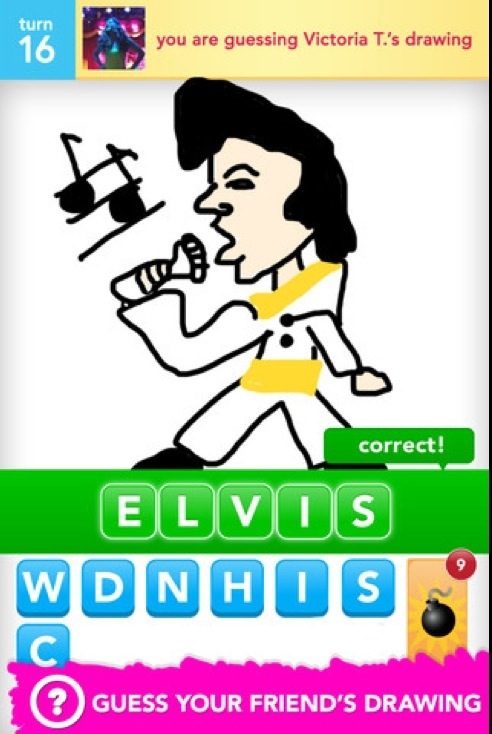
    If you are wondering, here is the connection with Draw Something.  If you are slightly nervous about putting something on paper, download the Draw Something app and start drawing. Practice makes perfect … possibly. I wonder if I can fit Elvis into a work context…….?

    Linked posts: https://whatsthepont.wordpress.com/2012/04/20/the-staff-dont-understand-quick-draw-them-a-picture-or-something/

  • Back in the mid 1800’s a group of Welsh emigrants were being rescued from an island where they been shipwrecked.  Before they left, they modestly showed their rescuers what they had achieved during their years of isolation. “These are our houses, this is the school, this is the reading room, this is the rugby field, and these are the two chapels”. “Why two chapels?” asks a rescuer.  The reply, “Oh, that’s the one we don’t go to…….”.

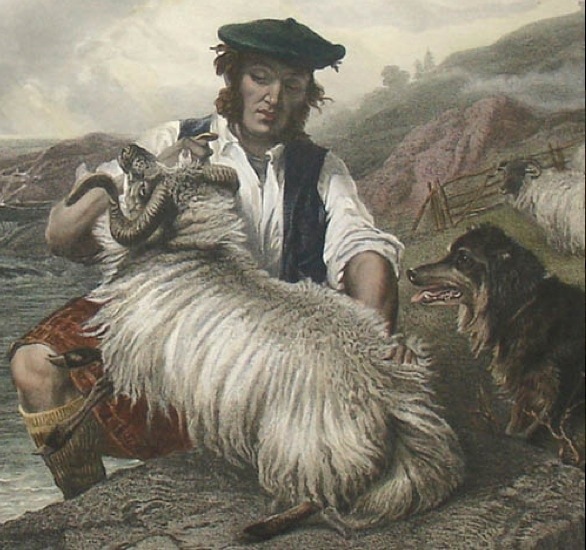
    We have a long history of not getting along with our neighbours in Wales, but maybe we aren’t that different to lots of peoples who have descended from animal herders (sheep farmers). That’s the theory offered by Malcolm Gladwell in his book Outliers in the chapter on Harlan County, Kentucky.

    The theory is that cultures that have developed around animal farming on marginal land (eg upland sheep farmers) are inherently more confrontational than those where there has been a strong requirement to collaborate (lowland arable farmers). If you are a shepherd looking after a flock of sheep you constantly need to be on your guard against predators, of the animal or most commonly the human variety. Preventing people stealing your sheep requires some demonstration of your physical prowess and a evidence you will take action to prevent your flock being pilfered. This has led to a ‘culture of honor’ (prevalent in the Southern United States) as Gladwell describes it, or ‘getting a bit chesty’ as we like to say in South Wales.

    Gladwell illustrates how this has been carried forward into the modern age and across continents by using the example of the violent family feuds that took place in Harlan County in the early 19th century. He argues that the roots of this ‘honor code’ behaviour can be traced back many generations to the culture of the herdsmen who farmed the marginal uplands.  Many of these people emigrated to America and ended up in the rural areas of the Appalachians and places like Harlan County. He identifies the North of England and Scotland as the areas where these people originally came from, but there’s probably just as much as a case to be made for Welsh immigrants.

    It’s an interesting theory that has been backed up by some research done at the University of Michigan, where certain groups of people (young men from the Southern States) were far more likely to ‘get a bit chesty’ if you insulted their honor. Have a look at the work of psychologists Cohen and Nisbett for more detail (Nisbett, R.E., & Cohen, D. (1996). Culture of honor: The psychology of violence in the South).

    With the current emphasis upon collaboration between public services in Wales I wonder if we need to think about where our ancestors came from before we start? If they were (or still are) sheep farmers from the uplands are we starting at a disadvantage, particularly if we insult someone’s honor? This will be an interesting one to observe at the next committee meeting on collaboration………, ‘who gets a bit chesty’ and why?

    The other great joy of reading Malcolm Gladwells book was that he does describe Harlan County in detail. Harlan interests me a lot as it seems very familiar. Not only is it the setting for Justified (a brilliant bit of TV based on books by a favourite author Elmore Leonard), they also have a strong coal mining tradition. As if it couldn’t get better, Steve Earle (another favourite) has even sung about the place, Harlan Man. Harlan might be in Kentucky but for me there are many similarities with bits of South Wales; feuding, coal mining, the general struggle to prosper and ‘getting chesty’. Maybe it is all to do with some common ancestry and descending from the same bunch of sheep farmers and miners?

    So, what’s the PONT?

    1. Our ancestors might have more of an influence upon our behaviours than we realise (have a read of Outliers).
    2. Collaboration may not be the default position for some people; it depends upon where they come from.
    3. At your next collaboration committee meeting, avoid insulting someone’s honor if you don’t want them getting all ‘chesty’ with you.
  • My ideas about chopping logs don’t quite fit with how my kids saw it.
    How not to motivate teenagers. Garden maintenance is not my day job; in fact it’s about as far away from ‘desk driving’, as it’s possible to travel.

    These two areas do however have some interesting crossovers, where it might be possible (in theory) to transfer some learning.

    Before I say anything it is probably worth mentioning that recently I’ve been extending my shed, and embarked on a few other activities. There was a bit of chicken ranching, messing around with the sewage tank, significant amounts of concrete and lots cutting up logs. Naively I thought this would be an opportunity to test my motivational skills and transfer employee engagement ideas into the world of teenage sons… like the complete idiot I am.

    Malicious Compliance is worse than blank refusal.  I’d always imagined that my teenagers would be thrilled at the prospect of doing some building with me. Learning some of the skills I’d picked up from my own father, and creating something useful.

    Using a bit of motivational ‘pull theory’ I tried the following approach:

    • Me, “kids, fancy having a go at chopping up logs with the chainsaw?”
    • Kids, “Nah…. we’re using double blade chainsaws to fight zombies on the X-box”

    I could go on, but you get the drift. My initial ‘offer’ was then followed by a series of increasingly less polite requests until I eventually ‘lost it’, used coercion (blatant threats) and then switched off the house electricity power supply.

    So, I got the help I needed. However it was possibly worse than struggling alone. The sullen half hearted shoveling of aggregate into a cement mixer and the limp attempts at hammering nails were pitiful. This was good old malicious compliance at its worst. But I know the game.

    Some of this was a deliberate attempt to provoke me into criticising their efforts which would legitimise the option of them storming off in a “Dad is grumpy and really difficult to work with” rage. So not ‘loosing it’(again) and ‘solid encouragement’ were the order of the day, and it sort of achieved the objective.

    Chainsaws don’t excite everyone. A useful lesson I learnt was, what excites and motivates me doesn’t necessarily do the same for other people, and not everyone loves chainsaws. A chainsaw in the hands of a resentful teenager probably isn’t a good idea either.  

    When thinking about this in the context of work it did dawn on me that, not everyone loves those ‘hands on’ practical team building activities that sometimes happen. Painting the community hall, might not be something everyone enjoys, even if it is a fantastic thing to do.

    People tend to be more committed to something they have chosen to do rather than forced to do, so it’s better to let them choose the activity.  Failing to do this will probably generate malicious compliance which just defeats the whole point of the exercise. Just saying in case you’ve got a team away day coming up and are thinking about a group activity.

    Age and experience beats youth and enthusiasm. For round two of Garden Maintenance with the kids I did actually find something that interested one of them.  Driving 8ft posts into the ground for the chicken run with a 16lb sledgehammer.

    Just the sort of thing a teenage gym monkey dreams about. Whacking a post with a 16lb lump of metal should be nothing for someone used to throwing around ten times that weight in the gym. My ‘pull theory’ was working, full engagement, excellent.

    It all went wrong as it turned out. “Dad cheated “ and won the post sinking contest, by a mile, I am champion (of our back garden) with the sledgehammer.

    Why did I succeed? Well it is apparently because “Dad’s had about 150 years of practice…..…and my hair was in my eyes”. Not strictly true, I did use a sledge hammer a fair bit in my youth and developed a little bit of expertise.  I might not as be as strong as the gym monkey but experience it seems does count.

    The more you practice the better you get.  Mastering a skill is important, which usually means putting in the hours. Even something as apparently straightforward as using a sledgehammer requires skill.  A lesson that has parallels in the workplace.

    Anyway we did finish a few jobs in the garden and rounded things off with a genuine campfire and cooked some burgers. During this I got the most astonishing request: ”Dad, can you move the fire closer to the house, I keep losing the WiFi signal on my phone”……..I despair.

    So, what’s the PONT?

    1. Take care in what you pick for motivational activities at team building activities (not everyone loves a chainsaw).
    2. Better still, let people choose what they want to do. This should get better engagement and avoid malicious compliance.
    3. Age, experience and mastery of your tools will beat youth and enthusiasm, but I would say that wouldn’t I!
  • You are engaged! http://www.delta7.com

    Suspend reality and imagine this strange situation…

    • Boss: “The staff here are a huge problem. They just don’t get my latest initiative, what’s wrong with them?”
    • Smithers: “Ah yes Sir. The words in your manifesto document are so beautifully crafted, truly inspirational, and it’s printed on the finest paper”
    • Boss: “Well here’s something that might work. I’ve heard that some organisations are drawing pictures… to dumb things down … so the staff get it”
    • Smithers: “errrr… perhaps you mean graphical representation Sir? A picture is drawn so that the  message can be understood and communicated at many levels, in a high impact way?”
    • Boss: “Yes that’s the sort of thing. Right, I want you to knock up an oil painting or watercolour of my fantastic ideas. Then they will understand and I shall achieve true greatness.  Make it happen Smithers!”

    This (obviously) is a bit of a parody of a real life situation I heard about. Those involved represent a kind of staff engagement ‘anti-matter’. They were struggling to justify yet another failed initiative and ended up blaming the staff for their lack of cognitive ability. The failure (in their eyes) was on the part of the ‘dumb’ employees, to understand and implement the clever ideas that were being thrust upon them. The ‘draw a picture’ discussion was actually just a diversion to avoid confronting the real problem, a lack of engagement with staff around the ‘clever new initiative’.

    This is a great shame as there are genuine benefits in using diagrams, pictures and graphics to communicate messages, understand ideas and generally make sense of the complexities of organisational life.

    A good example the approach I’ve seen is archetype extraction used by Cognitive Edge. This is a process where common understandings will emerge out of discussions, workshops, focus groups or other social interactions. A cartoonist / graphic facilitator will capture these common understandings and present them as a cultural archetype. These archetypes are a physical picture of how a community views things; common behaviours, social conventions, rituals and beliefs, common language, role models, “the way things happen around here”, etc (archetypes).  According to Cognitive Edge; “Archetypes can then be used in various initiatives such as branding, communications or strategy. Archetypes that are extracted from the anecdotes told naturally in a community resonate: they have bite.”  Have a look at their website for more details.

    Another good example I’ve seen of using pictures and cartoons is by Delta7. The graphic I have included in this post (you are engaged!) is one of many examples on their website. In a similar vein to the Cognitive Edge archetypes the example I’ve included here does look like a bit of an extreme version of what happens in organisations, or perhaps not? A bit like mentioned above, ‘it has bite’ and could be perceived as a bit uncomfortable for some people. It’s well worth having a look at the Delta7 website gallery for a few more examples of the pictures and archetypes they have created, I bet you will see a situation you recognise.

    Coming back to the Boss and Smithers mentioned earlier. I don’t think these are the sort of pictures the Boss had in mind. It’s a case of being careful what you wish for. If all you want are simple graphical illustrations, that’s fine but you do run a huge risk of patronising people and seriously disengaging them by ‘dumbing’ things down. If you go for something that digs a bit deeper and actually engages people (which I think you should), be prepared to live with the results. The pictures might actually have ‘bite’ and tell you how things actually do happen around here, possibly not what you imagined or wished for.

    So, what’s the PONT?

    1. Pictures, graphics and diagrams are a really effective way of communicating complicated messages, ideas or making sense of situations.

    2. They are also a good way of engaging staff, particularly if they are involved in creating the image as something that is commonly understood in the organisation, an archetype.

    3. Bosses be careful what you wish for here, some egos may not withstand the archetypes created, they can ‘bite’.

    Picture source: http://www.delta7.com/you-are-engaged/

    http://www.delta7.com/walking-the-talk/  another great one from Delta7.

  • Yesterday London Midland Trains tweeted that they were proud to have retained the top spot on the @engagementindex on Twitter. I’ve posted previously about how London Midland Trains use Twitter and how they provided  real time customer support trying to cross London during a time of rail disruption.

    This tweet got me intrigued, so I had to take a look, and it led me to the trains report on the Engagement Index Engagement Index website.

    Here is the graphic which is clear and easy to understand. Basically it is the ratio of direct tweets to an organisation that they have responded to, and those they have ignored. London Midland scores very highly as it responds to a high number of the tweets sent directly to them. The contrast is the train company at the bottom end that received  79 direct tweets and ignored them all, Arriva Trains Wales, oh dear.

    During March 2012 London Midland Trains received 1022 direct tweets; they responded to 767 and ignored 255. That might seem a high rate, but having seen the London Midland twitter stream when things are busy, there is a lot of traffic, and you could forgive them for not responding to some of the more ‘jaunty’ tweets (there is an interesting post on the Engagement Index blog about how to deal with tweets that contain swearing). The only other organisation that seems to come close to the London Midland performance (apart from Greater Anglia Trains) is Halifax in the banking report

    What I like about the Engagement Index approach (apart from it being free) is the fact that it is beautifully straightforward. I can’t do any better than to quote straight from their website:

    Overview

    The Engagement Index is a score on how well or badly a business is replying to messages aimed at them. It is a measure of their customer service performance on Twitter. More and more consumers / customers are turning to social media and in particular Twitter to engage, ask, complain to brands and businesses. Engagement Index measures how well or badly those companies are at replying to those messages.

    What’s the aim?

    To develop a simple scoring system with the aim of raising the customer service bar particularly in the UK. Sadly customer care in the UK to my mind is in the most part still very poor. Twitter is a game changer for businesses. Through Engagement Index I want businesses to be able to track themselves so that they can see how they are performing, see if the resources they have allocated are sufficient and aimed in the right places and so on.

    A couple of posts from John Dell’Armi give a good perspective on why organisations need to treat social media and particularly Twitter like any other form of customer feedback.  This one talks about having  nothing to fear (if you do the right thing) and another one about train companies of all things, “if you are on twitter, you need to be on twitter”.

    So what’s the PONT?

    1. Customer (service user) engagement on Twitter is just like any other form of engagement, so don’t ignore it.
    2. The Engagement Index is a powerful tool for measuring engagement. It  also allows benchmarking between and across sectors, and its free!
    3. Public services could a useful area for the Engagement Index to focus its attention next.

    Picture Source:  http://www.engagementindex.co.uk/reports?sector=trains

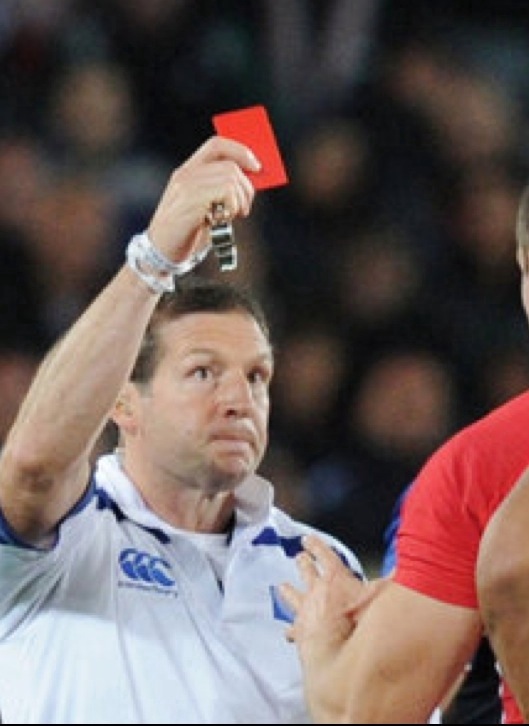
  • If you are Welsh and have even the faintest interest in rugby you’ll know exactly what this picture is all about (just in case you don’t have read about why Allain Rolland was right).

    This isn’t a post complaining about referees, they are just like the rest of us, struggling to cope with the reality of ‘what we write down is different to what happens’.

    What has prompted this post was reading a referees report about an incident that generated three red cards in a single game. I was watching my son play in the game; thankfully he wasn’t involved in the incidents. I’m not questioning the referee’s decision, it’s absolutely right that they clamp down on dangerous behaviour. It does however prove the point that what gets written down in formal reports is frequently different to what happened.

    I also understand the need to produce a report, but people do use some strange language in formal incident reports, a sort of slow motion speak:

    “I proceeded briskly to the disturbance and attempted to restore order with a few sharp blasts of my whistle”.

    Really? To me looked like you ran over to the fight, flapping your arms around and shouted “Oi!….. Boys leave it out”.

    The next bit was quite unintentionally hilarious, “The player I know now to be Rambo Llewellyn landed five punches on the head of his opposite number”. Really? Everyone knows this cannot be the case:

    1. Rambo ‘Psycho’ Llewellyn is a lovely boy. Ask his Mam (also watching);
    2. Rambo is incapable of firing off that many punches in a short space of time; and
    3. Had he done so, he would have punched himself in the face, at least twice.

    In a more serious vein, a while back I heard Professor Harry Daniels from Bath University speak about learning as a socio-cultural process . He used an example from multi-agency working in health and social care about what happens in the field is different to what is written down in files back at the office.

    The gist of what he said was that when the front line practitioners were faced with rapid fire situations they frequently did things to achieve a positive result or solve the problem, not unusual. On occasions this positive action was novel or innovative, and outside of the organisations rules framework policies and procedures, again not unusual. However, when the practitioner got back to the office, and they wrote their notes, they did it in a way that reflected the rules framework and not what actually happened. Not whole scale altering the facts, but forcing information into the organisations framework and systems. This was something that was recognised through the organisation. The practitioners knew this was happening, so did their managers and just about everyone up the chain of command. It’s just the way things worked.

    This example struck a chord with me. It’s exactly what I’ve done myself and seen plenty of other people do. You encounter a problem in the field, fix it, then you write-up notes to reflect what the organisational system requires, rather than what actually happens. There are some significant issues here like the loss of learning and transfer of knowledge from developing innovative and novel solutions in the field. If these solutions don’t find their way into the notes, how on earth do they get shared? Perhaps through people informally meeting and talking to each other, social learning, but that’s the subject of another post.

    So what’s the PONT?

    1. Report writing is selective and can also be influenced by the requirement to fit in with the organisation’s processes and systems.
    2. The loss of learning and knowledge can be significant if alternative methods of transfer are lacking.
    3. The gap between ‘field and report’ can be significant in formal reporting. If Rambo Llewellyn was that good, he wouldn’t be playing rugby for us, he’d be in the Olympic boxing team.
  • A quick post on my day out at the Engage4Success  event hosted by Admiral Insurance in Cardiff.

    One of the most significant things I heard about was the Admiral approach to employee engagement. They are a hugely successful company, based largely on having engaged employees. Have a look at the impressive history of the  best workplace awards Admiral have won, including 6th place in  The Sunday Times 2012 awards (officially the best place to work in Wales).  Interestingly the Sunday Times article talks about W L Gore who I’ve mentioned previously.

    Back to Admiral.  I don’t think I could adequately do justice to them in a post, (I’m sure there are plenty of people who will have written far more eloquent papers) but here is what I picked up in short digestible bites. Their approach can be summarised in 4 words: Communication; Equality; Recognition and Fun.

    Communication.  Everyone talks about ‘communication’ with employees, and lots of organisations do it badly, tokenistic and lacking authenticity. What I got from Admiral was the sense that they are completely committed to effective two way communication. I picked up on a phrase “no matter how much communication you think you are doing, do even more, and use as many channels as you can”.

    Equality. This really impressed me.  There was a strong sense of everyone contributing together, no differentiation or a ‘them and us’ culture.  There was mention of only two people in the whole organisation having personal offices, no separate dining areas for executives and no privileged company car scheme.

    Recognition.  People get recognised and rewarded for the good work they do. Simple! (obviously not “simples”, that would be very wrong).

    Fun. Woah! This really is radical. The idea is that people can and should enjoy themselves at work and have some fun.  You may be aware of the Admiral Ministry of Fun.  This should be something people in other organisations sign up to.

    Nothing more to say really, just a quote from the Admiral Website about their culture

    “People who like what they do, do it better”

    We firmly and wholeheartedly believe people who like what they do, do it better and as such we go out of our way to ensure coming to work in Admiral Group is enjoyable. We think happy staff will create happy customers, happy customers increase profits, and increased profits will make happy shareholders.

    So what’s the PONT?

    1. Communication and recognition, things lots of organisations seek to enhance as part of employee recognition.  Good stuff part of the staple diet.
    2. Equality, something a bit trickier as it does affect those who think, “they deserve more, or better”. But special company cars are very divisive.
    3. Fun. Absolutely brilliant. We definitely need to make the job more enjoyable, “People who like what they do, do it better”
  • This is a tale of good and bad, a bit of a shocker.

    It’s all about denial, ignorance and resistance versus balance, self-evaluation and an effective approach to improvement. Let’s start with the bad….

    After seeing Gemba Mat in action at Ricoh I was (ever so slightly over) enthusiastic and felt the need to tell lots of people about it. During my evangelizing with one group we were joined by someone who had been a ‘big cheese’ in their chosen field. Before I could finish the individual had metaphorically grabbed me by the throat and started ranting. The gist of it was….

    “Things like this could never work in their world of delivering personal services. It would be ludicrous to try to apply a manufacturing technique to their service area. Also, they were sick of the consultants who had tried to force this sort of thing on them”.

    Oh dear….. touched a raw nerve here, maybe they had experienced something like office 5s gone wrong which I have mentioned previously.

    I didn’t stick around to argue (far too ferocious), but I would have liked to have asked:

    • Is spending dedicated time thinking about how to improve what you do a bad idea?
    • Is structuring precious time, to use it to best effect, a bad idea?
    • Is involving people who know the work best a bad idea?

    I’m hoping the answer would have been no to each of these questions, but the individual was pretty set in their ways. A great shame and unfortunately there are a few of these dinosaurs about.

    This brings me on to my happy story.

    As part of University open day visits with my teenage son I usually like to get lost from the official tour and find a Lab Technician (preferably Arkwright) or real live student to talk to. Sometimes you strike gold and get to talk with someone who offers a real insight into how the place works. This happened in the last visit, and fortunately this is now my son’s favourite place.

    My conversation with a final year student went along the lines of:

    Me. “how do you find the working in industry part of the course?”

    Student. “Great, it’s a real opportunity to address your weaknesses”

    Me. “eh? don’t you go to a place where you know you will be good at it and enjoy yourselves?”

    Student. “oh no. It’s all about using that experience to develop your weak spots and turn you into a much more widely experienced person. John over there knew he needed to develop his computer aided design skill and deliberately looked for a tough placement that would push him in this area. That company has actually offered him a job when he graduates”.

    Me. “stunned silence….” (Hugely impressed)

    None of this is made up or stage-managed (they didn’t seem brainwashed either). I spoke with a few of the students and it was a similar story. They were all incredibly focused upon self-evaluation and improvement. They weren’t afraid of pushing themselves into uncomfortable situations either. This was done as individuals, with their peer groups and they weren’t shy about telling the Course Director and Tutors how they thought the course could be improved. It was great that everyone was involved in evaluation, went looking for feedback and did practical things to deliver improvement.

    Like I said, I think I struck gold here. The contrast between my ‘big cheese’ experience and the university students’ couldn’t have been more extreme. I just hope teenage son realises what he’s let himself in for. I also think it will be great when these students enter the workplace, what a difference they can make….. if the rest of us old dinosaurs let them.

    So, what’s the PONT?

    1. Constantly asking the difficult questions, ‘how did I do, how do I get better?‘, is a good approach to continuous improvement.
    2. Opening yourself up to alternative ways of doing things is pretty good too.
    3. There is a lot to be learnt from some of the new people entering the workplace. Listen and learn from them before they become fully inducted into ‘the way things happen around here’.
  • Ricoh Gemba Mat, the best of Ohno Circles, Gemba Walks and Employee Engagement.

    Gemba Mat is an improvement tool which combines the ideas behind Ohno Circles, the Gemba Walk and enhances them through employee engagement.  I think it is incredibly effective, not just as an improvement tool but also in how it engages and develops people. I saw Gemba Mat in use at Ricoh in Telford during an IdeasUK networking event.  Thanks to Chris Nicholls from Ricoh for allowing me to share this.

    The method is beautifully simple, low-cost and something I think could be used in just about any setting, not just manufacturing environments. This is how it works:

    • The whole process takes 60 minutes;
    • The observers find a good spot, and place the Gemba Mat on the ground;
    • The  observers then stand on the mat and observe what is happening in the process or activity in front of them;
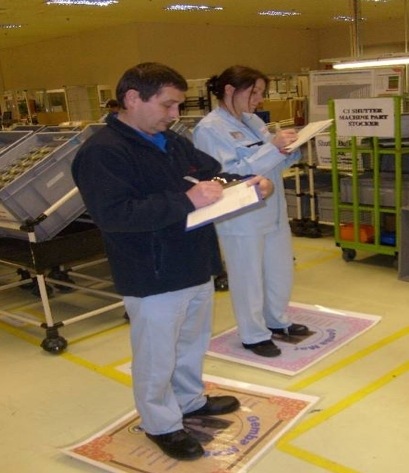
    • To help with the observations there are some prompts on the mat (7 factory wastes and 5 facilities), see the attached picture;
    • Problems observed are recorded on an observation sheet;
    • There is space for a maximum of 30 observations, and the observation period lasts 30 minutes;
    • In the remaining 30 minutes the observer is tasked with resolving (closing out) one of the problems (getting a quick win I think is an important part of maintaining momentum);
    • Remaining problems are considered as part of the Ricoh suggestion scheme;
    • There are repeat visits to the area to confirm problems have been resolved or countermeasures are in place;
    • The Gemba Mat exercise can also be carried out at different times of the day or from different observation points to see what problems can be seen.

    This is an incredibly effective improvement and engagement tool. The results at Ricoh speak for themselves. They have won numerous international awards for quality and innovation, including awards from IdeasUK. At Telford the results they get for employee engagement in their staff survey are remarkably good.

    A few things struck me while I was observing Gemba Mat at Ricoh.

    1. Ritualisation of the Improvement Process. The act of rolling out the Gemba Mat and placing it on the floor is highly significant, a bit like a ritual. It’s almost like saying to your brain, “forget everything else, you are now going into observation mode, to look for problems, and how to solve them”. We’ve all heard about athletes and performers going through rituals or warm ups before they perform. I’m sure there is something similar going on here, all of the thought patterns for problem spotting are brought to the front of your mind when you roll out the Gemba Mat.
    2. It’s a proper tool. The best tools are the ones that just work. They are easy to use; they help you get the job done, no fuss. Gemba Mat is just that, a perfect tool for the job.
    3. People like using it. In an offline conversation one of the employees told me that they had experienced some down time the previous week, “so we just picked up the Gemba Mat and went off to look at what another team did. They found it really useful”.  This was a spontaneous act which the whole team got involved in. There were no management ‘drivers’, no external ‘push’, they just did it. If that’s not an example of people being engaged in work, I don’t know what is.

    Thanks again to Chris and IdeasUK for the opportunity to see Gemba Mat in action. Follow @ChrisNicholls12 and @ideasworldwide (IdeasUK) on Twitter if you want to find out more, particularly if there are IdeasUK networking events at Ricoh, which are well worth attending.

    So, what’s the PONT?

    1. Gemba Mat is an incredibly effective improvement and engagement tool.
    2. Like all the best tools it’s easy to use and just works.
    3. Ritualising the improvement process through the act of rolling out the Gemba Mat and placing it on the floor has an important effect on how people use the tool.

    Links to other posts:

    https://whatsthepont.wordpress.com/2012/03/05/gemba-walks-kaizen-the-elvis-way-walk-a-mile-in-my-shoes/

    https://whatsthepont.wordpress.com/2012/02/23/employee-engagement-kaizen-passion-in-the-west-midlands-ricoh-telford-to-be-exact/

    Gemba Mat in action at Ricoh. Thanks to Chris Nicholls for the picture.

  • This is a prelude to a post on the Gemba Mat improvement technique I saw used an IdeasUK networking event at Ricoh in Telford. Gemba Mat is a beautifully straightforward and effective improvement and employee engagement approach that is worthy of a build-up so I’ll leave you in anticipation.

    Gemba is a version of the Japanese term Genba that translates as “the real place”. In the world of Kaizen and continuous improvement it’s come to mean the work place; the factory floor, the hospital ward, sales floor or where a service provider interacts directly with the service user or customer.

    The basic idea is that problems within a process or system will be visible, so the best place to go and look for solutions or improvements is the Gemba or workplace. Taking time to carefully look at the work process, as it happens, will help you to see what needs improving. Two things stand out here for me:

    • Dedicated time is spent focusing upon the work to identify improvements; and
    • It’s done at the workplace: not in a meeting room, on an ‘away day’, via a focus group or a survey of staff.

    The Gemba Walk is just an extension of this idea where people walk around the work place, gaining understanding and looking for improvements.

    It doesn’t have to just apply to a manufacturing environment. This post from the IT Managers Inbox  gives some clear advice on how to carry out Gemba Walks as an IT service provider.  “Gemba is not your desk”. “If you seek solutions to problems that need to be fixed, go to Gemba. If you want to see the work behind the reports, go to Gemba. If you want to show leadership, go to Gemba. Go to where the work is performed and observe and engage with those who do it……Gemba Walk is a technique that can help you deal with the problems that arise every day and be more effective at managing the people who solve them”.

    When you sit back and think about it Gemba Walks could be seen as having some similarities with time and motion studies, back to the floor exercises (much-loved by the reality TV people) and MBWA. Management by walking around (MBWA) is often mentioned in the same breath as Gemba Walk (see the Wikipedia article). However I think that the emphasis of these approaches can miss the importance of employee engagement. For me it’s not just about managers seeing something that needs improving, and getting someone else to do it. The real positive for me is the prospect of the people doing the job, getting involved and doing it themselves, a key part of employee engagement. More about this in the Ricoh Gemba Mat post.

    So, what has Elvis got to do with Gemba Walks you might be wondering? Well it seemed obvious to me, if you want to understand what someone else is doing “walk a mile in their shoes”.  There are probably some more heavyweight scholarly things I could have quoted for this, but I do very much like the idea of ‘doing Kaizen the Elvis way’ (and a link to this Elvis song pleases my wife). The lyrics are well worth a read but the chorus goes:

    “Yeah, before you abuse, criticize or accuse,

    Walk a mile in my shoes”. .

    Just sing it loud next time you are out in the Gemba.

    So what’s the PONT?

    1. To improve a process or solve a problem it helps to ‘walk a mile in the shoes’ of the people who operate it.
    2. Managers being visible and walking around the shop floor / work place / Gemba will help their understanding of what happens, and improve their decision making.
    3. Visibility will also help to improve reputation with the troops.
  • “Everything that can be counted does not necessarily count and everything that counts cannot necessarily be measured”. An Albert Einstein quote which eloquently sums up the problem with performance measures (and targets).

    I’ve been struggling with performance measures for ages and don’t think I’m any closer to being comfortable with them than I was about 20 years ago. What has changed is my viewpoint. I have moved away from the ‘hard targets / measure’ mindset and the ‘if it can’t be measured it can’t be managed’ mantra, towards a greater recognition of the complexities of life, and you can’t (and probably don’t need to) measure everything.

    All of this can be illustrated through my latest ‘let’s experiment on the kids’ adventure. Eldest son (Steady Eddie) is in the middle of selecting a university to attend. An important choice, one I couldn’t possibly let pass without offering some support and guidance (aka parental meddling). Being the robust scientific type, anything I offer needs to be logical, well structured, evidence based and repeatable. What he needed was a beautifully designed evaluation framework, based upon carefully selected performance measures. The perfect way to decide where he is going to spend the next three years of his life (I am such a good dad!).

    I should also mention that I believe in empowerment and involvement, so it is only fair that Steady Eddie decides upon the performance measures and the scoring system himself, I’m ‘just helping’. What he came up with surprised me a bit. These are all very sensible, the kind of ‘grown up’ thing I was looking for.

    Steady Eddie’s University Selection Criteria

    1. Employability – what percentage of graduates from the course get good jobs?
    2. Teaching Style – how much contact time is there with tutors? Is it classroom or practically focused?
    3. Environment – how safe does the Campus feel?
    4. Accessibility – how easy is it get to, and get back home?
    5. Accommodation – availability, quality & cost, a big deal.

    Scoring system (there was a bit more to this, but you get the idea)

    • 5 = absolutely brilliant
    • 3 = average
    • 1 = completely rubbish.

    This was fantastic. My spirits were lifted; this was everything I wish I’d done myself at 17 years old. Then reality crept in, we’d visited 3 Universities and it’s was starting to look like the ‘wrong choice’ was going to win. This was the local University which opened up the prospect of a ‘live at home option’, definitely not in my plans.  Time for me to develop an alternative scoring system and performance measures, here goes:

    Meddling Dads University Selection Criteria

    1. Tutor Dress Sense. The worse the clothing, better the score. I want technical focus, not some fashion victim. Tweed jacket, tracksuit trousers, Hawaiian shirt and a woolen tie (preferably all at once) = high score.
    2. Graffiti Quality. I like obscure graffiti eg “Heisenberg may have slept here!……… are you certain?”, fantastic. However “I am bored” carved into the lecture theatre desks is a bad sign.
    3. Lab Technicians / Junior Staff.  I want someone in charge that looks like Arkwright from ”Open All Hours”, preferably with a brown lab coat.  Someone who’s been around for eons, oozing wisdom, from which the ‘bright young MSc/MA’s who work there can all learn.
    4. Canteen Food. Always check out where the PhD students and Tutors eat. It’s got to be good old stodgy institution grub. Food is fuel, shovel it in and get back to the lab. Anything ‘gastro’ = bad news.
    5. Open Day Car Park. I want to see lots of second-hand Volvo’s in the car park. All driven by earnest middle class types who have thoroughly researched where their offspring is planning to go (saves me the hassle).

    The outcome has been that my alternative performance measures have helped guide his choice. By measuring some of the things that really matter, he’s settled on a university over two hours travel away. Definitely not a live at home option, result!

    So, what’s the PONT?

    1. Just about anything can be measured, but focus on what matters most.
    2. Going for the obvious, ‘sensible’ option didn’t help get the outcome we wanted.
    3. Be imaginative. Tutor Dress Sense should be a standard performance measure across all universities.