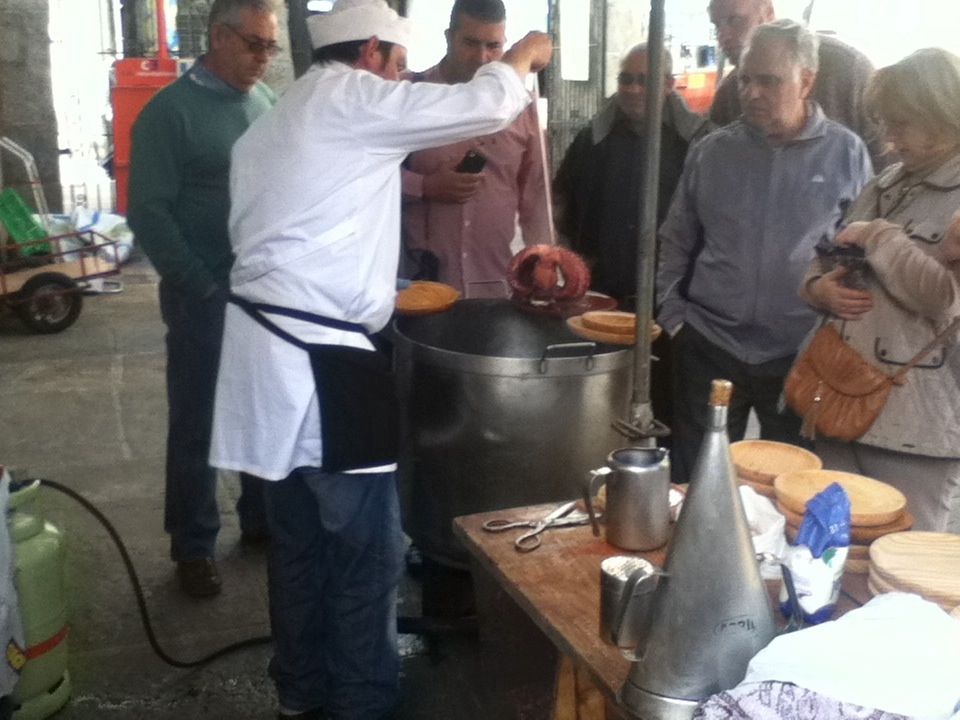
• Some things are inevitable, death, taxes and peer pressure from your cycling companions to eat octopus when you get to Santiago de Compostela. I knew it was coming from about 200km outside of Santiago when “Pulpo” started appearing on menus. When my travelling companions shifted their enthusiasm for strange land based animal products to scary looking oddities from the sea, I knew there would be no escape.

    I’m no food critic, so this is a straightforward description of my encounter with ‘Pulpo a Feira’, or ‘octopus at the party’ (literal translation), not much of a party if you happen to be the octopus!

    First some things I wasn’t going to do:

    1. Eat it cold in a tapas bar. The prospect of cold octopus sucker on toast freaked me out slightly.
    2. Attempt any of the specimens on offer in restaurant windows. I saw some of these beauties two days running.

    Even my basic understanding of seafood tells me the fresher the better. So…… It was off to Santiago’s Open Air Market to eat and party like a local.

    Santiago de Compostela Open Air Market Pulpo recipe:

    1. Take one octopus and tenderise. Two options here;
    2. Remove the inedible bits (again check out the recipe)
    3. Throw octopus into a huge vat of salty water and boil until tender.
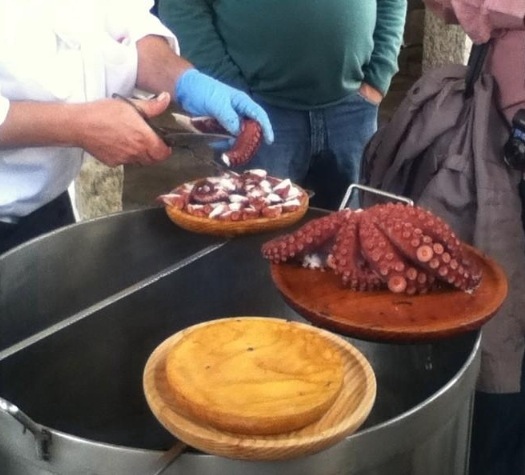
    4. Remove and cut into small pieces with a scissors and place onto a wooden dish.
    5. Season with paprika, salt and olive oil.
    6. Serve with wine and bread (optional).

    The results:

    It was quite chewy, but that’s ok. The paprika, oil and salt are necessary; otherwise I don’t think it has much of a taste. It was quite filling, definitely best shared with a few others.

    I’m not sure a Pulpo á Feira stall would take off in Pontypridd Market. Geof reckons it’s more the sort of thing they would go for in Swansea.

    Check out the pictures of the Santiago de Compostela Open Air Market, Pulpo a Feira experience, Party Time!, (unless you’re the octopus). Vegetarians may not want to proceed NSFV (not safe for vegetarians).

    So, what’s the PONT?

    1. Stick with the locals at the Market when it comes to eating unusual things.
    2. Check out the alternatives before giving in to peer pressure – so glad I didn’t try that cold octopus sucker on toast.
    3. Perspective is everything. A party it might have been – for everyone except the octopus.

  • Please pick one answer from the multiple choice list.

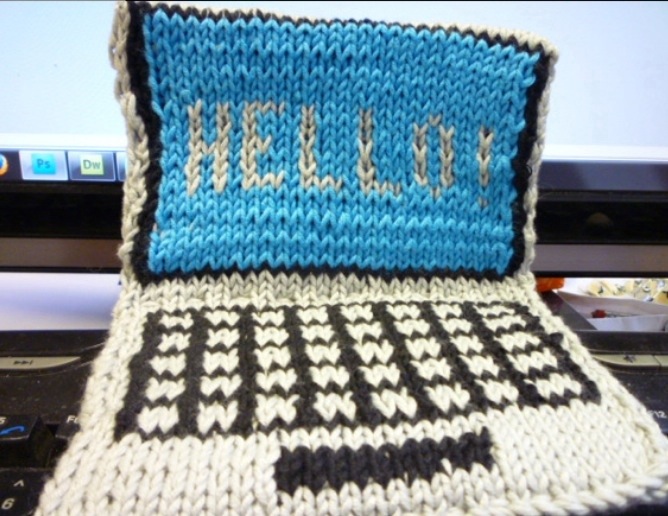
    a) a woolen laptop?

    b) a Fair Isle spam blocker?

    c) an Aran mouse?

    d) coworking?

    Obviously the answer is d), Coworking.

    This week WordPress Users Wales met to talk about plugins, it’s a bit technical but if you want an explanation check out this post on WordPress plugins . We shared the meeting space with some people learning to knit, the click of knitting needles in symphony with the tapping of keypads. The gathering happened at a fantastic venue in Castle Arcade, Cardiff called indycube, which promotes the idea of coworking.

    Mark Hooper (@markjhooper) who founded indycube told me a bit about indycube and the idea behind coworking. I think the coworking approach has some real benefits and provides a great opportunity for people to be social and exchange knowledge in these days of potentially solitary remote working. This is what I learnt.

    • Indycube is a Community Interest Company (CIC) that provides desk space in a relaxed office environment for basically anyone who wants to use it.
    • It costs £10/day to use the facility which includes wifi and free tea/coffee.
    • The idea is to offer freelancers, micro-businesses, remote workers and others an alternative to sitting in coffee shops, hotel lobbies or the back bedroom all day.
    • Most importantly it encourages coworking.
    • The idea behind coworking is that you sit alongside people who may have absolutely nothing to do with what you are working on.
    • Through social interactions with these people there will be some knowledge exchange and hopefully a serendipitous event that benefits you both. This could be a business idea, introduction to a new contact or valuable piece of information.
    • I know from my own experiences that some of the best things I’ve worked on have come from being outside of my silo(s) and having apparently random interactions.
    • Having a conversation with people, who routinely I’d have no reason to speak with, has generated some very useful things.
    • For a good explanation of the ideas behind coworking and how it works have a look at the Wikipedia entry.
    • Also have a look at the indycube website and this Western Mail article.

    I think there are many benefits to this sort of working. I did once see something similar to coworking in a big service organisation, but with a narrower focus. The organisation relocated its many dispersed project teams into a single purpose-built innovation facility (a big shed). They told me that the cross-pollination between apparently unrelated teams was highly beneficial for the organisation. Previously many projects ran late, over budget and never quite delivered on promises. Following the coworking, or colocation exercise as they called it, better projects got delivered, on time and to budget.

    In the case of indycube, a third sector (a CIC) has delivered something which other organisations could well learn from. Imagine parts of public services coming together, and working with people from places they had never even heard of or even thought about. What an opportunity for serendipity.

    Finally a lesson in never making assumptions about people based on appearances. Two blokes entered the indycube room fashionably late on Tuesday. They looked like absolute certainties for being WordPress plugin enthusiasts. Trendy urban chic clothes, longish hair, beards and possibly a t-shirt with an obscure Minecraft picture (Sorry guys). To my surprise (and the person next to me) they turned left and joined the knitting class, I was already making them a space on my table. I bet their blogs about learning to knit were on WordPress though!

    So, what’s the PONT?

    1. Coworking is something that could help remote and solitary workers socialise more often and avoid becoming isolated.
    2. Going to somewhere like indycube (designed to meet your needs) has got to be better than hanging around a coffee shop or a hotel lobby using the wifi.
    3. The chances of serendipity and great things happening from mixing with people you have no real connection with should not be under estimated.

    Picture source: A fantastic woolen laptop. Unfortunately it wasn’t made on the evening. http://www.flickr.com/photos/katemonkey/5665916936/

  • Good News! I’ve found a way of not feeling guilty about ‘over’ enjoying myself during the sort of team building events where I have to build the Eiffel Tower out of cardboard, pipe cleaners and sticky tape. Many people will have participated in similar exercises (with variable degrees of enthusiasm) but I suspect that most will be left wondering, “What on earth did that have to do with work?” Well, I’ve found a real world application which is tried and tested, high impact and ‘return on investment proofed’, continuous improvement (CI) technique.

    I saw it during an IdeasUK network visit to a manufacturing company where it was presented as part of their CI approach. It involved Lean Process re-design and lots of cardboard and sticky tape. This is what I learned.

    1. As part of their CI approach the organisation routinely reviewed each of their processes. A dedicated team supported local teams to carry out a review of what they did daily and develop improved new processes.
    2. The review started with some data collection and process mapping. There were lots of familiar CI tools used; observe the process, eliminate waste, identify improvements etc. Plenty of flipcharts with process maps and actions were produced, all good solid CI activity.
    3. Now the good bit. The team then created a scale model of their ideal process, using cardboard and sticky tape.  This was fantastic to see and walk through. The team included the smallest detail to ensure the process worked for them. Who better to do this sort of process design than the people who actually know how it works.
    4. The next stage was to build a working prototype and test it for a month. To illustrate the value of this stage I was given an example of how things changed between cardboard scale model and the final construction. A 6 foot plus team member had been on holiday during the cardboard mock-up stage and their place had been taken by someone significantly shorter. The impact of the difference in height became obvious during the prototype stage and adjustments were made. Problem solved.
    5. Finally the process is fixed and routine manufacturing resumes until the next scheduled process review, or some other trigger.

    Obviously there is a lot more fine detail involved in this CI activity than outlined here. What I wanted to emphasise was the impact of building the full-scale model using cardboard and sticky tape.

    In many improvement activities it is quite common for people to jump straight from good idea to full-scale implementation. The cardboard model is helpful in a number of ways:

    • It allows for a pause to ask the really challenging questions, “Does this really work?” This is potentially less confrontational and more productive than reviewing someone’s ideas written down on paper;
    • It allows people to interact and develop the solutions as they build the model. Better solutions are allowed to emerge as ideas are tested and refined;
    • It engages the people who really know the process;
    • It’s more realistic team building than recreating a French Architectural Icon on a training course; and
    • It’s really good fun.

    I know some people may say “…but this is manufacturing, this approach would never work in public service delivery (we are different, we are special)”  All I would say is, why not have a go, cardboard and sticky tape are for life, not just for team building.

    So what’s the PONT?

    1. Fully involving the people who do the job in the design of the process they operate is the most effective means of achieving continuous improvement.
    2. Prototyping /scale models are great ways of involving people and testing new ideas.
    3. There is a purpose behind many of the things we do on training courses and team building; we just need to understand what it is and bring them back into work a bit more often.

    Picture source: Thanks for the use of the cardboard Eiffel Tower image. http://nycmakesmyheartbeat.files.wordpress.com/2010/10/img_2355.jpg?w=480

    This picture shows how far you could take this approach…. there are a surprising number of ‘cardboard office’ images on the internet.

  • I’ve used a version of this picture before (see 4 foot posts story), but it’s so uncannily accurate that it’s worth seeing again. The purpose is to illustrate some of my project management ‘issues’ and learning through failure. This was all the result of some accidental IKEA Hacking.

    The Project: Refurbishment of a Client’s (youngest son) bedroom. Transformation from a pre-teen ‘mosh-pit’, to something significantly more sophisticated (that will last until he moves out).

    The Project Failures:

    1. Poorly Defined Outcomes. The Client changes his mind about thirty times a day. This includes ‘big ticket’ issues like ”am I a vegetarian or meat-eater?”, so little choices like door handle design were bound to be fluid. I never got a solid commit to anything.  Fail 1..
    2. Lack of Scenario Planning. I did have a plan and an idea of how IKEA were going to meet my needs. Unfortunately I got dazzled by a special offer of ‘end of line’ mirror doors and the original plan was forgotten. The ‘last minute surprise’ always happens to me in IKEA, I should have been prepared. Fail 2.
    3. Poorly  Executed Procurement . After vaguely agreeing changed specifications with the Head of Project Procurement (controller of finances/Wife), I headed off for some fun. Spinning around in the office chairs (23 revs/min) followed by a lie down to recover. We did come in under budget, but with a set of surplus half doors, how did that happen?  Fail 3.
    4. Construction Phase Conflict. Nothing new to say here, I’m sure most people will have experienced this. Things always go wrong during the construction phase, some people lose their cool and behave badly and the construction team becomes dysfunctional (yes it was my entire fault, sorry). Fail 4.
    5. You Tube to the Rescue. Hurrah! You Tube is full of videos of how to build IKEA stuff. I finally work out that it isn’t my fault. I’ve got the wrong stuff and I’m actually IKEA Hacking. Everything is on You Tube. Success!
    6. Face to face is best. Full of righteous indignation I was ready to take on IKEA. Unfortunately telephone help-lines don’t really work at 10.30 on a Friday night and neither do 25 minutes ‘hold’ times. The only realistic option is to show up in person. You are harder to ignore in the flesh. Fail 5.
    7. Physical things are easier to deal with than intangibles. I did visit the store, twice. First time was with just the neatly ordered paperwork, and I failed to resolve the problem. Second time was with a trolley full of badly re-packed boxes. It’s amazing how that changed the dynamic. It’s almost as if the problem only really exists if it’s sitting there in front of you. I also got to speak to an expert installer who solved my problems immediately. Success! Unfortunately I still have the surplus set of half doors (still don’t know how that happened). Fail 6.

    Learning from Failure: if I want my next project to run smoothly I need to:

    • Have clear outcomes;
    • Plan carefully;
    • Modify plans when things change;
    • Stay positively engaged with the Team throughout;
    • Communicate face to face whenever possible; and
    • Know when I need to speak to an expert.

    So what’s the PONT?

    1. We can learn a lot about project management by building things from IKEA. I’ve learnt more during this practical experience than in several classroom based project management courses.
    2. Communication is an absolutely critical part of the project management process, in work and real life.
    3. A small amount of time with an expert can save a lot of hassle. 30 seconds with the expert installer was more useful than about 2 hours of watching (and re-watching)  ‘how to’ videos.

    Apparently what I was doing is called IKEA Hacking. This involves taking standard IKEA products and doing something different with them than what was intended. This is a good example of open innovation by-product users, and unfortunately the source of my difficulties. Not surprisingly there is plenty of material on the Internet dedicated to IKEA Hacking, here are a few links:

    http://www.ikeahackers.net/p/about.html  (I wish I’d looked at this site before I started)

    http://www.businessinsider.com/ways-to-hack-ikea-furniture-2012-8?op=1

    http://www.complex.com/art-design/2012/05/the-10-coolest-ikea-hacks/

    Picture source: http://tamingdata.com/wp-content/uploads/2010/07/tree-swing-project-management-large.png

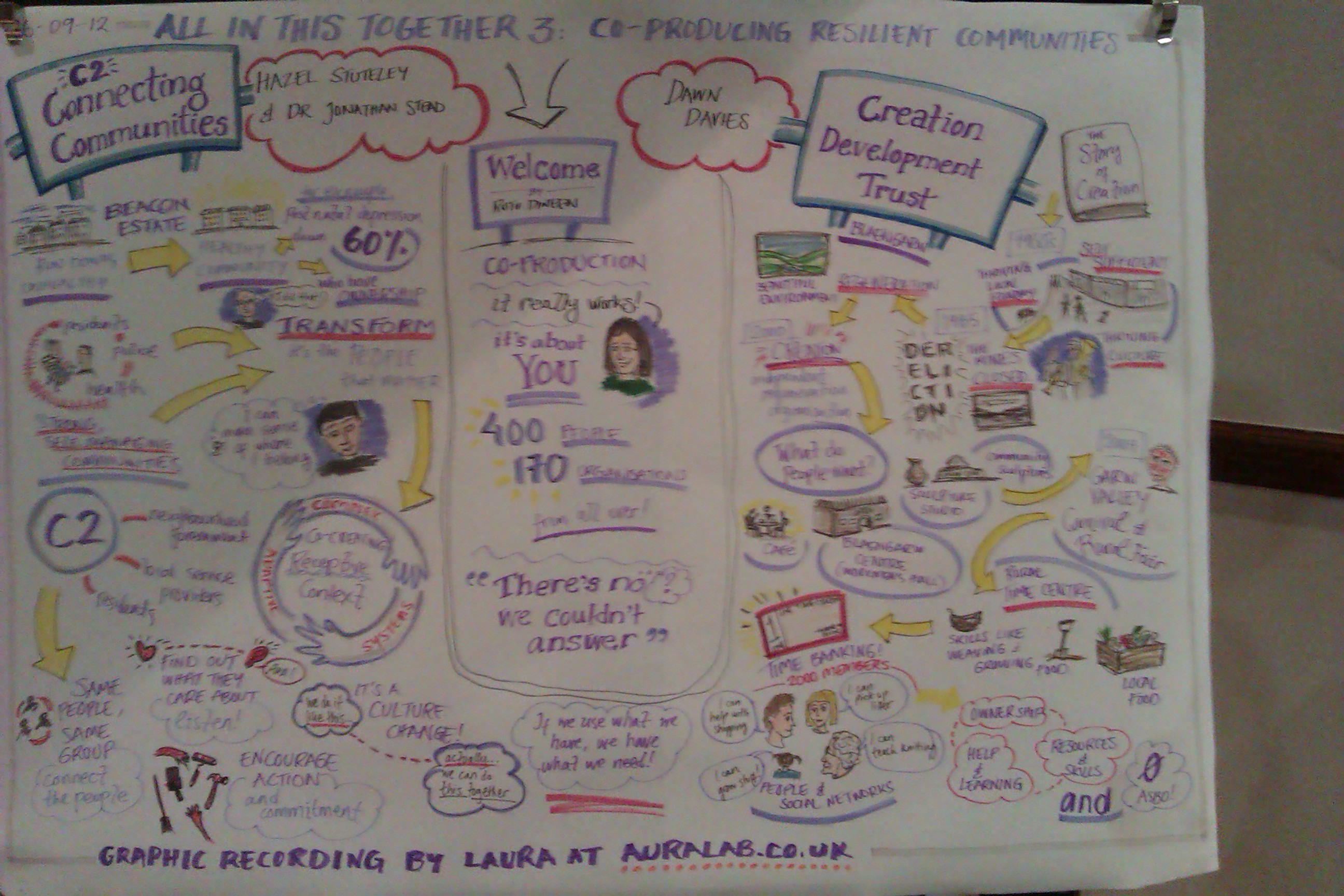
  • I’m not going to win any prizes for photography here; I just wanted to illustrate some graphic recording in action.

    I’m a big fan of using graphics as a method of knowledge exchange and communication.  Previously I’ve mentioned the work of Paul Richardson who did great work at Public Services Wales Summer School and Delta7 who do some fantastic work around engagement and archetypes.  Now I can post about another piece of the jigsaw, graphic recording.

    These pictures are by Laura Sorvala (@_auralab) of the work she did at the All in this Together, Co-production Conference held in Cardiff last week. The image was developed over about 60mins and 4 separate speakers.

    I think this is an incredibly effective way of capturing the important messages from the conference, in a way people are more likely to share and re-visit.  Enjoy!

    My photographs don’t do justice to Laura’s skills. Have a look at Laura’s website and the All in this Together blog for better images.

    So, what’s the PONT? (pretty much what I’ve said previously)

    1. Graphic recording is a highly effective way of capturing key learning points (so much better than my notes).
    2. Pictures really do speak a thousand words. People can effectively understand and remember complicated messages through images.
    3. The impact is long-lasting. I’m more likely to re-visit a picture or print it out and pin it on a wall than re-read my scribbled notes.
  • You may have heard the proverb “if you sup with the devil you need a (very) long spoon”. The idea is that if you mix with bad people you should be careful not to be influenced by them and start behaving badly yourself. It’s a very old sentiment that was mentioned as far back as 1386 in Chaucer’s ‘The Squires Tale’.

    This week I got a modern, evidence based example of this aspect of human behavior at a Leadership & Management Wales (LMW) seminar.

    “Management behaving badly” was presented by Professor Ralph Fevre of Cardiff University on the findings of a huge piece of research work into ill-treatment at work. The report ‘Insight into ill-treatment in the workplace: patterns, causes and solutions’ summarises the research which involved almost 4000 interviews. The report is well worth reading for anyone interested in HR, employee engagement, organisational development or just being a more effective manager or leader. A few points I took from the seminar:

    Problems

    • Small organisations tend to have less of a problem with ill-treatment;
    • Bigger organisations have a higher level of ill-treatment despite ‘proper’ policies (Dignity at work etc) and HR Departments which are supposed to prevent ill-treatment;
    • Many policies and subsequent interventions, to deal with ill-treatment, don’t seem to be effective;
    • Manager against subordinate was the most common form of ill-treatment; and
    • Managers themselves are highly likely to suffer ill-treatment.

    Some solutions

    • Manage the managers. Supporting managers to develop their people skills is an essential part of treating people properly, and getting the most out of them. It’s disappointing that the archetype of the technical expert with poor people skills, promoted to a managerial position who then causes havoc was mentioned several times during the session. The evidence suggests that there are still plenty of them out there (have a look at the report case studies).
    • Manage sickness absence properly. The evidence points towards the inappropriate application of sickness absence policies, particularly against people with serious conditions. Implement the policies properly and fairly (train managers to do this), and you prevent some of the ill-treatment.

    One finding did stand out for me. This was the importance of the overall culture of an organisation. It was summed up as, “if you have a dysfunctional organisation the levels of ill-treatment will be greater”. This issue around culture is linked to the issue of managers   being the source of ill-treatment against staff, and being the subject of ill-treatment themselves.  It seems like a case study of behavior begets behavior and an example of a ‘vicious circle’ that arises from ill-treatment from (and to) customers and service users. The role of leadership in addressing such a culture and reversing ill-treatment is fundamental, which is probably why LMW put on the seminar. Good choice.

    Linking back to the idea at the top of this post….do be careful where you choose to work. If it’s a dysfunctional organisation where ill-treatment is commonplace there is a chance you’ll be on the receiving end of it. I wouldn’t want to crush anyone’s hope and desire to change organisations (or the world) but do be aware that “if you sup with the devil you need a very long spoon”.

    So, what’s the PONT?

    1. Ill-treatment of staff does happen in organisations, but is more likely in big compared to small organisations (see the is 150 the magic number post).
    2. If you are a manager, you are likely to receive, as well as, dish out ill-treatment.
    3. Organisational culture has a huge influence on ill-treatment, as well as you, so be careful who you sup with.
  • Apologies to any birdwatchers that recognise this as a Painted Bunting, and not a common brown sparrow that has been ‘jazzed up’ by an Alcatraz inmate.

    I read about the Alcatraz painted sparrows in a book by former inmate Darwin Coon. Back in the 1960s the Alcatraz prisoners creatively used their painting equipment on the local brown sparrows they had captured. The ‘pimped’ sparrows were then released back into the wild.

    This was relatively harmless fun, until the Alcatraz ‘colony of exotic birds’ caught the attention of the press and local branch of the Audubon Society (similar to the British RSPB).  On the ensuing field trip to Alcatraz the hoax was exposed, with considerable embarrassment for the authorities and retribution for the prisoners.

    Darwin Coon cites this as one of the examples of ‘sticking it to the man’ he experienced during his many years of incarceration. The idea struck a chord with me. Over the years I’ve encountered many people who claim to be ‘sticking it to the man’. Frequently this is at work and appears to have a lot to do with employee disengagement.

    The Urban Dictionary (a great resource for decoding my kids conversations) defines ‘stick it to the man’ as, “to perform an act of vandalism or general civil disobedience in order to oppose the power of the man”. You might now ask, “who is The Man?”

    The Man is a slightly nebulous concept that can be both positive and negative. For ‘stick it to’ purposes ‘The Man’ is a very powerful and shadowy corporation or government body that is acting oppressively and ‘keeping us down’. It’s not possible to actually identify ‘The Man’, which brings me to the link with employee disengagement.

    On occasions I’ve heard people complain about ‘Them’ as being the cause of their problems in work. When questioned on who ‘Them’ are they give a vague explanation, generally pointed in the direction of ‘people at the top’. They might as well be talking about ‘The Man’.  It’s disappointing how much effort some of these people then put into ‘sticking it to the man’ and dragging down an organisation. I’ve heard this behavior referred to as ‘organisational terrorism’ or plain old meetings sabotage. I’m sure many of us will know of an individual who is working hard, ‘sticking it to the man’ in their workplace.

    If you fancy practical advice on ‘sticking it to the man’ have a look at this video. As a parody it’s great, but it does make think, “what is the point?” At the end of the day, acts of vandalism or disobedience against The Man (persons unknown and unseen) are ultimately pointless.

    Returning to disengaged employees its worth thinking about what can be done about it. One suggestion I heard is to make ‘The Man’ more visible. Apparently it is far easier to justify being negative towards the unknown or unseen than it is to someone who you recognise, and who knows your name. There may be a lesson here for leaders and managers to be more visible and get to know their employees. Maybe then there wouldn’t be a ‘Them’ or ‘The Man’ to ‘stick it to’?

    Back on Alcatraz ‘The Man’ (The Warden) was pretty obvious and the regime was oppressive by design. I think ‘sticking it to the man’ by jazzing up a few sparrows wasn’t that bad (animal rights permitting) after all, according to Darwin Coon the alternatives could be much worse.

    So, what’s the PONT?

    1. Disengaged employees (like prisoners) can be incredibly resourceful and creative in acts of ‘sticking it to the man’.
    2. Distant, aloof, disconnected or disengaged managers can create a sense of ‘them over there’ or ‘The Man’, where acts of ‘sticking it to’ become much easier to justify.
    3. Look out for painted sparrows in your organisation (small acts of rebellion). They may a sign of something bigger under the surface.

    Photo source: Painted Bunting http://en.wikipedia.org/wiki/File:Painted_Bunting_by_Dan_Pancamo.jpg

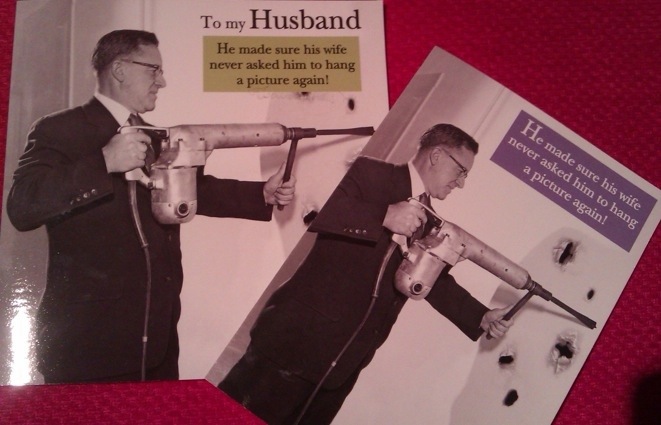
  • Last week it was my birthday.

    The family now knows how I think.

    Malicious compliance is well understood round here.

    They got me these cards (twice).

    There is no hiding place.

    * Disclaimers……

    1. Not the best ever piece of verse written for a birthday card, but I’m having a go.

    2. The drilling in the pictures in no way represents my DIY abilities.

    3. Neither does it represent any act of malicious compliance on my part (many years as a practitioner have taught me to be far more subtle).

    So, what’s the PONT?

    1. Malicious compliance is not a difficult concept to understand.
    2. Some acts of malicious compliance can be very obvious (check out the links below).
    3. Don’t let your family read your blog, they will know how you think.

    Related posts:

    https://whatsthepont.wordpress.com/2012/01/29/malicious-compliance-i-hate-painting-and-filling-in-forms/

    https://whatsthepont.wordpress.com/2012/04/26/more-malicious-compliance-mastery-and-lessons-from-shed-building/

    https://whatsthepont.wordpress.com/2012/06/23/my-epic-communication-fail-the-4-foot-post-story/

    https://whatsthepont.wordpress.com/2012/05/10/sherry-and-twiglets-vrs-fence-building-how-shared-action-builds-relationships-and-why-i-want-a-walking-coach/

  • Recently my kids held a ‘garden party’, which has reversed many of my expectations. The end result has been a much neater garden; some repaired power tools and an enhanced reputation for me as a really cool dad. I’d like to say it was down to my supreme leadership, but actually I had very little to do with it. The kids just did things themselves. It’s astonishing what the shame of an unkempt garden can do for the motivation of teenagers wishing to impress their peers.

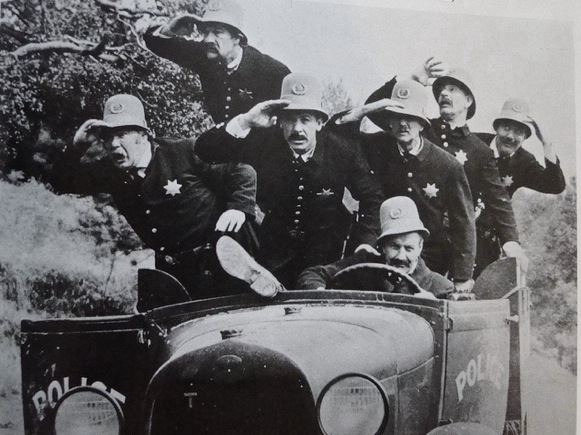
    My expectation had been of something like an episode of the Keystone Cops, a complete mess, lack of coordination, and a great deal of energy spent achieving nothing (ring any bells?). Instead I got weeding in the rain, hedge cutting and internet searches to locate a replacement part for a broken strimmer. Wonders will never cease.

    The point of all this is to direct a friend towards some advice on how they might get a group of people to self organise.  It’s a fairly straightforward challenge (compared to a teenage party).  Approximately 30 people who need to pair up to carry out some work together. The options currently being considered are:

    • Issue precise instructions on exactly how they should do things;
    • Get involved and organise them; or
    • Let them get on with it (they are after all grownups).

    Here is the advice; watch this video who needs leaders? This was shown by Nick Obolensky one of the speakers at this year’s Welsh Public Services Summer School .

    Nick’s video illustrates that it is possible for a large number of people to self organise to carry out a reasonably challenging task. The keys to success seem to be:

    • A clearly defined outcome that everyone understands;
    • Setting a limited number of clear boundaries (basic rules); and
    • Trusting people to get on with it and do the job.

    I won’t spoil the video for you, have a look for yourself. In particular look out for the bit at the end where Nick asks, “how long would that have taken if we had put someone in charge?”

    Back to my friend; my advice to them, go on, have a go at self orgaisation. All you need to do is trust them (and yourself). Imagine how much time and effort you will save, which you can then spend doing something much more interesting and productive than herding cats.

    So what’s the PONT?

    1. Self organised workgroups are possible and do work, even with the most unlikely subjects (my teenage kids).
    2. Everyone having a clear understanding of the outcome and small number of basic rules is important.
    3. Above all trust is critical. Trusting people to get on with it, and trusting yourself to let go.

    Link to herding cats post: https://whatsthepont.wordpress.com/2011/06/26/herding-cats%e2%80%a6-is-this-an-unconference/

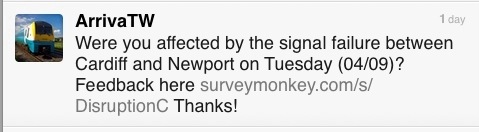
  • Here’s quick follow up to the post about Arriva Trains Wales and their journey to improved customer service.

    Last week saw another blip on the tracks. On Tuesday morning damaged signaling cable caused significant disruption. I know because I was due to meet people who were stuck at Newport (and I picked it up through Twitter).

    It was interesting to observe that those people making use of Twitter (following the various train companies and Twitter hash tags #) were far better informed (and less stressed) than those who weren’t, but that’s another story……

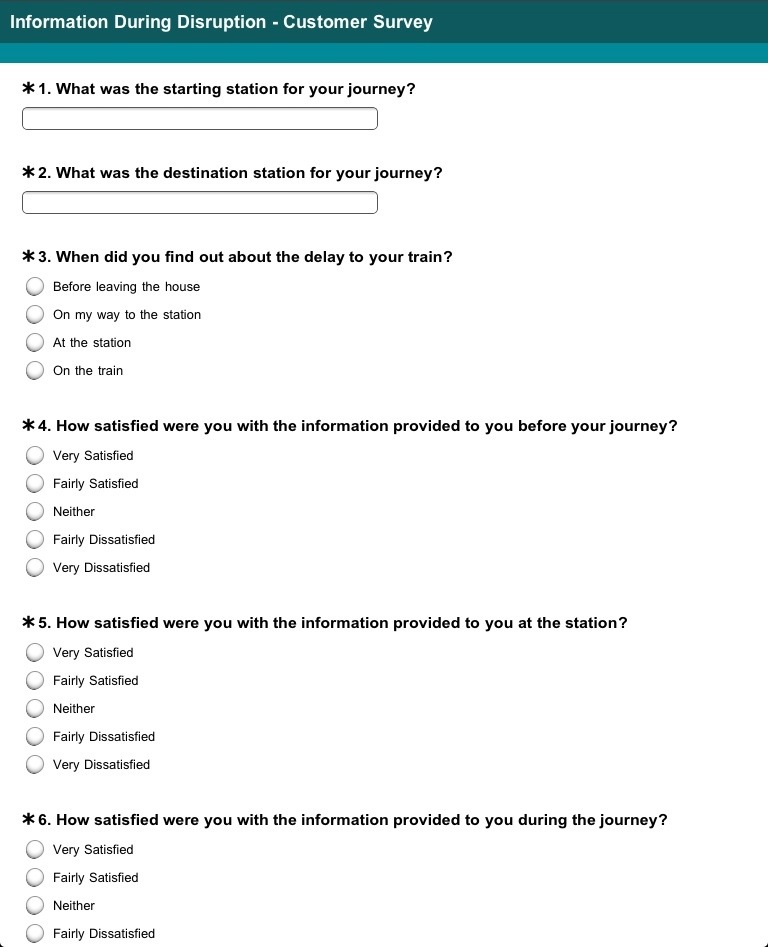
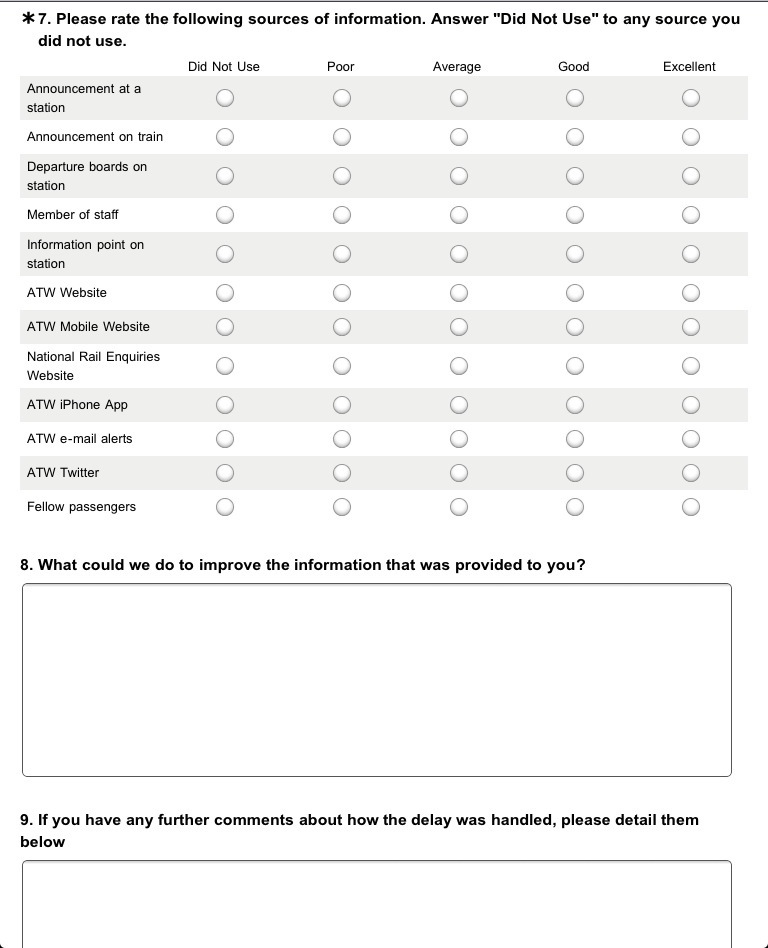
    What has grabbed my attention is the request ATW put out on Twitter for feedback on how communication worked during the disruption.  I think this approach is interesting in a number of ways. My observations:

    • You have been horribly delayed in your journey (not actually ATW’s fault), but they have tried their best to communicate with you while it was happening;
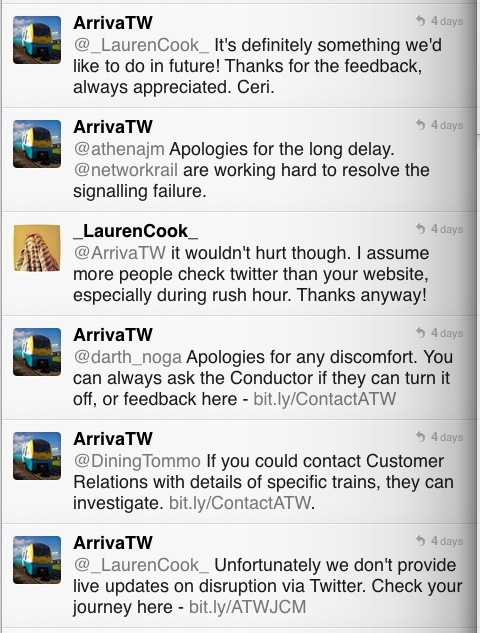
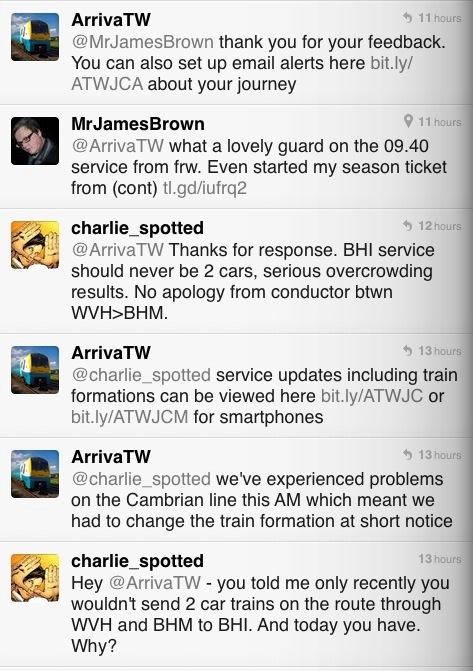
    • They have been honest and open about the limitations of their current communication  methods (no live tweeting on the disruption, see picture below);
    • But they do care about how they communicate with you, so they are asking how things worked on Tuesday so that they can make things better;
    • Sending this ‘how can we get better’ message takes some the heat out of the situation (in my opinion);
    • Gathering feedback in a structured manner while the issue is still live should capture information that is ‘fresh in the mind’, so it’s probably more accurate;
    • In my view, this is better than something six months down the track when a generic customer service questionnaire asks a potentially vague question about ‘communication during disruption’; and.
    • How good is your memory of the communication aspects of the event likely to be in 2 weeks time, let alone 6 months? This (almost) real-time feedback has got to be more useful.

    I really like what ATW are trying to do here. It’s a good attempt at trying to engage with service users through Twitter as part of the improvement journey. Even though it was a difficult situation they have seen an opportunity to try and make things better. Real ‘glass half full’ thinking, nice one ATW.

    I wonder if any other public service providers might have a go at something like this?

    So, what’s the PONT?

    1. During disruption, service users really appreciate knowing what’s going on. Twitter offers an opportunity to do that.
    2. Being open and honest about your limitations and asking for information on ‘how do we improve’ is a good way of engaging service users.
    3. Gathering feedback while the situation is still ‘fresh in the mind’ should provide information which is more accurate than a survey months later.

    Open and honest communication with @_LaurenCook_. Followed by a few screen shots of the survey. A wide range of communication channels available. I count 12!

  • How to read this post: click on this link, let the soundtrack start, come back here and start reading…….

    I’m sending some Twitter love to Arriva Trains Wales (@ArrivaTW). They are trying hard to engage with customers through Twitter but aren’t fully feeling the love yet. It’s also an opportunity to link to some music from The Doobie Brothers in the shape of Long Train Runnin (Without Love). I reckon the Arriva Trains Wales Twitter operators should adopt this as their theme tune. Nothing like a bit of 1970’s funk to lift the spirits.

    Over the last year I’ve been enthusing about London Midland Trains and how they engage with customers through twitter. If you don’t believe me follow them @LondonMidland, you could even try tweeting them, there is a better than 75% chance of them responding to you very quickly. How do I know this? Well I follow @engagementindex who send me regular tweets on customer service performance of a range of organisations who use twitter. I have posted about the fantastic performance of @LondonMidland previously, and had commented that @ArrivaTW had some way to go…..

    Well something has changed. In the July update from @engagement index I spotted that @ArrivaTW had leapt up the rankings. From a position where they weren’t responding to any tweets from customers they were doing much better.

    My spirits soared, look how things can change in a year.  Twitter enabled customer service for trains in Wales (and the Marches).  Even better was the new @ArrivaTW Twitter bio. An honest statement, “we try our best to reply”.

    I had to take a closer look for myself. Unfortunately this has coincided with an incident at the main Cardiff Train Station. A collapsed wall resulted in major disruption for several days. Hardly the fault of @ArrivaTW, they just run the trains, but they got plenty of criticism on Twitter. If want to see the collapsed wall, check out the @ArrivaTW Twitter pictures, brilliant use of social media.

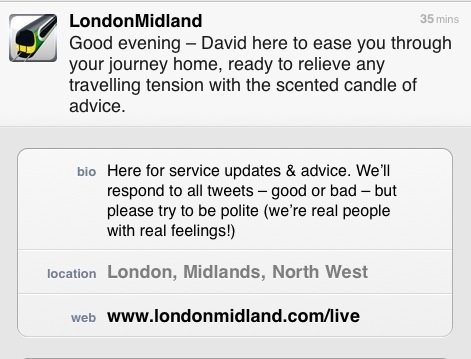
    What I saw on twitter were valiant attempts by the @ArrivaTW tweeters to help out, but unfortunately on occasions they got some pretty offensive comments.  It’s a real shame. Nobody deserves that kind of abuse, particularly when they haven’t caused the problem and are just trying to help. Perhaps @ArrivaTW should add to their twitter bio, “please try to be polite (we are real people with feelings)” just like the one on @LondonMidland.

    So, what the PONT?

    1. Here is some Twitter love from me to @ArrivaTW. What a difference in a year.
    2. Nobody deserves abuse for trying to deliver a service in difficult circumstances (particularly if you didn’t cause the problem), at the end of Twitter account there are real people with feelings.
    3. Keep plugging away @ArrivaTW. Hopefully the love will come, even if it feels like a Long Train Runnin’ (without love).

    There is some love out there for @ArrivaTW!

  • Here are two explanations of the same point. The picture and the academic text, choose which ever one you prefer.

    Following the why is good practice such a bad traveller post last week I thought I’d better back it up with a bit of academic rigour. Where better to look than one of the Welsh Public Services Summer School speakers, Professor Dr Alexander Fliaster of the University of Bamberg.

    Part of the talk from Dr Filaster was about knowledge exchange in social networks, using some research from German companies. One the points that grabbed my attention was the (research proven) revelation that certain people are blockages because co-workers don’t like or trust them. The consequence of this dislike was that people wouldn’t share knowledge, even if it would benefit them.

    Obvious really, but it was nice to hear it from a Professor, with some science to back it up. The behaviours and attributes of this sort of person were neatly summed by Dr Filaster in three words, “The Disconnected Jerk”. This was captured by the graphic facilitator Paul Richardson.

    One of the other things I wrote down during the presentation was: “if someone is disliked by their co-workers, irrelevant of whether they are competent or not, people will not go to them for information”.  I suspect many of us have experienced this or seen this happen. It certainly got plenty of nods or recognition from around the conference hall.

    Turning to the academic explanation, this paper Knowledge Mobilization Through Social Ties: The Cost-Benefit Analysis, provides the quote below. “Thus, even though conflicting parties must often interact and communicate on a daily basis, this frequent contact does not mean a close relationship and does not include a trustful sharing of ideas. Likewise, frequent contacts with a little-trusted colleague who is known for his opportunistic behaviour usually also do not lead to sharing interesting information or the collaborative creation of new knowledge.”

    For me, the picture of “The Disconnected Jerk” works just fine (we know who you are).

    So, what’s the PONT?

    1. Knowledge exchange is a deeply social process (see previous post). Difficult relationships or “The Disconnected Jerk” can cause real problems.
    2. Trust is a key part of effective relationships and low trust does cost you money.
    3. Drawings and graphic facilitation are a very effective method of communicating messages and ideas.

    Picture Source: Link to the Academi Wales Flickr stream: http://www.flickr.com/photos/81188091@N04/7643756830/in/photostream/

  • A straightforward answer, good practice is a bad traveller, because that’s the way we like it.

    I’ve sat in a few conferences where there has been quite a lot of ‘hand wringing’ from the stage, about why this is such a difficult pastime. We all know that sharing knowledge and good practice is the right thing to do, but there’s just not enough of it happening. The “bad traveler” suggestion is posed by these clever people as a bit of an excuse, hinting at something that is slightly beyond our reach.

    Well, I’m not convinced. The model of good practice transfer I understand is based upon three straightforward parts:

    Sharing: you need a source of good practice knowledge that people are willing to share.

    Seeking: people who are looking for good practice, are prepared to listen and accept what is useful to them.

    Process: simple mechanisms that allow the two groups to communicate.

    Here are my top six suggestions for why good practice isn’t travelling and is failing to progress beyond passport control:

    Seeking

    • Ignorance – people genuinely don’t know what to do. In a world of Google and Wikipedia I think this is nonsense. I’d change ignorance to ‘willful ignorance’;
    • Hubris – “what can anyone possibly teach me?” Defined as an overconfident pride and arrogance. Hubris is often associated with a lack of humility and a lack of knowledge…..; and
    • Not Invented Here Syndrome – a bit like hubris. The view that nobody else would be clever enough to understand what you are doing or the “special” nature of your organisation or service;

    Sharing

    • Knowledge is Power – “if I share what I know, you will be as clever and as powerful as I am”, often seen with subject matter experts. I understand the need to protect intellectual property, but if knowledge is so closely guarded that very few people know, it gets self-limiting.
    • Turf and Territory – a bit like knowledge is power. For some people, what they ‘own’ defines their power base and who they are. Giving up territory and turf is difficult.

    Process

    • Ineffective Transfer Mechanisms – with so many organisations, professional bodies and amateur enthusiasts working hard to spread good practice, I’d argue that this isn’t a valid reason. If you want the information, it’s pretty much available somewhere.

    This list has re-enforced for me the idea that knowledge transfer is a deeply social process. Almost everything I’ve listed is a human activity and I’d argue that the situation of ‘good practice being a bad traveller’ is a wholly social issue. At the end of the day, if people don’t want share and learn, it will never work effectively. As Dave Snowden says in his principles of knowledge exchange, “knowledge can only be volunteered it cannot be conscripted”. As we haven’t yet built a machine that successfully sucks the knowledge out of people’s heads, we need to acknowledge the social interaction element and get much better at it. Better we recognise this and direct our efforts here, rather than into ‘enabling’ IT systems.

    For possible solutions, I’m only going to say one word (for the moment), trust. People are more likely to share information with someone they trust. It’s the reason why medieval torture machines (and computer databases) don’t really work. Better to have a chat together over a cup of tea (or glass of beer), and then I’ll tell you what you really need to know.

    IMG_3577Eskimos in the Sahara Desert. Following a thought-provoking comment (see below) from Matt at Complex Care Wales I wanted to add something to this post.

    Matt makes the point that we are better off trying to develop good practice that fits our own specific context, rather than import good practice that has worked elsewhere. I agree.

    He uses the very helpful analogy of ” “good practice doesn’t travel well, just like an Eskimo in the Sahara”. The Eskimo ‘good practice’ way of travelling long distances around a desert (of snow and ice) is of little use for travelling in the Sahara (a desert of sand and heat). The ‘best practice database on desert travel’ many not have recognised this).

    I’ve talked about this in other posts: ‘Is Best Practice the Enemy of Innovation‘, and the ‘Buzzword Bingo, Best/Good Practice Glossary’.  Ultimately the transfer of good practice / knowledge exchange is a social process that is built upon trust. The choice of it being a ‘bad traveller’ ultimately rests with us.

    So what’s the PONT?

    1. Good practice knowledge exchange is fundamentally a social process. IT solutions are a diversion away from the critical issue.
    2. Knowledge can only be volunteered and never conscripted (Dave Snowden). If I trust you I will share.
    3. Good practice is only a bad traveller because we choose through our social processes to make it one.

    If you fancy finding out a bit more about the social aspects of knowledge exchange and some of the incredible things that can be achieved have a look at http://www.thenewsociallearning.com/ and read the book ‘The New Social Learning’, it opened my eyes!

    Linked post: On why low trust in an organisation costs you money.

    https://whatsthepont.wordpress.com/2011/10/03/low-trust-costs-you-money/

    Cartoon Source: http://www.toonpool.com
  • Building on my enthusiasm for graphic facilitation (as mentioned in previous posts) I was fortunate to see Paul Richardson of apagraphicfacilitation.com in action at Welsh Public Services Summer School.

    In the spirit of a picture really does speak a thousand words and the drawings are so much better than my notes, here are a few examples of the fantastic work Paul did during the week (as well as running daily workshops, impressive stuff!).

    This one is about a reference to the Boston Philharmonic Conductor Benjamin Zander. The speaker, Avril Carson spoke about how Benjamin Zander uses a phrase about ‘playing on one buttock’ to describe when musicians are really energised and engaged. I asked Paul if he could draw it…… I never thought he would, brilliant result.

    ‘Have I made them stronger and more capable’ is one from Emmanuel Gobillot. Advice on what leaders should do. Nothing more to add. Fantastic advice and a great image.

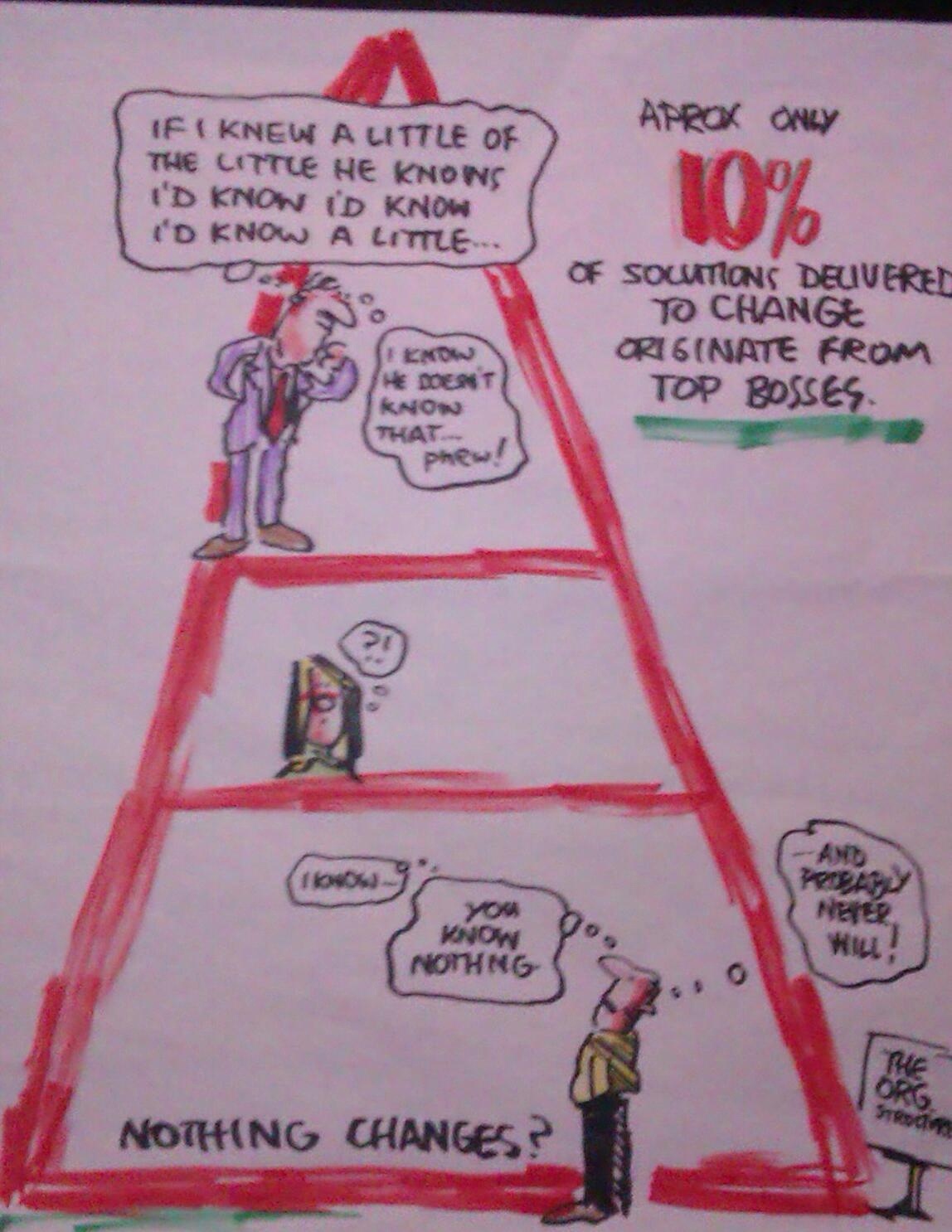
    The next one, a triangle is a bit more technical. It refers to research that indicates in change programmes only 10% of the successful ideas originate with the senior managers. The most useful ideas come from the people closest to the work (no surprises here…….). This was spoken about by Nick Obolensky. I need to dig up the research on this. Unfortunately I failed to write down the source properly, proving the point about my notes being less useful than Paul’s graphic facilitation.

    Overall, the images Paul produced have helped me build upon my learning at Summer School, and share it with others. The impact of showing people the pictures I took on my phone has been remarkable. If I had to sum up my experience of graphic facilitation in three words they would be; immediate, effective and long-lasting. Thanks Paul.

    So, what’s the PONT?

    1. They are a quick way of capturing key learning points (so much better than my notes).
    2. Pictures really do speak a thousand words. People can effectively understand complicated messages through images.
    3. The impact is long-lasting. I’m more likely to re-visit a picture or print it out and pin it on a wall than re-read my scribbled notes.

    If you want to see all of what Paul drew during the week here is a link to the Academi Wales Flickr stream: http://www.flickr.com/photos/81188091@N04/7643756830/in/photostream/

  • That’s a title that could conjure up something interesting particularly if you frequent the more exotic Berlin attractions (I’d imagine).

    Well actually it’s quite sweet and innocent.

    Love padlocks are a tradition that involves placing a padlock on a piece of municipal iron work, usually a bridge railing, and throwing the key into the river below. It’s a symbol of your never-ending love for your partner and should be inscribed with your names and an important date to add significance to the event. I wrote about the practice in Florence, Italy in 2011.

    Apparently it started in Florence when soldiers who were being transferred from the local army barracks would put the padlocks from their kit lockers onto the Florence bridges and throws the keys into the River Arno below. A romantic gesture, symbolising love and commitment.

    The practice has gone viral, spreading to 30 countries across the world. There is plenty of material about love padlocks on the Internet including details of the battles between sweethearts placing the padlocks and officials who want to remove them. If you are interested there are even businesses that will provide an inscribed padlock of your choice.

    Here is the example I saw recently in Berlin. That’s Berlin Cathedral in the background and the River Spree below.  This surprised me a bit. The extent of the love padlocks was a bit restrained in comparison with those I’d seen in Florence. Given the scale of other forms of self expression I’d seen in Berlin, particularly graffiti (which is everywhere) and things like the Love Parade, I’d have thought love padlocks would have taken off and gone viral. Perhaps love padlocks are a bit too tame and mainstream for the Berliners?

    I suppose it goes to show, you can’t predict human behavior and what will go viral.

    By the way, as far as I’m aware there is no evidence yet of love padlocks taking off in Cardiff, or anywhere else in Wales (excellent locations in Cardiff Bay, probably). You could however argue that the Welsh love spoon is a sophisticated demonstration of love. Love spoons are unfortunately quite expensive and not that practical for attaching to bridges as public expressions of love.

    So, what’s the PONT?

    1. Public expressions of emotion do seem to vary hugely between countries and cultures.
    2. Human emotions are complex and it’s incredibly difficult to predict what people might do, and what might go viral.
    3. Perhaps the Italians really are the most romantic people in Europe. I’ve just come back from Italy. There are plenty of love padlocks dotted around Florence, Venice and even popping up in places like Volterra.
  • Here is a guest post from my good friend Ena Lloyd. A better biog will follow once I get some decent internet connection in Tuscany. Thanks Ena…..

    I also attended the IdeasUk Employee Engagement network meeting, hosted by the Wales Audit Office in Cardiff, where it was great to meet colleagues not only from the Welsh Public Sector, but also the Voluntary and Private Sector who I fully intend to meet up with again to exchange some ideas.  There was great buzz on the day, particularly at the end of the workshops. All three workshops  were very engaging (pardon the pun but true!), very different, and were hosted by:-

    They represent very different parts of the UK business but they all had two key themes running through their workshops:-

    1.      Keep it simple; and

    2.      You have to continually evolve to keep staff engaged.

    What I also took away from all three workshops was that all three organisation had re-launched their staff engagement schemes several times since its initial launch and most importantly, that it’s OK to do this.  In fact, it’s essential for a number of reasons, namely, staff turnover, advancement of new technology and also to simply remind staff of the scheme. They on average, re-launch or update every two to three years. They viewed it very much as an evolving process.

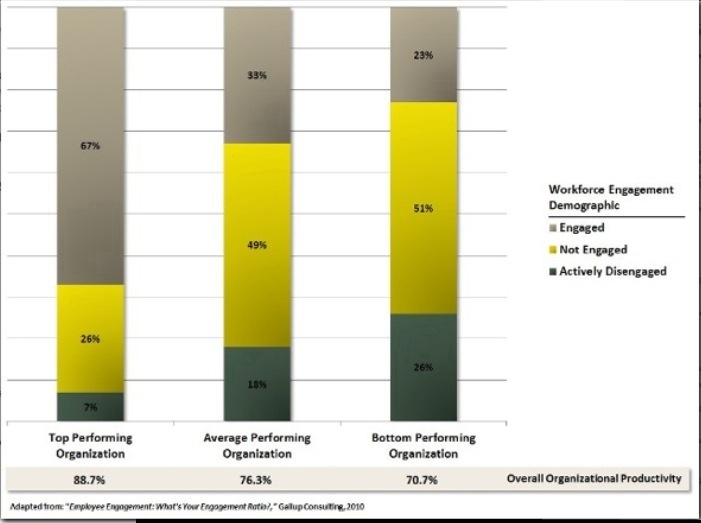
    There was an added moment of realisation for me in the Ricoh workshop hosted by Rob Bland and Chris Nicholls.  They were talking about the results of their latest staff engagement and the ratio staff engagement at their Telford.  They showed a recent slide which highlighted the level of engagement amongst their staff in terms of:-

    • Engaged;
    • Disengaged; and
    • Actively disengaged;

    What Chris Nicholls said next, brought ‘yes of course moment’ to mind. He simple pointed to the part of the slide which highlighted  the engaged staff, and said, we only focus on these staff. Adding we do some work with the middle ground of staff who are not engaged to see what we can to try to convert them to being engaged. However we don’t not worry about the actively disengaged,…………………… Why waste our energy, as we are unlikely to convert them, We focus only the staff who are engaged and make no apology for this.

    When Chris said that, i immediately saw parallels between the concept of focussing on engaged staff and the mantra which is constantly being repeated on the successful House of Tiny Tearaways programme by the eminently sensible Dr Tanya Byron, child psychologist. She constantly repeats to parents struggling with the challenging behaviour of their young children, acknowledge and praise positive/good behaviour in children.  Ignore or don’t acknowledge poor behaviour.  Well it’s just the same for adults really isn’t it!

    What I’m taking away from this is simply this, direct your resources where there is greatest impact. If some people don’t want to engage, don’t waste your energies.

  • Everybody sing along…….

    There is nothing better in life,

    Than writing on the sole of your slipper with a biro.

    There is nothing better in life,

    Than writing on the sole of your slipper with a biro.

    There is nothing better in life,

    Than writing on the sole of your slipper with a biro,

    On a Saturday night instead of going to the Pub.

    Lyrics: The Best Things In Life by sometimes surreal Half Man Half Biscuit (hmhb).

    Well there is……spending Saturday night, not with slipper and biro, but researching the 19th century English Romantic Poet John Keats and his ideas on Negative Capability (my wife tells me that by now most people will have left). There is a very good reason for my mindshift…….

    Earlier this year I was at Welsh Public Services Summer School where I was introduced to the idea of negative capability and Keats. This was in the context of how to approach learning and how I might best experience new ideas during the week. Helpfully it was broken down into some ideas I could get my head around.

    Positive Capability: Acts of certainty; Confidence; Extend Boundaries; Control; Comfort; and Adding Skills (the place where we spent most time).

    Negative Capability: Self inquiry; Observation; Adaption; Humility; Imagination and Uncomfortable Learning (not visited very often).

    This explanation was great as a starting point but something kept troubling me and was the reason why I ended up researching John Keats on a Saturday night, whilst listening to hmhb. The question I kept asking myself was; is negative capability really any different to some of the learning and self-development ideas I’ve heard about before? Things like:

    • Push the boundaries;
    • “Do one thing every day that scares you” (just did that).
    • Get out of your comfort zone;
    • Think outside of the box;
    • Be comfortable with ambiguity;
    • Deal with complexity etc,etc.

    Here are the results of my research and a few links that might be useful.

    • Wikipedia: Negative Capability, to be honest this didn’t help. I’m a lapsed scientist and the language  was all a bit too literary and then edged into psychoanalysis  (blimey).
    • French, Simpson & Harvey explained it more helpfully in a paper on Creative Leadership. Here they use the Keats quote to describe the state in which a person “is capable of being in uncertainties, mysteries, doubts, without any irritable reaching after fact & reason”.

    This is all great, but what you really need on a Saturday night is YouTube……….

    • Video by conferencereport. A useful explanation if you can cope with the cars passing in the background.  Having the presenter talk to a hand-held camera while walking around was curiously engaging.
    • Eben Pagan’s Get Altitude video has a more ‘management seminar’ style and talks about understanding another person’s emotions. A bit tangential.
    • Bright Star is a 2009 film about the Keats poem of the same name, here is the official trailer. Helpfully there are other videos linked to the film where negative capability is explained. Here is one with chaps diving in the lake Mr. Darcy style. To my surprise, the explanation of how to ‘understand poetry’ helped a lot with my understanding of negative capability.

    “The point of diving in the lake is not to immediately swim to the shore, but to be in the lake. To luxuriate in the sensation of water. You do not, ‘work the lake out’. It is an experience beyond thought”

    Summer School was a bit like diving in and immersing myself. Now I’m sitting back and doing some of the ‘working out’, on Saturday nights as it happens. As for hmhb lyrics, I’m still in the lake, luxuriating in the mystery.

    So what’s the PONT?

    1. Negative capability is different from just ‘pushing the boundaries’ of things you already know about.
    2. Accept that you cannot and may not need to understand everything you encounter.
    3. It can feel uncomfortable but by immersing yourself in things you don’t fully understand, new things can emerge.

    Photo source: John Keats http://en.wikipedia.org/wiki/File:John_Keats_by_William_Hilton.jpg

    I have to finish this off with one more hmhb reference for Helen Reynolds. John Keats wrote several odes including ode to a nightingale. As far as I know hmhb only have one ode, ‘ode to Joyce’, which does have a video featuring this picture of a kitten playing a guitar. Awesome!

  • A while back I was having banjo lessons. The banjo teacher couldn’t actually play the banjo. He was a fantastic guitar teacher, but had zero experience of banjos. He would joyfully rationalise this situation by assuring me (after he’d taken my £20) with soothing words, “don’t worry my son; as long as I stay one step ahead of you we’ll be just fine….”

    Things felt a bit like this last week when I helped out at the Canton Social Media Surgery, with me staying just about one step ahead.

    Having spent a while blogging, using twitter and other bits of social media I felt like I had enough experience to do my bit and help other people. I was slightly anxious, being very much in the territory of that Eleanor Roosevelt quote of “do one thing every day that scares you”. The other side of this was forcing myself to become more competent by trying to teach what I knew, a bit of a test……….. well I wasn’t disappointed.

    Juliette and Nicky  did a good job of preparing me. Plenty of pre-surgery reading, assuring me I’d be fine and giving me the grand title of ‘surgeon’. I was then introduced to my ‘patient’ a lovely lady. As I recall this is how it played out:

    • Lady: “I’m not that good with technology”
    • My thoughts: Great I’m on safe ground here…..
    • Lady: “I’m interested in WordPress, but I don’t know very much”
    • My thoughts: Excellent, I’m bound to dazzle you with my knowledge…..
    • Lady: “I have been on holidays, the campsite had WIFI so I’ve been looking at WordPress”
    • My thoughts: okaaay……..this could be interesting……..
    • Lady: “I’ve done some WordPress research….” and she produced an A4 notebook containing what looked like about 20 pages of neatly written notes
    • My thoughts: Arrgghhh…….. Where’s the fire escape!

    Fortunately we had a chat about Twitter while I gathered my senses and then we moved onto WordPress. In the end everything went very well. I found out that I do actually know a few things, and learnt quite a lot as well. Admittedly some of the learning came later that evening when I got home and clicked a few WordPress things (not that anyone would notice).

    This process of learning was a big thing for me was. Recently I heard Physics Teacher Alessio Bernadelli talk about how first year sixth form students (year 12) had learned about photo electricity by posting blogs to be reviewed by year 6 students. The act of explaining what they  knew to others helped their personal understanding. This is nicely summed up in a post from another teacher, Lucy Bunce in her blog where she quotes from the book Dirk Gently’s Holistic Detective Agency by Douglas Adams…….”What I mean is that if you really want to understand something, the best way is to try and explain it to someone else. That forces you to sort it out in your mind”

    My experience at Canton Social Media Surgery was about combining three things:

    1. really understanding what I know by explaining it to someone else;
    2. staying just one step ahead; and
    3. learning from the person you are teaching.

    Overall this made for a very rewarding experience. Thanks to my ‘patients’ who were very tolerant and to Juliette and Nicky for letting me take part, hopefully I’ll get invited back next time.

    So, what’s the PONT?

    1. As Dirk Gently says, if you really want to understand something, explain it to someone else.
    2. It’s amazing what you learn from the people you are supposedly teaching, just be sure you open yourself up, look and listen.
    3. In the words of Eleanor Roosevelt, “do one thing every day that scares you”. It worked for me.

    Picture source: This isn’t my banjo teacher. It’s Don Wayne Reno a fantastic bluegrass banjo player with the band Hayseed Dixie (who I happen to quite like).

  • Last week I had the great joy of attending an IdeasUK Employee Engagement network meeting in Cardiff, hosted by the Wales Audit Office. The three organisations presenting workshops were incredibly different yet, I picked up on five common themes: Longevity, Trust, Evidence, Belief and Passion.

    Question: Are these the key elements of success for any employee engagement approach?

    To set the scene, the organisations involved couldn’t be more different in relation to what they do, the numbers and type of people they employ and where they operate:

    • HSBC, financial services and banking (global);
    • Ministry of Defence (GEMS Scheme), defence (domestic and global); and
    • Ricoh Manufacturing UK (Telford), photocopier manufacturing (European wide).

    The success of each of these organisations and what they have achieved in employee engagement through their staff ideas schemes was obvious to see through the day. What struck me were common phrases/words/ideas/approaches/beliefs and values that kept popping up, despite them being very different organisations. Here is my take on what I think linked these three very different organisations, and what seems to support successful employee engagement.

    Longevity: Each one of these organisations has been pursuing a path of employee engagement for a long time. The MoD started Gems in the mid 1990s and it’s even longer for Ricoh (1986). I think this long-term view is critical in developing a culture where employee engagement is taken seriously and people live the values through their everyday behaviours. Things like the ‘Thank You’ culture in HSBC don’t happen overnight.

    Trust: This is mentioned so often that it’s almost a cliché; however the difference between saying it and actually trusting people is huge. It was impressive to see how HSBC trust their staff to interact with an internal social media type platform to share ideas. In the highly regulated world of financial services it would be so easy just to say no, ‘manage the risk’ and shut everything down. I heard the phrase ‘why wouldn’t you trust your staff, they know the job they do better than anyone’ several times during the day.

    Evidence: Every single organisation had rock solid evidence of the benefits their suggestion schemes had delivered. These ranged from a 14:1 return on investment through to hundreds of millions of pounds saved. My key learning point was the necessity of having solid evidence when someone questions the effectiveness of employee engagement and suggestion schemes. It’s surprising how many people ‘just don’t get it ‘(see the David MacLeod & Nita Clarke report) so you will need solid evidence.

    Belief: You’ve got to believe, because if you don’t, how will you convince anyone else? Everyone I met totally believed in the power of employee engagement; nothing else to say.

    Passion: This absolutely stands out for me as the defining characteristic of what makes great employee engagement. Passion is what I saw in all three organisations across the day but if you want one example of what passion inspires here goes…….

    Walking out of one of the workshops with Ricoh an individual who works in the NHS turned around and said out loud, to everyone…… “I found that inspiring, I would like to come and work for Ricoh”. Not a bad impact after sitting there for an hour.

    It was an incredibly useful session and I would like to say thanks very much to:

    • Stuart Laws – Ministry of Defence
    • Rob Bland & Chris Nicholls – Ricoh UK Products
    • Zufi Yousaf & Michael Davies – HSBC
    • Anthony Denatale – IdeasUK

    I know that IdeasUK are planning to keep the momentum going by publishing a series of blogs about the day. This is part of the pledge I made during the day to help keep things alive through my own blog posts.

    So, what’s the PONT?

    1. Longevity is a key feature of successful employee engagement which other organisations would benefit from thinking about.
    2. Evidence of success (and cash savings) is highly necessary if you want to convince the ‘just don’t get it’ crowd.
    3. Passion above all will inspire people to do great things.

    Links:

    http://blog.ideasuk.com/2012/07/06/i-pledge/

    https://whatsthepont.wordpress.com/2012/02/23/employee-engagement-kaizen-passion-in-the-west-midlands-ricoh-telford-to-be-exact/

    https://whatsthepont.wordpress.com/2012/03/10/ricoh-gemba-mat-the-best-of-ohno-circles-gemba-walks-and-employee-engagement/

    https://whatsthepont.wordpress.com/2012/03/05/gemba-walks-kaizen-the-elvis-way-walk-a-mile-in-my-shoes/

    https://whatsthepont.wordpress.com/2012/02/03/social-media-staff-ideas-better-engagement-a-bank-that-says-yes/

    http://www.goodpracticewales.com/Resources/Employee-Engagement

    Just to emphasise the point about longevity……