It’s that time of year in our house when I dutifully read all of the Christmas Cards before they are dispatched for recycling. There are literally 100’s of them.
“How can there be so many?” I ask my wife, who controls everything Christmas related at home, with ruthless military precision. “There are only supposed to be 150, it’s Dunbar’s Number, scientifically proven you know…. How many people are on our Christmas Card list?, I innocently enquire….
As it happens (which I would apparently know if I was a decent husband) there are 267 people on our Christmas Card list; 246 in the UK and 21 requiring overseas postage. I’m regretting I asked at this point, but Dunbar’s Number and Christmas Card Lists is an interesting subject, honest.
Dunbar and Hill’s Christmas Card List Research.This paper is a neat bit of research from 2002 looking at the size of human social networks. Previous work by Robin Dunbar had predicted that there was an average size of about 150 for human social networks. This basically means that (on average) you can only have meaningful social ties with about 150 other people. Dunbar proposed that this was linked to the size of the neocortex in our brains and our ability to do things like remember faces.
Much of this work had been done with groups of primates where it is relatively straightforward to understand social networks. Primates spend a lot of time in social groups, grooming – picking the fleas out of each others fur – which isn’t as obvious in Humans. I should point out here that this was in 2002, before the proliferation of social media. Nowadays there may well be ‘flea picking’ equivalents in social media networks to study, which I’ll get onto in a minute.
We send more Christmas Cards to friends as we get older? From Hill & Dunbar 2002, Durham
Working with Hill, they gathered information about now many people are on the average Christmas Card List. Guess what – the mean was about 150. There is plenty of other interesting information in the paper about demographic makeup of people on the lists and the emotional strength of the relationships.
One thing that did strike me was the reason for choosing Christmas Card Lists as a method of studying social networks. According to Hill and Dunbar the sending of Christmas Cards represents; ‘one time of year when individuals make an effort to contact all of those individuals within their social network whose relationship they value’. An inspired bit of lateral thinking. I do wonder though, how much longer will Christmas Cards survive in a world of digital media?
Validation of Dunbar’s Number using Twitter. Just when you thought things couldn’t get any better…. how about some analysis of a massive dataset from Twitter:
1,700,000 Individuals
380,000,000 Tweets
25,000,000 Conversations
150 is the Magic Number. Validation of Dunbar’s Number from Twitter
This 2011 research paper by Goncalves, Perra and Vespignani, looked at all of that data and came to the conclusion that ….’the economy of attention is limited in the online world by biological and cognitive constraints as predicted by Dunbar’s number’. Basically this means that our minds cannot cope (on average) with more than about 150 people in our social networks.
What does this mean if you have 1000’s of Twitter Followers, 100’s of LinkedIn Connections and Millions of Facebook Friends and don’t forget the people on your Christmas Card List? In reality, it probably means most of them aren’t actual friends, and it’s a bit difficult to have a meaningful relationship with more than about 150 of them.
Now I feel so much better that I wasn’t able to recognise about half of the people that those Christmas Cards were from. Sorry, it over stretched my cognitive ability. Happy New Year!
So, What’s the PONT?
Dunbar’s Number (150) is the mean for people in a stable human social network.
Beyond 150, it becomes difficult to have meaningful relationships due to the cognitive limits of our brains (things like the ability to recognise faces become harder).
I do wonder if habits developed through the use of Social Media over time might change Dunbar’s Number?
I’ve recently re-aquainted myself with the term after discovering the 2005 book “Dave Gorman’s Googlewhack Adventure”, during some pre-Christmas house painting (an ancient and compulsory tradition my wife assures me).
Basically a Googlewhack is what happens when you put two words in to Google, click search, and it returns A SINGLE SEARCH RESULT!
I know, sounds crazy doesn’t it.
Google pointing you to only one website that contains those two words……. surely……. there must be at least two search results: One for the actual website containing the uncommon worlds; and a Second one, an advertisement selling you something….. (things have changed a lot since 2005).
Where did Googlewhacking come from? It has its origins way back in 2002 with Gary Stock, who started to identify pairs of words that produced a single search result from Google, and developed the term ‘Googlewhack’. The helpful Gary then created the googlewhack.com website and the ‘Whack Stack’ for like-minded people to post their whacks.
An interesting point to note here is the very act of posting your Googlewhack online immediately ends it’s status as a Googlewhack – there are now two places on the world-wide web where a Google search could find those two words. If that’s not ephemeral, (something that is used or enjoyed for only a short time) I don’t know what is.
There were rules about what makes a Googlewhack and all sorts of derivative activities like discovering Googlewhackblatts developed. These are single words that returned only one search result. Activities like posting the Googlewhackblatt backwards on a website to avoid it being detected by Google developed, and the uses of elgooG (a backwards Google search) to find them. As strange as this all seems it is true…. (apparently)…..I read it here on Wikipedia.
And when did Googlewhacking end? The googlewhack.com website went offline in 2009. However, by the time I read the Dave Gorman Googlewhack Adventure book in 2005 it was incredibly difficult to find just one whack, let alone the unbroken chain of ten he was aiming for. Apart from the act of posting your Googlewhack online removing it’s status, other factors worked against this being something with a long-term future. The fact that people were putting ever more information online, every minute of every day, and the Google robots were getting ever more efficient at logging the information on websites, the days of a Googlewhack surviving were numbered. As internet ephemera go, it’s not a bad innings though.
If you fancy a bit of fun yourself, try putting some of the words into Google that transported Dave Gorman around the world on his Googlewhack Adventure, some of my favourites:
Coelacanth Sharpener
Pomegranate Filibusters
Acehigh Lawnmowers
As a Smart Car driver, I think i need to switch to Opera
Other Internet Search Engines Are Available. I should point out here that Google isn’t the only search engine that you can use. Back in the mid 2000’s there were a number of alternatives available.
The introduction to the Dave Gorman book talks very precisely about ‘the internet search engine http://www.google.com’, just in case you get mixed up with something else.
Funny to think that 10 years on and the ubiquitous term for searching anything on the internet is to ‘google it’. I know saying that might get me into trouble with enthusiasts of other search engines – so I have included this graphic of ‘if web browsers were a form of transport’ to hopefully appease anyone I’ve upset (sorry).
Some final thoughts on Ephemera….. This is a word I only learnt in my mid 20’s, before the internet and fancy search engines were invented. This was in the context of wetlands, streams and ponds that only existed for a short period of time when water table was high following the winter rainfall. The abundance of water supported diverse variety of plants and wildlife to flourish during that period, and they were dormant for the rest of the year.
It does however feel like a term well suited to the internet age. Apart from Googlewhack, what other internet activities have come, and gone, in very short space of time? ( I hesitate to mention Google Flu at this point.)
So, What’s the PONT?
Some things are ephemeral, they need the right environmental conditions and exist for a relatively short time. It happens in nature, why shouldn’t it happen on the internet?
Ephemera, by definition, don’t leave a lot of evidence they existed. One of the benefits of the digital age is that they can be recorded and preserved for future generations to enjoy.
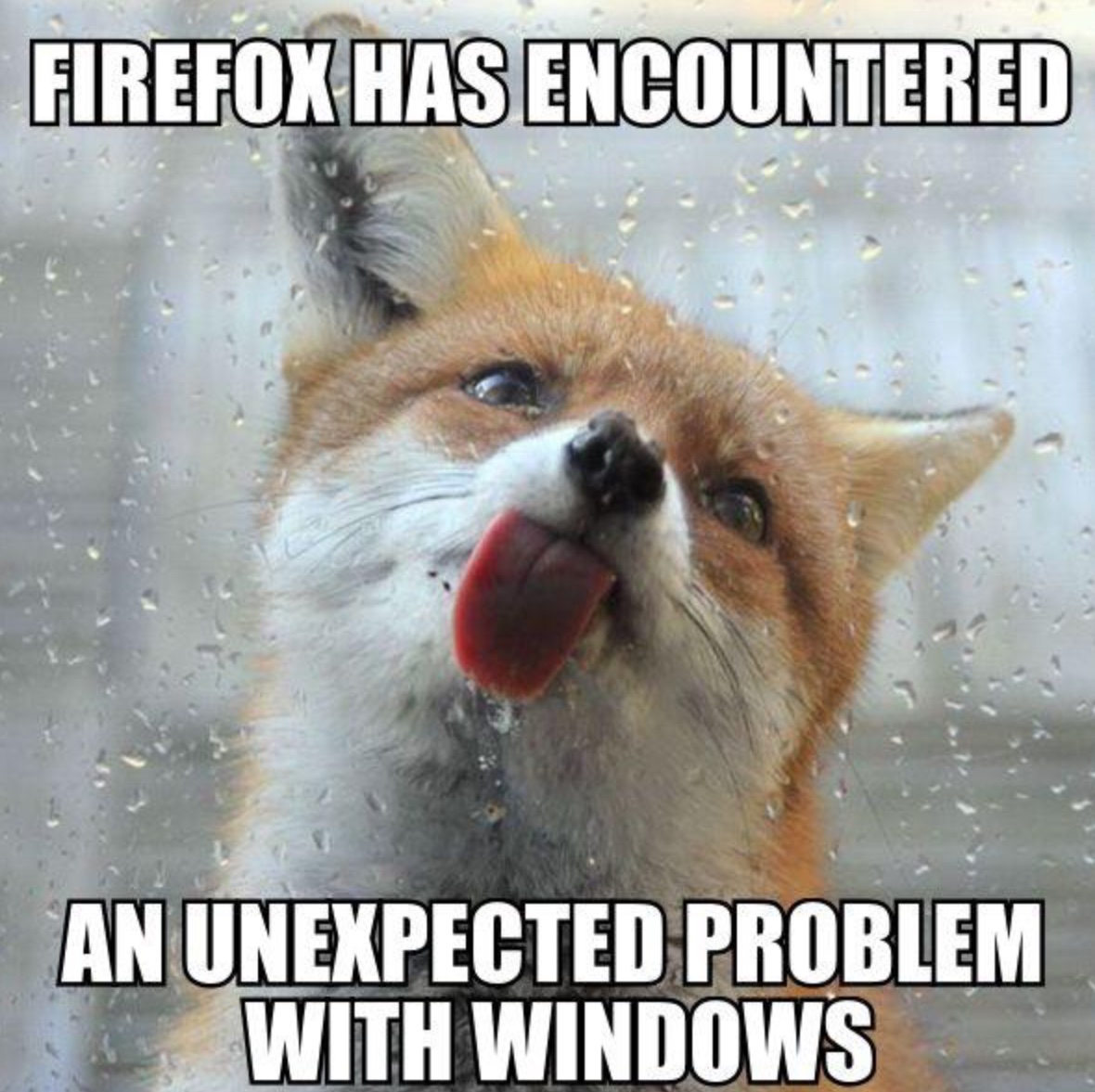
There is more than one search engine available – Like Firefox, or Safari. See the graphic above, and enjoy this Firefox joke.
Ultracomida Aberystwyth – Quality Tapas, Look almost gone!
This is a post about co-working, however let me start with something I learnt over the weekend, an essential for your etiquette handbook. When asked; “are you visiting Aberystwyth for anything special?”, DO NOT REPLY WITH, “We’re here to bury my Mother in Law’s Ashes”.
It’s a bit of a conversation killer, stuns hotel receptionists into silence and generally leaves everyone feeling uncomfortable, except the gravedigger. He was cool with it (and the payment in cash). If faced with a similar dilemma just make up some random excuse for being in town, it’s the polite British thing to do.
Back to co-working. I was recently trying to explain the idea of co-working to a friend, who understood, but wasn’t completely feeling the love (fully embracing the economic, environmental and social benefits).
They got that it involves spending your working day in a space shared with complete strangers. They understood that it might be cheaper and more convenient for people who operate as small businesses or sole traders, compared to renting an office or working from home/the shed. The benefits for people who move about a lot and need a working space in different locations, at different times were crystal clear.
All these obvious benefits are summarised here, and in this article about Indycube who operate many co-working spaces across Wales. They are great spaces, full of interesting people, I’d recommend spending some time working at one of them.
Where I felt my friend was struggling was around the ‘intangible benefits’, the unplanned things that happen when; you put random strangers together, get them talking, and see what happens. With Mark Hooper, one of the founders of Indycube, we spoke about ‘serendipitous conversations’. Something beneficial that comes out of what appear to be completely accidental and random events. Co-working perfectly creates the environment for the serendipitous conversations to take place.
Ultracomida Aberystwyth – the finest Tapas in West Wales
Why is Co-Working like Tapas? My unconvinced friend totally gets Tapas. They love the bite size pieces of tasty Spanish food and the sociability of it, mixing with friends over a small sherry or spritzer (darling**). So, how about this, a place where you sit and have your tapas at a communal round table with complete strangers.
This is what I did in Aberystwyth on Friday night, in the finest Tapas restaurant I’ve been to since Santiago de Compostela in NW Spain. Ultracomida serves Tapas in the room at the back of the delicatessen. I have written about the challenges of leaving the glorious A470 and getting to Aberystwyth, but it is well worth the expedition on the A44 across the Cambrian Mountains. Basically there are two large round tables that seat about 10 people each, and a bar you can perch against. It’s worth booking a seat at one of the tables and seeing what happens.
Time will tell if had a serendipitous conversation at Ultracomida on Friday, but I did learn a huge amount about some very diverse topics:
How to make ice wine,
How Italians make coffee and why it is the best in the world,
Why accidents have produced some brilliant innovations,
Even my wife, who was initially ‘lacking in enthusiasm’, got around to enjoying the conversations (somewhere in the planning I’d forgotten to mention this wasn’t a ‘romantic table for two’ event).
Hopefully my unconvinced friend will make the connection between ‘Tapas with Strangers’ and the benefits of co-working. At the very least we should go to Ultracomida in Aberystwyth and do a bit of action learning. Perhaps Aberystwyth also needs an Indycube next door?
So, What’s the PONT?
Conversation over food is a good way to share knowledge and information. Someone from Spain told me this week that it helped reduce email volume in their organisation.
Co-working is a great way to have serendipitous conversations.
Could mixing Co-working and Tapas be the next big thing?
Yes, I sat next to Judith Iscariot in Ultracomida
*Ultracomida in Aberystwyth has a Monty Python Life of Brian connection. The actress who played Judith Iscariot, (Sue Jones-Davies) became the Mayor of Aberystwyth 2008-2009, thirty years after the film had been banned for blasphemy in the town. Judith lifted the ban and had the film shown with some of the Pythons in attendance, and I had lunch sat next to her in Ultracomida about 5 years ago. Good story huh!
** Darling…. my unconvinced friend will get this reference.
How about this, something practical to help overcome the ‘speaking truth to power’ problem: The Listening Boss Starter Pack;
A picture of General Custer to hang on the wall,
A Jesters Hat,
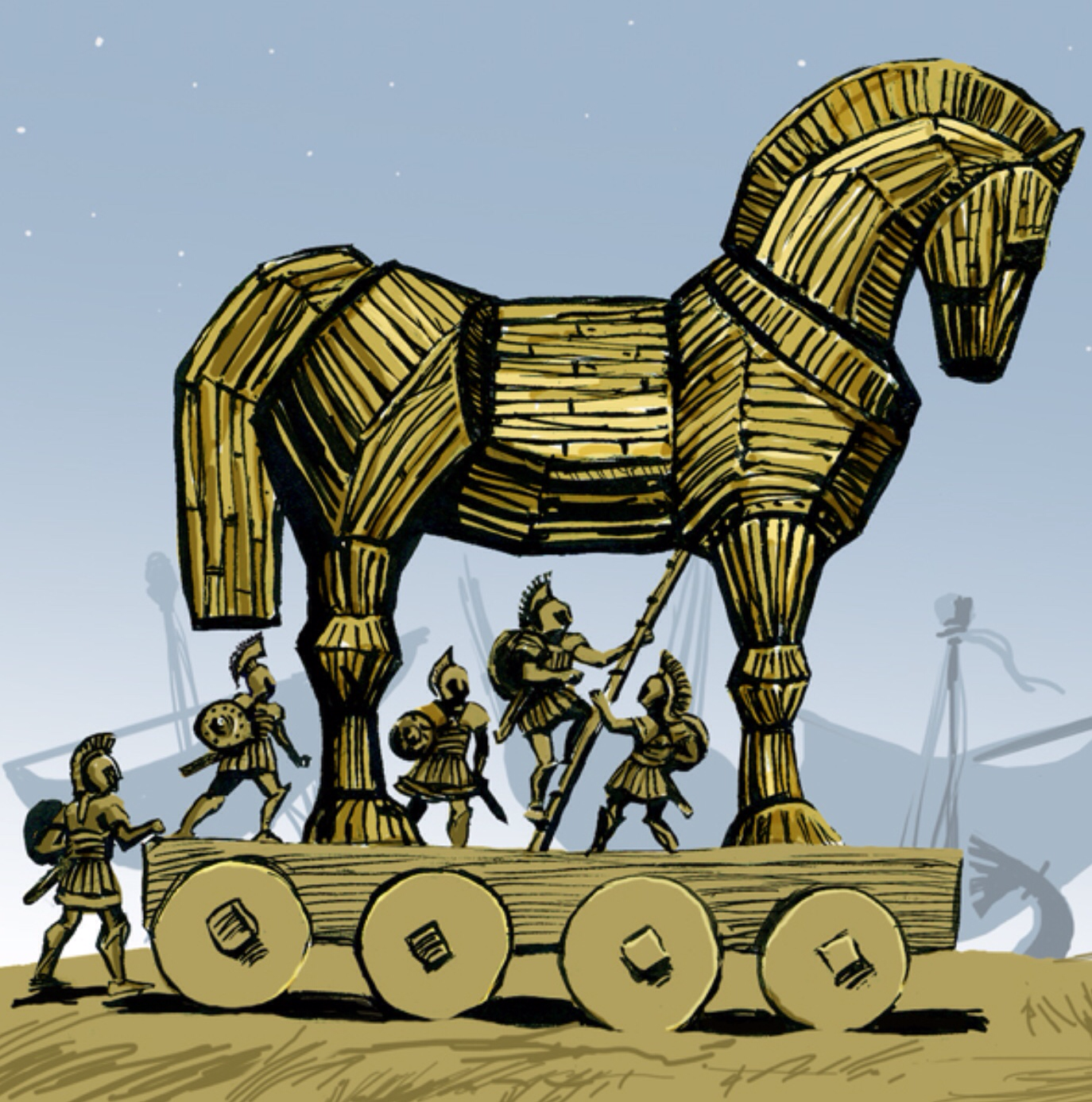
A Trojan Horse paper weight / desk ornament, and
A Darth Vader Lego Character (we all like a bit of fun).
You receive the ‘listening boss’ starter pack for every job you get that involves some form of power relationship with other people. It’s perfectly ‘scalable’ so will fit in with any circumstance.
For the ‘bottom rung of the ladder’ Team Leader / Supervisor role it can be a photocopy of General Custer in an IKEA Clip Frame. Hit the big time, become a Director and you get a Golden Frame with an Oil Painting of the General, whatever option satisfies your ego. A Plastic Trojan Horse at entry-level or Bronze Statuette for achieving CEO status…….. you get the idea.
This is not as daft as it sounds. There is some reasoning behind this, the background is explained in two previous posts about shooting the messenger and speaking truth to power:
Excessive amounts of testosterone leads to a loss of hearing. I think I’ve seen this situation. The more of a ‘strong leader’ and ‘manly’ you become, the less likely you are to listen to what others have to say. I would argue that this isn’t exclusively a male thing, there are a few ‘non listening’ female leaders about.
The need to lead. Some leadership models are based around the idea of a single heroic leader, all-knowing and with excellent judgement and decision making skills. Asking for help, or a second opinion (or listening too much) could be seen as a weakness of leadership if you believe in this model.
Over Confidence, Hubris and Ego. Self belief and confidence are a necessary part of leadership, but too much can spill over into believing you are never wrong and hubris; ‘an over estimate of your own abilities’
So Why the Listening Boss Starter Pack? The point of the starter pack is to remind the people who gain positions of power that they don’t know everything, and they need to listen. It is easy to say this on executive development courses and leadership training, but the starter pack is a daily reminder. Not the perfect answer, but it might help. You can modify the pack to suit specific individuals, but here are my explanations for the generic version:
General George Custer. The US Calvary Officer is most famous for the 1876 defeat (and his death) at the Battle of Little Big Horn. There is a lot of controversy around the leadership role of General Custer in the decisive defeat.
The James O’Toole paper talks about the CEO of a major American company who keeps a portrait of Custer in his office to remind himself “of the dangers of over estimating his leadership ability”. You might have your own favourite examples you could use?
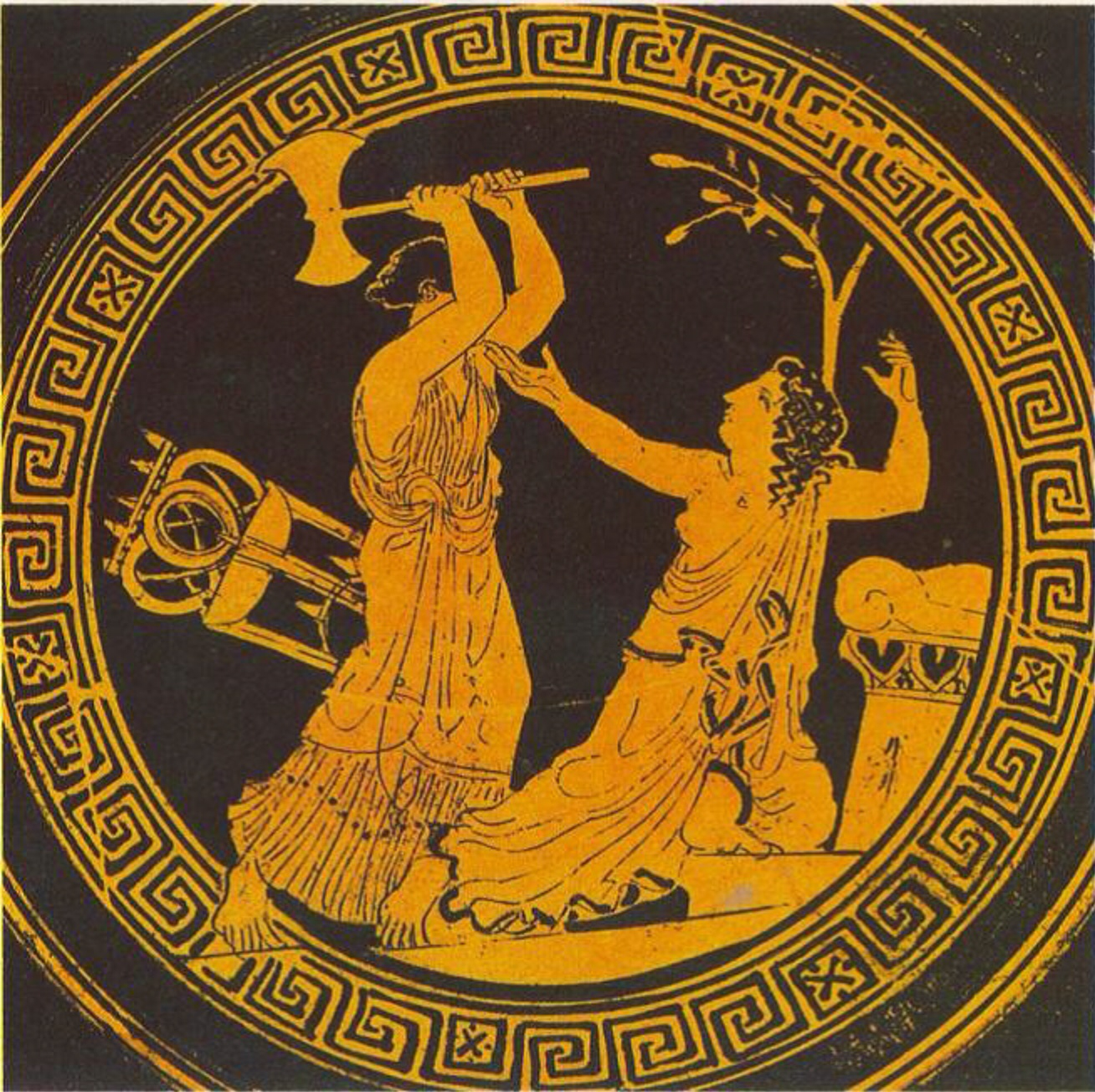
The Trojan Horse. You probably know the story of the Trojan Horse, which Greek soldiers used to gain entry into the City of Troy. What you might not know is that it was all predicted by the Prophetess Cassandra, and nobody listened to her. The story is a bit more complicated than that (you can read about Cassandra here) but I’m sure you get the point. The purpose of the Trojan Horse is to remind you to listen to the ‘Cassandras’ in your organisation.
The Jesters Hat. This is all about ‘Lear’s Fool’ of Shakespeare fame. In the play King Lear, ‘The Fool’ is the only person that King Lear will allow to criticise him. An act of ‘speaking truth to power’ that the King tolerates and accepts.The idea of ‘wise fools’ is common in many Shakespeare plays and other literature. However there are potential problems with using a single source to listen to the ‘truth’, the Jesters Hat serves as a useful reminder.
Darth Vader. Finally, the Lego Darth Vader serves the purpose of reminding any new boss of the worst boss ever. The Anti-Boss Model; an aggressive, bullying, poor listener who makes some very bad decisions.
You don’t want to be like this, and the Lego Darth Vader figure is there to remind you.
So, Whats the PONT?
Speaking Truth to Power needs to have someone ‘listening’ if it is to have any impact.
Powerful people can be prone to ‘loss of listening’ ability. They need to be aware of this.
There are a few helpful tools in the ‘Listening Boss Starter Pack’ that might help with continued listening
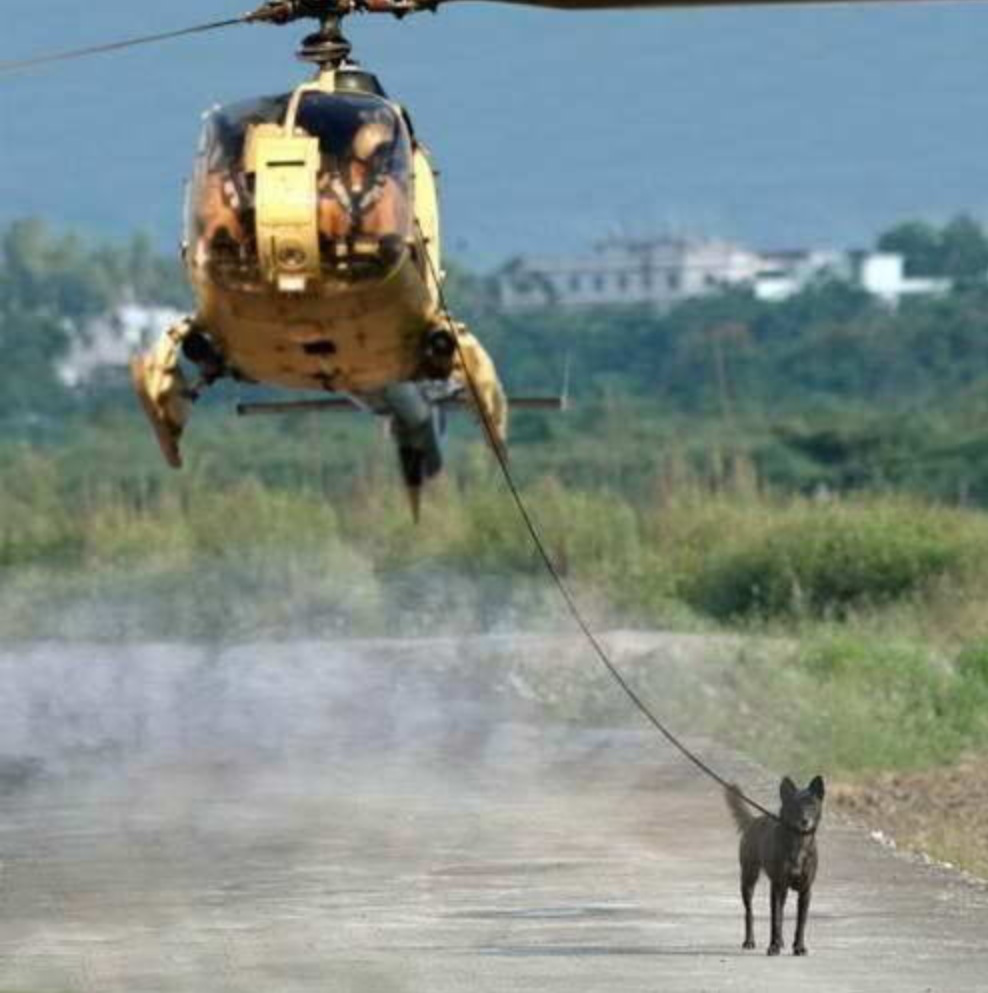
Hands up who’s seen the picture of the dog being walked using a helicopter?
Apart from being a brilliantly surreal situation, it often gets used as a metaphor to illustrate badly designed services – usually in the public sector.
Take a simple service delivery objective – exercising the dog: …..to improve the dogs; health, wellbeing and social interaction.
Add some measurement requirements – For the wider community; dog walking will help prevent anti-social behaviour and stimulate the local economy through the purchase of dog treats… (sorry, I’ve lapsed into Local Service Delivery Plan speak).
You have the basic components: a dog, a lead, a person to direct the dog and somewhere to walk. What could possibly go wrong?
In the public service ‘example’ we get the introduction of a helicopter (for very good reasons) which is: very expensive, complicated to organise, extremely noisy and probably a bit dangerous.
However, if you think like a dog (try to achieve this try licking parts of your anatomy), it’s not as much fun as meandering around the park sniffing trees, lampposts and other dogs bottoms. Hardly an example of user centred design?
Reality is often stranger than fiction. That example is mildly amusing, but totally ridiculous you might be thinking, not the sort of thing that could ever happen around here…
Twice this week I’ve been out socialising, when people have told me stories about hugely complicated processes being using to deliver a simple service. All the strangeness of the helicopter dog walking was replaced by the mundane nonsense of bureaucracy gone wrong. Not as exciting to look at, but just as excessive and expensive, and in the one case it had a very negative effect on the person.
The helicopter dog walking image is a good way of illustrating a problem of badly designed services, but unfortunately it can be a bit too abstract for everyone to get the message. If you are sitting in the depths of a bureaucracy there is a fair chance you will miss the big picture. You can easily fail to appreciate what it feels like to be the dog (out sniffing things) and concentrate on procuring a helicopter.
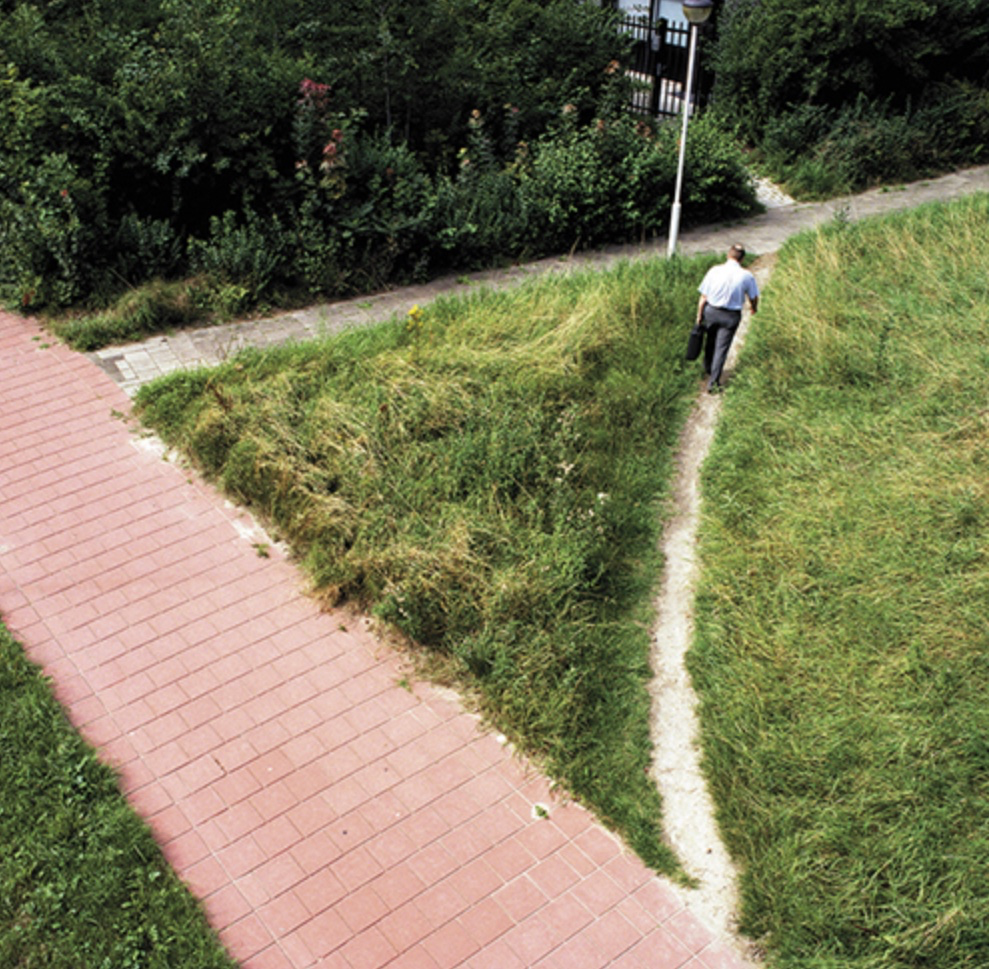
But how about this, something most people will have seen, and will probably have contributed to, Desire Paths (Caminitos de deseo).
I will not follow the inconvenient path designed by ‘Authority’
Desire Paths Basically these are the informal paths that people create around buildings, through parks and across towns. They are the way that people actually prefer to use to move from A to B rather than the route that has been ‘designed’ for them.
A tweet from Mike Dixon from the Citizens Advice Bureau alerted me to a group on Flickr that share photographs of Desire Paths. I cannot begin to tell you how pleased I am by this, particularly with the description of why Desire Paths exist: “It’s done against the will of some authority that would have us go in some less convenient way”. There is a great deal in that statement that anyone who designs or delivers services should ponder on.
Here are a few Desire Path gems to whet your appetite:
The Flickr Desire Paths Group was created in 2006 and has 472 Member who have shared 634 pictures. Anyone can join (I have).
The idea has been around a while. Look at the Spanish video below which features people looking suspiciously like 1950’s Town Planners.
Caminitos de deseo is the Spanish version, with Oilfantenpaadjes (elephant paths) being used in the Netherlands. Yes, there is an excellent website olifantenpaadjes.nl full of videos, pictures and commentary.
In Finland, the people who run parks are known to head out after fresh snowfall to check where people actually walk, so they can put the paths in those places.
In the USA, Yosemite National Park officials looked at the informal paths people used to develop the overall management plan for the park.
The Wikipedia article says they are also known as; social trails, goat tracks or bootleg trail
Sony apparently waited to see where their employees walked before building footpaths at a site. I’m not sure about this one, my wife claims she’s heard about it from me? If anyone knows about it I’d be delighted to find out the detail.
Caminitos de deseo, here is that cool Spanish Video:
Where is the User Centred Design? When you think about helicopter dog walking and Desire Paths there seems to be a lack of thinking about what service users actually require. From what I hear, and read, the lack of user centred design isn’t restricted to these two areas.
No more helicopter, please
But it’s not all bad news, there are reasons for hope. My experiences of co-production and working with organisations like Working With Not To make the think “there is another way”. There is also plenty of material and expertise available on user centred design, particularly from the digital industries, which has plenty of experts in UX (user experience). More on User Centred Design soon, in the meanwhile I’m off to walk the dog, minus the helicopter.
So, what’s the PONT?
The delivery of straightforward activities can be over-complicated if you don’t think carefully about how services are designed.
Service users know how things work best. Desire Paths are a good illustration of this.
Involving service users in the design of services can bring in valuable ‘lived experience’ to get better result for everyone.
Cassandra. She knew the truth but was never listened to…
Stop for a moment and think about this question. “What happens to the people who give bad news, or tell an unwelcome truth to the people in charge?” [PAUSE]
Now think about the question in relation to all of the books you’ve read, all of the films or television shows you’ve seen and all of the stories you’ve ever heard. [PAUSE]
My guess is that for much of what you have read, seen or listened to; these people will have experienced something unpleasant. The previous post about 2500 Years of Shooting the Messenger didn’t end on a high note. In fact, I suggested that ‘shooting the messenger’ was a deeply engrained human activity that has been practiced for 1000’s of years.
In the corporate world, projects that fail due to a ‘failure to speak truth to power’ are just helping to keep an ancient tradition alive. Not my most helpful post. Sorry. I will try to be more helpful here.
The Responsibility of Messengers, Avoid Sycophants and Axe Grinders: If you superficially consider the role of the messenger in speaking truth to power, it is easy to think of the person as completely impartial and an innocent party in the process. This might be the case sometimes, but in reality most situations are much more complicated.
People often have a relationship with the people they need to ‘speak the truth to’. Within organisations the messengers are frequently subordinates in the hierarchy and the ‘version of the truth’ they choose to tell (and how they do it) can have consequences. The consequences can be negative or positive for the messenger, but they will also have an effect on the surrounding culture.
Classic Sycophants and a Cheeky Child
The Emperors New Clothes
Sycophants. If messengers are sycophants, this can lead to situations where those in power become conditioned to hearing nothing but good news (and they love it!). You know the type, “I don’t want to hear about problems, just bring me solutions…..” leading to… “only bring me good news…. on a silver platter, with a ribbon”. This might be good for the sycophants, but a bit of a disaster for everyone else.
Imagine the challenge for the person bursting the ‘good news’ bubble. The tale of the Emperors New Clothes and the ‘cheeky child’ who speaks truth to power is well-known. The ‘Cheeky Child’ isn’t however common in lots of organisations, in fact many new starters are advised to; “keep quiet until you learn how things work around here”.
Hades from Disney’s Hercules
A serious Axe to Grind with the Olympus bosses
Axe Grinders. This is tricky. There is a blurry ‘speaking truth to power’ spectrum that covers: pointing out things that have gone wrong, raising serious concerns, being a whistleblower and having and axe to grind. Although the cause may be totally justifiable, it can end up being seen as deeply personal issue. Something which is linked to settling a score, seeking justice or just ‘getting even’.
Lots of people seem to find something a bit uncomfortable about people with ‘an axe to grind’. The unfortunate consequence can be marginalization by your peers as well as those in charge. If you are trying to speak truth to power, the label of ‘Axe Grinder’ can be a serious disadvantage. It makes it easier for the people in power to dismiss you as a bit of an ‘unhinged complainer’. You may have observed this.
The white paper by James O’Toole from Santa Clara University I mentioned in the last post talks in-depth about the problems of being a Whistleblower, it is well worth reading.
The Brave Messenger. Going back to the James O’Toole paper, ‘Old Tales and New of Leadership, Organizational Culture, and Ethics’, he also offers some very helpful advice on how to be an effective and in my view a Brave Messenger. Before speaking truth to power (and being virtuous) you need to meet the following criteria:
It has to be truthful.
It must do no harm to innocents.
It must not be self-interested (the benefits must go to others, or to the organisation).
It must be the product of moral reflection.
The messenger must be willing to pay the price.
It must not be done out of spite or anger.
There’s not much more to say here, this is very clear advice.
Being an effective messenger that speaks truth to power, and avoids getting shot, is a hard thing to do. You might need to cope with a culture of ‘good news’ created by sycophants and avoid being labeled as an Axe Grinder. Having a checklist (like the one from James O’Toole) to make sure you are doing things for the right reasons, is a good place to start.
So, what’s the PONT?
Messengers have an important role in ‘speaking truth to power’. It is not a passive process without consequences.
Sycophants and a culture of ‘good news only’ ruins it for everyone, and beware of being labeled an Axe Grinder – it makes it easier to be ignored.
Use the James O’Toole checklist for being an effective (and brave) messenger that speaks truth to power.
Finally: I did promise to be more helpful in this post so here is the Top Six in my “Popular Culture, Spot the Sycophant, Axe Grinder or Brave Messenger Checklist”
Please feel free to suggest others I can add. Just think: are these people speaking truth to power as sycophants, axe grinders or brave messengers?
Cassandra. Not Cassandra Trotter in the picture. Cassandra the Prophet from Greek Mythology who was blessed with knowing the truth about the future but cursed with never being believed by those in power. Daniel Madge reliably informs me that Cassandra Trotter has similar traits to the Ancient Greek Cassandra. The name isn’t a coincidence.
Uriah Heep. From the Charles Dickens novel David Copperfield. A Yes Man. Heep is known for his ‘cloying humility’, insincerity and obsequiousness. A sycophant in other words. I’ve heard people being referred to as a ‘bit of a Uriah Heep’. Very unpleasant comparison. Please note: Not to be confused with the 1970s British Heavy Metal band.
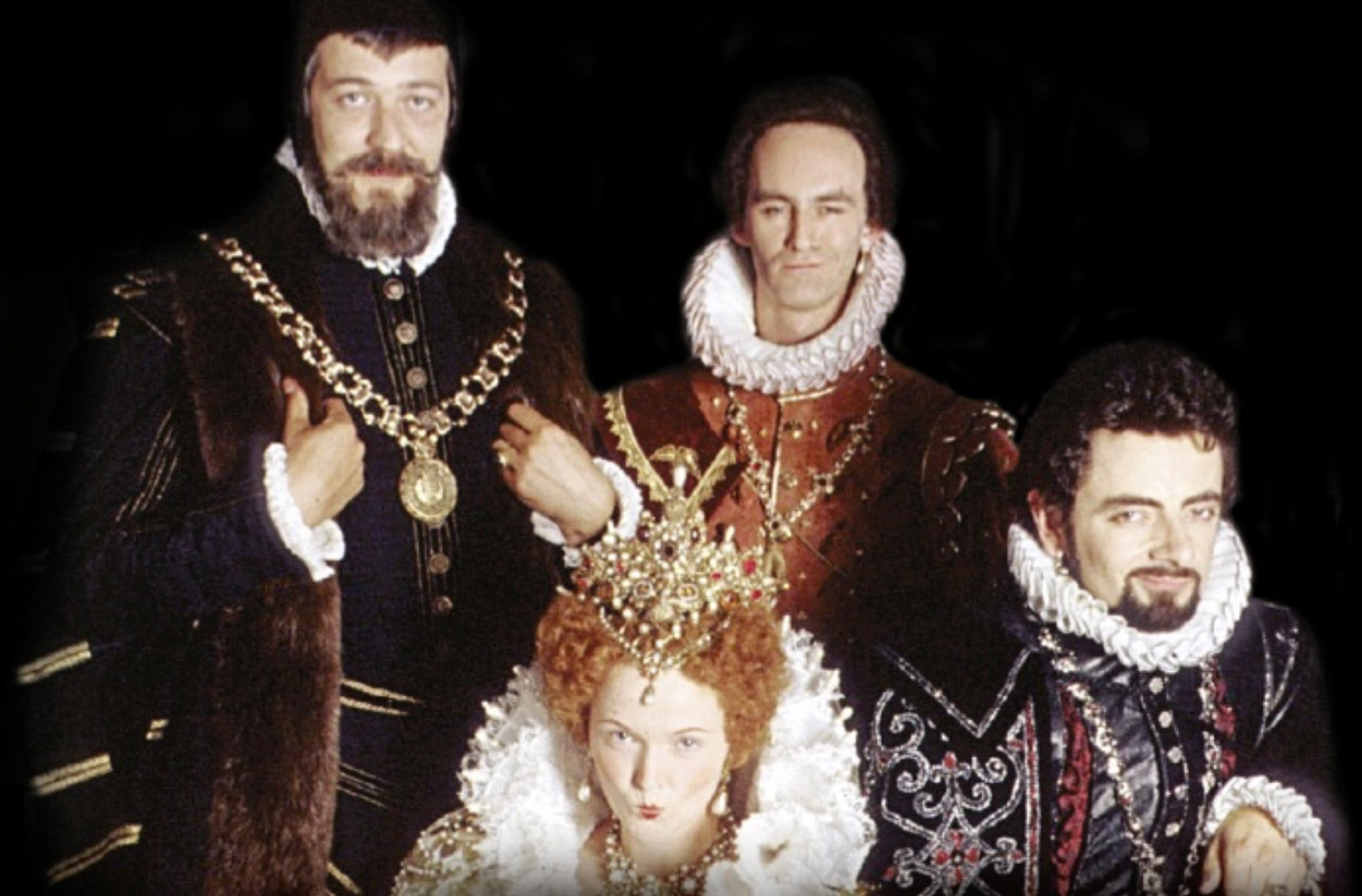
Edmund Blackadder.The Blackadder series of programmes has the lot when it comes to sycophants, shooting the messenger and all sorts of other terrible behaviour. If you want a study in ‘speaking truth to power’ have a look at the Elizabethan episodes where Blackadder is trying to speak the truth to Queen Bess. The impact of a ‘good news only’ culture created by the sycophants like Lord Melchett makes it a struggle.
Salacious B. Crumb. I’m testing your knowledge of Star Wars minor characters here. Salacious B. Crumb is a Monkey Lizard from the planet of Kowakian, who is employed by Jabba the Hut to make him laugh once a day. Failure to do this will end up with Salacious being eaten by Jabba. A peculiar relationship between a subordinate and the boss.
Hercules, Pain and Panic. Hades from Disney’s Hercules has popped up already. Not a pleasant chap. Pain and Panic are Hades’ sidekicks/employees and perform dastardly deeds at his bidding. Bringing bad news to the boss frequently results in things much worse than just ‘shooting the messenger’. This video sums things up nicely, look out for the line from Hades when he is displeased at the news Pain and Panic give him, “Memo to Me. Remember to maim you after my meeting”.
Private Joker, Full Metal Jacket. Private Joker is a US Marine Corps ‘Combat correspondent’ for Stars and Stripes during the Vietnam War, featured in the film Full Metal Jacket. The Peace Button scene where Private Joker tries to explain his philosophical concerns about war and the ‘onion thing’ to a Colonel. It is an interesting example of ‘speaking truth to power’. Private Joker is ‘rewarded’ for his message to the Colonel by being sent into the front line, where he might literally get shot. This clip is well worth watching.
Here are a few additions to the list that have been suggested:
Qu Yuan and Sima Qian. Thanks to Jules Yim for these. Qu Yuan 343 -278 BC was a Chinese Statesman and poet who ended up drowning himself after being exiled by the people in power. Dragon Boat Racing is said to have originated from local people responding to his suicide. Sima Qian (pictured) was a Chinese Historian 145 – 86 BC. His reward for speaking the truth to power was, castration, imprisonment and a life of servitude.
I was going to start this post with a link to the opening scene from the film Gladiator. You know, the bit where Maximus Decimus Meridius (Russell Crowe) is waiting pensively for a messenger to return from telling the German Barbarians to surrender. All around his Roman Legions prepare for battle (very dramatic). The messenger does return (but not in good shape) and Maximus commands, in a slightly Aussie accent, “at my signal, unleash hell”.
It’s all very gruesome, so I thought I’d share a less frightening Dilbert Cartoon, even if it does involve Tar and Feathers. I’m sure you get the point though, shooting the messenger or doing other unpleasant things to people who bring bad news or speak truth to power, is a commonly understood concept. This is something that’s still quite widely practiced, even if its done metaphorically nowadays.
The best project management failure cartoon ever, I had to include this.
The big thing I took from their combined wisdom was, not telling the truth to power contributes to very many project failures.
Paraphrasing some of the discussions, the problem starts with people not being prepared to tell those in power that things aren’t quite going to plan / something isn’t working / it’s all gone horribly wrong!
This ‘over optimistic reporting’ (aka Green Shifting) can have dire consequences. In extreme cases this can be when the person in charge delightedly receives the news that everything is ‘a green light’, and pushes for more progress. The result is driving something that is already a problem over the cliff and into disaster. There are plenty of high-profile examples you can read about on 101 Common Reasons Why Projects Fail, and also learn about interesting terms like ‘Green Shifting’ from a major BBC project failure.
Failure to Speak the Truth to Power. Its been interesting to talk about this phenomenon. Almost everyone recognises it. It’s not just about projects, it happens everywhere (think Mid Staffs Hospital), and it’s not just about large-scale activities.
The Vader Choke…”you failed to allocate me an executive parking space”….
It is tempting at this point to think that this is just a problem with the bosses. You know the type, the Darth Vader wannabe.
The image of the ‘Vader Choke’, being applied to a hapless Death Star Employee after some failure is a Star Wars classic. Most people will have encountered, or heard of, their very own organisational Darth Vader (and it’s not restricted to males).
But it’s not just the fault of the bosses. I’m grateful to Ray MacNeil for pointing out that this is a complex problem that involves more than just the boss. Organisation systems and culture often prevent people speaking truth to power, even if the ultimate boss is willing to listen. This recent example of a whistleblower from the UK Treasury illustrates the point.
Just how long has this been going on? Well, at least 2500 years. Old Tales of New Leadership, Organisational Culture and Ethics, by James O’Toole from the University of Santa Clara is well worth reading. The article starts with description of the 4th century BC Greek play, Antigone. I won’t spoil it (have a read for yourself), but the challenges of speaking truth to power from 2500 years ago seem very fresh and relevant today. Change the names of the actors, and any of the people I spoke to about project management failures last week would recognise the situation.
So what can you do? The honest answer? If its been going on 2500 years, I’m probably not going to give you the solution in this blog…… well not in this post. The article by James O’Toole does contain some very useful material which I will expand on in some future posts. Like: Speaking the Truth to Power Pt2. Messengers; Sycophants, Axe Grinders and The Brave.
In the meantime, if it is any comfort, your project failures that are a result of not speaking the truth to power have a very strong heritage, over 2500 years of it. You are helping to keep ancient traditions alive.
So What’s the PONT?
The failure to speak truth to power, or shooting the messenger, is an age-old problem at least 2500 years old.
The consequences of failing to speak truth to power can be catastrophic.
It’s a complex problem; Leaders, Messengers and the Organisation all contribute, although bosses do have a big part to play in fixing it.
Fried Egg and Chives. Scroll down for more deliciousness
“A picture is worth a thousand words…, “ an idea that is universally recognised, frequently used in business, but not often seen where it might have most impact – Senior Executive/Board meetings.
Descriptive text still dominates most senior level reports, often using ‘corpspeak’; a peculiar form of jargon developed by people like *The Head of Corporate Performance Management Policy Impact Reporting (*I made up the job title, but you know the sort I mean).
If you look at the explanation of, “a picture paints a thousand words”it is difficult to argue against the case for using more pictures. It describes the idea that “a complex idea can be conveyed with just a single still image…..making it possible to absorb large amounts of data quickly….. ” What’s not to like? Imagine a ‘Report to Board’ that contained just pictures of the impact of a decision they had taken. Imagine this happening all the time.
So why the fried egg? You might now be wondering about the fried egg picture? It’s actually a model of a fried egg, right down to the false chopped chives. I took the photograph outside a restaurant in Vancouver where the menu was full scale plastic models of the food they offered. You might have mixed views about the models (and some of the food, scroll down to see the full picture collage), but one thing isn’t in doubt, you know exactly what you are going to get….. fried egg with chives!
High Tech meets Traditional Fish and Chips at BIG SAMS
BIG SAMS, Pontyclun. This kind of clear and precise communication isn’t limited to cool and cosmopolitan Vancouver. In South Wales we have a few fast food outlets that make the most of pictures to show you exactly what you’ll be getting.
I expect you’ve seen picture menus, but what about 36″ colour TV monitors enticing you with what’s available?
Perfect if you are heading home from the Rugby Club, slightly ‘over refreshed’, and struggling to vocalise your urgent need for Chips, Curry Sauce and Cheese (a Welsh version of Poutine for Canadian readers). Just point at the picture on the screen and problem solved.
But it’s not all good news. This week I encountered one of those ‘posh’ restaurant menus that didn’t make a lot of sense. ‘Burger and chips’ was translated into ‘Burger Normandie’, with a very exotic explanation of the meal.
An parody of a menu – but its not that far off the mark. Link below to the source, worth a look!
The consequence was my kids freaking out over what was served,…. I mean who puts Brie on a burger!
I won’t go on about it, the point I’m trying to get to is that a combination of a text only menu, using unusual words caused quite a lot of confusion.
Is this all deliberate? The fast food picture menu experience compared to the ‘high end’ restaurant text only menu does make me wonder. If your objective is to clearly communicate to your customers, leaving them in no doubt about what they are getting for their money, the pictures win every time. If that’s the case, why don’t you get pictures used higher up the food chain in posh restaurants?
I suspect this might ruffle a few feathers but is this a case of, ‘that’s the way we like it’! Vendors use extravagant words as a disguise to make things sound better than they really are. Also, there are no pictures because, ‘that’s what they do in fast food joints’. All a form of ‘food snobbery’, deliberately used to confuse and exclude the masses?
Just a quick observation here, with so many people nowadays photographing their food, and sharing the pictures on social media, are the days of the text only menu numbered anyway? If you think about it, it’s the foodies who do a lot of this….. it must be a nightmare running a posh restaurant with wi-fi.
So what has this got to do with corporate reporting? I think there are some interesting links here with the world of corporate reporting. At the front line it’s a bit like the fast food vendor; keep it simple so that everyone understands. The higher up the organisation, the more ‘refined’ the reporting.
This week I was lucky enough to see some visual management techniques in action at an aircraft engine maintenance company. Pictures of how things work were everywhere. Ones that really impressed me were collections of continuous improvement actions. Basically a single page with a ‘before and after’ picture and a few text bullet points explaining why the action was taken and the benefits.
In my experience, this type of reporting rarely finds it’s way into reports for senior people. You might get a few graphs or tables, but rarely pictures. I do wonder why? It’s not like the technology is any sort of barrier.
Is there something else going on… a bit like posh restaurant food snobbery towards the pictures used by fast food vendors? Do we have the corporate reporting equivalent of picture snobbery? ….. “those pictures are fine for the front line workers to manage their performance, but what we need is carefully crafted text….. prepared by an expert skilled in drafting corpspeak”. Ultimately not something that helps with communication and widespread understanding.
So, what’s the PONT?
Pictures are effective at helping people understand complicated ideas and take in a large amount of information.
With modern technology it is possible to make much wider use of pictures in business reporting.
Before this approach becomes more widespread, we might have to overcome the corporate reporting equivalent of ‘posh restaurant snobbery’ towards the fast food vendor picture menus.
Note 2. I should also point out, in a previous life, I used to prepare Corporate Performance Monitoring Reports for senior management meetings, written in corpepeak …. Yes I am ashamed of myself.
Full size models of the food on offer in a Vancouver restaurant
Deliberately setting out to upset and annoy people isn’t an approach I’d routinely recommend, but please stick with me.
Here are three things to think about, and how they might be combined to help to build better communities that can deliver the services they require:
Doing something wrong, and then putting it right, builds stronger brand loyalty.
Closing the local library/hospital/school/park really gets local people annoyed and quite often results in a strong community response (a protest group).
Every community has assets that can be used to help that community.
1. Putting something right to build brand loyalty. This seems to be a well accepted approach in the world of customer services and retail. The basic idea is that if you do something wrong, and then put it right, your customers will be really pleased with you. So pleased with you that they will become much more loyal customers, or ‘raving fans’ as the marketing types like to say. The people who complain are the passionate ones, the ones that care about your product, and the ones you can work with.
I have heard about this in connection with Dell Computers who apparently resolve 97% of complaints and 40% of those who complained are turned into ‘raving fans’. What sparked my interest in this approach was an anecdote about how British Airways handled customer complaints, unfortunately I cannot find a link to it. If anyone has more detail about it (or it’s just an urban myth rolled out on training courses) I would be very grateful.
Based on what I’ve experienced I don’t think the concept is widely understood or applied in many public services.
2. Closing local public services gets local people annoyed (and upset). I don’t think I need to expand upon this point very much.
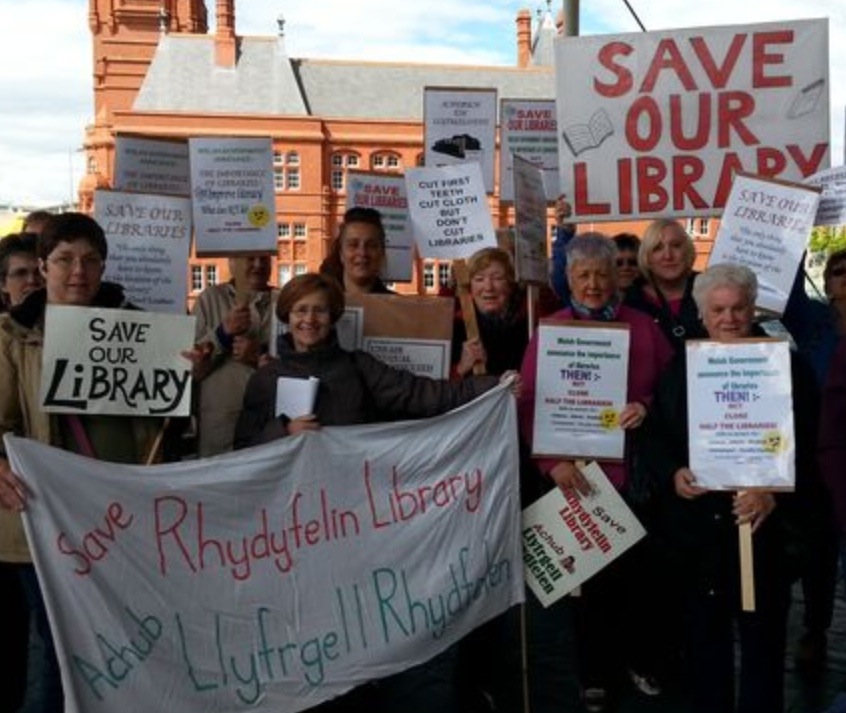
Here is a picture of Margaret Willoughby who chained herself to a bookcase in the protest to save Rhydyfelin Library from closure.
There will be many examples of local groups who have done the similar things to save their, park / hospital / school / day-care centre or any other public service that is facing the axe.
The Rhydyfelin Library Support Group site is with looking at as an example of a highly motivated community getting organised and achieving what it set out to do. Powerful community groups often develop in these situations.
3. Every community has assets. Have a look at this video of Cormac Russell explaining how communities can do incredible things, and why governments need to allow them to do this. Cormac talks about every community having assets and the importance of working with what a community ‘has’ and can contribute, rather than what it doesn’t have or what public services can provide. The is a lot of helpful information about Asset Based Community Development (ABCD) on the Nurture Development site.
How do these things join up? Have I made any sense so far? I did ask for you to please stick with me, here is my logic:
Public services are going to be doing things that will annoy service users over the next few years.
Closing some facilities looks inevitable.
Local people will get very annoyed and upset.
Many will organise themselves to fight against the closure.
These are passionate people, people who care – the ones the customer services experts from retail say that you could turn into ‘raving fans’.
Stick with me here – this is the scary bit.
Work with these people to come up with a better solution, they aren’t the enemy.
Have a look at the video from Cormac Russell for ideas how this might work.
At the end you might have a vibrant, engaged community delivering services for itself.
Obviously, setting out to annoy and upset your service users isn’t what most public services would do deliberately. However, if you are going to do unpopular things, you could use the ‘annoyance’ for a positive purpose. Look out for who gets most annoyed. These might just be the people who could help you make things better and the ones you need to work with the most.
Finally, the community group that forms to protest about a closure could have far greater benefit to the community for years to come. They might not end up as ‘raving fans’ of the council / health board, but they will be doing good for the community.
So, What’s the PONT?
People who complain about products or services are worth listening to, carefully, they care.
The ‘complainers’ may have the answers to the problems, or may even help you solve them.
Think about using potentially difficult decisions to identify the ‘complainers’ so that you can work with them, and help develop something that has a long-term benefit.
One last thing, there is a very relevant quote from Margaret J Wheatley, “All change, even large and very powerful change, begins when a few people start talking with one another about something they care about”. I suspect this might have happened at Rhydyfelin Library.
Links:
http://www.upyourservice.com/learning-library/customer-service-guarantees/when-service-goes-wrong-bounce-back Copyright, Ron Kaufman. Used with permission.Ron Kaufman is the world’s leading educator and motivator for upgrading customer service and uplifting service culture. He is author of the bestselling “UP! Your Service” books and founder of UP! Your Service. To enjoy more customer service training and service culture articles, visit UpYourService.com.
The Party Blower
An effective Jargon Buster
As used by Barod CIC
I go to lots of conferences and seminars. The result of this, (apart from the addiction to buffet food) is that I now speak a different language – ‘Jargy Jargy’ or Jargon, “the specialist language for a specific activity or group of people”(I’ve gone on about this before).
If you stop and think about it for a moment, I’m sure lots of people will recognise the affliction, if you aren’t suffering yourself (you are probably fibbing), you will know someone who is.
My Jargy Jargy affliction has been troubling me a lot lately. I’ve been particularly concerned because I’ve been speaking at co-productuion meetings with Working With Not To (a network of people doing co-production in Wales). Co-production is all about working together, no barriers, everyone included, no speaking down to people. Real people come to these events! How on earth are they going to understand the nonsense I garble at 300 words a minute, let alone the jargon I use?
Well the good news is that I’m working on my fast talking and trying to eliminate the jargon. But the really good news, I’ve experienced the Listening Service from Barod CIC, a community interest company which specialised in clear communication and making services accessible to everyone.
The Barod Listening Service. The easiest way to understand the Listening Service is to read the Barod Blog and look at this video:
The main things you need to know:
What speakers say is translated into clear language as they speak,
You can use headsets to listen to the translation, and
Speakers (some, not all) will change what they say, and how they say it.
What is the impact of the Listening Service? Having been in the room when the Listening Service is being provided I’ve seen interesting things happen. Some speakers have completely changed their presentations. It’s funny how the realisation that you are going to be ‘translated’ helps people do what they should have been doing in the first place. I know it had a big impact on me.
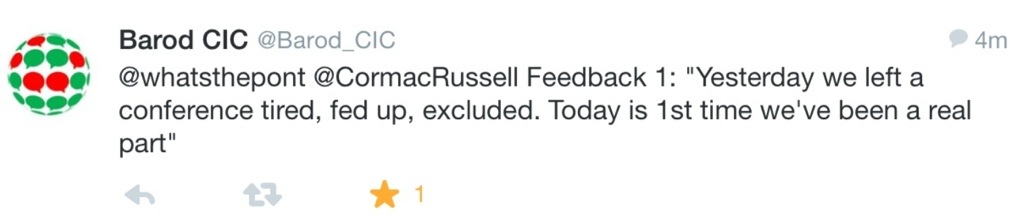
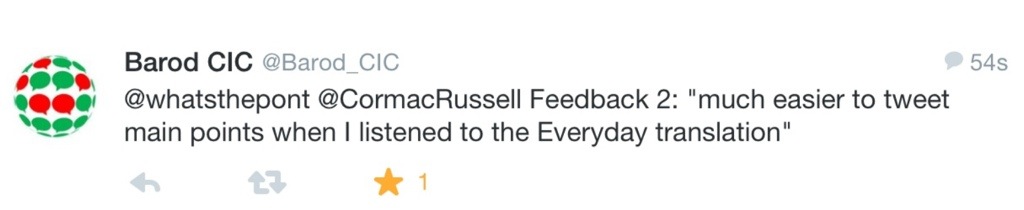
The best way to show some of the impact of the Listening Service are three tweets about the Re-shaping services with the Public event I was at last week (have a look at the summary of the #reshapeservices storify of the tweets here). This was the first time the Listening Service has been used fully, and the feedback is impressive (and interesting).
This pretty much says it all about inclusion and allowing everyone to access what was going on in the event……“today is the 1st time we’ve been a real part”. Imaging if we could reach that level of involvement in all conferences, particularly if they are talking about ‘service user needs’ and co-production.
This is an interesting one I never expected, but now I think about it, it makes perfect sense. Whilst I was sitting there trying to translate what was being said, and share it with the outside world via Twitter, I must admit, I did struggle on times. It would have been far easier to pick out the ‘Tweetable’ gems of information from the Listening Service and share them, rather than try to do two jobs at once.
This is a bit of a sobering thought. I did some of the speaking on the day. Was this my slot where “nothing had really been said”? It might have been, I was mostly doing the housekeeping notices and continuity, so I can cope with that…. but it’s a huge lesson. If the Listening Service is silent whist you are speaking, that’s because you aren’t saying anything very useful…. have a think about that,… the ultimate test of conference presentation usefulness!
One final thing. You might have spotted the party blower picture at the top and were wondering what it is all about? Barod also ran a workshop which involved people blowing the party blowers when they heard jargon in a passage of typical public service communication that was being read out. I was in the room next door, it was a riot of noise.
So, what’s the PONT?
Specialist groups or topics do develop a language of jargon that is often helpful in how they communicate with each other, within the group or about the topic.
People from outside the group can be excluded if they don’t understand the jargon, or it isn’t translated for them.
The Listening Service is a useful way of breaking through jargon (Jargy Jargy) used at conferences and seminars, and also provides other benefits of; including people, providing Tweetable messages, and it is the ultimate test of… how useful is your presentation.
A while ago I was in the kitchen, making tea for my late Father In-Law, and I was having a good old moan about some local politicians. You know the sort of thing…. “I cannot believe that Councillor X has failed to do Y…..”, spoken with passion and righteous indignation.
My Father in-Law, who had an uncanny habit of teaching me huge lessons when I was least expecting, quietly commented…. “yes, we get the politicians we deserve”. I didn’t actually drop the tea-pot, but it did stop me in my tracks. He was absolutely right.
We get the politicians we deserve. Those words from my Father In-Law were very logical and completely correct. I live in a democracy, every 4 years I have the chance to put myself forward to stand for local political office. If I don’t like what the current politicians are doing (or think I can do a better job), all I have to do is get elected and prove it, or help someone else who I think will to a better job. It’s as straightforward as that.
By not being prepared to stand myself, not voting in the election or not expressing a view and taking an interest; I really do get what I deserve. The democratic process, no matter how imperfect, does give you the opportunity to get better politicians, the ones you truly deserve. That moment of enlightenment sticks with me, my Father In-Law very politely telling me to, “put up or shut up”; thank you Tony.
An experiment in industrial democracy
Do we get the organisations we deserve? If all organisations and companies were run along democratic lines I would be tempted to say yes.
Most aren’t, but here is an interesting example, The John Lewis Partnership. In the words of its founder John Spedan Lewis, an ‘experiment in industrial democracy’.
It is worth looking at the John Lewis Partnership constitution and the various democratic bodies they’ve created to ensure that an individual partner (staff) can feed their opinions back into the main decision making bodies. Every employee is a partner and, ‘the happiness of its members’ is the ultimate purpose of the Partnership. Imagine that in your place of work………… while you are doing that, here are a few questions to ponder:
By most measures John Lewis is a very successful example of an industrial democracy. The way it operates allows its staff to create exactly the organisation they want and deserve.
No such thing as a dysfunctional organisation
It will never happen here. Thats enough fantasy for one day, let’s get back to the real world.
Recently I heard a clever Professor at a conference using the phrase “you get the organisation you deserve”. I must admit I was quite excited, could this be an example of industrial democracy and employee voice having a positive impact?
Unfortunately not, I’d mis-heard what was being said. What he was going on about was a quote from a book, ‘The Practice of Adaptive Leadership’ by Heifetz, Grashow and Linksy. “There is a myth that drives many change initiatives into the ground: that the organization needs to change because it is broken. The reality is that any social system (including an organization or a country or a family) is the way it is because the people in that system (at least those individuals and factions with the most leverage) want it that way…As our colleague Jeff Lawrence poignantly says, There is no such thing as a dysfunctional organisation, because every organisation is perfectly aligned to achieve the results it gets.”
Pause and have a think about this for a moment, there is no such thing as a dysfunctional organisation, because every organisation is perfectly aligned to achieve the results it gets. Quite sobering isn’t it.
What do you do if you find yourself in a dysfunctional organisation? I suppose this boils down to a few choices:
If you are an individual or part of a group with most leverage in your organisation you could change things …. if you really want to.
You could ‘put up’, make a stand and try to change the organisation. This is a very laudable thing to do, but is likely to come with consequences. Standing up for the right thing is tough in a democracy, but within a ‘closed’ organisation, it could be errr … ‘career limiting’.
No easy answers here I’m afraid. Ultimately I suppose we do get the politicians and organisations we deserve. If the political is bad or the organisation dysfunctional, we have all had our part in making it happen.
So, whats the PONT?
In the democratic process it is relatively straightforward to see the link between your own involvement and getting the politicians you deserve. In organisations things are less clear.
‘Put up or Shut up’ is sound advice, if you aren’t prepared to take action, stop complaining.
If your organisation is dysfunctional, what part did you play in making it that way?
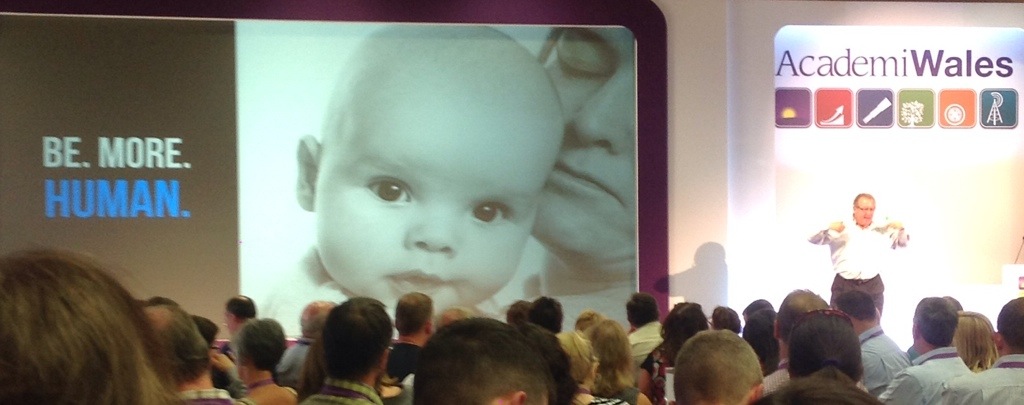
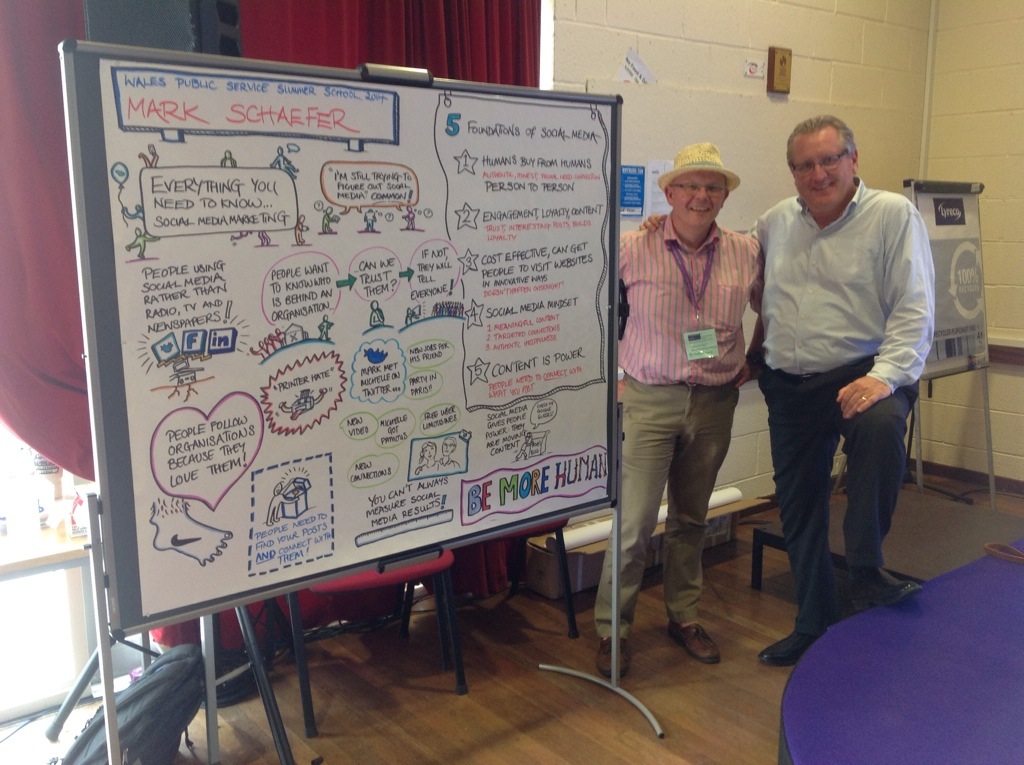
Mark Schaefer being completely Human at Academi Wales Summer School
Huge thanks to Mark Schaefer for the midweek boost at Academi Wales Summer School. It was a fantastic gallop through ‘everything you need to know about social media marketing’, there’s a great graphic of the presentation at the end of the post. Its the third time I’ve seen Mark speak and as previously; he was very entertaining, highly thought provoking and completely human; which was his key takeaway: in the digital world, Be. More. Human, the Killer App.
You can read more of what Mark has to say about Be More Human on his blog. This all made perfect sense to me, and I ended up in a (late night) conversation proposing that organisations should be more human.
It went along the lines of …..If people are encouraged to be a bit more human, the organisation will be more human, and this will lead to good things like more trust and greater compassion. It was late at night, and I have been thinking about ‘can you teach compassion and kindness’ quite a lot recently.
It seemed to me that by embracing social media, there was opportunity for Be More Human, which has so many benefits. Just to confirm the thinking is right, this morning I read, ‘how leaders can get more from social media’ where Helen Reynolds encourages CEOs to embrace social media and become more human.
So, diving headfirst into social media is the right thing to do….. or is it?
Designing out the Idiot. Many years ago I was involved in a project where one of the key success criteria was, ‘design out the idiot’. Our thinking had gone along the lines of; this process needs to work perfectly, the way people behave is the biggest problem we face, lets design it so that they cannot get it wrong.
Nothing much wrong with that logic, other than:
we ended up thinking of everyone as idiots,
the process was designed to meet the lowest common denominator,
it was highly controlled, prescriptive and complicated,
nobody liked it, and
in the end most people ignored the process and found a better way to do the job.
It was a massive failure. There is an interesting link here to how lots of organisations have behaved in relation to social media. When I think about a number of ‘design out the idiot’ social media policies I’ve seen over the years (and other HR policies for that matter), there is still a long distance to travel.
Being Human is really messy. Back to the point I’m trying make, to Be More Human, you need to accept that people are really messy. As well as the desk covered in papers and clothes all over the floor type of of messy this also means:
Lack of Uniformity – no two people are alike, what is acceptable and reasonable for one person, may outrage the next person.
Unpredictability – different groups of people respond differently to the same situation, and the same group may respond differently on different days, you just cannot accurately predict.
Failure – people get things wrong, lots of the time. This can vary from completely accidental mistakes through to deliberate acts of sabotage and malicious compliance.
So what can you do? If we want to Be More Human, we need to accept the human messiness that comes along with it; lack of uniformity, unpredictability and a fair bit of failure.
This means a move away from the ‘design out the idiot’ approach and look for opportunities in what is going to happen anyway. Work with the grain of what is happening rather than try to constrain and prohibit.
From my own experiences I think that it is price worth paying for the benefits you get. Let people have a go, let them fail, let them Be More Human.
Perhaps social media is the best testing ground for people and organisations to try out if they are capable of becoming more human?
If as public services we are mostly in the ‘people business’, maybe this should the the territory where we test ourselves – starting with the HR Professionals (well, they do write most of the policies).
Thanks to Mark for being human and giving us the opportunity to think about how we Be. More. Human.
So, What’s the PONT?
Anything involving people is a messy old business.
Trying to dehumanise processes and policies (design out the idiot) is pointless – we always find a way around.
Social media might just offer the opportunity to test ourselves and ‘Be More Human’ – then apply that learning to everything else.
Finally, remember; Be. More. Human. isn’t just for social media…. its for life.
Everything you need to know about social media marketing, graphic of Mark’s talk by Rachel Walsh, who works with Fran O’Hara, they did all of the graphic notes during the whole week of Summer School. https://twitter.com/RachelWalsh/status/481872544887484416/photo/1
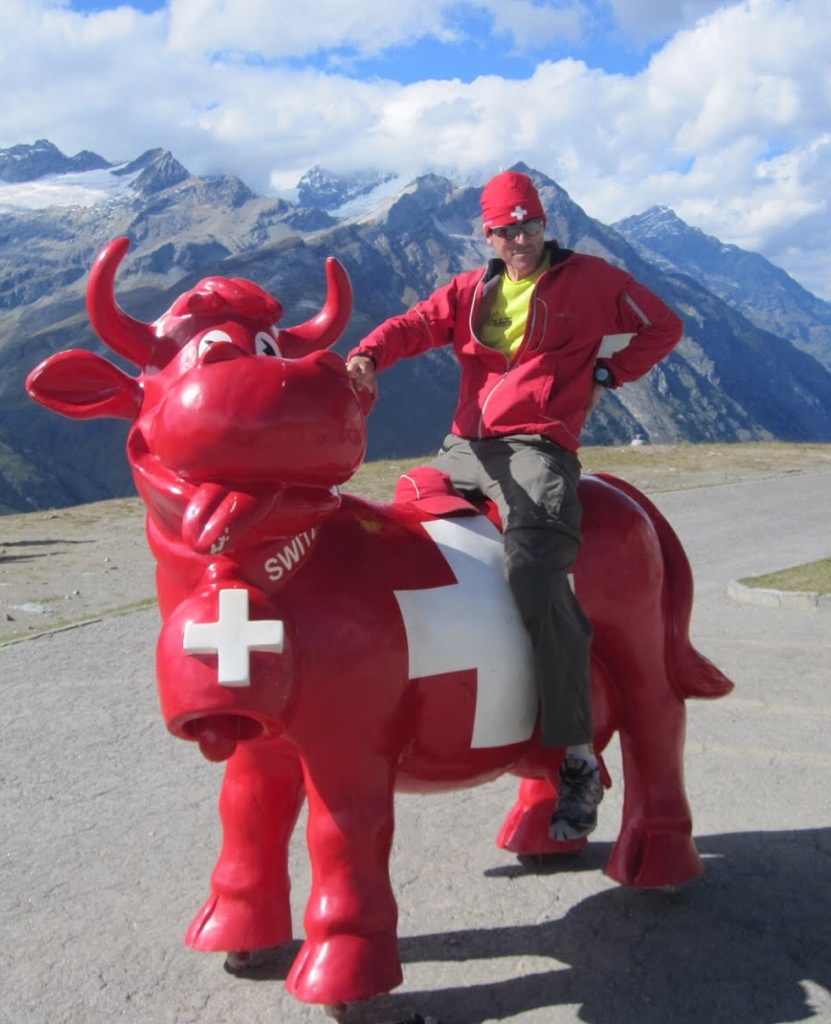
A mounted voter astride a red plastic cow, on wheels. Oh to be Swiss…..
Don’t Panic. I haven’t gone all happy clappy.
This is a relatively sensible explanation of why I’m suddenly enthusiastic about voting. And anything with a mention of Switzerland has to be earnest and sensible, despite the picture.
Why the early lack of enthusiasm? This all stems from my recent trip to the Prospect Union conference in Glasgow. One thing we did a lot was vote.
Based upon my previous voting experiences I wasn’t expecting much. It’s fine for elections etc, but for committee meeting and everything else, well, voting always seemed to be the ‘kiss of death’. The situation where everyone was so deeply entrenched that the last resort was to ‘put it to the vote’. Basically, everything else had failed
Well things were different at Conference. This was voting being conducted in a way I’d never experienced. It was an essential part of how the conference was organised. A motion is proposed, people publicly debate it, speaking for or against it, and then it’s put to the vote. You have 3 very clear choices; vote for, vote against or abstain.
All straightforward stuff which pleased me enormously and got me writing things down about how useful I thought it was. Do check with anyone who’s been unfortunate to ask me how my trip to Conference went and they’ll testify to my newly found voting enthusiasm.
So why is voting so good? Given that there were over 500 delegates in the room, I think a formal voting process is probably the most efficient and effective way of carrying out the business of setting priorities, making policy and holding to account.
Straightforward. Raise your hand for yes or no.
From the perspective of the people in the room I also think there are significant benefits:
Everyone is involved. The act of raising a hand, or placing a voting card in a box is pretty inclusive. No need to worry about the loud mouths, seniority or the Alpha Males/Females dominating a focus group or round table discussion. Everyone has an opportunity to express their view in a simple way; raise your hand.
Its Clear and Decisive. There is none of the ambiguity you get with round table ‘let’s reach a consensus’ discussions. The debate has happened, this is what the majority has voted for and this is what we are going to do. If you don’t like it, hard luck, that’s democracy (which is why I tell my kids they need get involved).
To save you the trouble…. the key point is that when we vote, our sense of wellbeing will increase when we see that other people share our personal opinions. I knew something had to be happening to me at conference. That sense of happiness I got when I raised my arm and could instantly see that 100’s of other marvellous people in the room shared the same opinion as me. Great whilst you have lots of people to agree with, but what happens if you are constantly in the minority?…… moving on swiftly……
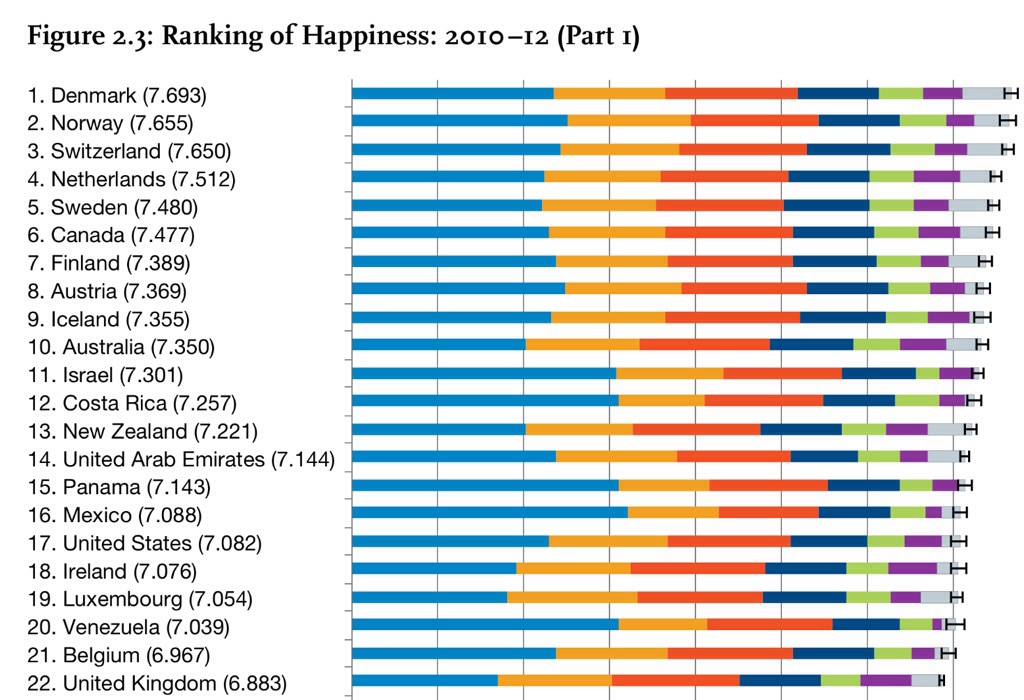
The Swiss are really happy, and they vote a lot. Thanks to Mark Hodder for pointing this out. I’ve now spent more time than I ever imagined reading about the voting habits of the Swiss. It might not be a coincidence, but the Swiss come very high up on the global rankings for happiness, and they also vote a lot.
They have a system of Direct Democracy where any citizen can challenge any law approved by Parliament or propose an amendment to the Federal Constitution. Imagine that here….
They vote on average 4 times a year. Between 1995 and 2005 they voted 31 times on a 103 questions. By comparison France voted 3 times during that period. I’ll leave it up to you to draw your own conclusions about the relative happiness of the Swiss and French.
UN Happiness Report 2013 The Swiss in at number 3 (UK number 22)
Maybe there is something going on here we could bring to the workplace? At a basic level a bit more voting might make us happier (like the Swiss), and on top of this we could get quicker, more decisive decision making that involves everyone?
So, What’s the PONT?
Voting isn’t the option of last resort I used to believe.
It is quick, decisive and involves everyone on an equal footing.
It makes you happy… ask the Swiss….. What’s not to like?
Picture Sources: The Swiss Red Cow – brilliant, and big tourist attraction. http://ciaobambino.com/finding-switzerland-tourist-attractions/
Democracy on a huge scale. I was in Row F, Seat 54
I’m freshly back from my first ever Trade Union conference.
It was the Prospect Union conference to be precise, Voices Shaping Change, which involved over 500 people spending two and half days in Glasgow.
I wasn’t quite sure what to expect, but its safe to say that I’ve walked away better informed, very impressed and quite a bit inspired.
Here are some observations on three key learning points I took away from Glasgow: Encouragement, Openness and Professionalism.
Encouragement…. “this is my first time at Conference”. One thing that struck me during the conference was the amount of clapping you do. Every speaker gets a round of applause, an acknowledgement to say thank you for their contribution. Standing up to speak from a stage in front of 500+ people is a daunting task, and should to be recognised.
I’ve been to a few other events recently where the speakers have hardly been acknowledged. Regardless of whether you agree or not, it is good manners to recognise the effort people have put in to share something with you.
Where the Prospect conference really impressed me was how some speakers got a round of applause BEFORE they had spoken. This is not as strange as it seems. A number of people stepped up to the podium and said, “this is my first time to speak at conference”.
This triggered an instant round of applause. Recognition from the audience that the speaker was taking a big step into the unknown and offering them encouragement, willing them to do well. You could see the impact, smiles and people swelling with confidence.
What a brilliant thoughtful thing to do. If I had to pick one thing that summarised the general tone of the conference, it would be that; respectful encouragement.
A lively debate on the Scottish referendum
Openness. The most democratic thing I’ve experienced. I knew I was going to experience live ‘democracy’, but I wasn’t prepared for it to be so open and transparent. Debate was carried out respectfully, with lots of evidence and well reasoned argument.
It was the degree to which the Executive and Officers were happy to be questioned in public debate that surprised me. A number of the motions proposed raised questions about performance. They were all debated without people turing to denial, defensiveness or blaming others.
There are many other organisations that might benefit from adopting this model of allowing the service users to publicly question and discuss the performance of the organisation. I wonder if we would have had a Mid Staffs Hospital scandal if there had been this kind of public scrutiny and debate available to the hospital service users?
I don’t know if this is how all union conferences work, but I think there is a lot that can be learnt by anyone interested in engaging with citizens, patients, the public and service users (or whatever you choose to call people) in an open and transparent manner.
Professionalism, this should have been no surprise….. Prospect do badge themselves as “the trade union for professionals”. I’m sure there was plenty of frantic activity happening in the background, but for a newbie like me everything ran like clockwork. When you think about the scale of things this is astonshing:
500+ people from a hugely diverse range of professions (from archeologists to nuclear scientists),
100 motions to be debated,
A panel session on a hugely contentious issue,
Breakout sessions (with feedback),
Voting on motions (included card votes and tellers) and
A Gala Dinner (plus disco).
For students of complex adaptive systems this had it all going on. The process of debating motions and voting on them is a great example of a complexity. There is little certainty about what the result will be, and a good speaker can do a lot to influence the voting; so many variables that cannot be controlled. I learnt a lot about the difference between winning or loosing a motion or even having it remitted. The Standing Orders Committee have a very important role in the process of navigating a way through the complex issues (more on that in a future post).
When in Glasgow – Irn Bru the morning after the Gala Dinner
What did I walk away with? Overall my two and a half days at the Prospect Conference in Glasgow were brilliant, thank you.
I’m walking away far more knowledgeable and informed about a range of things.
I’m hugely impressed by lots of the people I met and the way it was organised.
Finally I’m inspired. Inspired to tell people about how good my experience of democracy was, and why they should get involved.
So, what’s the PONT?
Encouraging fellow speakers at conferences is more than just being polite. It makes a huge difference. Should we be clapping everyone BEFORE they speak?
Democracy is a complex and unpredictable sport. Done on a large scale it is fascinating being part of it.
There is a lot to be learnt from unions who have been practicing this sort of democracy for many years. Any organisation that wants to properly engage and listen to service users or citizens should take a look.
This is my favourite image of Clydeport, Glasgow. A painting of the Dockside Crane outside my hotel window, doing what it was built to do.
You’ve probably heard of Maslow’s hierarchy of needs, and seen the pyramid representing the five levels of human needs?
You may also have seen the version for the internet generation? The one with WiFi scrawled at the bottom, as the most basic of human needs?
You might even have re-tweeted the image (don’t worry, everyone was at it). Sometimes theories and models get shared without much thought about, “what does this actually mean?”
What is Maslow’s Hierarchy? Basically, it’s a theory about human motivation that psychologist Abraham Maslow published in 1943. The idea is that humans have 5 sets of needs that come in a particular order. This is often represented as a triangle to illustrate that needs lower down the triangle have to be satisfied before you move upwards. The theory is frequently used in business as a way of understanding staff motivation. So much so that this BBC article says, “On management training courses it’s as inevitable as biscuits and role-playing”,so it is worth paying attention.
But that’s not why I’m here….. what I want is some experimentation!
An Experiment….. do try this at home! Actually the garden is the best place. What you will need is some really foul weather, pouring rain and lashing winds (50mph gusts are good). Wear a reasonable quality waterproof jacket and a pair of wellington boots. The wellingtons are important because you need to pour a half pint of water into each boot for the experiment to work. A flight of steps in the garden is desireable, but if unavailable you can use an old beer crate.
The experiment runs for 25 minutes. Basically you just keep walking up the steps or off and on the beer crate in the pouring rain and wind. At 5 minute intervals you need to lower the hood of your coat to allow rainwater to leak around your neck and dampen the clothes underneath. As an experimental variable, family and friends can throw an unannounced bucket of water at you at any time. Sounds like fun?
Collect Experimental Data. During the experiment, at 5 minute intervals, you need to keep a careful note of what you are experiencing and how you are feeling. Research so far has recorded the following; miserable, wet, cold, damp, thoroughly dispirited, many swear words, I’ve got Trench Foot and I’ve never been happier (that was an outlier).
Post Experiment Observation. Now end the experiment. Stop walking and get away from the rain and wind. You can move to shelter here, a gazebo or shed perhaps? Observe what happens next.
What do people do next? If the updated Maslow’s hierarchy diagram is to be believed, people will search for WiFi; before dry clothes, warmth or food. That sounds a bit unlikely don’t you think?
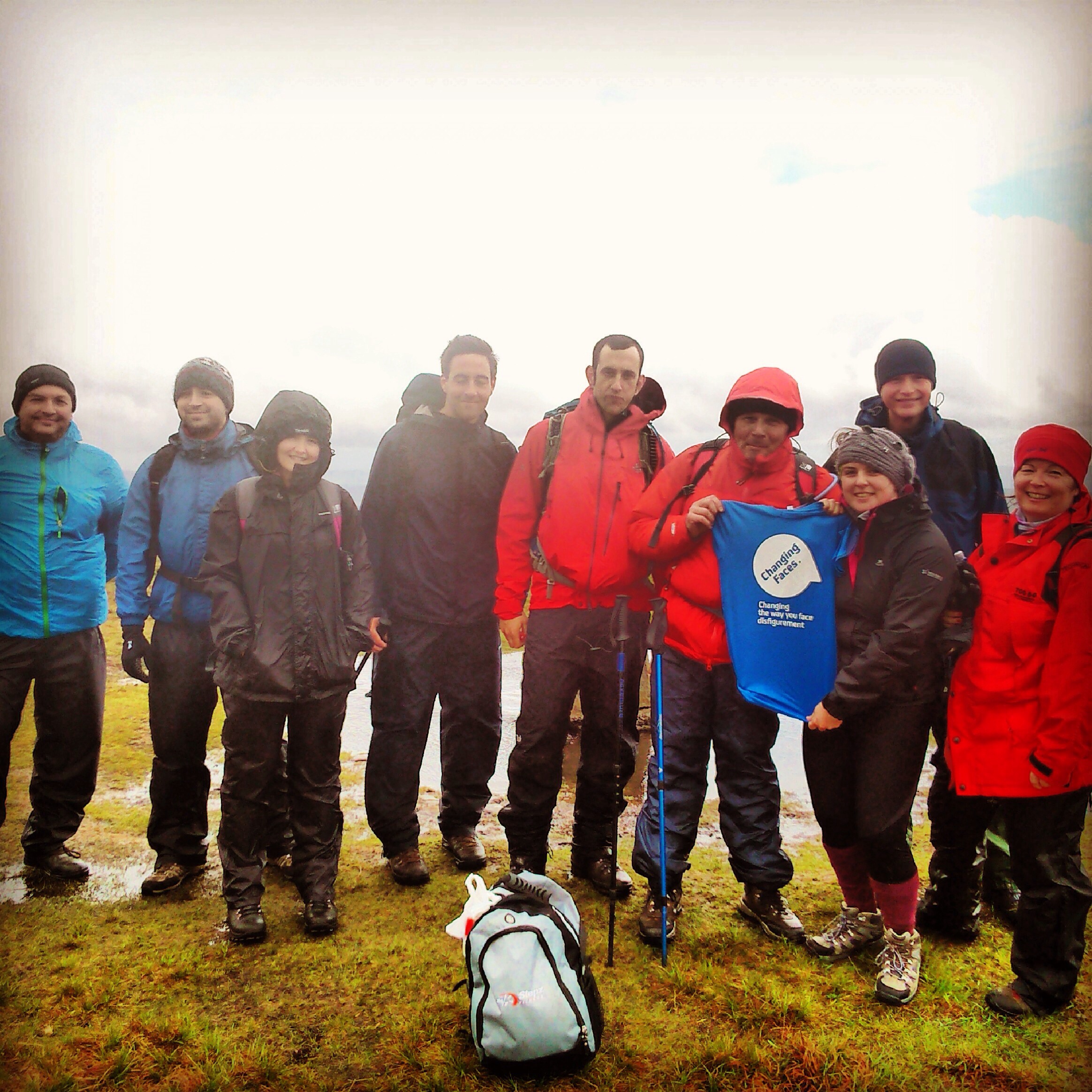
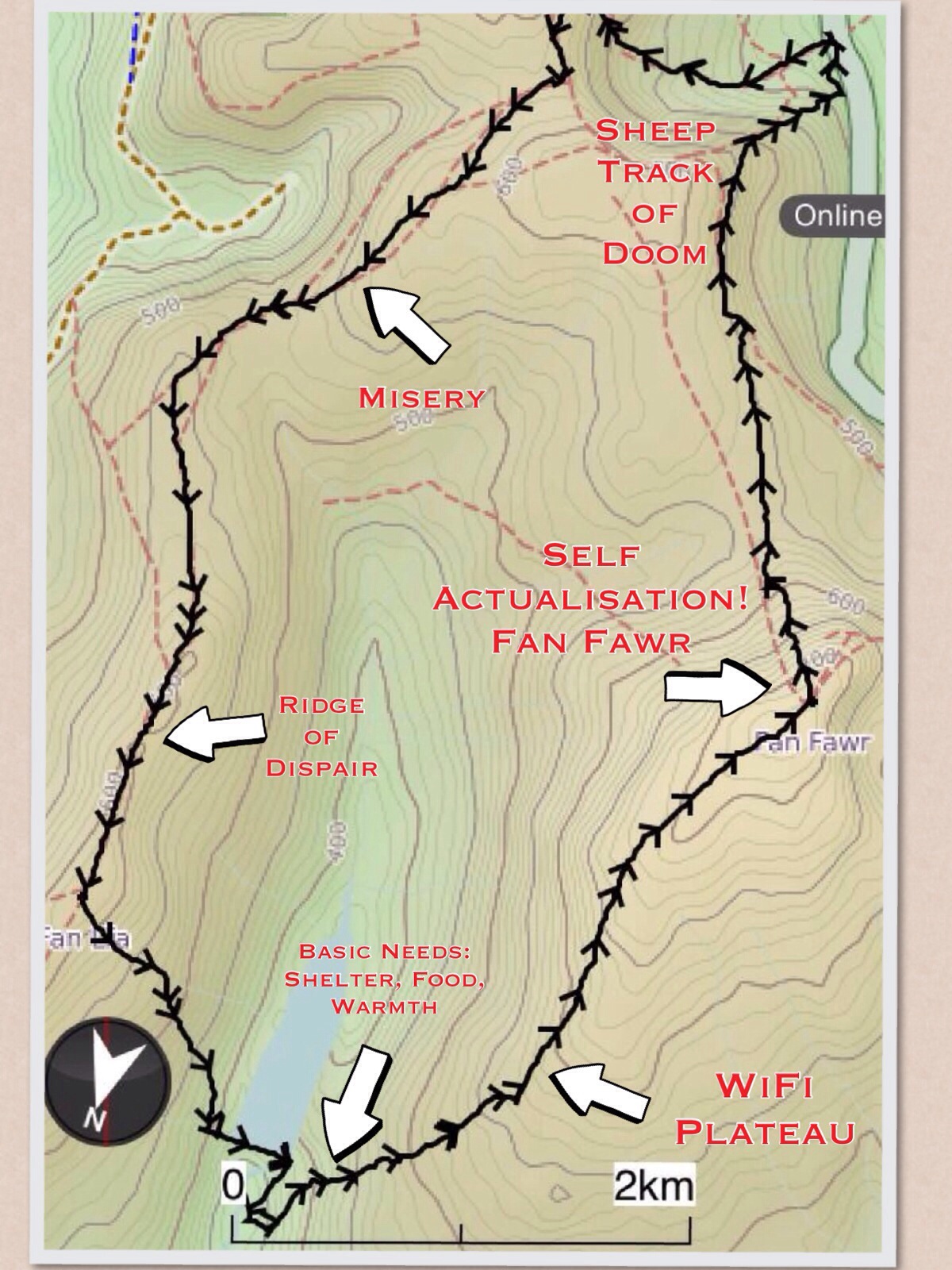
Maybe not….. Let me share what happened while I was out hill walking in the Brecon Beacons with some colleagues last weekend.
On top of Fan Fawr
Ystradfellte Reservior to Fan Fawr. The 3 hours up to this point had been pretty much like the experiment I’ve just described.
Luncheon was taken at Ystradfellte Reservior, huddled under a sheet of plastic builders tarpaulin we found next to some big water pipes. Then we struck out on the homeward leg, which involved climbing 400m (1312ft) up to the peak of Fan Fawr. This was just like the morning until something amazing happened, it stopped raining and the sun came out, briefly.
The WiFi Plateau. At this point I was just behind the first half of the group approaching a plateau area. As I arrived the first thing I saw was the 4 of them, all with phones out looking at the screens and pressing things. I also heard my phone ‘ping’ as it picked up a signal again after being down in the valley. I wish I had used my phone to take a picture of them on their phones, but to be honest, I was too exhausted.
So, does this prove the updated internet version of Maslow’s Hierarchy is correct? Will a group of cold, wet and exhausted people seek out the WiFi, 3G Phone Signals and the Internet before they think about any other basic human need like food and shelter? I’m not sure my observations prove anything, but it was a sight to make you think.
Have a look at the BBC article about Maslow which mentions some of the criticisms of the theory. One of them questions why people do the ‘higher’ things whilst ignoring more basic human needs. Situations like the ‘starving poet’ seeking ‘self actualisation’ are mentioned or mountain climbers who ignore dangers and depravation reaching the top. Maybe my companions were examples of that, ignoring their own discomfort for a greater purpose? (see below *)
So, what’s the PONT?
Maslow’s Hierarchy is commonly used in business to help understand the complicated subject of human motivation.
It’s always worth looking into theories and models to get an understanding of what is behind them.
Nothing stays the same. It’s probably worth looking at modern updates for lots of theories to see how they fit with the internet age.
*Why we were hill walking in the Brecon Beacons on very wet and windy day. It was all part of the training we are doing to climb the Welsh 3 Peaks in 24 hours on June 21st (Snowdon, Cadair Idris and Pen y Fan).
We are doing it to raise funds for the Wales Audit Office Staff Charity, Changing Faces which supports and represents people who have conditions or injuries which affect their appearance.
It always pleases my wife when I quote Elvis, so here goes….. “A little less conversation, a little more action please”. No hidden meaning there, so lets move on, swiftly.
This comes as a huge relief, as I seem to spend most of my time having conversations. Justifying that I am actually achieving something in these conversations has been nagging away at me for ages.
Here are two things that help me keep on track, and remember that I am doing something useful; ‘We learn when we talk’ and Nemawashi. So, who fancies some Japanese?
Nemawashi – ‘digging around the roots’. Thanks to Stewart Greenwell for sharing this. Nemawashi, is a Japanese word that means ‘an informal process of quietly laying the foundations for change or new project. It involves talking to the people concerned, listening and gathering feedback’. In other words, a lot of conversations.
Nemawashi – digging around the roots ready for transplanting
The origin of Nemawashi comes from the activity of digging around a tree roots to prepare it for replanting elsewhere. I’ve transplanted many trees over the years, and the importance of ‘nemawashi’, and really digging around the roots to make the job easier (for me) and successful (for the tree to survive) is very relevant.
By contrast, I’ve also done some ‘grubbing’, digging out tree stumps. This can be a brutal process with broken roots and no prospect of the tree ever surviving. As a metaphor for some imposed changes I’ve seen over the years, that fits quite well.
I very much like the idea of conversations being the process of Nemawashi in an organisational change or the delivery of a project. Building the foundations, laying the groundwork or ‘digging around the roots’ is definitely action in my books.
The post talks about the idea that, by describing something to another person, your own understanding of the subject is improved. Research at the University of Michigan looked at conversations between people and concluded that although the receiver of information received benefits, there was evidence that the speaker of the information made the greatest cognitive gain. The idea that you learn from speaking is linked to how we store information. If it is for our own use (thinking about it), it is arranged differently to how we would speak it. The change in how we organise the information for presentation, leads to us considering it in different ways, and we end up learning more about it.
Dr Dixon writes, “If I read a great article I will incorporate the ideas more fully into my own cognitive map if I tell a colleague what I have just read (or write a blog about it)”.
The idea that through speaking, I better understanding what I already know, and learn more, is another positive reason for having conversations.
Not all conversations are good or useful. I had to mention this, sorry. In this post about Knowledge Management and Real Conversations David Gurteen talks about the need to have effective conversations. David makes the point that generally we are not good at conversations and we need to learn how to have effective conversations, as a skill, practice it and encourage it. More on this in a future post.
It is well worth reading David’s post and reflecting on some of the questions he asks about, ‘are you listening’ in conversations and ‘are you speaking/telling the truth?’.
The implications for social media. Unfortunately I missed the #socialconvo with Shirley Ayres, Paul Taylor and Mark Brown this week, I did however catch up via the Storify summary from Mike Clark.
What struck me from that conversation, was the idea that if you apply the principles I’ve just mentioned to social media conversations, it extends them hugely. The ability to do some Nemawashi with dozens more people now exists. You can still ‘quietly lay the foundations’, but it can be done on a much larger scale.
Likewise, the opportunities to ‘learn through talking’ (conversations) are amplified hugely. I know from my own experience that reading a post, commenting on it,sharing it through social media and talking with people about it helps me to learn, ‘an addition to my cognitive map’, in the words of Dr Dixon.
Paul Taylor quoting Shirley Ayres at #socialconvo
As an example from #socialconvo have a look at the Tweet from Paul Taylor. The cognitive effort to distil a complicated idea down into 140 characters, that can be shared, must have helped Paul better understand what he was saying (writing).
Finally, a chance to re-write some Elvis lyrics: “a little more conversation, it’s the action that we need”……That feels better!
So, what’s the PONT?
Conversations are action. Think Nemawashi, what is more positive, digging around the roots or grubbing up dead tree stumps?
Conversations provide the opportunity to better understand what you know by ‘learning as you talk’.
Listening in a conversation is just as important as speaking.
Can you teach Compassion? I’ve seen a lot of dicussion about the idea of ‘teaching compassion’ recently. Lots of it is linked to improving standards in health and social care.
It’s left me wondering, does the need to teach compassion and kindness extend beyond the workplace? Is it something that starts in, and is best suited to home? If you have to ‘teach compassion’ when people turn up for work, it is too late?
I’m not about to offer any solutions here, just share my own experience of what happened with one of my teenage sons. I wrote a post about it ages ago, hardly anybody read it back then so I thought it would be ok to recycle the original.
The quandary I faced over two and half years ago remains the same as it does now. Does having a generous and accepting nature make you naive and more vulnerable to people wanting to exploit you? Is it the right thing to do to teach children to be ‘tougher’, less trusting and more sceptical of people to avoid being exploited? Ultimately do we all need to learn by making our own mistakes, and then decide?
Blimey, that was all a bit ‘Dali Lama’. Here’s the post I originally wrote in September 2011. It followed a trip to a University open day and an incident at Cardiff Railway Station. You can make your own mind up if I did the right thing.
The best £1.47 you’ll ever spend Son.
This week I was sat in a busy railway station with my 17-year-old son. While I was daydreaming he was approached by a stranger who engaged him in conversation.
Almost immediately my son had taken out his wallet and had handed over a pound coin. The stranger continued talking and my son then handed over the rest of the change in his pockets, all 47p of it. At this point I intervened and the stranger quickly left, counting the money.
There was nothing particularly threatening about the stranger, he was reasonably well dressed and spoke in a calm albeit slightly urgent tone. The exchange happened very quickly, probably less than a minute. However it seemed like slow motion as I tried to make sense of what was happening and work out how I was going to intervene without it looking mean and heavy handed.
My son and I sat down and pieced things together. We established that the stranger had said he needed money to catch a train home as he was about £2 short of the fare. There was a fairly embarrassed silence between us for a moment whilst we both though about what had happened.
For me there was a deep sense of worry about vulnerability. Had my son been the victim of a rip off merchant? Had the stranger exploited a vulnerable individual with a well rehearsed script “I need £2 for the train home”. A scam that worked on dozens of people every day?
If it was this easy, how was my son going to cope with situations like this throughout the rest of life? On the other hand, was he doing the right thing, being the Good Samaritan, helping a fellow traveller in distress?
I’ve mentioned this incident to a few friends with teenage children and we end up pondering the same questions? How do kids learn to deal with these sorts of challenges? How do they strike the right balance between compassion and indifference? Is the best way to learn from your own experiences and failures? Can we actually teach them anything or do they need to work it out for themselves?
My sense of anxiety around this was been heightened by my wife’s response, “oh my god, he could be in university halls this time next year, what will happen to him……..?” Calm down, he’ll work it out has been my response, he has to…that’s life (by the way, I never actually tell my wife to “calm down”, it’s just not worth it).
As it turned out my son and I had a very sensible and measured conversation about the incident later on. Drawing on experiences of my own, and the experience of others, we started to piece together an approach / strategy /coping mechanism (call it what you like), for how he might deal with people trying to take advantage of him (in whatever circumstances).
Hopefully this gives him some protection and doesn’t smother the generous and giving side of his nature, which some might think is a bit naive, but I think is one of his more endearing features (by the way he’s 6 foot 3 and built like a Grizzly Bear).
So what’s the PONT?
That could be the best £1.47 you’ll ever spend Son. A huge piece of learning.
If people ask for money, think about offering practical help (food or buy the ticket) rather than handing over cash.
Don’t ever become cynical and indifferent towards people who you could help.
If you are wondering about the Roger Mellie picture, well, he’s the fictitious editor of ‘Rogers Profanisaurus’. To quote the fly sheet, “the definitive reference volume of English obscenities”. Not something you should be reading at work, so don’t open the link!
The point is that Roger’s Profanisaurus is a compendium of really bad words and phrases. Rude and offensive stuff that shouldn’t be used in the workplace (I hope you agree – I know you’ve had a quick look). The principle of Roger’s Profanisaurus, a collection of ‘words not suitable for work’, is the same as the Geriatrics Profanisaurus, but the content is rather different, which I will explain later (I told you not to look at Roger’s).
What has a Thesaurus/Profanisaurus got to do with Jargon? The purpose of a Thesaurus is to find the words which best allow you to describe a situation or idea. A typical Thesaurus will have words with similar meanings grouped together so that you can identify something that helps people understand more easily or has greater impact.
My School Thesaurus No connection with Roger’s Profanisaurus
The most well known of the thesauri, is Roget’s Thesaurus, published by Dr Peter Mark Roget in 1852. Interestingly Roger’s Profanisaurus does not appear on the list of thesauri referenced in the wikipedia article, funny that.
The idea of being able to use words that have a different meaning did get me thinking about Jargon again.
A while back I wrote a number of posts about Jargon. The roots of the word come from the Old French ‘gargun’ to describe ‘the cheeping of birds’ and ‘confused and unintelligible speech’ in 14th Century English. The modern day definition of Jargon talks about ‘special words or expressions used by a profession or group that are difficult for others to understand’.
There are some very positive reasons for using jargon. Within a specific technical community it can help to communicate more clearly, efficiently and effectively. It can even help to build relationships within that community by creating a sense of being exclusive through having your own special language.
For me, the link between using Jargon and a Thesaurus sits here; using different words that have the same meaning.
However, using these different words is not always done for the purpose of improving understanding that Roget intended; Jargon isn’t always good. Likewise, I’d also suggest that reaching for the Thesaurus isn’t always good either. Sometimes people use ‘interesting’ and ‘alternative’ words to impress, rather than the plain and straightforward which would help with understanding. A surfeit of hyperbole for example (see what I did there). This is where I think David Oliver’s Geriatric Profanisaurus is inspired.
The Geriatric Profanisaurus and the dark side of Jargon. What the Geriatric Profanisaurus does is expose phrases that are more than just technical jargon. These are phrases that have an underlying meaning of disrespect for the people that are being referred to, or a lack care and effort. It is worth reading the post to get a sense of what this means, for example:
“Poor Historian….is shorthand for I couldn’t be bothered to find out anything about this delirious patient”
“The stroke in D4….this is a person…. someones mother, father or spouse….. someone with a life history…… reducing them to a number is profoundly disrespectful”
“The Elderly…..a word abhorrent to people who are older and the other side of 60… the use of language develops attitudes….. (and gives) the opportunity to discriminate and deny rights”
The title of the Geriatrics Profanisaurus post suggest that these are words and phrases that should be banned. I’m with David Oliver on this. Just like Roger’s Profanisaurus words and phrases that are NSFW, Not Suitable for Work.
These words and phrases aren’t just jargon. There is a darker more pernicious* element to them, that shouldn’t be accepted and should be challenged. The Geriatrics Profanisaurus is an effective way of getting them out in the open. I wonder if there should be a Profanisaurus for lots of other areas of activity, identifying these phrase and words for what they really are?
So, what’s the PONT?
Jargon is useful and can help with understanding and communication within specific technical communities.
Choosing alternative words from a Thesaurus can help explain an idea or improve understanding.
If either is used to exclude, confuse, cover up a lack or concern or show disrespect, they should be exposed in a Profanisaurus.
*pernicious – who spotted I’ve been using my Thesaurus?
I’ve been worrying about Big Data recently. Worried mainly because I don’t really understand what it’s all about.
Worried, and fearful, that I’ve been left behind as one of the ignorant (and exploitable) herd, while the ‘Big Data Hipsters’ head off into the distance, on their fixed gear bicycles.
My anxiety started with Google Flu, something I could just about understand.
Google Flu and Big Data. Thisis the idea that by using the ‘Big Data’ from millions of internet searches, it is possible measure the health of a population and the outbreak of diseases. In essence, if lots of people from a specific area/community are searching the internet using phrases like; ‘flu symptoms’, ‘flu treatment’, ‘where to buy flu medicines’; there is a fair chance that there is a flu outbreak in that area/community.
If you extend this logic further, by using the information that ‘Big Data’ provides, Health Agencies, Government Bodies and others, can do things to stop the spread of the disease and help those affected recover; a great idea that has very many benefits. Compared to waiting until people turn up at the doctors, have the symptoms confirmed and send the data to a central administrator, this is much quicker. In almost real time, you can work out where there is an outbreak of flu happening. You might even be able to predict an outbreak based on people searching for early symptoms. The opportunities for improving public health and finding out interesting things about other issues that affect society are huge.
Quote – Dan Ariely
Big Data is like Teenage Sex. However, things weren’t quite as glorious as people predicted. This article by John Naughton in The Guardian, ‘Google and the flu: how Big Data will help us make massive mistakes’, explains how the Google flu predictions didn’t match the actual flu data collected.
The article talks about the approach being ‘cheap, accurate and theory free‘ and…..‘it doesn’t know anything about the causes of flu. It just knows about the correlations between search terms and outbreaks’. It is worth a look at the comments on the article, not everyone agrees.
It does seem to me that there is still room for some deep subject knowledge and human wisdom in the world of Big Data. That is a relief. I wasn’t quite ready for all decision making to be handed over to the Wizards of Big Data Analytics.
I’m not a Luddite here, I recognise that there are potentially huge benefits to be gained from Big Data. I’m just pleased that there seems to be a bit of recognition that there is a lot of hype around the subject. The quote from Dan Ariely comparing Big Data to teenage sex is reassuring.
Another thing from the Guardian article; it is also worth looking at the link to the Garther Hype Cycle. This neatly summarises over excitement, and unrealistic expectations (hype) that are often found with advances in technology, which brings me onto the Woozle Effect.
Woozle Hunting – from the Winnie the Pooh books by A.A.Milne
Following your own footsteps – Woozle Hunting. I’ve recently been introduced to this after reading posts by Mark Curnow and Mika Latokartano.
The original story comes from the Winnie the Pooh books by A.A.Milne.
Winnie the Pooh and Piglet are out in the snow hunting an imaginary beast, The Woozle. They pick up some tracks, decide they belong to the Woozle, and follow them around a bush. They keep going around the bush, finding more and more Woozle tracks, getting ever more agitated. Eventually Christopher Robin turns up to point out they have been following their own tracks, there is no Woozle, and everything is fine.
The Woozle Effect. In the world of scientific research the phrase Woozle Effect has been used to describe the situation where people reference research work that is unproven or dubious. By continued referencing and citations, the original research reaches the status of ‘the truth’. This is despite it being based upon an unproven theory or concept and the only evidence of it being correct are the ‘footprints’ of those who keep referring to it.
You may have experienced a Woozle Effect situation yourself?
When you think about The Gartner Hype Cycle and Big Data it feels like there is a bit of the Woozle Effect happening. Almost every week I get an invitation to an expensive conference where someone will ‘unlock the secrets of Big Data’ for me. There seems to be an assumption that Big Data is capable of understanding all of the problems in my world, and offering me the solutions. I don’t doubt that Big Data will probably help, but for the moment I’m treating it a bit like teenage sex, and thinking like Christopher Robin.
So, What’s the PONT?
Big Data offers huge opportunities to better understand and solve problems.
With new technology there is a risk of hype, inflated promises and unrealistic expecations.
Make sure the Woozle you are following isn’t just your own footprints, or those of other entusiasts.
“We cannot solve our problems with the same thinking we used when we created them” Albert Einstein. I know the picture is of Max Planck, there is a reason. You are probably fed up of seeing the Einstein quote, often stated as an instruction… ‘change the way you think!’. It may be just me, but sometimes it is hard to see evidence of different thinking. The language people use changes to fit in with the latest ‘paradigm’, but the thinking stays the same.
Max Plank did also say, “Science progresses funeral by funeral”. A bit depressing but, rather than ‘waiting for funerals (or voluntary early severance)’ I think there is opportunity to change thinking by introducing new people. Activities like Hackdays and Co-production (a form of crowdsourcing) offer the perfect opportunity to introduce new people to different ways of thinking.
The Wisdom of Crowds. Before getting on to why diversity is important, it is worth reflecting on what makes crowds wise, and the fact that not all decisions made by crowds are good. If you want an illustration, take a look at the ‘online witch hunt’ that followed the Boston bombings in 2013.
Expertise – they need to be reasonably smart and have some knowledge of the subject,
Diversity – different perspectives will help the crowd come up with a better answer than a single genius or group of deep experts (I’ll cover this later),
Independence – for real wisdom of crowds approaches to work, contributors must not know what others are contributing. If they do they will adjust their contribution in response, and
Separate Decision Making – decisions are made by someone detached from the crowd, to avoid bias.
Scott E Page and Diversity. I’m grateful to Peter Miles (@complexitysol) who pointed me in the direction of Scott E Page and this 83 minute video of him giving a lecture about diversity in teams, crowds and other groups. Yes, I did watch the full 83 minutes and here are a few things I learnt:
Different ways of thinking are the key – the term ‘cognitive diversity’ was used to emphasise that this is about different ways of thinking, experience or how you see things (perspective).
Diverse teams out-performed mono-cultures – A diverse team with a few deep experts, tacking a tough problem, will outperform a group of single subject experts.
Some organisations get this – Scott mentioned that some companies were deliberately recruiting for diversity to get economic and performance benefits. Diversity wasn’t just driven by equalities and employment law. For these organisations there are tangible benefits that support better performance, ability to innovate and better products for service users.
This got me thinking, diversity should be one of the main features of Hackdays and Co-production. You gather a group of strangers, get then to tackle a difficult problem, maximise the wisdom of crowds and bingo, you have a brilliant result! But does it always work like that? How do you guarantee diverse thinking? What if the people who turn up all think the same way?
Hackdays, Co-production and ‘whoever turns up’. Recently I attended the NHS Hackday in Cardiff. One of the questions asked on the fringes was, ‘beyond being physically present, how do people get involved? A good question. How do you make sure there is wide diversity of thinking and different perspectives?
The good news on the Cardiff NHS Hackday was that the co-orgaiser, Ann Marie Cunningham (@amcunningham) worked hard to involve as many people as possible. More specifically she was active in trying to involve people with a different perspective – patients, carers, people with the ‘service user’ view of the NHS. This went as far as holding meetings the week before, which has got to be good for the cognitive diversity of the crowd that were involved.
From the co-production angle I’ve recently been involved with Working With Not To. They run events that have a very wide attendance, which seems to satisfy the requirements of creating a ‘wise crowd’. In addition to the ‘usual suspect service providers’; citizens and service users participate fully. 20 years of experience of using a service develops deep expertise and very clear perspective. As with the NHS Hackday, bringing together a diverse group of people requires effort and determination.
Overcoming Social Privilege and ‘un-ME-conferences’. For another perspective on how to increase the cognitive diversity at an unconference (another variation on the crowdsourcing theme) have a look at what Alastair Somerville (@Acuitiy_Design) has been doing. This post ‘building tools for invisible people’, talks about the need to make sure that everyone who could contribute to a Hackday, Un-conference or Co-production event is able to do so. If you are about to organise an event it is well worth pausing to read it. Without people who could contribute, how do you know if you are getting the cognitive diversity you need to make the crowd ‘wise’? Can you afford to leave it to chance and ‘whoever turns up?’.
One final thing from Alastair, have a look at this link to un-ME-conferences. A clever idea that you swap your ‘me’ with someone else and become a different identity for the conference. A clever idea that could do a lot to introduce some cognitive diversity and help people get around social privilege. I like it.
So, whats the PONT?
Crowd activities (Hackdays, Unconferences & Co-production) can be wise as well as irrational.
Diversity is one of the requirements that help a crowd out perform other ‘single focus’ groups.
Getting around ‘whoever turns up’, and making sure you have diversity in your crowd is a conscious act, and takes some effort.
Picture sources: Max Planck quote: izquotes.com
How something appears is always a matter of perspective. https://plus.google.com/+ScottCramer/posts/NhcXbznfWs3