
• Post Project Review Vulture
    Post Project Review Vulture

    “Ideas need to be brutally tested”….. So says the teenage idealist.

    This was part of a conversation with my son during a 5 hour road trip along the mystical A470. He is studying product design.

    I must admit, the ‘teenage idealist’ part of me very much liked that proposition. It sounds very dynamic and action orientated.

    When I asked, “what exactly do you mean by brutal”, it was like lighting a firework. I was treated to an explosion of exactly how an idea gets treated in the world of student product design:

    • ‘you strip the idea right back to its very core to make sure it works’,
    • ‘you constantly evaluate and check, does it meet the design requirements?’,
    • ‘you add nothing unless it gives extra value’,
    • ‘completely honest peer evaluation is critical’,
    • ‘you test and discard what doesn’t work, you refine, you test again’.
    • ‘you need brutal testing to make sure that only the best products find their way into the harsh reality of the marketplace’.

    A brutal process indeed.
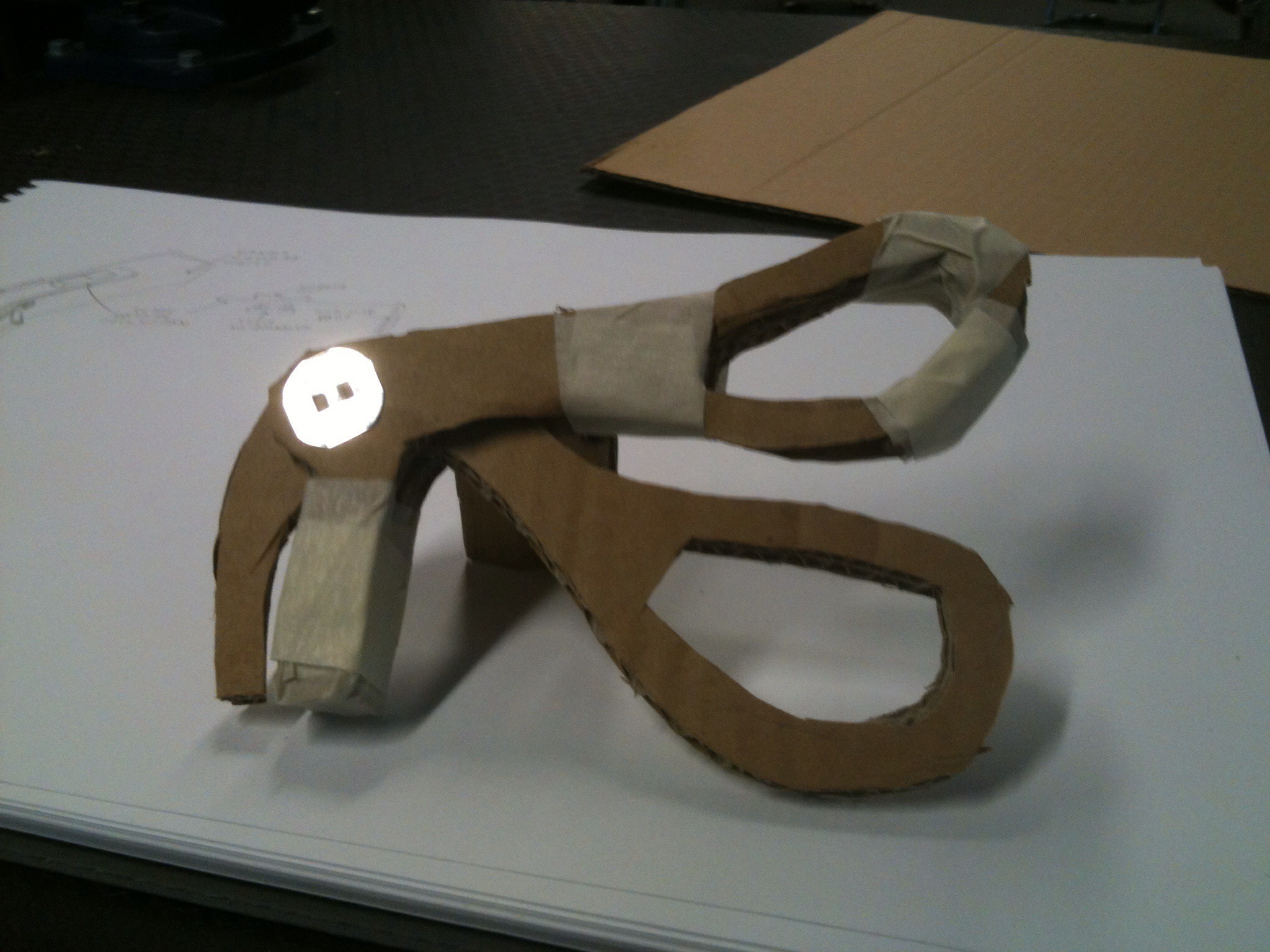
    Reject Number 2. Tragic
    Reject Number 2….. Tragic!

    The (sad) reality of brutally rejected Ideas. The small pile of cardboard prototypes I’d seen on my Son’s desk, now made a lot more sense. They were a the consequences of a brutal selection process, rejected ideas. It was quite sad, some of the prototypes looked like good fun.

    There had obviously been a far bit of effort (physical and emotional) in getting them to the point of rejection. It’s a tough life as a product design student.

    I’m not sure if I have that level of emotional resilience to cope with having my cherished ideas being kicked to pieces, even if it is supposed to be ultimately helpful. It needs a certain sort of mindset.

    Who ‘brutally’ tests ideas? The conversation got me wondering about the design of public services. It’s only in recent years I’ve heard people talk about public services being ‘designed’. Before that they must have just ‘happened’.

    However, I’m not sure if we are using the word ‘design’, in the same way that a product design student would recognise it. The part I think is missing is the process of ‘brutally’ testing many ideas before you choose the best one to develop.

    I do worry that when ideas and solutions to a problem are looked for, only very few possibilities are ever considered. These are frequently; the most obvious, ‘first thing we thought of’, or variations of things that have been done before. There isn’t much that is really new.

    Just to compound the effect, when it comes down to ‘options appraisal’ (testing the ideas), this is far from brutal. In my view, any evaluation process that accepts ‘do nothing’ as a realistic option, is a bit of a sham. ‘Do Nothing’ = ‘lets pretend we have many realistic ideas and throw this one in for dramatic effect’.  

    There seems to be a lot of ‘mushy consensus’ dominating what gets done.

    But ‘brutal’ is bad. In the polite world of public services, ‘brutal’ is very bad. Rightly so. But I do wonder if we could do with a bit more rigour in evaluating ideas, options and proposals. Maybe it would work if we adopted other processes we know and happily accept, like procurement or post project reviews?

    • Procurement. We all know and love this. Set out what you require, ask some people if they would like to bid for it. Brutally appraise their bid against some set criteria. We could easily apply that approach to testing ideas.
    • Post Project Review. A bit like the procurement process but done after the event. The project is appraised against some carefully chosen criteria to see if it was up to scratch. Unfortunately, if you get it wrong, this can feel like the vultures picking over the bones of a once mighty beast of the Savannah (brutal).

    Why not apply to ourselves what we happily do to others?

    Take out the sting with Ritual Dissent. This is another approach for testing ideas which does a rigorous job and doesn’t upset people too much. I was taught it by Dave Snowden and have used it on several occasions. The idea is that you ritualise the process of testing an idea, and also use active listening techniques. Read more here. I have had some great results using it.

    Unfortunately the phrase ‘ritual dissent’ does cause a bit of anxiety. A shame really. If we used it a bit more widely; we might encourage a few more ideas and test them a bit more rigorously.

    Finally. Brutal is bad, but in the long-term the alternative of ‘mushy consensus’ with no rigour is probably worse. A relevant Peter Druker quote: “There is nothing quite so useless, as doing with great efficiency, something that should not be done at all.” It’s all about picking the right idea.

    So, what’s the PONT? 

    1. The first ideas that emerge aren’t necessarily the best. The best way to have a good idea, is to have lots of ideas.
    2. Rigorously testing many ideas will help to find the one that works best in the circumstances.
    3. ‘Brutal’ evaluation happily gets applied to areas like procurement. Why not apply the approach to service design?

    Picture Source: The Post Project Review Vulture.

  • 20140111-093640.jpg

    This is the uniform we wear in Wales when embarking on a pilgrimage along the A470. To quote Wikipedia, ‘the 186 mile long road from Cardiff in the South to Llandudno on the North Coast’.

    To quote the recent BBC Radio4 programme by Cerys Matthews on the Welsh M1 “the A470 is a Celtic Road and like the Celtic Knot, a symbol of infinity”. Anyone who has driven it knows exactly what that means.

    When my eldest son decided to study at the most geographically awkward University possible – Bangor, North Wales – I knew it was time to fall back in love with the A470.

    By the way, when I say Bangor is difficult to get to from Cardiff, I don’t  mean in the sense of rickety rope bridges or negotiating river rapids on a wooden raft; although you can probably do that if you go via Aberystwyth.

    There are many reasons why I love the A470; it is beautiful, diverse, historic and challenging; but above all it is a really good opportunity for a chat* (*travelling companion required). Let me explain.

    The Beautiful Infrastructure Top Ten. The A470 has much of the best of what Wales has to offer:

    • It meanders through 2 of our 3 National Parks – beautiful scenery overload TICK
    • 21st Century City (Cardiff) to Medieval Market Towns (dozens) TICK
    • Industrial Heritage. Coal, Iron, Metal Ore Mining, Quarrying – we’ve got it all TICK
    • Religion. Chapels every 100 yards or so. Historic Abbeys etc TICK
    • Nuclear Power Stations, Hydroelectric, Wind Turbines (on & offshore) TICK
    • Farming, 9 million sheep, cows, chickens and all that stuff TICK
    • Mountain Ranges, with ‘interesting’ mountain passes. TICK
    • Rivers, Lakes and Trees. TICK
    • Castles. More than you can shake a stick at. TICK
    • Scenery. Did I mention it is astonishingly beautiful? TICK

    A good opportunity to chat – The Green Desert.

    Bits (most) of Mid Wales have been called the Green Desert. This can be because getting a phone signal, mobile broadband or even digital radio can be a bit challenging. Now, some people might consider this to be a problem.

    Not me, I quite like the digital isolation. What it allows you to do is have a really good conversation with your travelling companion.

    So who do you talk with?

    When my kids were younger we didn’t go on holiday anywhere that was more than 2 hours away. I just couldn’t cope with 6 of us being locked in the car for any longer. So, I never thought I would be saying, “I look forward to 5 hour car journeys with my eldest son”. As it turns out he is a fine companion, this is how it works:

    • 5 hours is a long time. So settle into a more relaxed mindset. There is no point rushing, on the road, or in conversation.
    • Business can be sorted at the beginning or end. There is always some mobile phone signal around the A55 in the North, or South of Merthyr Tydfil. Anything important can be dealt with then (phone Mum!).
    • Side by side is good. Being sat side by side in the car allows for the more interesting topics to be discussed. Floating an idea or touching on tricky issues can be done without entering dangerous eyeball to eyeball territory. This is why sitting across the table on the train is never as effective.
    • Silence is acceptable. The length of the journey means that nobody is expecting 100% conversation. Picking up and putting down a topic, with episodes of silence in between is perfectly acceptable.
    • The A470 does its bit. Did I mention it is really beautiful? Commenting on the wonders of Wales can provide a useful break in conversation if you need one.
    • Sharing helps. Sharing the driving helps on both a practical and emotional level. There is a lot of trust required if you are prepared to let someone else drive. Particularly the case if you take the short cut through the mountain roads near Corris, on a dark and rainy November night.

    The consequence of all this? Well I actually now look forward to a shared 5 hour A470 road trip with my son.

    Does this work for every travelling companion? 

    Over the years I’ve travelled the A470 with many work colleagues. The things I’ve mentioned about my road trip with my son work just the same. It is an excellent opportunity to have a really good conversation. Get to know that person a bit better, talk about what makes each of you tick, and even discuss a bit of business.

    Finally a confession. I do use the A49 via Hereford and Shrewsbury quite a lot, and the train. Sometimes, unfortunately, the need for speed overrides my desire for good conversation. Also, we don’t always wear the uniform pictured, sorry…..but I am thinking of asking the Welsh Assembly to pass a law.

    So, what’s the PONT? 

    1. The A470 is more than just a road through the middle of Wales.
    2. The opportunity for 5 hours of conversation with a family member, friend or colleague should be cherished and used.
    3. Agree beforehand who is going to drive the hilly bits if you take the shortcut through Corris.

    20140111-095945.jpgBBC Radio 4 Programme. The Welsh M1 with Cerys Matthews.

    Here’s the link to episode 1, 10th January 2014

    As an extra treat for A470 enthusiasts, here’s a song that mentions the A470, The Size of Wales (same as New Jersey, USA apparently) by the Gaudy Orde. It is brilliant in many respects, thanks Jacob.

  • 20131116-124219.jpg

    Most commercial products new to the market fail. Fact. 

    Most change programmes fail. Fact.

    Most initiatives in public services work perfectly. It’s completely different here…..  Really?

    I may have upset some people, with those assertions, so I’d better explain myself.

    Most Commercial Products Fail – The Museum of Failed Products.

    I’ve mentioned this before. Basically this is a venture that began in the 1960’s when Robert McMath, who worked in marketing, started collecting examples of consumer products for a reference library. When it became too large he moved it to a converted granary. It now holds over 110,000 individual, health, beauty, food and other products collected over 40 years. The collection is increasing at around 400 new products a month and is run nowadays by GfK Custom Research North America, at Ann Arbor in Michigan if you fancy a visit.

    The point I wanted to get across is that Robert McMath created a museum of failed products. The vast majority of the products in the museum did not succeed. Most new products fail, and this Guardian article suggests that the rate can be as high as 90%.

    Two other interesting and relevant things about the Museum of Failed Products:

    • It is a source of improvement and innovation. People turn up from all over the world to look at what others have tried previously. Thousands of the ideas and attempts are all in one place to provide inspiration, and show you what hasn’t worked
    • A substitute for Lost Corporate Memory. Some articles mention that people use the Museum to test new ideas, and ‘find’ similar products their organisation has already tried. The ‘corporate memory’ of the earlier attempt has been lost. Not a surprise really. What organisation do you know of that puts previous ‘failed attempts’ on show for everyone to see? I would suggest that ‘loosing’ the corporate memory of what has gone wrong is quite a common pastime.

    70% of Change Programmes Fail.

    The figure of 70% failure comes from work done by John Kotter way back in 1995. It created a whole industry of change management consultants. However, this work by McKinsey and Company in 2008, “The inconvenient truth about change management” suggests that over a decade later, and the failure rate is still about 70% …..  errr…. what’s changed?

    The learning points for me are:

    • This is a very low success rate. I suspect that many ‘Executive Committees’ and ‘Governance Boards’ don’t fully appreciate that there is a 70% chance of project failure. If they did appreciate this fact, I wonder how many would approve the business case, even if there is really pretty Gantt Chart and dazzling graphics of the staff communication strategy?
    • Are we focussing too much on ‘success criteria?’. Most of the change management advice I’ve experienced seems to involve; “apply this magic formula of tools and techniques, and the change programme will work perfectly”. Perhaps we should be thinking more about the failures, and learning from them?
    • If we looked at other initiatives, would the failure rate be similar? Change management was subjected to some thorough investigation and analysis by Kotter, to come up with the 70% failure figure. I do wonder what the results would be for other areas of activity?

    But everything is different here……. Really? 

    Based on the evidence from the Museum of Failed products and the failure rate of change programmes, I wonder if failure of public service initiatives is more common than we think?

    Where you frequently have; poorly defined objectives and outcomes, dubious measurement frameworks and vested interests, things can be quite difficult. How do you make a judgement or announce that something is an outright failure? It’s not as straightforward as people never buying your ‘dandruff shampoo for bald heads’ product.

    I do wonder if there is a need for a Museum of Failed Public Sector Initiatives? It would be a valuable resource for:

    • Helping recover ‘lost’ corporate memory;
    • Sharing the learning from things that haven’t worked; and
    • A source of inspiration for things that might work.

    So, what’s the PONT? 

    1. Not everything is successful all of the time; failure is an inevitable part of life.
    2. How you respond and learn from failure is more important than trying to avoid it.
    3. A Museum of Failed Public Sector Initiatives could have considerable benefits.

    The Mistake Bank “learning from faux pas, miscalculations and decisions gone wrong” curated by John Caddell is an interesting example of how this could be done.

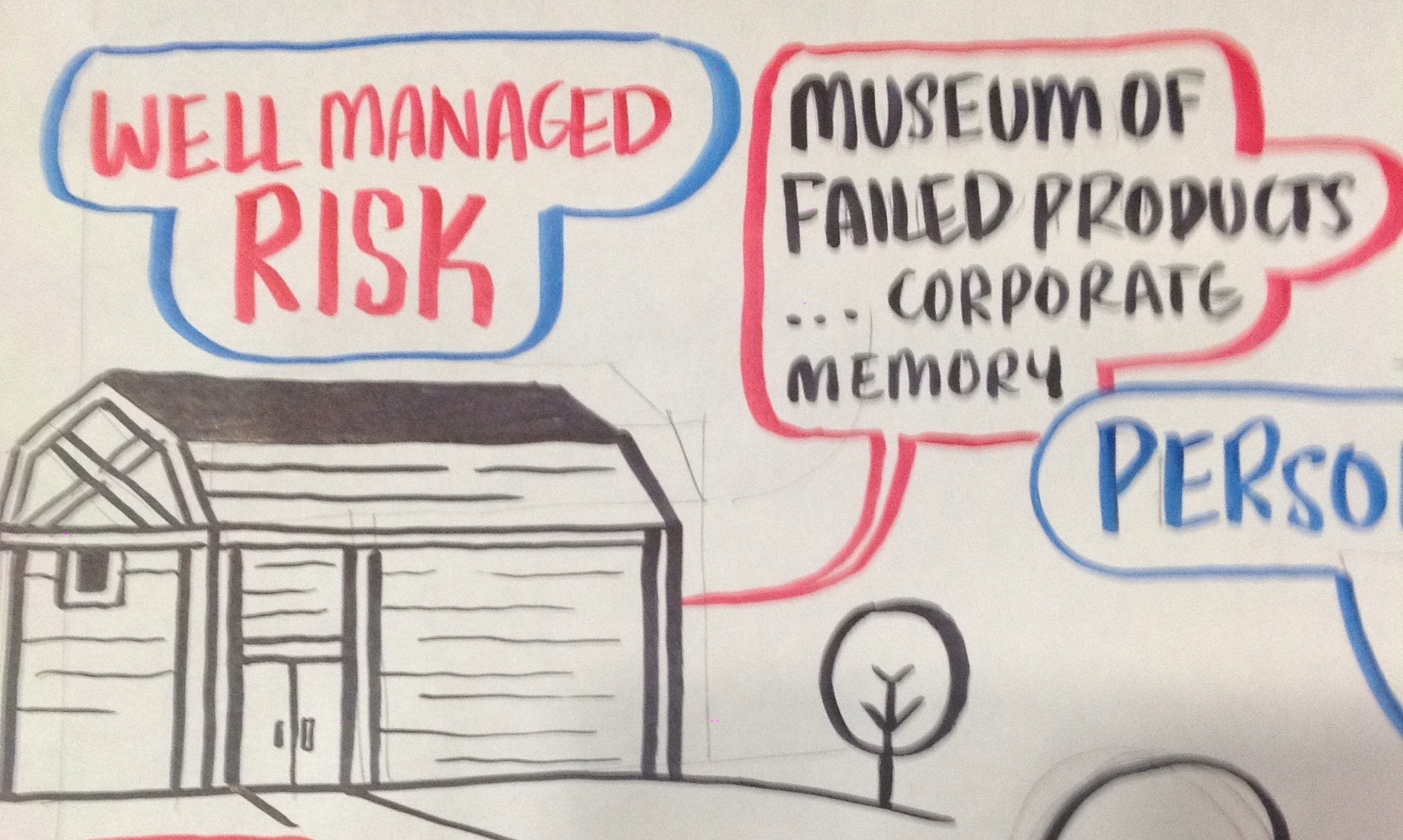
    Picture Source: Graphic by Joel Cooper, drawn at the Northern Housing Consortium Summit, November 2013. joelcooper.co.uk  http://ieatart.carbonmade.com

    Here is the full graphic of my talk ‘Learning to Love the F Word’. Thanks to Joel and thanks to Northern Housing Consortium for inviting me to speak.

    20131116-131112.jpg
  • Trojan Horses and Business Case Option Appraisals. I’ve always had a deep suspicion about the option appraisals you see in business cases. It feels to me like a one of those corporate games that lurk in the shadows. You play by the rules and get the answers YOU want. It might not be the best answer for the people on the receiving end of your plans, but you’ve followed the rules. So it doesn’t matter (from an organisational governance point of view), you‘ve followed the rules.

    This post is a reflection on how you understand if someone is just playing the game. Have they really looked at multiple options and tested them rigorously? Does the options appraisal reflect that, or is it just a Trojan Horse? Something they have become emotionally attached to. As part of the ‘Review Panel’ you are just playing your part in the game.

    So, here are some thoughts on how it applies to the much loved ‘pilot project’ and some questions to ask... let’s begin.

    How did the other pilots go? An innocent question to ask anyone talking about their options or ‘pilot project’.

    A common response… tumbleweed… silence… nothing but embarrassing silence and the shuffling of feet…

    Confirmation that ‘The Game is On’.

    Phased Implementation is not a Safe to Fail Pilot. I want to paint this in 6ft high letters somewhere so that; ‘Policy Wonks’, PRINCE2 Practitioners, Think Tank Strategists, and Corporate Policy Leads can see it every day.

    Phased implementation of a single big idea, quite often gets disguised as a ‘pilot project’. In reality it is just a Trojan Horse. A sneaky way of introducing a single idea as a method of solving complicated problem. This sort of phased implementation is not a pilot. It is certainly not an experimental ‘safe to fail’ pilot to test different ideas. (Link here to previous posts on ‘safe to fail’ pilots.)

    I’ve had a couple of conversations recently about managing risk and learning from failure. These were with people who had seen more than their fair share of public (and private) sector projects over very many years.  We ended up agreeing on the following:

    • A large number of projects are developed on the basis of working towards a single well-defined ‘perfect’ product or outcome,
    • This often doesn’t account for the context of the situation or the fact it is complex;
    • Frequently, as part of the planning stage there will have been very few alternative options considered;
    • Ideas generation is at best restricted to a carefully controlled focus group, or brainstorming session (packed with groupthink);
    • If you are lucky there might have been some ‘stakeholder consultation’;
    • If options have been considered, most of them will be variations on the same theme;
    • There will always be a ‘do nothing’ option thrown in for dramatic effect;
    • Many of these projects claim to have gone through a testing or pilot stage, in reality they haven’t;
    • What this ‘testing’ and ‘piloting’ actually amounts to is phased implementation;
    • The ‘pilot’ phase is actually a Trojan Horse for getting the idea introduced beyond the point of no return;
    • Very few (if any) of these tests and pilots are ever killed off, or substantially changed; and
    • Learning from failure isn’t a phrase you will hear very often (if ever).

    Apologies if that sounds a bit sceptical. I just wanted to get across the point that the phased implementation of a single clever idea is not a real pilot exercise.

    How to spot a real pilot exercise. If someone starts banging on about their pilot project, be suspicious, in a nice helpful way…

    Here are five questions to throw into the conversation. Check for the reaction and listen for the responses. Be prepared to deal with a tumbleweed moment…

    1. How did you generate different ideas for your pilots?
    2. How have the other pilots gone?
    3. Did you learn much from the ones that failed?
    4. Do you have anything in place to stop this pilot if it starts to fail?
    5. How will you be sharing the learning from your pilot?

    Possibly a bit cruel, but remember; Trojan Horses (single idea, phased implementation) are very different to Trojan Mice (multiple safe to fail experiments run in parallel).

    So, what’s the PONT? 

    • Pilots (testing things rigorously) are very different from phased implementation. Trojan Horses are not Trojan Mice.
    • A good pilot exercise is best done with a diverse range of ideas to test.
    • Ask the five simple questions to test if something really is a pilot, and be prepared for the tumbleweed moment.

    Picture Source. How did the other pilots go?….  a tumbleweed moment. I particularly like the person leaving the scene in the road sign….

    Tumbleweed at a gas station in Chelan, Washington by A.Balet. http://en.wikipedia.org/wiki/File:Tumbleweed_in_Chelan_WA.jpg

    Linked Posts:

    Trojan Mice – explanation here. http://whatsthepont.com/2013/07/28/continuous-improvement-why-matters-to-squeeze-the-pips-release-trojan-mice-and-win-small/

    Agile Project Management link. http://whatsthepont.com/2012/12/02/agile-project-management-and-a-naval-bombardment-in-newport-south-wales/

    Safe to Fail Pilots & Dave Snowden link.http://whatsthepont.com/2013/11/04/loving-and-learning-from-failure-great-idea-but-how-does-it-work/

  • 20131104-211038.jpg

    “Accept that failure will happen and learn the lessons”.

    That could be a classic from the dictionary of  “easy to say, hard to do” inspirational quotes. You know the ones, they get posted all over Facebook with backgrounds of epic landscapes or golden sunsets. I fully agree with the sentiment, but how does this work in a world dominated by; performance targets, measurement frameworks, corporate governance, internal audit and external scrutiny?

    Following recent posts about failure here is a summary what I’ve learned and some practical advice on learning from failure. I’ve tried to cover some of the concepts which have helped me understand how to approach failure, and steps for learning in a structured way. In my experience, having a structure or process, is often the best way of convincing ‘those charged with governance’ that embracing failure isn’t just reckless risk taking.

    Concepts and Context. The most important thing I’ve learned about failure is that context is extremely important. Circumstances really make a difference.

    In a very structured, predictable, clearly explained and carefully monitored environment; when someone decides to ignore the rules, or do something different, failure is generally seen as a bad thing.

    In highly unpredictable (complex) situations where there are no well-defined rules, a great deal of uncertainty, novel solutions are often required. Trying something new and learning from failed attempts is good. Likewise heroic efforts that fail in the face of overwhelming odds are often viewed positively.

    Here are a few examples of concepts used to describe failure as being very context dependant:

    So, how does this work in practice?  Concepts are helpful in understanding, but some practical advice goes a long way in turning theory into action. Here are some of the things I’ve picked up which I think help.

    The Mistake Bank by John Caddell.  One of the best things you can do to accept failure is to make a bit of a ‘song and dance’ about it. In The Mistake Bank, “How to succeed by forgiving your mistakes and embracing your failures” John provides some advice on doing exactly that. One of the recommendations is to create a ‘Mistake Bank’ where the details of failures are recorded for everyone to see. This isn’t a library of ‘name and shame’, but a genuine, positive learning resource.

    In a climate where lots of organisations are rushing to build ‘good practice libraries’ this approach seems bit counter intuitive. I think this is inspired advice. In my experience there will be more genuine learning from honest descriptions of failure than ‘gold plated’ best practice case studies.  A ‘Mistake Bank’ is something any Team, Department or Organisation could develop with relatively few resources (and a massive shift in thinking).

    Fast Intelligent Failure versus Slow Stupid Failure. Jack Matson started developing this idea in the 1980’s. Some of his work involved getting his College Students to work on projects that were actually designed to fail. This, Students Learn to Succeed in ‘Failure 101’ article from the Chicago Tribune gives a good outline of how ‘designing to fail’ generated more innovative solutions.

    Trojan Mice. Safe to Fail Pilots, Dave Snowden. I have mentioned this before. The basic idea is that, in complex situations there will be no ‘right answer’. You have to look for suitable answers through a process of experimentation. This will involve a series of ‘safe to fail’ pilot experiments that are run in parallel. The point about them being ‘safe to fail’ is important and Dave suggests that some pilots should actually be designed to fail.

    Another important aspect is monitoring what is happening and ‘amplify’ the positive pilots whilst unsuccessful pilots are ‘dampened’. In this sort of structured environment it’s possible to accept failure and learn from it. It can also give comfort to those concerned about ‘reckless’ risk taking.

    Professor Amy Edmondson. For my final bit of practical advice I’d suggest looking at this Havard Business Review video. Three bits of practical advice from Professor Edmondson on how Leaders can create and environment of learning from failure:

    1. Explain the Context. Let workers know if the context is straightforward or complex, and how failure will be understood.
    2. Embrace the Messenger. If someone points out failure, welcome what they have to say (no matter how difficult).
    3. Take Action. Take steps to learn from the failure.

    So, whats the PONT?

    1. Failure is inevitable, but you do have choices about how you respond to it.
    2. Context is very important. Failure in a highly complex situation is different to failure in a highly controlled predictable environment.
    3. Whatever happens, make sure you accept that failure has happened, and learn all that you can.

    Picture Source: A Golden Sunset with some motivational words about learning from failure. It’s one of mine, sorry,……… I’ll get my coat.

  • 20131029-212250.jpgAdvancing until you meet fire from the ‘enemy’ is a very effective way of gauging if you have had any impact. It’s not the only measure, but it is a cast iron indicaton that you have stirred something up.

    I have to thank a former colleague (Howard) for telling me about this. He explained how a colleague (with significant military experience) had used this expression when describing how change and other initiatives might be considered in  a ‘civilian’ organisation. I very much like the analogy (and it also gave me an opportunity to dig out some old Commando Comics from the attic).

    Obviously this can be a high risk occupation. Enemy fire can have lethal (or career limiting) consequences. So, the approach should be handled with respect and some understanding of whether the risks and consequences are worth the prize.

    Here are a few pointers for organisational skirmish planning.

    Battle / Skirmish Plan Objectives:  These can be the objectives of anything different you what to introduce. A minor change in a routine work process or a major restructuring of departments and new job descriptions. The thing to remember is that some people will not like the idea of change, and will resist it. These people have the potential to become ‘enemies’, and nobody needs enemies.

    Who are the enemy?  This is a tricky question. The ‘it will never happen here’, ‘over my dead body’ individuals are relatively straightforward. The ‘malicious compliance’ crowd and the saboteurs are more difficult to deal with. You just don’t know when and where the hostile fire is coming from. The point is to be vigilant and ready to respond.

    What does ‘enemy fire’ look like? As above, the very obvious direct attacks are something you can sense and respond to. Less easy are the acts of saboteurs. For organisational life it is worth developing a ‘spot the saboteur’ checklist. Other indicators like telling tales and malicious gossip are also worth looking out for.

    How to respond when you are under fire? There are a range of choices here, ranging from ‘meet fire with fire’ or ‘open peace talks’. Crushing the opposition with superior firepower is a temping option, but should only be used in extreme circumstances.  Better in my view to engage in peace talks.

    A consequence of advancing to meet enemy fire has been to ‘flush out’ those that are not happy with what is going on. Now you know who these people are you can have a discussion with them. Get a better understanding of what they think, what concerns them and understand why they were shooting at you? This is a great opportunity to learn from each other, find some common ground and advance together.

    At the end of the day these people are ‘friendlies’, not real enemies (they work for the same organisation as you). They just got a bit jumpy with the speed of your advance and their fingers just ‘slipped’ on the trigger.

    So, what’s the PONT?

    1. Any form of disruption to ‘business as usual’ will generate a reaction.
    2. If the reaction is ‘enemy fire’ you know you have made an impact and have contact with the people who are most concerned about the disruption.
    3. Use the contact to engage and open up ‘peace talks’.

    Picture Source: Commando Magazines http://www.amazon.co.uk/Who-Dares-Wins-Special-Forces-Adventures/dp/1847329705

  • 20131027-210116.jpg“The best camera is the one that’s with you”, is the title of a book by Chase Jarvis about some incredible pictures taken using an iPhone. While looking for the book I bumped into another relevant quote; “buying an expensive Nikon doesn’t make you a photographer. It makes you a Nikon owner” (source unknown).

    The point is, that you can do incredible things with whatever equipment you’ve got available. These can be simple tools and methods; however with the right mindset you can get incredible results. Having the most sophisticated, ‘shiny new things’ doesn’t always guarantee success. I think this idea is as relevant to the world of continuous improvement as it is to photography. Here are two examples of why it think it works.

    “Everyone here has access to spreadsheet software”

    I recently learnt about how a very successful and sophisticated organisation used ‘everyday’ spreadsheet software as part of continuous improvement. The reasons why?

    • It did the job (good enough is good enough);
    • People used the software daily (no extra training required); and
    • It was available (just about everyone could get access to use it).

    Technology elitists will be disappointed to learn that this was Microsoft Office Excel. It’s probably not a cool thing to say but I do think there is lots that can be done with ‘off the shelf ‘ Excel to support continuous improvement. The way this organisation used Excel was to compile information on continuous improvement projects in a single file which included:

    • Financial information (output from a standard accounting system);
    • Project planning (a stripped back Gantt Chart); and
    • Basic business improvement tools (root cause analysis in Excel page – brilliant).

    There was great benefit to having all the information in a single place. This was helpful to both the people running the project and those who wanted to learn from them. It doesn’t take much to email a copy of the Excel project file to someone else working in the organisation, so that they can learn from your experiences. A great help if you are trying to spread continuous improvement across the organisation. I’d also argue that the ‘working papers’ in the Excel file represent a far more realistic account of reality than a retrospectively constructed ‘best practice case study’.

    One final thing, the use of Excel to record an Ishikawa Root Cause Analysis Diagram was inspired. No need for a fancy software package here, a great example of using ‘what you’ve got’, to maximum effect.

    ‘Back of envelope’ scribbles versus new ‘whistles and bells’ software package.

    A while back I worked with two separate organisations who were trying to introduce performance management systems. They had very different approaches.

    • Organisation A took the ‘Big Bang’ approach and invested heavily in some performance management software. The implementation plans looked brilliant. Dozens of workshops, ‘senior system administrators’ and ‘champions’ strategically placed in every department.
    • Organisation B took the ‘cheap and cheerful, home grown’ option. This was basically lots of spreadsheets (you guessed right….it was Excel) that were completed by each department and submitted to a central department who compiled the information and engaged in some analysis and ‘monitoring’ of performance. Where departments were unable to submit Excel returns, alternative methods were permitted. Not quite scribbles on the back of an envelope, but not far off.

    Two years on and in Organisation A the new software system was discredited and in disarray. The phrase ‘rubbish in, rubbish out’ pretty much summed up the situation. There had been a very limited culture of measuring and monitoring performance, which the ‘Whistle and Bells Software’ had done nothing to encourage.

    By contrast, in Organisation B they were by this stage crying out for new some software. The spreadsheets and ‘back of envelope’ submissions had reached the limit of what was possible. When they did introduce some specific performance management software, it was a success. The mindset had been developed and they were ready for something extra.

    The best tools are what you’ve got.  Going back to the original point about making the most of the tools you have available. I do think that with the right mindset a great deal of continuous improvement can be achieved with simple tools.

    The Ishikawa Root Cause Analysis diagram is a great tool for stepping back and taking a good look at the processes in any organisation. Just like the Ricoh Gemba Mat (my absolute favourite) or the 5 Whys.

    What you need is the right mindset which includes some understanding of the principles, what needs to be done, how to do it, and what tools to use. Jumping straight to the ‘fancy tools’ can just lead to a bad case of ‘all the gear and no idea’.

    So, what’s the PONT?

    1. It is possible to achieve a great deal of continuous improvement with some ‘everyday’ tools and methods.
    2. What ‘you’ve got’ can sometimes generate some innovative solutions, for example the Ishikawa Diagram in Excel
    3. Before jumping to the ‘whistles and bells’ solution it is worth pausing and thinking, is ‘good enough, good enough’.

    Finally, the mention of Ishikawa has given me the opportunity to link to another of my favourite videos from the Juran Institute on root cause analysis.

    Picture Source: Ishikawa Fish Bone Diagram. http://en.wikipedia.org/wiki/File:Ishikawa_Fishbone_Diagram.svg

  • 20131013-180012.jpgI don’t think this is an actual Dalek quote, but it should be….. “Failure is not an option…. exterminate!”

    I’m back to pursuing learning from failure after listening to an episode of The Life Scientific on BBC Radio 4, featuring Professor Dame Wendy Hall. In response to a question (27mins) on why the UK doesn’t have the equivalent of a Google or Twitter Professor Hall responded; “we don’t kill things fast enough…. most things will fail…. “. This was a thought-provoking answer and is worth listening to. In fact, listen to the whole programme if you are at all interested in computing and the discipline of Web Science, which she co-founded at Southampton University.

    From this explanation of failure in the complex world of technology innovation I ran straight into one of my Dalek friends….. a practitioner from the world of Heath and Safety regulation.

    Whilst we were chatting about my recent blog posts on failure they did actually say “In my line of work failure is not an option…. things are either right or wrong. There is no place for failing and learning. We have to be right” (best spoken through one of those voice changer toys….. EXTERMINATE!).

    Well they are both right. In some cases ‘most things will fail’ and we need to ‘kill things quickly’, learn the lessons and move on. In other cases failure isn’t an option, things have to be right. The response to failure is very specific to the situation. I’ve been trying to find a good explanation for why this is the case, and here are two examples; one by John Caddell who wrote The Mistake Bank and The Cynefin Framework by Professor Dave Snowden.

    John Caddell, The Mistake Bank. 

    John Caddell has been very generous and shared material with me on how to learn more effectively from failure. One of the key points I took from this was the need to understand your circumstances. How you relate to failure in a highly structured, predictable situation will be different to a highly unstructured unpredictable environment. This diagram from John’s Mistake Bank blog has been adapted from the work of Professor Amy Edmondson.  Professor Edmondson wrote, Strategies Learning from Failure, which she discusses in this Havard Business Review video. 

    20131013-200451.jpg

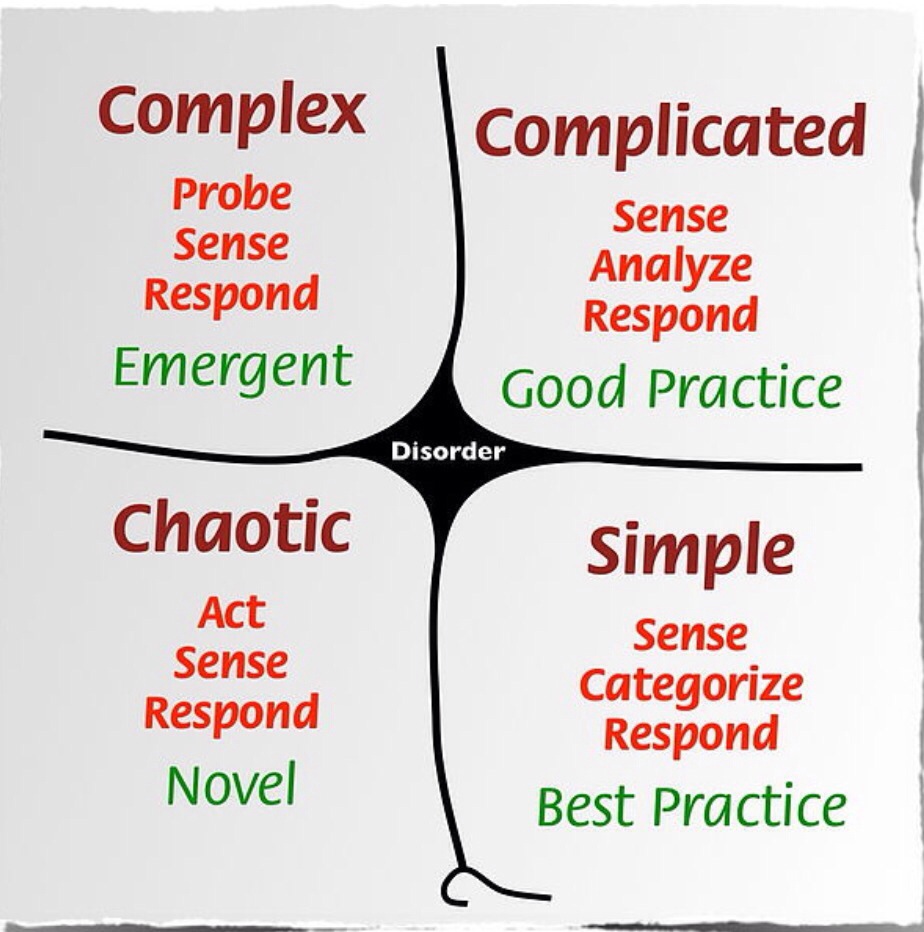
    The key point is, for highly predictable, less complex areas, failures should be treated as defects and avoided. My Dalek friend is right here. A 3 ton load in a 2 ton limit should not be allowed. In unpredictable and highly complex areas, failure needs to be looked upon as something you can learn from. The trick here is to develop an approach that allows rapid learning through fast intelligent failure. I find the Cynefin Framework helpful in understanding this.

    The Cynefin Framework and learning from failure.

    20131013-200442.jpg

    The Cynefin framework is also the subject of a Harvard Business Review article so has a good pedigree.

    From the perspective of learning from failure it is worth focusing on the four domains. In the simple domain there is best practice, one way of doing things. Here failure, deviation from what is ‘best’, is a problem. Rather than accept failure and learn, its best to avoid the failure in the first place, as there is little to improve.

    Jumping straight to the complex domain. There is no known answer, practices are emerging from a complex unknown situation. This very much describes the situation in the modern world and the example given by Professor Wendy Hall. In technology innovation there are lots of ‘attempts’ and failures need to be ‘killed off’ quickly. The crucial point is to learn from the mistakes and move on. In the words of the Cynefin Framework, ‘probe’ for new solutions. More on the Cynefin Framework can be found in this video on the Cognitive Edge website.

    Daleks, the enforcers of Best Practice.  I have limited experience of real Daleks but I do think they would be enthusiastic ‘best practice’ enforcers. Insisting on the one and only ‘best’ method of doing things. This would be regardless of the level of uncertainty or complexity of the situation. Failure is not an option……..EXTERMINATE!

    By contrast, John Cadell, and three Professors all say that there are circumstances where failure in inevitable and should be encouraged so that you can learn, make changes and move forward. The world of emerging practice, not best practice or even good practice.

    Failure is an option, it just depends upon the circumstances.

    So, What’s the PONT?

    1. Learning from failure is a highly valuable activity that should be encouraged.
    2. Understanding the situation and what approach to apply to failure is important.
    3. Daleks and Doctors (Professors) have their rightful places, but mixing them might not get a happy ending (YES! A Doctor Who link at last)

    Picture source: BBC Doctor Who Publicity. http://www.bbcshop.com/doctor-who/doctor-who-talking-dalek-bronze-dalek/invt/04352a

  • 20131004-213942.jpgI spent half a day in hospital this week. Nothing very serious, just a bit of digging for a fish bone stuck in my throat.

    To break up the boredom I did joke with a friend on Twitter that I was doing some ‘field ethnography’.

    From my observations I can report that I spent a lot of time sitting around waiting for things to happen. This gave me plenty of opportunity to make careful metal notes of my physical surroundings and what people were doing. A bit of an unplanned ‘mystery shopper’ visit.

    My visit to A&E ended positively and I have no complaints. I do however have a few thoughts on how you get ‘extra’ from a trip to A&E, using the following:

    • social media;
    • the hours spent sitting around waiting for things to happen; and
    • the ‘resource’ of bored people. Patients and relatives sat around looking for something to amuse them. There is a limit to the number of times you can read the leaflet from the ‘ambulance chaser’ lawyers.

    The inspiration for my thinking here is the much talked about desire to gather the views and experiences of people using the health care system. Much of this seems to be driven by the recommendations of the Francis Report, into failings at the Mid Staffordshire Hospital.  ‘Listening’ to what service users have to say and gathering ‘patient opinion’ are a high priority.

    Base on my experiences in A&E, I do wonder if there is an opportunity to use social media, like twitter, or something similar. Here are two examples why I think this approach might work; WH Smith Carpet and London Midland Trains.

    WH Smith Carpet (@WHS_Carpet) and Customer Care. “Documenting the wonders of the abject carpet at WH Smith”

    This Twitter account does exactly what it says in the biography. Members of an ‘army’ of just over 3000 followers send in pictures that record the condition of carpets in WH Smith shops.

    The implications of this activity have been well covered in this post by Dan Slee, WORN STORIES: What tweets about carpets tells you about WH Smith. The general message, which is reinforced by many of the tweets is; “if they don’t care about the state of the carpet, how much do they care about me as a customer?”

    I’ve not managed to find any evidence of a drop in WH Smith profits linked to this Twitter activity, or any sign of improvement in carpet quality. There do however seem to be pictures of ‘pristine laminate’ and ‘spotless’ carpet creeping into the Twitter stream.

    London Midland Trains on Twitter (@LondonMidland)

    I have to own up to previously expressing love for London Midland Trains. I’ve also written a few posts about how their customer service works in real-time through the use of Twitter.

    London Midland have over 53,000 Twitter followers. These people are a ‘Human Sensor Network’. They are able to tell the train company, in real-time, exactly what is happening with the service they deliver. They frequently do this, and provide information on both good and bad aspects. The implications of having access to this ‘sensor network’ of thousands of people is huge. On top of the information being pushed in your direction, you could also use the network to ask questions. A massive opportunity to ‘listen’ and seek user opinion. Follow their account for a while and watch the conversations. They do get some very positive feedback, even from stressed commuters.

    So does this have any relevance to A&E?

    I’m not going to consider the ‘it will never happen here arguments‘. These are my thoughts on the pressures and opportunities:

    • It’s only a matter of time before a @WHS_Carpet for the health service emerges.
    • This could be as trivial as a “tasteless waiting room curtains” theme or something more serious like “gross failures in hand-washing techniques”.
    • So, it’s probably worth being prepared and looking for opportunities.
    • A facility for people to capture experiences and share them with the organisations who can do something about it is helpful. They can help to resolve problems, quickly, and make improvements based on user experience.
    • It might even generate some good news. Nobody is making people Tweet the ‘pristine laminate’ and ‘spotless’ pictures to @WHS_Carpet.
    • Better to give people something useful to do when they are bored and fiddling with their phones in A&E.
    • They are potentially a free resource. A Human Sensor Network at your disposal.

    So, what’s the PONT?

    1. The use of Smart Phones and Social Medial is becoming all-pervasive, even in A&E.
    2. It is inevitable that people will start to ‘share’ their experiences. @WHS_Carpet and @LondonMidland are different examples of how you can respond.
    3. Why not use people with time on their hands as a Human Sensor Network to help you ‘listen’ and gather opinion.

    Human Sensor Networks: More on these in this post by Michael Cheveldave who works with Dave Snowden at Cognitive Edge http://cognitive-edge.com/blog/entry/5922/human-sensor-networks…-the-ultimate-executive-coach/ 

    Picture Source: I was going to use a picture of the light tube that was inserted up my nose (twice). In the interests of good taste, I’ve used the fish skeleton. Much less scary. http://www.freepik.com/free-vector/fish-skeleton-clip-art_376316.htm

  • 20130929-133849.jpgIf you’ve seen the television show NUMB3RS you may have the impression that it is possible to mathematically predict complex situations. Gather some NUMB3RS (data, information etc), apply a relevant mathematical model, calculate the next occurrence of the event and catch the perpetuator in the act. All you need is the application of some fiendishly clever mathematics, and a genius with a chalkboard.

    Brilliant! I want to apply some of this method to learning from failure.

    Recent posts have been about, ‘how I learnt from failure’ and how some organisations like Honda are successfully using failure to innovate. Extending my logic I thought that; if I can better understand how failure works, there may be away of approaching it so that I can extract the helpful learning (and make positive changes), before things go horribly wrong. Simple, just like in NUMB3RS.

    The result has been a bit of bewilderment on my part. There’s a lot of mathematics about failure on the internet. There are even some ‘chalkboard’ videos, but I’m no Dr Sheldon Cooper (although my wife claims I have behavioural similarities) and I’ve struggled. There is good news though, I’ve found three other useful approaches: Swiss Cheese, The Incident Pit and Timeline of Inevitable Failure (sounds like an Indiana Jones film).

    The Swiss Cheese Model of Failure in Systems. The basic idea here is that human systems are like slices of swiss cheese stacked side by side. Slices of Swiss cheese typically have holes in them. In the model the holes represent points of failure. The failures can be latent (built into the system and can remain dormant for a long time) and active failures, which are most often unsafe acts by humans.

    20130926-224131.jpgFor the Swiss cheese model to work, the latent and active failure holes line up between the slices of cheese and a catastrophic failure occurs. The model has been used widely in aviation and healthcare and seems to be a useful way of illustrating how apparently unrelated, often small errors, in different parts of a system can join up to create a major failure.

    The Duke University Medical Centre has a good explanation of the Swiss Cheese Model (picture source) on their Patient Safety – Quality Improvement pages, along with a good general section on ‘Error’. If you fancy a technical appraisal, this 2006 report, ‘Revisiting the Swiss Cheese Model of Accidents’, from the European Organisation for the Safety of Air Navigation is more interesting than you might imagine. Thank you to Failure Dynamics for letting me know about this model.

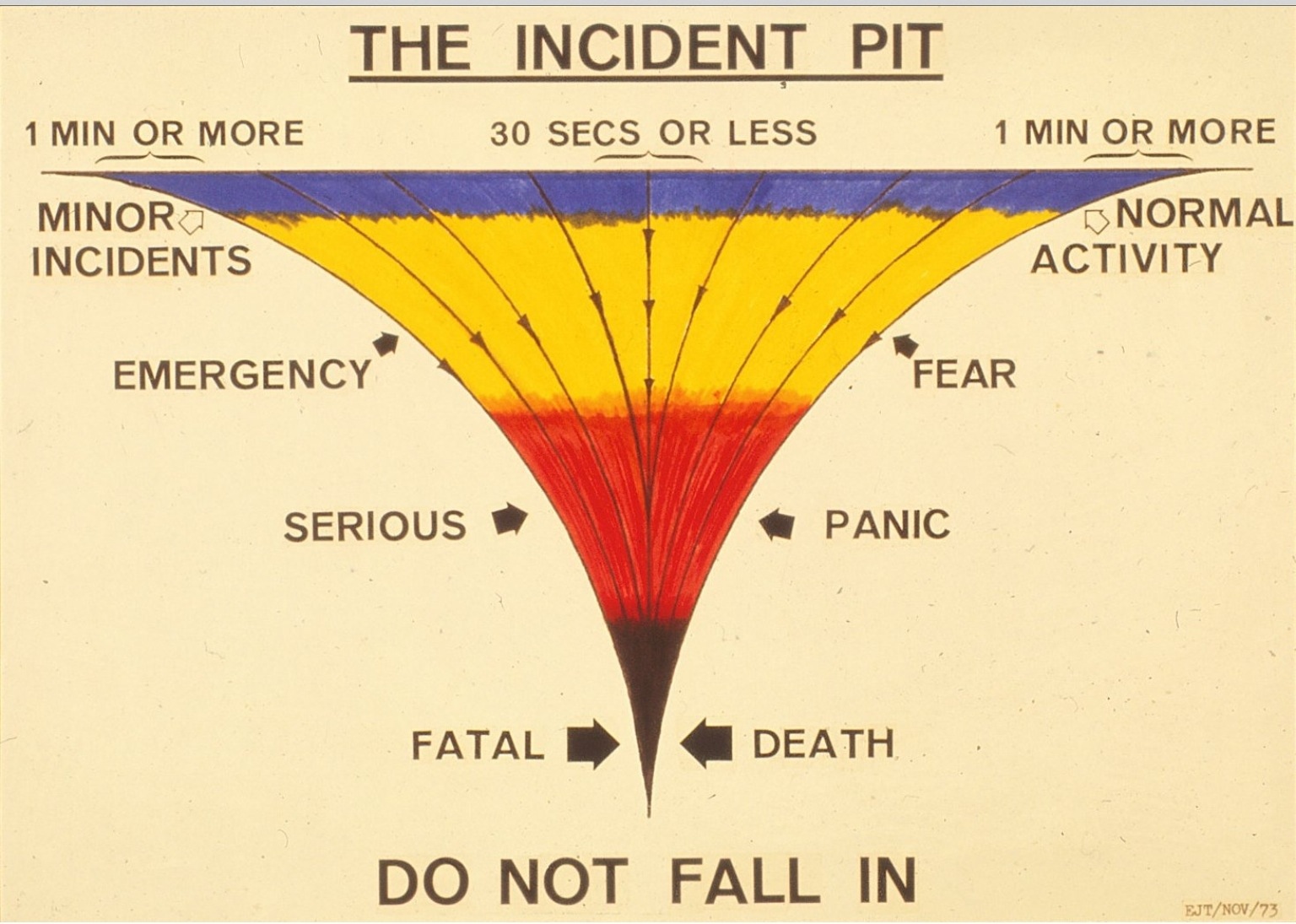
    The Incident Pit. This represents my first formal encounter with failure and risk management. The model goes back to 1973 when the concept was presented at the British Sub Aqua Club Diving Officers Conference. It was developed from the evidence gathered from numerous diving accidents (including fatalities) and was part of the diver training I went through in the 1980’s.

    20130926-224140.jpgKey point is that due to the hazardous nature of underwater swimming (diving) minor incidents are always happening; caused by the environment, equipment or humans. The ideas is that you are constantly aware, so that you recognise when these minor incidents are occurring and rectify then before they escalate into something more serious. Taking action early (learning from small failures) prevents you ending up dead at the bottom of the the incident pit. There is something in this approach which fits in with my objective of learning early from failure.

    This was highly effective as a learning device back in the 1980’s and to be honest, it was at the front of my mind when I abandoned my sea swim in August 2013. This example from Swanage Coast Guard suggests that is still very much in use.

    The Timeline of Inevitable Failure. I must thank Matt from Complex Care Wales for sharing this model he has developed.  I hope Matt will publishing some more detail about this soon. (larger scale version at the end of the post)

    20130926-224123.jpgThe model is self explanatory, I’ve shown it to a few people who’ve grasped the ideas instantly.

    The key points for me (a bit like the Incident Pit):

    • There are always errors or failures occurring in day to day processes.
    • The more complicated or complex these activities, the more they occur.

    The best way to approach these is to have triggers that allow you to recognise the errors, and then you do something about them before they escalate. These are the places where you can most usefully learn, and it seems to fit in with the idea of ‘fast intelligent failure’.

    Back to NUMB3RS. Well, there aren’t many numbers in these models. What they are is different graphical explanations of how the failure process works. What is useful for me is that they give an indication of where it might be possible to ‘get in early’ and do some effective learning from failure. Moving from the ‘backwards look’ towards some ‘real time’ learning. Some more on this in the next post.

    So, what’s the PONT?

    1. Learning from failure as early as possible (fast intelligent failure) is preferable to a major inquiry when something big goes wrong.
    2. The graphical explanations of various failure models assist in identifying where it might be best to look for learning from failure.
    3. Numbers (or even NUMB3RS) aren’t always the answer.

    Picture Sources & Useful Links:

    Swiss Cheese Model: Duke University Medical Centrehttp://patientsafetyed.duhs.duke.edu/module_e/swiss_cheese.html

    The Incident Pit: Wikipedia article, http://en.wikipedia.org/wiki/Incident_pit

    NUMB3RS picture: http://www.fanpop.com/clubs/numb3rs/images/7394650/title/numb3rs-wallpaper

    Timeline of Inevitable Failure – Complex Care Wales main site: http://www.complexcarewales.org/home.aspx

    20130926-224123.jpg

  • 20130920-074458.jpgMany years ago in a galaxy far far away I ran a series of improvement workshops with a big organisation. The final session was about developing an action plan and things were going swimmingly. The group had ‘taken ownership’, identified ‘SMART outcomes’, developed ‘success criteria’ and set out a ‘monitoring and evaluation framework’. What could possibly go wrong?

    As we were about to close the session one of the senior figures, Vice Admiral Bufton-Tufton (retired) stood up to propose a vote of thanks, my moment of glory. I was happily basking in the limelight when he rounded it off with…. “In the immortal words of Sir Humphrey from Yes Minister,…. we will do everything we can to move things forward, without being seen to be directly helpful”. A mis-quote from Yes Minister, but it did really happen.

    The room erupted into laughter and everyone left congratulating Vice Admiral Bufton-Tufton (retired) with a bit of back slapping. The carefully crafted action plans were forgotten and the hard work evaporated in a moment of self-indulgent humour…. or was it? Could it have been a bit of sabotage using some of the famous ‘Yes Minister’ Mandarin English?

    Yes Minister was a 1980’s TV parody of the Westminster Government’s, ‘Department of Administrative Affairs’, and the relationship between the Minister and Civil Servants. One of the many memorable features of the programme was the obscure language used by the Permanent Secretary (Senior Civil Servant), Sir Humphrey Appleby, a form of Mandarin English. The ability of Sir Humphrey (a master of obfuscation)  to block change in the Department of Administrative Affairs by using confusing language was astonishing. It was so effective that it has almost become the benchmark for this sort of behaviour. If someone is referred to as a ‘bit of a Sir Humphrey’ you know you’ve got trouble. Enjoy this clip of him in action.

    It would be easy to have a cheap shot at the Civil Service and say that Sir Humphrey behaviour is typical of every Civil Servant, which of course is not true. However……. you might like a look at this.

    How to be a Civil Servant. This is a website www.civilservant.org.uk a Civil Servant  friend of mine told me to look at after I wrote about jargon used by the NHS. They were keen to point out that the Civil Service has its own set of jargon, known as Mandarin English. Before I get onto that, a few words about ‘How to be a Civil Servant’. Please, please do have a look at it. It’s possibly one of the most: hilarious / useful / honest / practical / subtly subversive things I’ve read. I just can’t work out which definition fits best. In a way it is like the extended, modern-day manual for Parkinson’s Law from the 1950’s.

    Mandarin English. You will need to follow this link to the PDF as its difficult to find. I’ll just quote directly so that you get idea of what it’s about.

    A Short Course for New Recruits  Lessons 1-5: Vocabulary  “It is no accident that Whitehall officials are known as Mandarins. Their language is often as hard to understand as anything spoken in Beijing. This document …. will provide you with the basic language you will need to get by and survive in Whitehall.”

    Here are some of my favourites:

    • Plain English. Words of one syllable, with subtitles for the hard of hearing. Civil Servants do not use Plain English. It is for civilians and half-wits.
    • Surprised. Another classic senior official understatement. Signifies utter horror, disgust and fury.
    • Hope This is Helpful. I am well aware that it is not helpful at all. Please do not contact me again.
    • Draft Please! Graft for hours producing a coherent and impressive letter so that I can fulfil my teacher fantasy by needlessly amending it.
    • Strategic Review. The same as a Review but marginally more superficial and likely to recommend the creation of a ‘Co-ordination Unit’.

    I’d recommend a look at Mandarin English and some of the other guidance available at ‘How to be a Civil Servant’. Some of it feels uncomfortably familiar.

    Finally, it’s probably no coincidence that the organisation I was running the workshops with (from the far away galaxy) made very little progress with the improvements after the Mandarin English episode (or I might have been me … who knows). I must also thank my anonymous friend who alerted me to Mandarin English.

    So, what’s the PONT?

    1. Jargon, technical language and specialist terms do have their place and are useful where they help with communication and understanding in specific communities.
    2. Outside of these communities, jargon can cause confusion and exclude people, so beware when you use it.
    3. It’s worth checking if your own organisations needs a handbook of ‘Mandarin English’ for new recruits.

    Photo Source:http://www.yes-minister.com/photos_ym.htm

    Full link to Mandarin English: http://www.civilservant.org.uk/jargon.pdf

  • 20130911-225026.jpgNow that’s a statement that might cause a few recruitment consultants and career coaches to splutter into their skinny macchiato. Surely its all about winning and trumpeting your success, isn’t it?

    Admitting to failure, and claiming it as some sort of achievement is a pretty alien concept. In many organisations the approach to failure is often a combination of; find someone to blame, deny it ever happened or bury the evidence (fast and deep).

    Well, there is a different point of view. In this TEDx video Professor Jack Matson talks about the need to embrace ‘fast intelligent failure’ and avoid ‘slow stupid failure’.

    There are a number of reasons why embracing failure might be good for you:

    • Its where you learn most. You might recognise this from your own experiences. I do, and in this post I’ve tried to demonstrate that the greater the emotional pain of failure, the more you learn.
    • It leads to improvement. It’s part of a virtuous cycle of improvement: fail, make improvements, try again etc etc. Apparently Edison tried 1000 times and made 999 improvements before the light bulb was perfected.
    • It supports innovation. The experiences and learning from failure lead to; new ideas, unplanned and unintended innovations and new products.
    • It helps build resilience. Experiencing small, low cost, relatively safe failures is a good way of building up your understanding of what failure feels like and develops resilience. Experiencing a huge failure as a first time event could have a more detrimental impact than if you’ve only ever succeeded in the past.
    • It can be a motivator. For some people the experience of failure might be the motivation they require to drive them forwards.
    • It teaches you some humility. An odd one this, but not everyone can be a winner. Understanding what it feels like to fail might help some of life’s ‘born winners’ to be a bit more compassionate and understanding.

    Just to prove I’m not alone in my new obsession with failure here are a few examples of where failure has been used successfully (if that statement makes sense….)

    Jack Matson Failure 101. During the 1980s and 1990s Jack Matson taught engineering students to deliberately fail. The TEDx video and this article from the Chicago Tribune give a taste of what lead up to his 1996 book, ‘Innovate or Die’. The concept of ‘intelligent fast failure’ where you rapidly test new ideas, learn from failures and apply the learning to the next situation is explained in the book.

    Trojan Mice and Safe to Fail Experiments. Dave Snowden introduced me to the concept of safe to fail experiments which I’ve written about previously as ‘Trojan Mice’. When I last saw him present he described the criteria for setting up safe to fail pilots which included the requirement that some pilots are actually designed to fail. The graphic I’ve used at the start of the post was created at Dave’s talk.

    The Institute of Brilliant Failures. This is a ‘brilliant’ website that provides all sorts of information on failures, the sort of website you can spend a lot of time browsing (beware). I was particularly interested in The Museum of Failed Products which is a collection of consumer products, of which apparently 90% have failed. This Guardian article, where The Museum is also featured, discusses some of the disadvantages of being relentlessly positive, rather that a bit of stoicism is well worth reading.

    Even Honda are Failing. This is an interesting video from Honda; ‘Failure -The Secret of Success’. A number of the Honda people talk in the video about how they have experienced some fairly major failures, and how they all seemed to lead on to something bigger and better. The most interesting thing for me was the organisational culture that seems to support this. It must be very liberating to work in that sort of environment; but I do have to wonder, where are the Six Sigma people?

    Churchill knew it. “Success is stumbling from failure to failure with no loss of enthusiasm”. Its always good to end on a Churchill quote.

    I would like to thank some people who provided some inspiration in writing this post:

    Failure Dynamics http://failureconsulting.wordpress.com for pointing me in the direction of Jack Matson

    Mark Hodder (@MarkHodder555) for the link to the Museum of Failed Products

    So, what’s the PONT?

    1. Lots or organisations (and people) could benefit from more openly accepting that failure does happen.
    2. Doing things in a ‘safe to fail’ environment might help to encourage innovation and build up resilience to future failures.
    3. Above all, go ahead and stick it on your CV. Failure is a great way of showing that you’ve learnt something.

    Picture Source: Wales Audit Office seminar with Dave Snowden. Graphics byhttp://www.auralab.co.uk http://www.wao.gov.uk/assets/englishdocuments/WAO_DaveSnowden_sketchnotes_Auralab.pdf

  • 20130903-233825.jpgI’ve heard lot of people recently going on about how necessary it is to fail. “Fail fast, fail forward”, “Learn the lessons from failure, and move on”, “Take risks and accept that some things will fail”, “Share your mistakes”.

    It’s all a bit worrying if you’ve spent your working life in organisations where failure (and particularly owning up to it) is something you’ve avoided at all cost, and you certainly don’t go public trumpeting the details of your epic fail.

    I do understand the value in encouraging a bit of well-managed risk taking, and the inevitable failure. If the graphic that was popular on twitter recently (see above) is anything to go by, multiple failures are the best route to a successful venture. However, for me there is a key thing missing here, what does failure (let alone multiple failures) actually feel like? Also, how do you maximise the learning from failure?

    I think we need to be prepared for the emotional consequence of failure because, I have a theory: The more the failure hurts you, the better the learning. Let me explain from some of my own experiences.

    Low Pain Failure: A situation many will have experienced, the contract tender. You invest a significant amount of time in writing the tender proposal, submit it by the due date and wait for a decision.

    You get the call, sorry your submission wasn’t successful: your fees were too high, you lacked the relevant experience, other bidders offered greater value for money (delete as appropriate).

    All good feedback, you learn the lessons and will dutifully apply them to the next tender proposal.

    To be honest, there’s not much pain in these nowadays, it’s just a ‘consequence of doing business’. I probably felt more pain with the first few of these that got rejected. There certainly isn’t a massive ‘post mortem’ of hand wringing and ‘anguished why’s’ anymore.

    Medium Pain Failure: Someone rejects my clever idea. I’m asked to help someone solve a problem by contributing my thoughts and ideas. They then go away and do completely the opposite of what I’d suggested – in fact something I’d warned them against. My goodness, that hurts.

    Translating the pain of failure in these circumstances can take a couple of routes. The petulant teenager in me would like to terrible things like the “I told you so dance” around the wreckage of their daft idea that went wrong.

    The sensible grown up in me asks questions like: “how did I fail to properly communicate my ideas to these people?”, “what do I need to do to help them understand?”, “how can I better evidence my arguments?”

    A helpful and quite deep learning process, driven by the pain of the failure.

    Very Painful Failure: I do lots of swimming, pretty much every morning before work, generally a mile which I can manage in a respectable 32mins (it does vary). Over the summer I entered a mile long, open water sea swimming competition between Port Gaverne and Port Isaac in North Cornwall. I’ve never done this sort of thing before, but surely it all amounts to pretty much the same thing, doesn’t it?

    Well, I got it spectacularly wrong. After about 400m I’d convinced myself that I was going to drown and headed straight for the rescue boat, to extract myself whilst I was still capable of doing so. Just to add to my shame I was dropped off by the finishing line to wade ashore and meet the cheering crowds.

    I spent the rest of the day sulking in bed.

    The emotional pain of failure was immense…… to be honest it’s still gnawing away at me.

    What this has done though is drive some intense learning. I have committed to go back next year and complete the swim. The last two weeks have been all about asking swim buddies at the pool (and some complete strangers) what they know about sea swimming…. apologies to them if it feels like a bit of a grilling.

    This is intense learning and, by spring I reckon I will be a walking open water swimming encyclopedia.

    Next steps: Back down to the sea to put the learning into practice; look out Porthcawl.

    So, what’s the PONT?

    1. For many successful people and organisations accepting that things fail, and admitting it, might be a difficult thing to come to terms with.
    2. Saying we should accept failure and learn from it is easy to say, but quite a hard thing to do. There are emotional consequences.
    3. There may well be a link between the pain of failure and intensity of the learning (there was for me). The greater the pain the bigger the learning.

    Picture Source: I think it originated with @douglaskarr https://twitter.com/douglaskarr

    http://www.togather.com/douglaskarr

  • Oblique Strategies – Random Disruption, Rock Stars and Innovation

    Question: What has David Bowie and Brian Eno, a 1970’s recording studio, the “Heroes” album, and a pack of cards called ‘Oblique Strategies’ got to do with your Corporate ‘brainstorming and innovative creativity’ team away day session?

    Answer: Quite a lot actually.

    Sorry to disappoint those hoping for some pointers on ‘creativity enhancing pharmaceuticals’ (although these may be necessary on the team away day). This post is about a technique to disrupt familiar thinking patterns, that was used to great effect in the music industry almost 40 years ago.

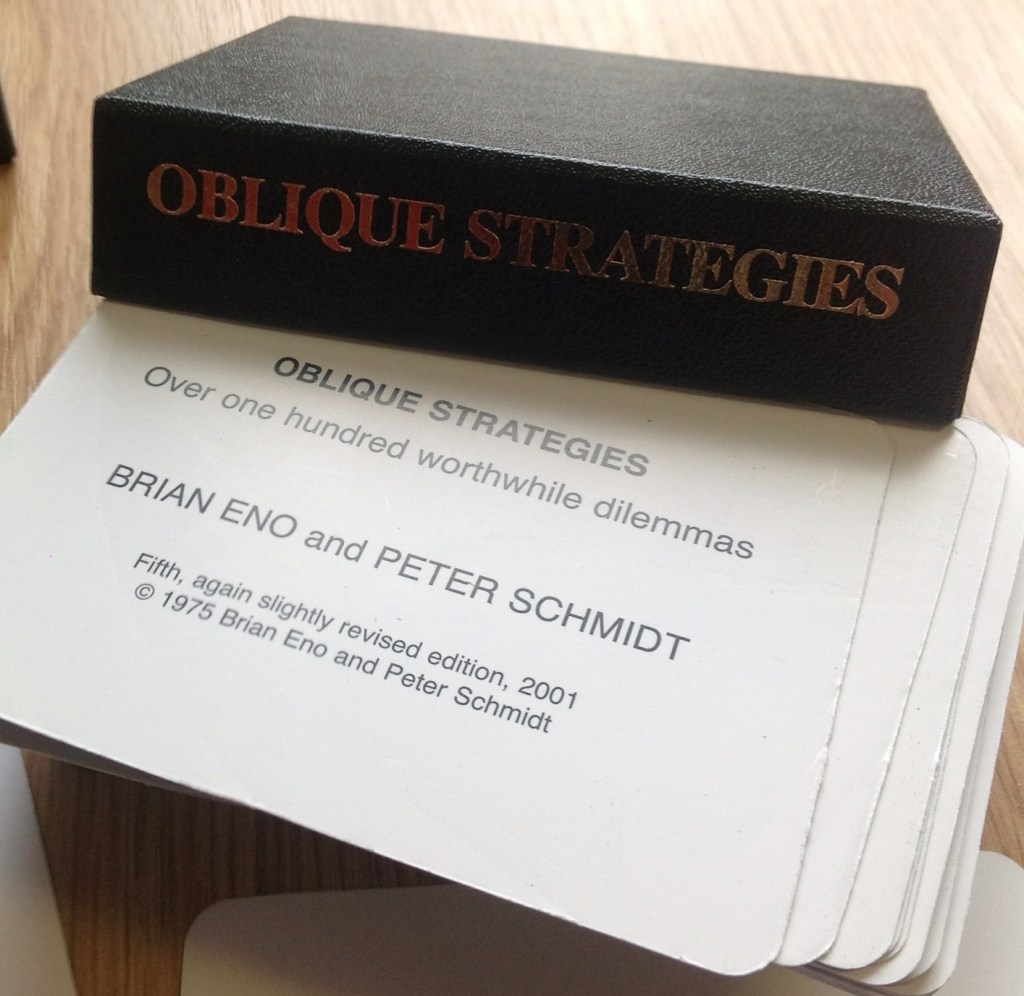
    I must thank my colleague Alastair for introducing me to Oblique Strategies and this BBC Radio 4 programme by Simon Armitage, which I’d recommend. That prompted me to obtain a set of Oblique Strategies cards (2001 version), picture above.

    Oblique Strategies were produced by Brian Eno and Peter Schmitt in 1975 and come in a black box, with gold writing and the top card bearing the words “over one hundred worthwhile dilemmas”.

    It’s when you look at rest of the plain white cards that things start to get a bit interesting, all sorts of ‘oblique’ phrases appear such as:

    • Look closely at the most embarrassing details and amplify them
    • Tidy up
    • Be a gardener
    • Try faking it!
    • Withdrawing in disgust is not the same thing as apathy
    • Not building a wall; making a brick
    • Remove ambiguities and convert to specifics7

    How Oblique Strategies Work. The idea is that you use the cards to jolt you out of familiar thought patterns, and into a mindset where you explore something different. You literally remove a card from the deck, read what’s written on it and have a think about what it means. There are some rules but you will need to get hold of a set of cards to read for yourself (I’m not about to stray into copyright territory here).

    This is essential stuff for musicians (and managers) who are burning up expensive recording studio dollars with the equivalent of ‘writers block’. The cards were apparently used by David Bowie while he was making his Berlin Trilogy of albums (Low, “Heroes”, Lodger) and by the likes of REM and more recently Coldplay. Given the end product of some of these recording sessions, it’s not surprising that in some quarters the Oblique Strategies cards have developed an enigmatic and almost mystical status. It is a bit tempting to think that an oblique phrase on a randomly selected card inspired the latest million selling Coldplay single. The enigmatic status might also have something to do with exceptionally clever marketing and ‘signed limited editions’, given only to close friends.

    So what has this got to do with corporate brainstorming sessions? Well, anyone who has been on a lateral thinking or creativity course; or has read anything by Edward de Bono, will be familiar with the concept of disrupting existing thought patterns. A quote from de Bono, “creativity involves breaking out of established patterns in order to look at things in a different way”, nicely sums up what the Oblique Strategies cards and other ‘disruption techniques; are trying to achieve. The approach has become one of the main techniques used nowadays in the business of stimulating creativity, almost as common as bringing together people with diverse viewpoints and experiences.

    It is interesting to think that a practice with 40-year-old roots in the music industry (and was a bit esoteric and unusual) has now been transferred into the mainstream of business and corporate life.

    Just to shatter the enigma and any illusion of mysticism around Oblique Strategies a bit further, you won’t be surprised to learn that there is an app for Oblique Strategies, as well as a few closely related ‘productivity apps’. I’m actually quite disappointed by that, it feels a bit too corporate and mainstream, and I really enjoyed the feel of the cards.

    Final thought. I wonder if there is any mileage in spotting Coldplay lyrics that could be Oblique Strategies phrases? I’ve always been taken by:

    • “Tigers waiting to be tamed” – Clocks
    • “I’d rather be a comma, than a full stop” -Every Teardrop is a Waterfall

    So, what’s the PONT?

    1. Disrupting existing thought patterns to encourage different thinking and creativity has been around for a long time.
    2. The Oblique Strategies cards have been used widely in the music industry and linked with some very successful artists and recordings.
    3. The approach is being mimicked by the business world, with mainstreaming through the development of apps.
  • 20130815-132854.jpgHaving new ideas, particularly big innovative ones, can be dangerous. Radical thinkers and mavericks have a very long history of being persecuted and sometimes being burnt at the stake.

    Question: Do you really want to be a martyr for your organisational improvement idea? Wouldn’t it be better to achieve positive change by working quietly behind enemy lines?

    There is a (wrongly attributed) quote from John Wesley, “set yourself on fire with enthusiasm and people will come from miles to watch you burn” This might over 200 years old, but you can still look at this from the perspective of modern day ideas, both positively and negatively:

    • Yes, people love my ideas, they are coming to learn and implement; or
    • They hate my ideas and are enjoying the spectacle of me getting toasted.

    The point is, that getting an idea accepted can be a huge challenge, possibly as challenging as coming up with the idea in the first place. Obviously this will vary, depending upon who you need to sell the idea to. I’d suggest it is probably easier somewhere like Google or Ricoh in Telford, than in a huge government department. I did touch on this in a post about Idea Antibodies where I suggested a way of gaining acceptance for your innovative idea was to “pretend you’re not a maverick”.

    Two of the things that happened following the post that are well worth sharing are:

    Good Advice from Mark Braggins: This is good solid advice, I’ve changed nothing here….

    “Sometimes it’s not the idea which is rejected, but the way it’s presented, particularly if the proponent appears to challenge the top leadership.

    • Deploy different tactics according to the nature of the idea, for example:
      if it could save money, approach the lead for that part of the business and talk to them directly, without challenging in public. If convinced, they might volunteer to take it forward.
    • If it’s an innovation idea, encourage an ‘innovation workshop’ and contribute to it. Open questioning may help others come up with a similar, or better idea.
    • If it’s the idea which is important, allow others to think it was their idea in the first place, and encourage them (a sort of constructive Lago figure?).
    • Empathise with the decision-makers, and use language they understand. Avoid technical jargon.
    • Ideas people also need sales, communications & marketing skills to spot the obstacles or blockers and adapt accordingly.
    • Timing can be very important. Pick the time when decision-makers are most likely to be receptive to ideas.
    • Persevere.
    • If all of that fails, but you feel it’s still a good idea, move or start a new business.”

    Good points from Mark that I think just about everyone could agree with. One area where there is some debate, is around when is the right time to move on and leave the organisation? How long do you persevere before you leave or change and become one of the sheep?

    Paul Taylor is fairly clear in this presentation that ‘if they don’t get it’, you do actually need to leave. However, what if the organisation you work for is the only one doing what it does, what if it is the National Heath Service? If you really need to stay and be part of the organisation to make the changes Helen Bevan gives some good advice on how to be a “Boat Rocker”; creating the change from within.

    How to be Boat Rocker by Helen Bevan

    This is a really thought provoking presentation from Helen, Calling All Change Agents. It is 67 slides long, packed with useful information and well worth viewing (several times). Here are three key messages I drew from it:

    1. Don’t be an outlier. This is taken from a Seth Goding quote” the best way to survive as an outlier is not to be one”, or just pretend not to be a maverick.
    2. Be Mundane. There are some thought provoking quotes from Debra Meyerson who wrote Tempered Radicals: “Instead of stridently pressing agendas, start a conversation…..yearn for rapid change, but trust in patience,……….their ends are sweeping, but their means are mundane”.
    3. Build Alliances. Helen’s advice on how to build alliances with people: tell a story, make it personal, be authentic, create a sense of “us” and build a call for urgent action.

    These are just a few snippets. The full presentation is well worth spending time absorbing.

    Finally, you might be wondering about the picture of Miss Marple? In my mind she is a good example of someone doing the mundane; quietly getting to the bottom of things, gathering the evidence, convincing skeptical people, getting people to accept what she has to say. I wonder what sort of ‘change agent’ she might have been?

    So, what’s the PONT?

    1. Life as a radical ideas person can be very difficult. Depending on the circumstances you can get ‘burnt’.
    2. Leaving the organisation is always an option.
    3. If you want or need to stay and make change from within, think about being mundane, patient and doing small things. Work quietly behind the enemy lines.

    Picture Source: Miss Marple (Joan Hickson)  http://agathachristiereader.wordpress.com/2011/05/24/miss-marple-review/

    Linked Posts:

    The original Ideas Antibodies post. http://whatsthepont.com/2012/12/23/idea-antibodies-do-some-organisation-have-an-autonomic-immune-response-that-kills-ideas/

    View of some Big Beasts on the Ideas Antibodies post: http://whatsthepont.com/2013/08/06/are-we-programmed-to-innovate-or-stick-with-what-we-know-welcome-to-the-jungle-and-the-big-beasts/

  • 20130806-230110.jpgLast week I observed something at the edge of my knowledge, a discussion about……, innovation and evolution. A potent combination that elicits strong opinions, and a jungle that I don’t fancy entering. So, I’ll just commentate from sidelines like a ‘low rent’, bloggy David Attenborough…. “experience the thrill of two big beasts slugging it out, blow for blow…..”

    This is how the scene at the metaphorical jungle watering-hole presents itself.

    Typical Friday morning in the jungle. I retweet one of my posts about how some big organisations have ‘ideas antibodies’. I’d proposed that big organisations, (and many people), don’t really like new stuff, and do things to make sure that innovative ideas are killed-off. The analogy of a biological immune system, antibodies congregating to neutralise the effect a foreign body, seemed to fit quite well? It was a post that has been inspired by listening to Dave Snowden.
    A typical morning at the watering-hole with lots of exchanging exciting chatter. Oh and by the way, I then disappear into the undergrowth (work).

    The Big Beasts approach the watering-hole. One of the reasons I’d suggested why there were ‘ideas antibodies’ was to do with evolutionary development. The proposition was that we have developed by sticking with what we know. The best place to hunt for Wildebeest, the best places to gather wild fruits etc. Any attempt to move away from the ‘best’ is met with resistance. Why would we want to risk failure if everything is going just fine? There is the view that this is a successful evolutionary trait has carried on to the current day, something I borrowed from Professor Alf Rehn.

    Enter the Complex Care Wales Big Beast. I know Matt who’s runs @ComplexWales, and he’s a clever guy. Matt likes this sort of talk and is straight on it, diving in with some tweets to support the argument, and take things further. To paraphrase ‘from an evolutionary perspective we are predisposed to accept best practice…… we are more likely to avoid failure than mimic success from elsewhere’ (Matt does write excellent tweets).

    Enter the Ferret Fancier Big Beast. I don’t know @bendean1979, but he’s a Doctor, so he must be clever. Ben offered the counter view that it is actually an evolutionary advantage to accept new ideas and be innovative. Accepting new ideas is what has got us to where we are as a species, all part of the Darwinian ‘survival of the fittest’ theory. Now that seems to make sense to me, except Matt came back with a counter argument.

    So where does this leave me? At times of sparring at the jungle watering-hole, I do find it’s best to align yourself with the biggest beast you know. For this sort of stuff it would be Dave Snowden. It’s always good to back up ideas with some practical evidence and in this video Dave uses the example of the search for finding a method of measuring longitude. Dave describes how the established thinkers of the day rejected an innovative (and very effective) method, which is both sad and illuminating.

    From my own perspective I’ve experienced idea blocking by some Information Technology ‘experts’ in response to open source software and social media. I’ve seen examples where the ‘experts’ have gone from; ignorance to denial to obstruction; and are now promoting it like it was their own idea in the first place. How do you rationalise that sort of massive shift in viewpoint?

    One final thought. When very few people read my blog I never had any of this sort of excitement. I think I need to get more engaged in the conversation when I ‘drop rocks’ into the watering-hole, and not scurry off to the undergrowth. Thanks Matt and Ben, in my view (IMHO), that kind of discussion is what social media should be about.

    So, what’s the PONT?
    1.If you are going to drop a rock in the social media ‘watering hole’, you need to stick around to see what happens with the ripples.
    2. If the big beasts enter the watering hole, either, stay in David Attenborough commentator mode, stand your ground, or find an even bigger beast to hide behind.
    3. I’m sticking with the view there are organisations (and people) with a ‘predisposition’ to have ideas antibodies, and it’s probably an evolutionary trait.

    Photo Source: http://www.flickr.com/photos/orsom/4489375413/

  • 20130728-210823.jpgI recently heard someone being very dismissive about staff suggestion schemes and efforts to encourage small improvements. He was one of those “what you need is a paradigm shift”…..and…., “I’m just the fella to tell you what your big new idea needs to be” types . Oh, and he threw in something along the lines of…. “the old thinking that got you into this problem won’t get you out of it”. Don’t you just love ’em…..

    I’m not against the idea of different thinking and paradigm shifts (here is the definition of paradigm shift, if like me, you don’t really understand what it means).

    What I do think is, that there is plenty of opportunity to make some of our existing things much better. Before charging off to chase the next ‘pot of gold at the end of the rainbow’, make sure you’ve done the best with what you have. Small scale continuous improvement and large-scale change can exist in the same universe. I also think that if you are continually thinking about continuous improvement, this just might help come up with the next big, paradigm shifting, idea.

    Here are three reasons why I think we need small-scale continuous improvement; Squeezing the Pips, Releasing Trojan Mice, and Winning Small.

    Squeezing the Pips. There are huge opportunities to improve how things work. To squeeze out a bit more waste and squeeze in a bit more customer focus. To squeeze out a few more of the time-wasting meetings and squeeze in a bit more product improvement. If this wasn’t true, there wouldn’t be any reason for the dozens of business improvement and Lean consultants selling their services. I think as humans many of us have difficulty with sustaining interest in a topic, which I have touched on previously in a post about longevity. But that doesn’t mean we should stop trying to ‘squeeze the pips’. If you are interested, I’d recommend having a look at what the ‘pip squeezing’, All Wales Continuous Improvement Community are up to.

    Releasing Trojan Mice. Trojan Mice are; safe to fail experiments or pilot projects, small focused changes introduced in an inconspicuous way, or ‘ideas’ let loose to see where they end up. I like the idea of Trojan Mice and have written about them previously. In the context of continuous improvement they are the multitude of small changes that are generated by the people involved in an activity. They are a diverse range of ideas that are worth testing in a safe to fail environment, rather than waiting for the one big idea (from the top) that will save us all.

    Winning Small. Here is a bit of science that seems to fit with what I’m saying. At Academi Wales Summer School this year I heard Professor Ian Robertson talk about the science of winning. You can watch him explain his research in this video. The gist of the lecture was, if you win small things, your brain chemistry is changed, making it more likely that you will go on to win bigger contests. Lots of the examples he used were drawn from sport, but you could potentially apply this to the world of continuous improvement. If you have lots of small successful ideas, this prepares your to have bigger more successful ideas.

    Keeping the Engine Turning. A final thought about some of the things I’ve heard about staff suggestion schemes on the Ideas UK Networking Meetings I’ve attended. I’ve heard it mentioned many times that small incremental changes are necessary to ‘keep the engine turning’ and maintain momentum. At Ricoh for example they say that about 80% of the improvement ideas suggested by the staff are quite small things. These are the small acts of continuous improvements that are implemented at team level, ‘that keep the ideas engine turning’. This level of activity is necessary to support the generation of the 20%, ‘big ideas’.

    Small ideas are important and they do count.

    So, what’s the PONT?

    1. Think hard about improving what you’ve got already, before chasing ‘pots of gold at the end of the rainbow’.
    2. Winning with small continuous improvement ideas can help to set you up for the big winner.
    3. Staff who are closest to the action, with deep experience, are best placed to come up with improvement ideas, rather than from ‘Mr New Paradigm’.

    Picture source: It’s actually one of mine.

  • 20130721-170009.jpgWarning. I’m going to talk about Love in a minute, nervous types can look away now.

    What does an organisation that is founded on ‘The Spirit of Three Loves’ look and feel like? How does love make any difference in a culture of continuous improvement? Surely it’s all about; logic, process, systems, targets and driving efficiencies, isn’t it? Well I don’t think that’s necessarily so….. this is why.

    Last week I had a visit to one of my favourite manufacturing sites, Ricoh in Telford, as part of an Ideas UK Networking Meeting. The official purpose was to learn about continuous improvement and employee engagement. My objective was to learn about love.

    The success of Ricoh is self-evident. Just go to reception and look at the cabinets full of awards recognising what they do. When you go beyond the ‘shop window’ however, you start to see some of the things that contribute to the success, including love.

    A while ago I learned about the Ricoh Spirit of Three Loves and wanted to see what it meant it for myself. I found it, prominently displayed in a meeting room.

    20130721-170026.jpg

    The 3 Loves are the founding principles of Ricoh which were created by Kiyoshi Ichimura back in 1946.

    67-year-old Japanese founding principles are great, ‘in principle’ but what does ‘the spirit of love’ look like in Telford in 2013? These are my observations:

    • People look you in the eye. When you meet people or walk around the factory people will ‘eyeball’ you. Not in a suspicious ‘what are you up to’ way, but more with a ‘twinkle’ that is about enquiry and saying, ‘hello, you are someone different, can I help you’? Perhaps this has something to do with ‘Love your neighbour’?
    • They constantly look at ways to improve. The whole point of the visit was to learn about continuous improvement. Examples of activity to understand the work and improve it were everywhere, including my favourite, Gemba Mat. On a previous visit I remember watching people at work. Team members would take the initiative, step in to help others, go beyond what was ‘required’ of the job. People do seem to ‘Love their work’.
    • Recognition is everywhere. From the Kaizen Forest, to the Monthly Team Awards, to the Hall of Fame, to the Trophies in Reception and the ceremonial spades, everything good is recognised. I spotted awards going as far back as 2002 in the Hall of Fame. This wasn’t because they couldn’t be bothered to take them down, it was deliberate. A bit like the prize winners board at a school, or captains’ list in a sports club it gives a sense of achievement and longevity. That sense of longevity, ‘we are doing this for the long term’ may well a consequence of the founding principles of love.

    This ‘Spirit of the Three Loves’ approach is quite different to what I see on many of my travels. Dan Slee recently wrote this post about about what torn carpets and poorly maintained shops tell you about a high street retailer. You can sense a lot from the physical environment and the people you bump into at an organisation. Do the people love what they do? Do they love you as a customer or service user? I have heard people say how much they hate their jobs or organisation. If that view really is true, I do wonder about the quality of what they produce.

    One of my fellow visitors commented on how the feeling at Ricoh was completely different to some places we both knew, ‘Zombieland’ was the phrase we used. I’m sure many of us will have seen our own Zombieland:

    • Desperately ugly buildings in poor locations;
    • Reeking of neglect and poor building maintenance;
    • Receptions areas like a high security prison;
    • Symbols of fear and oppression everywhere (DON’T! signs); and
    • Zombie staff. People with no spark of life, shuffling around corridors aimlessly, never making eye contact and wishing for the end of the flexi-time period to go home.

    A final thought. I saw Robert Holden speak at Academi Wales Summer School recently about the importance of love. He was great to listen to, but I couldn’t quite visualise what it looked like in the workplace. I think the visit to Ricoh has helped with that.

    So, what’s the PONT?

    1. A continuous improvement culture is about more than just logic and processes.
    2. How people feel about each other, their work and the organisation play a big part in any culture.
    3. Talking about principles, values and culture in terms of love (something most people seem to recognise), might be a good thing.

    Just a small part of the Ricoh Hall of Fame, and some ceremonial spades. Good things are recognised.

    20130721-165938.jpg

    20130721-165951.jpg

  • 20130714-103822.jpgBe honest and own up …….. Have you have ever sent a really horrible email to a colleague at 5pm on a Friday evening? Then, made it worse by switching on ‘out of office’, shutting down the computer and going away on holidays for two weeks?

    It’s like throwing an email hand grenade over the wall, and running for cover.

    Going away on holidays seems to be a trigger point for this sort of activity. You know how it is,….. ‘I won’t be here for two weeks to feel the pain this is going to cause,….. I might as well throw it over the wall …… and see what happened when I get back’. There must be a German word for this, something a bit like Schadenfreude.

    Being on the receiving end of this sort of behaviour has occasionally sent me into an apoplectic rage, which was probably the intended impact. And, before anyone asks, YES, I am guilty of it…. in the past, when I didn’t know better. Confession is good for your soul, but only if you recognise your bad behaviour and change your ways.

    With holidays approaching here six email hand grenades I think you should avoid sending just before you leave for Porthcawl or Portugal.

    1. I couldn’t be bothered to read this. Here is an email with a mountain of document attachments. I’m not quite sure if there is anything useful in them. If I send them to a dozen people, with some vague ‘see attached’ comments, someone might look at them in detail. Hopefully they will find the ‘diamond’ and I’ll then get the credit.
    2. Dump your backlog on someone else. Seen quite often. It’s those things you have held onto because ‘you are the best person for the job’, but never quite got around to doing the work. It was once important to you, now it doesn’t matter so much, so over to you…..
    3. The too hard to do. Complicated and difficult things you are supposed to do, but just can’t work out how. Here is an unsupported ‘development opportunity’ for someone else.
    4. Please have my difficult conversation. Something you should have done but couldn’t face. A great opportunity for someone else to deal with a difficult situation.
    5. I’m sorry, but…. The very worst kind of email hand grenade, giving someone some bad news, then running away.
    6. We are restructuring…. This one wins the prize as they move the hand grenade into WMD territory, ‘weapon of mass demoralisation‘. They are generally sent by a corporate lacky, just before major holidays and festivities …. ‘Here are the results of the restructuring consultation…….’ What are they thinking?

    The answer is pretty straightforward in my view. Don’t throw email hand grenades. If it is difficult and you need someone to do deal with it whilst you are away relaxing, go and talk to them about it. Otherwise, don’t bother.

    The thing to remember about hand grenades, is that occasionally they bounce off the walls and rebound back into your lap. You wouldn’t want that, would you…….

    Late News. I’ve just had the following situation brought to my attention. Apparently some people thoroughly deserve an email hand grenade, preferably just before they go on holiday.  I couldn’t possibly condone that (sounds a bit like schadenfreude to me) unless perhaps in extreme circumstances……..

    So, what’s the PONT?

    1. Sending horrible emails and going away on leave is like throwing a hand grenade and running for cover.
    2. Bad behaviour usually begets bad behaviour. If you throw email hand grenades, expect some in return.
    3. It’s a straightforward choice…….don’t do it.

    Note: A hand grenade is any small bomb thrown by an individual. It’s a personal act of aggression, just like pressing the email ‘send’ button could be if you get it wrong.

    Picture source: Hand grenade purse, great for coins, keys and virtually guarantees being questioned at airport security.  http://laughingsquid.com/a-key-coin-purse-that-looks-like-a-hand-grenade/