• IMG_4594

    Can you see the Rabbit and the Duck?

    Try turning the screen through 90 degrees – then back again.

    Right, fun over, back to the serious stuff. Hands up if you hear this phrase, chanted out at just about every meeting you attend nowadays. It’s a new mantra that started creeping into widespread use about 2 years ago…. now it seems to be everywhere;

    “We need evidence to support our decision making/practice/thinking/anything else you can think of….”

    Nothing wrong with that statement a first glance, but two things agitate me slightly:

    1. What on earth did we do before the new ‘creed of evidence’? Did we just make things up? I don’t think so. In the world I know gathering ‘evidence’ and using it has always been a big part of everyday business.
    2. (This might sound a bit sceptical….) Many of the people who say, “we need evidence…..” actually mean; “I need only the evidence that supports my decisions” (based on my beliefs, perceptions and bias).

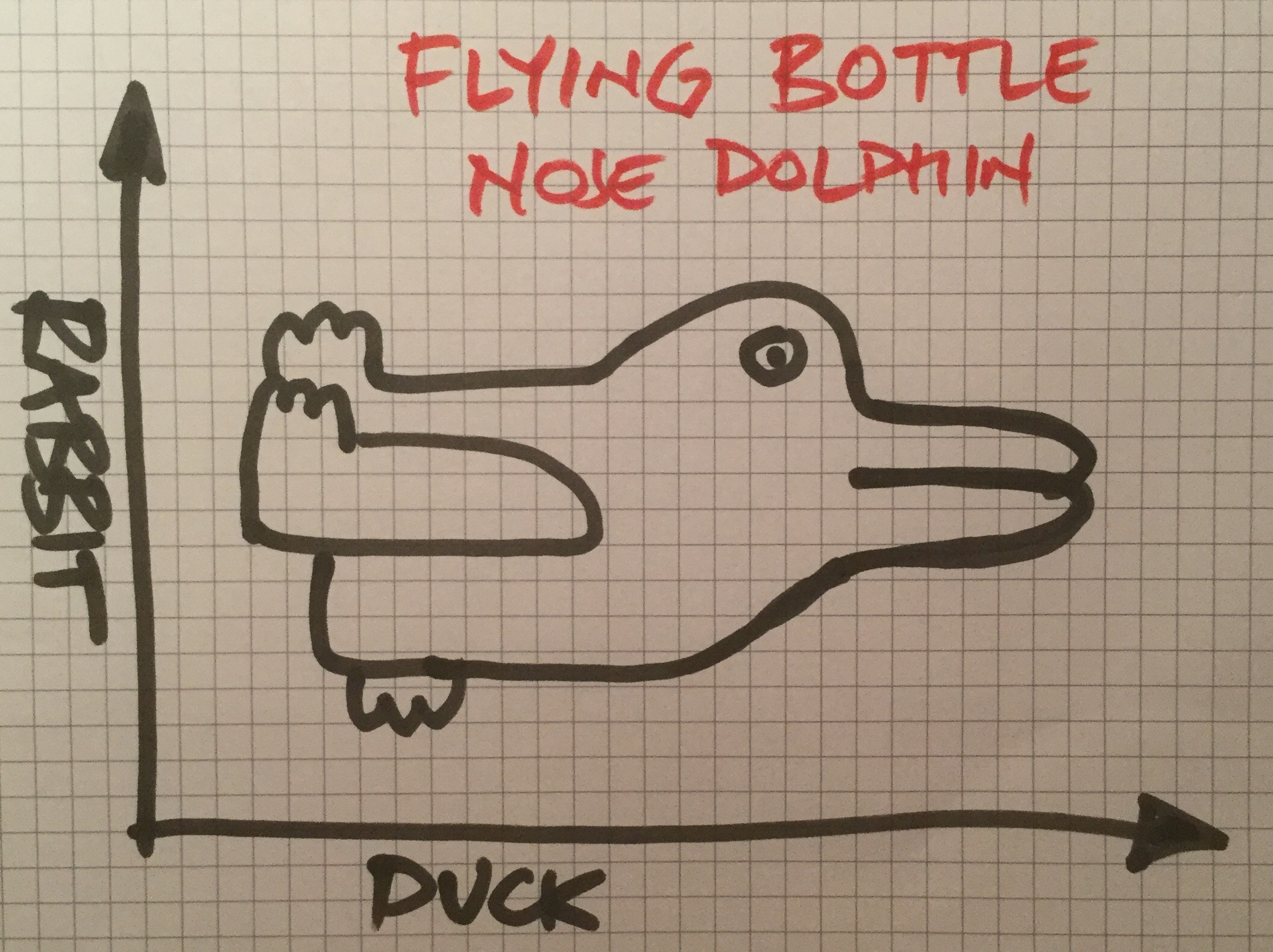
    What has Evidence got to do with Rabbits and Ducks? One of the things that occasionally gets used in the ‘evidence’ debate is the Rabbit Duck Index (see graph above).

    The people who use it are generally trying to get across the point that evidence is important, but it is also important to recognise which angle you are looking at it from (Rabbit or Duck?). When you link that idea to the fact that; we don’t necessarily collect all of the evidence available, some of it might be incomplete, some of it might be contradictory or ambiguous and there might more than one ‘right’ answer, it’s a complex situation.

    Evidence in our complex world is not always binary (yes/no), black or white. There is lots of grey and ambiguity that needs to be recognised. I did touch on this previously when I wrote about The Ladder of Inference and Expert Bias.
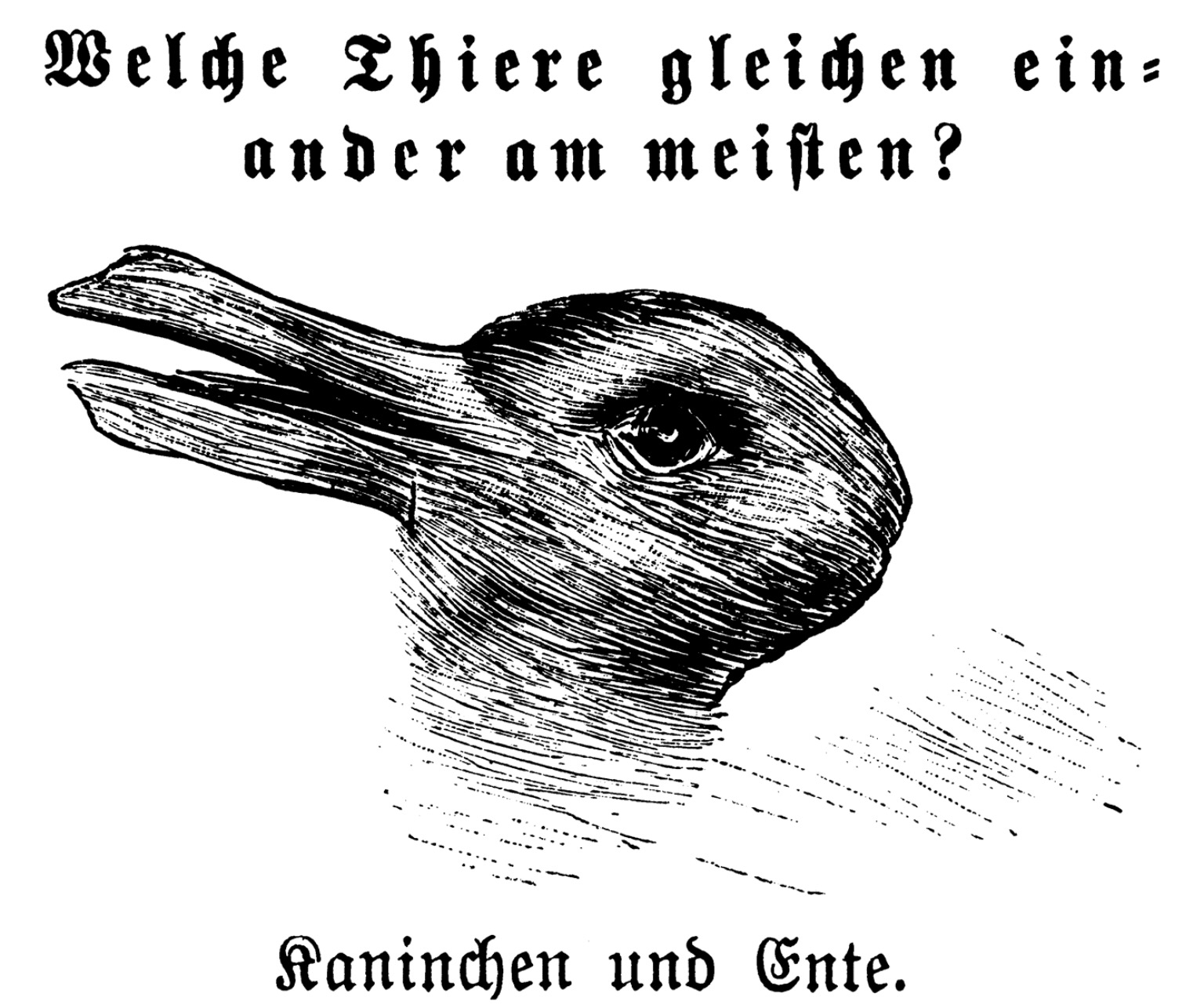
    IMG_4597The original rabbit / duck illustration (link here) can be traced back to 1892 when it appeared  in a German magazine, Fliegende Blatter.

    From there it was picked up by a series of Psychologists who used it in studies of perception.  This Wolfgram Mathworld article has a helpful reference list to many of the studies where it has been used.

    My favourite is the study where children shown the picture in the spring (Easter) see the rabbit, whist children shown the image in the autumn (October) see the duck (explain that one….).

    The rabbit/duck picture is a really useful illustration that perception is important, but I’m not always sure that the very important point that it makes generally sinks in. The ‘Rabbit Duck Index’ is often dismissed as a party gimmick and then its back to business as normal.

    Knowing and Doing are Different Things. Thinking about the better use of evidence, is seems that ‘knowing’ there are different ways of looking at the evidence is an important first step. If you actually recognised there might be a different way of seeing the evidence, you might take those views on board – or at least try an understand them.

    This isn’t easy. Smarter people than me have been looking at it for ages. However, it did occur to me that if you learned to think about different points of view at an early age it might help you in later life. When presented with evidence at the Board Room Table you might take a look at the range of views?

    This where I bumped into the brilliant Duck! Rabbit! book by Amy Krouse Rosenthal. Basically it’s the Duck or Rabbit conversation, held by two small children, each using the evidence they have available. Have a look at the short video of the book at the end of the post which summarises it beautifully.

    From the reader comments on Amazon (here) it appears that the book is being read a lot to 2 and 3 years olds (mostly by grandparents). This might mean we have future generations with a wider understanding of the complexities of ‘evidence’, and are prepared to see it from other perspectives. I hope so.

    So, What’s the PONT?

    1. A lot of effort is being directed at collecting and using ‘evidence’ in public services, but not all evidence is equal and it often isn’t ‘black and white’.
    2. We need to understand that people with different perspectives will see things differently and we need to recognise that they might be just as ‘right’ as our own interpretation.
    3. The Duck Rabbit Index is a useful illustration, which could be used in the workplace to raise the issue and help with ‘knowing’ (followed up by the Duck! Rabbit! book video).

    Video of the Amy Krouse Rosenthal book: Duck! Rabbit!

    Thank you to Olwen Williams (@OlwenOlwen) who provided another perspective on the Duck Rabbit Index Graph. Based upon the available evidence Olwen has suggested an alternative, a Flying Bottle Nose Dolphin. I can see that, it was probably in my mind when I drew it……
    IMG_4602


  • The Experiment So Far.  On January 1st I started a personal experiment to try and record some of the interesting things I bumped into most days. The thinking behind it is explained here: An Experiment for 2016 #TiL253.

    What I’ve learnt so far:

    • The figures: Between the 1st – 9th January I posted 8 TiL’s using #TiL253.
    • I managed to record two number 6’s – so missed out 7 and jumped straight to number 8 (not my best effort at counting).
    • It’s probably too early to try and make sense of the 8 TiL’s I’ve collected, something for bigger numbers.
    • I’m still trying to work out how I collate and summarise what I’ve got. At the moment I’m looking at something like Storify, which might help to tidy up the Twitter search of #TiL253, which even at this early stage looks a bit messy.
    • Helpfully, I was guided through Trello last week (by @ComplexWales) which looks like a neat way to manage the  organisation of the TiL’s I’ve gathered. More on the development of that in future posts.
    • People: People have been both interested and helpful, which has been great, thank you.
    • Collecting the TiL’s has been far easier than I’d expected. There was only one day in the first week when I was so ‘head down’ and absorbed in doing something that I didn’t get around to identifying something I’d learned (I probably did, but I was too mentally exhausted to record it).
    • How the TiL’s emerged. There’s no obvious pattern yet, but for the record, here are this weeks #TiL253’s

    IMG_4553

    The Goldilocks Zone – this emerged as I was writing the post to introduce #TiL253. One of my kids was astonished that I didn’t know this piece of basic interplanetary theory.


    IMG_4552

    Archie Cochrane X-Rays in the Rhondda.

    This popped up after aTwitter exchange about TiL with Sian Jones (@evidentlysian). Coincidentally I’d recently had a conversation about the Cochrane archive with my cousin who works in Llandough Hospital where it lives.

    IMG_4551


    Ageing Well in Wales. 

    This did pop up in work related conversation, but it’s also of a personal interest, if you know what I mean……. (worth a read).


    IMG_4560


    “Do. Or do not do. There is no try” I genuinely did no know this Yoda quote…..oh the shame I feel….. first Goldilocks Zone, now Star Wars entry-level material.

    The Yoda quote popped up in a #TiL253 related Twitter conversation, where I was completely clueless (so I stayed quiet and kept my head down for a while – always best on Twitter I find).

    Thankfully Usha Kuchimanchi (@learntodoc) saved the day and explained the reference. It’s opened my eyes to a new world of Yoda quotes….


    IMG_4561

    General Stanley McChrystal. ‘We should lead like Gardeners.’

    Another one that emerged from #TiL253.

    Thanks to @tamsinStirling1 I ended up listening to a very good BBC Radio 4 programme on the Future of Leadership by Margaret Heffernan.

    The interview with Stanley McChrystal and the quote about leadership being like gardening seemed perfect.


    IMG_4558

    Extensivists.  Popped up in a work conversation – I was truly astonished by this word.

    So have a few people I’ve tested it on.


    IMG_4559


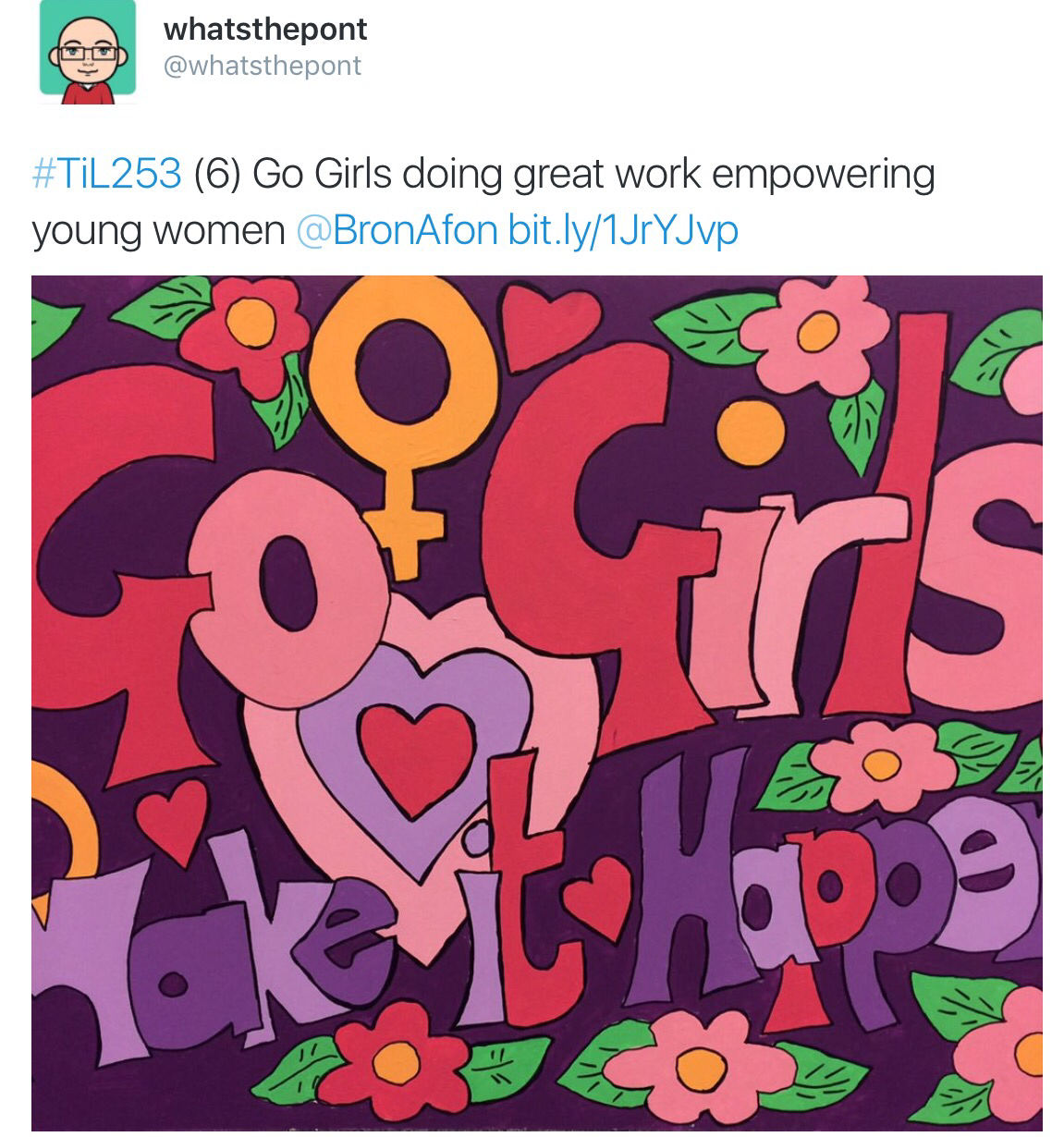
    Go Girls (Bron Afon Housing).

    This was my second number six – but probably a refection of my over enthusiasm

    This came from a Randomised Coffee Trials (thanks David Gurteen) conversation and is an example of something I wanted to remember and share.

    I did share it, with some people who found it very helpful to know about what was happening with Go Girls, hopefully that might also help Go Girls.


    IMG_4557

    Keynote Listening. (no number 7, straight to number 8)

    I love the idea of Keynote Listening and getting the ‘Sage off the Stage’. It came from a work conversation and is something I’d like to follow up.


    That’s it for my first week of #TiL253. I’m not sure if this summary format works. I’ll have a look at Trello and Storify to see what the future alternatives are.

    So, What’s the PONT?

    1. People have been very interested in #TiL253 and generous in providing support and advice, thank you.
    2. I’m still not sure about the best way to collate and summaries what I’ve learnt. More to follow on that.
    3. There’s no obvious learning, pattern or ‘meta’ understanding emerging yet. I think I need a fair few TiL’s for that to happen.
  • This is an Experiment. I’m having a go at recording some of the interesting things that cross my path.

    It’s called #TiL253. Today I Learned (TiL), I’ll explain the # and the 253 in a minute.

    Why Bother?

    • Most days I; read about / get told / overhear / observe / randomly discover interesting things
    • Most days I forget them by bedtime
    • I want to see if I can record them (the most interesting ones) in a reasonably organised way
    • If I share them, people can then have a look to see if they also find them interesting
    • At some point, I can have a look back to see if the ‘interesting things’ add up to anything useful, or ‘interesting’

    How will it work?

    • I’m going to use Twitter to share the interesting things I’ve collected
    • This means I have to keep it short – it don’t want to burden anyone
    • A twitter hashtag means I can keep track of what I’ve been doing
    • #TiL253 appears to be an uncommon hashtag

    Why #TiL253?

    • TiL = Today I Learned
    • 253 = a number of TiL’s I’m aiming for
    • Why 253? (there is a bit of logic to this)
    • I didn’t want to be tied to a time period – like a year
    • But, there are 365 days in a year
    • I don’t want to be committed to ‘working/thinking’ about this all of the time
    • There 52 weekends and 8 Bank Holidays when I can ‘rest’
    • 365 minus weekends and Bank Holidays = 253
    • It’s a challenge to reach 253, but achievable (I think) – time will tell
    • 253 could be a ‘Goldilocks Number’
      • Not too big (unachievable)
      • Not too small (a bit trivial, not enough of a challenge)
      • ‘Just Right’ (ha ha ha, ‘The Goldilocks Zone’ will be my first #TiL253)
    • As I go along I might turn some of the #TiL253’s into blog posts which I’ll post on this page

    It might all go horribly wrong………
    My first #TiL253 – The Goldilocks Zone – ‘something in just the right place’.

    Also known as the circumstellar habitable zone (CHZ), see NASA , The Goldilocks Zone for more details.

    There’s more about the CHZ / Goldilocks Zone in this Wikipedia Article where you can also find this image from the European Southern Observatory.

    IMG_4517


  •  

    Moai - buried, but that one looks a bit toppled Moai – buried, but that one looks a bit toppled

    I’m thrilled with my latest T-Shirt purchase,“something buried in the dirt cannot topple”, it’s all about the slogan…..

    My interpretation; if you are deeply involved to something at a practical level (buried in the dirt), you are less likely to be easily disrupted (toppled) by external forces or events.

    I’m sure we could spend many enthralling hours talking about the purpose of metaphors and the ‘real’ meaning of that statement, but we can’t. What I did want to talk about was the idea of ‘The Bosses’ in organisations being involved in ‘frontline’ activities (buried in the dirt) by participating in a few mystery shopper activities.

    Undercover Boss, Back to the Floor. I’m sure you’ve seen things like; ‘Back to the Floor’ and the ‘Undercover Boss’ programmes. The basic ‘plot’ is that the Boss, goes undercover at their organisation (usually doing a low-level job) and finds out astonishing things. It’s typically a mixture of good and bad, but any TV producer who knows the tricks will have some of the following:

    • Superstar frontline workers doing a brilliant job, despite –
    • Daft policies and processes that work against good sense*,
    • Dodgy Managers / Co-workers who exploit / bully the good people*,
    • An amazing insight that will save the company / make them all superstars*.

    All of these examples (*) provide a brilliant opportunity for the Boss to ‘make things right’ through inspired leadership (it is telly after all). Despite the twists that TV programmes might introduce I think that bosses getting involved in front line activities are potentially a very good thing. My reasoning is fairly straightforward:

    • If you experience the practice you better understand how it actually works,
    • Better understanding helps you make better ‘strategic’ decisions,
    • You’ll leave people alone to get on with the things they are good at,
    • People doing the job will (hopefully) have greater respect for your decisions because you understand their situation, and
    • People might like you more (because you get your hands dirty).

    I do however realise that it’s not that easy to go ‘back to the floor’ or ‘undercover’ in lots of organisations. Being known/recognised, the ability to perform specific skilled tasks and available time are a real things that work against it. You probably wouldn’t want your Hospital Director of Finance, ‘undercover’, helping out with a kidney transplant. But that doesn’t mean we shouldn’t try something else.

    IMG_4437Try Mystery Shopping. This is why I’m recommending the ‘Mystery Shopper’ route.

    Why not have a look at things from the perspective of someone on the receiving end of your organisation? There’s a lot to be learnt.

    With this in mind, here are 3 mystery shopper tasks every Boss (anyone with Executive, Non Executive, Director or Chief in their title) could try, at least once a month I’d suggest. They’ve been carefully chosen because they are relatively easy to do. Something that might take no more than 10 minutes during a lunchtime, without even having to leave your desk – so no excuses. Please try to:

    1. Apply for a job online
    2. Make a telephone enquiry
    3. Complete your expenses online (by yourself)

    Apply for a job online. I’ve observed some people in the 18-25 age group going through this activity recently. It’s fair to say that the experiences range from brilliantly smooth to unbelievably torturous. Given that so many organisations are using online methods to recruit new people it really is worth experiencing ‘how it feels’. If staff really are your greatest asset, and the future of the organisation depends on them, what is their first impression? How do you feel walking away from the online recruitment process? Is this what you want the ‘future’ of the organisation to experience?

    Make a telephone enquiry. This is easy. Just think of something somebody might need from your organisation, or a question they might ask. Then just make a call as a ‘member of the public’ and see what happens.

    DON’T USE YOUR DESK PHONE – that might give the game away.

    Someone recently told me of their experiences of doing this with an organisation they were working with. The results were awful: hugely complex phone dialling systems, waiting for ages, getting cut off and when they did eventually speak to someone they were given wrong information. This was a middle manager phoning in as part of some training. They (and definitely the Chief Executive) had no clue that things were so confusing for service users.

    Have a read of this blog post by Kate Bentham, Channel Shift or Channel Shove?, to get the feeling of what she experienced when she tried making a telephone enquiry.

    Complete your expenses online. This doesn’t have to be your expenses. Just try to do anything your organisation mandates that staff perform online. This is particularly effective if it is something usually be done for you by your Personal Assistant. A bit of ‘mystery shopping’ of what that the people on the ‘frontline’ of the organisation have to grapple with. Have a go, you might be thrilled.

    Disclaimer: none of the above is foolproof. Wrongly applied it could be perceived as; meddling, micro-management or even harassment and spying.

    It just seems a better alternative to sitting isolated in an ‘Ivory Tower’ waiting to be toppled. Better to have a bit of you ‘buried in the dirt’.

    So, What’s the PONT?

    1. Practical experience of what happens in an organisation can help you better understand and appreciate what it takes to do the job. This can help you make better decisions.
    2. Going ‘back to the floor’ and becoming ‘buried in the dirt’ can be difficult to do, for many reasons.
    3. Doing some mystery shopping could be a relatively easy alternative that will give you a different perspective and possibly some valuable insights.

    Picture Source: Easter Island Heads have bodies buried underground.

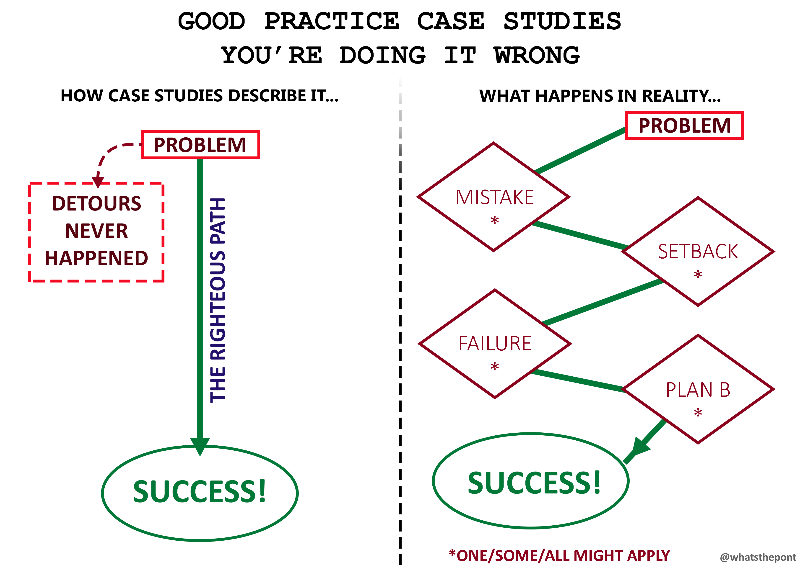
  • IMG_4391Good practice case studies are like Hollywood movie trailers…… they only show you the best bits of what happened (with some exceptions).

    Sorry if that’s upset anyone, I am trying to be helpful.

    There is a great deal that can be learnt from the things that ‘didn’t quite go to plan’ (failure in many cases). However, in most examples you don’t generally get to find out about these golden nuggets of learning.

    That’s a Bleak View of the World.  Well, I do go to a lot of conferences and seminars, where I listen to lots of people presenting their good practice case studies. I also read lots of case studies on a variety of topics (for good reasons, it’s not an obsession or anything).

    The one thing that strikes me about ‘Good Practice Case Study Land’ is that,……Nothing Every Goes Wrong!

    OK, I’m exaggerating a bit, but things hardly ever seem to go wrong in case studies, particularly when they are written down and presented at a big conference, or even a modest workshop with colleagues.  It’s not quite the world I experience where mistakes, errors and deviations are part of everyday life.

    I’m not suggesting that the people who are presenting their ‘perfect’ good practice case studies are fibbing, or are committing any sort of terrible crime. To use the Hollywood Movie analogy, the case studies are just a ‘trailer’ for what actually happened.

    When you condense weeks, months or even years of work down into 800 words or 15 minutes on stage you have to leave things out. Dropping the less glorious events (things that didn’t quite work to plan) feels like a very reasonable thing to do.

    Did anyone suffer? The point I’m trying to get across is that by not including any of the things that didn’t work (or failed), we aren’t helping people who might want to learn from our experience. if they don’t know about our pitfalls, mistakes and failures, they will probably make them themselves. I think it would be nice if we saved them some suffering.

    An unexpected benefit could be ‘helping’ those people who seek, ‘simple quick fixes’, understand that transferring good practice might be a little more complicated in reality. You might have experienced one of them, racing back from a conference (literally, in the car talking excitedly over the phone) insisting on the implementation of some latest ‘good practice’. Not fully recognising some of the complex issues (and failures) that sit behind the 15 minutes of highly polished case study they have experienced. If you are ever on the receiving end of some of this behaviour just ask, “……did they mention any failures or setbacks?”

    So, what’s the PONT?

    1. Good Practice Case Studies are like Hollywood Movie Trailers – they show the best bits and there’s usually a lot more going on.
    2. It’s rarely a straight line from problem to solution. Failures and mistakes happen, which are golden learning opportunities – we need to share them.
    3. If you are presenting a good practice case study, do introduce some failure. People might like you more – honestly, it’s called the Pratfall Effect.

    Disclaimer. For Matt Wyatt’s friend Gareth (who works on Oracle programming in the basement), the sequence in the graphic of things going wrong is not prescribed. It is only an illustration. These are things that might happen. You could have; just one of those things (an almost perfect project), all of those things, or 77 of them in a long line (a bit like Edison’s 1000’s of lightbulb attempts). It’s just to get the idea across. Apparently though there is a formula for failure and success in IT startups, mainly in California. Thanks to Dave Snowden for sharing this. For a successful Digital Startup you need to:

    • Socialise the Idea (talk to people about it),
    • Fail 3 times,
    • Pivot (a sort of Plan B / do something completely different), and
    • Success!

    Finally: Thanks again to Matt Wyatt who put me onto this; Honest Trailers on You Tube by Screen Junkies.  A warning….. you can easily lose hours of your life watching these ‘Honest’ Trailers for Hollywood blockbusters. Some of my favourites; The Hunger Games, Aladdin and Love Actually (link below).

    These Honest Trailers helpfully remind us of the gap between the ‘glossy promise’ of the trailer and the actual reality of the movie. A bit like many good practice case studies. While you are enjoying them, have a think, do you have any examples of good practice case studies where the reality wasn’t quite as glossy? (please let me know).


  • I love this; cruel but fair
    I love this – cruel, but fair

    The recent VW emissions scandal has brought together two interesting ideas, corporate amnesia and learning from failure.

    Instead of learning lessons from failure and retaining them in the corporate memory (so you don’t make the same mistakes in the future), what if organisations adopted the opposite approach?

    What if an organisation took action to deliberately forget failure, accidents and mistakes (and wrongdoing); so they were free to repeat the practice in years to come? Deliberate corporate amnesia, sounds a bit unlikely? Do read on……

    Corporate Memory Loss. At the moment there’s a fair bit of angst in (some) organisations about ‘corporate memory loss’. You know the sort of thing; a financial crisis appears, and the response is to offer lots of people severance and/or restructure. The result is that people with many years of knowledge, skills and experience walk out of the door, taking with them what gets referred as ‘corporate memory’. The potentially negative effects of this loss of knowledge are fairly obvious, which is a bit strange when you think about how often so little is done to retain some of that knowledge.

    Shelves full of (failed) products at GfK Custom Research
    Shelves full of (failed) products at GfK Custom Research – aka The Museum of Failed Products

    When you combine this organisational loss of knowledge with learning from failure things get interesting.

    The Museum of Failed Products (which I’ve mentioned before) is a good example. Basically its vast collection of consumer products produced over the last 40+ years. All neatly arranged on the shelves of a huge facility in Anne Arbor, Michigan, it serves as reminder that most new consumer products (8 out 10 it’s claimed)  don’t succeed.

    A secondary feature is the ‘rediscovery of lost corporate memory’. Apparently it’s not uncommon for a Product Developer/R&D Scientist; new to ‘Company X’ (and bursting with ideas) to browse the shelves and ‘discover’ that Company X tried that product idea 10 years ago, and it was a complete failure. A classic piece of corporate amnesia.

    IMG_4243Meanwhile at Emissions Test Center…. Bringing things right up to date it turns out that VW aren’t exactly strangers to the world of engine emission ‘defeat devices’. Way back in 1973 they ran into trouble with the US Environmental Protection Agency (EPA) for using emission defeat devices.

    Megan Geuss has written a fascinating article in Ars Technica UK, ‘Volkswagen’s emissions cheating scandal has a long, complicated history’, which brings together all the key facts. To be fair to VW, they weren’t alone in this sort of practice (but you probably suspected that anyway).

    The picture above, with ‘defeat devices’ written in the margin is from the 1973 EPA press release, well worth a look.

    The point is, that in 1973 VW were involved in activities that have a very similar odour to the emissions cheating scandal that has happened 42 years later. Did they learn nothing from 1973? Have they forgotten the (‘not an admission of guilt’) payment of $120,000 they made to the EPA?  Surely, there must be some story about ‘1973 and the EPA’ floating around VW? There must be some crusty old engineer lurking in an obscure department that remembers it well? Apparently not………

    Forgetting is Hard Work. As it turns out there may be a phenomenon of deliberate ‘forgetting’ in some organisations. Researchers (Sebastien Mena et al) at The Cass Business School in London have written this paper ‘On the Forgetting of Corporate Irresponsibility’ which gives a through analysis. If you fancy something shorter have a look at ‘VW and the never-ending cycle or corporate scandals’ from the BBC. Professor Andre Spicer at Cass is also worth looking at on twitter (@andre_spicer)

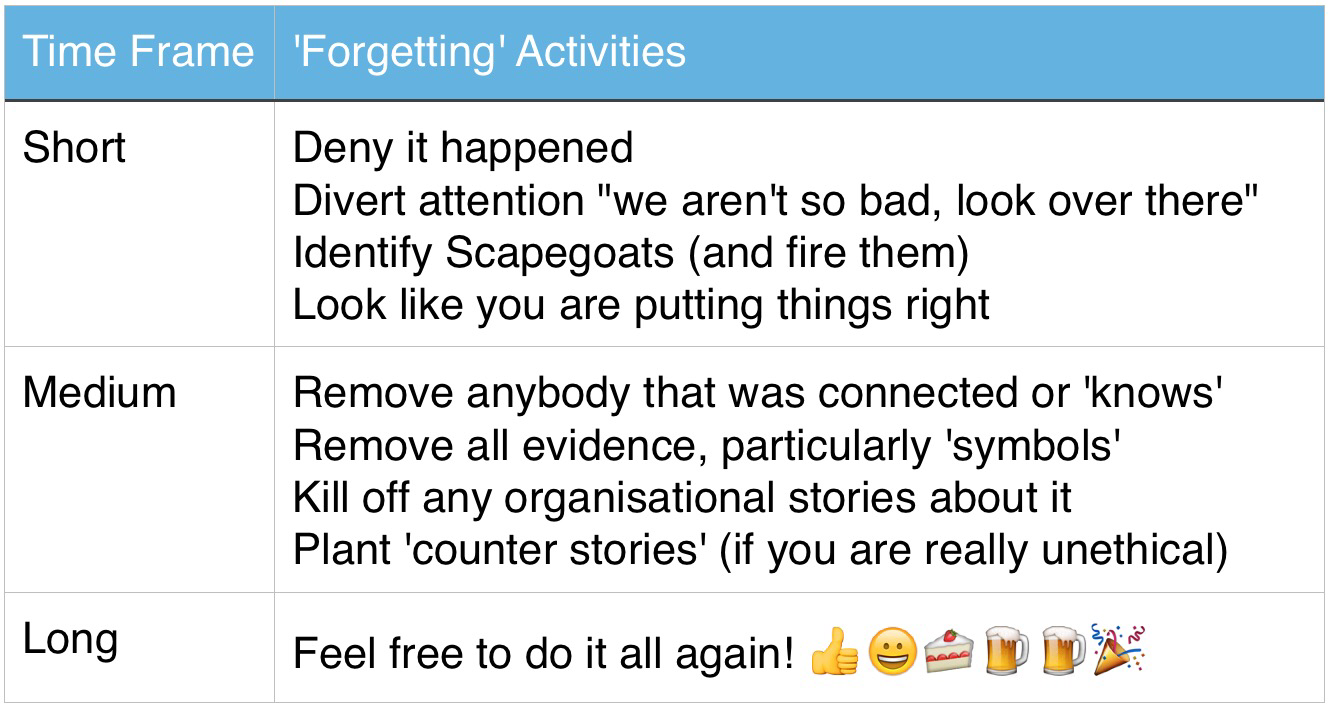
    What this all boils down to is that it takes hard work and some determination to ‘forget’ a corporate scandal. The table below provides a helpful (non academic, very loosely based upon what I’ve been reading) summary. Do see if you recognise anything from organisations you have worked in.

    IMG_4260

    Remember, all of this ‘forgetting’ this takes time and quite a bit of deliberate effort – it doesn’t feel like something that happens by accident. So, you have to ask the question, “Is it worth the effort?”

    So, What’s the PONT?

    1. Corporate memory exists and can have a negative as well as a positive effect.
    2. ‘Forgetting’ corporate memory requires a deliberate effort, and I would suggest it probably isn’t worth it in most cases.
    3. Better to remember the lessons, to avoid repeating the mistakes of the past.
  •  B17 Flying Fortress Checklist, 1944
    B17 Flying Fortress Checklist, 1944

    This isn’t an anti-checklists post.

    It’s an illustration of why picking up an example of good practice in one location, and dropping down in another doesn’t always work. No matter how brilliantly conceived, beautifully constructed or obviously ‘good’ the original good practice might be.

    So, next time a politician or clever speaker at a conference tells you “it’s just a simple matter of transferring good practice”, please ask them; “what about Atul Gawande and the Hospital Checklists?” (and then get sacked or thrown out of the conference).

    Checklists are a good thing. The thinking behind checklists is difficult to argue against. Basically a checklist breaks down a complicated procedure into a series of logical, easily understood steps. This helps a person/operator successfully complete the procedure.

    The origins of the modern checklist (which is a fascinating story) track back to 1935 and the adoption of the B17 Flying Fortress Bomber by the U.S. Airforce. The B17 checklist helped to reduce accidents caused by human error, and versions of it have been ubiquitous in the aircraft industry for the last 80 years.

    Checklists are so effective that they aren’t just restricted to aviation. They have a role in everything from; ‘packing for your round the world trip’ through to auditing and ‘shutting down your nuclear reactor in an emergency’. Useful in any complicated situation where the human brain could become confused or muddled, particularly in a stressful situation. So, it’s no surprise that the medical world (eventually) picked them up.

    IMG_4093

    Atul Gawande helped us love checklists. You’ve probably heard of Atul Gawande, author of the 2009 bestseller, The Checklist Manifesto? (Yes, I do own a copy, a birthday present from my Father in Law).

    The book talks about how eight hospitals took part in a pilot of the  World Health Organisation (WHO), 19 Point, Surgical Safety Checklist during 2007/8. The results were impressive:

    • Post operative complications reduced by almost a third.
    • Death rates reduced by almost a half.

    The WHO went on to recommend that the Surgical Safety Checklist (or something similar) was adopted by all hospitals. The UK National Health Service (NHS) required that all its facilities use the checklist, and by 2012 over 2000 facilities worldwide had tried checklists. An impressive example of ‘evidence based good practice’ being rolled out across organisations.

    If you want to get a feel for just how enthusiastically this example of good practice has been ‘rolled out’, have a look at You Tube and search for ‘WHO Surgical Safety Checklist’. You might be surprised by just how many diverse organisations and groups have uploaded videos, I was. You can lose a few hours browsing the 3000+ search results. ‘How NOT to do the WHO Surgical Safety Checklist’ is a particularly uncomfortable yet compelling video to watch.

    Checklists haven’t worked like they should. This feels like a bit of a spoiler, but do have a look at this article from Nature; Hospital checklists are meant to save lives – so why do they often fail?

    The Nature article uses an example of 200,000 procedures carried out at 101 hospitals in Canada, where there was no evidence of any reduction in complications and deaths following use of checklists. It also details the failure to match results of the Michigan Checklist, which was used to prevent problems associated with the introduction of catheters into veins (eurrgh!).

    Source: http://www.nature.com/news/hospital-checklists-are-meant-to-save-lives-so-why-do-they-often-fail-1.18057
    Source: Nature

    For me, the article is making a very clear point that; checklist aren’t the problem, it’s how the people who receive the ‘new’ checklist choose to use it. There are a number of ‘issues’ used to illustrate this: (have a look at the helpful graphic)

    • Staff resisted, or failed to complete the checklist. Sounds like a bit of the ‘not invented here syndrome’ to me.
    • The checklist was illogical or inappropriate. Fair point, one size rarely fits all.
    • The checklist was seen as a waste of time. A bit like the first point, people don’t see it as useful.
    • ‘Parachuted in’ solutions. It was just another ‘initiative’ dropped on front line staff by Managers and Administrators.
    • It felt ‘Imposed’. People do have a tendency to resist things that are imposed upon them, regardless of how much it is the ‘right thing to do’ (I know I do).
    • It didn’t fit the local context. The requirements of a checklist developed in a well-resourced American hospital might not apply in an under-resourced hospital in a conflict zone. You may not have the same standard of equipment or even the same number of people available to perform the task.

    It’s all about the implementation. The Nature article goes to talk about the need for careful thinking about how you transfer good practice and the growth of Implementation Science.

    As an example of proven good practice (which saves lives) the WHO Surgical Safety Checklist stands out. It’s been enthusiastically adopted in many places, just have a look at You Tube. However there are places where it has failed to have the desired impact. Based on this experience I think there is a case for thinking more widely about the process of implementation in the transfer of good practice and the role of Implementation Science. Good practice transfer is not always a simple case of ‘just do it’.

    So, what’s the PONT?

    1. Checklists are a very effective way of reducing human error in complicated (and straightforward) procedures. An example of ‘transferable good practice’.
    2. Issues around ‘implementation’ the WHO Surgical Safety Checklist have prevented them from being fully effective in some settings.
    3. Universal acceptance and use of the Surgical Checklists might take time (Aviation checklists are after all 80 years old).

    Related Post: Why is Good Practice such a bad traveller? http://whatsthepont.com/2012/08/19/why-is-good-practice-such-a-bad-traveller/

  • Wikinomics - I've owned several copies
    Wikinomics – I’ve owned several copies

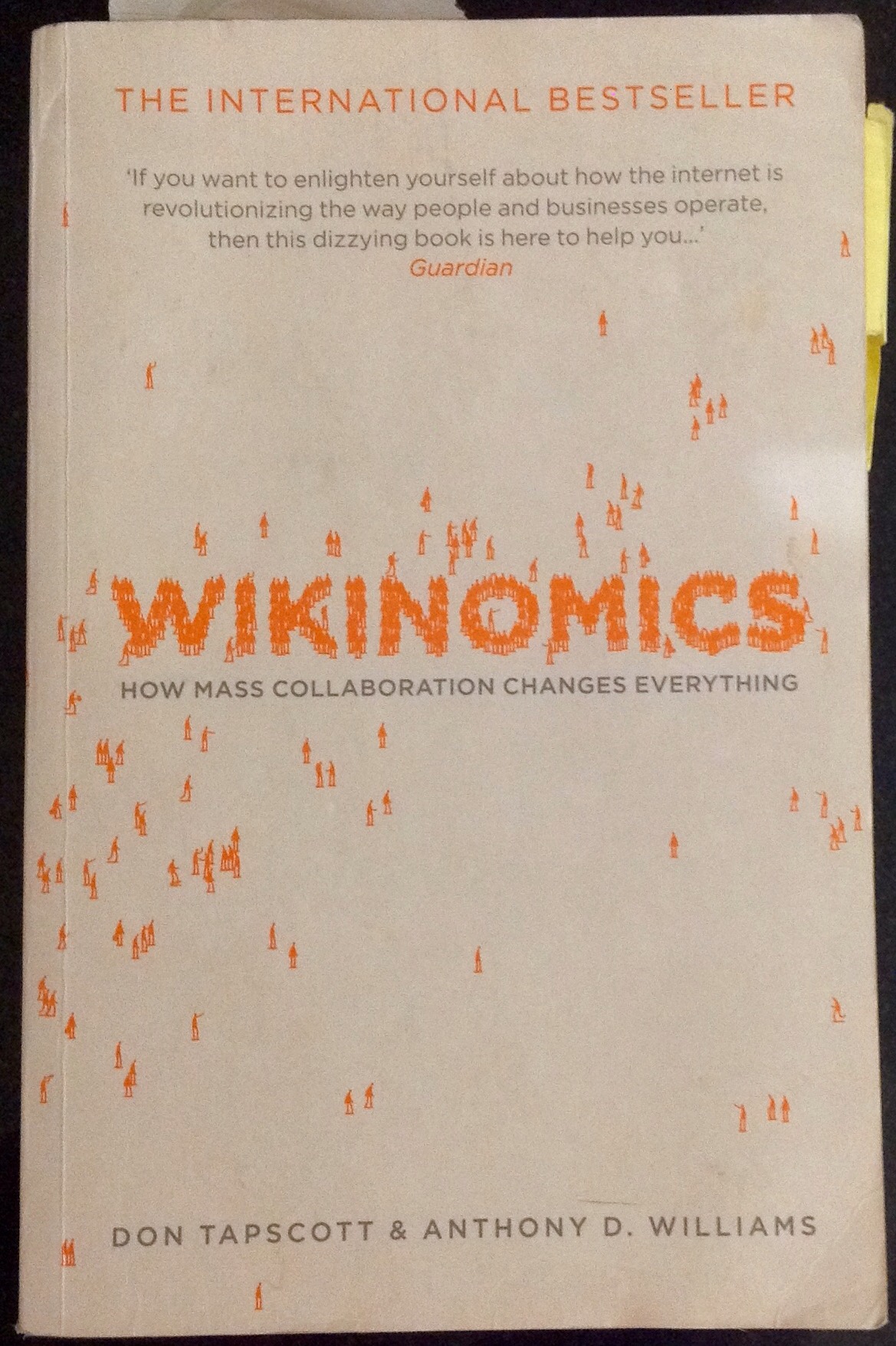
    Way back in 2008 I read ‘Wikinomics’ by Don Tapscott and Anthony Williams, and it pretty much changed my life. At the core of Wikinomics was the idea that the large-scale collaboration of people online, was going to change everything we do.

    The ‘phrase d’jour’, was Web2.0; used a lot at the time to describe the ideas around ‘online mass collaboration’, including what we now recognise as social media.

    Wikinomics was full of inspiring examples of Web2.0 working in real life, including one about the response to a disaster that really intrigued me.

    Computer Coders to the Rescue. This was the story of how a group of computer coders had quickly come to the rescue following the 2005 Hurricane Katrina. Katrina had devastated many USA Southern States and in particular New Orleans. Responding to the missing persons crisis almost 3000 computer coders gathered online; developed and populated a system called “People Finder”.

    The system automatically collated data from the dozens of fragmented databases, message boards and other sources online where people were posting information. The result was a single source which outperformed any government initiative. More importantly People Finder helped to reunite people with loved ones. It’s an inspiring story, well worth reading about in Wikinomics (pg 185 -188).

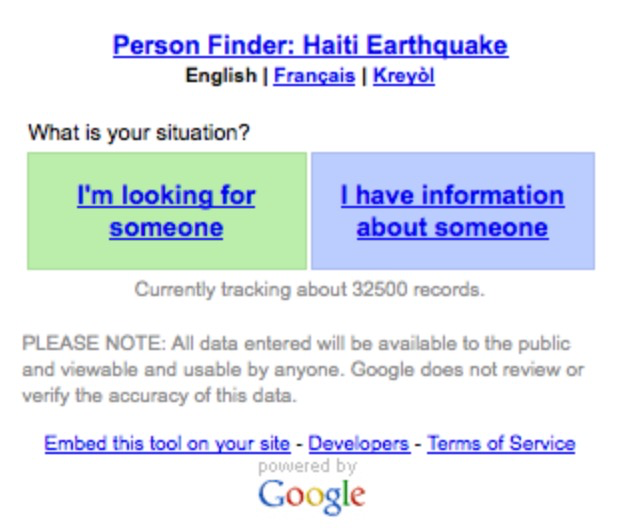
    Google Person Finder from the Haiti Earthquake
    Google Person Finder from the Haiti Earthquake

    Since Hurricane Katrina organisations like Google have become active in helping locate people during a crisis with Google Person Finder, continuing the good work started by the Web2.0 Katrina Coders.

    Mass collaboration online, Web2.0 as it was described, (including social media) was going to save the world, and I was hooked!

    But Social Media isn’t all good. Imagine my disappointment several years later when some people (who really know about Web2.0) started telling me that “you need to be cautious of social media in a crisis”.

    My ‘caution’ was needed because social media was being systematically used and manipulated to influence how people behave. They suggested that, “approximately 30% of tweets in a crisis are ‘bot’ (automatically) generated. Many are specifically aimed at escalating the incident”. The reason why this happens was not explained (or fully known I suspect), so I was happy to partially ignore it. Web2.0 and social media is a force for good… Isn’t it?

    The Rise of The Troll Farm. Then I bumped into the phenomenon of Troll Farms, so I sat up and paid close attention.

    Basically Troll Farms are coordinated efforts to spread misinformation through social media for an unclear but often dubious purpose.

    This article, ‘The Agency’, in The New York Times describes a social media crisis that ‘somebody’ manufactured in the town of St Mary Parish in Louisiana in 2014. Anyone looking at social media at the time would have been convinced that a local Chemical Plant had actually exploded.

    Imagine how that would make you feel if you lived anywhere nearby, or had friends and family in the vicinity? Basically there was a coordinated effort via; Twitter, fake websites, You Tube videos, Wikipedia pages, texts and other methods. The aim was to create the impression that there had been a major explosion at a Chemical Plant in St Mary Parish.

    Nobody seems to know why, but the scale of the efforts suggest something very well-resourced and highly organised was behind the ‘crisis’, possibly a ‘foreign state’? The New York Times article goes on to talk about the workings of the Internet Research Agency, an alleged Russian Troll Farm*.

    It’s all very interesting, detailing how workers would spend 12 hours a day on multiple false social media profiles spreading misinformation for a particular purpose. 100’s of staff spending 12 hours a day doing things like innocuously commenting on blog posts while subtly (or not) inserting political messages. Depending on your point of view, you can decide how much of The New York Times article might also be misinformation about the Russian misinformation service (it’s a funny old world).

    *Note – Other Troll Farms are probably available – this isn’t just a Russian thing. Other Countries/Large Corporations/Political Groups very probably have their own equivalents of ‘Troll Farms’.

    What Happened to Web2.0? This all feels very different to the world of Web2.0 Tapscott and Williams talked about in Wikinomics;

    • Why on earth would someone want to manufacture a crisis using social media?
    • Why would someone want to escalate an existing crisis using ‘Twitter bots’?

    I’m not clear on any of the answers to these questions. I do however think that some of the challenges aren’t very different to what we’ve always faced – people want to influence what we do by feeding us certain types of information.

    The rise of Web2.0 and Troll Farms just seems to give a bit more scale and speed to the transfer of the (mis)information. But no need to panic just yet (Mr Mainwaring) and switch off your social media.

    The trick in responding might be bit of old-fashioned good practice; check your sources, work out who you can trust, test what you find and do a bit of ‘triangulation’… before you press the share or retweet button.

    So, What’s the PONT?

    1. Tapscott and Williams were right in Wikinomics – Mass Collaboration Online has changed (just about) everything.
    2. As with many ‘tools’ available to humans, we can choose to use them for good or bad purposes.
    3. How we deal with the information we receive hasn’t changes that much, always check your sources and work out who you can really trust, especially in a crisis.

    A version of this post originally appeared on www.comms2point0.co.uk. Link here https://comms2point0.co.uk/comms2point0/2015/9/3/the-rise-of-troll-farms-can-you-really-trust-social-media-in.html

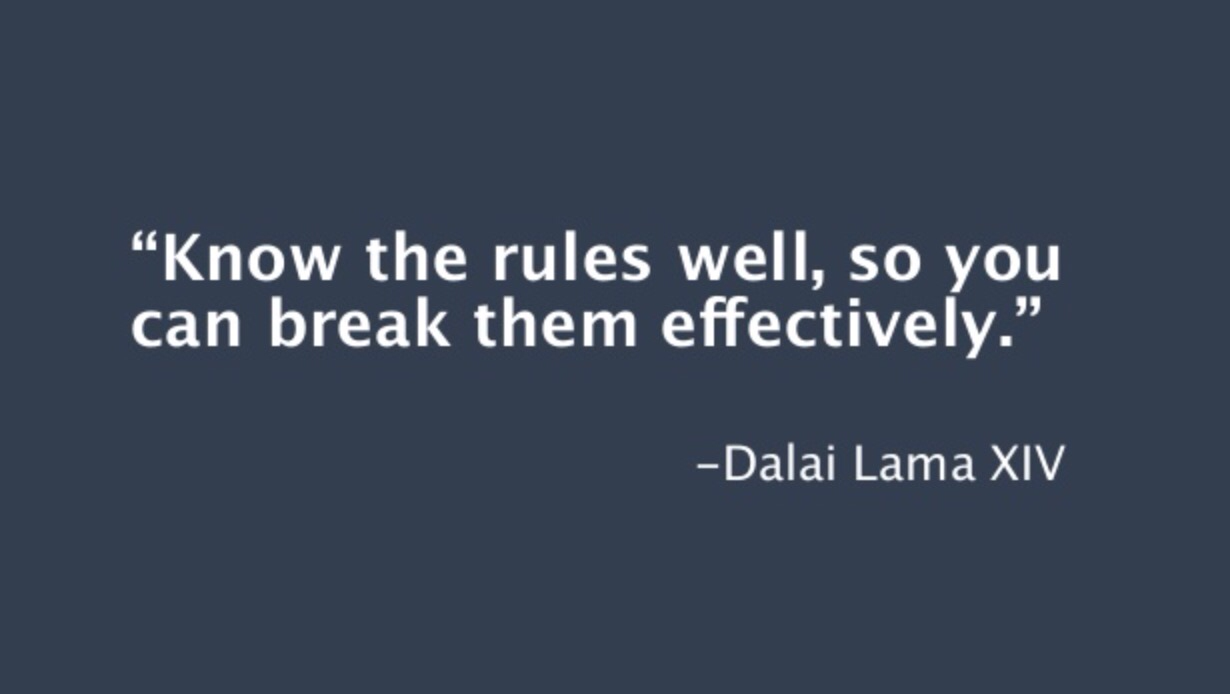
  • “Learn the rules like a pro, so you can break them like an artist” is attributed to Pablo Picasso. Variations of it have been used widely by people from The Dali Lama to Fashion Guru Alexander McQueen, which is where my story begins…

    Once upon a time my friday evenings typically involved quality moments at the bar in Pontyclun Rugby Club. You get the picture, a robust discussion of culture, philosophy, macro-economics and global politics (and beer).

    So, you can imagine how easy it was for me (8pm on a friday evening) to merge seamlessly with the crowds at The Victoria & Albert Museum in London. Waiting patiently in a very warm queue to see the sellout Alexander McQueen exhibition, Savage Beauty.

    I’m ashamed to say that I wasn’t expecting to enjoy it. High Fashion isn’t really my thing. My impressions of Alexander McQueen’s work were based upon occasionally flicking through the pages of Vogue. All pretty scary stuff as far as I could see.  

    So, I’m shuffling along with the crowds, feigning interest, when I’m suddenly confronted with a quote from McQueen that changed everything. “You’ve got to know the rules to break them… That’s what I’m here for – to demolish the rules but keep the tradition”.

    I was transfixed – I was immediately out of the line and pushing my way back in at the start of the exhibition. I was like a man on a mission, reading everything I could and looking at the displays with renewed interest. What on earth was going on you might now be asking.

    Alexander McQueen Spent 5 Years as an Apprentice. It turns out that McQueen left his East End school (with one O Level in Art) at 16 years of age and went to work as a Tailors Apprentice in London’s Savile Row. During this period, including two years at a military tailors, he learnt how to produce beautifully tailored garments.

    A Masters Degree in Fashion at St Martins College followed, and the rest is history (very interesting history as it happens). One of the things that stood out for me in the exhibition was the fact that McQueen was always recognised for his skill and ability in garment making – he knew how things worked.

    When you look at what he produced in his early years, you can see this – and you know it is there with the more ‘avant grade’ productions from later years – they wouldn’t exist without that deeper understanding (even the birch plywood dress).

    The quote “you’ve got to know the rules to break them….” beautifully sums up that approach. It also embodies why I think the idea of an apprenticeship (time spent learning your craft) is so very important. As Picasso said, it’s all about “learning the rules like a pro, so you can break them like an artist”.

    How do Apprenticeships Work? Apprenticeships have been around since the 1300’s and have been broadly defined as ‘a person who learns a trade from a skilled employer, for a fixed period at low wages’. I think there’s a bit more to it nowadays and it is worth a look at the Wikipedia description of apprenticeships, particularly in countries like Germany and France.

    It you fancy going deeper, The Educational Theory of Apprenticeship is also worth a look. This is all about ‘learning through the physical integration into practices associated with the subject’, getting your ‘hands dirty’. I particularly like the explanation of the passage of a novice through to ‘journeyman’ in 5 Phases:

    1. Modelling – the learner observes and contemplates. Basically you have a look at what the expert is doing and think about what you have seen.
    2. Approximating – in non-critical scenarios, the learner mimics the actions of the teacher. There is opportunity to make mistakes and fail in this ‘non-critical’ environment, and essential part of the learning process.
    3. Fading – the learner (still within a safety net) starts to ‘play’ with what they have learnt , and there is less dependence upon the teacher.
    4. Self Directed Learning – the learner attempts actions in the real world, where the scope is well understood. They only seek assistance from the expert when required.
    5. Generalising – the learners skills are applied to multiple scenarios in the real world as they continue to learn and grow their ability. Within each of these phases there is an emphasis upon thinking and reflecting upon what you have experienced and learnt.

    I think this is a very useful model that can be applied far more widely than trade and craft apprenticeships. All sorts of activities and professions (and dare I say Leadership and Management) could benefit from people spending time going through these phases.  To sum up what I’ve picked up from my recent experiences of learning about apprenticeships:

    • They take time (typically between 2-7 years to fully learn and understand)
    • You need to know how things work (learn the rules)
    • There needs to be a ‘safe’ space to learn from mistakes (and failure)
    • You have to keep learning (or you’ll stay as a ‘Journeyman’)

    Fast Track Graduate Schemes. Finally, I do wonder if there is a case for taking more of an apprenticeship approach to ‘fast track’ graduate schemes?

    Based on what I’ve been reading I think that you do need time to learn how things work. You also need time to test, fail and make mistakes – it’s a key part of learning. How many fast track schemes allow this?

    Ultimately you really need to learn the ‘rules’ (written and unwritten) – only then can you behave like Picasso, The Dali Lama and Alexander McQueen. It takes time, failure and hard graft.

    So, What’s the PONT?

    1. Understanding ‘how things work’ really is necessary to perform any task or job.
    2. This will take time, commitment and a fair bit of failure, reflection and thinking, as well as the practical stuff.
    3. If you want to break the rules like a pro/effectively, you really need to understand what you are breaking, so learn them in the first place.

    Thanks to my old school friend Ian Davies for also inspiring this post with our chats about apprenticeships, and for coaching one of my sons in the dark arts of quality management systems.

    IMG_3844

  • Source:http://theleadershipgroup.ca/blog/leadership-is-knowing-when-to-climb-down-the-ladder/
    Source: http://theleadershipgroup.ca/blog/leadership-is-knowing-when-to-climb-down-the-ladder/

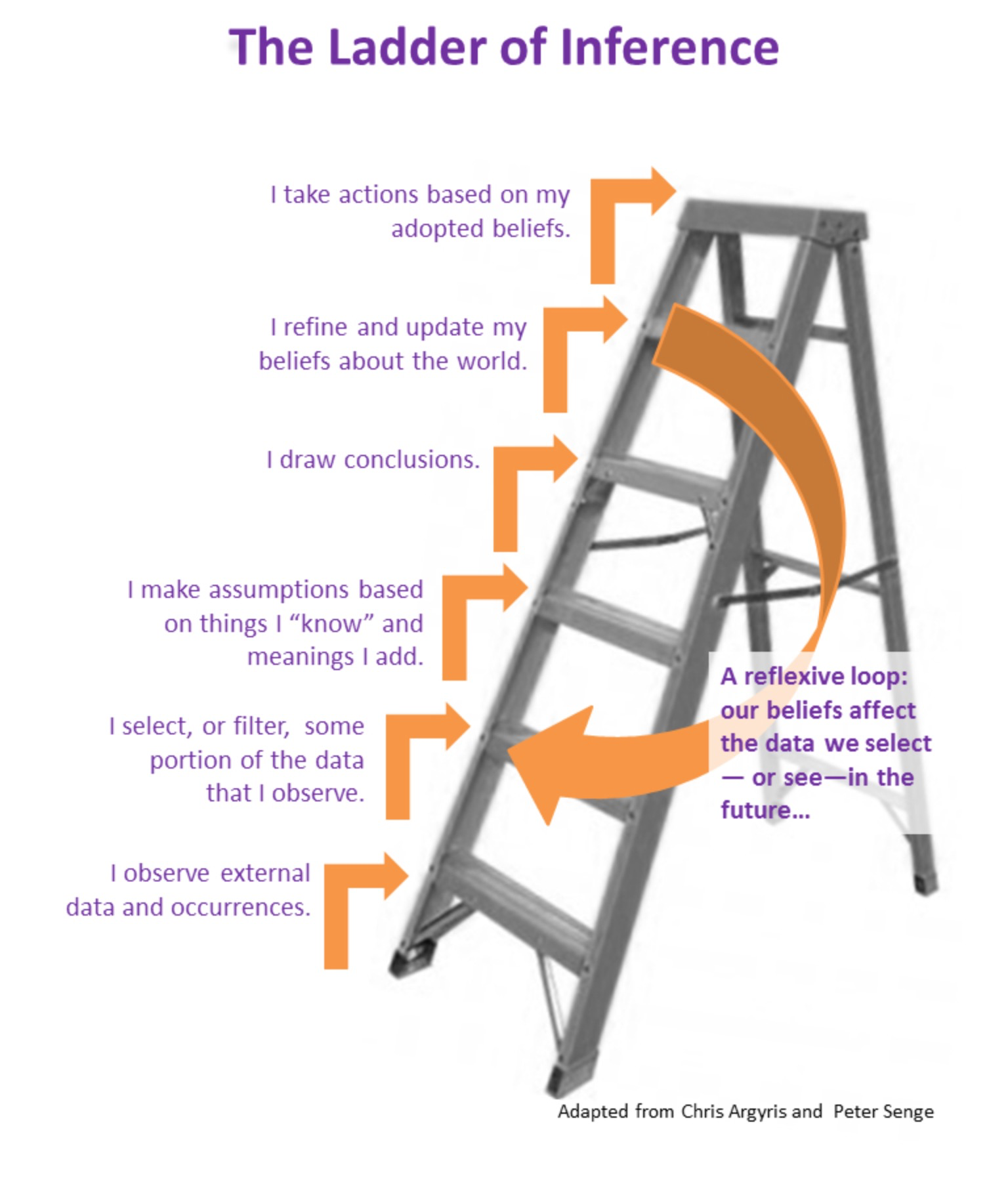
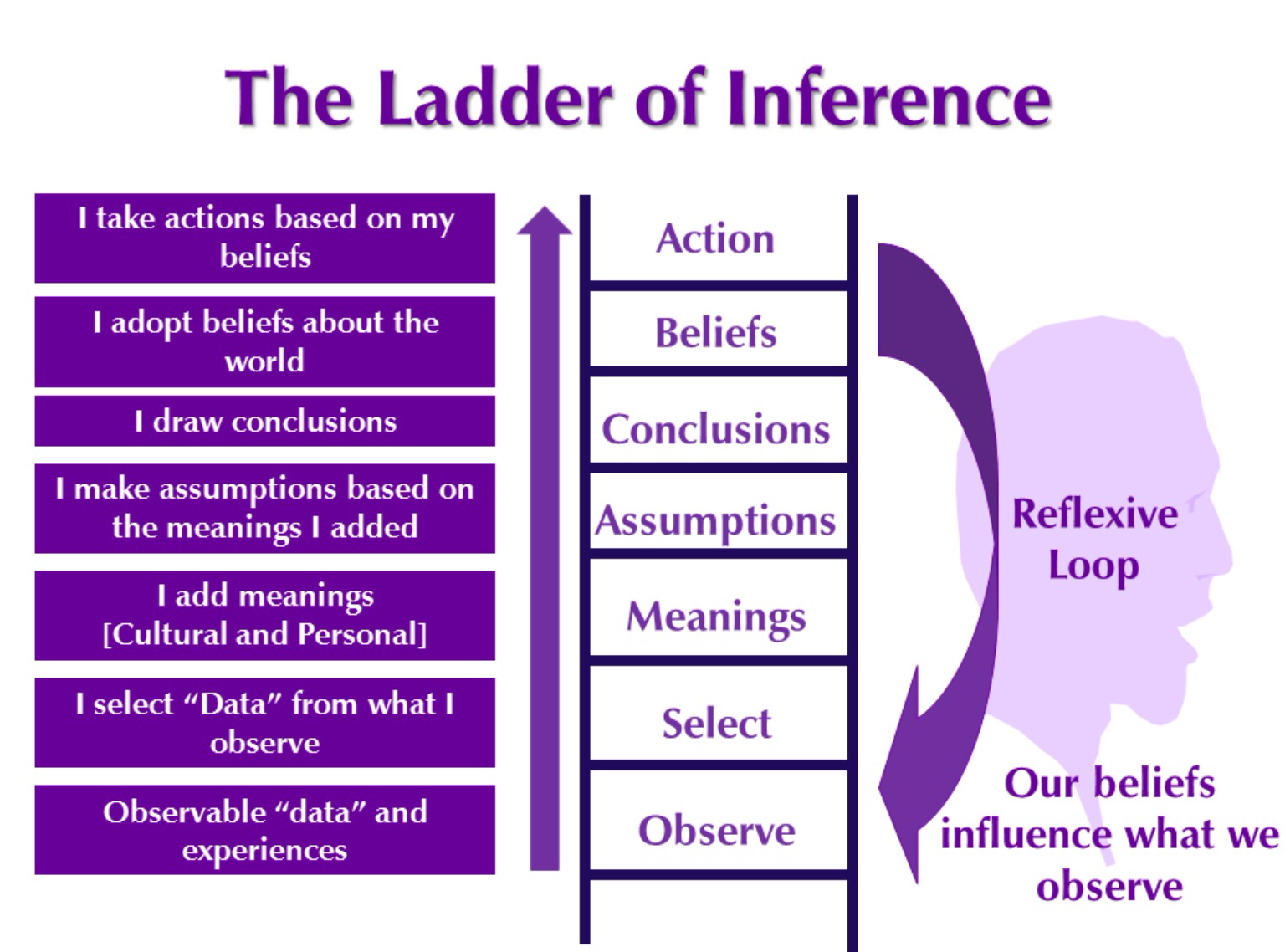
    The Ladder of Inference is a concept developed by the late Harvard Professor Chris Argyris, to help explain why people looking at the same set of evidence can draw very different conclusions.

    The difference comes from the idea that, based on their beliefs, people ‘choose’ what they see in amongst a mass of information.

    More on that later, but first off, who fancies an experiment?

    If I was being a bit hipster I could claim it as a Randomised Control Trial (RCT if you are uber hipster), but I’ll stick to plain old ‘experiment’.

    Try this experiment at home or in the office:

    1. Go to twitter and find a hashtag for a recent conference or seminar where people have been busily tweeting,
    2. The topic doesn’t really matter, but something reasonably linked to your area of interest/business might be useful,
    3. Search on the hashtag so that you can see a good selection of tweets – about 100 will do,
    4. Copy the 100 tweets and paste them into a document. The aim is to have about 3 pages of written text for people to look at (pretty straightforward so far),
    5. Now find two Test Subjects (people). Colleagues with very different views on the world would be good. Mr Grumpy and Miss Sunshine or Cruella de Vil and Ronald McDonald (we all have them).
    6. Now ask the Test Subjects to independently review the tweets and provide you with a summary of the key points emerging from the Twitter stream,
    7. Just to make it interesting you could ask the Test Subjects to summarise their findings in no more than 5 tweets,
    8. Sit back and wait for the results.
    9. If you are feeling ambitious, you could repeat this experiment a number of times, with different Test Subjects, different collections of tweets or a different context.
    10. For example choose Test Subjects (people) with a very similar outlook. Before they do the analysis, brief one that you thought seminar was excellent, and the other that you thought it was rubbish (sneaky!).

    The Results. I’ve not formally run this experiment (yet) but I have experienced a fair number of the summaries of Twitter conversations that people like to share about conferences. Storify Twitter summaries are almost mandatory for public sector conferences nowadays.

    What has intrigued me is just how differently people can interpret and present the summary of the discussion at the same event. I appreciate that there will be a certain amount of bias and pushing of corporate messages. If your organisation is running the conference/seminar you will probably want to push key messages – dissenting voices and challenge probably isn’t something you are going to ‘share’ given the choice.

    However, it is the variation in the summaries from the apparently independent/unbiased people that intrigues me. I’m sure that people will have very good intentions, but I do think there is a fair bit of ‘expert bias’ going on in these situations.

    This is something neatly illustrated by The Ladder of Inference developed by Chris Argyris and had also been used by Peter Senge in his book The Fifth Discipline.

    Source:https://pivotalthinking.wordpress.com/tag/ladder-of-inference/
    Source: https://pivotalthinking.wordpress.com/tag/ladder-of-inference/

    The basic idea is that:

    • When presented with a range of information/data/facts, we select what fits with a belief we already hold about that situation.
    • All other information is ignored.
    • We make our decision on the ‘evidence’ we have selected (evidence based decisions are always the best).
    • Our beliefs become stronger based on that good decision we have made (a feedback loop).
    • In the future, when we look at information/data/facts, and what we select will be influenced our now more strongly held beliefs.

    Both of the graphics I’ve used in this post illustrates the concept very effectively. If you would prefer here is a 3 min video, The Ladder of Inference Created Bad Judgement, from Edward Muzio.

    Am I suffering from ‘Expert Bias’? I’ve been worrying for a while that I’m a candidate for The Ladder of Inference. It’s not just how I view the tweets from a seminar, but just about everything where I’m presented with data/information/facts.

    Everything I’ve ever experienced informs how I see things and gives me an ‘expert bias’. You might now be thinking, ‘that would never happen to me….’ (oh lucky you…..)

    At one level it could be argued that I should stop getting anxious and get over it – that’s the job, to make sense of complicated information. At another level I would like to put some rigour into what I’m doing, how do I perform a cross check?

    The work from Chris Argyris suggests a process of ‘climbing down’ The Ladder of Inference. Going back down into the facts and looking at all them more closely, attempting to remove your bias. The Edward Muzio video summarises this as:

    • Climb down the Ladder of Inference (a lovely metaphor)
    • Question your Assumptions and Conclusions (with a trusted colleague)
    • Seek Out Contrary Data (to test what you are seeing)

    These are all good suggestion, but quite hard to do. What if you have no idea of how you are biased? The topic of unconscious bias, how you recognise it, and how you deal with it is helpfully the focus HR Training Programmes in many organisations, linked to things like equalities and diversity work, but helpful in so many other areas.

    At the end of the day, if we just get as far as recognising there is such a thing as The Ladder of Inference and Expert Bias, I think that’s a pretty good start. It might help me when I’m reading the next tweet Storify.

    So, What’s the PONT?

    1. People can interpret the same set of ‘facts’ in different ways.
    2. Recognising it as Expert Bias, Unconscious Bias or The Ladder of Inference is helpful as it can help prevent wrong conclusions and bad decisions.
    3. Once your bias is recognised, you need to take steps to ‘Climb Down The Ladder’. It’s always better to fall from a low step.
  • Del Boy Trotter, Risk Management Advisor, Del Boy Trotter, Risk Management Advisor, “Who Dares Wins”

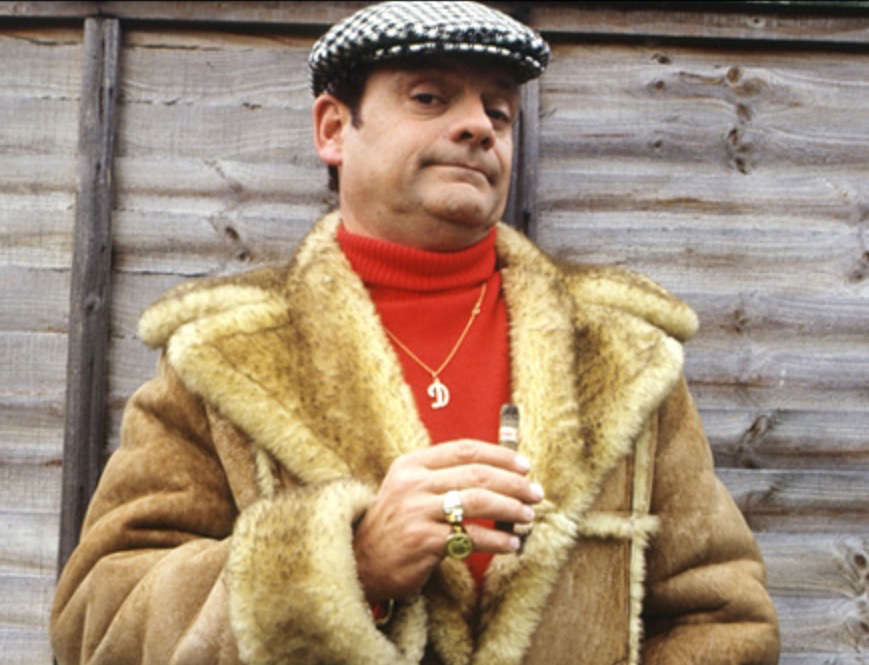
    “That which does not kill us makes us stronger” A terrible confession to start… I thought it was Del Boy Trotter; Risk Management Advisor (“who dares wins”) and famous Peckham Philosopher who said this. Actually it was Friedrich Nietzsche, the famous German Philosopher (1844-1900), but you all knew that. 

    We all know it makes sense… some minor trauma, a failure or a setback (provided you learn some lessons from it) will improve things for the future; making us stronger, cleverer, more skilful, more resilient. Nietzsche coined the phrase in the late 1800’s and we’ve been quoting it ever since. However, there didn’t seem to be much empirical research to prove this was the case, until recently…

    Buffalo University USA, Mark D. Seery. The 2010 research by Seery, Holman and Silver, ‘Whatever Does Not Kill Us: Cumulative Lifetime Adversity, Vulnerability and Resilience’ looked at the impact of negative events on the lives of almost 2400 people.

    My interpretation of the conclusions they came up with are:

    1. If you have no trauma or difficulties in your life then you aren’t very well equipped to deal with something bad when it happens.
    2. If you have lots of difficulties (chronic exposure) you are in a pretty bad place full stop. More trauma or difficulty just adds to the misery.
    3. The right amount of bad stuff means you develop resilience that allows you to cope much better with any future difficulties. A sort of ‘Goldilocks Zone’ of bad stuff – not too much, not too little…..’just right’.

    All a bit like taking well-managed risks, learning from failure, beneficial accidents and Trojan Mice….

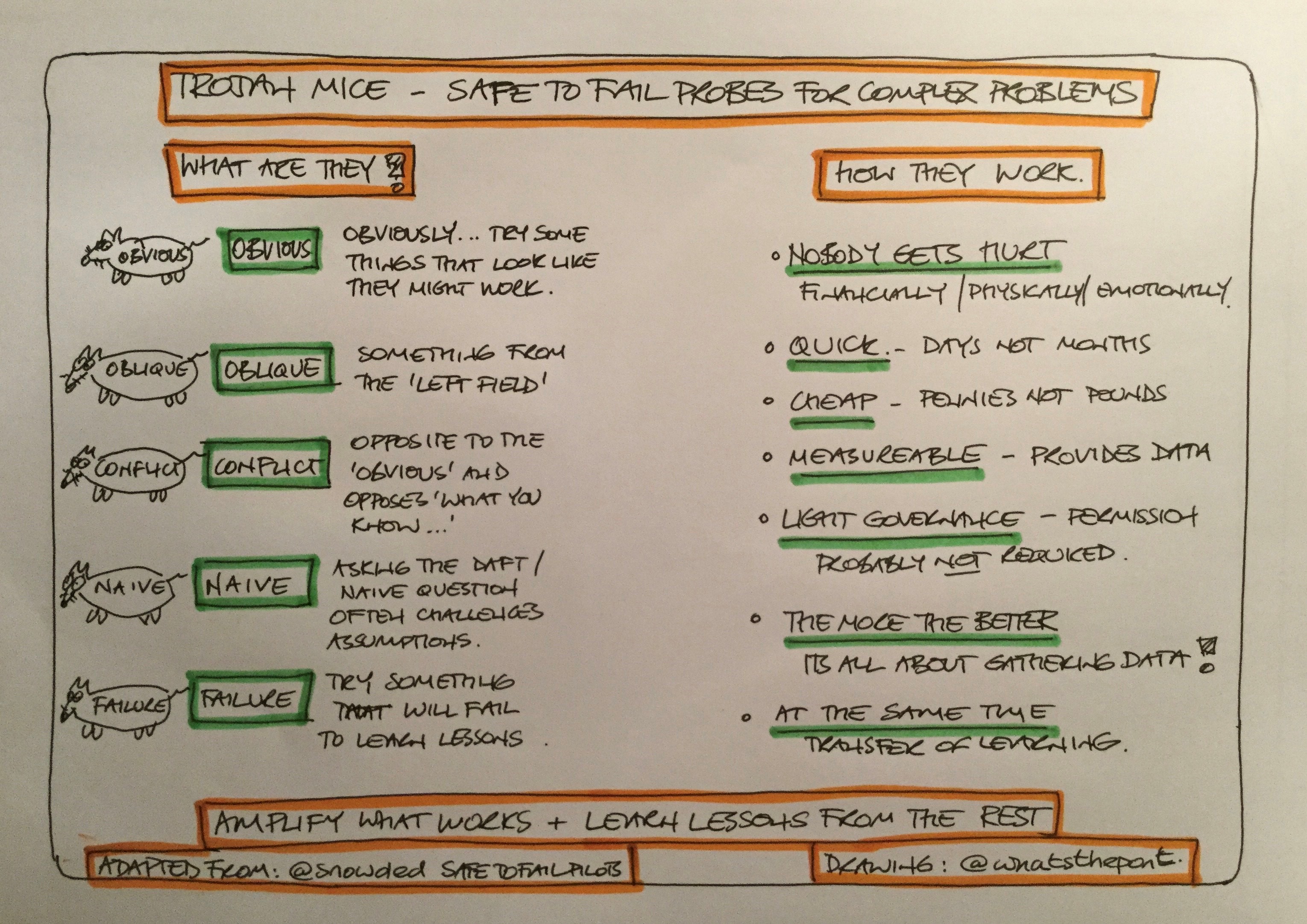
    Trojan Mice ‘Safe to Fail’ Pilots Run in Parallel.
    Full graphic at end of post (*no actual mice were harmed in the process)

    What are Beneficial Accidents and Trojan Mice?  Trojan Mice mice is a metaphor for an approach you can use when testing ideas in a complex situation. Explained as ‘safe to fail pilots’ by Dave Snowden; multiple test pilots that are run in parallel. 

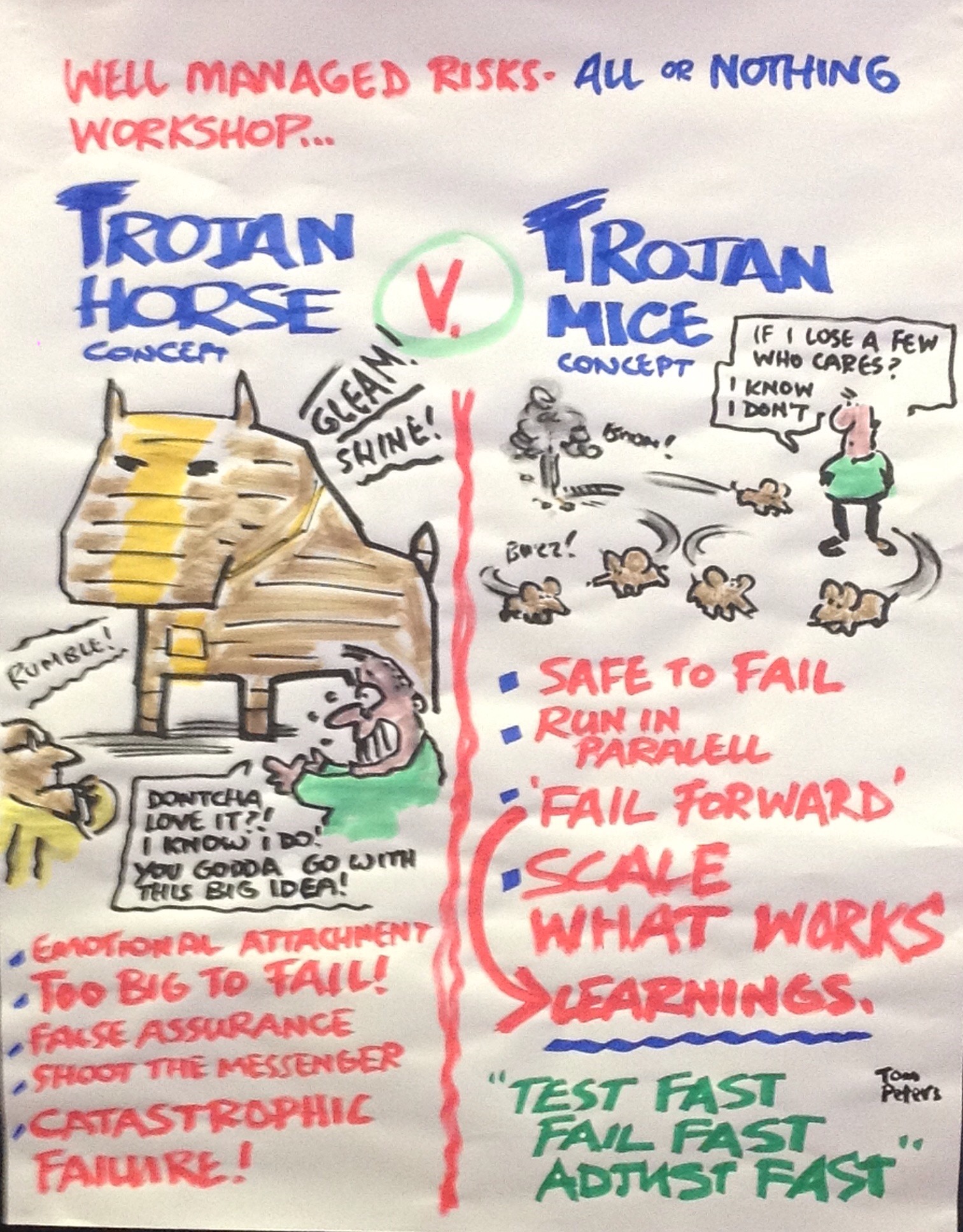
    ‘Safe to Fail’ means that any failure is fully ‘survivable’ and some pilots might actually be designed to fail. The whole point is that you test the situation and learn incredibly valuable things from the pilots and any failures. By conducting this process with multiple tests in parallel you are able to scale up what works and ‘kill off’ (I prefer the word ‘dampen’) what doesn’t. I have talked about this before in: 5 Differences Between Trojan Horses and Trojan Mice and What’s Eating the Trojan Mice.

    Recently Trojan Mice were part of a workshop I was running on ‘Well Managed Risks’ at the Welsh Public Services Summer School (#SSWales on Twitter) which, by the way was inspiring and an incredible opportunity to learn and share ideas.  Whilst I was explaining the benefits of ‘safe to fail’ Trojan Mice and ‘survivable failure’ one of the delegates shared the concept of ‘Beneficial Accidents’……. the same sort of thing, accidents where you learn a huge amount, but it doesn’t actually do you any significant harm.

    The area she worked in was Children’s Play, and we all quickly started sharing stories of falling out to trees and other escapades that taught us so much as children. It’s obvious really, but why isn’t the approach widespread in the world of work?

    The lady who shared the idea of Beneficial Accidents said it was a phrase that had been used by people from the Royal Society for the Prevention of Accidents (RoSPA), and also shared a document from the Health and Safety Executive (HSE) with me (thank you Cathryn).

    Children’s Play and Leisure – Promoting a Balanced Approach from the HSE is well worth reading in you are at interested in how to approach learning from failure and  well-managed risk taking. Just have a look at this section on ‘striking the right balance’ from the document – if you replaced the ‘play’ references with ‘corporate’ I think it would work quite nicely as a guide to what ‘well managed risks’ look like.

    HSE Play and Leisure Guidance Mistakes and Accidents WILL Happen! HSE Play and Leisure Guidance
    Mistakes and Accidents WILL Happen!

    Well Managed Risks and Failure. Getting back to where this all started:

    • Doing things differently involves some sort of risk (“who dares wins” – Del Boy Trotter)
    • Risk Management is not about eliminating risk
    • In a complex environment, multiple ‘safe to fail pilots’ (Trojan Mice) are a good idea
    • Failures is great for learning, but needs to be survivable (Beneficial Accidents)
    • If it hasn’t killed you, it will probably make you stronger (Nietzsche & the HSE?)

    In August I’m taking part in a session in Cardiff which is looking at Practical Strategies for Learning from Failure with Shirley Ayres, Roxanne Persaud and Paul Taylor. It’s a pilot for something we plan to do Leeds in the Autumn. If this sort of thing interests you – tickets are available here: Practical Strategies for Learning from Failure #LFFdigital

    So, What’s the PONT?

    1. No risk = do nothing = extinction
    2. Learning from failure / averse incidents helps you in the long-term, and helps build resilience
    3. The ‘Beneficial Accidents’ approach and HSE guidance on children’s play could be used for approaching ‘Well Managed Risks’ is the corporate world.

    Here is the full graphic of Trojan Horse v Trojan Mice from Summer School. Thanks to Paul  Richardson of apagraphicfaciltation.com for this.

    IMG_3711

  • Corporate Reporting. Doing a Jigsaw Puzzle, without the box lid.

    Recently I’ve been reminiscing about my past life as a Corporate Planning and Performance Reporting Minion.

    They were happy days, but thankfully I’ve been ‘clean’ for over 20 years.

    I’m not dropping my guard though. I know that all it takes is one email (cc’d to your boss) and I’ll be ‘off the wagon’.

    Before you can say ‘Three Year Plan’ I’ll be demanding quarterly KPI returns. Updates for the Leadership Team Dashboard (cc’d to your bosses boss) and ‘cascading linked spreadsheets’ of ‘mandatory’ information. I was a happy Minion.

    Missing the Box Lid. What prompted the nostalgia was a conversation with a wise owl. They explained what it was like to produce the Annual Report in their world…

    “the corporate reporting job is a bit like putting together the pieces in a jigsaw puzzle, relatively straightforward…” (lovely, I get this)

    “however, we don’t have the picture from the lid of the box the jigsaw puzzle came in”…  (oh dear, that sounds familiar)

    “in fact, I’m not even sure there is a box lid, and if there was, the picture probably wouldn’t make any sense” (sigh!) 

    This got me thinking. Is the ‘missing jigsaw box lid method’ a reality of corporate reporting?

    Even more interesting, is it a situation where different people imagine a different picture on the jigsaw box lid? For some it’s a highly complicated picture of Picasso’s Three Musicians. An example of Synthetic Cubism.

    For others the corporate report ‘picture’ is very simple, a 10 piece Children’s Wooden Elephant Jigsaw (Early Learning Centre). I think we used to call these ‘Balanced Scorecards’ back in the day…

    Have a look at this picture and please tell me you get what I’m blathering on about.

    Synthetic Cubism verus ELC  Wooden Elephant. Reality versus expectations?
    Synthetic Cubism verus ELC Wooden Elephant. Reality versus expectations?

    Synthetic Cubism = Corporate Reporting. You might now be wondering, what has Cubism has to do with corporate reporting? Well have a ponder on this definition; ‘In Cubist artwork, objects are analysed, broken up and reassembled in an abstract form – instead of depicting objects from one viewpoint, the artist depicts the subject from a multitude of viewpoints to represent the subject in greater context’

    Many years after my corporate planning experiences this is a revelation! I now understand. I wasn’t just a Corporate Planning Minion, I was an Artist – a Cubism Artist!

    Consider the definition of cubism through the lens of corporate reporting …

    • ‘objects are analysed, broken up and reassembled’…… data and information is collected, analysed and reported.
    • ‘the artist depicts the subject from a multitude of viewpoints’…. information is presented in a variety of ways.
    • ‘to represent the subject in greater context’….. to meet the requirements of the audience.

    That makes me feel much better. I now know why I felt so uncomfortable, I was an artist in a world of scientists. Retrospective coherence (making sense of things with the benefit of hindsight) is a great thing.

    There is a serious point to all this. The conversations I’ve been having years after leaving corporate reporting ‘engine room’, suggested that things might not have changed very much. As far as I could see there are two big issues, which conflict with each other.

    • People have very different expectations. The ‘bosses’ quite often think of corporate reporting as a 10 piece wooden jigsaw. However, the Minions know it’s a bit more like Picasso’s Three Musicians. The drive towards the 10 piece elephant jigsaw can result in the large-scale aggregation of information and the risk that things become ‘averaged out’, over simplified and too abstract. Sometimes you need to see the detail of what is happening at the ‘coal face’, even at Board level.
    • Almost everyone wants to keep adding things into the system – just to provide that bit more assurance. This ends up making the picture even more complicated and the jigsaw ever more difficult to complete.

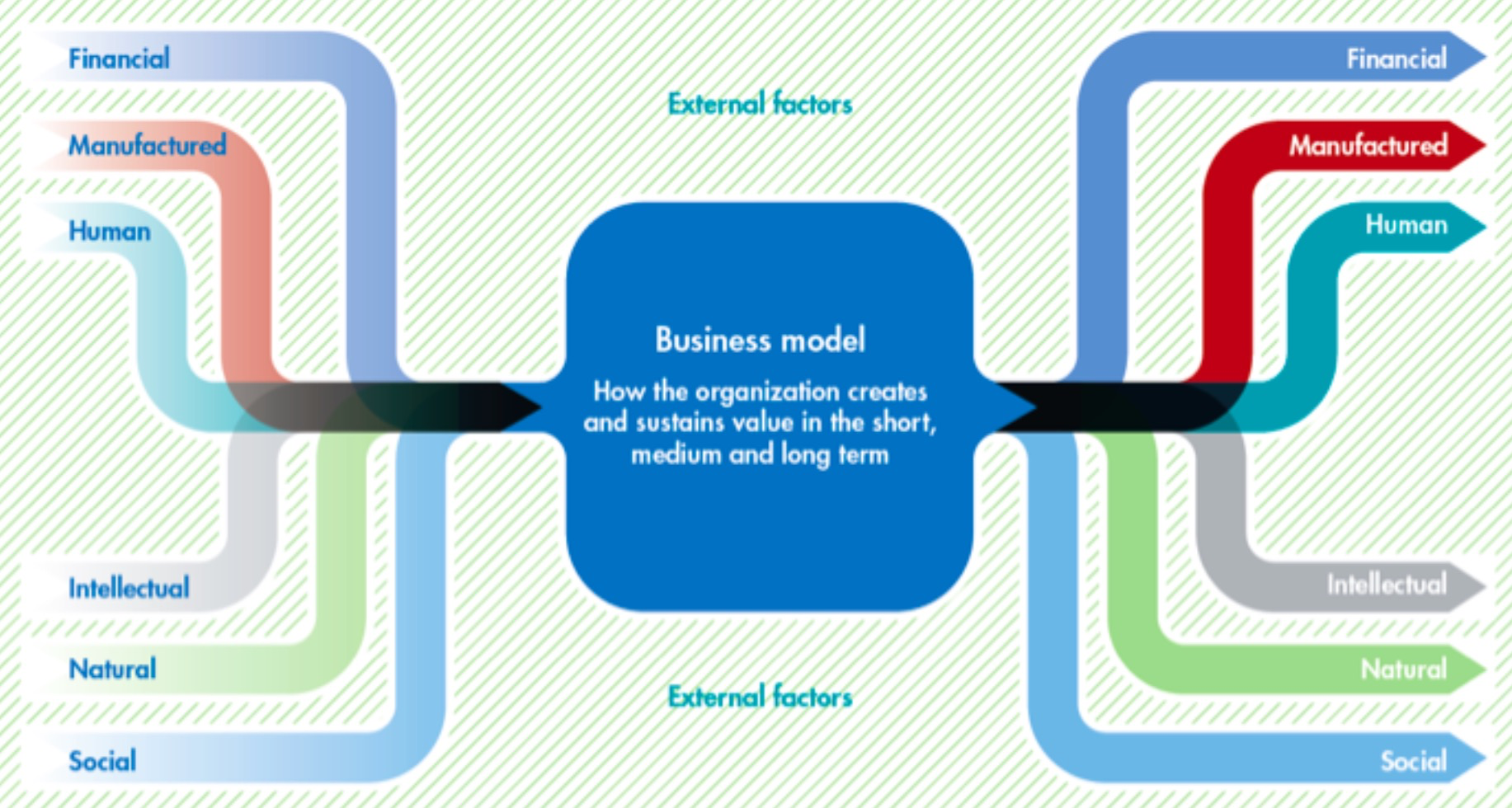
    The Integrated Reporting Movement…..this might just help. If you haven’t switched off yet, this is worth a look. The Integrated Reporting ‘Movement’ is all about improving how organisations “communicate a clear, concise integrated story that explains how ALL of their resources create value”. It’s all explained in-depth on the Integrated Reporting website.

    There are some important messages here about sustainability, not just the ‘green stuff’. How to focus areas like the impact upon society and the viability of the organisation in the long-term (20 – 30 years). When you add the emphasis on clear and concise reporting there’s quite a lot to get excited about.

    If you prefer your information via video, here’s link to Professor Mervyn King from South Africa taking about Integrated Reporting. Thanks to Mike Palmer for pointing me in the direction of this.

    So, what’s the PONT?

    1. Corporate reporting can feel like more of an art than a science – perhaps it’s a bit of both?
    2. Seeing the ‘big picture’ ‘jigsaw box lid’ is important, to understanding where things might fit together.
    3. Beware of over- simplification. A 10 Piece Wooden Elephant is different to synthetic cubism.
    Integrated Reporting - the new 'Jigsaw Box Lid' for everyone?
    Integrated Reporting – the new ‘Jigsaw Box Lid’ for everyone?
  • IMG_3540

     What is Homologation? A quick multiple choice test;

    1. The process for making fruit smoothies,
    2. The measurement of tree trunks at a saw-mill, or
    3. Approval being granted by an official body.

    Congratulations if you chose Number 3. Homologation is indeed the process of an official body (Government, Court of Law, Academic Body, Professional Institution, Industry Body etc) granting approval for something, a bit similar to accreditation. Not a word I knew of, and something I’ve only learnt about for 2 reasons:

    • An explanation from some mechanical engineers of how innovation is ‘forced’ into F1 Motorsport, and
    • A short conversation with Sheldon Steed at People Driven Digital (#pdDigital15) about how big institutions get to recognise and accept novel products, ideas and innovation from small organisations.

    F1 Racing and Homologation.  If you want to get a feel for the technical regulation of Formula 1 Motorsport have a read of this article ‘Arms Race? Game Changer? What do the Latest Changes to F1 Engine Rules Mean?’ by F1 broadcaster James Allen. Homologation gets mentioned a lot.

    Back to where this started for me, I was listening to a group of very experienced Mechanical and Electrical Engineers talk about innovation in F1. The gist of the discussion was as follows:

    • The razzmatazz of a Grand Prix Race, Television exposure, Superstar Drivers and massive sponsorship deals are just a side-show (in their view),
    • But a side-show with a purpose – it funds the really interesting engineering innovation behind F1 that makes the cars achieve incredible things,
    • It’s the engineering innovation that stops F1 getting boring (really?) and in particular the frequent rule changes that the governing body introduces – this is where homologation fits it.
    • Basically the governing body changes the rules – for example on how energy is recovered from the brakes to feed into electric motors on the car.
    • The engineers come up with their solution and before the car can be raced, the solution has to be homologated (approved).
    • That all sounded very clever and sensible to me. A good example of where a governing body, the Federation International de l’ Automobile (FIA), is forcing innovation by changing the rules – and example of disruptive innovation (something that gets talked about so much at the moment).
    Reverse Homologation? Red Bull Soapbox races. Does innovation from this space ever find it’s way into F1? Picture source: https://commons.wikimedia.org/wiki/File:Red_Bull_Soapbox_Race_2017_-Alexandra_Palace,_London(35802925281).jpg

    Upsetting the Hierarchy. The Engineers I listened to were an interesting bunch and they didn’t stop there. The other important part of the world of F1 rule changes they spoke about was “upsetting the hierarchy”. They explained it as follows;

    • The ‘big’ companies in the motor-sport world are brilliant at all sorts of things like maximising the efficiency and effectiveness of existing systems and products. They have enough money and resources to ‘squeeze’ the existing design/product/system to get that last few percent out of it.
    • This ‘last few’ percent will get them to first past the chequered flag in a stable system.
    • What they are not so good at is; agile, creative, innovative solutions when the rules of the game change. This is where the smaller organisations seem to have the advantage.
    • When the rules change, the smaller organisations come in with the radical new solutions, and have them tested in a rigorous/brutal environment (the homologation process and the F1 races).
    • Where things work the small organisations have a competitive advantage and are able to upset the hierarchy – for a short time.
    • Quickly the big organisations are able to identify what the others have done, standardise and improve it to ‘squeeze the extra few percent’.

    This all sounded very convincing and very effective to my ears; change the rules, force innovation, upset the existing hierarchy. A really interesting approach from the Governing Body (FIA) who change the rules and impose homologation to; keep F1 Motor-sport interesting, feed innovation into domestic car production, and maintain a bunch of very happy engineers.

    IMG_3500

    The link with People Driven Digital. At the People Driven Digital I heard about how people who are developing new/innovative solutions are finding it a challenge to engage with big organisations like the NHS or Pharmaceutical Companies. The sense I got was that some big organisations tend to only want to talk to other big organisations.

    In the conversation with  Sheldon Steed, we talked about the challenges he faced with the digital phone app he had developed to manage diabetes for his sons. It is worth looking at the video he has posted on his blog about the app mumoACTIVE.

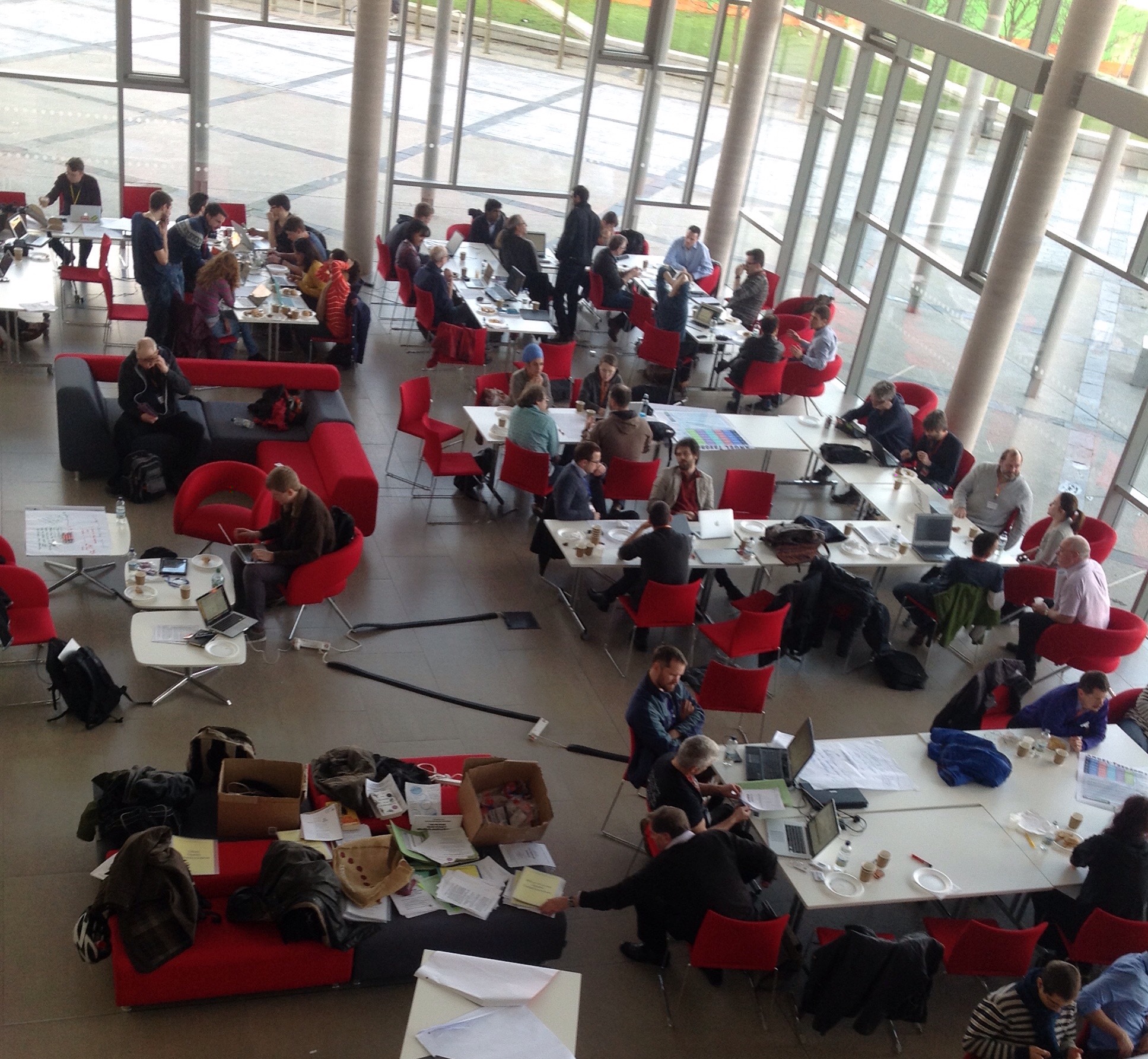
    The point I’m getting at here is, can we learn something from rule changes, homologation and the disruption of hierarchies in F1 motor-sport? Is there an opportunity for the big organisations in health to find a different way to talk to the smaller (possibly more agile and innovative) organisations? Can things like People Driven Digital in Leeds and the NHS Hackdays in Cardiff (which I was fortunate to attend) provide the ‘safe’ space for it to happen? I hope so.

    So, what’s the PONT?

    1. Changing the “rules” can force people to think differently and develop innovative solutions (disruptive innovation).
    2. The approach can disrupt hierarchies, where existing ‘big players’ get overtaken by ‘small fry’ with better solutions (this can have consequences for ‘small fry’).
    3. Can things like People Driven Digital in Leeds and NHS Hackday in Cardiff provide the space for ‘big organisations’ to engage with ‘small organisations’

  • A greeting card you can send to fellow knitters
    A real greeting card you can send to fellow knitters*
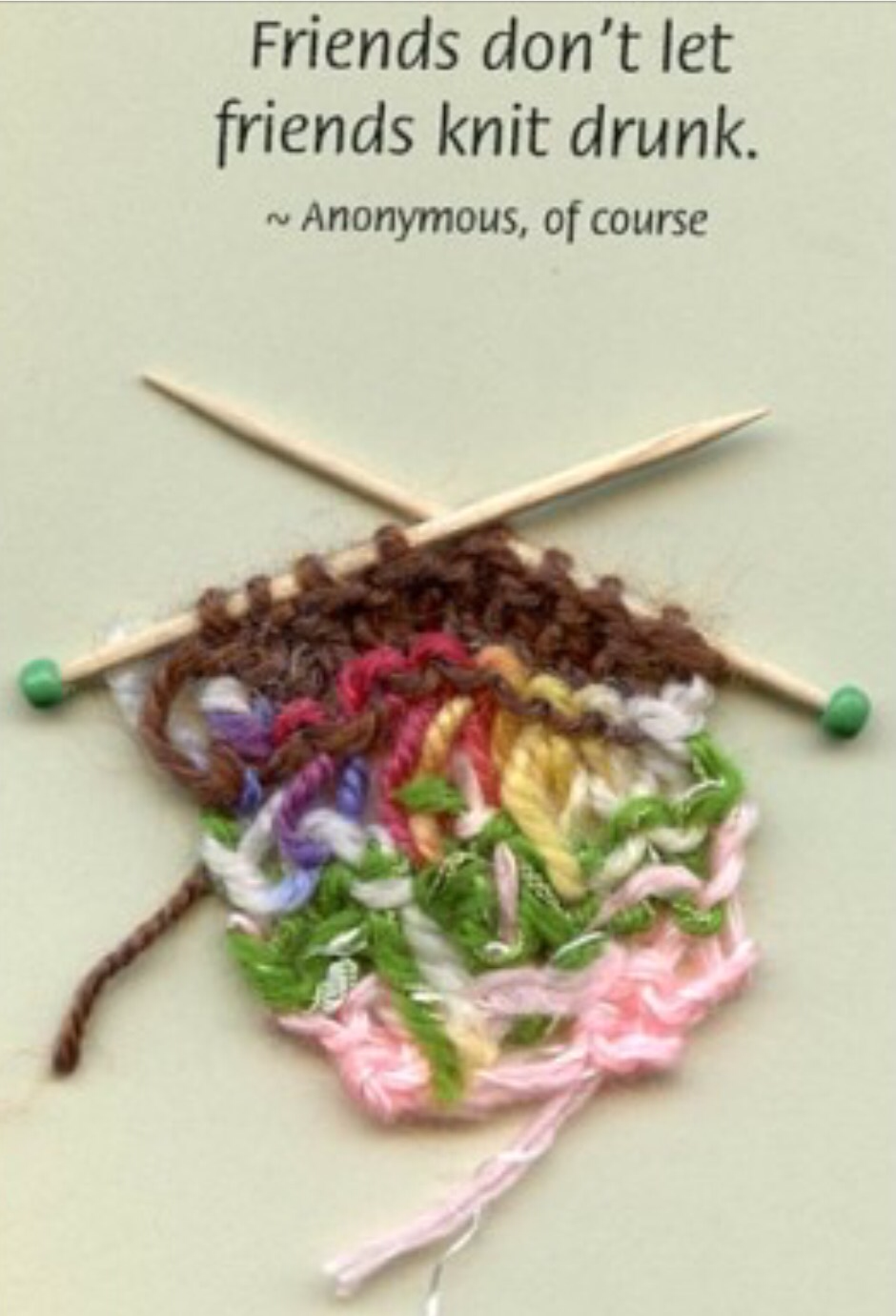
    Friends don’t let Friends …. Knit Drunk. Sorry to start a post with such a disturbing image.

    It all started with a schooner of sweet sherry, now just look at those loose stitches, and the wool colours. All so preventable and very wrong.

    Sometimes it is necessary to share startling graphic images to highlight the consequences of doing the wrong thing. Only then your friends might step in and ‘nudge’ you in the right direction.

    After dabbling with Behaviour Change Science in the last post, ‘Meeting Lemmings and Choice Architecture’, I’m sticking with the topic. This time it’s about using peer pressure to ‘nudge’ people towards having better meetings….

    Friends Don’t Let Friends…. Do Lots of Things. There’s a lot of material on the internet about Peer Pressure and the ‘Friends don’t let Friends…’ campaigns. Alongside the dozens spin-off T-shirts, posters and other paraphernalia there are plenty of papers and articles describing the effectiveness of the approach. A great deal of it is linked to the world of social marketing campaigns in Public Health, aimed at areas like; preventing drink driving, anti smoking, anti drugs and general ‘improve your lifestyle’ messages.

    Possibly the most well-known campaign and character is Smokey Bear, who started life back in 1944 as part of an initiative to reduce the number of forest fires in the USA. By 1983 Smokey Bear had expanded beyond Forestry, into the National Highway Traffic Safety Administration, to head up the anti drink driving campaign. During the period 1983-1999 alcohol related road fatalities in the USA dropped from 21,000 a year to 12,500. The success of the Smokey Bear, “Friends Don’t Let Friends Drive Drunk” campaign led to Smokey being inducted into the Advertising Week Walk of Fame in 2014 (have a read of the article, it is interesting).  There are plenty of videos of Smokey Bear online if you fancy.

    So what else can Peer Pressure do? Getting back to where I started, could peer pressure be used to help nudge people into having better meetings? Is there room in the corporate world for a ‘Friends Don’t Let Friends Have Rubbish Meetings’ campaign? Could we have T-shirts, posters and lapel badges to support the campaign?

    Obviously the office isn’t the forest, and we don’t have bears we could enlist in the campaign. However, I have been reading some serious research (from the Journal Nature you know) which talks about examples of how peer pressure has had the desired effect of changing behaviour. Inducing Peer Pressure to Promote Cooperation, describes how social mechanisms (mostly peer pressure) are able to encourage cooperation between people and promote different behaviours.

    There are some interesting examples in the paper like:

    • Micro-lending – where there are higher rates of repaying loans because people know each other and feel peer pressure to pay back what they have borrowed.
    • Water Use – people putting pressure on neighbours not to water their lawns when there is a water shortage.
    • Lobster Fishing – the Maine Lobster Fishery as an example of a successful sustainable fishery operated through the involvement of the fishermen in regulating the fishery and each other (peer pressure).

    Lobster on Nova Scotia
    Lobster in Halifax Airport, Nova Scotia
    I’m particularly interested in the Maine Lobster Fishery as an example of successful ‘co-management’ between the Government and the Lobster Fishing Businesses. This may be an example of ‘co-production’ which is talked about widely in Wales at the moment.

    This article by Monique Coombs in Grassroots Economic Organising  explains the organisation and the self-regulation of the Maine Lobster Fishery

    Whilst I was in Nova Scotia last year some people I spoke to said that elements of the Maine peer regulation model had been adopted there. I apologise for the half tartan lobster picture. It’s from Halifax Airport and I’ve been desperate for a chance to use it….they do love their lobsters in Nova Scotia.

    Will ‘Friends Don’t Let Friends Hold Rubbish Meetings’ work?  I think there is a good chance. There is sound historical evidence that the approach works (Smokey Bear), academic research into the theory, and practice from the extremely difficult world of catching lobsters.

    Dealing with a few office workers cannot be that difficult in comparison? Most people want to have better meetings, they just need some help from their friends. All we need are some lapel badges, posters and T-shirts, and we should start the better meetings revolution.

    So, What’s the PONT?

    1. Peer Pressure has a powerful effect on changing people’s behaviour.
    2. Campaigns like the Smokey Bear “Friends Don’t Let Friends Drive Drunk” are recognised as being highly successful.
    3. Everyone wants to have better meetings, we just need some help from our friends, “Friends Don’t Let Friends Hold Rubbish Meetings”.

    Linked Post: A while back I wrote about social marketing being used to prevent deliberate grass fires in Wales – ironically we’ve just had the worst period of deliberate grass fires for years. http://whatsthepont.com/2011/07/14/bernie-the-sheep-social-marketing-tackling-social-problems/

    Picture Link: *Drunk Knitting http://www.paradisefibers.com/itty-bitty-witty-knitties-cards-friends-don-t-let-friends-knit-drunk-swatch-is-full-of-knots-etc.html  I know I shouldn’t be surprised, but I’ve just found a community for Drunk Knitters on Facebook.

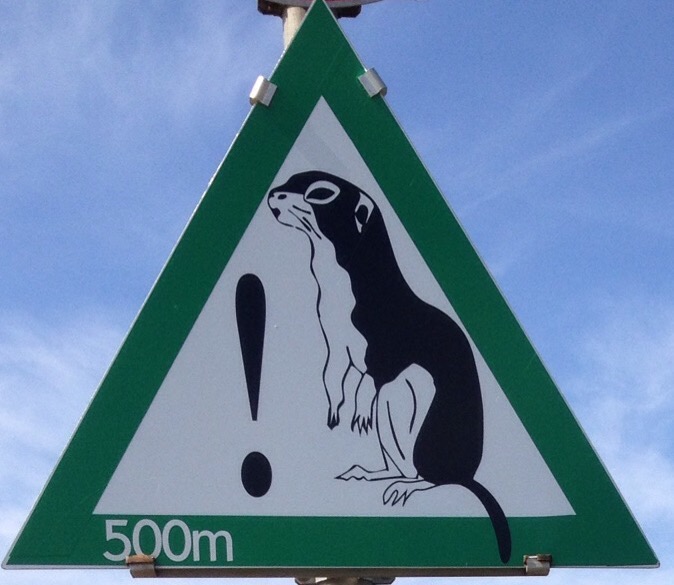
  • Beware Weasels! Obviously not a Lemming, but I saw this while cycling in Austria and had to use it.
    Beware Weasels! Obviously not a Lemming, but I saw this while cycling in Austria and had to use it.

    This post follows the one I wrote about meetings being a virus that use human hosts to reproduce.

    Paul Taylor rightly questioned; ‘we know meetings are a problem, but why are we unable to do anything about them?’. Ultimately there’s something strange going on with meeting attendance; people cannot, or do not want to, change their behaviour. No matter how bad the meeting promises to be, no matter how much we recognise this; most of us still turn up to suffer.

    The sort of behaviour you might expect from Meeting Lemmings*.

    Why?…. Is it just too easy to make the wrong decisions and ‘jump’ with the rest of the Meeting Lemmings? Well this might help…. Choice Architecture. I’ve recently been learning about Behaviour Change Science (and Choice Architecture), with people from the Wales Centre for Behaviour Change at Bangor University, North Wales.

    Old Wine in New Skins? Behaviour Change Science (sometimes called Nudge Theory) has probably been around for ages, just called other things. Anything that involves trying to get people to behave in a certain way, or do different things would probably count as ‘behaviour change’. If you think about why many people participate in certain religious practices (roots in ancient history), or how marketing and advertising influence the products we buy (also quite historic), there’s lots of ‘behaviour change science’ going on out there.

    At the moment in the world of public services, there is a huge desire to try to move people away from dependency upon services, and towards greater self-reliance. With this objective in mind you can see the attractiveness of ‘behaviour change science’. You may also have spotted ‘nudge’ and ‘behaviour change’ popping up on your ‘Buzzword Bingo’ cards at meetings?

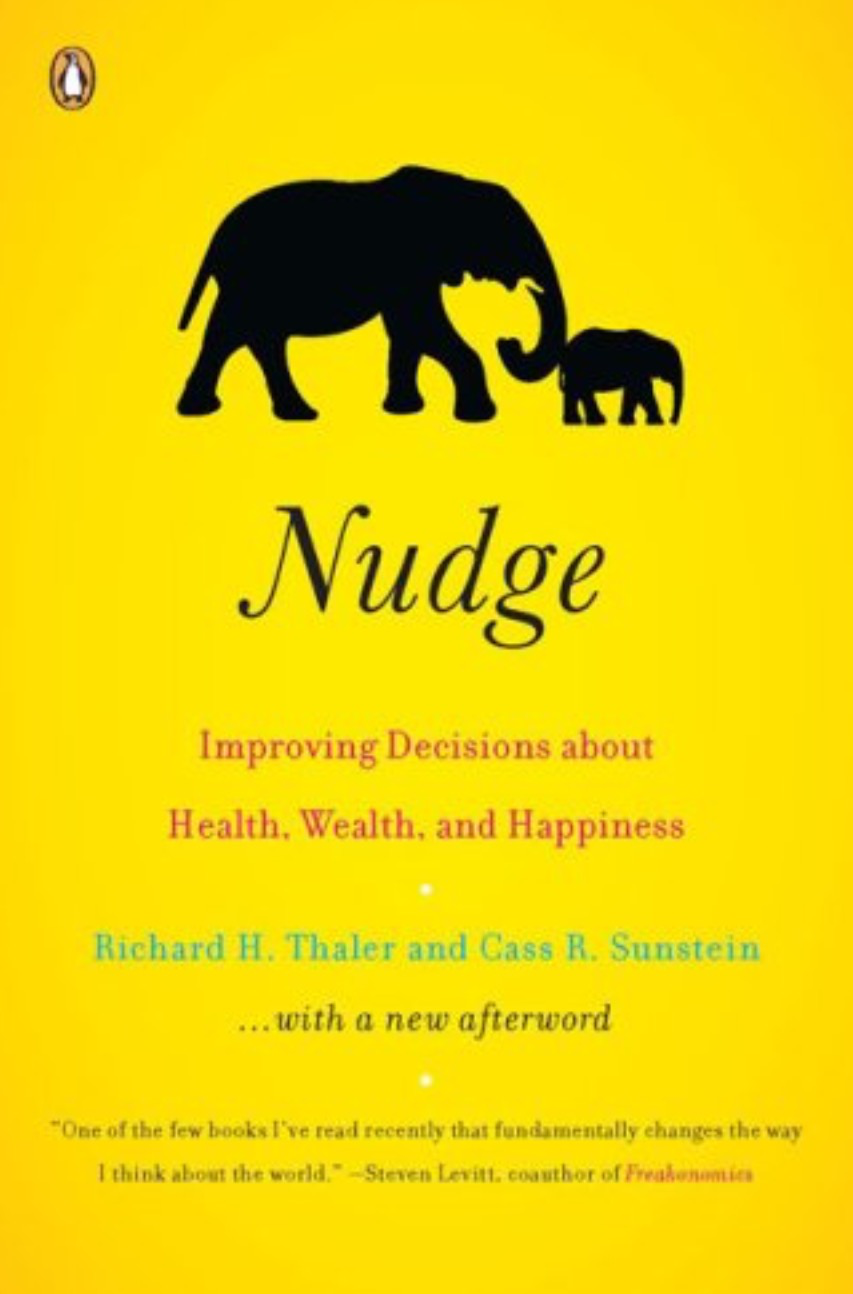
    IMG_3406The idea has been popularised in books like ‘Nudge’ (Thaler & Sunstein) where the idea is that you ‘nudge’ people in the direction of making the ‘right’ choices – you definitely don’t force people (that would be bad, the sort of thing Dictators do).

    This is all part of an idea called ‘liberal paternalism’ which you can read about in this helpful paper; Choice Architecture by Thaler, Sunstein and Balz.

    Choice Architecture and Meeting Lemmings? In the spirit of sharing, here is some of what I learnt about behaviour change science in Bangor, and how I think some of it could be applied to meetings. In particular I’m thinking about Choice Architecture.

    The basic idea is:

    • We have a number of choices we could make around meetings.
    • How these choices are presented is called the Choice Architecture.
    • The choices we make are influenced by the Choice Architecture we face.
    • By presenting ‘choices’ in a certain way, people will be ‘nudged’ to make better decisions.
    • Better decisions will lead to better outcomes (hurrah!).

    For meetings, I’m assuming that better outcomes would be: no meetings in the first place, much shorted meetings or alternative (better) ways of holding a meeting. This isn’t perfect logic, but please bear with me.

    Boiling the meeting choice architecture down into its essential components, I reckon you have 4 key areas where you can influence choice, the core of most meetings:

    1. Attractiveness – what attracts people to your meeting?
    2. Timing – finding the time for people to meet
    3. Venue – the physical space where they meet
    4. The Paper Trail – proving your meeting achieved something useful.

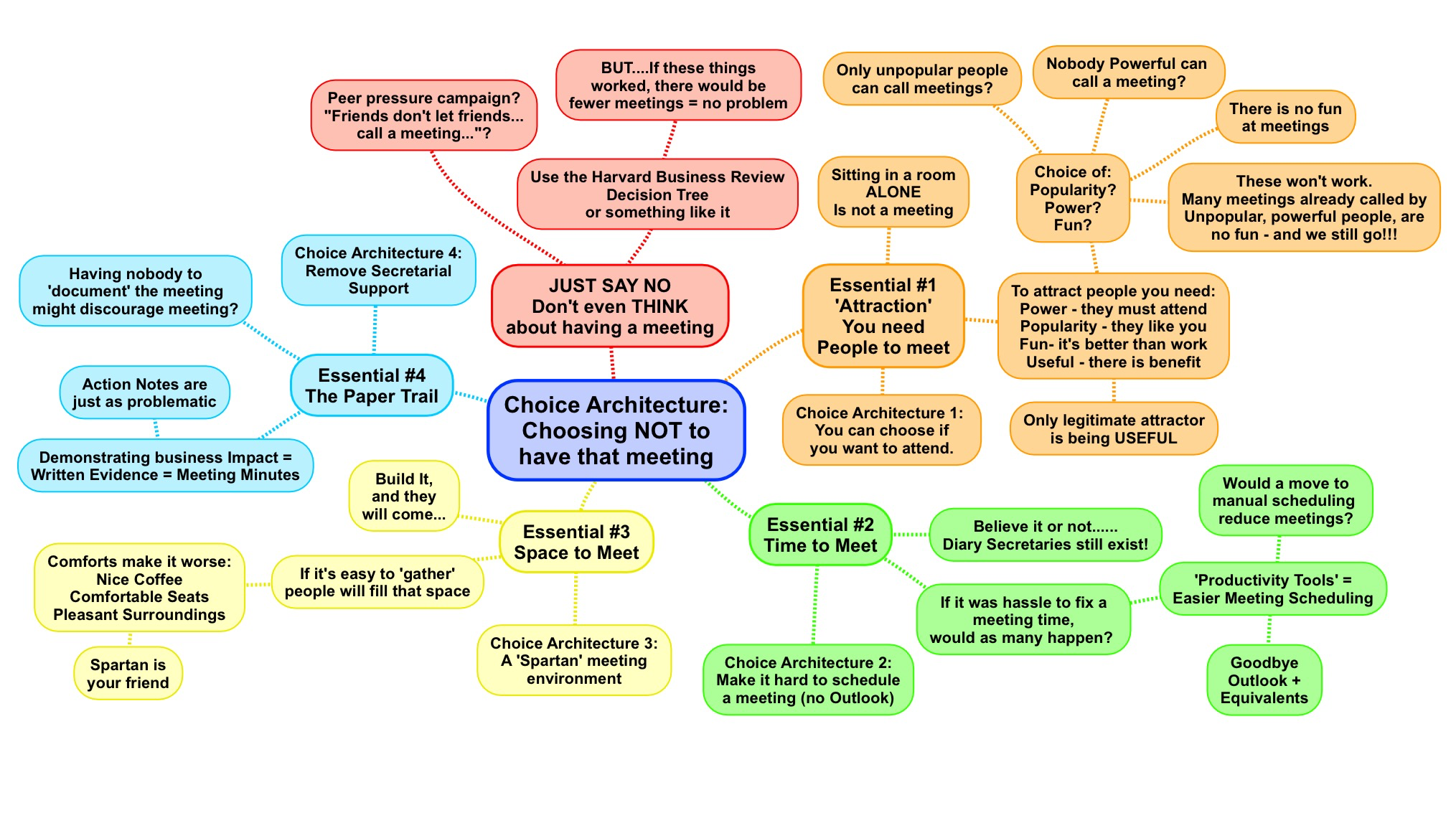
    Making better Meeting Choices: Here are my suggestions for improving meeting choices architecture. If you want a more detailed explanation of why I think these would work, the attached mind map hopefully explains it.

    #1 Attractiveness – meeting attendance is always optional – people are free to choose if they attend. They will need to be convinced, ‘will it be useful to do so?’.

    #2 Timing – prohibit the use of meeting planners and other ‘productivity tools’. It is a physical and mental hassle to plan a meeting. It’s a choice, do you really want that meeting? Have a look at Matt Ballantiine on Efficient Unproductivity which nicely describes the problem.

    #3 Venue – keep it basic. Meetings shouldn’t be about the luxurious surroundings, the focus should be in getting business sorted. Also, spaces can only be booked in multiples of 15mins, with a limit of x8 units (120 mins/2 hours). Your choice of how long to stay in the meeting space is decided by business need, not comfy surroundings.

    #4 Paper Trail – you are required to provide ‘written evidence’ that your meeting served a useful purpose – but there is no administrative support for this. Again, a choice with consequences.

    My Mind Map - trying to explain the logic behind my thinking, good luck!
    My Mind Map – trying to explain the logic behind my thinking, good luck!

    That’s not going to upset anyone….. I appreciate that these might look like extreme options and difficult choices. I would however argue that we already know ‘the right thing to do’.

    Articles like the Harvard Business Review, ‘All the Charts, Tables and Checklists you need to conduct better meetings’ summarise exactly how you should approach meetings. What all this good practice and advice hasn’t done is affect our behaviour, many people still behave like Meeting Lemmings. Maybe what we need is a different (and possibly difficult) Choice Architecture to ‘nudge’ us in the right direction?

    So, What’s the PONT?

    1. Meetings are considered a waste of time by many people. But despite ‘knowing better’ they still attend, a case of Meeting Lemming behaviour.
    2. Behaviour Change Science and the use Choice Architecture can be used to influence the choices people make.
    3. The Choice Architecture around meetings could be changed to ‘nudge’ people towards making better decisions about avoiding/improving meetings.

    *Meeting Lemmings. Lemmings are a rodent like mammal which is popularly (and falsely) known for a suicidal tendency to rush off the edge of cliffs and end up dead. They really should make better choices, it doesn’t make sense. The ‘Meeting Lemming’, should also make better choices:.. “this meeting will be a complete waste of time”…. but they turn up anyway, or worse, they organise it.

    An actual Lemming - not as impressive as a Weasel.
    An actual Lemming – not as impressive as a Weasel.

  • Dilbert by Scott Adams 15th December 2001
    Dilbert by Scott Adams 15th December 2001

    Meetings are a type of Virus that use humans as hosts to replicate…..

    That might strike you as an odd statement; but have a look at the Dilbert cartoon and think about how you would answer these questions:

    1. Have you ever gone to a meeting where you have no idea why you are there?
    2. At the meeting people speak your language, but use words and expressions you don’t recognise?
    3. Throughout the meeting some people speak, just for the ‘joy of hearing their own voices’?
    4. At the end of the meeting you feel a deep relief it has ended and wonder, ‘what on earth just happened and what did it achieve?’

    If you have answered yes to all of those questions, the only logical conclusion must be that there are factors beyond rational human control that have caused the meeting to happen. Something we cannot quite control through the power of efficient business processes and synchronised Outlook calendars. The Dilbert suggestion that meetings are a viral life-form doesn’t seem so strange now……. does it?

    It’s Open Season on Meetings. Just to get serious, everyone seems to have turned their sights on meetings at the moment.  I’m just as guilty and I’ve written a few posts about meetings (available here) where I’ve put the point across that, despite the problems, meetings are very valuable part of doing business. Face to face contact is invaluable in helping to develop relationships and build trust, and sometimes meeting face to face is the only way to get agreement over difficult issues. But that doesn’t count for every meeting.

    Just to prove it’s a serious ‘grown up’ issue, the Harvard Business Review (HBR) have produced ‘All the Charts, Tables and Checklists You Need to Conduct Better Meetings’. Despite the 1st April publication date, this is a good summary of the things you need to consider, it is worth looking at. You might have seen this ‘Should I Hold A Meeting’ decision tree from the HBR Article which circulated widely on Twitter (thanks to Paul Taylor where I first saw it).

    Harvard Business Review Graphic - Meetings go grown up  and serious
    Harvard Business Review Graphic – Meetings go grown up and serious

    Virus Control in Meetings. In the spirit of meetings being viral life-form, I thought it would useful to apply some anti-viral techniques for keeping them under control. So here goes with; avoiding infection; escaping the Infection zone and slowing down virus replication.

    • Avoiding Infection – this is easy, just don’t go to any meeting that doesn’t look useful. Obviously this is easier said than done, especially where some organisations enforce ‘mandatory’ meetings. However it is worth persevering, the HBR checklist is useful, particularly when you have the power to call the meeting. Just think of taking the decision to not call the meeting as the metaphorical equivalent of a good dose of extra strength hand sanitizer. A bit tingly, but worth the effort.
    • Escaping the Infection Zone – this particularly applies to the meetings where you are at the mercy of someone else. The longer you stay in the ‘zone’, the more likely you are to become infected with the ‘meeting virus contagion’. You can use multiple excuses to escape and ‘slip away’ for a while. Urgent telephone calls are a favourite, so are lavatory breaks. People will generally be too polite to ask why you’ve been away for ages, and its also a chance to use the hand sanitizer.
    • Slowing down replication – only one thing to say here, SABOTAGE. If you become a complete meeting nuisance, in a non-specific sort of way, there’s a good chance you won’t be asked back. There are a few approaches you can take, asking awkward questions is always good, but can be counter-productive. You don’t want to be routinely brought in as the ‘critical friend’ or ‘voice of reason’.
    • Be boring – It’s a definite ‘anti-viral’ meeting killer and might get you permanently excluded. If you want some more detail have a read of ‘A Guide to Boring’ from Helen Reynolds.
    • The Field Sabotage Guide. The Simple Sabotage Field Manual is a practical guide to basic, but effective meeting sabotage. Produced in 1944 by a predecessor organisation to the CIA it was declassified recently and is applicable 70 years on as it was on the day it was written. You might recognise some of the behaviours from meetings you’ve attended. I have written about it previously (Spotting Field Sabotage), and the picture below clearly explains what you need to do.

    Simple Sabotage Field Manual. Section 11, Page 28. Declassified
    Simple Sabotage Field Manual. Section 11, Page 28. Declassified

     So, What’s the PONT?

    1. Meetings can be a highly effective way of building relationships, developing trust and getting things done.
    2. Not all meetings are organised to make the most of the valuable resources they attract. Sometimes you can wonder ‘why are we here?’
    3. Always ask why do you need this meeting? Use things like the HBR ‘charts and checklist’, but if all else fails you could use sabotage to slow down the replication of the meetings viral life-form.

    Picture sources:

    Dilbert Cartoon: 15 December 2001.  http://dilbert.com/strip/2001-12-15

    Simple Sabotage Field Manual : http://www.gutenberg.org/files/26184/page-images/26184-images.pdf

    Harvard Business Review Meeting Charts, Tables & Checklists: https://hbr.org/2015/04/all-the-charts-tables-and-checklists-you-need-to-conduct-better-meetings

  • Question: Can you think of an organisation you have been part of, one where there is an unwritten rule that almost everyone complies with, and nobody really knows why?

    This rule dictates how people behave and is often about stopping people doing something. The reasons why the ‘rule’ exist are unclear, and nobody can adequately explain the behaviour.

    It is part of “the way things are done around here”. 

    Information Governance, Data Sharing, IT Security.  Just to help you, here is a situation you might have experienced. You know the sort of thing “you are not allowed to read that very valuable information because it is on a WordPress Blog. There are ‘security issues’ with WordPress. The IT department will cut and paste the text into a word document and will email it to you …… it will be available in 10 working days”.

    I’m not making this up, I have seen this happen in recent history. The justification is always some hazy requirement to comply with ‘IT security’ and is justified by referring to some terrible incident (usually not explained) that happened in the past.

    I have occasionally (very unfairly, in dark moments of frustration) thought this sort of thing was down to some IT people, in some organisations, being more interested in job protection, the joy of sheer awkwardness and making everyone play by their rules; rather than treating the users as customers.

    This was probably as a result of me watching too many episodes of The IT Crowd. I realise now I was very wrong, sorry.

     5 Monkeys and the Path to Enlightenment. I’m grateful to my friend Geof (an IT person) who helped me with my unjustified prejudice and pointed me at the 5 Monkey Experiments. This gives an explanation of why groups of people might do things (comply with rules) for reasons they don’t fully understand. There might be a good logical explanation for the behaviour, but it is buried in the mists of time. Way back in the ‘corporate memory’ if you like.

    A quick way of explaining the 5 Monkeys Experiment is this graphic.

    The text is also at the bottom of the post. If anyone has the original source for this I'd be grateful The text is also at the bottom of the post.
    If anyone has the original source for this I’d be grateful


    If you prefer here is a 90 second video of the 5 Monkeys experiment. However if you want an even better explanation, get Matt from Complex Care Wales to describe it – with full Kung Fu movements!

    Detecting  5 Monkeys Behaviour? Does any behaviour that might fit the 5 Monkeys theory come to mind after those explanations? I’ve heard of a few over the years, and would be happy to add to this list:

    1. IT Security – the one above, WordPress poses a dangerous risk to security so we cannot let you read blogs….
    2. More IT Security – Skype is really dangerous. There are ‘security risks’ so you are not allowed to have a business meeting using Skype.
    3. Staff Surveys – “it’s all about 5 Monkeys Behaviour…..the reason why everyone is unhappy here is because of some terrible thing in the past. It’s nothing to do with the current regime.”
    4. ‘Signing The Book’ – my favourite example of this is an establishment (in Cardiff) where people who cycled or walked to work dutifully signed a special book. This practice (which only stopped in the 2000’s) dated back to the Second World War and was linked to an entitlement for extra canteen rations as part of the war effort. 50 plus years of compliance and signatures for absolutely no purpose.

    Is this all too good to be true?  The 5 Monkeys Experiment does provide a very helpful to explain away some features of organisational life. There are plenty of examples of compliance with rules you cannot explain and behaviours that fit the 5 Monkeys model.

    I am however just a bit sceptical.

    Firstly because I’m not a monkey, and I don’t really like getting compared to what happened in a monkey experiment. Secondly, there is a bit of doubt about the experiment taking place as described. Have a read of this thread on the Skeptics Website which questions the source of the information. I’m hoping Matt from Complex Care Wales will zoom in at this point and fill in the gaps in my knowledge.

    Finally, despite my scepticism, I do like the metaphor it provides….if you spot a new colleague (new monkey) having their new ideas crushed by existing staff (being beaten up by the old monkeys), step in and tell them the 5 Monkeys Experiment story.

    So, whats the PONT?

    1. People in organisations do comply with rules and behave in certain ways, without fully understanding the reasons why they are doing it.
    2. This can be for good useful reasons, or others that are not so useful. The key thing is to ask questions like, ‘why are we doing this?’
    3. The justification of ‘it’s the way we do things around here’ might just be because you are acting like a 5 Monkeys and ignoring the bananas for reasons that are no longer relevant.

    Thanks again to Geof and Matt for prompting this post.

    Sources: Skeptics Website http://skeptics.stackexchange.com/questions/6828/was-the-experiment-with-five-monkeys-a-ladder-a-banana-and-a-water-spray-condu 

    Here is the full test from the graphic - via the Skeptics Website Here is the full test from the graphic – via the Skeptics Website

    Monkey image via: https://images.unsplash.com/photo-1559126132-9041b5233081?ixlib=rb-1.2.1&q=80&fm=jpg&crop=entropy&cs=tinysrgb&dl=cherylyn-ang-HjbzlmAcjDI-unsplash.jpg


  • My T-Shirt - worn to important meetings (under a shirt - obviously!) My Kafka T-Shirt – worn to important meetings (under a shirt – obviously!)

    “Every revolution evaporates and leaves behind only the slime of a new bureaucracy”.

    There is a point to the Franz Kafka quote, which will be explained later. In the meanwhile I’ll stop being pseudo intellectual and resume normal service….

    Last week I was at this Working With Not To event, learning about Co-Production and Asset Based Community Development. It was great to meet Cormac Russell and even better that he mentioned MEN’S SHEDS!  I’ve been desperate to talk about sheds for ages, so here goes.

    Men Sheds Australia. Cormac told the story of how the Men Sheds movement in Australia had grown from a small social movement, into something that attracted the attention of large government institutions. The key points were:

    • Many Blokes like to mess about in their sheds – fact – no further explanation needed.
    • During the 1990’s in Australia a few Blokes started to informally gather together in sheds and do ‘shed based activities’ – you know the kind of thing, fixing lawnmowers, repairing a bookcase, making new things etc etc.
    • The activity became popular and spread by ‘word of mouth’ around Australia. Men Sheds started to pop up everywhere.
    • Some people (Academics) started to notice that the Blokes who got involved in Men Sheds were healthier and happier than those who didn’t.
    • Proper scientific research followed which tried to understand if there was a clear link between better men’s health and Men Sheds. The research wasn’t completely conclusive (is it ever… ha ha), however the general view is that Men Sheds are beneficial. This report by the Lancaster University Centre of Ageing Research summarises the ‘shed loads’ of research into Men Sheds.
    • Scientific research led to government bodies taking an interest and now Men Sheds features prominently in the Australian Government Department of Health Policy.
    • A small social movement has grown to global success with a 1000 Men Sheds in Australia and expanding networks across the globe in countries like the UK, Ireland, Finland and Greece.
    • Have a look at this video of an example from Age UK (Bromley & Greenwich) which has been funded by the National Lottery.

    http://www.youtube.com/watch?v=eTZaw8GW7r8

    Where does this fit with the Slime of Bureaucracy?

    If you look at any of the Men in Sheds websites and you’ll see a fair few references to ‘Health and Safety’, Insurance and ‘guidance’ for operating a shed.

    I suspect that when the first Men Sheds started as a Social Movement in Australia there wasn’t a Health and Safety Policy in sight. Cormac Russell made the point that with the growth of Men Sheds they attracted government attention, and MONEY.

    The money is quite necessary, sometimes essential. It helps to keep the sheds viable, particularly those where opportunities to raise funds by selling products and services don’t exist. However, money, particularly if it’s been provided by the taxpayer, usually comes with a bunch of rules and regulations attached. There might even be a Manager,  a Coordinator, a Liaison Worker and even an Evaluation and Reporting Officer attached.

    I’m not sure if any of these things actually harm the Men Sheds movement, but they do add a layer of something that didn’t exist when the first ‘social movement’ started. Maybe this is the ‘Slime of Bureaucracy’ that Kafka spoke about?

    Whatever it is, I hope the revolution of Men Sheds doesn’t evaporate before I get a chance to get a saw in my hand and put some overalls on.

    So What’s the PONT?

    1. Men Sheds are an activity that helps many men to socialise and make a positive contribution to society.
    2. Whilst the research doesn’t seem to have absolutely proved the link with better physical health, they are undoubtedly a very good thing (in my view).
    3. With any revolution (or social movement) I think a bit of ‘the slime of bureaucracy’ is probably inevitable if the movement becomes highly successful and grows significantly beyond it’s original community.

    Here are some useful Shed based links:

     Mens Sheds UK: http://www.menssheds.org.uk 

    Age UK Men in Sheds: http://www.ageuk.org.uk/professional-resources-home/services-and-practice/health-and-wellbeing/men-in-sheds/

    Age UK Cheshire – Men in Sheds: http://www.ageuk.org.uk/cheshire/our-services/every-man-needs-a-shed/  (where I first heard of Men in Sheds)

    And a Shed Locator Map – to find your nearest shed: http://www.zeemaps.com/view?group=598561

    IMG_3060

  • Cardiff NHS Hackday 2015 - from above
    Cardiff NHS Hackday 2015 – from above

    I was going to call this post “Don’t worry about the slashed training budget…. Send your people to NHS Hackdays and get them trained for free…”.

    However that gives the wrong message and would send some Organisational Development Professionals into a bit of a ‘tail spin’. The idea doesn’t quite fit with conventional thinking.

    The point I’m trying to make is that NHS Hackday is much more than a bunch of enthusiasts getting excited about technology and fixing medical problems. It exposes the people who participate to a wide range of ‘development opportunities’ that you might wait a lifetime to experience in many traditional personal development programmes.

    I should say that I have been very lucky over 20 plus years to experience a wide range of training and development courses. Everything from online Health and Safety compliance courses through to Raft Building with ropes and logs (the dreaded team-building) and ‘Speaking Confidently’ with an opera singer. Most of the experiences have been very good, and I would like to think they have helped me become better at my job(s). However, nothing comes close to 36 hours of NHS Hackday when you are fully immersed in trying to make something that is real. Something you believe will make a difference. If you could transfer that essence into other training and development situations I think it would have a huge positive impact.

    Here's some paper and pens - explain your idea!
    Here’s some paper and pens – 2 minutes to explain your idea!

    What about My Development Needs?: Just to prove I do think about this stuff, and don’t swan off to random gatherings on the weekend, this I how I thought the NHS Hackday helped with 10 of my development needs (it’s also annual appraisal time, and my Boss might read this).

    1. Networking Skills. I bet there isn’t a single organisational competency framework that doesn’t have ‘networking skills’ featuring somewhere. Well, Hackday is the perfect place to practice these, 36 hours to network with a 100+ people. I must admit to drawing comfort from the fact that although I might have the lowest IQ at Hackday, I probably wasn’t the most socially awkward person in the room…
    2. Speaking Confidently in Public. Always tricky to develop this skill, well try this….. the Saturday Morning Pitch! Getting your point across, in 60 seconds, to a packed lecture theatre of 200 really clever people, beats anything I’ve ever experienced on a training course.
    3. Visual Communication. “Here’s a sheet of flip chart paper and some pens. You have 2 minutes to create something that explains your idea, and then post it on the boards”. It really happened! Again, a skill I often use in real life, and there’s nothing like practicing it under real pressure. I could name and shame someone here who cheated – and turned up with printed posters, but I won’t…..I’ll be doing it next year.
    4. Influencing Skills. Now you have to convince some people, over who you have absolutely no power, to come and work with you for the next 2 days. It was at this point I was wishing I’d done training in hypnosis and mind control. This is one of the toughest things I’ve done in ages.
    5. Teambuilding. No empty barrels, ropes and logs to help out; just a table, some chairs, an extension lead and flipchart paper. All that stuff you learn about setting the vision, working to people’s strengths, communicating clearly and respecting the needs of all team members are used in overdrive at this stage.
    6. Project Management. ha ha ha, there wasn’t a PID, Gantt Chart or a Prince2 Manual in sight! With less than 24 hours on the clock we were ‘stripped down, flexible and outcome focussed’. I’ve not yet done ‘Agile’ Project Management Training, if I do, I hope it’s a bit like this.
    7. Problem Solving & Learning from Failure. This alone would sum up the Hackday experience. As it turns out my original idea ‘needed some work on the detail’ to put it mildly. Approaches like ‘brainstorming’ (in a non obvious way) get dragged out as part of the creative thinking process. We did try some things that didn’t work, learnt from failure and moved on (quickly).
    8. Time Management. Did I mention we had less than 24hours on the clock? The prospect of presenting our working solution to the other Hackers at 3pm the next day is a great incentive to manage the time effectively.
    9. Decision Making & Prioritisation. It’s easy to delay decision making and do more fact-finding when there is no pressure. The urgency of Hackday meant that we made rapid decisions about what we were going to do and stuck with them. Prioritisation meant that some of the things we could have done, or were ‘nice to do’s’ were put aside for another day.
    10. Thinking On Your Feet. If the 60 second pitch on saturday morning had felt like a challenge, the 150 seconds to present your working prototype to your peers on Sunday afternoon was on another level. Then to top it off you get questions from the Judges. Cue what you learnt on the ‘thinking on your feet’ course.
    11. Dress For Success. A long time ago I really did go on a course like this, well it was the 1990’s. The observant will have noticed that this is number 11 in my top 10 list, which is a deliberate mistake. I just wanted to point out that not every course you attend will be effective. It’s clear, from the picture below that I didn’t take on board the lessons from ‘dress for success’. What was I thinking keeping that hat on?

    So, whats the PONT?

    1. NHS Hackday was about so much more than a group of enthusiasts fixing some problems.
    2. The act of working with other people to make something real creates a sense of enthusiasm and commitment that is impressive.
    3. For me, it tests and develops all of the things I think are important in my personal development, and I would recommend it to anyone.

    Links to other NHS Hackday Posts I’ve written here:

    http://whatsthepont.com/?s=NHS+Hackday&submit=Search 

    Picture via Paul Clarke https://www.flickr.com/photos/paul_clarke/12153390494/in/set-72157640139264593/

    Failure to learn lessons from the 'Dress for Success' training
    Failure to learn lessons from the ‘Dress for Success’ training

    Our product partly developed.
    Our product partly developed.


  • New stickers for 2015 I hope
    New stickers for 2015 I hope

    This weekend sees the return of the Cardiff NHS Hackday and I’m going to make the plunge. Last year I was an interested observer, and produced a few posts about what happened (available here). This year I’m hoping to make a pitch. This might be a completely daft idea, so I’m testing it here first, what could possibly go wrong?

    So here it is….., my idea for a visual tool for getting people to walk the Wales Coastal Path. All comments very welcome.

    The Wales Coastal Path – A Visual Tool for Sign-Up and Completion of Walking Stages. Supporting Groups to Participate in Walking the Path.

    Route of the 1400Km Wales Coastal Path
    Route of the 1400Km Wales Coastal Path

    Why Walk the Wales Coast Path as a Group?

    The health benefits of exercise are well-known and considerable effort and resources are directed towards encouraging people to participate in a wide range of physical activities. Walking is a form of exercise that is many positive features which include; relatively easy access to the activity, low-cost of participation (you don’t really need expensive equipment) and above all, the ability to get easy access to very many excellent walks in Wales. One of the most interesting and potentially challenging of these walks is the Wales Coastal Path, all 870 miles or 1400 km of it.

    The prospect of walking the whole length of the Wales Coastal Path is daunting, even for the most experienced and enthusiastic walker. There are however groups of people who are interested in tackling challenges, as a group. The popularity of events such as the Welsh Three Peaks Challenge organised by Charities such as Ty Hafan clearly demonstrate this. One of the benefits of tackling a challenge as a group (apart from the principle of ‘many hands make light work’) is that people are able to provide support and encouragement to other group members. Peer pressure, for a positive purpose, can help people achieve impressive things.

    This Hackday pitch is to create a visual tool that allows groups of people to sign up to walk the Wales Coastal Path; then commit to walking a specific section(s) and register completion when they have walked that section(s).

    How would the Wales Coastal Path Visual Tool work?

    • The ‘front end’ part of the tool (the part users see) would be a map of the Wales Coastal Path. Users would able to download the tool for specific use with their own group.
    • At this point the whole of the route of the Coast Path is highlighted as RED – unassigned.
    • The route of the Coast Path is divided up into units of walking. These could be 5km units, to encourage ‘entry level’ participation or they may be based upon other distances which are determined by the difficulty of the terrain or accessibility. For example 5km stretches in the flat urban areas of North and South Wales are probably more feasible than remote areas of the Llyn Peninsular or rural Pembrokeshire.
    • Members of the group would select their walking section based upon their own abilities and preferences.
    • Once a walking section has been chosen, that part of the Coastal Path map turns YELLOW.
    • A Wales Coastal Path map progressively turning yellow would act as a good visual stimulation and will encourage peer support amongst the group.
    • As members of the group complete their walking section, they register this and that section of the map turns GREEN. Again the visual elements of this will encourage peer support amongst the group and acts as a record of achievement.
    • Just to be clear – this is not a detailed navigation tool for the Wales Coastal Path – there are plenty of commercial providers of this information – from paper Ordnance Survey maps to real-time digital GPS navigation tools. This is an overview that allows scheduling and sign off for groups.
    • Beyond this being a tool to visualise sign up and completion, there are very many opportunities to enhance the basic version, for example:
      • The ability to post photographs of the walk,
      • Links to social media feeds to share experiences,
      • Links to local services such as public transport or accommodation and
      • Links to fund-raising activities.

    Some Questions that Need to Consideration.

    • Does this tool exist already? (I’ve looked but found nothing)
    • How easy is it to get a digital version of the route?
    • Will this ‘tread on the toes’ of Wales Coastal Path?
    • How easy is it to split up the walking sections?
    • Are there any liability issues?

    Any answers to the questions would be very much appreciated. I’m unlikely to be much help with coding, but I can talk a bit about walking some of the coast path. Hopefully see you at Hackday.

    Picture and Information Sources:

    http://www.walescoastpath.gov.uk/default.aspx

    Detailed maps of path sections are available
    Detailed maps of path sections are available