• 20130707-134817.jpg
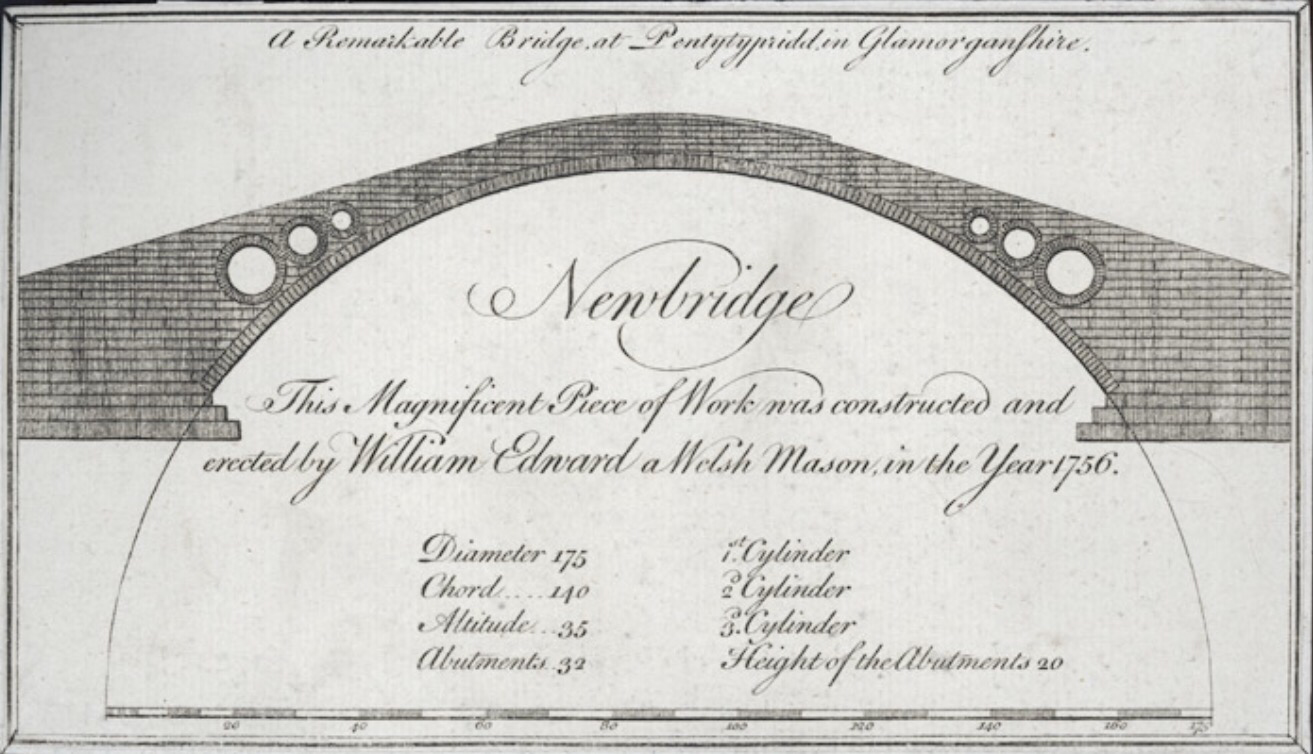
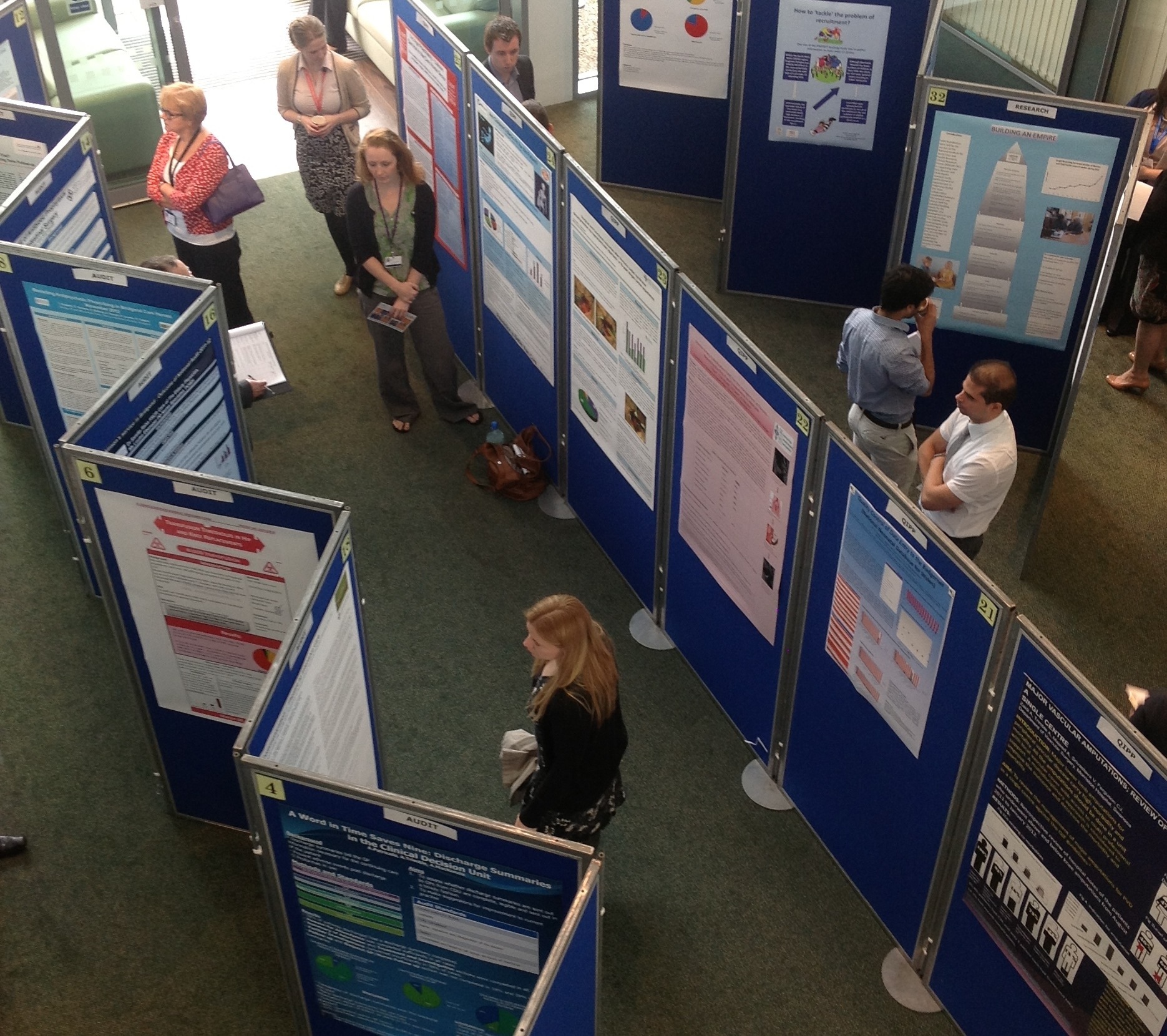
    Image: A typical poster display you see at Health events.

    I’ve seen poster displays many times, in many places, but it never really struck me that not only are they are a very effective method of sharing knowledge, they also support staff engagement.

    Poster displays as part of Kaizen and Continuous Improvement processes in places like Ricoh Telford and the IdeasUK annual conference have always attracted me, but I’ve not seen them very much in Public Services.

    This week I was fortunate to attend an event at Abertawe Bro Morgannwg University Health Board (ABMU). This was the annual poster competition which is the culmination of a year of looking at; Clinical Audit, Research and Quality Innovation Productivity & Prevention (QIPP). I was hugely impressed with the experience and think there are a number of benefits of using a poster approach, that others could use. Here are my top 5 tips.

    1. If you want to understand something, teach it. This is an old adage but very relevant to posters. Producing a poster will involve the translation and distillation of a mass of complicated data, information and knowledge. That thinking process has got to help with your own understanding of the material. Ultimately you want others to learn from you; you need to understand it to explain it.
    2. Graphics and short interesting text beats 10,000 words. Sorry, a statement of the bleedin’ obvious. Communicating using graphics and clear, concise text should get more people engaged and help them understand. It’s probably no coincidence we have advertising posters, not advertising essays.
    3. You reach further. You could look upon posters as the Grandparents of info-graphics, which flood the Internet. The point is you can literally print 100’s of copies of a poster and ‘post’ it to people. Alternatively, you can take a picture and tweet, Instagram or stick it in a blog. Potentially a massive reach for low cost with high impact.
    4. It’s good for Team learning. You could look at poster production as a post project learning exercise. Reflecting upon what you have done, recognising the achievements alongside, ‘what could we have done better’ can be part of the poster production. This might generate more open discussion and embed learning more deeply than a ‘head to head’ meeting to discuss what went wrong/right on this project?
    5. Other people will love you. External recognition of the good work you have done, particularly from peers, is pretty good. Posters can help that, even better if they are part of a recognition scheme like a competition.

    After the event I managed to speak with one of the organisers, Dr Sharon Evans. Here is a link to some audio of our conversation, with Sharon taking about why she thinks posters are useful and important. If you listen carefully, just at the end you might hear a reference to ‘made in Bridgend and used across Wales, and wider’. It sort of proves that point about posters having a far-ranging reach.

    One final though. I have previously posted about ‘Why is good practice such a bad traveler?’. I think that the poster approach could be a method of overcoming some of the barriers to good practice travelling that I mentioned.

    So, what’s the PONT?

    1. Posters are an effective way of supporting knowledge exchange.
    2. Posters can also support employee engagement through the process of making the poster, peer recognition and possibly external reward.
    3. There is opportunity to use the poster approach much more widely.

    Linked Posts:
    IdeasUK Annual Conference. Learning from one of the events I attended. http://whatsthepont.com/2011/11/12/off-island-ideasuk-conference-2011/
    Ricoh Telford. Great example of a continuous improvement culture. http://whatsthepont.com/2012/03/10/ricoh-gemba-mat-the-best-of-ohno-circles-gemba-walks-and-employee-engagement/

    Link to Audio with Dr Sharon Evans: http://audioboo.fm/boos/1486406-dr-sharon-evans-tells-us-how-posters-are-helping-to-share-good-practice-in-the-abertawe-bro-morgannwg-university-health-board-dr-sharon-evans-yn-dweud-wrthym-sut-mae-posteri-yn-helpu-i-rannu-arferion-da-ym-mwrdd-iechyd-prifysgol-abertawe-bro-morgannwg#t=1m44s

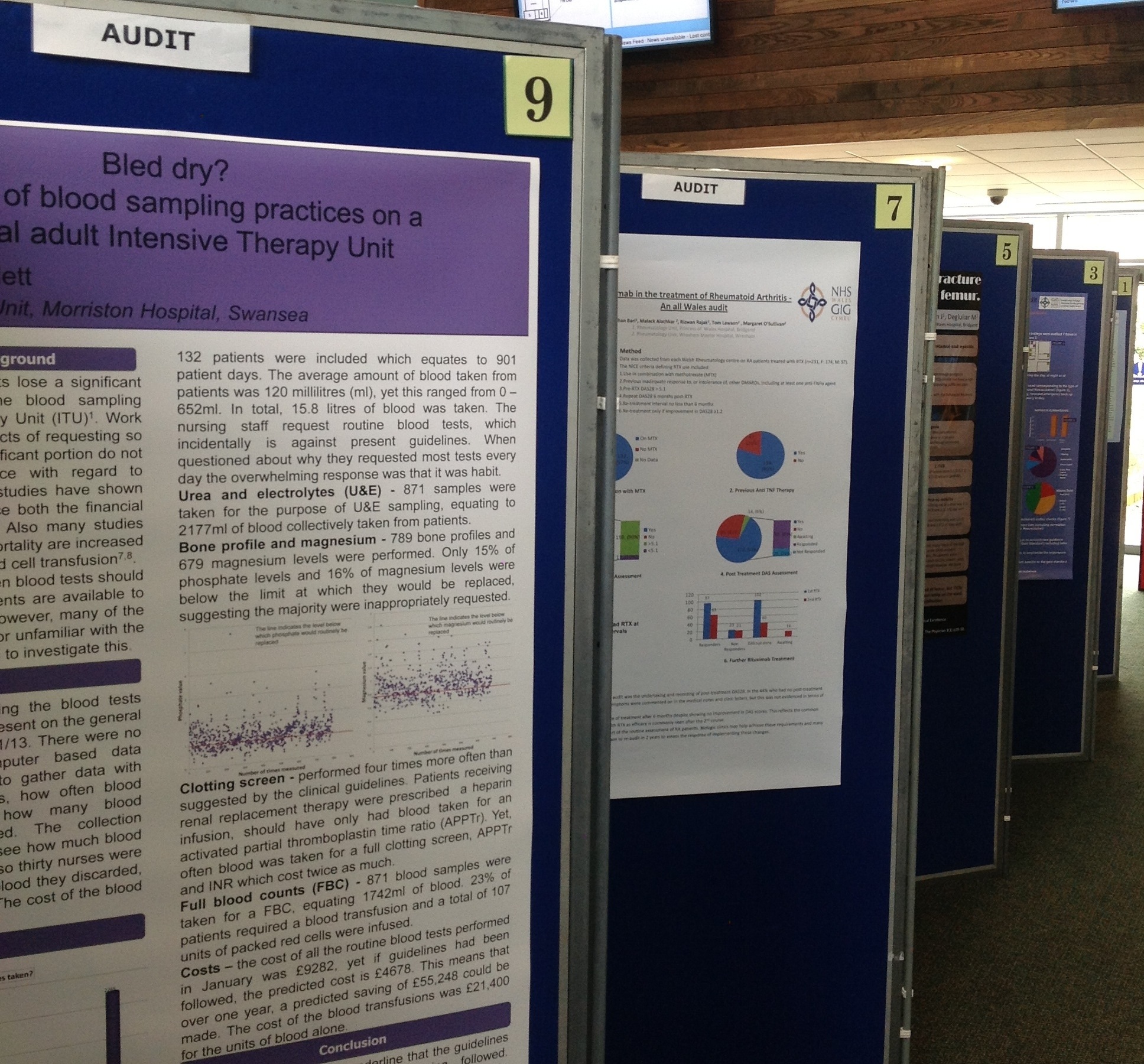
    Poster 9 of 46 in the competition.
    20130707-134803.jpg
    Image: A selection of posters on clinical audit

    Update (more of a note for myself). Its always good to check if things work as well as you think they do. Here are a few papers that have evaluated if posters really are as effective at knowledge exchange as we like to think. The short answer is, yes, but more research is needed…(but they always say that!)

    What impact do posters have on academic knowledge transfer? A pilot survey on author attitudes and experiences BMC Med Educ. 2009; 9: 71. Published online 2009 Dec 8. doi: 10.1186/1472-6920-9-71

    Whats is the evidence that poster presentations are effective in promoting knowledge transfer? Health Information and Libraries Journal 2013, 30, pp 4-12. https://www.researchgate.net/publication/235646004_What_is_the_evidence_that_poster_presentations_are_effective_in_promoting_knowledge_transfer_A_state_of_the_art_review

  • 20130703-230412.jpg

    Almost everywhere I go at the moment someone is trying to change their organisation’s culture. “We are striving for; a learning culture, a feedback culture, a continuous improvement culture, a client focused culture, a listening culture, a culture vulture, blah blah blah.”

    A while ago I heard some good advice from Fons Trompenaars at Academi Wales Summer School, “If you want to understand your own culture, you need to spend some time in someone else’s culture”.

    Fons illustrated this with is own experience of living in the USA. During this time he realised ‘just how Dutch I was’. I’m sure this didn’t involve Fons clutching an Edam Cheese and wearing wooden clogs on the streets of Boston, but you get the point.

    Some observations on the advice from Fons:

    • Before trying to change your culture, you should try to understand what it’s like now.
    • Some of the cultural change activity I’ve seen has been based on huge assumptions.
    • Different experiences will help you understand what your culture is like.
    • It might also help you to work out what you want your new culture to be.
    • Do you want a better version of what currently exists or something completely different?
    • You might also gain an understand what happens in other organisations that gives them their distinct culture.

    I do acknowledge that culture is a difficult thing to accurately describe. However, I also think that more can usually be done to understand where you are now. To paraphrase the advice from Fons, ‘go and experience something different to really know yourself’.

    My experiences of other organisations had taught me a lot.
    One of my most revealing experiences happened while working on a partnership project. One day I asked what was the purpose of the big grey safe bolted to the pillar in the middle of the office?

    None of the 20 people in the room knew. Not even the bloke who had been there 25 years and used to sleep away his afternoons behind a screen of potted plants. Nobody had ever thought to ask the question…

    That incident said something to me about the culture of that organisation. The sense of empowerment, compliance with the rules and the lack of an enquiring mindset of people in that organisation.

    By comparison, in one place I used to work, my colleagues would have opened the safe with a crowbar and hacksaw. Just to find out. They were an inquisitive bunch.

    How do you test culture?
    If you are going to try a different culture make sure you observe things carefully. Try out a few of these little exercises:

    • How do you organise a working lunch for some visitors, service users or clients?
    • How do you get a small idea to improve something implemented?
    • How do you get to speak to the head of the organisation, face to face?
    • How do you get a letter sent out, committee report approved or blog post published?
    • Do something wrong and see what happens.

    This is not a comprehensive list, but I reckon that if you have a go at a few of these activities, you will gain you a fair idea about the culture of the organisation you are visiting, and yours.

    So, what’s the PONT?

    1. Lots of cultural change is based on assumptions, about the existing culture. It’s worth finding out if those assumptions are correct.
    2. If you want to understand your own organisations culture, try spending time in someone else’s culture.
    3. And while you’re there, carefully observe and compare how a few mundane tasks are carried out in each organisation.

    Linked Posts:
    Back to the floor. http://whatsthepont.com/2013/05/29/if-i-ruled-the-world-all-public-sector-senior-managers-would-do-a-secondment-in-the-community-by-jargonautical/

    Ricoh,Telford. The best continuous improvement culture I’ve seen. http://whatsthepont.com/2012/02/23/employee-engagement-kaizen-passion-in-the-west-midlands-ricoh-telford-to-be-exact/.

  • 20130622-220618.jpgAt the end of this post I’m hoping that I will have convinced you to view a video of a song from the Gilbert and Sullivan, Comic Opera, ‘The Gondoliers’. Not generally my everyday listening, but please persevere.

    Recently I listened to Tony Quinlan from Narrate talk about how the patterns we have established in our brains have an important role in how we make decisions. The idea was that we have patterns that have been formed by our experiences, particularly those in our early years. Stories and tales we have heard will form a big part in shaping these patterns; which is why fables, fairy tales and parables are such an important part of our development.

    When it comes to decision making, most of us don’t logically scan all available information and make a decision based on the facts. We identify a pattern (based upon what we already know) and use that to justify whatever decision me make. Just to make this less logical and precise, we will select the quickest ‘reasonable fit’ pattern, rather than wait for the ‘best fit’ pattern. In addition, we are probably only scanning about 5% of the available information. Tony works a lot with Cognitive Edge and there is lots of material about the topic on Dave Snowden’s blog.

    Closing a Public Asset that was funded by Public Subscription. Tony talked about a situation where the closure of a public asset is about to take place; for example a local hospital that was built almost 100 years ago with subscriptions from miners wages. If the local people have grown up with stories about the struggle their grandparents faced to secure decent health care, any proposal to take that away is going to be difficult. The conclusions they make about ‘consultations’ will be made in the context of patterns which were developed from the narrative that came from the situation their grandparents experienced. No matter how many facts or how much logic is thrown into the debate, it doesn’t matter people probably aren’t listening any more, the patterns and responses have been fixed. I have experienced something similar.

    Tony did offer some suggestions about finding a narrative and ‘walking with people’ to an agreeable solution. Have a look at the Narrate site for some examples.

    Quite calm consideration, then carnage. The conference Tony was speaking at was about austerity and the challenges public services face over the next few years. There was no denying the scale of the problem. There was also lots of talk about capable and committed people working throughout public services ready to tackle the problems, collaborate, share knowledge and get stuck in. It think it was eloquently summed up in the quote “quite calm consideration will untangle every knot”. I was quite hopeful and inspired at this point.

    With 24 hours things were being spoken about at another conference, by different people, in a very different language. The gist was, ‘we are facing a nightmare scenario…… it’s going to be carnage’.

    This contrast in language certainly surfaced different patterns of response in me. I was lucky in that I experienced both, so can hopefully try and make a balanced decision (am I deluded and naive or can we sort this out?). When I reflect upon what Tony Quinlan had said about what patterns are surfaced, and how this influences the decisions we make it made me wonder. I do think that the language people choose to use is important.

    What about Gilbert and Sullivan? The ‘quiet calm consideration will untangle every knot’ quote is from the Gilbert and Sullivan Opera, ‘The Gondoliers‘. I never realised I could be a fan of comic opera, the Indie Rock and Bluegrass patterns in my head must have been preventing me. There are some video links to the ‘In a Contemplative Fashion’ song at the end of the post. They are worth a look and listen. In the Martin Milnes version the words are very clear and the one from the Derby Gilbert & Sullivan is a bit more theatrical, your choice.

    So, What’s the PONT?

    1. Many of us make decisions based upon only a part of the information that is available.
    2. This is influenced by the patterns in our brains which have been developed by the narratives we will have heard or experienced.
    3. What we choose to say to people can have a significant influence on the patterns that surface and how they make a decision. It can be a choice between, quiet calm consideration or carnage.

    Linked Post: My experiences of why hard scientific evidence was beaten by emotion. http://whatsthepont.com/2013/05/19/one-ounce-of-emotion-beats-a-ton-of-scientific-evidence-its-all-about-the-babies/

    The Gilbert & Sullivan Videos:

    Martin Milnes in THE FALSETTO SINGS GILBERT AND SULLIVAN at the International Gilbert and Sullivan Festival in Buxton.

    Derby Gilbert & Sullivan Co’s production of The Gondoliers at the 2009 Buxton Festival.

  • 20130616-230854.jpgThe last few days I’ve been passing on the book collection my late Father in Law had built up over 50 years. There were in excess of 1500 books and it’s been really tough.

    At one level there is the basic problem of handing over a book. There is something about a book that seems to create a physical and rational attachment that makes it hard to let got. For me a book is a physical artefact that stands for hard work, knowledge, wisdom and learning. Why would anyone what to part with it? I bet many people still have childhood or college books that they hold onto ‘just in case’, I know I do.

    At an emotional level it was even worse. Almost every book seemed to have slips of paper or cards inserted into them where my Father in Law had written notes and comments. These weren’t just books to decorate the shelves, he’d read them all, some of them many times. His personality was literally written across the collection.

    Could anything make this a less of a difficult experience?

    When it came to topics where I have limited interest and very little understanding, things were slightly easier. Saying goodbye to an ancient tome, in Latin or Greek became easier after a while. I had to keep reminding myself that if I didn’t take positive action, these books would end up sitting in boxes in my house. This was a good practical, no-nonsense motivator.

    However, the biggest help was finding someone who loved books and was prepared to take care of them. I was fortunate to find Andrew Mitchell the owner of Capital Bookshop in Morgan Arcade, Cardiff. As it turned out my Father in Law had been a customer of Andrew’s for many years. My Father in Law had sold books to Andrew and bought many others from him.

    It felt like this was an opportunity for some of these books to ‘go home’ and find their way onwards, back into the hands of new people who would love, cherish and above all learn from them. I think my Father in Law would have liked that.

    If you are in Cardiff, please pop in to Capital Bookshop to see Andrew. Hopefully you’ll pick up a book my late Father in Law used to own. It will have A Whiley written inside the cover.

    Picture Source: http://charlotteroseturner.blogspot.co.uk/2009_01_01_archive.html

  • 20130615-211045.jpgThis week saw the fantastic Online Influence, ‘Oi!’ Conference roll into Cardiff, beautifully squeezed in-between Rhianna and John Bon Jovi (concerts). A fairly standard Cardiff week.

    You can read about the fantastic speakers; Phillipa Davies (@mindhiver), Ian Cleary (@IanCleary) and Mark Schaefer (@markwschaefer) on the Oi Conference site. I’d also recommend looking at this review of #Oiconf13 by the incredible @MrTonyDowling, who is behind the whole thing.

    There was a great deal of activity following the conference with examples of people putting learning into action. I’m happy to say I’ve also had a go.

    Working with incredibly generous Helen Reynolds (@HelReynolds) we sat down at a different conference we were both speaking at and recorded our key learning points from Oi! Conference 2013.  Here they are, hope you enjoy our 6min podcast.

    So, what’s the PONT?

    1. A recording seems to be a quicker method of sharing content than a traditional blog post (I’m sure it will be once I’ve cracked the technology).
    2. We are hoping that it is a more effective method of sharing (the Jury is still out on that one).
    3. I still have lots to learn. It would have been a good idea to have tested the technology before jumping in with both feet (so unlike me).

    Picture: A front cover from The New Musical Express, June 18 1977, featuring ‘The Stranglers’. You’ll have to listen to the podcast to work out why this is relevant (close to the end between 5-6 mins)

  • 20130529-173130.jpgI recently overhead one of those slightly awkward “what’s your job” dinner conversations. Guest 1,”I’m an NHS Senior Manager”…..Guest 2, “Oh” ……. Guest 1, “I’m actually a nurse by background. I did all my practical training on the hospital wards, qualified as a nurse and moved into management much later on”…… the conversation went well after that.

    The ‘in between the lines’ message was; ‘I am a serious professional, I am caring and compassionate, and I have earned a position through working at the front line’ (rather than some fast track graduate who had a minor brush with patients on a gallop to the top). In these days post Mid Staffordshire Hospital Inquiry it was important for this individual to establish their credentials. They wanted their dinner companion to understand what they were about.

    There are lots of positives that come from practical, experience based job development:

    • Learning from colleagues who have developed the wisdom that comes from experiencing thousands of different situations over many years;
    • Speaking the language of that specialist group which gives deeper meaning and speeds up understanding;
    • Being able to try, fail and learn in an environment with colleagues around that can manage and mitigate risks; and very importantly
    • Getting close to the service or product users and developing an understanding of life from their perspective.

    This is hard won experience that comes at a cost, mainly time and application (effort).

    Can you teach care and compassion? The big question for me in all of this relates to the role of senior managers and leaders. If you’ve never been part of the system you are managing, can you really understand it well enough to lead it effectively?

    Second question; if a large component of that service is about caring and compassion, how does it work if you’ve never experienced what it’s like to be at the front line? As a senior manager how do get a better understanding of what it feels like to be on the receiving end of ‘your’ service? A situation where a paid employee of a big organisation is making some pretty serious decisions about what happens to you. How do you get to understand what it feels like to be confused, vulnerable or afraid?

    I’m not sure if you can you teach compassion, empathy or how to be caring on an MBA? (I’ve no doubt a Business School prospectus is offering it somewhere). For me, the point seems to be; if you want to understand, you need to get up close and experience how it feels, not just learn the theory.

    How about this for a suggestion? Over the weekend I was involved in a conversation with Lucy Knight (@Jargonautical) and Claire OT (@claireot). Lucy proposed the following; “if I ruled the world, all senior public sector staff would do a part time secondment in the community”. Have a read of this post ‘govsplaining’ by Lucy which gives a very practical insight into different approaches between the voluntary and public sector.

    I must admit to getting slightly over enthusiastic about Lucy’s idea and suggesting some sort of ‘National Service’ scheme where everyone spends time working in a community or voluntary activity. I’ve always been a big enthusiast of ‘back to the floor’ activities, particularly for those people who’ve climbed so high in an organisation that they’ve lost touch with the front line, or in some cases never had it in the first place.

    The idea of part time secondments for senior managers working in service areas where they have direct contact with citizens and service users could have an incredible impact. Not just the contrast between how services are run but also the service user experience and how it feels. Imagine the impact on a financial target driven, ‘spreadsheets rule the world’, hard nosed Head of Corporate Resources working in a community adults day centre for a few months.

    So, what’s the PONT?

    1. It’s easy to loose touch with user experience and service users the more senior you become in an organisation.
    2. Secondments may be a way of reconnecting with the service users and the people who deliver the service.
    3. For activities that focus on care and compassion, experiencing how it feels at the front line may be the best way of gaining some understanding.

    Linked posts: Every CEO should try to access the service their organisation delivers using a mobile phone. Not exactly ‘back to the floor’ but it will give a taster of the user experience. http://whatsthepont.com/2013/02/21/every-ceo-should-try-to-access-the-services-their-organisation-delivers-using-a-mobile-phone-at-least-twice-a-month/

    Charity Bag Packing at the local supermarket. How it helped some teenage rugby players learn some social skills. http://whatsthepont.com/2011/10/22/bag-packing-social-skills-and-youth-rugby/

  • 20130519-165205.jpg

    Last week I attended an event organised by The Alliance for Useful Evidence and Wales Public Services 2025 (#a4ue on Twitter). The aim was to work out how you get policies developed and practices delivered that are better informed by evidence. The problem seems to be that millions of pounds (of taxpayers money) is spent on things for which there is limited evidence of success.

    There were lots of views about how you collect better evidence and a bit of ‘hand wringing’. Why is it that evidence doesn’t get used properly? To paraphrase; “We produce compelling, factually accurate evidence yet the politicians ignore it and make decisions based on political values, not the evidence we put in front of them……”.

    This situation could apply almost anywhere. Head down to your Local Council Planning Committee and you probably won’t have to wait too long before you see the Committee Members overrule some technically correct, fully evidenced advice from the Planning Officer. A cruel but compelling spectator sport.

    In their defence I’d say its not just politicians that are ‘guilty’ of this, and in fact, it’s more to do with how you communicate the evidence. Here’s a personal experience.

    Lets clean up the Gas Works. About 20 years ago I was working in environmental protection when a proposal to clean up a former heavy industry site landed on my desk. This was an imaginative and cost effective proposal that would deal with the huge quantities of toxic waste that had blighted a local community for over a 100 years. In three years time the site would be regenerated, creating space for new clean employment opportunities and a community recreation facility. What could possibly go wrong?

    The Public Meeting. Imagine this, a village hall packed with about 100 local citizens and a bunch of experts sat on the stage. The experts had absolutely tons of carefully researched scientific evidence about why this proposal was a good thing:

    • Long term risks to health from the site would be removed;
    • Risks during cleanup would be minimal and well managed;
    • Economic benefits during the clean-up would be significant (jobs);
    • Long term job opportunities were predicated;
    • River water and ground water quality would improve significantly;
    • The Environment and biodiversity in the valley would be improved; and
    • Sustainability was constantly mentioned.

    This was a very logical, rational, well balanced and fully evidenced argument to proceed with the scheme. As a trained scientist I was completely convinced.

    The Counter Argument. A lady stood up at the back of the room and yelled “what about the babies……?”. She then proceeded to describe in graphic detail a case of birth abnormalities that had occurred close to a waste management facility in a nearby community. That situation was completely different to what we were talking about, but that didn’t matter. The damage had been done. The carefully prepared evidence had been rendered useless by 30 seconds of pure emotion. That’s where I learnt the phrase, “one ounce of emotion beats a ton of scientific evidence”.

    As I recall, the clean up of the site was delayed for several years (of continued pollution) while an agreeable compromise was reached.

    Why don’t we accept what experts say? In this seminar I heard Dave Snowden talk about how you need to be prepared to accept new ideas. Patterns of recognition need to be developed beforehand so that you can accept the new idea. If we don’t recognise what is being offered we are more likely to reject it straight off. I’ll dig out my notes from the session and put together a more substantial post.

    For me the learning from “what about the babies…”, has great relevance to the ‘useful evidence’ debate. It’s all about choice. Whether you are a local citizen, policy maker, delivering a service or a politician you have the choice of ignoring or using evidence. Understanding that people will make choices about what they absorb, no matter how scientifically accurate, is worth thinking about if you are trying to get people to use your ‘really useful evidence’.

    So, whats the PONT?

    1. People can choose what evidence they accept. Scientific ‘fact’ does not automatically equal acceptance.
    2. How evidence is presented is important if you want people to understand and accept it. Recognition of something familiar is important.
    3. Emotion will beat evidence and facts, just remember “the babies……”

    Picture Source: Just a thought. The evidence bag in the picture says ‘to be opened by authorised personnel only’. I wonder how much other evidence is given this ‘experts only’ status!

    Linked posts: How Florence Nightingale used infographics to convince Civil Servants and Politicians that they needed to improve sanitary conditions to reduce deaths during the Crimean War. http://whatsthepont.com/2013/01/27/florence-nightingale-the-mother-of-infographics-btw-she-was-also-a-nurse/

  • 20130511-125211.jpg

    Ask the internet and often it delivers more than you expected. Today was one of those days.

    About two weeks ago I ended up in a Twitter discussion with Shirley Ayres and Paul Taylor about how much time gets wasted in meetings. It started with a post about are meetings are the symptom of bad organisation, and ended up with some ideas around calculating just how much meetings cost.

    One of the things mentioned was doing the following calculation, in your head:

    Number of people x Hourly pay x Hours spent meeting = Meeting Cost*

    *This doesn’t include travelling to the meeting or preparation time, which probably needs to be built-in, but it’s a good starting point.

    The idea is that you then compare this cost of meeting figure against the benefits that have resulted from having the meeting, simple. The benefits should be greater than the costs. However, calculating the monetary value of the benefits of a meeting is a bit more difficult to work out.

    That was where I left the discussion until Shirley and Paul picked things up again this morning (I have a good reason for being absent, honest).

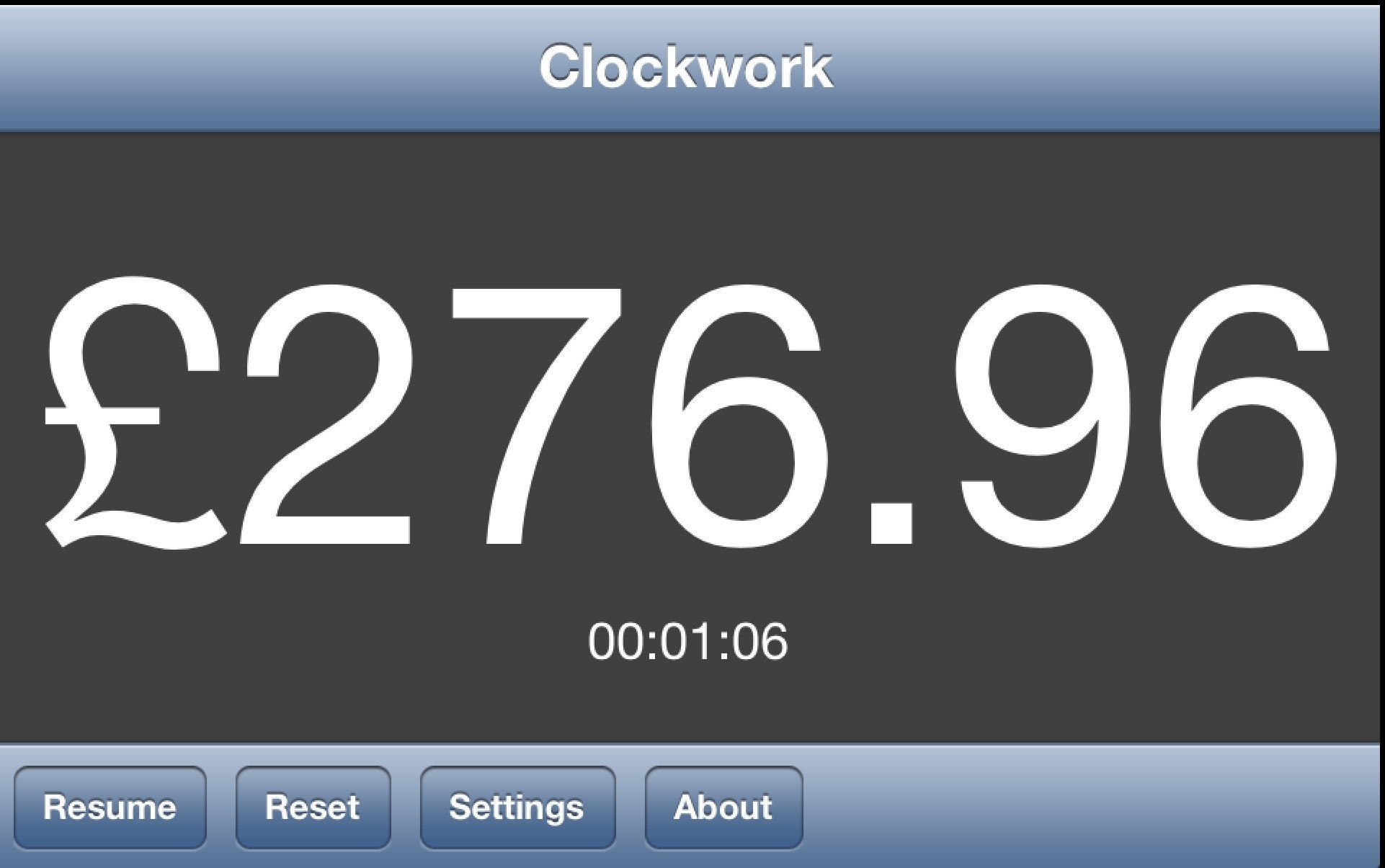
    Say hello to Meeting Ticker and Clockwork Meetings, these are two very helpful programmes that allow you to display the costs of your meetings. To quote Nick Atkin of Halton Housing Trust, “this would shorten meetings by about 75%”. This is how they work:

    Meeting Ticker was introduced by Paul this morning. This is open source software which has been developed on GitHub by Toby Tripp, Lydia Tripp, and Roy Kolak. It is worth reading the explanation of why Meeting Ticker was developed ….’expensive consultants sitting on their butts for hours on end’ was a big motivator (sound familiar?).

    This is very straightforward to use; you add in the number attending, make an estimate of the hourly salaries and press start. You then watch a meter rapidly adding up the pounds and pence with “stop the bleeding” written dramatically below. It is slightly mesmerizing and would shorten meetings I’m sure.

    A couple of observations:

    • Meeting Ticker is written on GitHub, open source software so anybody (with the necessary coding skills) could develop it further, for example to include a choice of salary ranges or a salary calculator.
    • It might not work using Internet Explorer. There is an advisory note saying “If this works on Internet Explorer, it is purely by accident”. Worth knowing if your organisation (there are plenty) only allows an ancient version of Internet Explorer as the web browser.

    Clockwork Meetings This afternoon Ed Bullock from Halton Housing Trust came up with this free app on iTunes. It is just as easy to uses as Meeting Ticker, you add the number of attendees, hourly salary cost and press start. The big difference is the ability to set an audible ‘click’ to make a noise at set intervals. Just what you need in case you forget the fact there is ‘money on the clock’.

    The discussion hasn’t ended here. There is a lot of activity ongoing to find the best on-line salary calculator that could be used in conjunction with either of these applications.

    I’d suggest that you also need a large screen in the meeting room, so that everyone can see the costs rising as the meeting progresses (or drags on). Hopefully it will focus minds to think about costs and benefits.

    I know we haven’t yet worked out how we measure the benefits of meetings. Maybe that’s something Shirley can encourage debate about next weekend?

    So what’s the PONT?

    1. There seems to be software programme or app for just about anything you can think of, somewhere on the internet. You just need someone to look in the right place.
    2. A highly visible display of the costs of a meeting is likely to have an impact on how people behave and long the meeting takes.
    3. Slight word of caution here. Don’t let this approach fall into the wrong hands. I worry that a few people might misuse ‘meeting cost measures’ and force people into hasty decisions, when a more thoughtful consideration of the evidence is required.

    Picture source: Meeting Ticker http://tobytripp.github.io/meeting-ticker/

    Clockwork Meetings: https://itunes.apple.com/ye/app/clockwork-meetings/id384045562?mt=8

    20130511-184645.jpg

  • 20130509-224405.jpgI’m not ashamed to admit my naivety and ignorance. In the last post I was astonished to find out there was a book available called ‘NHS Jargon Explained’. I was just scratching the surface…..

    On the basis that jargon is “the specialised or technical language of a trade, profession or similar group”, and the NHS is a massive organisation with very many specialist groups, this shouldn’t be surprising. A quick search using twitter turned up some interesting examples of NHS ‘jargon busters’. These are my favourites, apologies to anyone worthy who’s not on the list.

    Guardian Newspaper, Glossary of Healthcare Jargons and Acronyms. This is 2011 vintage and has about 70 examples of the most common NHS jargon. I was a bit surprised to see BT (British Telecom) feature. Apparently it’s something to do with them running the N3 Network. Have a look at the Guardian article to find out what N3 means. You also need to know that a ‘spine’ isn’t necessarily that thing in the middle of your back.

    NHS Local, West Midlands. This is provided by a group of NHS organisations, Universities and private sector organisations that are “transforming healthcare by changing the conversation between patient and the NHS” (that’s not jargon is it). The jargon buster has about 70 explanations, mainly to do with maternity services. Very useful if you need to use that service. A great explanation of ‘oily fish’ can be found here.

    Leicestershire NHS, Health Informatics Service. This is blog by a Communications and Marketing Officer in Leicestershire NHS, that explains about 30 Information Technology terms used in the NHS. Helpful information about the language used by another specialist group that will be of benefit to those who don’t work in IT or understand it. Unfortunately there was no explanation of exactly what ‘informatics’ means (is it just me?).

    Health and Social Care Information Centre, National Casemix Office Jargon Buster. I had to use the jargon buster to understand what a ‘Casemix Office’ does: “A system whereby the complexity of the care provided to a patient is reflected in an aggregate secondary healthcare classification.” Phew, thank goodness that’s cleared up. There are about 60 definitions here, some of them pretty baffling, but it is the language of a very specialist group. Well worth a look if you want to understand what ‘complications and comorbidities’ are all about, alongside ‘cliff edges’, ‘unbundling’ and ‘spells’.

    NHS Confederation Acronym Buster. This has a bumper 500 acronyms explained. There is even Application Software (an App, see the NHS Leicestershire definition) available to download for free. This is very helpful and something you could keep under the desk for emergency situations when the healthcare experts are running wild. My only gripe would be that defining acronyms is only half of the problem solved. The jargon remains.

    My Health London.  This is an award-winning information website for health services in London. The jargon buster is in a section focussed on young people and there is also a free App you can download called ‘Well Happy’. This is worth a look as it has very clear, jargon free explanations under headings such as ‘Sex and Relationships’ and ‘Alcohol and Addiction’.  Very useful for those difficult conversations with the teenage kids.

    This has been a bit of an eye opener. Specialist groups certainly do have their own language, unfortunately jargon to outsiders. There were other examples I stumbled across from the third sector, IT, property and law. Nothing I could find specifically from the world of Local Government… yet?

    So, what’s the PONT?

    1. In a large and complicated organisation like the NHS the occurrence of many specialist groups with their own technical language (jargon) is inevitable.
    2. The specialist groups need to make sure they don’t exclude outsiders by the use of technical language that isn’t easily understood.
    3. The good news is that may specialist groups are trying their best to share their ‘jargon busters’ which are free for everyone to use. Hopeful those who aren’t as well-developed or inclusive will pick these up and use them.

    Picture Source: My Health London, Young Peoples, ‘Well Happy’ App.

    20130509-224358.jpg

    https://www.myhealth.london.nhs.uk/health-communities/young-people/download

  • 20130426-205100.jpgMy last post about meetings led to a bit of a discussion about jargon. It’s something that’s despised by many people, but has probably been used by most of us on occasions . So I’m being particularly carefull to avoid using it in this post.

    It’s worth having a think about why jargon exists and why we use it.

    Basically it’s just a very specific form of language used by people to communicate and (hopefully) help others understand what they are saying.

    The origins of the term jargon seems to have come from the Old French word ‘gargun’ which describes the ‘cheeping of birds’. In the 14th century it was used to describe unintelligible or confused speech. Some of the modern definitions of jargon you’ll find include:

    • confused unintelligible language;
    • technical terminology or characteristic language of a special activity or group; and
    • obscure and often pretentious language marked by the unnecessary use of too many, long, vague and uncommon words.

    For me, there seems to be two distinctly different reasons for using jargon, one acceptable (with conditions) the other completely unacceptable:

    Technical. In this case you have a specific highly technical area where jargon helps communicate more clearly, efficiently and effectively (within the technical community).
    Posturing. Here people choose to use language that prevents others understanding what they are saying. The word ‘evasive’ is used a lot in connection with this type of jargon.

    What do you do about jargon?

    Posturing Jargon. In the case of posturing this is easy (in theory). Just say, “I haven’t got a clue what you are talking about. Please could you explain that without the jargon.” Obviously, this isn’t as easy to do as it sounds, but it’s worth thinking about. Remember that the use of jargon will be an (unconscious or deliberate) act to exclude you from a conversation or prevent you understanding what is being said. You may have encountered this sort of person……..

    Technical Jargon. For technical jargon it’s much less clear-cut. This might be a highly specialised area and the jargon actually helps with communication. I remember as an undergraduate I used a specialised scientific dictionary as part of classes. Perfectly reasonable as most of the words didn’t need to be used in general conversation, but it helped greatly in the laboratory. To people outside of that community it was just jargon – ‘cheeping birds’. You need to be on your guard to avoid excluding people from the conversation if they don’t understand the specialised words. There are useful approaches like having a ‘jargon buster’ (explanations of the jargon) available, but the objective should surely be to minimise the jargon in the first place, or keep it where it belongs, in the specialist community.

    Management Speak. The place where this gets messy is the crossover between technical and posturing. What if you have someone posturing using technical jargon terms? Dangerous territory. If I was being sceptical I could say that this is the territory of management speak. This Guardian article highlights some of the worst examples like, ‘drill down’ (look in detail) and ‘sunset’ (close down the project). I’m sure you could find plenty of jargon and management speak from your own experience, and use it in that the old favourite ‘Buzzword Bingo‘.

    One final thought whilst I was thinking about this post I stumbled upon a book by Tony White called NHS Jargon Explained. Initially I thought it was a joke. It’s not, you can buy it on Amazon. I’ve no doubt it’s necessary, but I do wonder if we’ve over complicated things to the point where people have written books to explain what public services are talking about. Not just for people who work in the service but also, “campaigners, patient interest groups, researchers and journalists, and patients and their relatives may also find it useful and enlightening!” No further comment…….

    So, what’s the PONT?

    1. Jargon has its place in specialised technical communities where it helps communication and understanding.
    2. Once you take that language outside of the community you have to explain clearly what you mean, or risk excluding people.
    3. People using jargon to posture, evade, confuse or exclude people should not be tolerated. Ask the question, “I don’t understand, what do you mean?”

    Just checking, how jargon free is this post? Anyone know of a jargon checker I could use?

    Photo Source. Birds on a wire. http://johnsmyth.ie/blog/2011/11/21/the-chattering-classes/

    Linked Posts: Buzzword Bingo http://whatsthepont.com/2012/11/16/best-practice-glossary-or-buzzword-bingo/

    Meetings Sabotage http://whatsthepont.com/2011/10/30/meetings-sabotage-additional-field-examples/

    20130426-205110.jpg

    NHS Jargon Buster

  • 20130421-204621.jpgDoes anyone remember the first meeting they called?

    I can, it was quite an anxious experience. Suddenly I had POWER! Power to take people away from doing something useful and have them sit around a table with me for a few hours. Outside of the work that kind of power would be considered a big deal.
    The consequence of my anxiety was asking many questions like:

    •  Why do we need this meeting?
    •  Do all these people really need to be there?
    •  Is the journey from South to North Wales justifiable?
    •  What will it cost to put these people in a room for half a day?
    •  Is there an alternative way to achieve what we want to do?

    The result was that lots of meetings never actually happened. There was often an alternative way to get things done, it just needed thinking about. That however was long time ago and I’m ashamed to say that I probably don’t put as much thought into calling meetings nowadays. Perhaps all that anxiety wasn’t such a bad thing?

    The one thing still do quite often is a quick calculation of the cost of the meeting based roughly on salaries. Following the last weeks post about meetings being the symptom of bad organisation, Shirley Ayres mentioned that she also does this. Shirley takes it one step further by challenging those present with a question about are the outcomes of the meeting value for money? I might try a bit of that.

    Ultimately there is great deal of power that comes with the ability to drag people away from what they are doing and into a meeting, it needs to be treated with respect.

    So why do we have meetings? There’s plenty of advice available on how to have effective meetings, have a look at businessballs.com for useful and practical material.
    Amongst this they have an interesting view on why we have meetings which is about understanding.
    Essentially the most useful purpose of a meeting is that face to face contact between people which increases understanding and meaning. Quoting the research by Dr Albert Mehrabian they make some points about how people develop understanding:

    • Written Word = 7% On this basis completely substituting meetings with emails will be challenging.
    • Tone of spoken word = 38% Telephone conferences will improve things, but there is still potential for lots of misunderstanding.
    • Facial expressions and non-verbal signals = 55% Face to face meetings stand a much better chance of achieving understanding and meaning. They also point out that meetings are the most effective way of; securing commitment, exchanging knowledge, creating new ideas and resolving conflict.

    I’ve not seen any figures for how this works with video conferences. Face to face communication through facilities like Skype and FaceTime are normal business practice for many people. A video conference certainly feels more useful that a telephone conference, but is it as effective as a real time face to face meeting?

    So it’s not just a social thing. The point about getting better understanding and meaning is a huge benefit and good incentive to have meetings. However, it doesn’t automatically follow that the benefits will happen just from meeting face to face. There is plenty more that needs to be in place to have a effective meeting, just scroll through the businessballs advice.

    So, what’s the PONT?

    1. The improved understanding acquired through face to face meetings is a big incentive for holding meetings.
    2. The ability to call a meeting is powerful. Meetings use up lots of resources. Outcomes need to pass the value for money test.
    3. It’s worth remembering the ‘first time’ you called a meeting and using the same level of care and attention that went into planning that first meeting for all.

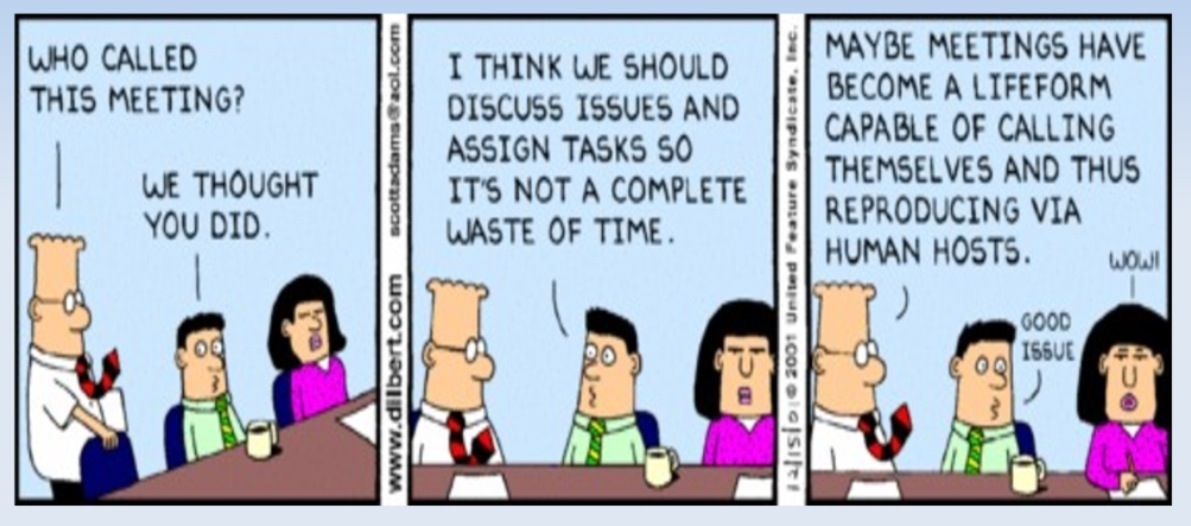
    Picture Source: Dilbert by Scott Adams

    Links to other posts: http://whatsthepont.com/2013/04/14/meetings-are-the-symptom-of-bad-organisation-yes-but-no-but-maybe/

  • 20130414-191305.jpgFor anyone who works in a large organisation this will resonate. You can back it up with comments you might have heard over the years, like; “meetings suck the life-force out of me”, “that’s two hours of my life I will never get back” and “that was a big waste tax payers / shareholders money”.

    Top tip for really dull meetings: pretend you have to visit the bathroom. Go and do some useful work, then return just before the end of the meeting. Nobody will have the courage to ask why you took so long.

    Back to the full quote by Peter Drucker, “meetings are the symptom of bad organisation. The fewer meetings the better”.

    The point seems to be that meetings represent a failure to properly plan and organise what you are doing. As a result you end up in meetings trying to fix things that haven’t worked. Ultimately if you have to spend time in meetings, you aren’t doing the things that really matter like: making products or delivering services.

    There is plenty of research and figures to back up the idea that meetings are a problem. This paper by Romano & Nunamaker analyses a huge amount of the research written about meetings and presents some depressing findings:

    • Many reviews and surveys reveal that meetings dominate workers and managers time and yet are considered to be costly, unproductive and dissatisfying.
    •  The number of meetings and their duration has been steadily increasing.
    •  Studies of managers and knowledge workers reveal that they spend between 25%-80% of their time in meetings.
    • Self estimates of meeting productivity by managers in many different functional areas range from 33% – 47%.

    I said it was depressing. Just imagine you are one of those knowledge workers or managers who spend 80% of their time in meetings, of which only 47% of that time is productive. That’s over 40% of your time in work, 2 days a week, doing something that is useless (and we worry about people wasting time on social media…….).

    This lack of achievement and the frustration that goes with it has to have an impact upon your level of engagement and sense of job satisfaction. This paper by Rogelberg et al in Human Resource Management (March-April 2010) makes the link between overall job satisfaction and meeting satisfaction. It goes on to suggest that meeting satisfaction could be used as part of job satisfaction measures and employee engagement.

    If you fancy a more in-depth look at this topic, and potential solutions, one of the co-authors of the paper, Joseph A. Allen runs the Centre for Meeting Effectiveness Lab  at Creighton University, Omaha, Nebraska. There are some useful links on the page to work that the Lab is doing.

    So, we need to ban all meetings! (Not quite yet……Rambo)

    This could be one response to the ‘meetings problem’. As attractive as it might seem (to some people) it might actually make things worse. Meetings are very necessary for transparent decision making, relationship building and knowledge exchange. I’ve argued before that knowledge exchange is a social process  and meetings are a good place to achieve this. What we need is better meetings.

    Having better meetings depends upon better process and people’s behaviour. Before any of this you need to be confident that you need the meeting in the first place, which links back to the Peter Drucker quote, “the fewer meetings the better”.

    Meeting process and behaviours are two things I plan to write some posts about soon. In the meanwhile some more meeting quotes: (there are thousands on the web)

    • “A meeting is an interaction where the unwilling, selected from the uninformed, led by the unsuitable, to discuss the unnecessary, are required to write a report about the unimportant.” Kayser
    • “An employee who needs permission to buy a box of paperclips can spend tens of thousands of dollars worth of employee time on bad meetings.”

    So, what’s the PONT?

    1. Meetings are very necessary for many good reasons like; transparent decision making, relationship building and knowledge exchange.
    2. The numbers and duration of meetings for managers and knowledge workers is increasing.
    3. The costs of bad meetings in lost productivity and reduced staff satisfaction are huge. We need to have better meetings, starting now.

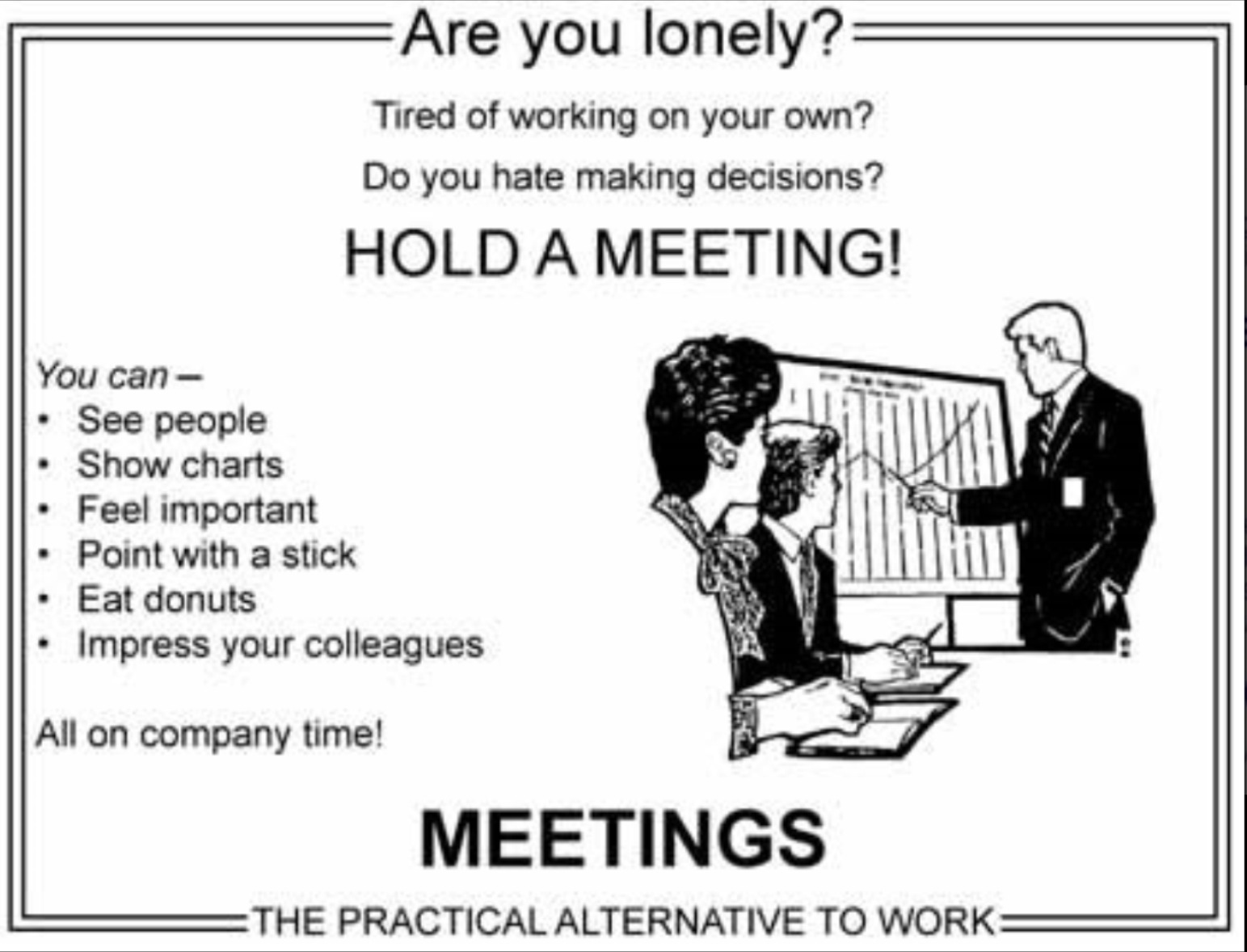
    Picture Source: http://venturevillage.eu/make-meetings-effective. Some useful tips here on how to make meetings more effective.

    20130414-191327.jpgAn old favourite.

  • Vardre RFC, Venice of the Swansea Valley? Re-visiting old rugby grounds

    For over quarter of a century I spent Saturdays playing rugby on many of the pitches across South Wales (all in the lower divisions). Unfortunately I didn’t pay a lot of attention to the places I was visiting.

    Before the match I was usually too anxious and afterwards, well it was usually dark, I was exhausted and occasionally ‘over refreshed’.

    Recently I’ve had the joy of accompanying my middle son to rugby games with Pencoed RFC Youth. This has allowed me to see things differently and appreciate some of the interesting quirks and oddities of South Wales Rugby Clubs.
    This week was a trip to Vardre RFC, which can be found at Clydach in the Swansea Valley.

    20130407-234557.jpg
    Lovely Clydach. This is Vardre RFC, at the confluence of the Lower Clydach and Tawe Rivers. The Club could well be a prototype for the Tardis. You enter a small door off Clydach High Street, pass through the modest bar and then get swallowed up by an enormous function room; not what I was expecting. There are also extensive changing rooms underneath the function room, but nowhere near the pitch.

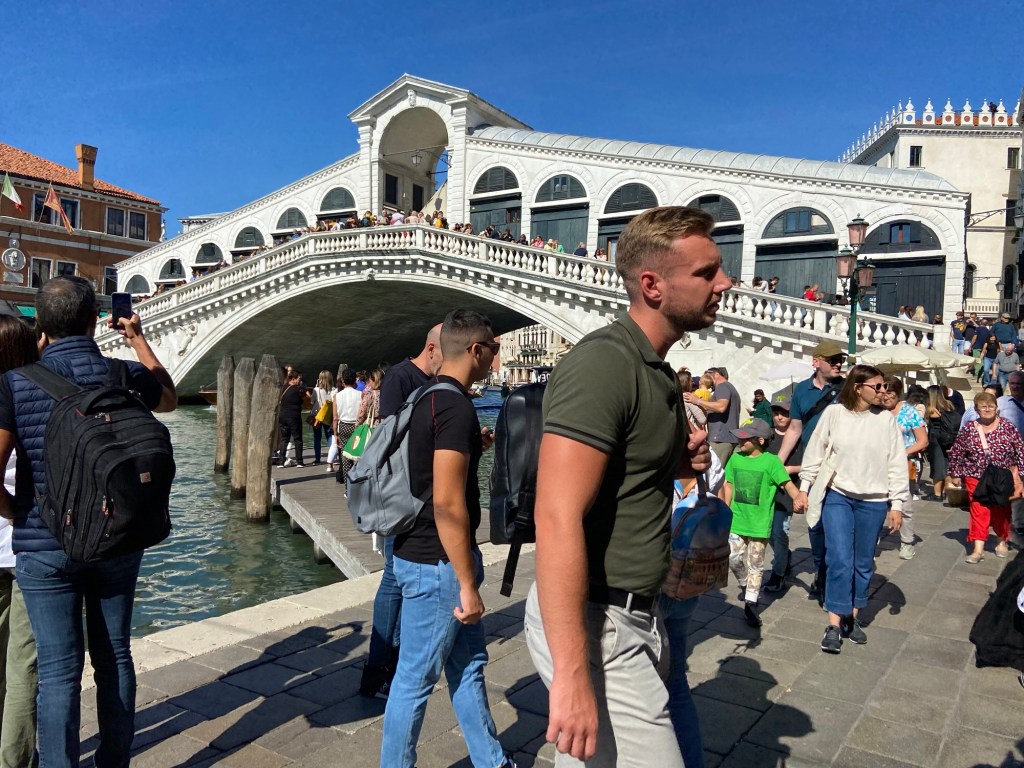
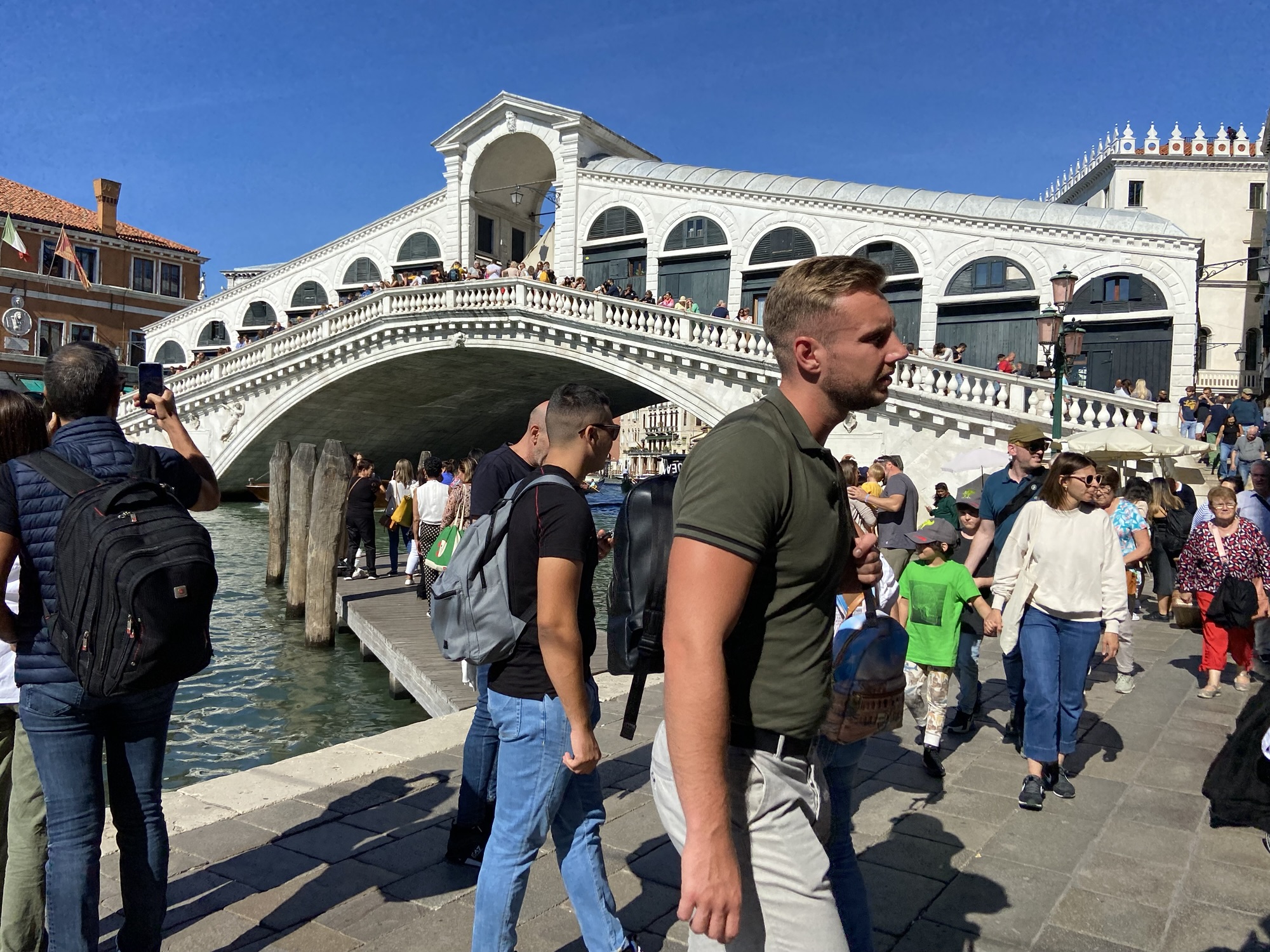
    Bridges, canals and rivers. Listen carefully if you ask anyone in the club for directions to the pitch. Last time I heard anything so complicated, with as many bridges and canals I was in Venice at the Rialto Bridge.

    20130408-072614.jpg

    Here’s the first of the bridges. A lovely centuries old cast iron affair over the Clydach to Swansea Canal. You might have noticed the enormous chimney in the background. That’s ‘The Mond‘. The largest Nickel refining plant in Europe, which has a long association with the area.

    Some local ‘characters’ were sat at the right hand end of the bridge, thoughtfully placing their huge quantity of empty beer cans in a recycling sack.

    20130408-000143.jpg
    Bridge number two. Crossing the River Tawe this time. The bridge looks quaint on a sunny day, but I really wouldn’t fancy it at night when the river is in flood. It’s also single file, so if the rugby teams are coming the opposite direction you’ve got a long wait. Don’t look down either. Some of the wooden planks have seen better days.

    20130408-073117.jpg

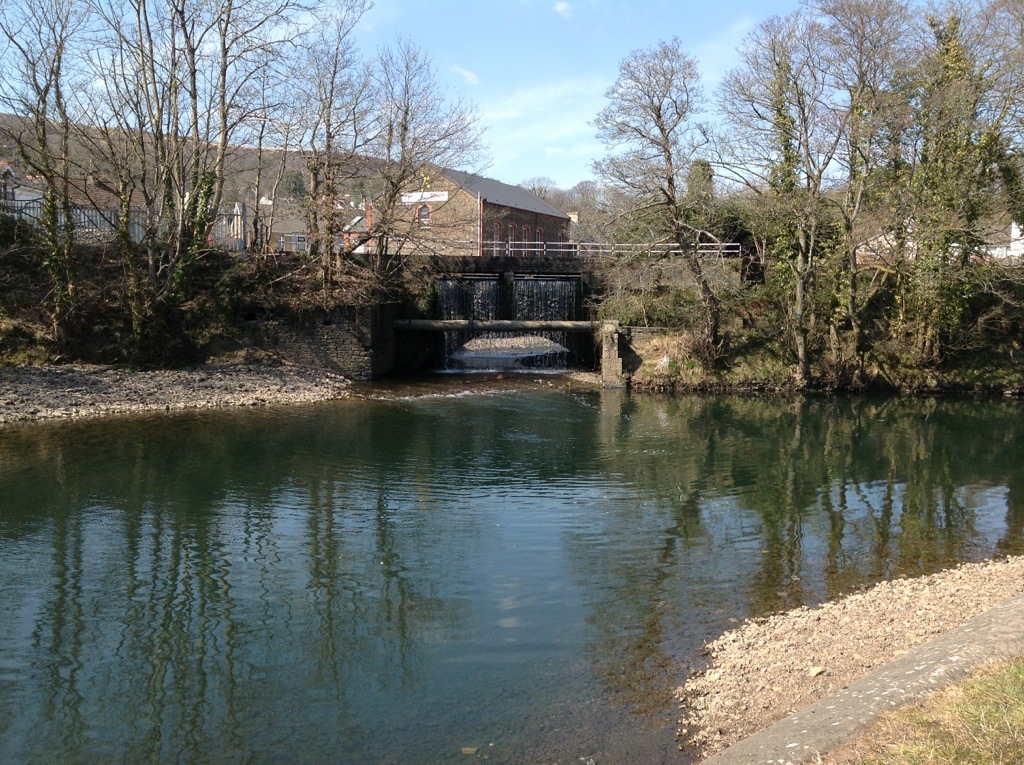
    Waters-Meet. Excuse the self-indulgence here. This is the point where the waters of the River Tawe, Lower Clydach and the overflow from the Canal meet. As a former student of water quality this is a text-book situation. Where is the mixing zone? Where do you collect representative water quality samples? Why are there so many foreign beer cans on the river bank?

    20130408-073737.jpg

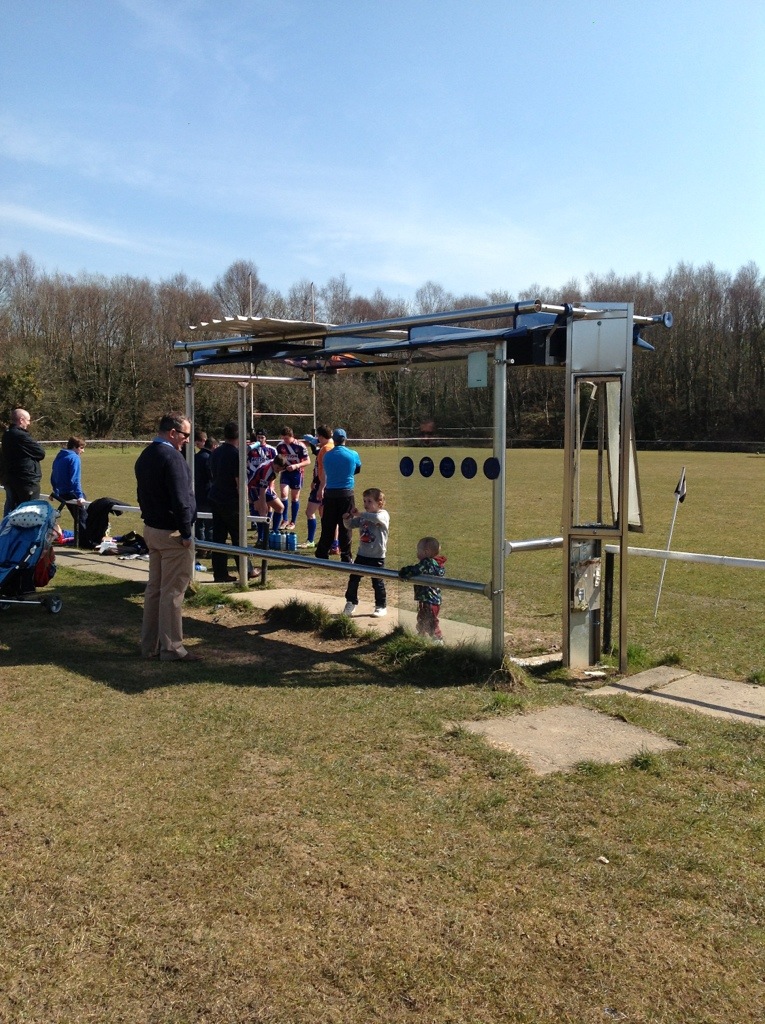
    Bus Route? This perplexed me. When I eventually found the rugby pitch I encountered a bus shelter. Hugely vandalised, but still a very modern bus shelter with electronics and one of those screens for real-time updates. We don’t even have those in the village where I live and this was in the middle of a field!

    I can only speculate that it was some creative ‘re-purposing’ as a team dugout by the Vardre RFC, Pitches (sub-committee). Alternatively a cover up for some late night, over enthusiastic e-Bay bidding.

    20130408-193837.jpg

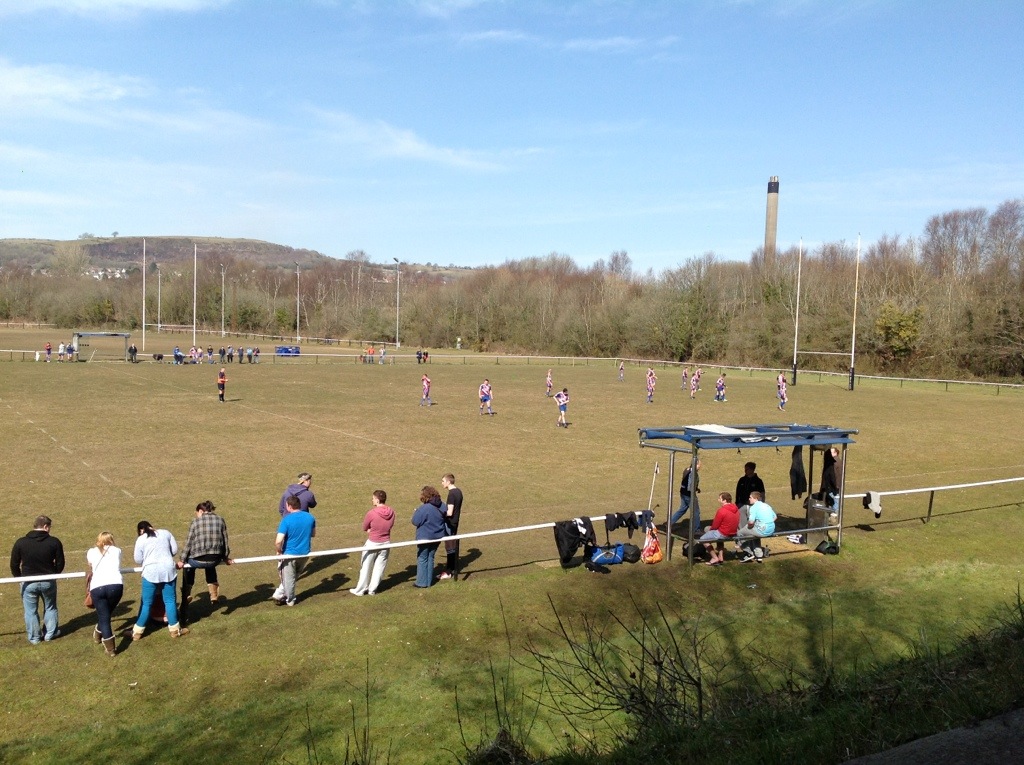
    Grandstand View. Continuing the ‘re-purposing’ theme I tried out the grandstand, a single story, lean-too tin-shed affair. In keeping with many other South Wales rugby grounds I think the building materials may have been ‘borrowed’ from the local industrial facility. No picture unfortunately, but you do get a good view of the pitch, and the second ‘re-purposed’ bus shelter (also vandalised).
    20130408-194703.jpg

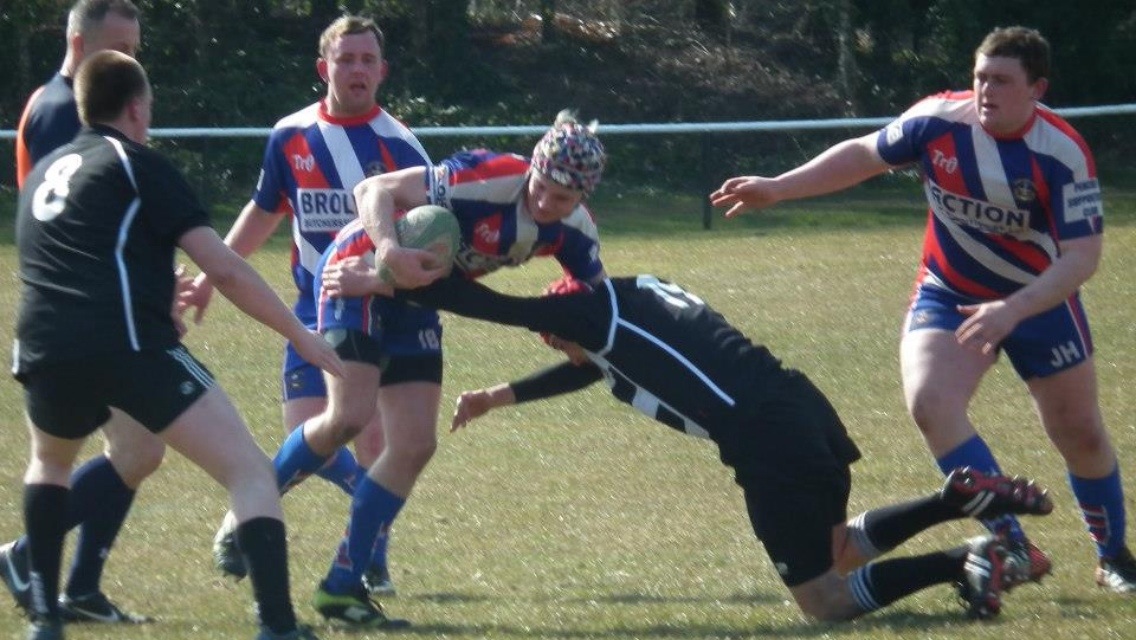
    Rugby Action Shot No1. Our number 7 making a break, just before he got isolated in the tackle and was penalised for not releasing the ball.

    20130408-195216.jpg

    Rugby Action Shot No 2. Our number 7 demonstrating the classic line-out overthrow (aka failing to catch the ball). We did actually win the game though.

    So, what’s the PONT?
    1. Should Vardre RFC be incorporating a Gondola alongside the Magpies on the club badge given that they are the Venice of the Swansea Valley?
    2. Where did Vardre RFC Pitches (sub committee) get those bus shelters from?
    3. Will the Pencoed No7 be selected for the League match against Mumbles RFC next weekend? (btw, No 7 is my son. He is cool with this).

    My picture of the Rialto Bridge in Venice. Last time I was given a route description with so many bridges, canals and water to cross.

  • 20130404-224803.jpg‘Clump Recruitment’ is a jazzy new expression I recently heard mentioned at this event. The gist is that you can recruit Generation Y  people as a group or ‘clump’ by targeting where they hang out together (usually online somewhere, apparently). The idea is that you can then get them to all come along together and work for your knowledge economy business. This gives you all the benefits of a ready-made socially cohesive group. Large scale recruitment of the right people, done in a flash. Sounds fantastic.

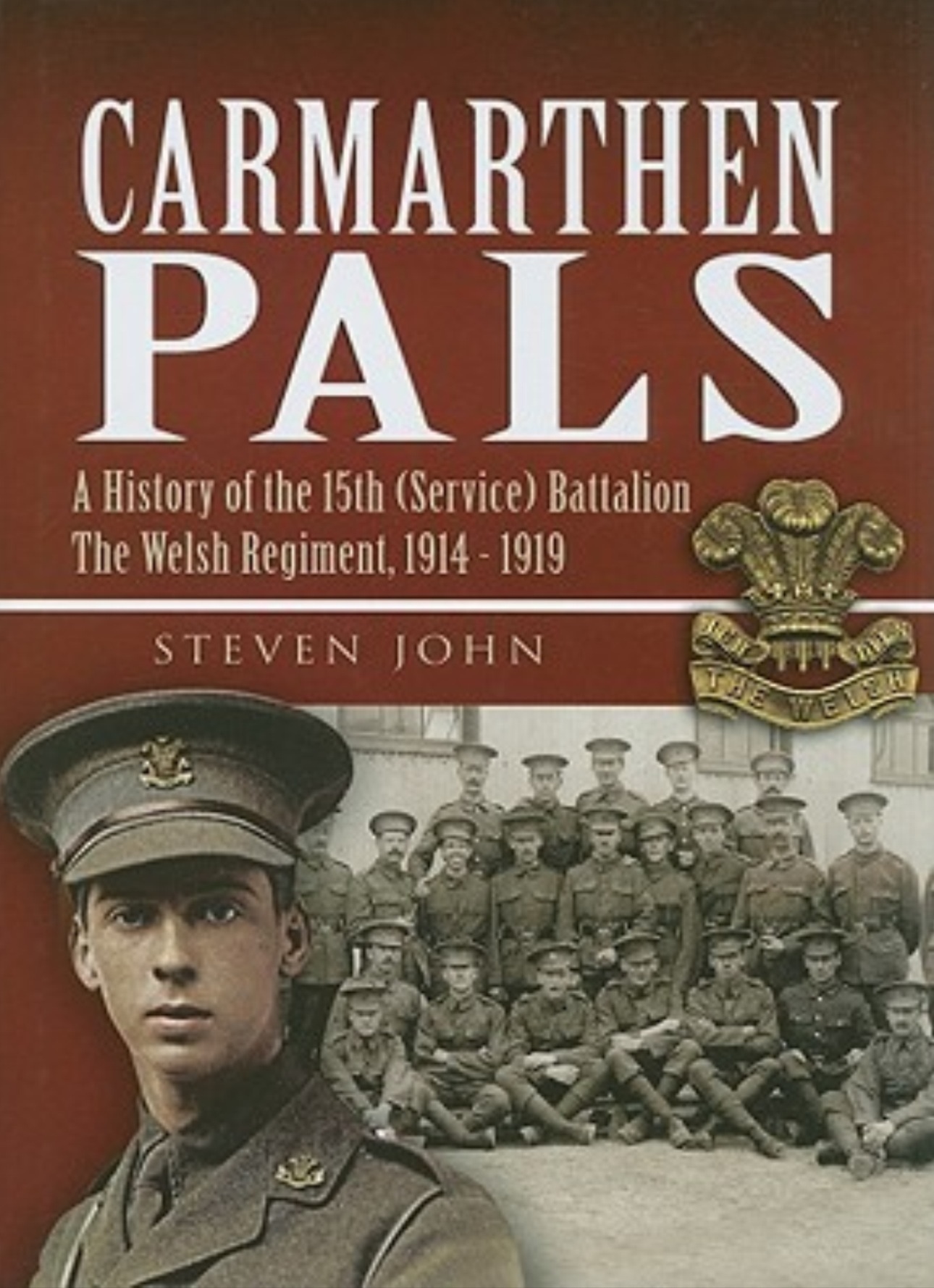
    I did start wondering though, hasn’t this sort of group recruitment happened before? Is the idea of ‘clump recruitment’ just ‘old wine in new bottles’?‘To explain my quandary here are two examples; the Pals Battalions from World War One and the older practice that flourished in the industrial revolution, where whole families worked for a single organisation.

    The Pals Battalions of World War One.

    The Pals Battalions were created at the outbreak of war in 1914 when there was an urgent need to recruit into the army. The Generals moved away from the traditional methods, reasoning that young men would be more likely to enlist if they could be sure they would be with people they already knew; friends, workmates, neighbours (and possibly family).

    The idea certainly worked and between August and September 1914, 500,000 men had volunteered and a further 500,000 by the end of the year. A successful recruitment campaign in anyone’s books.

    However, what shouldn’t be forgotten here is the impact of warfare on people from a specific community. The Battle of The Somme effectively wiped out the Accrington Pals, with a devastating effect upon the community the young men came from.

    There’s is an excellent article about the Pals Battalions by Bruce Robinson on the BBC website which is well worth reading.

    Richard Arkwright and Cromford Mill.

    Richard Arkwright is a major contributor to the development of the industrial revolution in the 1770’s and has been credited with developing the world’s first factory system. You can read about him here or view the Tony Robinson, walking through history TV series.

    What struck me in the video clip was how whole families were employed by Arkwright at Cromford Mill. Women and children in the factory producing thread whist the men were involved in weaving cloth. The workforce planning setup favoured the recruitment of a ‘family unit’.

    A policy of incentives, like workers accommodation, may well have helped with the recruitment and retention at Cromford Mill. However, it also makes it difficult for workers to buck the system. If the whole family work for the same organisation there is unlikely to be much industrial dispute.

    Throughout the industrial revolution there are numerous examples of several members of the same family, if not whole families or generations working for the same organisation. I know from my own family history that having a relative working in Deep Navigation Colliery meant that other members of the family followed.

    Old wine in new bottles.

    Back to old wine in new bottles, I do wonder if the idea of ‘clump recruiting’ Generation Y people is a bit of history repeating itself. The idea of recruiting specific groups, sometimes in very large numbers, has been around for a very long time.

    If you want some interesting perspectives on ‘old wine in new bottles’, have a look at The Custody Record blog. I particularly like:

    • “We are not returning to how we did things before. We are moving forward in a familiar way.”
    • “We are not retreating. We are advancing in a new direction.”
    • “Old wine in new bottles.” The practice of taking something old and dressing it up to look like something new.

    So, what’s the PONT?

    1. Recruiting groups of people who are very similar or linked can have consequences such as a potential lack of diversity in your workforce (or much worse in the case of the Pals).
    2. “History merely repeats itself. It has all been done before. Nothing under the sun is truly new”. Biblical quote, Ecclesiastes 1:9.
    3. It’s always worth checking that the new idea isn’t just ‘old wine in new bottles’.

    Picture Source: Cover of the book about the Carmarthen Pals Battalion. http://www.amazon.co.uk/Carmarthen-Pals-Steven-John/dp/1848840772

  • 20130329-122851.jpgThis week I ended up on BBC Radio Lancashire talking about textiles, Lancashire Folk and an old 78rpm record. I have absolutely no connection with Lancashire and the textile industry (as far as I know) so this was a bit of a surprise.

    The only link was a 1950’s 78rpm record called ‘Lancashire Speaks’  which I wrote a blog post about. Social media intervened and this is how I ended up on the radio talking to Ted Robbins and Andrew Schofield from the North West Sound Archive.

    • Saturday 16th March – I find the ‘Lancashire Speaks’ record amongst the collection that belonged to my wife’s Grandparents.  I do some research on Cyril Lord who issued the record but draw a blank.
    • Sunday 17th March – decide to write a blog post about how the record is an interesting early example of getting local people’s voices heard by remote decision makers. I also offered the record to a good home as an example of social history.
    • Monday & Tuesday – conversations on my twitter account with people commenting on the blog post and suggestions of who might be interested in the recording. The North West Sound Archive got mentioned three times so I send them an email.
    • Wednesday & Thursday – email and telephone conversations follow with Andrew Schofield from the North West Sound Archive. The record isn’t something Andrew is aware and they would be interested in a copy. At this point neither of us has listened to the recording.
    • Weekend of 23rd & 24th March – I source suitable material to package this now precious record and send it to the NW Sound Archive at Clitheroe.
    • Tuesday 26th March – Phone call from Andrew, he’s received the recording safely and it works. Two minutes of Lancashire Folk speaking about the textile industry, directed at Members of the Houses of Parliament.  A bit of ‘hiss’, but what do you expect for a 60-year-old recording.
    • Wednesday 27th March – emails and phone calls. Would I be prepared to talk on BBC Radio Lancashire about the recording? Gary Scott had picked it up via my blog post and they would like to talk to me. Now who is going to turn down an offer like that? Not me!
    • Thursday 28th March – I get to speak with Ted Robbins and Andrew and listen to the recording for the first time. You can have a listen to the whole interview here (skip to 47-58mins). Hopefully I will have the digital recording of the Lancashire Textile Workers soon which I will add here.

    20130329-122858.jpg

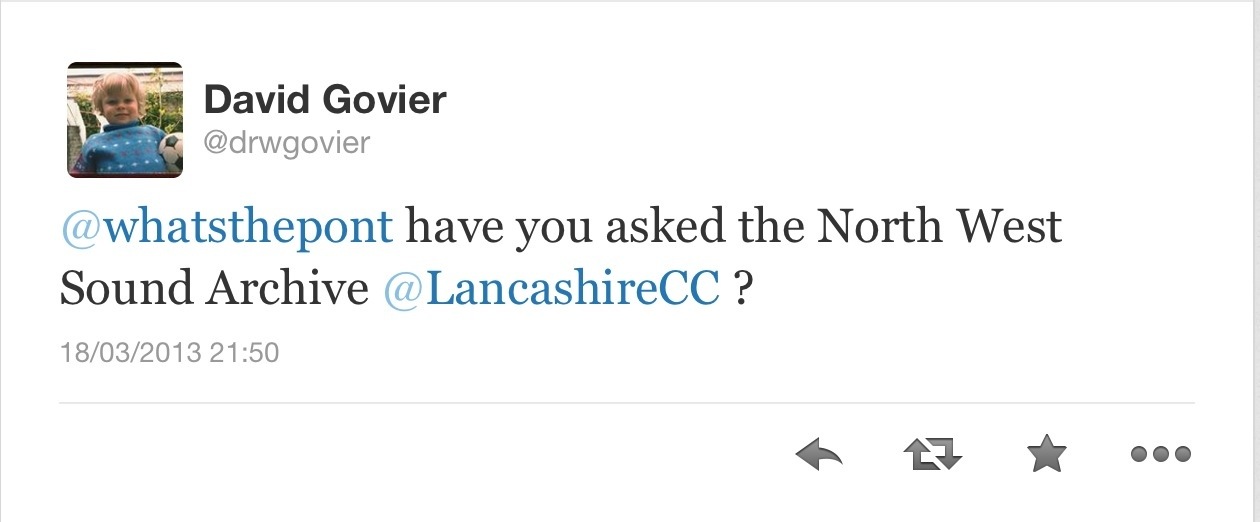
    One of the Tweets suggesting I contact the North West Sound Archive. People were very helpful.

    So what happens next?

    In Lancashire – hopefully people get in touch with the Ted Robbins show or the NW Sound Archive with some more information and we can fill in a few more of the gaps in information.

    In South Wales – The only connection we think we have with the record in my Wife’s Grandfather, George William Ridgwell, who was in the Metropolitan Police (1921-1962) and the Inspector at the Houses of Parliament during the 1950’s. We think that he may have acquired the record during this time.  It would be interesting to know.

    Has social media helped in solving this mystery?

    Thinking about the alternatives I probably wouldn’t have bothered doing anything other than putting the record back in the box. With relative ease I wrote a blog post which ended up with an interview with the radio station at the heart of Lancashire. I don’t think alternative methods would have achieved such wide coverage. Here are some numbers (imagine what we could have achieved if I was really good at this sort of thing):

    So, what’s the PONT?

    1. Blogging and social media have helped me to share a bit of social history which otherwise might have remained ‘lost’ in a box.
    2. It might help piece a few more bits of the jigsaw together, in Lancashire and some family history back here in South Wales.
    3. Is been great fun. I’ve spoken with Ted Robbins, Andrew Schofield and created a bit of excitement in work and with the family and friends.

    One final thing. Cyril Lord was an interesting character. I’d love to know if he really did have a cameo appearance in a Batman episode as the ‘Carpet King’.

    Photo Source: Ted Robbins from BBC Radio Lancashire.  http://www.bbc.co.uk/podcasts/series/robbins

    20130329-122905.jpgHeron Corn Mill were very helpful.

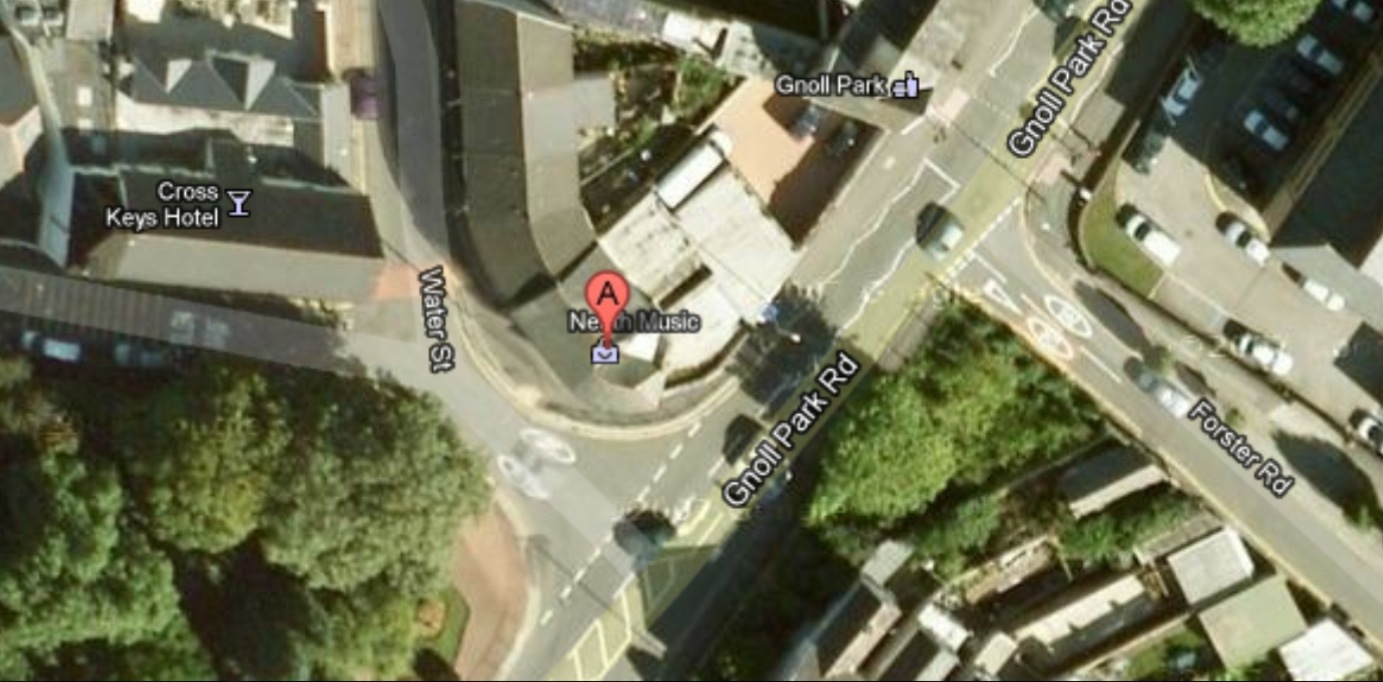
  • Neath Music from company helecopter
    Neath Music from company helicopter

    I know that I shouldn’t be surprised by this statement. ‘People buy from People’ is one of those truths that underpin so much human activity, particularly if this involves some sort of exchange. The exchange can involve a product, service or knowledge and information.  This is where knowledge workers fit in; stick with me…….This week I met some people who run small businesses at the launch of FYI Neath, a website to support the development of the South Wales Town of Neath (and surrounding areas).

    The ‘People buy from People’ theme was kicked off by Joel Hughes (who has said this on several occasions). The general idea is that; if you know, understand and trust another person, you are far more likely to exchange things with them. An important concept if you are in business and need to sell products and services, but just as relevant if you are a knowledge worker. A while back I wrote this post The Disconnected Jerk which talks about some research on people not sharing knowledge with people they don’t like or trust (even if their job requires them to do it).

    Part of the FYI Neath event involved people who run small businesses talking about how they develop a relationship with their customers online, so that they can reach the point where ‘people will buy from people’. Here are some of the points I took away, thanks to Deenna Boutique and Neath Music:

    • You are your business. Whatever you say online has to reflect who you are. It’s the same as if someone walks into the shop to speak to you. Let the passion for your business show.
    • Give the ‘pros and cons’. You need to be honest about the products you sell. Customers will expect that and respect your opinion.
    • Deliver on what you promise.

    The objective underneath all of this online activity was to develop a relationship with customers so that they know who you are, understand you and above all trust you. Good advice for anyone working in the field of knowledge management.

    Dave Snowden talks about this concept as knowledge can only be volunteered; it cannot be conscripted.  It has also been described in this post as one of the 7 Principles of Knowledge Management by David Gurteen, which is worth a read. The underlying principle here is that people won’t exchange or share knowledge with you unless they trust you. Being a knowledge worker in a massive organisation is just the same as running a small business in Neath.

    Or maybe not…….. You have to check out Neath Music. As part of building the relationship with the customers they write a blog. One of the latest features is ‘Local Stars playing reasonably priced guitars’. Now then, why would you want to buy an Epiphone EB-3 Base Guitar online, from some anonymous corporation, when you could go into Neath Music and meet some fantastic characters? I’m quite tempted to pick up my Banjo again, I think it needs re-stringing.

    So what’s the PONT?

    1. People buy from people. The small businesses in Neath know that.
    2. Developing a trusting relationship online is as important as doing it face to face.
    3. Knowledge exchange is a social process. It depends upon people trusting each other to share what they know.

    Picture Source: This is Neath Music – taken from the company helicopter (apparently). http://www.neathmusic.com/contact/screen-shot-2012-12-30-at-15-32-33/

    Links to related posts:

    Low Trust Costs You Money: https://whatsthepont.wordpress.com/2011/10/03/low-trust-costs-you-money/

    Why is Good Practice such a bad traveller? : https://whatsthepont.wordpress.com/2012/08/19/why-is-good-practice-such-a-bad-traveller/

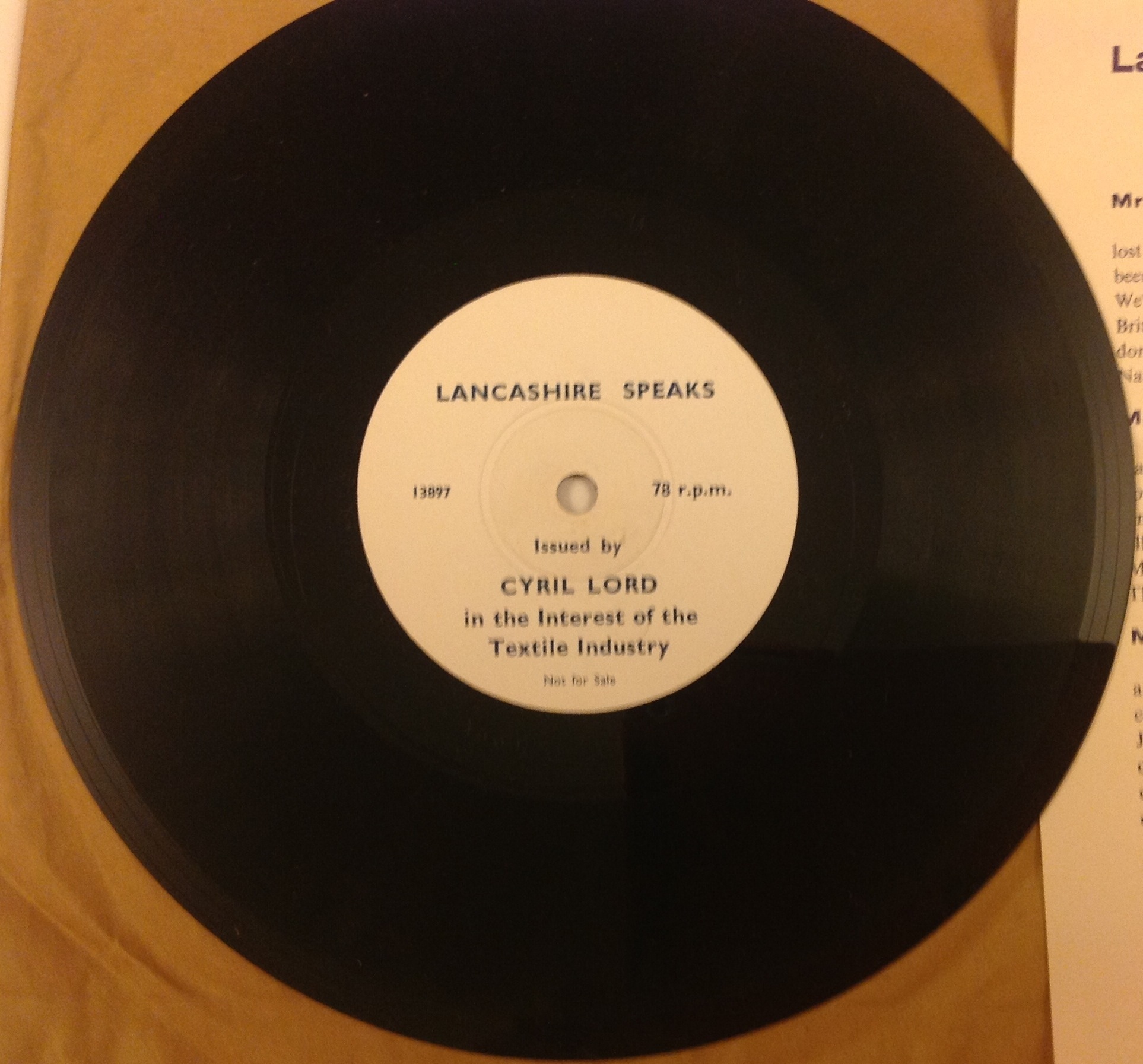
  • 20130317-211906.jpgI’ve just found this 78rpm vinyl recording of Lancashire textile workers. It’s called ‘Lancashire Speaks’ and was issued as record by Cyril Lord sometime in the 1950’s (I think).

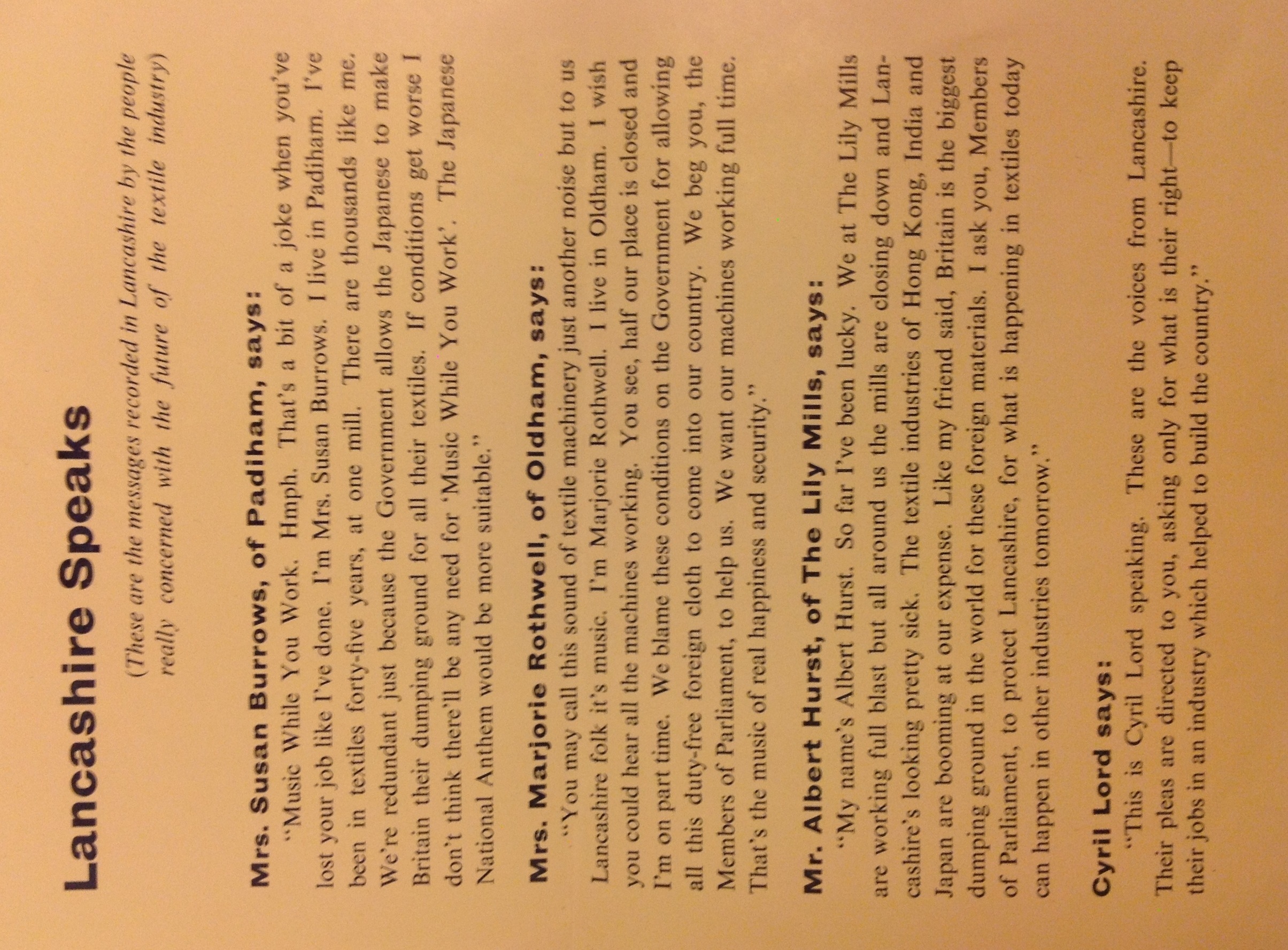
    I don’t have a 78 rpm record player so the exact nature and quality of the recording in a bit of a mystery. The best I can do is a sheet of paper (picture at end of post) I found inside the blank, brown paper sleeve which says: “these are the messages recorded in Lancashire by the people really concerned with the future of the textile industry”

    • Mrs Susan Burrows of Padiham,
    • Mrs Marjorie Rothwell of Oldham,
    • Mr Albert Hurst of The Lily Mills, and
    • Cyril Lord

    From what I’ve found out, Cyril Lord was a self-made textile entrepreneur who is linked to a number of innovations in the textile industry between the 1940’s and 1970’s. A few of his innovations were not wholly successful (blue Astroturf) and he was also known for his imaginative approaches to advertising and marketing. There is some material online about a Cyril Lord cameo in a Batman Episode as the Carpet King! (might be a coincidence, I’m not sure about that one).

    The ‘Lancashire Speaks’ records seem to have been directed at Members of Parliament (MP’s) as part of a campaign by Cyril Lord to get reforms to help the struggling Lancashire textile industry. There is also some interesting material available in a British Pathé film of a protest meeting involving what look like lots of textile workers.  ‘Lancashire Speaks’ could be a useful record of the time and the views of textile workers. If anyone knows any more about it, or could suggest a good home for a piece of ancient vinyl, I’m happy to pass it on.

    Thinking about Cyril Lord’s approach, this might have been the cutting edge of 1950’s communications and influencing.  Here is a vinyl record that was distributed directly to Members of Parliament, with the voices of workers speaking (in a different accent) about something that is important to them. If the alternative was writing a letter, or the costly trip of travelling to meet MP’s in London this was pretty high impact.

    I’m not sure if record players to ‘listen to the voice of constituents’ were allowed as MP’s expenses back then, but it’s an interesting thought. Sixty plus years later; Twitter, FaceBook, You Tube videos, Skype and dozens of other platforms allow MP’s to hear from their constituents and ‘citizens with a view’ pretty much constantly. I wonder if some of them would be happier with slipping on the occasional 78rpm vinyl record?

    So, what’s the PONT?

    1. Communication and innovation seem to go hand in hand; ‘Workers Voice’ records in the 1950’s may well have been the equivalent of a modern Twitter campaign.
    2. Capturing and using authentic voices to tell the story is an approach that has been around for a while.
    3. If anyone can suggest a good home for the record, happy to pass it on.

    Photos: My own

    Links: Fascinating read by Philip Ollerenshaw, University of the West of England on: Innovation and Corporate Failure: Cyril Lord in UK Textiles 1945-1968 http://www.helsinki.fi/iehc2006/papers2/Olleren.pdf

    LATEST NEWS!!!!  The record is off to a good home.

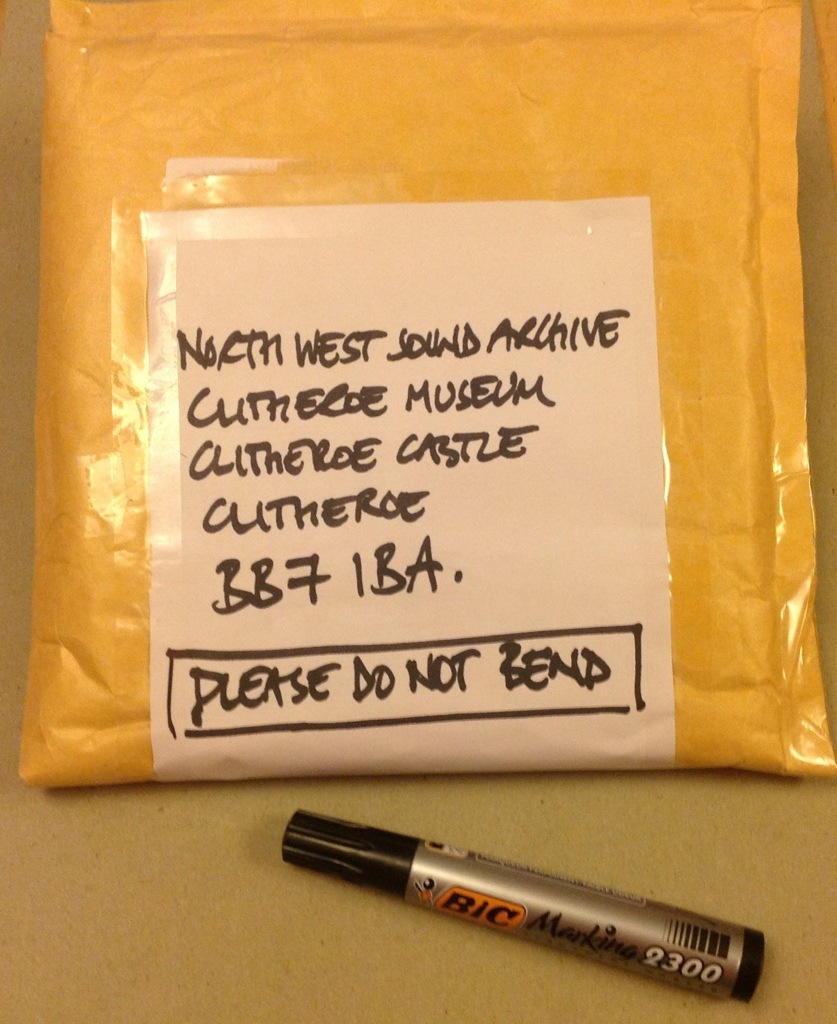
    The record is on its way to the North West Sound Archive in Clitheroe Castle Museum. Thanks to the internet and Twitter I’ve spoken to people at the archive and they would like the recording as they don’t have it. I hope it survives the journey (it is very well packed – see the picture) and it is playable.

    20130324-183229.jpg

    20130317-211841.jpg

  • 20130310-160803.jpgIf hear another person loudly proclaim that their incremental improvement to an existing activity, process or product is ‘INNOVATION!’ I will scream (quietly to myself…..). Small enhancements are not innovation.

    To be fair the language is a bit confusing and I’m not alone. This article on the British Quality Foundation blog by Paul Sloan draws the comparison with politicians who trumpet every piece of routine spending as ‘significant new investment’. The hyperbole (exaggeration to create emphasis) has permeated the world of improvement, causing confusion which doesn’t do justice to the real innovation some people are achieving. So here are some explanations:

    • Continuous Improvement & Kaizen,
    • Adaptation,
    • Exaptation, and
    • Innovation.

    Continuous Improvement. CI for short does what it says on the tin, an ongoing effort to improve services, products or processes. There is a strong emphasis on the incremental (little changes) in this approach, alongside the importance of feedback from the users of the product or service.

    If you fancy jazzing things up (and impressing your colleagues) you could describe this approach as Kaizen, the Japanese for Good Change, (Kai = Change, Zen = Good). I very much like Kaizen. It recognises that the people who do the work are best placed to identify the required improvements and implement them. The emphasis here is that changes are small enough to be implemented by an individual worker or at team level, which has additional benefits linked to employee engagement. Remember that this is not radical innovation or change on a massive scale.

    Adaptation. A term from biology which refers to how a living organism changes to become better suited to its environment. The example of how humans adapted to live and hunt in groups, because it was more efficient is often used to illustrate adaptation.

    A service delivery example would be the process of paying bills. This has adapted from; face to face, to postal, to the current online processes. You could argue the difference between continuous improvement and adaptation is about scale of the change, but it is a bit subjective.

    Exaptation. Another term from biology. This refers to the process of using something that has been developed for one purpose, to achieve something completely different. The classic example is feathers which were apparently developed as a temperature controlling feature that then turned out to be very useful for flying.

    A more recent example Dave Snowden described is the car in a plastic bag, which apparently originated during the Bangkok floods. One enterprising individual drove their car into a large plastic bag that had been used to protect new furniture. Now lots of people in Bangkok have car size plastic bags; available for use in future floods.

    The act of taking something that was developed for one purpose and using it in a completely different setting is where exaptation differs from continuous improvement and adaptation. A bit like lateral thinking.

    Innovation. Looking at my 1970’s Pocket Oxford English Dictionary, ‘sixth edition’ (schoolboy stuff, but it’s what’s shaped me), innovation is ‘bringing in novelties’. Novelties are, ‘new things, strange, hitherto unknown’. The ‘new’ part of innovation is fundamental to what it’s all about, even down to the Latin origins of the word novus = new.

    It seems fairly straightforward to me that incremental improvements to an existing activity is not innovation, I hope you agree (or maybe not and it’s just the pedantic schoolboy in me that has resurfaced). If you fancy some more on this topic, links at the end of the post.

    Finally, back to the Paul Sloan article where he suggests introducing two new terms; ‘radivation’ for radical innovation and ‘incrovation’ for making improvements to existing products. I know my spell checker is struggling with the concept, I wonder if the rest of the world is ready for the change?

    So what’s the PONT?

    1. There is a big difference between something completely new (innovation) and incremental change (continuous improvement).
    2. Understanding and using the most appropriate description helps with understanding.
    3. Hyperbole can creep into all sorts of conversation, beware.

    Links: More detailed explanation of exaptation From Dave Snowden . http://cognitive-edge.com/blog/entry/5573/exaptation-managed-serendipity-part-i/

    Links to other things I’ve written: Is best practice the enemy of innovation https://whatsthepont.wordpress.com/2012/11/11/is-best-practice-the-enemy-of-innovation/

    Do some organisations kill off new ideas?https://whatsthepont.wordpress.com/2012/12/23/idea-antibodies-do-some-organisation-have-an-autonomic-immune-response-that-kills-ideas/

    Encouraging innovation with Belbin Resource Investigators .https://whatsthepont.wordpress.com/2013/02/03/encouraging-innovation-use-some-naive-experts-belbin-resource-investigators-and-send-them-back-to-the-floor/

    Photo source: Dog floatation device. For other flood inspired exaptations and adaptations have a look at this site. http://blog.dothegreenthing.com/wp-content/uploads/2011/11/tumblr_lugcvlDfUk1r6pia1o1_500.jpg

    Photo source: Car in the plastic bag article from China Car Times. http://www.chinacartimes.com/2012/07/guandong-government-wraps-cars-plastic-bags-avoid-typhoon-damage/

    20130310-160809.jpg

  • 20130302-173632.jpg

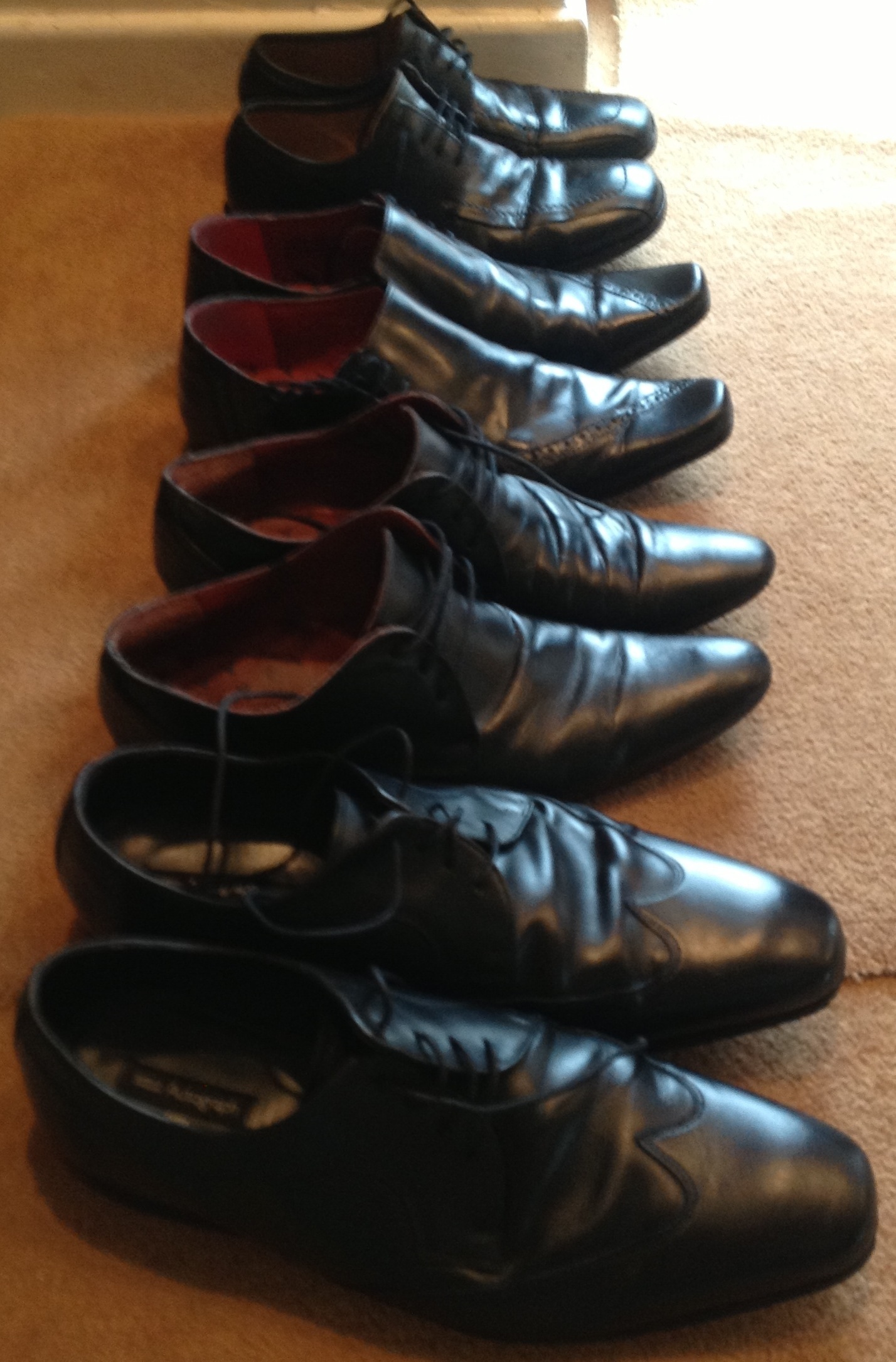
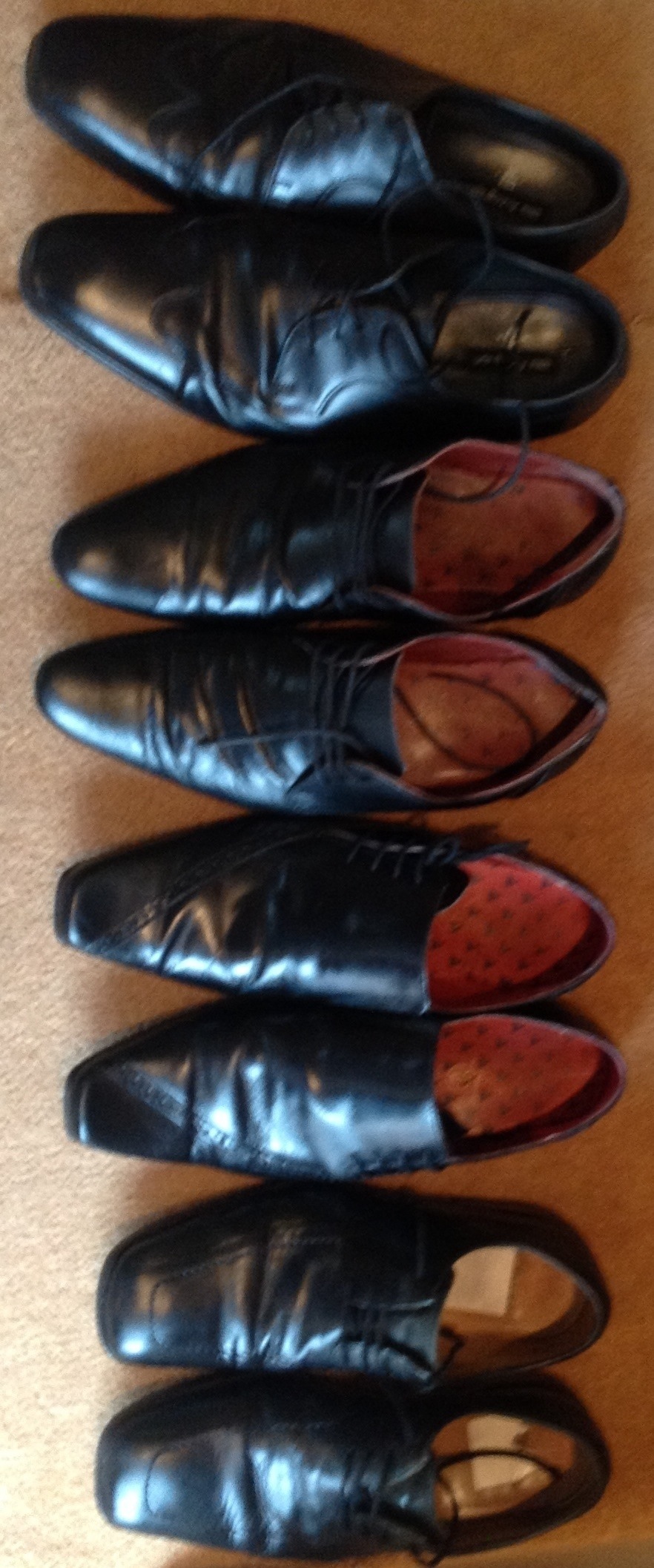
    This isn’t something you see very often in our house. Four pairs of shoes (size 8 -13) all nicely polished and lined up by the front door. It was a nostalgic reminder of a ritual from growing up.

    Sunday afternoons as a schoolboy were about my shoe cleaning ritual. It had started with my rugby boots and developed into an epic task of cleaning as many pairs of shoes as I could find. I really used to relish the process of:


    • Finding the shoes (it was the sort of house where people abandoned their shoes rather than take them off);
    • Cleaning off mud and other detritus;
    • Applying the polish;
    • Removing excess polish;
    • Buffing them up to get a nice shine; and
    • Placing the finished article in a neat row by the kitchen door, ready for Monday morning.

    As a physical activity it wasn’t particularly demanding, just a routine I repeated, but it did allow me time to think. Thinking about the week that had passed and preparing for the week ahead. There was actually a lot of other stuff going on as part of this ritual, which only really makes sense to me now:

    Taking care of valued possessions. The act of cleaning the shoes was about making sure they were fit for purpose. Also prolonging their useful life through repair and maintenance. I really did cherish my rugby boots.

    Taking care of others. Thinking back I did enjoy the thought of having my siblings, mother and grandmother wear shoes I had looked after for them. My strongest sense of pride however came from cleaning my father’s shoes, even the terrible tan colour ones I could never find a polish to match. (My brother once threw up in those shoes – something weirdly symbolic in that I’m sure).

    Making the best use of my time. This probably came from my time in the Cub Scouts. I always used to feel justified that I had done something useful with my time on a Sunday evening, setting me up for school on Monday.

    My kids claim that they know nothing about the process of polishing shoes, due to my poor parenting skills they inform me. Apparently they aren’t alone.

    I had to buy some polish in a local shop this week which was slightly odd. First off the polish was kept behind the counter. I can’t fathom out why. It’s hardly dangerous medicines or high cost like the vodka they keep there. Perhaps it was because they didn’t know what shoe polish is? The young guy serving said that he had never used shoe polish and asked how it worked. I did explain. I then got a guided tour of his £90 trainers that last him about six months. Great, I was heading off to polish some shoes I’ve used for two years and have had re-soled and re-heeled twice. I walked away with the distinct impression that he thought I was some weird old codger.

    For the benefit of my local shop worker and my kids, here’s a video on how to polish your shoes. I hope they watch this. On their behalf I have picked one of the better videos with a really cool guy, with cool clothes and nice hair. Perhaps they will learn something from him rather than me.

    On a positive note, I did notice that my middle son had cleaned his rugby boots last week, first time ever I think. OK, the sink was full of mud and the draining board was covered in grass, but it’s a start. At least he’s stopped asking his grandmother to do it.

    So, what’s the PONT?

    1. Rituals and routines are important as a way of making sense of the world around us.
    2. They can also help surface memories and patterns of how to do things. It helped me get back into the school week, perhaps I should resume it for work?
    3. Training shoes have a lot to answer for.

    20130302-173621.jpg

    Photo Source. It’s one of mine, as are the smallest pair of shoes.


  • 20130224-203023.jpg

    Before I start this is not a rallying call for mediocrity or dumbing down. There are many people with deeply held views on ‘good enough is not good enough’. I’d prefer not to offend them.

    This a post prompted by frustration. Frustration at the ‘pursuit of perfection’, and how it slows down getting things done.

    Just to illustrate, imagine this scenario. You need approval on a business case to start a low value pilot project. People up the chain keep returning the business case and asking for: more data, more detail on the return on investment, greater clarity on risks and absolute certainty on the outcomes and impact. All useful stuff but there has to be a cut-off point where good enough is good enough. The same applies if you a writing up a report. At what point does the effort you put in exceed the impact?  Here are a few thoughts about written communication (mainly reports) and what ‘good enough’ means.

    Why do reports need to be good enough?

    1. People need to understand the message. This is the most basic reason for writing the report. If you don’t achieve this you might as well not bother.
    2. It needs to be accessible so that the reader will engage. By this I mean; layout on the page, use of data/graphics/images, font size/type, sentence length, grammar, spelling etc. There is nothing like densely packed monolithic blocks of badly written text to switch off lots of people.

    There are many variations of what could be done. I’d argue that the shorter and more straightforward something is, the easier it is for people to understand and quicker to implement.

    Why do people pursue perfection? (Apologies if this sounds a bit cynical)

    1. It’s a power game. Messing about with what someone else has written can be a massive ego trip for some people.
    2. It puts off decision making.  People are just covering up their inability to make a decision under the smoke screen of ‘seeking perfection’.

    So what do you do about it?

    1. Massage egos. This is where ‘good enough is good enough’ really has benefits. You know things will be changed by someone, no matter how hard you work on it. Just accept the situation, produce good enough reports and shovel them up the line. At least that keeps things moving and the people making the changes think that they are doing something useful and making a difference.
    2. Draw a line in the sand. If someone is pursing perfection because they cannot make a decision just say, ‘no more amendments’. Easier said than done, but you might have to back this up with some numbers like how you have exceeded the cost benefit ratio through excessive administration costs (they like that sort of stuff). Better still say you will accept the blame for anything that goes wrong.

    The world of IT Management describes this concept as The Principle of Good Enough (POGE). This article by Scott W. Ambler talks about the idea of Just Barely Good Enough in the context of agile project management. The graph he uses is a development of the Law of Diminishing Returns, something which is well worth reviewing if you’re stuck in a ‘pursuit of perfection loop’. The article does point out the there is no simple mechanical method of knowing when something is good enough. Good enough will be dependent upon; the situation, it will change with time and it is achieved sooner than you think. At the end of the day it’s a judgement call.

    The important thing to remember is that ‘good enough’ does not represent low quality.

    The graphic below is useful if you are locked into a ‘perfection loop’. Borrowed from an interesting read by Scott W. Ambler Associates http://www.agilemodeling.com/essays/barelyGoodEnough.html

     20130224-203036.jpg

    So what’s the PONT?

    1. Pursuit of perfection can be a behaviour that creates delay by putting off having to make a decision.
    2. The good enough approach needs to reflect the situation and can change with time.
    3. Accept that some people like to change reports. Produce something that is ‘good enough’ and move it up the line to get closer to action.

    Finally a quote from General George Patton: “A good solution applied with vigour now is better than a perfect solution applied ten minutes later”