• This is a genuine question. I only ask because there’s something from Dave Snowden rattling around my head that seems particularly relevant at the moment.

    “In a crisis, you should always deploy an innovation team alongside the business recovery teams…to capture the novel practice”
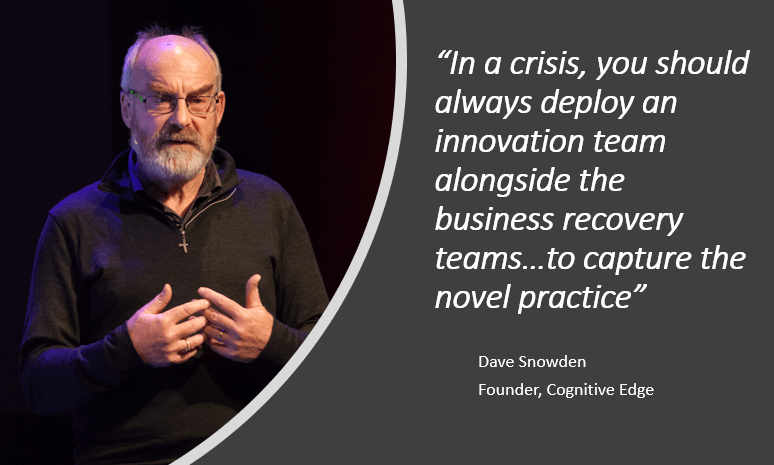
    The point of this statement (for me) is that during a crisis people will do things they have never done before. The situation will be complex or even chaotic, so the ‘business as usual’ rules do not apply.

    People will probe complex problems to see what might work, or just take direct action in a chaotic situation. Some things will work, some things will fail, but each and every action is an opportunity to learn ‘something’. Learning that could be useful to others in a similar situation, or the people following behind you.

    The question is how do we capture the valuable information about new practice, and how do we make sense of it?

    But that’s what Post Incident Reviews do. Nope, I don’t think they do. This isn’t a flat out dismissal of the post incident review industry, but I do think they have limitations.

    Ask someone what happened during a high intensity, rapidly moving situation from a month ago. I’d bet they will put together a ‘story’ that represents a logical, ordered sequence of events that match the actions and outcomes they think happened. I know I do. It’s called retrospective coherence.

    The same thing happens in Post Incident Reviews. People recall the things that happened through the lens of retrospective coherence, to fit with what they thought actually happened and the organisation’s rules. The longer you leave it, the more likely you are to get a ‘blurred’ or biased version of events.

    The Cheese Fondue Approach. There’s another dimension to this – homogenization. Basically everything gets mixed together in a gloopy mess. This is an idea that builds upon the Swiss Cheese Model of Failure (explained here) where everything is mixed together for the review, like the cheese in a fondue. What is drawn out are generic messages that are homologous or ‘average’. Basically they don’t really work for anyone. There’s a link in this post the lovely paper, Hot Cheese: A Processed Swiss Cheese Model that explains the situation.

    Image: Retrospective Coherence via @Complex Wales. How things really happened and how we tell the story. Beautifully explained here:
    https://complexwales.wordpress.com/2019/03/09/the-mystical-acronomicon/

    Naive Observers and Hot Reviews. The good news is that some organisations have recognised the risks of retrospective coherence and put things in place to make sure they capture learning as quickly and as accurately as possible.

    People from Fire and Rescue Services have told me about a process where they ‘download’ the learning at the site of an incident. Appropriately called ‘Hot Reviews’, and they weren’t joking.

    The other example is from this webinar: A conversation about Risk & Resilience, with Dave Snowden & Robert Koch from the South African Energy Company Eskom. There’s a lovely quote I took from the webinar “put naive observers in alongside the incident team to capture the key learning points” which I wrote about in this post.

    So is Anyone Deploying Innovation and Learning People? As I said earlier, this is a genuine question. I spoke about it with Toby Lowe from Northumbria University earlier today and we were both asking the same question.

    If we are going to come out of COVID-19 having learned as much as we can, it’s probably a good idea to try and do something (resources permitting, of course). Expect more from Toby on this.

    Here’s my offer… In my small corner of the world (@goodpracticeWAO) we are trying to have a go at something along these lines (resources permitting of course). Starting this Friday we plan to do this:

    • One of the Team has volunteered for the role of ‘COVID-19 Learning Log Keeper’. (we are trying to think of a cooler name, but that’s where we are for the moment).
    • In the Dave Snowden quote this person is the ‘observer’
    • The plan is for the Log Keeper to have a ‘what did you learn conversation’ with each team member, once a week.
    • A different person each day of the week. As there are six of us, the maths work out perfectly.
    • The conversation shouldn’t last no more than 30 minutes, recording what is said in writing (at the moment).
    • To prompt Team Members the following questions will be used:
      • What have you done differently this week? (descriptive)
      • What did you learn? (reflective)
      • What has gone wrong? (we don’t take “nothing” for an answer, something always goes wrong.)
    • The Log Keeper will summarise the findings into a short note to be shared and discussed at the Monday team meetings.
    • As time goes on and the volume of material grows, we may need to look at using something digital to manage the information.
    • For wider sharing of our learning we are looking at options around blogs and podcasts.

    That’s basically it for the moment. We are a fully dispersed team, working from home (like many people at the moment). It’s an attempt to capture learning in a systematic way so that we hopefully emerge from COVID-19 better than we went in.

    I should also say, there are some other impacts we are thinking about here, like making sure we stay in touch, have regular social contact and help each other to try and make sense of an uncertain world.

    Happy to share what we learn as we go along, and learn from approaches anyone else is trying.
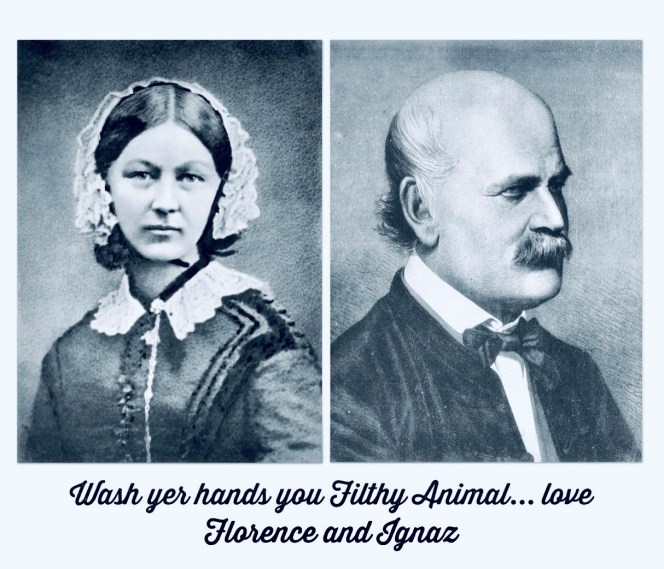
  • Florence Nightingale and Ignaz Semmelweis knew this. They probably used language more in keeping with the late 1800’s, but you get the gist.

    Public Handwashing Facilities. I have an idea… How about we make handwashing a very public activity. Put the wash-basins, water, soap and drying facilities in a very public space, so that everyone can see what’s going on?

    There’s the obvious impact of peer pressure that might come into play here, but I can also see other potential benefits:

    • Group singing. A chance for people to sing along (with others) to the lyrics of their favourite song using the modified WHO hand washing guidance posters that have appeared (my favourite at the end of the post). *Caveat – no Justin Beiber allowed.
    • For ‘literary types’. A chance to recite Shakespeare. In particular the Lady Macbeth, ‘out dammed spot’ part mentioned in the previous post (link here). Helpful if you are a bit ‘guilt ridden’.
    • Influencing opportunities. A chance to stand next to the Chief Executive and purposefully share your thoughts and good ideas whist rubbing your hands gleefully (you can just imaging the people that will queue up for that opportunity in some places…).
    • Gossip. Yep, we know it happens – maybe it will contribute to a more transparent workplace if we ‘share’ in public?
    • What I actually meant to say instead of ‘Gossip’ was, Social Exchange of Knowledge. In reality this is the sort of social setting where most information is shared in organisations. Another ‘water-cooler’ opportunity.

    There’s probably a million reasons why this is a stupid suggestion – but I’m not worried. I’ve got you here for my real reason – an explanation of the challenges of spreading good practice. I’d like to illustrate this through the lens of two handwashing pioneers from the late 1800’s; Florence Nightingale and Ignaz Semmelweis. Anyone still there?

    Florence Nightingale knew her stuff. An 1860 quote from Florence Nightingale that featured in ‘Notes on Nursing, What It Is and Is Not’.

    “Every nurse should be careful to wash her hands very frequently during the day. If her face too, so much the better. To wash with soap, and soft water…”

    Behind this quote is a body of evidence that Florence Nightingale gathered to prove the effectiveness of cleanliness and good hygiene. This was a critical factor in the survival and recovery of injured British Soldiers fighting the Crimean War.

    This article by Juli Maxworthy in Reflections on Nursing Leadership – The dirty hands of health care: What would Florence think?’ provides a useful summary of what Florence did in the 1850’s. It also provides a frightening insight into the impact of not washing hands in current times. It makes the link between poor hand hygiene and research into Hospital Acquired Infections and the preventable deaths each year of up to 90,000 hospital patients in the USA. Florence might have something to say about that…

    The work of Florence Nightingale was clearly based upon sound observations and had evidence to back it up. You’d think it would be easy to change practice based upon this. It turns out not. Here’s a link to a post about the Coxcomb diagram she developed as part of her campaign to get the point across – an early example of an Infographic if you like.

    Many people rejected her conclusions and it required the use of political connections to get things taken seriously. In the background to this was the ‘influence’ of reporters being present on the battlefield and the threat to share her findings with the general public if a Commission to review public health was not created.

    Florence Nightingale got things done, but it does illustrate that clear evidence of good practice often isn’t enough to convince people. But, she did fare better than Ignaz Semmelweis who was trying to promote the benefits of hand washing a few years earlier.

    The Bleak Tale of Ignaz Semmelweis. I don’t quite know where to start on this story. Basically, Semmelweis ‘the saviour of mothers’ was a doctor working in Vienna in the 1840’s. He noticed that the incidence of fever (infection) and death could be reduced significantly on maternity wards if the medical staff washed their hands. This was particularly evident if they washed their hands between working on postmortems and then delivering babies is the maternity ward.

    This seems very obvious now, but at the time the ‘Germ Theory’ of how disease is spread hadn’t been proposed. Semmelweis was very much going against the common understanding and suffered for it. You can have a read about what Semmelweis went through to promote hand washing here or look at this excellent video by Micheal Loughlin from Nottingham Trent University.

    If you want to know just how much Semmelweis suffered to spread good practice about handwashing, it doesn’t make comfortable reading. The ‘saviour of mothers’ was ‘shunned’ by the medical community, suffered with his mental health and died at the age of 47 in a mental health institution, from blood poisoning.

    Good practice is not always common practice. The examples from Florence Nightingale and Ignaz Semmelweis in the late 1800s’ provide very important lessons for now. Being an innovator and having clear evidence of good practice does not necessarily mean an idea will be accepted by your peers and the top level decision makers in the organisations you work with. It’s tough changing embedded ‘custom’and practice.
    Even if you did convince your peers (and the decision makers), there’s still the tricky challenge of changing the behaviour of practitioners, patients and the wider public.

    The current emphasis on improving hand-washing practice would suggest that many of the previous ‘communications campaigns’ and other initiatives have failed to turn good practice into common practice. It’s far more complicated (and difficult) than just telling people what’s good for them. There’s a few suggestions in this post about ‘why good practice is such a bad traveller’.

    Maybe we should try a bit of group singing at the communal public handwashing facilities?

    So, What’s the PONT?

    1. Washing your hands and the reduction in illness has been known for over 150 years.
    2. Having solid scientific evidence of good practice doesn’t guarantee that people will listen to you, and do what you recommend.
    3. The ‘ways and means’ of convincing people to adopt good practice or ‘do the right thing’ are complicated and require more than just ‘telling’ people what is good for them.

    How about a sing along to this one? Rush, Spirit of Radio works surprisingly well. I can’t quite see it as a group activity though.

    Source: washyourlyrics.com developed by William @neoncloth

    Image Source: Florence Nightingale & Ignaz Semmelweis – public domain via Wikipedia.

  • Now wash your hands, please. Forming an orderly queue at the rugby/football stadium toilets to wash your hands has become quite a thing. Well, according to Twitter, where it’s being mentioned a fair bit at the moment.

    From a personal viewpoint I’ve attended rugby based ‘mass gatherings’ at stadiums for many years, and I can confidently say that it hasn’t always been like this. A number of reasons;

    1. The hand washing facilities in the toilets at most stadiums – particularly the older ones – are woefully inadequate. It’s like they weren’t expecting anyone to even think about it.
    2. It’s physically challenging. Most people will head to the toilets during ‘natural breaks’. Half time or full time, when it’s a frantic rush to make room for more beer. The toilets are packed and it’s not easy to; stop, admire your reflection in the mirror, lather up your hands with the disinfectant soap and give them a good rub. The tide of bodies quickly sweeps you out of the door.
    3. It’s just not what people do. Obviously these are just my experiences. There may be rigorous hand washing happening in other toilets.

    COVID-19 Coronavirus has changed everything. Well, maybe. There are really good reasons for avoiding/slowing down the spread of COVID-19 and the message does seem to be getting across.

    This might have had something to do with there being an avalanche of information, telling us to wash our hands to avoid spreading a deadly virus. Everyone has been doing it from Prime Ministers and Presidents through to animated cartoons and memes.

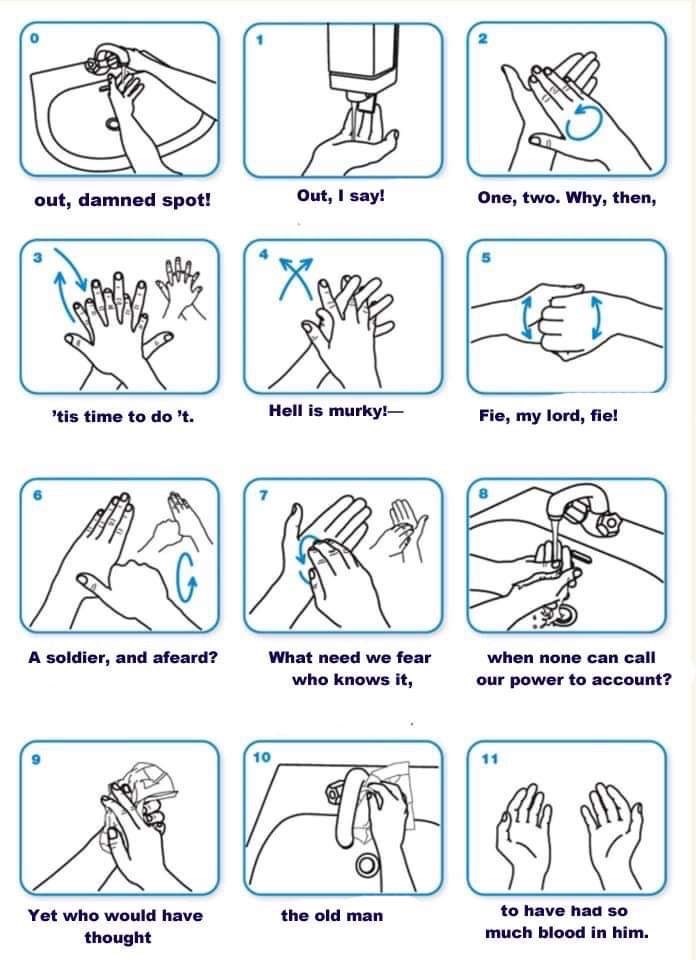
    To be honest, my secret wish is that the biggest impact from all this information will be to have come from ‘unofficial’ sources. My favorite is an adaptation of the World Health Organisation graphic for washing your hands, using the text from Shakespeare’s Lady Macbeth. Oh yes!

    This was created by Rosie Swayne from the FOSSILHEADS, a band ‘putting the ‘oooh’ back into existential doom’ (I liked them just from that description, and now I’ve listened to some of their music, I like them even more).

    The Fossilheads image did go viral on social media (ha ha) and you can read more about it in this article from The Poke: Handwashing with Lady Macbeth is the way forward in the fight against the coronavirus – the image is below. Totally guilt free.

    Source: World Heath Organisation hand-washing guidance using the words of Lady Macbeth (W. Shakespeare) adapted by The Fossilheads – brilliant!

    Unintended Consequences of Hand-Washing. Sticking with the Lady Macbeth theme there are some interesting psychological and behavioral aspects to handwashing. The idea of washing away guilt is one of them. I’m wondering if Lady Macbeth’s actions might have crept deeply into our subconscious? Depends what you are feeling guilty about though, I suppose…

    Other ‘psychological effects’ have been described in 6 Purely Psychological Effects of Washing Your Hands published on PsyBlog. They cover things like; being more optimistic, feeling superior to those who don’t wash their hands and ‘guilting’ other people into washing their hands. Good old peer pressure and a bit of social practice theory. This aspect might be of interest to anyone who’s hoping to change group behaviours as a result of coronavirus. I wrote about social practice theory here: Cycling to Work, ‘it’s just what we do…’ could Social Practice Theory help? (I know its about cycling, but the principles apply).

    Part of me is wondering what the long term consequences of this focus on hand-washing will be. Will it stick? Will we see a general improvement in health from good hand hygiene? Will we be less or more guilty? Will soap sales boom? Will hand washing facilities improve at public venues? Will we become more conversational as we wash hands together at the sinks in the sports stadium? (I’ve found it’s more socially acceptable to chat at the sink rather than the urinal…)

    And will there be unknown unintended consequences? Who knows what, but the important thing is that we keep an eye out for their emergence. They might be brilliant and we want to amplify them, or they might be ‘not so good’, and we need to dampen them down.

    Global Hand Washing Day – October 15th. One thing I have learnt is that there is a designated day to raise awareness of hand-washing. It’s organised by the Global Handwashing Partnership which you can find out about here; About Handwashing. Its a big issue for the well-being of society, globally. Maybe one good thing emerging from the coronavirus situation is that the profile of handwashing is being highlighted.

    Source: Global Handwashing Partnership https://globalhandwashing.org/global-handwashing-day/

    It hasn’t always been this way. The history of handwashing and the people who have promoted it doesn’t make easy reading. Two figures spring to mind, Florence Nightingale (a favourite of mine -I previously written about here: Florence Nightingale; the mother of Infographics ) had the data to prove the case back in the 1850’s.

    But what I really wanted to talk about was Ignaz Semmelweis and his attempts to introduce handwashing into medicine in the mid 1800’s. But that will have to wait until I get back to the usual sort of stuff I write about – how organisations, institutions and bureaucracies frequently resist change and crush innovative individuals. More on that in the next post, happy days.

    So, What’s the PONT?

    1. The benefits of handwashing have been known for years – yet its still not widespread. Good practice isn’t necessarily common practice.
    2. The impact on behaviour from the avalanche of information is uncertain. It might be all good, but there might be unintended consequences.
    3. Some ‘unofficial’ activities can reach more people than the most carefully designed and heavily funded ‘campaign’. Just think of Lady Macbeth while washing your hands (nice work Fossilheads).

    I have written about handwashing previously. Its not like I’m obsessed or anything

    Hand Sanitisation (washing) and visual management in hospital: https://whatsthepont.blog/2011/06/23/5s-and-visual-management-in-hospital/

    Visual Management. Theory, Case Studies and the Reality of Sustaining Improvement https://whatsthepont.blog/2014/02/09/visual-management-theory-case-studies-and-the-reality-of-sustaining-improvement/

  • Audit is also a Social Process. When I got a job with the District Audit Service about 20 years ago my Father in Law (one of the wisest people I’ve ever known, just like his daughter) told me a joke.

    QUESTION: How do you know you’ve met an extrovert Auditor?

    ANSWER: When they were talking to you, they looked down at YOUR shoes, not their own.

    I don’t think he was actually telling me a joke, it was more of an ‘observation’. At the time I was stood there in my new grey suit, neutral shirt, purple tie and black shoes. It’s one of those moments that has stuck with me. Did I have the ‘right’ interpersonal skills to be a good Auditor?

    Relationships and Interpersonal Skills Matter. Recently I wrote about the negative effect that Regulation, Inspection and Audit (Regulation) can have on people, in this post; Regulation, Inspection and Audit Really, Really Shouldn’t Hurt.

    In the post I mention the Kings Fund / Manchester University Business School report, Impact of the Care Quality Commission on provider performance: room for improvement? The title might not suggest it, but it’s actually a great weekend read (particularly with Storm Dennis lashing down outside).

    In the Discussion Chapter, there’s a specific section that talks about the ‘Importance of relationships and social processes’ (pg 41-44). I’m sure you’ll understand the point that ‘behaviour begets behaviour’ and ‘tough, adversarial’ approaches to regulation aren’t helpful or effective – which was covered in the earlier post (link). The report emphasises the point that relationships and how people behave really does matter. Here’s a powerful quote from the report – relevant to situations beyond just CQC Inspections.

    “Regulation is clearly seen as a social process. For both the regulator and providers, it is not just what you do, it is who does it and how it is done that matters fundamentally to the way regulation works, and to the impact. That does not mean that regulatory standards and procedures do not matter, but that the human interactions and social dimensions of inspection and rating are very important indeed.“

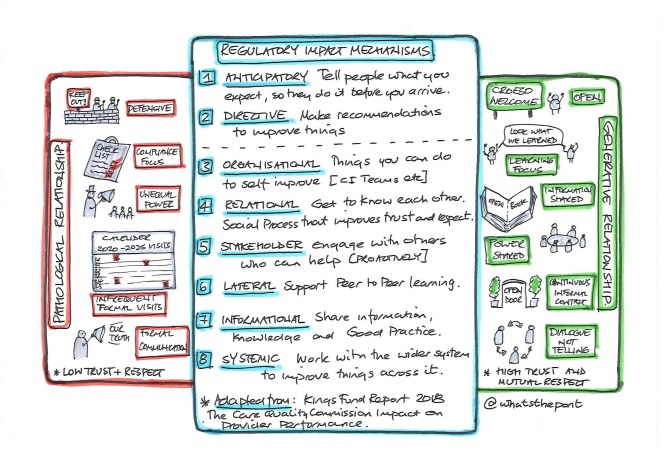
    Image: Regulatory Impact Mechanisms. Adapted from the Kings Fund Report.

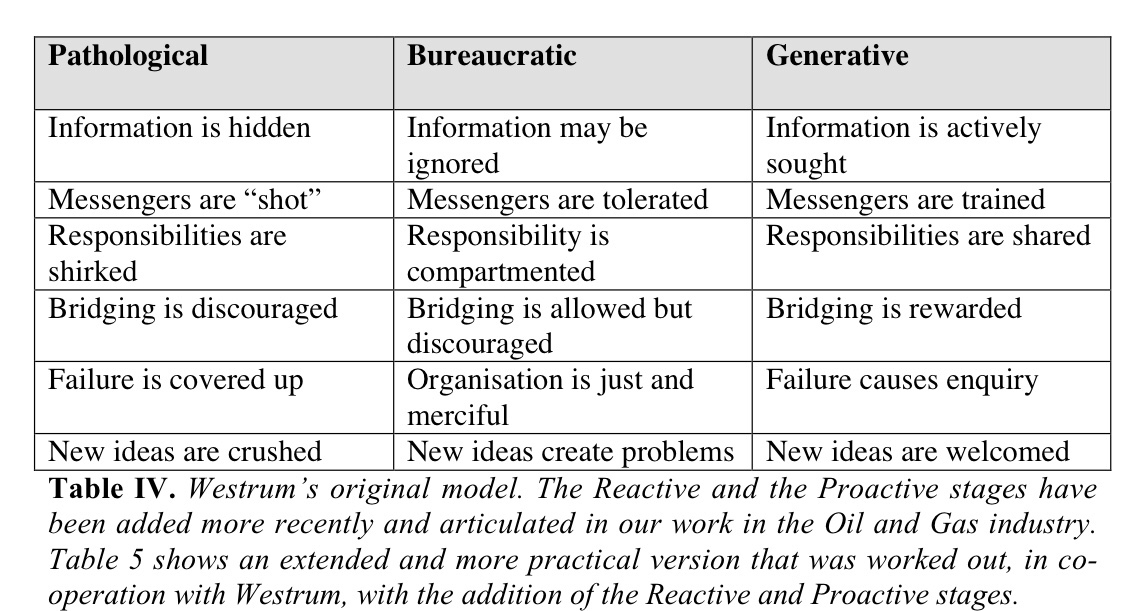
    Pathological to Generative Regulation. This phrase doesn’t actually feature in the Kings Fund Report, but I think it is definitely implied. It does however get an explicit mention by former CQC Director of Quality Improvement, Jeremy Cox in the video I linked to in the last post, and his own post he wrote for Easier Inc, The Box that Ticked Itself.

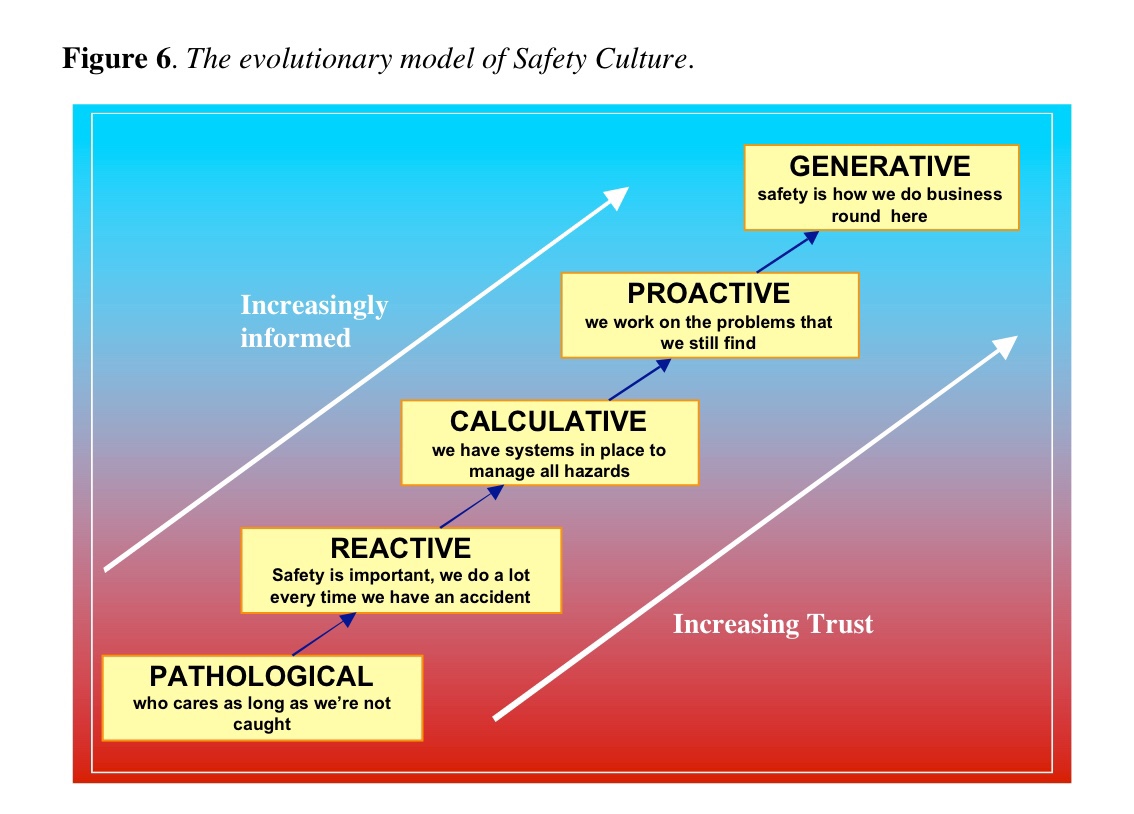
    As far as I can work out the origins of the phrase ‘Pathological to Generative’ comes from work done around the evolution of the health and safety culture in the Oil and Gas Industry. If you’ve got the inclination, have a look at this 2001 paper ‘Safety Management and Safety Culture. The Long, Hard and Winding Road’ by Prof. Patrick Hudson from Leiden University in The Netherlands.

    Alternatively you can have the ‘Hollywood’ version I wrote; Pathological to Generative. Moving up the Regulation Ladder with Bruce Willis. The most useful thing I can point you towards quickly is the graphic that illustrates the difference between Pathological and Generative approaches.

    Image: The Evolutionary Ladder of Safety Culture. Source, Patrick Hudson, Management and Safety Culture – The Long, Hard and Winding Road, 2001

    Making the move from Pathological to Generative. I did mention that the Kings Fund report identifies a number of things that help the relationship move from Pathological to Generative (they use Purposeful – but I’m sticking to Generative). This is focussed around something they call ‘Regulatory Impact Mechanisms’. I’ll try to explain the basic gist of how I think it works:

    • A pathological relationship features a tough, adversarial approach and a number of behaviours that reinforce this – on both sides (and it doesn’t actually have the desired impact – improved services).
    • A generative approach is much more supportive, featuring mutual trust, respect, openness and the sharing of knowledge (to help people and organisations improve what they do).
    • Sitting between these ‘states’ are eight ‘Regulatory Impact Mechanisms’ (RIMS for short).
    • The general idea is that you can use these RIMS in ways that can have different impacts on the relationship between Regulated and Regulator.
    • Depending on what you both do it can be a Pathological Relationship (BAD) or a Generative Relationship (GOOD).
    • But, you’ve both got to want the same thing.
    • It’s as easy as that!
    • Just to help you a bit more I’ve tried to describe the RIMS in the drawing above. Its also worth looking at pages 14-15 of the Kings Fund Report (link here). I’ve also posted images of the pages at the end of the post.

    Yeah, but the Regulators will go ‘soft’. The worry that Regulators, Inspectors and Auditors will ‘go soft’ and ‘return to the wild’ is valid. A bit ‘over-played’ but valid. Nobody really wants a ‘cosy regulator’ like nobody wants a ‘bent copper’.

    There are plenty of ways to overcome this concern though (it’s all just good risk management). The Kings Fund report talks about the training process for Inspectors. If you want to look further afield – try the United States Nuclear Regulatory Commission, Resident Inspectors Programme. Basically the Inspectors become ‘resident’ at the nuclear facility and really get to know what’s going on. To avoid them getting ‘too cosy’ there are all sorts of things in place, and they move on after 7 years. You can have a read about it and find some links in this post I wrote: The Hawthorn Effect and ‘Cleaning the House’ before important visitors arrive.

    A Framework for…? The report identifies that RIM activities 1 & 2 are the most commonly used. For the rest, their application is less frequent and widely spread, but they do actually happen (I’d confirm that from my own experience).

    So, if it’s already happening in some places… I’m tempted to ask what’s stopping the rest of us also doing it? Probably only our own behaviours and some (misplaced) fear of failure. To quote William Gibson, ‘The future is already here, It’s just unevenly distributed’… and it might well be already happening under your nose.

    Finally, It all boils down to people and the relationships we have. I ditched the grey suit and purple tie ages ago, now I’ve got a Tweed waistcoat and I’ve grown a ‘hipster’ moustache, its much more ‘me’.

    So, What’s the PONT?

    1. Regulation, Inspection and Audit is a Contact Sport. It’s a social practice that requires good interpersonal relationships based upon trust and mutual respect.
    2. To move from Pathological to Generative relationships the Regulatory Impact Mechanisms detailed in the Kings Fund Report offer a ‘Framework’.
    3. The future (of Regulation, Inspection and Audit) is already here, its just unevenly distributed and probably happening under your nose.
  • Be careful what you wish for… After blathering on about Trojan Mice for ages people have actually paid attention. Thank you Paul Taylor for the mentions in this post ‘The Complex Problem with Big Change Programmes’ and ‘People Aren’t Sick of Change, They are Sick of Change Programmes’.

    There’s an important point in Paul’s posts. Trying to change things in a straightforward, highly predictable and controlled environment is very different to trying to change things in a complex, unpredictable and uncontrolled environment. It’s not just a case of using the same tools to do a different job. You wouldn’t expect a carpenter to fix your gas boiler with a hammer and chisel. Trojan Mice are not the same as Prince 2 Project Management (although they do need a proportional level of management).

    Thanks also to Neil Prior from Practice Solutions who arranged for me to explain the concept of Trojan Mice to a live audience. This is where the 900 seconds comes in. It’s basically 15 standard minutes, sounding a bit more interesting and hopefully attention grabbing.

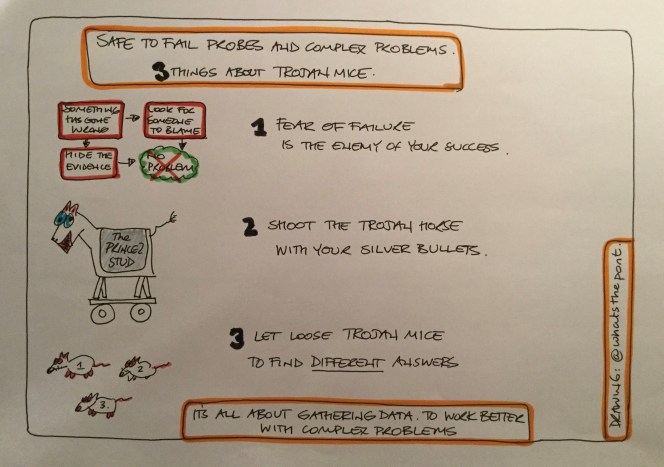
    900 Seconds of Trojan Mice. Here are the visuals I’m going to use in my 900 seconds; five of them. So that’s roughly three minutes a drawing. I’m posting them here as a bit of a road test. Any comments or observations gratefully received.

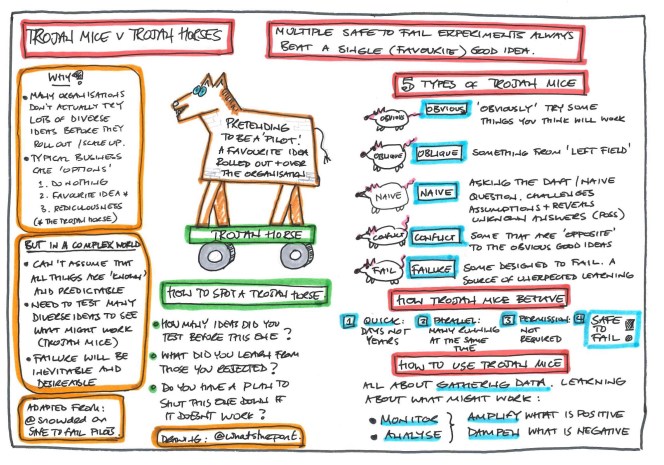
    Setting the scene and planting the key messages: hopefully this does what it says on the tin. I think I should emphasise that this is about an approach to complex situations. It’s not an attack on project management and Prince 2 , they are approaches designed for controlled environments. Trojan Mice are about probing and gathering data to make sense of complex problems.

    Fear of Failure is the Enemy of Success. I’m making the point here that attitudes to failure in organisations shape peoples’ behaviour. If there is a fear of failure, the learning that emerges from a failure or mistake is often lost (or buried). In addition, the fear of failure leads to a low risk culture where people don’t try anything that could fail and put them at risk. It’s all about seeking certainty and minimising the risks.

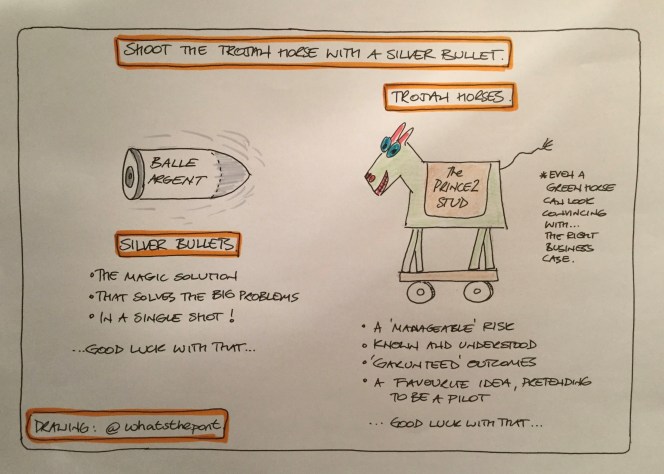
    Shoot the Trojan Horse with your Silver Bullets. A few things going on here. Trojan Horses are the well managed projects that often get rolled out organisations. There’s often an illusion (delusion?) of certainty about them and an expectation that the ‘demonstrator pilot’ can easily be scaled up to be implemented across the whole; department, region, organisation, country. Frequently Trojan Horses are the ‘pet project’ of one individual. Something they are emotionally attached to. They might have skillfully used the ‘Project Management Options Appraisal’ section of the Business Case to make it appear as the ‘only game in town’. Sound familiar? (*cough, cough* I admit to doing this – in the past!).

    Silver Bullets are just as mythical and unrealistic as Trojan Horses. They are the magical solutions that will solve all of our problems in a single shot. They are seductively attractive and lots of organisations are drawn to them as the easy fix, with depressing frequency. This re-occurrence happens so frequently that Matt Wyatt (@ComplexWales) has suggested they be called Silver Boomerangs, ‘because they keep coming back around’. All explained in this post The Life Cycle of a Silver Bullet.

    The point of this drawing is to suggest you could solve two problems at once, by shooting the Trojan Horse with a Silver Bullet – nice!

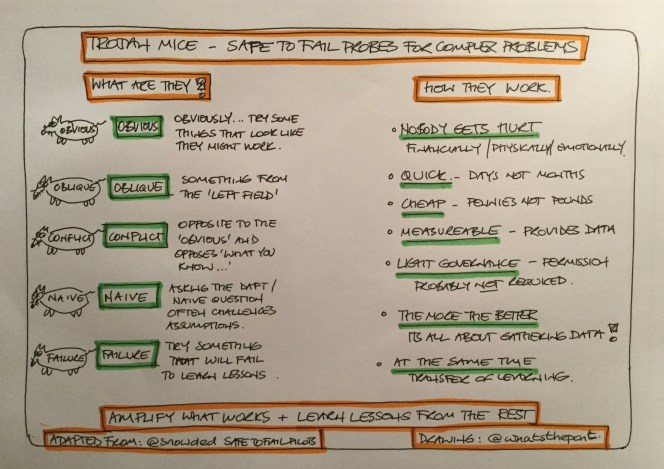
    Trojan Mice. Safe to Fail Probes for Complex Problems. I’m hoping this is a fairly self explanatory drawing. The main point is that the more you probe and gather data about complex problems; the better position you are in to make sense of it and make good decisions about what to do next. The more Trojan Mice you deploy, the more data you will get.

    The points about ‘Safe to Fail’ are obvious (I think). If you what to know more have a read of ‘Stop Talking, Start Experimenting’ by Paul Taylor on the work of Bromford Lab. There is a great graphic in this post that clearly shows the difference between Tests (Experiment / Trojan Mice) and Pilots.

    One final bit I want to emphasise on the drawing is measurement. Deploying Trojan Mice is all about gathering data for measurement; in whatever form that measurement takes. Employ a Product Designer – they are pretty good at thinking from this perspective.

    Trojan Mice and the Dolly Parton Challenge. Apologies if this feels completely left field (it’s all explained in this post). I’m just trying to make the point that the language that gets used around Trojan Mice matters. It’s ‘Horses for Courses’ and Mice for.. err…?

    Anyway, it all boils down to taking well managed risks. If you are trying to get your proposals past the ‘Audit, Risk and Killers of Anything with a Spark or Creativity Committee’, you probably want to talk in terms of ‘Well Managed Risks’.

    If you are turning up at a learning event full of the super cool innovators, thought leaders and like minded progressive thinkers, to blather on for 900 seconds, Trojan Mice are probably your thing.

    So, Whats the PONT?

    1. Trojan Mice are a tool for gathering data (probing) complex problems and situations. The more Trojan Mice you deploy, the more data you can gather to help you make sense of the problem/situation. That helps you make better decisions about ‘what next?’
    2. The tools you use depend on the circumstances. A tool that is designed for a ‘controlled’ environment is unlikely to work in a highly uncontrolled and unpredictable complex environment.
    3. How you talk about Trojan Mice depends on context. For an Audit and Risk Management Committee you are just describing a ‘Well Managed Risks’ approach. For others, Trojan Mice works just fine.

    Resources: More info on Trojan Mice

    The History of the term Trojan Mice explained by Harold Jarche (back in 2012) https://jarche.com/2012/10/on-trojan-mice/

    General Description : https://whatsthepont.blog/2011/07/24/let-loose-the-trojan-mice-dont-waste-money-on-big-stuff/

    Things that block Trojan Mice:  https://whatsthepont.blog/2011/07/31/what%e2%80%99s-eating-the-trojan-mice/

    Spotting the difference between Trojan Horses and Trojan Mice:  https://whatsthepont.blog/2013/11/10/trojan-horses-are-not-trojan-mice-5-questions-to-spot-the-difference/

  • Does this make any sense? Or is it just a lame attempt to make taking ‘well managed risks’ sound appealing?

    The Dolly Challenge. If I’m having to explain this. I guess I’ve failed, but thanks for sticking with me. Basically the #DollyPartonChallenge is the latest fad that’s doing the rounds on the internet. Post pictures of yourself on 4 different social media platforms:

    • LinkedIn – serious / businesslike me
    • Facebook – Real life, take me as you find me
    • Instagram – no idea, not my thing, but a polished/posed version?
    • Tinder – super seductive and enticing

    You get the drift… If you want a bit more explanation, have a look at this BBC article about how Cleveland Police have used it to help find a wanted person.

    How does an auditor ‘sell’ a presentation about ‘well managed risks’? Be honest, who is going to be thrilled at the thought of an auditor talking to them for 15 minutes about well manged risks? I’d make a wild guess at… not many!

    So… the #DollyPartonChallenge for Trojan Mice is my attempt to make well managed risk taking come across as ‘super seductive’ and as inciting as possible. Obviously I’ve swapped Instagram for Twitter, because its Twitter I know and don’t have much of a clue about ‘Insta’.

    This is ‘actually something I’ve got to do next week, so any feedback would be greatly appreciated.

    I’ll stop here, and get my coat. I think I might have gone too far…

    If you are interested in Trojan Mice, here’s some stuff I’ve written about them.

    General Description: https://whatsthepont.blog/2011/07/24/let-loose-the-trojan-mice-dont-waste-money-on-big-stuff/

    Things that block Trojan Mice: https://whatsthepont.blog/2011/07/31/what%e2%80%99s-eating-the-trojan-mice/

    Spotting the difference between Trojan Horses and Trojan Mice: https://whatsthepont.blog/2013/11/10/trojan-horses-are-not-trojan-mice-5-questions-to-spot-the-difference/

  • Imagine a situation where you can measure the psychological and physiological effects of a visit from the Regulator.

    That’s what this fuzzy image shows. It’s actually heart beats per minute of the registered manager of a care provider, and the impact of a notice to visit from the Regulator. The ‘spike’ happens when the ‘regulatory visit’ was announced (October) and declines towards to actual visit in the following January. “I lived with a bit of anxiety tucked under my rib cage at all times” was how it was described, surely that’s not good for anyone?

    Image from Helen, Registered Manager at a Care Provider. Taken from the Jeremy Cox presentation (see below). What happened? – the ‘regulatory visit’ email.

    Creating stress and anxiety can not be right… I’m really troubled by the idea that a ‘visit from the Regulators’ is a major source of stress and anxiety. Along with that, it also influences the behaviour of the people being regulated – and not generally in a good way either.

    Have a look at this video Radical Models of Regulation by Jeremy Cox, former Director of Quality Improvement at the Care Quality Commission (CQC). Jeremy tells the whole story, offers some ideas for a better approach to regulation and there’s even a happy ending for the Registered Manager, Helen.

    Who do your Values and Behaviours apply to…? I bet that lots of the organisations that do ‘regulation’ will have values and behaviours written down. They will talk about; ‘valuing people’, ‘treating people with respect’ and ‘building trust’. I’m guessing that this applies to how the people working for regulators treat each other, but I’m left wondering how this applies to the people who they regulate. I do know a few teachers who can describe experiences like those explained in the video. It feels like a common experience – but that doesn’t make it right, or even useful.

    Behavior begets behaviour. There’s an important point Jeremy Cox makes in the video that Regulators often complain of ‘dysfunctional behaviour’ in organisations. However the Regulators don’t stop to think about what part they play in creating that behaviour.

    If your behaviour is all about mistrust, sniffing out problems and punishing the guilty it’s hardly surprising that people behave defensively. I wrote about this in ‘How to beat the Inspectors’ . It was prompted by my surprise that there was an ‘industry’ of people advising organisations on how they should prepare for regulation , inspection and audit. Basically, how to ‘pull the wool’ over the regulators eyes. What a waste of money and resources.

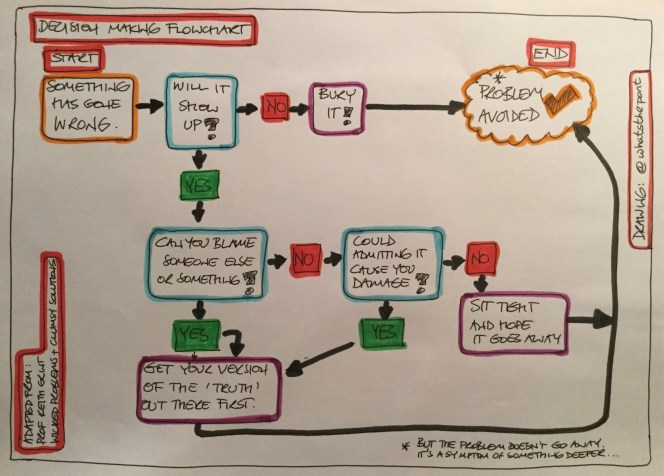
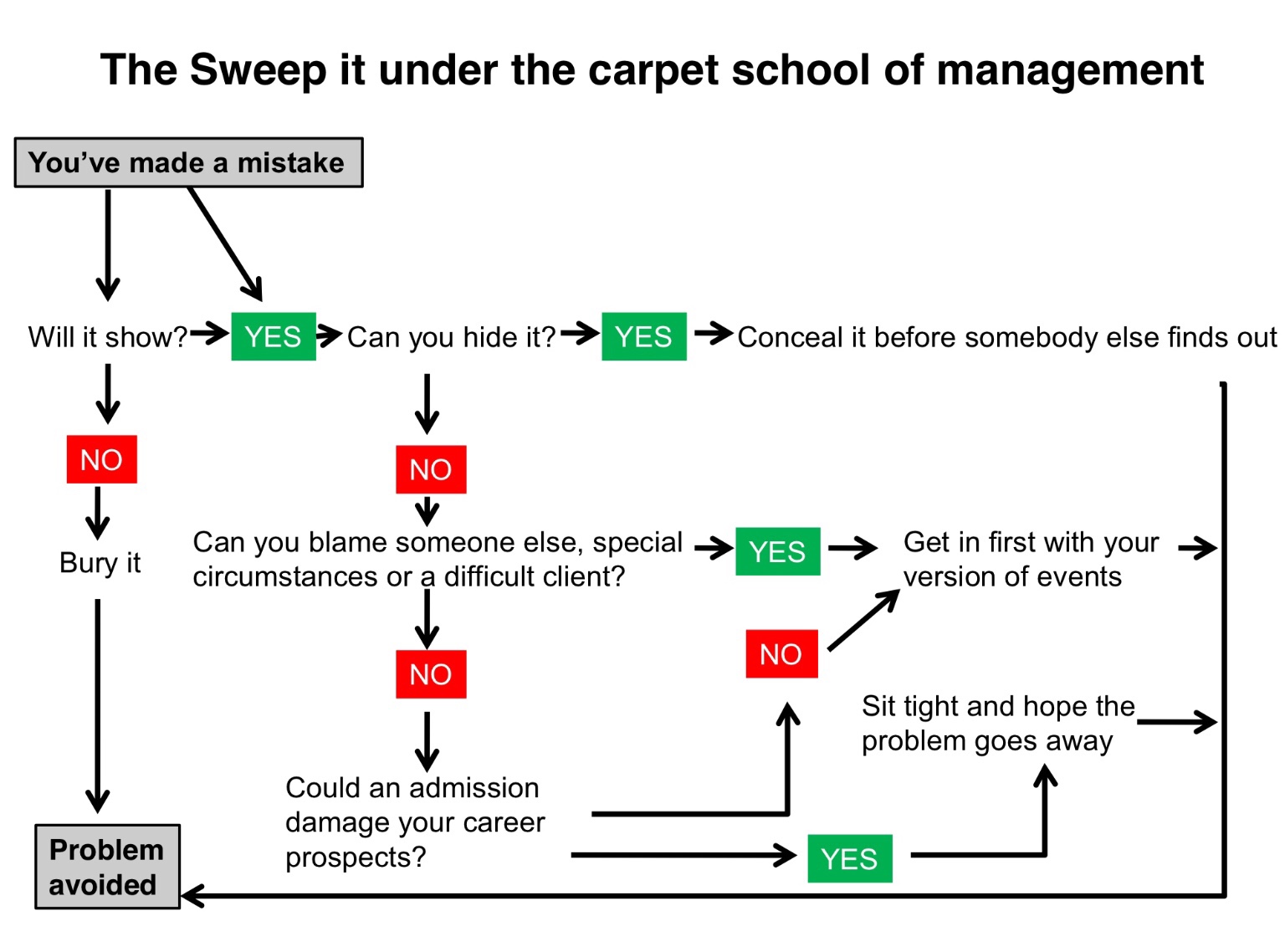
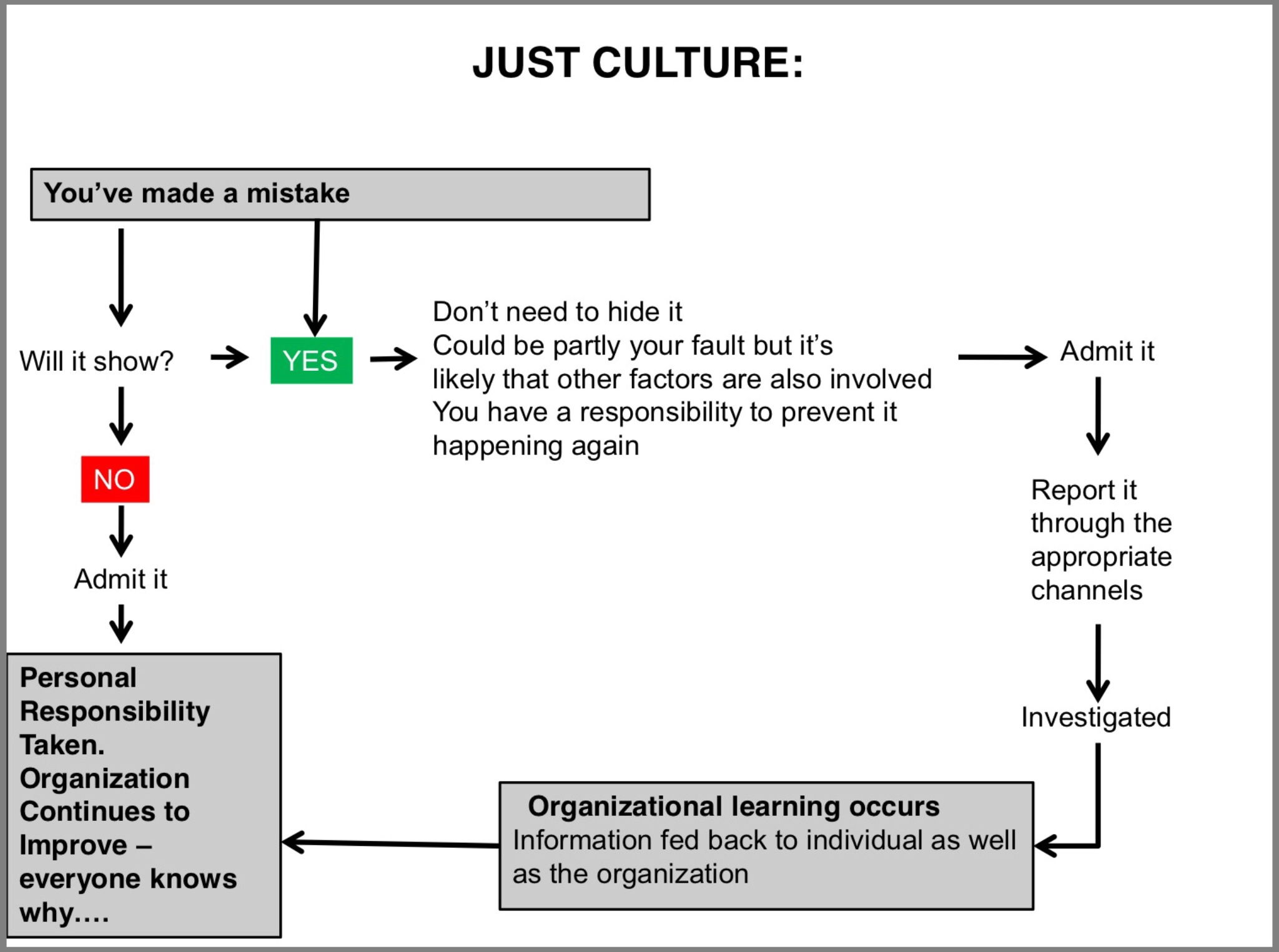
    The second point that’s nagging at me around behaviour is about how a negative approach to regulation can contribute to the fear of failure. We all recognise that an ‘overactive’ fear of failure in organisations can lead to behaviours that involve hiding the evidence and looking for someone to blame when things inevitably go wrong.

    This lovely flowchart was developed by Professor Keith Grint paints the picture. The details are explained in this post about moving from Pathological to Generative Regulation.

    Source: Prof Keith Grint Wicked Problems and Clumsy Solutions
     http://leadershipforchange.org.uk/wp-content/uploads/Keith-Grint-slides-handout.pdf

    The Spanish Inquisition Approach to Regulation. The ‘terrorise and torture’ or ‘cruel but fair’ approach to regulation, inspection and audit isn’t something we should be using in the 21st Century. Apart from the fact that it doesn’t really work as a means of ‘driving’ improvement, it actually builds some negative and counter-productive behaviours.

    It really, really shouldn’t hurt. The idea that Regulation is also causing people stress and anxiety is not right. I’d hope the people designing the regulation approach would want to avoid that as an impact (I hope…). Nobody wants to see people doing their best, often in difficult circumstances, suffering because they are being inspected.

    There is hope, and a happy ending. I do recommend you watch the video. Jeremy Cox puts forward some ideas on how you might do regulation differently which includes things like:

    • Developing a relationship based on mutual trust and respect;
    • Sharing information on good practice; and
    • Linking stakeholders and peers to share learning.

    All interesting ideas which I’ll expand on from my own experiences in a follow on post. The one thing I would add and emphasis though is context. It’s massively important to understand the context of where you both are. If either organisation (regulated or regulator) are in different places on the spectrum of Pathological to Generative, it’s going to be difficult to see things through the ‘same lens’, and ‘speak the same language’. Interestingly Jeremy Cox used the Cynefin Framework as a means of looking at context… more of that in the next post.

    So, Whats the PONT?

    1. A bit of stress can be useful in certain circumstances. But prolonged anxiety ‘tucked under your rib cage’ can not be good for you. Regulators need to think about the impact of their actions on those they regulate.
    2. Behaviour does beget behaviour. If you don’t trust people, look for problems and punish the guilty, don’t be surprised if people are defensive and hide things.
    3. A generative approach is a great aspiration, but not everyone plays nice and by the rules. Just be aware of context.

    Thanks to Sam Spencer (@rethinkingserv) for sharing the Jeremy Cox video and prompting this post

  • Ritual Dissent: “We do that here. It’s just that the dissent happens once people have gone back to their desks and they destroy the idea” Anon.

    Just for the record, what I’m talking about here is: Dissent as a strongly held difference of opinion and Ritual as a set of fixed actions that are part of a ceremony, often with deep meaning.

    So, anyone experienced this? A solution / plan / idea is carefully crafted in a ‘collaborative’ workshop / meeting / engagement session, then it fails to fly when it is implemented. The reasons appear to be:

    1. Some people aren’t really committed and you get the ‘dissent at the desk’ phenomenon described by Anon above.
    2. It collapses under the pressures of real life. The solution / plan / idea hasn’t really been tested. It sounded great in the workshop, but it’s not what is needed in the real world. It’s unworkable.

    Say hello to Ritual Dissent. This is one of Dave Snowden’s creations and I love it. I love it because it helps overcome exactly the problems I have mentioned above, AND, it has a number of other positives. Here are my top 7 reasons to love Ritual Dissent:

    1. Robustness. It lets you robustly test an idea / plan / solution – in a ‘safe to fail’ environment (nobody gets harmed).
    2. Diversity. You can involve a lot of people, with different viewpoints – always helpful.
    3. Better Listening. It requires people to actively listen. Always helpful if you’ve been elevated to a position where you’ve forgotten how to listen properly.
    4. Better Feedback. It allows people to give honest and direct feedback, overcoming the tendency to bush over what we really think.
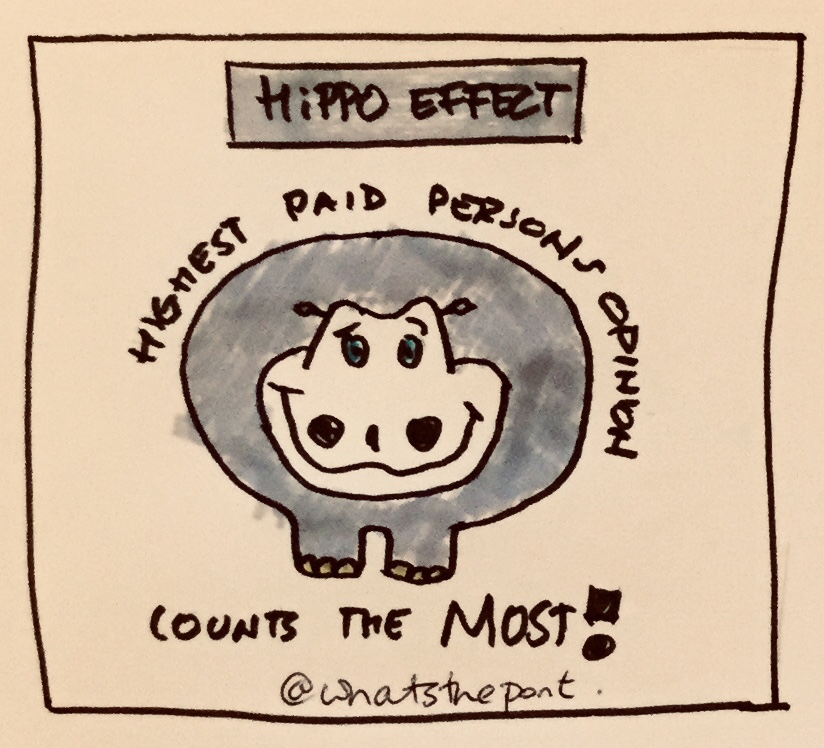
    5. Equality of Opinion. It helps overcome power imbalances. Too often the opinion of the highest paid person carries too much weight (HiPPO Effect). Its the quality of the idea and the feedback that matters here.
    6. Value for Money. It’s a rapid and action focussed process which plays to my preferences. If you’re going to put a group of expensive people in a room, squeeze them to extract value. Focus doing things that have a better chance of working in the real world. That’s Value for Money in my book.
    7. Managing Emotions. There are no hurt feelings. Don’t under estimate the hassle that hurt feelings can bring. Best to avoid creating them.

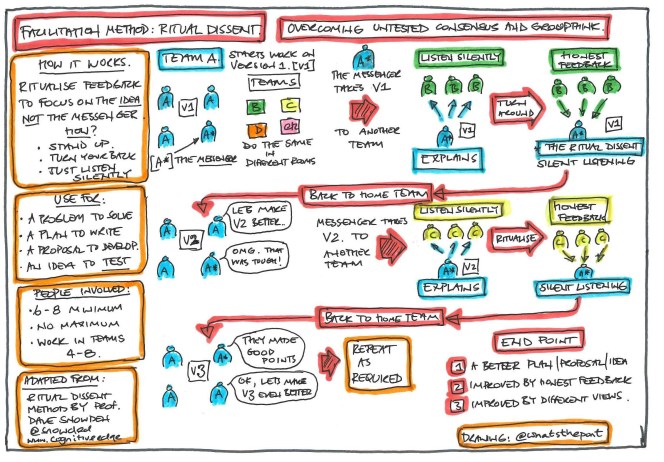
    So how does it work? I’ve posted the drawing above which hopefully helps.

    • You need a task to focus on; the development of an idea, a plan , solution or proposal.
    • Small Groups (A, B, C etc) will work on their proposal.
    • Each group appoints a Messenger. Someone who is both robust and resilient (if they are a bit ‘thick skinned’, all the better).
    • After some working on the proposal, Messenger A takes it to Group B to present it.
    • The Messenger presents the proposal to silence. There this no feedback, although questions to establish clarity can be asked.
    • The Messenger then performs the Ritual. They stand up, turn their chair to the group and sit with their back to them.
    • The Group then gives their feedback. This is brutally honest feedback that points out the flaws, errors and problems with the proposal. The ability to give honest feedback is helped by the fact you aren’t being ‘eyeballed’ or receiving any non verbal communication (body language) from the messenger.
    • The Messenger just listens. Actively listens. It’s amazing how good you can get at listening if other things like looking at body language are taken away from you.
    • The Messenger can take notes of what they have heard.
    • Once the feedback is over, the Messenger return to their group to share what they have heard and use it to improve or re-work the proposal.
    • Once the proposal has been improved, the process starts again.
    • You can go through a number of cycles of receiving feedback, involving different Groups if available. This adds to the diversity of views.
    • At the end, the feedback can be switched to Assent rather than Dissent. Basically the Group say only positive things about the proposal. Its nice to finish on a positive (provided it is actually positive).

    Things to watch out for. I’ve run ritual dissent many times and there are a few things to be aware of. There’s the usual stuff about clearly explaining things which is always a challenge. More often than not its the people with the most qualifications, biggest salaries and swankiest job titles that need most explanation. The other big issue can come around culture. If this is an organisation where people like confusion and bureaucracy, and don’t really like accountability and responsibility you might struggle. The Ritual Dissent method takes you to a place where accountability and responsibility are more visible than you sometimes get in a mushy comfortable consensus. Some people don’t want that.

    Resources. I did mention earlier that the Ritual Dissent Method was created by Dave Snowden. You can find out more about the method at:

    The Cognitive Edge website for the full method statement: https://cognitive-edge.com/methods/ritual-dissent/

    A podcast I recorded with Dave Snowden on the Wales Audit Office, Good Practice Exchange website: https://goodpracticeexchange.wales/2019/01/22/episode-4/

    I’ve written some previous post on Ritual Dissent, which on reflection look a bit rubbish, it was a long time ago.

    Ritual Dissent – getting better proposals and dealing with saboteurs

    Ideas need to be brutally tested before you implement them”….. or try some Ritual Dissent?

    One final positive. Ritual Dissent is good fun. It’s amazing how many smiles you see and even a bit of laughter. I think this might have something to do with just how liberating it can be. If you get a chance to talk to Dave Snowden, ask him to tell the story of when it was done in a top end school…

    So, What’s the PONT?

    1. The Ritual Dissent Method helps avoid the ‘dissent back at the desk’ which happens in many places.
    2. It encourages honest and robust feedback by focusing on the idea, not the person sharing it.
    3. It allows for things to be tested in a ‘safe to fail’ space so that they have a change of surviving in the real world.
    Ritual Dissent, great for overcoming HiPPO Effect
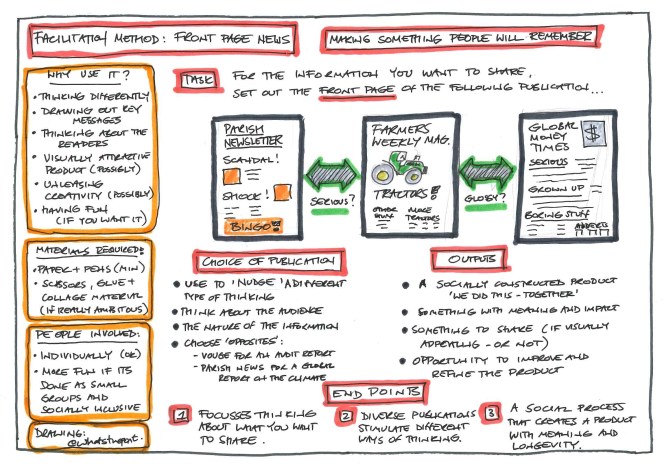
  • Facilitation Sketchnotes

    I’ve been experimenting with some drawings / sketchnotes of facilitation methods I’ve used a lot, or fall back on at various moments.

    I was planning to have done something a bit more structured with them, but that’s proving to be a challenge at the moment – so I’m just parking 4 of them here until I get some time to work out what would be useful / helpful.

    There are 4 in this sequence:

    • The 1:2:4 Method
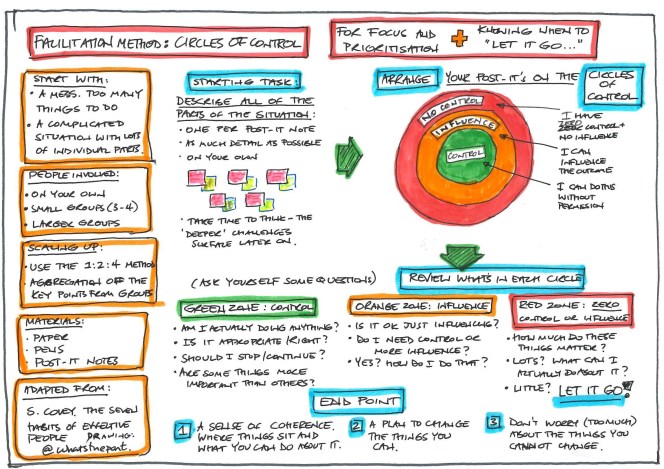
    • Circles of Control / Influence
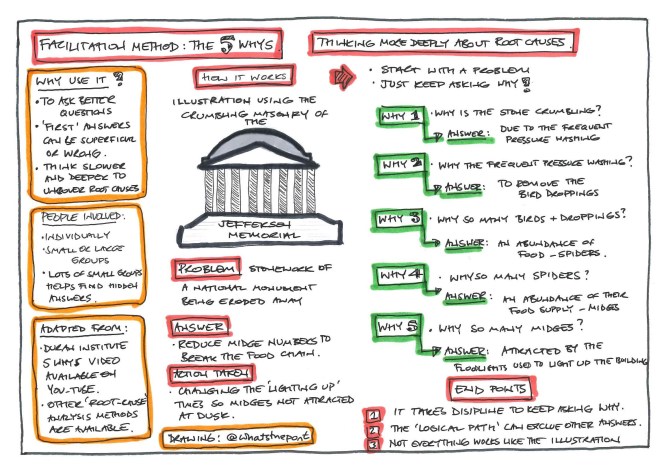
    • The 5 Whys
    • Front Page News.
  • How do you send a message to someone who is 10,000 years in the future?

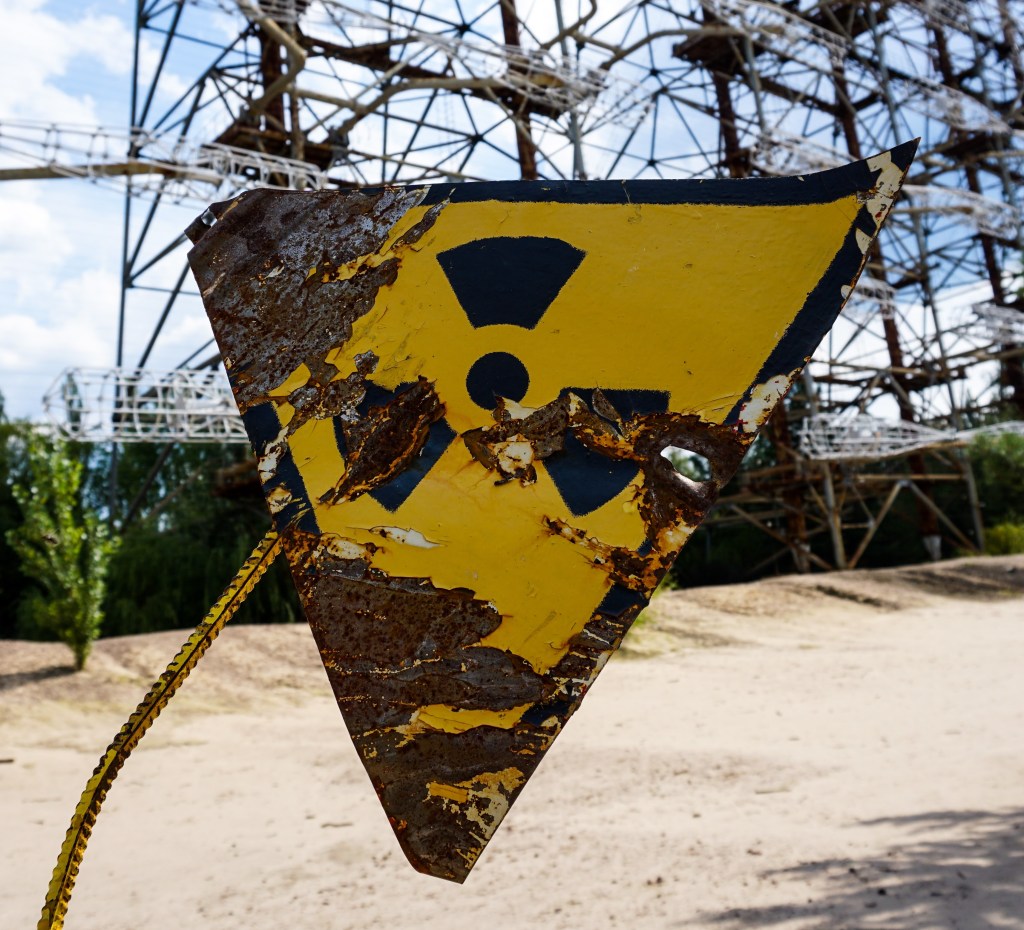
    How well do signs stand the test of time?
    Image: Photo by Ilja Nedilko on Unsplash

    It’s not a question I’d imagine most of us think about every day. Even the people who have Futurologist in their job title might struggle. The Wellbeing of Future Generations Act (Wales) probably doesn’t quite stretch to 10,000 years in the future – it’s a very long time.

    But it is something you need to think about if you are responsibly storing (burying underground) radioactive waste. Material that will remain dangerous to humans (and potentially other life forms) for at least 10,000 years.

    Hello Nuclear Semiotics. So, imagine you’ve got the job to come up with a ‘message’ that will warn people that ‘bad stuff’ is close by. The message has to work for whatever those future generations might be in 10,000 years time. They might be recognisably human (similar to now), or hugely different (think octopus or something). It’s a responsible thing to do, and in some ways this is the ultimate Wellbeing of Future Generations job. The broad area is called Nuclear Semiotics (which is all about symbols and their meaning, link here). In the 1980’s long term radioactive waste storage projects at Yucca Mountain in Nevada and another in New Mexico created the Human Interference Task Force.

    The Human Interference Task Force (HITF). The HITF ‘does exactly what it says on the tin’ – finding ways to prevent everyday Humans from messing with the Nuclear Waste. Straightforward.

    However, things definitely don’t look straightforward when you throw in the 10,000 years in the future dimension. There are so many questions that pop up, here are just a few:

    • What language will be used then?
    • Will they understand writing?
    • How technologically advanced (or undeveloped) will society be?
    • Will humans still exist on earth (or some other species)?

    If you fancy disappearing down an internet rabbit hole job you can have a look at the work of the Human Interference Task Force (HITF) here. Just to give you a taste here are a few of the things they have been involved in, from indestructible concrete (sensible and predictable) through to Ray Cats (brilliantly left field).

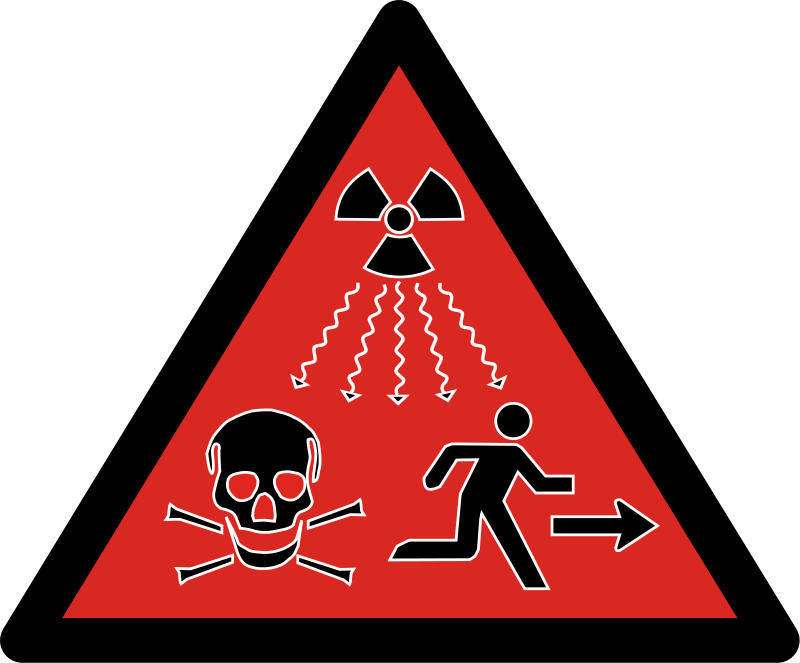
    ISO Nuclear Warning Sign. Image Source User:Yann and User:AnonMoos .https://commons.wikimedia.org/w/index.php?curid=1717279

    Bury and Forget. The approach is to bury the material as securely as possible (deep and difficult to get to) and then walk away with no obvious indication that it’s there. The idea is that anyone with the technological capability of drilling or digging into that space will also have the capability to work out that there is radioactive material present. I can follow the logic in that.

    Obvious Warning Signs. Bury the Material as above, but around it place many layers of warning signs. This is where the indestructible concrete fits- a base material for any of the language or symbols you choose to use. It’s also were the Semiotics experts come into play.

    One big question for me, will the ‘skull and crossbones’ have any relevance in 10,000 years time? Back in the 1700’s when Pirates roamed the Caribbean it really was a terrifying symbol of death and suffering. A skull has also featured on gravestones for centuries. However, nowadays you are more likely to find it on a school lunch box or invite to a pre-school ‘pirate play party’. Lots of opportunity for confusing messages…

    On the language question there is a suggested text that would be translated into all of the languages recognised by the UN and periodically updated as languages develop (assuming the UN is around in 10,000 years).

    Just one thought here, how much attention will a Roughneck Oil Driller in the year 7019 pay to warnings written in 21st English or any other language? Hopefully a bit more than the attention 19th Tomb Robbers paid to the warnings written in Ancient Egyptian Hieroglyphics…

    Create Local Stories. Make the presence of the Nuclear Waste a highly visible and talked about feature of the local community. The locals develop ‘stories’ that warn people about the risks and this keeps people away. The power of the stories is so strong that they get passed down through many generations. A bit like historical folk tales that teach us to beware of wolves in the forest.

    There’s a lot of skepticism about this idea for reasons I won’t go into here but it does have quite a lot in common with what comes next.

    The Atomic Priesthood. Basically a new religion that is created to keep people away from the nuclear waste, through the use of knowledge, rituals and myths (I’m not joking). The religion will be strong enough to last the next 10 millennia.

    Anyone who’s has a brush with Warhammer 40K and the Adeptus Mechanicus will see some similarities here. The idea of an Atomic Priesthood seems to be well established in the world of Science Fiction and this paper is worth a read if you are interested (not recommended if you want cheering up) The Atomic Priesthood and Nuclear Waste Management – Religion, Sci-fi Literature and the End of our Civilization.

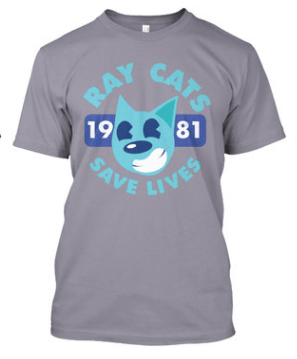
    Ray Cats T-Shirts, Cool Merch. https://teespring.com/stores/the-ray-cat-solution

    Ray Cats – Brilliant Left Field. This was the idea of two Philosophers Françoise Bastide and Paolo Fabbri who were part of the HITF, employed by the US Department of Energy and Bechtel Corp at Yucca Mountain Nuclear Waste Repository in 1981.

    The basic idea is as follows:

    • Cats have cohabited with Humans for a long time
    • Some societies treated Cats as Gods (the Ancient Egyptians) although if you had a cursory glance at the internet in the 21st century you might think nothing much has changed.
    • So, its reasonable to propose that cats and humans will stick around each other for years to come.
    • How about we genetically engineer cats to change colour in the presence of radiation, and this will warn people to stay away.
    • A brilliant warning system for Future Generations

    This ideas has gained a lot of traction through the website theraycatsolution.com – with plenty of people talking about Ray Cats and working on genetic engineering projects. They also produce cool merchandise, which may actually be one of the most effective ways of embedding the story in society for years to come, “Cool shirts today, a 10,000 year-old warning for tomorrow...“

    So is this the Ultimate Wellbeing of Future Generations Job? That question is full of challenges like – ‘if we hadn’t created the problem in the first place (nuclear waste) we wouldn’t be looking for a solution that would last for 10,000 years’. However, putting that to one side, I think there are some interesting things surfacing from the HITF work. These ideas could be applied to the Wellbeing of Future Generations thinking on a much shorter timescale. Sometimes you have to go to the extremes and then come back again.

    So, Whats the PONT?

    1. Diverse thinking always helps when you are trying to solve complicated problems (how many project teams have a Philosopher?)
    2. How we communicate is not static. Not now, not ever, but especially 10,000 years in the future.
    3. Never underestimate the power of cool merchandise. A Ray Cats T-Shirt is on my birthday list.

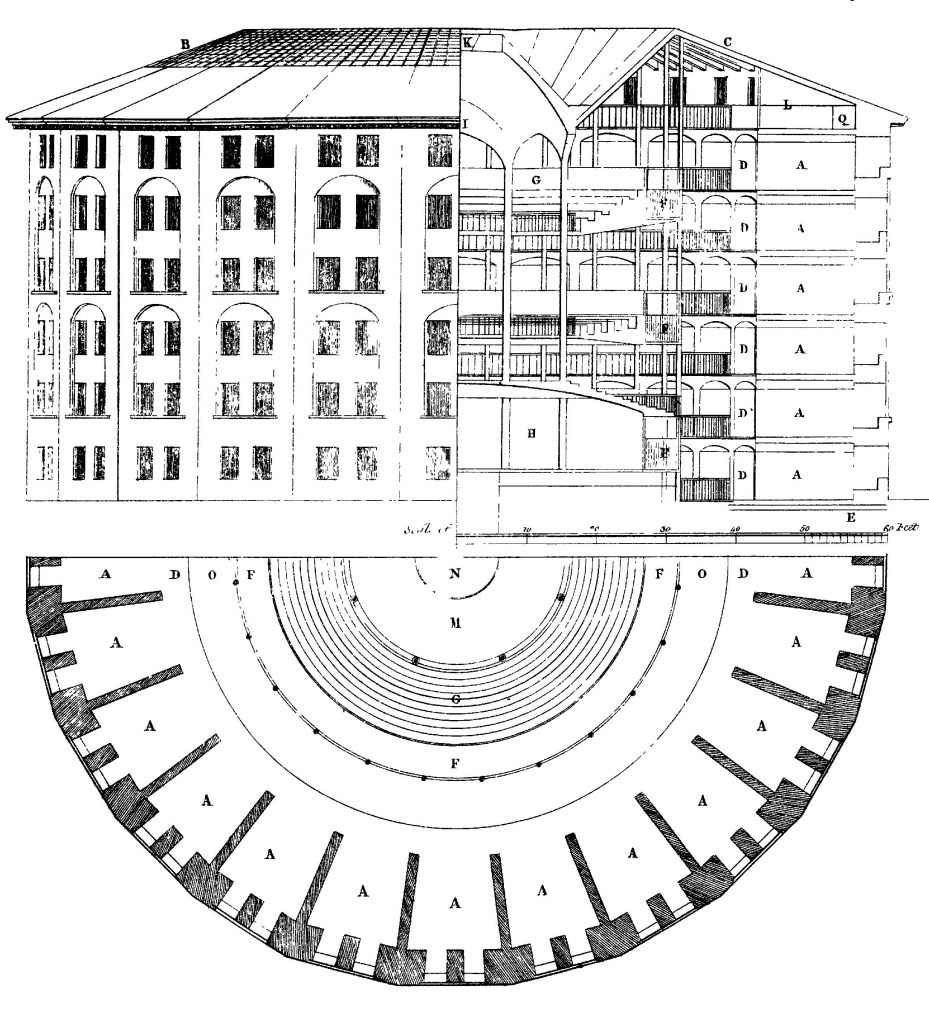
  • The Panopticon a prison where every inmate (thinks) they are being observed continually. Plan of Jeremy Bentham’s panopticon prison, drawn by Willey Reveley in 1791. Source: https://en.wikipedia.org/wiki/Panopticon#/media/File:Panopticon.jpg

    What do you do when people aren’t watching you? This might be a post about the difference between EPISODIC regulation and something that has more of an ANTHROPOLOGICAL feel to it. Let see how it goes…

    Alternatively, if none of that makes any sense, how about this question, What do you do before your Mother/Father-in-law visits?

    I was asked the question by Paul Barach from Wayne State University School of Medicine, Chicago at the Patient Powered Safety event organised by Chris Subbe at Bangor University. This is how the exchange went…

    • PB. What do you do at home before your Mother/Father-in-law visits?
    • Me. Clean up the house of course.
    • PB. What do you do once she/he has left?
    • Me. Return to my slobish lifestyle…

    Paul pointed out that this was the ‘Mother/Father-in-law is visiting’ regulatory approach and is commonly seen in situations where organisations are having a visit from the auditor/inspector or any other type of regulator. The behaviour and practice demonstrated while the inspector is ‘on-site’ does not mirror what happens once the inspector steps outside the front door, and returns to his/her own home. Episodic regulation (visits once in while) fits this pattern and does not always give an accurate picture of what happens the rest of the time. Paul referred me to an approach used by the US Nuclear Regulation Commission (NRC) of ‘Resident Inspectors’. Basically it’s your Mother/Father-in-law coming to live with you, Inspectors who are permanently based at Nuclear Facilities. I’ll talk more about that in a moment, but first, The Hawthorne Effect.

    We behave differently when we are being observed. The Hawthorn Effect (also known as Observer Effect) refers to experiments that were carried out in the 1920’s at the Hawthorne Works near Chicago. The works were a huge manufacturing facility making telecommunications equipment, with people willing to participate in work based psychology experiments.

    Some of the basic experiments involved changing the levels of light in parts of the factory to see if it affected the productivity of workers. Light levels were increased and light levels were decreased. The observations indicated that pretty much no matter what happened (lights up, lights down), worker productivity increased while the experiment was running, and the workers were being ‘observed’. Once the observation has stopped, things return to normal.

    The general principle that has fallen out of this is The Hawthorn Effect, people will change their behaviour when they know they are being observed. This seems totally obvious, we’ve all done it, we’ve all seen it (or am I being naive?)

    A personal observation; over the years I’ve seen multiple ‘observations’ of meetings, committees and people ‘doing their jobs’. Most of the time the observers seem to ignore their ‘effect’ (Hawthorn) and the impact they might be having. For example a Chief Executive or Director sitting in as ‘observers’ on a staff focus group about how to improve the business. It’s clear (to me) that their presence is going to influence behaviour and what is produced.

    There’s a lot of debate about the impact of the Hawthorn Effect, and the original data it was based upon, but it is widely accepted as being a real phenomenon. If you want to know a bit more about The Hawthorne Effect I’d recommend this BBC Radio 4 Mind Changers programme with Claudia Hammond.

    Three Mile Island Changed Regulation. Before we dive into the NRC Resident Inspectors Programme have a look at this video from Thomas Wellock, NRC Historian. Tom explains the Three Mile Island nuclear incident of 1979 and some of the changes that happened as a result. How fantastic to have an organisational Historian; someone dedicated to learning the lessons from history to inform the present and the future. I think we could do with a few more organisational historians in prominent places.

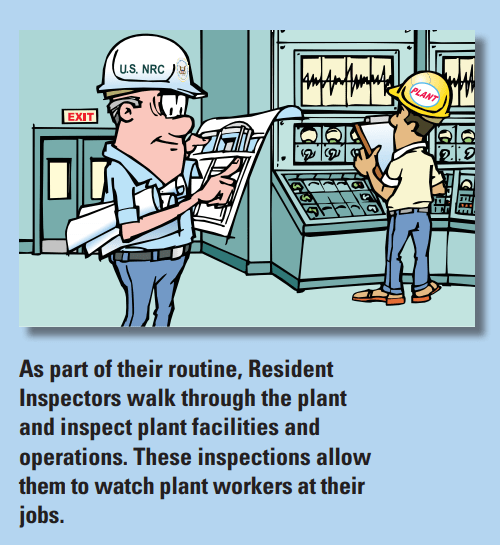
    NRC Resident Inspector Programme. Your Mother/Father-in-law coming to live with you, long term. Following Three Mile Island this represented a shift from episodic regulation to something more continuous. A presence on-site that is continually ‘there’ and continuously observing what you do.

    There are some interesting features of the Resident Inspector Programme that are edging towards this idea of anthropological regulation I mentioned earlier:

    • Inspectors live in the local community,
    • They don’t socialise with workers from the facility,
    • They have unrestricted access around the facility,
    • There will be two of them (support, checking in on each other etc),
    • They spend a lot of time ‘observing’ what gets done and,
    • They stay for a maximum of 7 years before they move on.

    There’s more detail in the NRC graphic booklet, A Day in the Life of an NRC Resident Inspector. I’d also recommend it as an example of making a technical topic accessible and easy to understand.

    Observational Regulation. US.Nuclear Regulation Commission publication. A Day in the Life of an NRC Resident Inspector. Accessible and easy to understand. Source: https://www.nrc.gov/docs/ML1310/ML13107B364.pdf

    Episodic to Anthropological Regulation. Anthropology is the study of humans, how they behave and the ‘society’ around them. The methods tend to involve long term observation, done in a way that aims to not change or have an effect on the subject it is observing. I’m sure you can see where I’m going here. There’s a big difference between an episodic (clean the house before visitors) regulatory visit and the ‘live there permanently’ approach of the NRC Resident Inspectors. I’m not sure it would be defined as anthropological regulation, but I think it’s worth thinking about as something that could be applied in other settings for two main reasons:

    • Avoiding the ‘clean up the house’ approach – you get a more realistic picture of what happens when the regulators aren’t there.
    • Behaviours are changed, possibly permanently. If people do things for a long time because they are being observed there’s a chance that a behaviour will become a permanent habit. There are obviously negatives to this around the impact of continuous observation. This is where the Panopticon Prison diagram from earlier fits it – but that’s another topic for the future.

    One thing I’m trying to work out is where this fits with the idea of Generative Regulation I wrote about in this post: Pathological to Generative. Moving up the Regulation Culture Ladder with Bruce. I’m wondering if anthropological regulation would support a generative approach or actually stifle it? Innovation and better ways of doing things might become suppressed as the people being observed behave in a way that a regulator ‘expects’? Who knows, but it’s probably worth an anthropological study.

    So, What’s the PONT?

    1. People change their behavior when they are being observed, and they do something different when they aren’t being observed. The Hawthorn Effect.
    2. Episodic regulation (a visit from your Mother/Father-in-law) generates non-routine behaviours (cleaning the house) that stop when the inspection is over (back to the couch…).
    3. A more anthropological approach; long term, non intrusive observation might help understand what happens in reality.
  • Power is a bit of a taboo subject, we don’t really talk about it. But when you boil things down to what matters in any human connection, power really does count. This is particularly true in a partnership. If you’ve got big differences in how much power sits with people around the table, there’s a chance you’ll to run into some difficulties* (*unless you do something to manage it).

    Why is Power Important? At its most basic, power is about the ability to do what you want to do, or get others to do it for you.

    So, if you agree with that logic, the more power you have the greater your ability is to have your objectives delivered.

    Think about this for a moment, then apply it to the situation of a partnership. A group of people from different places trying to achieve a common outcome (hopefully). I say hopefully (in brackets) because sometimes people are ‘forced’ into being a partnership, it’s not always voluntary…

    Applying the logic of power = ability to get your own objectives delivered, in a partnership this can have a big influence, especially if  membership of the partnership isn’t voluntary.  I’m sure you can imagine the scenario of someone on a partnership agonising over this dilemma… “I’ve got the power to make this happen, but do my personal (organisational) objectives sit above those of the partnership?”  Hmmmm…Tricky…

    The point I’m getting at here is that power is important and if you don’t recognise and manage it, there could be problems.

    Where Does Power Come From? There’s plenty of material explaining the different sources of power, lots of it these days wrapped up in the language of leadership style.

    I’d recommend sticking with some of the original work that was done (in the 1950s) by Social Psychologists John French and Bertram Raven. This explanation, ‘French and Raven’s Five Forms of Power‘ on the Mind Tools website is a useful, easy to digest explanation.

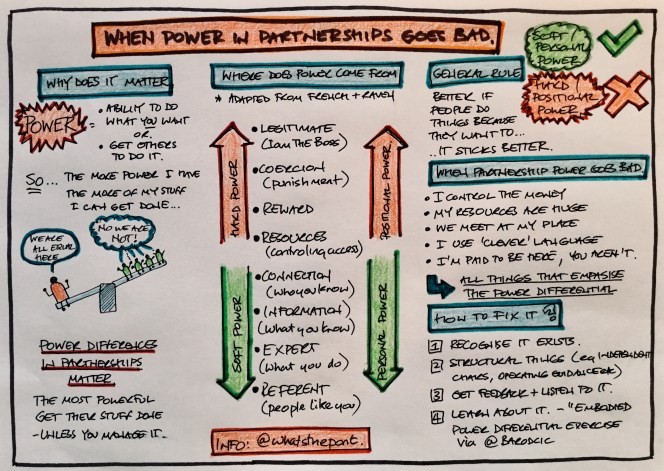
    Inevitably things have moved on a bit since the 1950’s and now people talk about up to 8 sources of power, or Power Bases. I’ve tried to summarise the range of Power Bases in this scruffy drawing. (Apparently, scruffy = ‘hand drawn artisan charm’, yes someone said that about one of my drawings. I was chuffed)

    img_0450

    What I’ve tried to illustrate here are the broad differences between Hard / Positional Power and Soft / Personal Power.

    There’s a view held by many people that Soft Power is more effective than Hard Power. This is because people will do things for you because they like and respect you. This is more desirable than people doing things because they have to or because you threaten them in some way. The soft power commitment to do something ‘for you’ is considered to be deeper and lasts longer.

    It’s not as clear cut as that, but I’m sure you get the gist. I’ve previously written about the idea of Malicious Compliance (link here) which gives a flavour of what happens when people do things because they ‘have to’.

    Just in case you can’t make any sense of my drawing the following are considered to be ‘sources of power’ – on an arbitrary scale of Hard to Soft.

    • LEGITIMATE. The Law/Position gives me authority. I am the Boss/Commissioner/Inspector/Queen/King etc.
    • COERCIVE. I have the power to cause you pain or damage you.
    • REWARD. I have the power to give you good things.
    • RESOURCE. I have power over access to things you need.
    • CONNECTION. I know powerful people.
    • INFORMATION. I know things that are useful to you.
    • EXPERT. I can do things that would be helpful to you.
    • REFERENT. You like me as a person.

    This is only scratching the surface of power and how it’s used. Any one of these ‘Powers’ could be used individually, or in combination, for good or bad purposes.

    Its worth a look at the work of John French and Bertram Raven (link here) if you want to get deeper into Power. 

    When Partnership Power Goes Bad. The list below is a reflection on when power in partnerships can cause problems:

    • My organisation controls the money.
    • My organisation has significant resources and we administer the partnership.
    • The Partnership meets at my premises.
    • We use ‘clever’ language and jargon specific to our sector.
    • I’m paid to be there, some people in the room are volunteers or service users.

    It doesn’t take a huge leap of imagination to connect what is in the list above to the French and Raven Power Bases. Have a go, you might not have realised just how powerful you are in a partnership.

    The problems created by a power difference are usually for the people with the least power, and often they don’t speak up about it… for very good reasons. Speaking truth to power is as much of a challenge for people in partnerships as it if for individuals. I wrote about this a while back in 3 linked posts, here’s the first one: Speaking Truth to Power Part 1. 2500 years of Shooting the Messenger. 

    So what can you do about Power Differences? These are only suggestions, and I’m open to ideas on what else could be done to reduce or manage any power imbalances in partnerships. Thanks to Anne Collis and Rachel Rowlands for conversations that have informed this.

    • Be aware that power has an influence over what happens.
    • A big difference in power can cause difficulties.
    • Try to manage the difference.
    • Structural things like transparent decision making and  ‘rules’ on things like speaking can work for some partnerships.
    • An independent Chair helps.
    • Have someone independent observe whats going on. 
    • Try ‘sitting outside’ and observing for yourself.
    • Try taking part in an ’embodied power differential exercise’ with Barod CIC

    There are no easy answers here, but recognising that power is a ‘thing’ in partnerships, and that it can cause difficulties is a starting point.

    So, What’s the PONT?

    1. Power has a big influence on what happens in partnerships. The more you have, the more likely it is that you will get what you want done.
    2. Recognising that there are differences in power within a partnership is a good staring point.
    3. Speaking truth to power is as difficult for people in partnerships as it is for individuals. It’s worth remembering that.
  • Target setting and ‘outcome measurement’ are part of a vast industry of checking and ‘holding to account’ but basically it doesn’t work, and probably causes more problems than if you didn’t bother in the first place.

    That’s a bit controversial…, particularly if you are in the game of; measurement, checking and ‘holding to account’. Let me explain, but first have a look at these images from the Foresight Tackling Obesities: Future Choices Report from 2007 (via the GOV.UK website).

    Foresight Obesity Map. Individual Energy Balance at the center with major influences surrounding it; Education, Healthcare through to Food Production and Media. It’s Complex!
    Just in case you need any more convincing that it’s complex. Extract of the Weighted Causal Linkages map – Solid line = Positive, Dotted = Negative, Thickness = Strength of Impact

    Measuring outcomes in Adult Social Care. This week I was at a session organised by Monmouthshire Council Social Services and Nick Andrews from the Swansea University, School of Social Care Research, where Toby Lowe from Northumbria University introduced the The Foresight Obesity Map.

    The point Toby was getting across was that in a complex system, like society wide obesity, specific interventions on discrete areas are unlikely to have the outcome you hope for.

    There’s too much going on; the system is not predictable and it is constantly changing. This means that targets and carefully measurements of progress against them is pretty much pointless. You are trying to define the unpredictable (by setting targets) and measure things over which you have no control. A complex system is controlled by many things beyond what you are concerned with.

    The point that Adult Social Care operates in a complex system was not lost on most people in the audience – even the people from regulation/audit/performance management and data. We had an existentialist crisis in a group discussion on our table… ‘What is our purpose…?’ Always a good one to ponder just before lunch.

    The key point from all of this is that – we live in a complex world and attempting to control and measure it by breaking it up into smaller parts (reductionism) doesn’t work like you think it does.

    If you want to get deeper into complex systems have a look at Toby’s blog, Embracing Uncertainty and what Dave Snowden has to say in posts like; ‘the banality of measurement’ and,‘the myopia of metrics’.

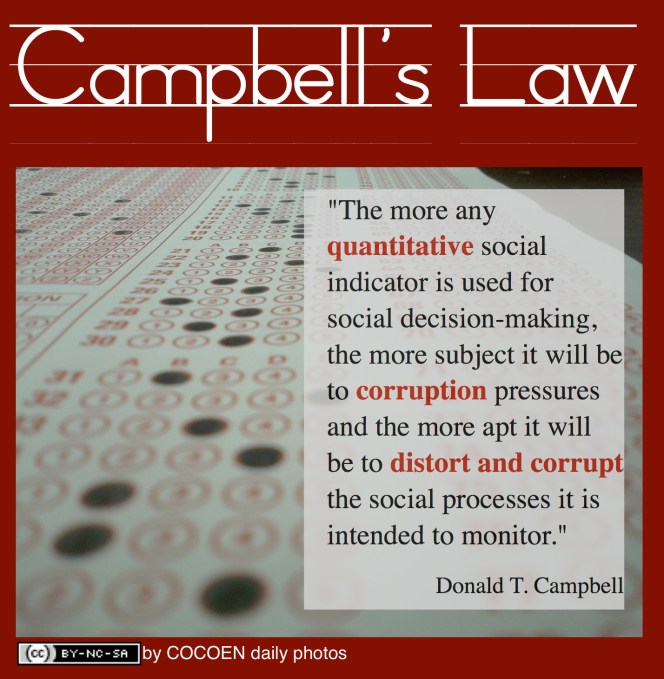
    Campbell’s Law and Corruption Pressures. This is my second big point. Basically, people will change their behaviour to achieve targets that are being used to measure their performance. Many people will have heard of the expression, “What gets measured gets done” – attributed to many people – and basically true as far as I’ve observed.

    Image Source: https://jl8910.wordpress.com/2011/03/01/quote-poster-campbells-law/

    Campbell’s Law describes this change in behaviour as ‘corruption pressures’ which in extreme cases can be ‘corrupt’. Deliberately acting to falsify results or in less extreme cases ignoring some things (like a small act of human kindness) whist you focus on getting the job done on time (because that’s what you are measured on).

    If you search the internet you’ll find many examples of people and organisations changing behaviors and ‘corrupting’ measurement processes to make sure they deliver against what is being measured. Examples include; education in schools, hospital waiting times, police records of crimes solved etc etc etc. The evidence for this practice is so widespread that I’m a bit surprised that we don’t talk about it more – it’s a bit of a problem in my view.

    You can read more about the work of Donald T. Campbell (a Social Scientist) here. Also, there are people like Charles Goodhart (an Economist) and Marylin Strathern (an Anthropologist) who pretty much said the same thing which you can read about in this post by Dave Snowden, The Strathern Variation. In the post Dave offers his own variation: Anything made explicit will sooner or later be gamed for survival purposes and that need will corrupt practice and people (Snowden)

    Dead Cobras (finally). My third point – the law of unintended consequences. When people are ‘gaming’ (a less threatening word than corrupting) measurement system, you often get unintended negative consequences.

    Known as the Cobra Effect one of the best known examples comes from time of British Colonial rule in India. The Authorities wanted to reduce the numbers of Cobras so offered a reward for any dead Cobras delivered to them. People saw the financial opportunity in this and started to breed Cobras so they could claim the reward for the dead ones. The Authorities got wise to the practice and stopped offering the reward. The result was Cobra breeders releasing the now worthless snakes and the problem was much worse than when things started.

    I suspect that if most people sit and think for a while they will be able to find an example of The Cobra Effect from an aspect of their working life. Maybe not as dramatic as a plague of poisonous snakes, but an unintended negative consequence of people chasing targets.

    Outcome Measurement is a Dead Cobra. I mentioned that just before lunch these was a bit of an existential crisis in the discussion at the regulators/auditors/performance and data people’s table.

    Basically this is where I was at: “in a complex system target setting and measurement of progress against those targets is pointless, and people will corrupt the system (change behaviour or full on cheat), and you are probably going to get unintended negative consequences – like a plague of poisonous snakes”. Oh happy days!

    The Story is The Measure*. Like any good story format I’m offering you a bit of hope here. There was an afternoon session and we came away with some ideas on what you can do to ‘measure progress’ in a complex system.

    I promise I will write that post soon (on the train to Bangor on Wednesday) and walk away from the pit of poisonous snakes. All I’m going to say for the moment is that core to it is the idea that ‘the story is the measure’ of what is happening in a complex system. Oh, and by the way I don’t mean manufactured ‘corporate stories’. I mean real stories told be real people in their own, unfiltered words – a bit like what I’m talking about in this post; Cool Story Bro… be cautious of Organisational Storytelling and Silver Bullets

    *I’m attributing ‘The Story is the Measure’ to Matt Wyatt @ComplexWales if he didn’t invent it, he will certainly have a view on who did.

    So, What’s the PONT?

    1. We live and work in a complex system. Simple, traditional linear models do not work in complex systems.
    2. Campbell’s Law is a real thing – people change their behavior to meet targets. These ‘corruption pressures’ often have unintended consequences.
    3. Unintended consequences are often negative like the Cobra Effect – things are far worse than when you started.

  • …basically you throw everything into a pot and mix it all together into a smooth consistency. Then you stick a piece of bread on a fork, pop it into the mixture, and see what comes out. That’s your project learning, driven by a thinking process called retrospective coherence.

    Source: Wikipedia https://upload.wikimedia.org/wikipedia/commons/d/d8/Swiss_fondue.jpg

    The Origins of Fondue and Project Reviews. If you are interested in Fondue have a look at this BBC Travel article, ‘Tracing Fondue’s Mysterious Origins’. For what I’m talking about here, all you need to remember is things get mixed together to create a gloopy (and delicious) liquid. What you probably don’t need to think about is the mixture coagulating in your stomach if you drink beer with it. Urrghh, that explains so much…

    From a project review perspective I’m not sure when they became a ‘thing’. I don’t recall being involved in ‘project reviews’ and ‘post project learning’ in my early working life. It seems to have become standard practice since the concept of ‘Learning Organisations’ and PRINCE2 project management have become commonplace. What matters though is that they both exist.

    Retrospective Coherence. There are two reasons for writing this post, Dave Snowden and ComplexWales. Both of them spoke about retrospective coherence within a couple of days of each other, or was it weeks? – see what I did there…

    Basically retrospective coherence is a thinking process where we make sense of events that have happened in the past. By thinking retrospectively (looking backwards) we neatly put events in order, so that they make sense to ourselves and others when we ‘tell the story’ of what happened.

    In this post The Mystical Acronomicon, ComplexWales explains how retrospective coherence often happens when people are writing case studies. The polished case study suggests a logical liner process with stages which neatly spell the acronym H.I.T.S. In reality however the stages happened as a convoluted mess spelling S.H.I.T. illustrated below.

    Image Credit:
    https://complexwales.wordpress.com/2019/03/09/the-mystical-acronomicon/

    For me this has a major implication for people using case studies. How can you replicate (copy) something if it didn’t actually happen the way it’s described?

    From a project review perspective I think this case study example fits the Fondue metaphor perfectly – a gloopy mixture from which a precise example of learning is extracted (I’ll get my coat…).

    The Dave Snowden prompt involved him speaking in this webinar about Risk and Resilience with Robert Koch from a power utility in South Africa. During the conversation they touched upon the process of extracting learning from incidents. Here are some of the key points I picked up on the need for rapid reviews: (apologies if I’ve misinterpreted any of these… it was a couple of weeks ago…)

    • “you need to reflect upon an incident immediately – whilst the emotion is still with you”
    • “the longer you leave it to reflect, the worse the information you get”
    • “adrenaline changes our memory structures” (I need to understand this one a bit more)
    • “put naive observers in alongside the incident team to capture the key learning points”

    What I took from this was the idea that a project review held a significant time after the end of a incident isn’t going to yield learning points that are as useful as those that you get from capturing them in the moment (or as soon as you possibly can afterwards).

    Rapid Reflection is Essential. I think this is a big deal. Lots of organisations invest heavily in project reviews and post project learning. I have encountered situations where people feel that nothing much happens as a result of them – the learning (if there is any) doesn’t get used and nothing much changes. Maybe they are just caught up in retrospective coherence and drawing out generic messages of little value from the gloopy fondue?

    If you want to read more about retrospective coherence have a look at this post from Modus Cooperandi : Is Retrospective Coherence a Cognitive Bias?

    Also of relevance, the transfer of learning in organisations is influenced by the rules and practices that exist – the learning we share depends on what the rules say. If you’ve done something brilliant, but it doesn’t fit with the existing rules, you probably won’t tell anyone. In this post I wrote about work of Professor Harry Daniels from Bath University; Field notes to report, what we write down in reports is different to what actually happens.

    How do you make learning real time? This is a difficult one to answer. The easy thing to say is that you ‘make notes and keep a log as you go along’. I’ll stick that in the ‘bleeding obvious, easy to say, hard to do’ folder.

    I’m sure that there are people and teams who will do this already. Digital equipment means that it is possible to record a vast range of activities. However, how much of the recorded material is used for learning and how much is actually for other purposes like protection against insurance claims? A kind of team ‘dash camera’ that only gets looked at if there is a crash or claim, never for routine learning?

    Returning to the Cheese Fondue metaphor, this paper ‘Hot cheese: a processed Swiss cheese model’ in the Journal of the Royal College of Physicians of Edinburgh talks about the need for the continuous capture of learning. I’ve tried to capture the main points in this post, Struggling with Learning from Failure? Just host a Cheese Fondue Party which ends by making the point that it’s better to try and learn as you go along, rather than leaving it for the Fondue Party at the end.

    So, What’s the PONT?

    1. Learning from project reviews is a good thing. Just be aware of the pitfalls particularly if you leave it for a long time.
    2. Try to capture learning points in real time or as soon as possible – when you can still feel the emotion.
    3. Think about involving people as ‘observers’ to stand on the ‘outside’ of the activity and record the points of interest and potential learning .
  • Panic_button
    What do do when the Panic Button is missing? Call the AA obviously!

    I’m not excited about autonomous vehicles. There’s a lot been said about the benefits of the autonomous vehicles that we’ve been promised will arrive in the next few years. On-demand use, energy efficiency, less congestion, improved safety, high reliability etc etc. But I’m not so sure…

    The ‘reliability thing’ (never breaking down and leaving you stranded on the roadside) has two negatives in my view; first the loss of jobs for the people who provide this type of service and second, the opportunity to experience a first class service that sets a benchmark for others to aspire to.

    Life on the road(side). About once every 18 months something happens to a car I’m driving and I have to call the Automobile Association for help, (the motoring AA, rather than any other type of AA organisation)

    The type of mechanical problems I’ve had vary from; self-inflicted (putting petrol in a diesel car) through to the latest super complicated engine management sensor lights dashboard disco – that terrifies me, especially when the self destruct one starts winking.

    On every occasion, I’ve called the AA and once they’ve have finished I’ve been left feeling overjoyed and grateful that my immediate (and most serious) problems have been solved. I’m also left deeply impressed by a level of efficiency and customer service that I don’t often see in lots of other things I encounter, particularly in some public services.

    Don’t trust me – listen to a Doctor. You don’t have to take my word for it, have a look at this article by Dr Jessica Drinkwater published in the British Journal of General Practice; ‘The AA: What should we learn from the 4th emergency service’.  The article pretty much sums up my experience; efficient, human and thought provoking…

    Two things that happened in Dr Drinkwater’s experience with Tim the AA Recovery Technician are similar to what I’ve experienced and are worth pointing out:

    • Shared decision making. The process of agreeing ‘what to do next’ with Tim was, in the view of Dr Drinkwater, an example of shared decision making. For anyone interested in the co-production of public services, or greater involvement of people in the services they use, this is an important point. If AA Technicians have got it nailed, what’s stopping everyone else?
    •  Adjusting communication to fit the audience. Tim and Dr Drinkwater had a conversation about communication and the need to adjust your style to fit with the audience. In the view of Tim (who’d seen a few) many GP’s aren’t very good at this, and it was something that Dr Drinkwater took away from the encounter (and wrote about in the journal article).
    cd40b7cd-e339-4037-a238-ed0b350f7633-4600-000005e3bdeaef4f
    This tableau looks very progressive for the 1970’s.

    Rescued from Llantrisant. Just a few things to add from my experiences last week.

    • Work place poetry in motion. I love watching how people do their jobs and Steve my AA Technician was an expert. Every movement was carefully choreographed and carried out with maximum efficiency. No ‘huff and puff’ or forcing things to work. It all went perfectly and he had plenty of breath to answer my incessant stream of pointless questions. Why isn’t everything like this?
    • A continuous improvement masterclass. Steve had modified some of his kit to make things work better. Half a tennis ball attached to the temporary light board webbing ‘spreads the load’, so that my car windows don’t get damaged. Beautiful! And there were other nice touches like ‘clean’ straps kept up front in the drivers cab so that my car didn’t get dirty.
    • And I was rescued. The whole experience felt like a very pleasant morning, with a knowledgeable neighbour who’d popped around to help me with my car. I felt slightly embarrassed at the end having to ‘rate’ Steve on the ‘paperwork’ – a mobile phone. A ‘smiley face’ just didn’t seem enough…

    We’ll lose all this with autonomous vehicles. At the risk of sounding a bit weird and ‘needy’ I’m going to miss being rescued by the AA Technicians. When completely reliable autonomous vehicles roll into town what jobs will the AA Technicians do? What will I do when I need to be rescued from Llantrisant?

    For South Wales that will of course be about 10 years, after they are commonplace in London, which I’d like to think of as an opportunity  – there’s so much to learn.

    The AA Member and the ‘salute’. Finally, I did end up digging into a bit of the history of the AA. They were formed in 1905, initially to help members avoid police speed traps, which is where the ‘salute’ comes from. Apparently the salute was a ‘secret code’ to warn Members about speed traps ahead. If the AA Officer didn’t salute, the Member knew something was ‘wrong’. It’s worth a read of this article about the AA. which includes the fact the AA was a Mutual, owned by the Members up until 1999 when they were demutualised.

    So, what’s the PONT?

    1. I’m not recommending you get your car to break down but, it is a great learning experience and it leaves you feeling happy (well, it works for me).
    2. AA Technicians seem to have; shared decision making, advanced personal communication skills, customer service, technical mastery, problem solving and continuous improvement nailed. All graduate recruitment schemes could involve a few months on the recovery vehicle – imagine what people would learn.
    3. Autonomous vehicles might not be totally good news – look at what we might loose.
    AA_salute
    The ‘Salute’. I had one of these books years ago. I wish I’d kept it.
  • 38a05019-a9c5-42db-9819-c19bdab03d71-48184-0000306b5da9a5c9
    Bruce Willis, Oil Driller, also in the blockbuster film Armageddon. There is a connection, honest.

    Love Your Auditor. A wise person* once explained to me why they enjoyed a visit from their auditors. The gist of the story revolved around the benefit provided by auditors in presenting an ‘outside viewpoint’, something valuable that helped them improve their business. A challenge in the style of a ‘critical friend’ was a catalyst that helped to get things moving. I don’t remember if they actually used the word ‘love’ and ‘auditors’ in the same sentence, but they certainly looked forward to the visits and remembered the auditors fondly (rather than with dread or fear).

    Then I woke up and had my corn flakes… it was just a dream…

    Sorry, I shouldn’t be so negative. This wasn’t a dream, it really happened and the wise person* was the lovely David Hain, telling me about his early career as a manager in the retail sector. I’m not sure of exactly how many people that have ‘loving’ relationships with their; inspectors, regulators, auditors, tax inspectors etc etc., however, there are plenty of people who don’t. Please stick with me and I’ll explain.

    ‘Six Ways to Deal with an Ofsted Invasion’ is an article written about Education Inspectors, published by the serious and grown up Times Educational Supplement. The article presents Inspectors as ‘the enemy’, and recommends 6 ‘tactics’ that Educators can use to ‘thwart their attack’. I wrote about it in this post ‘Beating the Inspectors Number 7. Satisfaction of Search Bias’ which links back to the article. None of this does much to suggest a ‘loving’ relationship does it?

    If you want more… my former colleague Mike Palmer, who spent a large part of his career in regulation, frequently talks about the concept of organisations presenting a ‘mirror of assurance’.  Basically this refers to the practice of ‘ reflecting’ back to the regulators the things they are looking for. Anything else just isn’t ‘seen’ or hidden and the regulators are satisfied with ‘finding what they are looking for’.

    This all represents some pretty bad (pathological) practice and there are a number of reasons why:

    1. It gives a false sense of assurance that things are ‘ok’ when they might not be.
    2. It costs a lot of money / resources (which are essentially wasted).
    3. It creates an ongoing culture of mistrust (there’s no trust or love).

    Fear, Blame and Failure. There are some long-established and deeply rooted human behaviors that go hand in hand with this ‘lack of love’ for the regulators. Basically it’s about the fear of failure and punishment as individuals, teams, communities and organisations. There’s lots been written on this by far clever people than me, but here’s a few links to what I’ve had to say:

    I’m not going to dwell on any of that, just show you two diagrams created by Professor Keith Grint at Warwick Business School. These are taken from a presentation based upon his paper: Wicked Problems and Clumsy Solutions: the Role of Leadership

    img_8704
    Source: Prof Keith Grint Wicked Problems and Clumsy Solutions. http://leadershipforchange.org.uk/wp-content/uploads/Keith-Grint-slides-handout.pdf

    img_8703
    Source: Prof Keith Grint. Wicked Problems and Clumsy Solutions. http://leadershipforchange.org.uk/wp-content/uploads/Keith-Grint-slides-handout.pdf

    Bruce Willis is going to save us! I promised there was a connection. It’s not actually Bruce that’s going to save us, it’s over 30 years of learning how to develop the safety culture in the oil and gas industry. Anyone who’s seen Bruce and his crew drilling holes in the meteorite will however appreciate that he might not be the greatest health and safety role model – but he does save the world.

    What I’m actually going to use is the work of Prof. Patrick Hudson from Delft University in the Netherlands and his 2001 paper, Management and Safety Culture – The Long, Hard and Winding Road.

    Before anyone switches off because, ‘safety culture in the oil and gas industry has nothing to do with our business…’ just bear in mind this advice from Bruce**

    • it’s all about humans and how they behave; that’s relevant to every organisation,
    • the oil and gas industry have made some big, highly visible mistakes and have been forced to learn from them,
    • they’ve been doing this stuff for ages, and have made major improvements over that time (the statistics prove it), and
    • they’ve thrown a ton of money at it. The oil and gas industry is very rich, which has allowed them to invest relatively modest amounts (tons of money) in making things better.

    Think about it? Still not relevant? **By the way Bruce didn’t actually say that.

    From Pathological to Generative Cultures. Patrick Hudson’s ‘Long, Hard and Winding Road’ paper covers a lot on leadership and how the industry developed its safety culture. It also talks about the impact of legal requirements and the role of auditors and regulators. I just want to illustrate two of the key parts that I think are relevant to audit and regulation; a table describing the features and behaviours associated with different types of safety culture; Pathological, Bureaucratic, Generative and, a graphic which illustrates the ladder or evolution of safety cultures.

    img_8705
    Behaviours associated with different safety cultures. Source, Patrick Hudson, Management and Safety Culture – The Long, Hard and Winding Road, 2001

    img_8706
    The Evolutionary Ladder of Safety Culture. Source, Patrick Hudson, Management and Safety Culture – The Long, Hard and Winding Road, 2001

    What does this mean for regulation and audit? I think it is possible to map audit and regulatory activity directly onto what is described in Patrick Hudson’s tables and graphics.

    For example, if information is hidden in a pathological organisation the regulators might ‘turn the place upside down’ looking for it. Where information is actively sought in a generative organisation there’s a fair chance that emerging thinking will be shared early on with the regulator. That’s the kind of behaviour I’ve heard spoken about many times, “talk to us early on about what you are planning to do, we might be able to help you avoid the pitfalls…”

    For the regulators, the operators and everyone else, the generative culture has to be the place to aspire to. I want to talk about the detail of ‘how you get there’ in a future post. Part of that will cover the idea that there isn’t ‘one size that fits all’ and a generative regulatory approach is unlikely to work with a pathological organisation, and vice versa.

    In the meanwhile there’s a part in the paper’s conclusion where it talks about a generative culture making financial sense. Basically it costs less money if you haven’t got to maintain labour intensive processes to satisfy the regulators. Also, you aren’t ‘deploying defences’ to withstand something like the Ofsted Inspector Invasion that was described earlier. These resources could then be used positively to help achieve the real purpose of your organisation. Imagine that.

    So, What’s the PONT?

    1. Adversarial (pathological) regulation costs more than a more generative approach.
    2. Different behaviours are required from both operators, regulators and the legal framework for this to happen (they need to compliment each other).
    3. It can happen, I know someone it happened to. I’m not quite saying ‘love your auditor’, but we can all try a bit harder.

    Finally, Bruce Willis must have a useful quote on safety culture. Can anyone help me out? By they way anything starting with ‘Yippie-Ki-Yay’ is banned Dyfrig Williams.

  • Image from the Orr’s and Bailey Islands Fire Department website: https://www.obifd.org/

    There are 337 Fire Departments in the State of Maine USA, and 94% (316 of them) are Volunteer Fire Departments (VFDs). For a population of roughly 1.3 million, that works out at about 1 Fire Department per 3,964 Mainers. In Wales we have approximately 153 Fire and Rescue Stations, all operated by paid professionals. For a Welsh population of roughly 3.1 million, that works out at 1 Fire and Rescue Station per 20,424 people.

    Wales and Maine are very different. The ‘green desert’ of Mid Wales is ‘overpopulated’ compared to the vast tracts of Maine wilderness, their rurality is on a different scale. So I shouldn’t be making crude comparisons of ‘fire and rescue stations per head of population’. But I have, and hopefully it’s grabbed your attention.

    logo1‘NEIGHBORS HELPING NEIGHBORS’, the motto of the Orr’s and Bailey Islands Volunteer Fire and Rescue Department is what I want to talk about. This post is the follow on to the one I wrote about; Libraries, Post Offices and Volunteer Fire Departments in Maine (link here).

    The idea of ‘neighbours helping neighbours’ is something that is fundamental to the concept of; supportive, strong, resilient (able to recover from setbacks) and united (cohesive) communities. If you pause for a moment I’m sure you could recall a number of initiatives to promote neighborliness in communities you’ve seen. Everything from checking on seniors during the cold weather or sharing a meal through to organising a street party?

    It’s well worth spending some time browsing the Orr’s and Bailey Islands VFD website to get an understanding of what ‘neighbors helping neighbors’ means there. Here’s a link to the website https://www.obifd.org/, and a few of my observations:

    • They have a long history.  ‘The departments financed their organizations with bake sales and lobster stew suppers which became very popular and well-attended in the area.’ Food brings people together – everywhere…
    • A role for everyone. ‘the members of our department come from all walks of life, and include retired professionals, working fishermen, stay at home moms, and high school students’ … ‘In addition to Emergency Responder positions, Volunteer opportunities exist for those interested in fulfilling support and administrative roles as well as board and committee assignments.’ 
    • Scholarships for the future. ‘​Each spring, the Orr’s and Bailey Islands Fire Department awards the Sue Cary Scholarship to help responding members or prospective members further their education. Intended to help recruit, train and retain volunteers, the scholarship is available to high school graduates…’  This is a grant of up to $5000 which would be attractive I any student I’d imagine.

    img_1296
    Sunset from the Bailey Island loft where I spent a weekend watching the Lobster Boats

    Is a Volunteer Fire Department the ‘perfect’ community cause?  I’ve probably spent too long on the Orr’s and Bailey Islands VFD website. Now I want to go back and live there, just so I can join the VFD, it’s also a stunningly beautiful place, which helps.

    Over the years I’ve seen people try to build communities around all sorts of interesting, and unusual things. Lots of them have been protests; “Save the [insert appropriate public service] from closure”, for example; The Library, Doctors Surgery, Park, Theatres and even Fire Stations. A ’cause’ is a brilliant way of binding people together and motivating them to do something – for example the attempted closure of Rhydfelin Library near Pontypridd which I wrote about here.   The trouble with protests though is that there are usually two sides; people who want something to happen and people who don’t. That’s not great for uniting a community. The other thing to remember is that sooner or later a protest will end.

    A VFD is different though, it’s not about preventing the closure of anything. It’s about saving people and property from damage – your neighbours and their homes. Think about it… this is a cause that nobody can disagree with (unless you’re an arsonist). Everyone can get behind the idea of a VFD, even if they do nothing, they are unlikely to be against it.

    Secondly a VFD a ‘gift that keeps giving’ from a community ’cause’ perspective. The threat of fire might have diminished over the years, but the rescue part has grown with the increased number of vehicles on the road. There will always (as far as you can predict anything) be a need for some form of Fire and Rescue Service. This is perfect for any community looking to organise itself around something that matters (in my view).  In the case of Orr’s and Bailey Islands, the Sue Cary Scholarship also helps to maintain the future focus through new recruits.

    A VFD will also other benefits for the wider community; alongside people becoming familiar with and habituated into the act of volunteering, they also develop the skills necessary to run an organisation. That’s got to be good for ‘community capacity building’ and should (hopefully) lead to other acts of volunteering… and who knows what else…

    Just a thought, if your VFD is a ‘cornerstone’ of the community everyone will know the people involved. They are your friends, family and neighbours. Would this make you less likely to start a deliberate fire if one of these people could get injured?  Just wondering about this in the context of  the deliberate mountainside grass fires that plague the South Wales Valleys every spring.

    Professional Experts versus Enthusiastic Volunteers. There is always two sides to each story and I mentioned in the earlier post that a professional (retired) fire fighter friend was quite dismissive of Volunteer Fire Departments. They raised a question about the level of technical skills and ‘doing more harm than good’. I don’t know how realistic this concern is, but faced with the choice of a local VFD turning up in within 15 mins in the middle of rural Maine, or waiting 45 mins for the ‘professionals’, I’d rather take my chances with the VFD (especially if my barn was on fire!).

    The challenge of having the necessary level of technical skills came up in a conversation in a town many miles north or Bailey Island. Basically their VFD was struggling to retain operational emergency responders. This wasn’t because there was a lack of people, it was because they were struggling to find the time to do the necessary technical training. It would be a shame if the requirement for ‘demanding professional standards’ leads to the decline in a voluntary activity that had been at the heart of a community for generations.

    Finally, I realise that Maine isn’t Wales. The context and requirement for fire and rescue services in rural Maine is hugely different to what is needed in the densely populated urban areas of Wales, and Maine. There is however something in the wider community benefit that comes from a Volunteer Fire Department that is worth thinking about.

    So. What’s the PONT?

    1. A ’cause’ that everyone can support, that will remain relevant for a long time is potentially great focus for community building. Volunteer Fire Departments could offer both of these.
    2. The tension between Professional Experts and Enthusiastic Volunteers exists in many situations, and it needs to be acknowledged and managed.
    3. Context is everything, both community building and fire fighting in the ‘green deserts’ are very different to what is required in the ‘urban jungle’.
  • 017_13J_dishwasher graphic
    Dishwasher loading etiquette is a key indicator of corporate values and behaviour

    The Perfect Retirement Speech. I’m thinking of offering a course on how to write the perfect retirement speech. Nothing fancy, clever or sophisticated, just three bite-size chunks.

    Part 1 is just a case of, writing down what you really think about a specific topic connected to your working life; take your pick from the following examples:

    • How badly people load crockery in the office dishwasher
    • Car parking facilities
    • And anything else up to and including …
    • The moral fibre of the Chief Executive
    • The geo-political influence of the organisation on World peace

    The choice is yours, it just has to be something you wish you’d spoken up about years ago.

    Part 2 involves you ‘telling it how it is’. This will be a retirement speech to inspire the people you are leaving behind to carry on the good work you started, or mopping up the mess, it depends…

    Your ability to ‘tell it how it is’ will be 100% guaranteed to be free from any form of consequences – most importantly something that could harm you. There will be no investigation into what you might have done (or not done), reduction in your pension, loss of opportunities to sit on influential advisory committees and Boards, harm caused to innocent bystanders or damage to your reputation. Totally risk free.

    Part 3 involves working out how you make a positive difference to some of the things written down, before you actually retire… Part 3 fully acknowledges that dealing with the moral fibre of the Chief Executive might be easier than getting a neatly stacked office dishwasher.

    Part 4. Errr, … that’s it.

    The good news is that you can sign up for my ‘Perfect Retirement Speech’ course if you are ; 6 weeks, 6 months, 6 years or 26 years away from retirement. I reckon it has relevance at any time, and should be repeated at regular intervals.

    Speaking Truth to Power. You might have guessed that was coming… Only on rare occasions do you get the ‘tell it how it is’ retirement speeches I’m suggesting on my course.
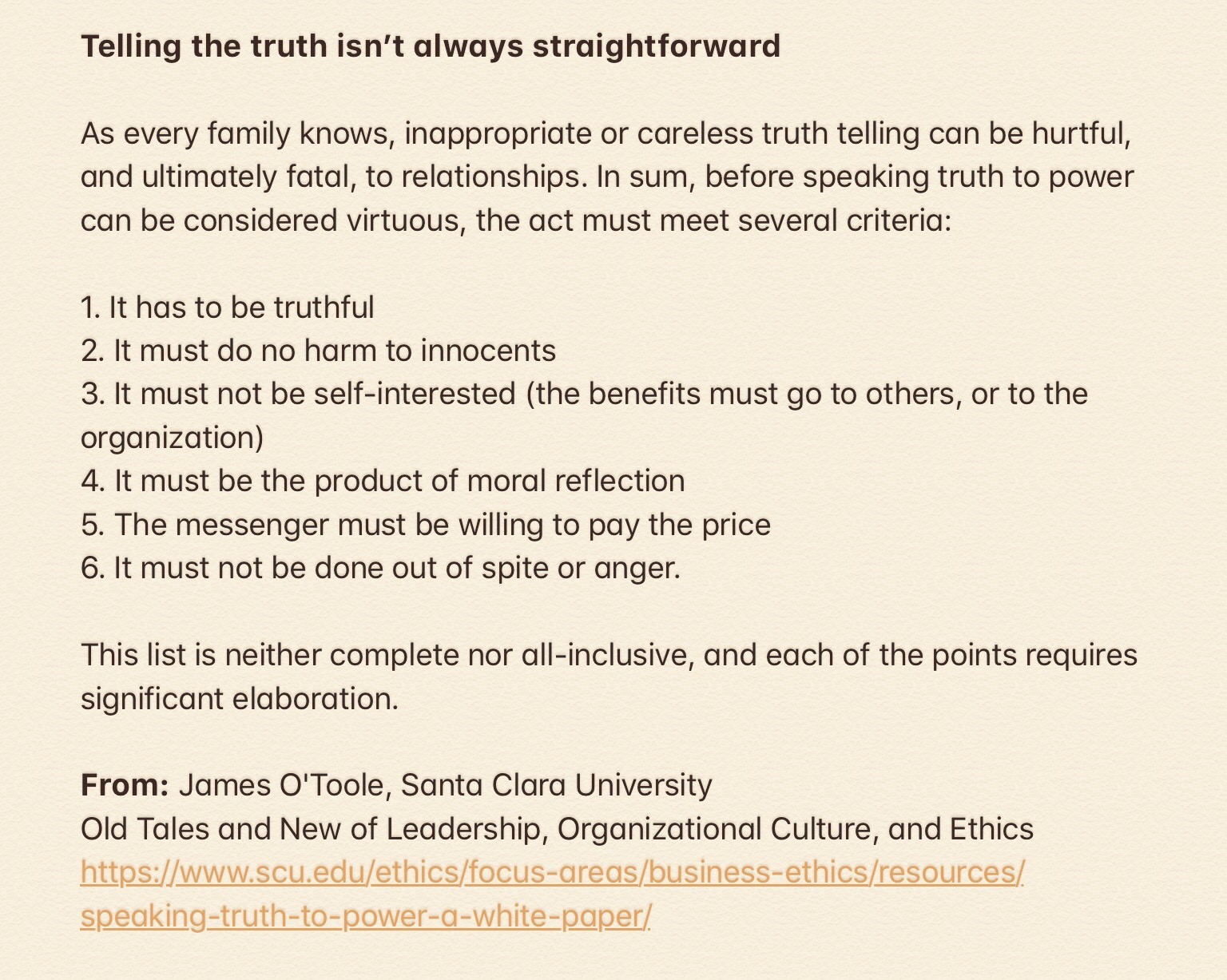
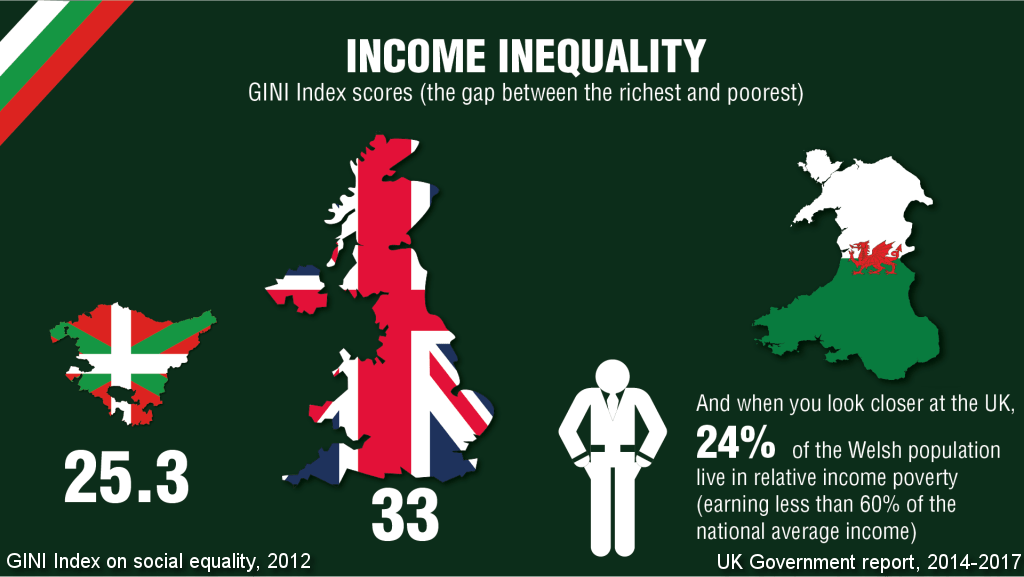
    There are probably good reasons and social conventions for that. Ultimately though it’s the same reason why people don’t say those things when they are about to retire or are still deep in the job. It’s the fear of reprisals which comes from speaking truth to power.

    I have written about Speaking Truth to Power before, in a series of three blog posts:

    To save you the effort of reading these posts, the basic gist is that people have been struggling with ‘speaking truth to power’ for thousands of years. Ever since communities have been organised around powerful people; Queens, Kings, Chief Officers, High Priests/Priestesses, Team Leaders, people higher up the ladder tend not to like hearing bad news from those lower down. The consequence of bringing the bad news can be terminal – hence the term, ‘shoot the messenger’.

    If it’s any comfort, we’ve been struggling with this behaviour since the time of the Ancient Greeks (300 years BC) and probably before that. Greek Tragedy plays and people like Aristotle had plenty to say on the subject of virtuous thought and behaviour. If you want a really thoughtful analysis of the subject, with some modern-day examples, this paper from James O’Toole at the Markkula Centre for Applied Ethics at Santa Clara University is well worth reading: Old Tales and New Leadership, Organisational Culture and Ethics.

    Here’s a snippet of what James O’Toole has to say about the challenges of being virtuous when telling the truth. It isn’t always straightforward.

    Truth

    If this was easy, we’d have fixed it by now. Recently I’ve been speaking with some people who are ‘new’ to the workplace. They see things from a completely different perspective to me – particularly when it comes to speaking truth to power.

    Two things stick in my mind and might offer a solution to the challenge of bosses listening and workers being able to ‘tell it like it is’. These solutions are focussed on ‘Old Len’ and the ‘Newbie’.

    The Old Len Retirement Programme*. Basically Old Len is someone who’s been in the organisation forever. They know how the organisation works, they’ve seen countless Managers and Chief Officers come and go.

    Len is about a year off retirement (on full pension) and ‘doesn’t give a toss’. That’s a technical term for someone who is ‘unshackled’ and feels free to say exactly what they think – particularly if it’s the latest improvement initiative. My associate who is ‘new’ to the world of work admires Len greatly, and say’s “why isn’t everyone as honest as Len?”.

    My suggestion is that every organisation finds their Old Len; anyone who is within a year of retirement and offers them a new job for their last six months. Their job is to attend every Board, Committee, Working Group and other meeting they can find, sit at the table, listen to the conversation and ‘tell it as it is’.

    Imagine that.

    I’d suggest that if that idea feels uncomfortable, you probably need to do it. If it feels really uncomfortable, you definitely need to do it. (* Note, Old Len could also be Lynn, no gender bias here)

    The Newbie Programme. This involves bringing in someone who knows nothing about the organisation and isn’t expected to offer any solutions. Their role is just to question ‘why?’, and point out contradictions and peculiarities that have become routine to everyone who’s been part of the system for years.

    The ‘Newbie’s’ protection will come from the fact that they are ‘new’ and ‘naive’ and not expected to know about these things. As soon as they become absorbed into the organisation their layer of protection and ‘why?’ Superpower will probably diminish, so time to move them on to somewhere safer.

    I often wonder if this is what the role of interns should be about?

    As with the Old Len Programme, if this idea feels uncomfortable, you probably need to do it.

    If all else fails – The Retirement Speech Course. If you really don’t want to try these things, there is my Retirement Speech Course, but I wouldn’t recommend it. If you’ve got people thinking, ‘I wish I’d said that’ at their retirement or any other stage of their working life, and are afraid to say it, a course in retirement speech writing isn’t going to save you.

    So, What’s the PONT?

    1. Speaking truth to power has been a challenge in organisations (and society) for millennia – it’s nothing new or modern.
    2. When the ‘fear of consequences’ is removed people will tell you things that you really need to hear.
    3. Liberating people near retirement to ‘tell it how it is’ or listening to the ‘naive’ question ‘why?’, may be exactly what the organisation needs to hear.
  • Take me back to Alphonso Street (Dowlais) #ChurchillFellowship Post 15

    img_9680Alphonso Street, Dowlais. Please excuse the obscure post title. Alphonso Street is a place in Dowlais, Merthyr Tydfil.
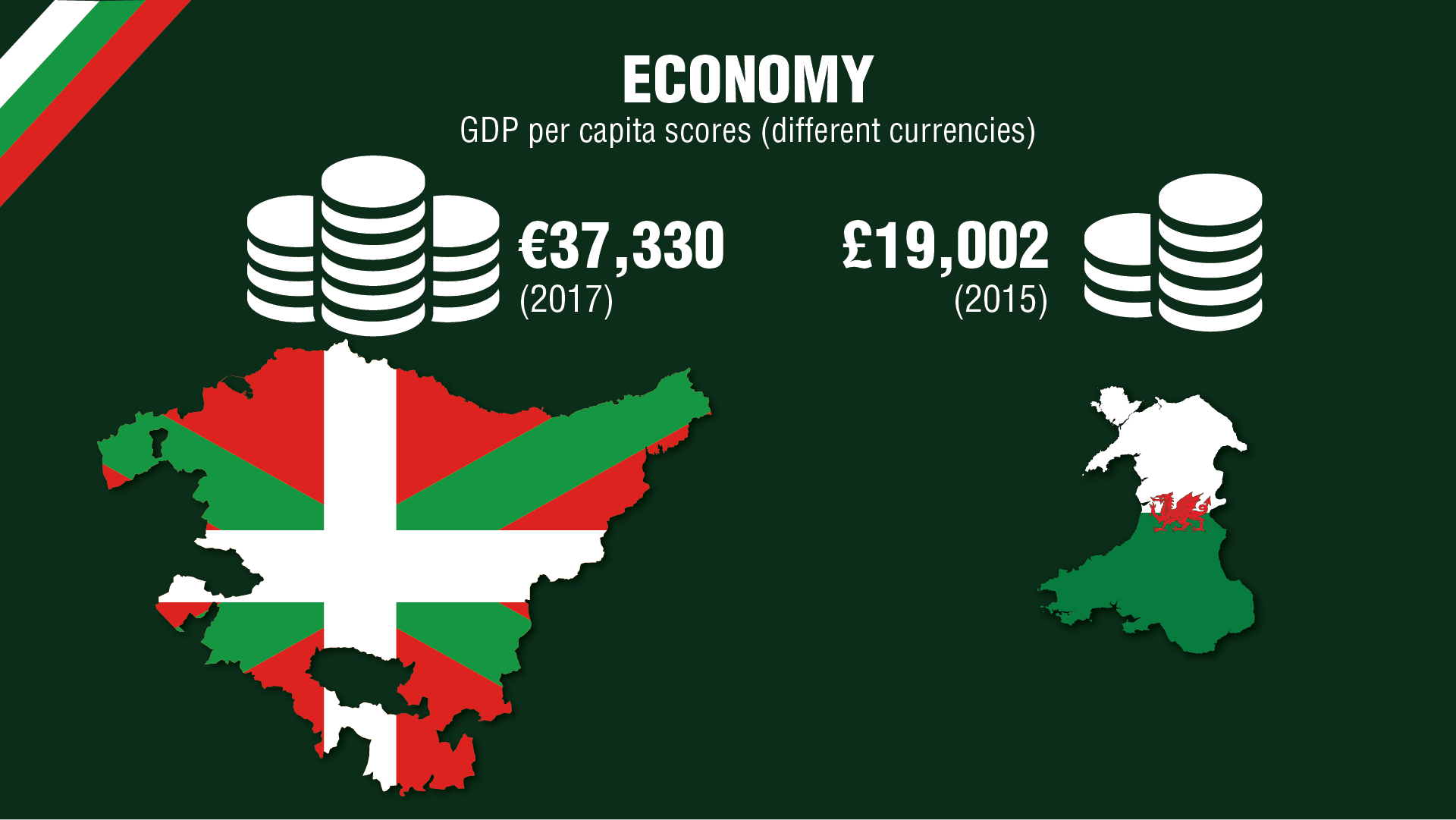
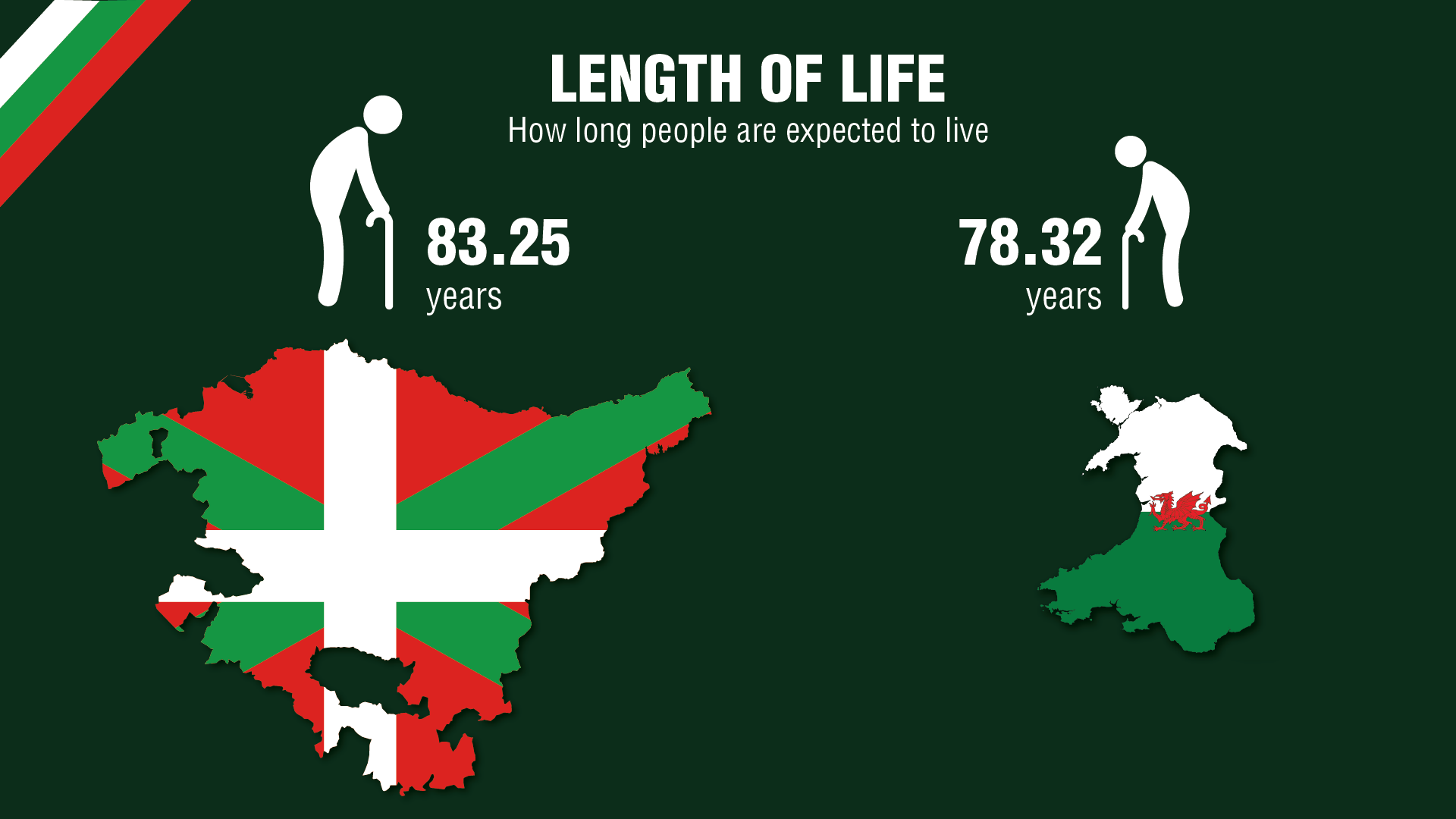
    Remarkable and exciting (for me anyway) because it’s where a Spanish Community that traveled from the Basque Country settled in South Wales in the 1900’s. I’ll explain more in a minute.

    Mutual Benefits – cooperation between Wales and the Basque Country

    On Tuesday I spoke at a conference (#WAOBasque) which was organised by the Wales Audit Office Good Practice Exchange, The Wales Cooperative Centre and Cardiff University Business School. The purpose of the conference was to learn about some of the things they do in the Basque Country, that contribute to it being one of the most successful regions in Europe. The stars of the conference were very much six people from the Basque Country who visited us, their details are at the end of the post, Eskerrik asko!

    I’ve also been a bit provocative. I opened my session by saying we should pay serious attention to our Basque visitors because they are; richer, happier and healthier than us, and they also treat each other better. Not exactly an opening to ‘win over the locals’, but I am very much a ‘native’, so I felt reasonably justified. I also had some evidence, proper statistics.

    Richer, Healthier and Happier. The figures on the next few pictures speak for themselves. In terms of gross domestic product the Basque Country has one of the highest levels in Europe. Gross household disposable income is also high. Their average lifespan is almost 5 years longer than what you can expect in Wales and overall they are happier than the whole of the UK.

    Performance in areas like education is close to the top of European standards. They are as good as what you get in places like Scandinavia , which I wrote about in this post on the Basque Ikastola Schools. I could go on…

    3 economy (007)

    1 length of life (009)

    2 life satisfaction (007)The one statistic that really grabbed to me was a measure of inequality, the GINI index. If you like really complicated equations, have a look at this on what Italian statistician and sociologist Corrado Gini created. Basically, it’s a measure of the differences between those with most and those with least in your society. The higher the GINI index number, the greater the inequalities in your society.
    4 with source (005)

    There’s a lot been said on how greater inequality leads to problems in society. For me, the ‘on the ground’ indicator was homelessness. When I’ve been in Bilbao this year I’ve been struck by how few homeless people there are, up to the point where I was deliberately looking out for them (you do find them if you search). This was in stark contrast to my experiences of walking the 1 km from Cardiff train station to my place of work. It isn’t unusual to see 10 homeless people on that walk; any day of the week, any time of day, any weather.

    I think that my statement that the Basque People, ‘treat each other better’, was reasonably justified.

    Can the Social Economy Save Us? One of my observations from time in the Basque Country was the strength, and diversity, of their social economy and cooperatives. Many people will have heard of the Mondragon Corporation, but there is a lot more to their ecosystem than just Mondragon. For example the ner.group, K2K Emocionando and cooperatives like Panelfisa, which I wrote about in this post, The Panelfisa Paradox.

    Material from of the conference can be found the WAO Good Practice Exchange pages here: Mutual Benefits. Building a Cooperation between Wales and the Basque Country.

    The outputs from the conference and three days of visits and meetings will be shared over the next couple of weeks. In addition there’s also a recording to follow of the 60 minute webinar where Derek Walker, Chief Executive of the Wales Cooperative Centre, interviewed me about my experiences and learning from my Churchill Fellowship travels.

    Back to Alphonso Street. One of the main reasons for having the conference was to build connections and collaboration between Wales and the Basque Country. Based upon the events of last week it looks like things are going to happen. Hopefully I can report on the ‘what’ in future posts.

    For the moment, I just want to point out that this could all be just a continuation of what was started in the 1900’s – just look at Alphonso Street in Dowlais. There are plenty of other interesting connections that can be included in future posts.

    We are more connected than I’d ever imagined, and last week just confirmed that feeling. It was like reconnecting with family you haven’t seen for ages.

    So, What’s the PONT?

    1. The Basque Country and Wales have many similarities and a long history of connection and collaboration.
    2. There are current differences though in relation to economic performance, health, well-being and inequalities in society.
    3. The Mutual Benefits conference helped to develop relationships that could lead to some interesting developments. Watch this space!

    Getting back to the Mutual Benefits conference, here’s a quick summary of what the Basque Visitors were taking about, and links to presentations and other content.

    MU_LANKIWorkshop one: Experiences of developing cooperative identity in Mondragon enterprises.  Fred Freundlich and Leire Uriarte, Mondragon University
    In the 1960’s and 1970’s Mondragon created three centres for higher education which joined in 1998 to form Mondragon University. It’s purpose is to support the development of the Cooperatives that make up the Mondragon Corporation through education and knowledge sharing. The workshop focused on collaboration work between the University’s Faculty of Business and the Institute of Cooperative Studies (LANKI) at its Faculty of Humanities and Education to develop cooperative identity within Mondragon Businesses.

    Link to blog post from Mondragon University: The Mondragon Cooperative Experience

    Link to Mondragon University workshop presentation: http://www.audit.wales/sites/default/files/seminar_documents/Mondragon-Uni-presentation.pdf

    colaborabora2Workshop two: Co-creation, prototyping and people-centred design: 3 Keys to Foster Social Innovation. Rosa Fernandez, ColaBoraBora The workshop demonstrated the HOW and WHY of a three-key process; co-creation, prototyping and people-centred design. The need to be integrated and develop more innovative social practices, policies and services. Learning from projects developed by ColaBoraBora together with Basque Public Organisations. ColaBoraBora is a social cooperative that designs and facilitates  innovation and collaboration focused on people.
    Link to blog post from ColaBoraBora: Redefining the ‘WHATS’ and Transforming the ‘HOWS’

    Link to ColaBoraBora workshop presentation: http://www.audit.wales/sites/default/files/seminar_documents/ColaBoraBora_workshop.pdf

    GUREAK 2Workshop three: GUREAK.  Aizpea Barros Garmendia   GUREAK is a Basque group of companies which generate and manage steady work opportunities, suitably adapted, for people with disabilities in the region of Gipuzkoa. They have a specific focus on people with intellectual disabilities. They employ almost 6000 people and currently, around 82% of their staff have a disability. They are financially sustainable with an annual turnover of €240 Million and for every €1 of public money they receive they return €3.1 to the economy.
    Link to blog post about GUREAK: A Basque Social Labour Inclusion Flagship, ‘Here with Ours’

    Link to GUREAK workshop presentation: http://www.audit.wales/sites/default/files/seminar_documents/Gureak-presentation.pdf

    MTA_futureWorkshop four: Mondragon Team Academy (MTA). Jon Azanza Atondo and Eder Guerra Muñoz. The workshop described the MTA approach to business incubation and innovation, how it is delivered and what it feels like to be a student.  MTA has created a variety of businesses over the 10 years of its operation and developed cohorts of successful social entrepreneurs.
    Link to blog post about MTA: Cooperative Entrepreneurs Bootcamp, Mondragon Team Academy.

    Link to the MTA workshop presentation: http://www.audit.wales/sites/default/files/seminar_documents/Mondragon-Team-Academy-presentation.pdf

    K2K_LOGO-1Workshop five: New Working Relationships – Basque Style.  Chris Bolton, Wales Audit Office The workshop explained the transformation of a traditionally structured cooperative, Panelfisa (automotive fixings manufacturing) into an organisation of self-managed teams. These had greater; transparency, trust, productivity, customer satisfaction, profitability and wider social benefit. “The most important thing was not the screws”, but the change in working relationships that helped this happen. The role of K2K Emocionando in supporting this transformation and the ner group of 24 organisations and 2700 people, who Panelfisa are now part of was explained.
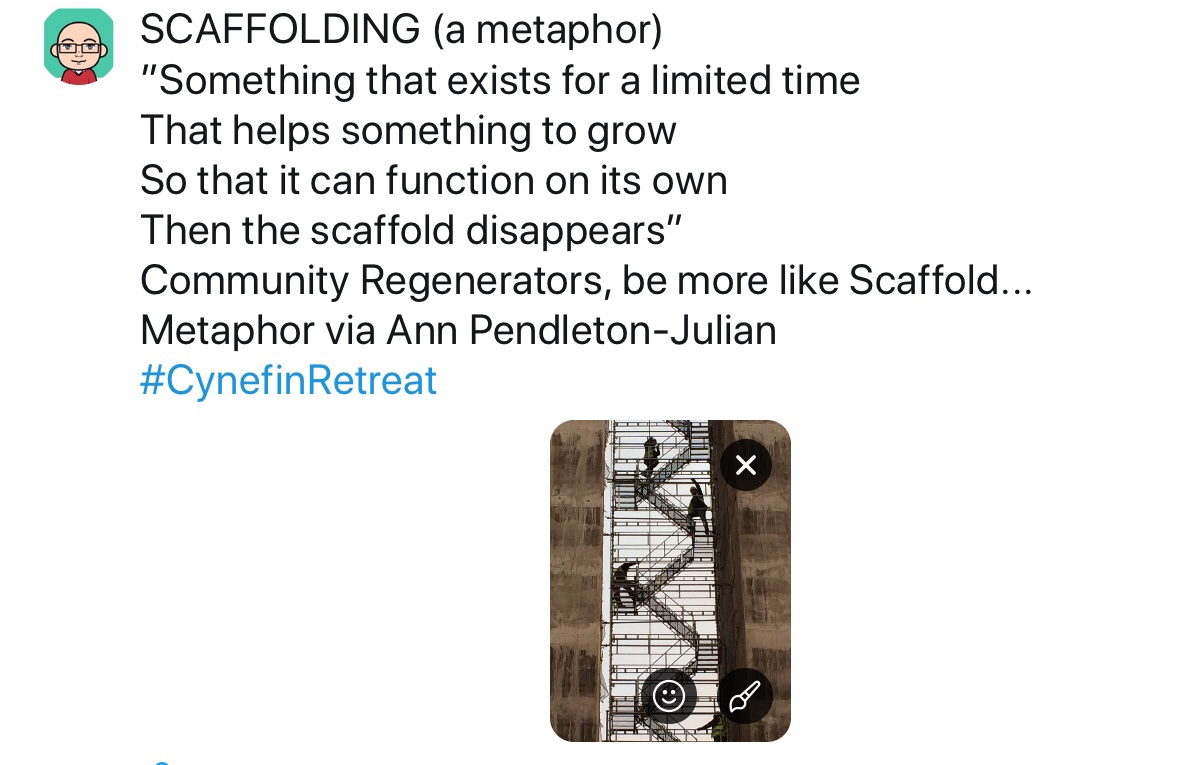
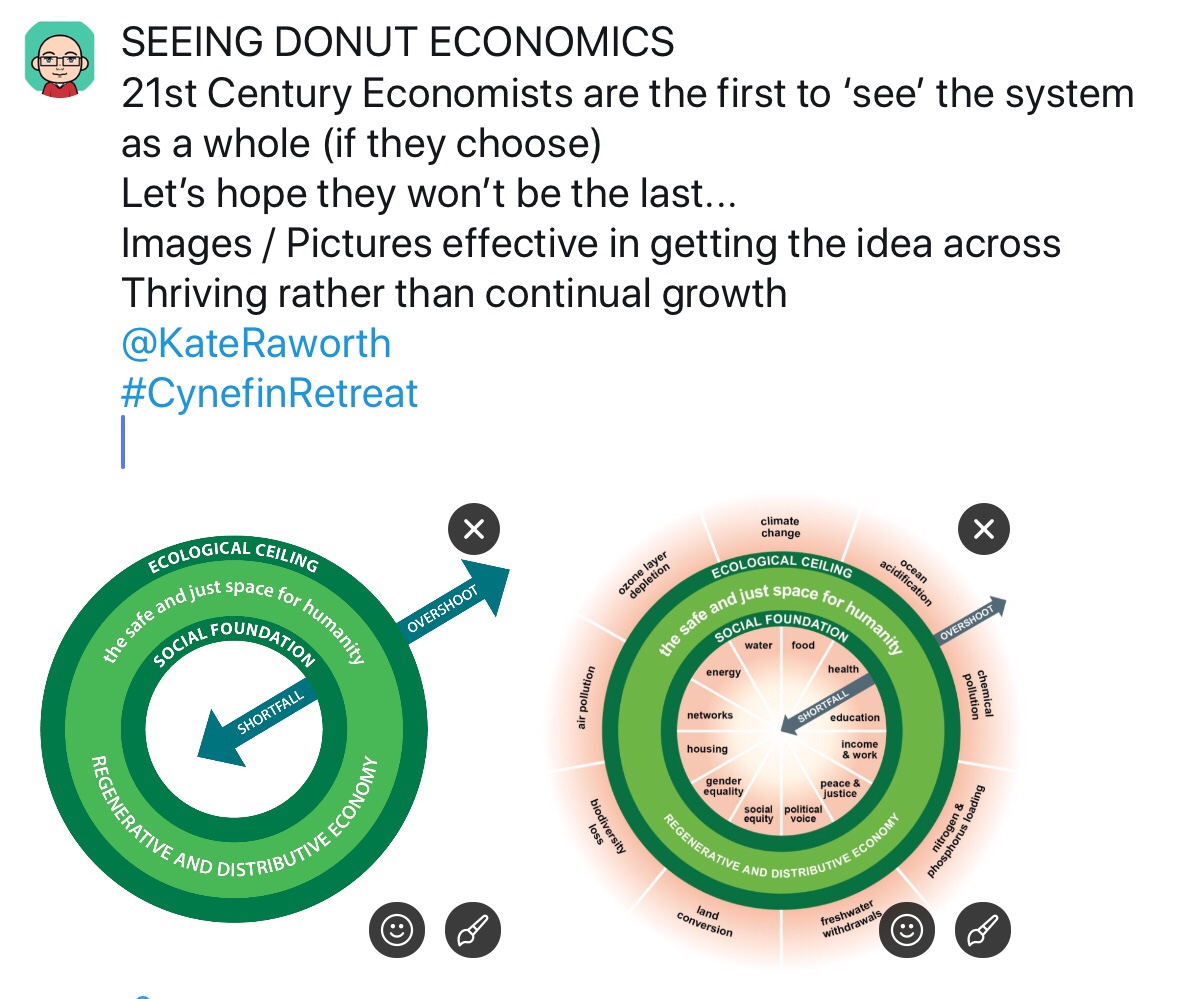
    Link to blog post about Panelfisa: What Panelfisa teaches us about Sustainable Human Development.

    My other Churchill Fellowship posts can be found here: Churchill Fellowship 2018

  • SCAFFOLDING, SEEING DONUT ECONOMICS, PSYCHOCRATS, FUTURE HERITAGE AND  NAVIGATING THE WHITE WATER.

    5 Tweets barely scratch the surface of 3 days (and nights) of talking and thinking and walking and talking at the Cynefin Retreat in the heart of Snowdonia, Autumn 2018. Link here on the Cognitive Edge page.

    It was an absolute joy and privilege to attend , so,  I just want to plant a metaphorical ‘walking pole in the ground’.  To remind myself of a few things I need to come back to over the coming weeks and months.

    img_9562

    At the core of this metaphor is a massively important point. In too many examples of; community regeneration, development work or quality improvement initiatives, the scaffolding becomes the important ‘thing’. The people doing the supporting work become too focused on the scaffolding. When the scaffolding is removed (often in response to budget cuts), the ‘thing’ was supposed to have ‘built’ cannot stand up on its own two feet. It’s not sustainable.

    Have a read of this post by Cormac Russell, Beware of the Progressives (Part 1) and this by Paul Taylor; ‘Communities Need A Different Model – And That Might Not Include Us’ to get a sense of what I mean about the danger of  the Scaffolding becoming the most important ‘thing’.

    There are variations and extensions of the Scaffolding metaphor, which I’ll need to return to in the future. Have a look at the following posts for more detail:

    Sonja Blignaut – Learnings from Whistler (Cynefin Retreat): Scaffolding and Emergence

    Kaimar Karu – Frameworks, falseworks and scaffolding (and Information Technology perspective)

    Matt Wyatt –Representation – Go forth (an explanation of analogy, metaphor, models and much more)

    img_9565

    The main point here is about the power of images. The idea is that images go straight to the part of our brains where we can make sense of complicated things. The system described by donut economics; the ecological ceiling, a social foundation and the fair and just society we need to exist between these two, is certainly complicated.  If an image helps economists to think about more than just money and stakeholder value, that has to be a good thing.

    Here’s a link to Kate Raworth explaining Donut Economics at the TEDx Athens


    img_9567

    Governments have been trying to change the behaviour of their citizens ever since there have been governments. Better understanding of psychology, neurolscience, cognitive science and the ‘internet of things’ makes this potentially more powerful and effective.  The ability to ‘nudge’ people towards becoming a herd of sheep, directed by the Psychocrats is getting ever closer.

    Have a look at Neuroliberalism: Behavioural Government in the Twenty-First Century (Economics in the Real World) for a balanced view.

    For a poignant video that gets to the heart of the issue in 4 minutes, try Uninvited Guests.  https://vimeo.com/128873380

    If you want something a bit more ‘1984’. Have a look at this from the Australian Broadcasting Corporation:  Leave no dark corner – China is building a digital dictatorship to exert control over its 1.4 billion citizens. For some, “social credit” will bring privileges — for others, punishment.  You can thank Beth Smith for that!

    img_9570

    The idea that your heritage deeply influences your sense of identity probably doesn’t come as a surprise to anyone. The proposition that there are many potential ‘futures’ that could emerge, and we will influence that, depending on our heritage and identity was something that made me sit up and pay attention.

    This did make me think about my time in the Basque Country, and their approach to long-term thinking and planning – Planting Oak Trees to Build Future Ships.  Industry, self-reliance and future planning seems to define a large part of the Basque identity. If  the Heritage and identity of the Basque people is shaping their future, what does that look like for Wales?

    img_9571

    At the risk of becoming self-indulgent – this is very much a personal call to action.

    The Cynefin Retreat in Snowdonia has given me lot that will help me move forward at a practical level. I also met some amazing people and excellent conversations, thanks everyone.

    Finally, here’s a picture proving you can Walk into Mordor… actually we were walking out of the Devils Kitchen at sunset.  Twll Du, the Black Hole that splits Clogwyn y Giefr  between Y Garn and Glyder Fawr.  The clouds often rise up the ‘chimney’ like smoke to signify the Devil is cooking… Thanks William Oliver.

    img_1784


    img_1772