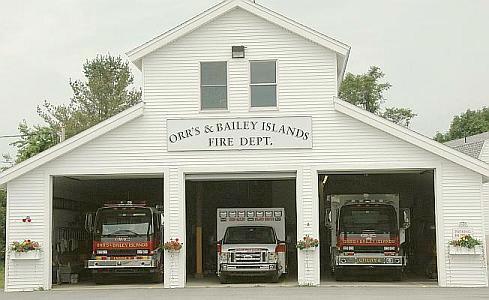
• How many; Post Offices, Libraries and Volunteer Fire Departments = Socialist Utopia? #ChurchillFellowship Post 14


    logo1In September I drove over 2,250 miles around Maine, Massachusetts, New Brunswick and Nova Scotia (in an economical compact car) . It was part of my Churchill Fellowship travels. I think its fair to say I saw a lot of small towns along the NE Coast of the USA and Canada.

    One thing that struck me was; no matter how remote, how small, how ramshackle and ‘clinging to existence’ (in some cases) the town, they all seemed to have something; a Post Office, a Library and a Volunteer Fire Department. Quite often they had all three.

    If you consider a Post Office, Library and Fire Department to be; a measure of civilisation, fundamental public services (things that are provided for public good), a ‘cornerstone of the community’, the people of Maine in particular seem to be doing something right.

    One of the people I met on my travels mentioned the perceived abundant provision of Public Services in “the Socialist Utopia of Europe” (his words).  This did make me smile. I’ve travelled around a fair bit of the ‘Socialist Utopia of Europe’, mostly on a bicycle, and a know the UK quite well (particularly Wales). Having a Post Office, Library and Fire Station in every small town isn’t something I feel familiar with – which is probably why the Maine situation drew my attention. It certainly don’t think I see; a Post Office, Library and Fire Station in every village and small town in rural Wales.

    Is this just personal bias and skewed perception? What’s the evidence?  Sorry to trouble you with numbers, but here’s what I’ve managed to extract from ‘official’ and not so official sources.  I’ve compared Maine with Wales here, because I spent most of my Fellowship time travelling around Maine and I want to talk about the Orr’s and Bailey Island community and their Fire Department in the next post.

    Maine v Wales, does size matter? Maine is much bigger (x4.4) than Wales, with far fewer (42%) people than Wales, mostly concentrated on the coast. The biggest concentrations of people live in the vicinity of Portland and Bangor. It’s pretty rural and sparsely populated for everyone else. This website, ‘Maine Cities by population’ gives you the details if you want it.

    Maine2_v_Wales

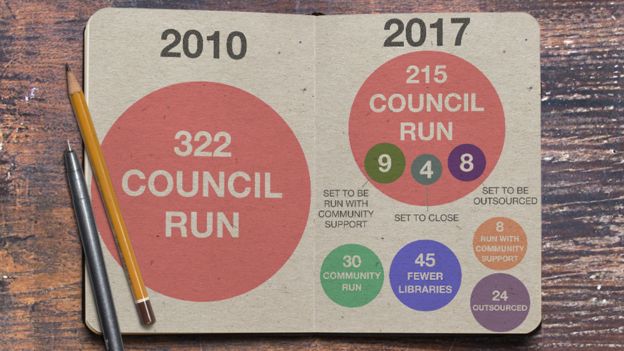
    Libraries Wales v Libraries Maine.  The most useful source of information and data I found about libraries in Wales was this article by BBC Journalist Lucy Ballinger: ‘what next for libraries as scores are shut and out-sourced’. There’s even a graphic – see below – which helpfully highlights the numbers – it was 277 in early 2017.

    You wouldn’t believe how much I struggled to quickly find that number from ‘official’ sources and various reports and ‘inquiries’, thank you Lucy (there’s a lesson in there somewhere).
    BBC_libraries
    BBC article on Welsh Libraries: https://www.bbc.com/news/uk-wales-38654997

    Getting information about libraries in the USA is fairly straightforward. Have a look a the Institute of Museum and Libraries website (link here).  If you want some data specific to Maine, The Public Libraries Survey, Fiscal Year 2016, Supplementary Tables report (link here) is the place to go.

    I can tell you that Maine has 227 Public Libraries (compared to 277 in Wales). What is really interesting though, is the fact that 11% (approximately 25 libraries) served a population of under 1,000 people!

    29.1% (approximately 66 libraries) served a population between 1,000 and 2,499 people and 25.6% (approximately 58 libraries) served a population between 2,500 and 4,999 people). Maybe my perception that every small rural town had a library was fairly close to the reality?

    Post Offices in Maine v Wales.  I’m not going to dwell on this one. There are apparently 439 Post Offices in Maine according DowntownME a search website for businesses in Maine (link here). So, if I thought saw a lot of Public Libraries in Maine (227), there were almost twice as many (439) Post Offices!

    What surprised me more was the figure of 906 Post Offices in Wales, according to this August 2018, House of Commons research briefing on Post Offices numbers in the UK (Welsh figures on page 10).  As they they seem to be mostly hidden at the back of the local SPAR store, I guess I just haven’t spotted them on my travels.

    Volunteer Fire Departments (VFD) Maine v ‘Professional’ Fire and Rescue Services in Wales.  This is a tricky one for me. I got mildly roasted by a ‘professional’ (retired) fire fighter friend for daring to compare the fully-time professional fire fighters in the UK to the Volunteer Fire Departments in the US. So I’ll tread carefully…

    According to the U.S. Fire Administration website, National Fire Department Registry quick facts (link here), you can quickly work out that Maine has a total of 337 registered fire departments. 94% of these are Volunteer or Mostly Volunteer so I think it would be reasonable to work on a figure of approximately 316 Volunteer Fire Departments (VFD’s) in Maine. That’s more than the Libraries (227), and less than the Post Offices (439); but it’s still a lot of VFD’s

    By compassion, I think Wales has 153 Fire and Rescue Stations, according in Welsh Government figures (link here).

    So, based on 227 Public Libraries, 439 Post Offices and 316 VFD’s, my perception that almost every small town in Maine has one (or all 3), is a reasonable view of the world of Maine.

    Compared to the “Socialist Utopia of Europe”, and Wales in particular, we might not be so blessed with public services as my new friend from Maine had perceived. This is particularly true if you look at it from the ‘per head of population’ perspective

    Maine isn’t Wales and the huge distances and sparse population make any comparison with places like Wales unrealistic. However, there is something I want to focus on in the next post – the role the Post Office, Library and particularly the Voluntary Fire Department play in creating and maintaining a sense of community.

    In the case of the VFD, the clue is in the name, ‘Volunteer’. There was a lot of conversation at the Wales Audit Office event on Community Resilience last week (#WAOResilient18) about this. The idea that ‘communities that look after themselves’ are more resilient was a strong theme. Maybe the motto of the Orr’s and Bailey Island VFD, “Neighbors Helping Neighbors”* has plenty in it that we can learn from. More of that in the next post.

    So, What’s the PONT?

    1. Comparisons between Maine and Wales are pointless, and I shouldn’t do it. However…
    2. Per person, Maine has more Libraries and Volunteer Fire Stations than Wales.
    3. Great communities are about more than just the ‘assets’. How people use them is probably more important  – more on that in my next post.

    *For the grammar and spelling pedants, yes I can spell neighbour. I was quoting directly from the Orr’s and Bailey Island Fire Department website.

    Link to my other Churchill Fellowship Posts here. https://whatsthepont.com/churchill-fellowship/

    BaileyIsland


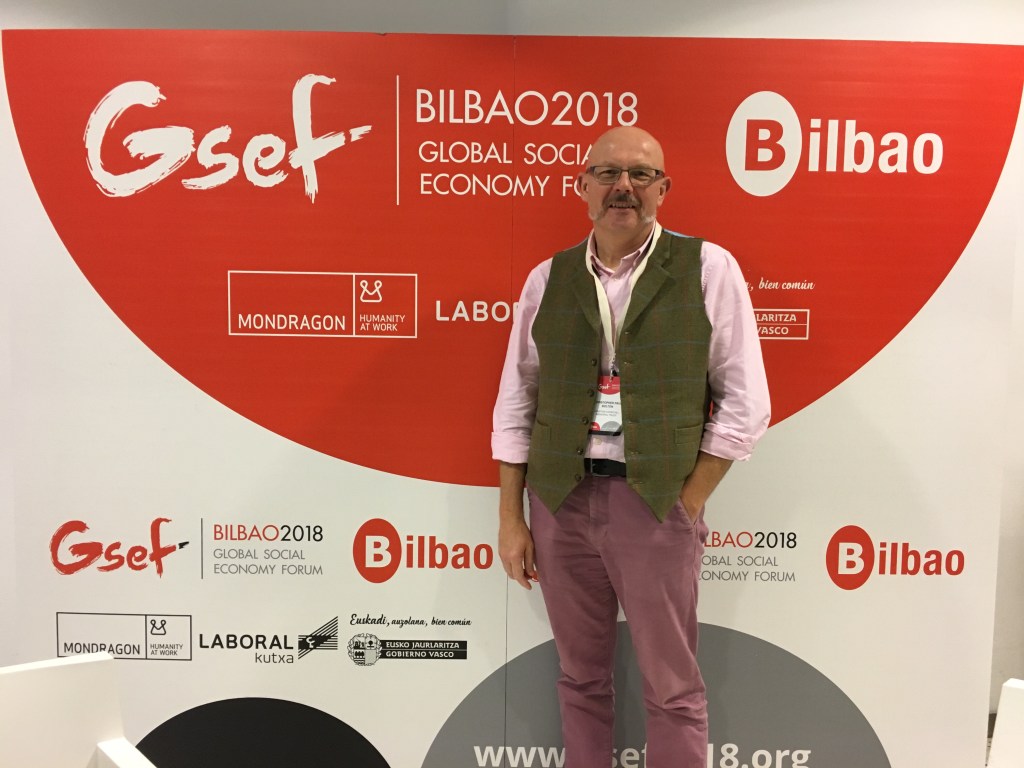
  • GSEF2018 Bilbao, that was brilliant! Now to get Wales to GSEF2020 Mexico City. #ChurchillFellowship Post 13

    I’m still in Bilbao. Fizzing with enthusiasm after 3 days of the Global Social Economy Forum conference. Apologies if I’ve been spamming you with Tweets.

    There’s a mountain of information I need to digest and share, which I will try and do through a variety of routes. Just to set the scene, here are a few of the (approximate) numbers from GSEF18.

    • 1700 people attending
    • 84 Countries represented
    • 119 workshop presentations
    • 100 euros the cost of attending (astonishing value for money)
    • 13 technical site visits (Mondragon was popular as you’d imagine)
    • 5 plenary sessions
    • 5 working languages (Basque, Spanish, French, Korean & English – massive respect to the translators – the one who sounded like Henning Wehn made me smile)
    • 3 days long (very full days)
    • 1 breakfast meeting
    • Many other things (like the Youth Forum) to numerous to list, and
    • 1 brilliant city – Bilbao (I love it here)

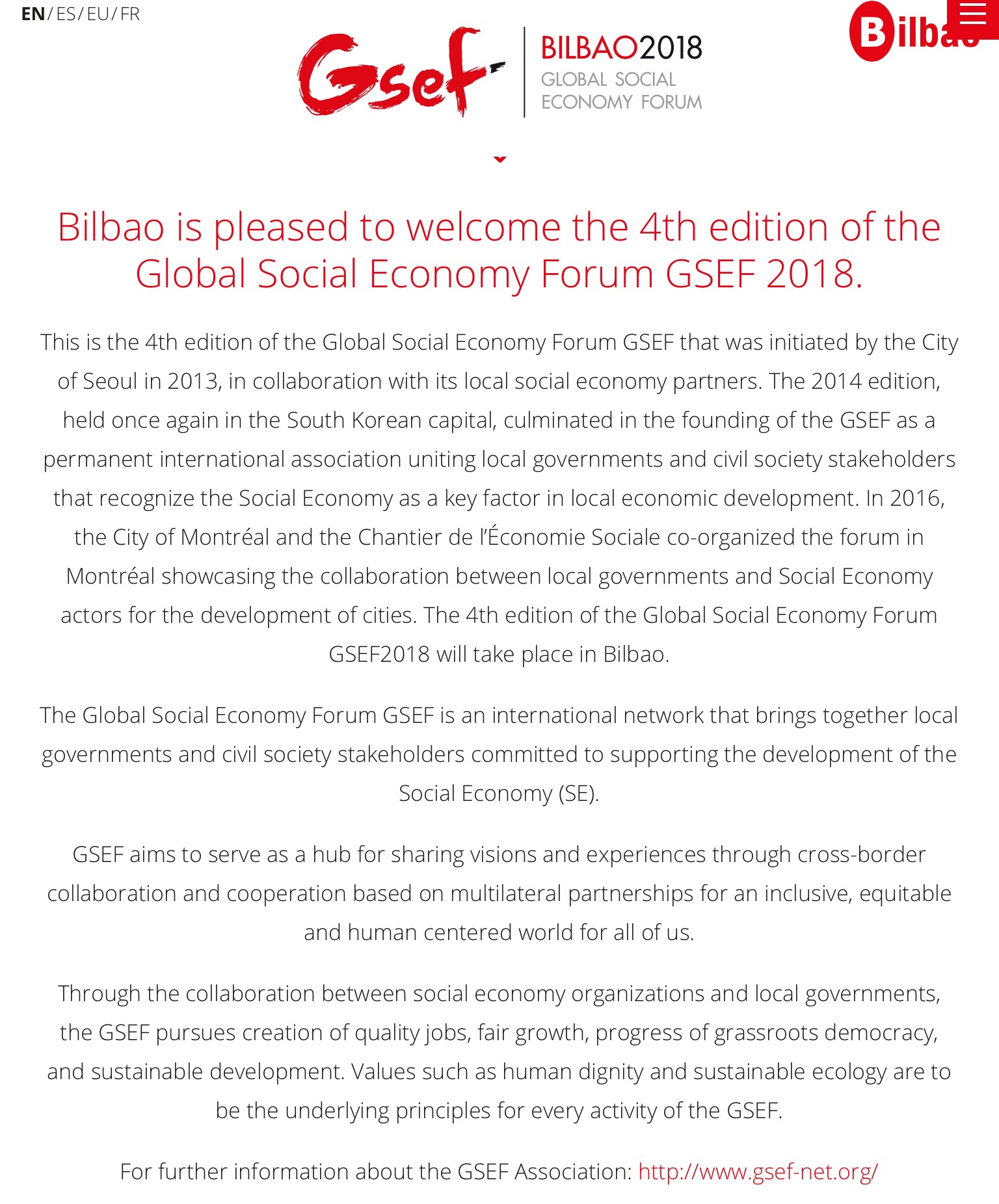
    The Global Social Economy Forum. The screen shot below perfectly explains what GSEF2018 is about and what it is trying to achieve. For me, there’s an uncanny similarity in this with a lot of what we are trying to achieve in large parts of Wales…

    The link to GSEF2018 Bilbao website is here, the main Global Social Economy Forum website (www.gsef-net.org) and C.I.T.I.E.S (knowledge sharing about the Social Economy) is here. Lots of the resources are available on these sites.

    What about sending Wales to GSEF2020 Mexico City? I ended up reflecting on a couple of things during the 3 days in Bilbao.

    The first was the low number of people attending from the UK, and as far as I know I was the only person from Wales. The downside of that was me speaking in Welsh to camera… ‘Cymdeithasol ac undod’. Hopefully this came across as something that sounded like ‘social and solidarity economy’? I did my best, and they’ll probably never publish it (I’ve got the face for radio).

    The second reflection was that Wales is actually doing some interesting things around the social economy. I’ve seen this though my connections with; the Wales Coop Centre, Coops and Mutuals Wales, Cartrefi Cymru Coop and Co-production Wales, just to name a few. We could have put a few Welsh examples into the workshops at GSEF2018 and possibly had someone at the plenary sessions.

    Let’s go to Mexico City! Based on all of the above, why don’t we represent Wales at GSEF2020 in Mexico City?

    I was thinking about this over Pintoxs last night, and I couldn’t get out of my head some of the Rugby Club tours we used to organise to far flung places like Canada. I also couldn’t ignore the 36 hour Ferris Coach Tour Trips to Spain my Mother and Aunties (and about 50 other people from the street) used to go on, is it just a South Wales Valleys thing?

    Anyway, if we could do that stuff on a shoestring, why can’t we to Mexico City?

    Cost wise it’s about a £750 round trip flight, probably cheaper if we go on a chartered flight. It’s achievable and we’ve got 2 years to sort it out.

    A few thoughts on this:

    • It should be done cooperatively and democratically
    • We are going to share and learn
    • Gender and age balance needs to be right
    • Money – rise this ourselves – to badly misquote Mark Hooper ‘never take government money, they try to make you do stupid things’
    • Use the whole process as a networking / relationship building / knowledge sharing process
    • It’s open to anyone who’s prepared to contribute
    • Lets have a bit of fun when we are at it

    There will be plenty of things around the organisation and governance of this we’d need to sort out, and I’m heading towards Adrian Roper at Cartrefi Cymru Coop for advice on that.

    So, WHO’s IN?????

    VAMONOS MEXICO CITY GSEF2020

    Just heading for Bilbao Airport and the plane home… (I may have calmed down later)

    My other Churchill Fellowship posts can be found here: https://whatsthepont.com/churchill-fellowship/
  • IMAGINE –  everyone working towards a common aim, the benefit of Future Generations. #ChurchillFellowship Post12

    This is a post for anyone interested in how; people, the place where they live, what happens there, private enterprise, public services and government, all co-exist in a way that is focussed on making sure future generations have something left for them to continue in that place.

    So, I’d like you to take a deep breath (in, and out) and think about a few things:

    1. Imagine a place where everyone is managing what you’ve got, so that future generations can benefit from what this makes this place special. You all want your grandchildren to have the good life you’ve had, and your grandparents did before you. This is for real. People involved in front line activity recognise this as much as the policy and law makers. Anything spring to mind? (The National Heath Service maybe?)
    2. Imagine a place where the people involved in the front line activity sit down with the Big Chiefs (the Government law makers) to work out the rules that will benefit everyone, and help manage things for the benefit of future generations (see 1 above). The co-design of the rules.
    3. Imagine a place were day to day ‘Management’ is mostly in the hands of the people at the front line. They have the knowledge, they know what works to achieve the big objective – benefit for future generations (see 1 above). And guess what – the majority of people do the right thing.
    4. Imagine a place where, when you need to do things differently to respond to your local conditions, you can do it (with certain criteria) by talking to each other and the Big Chiefs. The co-management of your area (or zone).
    5. Imagine that is this works well you don’t require very much external regulation and checking. This is because everything works as it should (you set the rules together – see 2 above) and most people are working towards the same objective (see 1 above). The community effectively ‘regulates’ itself. Where people are seriously misbehaving the external regulators can concentrate their resources (small because you don’t need a huge army of them) in discrete areas that need it most. Thin (but effective) regulation and a modest cost.
    6. Imagine that you started this 28 years ago in 1995. You’ve had a generation to try it out and see if it works. And guess what, it is working. Your area of activity seems to be in better shape to support future generations than other people trying different approaches around you.

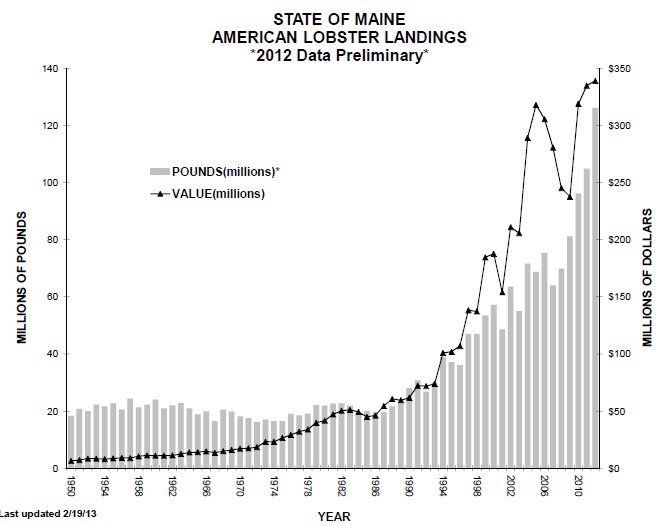
    Back in the room… REALITY CHECK (a graph always helps for that)

    What I’ve described in the ‘Imagine’ section above is actually the Co-Management approach to the Maine Lobster Fishery. And before anyone starts with the “oh it will never work here”, please go back to the first 5 points I’ve listed, and seriously ask yourself, Why? The only realistic answer I can come up with is that people don’t want it to.

    So, does it really work? I’ve had lots of conversations with people with different types of involvement in the Maine Lobster Fishery over the last two weeks. These have included Lobster Fishermen, The bodies that represent the Lobstermen, Fisheries Research Organisations, University Professors and the people who oversee the system, The Maine Department of Marine Resources. I’ll get back to all of those areas in future blog posts, where I’ll personally thank all of the individuals who have been so generous in sharing their time and knowledge.

    In response to the question, ‘does it really work?’ I’d say yes. The graph above from the Maine Department of Marine Resources indicates that lobster production is increasing and all the signs are that it is sustainable for future generations. The other impact is upon the Fishing communities of Maine. Spread along 5000 miles of stunningly beautify coastline, the $1.5 Billion generated annually by the Lobster Fishing Industry does a great deal to keep those communities economically (and culturally) sustainable. Imagine that in Wales…

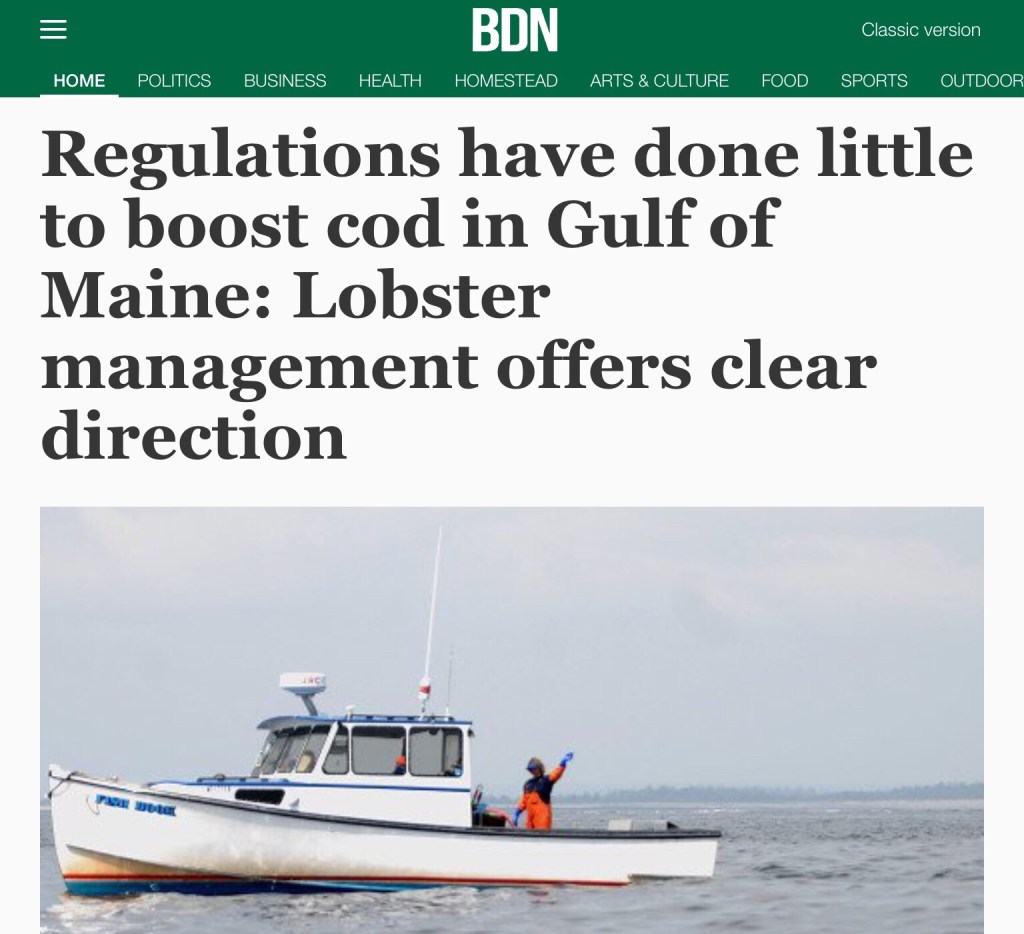
    Rather than swamp you with scientific papers and other documents, here’s a link to the Bangor Daily News which talks about the co-management approach in Lobstering and why this should be applied in Cod fishing where there has been a crash in Cod numbers.

    The Bangor Daily News (BDN) is a good piece of writing in my view, well blanched and linked to factual sources like this James Acheson (University of Maine) paper on ‘The Development of the Maine Lobster Co-Management Laws.

    There will be lots more to come on this, I just wanted to flag it up before I write any more detailed posts about how it works, and some of the challenges faced. This is a complex adaptive system, that is constantly changing and needs constant attention.

    The big point for me is around Co-Management. The approach has been operating successfully for 28 years – a generation. ‘Managing the resource for future generations’, literally pops up in every conversation about Lobsters. I’d argue that there is something we could learn from this in Wales, and our own focus on the Wellbeing of Future Generations.

    So, What’s the PONT?

    1. Being ‘stewards of the resource for future generations’ was one of the phrases I heard in almost every conversation about Lobsters in Maine.
    2. The co-management approach links to practice in the Lobstering Communities where ‘self-regulation’ is possible and successful (Something I’ve heard talked about in many other areas, but rarely seen).
    3. Effective ‘self-regulation’ allows for a ‘thin’ layer of external regulation, which can be directed (with the help of the community) to the areas that need it most.

    Just to prove thinking about future generations is everywhere, here’s the introduction letter from the front of the Maine Department of Marine Resources Law Book (which I am taking home for my good friend Simon Neale )

  • Jeff LaFleur from Mayflower Cranberries, Ocean Spray Owner GrowerNot much is certain in life and many cooperatives either don’t get moving in the first place, or fail later on (just like lots of other enterprises). So why do some survive and prosper for generations? Almost 90 years in the case of Ocean Spray, which started in the 1930’s.

    Are there certain activities that have ‘characteristics’ that favour the creation and sustainability of cooperatives? Is Cranberry growing one of those activities?

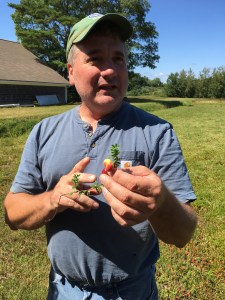
    This is a really complex question to try and answer in a blog post, but bear with me. I’m going to try and condense what I learned from spending time with two of the Grower Owners of Ocean Spray and their Director responsible for Cooperative Development (yes, I did get to stand in a Cranberry bog while I did it).

    So, if I had to identify two characteristics that contribute to Ocean Spray being a successful cooperative they would be; People and Plants. People is about the farmers who grow the Cranberries, their culture, heritage and (cooperative) behaviours. Secondly the cranberry plants themselves – the peculiarities of Cranberries almost demand a level of long term thinking that supports cooperative behaviour.

    Ocean Spray is HUGE! (and successful). Just to set the context Ocean Spray is a cooperative based in Southern Massachusetts on Cape Cod, where Cranberries were first commercially grown in the late 1800’s. It can trace its formation back to 1930.

    They are a global operation, turning over almost $2 Billion annually, and they are owned and controlled by about 700 Grower Owners (Farmers). This article from the Boston Magazine gives a summary of some key facts like; 6,900 jobs being the tied to Cranberry production in Massachusetts or the fruit has four air chambers which make them float when they are harvested.

    If you want a really detailed (57 page) read about Ocean Spray, this University of Wisconsin paper by Edward Jesse and Richard Rogers does the job: Ocean Spray Cooperative, Lessons in Cooperative Governance.

    By comparison, according to WalesOnline, the largest private companies based in Wales are Iceland Foods (£2.8 Billion) and Admiral Insurance (£2.5 Billion).

    Looking at just cooperatives, according to the data explorer on the Cooperatives UK website (link here), the combined value of all cooperatives in Wales is about £395 million. Most of this is made up by the 10 largest cooperatives, with Clynderwyn and Ceredigion Farmers accounting for £48 million and South Caernarfon Creameries £33 million. So, Ocean Spray are in a completely different league compared to what’s happening in Wales.

    Plants and People equal long term success. I mentioned earlier that there might be certain characteristics that contribute to the success of Ocean Spray as a cooperative. Here are a few of my thoughts on each of these, there will be many other things that influence success like; really efficient production systems, effective marketing strategies and good management. This is just my take on a specific area.

    Bespoke Cranberry harvesting equipment with Jeff LFleurCranberry Characteristics:

    • Cranberries are native to Southern Massachusetts and are well adapted to the environmental conditions; acidic bogs, which aren’t very well suited to other crops.
    • They are a perennial plant – growing for many years, with some Cranberry bogs being over a 100 years old. You can read more about Cranberries here.
    • Creating a new bog (or refurbishing an old one) is a high cost, long term investment. In addition the ‘new’ plants aren’t likely to produce fruit for 3 years. Realistically the ‘pay-back’ time could be approaching 5-10 years, making it at best a medium term investment.
    • The specialist nature of the Cranberry plant and harvesting methods means that the mainstream agricultural equipment manufactures don’t make equipment for Cranberry farmers (I didn’t see many John Deere dealerships on my travels).
    • This means that equipment tends to be bespoke, manufactured within the Cranberry community and built to last, because you can’t just drive to John Deere if it breaks down.
    • All in all, I think this combination of; a strong heritage, long term thinking and the need to be self reliant, supports the idea of being a cooperative.
    • It’s all about planning for the long term and supporting the other growers around you, rather than chasing quick profits through ‘cash crops’. You just can’t jump ‘in and out’ of Cranberries.

    From the Ocean Spray website, Meet the FarmersCranberry People:

    • Cranberry production feels like it is wrapped up in the history of the Pilgrims who originally settled in Massachusetts. Maybe it’s no coincidence that one of the bogs I visited was called Mayflower Cranberries. Named after the ship, The Mayflower that the original settlers travelled on in 1620.
    • Surviving those early years in the 1600’s will have required a high degree of cooperative behaviour. I might be over romanticising things but perhaps this has influenced the culture and behaviour of the community and in particular the Cranberry Farmers?
    • I do know there is a great recognition of the heritage and longevity associated with Cranberry farms. The Ocean Spray ‘Meet the Farmers’ page (link here) on their website talks about some of the farms that have been operated by the same family for several generations.
    • Where I met first generation farmers they were very aware of this, and what it meant to be part of the ‘Ocean Spray family’ and the cooperative. It wasn’t just about growing Cranberries, it was something much bigger, and long term.
    • One other thing was just how connected the ‘family’ are. I know lots of farmers like to share and talk with each other, but this was a very connected community. While I was at one of the bogs there was a text conversation going on in the background, updating everyone on the implications of the rain storms the previous night – in Wisconsin, over a 1,000 miles away!
    • As with the nature of Cranberries, does this nature (and behaviour) of the Cranberry People suit itself to being a cooperative? A strong heritage of working together, caring about the wellbeing of your neighbours and being highly connected with them?

    As I said earlier, there will be many other factors that contribute to Ocean Spray being a huge and very successful cooperative. I just wonder if the characteristics Cranberries (the product), and above all The People, help significantly in the process of becoming a cooperative and maintaining it.

    Thanks very much to the people at Ocean Spray who generously shared their time and knowledge, I very much appreciate what you did for me, thank you; Jeff LaFleur, (Mayflower Cranberries, Ocean Spray Board Director); Iain and Christine Ward, (Highland Cranberry, Ocean Spray Council Member – Iain) and Mike Viano (Director of Cooperative Development at Ocean Spray).

    So, What’s the PONT?

    1. There are many things that contribute to making a successful cooperative. I’ve only identified two that I think are important – the product (or service) and the people.
    2. The product or service might have characteristics that are highly compatible with being delivered cooperatively. Would things like social care be more suited to cooperative delivery than through a ‘for profit’ approach? Are Cranberries more suited to cooperatives or does this apply more widely to agriculture?
    3. People are the key part for me. Being part of a cooperative requires a way of thinking and behaving that involves more than just your own wellbeing, and taking a longer term view of the world. Dare I say it, thinking about the Wellbeing of Future Generations. Perhaps we can learn something in Wales about the practical application of the Wellbeing of Future Generations Act from Cranberry Farmers in Massachusetts?

    Links to my other Churchill Fellowship posts here.

  • MTA_4This might be my daftest idea yet. If it’s as obvious as I think, why isn’t it already happening in Wales?

    Here’s the idea. An intensive University Degree Course, aimed at the over 50’s. On the course the participants will; create real businesses, with a strong social purpose (cooperatives if possible), and get a degree out of it. The continuation of the businesses after the course, and graduates that are; happy, confident, full of drive and social purpose, will be an ‘added value’ outcome. And the slightly controversial bit… link it to voluntary early retirement payoffs.

    Does that sound realistic, or shall I get my coat and leave…?

    Mondragon Team Academy (MTA) lit my fire. Basically, MTA is a degree course where participants really do create businesses, learn about business theory while doing the practical work and gain a degree from Mondragon University at the end. There are other bits of ‘magic’ that make MTA special and exciting in my view like:

    • MTA is run using a ‘Team Academy’ approach. People really do work as a Team – throughout the course.
    • It is delivered by a Cooperative University  (Mondragon Unibertsitatea) – where undergraduates are immersed in cooperative thinking and ‘doing’ – that has got to have an impact on how you think and ultimately behave.

    If you want to know a bit more about MTA try the following:

    Where do the over 50’s fit in? There are a few things that have spinning around in my head that prompted my ‘daft idea’ and this post.

    1. Shirley Ayres made a comment about my original MTA blog post around the potential exclusion of people over 50. I’d started that post with “I wish I was 18 again so that I could apply for the MTA course…”. From the conversation with Shirley I started to think, “why couldn’t I apply for something like it when I’m 55?”
    2. The conversation also highlighted that older people with ‘half a lifetime’ of experience could actually do something good in the world. A course for an 18-20 year old might not be an exact fit for someone who’s worked for 30 years, however things like the Team Academy approach and social entrepreneurship might be perfect?
    3. There’s probably a need in society for courses like this. Organisations like Prime Cymru (link here) provide support to people over 50 who want to remain or become economically active. The Prime Cymru website talks about 240,000 people in Wales between 50 and retirement age being economically inactive, with many depending on benefits. Some form of paid work, especially if you’ve created it yourself, ought to have a positive impact here.
    4. There’s probably a demand. Since about 2008 I’ve seen lots of people I know leave public services. Many of them with ‘voluntary early retirement’ or ‘voluntary severance’ financial packages. I often wonder what they are all doing. Yes Facebook has plenty of their holiday pictures, but you can’t spend your life on holiday (or is that just me?)  There must be a small but significant percentage of these people who would be interested in an intensive University MTA type course for social entrepreneurs?  What if it was offered as part of an early retirement severance package? Would that ‘flush out’ the right people?

    This really could be a daft idea.  There are many questions crashing around my head now. I think there is a need to do this sort of thing, I think there are probably people who would want to do it, and… it would probably produce businesses that add value. However, there are things that might prevent it like:

    • What would it cost? Would it generate enough to pay the teachers/coaches and the University fees?
    • Do we have the people with the right competencies to deliver this?
    • Could we team up with Mondragon University and become a ‘partner’?
    • Will it tread on anyone’s toes? Would existing Universities or other institutions with their flagship projects seek to block it (subtly or otherwise)?
    • Could you actually link it to early retirement / voluntary severance packages?

    In the spirit of working in the open (like I said I was going to), I’m going to press publish and see if anyone agrees it is a daft idea, or if they have answers and something could be done…


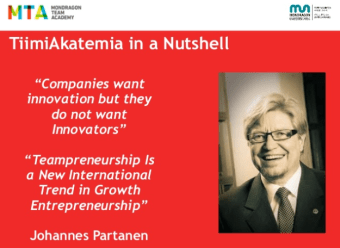
    MTAFinally, “Companies want innovation, but they don’t want innovators.”  (taken from the Slide-share presentation)

    An interesting quote from Johannes Partanen from  Tiimi Akatemia – Team Academy at Jyvaskyla University in Finland.

    Maybe the Team Academy approach is the solution to organisations getting the innovation they want, without giving  innovators the ‘anti-body’ treatment?  Something Paul Taylor from Bromford Lab might have a view on?

    So, What’s the PONT?

    1. The Mondragon Team Academy approach is highly attractive (I was sold) and it is producing positive results.
    2. Running a similar approach with over 50’s is possible (I think), and could also have impressive results.
    3. Could it be financially linked to the continuing exodus of people retiring early from public services, or anywhere else?

    Video of Lihar Pilldao speaking about Mondragon Team Academy, via The Praxis Peace Institute

    My other Churchill Fellowship posts can be found here

  • K2K_2012Book“Panelfisa Coop, The important thing was not the screws”  This post is about the transformation (a deliberately chosen word) of Panelfisa, a worker owned industrial manufacturing cooperative in the Basque Country.

    It’s not a ‘recipe book’ case study claiming… “follow these 5 easy steps and you too will transform your organisation”; life just isn’t like that. It’s about manufacturing widgets and sustainable human development, that might be a paradox for some – The Panelfisa Paradox.

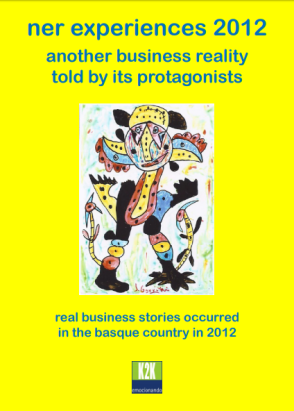
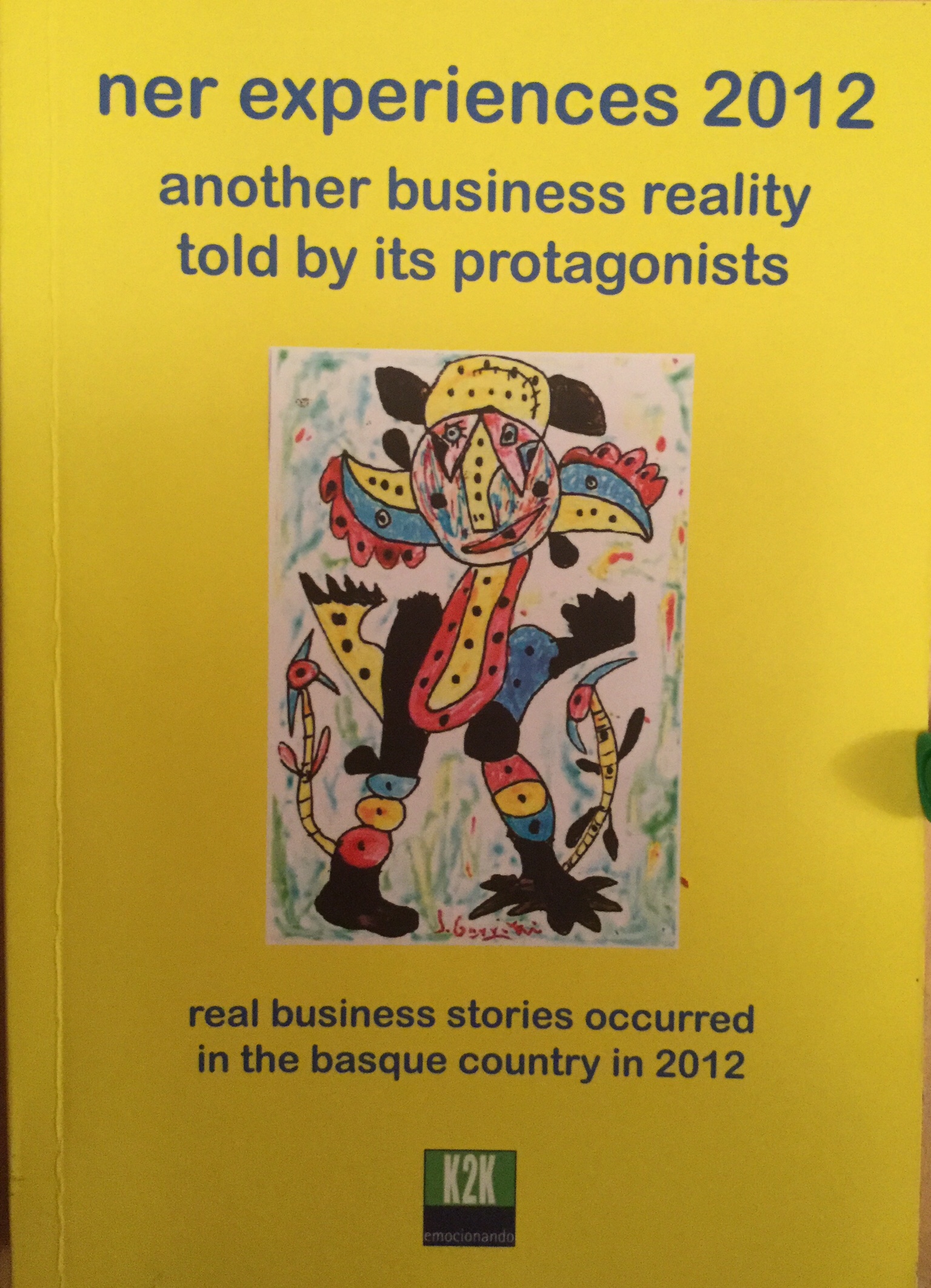
    Just to set the context, Panelfisa manufacture ‘fixings’, mostly for the automotive industry. These are screws that hold things together in everyday language, and it’s where the quote “the important thing was not the screws” comes from. Human relationships were the thing that really mattered here. The transformation of Panelfisa between 2010 and 2012 is explained in detail in the book: ‘ner experiences 2012 – another business reality told by its protagonists – real business stories that occurred in the basque country in 2012′.

    I’m fortunate to have a copy, given to me by Pablo and Jabi at K2K Emocionando, but you can read an online copy if you wish (link here).

    What can we learn from making widgets? I’ve deliberately used the term ‘widget’ here to make a serious point. Widget is a word that describes an ‘imagined small product made by a company’, often because people cannot describe the actual product, or sometimes to be dismissive. By using the word ‘widget’ some people are able to justify being unwilling to accept new ideas or different ways of thinking. I’ve often heard the phrase, “Ah… but that would never work here, they make widgets, we are dealing with complex human systems…”.

    But guess what – there’s plenty to learn from Panelfisa. They might be the embodiment of clever engineering, sophisticated manufacturing and quality control (making millions of screws), but they are also a complex human system; the people who work there and the global network of customers they deal with.

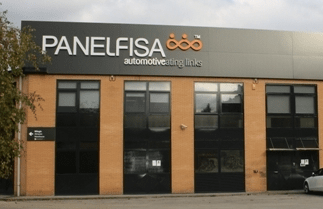
    panelfisa_4.pngWhy should you be interested in Panelfisa? Before I dive into the things I’ve learnt, here is a quick summary of the Panelfisa experience:

    • They are a worker cooperative of approximately 80 people, based in the Basque Country, with activities worldwide.
    • Their activity declined following the 2008 financial crisis (like many others), but things had picked up again.
    • However, they had traditional hierarchical structure, with decision making concentrated with a few people, departmental silos and less than optimal performance.
    • They had previously engaged in change programmes and continuous improvement initiatives, but nothing had made a major difference.
    • The need to change and improve was recognised by some of the people in Panelfisa and in 2010 they engaged with K2K Emocionando (link here) and underwent a process of transformation.
    • This was very much based on ‘new relationship styles’ between people, and has some key features like: self managed teams (the team appoints a leader and you decide how you will work with other teams) and complete transparency.
    • The outcome has been: improved quality, greater efficiency, higher sales, happier customers, improved customer relationships and above all, happier workers (who also happen to be the owners).
    • These are things any organisation can aim for, but just to put the ‘icing on the cake’, as part of the ner.group, Panelfisa; “spend 2.5% of the results and aim to give 2% of our hours for activities in the fields of education, environment, sustainability and solidarity with those most in need”.
    • If you want to know more about how K2K Emocionando and the ner group work, have a look at this post from Corporate Rebels: A radical and proven approach to self management. 
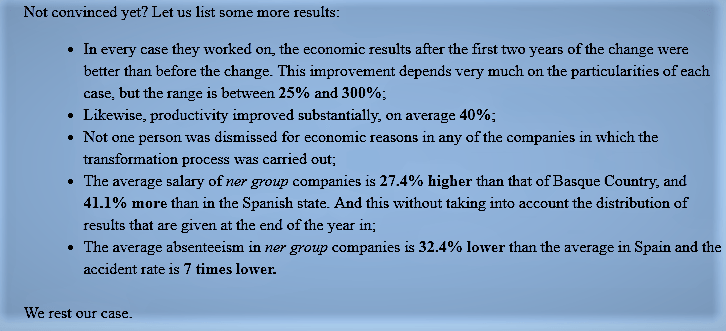
    • If you haven’t got time for reading, here are the headline figures on the ner.group from the Corporate Rebels post.
    corp_rebels (3)
    Source Corporate Rebels: A radical and proven approach to self management. https://corporate-rebels.com/ner-group/

    No Silver Bullets, but some things we should pay attention to.

    1. Transformation cannot be easily explained. At the end of the Panelfisa description in the ner.experiences 2012 book are reflections from the workers, on how they found the experiences. One of the questions asks: “what do the people who surround you think when you tell them about the change that has lived in your organisation?” The responses are beautifully honest and are all a variation on “they do not understand”.  If the people who have been immersed in a successful transformation cannot explain it, in a way that their friends and family (people who surround you) can understand – it must be hard to do. It’s a complex process that can’t easily be written down in a ‘recipe book’.
    2. Uncertainty, fear and stepping beyond the comfort zone. These are things that will featured in every change management text-book. The Panelfisa experiences bring these to life in a way I’ve never read about before. The honesty with which people speak does actually give you a real sense of what this means.
    3. Change works best if everyone (most people) want it. The approach at Panelfisa involved everyone having a vote on should they proceed. If the vote wasn’t high enough, the change wasn’t going to take place. They achieved 100% approval as it happened, which was helpful when they were going through the tough parts. Imagine if this was done as part of changes in public services?
    4. Real involvement is different to consultation. The lead up to the vote on change involved trips to organisations that had implemented the ner style of working. Everyone was invited and one visit included 41 of the 80 workers. That’s a significant investment, but necessary if you want people to understand and feel confident about the change. I’m searching for examples in the public sector of where people other than the decision makers or the ‘chosen few’ would have taken part in such an experience.

    Trying to condense the Panelfisa experience and the ner.group into a blog post is difficult. It’s not something that a ‘case study’ can do justice to in my view. The ‘ner experiences 2012 … told by its protagonists’ is a good way to get a sense of how things work. It is definitely complex human relationships, new styles of working, being enacted through an engineering company, traditionally seen as the widget makers. A paradox we can all learn from, The Panelfisa Paradox.

    So, What’s the PONT?

    1. The ner.group are undoubtedly successful.  Operating an organisational style (self managed teams, flat structures, transparency etc) that reflects the way lots of organisation say they would like to work.
    2. However, it’s not easy. The desire for change and the courage needed to ‘stick to the road’ is huge (just read the book).
    3. If we are committed and want to do this, we can learn a lot from organisations like Panelfisa.

    One final thing. Ages ago I remember sharing my experiences of visiting Ricoh in Telford and seeing their Gemba Mat improvement process. Basically Gemba Mat (link here) involves teams on the factory floor, self-organising to help other teams improve what they do. I was really excited and shared it with a group of people who included a senior officer in social services. I remember them getting quite angry and saying “that might work for the widget makers, but it will never work here…”. I agree, it probably wouldn’t have (particularly while they were still in charge!).

    Gemba Mat Link: https://whatsthepont.com/2012/03/10/ricoh-gemba-mat-the-best-of-ohno-circles-gemba-walks-and-employee-engagement/

    My other #ChurchillFellowship posts can be found here.  

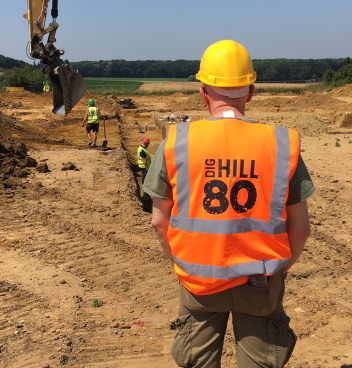
  • Please have a look at this video from BBC Breakfast about the Dig Hill 80 an archaeology project at a World War One site in Wijtchate, near Ypres, Belgium. I visited the site two weeks ago and I’m still deeply affected (in a good way) by the experience. The video gives you a sense of what I experienced…

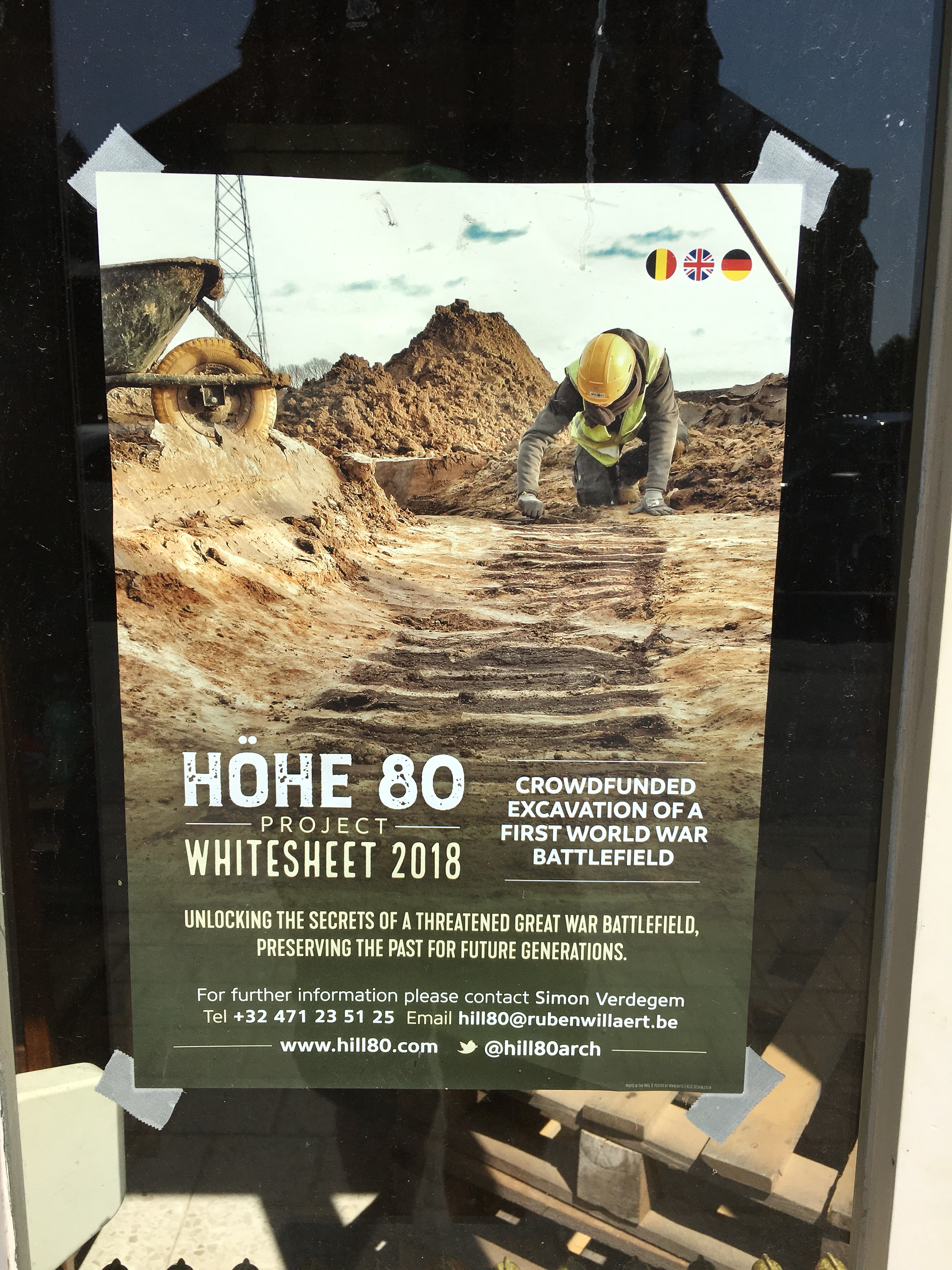
    Dig Hill 80 is all about people. Dig Hill 80 is an archaeological excavation of a WW1 stronghold that tells the story of the whole of WW1, from the perspective of both sides. It’s all explained in the video, or you can have a look at the Dig Hill 80 website here.

    The web pages talk about an “international project which is about education, peace, reconciliation. Without jingoism.” and that is so very true.  For me, the core of Dig Hill 80 was the deeply human act of recovering the remains of fallen soldiers; husbands, brothers, fathers, sons and friends. People of all nationalities. People who have been ‘lost’ for a 100 years and burying them with dignity, so that they can be properly remembered.

    On top of  respecting the fallen, there were the people in the here and now. Dig Hill 80 brought together over 3000 backers online and 400 people who visited and worked at the site. With representation from about 44 countries, it truly was a global effort.

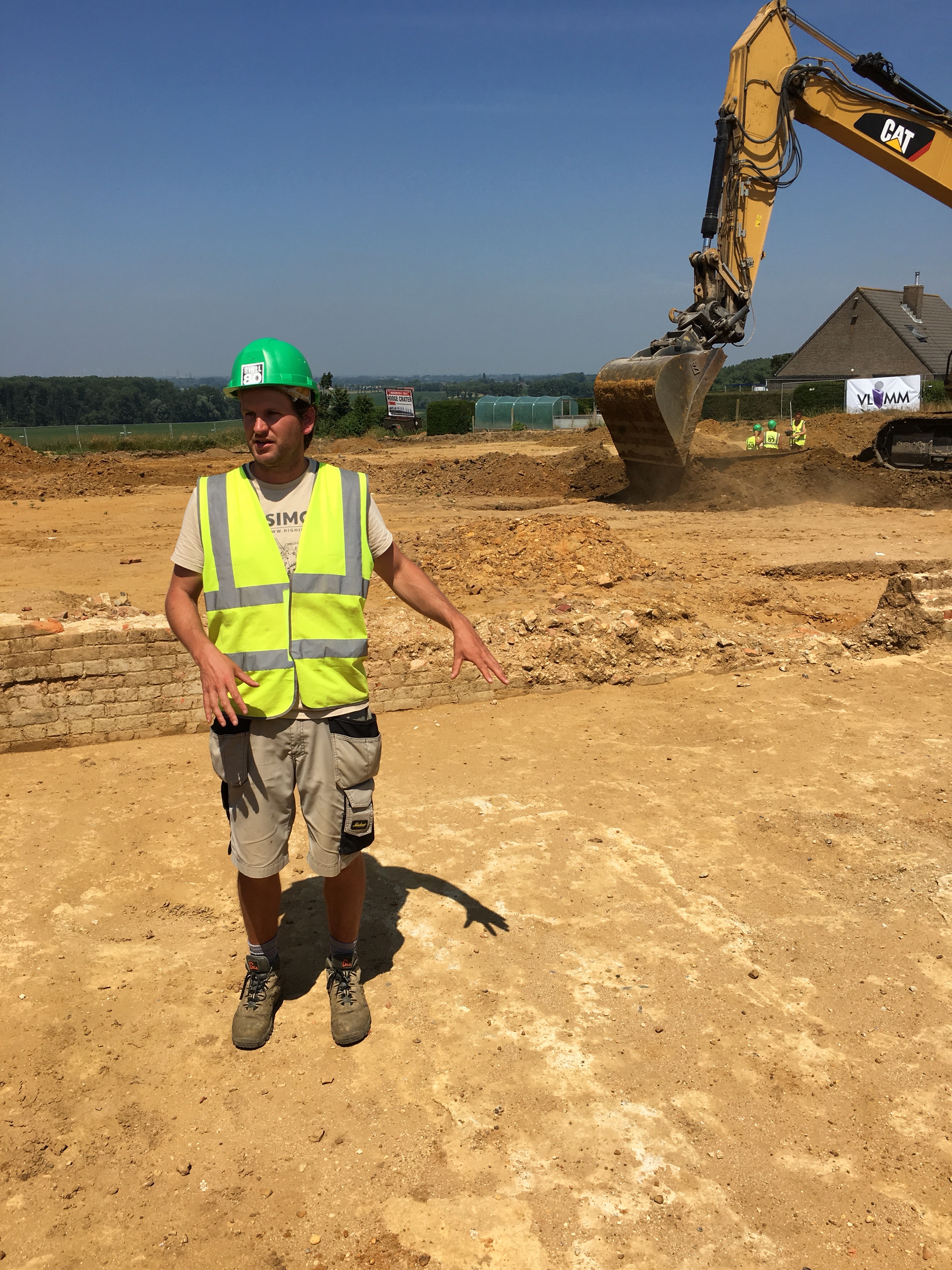
    The idea that this was an international project really sank in when I visited the site at the end of June with my eldest son (it was his Christmas present). We were being briefed by the amazing Simon Verdegem, Head Archaeologist who said, “there are people speaking five languages here today, so I’d better use English is that’s OK?”.

    img_0675Mass collaboration changes everything. This is the strap line from the 2006 book Wikinomics by Tapscott & Williams (link here), which has a big impact on how I think about things, in particular the power of the internet.

    Ten years on from when I first read Wikinomics, Dig Hill 80 demonstrated exactly what the book had talked about; large numbers of people coming together to contribute to a common cause, mass collaboration (for good).

    Phrases like ‘crowd sourcing’ and ‘crowdfunding’ are commonplace nowadays, but it is easy to forget that 10 years ago it was very much a ‘concept’. Here a few questions and observations that have surfaced with me following the Dig Hill 80 experience:

    • Is this the way to do archaeology in the future?  There’s a massive squeeze on public finances and how do you pay for important work like Dig Hill 80?  There might be a long list of possibilities following the ‘discoveries’ in Wales – link here – A Heat Wave is Revealing Centuries-Old Sites in Wales.
    • Creating deeper involvement. The crowdfunding model, which involves people in archaeology has a much bigger impact than museums and re-constructions, in my view. There is something about ‘being part’ (however small) in the actual on-site archaeology that engaged me far more deeply than looking at preserved artefacts in a museum. This has to help in the process of understanding the past and avoiding making the same mistakes in the future?  In the BBC Breakfast clip the interviewers say to Al Murray that Dig Hill 80 had “got to him…”. It certainly ‘got to me’.
    • Good enough beats perfect. Using Facebook live to share daily updates from the site was absolute genius. From the first one, where the wind was blowing and you could hardly hear Simon, through to the last day on site they were compelling viewing. It was like watching the evolution of the technology and Simon’s presenting style; it just got better day by day. The speed of sharing progress and it being very ‘real’ were all part of the process. It absolutely engaged me in the story.
    • Could the Dig Hill 80 lessons apply wider? Getting back to the point I made about the squeeze on public services I’m wondering if there are other things this approach could apply to? Could you crowdfund regeneration of a run down neighbourhood? A community energy scheme or an idea to promote physical activity and wellbeing?  Could the lessons from Dig Hill 80 be applied to some of the ideas around Participatory Budgeting (link here) being proposed? And finally, as a model of sharing knowledge and engaging people in a project with; unfiltered, realistic and real-time updates (using things like Facebook), there’s a lot I can learn.

    How do I become a digger driver?  Finally, around the middle of Dig Hill 80 a call went out on the Facebook group for a qualified excavator driver to join the volunteers on site. I don’t hold a CPCS Tracked 360 Excavator Ticket, but I’m seriously thinking about getting some training. If Simon plans another project like Dig Hill 80 maybe I could get more deeply involved…

    So, What’s the PONT?

    1. Dig Hill 80 was an incredible experience at so many levels. It was at it’s very core about people; respecting the fallen and bringing together the living.
    2. Technology (the internet) has facilitated Dig Hill 80 in a way that would have been much more difficult 10 years ago. Mass collaboration, via the internet, has changed everything.
    3. Where and on what else could we use the lessons from Dig Hill 80?
    img_0672
    Simon Verdegem on the concrete slab on top of what was thought to be a command bunker
    img_0680
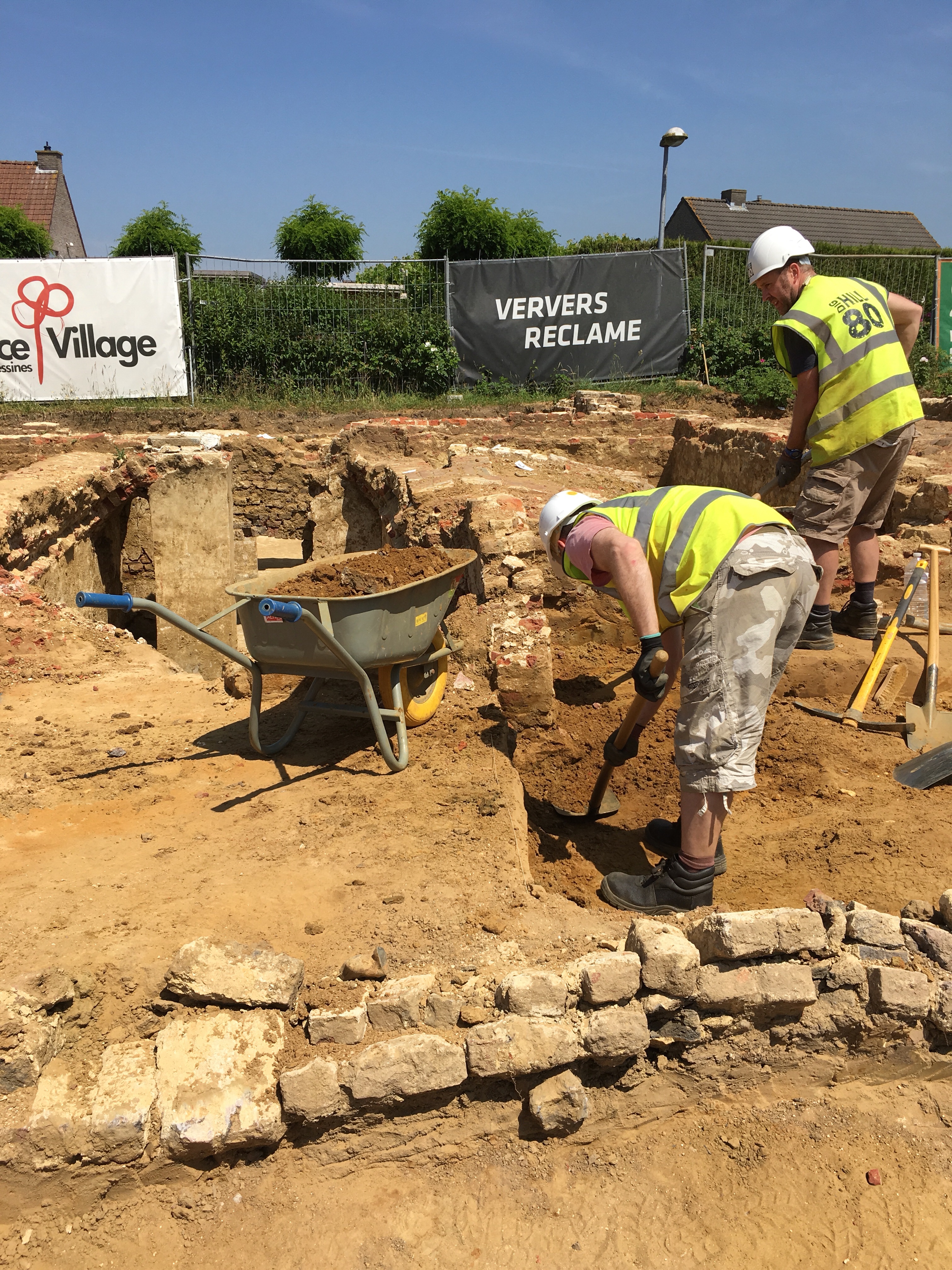
    Excavation around the Mill buildings

    img_0684
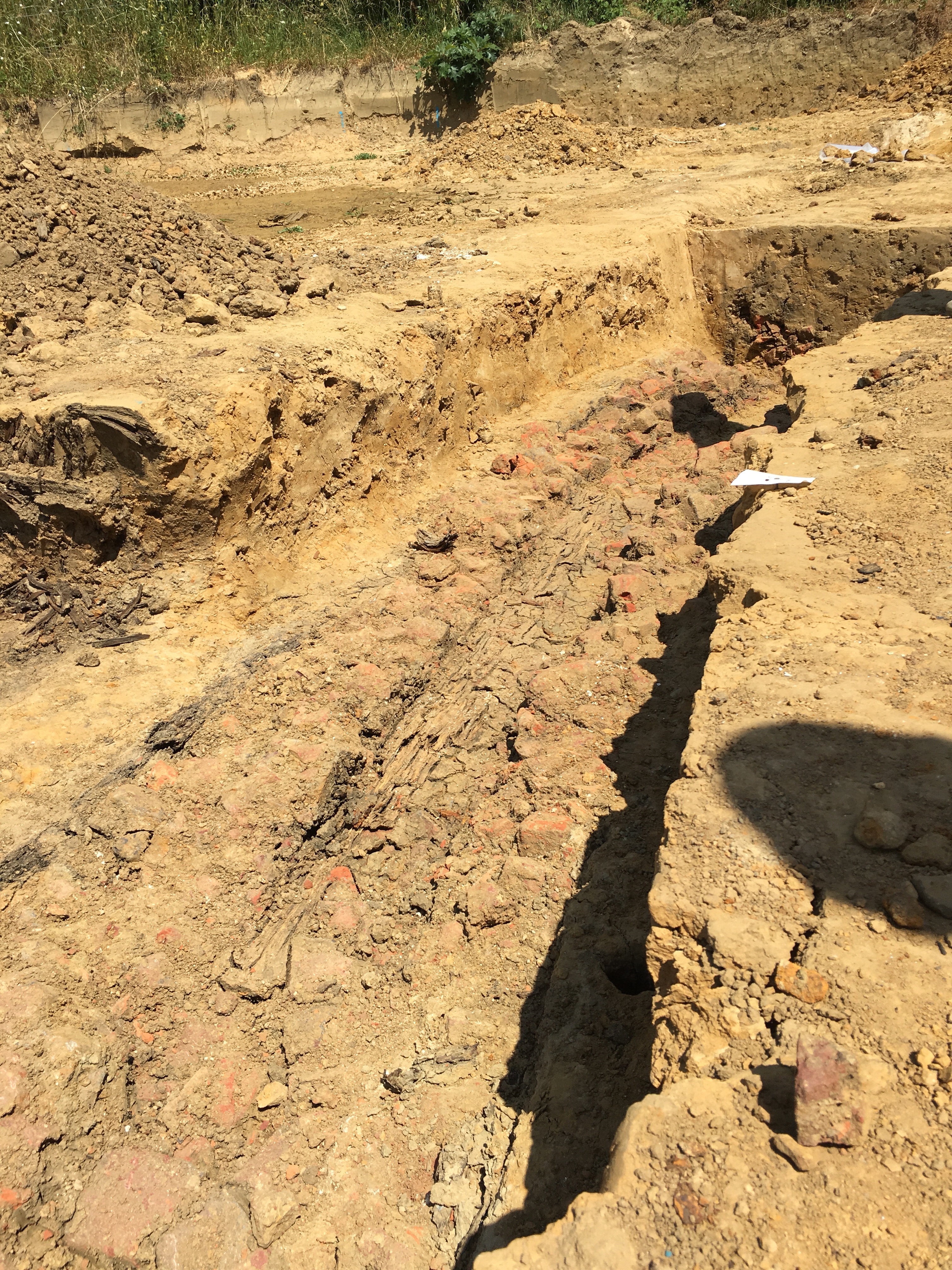
    Base of a trench with brickwork from the buildings used as drainage layer with remains of wooden duck boards
    img_0695
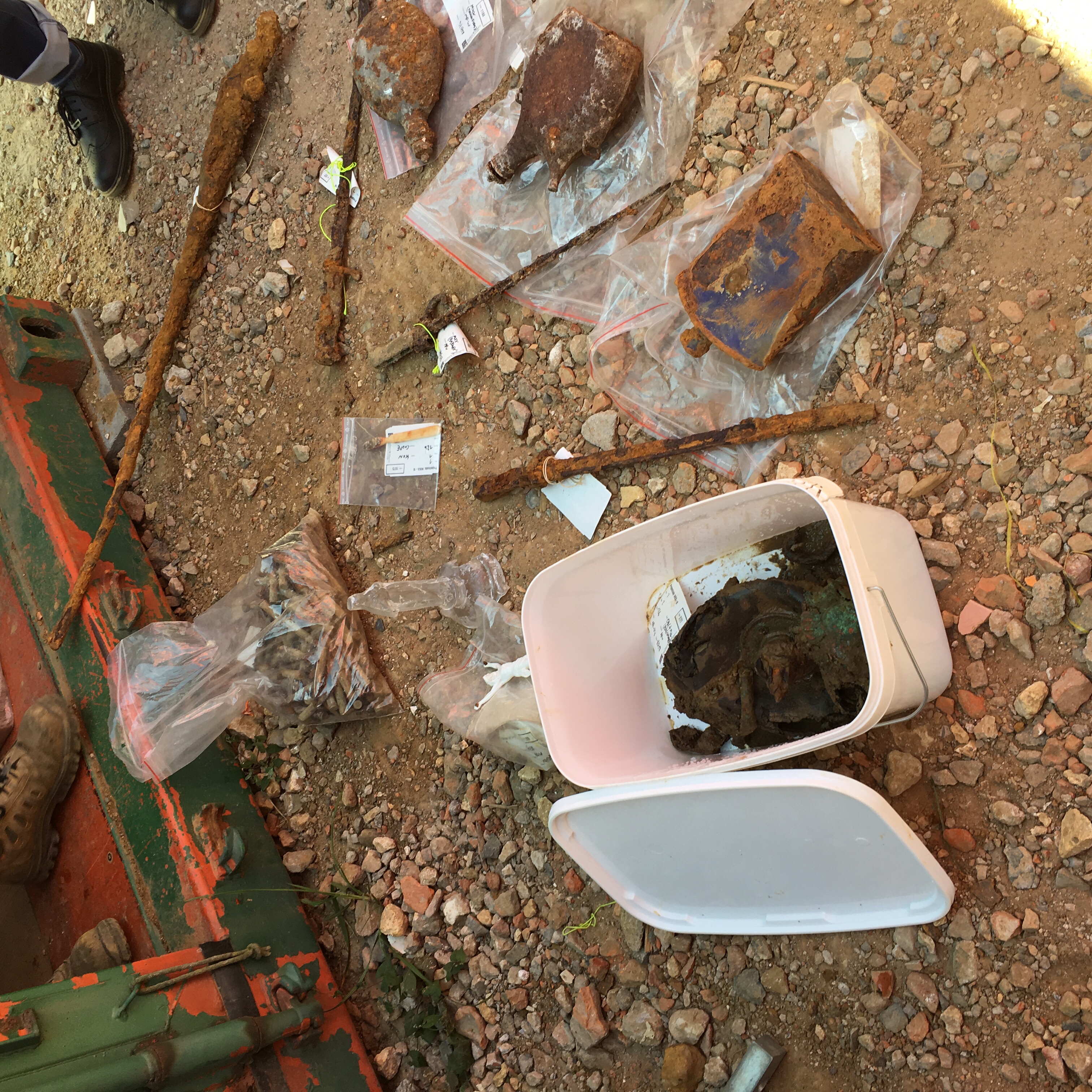
    From top to bottom: German, French and British bayonets and water bottles found at Dig Hill 80
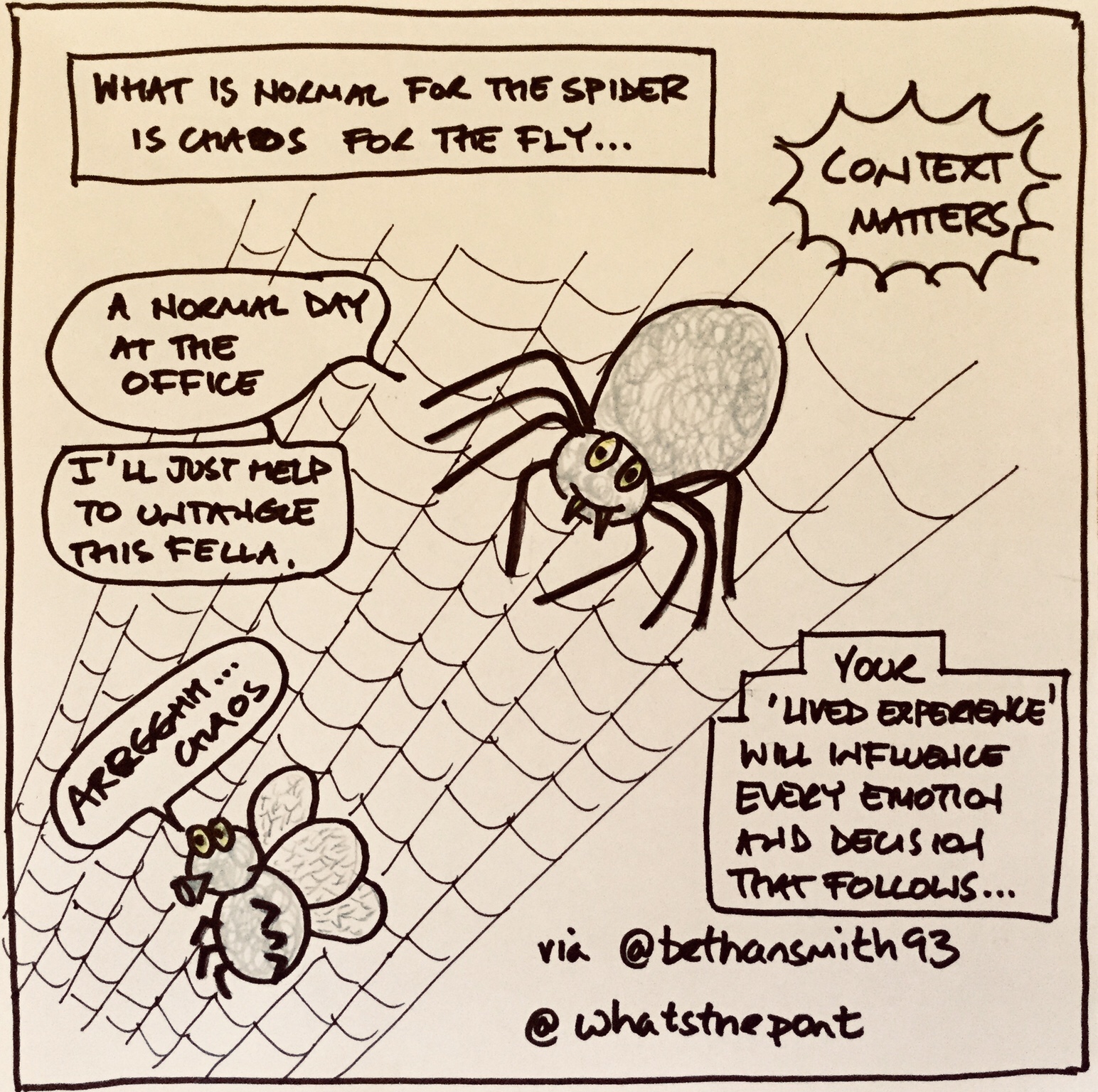
  • Context is everything. Thanks to Beth Smith (@bethansmith93) for ‘what is normal to the spider is chaos to the fly’, which inspired the illustration above. The quote neatly describes how different experiences of a situation (the context), can massively influence your feelings and also the decisions you make about the situation.

    For the spider it’s ‘business as normal’. A calm and rational approach is the way to proceed. For the fly, its chaos. Total panic stations and doing anything to get yourself out of a dangerous situation. Calm and rational thinking is a long way off for the fly.

    Beth used the quote at meeting of the Co-production Network for Wales (link here) and I think it is really effective at pointing out to the people who provide services (the doers), that ‘normal business’ might be experienced very differently (chaos) by the people who use the services (the done to).

    Referring to ‘doers’ and the ‘done to’ might be a bit judgemental and upset a few people, but so is the Spider and Fly analogy. However, it does get to the heart of a big issue in co-production, POWER!

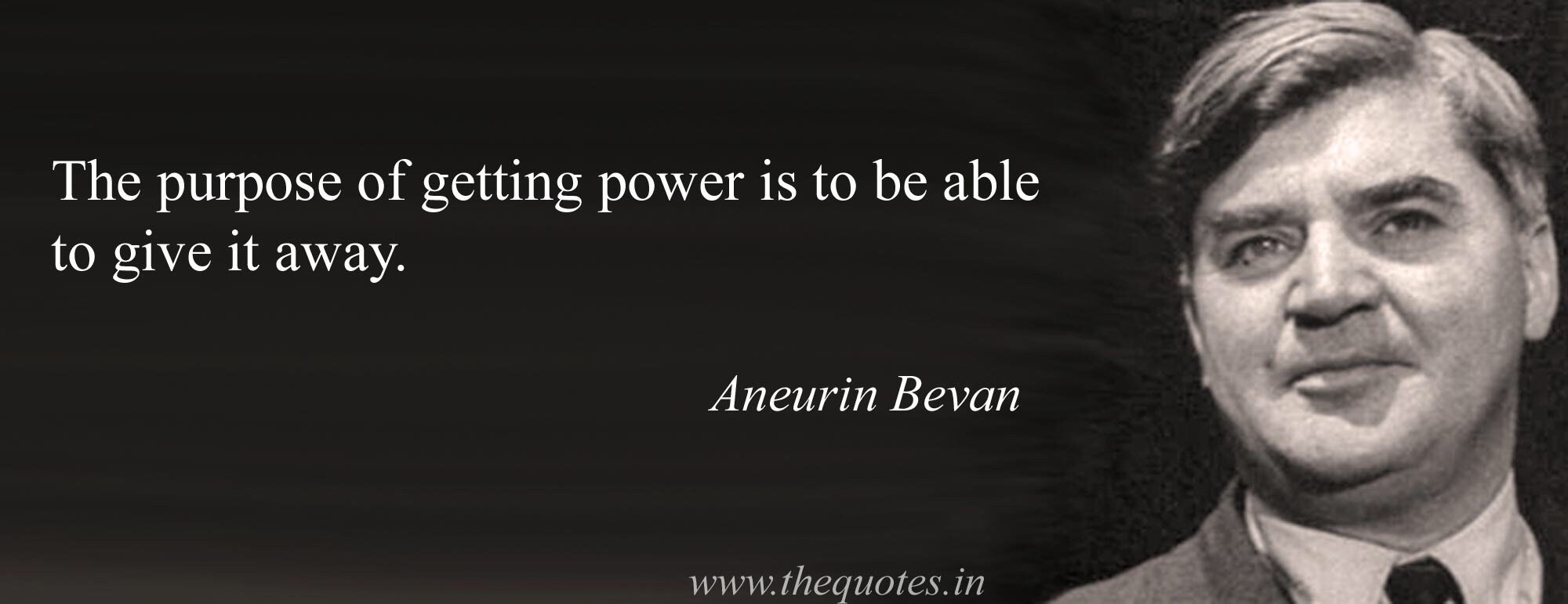
    Power, and giving it away. One of the other things that popped up the Co-production Wales conference was a quote from Aneurin Bevan, “the purpose of getting power is to be able to give it away”. It was the 70th Anniversary of the National Health Service, so an Aneurin Bevan quote was inevitable, but particularly relevant as it happened.

    The context around the quote was to support the need for co-production and raise the question of power in the co-production of public services. For me, the quote emphasises the need for a change in the established power relationship. Moving away from a situation of ‘doers and the done-to’ and towards ‘us’ and ‘we’.

    I appreciate that this is a really hard thing to do. Voluntarily giving up power seems to go against the general flow of what is ‘expected’ in the world, and how large parts of society seem to work. The examples of people clinging desperately to power, for example the departure of Robert Mugabe, seem to outweigh the examples of people stepping aside and handing over power graciously.

    Why would things be any different in Public Services with someone deciding how a service should be delivered? You might have observed some of these power grabbing, consolidation and (grimly determined) retention behaviours in your own area of activity…?

    If you want a sense of the scale of the challenges around co-production and in particular power, have a read of ‘A Simple Guide to Co-production’ from Recovery in the Bin. It’s written by user led mental health survivors and supporters (link here) and might not make comfortable reading for some.  I do however recommend having a look and reflecting on what’s being said. It rang true in many places for me and influenced the spider and the fly illustration I drew.

    Good News! People are already sharing power. Everything finds its way back to my Churchill Travelling Fellowship at the moment. One of the organisations I met in the Basque Country was the ner.group where, ‘ner’ stands for ‘new style of relationships’.

    The ner.group is made up of 23 organisations, employing 2,700 people, with over 400 million Euros a year turnover and they are really serious about their social contribution. They are well worth paying attention to. I think there are very strong connections between what co-production is trying to achieve around relationships, and what the ner.group area is already doing.

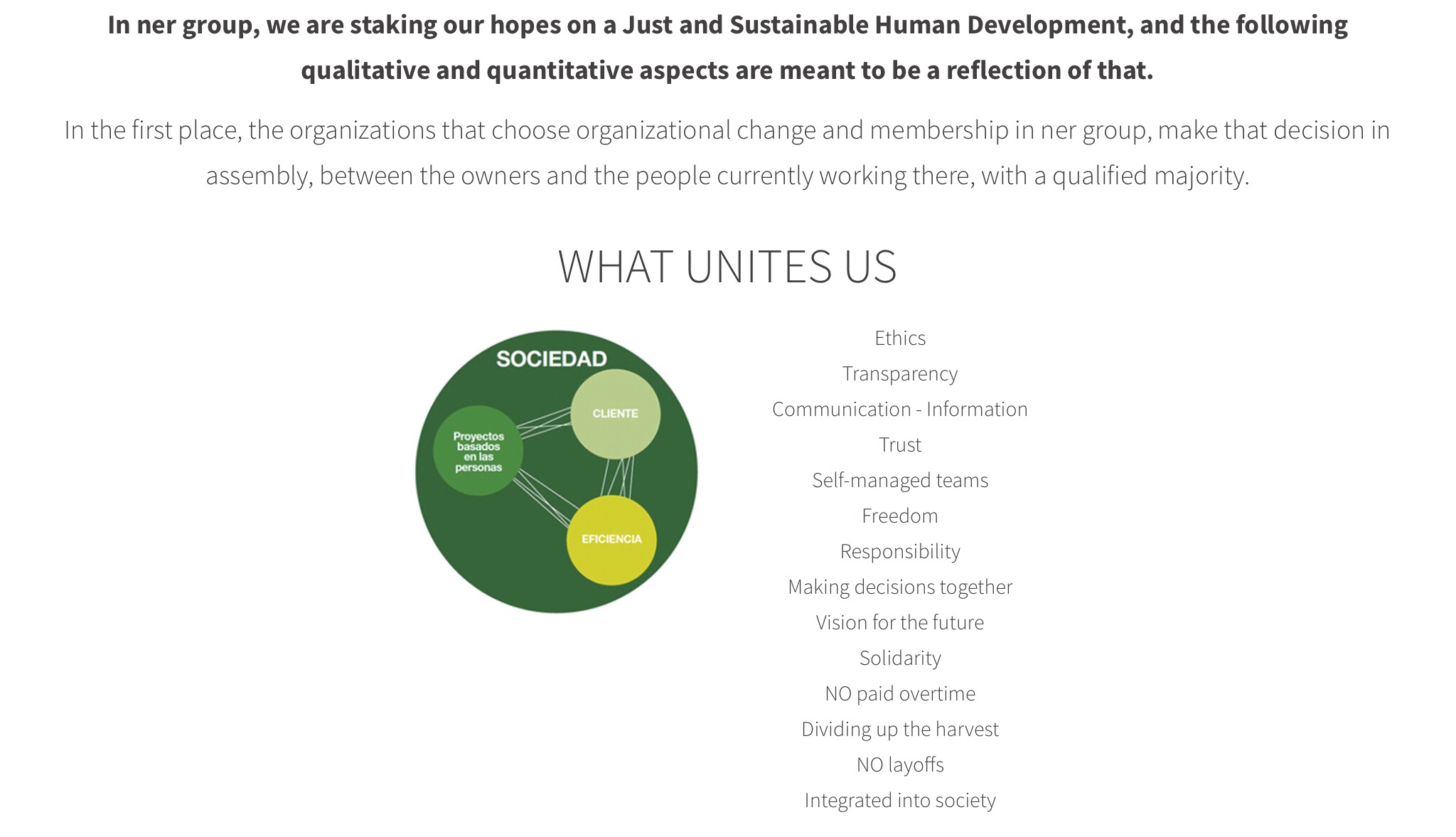
    Have a look at the screen shot of WHAT UNITES US from Organisation Style page the ner.group website below.  I think that what they have described is pretty close to what co-production is aiming for; ethics, making decisions together, freedom, responsibility, transparency etc is what they focus upon. Very much a new style of relationship…

    I’m working my way through books that describe this approach in detail, with practical examples of where it has worked. Thanks to Pablo and Jabi from ner.group generously gave them to me. I’m planning to write a post about the work they did with an industrial worker cooperative, Panelfisa Automotiveating.  This gets to the heart of successfully shifting power and building trusting human relationships.

    img_9046
    From the ner.group website – Organisational Style http://www.nergroup.org/en-us/Organization

    Everything is possible… Context is everything, and the spider and fly example illustrates this beautifully. Building co-productive relationships that do this isn’t easy, but there are successes in Wales, and there are some large-scale successful examples in the Basque Country. The ner.group run businesses, operate in a commercial world and are doing things I think any co-producer would aspire to.  If it can be done in the business environment surely it can be done in public services? Andy Middleton might have something to say on this…

    So, Whats the PONT?

    1. A significant part of co-production is about the sharing of power (making decisions together).
    2. Context matters. The people currently with power, could usefully think about the Spider and the Fly quote – being in the web can be chaos.
    3. There are examples of people successfully operating in a co-productive way and forming ‘new relationship styles’ in the Basque Country. We can learn from what they do.

    This is one of the books I’m reading about the ner.group

  • I should more beware of seeking simple answers to complex problems. One of my KLOE’s (Key Lines of Enquiry – yes, I confess to an audit background) on my trip to the Basque Country was to get a sense of: ‘how you develop a society where there is a widespread understanding of cooperatives, and the skills and behaviours to successfully operate them?’ 

    My thinking revolved around the idea that the knowledge and skills required to work in a cooperative business don’t just ‘appear’. Most people probably aren’t ‘hardwired’ to behave cooperatively. If we were, society (and business) would probably be very different to what it is now. We wouldn’t spend so much time on team building activities for starters…

    So, almost as soon as I arrived in Bilbao I started asking the question; “how do you develop your understanding of cooperatives, skills and behaviours?” (I’m a top quality companion for a random conversation on the bus or in a Pintoxs Bar…, no footballing small talk here!)

    It’s the Ikastola (stupid), or is it…? Almost too quickly the answer fell into my lap, cooperative schools, specifically Ikastola. From several conversations the following picture of cooperative schools and their link to Basque society emerged:

    • Ikastola have a very specific place in the Basque Country and Culture,
    • They go back to the 1900’s and were created to maintain the Basque language through teaching,
    • They survived the Spanish Civil War in the 1930’s and continued throughout the time of Franco,
    • The public use of Basque was prohibited during this time, so the effort to continue would have been immense,
    • From the conversations I had, there was a sense that the ‘covert’ use of Basque in the Ikastola helped to maintain the language,
    • Following the death of Franco in 1975, the Ikastola have flourished under the Basque Government,
    • Being ‘cooperative’ seems to be closely associated with being an Ikastola, as much as using the Basque language,
    • Figures of 30-40% of schools being Ikastola (and cooperative) were quoted in conversations I had,
    • The Ikastola fit into the category of schools that are ‘private’ but are supported by the government (colegios concertados),
    • Government funding covers the ‘teaching’ costs and parents contribute the rest,
    • The contributions from parents ranged from; cash (up to 1200 euros annually), contributing to the work/running of the Ikastola (eg working in the canteen), or fundraising festivals (eg Kilomtroak, where people walk a 5-10km route).
    • Here is a link to a Spanish Wikipedia article on Ikastola, it hasn’t been easy finding this stuff (lots of information is buried behind academic publication paywalls).

    Does this add up to cooperative schools creating a cooperative society? This is a difficult one to answer.  I’m edging towards yes, but I need to go and talk to a clever Professor who knows lots about behaviour change science and education (hello Carl, see you soon).

    I can’t find a definitive figure for how many Ikastola there are in the Basque Country although the 30-40% figure feels reasonable, if that’s what he locals think…  The balance between running the school with a focus on the Basque language or as a cooperative also seem to vary. There is reference to some being more cooperative focused than language focused, but many are a mixture.

    What is clear though, is the expectation that parents will be involved, and have ‘ownership’ of what happens around their children’s education. From the Spanish Wikipedia article “involvement of parents with this educational model are part of the Ikastola’s DNA, compared to the public or private model of the rest of schools”.

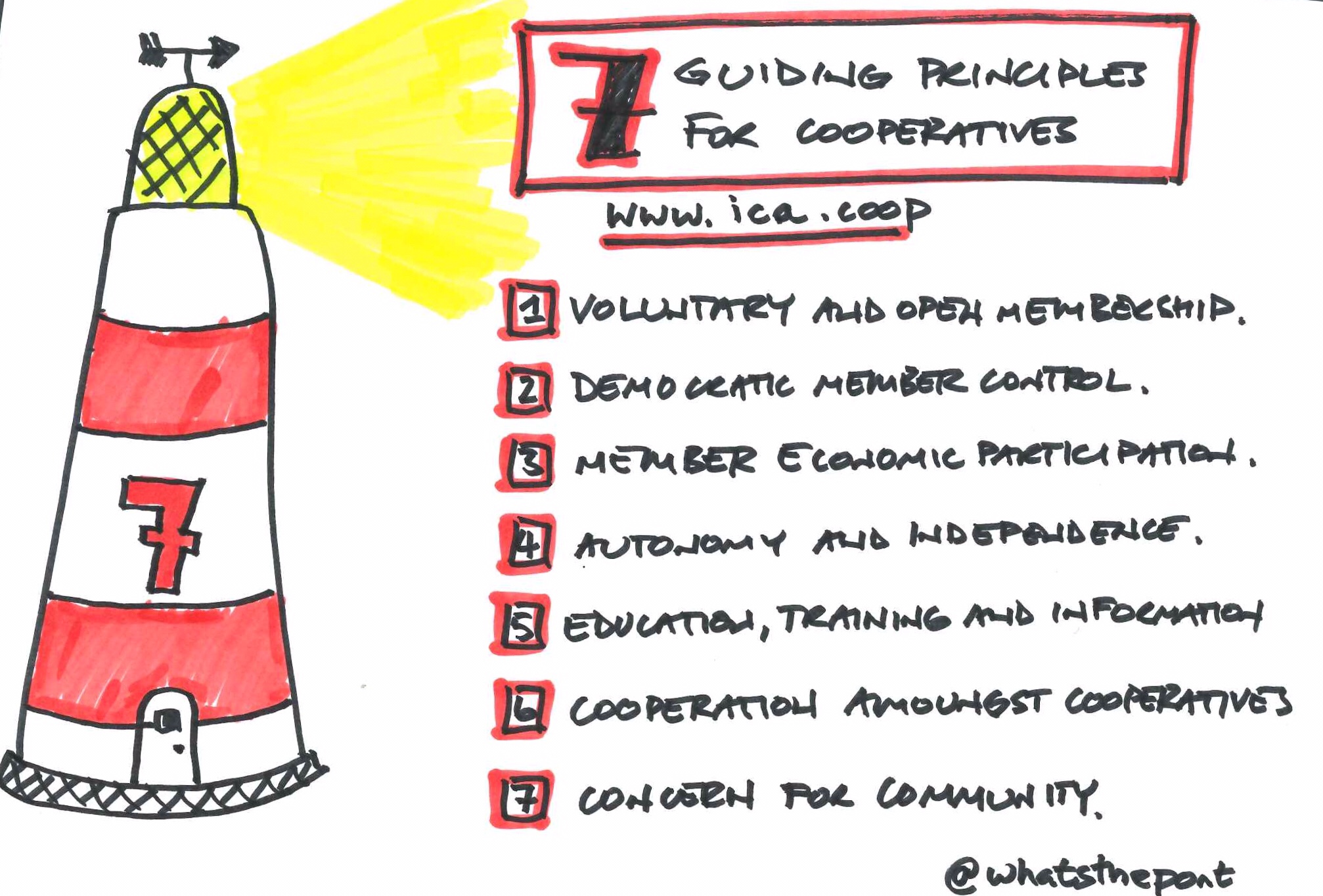
    This understanding and demonstration of cooperative behaviour in Ikastola seems to fit with a number of the guiding principles for cooperatives. Perhaps this school influenced behaviour is enough to influence what happens next in the wider (cooperative) society?

    More Questions than Answers. My head is spinning from thinking about this. I will need to come back to it with another post, in a while.

    In the meanwhile, it’s worth a read of this 2016 BBC article ‘Basques reinvent themselves as an education power’, by Sean Coughlan, Global Education Editor. Apart from the fact that the Basque Country is doing very well in education (comparable to the Scandinavians) the journalist has found statistics I couldn’t. Apparently around 50% of the schools in the Basque Country are the public / private model (colegios concertados) and the higher level of engagement of parents in these schools is emphasised. He also makes the link with the approach and entrepreneurialism in Basque Culture.

    If you want to get a feel for what an Ikastola is like, have a look at the website of Lauaxeta Ikastola, (link here) which is  about 15 miles outside Bilbao and is owned by a cooperative.

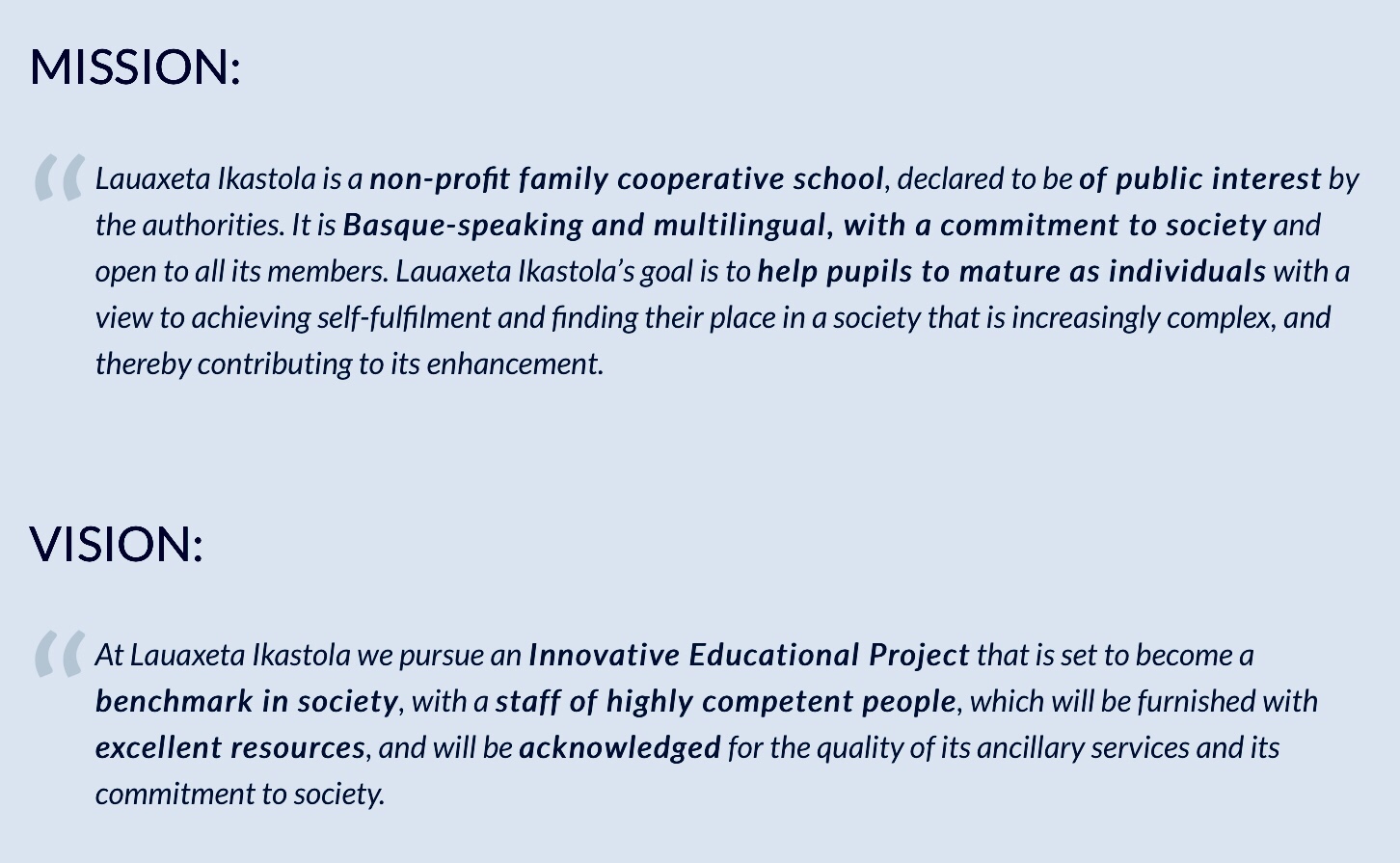
    I do very much like this phrase from the school mission: “…help pupils to mature as individuals with a view to achieving self-fulfilment and finding their place in society that is increasingly complex, and thereby contributing to its enhancement”

    I wish I could have gone to that school, maybe then I wouldn’t have jumped so quickly to a simple answer for a complex problem…?

    Mission and vision from the Lauaxeta Ikastola website.

    So, What’s the PONT?

    1. Schools have a huge influence on the understanding, skills and behaviours of the students that attend them (it’s one of the reasons we have schools).
    2. If you closely involve parents in the ‘schooling’ experience, there is a chance that the understanding, skills and behaviours will ‘rub-off’ on them.
    3. If the school is a cooperative and operates using cooperative principles, there could well be a wider impact on society.

    Picture Links: Answers: Simple by Wrong / Complex by Right by Wiley Miler https://www.gocomics.com/nonsequitur/2016/01/20

    Lauaxeta Ikastola website. Mission, vision and values page.

    My other Churchill Fellowship posts can be found here: Churchill Fellowship 2018

  • Here’s a quiz. What links these four things together? There are pictures to help you:

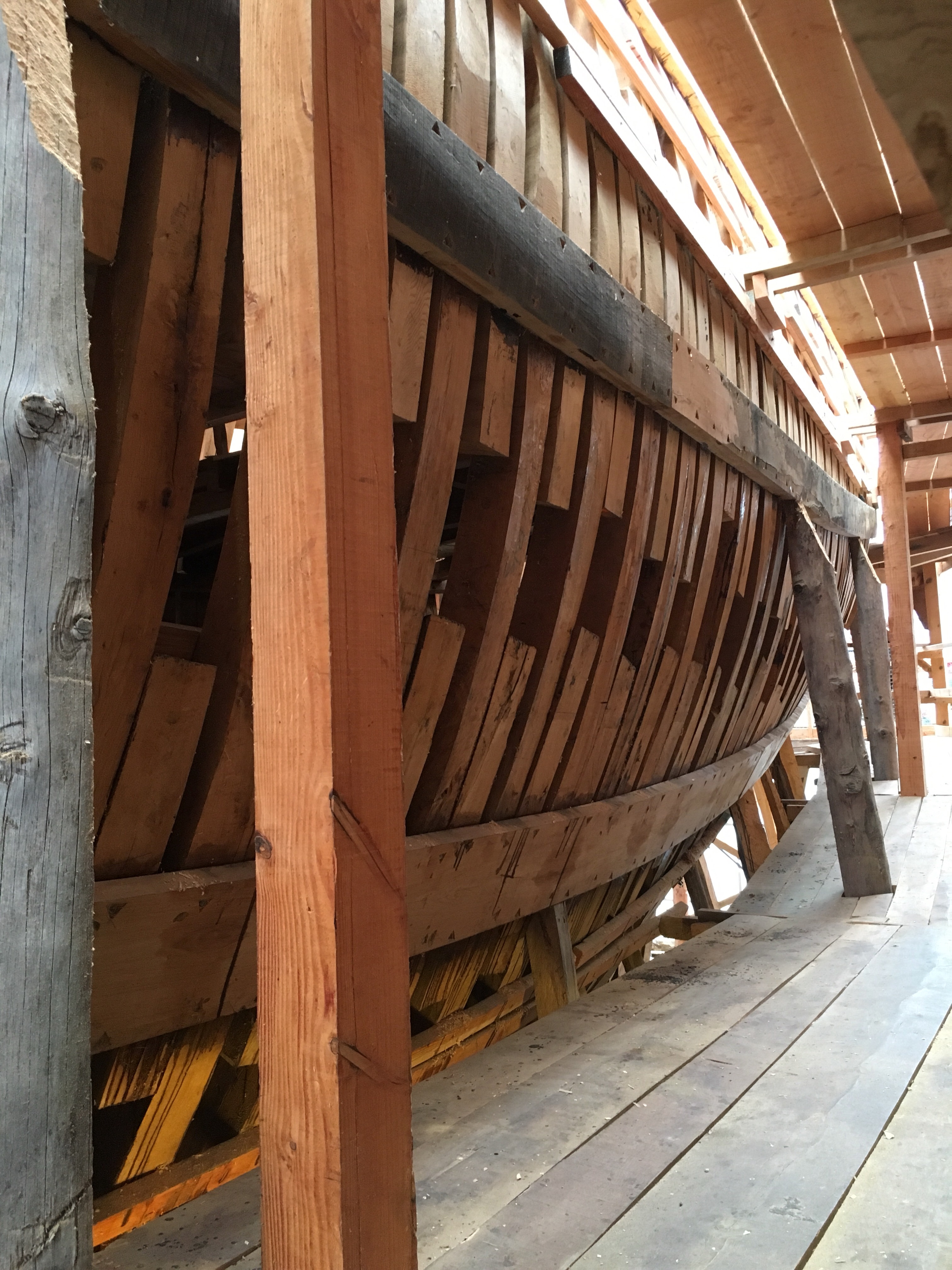
    1. A replica (under construction)of the Basque Galleon, San Juan,
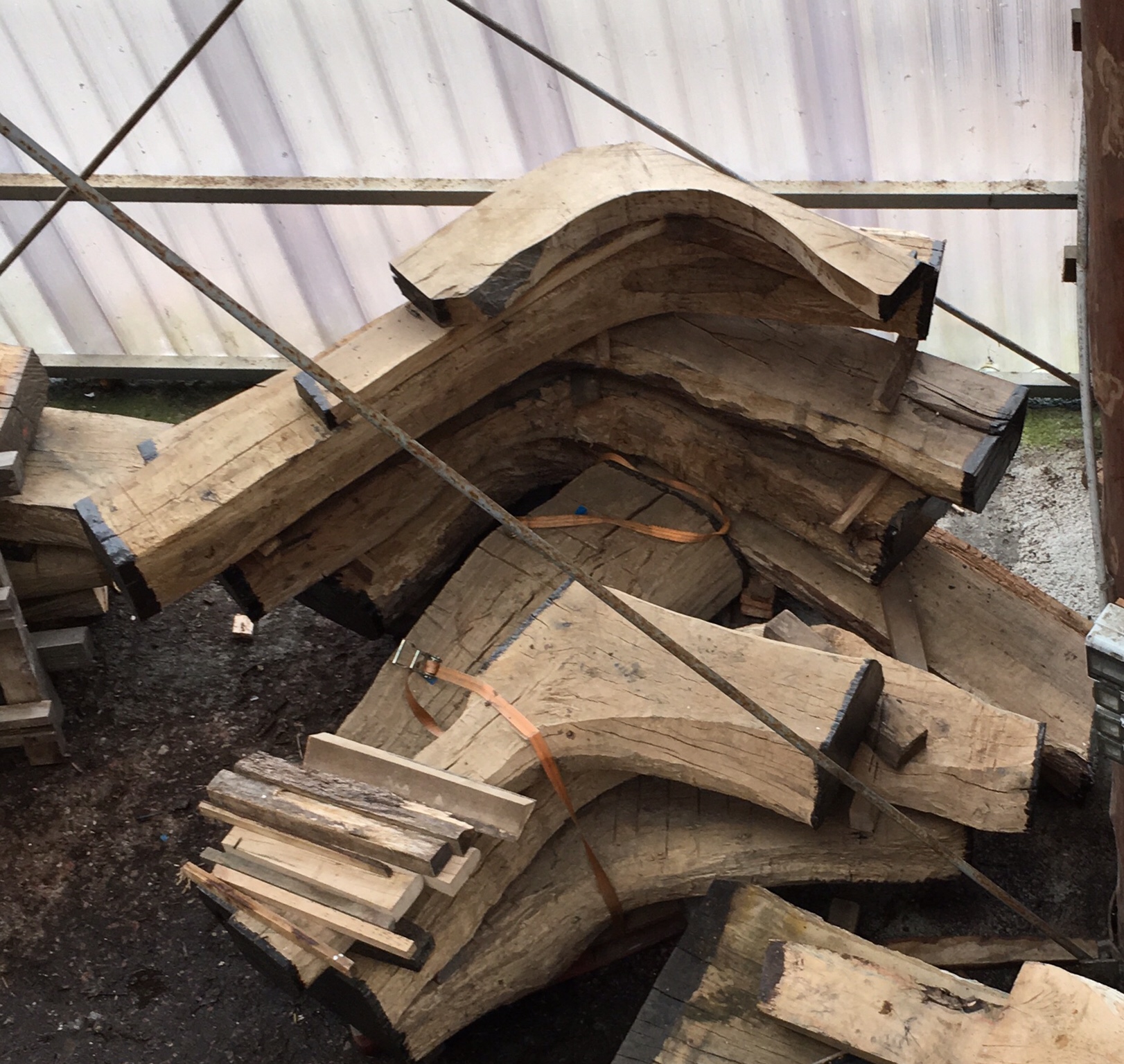
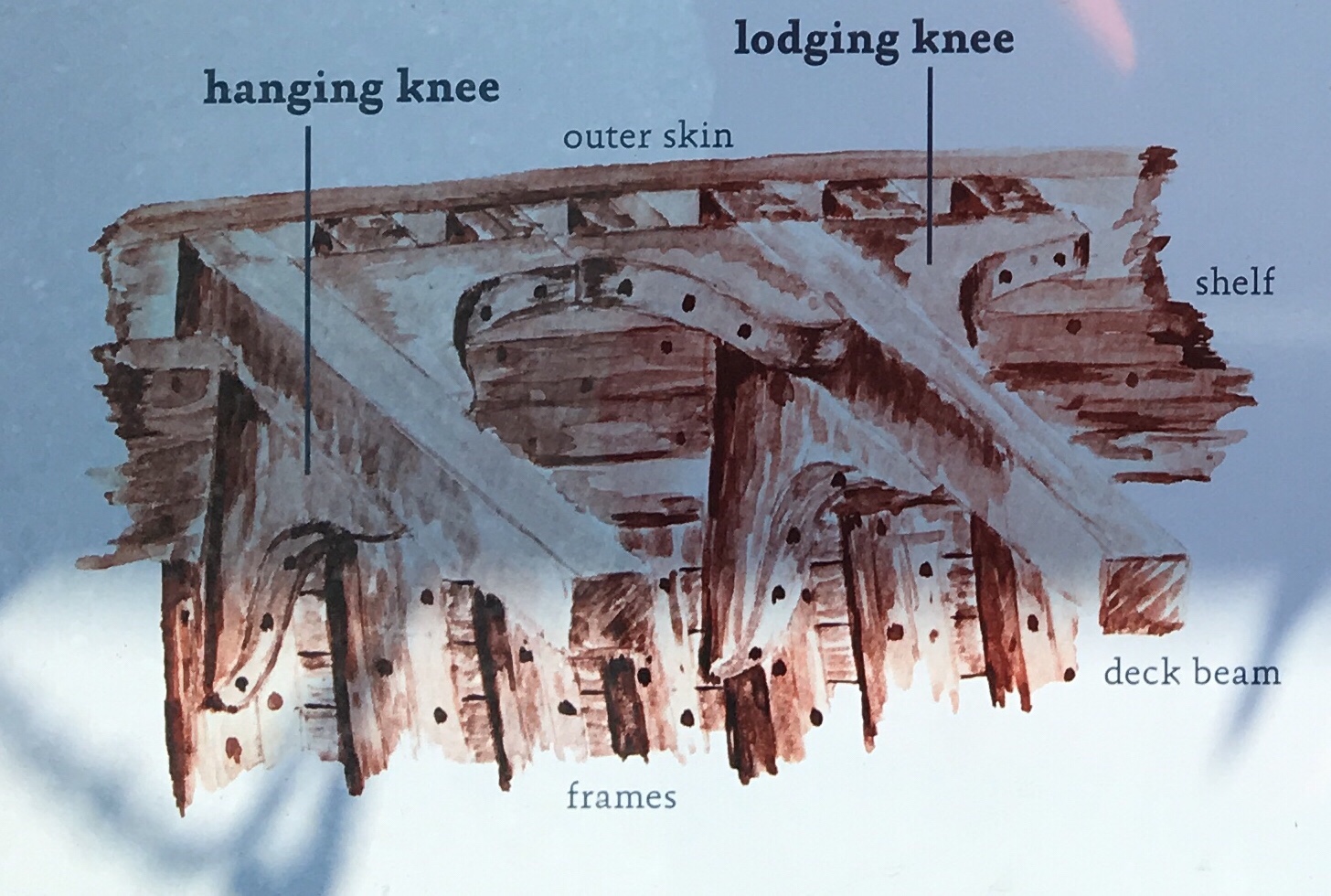
    2. Some strangely shaped pieces of wood,
    3. The Wellbeing of Future Generations (Wales) Act 2015, and
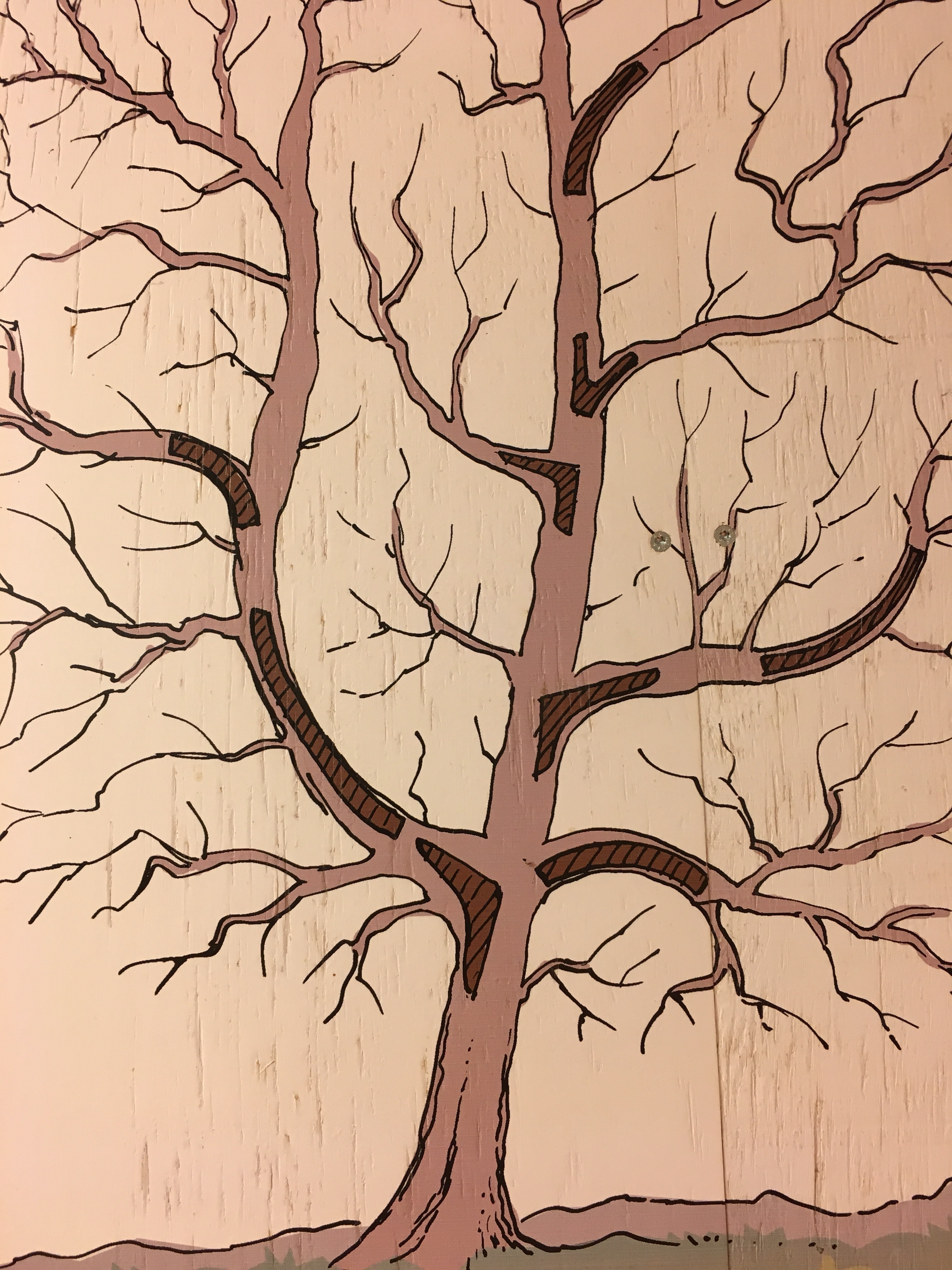
    4. A template drawing of the ‘sections’ of a mature oak tree.

    * There’s a Mayflower II update at the end from Plymouth Rock Massachusetts.

    The answer to what links these things is Time, more specifically, long term time.

    Planting Oak trees to build ships. At the end of the first leg of my Churchill Fellowship visit to the Basque Country (link to previous posts here), I had Saturday ‘off’, to do some tourist activities. This took me, via a section of the Camino de Santiago, to the Alabola Itsas Kultur Fakoria in Pasai, San Pedro, on the eastern edge of San Sebastián, (both deeply self-indulgent pastimes, I was enjoying myself).

    Alabola is basically a museum dedicated to Basque wooden shipbuilding. At the moment they are making a faithful copy of a famous ship the San Juan which sank off Newfoundland in 1565. Yes, the Basques were busy trading in North America in the 1500’s and yes, the San Juan is being re-constructed using ancient techniques – you can watch people chopping away with axes and adze’s; brilliant!

    Watching the activity of the ships builders it’s very clear that this isn’t a quick process, and when you look at the new San Juan it is also very clear that this is something that is being built to last.

    But what’s this got to do with Time? In the supporting exhibition there’s an explanation of how the wood for the ships was supplied. This wasn’t a simple case of just heading to the nearest forest, chopping down a handy tree and cutting it into useful (transportable) pieces.

    There was actually an industry, and a design led process (yes, they had such things in the 1500’s) that produced the required components for ship building. This was achieved by working ‘with’ living organisms, mostly oak trees. A component of this ‘working’ involved pruning, to shape the oak trees so that they grew in the required ‘ship-shaped’ ways. This is where the template fits in.

    Most people will know that oak trees don’t grow overnight. Oak trees don’t even produce acorns until they are about 50 years old. According to the Woodland Trust, it takes up to 150 years of growing for an oak tree to produce wood that is suitable for use in construction.

    I’ve been trying to do some calculations here. If the average lifespan in the 1500’s was about 40 years, it would be the great great grandchildren of the person who planted the oak tree who would be able to use it for ship building…

    I may have my calculations wrong, but I’m sure you get the gist. Basically you are doing things now for the future; planting oak trees and managing them, for your descendants (people several generations in the future who you will probably never meet). They will feel the benefit of  your actions, not you.  An expert in Behavioural Economics will need to explain that one to me.

    Whatever the explanation, that feels like a solid example of (very) long-term thinking.

    Does historic practice influence current attitudes? I’m not going to try to answer this, just give two examples. In the conversations I had during my visit the idea of time, and thinking long-term came to the surface frequently:

    • Speaking to someone about my visit to Mondragon Team Academy (MTA) (link to the Social Entrepreneurs Bootcamp post here) I asked if they had noticed any impact of MTA in the wider Basque community. Their answer was very matter of fact, “it’s only been 10 years they have been doing it, these things take time”.
    • In conversation with Pablo Aretxabala and Jabi Salcedo from K2K Emocionando they were explaining a programme they were involved to the improve the economic performance of organisations in a locality. They were 18 months into the programme and were “in the middle of the beginning, these things take time…”

    Maybe the influence of ancient Basque foresters and ship builders does reach down the years?

    What has this got to do with Wales? You’ll have spotted the earlier reference to the Well-being of Future Generations (Wales) Act 2015. This places requirements on public bodies in Wales to act in accordance with the principles of sustainable development.

    One of the areas the Act talks about the behaviours required by these bodies, described as The Five Ways of Working, illustrated below.

    The ‘Way of Working’ that’s the focus of this post is Long Term Thinking. Public bodies are expected to behave in a way (the things they do, the decisions they make) that recognises: “the importance of balancing short-term needs with the need to safeguard the ability to meet long-term needs”.

    That’s a tricky thing to do, and also demonstrate that you have actually done it. There are lots of questions being asked in Wales about things like; ‘exactly how long in years is long-term?’, ‘ how do you measure if people are behaving in this way?’, ‘are there different levels of commitment to long-term.’

    All good questions I’m not going to try and answer other than to say…

    Would your actions, decisions and behaviours pass the Basque Shipbuilding Test? Are you “planting oak trees to build future ships?” If you are doing something similar, then you probably are thinking long-term.

    So, What’s the PONT?

    1. Taking time to build something, and building it to last is as relevant now as it was when the San Juan was afloat in 1565.
    2. Doing something now, that will benefit people you’ve never met, a very long time after you have expired is a challenging idea. I’m not sure most people see it as a realistic option.
    3. Long-term Thinking is a difficult behaviour to measure. Maybe the response to the question, “are you planting trees to build future ships?” might give you an insight?

    UPDATE FROM THE MAYFLOWER II AT PLYMOUTH ROCK

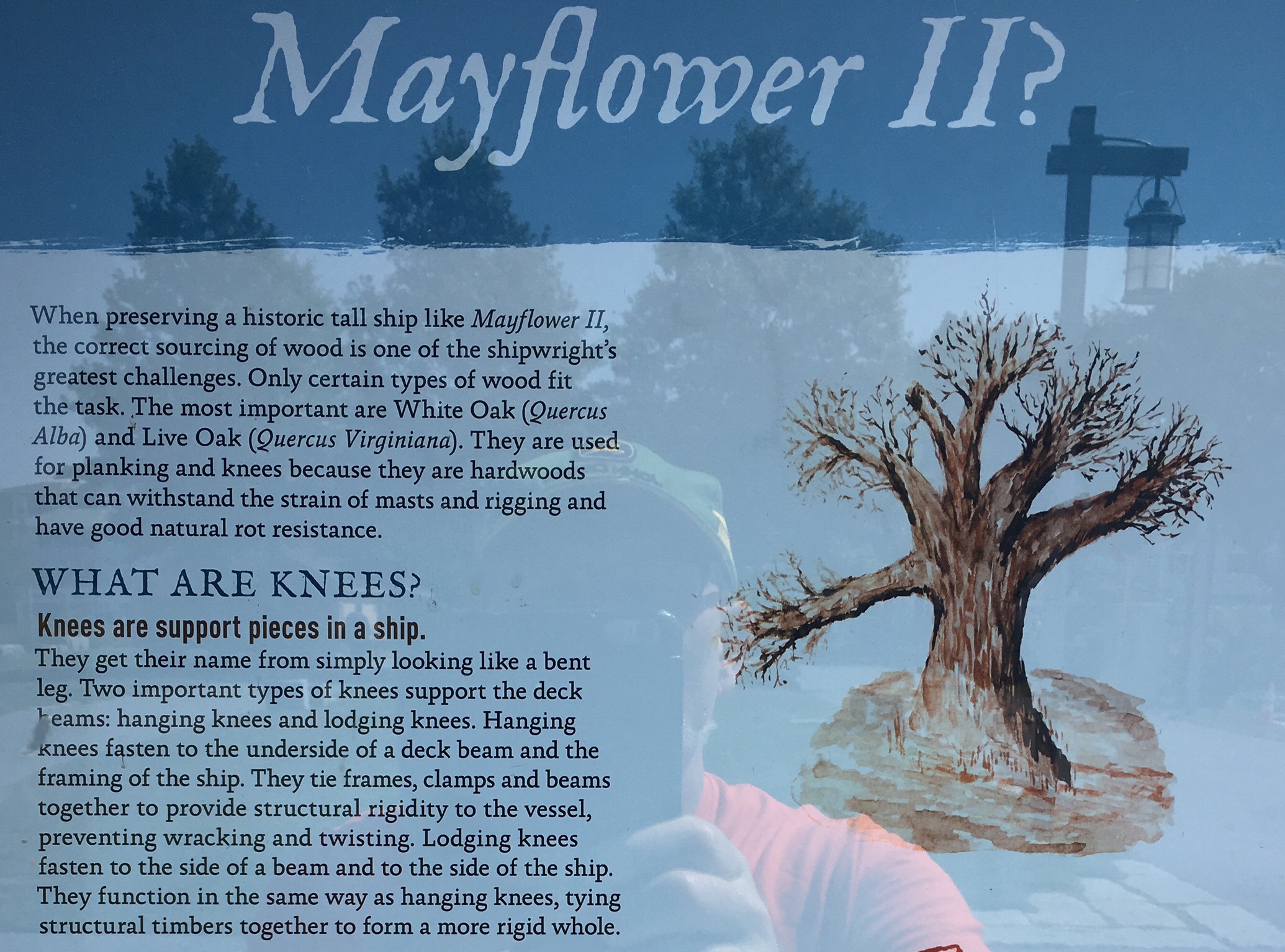
    This is hugely pleasing, Mayflower was the ship that brought the English Pilgrim Settlers to the USA in 1620. The replica Mayflower II is currently undergoing repairs, ready for the 400th anniversary of the landing in 2020.

    The shipwrights have put out a request for people to ‘volunteer’ trees they might have in their backyard to be used in the construction. And guess what, there’s a template (drawing) you can use to work out if you have a suitably shaped tree.

    It looks quite like the one I saw in San Sebastián, which probably isn’t surprising, but it made me happy. Mayflower II pictures below.

  • James Reason Swiss Cheese Model. BMJ, 2000 Mar 18:320(7237): 768-770
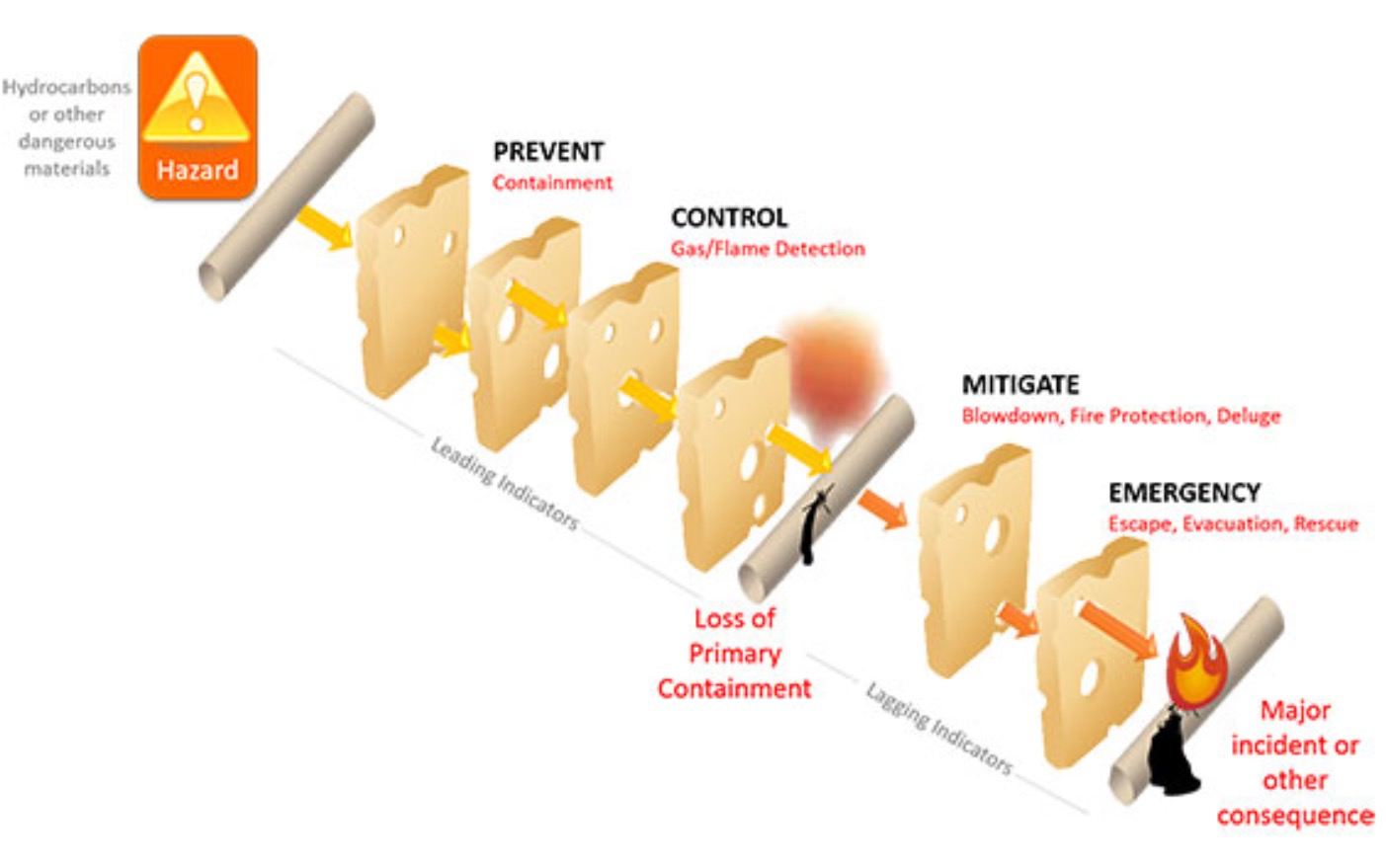
    James Reason Swiss Cheese Model. Source: BMJ, 2000 Mar 18:320(7237): 768-770

    A while ago I was part of the Cardiff pilot of Practical Strategies for Learning from Failure (#LFFdigital). My job was to explain the James Reason Swiss Cheese Failure Model in 300 seconds (5 minutes).

    This is what I did.

    The Swiss Cheese Model of Accident Causation (to give it the full name), was developed by Professor James T. Reason at the University of Manchester about 25 years ago. The original 1990 paper,“The Contribution of Latent Human Failures to the Breakdown of Complex Systems”, published in the transactions of The Royal Society of London, clearly identifies these are complex human systems, which is important.

    Well worth reading is the British Medical Journal (BMJ), March 2000 paper, ‘Human error: models and management’. This paper gives an excellent explanation of the model, along with the graphic I’ve used here.

    The Swiss Cheese Model, my 300 second explanation:

    • Reason compares Human Systems to Layers of Swiss Cheese (see image above),
    • Each layer is a defence against something going wrong (mistakes & failure).
    • There are ‘holes’ in the defence – no human system is perfect (we aren’t machines).
    • Something breaking through a hole isn’t a huge problem – things go wrong occasionally.
    • As humans we have developed to cope with minor failures/mistakes as a routine part of life (something small goes wrong, we fix it and move on).
    • Within our ‘systems’ there are often several ‘layers of defence’ (more slices of Swiss Cheese).
    • You can see where this is going…..
    • Things become a major problem when failures follow a path through all of the holes in the Swiss Cheese – all of the defence layers have been broken because the holes have ‘lined up’.
    Source: http://www.energyglobal.com/upstream/special-reports/23042015/Rallying-against-risk/
    Source: Energy Global Oilfield Technology http://www.energyglobal.com/upstream/special-reports/23042015/Rallying-against-risk/

    Who uses it? The Swiss Cheese Model has been used extensively in Health Care, Risk Management, Aviation, and Engineering. It is very useful as a method to explaining the concept of cumulative effects.

    The idea of successive layers of defence being broken down helps to understand that things are linked within the system, and intervention at any stage (particularly early on) could stop a disaster unfolding. In activities such as petrochemicals and engineering it provides a very helpful visual tool for risk management. The graphic from Energy Global who deal with Oilfield Technology, helpfully puts the model into a real context.

    Other users of the model have gone as far as naming each of the Slices of Cheese / Layers of Defence, for example:

    • Organisational Policies & Procedures
    • Senior Management Roles/Behaviours
    • Professional Standards
    • Team Roles/Behaviours
    • Individual Skills/Behaviours
    • Technical & Equipment

    What does this mean for Learning from Failure?  In the BMJ paper Reason talks about the System Approach and the Person Approach:

    • Person Approach – failure is a result of the ‘aberrant metal processes of the people at the sharp end’; such as forgetfulness, tiredness, poor motivation etc. There must be someone ‘responsible’, or someone to ‘blame’ for the failure. Countermeasures are targeted at reducing this unwanted human behaviour.
    • System Approach – failure is an inevitable result of human systems – we are all fallible. Countermeasures are based on the idea that “we cannot change the human condition, but we can change the conditions under which humans work”. So, failure is seen as a system issue, not a person issue.

    This thinking helpfully allows you to shift the focus away from the ‘Person’ to the ‘System’. In these circumstances, failure can become ‘blameless’ and (in theory) people are more likely to talk about it, and consequently learn from it. The paper goes on to reference research in the aviation maintenance industry (well-known for its focus on safety and risk management) where 90% of quality lapses were judged as ‘blameless’ (system errors) and opportunities to learn (from failure).

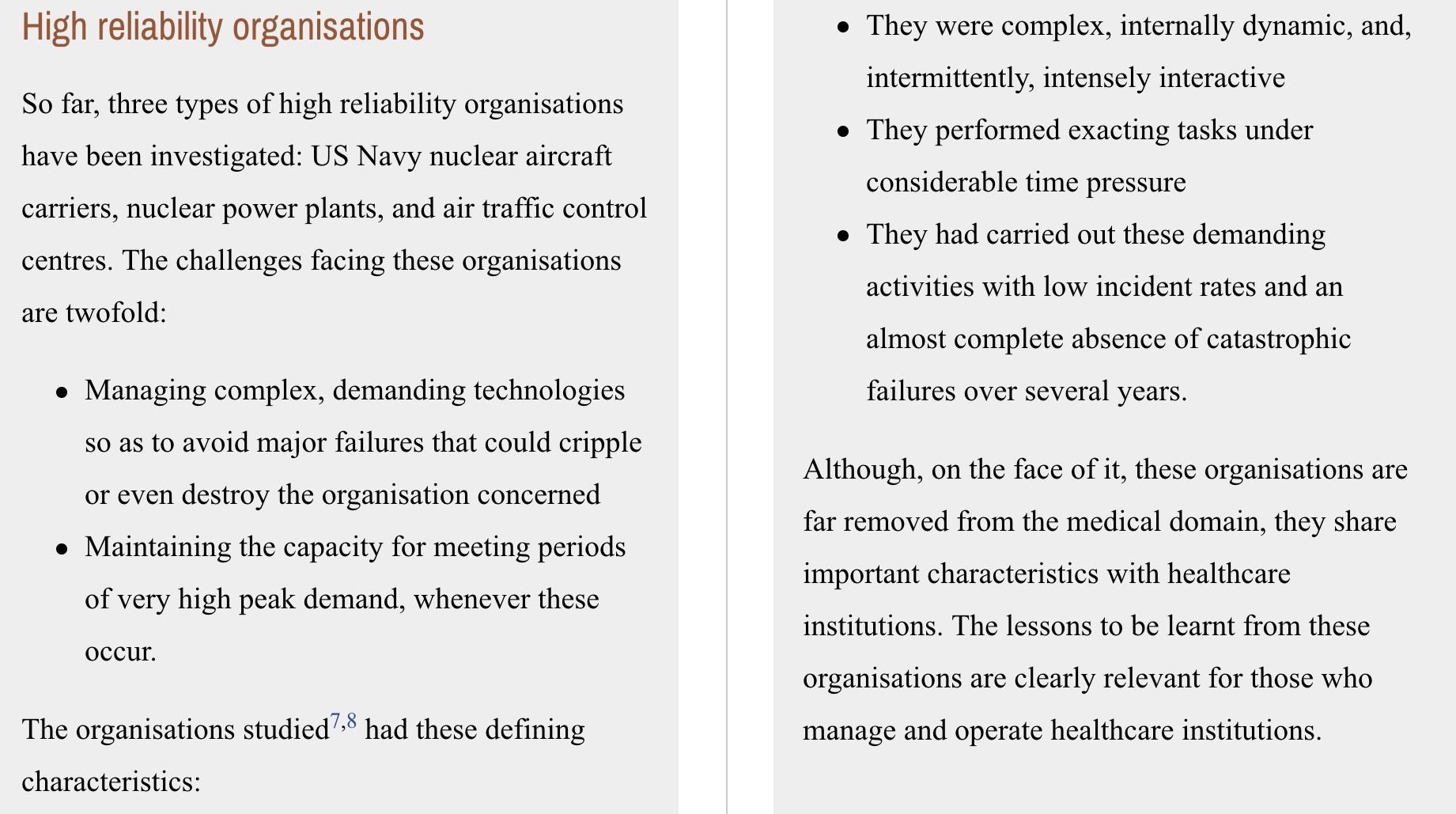
    It’s worth a look at the paper’s summary of research into failure in high reliability organisations (below) and reflecting, do these organisations have a Person Approach or Systems Approach to failure? Would failure be seen as ‘blameless’ or ‘blameworthy’?

    High Reliability Organisations: Source BMJ, 2000 Mar 18:320(7237): 768-770
    High Reliability Organisations: Source BMJ, 2000 Mar 18:320(7237): 768-770

    It’s not all good news. The Swiss Cheese Model does have a few criticisms. I have written about it previously in ‘Failure Models, how to get from a backwards look to real-time learning’.

    It is worth looking at the comments on the post for a helpful analysis from Matt Wyatt. Some people feel the Swiss Cheese model represents a neatly engineered world. It is great for looking backwards at ‘what caused the failure’, but is of limited use for predicting failure. The suggestion is that organisations need to maintain a ‘consistent mindset of intelligent wariness’. That sounds interesting…

    There will be more on this at #LFFdigital, and I will follow it up in another post.

    So, What’s the PONT?

    1. Failure is inevitable in Complex Human Systems (it is part of the human condition).
    2. We cannot change the human condition, but we can change the conditions under which humans work.
    3. Moving from a Person Approach to a System Approach to failure helps move from ‘blameworthy’ to ‘blameless’ failure, and learning opportunities.
  • I’ve visited 100’s of factories over the years, as part of previous jobs, and in my leisure time (ask my wife). Sometimes I’ve been accused of getting a bit over enthusiastic. I love seeing things being made. However, I’ve never been so greatly affected at an emotional level as I was when I visited GUREAK in Donostia-San Sebastián yesterday.

    GUREAK is an organisation deeply rooted ‘here‘ in Spain’ smallest Province, Gipuzkoa, which is part of the Basque Country. What GUREAK do is social labour inclusion, basically they create stable employment opportunities for people who require extra support, explained in the picture above taken from their website.

    GUREAK aren’t a part of Government, a Government Agency, a Charity or a Cooperative (although that option was considered). They are a commercial company, who’s existence depends upon its ability to remain financially sustainable in a competitive world. GUREAK achieve that and have been successfully doing it for over 40 years.

    A quick history of GUREAK. The history and development of GUREAK is very well explained on their website, link here, and in a video I’ll link to at the end of the post. Both links are well worth studying, I just wanted to emphasise a few things:

    • The origins of GUREAK are with a group of families of children with learning difficulties from across the Gipuzkoa Priovince.
    • They formed ATZEGI association in the 1960s to ‘fight for the rights of people with intellectual disabilities’ and are still very active today. Link to ATZEGI mission, vision and values here.
    • One of the things ATZEGI did successfully when they started was improve schooling for their children, ‘Ours’.
    • Then they faced the challenge of ‘what happens to ours after schooling finishes?’
    • ‘Why shouldn’t our children have the opportunity to work like everyone else?’ This is where GUREAK (which is Basque for OURS) was born.
    • Work is an important part of Basque Culture, with a widespread recognition that Basque people ‘work hard’.
    • Work is also key part of social inclusion. Alongside providing people with; wages, social connections, routine and structure, it also includes you in Basque society, where ‘working hard’ counts.
    • In 1975 GUREAK was created as industrial company and has grown to what it is now; a diverse business, employing over 5000 people (82% with disabilities) and an annual turnover of over €200 Million. You can read the details about GUREAK here.

    Sustainability, Profitability and Social Benefit. There’s just five things I want to say that give a sense of just how impressive GUREAK are.

    • Economic Return. The picture above taken from the GUREAK website points out that they do receive some help from government sources. A €3.09 for every €1 spent is a significant return on investment, I suspect would interest anyone in government.
    • Quality Work Close to Home. GUREAK are present throughout Gipuzkoa. They have an objective to create employment close to home for people, and have a principle that 20km is the maximum distance anyone should travel to work. That’s something that could apply in so many other settings.
    • Balancing Profitability and Good Work. GUREAK are clear that any work they contract to do must be suitable, or adaptable, for the people who work there, and it must also be profitable. This balance is critical to maintain. To do work that was only about job creation and not profitable, would threaten the financial sustainability of GUREAK. To accept contracts that were profitable, but did not provide jobs for people with requiring additional support would go against the core reason GUREAK was created.
    • The Future of Work. Within their industrial sector most of the work is manual. That is the nature of how GUREAK create jobs to meet peoples capabilities. GUREAK are very aware of the implications of automation, robots and artificial intelligence on the world of manufacturing and work. They are thinking deeply about this, because it could impact on their ability to survive more so than other commercial companies. I think we could all learn something from GUREAK on this.
    • Personal and Professional Development. GUREAK do more than just provide a job. There is a huge emphasis on personal and professional development for all workers. They have a section of the business called ITINERARY, which focussed on this, link here. The video also provides a good explanation of how ITINERARY works.

    Finally, I did say the visit to GUREAK affected me emotionally. Here is their corporate video which I encourage you to watch. It explains things about where they came from and what they do beautifully, it is also a great advertisement for Gipuzkoa. The bit that particular affected me was towards the end (7.20mins) where one of the workers Juan Carl is retiring and leaves the building, just as a young man enters…

    GUREAK video (English)

    Thank you so much to Maria Larraza Malkorra at GUREAK for sharing your knowledge and inroducing me to amazing people at GUREAK. I’m looking forward appearing to the video of GUREAK news. Also massive thanks to James Wilson from Orkestra, the Basque Institute of Competitiveness at Deusto University, for introducing me to Maria. Eskerrik asko to you both.

    So, What’s the PONT?

    1. People and communities have the ability to do incredible things. GUREAK came from a collective of motivated families.
    2. GUREAK as a private enterprise, in a competitive world and it achieves incredible things.
    3. As the video says, they are a ‘referent source of pride’ for Gipuzkoa. Rightly so. I think having an organisation like GUREAK would be a source of pride for any region.

    Note. The pictures above have been taken from the GUREAK website.

    The rest of my Churchill Fellowship blog posts can be found here: https://whatsthepont.com/churchill-fellowship/
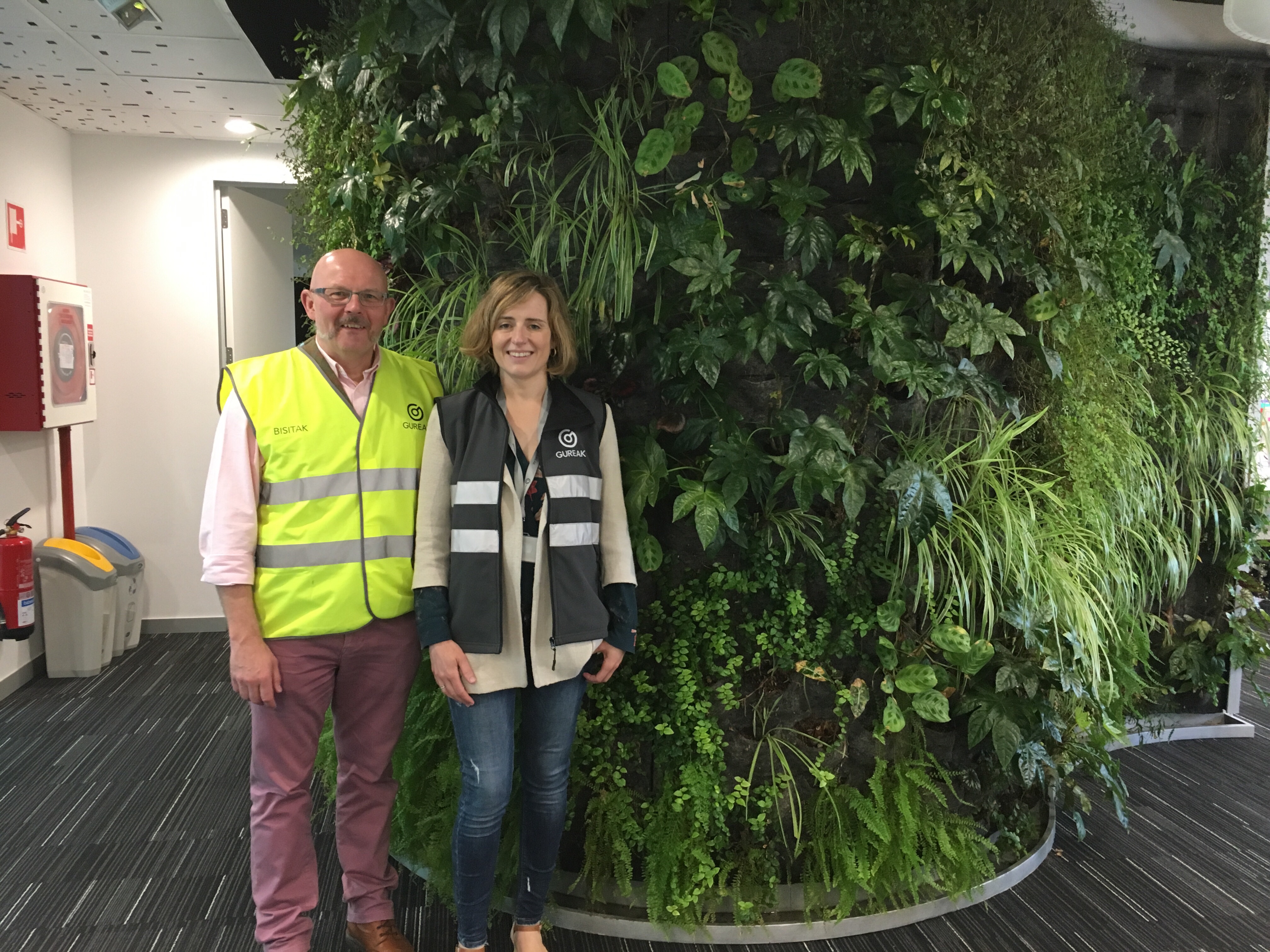
    This is my own picture, me with Maria.

  • Martin and Jon, fantastic hosts, great people.Yesterday I had a “I wish I was 18 again” experience…

    I was wishing I was 18 again so I could go to Bilbao and spend four years doing a degree in Entrepreneurial Leadership and Innovation at Mondragon University. I’m not kidding.

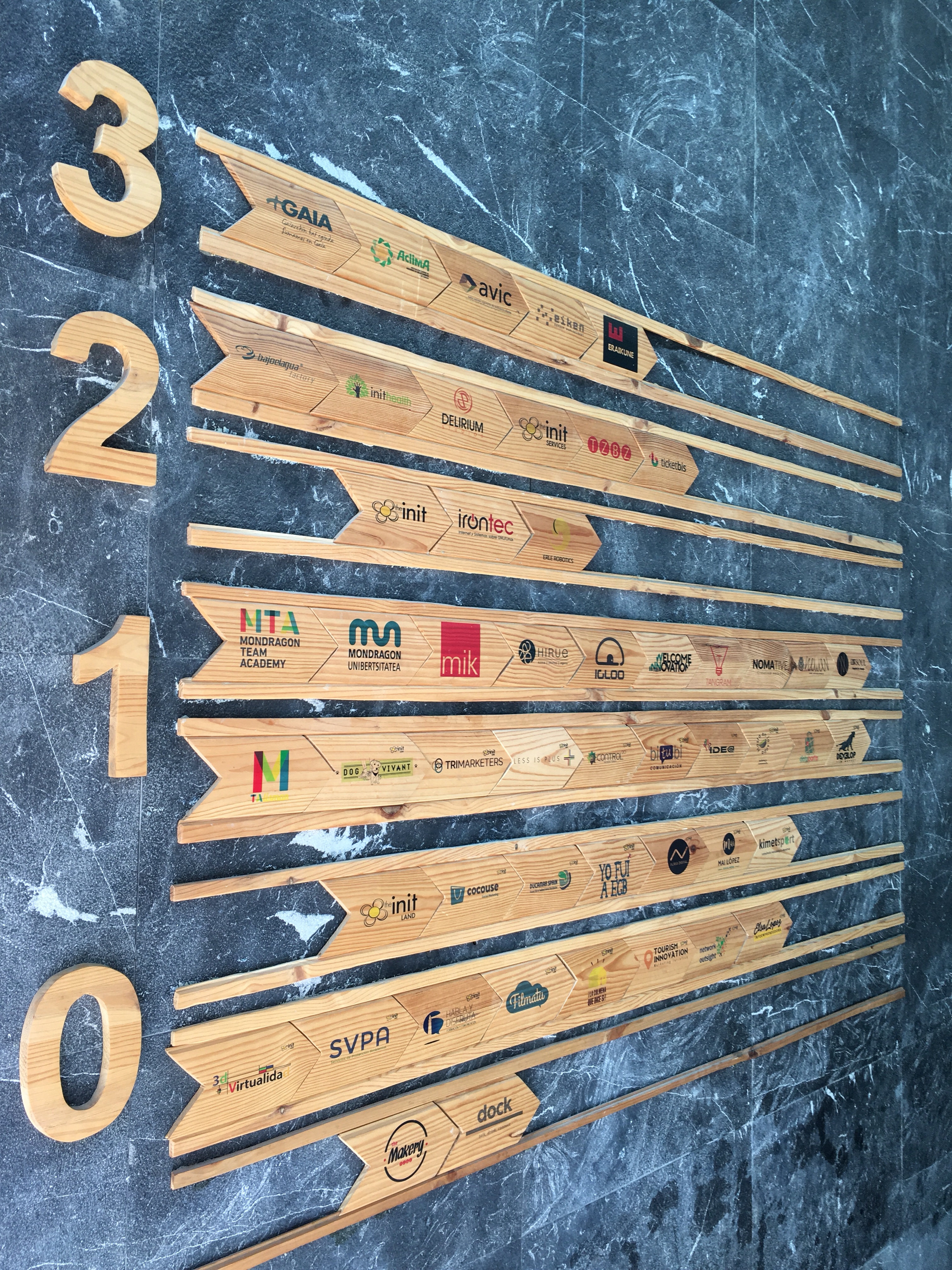
    This was all slightly unexpected, and I’ll cover that in the next post under; ‘the best things happen without a plan’. My ‘meeting free’ afternoon turned into a brilliant opportunity to spent time talking with students (Martin and Jon above) on the LEINN Degree Course (Leadership, Entrepreneurship and Innovation, link here), and touring their Innovation Lab at BBF, Bilbao Berrikuntza Faktroria (even the name sounds cool).

    Cooperative Entrepreneur Bootcamp. The reason I was at BBF is because of a conversation in the shadow of Port Talbot Steelworks, South Wales, back in 2016. The conversation was with the incredibly connected Charlotte Galsworthy (thank you Charlotte) and Gorka Espiau (currently at McGill University in Montreal), link to Gorka’s blog here. Gorka has a strong connections with Mondragon University and spoke about a programme in the Basque Country where people come together to develop entrepreneurship and solve problems. He mentioned things like how cooperative behaviours are ‘encouraged’ right from the start, with people being put into teams and told to ‘get on with it’. I’m not sure if Gorka actually used the phrase ‘bootcamp’, but that’s what stuck in my mind (and I wrote it down).

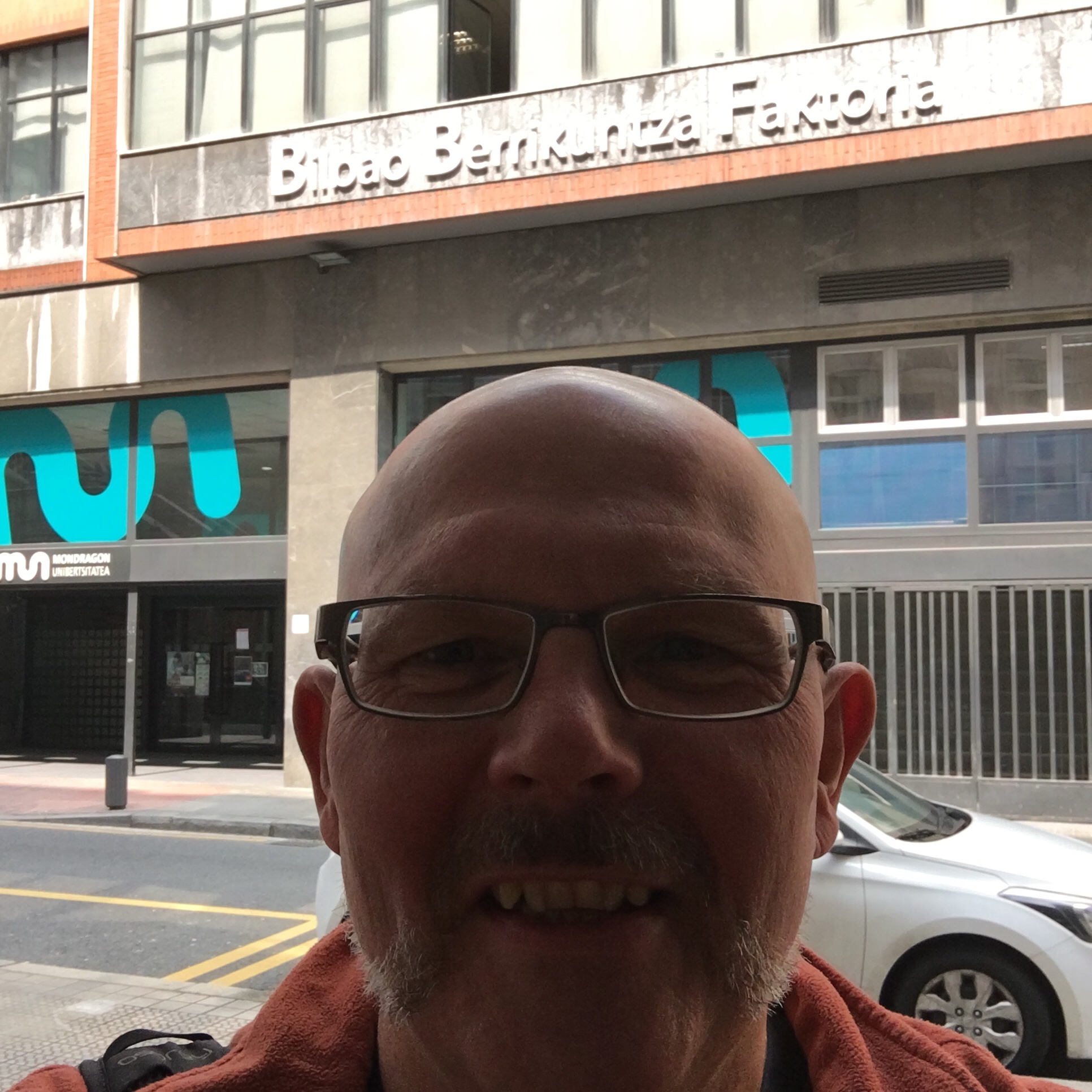
    That conversation lit a small, but significant, fire inside me and two years later, I found myself sitting outside what I think is the Bilbao home of the cooperative entrepreneurship ‘bootcampers’, BBF.

    Courses on Cooperation at a Cooperative University. That sounds almost too good to be true if you are into cooperatives, but it is.

    Mondragon University is part of the Mondragon Corporation, the huge and successful cooperative that sits in the heart of the Basque Country. Here’s a link if you want to know just how big, diverse and successful the Mondragon Corporation is, and there should be more in following posts.

    One of the courses Mondragon University run is LEINN, and you can read it and other linked coursed via the Mondragon Team Academy website, here (MTA).

    There are some absolute gems in the LEINN brochure like:

    • “The aim of MTA is to turn ourselves into the agents of change… adopting co-operative values”
    • “We train participative, supportive and responsible people… People who can contribute to the development of our society”
    • “To experience a different educational methodology in which we celebrate errors”
    • “A commitment to your society and sustainable development”
    • “The teacher has become a team coach… guiding, advising, asking pertinent questions and narrating the learning experience” (one for Paul Taylor, Innovation Coach at Bromford I think)
    • It’s developed from the Finnish Team Academy approach (and everyone in Wales loves Finnish stuff…)

    It’s worth looking at the brochure. It did strike me that what Mondragon are doing here is almost what you might do to grow the future generations that will fully deliver the Well-being of Future Generations Act in Wales, just saying.

    Real Conversations with Real People. This is the stuff that really matters and I just want to share a few of the nuggets I picked up in the conversations and informal tour yesterday. This is a bit unstructured, so please bear with me (better to share early I think):

    • The course attracts people with a passion for what they are doing. That was so obvious. These students absolutely loved what they were doing.
    • Many had tried other ‘conventional’ courses and had dropped them in favour of this learning style. One mentioned that they would never succeed on a conventional course, this was different.
    • Cooperation was essential, people are put in teams with strangers at the start, and they ‘have to make things work’. Being ‘dropped’ into a foreign country to work helped this process.
    • They create real business – I saw some of them on the floor above the lab.
    • Accepting failure happens and learning from it was understood.
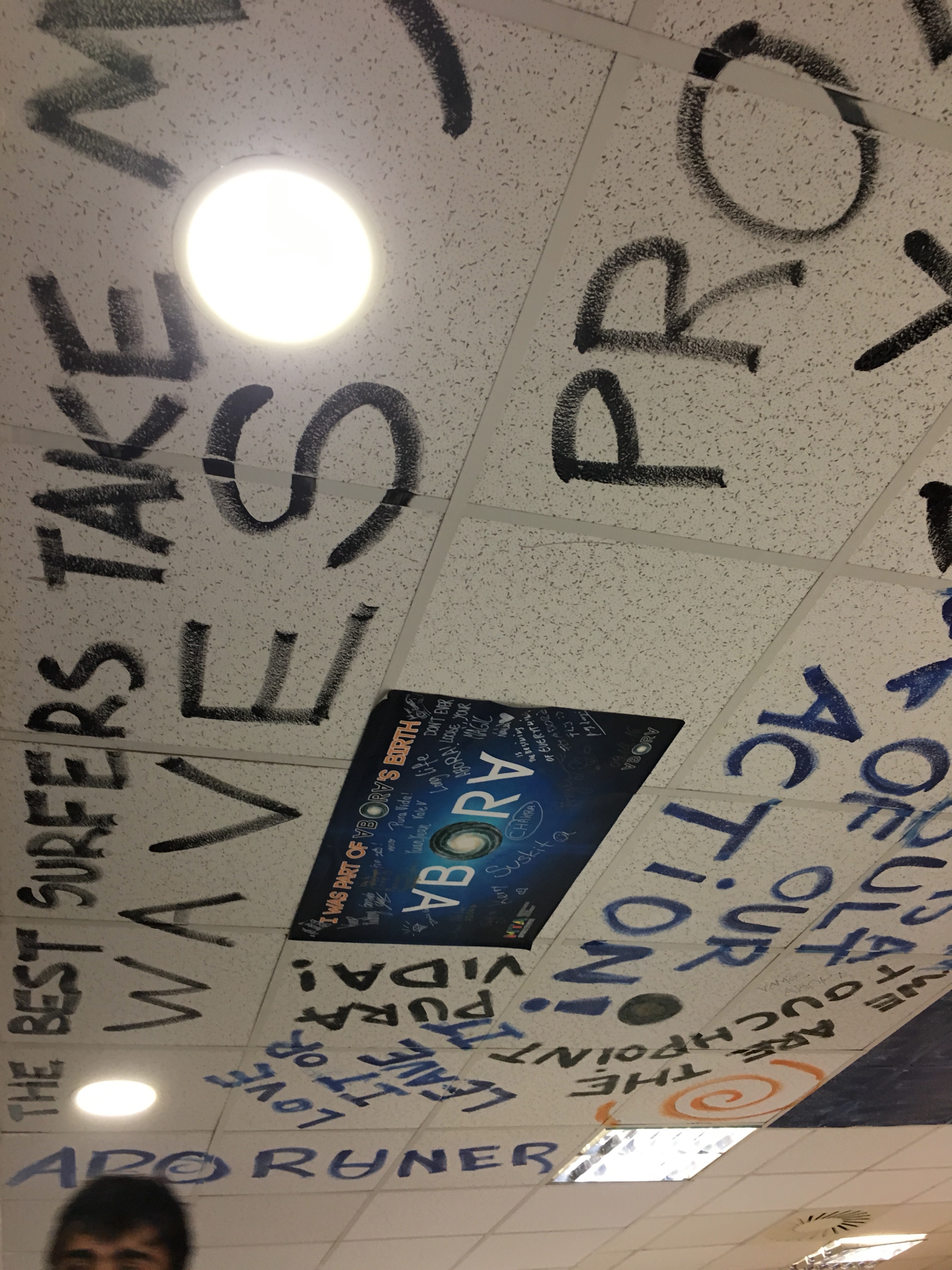
    • It’s really messy in the lab. Great! There were even drawings on the ceiling (pictures below).
    • Fun was mentioned several times and ‘play’, and how this is lacking in the ‘grown up’ business world
    • Cooperative Principles weren’t actually mentioned, because think the are so deeply embedded that they probably don’t need to.

    I could say a lot more, it was slightly unexpected and a bit overwhelming (in a very positive way) to be honest. I’m totally grateful to Jon Azanza (www.bemonkeys.com) and Martin Fernandez de Labastida (www.theworldid.org). Thanks so much to you and your fellow students for welcoming me and being generous with your time and knowledge.

    I’ve put my pictures at the end of the post.

    So, What’s the PONT?

    1. If you are interested in cooperatives, and a cooperative university that teaches you how to be cooperative, have a look at what MTA does.
    2. There’s a strong connection between what’s happening at MTA Bilbao and what we are trying to do with the Wellbeing of Future Generations Act in Wales.
    3. Sometimes the best things happen without a plan. Yesterday was ‘unplanned’ but it was brilliant. More about that in the next post.

    Links to some of Teams I met:

    Jon Azanza www.bemonkeys.com

    Martin Fernandez de Labastida www.theworldid.org

    Mapu www.maputeam.com

    Note to self: this is the first post I’ve written using my iPad. Tidy it up when you get home

  • e704e74e-6e65-4a06-8d30-12576a1dca38-3693-00000371ca2b1095
    I’ve got the card, but do I understand?

    I’ve got my Coop card, purchased for a pound. It entices me away from Aldi and into the local Coop; 5% rewards for me and 1% for my local community. But having the card, and being a ‘Member’ doesn’t mean I actually understand what’s going on. Sadly I haven’t developed a deeper insight into the operation of cooperatives by just having the card.

    This is unfortunate. I’m about to embark on the first leg of my Churchill Travelling Fellowship (details here) to look at large-scale cooperatives, so a good knowledge of how cooperatives work is quite important.

    To be honest, I have actually been learning about cooperatives for a while. This post is a summary of some key questions I’m thinking about and also a bit of, ‘I wish I’d known that when I started’. Hopefully its of some use for anyone else who’s interested in what happens ‘behind the Coop card’.

    “Cooperative” covers a multitude of activities. Nobody will be surprised by this, but cooperatives are as diverse as anything that exists in the private sector. This diversity inevitably creates the desire to categorise things to understand whats happening. One of the categorisations I’ve seen is around the purpose the cooperative. Why does it exist? There seem to be four broad groupings:

    • Consumer Cooperatives– groups that combine to collectively consume a product or service, which gives them a better deal than doing it alone.  This would include my Coop Membership (purchasing cheaper groceries) or even things like Barcelona Football Club being owned by the fans (consuming football).
    • Producers Cooperatives – groups that produce goods and services that get a better deal when they sell their products collectively, or collectively obtain services to support their business. For example, small agricultural producers who cooperate to strike a better deal with a big supermarket, or they might collectively ‘buy’ specialist marketing services to sell to other territories.
    • Community Cooperatives – the boundary between consumer and producer blurs a bit here. A community might be motivated by things other than the ‘best deal’. For example community housing or a villagers owning the Post Office and shop will probably have more of a focus on the social (community) benefit than the economics of the best deal.
    • Worker Cooperatives – Basically this is about control. The workers own the business, do the work, make the decisions and receive the rewards for their labour. In practice it is often more complicated with a focus on society, community, and ethical behaviour featuring in how many worker cooperatives operate.  Worker cooperatives are the main focus of my trip to the Basque Country in NE Spain.
    • Multi-Stakeholder Coops – these bring together community, consumers (service users) and producers (including workers). Thanks to Adrian Roper of Cartrefi Cymru for sharing this, which you can read about in the comments below.

    The Seven Principles of Cooperatives. The are some specific ideas on what the purpose of cooperatives should be. The International Co-operative Alliance (www.ica.coop) promotes these seven principles which are aimed at helping cooperatives operate (see website for a full explanation):

    1. Voluntary and open membership
    2. Democratic member control
    3. Member economic participation
    4. Autonomy and independence
    5. Education, training and information
    6. Cooperation amongst cooperatives
    7. Concern for the community

    This video from the National Rural Electric Cooperative Association (representing the interests of 900 electrical cooperatives in the United States) gives a good explanation of the Seven Cooperative Principles.

    Education, Training and Information. Coming back to my Churchill Fellowship, I’m particularly interested in Principle 5: Education, Training and Information.

    The detail of the Principle is: Co-operatives provide education and training for their members, elected representatives, managers, and employees so they can contribute effectively to the development of their co-operatives. They inform the general public – particularly young people and opinion leaders – about the nature and benefits of co-operation.

    I am trying to find out is there is any link between the resources and effort put into achieving this Principle and the success of the cooperative? If there is a link, what does successful delivery of Principle 5 look like?

    Worker cooperatives have to deal with tensions.  This is a complicated one to explain and I’m probably going to have to come back to it in another post.

    Briefly the issue is around the tension the exits in a number of areas which include:

    • Making a profit and Principle 7, (concern for the community) are they compatible?
    • Speeding up decision-making (through centralisation) and maintaining Principle 2, democratic member control,
    • Involving literally anyone, and Principle 1: Voluntary and open membership (do you ‘select’ only ‘suitable’ candidates for membership?)

    Just to get a sense of the tensions I recommend looking at this video from one of the workers at SUMA Wholefoods (link here). It’s a very frank explanation of the challenges and benefits of being part of a worker cooperative.

    There are some interesting comments like; “management is a function, not a status”, and “we try continuously to dis-empower executive managers”. I think this is linked to the idea that too much power resting in the hands of a few ‘elites’ works against Principle 2: Democratic member control. The video is well worth watching.

    What about the Benefits of Cooperatives? I could go on about this a length. There are very many benefits that come from worker cooperatives, examples include;

    • They are more productive than traditionally structured businesses (9%-19%);
    • They’ve consistently outperformed FTSE companies;
    • 69%  of Employee Owned Businesses have zero debt;
    • They created more jobs during the last recession than conventional companies;
    • They preserve more sustainable jobs in deteriorating market conditions; and
    • I could go on… but you may prefer this short video from Co-operatives UK, which neatly sums up the benefits of cooperatives.

    Finally, I would like to thank Dr Sarah Jenkins at Cardiff University Business School for sharing knowledge, and generously spending time talking with me about her research into cooperatives, thank you Sarah.   Here’s a link to some of Sarah’s publications.

    So, What’s the PONT?

    1. ‘Cooperative’ is a word that is used commonly to describe a diverse range of activities.  Having a Coop Card didn’t mean I understood this.
    2. The Seven Principles of Cooperatives are a useful reference point and a reminder of why cooperatives exist and their purpose.
    3. The benefits of cooperatives are extensive. I’m just left wondering why they aren’t more widespread…
  • 1484e4ec-60e7-42a0-b1b0-8b8353b134d0-13580-00000fd45a6bc089
    Just a quick selfie please…

    Here’s a question. How do you find a parking space for someone visiting your organisation?

    Is it as challenging as securing a visa for a sightseeing tour of North Korea, for you and your friends from the photography club? Alternatively, do you just check for an available space and book it? Simples!

    Recently I shared this post; ‘if you want to understand your own culture, spend time in someone else’s’.  This led to a conversation with Richard McCrory (@iamdoctord) about different ways of understanding organisational culture. The idea emerged of doing an assessment of culture by observing how an organisation does mundane things.

    No focus groups droning on about culture. No awkward sessions with people trying to draw ‘the culture’. No search for the truth in strategy documents. No analysis of the performance and impact measures. And hurrah, NO TICK BOX SURVEYS of do you, ‘strongly agree / strongly disagree with the following bizarre statement…’.

    Just sit back and observe, or even better, try to do a few of the mundane things yourself. You know, the day-to-day stuff that keeps an organisation ticking over.

    Watching things tick over. Behind the conversation was the idea that the approach to these mundane, everyday things is very likely to be a reflection of culture in the rest of the organisation.

    If the process of getting a car parking space for a visitor is; slow, needlessly complicated and not focused upon the needs of the visitor (the customer), there’s a fair chance that this approach is likely to be replicated in other parts of what the business does (or am I being too simplistic?)

    Alternatively, if the process of getting a car parking space is designed with visitors in mind; quick, straightforward and as helpful as possible, there’s a chance this is also reflected in what the organisation does.

    Before I move on, it might be worth pausing to think about a recent example of when you have tried to park somewhere as a visitor, customer or service user. For me, my visit to a John Lewis store to collect a package, and an appointment at the outpatients department of a hospital spring to mind. They were very different experiences. I’ll leave it up to your imagination to work out how.

    noparking

    Focusing on Mundane Things. Getting back to the conversation about culture, we decided that we really needed a suite of ‘mundane things’ which we could use to assess culture. We also needed a scale for measurement (everything’s got to be measurable, hasn’t it?), and I’ll get to that in a minute.

    In the meanwhile, here are a few of the mundane things that could be used to assess the culture of an organisation. I’m sure there are many more, please feel free to suggest your own. The idea is that you choose examples from the suite that are most representative and useful for the organisation you are looking at. Here goes:

    1. Book a parking space for a visitor
    2. Book a meeting room where you can talk to the visitor
    3. Get the visitor into the meeting room (past reception / security / bag scanning etc)
    4. Provide the visitor with a hot beverage (or a cold one)
    5. Book a train ticket for a business trip to London (or out of London if you work there)
    6. Speak directly to the Big Boss / Chief Executive (or anyone two ranks above you if you work in a many layered organisation)
    7. Send a letter of thanks to someone, outside of the organisation, who’s done something helpful
    8. I could go on… you are very welcome to suggest others

    Bureaucratic Hell or Hippy Fantasy? – The Measurement Scale. I’m hoping this suggestion is a slightly more realistic measurement scale. It’s not linear, running from very good to very bad (or the other way around if you fancy). It’s basically two extremes, both probably wrong, and roughly the opposite of each other.

    If you are familiar with the dyad/sliding scales used in SenseMaker you’ll get where I’m going here. In the middle it’s the Goldilocks Zone, not too much or too little of either. For most of the time, in a reasonably balanced ‘just right’ culture. The Goldilocks Zone is probably where you would want to be most of the time. You shift towards the ‘extremes’ depending on the context (a Bureaucratic Hell or a Hippy Fantasy).

    So, how does this work with one of the activities from the ‘suite of mundane things’? How about Number 4: Providing a Visitor with a Hot Beverage? 

    MEETING_2

    I’m sure you get the get the gist. I’m quite enjoying this. How about:

    Number 6: Speak directly to the Big Boss / Chief Executive (or anyone two ranks above)

    BOSS_4For anyone who happens to work in the Bureaucratic Hell culture, here’s a graphic explaining the Bird of Paradise Dance. It probably won’t help you get a meeting with the Boss’s Boss any quicker, but it might help ease the pain,… remember, The Bird of Paradise has an elegant dance…

    c6a5dd42-bbea-43ac-9479-54f1d42ea0b3-13580-00000fd585730233
    Source: https://newsela.com/read/elem-animal-atlas-australasia-oceania/id/32619/

    So, What’s the PONT?

    1. How an organisation does the mundane things probably says a lot about the rest of their culture.
    2. Stepping back and observing the mundane things, or even trying to do them can tell you a lot.
    3. Culture doesn’t have to be a Hippy Fantasy, but neither does it need to be a Bureaucratic Hell. The Goldilocks Zone is just fine. Just remember that next time you are offering a hot beverage to a visitor, “…it’s not too hot and not too cold, it’s just right…”.
  • Fulfilling the promise I made in my initial blog post (link here), I’m starting to share some learning from my Churchill Travelling Fellowship. This post summarises the whirlwind since the 2018 Fellowships were formally announced on the 9th March and today, the 25th. It’s been as interesting and exciting as people promised.

    img_0189Thanks… and Don’t Panic. First off, I’ve been a bit overwhelmed by the level of interest.  Along with telling family, friends and work colleagues I wrote the initial blog post and shared it via Twitter and LinkedIn. I’ve had a few things shared quite widely around Twitter in the past, but nothing like this.
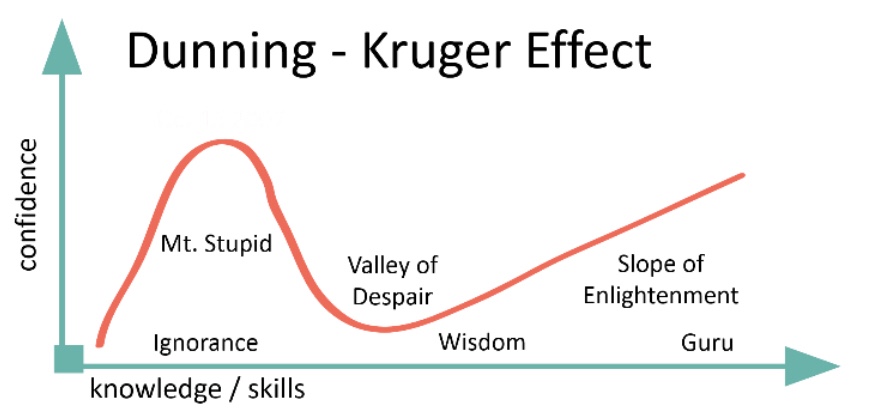
    What was really astonishing were the number of people that took the time to wish me well, make suggestions and kind offers of help. Thank you all very much, I’m extremely grateful.

    Where it got slightly panicky was around the statistics that LinkedIn provided, telling me who’s been looking at my post. Out of 4400 views, apparently 48 were people in the Welsh Government and 36 from Grant Thornton LLP. I don’t think I’ve ever been so conscious of something I’m doing being noticed. I’d better make sure I deliver on what I’ve said I’ll do, particularly with over 600 views from Cardiff (I need to be able to hold my head up as I walk down Cathedral Road).

    A Dunning Kruger Moment. On the 20th March I headed off to Westminster for the New Fellows seminar organised by the Winston Churchill Memorial Trust. This was an opportunity to; learn about what it means to be a Churchill Fellow, what’s expected of me, what I’ll need to do to make my travels a success and an extremely valuable chance to meet other Fellows.

    This is where I had my Dunning Kruger moment. For those not familiar with the term it is explained here, and basically means; a lack of knowledge and experience can give you a false sense of confidence. The fact you know ‘nothing’ doesn’t stop you thinking you are brilliant, and can do anything…

    Anyway I had a moment of realisation that:

    • I was surrounded by brilliant people, who knew tons of stuff about their subjects,
    • Most of them seemed to have spend half their lives travelling the world, founding cool startups, social enterprises, or both.
    • What do I know about cooperatives?
    • Am I competent to be let out on my own in a foreign country?
    • Arrrgghhhh… I’m doomed.

    I suppose the joy of knowing about the Dunning Kruger effect is, once you realise you are sitting on top of Mount Stupid, you can do something about it. I’m just hoping that my Valley of Despair isn’t too deep and wide (see graphic below).

    ba635e42-6ddb-428e-8990-6f1673685915-10900-00000bbf95b86616
    Source: unknown, there are many versions of this on the web

    Coincidentally I ended up having a conversation about competency with co- founder of The Do Lectures, Andy Middleton later in the week. We focused on behaviour change in public services and the idea of Minimum Viable Competency to do a variety of jobs. It did get me thinking about the idea of a Minimum Viable Competency (MVC) to successfully operate a cooperative. Would it be the same MVC for all cooperatives, large or small? Would MVC vary depending on sector? One to think about for my travels (and the subject of a podcast I recorded with Andy – I’ll put the link here once it’s edited).

    Practical Stuff, and Getting Out of The Valley of Despair.  The good news is that the seminar on the 20th did give me some really useful practical advice on what I need to to do if I’m to make the Fellowship a success. Here goes on my 5 takeaways:

    1. Don’t over do on the scheduling. I need to leave space while I’m travelling to reflect upon what I’ve learnt and make sense of it.
    2. Begin with the end in mind. Have a clear idea of who I want to influence when I get back, and what will work with them.
    3. Work as I go along. Don’t leave the analysis and write up until the end. Do as much as I can while I’m travelling (see number 1).
    4. Be flexible and respond to opportunities. Apparently things will emerge, and I will need to be flexible to identify and use these opportunities.
    5. Enjoy myself. This isn’t the day job, and I’m more likely to learn if I’m enjoying myself.

    On reflection, that feels like a list I could apply to pretty much anything, hopefully including the detailed itinerary planning which is next on my list.

    So, What’s the PONT?

    1. People have been extremely generous in their congratulations and suggestions of help, thank you very much everyone.
    2. Approaching the unknown is scary, but at least I now know about the Dunning Kruger effect, and I’m trying to work out what will be my Minimum Viable Competency.
    3. Practical advice (particularly that given by previous fellows) is invaluable, I’m going to make the most of it.

    Finally, if you like a singsong, here’s an explanation of the Dunning Kruger Effect set to music, the Dunning Kruger Song from the Incompetence Opera (I kid you not). Nessun Dorma will never be the same again.


  • img_0282
    Were these chairs etc from a ‘collection’? All very TED.

    I was at the National Museum of Wales, Reardon Smith Lecture Theatre in Cardiff last week, a fabulously retro venue that transports you back a 100 years (I love it; my companion wasn’t so keen). The reason was to listen to a conversation between David Hurn and Martin Parr, both highly accomplished documentary photographers.

    It was linked to the ‘Swaps’ exhibition at the Museum. Swaps is literally an exhibition of photographs David Hurn has gathered by swapping his photographs with other photographers. That’s a pretty interesting concept. I can’t think of another situation where this sort of thing happens. Maybe computer coders do this sort of thing with code they have written? Who knows..?

    Also, Martin Parr gets described as a someone who’s projects take an, “intimate, satirical and anthropological look at modern life”. Satirical and anthropological views on modern life are right up my street, so I was looking forward to this, and I wasn’t disappointed. Don’t expect any insights into the technicalities of documentary photography to follow. Here are a few things that I did learn that aren’t specifically about photography.

    1. Hard work and passion count. This was a recurring theme during the conversation. From references to driving for hours to get to a location with the right light conditions, through to spending every weekend for a few years at New Brighton beach, it came through. One thing that did strike me was a comment that you can spot the passion and hard work in a photograph. Both of them had judged many photography competitions, and they could detect the hard work and passion.

    I recognise that idea. Developing deep expertise isn’t a quick process. It needs hard work and commitment, whether it’s in photography or something else. Get the basics right before becoming brilliant, which I did write about a while ago in Learn the Rules Like a Pro, so you can Break them Like an Artist.

    2. Being human matters. Working as a Butlin’s ‘roving photographer’ in the 1960’s was an excellent way of developing people skills it turns out. I know some people get a bit ‘sniffy’ about the photographers who are present at lots of events and venues, taking pictures with the aim of you buying the print. If you’ve been on a cruise ship you’ll recognise this, but maybe we should be a bit kinder to them? Roving photographers have literally seconds to establish a connection and build enough trust to take a photo that captures something that’s much better than the grimace that says; ‘please go away, I don’t like you’.

    It’s a tough job, where I’m guessing you have to learn fast to survive. I’ve thought for a long time that everyone should spend time in a front line customer service role. Working in a shop, selling newspapers (I did both), or roving photographer to learn some of those skills of how to better interact with other people. I’ve encouraged my kids to do it, although they might not see it from my point of view now, I hope it will help them in the future.

    Here’s a link the Butlin’s Blog which talks about why they reintroduced roving photographers

    img_0285
    Martin Parr (left) and David Hurn with Abandoned Morris Minors of Western Ireland in the background

    3. Learning and collaboration. This intrigued me. David Hurn spoke about the situation in the 1960’s where photography was developing as an ‘art’. During this time many of the people,who went on to great things, used to meet and share ideas. He spoke about the collaboration, learning from each other and a lack of competition.

    This might have been the ‘spirit of the age’ or I do wonder if it’s about the lifecycle of a new movement / idea? The ‘pioneers’ are more interested in furthering the practice rather than squeezing financial gain out of it? Is learning and collaboration easier in an environment where everyone is motivated by something other than money?

    There does feel like a bit of a parallel here with the ‘early years’ of social media (the late 2000’s ha ha). Things like blogging felt a bit more collaborative then, rather than the frantic scrabble for ‘views’ and advertising revenue you see more of now.

    4. Cooperatives have a long life. I didn’t know that they were both members of Magnum Photos, and that it was a cooperative operating internationally. The fact that it has been around for over 70 years (established 1947) is impressive. I think it was David Hurn that said it has survived when many other commercial outfits have collapsed.

    It was also mentioned that Magnum have changed what they do to reflect modern demands and are in a good financial position with the future looking positive. Having good staff , which they invest in, was a key part of that. That’s not a particularly different idea, but I do wonder if their cooperative approach had anything to do with the success and long lifespan?

    5. Adopting technology, where it works. Inevitably there was some talk of photography technology, mostly raised in the Q&A. Both of them had moved on to new technology, when it worked better than what already existed. There seems to be little argument for stopping using dangerous, smelly chemicals to develop and print in a darkroom. However this was only done when the digital versions could at least match what the chemical process could produce.

    On the digital camera argument David Hurn summed it up neatly. “It’s all about the stream of light that enters the box. What’s behind doesn’t really matter, you need to work to be in the right place at the right time to capture that stream of light.” Work hard for what you want…

    So, What’s the PONT?

    1. If you want to be good at something, you need to work hard at it. Happy to have that discussion with my youngest son if he happens to read this and questions my view.
    2. People skills are really important. The best way to develop them is by involving yourself with people. A stint in retail isn’t a bad way to do this, or roving photographer.
    3. Technology is great, if it’s better than what you’ve got already, and working hard to be in the right place at the right time is equally important.
  • Cool Story Bro… be cautious of Organisational Storytelling and Silver Bullets
    f7f39d82-6642-4156-95fa-5f7a85d6b80a-36590-000019f5e94e5782
    Wayne’s World. Most Excellent Organisational Storytelling Bro.

    Cool Story Bro. I’m feeling mildly guilty at the moment. I might have been a little bit over sceptical and grumpily dismissive of the heartwarming stories told at conference. I know, I sound like a cold-blooded reptile, but I’ll let you decide.

    For the after lunch slot two highly respected leaders took to the stage and told their ‘stories’. Unfortunately, they were  basically the same story (despite the black and white photos taken 150 miles apart over 70 years) , which is where it  all went wrong for me.

    Heroic individual saves a person in distress. I might have been able to ‘suspend reality’ and enjoy a single heartwarming story. However, listening to the same thing back to back felt a bit contrived, and snuffed out my Disney approved, ‘I Believe’ sensor. Here goes with the aggregated version;

    • Doris/George (insert names as appropriate) is in their 80’s and has lived a long and  happy life,
    • They had a fulfilling job, a neat home, raised a family and were solid members of their community,
    • Even during tough times they were resilient and self-reliant, having little involvement with public services (this is starting to sound like a Billy Bragg song),
    • Then, 5 years ago, Doris/George’s partner died,
    • Doris/George starts to go downhill. They become isolated, lonely, increasingly unwell and “bit of a burden on public services”,
    • You know this part of the story… Doris/George has repeat visits to the Accident and Emergency Department, involvement from Social Services etc, etc,
    • Enter the unassuming heroine from somewhere in public services (usually the voluntary sector) who battles against the ‘system’ and does something to change Doris/Georges’ life,
    • Doris/George is now a ‘ninja’ (stalwart) at the local Knitting Nannas / Men’s Sheds Club and is predicted to live independently until 105 years old,
    • And the moral of the story?
    • Small actions by dedicated public servants, prepared to be innovative, and operate outside of the system can change people’s lives,
    • Lovely…
    • Everyone is now inspired to go away and make a difference.

    416b93f7-a070-4807-a3d9-27ea3b875a3c-36590-000019f9c1806a4d

    Pass the ‘Cool Story Bro’ Hat. If  you’re a follower of  meme’s you’ll recognise ‘Cool Story Bro’  as an insult or sarcastic response used to dismiss a very long or ‘off the point’ story. In my opinion it can be equally useful in the world of organisation storytelling, especially if we can wear hats!

    The fact that the conference stories were told so closely together did not help with my skepticism. I’m sure these were well-intentioned actions to get a message across, using ‘story’ as the method.

    However, a few things rattling around my head made me question the approach. Specifically, how do you avoid ‘Silver Bullet Syndrome’ in organisational storytelling and come across as credible?

    img_7145
    https://whatsthepont.com/2017/05/29/the-life-cycle-of-a-silver-bullet/

    Sliver Bullet Syndrome and Organisational Story Telling. This is going to sound really bad, but it felt like the stories I heard at the conference were a good illustration of; Stage 8 of the Life-cycle of a Silver Bullet – Standardisation and Superficial Copying.

    Storytelling, done properly, is a really powerful and effective way of sharing knowledge and shaping the way people behave in organisations, and wider society – we’ve been doing it for thousands of years. It’s not just another new ‘business tool’.

    Just to reinforce my suspicion that organisational storytelling has become ‘industrialised’, this week I received yet another invite to a Storytelling Course. It was giving me the chance to “…set sail towards a more engaging and succinct narrative…to move beyond data, ‘facts’ and information…to create a shared vision of success that will, inspire, unite and motivate colleagues.”  I’m not making this up. It was all neatly compressed into a day long course for the meagre sum of £750 (plus VAT).

    Really? That does smell a bit like ‘Standardisation and Superficial Copying’ to me.  I reckon I would take a bit more than a day long course to get me ‘setting sail’ as an expert storyteller.

    My preferred approach to becoming proficient at something is to take time to understand, and practice…. lots of practice! A good starting point is to read things that clearly explain the theory and gives pointers on the practice.

    With that in mind I’d strongly suggest reading this by Dave Snowden; Narrative Patterns, the perils and possibilities of using story in organisations. 

    I read it first a few years ago and I’m now seriously looking at it again; in a lot of detail. Concepts like Anti Stories and the differences between Fables, Myths and Viral Stories all have huge relevance in all aspects of organisational life.

    What stands out is that using stories requires diligence and skill that has to be developed over time. A quick fix silver bullet solution is unlikely to help you sound credible or make a difference.

    Finally, are there ‘Universal’ Stories?  I know I said I felt mildly guilty for my skepticism, and this is part of it. At the core of the conference stories was the idea of someone who falls on hard times, meets someone who helps them and is put back on the straight and narrow.

    That might sound familiar, because it is. It’s a plot common to many films and books and had been extensively covered by people like Kurt Vonnegut who talk about the Seven Universal Stories.  Maybe the conference speakers have been unlucky enough to have chosen the same universal story to speak about? More about that in the next post.

    So, What’s the PONT?

    1. Storytelling is an effective way of sharing knowledge and shaping behaviour. We’ve been doing it for thousands of years.
    2. Like anything worth doing it’s not a quick fix or silver bullet. It takes time and practice to learn how to do it effectively.
    3. Get it wrong, and you run the risk of people putting on their ‘Cool Story Bro’ hats (and T-shirts). We are all quite good at spotting duff stories.

    An Update. Here’s a indicator that the ‘industrialisation’ of a method might be well underway, and things are approaching ‘Peak Stage 8’ of the Silver Bullet Lifecycle.

    Have a look online to see if it is being combined with any of the latest hot subjects or management fads and sold as a half day course. Try searching for: Digital Storytelling, BigData Storytelling or Agile Storytelling…Cool Story Bro!

  • Looking at a Gantt Chart using a mirror (failed attempt). It’s not that easy.

    Here’s a thing. Have you ever had a conversation where someone says; “let’s hold the mirror up to that one”, you make agreeable noises and nod your head in a seriously earnest way?

    However, deep down you are wondering; “what on earth does that even mean?”, “how do we stick a project review action plan in front of a mirror?”, “does this involve me standing in front of the bathroom mirror photographing A3 Gantt Charts?” Arrggggghhhh!

    Help from The Bard? Hamlet, Act 3, Scene 2, Lines 20-21. If you studied English Literature in school you might be familiar with this quote from Shakespeare, “to hold as ’twere, the mirror up to nature”. Maybe this is what it’s all about?

    I was always rubbish at interpreting what important literature means, so for definitive guidance I’ve gone straight back to every students favourite, the No Fear Shakespeare sparknotes. Apparently the quote is simply direction given to the actors to not exaggerate in their performances. They need to represent the reality of life, good and bad. The purpose of the play is to be a ‘moral reminder’ for those watching, and the actors need to avoid overdoing it.

    That’s all well and good, but not a lot of use for the Gantt Chart mirror challenge. More help is required.

    img_8265
    Do go and listen to this…

    More help from Art: BBC Radio 4, Only Artists. This is more like it. It turns out ‘holding up the mirror’ is a physical thing that painters actually do! The purpose is to get a different view of the work.

    It’s far better explained by Painter Jonathan Yeo in his conversation with Music Producer William Orbit in this episode of Only Artists. I’d very much recommend listening to the whole 30 minutes (it’s really entertaining and informative, one of the many reasons I’m happy to pay the BBC licence fee). However, if you are short of time it’s between 24.20 – 24.40 minutes here on the Podcast. If you aren’t quite sure if my over enthusiastic recommendation is worth the investment of your time, here’s the gist of what Jonathan Yeo says:

    …”The reason you look at things in the mirror when you are doing a painting is to make it look unfamiliar. Because when you’ve been looking at something for a long time it looks right to you, you can’t see the mistakes any more. It looks right just because you’ve got used to it. You look at it in the mirror to see it fresh”…

    It turns out that painters have been doing this for ages and have all sort of techniques to see their creations with ‘fresh eyes’. Have a browse of this Community discussion on ‘Wet Canvas’, where looking at paintings; in mirrors, upside down, through sunglasses and even welding goggles is perfectly acceptable (though not all at the same time, I’m guessing?)

    Musicians are at it too. Responding to Jonathan Yeo, William Orbit shared a few of the techniques that are used in music to ‘hold up the mirror’. These included:

    • Listening to a track backwards,
    • Slowed down or speeded up,
    • Turning the headphones around,
    • Listening from another room (like the kitchen while making a cup of tea),
    • With different ears (basically, get someone else to listen and give feedback).

    Some of this sounded similar to the Oblique Strategies method I wrote about in Random Disruption, Rock Stars and Innovation, which is (apparently) widely used in the music industry to unblock creativity.

    One of the other interesting things that William Orbit said was, that you should absolutely ‘hold up the mirror’ if what you are working on feels like the best or the worst work you’ve ever done. I think that’s an important point and fits very closely with what Jonathan Yeo said about not being able to see mistakes as you’ve become too used to seeing what’s in-front of you. I wonder how many times I’ve laboured over a report or briefing note (or blog post) and have failed to see the mistakes because I’ve become too familiar with it? Every single time if I’m honest.

    So, how do you hold up the mirror? In the world of written work the ‘standard’ technique would be for someone else to review what you are doing. That’s fine in theory, but it always runs the risk of the reviewer indulging themselves in their ‘red pen teacher fantasy’, you getting offended and everyone retreats to their bunkers. Not the best outcome.

    Looking at the techniques from painting and music I wonder if we should be thinking about something similarly creative for the Gantt Chart Challenge? What would the Gantt Chart look like if you literally did look at it in the mirror? I’ve no idea, but it might give a view on mistakes, ‘uneven delivery timeline balance’ or who knows what? So, if someone does say, “lets hold up the mirror”, suggest a few experiments to see what works. Better to see the mistakes yourself than wait until the work is on public display.

    So, What’s the PONT?

    1. If you spend a long time focusing on the same thing it becomes very familiar and you run the risk of not ‘seeing’ mistakes.
    2. Another viewpoint or taking a ‘fresh look’ can help to spot the mistakes before they are exposed to public scrutiny.
    3. Painters and Musicians have techniques to do this. Rather than just saying ‘hold up the mirror’, it’s worth testing a few methods that would allow you to actually see things differently.
  • 333a5016-95d7-4a04-96ef-83880f143491-3190-000002f66021e561
    Know anyone with this as their favourite mug?

    Here’s a quick quiz.  Where did the phrase ‘Failure is not an option’ originate? 

    1. Queen Boudicca AD 61, in her famous  rallying call to the Iceni Tribe before taking on the occupation forces of the Roman Empire.
    2. Chief Engineer Isambard Kingdom Brunel 1835. In his brief memo to all Great Western Railway staff, stressing the importance of building a fast and  reliable (under 2 hours) link between London and Cardiff.
    3. Hollywood Script Writers Al Reinhart and Bill Broyles, 1995. Created as the tag line for the Apollo 13 movie.

    The answer is obviously 3, the 1995 tag line to Apollo 13. But it does feel like an expression has been around for ever. One of the ‘standards’ you hear rolled out in organisations with monotonous frequency, often by someone who’s been on a performance management course. Even grown-up organisations like NASA and the Smithsonian Institute will sell you; mugs, t-shirts, mouse-mats and other paraphernalia with it emblazoned upon.

    The story behind ‘failure is not an option’ is worth reading (link here). It apparently came about from an interview with Apollo 13 Flight Controller Jerry Bostick who was asked what happened when things went wrong, “did people panic?” The answer was “No, when bad things happened, we just calmly laid out the options and failure wasn’t one of them”. Thanks to Roxanne Persaud (@Failwise) for alerting me to what feels like another NASA inspired urban-myth.

    Failure is inevitable and so is blame. A recent Twitter thread by David Oliver (@mancunianmedic) generated an explosion of commentary about risks, mistakes, failure, accountability and blame. I’ve linked to the conversation here and have included screen shots of the initial 8 Tweet thread at the end of this post.

    The basic gist is:

    • Failure happens in medical situations;
    • This mostly isn’t due to ‘deliberate’ acts;
    • Situations are frequently complex with high levels of risk and many unknowns;
    • The ‘system’ often has in built errors like inappropriate staff numbers, skill shortages or exhausted medics;
    • People on the receiving end of treatment are often very ill;
    • Some times failure is inevitable;
    • When things go wrong, people get blamed and held ‘accountable’;
    • Accountability and blame are usually associated with some form of  punishment or sanction;
    • This can have devastating effects on them, the people around them and throughout the rest of the system; and
    • This raises a question, is it easier to blame individuals than fix the system they are working in?

    It’s the impact of  the ‘blame’ and punishment that really interests me. This is from two perspective:

    1. What people do about future failures; and
    2. How do you learn from these experiences?

    Sweep it Under The Carpet Approach. Keith Grint from the University of Warwick talks about the ‘under the carpet’ approach to failure, which has been adapted from work by Robert Westrum of the University of Michigan. Basically, if something goes wrong; hide the evidence, or look for someone else to blame. This flow chart summarises perfectly.

    img_8232

    For me, the act of looking for (and finding someone) to blame creates a self-reinforcing feedback loop. Once someone has experienced failure, and then the pain of blame and punishment, how are they going to react in the future?  Will they happily share the bad news or dive straight into this flowchart? Anyone in a position of power might want to ponder on that for a moment (and quietly dispose of the ‘Failure is not an option’ mug).

    Behaviour is shaped by the preoccupations of management. Westrum in his earlier work described three broad organisational cultures in relation to how they interact with failure; Pathological, Bureaucratic and Generative. I’ve taken the explanations below from a paper by Patrick Hudson which explains the development of Health and Safety Culture in the Oil and Gas Industry (more of that in the next post).

    img_8233

    The flow chart from Keith Grint essentially describes the Pathological Culture, you may have seen it in operation?

    For the Generative Culture,  is is entirely possible that there are organisations (or groups of people within them) that are actually doing this.  I’m just not lucky enough to bump into them on a regular basis – with a few exceptions, including  Bromford Lab. It is worth following what Bromford Lab do as an example of well managed, intelligent failure. The fact that they work ‘in the open’ (see their Trello Board project website) is a pretty good indicator (in my view) of a Generative Culture.

    I did mention learning from experience earlier and just wanted to emphasise something. Every buried failure is a buried opportunity to learn something and share that experience with others who might benefit from your experience. Just saying…

    So, What’s the PONT?

    1. Failure is real and inevitable in many situations. It’s how you respond that matters.
    2. Blame (and punishment) shouldn’t be inevitable. Deliberate failure is very rare. ‘Blaming and shaming’ will shape how people respond to future failures.
    3. Management preoccupations shape culture. If you’ve got a ‘failure is not an option’ mug – quietly get rid of it.

    Here’s a link to the other things I’ve written about failure.

    Here’s the David Oliver Twitter thread that prompted this post.

    D_Oliver1

    D_Oliver2