• Why does everything cost £4,999?

    Workarounds, common behaviour? Obviously ‘everything’ doesn’t actually cost £4,999. However, if you work in public services sometimes it feels like a lot of things do. It’s linked to some common behaviour you see around procurement and ‘workarounds’.

    The magical £4,999 figure might be something you are familiar with if there’s an organisation procurement policy with a £5,000 threshold. Beyond £5,000 and the policy requires bureaucratic paraphernalia like business cases, three written quotes or an expressive version of ‘The Bird of Paradise Dance’ to delight the Procurement Officer. It can be a pain.

    As a result what you often see are ‘workarounds’. Behaviour that people engage in to make their lives easier. Part of me thinks that’s a bad thing.

    The rules and processes are there for a reason; usually quite good, well intentioned reasons. There’s a quote I’ve written about which is along the lines of “never remove a fence until you understand why it was put there in the first place”. I think that ‘climbing over the fence’ by using workarounds equally applies.

    However, in many cases this workaround behaviour can also be about ‘doing the right thing’. Delivering a quicker, safer, more effective and economical service. I find it hard to argue against behaviours that are ultimately ‘doing the right thing’. However, if people are working against a policy or rule this puts them and others at risk. So something isn’t right in the system. The fact that workarounds exist, and many of us have probably used them (for absolutely the right reasons) is worth thinking about.

    Keeping below the £5K procurement threshold… I don’t think I need to labour the point on this – but people frequently take the path of least resistance.

    If you want a sobering read on the reality of what happens around procurement, and an understanding of why people create ‘workarounds’ try this from Harriet Boulding and Saba Hinrichs-Krapels. Factors influencing procurement behaviour and decision making: an exploratory study in a UK healthcare provider.

    A key finding from the work says, “We observed that these factors led requisitioners to employ a variety of strategies or so-called ‘workarounds’ to overcome the challenges they encountered… which both addressed and created difficulties.” A nice way of saying ‘the procurement system is a bit of a mess and peoples’ behaviour didn’t help’. I do recommend reading the paper which uses data from lived experiences and ‘snowball sampling’, introduced to me by Sam Williams.

    Behavioural insights – making things better? As this post is essentially about behaviour, I’d better mention something about behavioural insights, there’s a lot of material out there. Interestingly, from a ‘choice architecture’ perspective, the choice is a bit overwhelming… ha ha ha. (Apologies, I shouldn’t laugh at my own jokes, here’s something explaining Choice Architecture; how to avoid being a ‘Meeting Lemming’)

    So, I’ve picked a path of least resistance and I’ve gone for this published by The Behavioural Insights Team. Buying better: improving NHS procurement with behavioural insights.

    There’s plenty of useful material in the document prompting thinking about cognitive biases and reasons why people might behave in a certain way. Things like; choice overload, risk aversion and status quo bias.

    The suggestions for improvement all make sense (up to a point);

    • Design Smart Defaults – make it difficult for people to do the ‘wrong’ thing.
      • Online systems help. Preselected choices and drop down boxes limit what you can ‘choose’.
      • But what if you are a small organisation and can’t afford the procurement software?
    • Simplify and Harness Friction – I understand why we are reducing ‘friction’.
      • Make the ‘chosen’ system ‘easy’ so that people get things done by taking the path of least resistance.
      • I am struggling with what ‘harnessing friction’ means though.
    • Use Cost and Social Norms – the social nudges we’ve all become familiar with from buying online.
      • Messages (nudges) saying; “80% of efficient purchasers buy this brand of gloves” (I don’t know if it’s just me but… “efficient purchasers” winds me up a bit.)
      • Prompts from other ‘user ratings’ and product reviews.
    • Provide Timely Prompts – messages that arrive at just in time to stop you doing the ‘wrong’ thing and encouraging (nudging) you to do the right thing.
      • An example; “You have selected a more expensive delivery option. Are you sure you want to proceed with this option?”
      • This feels like something that would work well in a large organisation, with standard products and services, and the budget to afford a sophisticated online procurement system.

     I get it, but… There’s a bit of a nagging doubt sitting with me at the moment. I understand why we need good procurement processes. For all the reasons of providing value for money, avoiding fraud, giving some certainty to suppliers and many other good reasons. I appreciate the work of the Behavioural Insights Team – it’s a lot like what the likes of Amazon and other retailers have been successfully doing to drive our behaviour (in the way they want) for many years.

    But, there’s always the BIG question of who sits behind the system and decides on the ‘right’ choices we should be nudged towards? Also, what does this mean if you really are looking for bespoke and innovative products? Will a truly efficient and sophisticated procurement system kill off innovation? So many questions…

    Finally, I wonder if the Behavioural Insights people were ever in touch with Boulding and Hinrichs-Krapels?

    So, What’s the PONT?

    1. Never climb over a fence until you understand why it was put there in the first place. Procurement rules are there for good reasons. Have a think before you climb the fence.
    2. A single procurement system will not cope with everything. There will be bespoke and innovative things that fall outside of a standardised approach that need to be procured. How does a system cope with those to avoid non compliance, workarounds and fence climbing?
    3. Behavioural insight approaches and ‘nudges’ are great where there is a standardised, predictable and established system. But who decides on the ‘right’ choices?
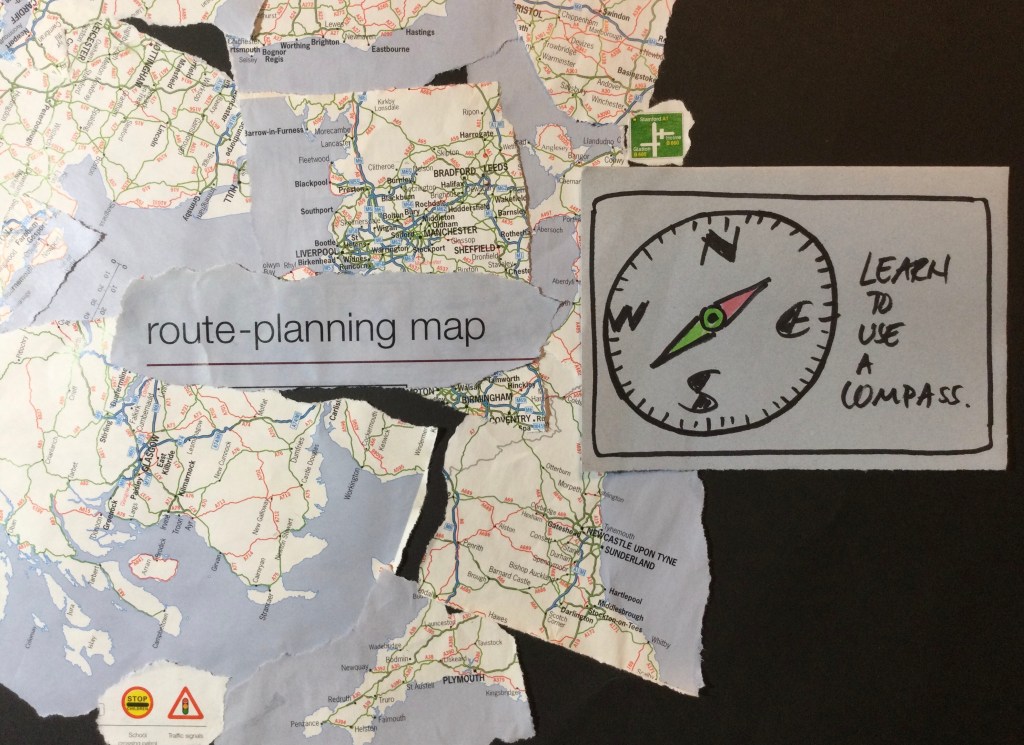
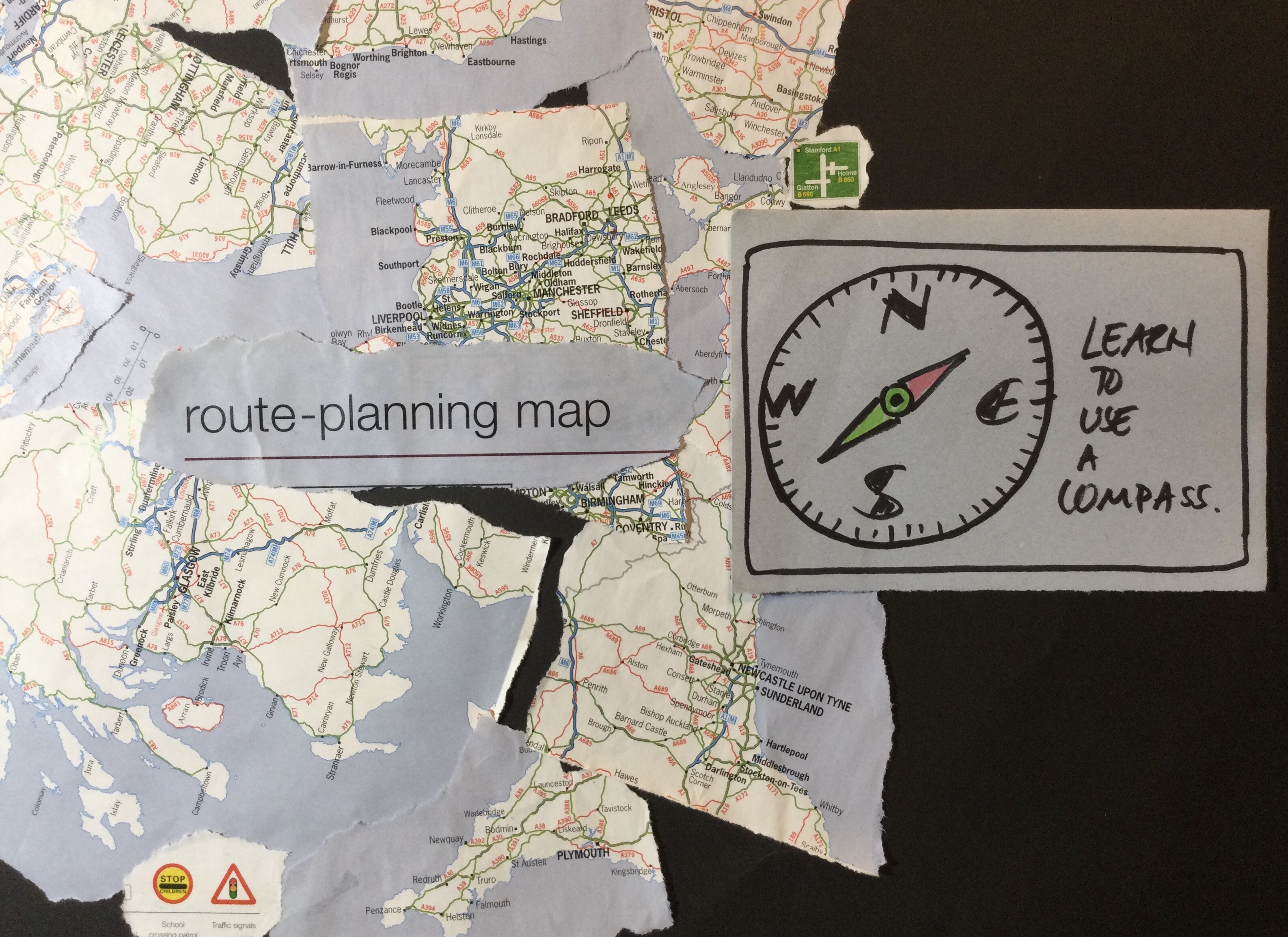
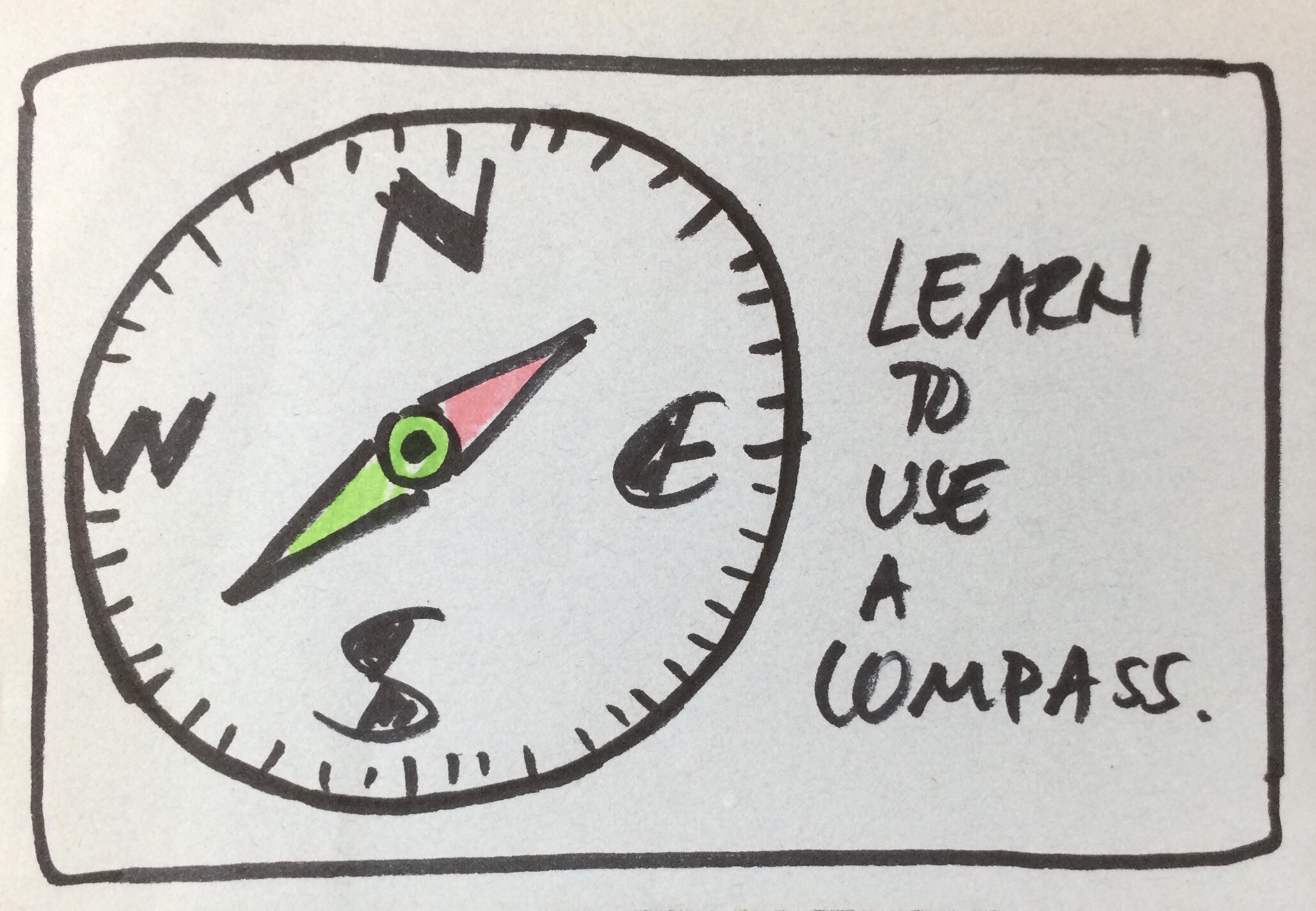
  • Rip up your Culture Change Road Map and learn to use a Compass

    Road Map Fatigue. One of my (many) failings is getting irritated by the ‘change road maps’ you see on office walls. You know what I mean.

    I’m particularly triggered by those proclaiming a ‘road to a better culture’.

    Please can we rip up the road maps and start learning to use a compass – because it’s a complex world out there.

    Rip up the Road Map. Some of my irritation with these road maps comes from a feeling that they are a bit dishonest. They ‘promise’ a future that is certain and guaranteed. If you just do all of the things on the road map, you WILL get that better culture. The second point is that it always feels a bit ‘done to’. Someone else’s ‘vision’ of the future, with arbitrary milestones to measure your progress. Let me explain…

    1. Outcomes emerge in a complex adaptive system. Most organisations are made up of real human people. Individuals who are beautifully diverse and behave in curious and unpredictable ways. There are just too many variables to predict the future with any confidence. Outcomes will ’emerge’ and are unlikely to be what was predicted. I’ve written about this in, Campbell’s Law and why Outcome Measurement is a Dead Cobra.
    2. Somebody else’s perfect future. Despite the ‘consultation and engagement’ circus you often see there’s still a terrible whiff of ‘doing it to’ people. At the end of the day it’s people at the ‘top of of the pyramid’ deciding the future for everyone else. That feels a little bit ‘colonial’ to me, “control over people… forcing their own language and values (and vison of the future) onto those people”.
    3. Flogging a Dead Horse. We all know this stuff doesn’t really work. Paul Taylor has written about it many times and introduced me to the phrase ‘change washing’. There’s a huge industry of change management yet, how much change does it deliver? Have a look at these from Paul;
    4. The Ship of Theseus. Lots of people will have seen change initiatives before, and are very effective at resisting them. I wrote about this here, Swapping a few ‘planks’ probably won’t change the identity of your organisational ‘ship’. Continuing the Nautical Theme…

    Learn to use a Compass. But what happens if you rip up the road map? Me getting irritated is all well and good, but is there an alternative approach? We can’t just stand around and do nothing.

    This is where the compass comes in. It’s all about setting off in the right direction and navigating your way through the complexity. The approach is described as the Vector Theory of Change developed by Dave Snowden. It’s clearly explained in this document from Linda Doyle from the Cynefin Centre. The main points for me:

    1. Start from where you are. Properly understanding the current situation is essential. This gives a fair idea of what might (and might not be possible). The idea of looking for ‘disposition’ towards change is explained in Linda’s article. It’s far easier to work with someone/thing disposed to changing than shoving against a closed door. Beware though, this does take serious deep work.
    2. Set a direction and find stepping stones. This is where the compass comes in. It gives you a general direction of travel, without being constrained by a road map. It’s far easier to cross a river by using stepping stones than trying to leap across. Linda’s article talks about the idea of ‘adjacent possibles’, linking back to behaviour change science. I like adjacent possibles. They offer the prospect of compromises, common ground, and agreement. A far easier prospect than ‘leaping the chasm’.
    3. Co-design interventions. Again linking back to behaviour change science, think about small nudges (rather than shoves). Use multiple safe to fail probes to gather data and understand what is possible. Sometimes the ‘probes’ are called Trojan Mice explained here in; Trojan Horses are not Trojan Mice. 5 Questions to Spot the Difference. Above all do things together, with the people affected by the change. A co-productive approach.
    4. Seek & Use continuous feedback. This might seem like a statement of the obvious, but it needs saying. If you are co-designing interventions and sending out Trojan Mice, you need to understand what they have experienced, and act upon it. Learn from the experience, amplify the desirable things (that will keep you on the compass bearing) and dampen the things that don’t help.
    5. Repeat. Keep doing all of the above, particularly Point 4, until you are happy you’ve arrived.

    The journey can be more enjoyable than the destination. I must admit, I feel better for writing that. There is some truth in the statement that the journey can be as enjoyable as arriving at the destination. If you fancy a bit more of a creative writing angle, have a look at this from Linda.

    So, What’s the PONT?

    1. Road Planning maps aren’t suited to change in complex situations. They oversimplify and drive people towards imagined outcomes (that probably aren’t right or achievable).
    2. A vector based approach is better. Work with the disposition to change within the system, use a ‘compass’ to guide you along the direction, and Trojan Mice to probe the territory. It has a far better chance if ‘arriving’, especially if it’s done together, gyda’n gilydd, co-productively.
    3. All of the above doesn’t offer quick guaranteed success. It involves a lot of deep, serious hard work. Unfortunately that isn’t popular. So I expect to be irritated by road maps for some time to come.

    PS. You can always tell when a change programme is waning. The road map has started on it’s journey from high profile places (reception / CEO office wall) through to less obvious venues, like the fire escape stairwell. A sort of journey along the road to oblivion, making way for the next change initiative road map.

    Just Rip Up the Road Map
  • Innovation Urban Myths and Bootlegging as an Immunosuppressant

    I love a good story. What I mean is the messy, unpolished and authentic stories people tell about real life. The stories I don’t like are the ones manufactured as part of ‘corporate storytelling’. To engage staff, get a message across, change culture (ha ha ha ha!), ‘sell’ the need for change or indeed ‘sell’ anything. It’s just the way I am. I’ve even written about it the need to be cautious around corporate story telling.

    Urban Myths of Innovation. So what do story telling, urban myths and innovation have to do with each other. Well, there is a link. In this case it is around how some innovations get turned into case studies, conference stories and ultimately urban myths. A sort of progressive shift away from reality and actual facts.

    This example is about the 3M Post It Notes which I guess most people have used at some point and might even be aware of the story of their development. I just want to tell the ‘Post It Note Story’ in three parts, as it happened to me over a period of 10 days. A real experience to illustrate some of the perils of ‘Urban Myths of Innovation’.

    Here’s my Post It Note story, as I experienced it, in three stages:

    1. Superficial Urban Myth – Failure will make you innovative.
    2. I’ve read the case study on the internet – a bit more detail and reflection.
    3. Sceptic’s Corner – “I know someone who was there, it happened like this…”

    Stage 1. Failure will make you innovative. I’ve heard this trotted out many times in many places. The basic explanation is:

    • 3M are in the business of making glue.
    • Most glues need to be permanently sticky and hold things together.
    • One day someone invented a glue that didn’t work, it wasn’t permanently sticky.
    • A failure – Boo!
    • However, the Inventor identified that glue could be used for Post It Notes.
    • The Company made a fortune and everyone is happy.
    • Success – Hooray!
    • And the moral of the story… you need failure to be innovative.
    • THE END

    Stage 2. I’ve read the case study… This was a response to the story above, from someone I was sat next to at a conference. It started with, ‘well, that’s not what I know about how Post It Notes were invented’. They went on to add the following:

    • The person who invented the Post It Notes used the glue formula to ‘stick’ pages in their hymn book to help with the process of practicing for the Church Choir.
    • The transition from hymn book page marker to million dollar product happened when everyone saw it’s usefulness and value.
    • Naming Arthur L. Fry as the inventor adds a lot of credibility to your story telling at this point.
    • However, there’s still a bit of a chasm between page marker and product… what actually happened?

    Stage 3. Sceptic’s Corner. Within 10 days of the other two experiences I found myself at a social event sitting next to an actual Polymer Chemist. As things inevitably do, the conversation arrived at the 3M Post It Note story. To my delight they knew about what had actually happened…’ The basic gist was along the lines of ‘it was a significant struggle to get the idea accepted’.

    In their version, the inventors ended up making prototypes and distributing them to people who worked in the company administration. Their value was recognised and eventually came to the attention of people with the power, to approve resources to turn an idea into reality. A sort of undercover, guerrilla innovation story, succeeding against the odds.

    The Approved Version. I’m sure everyone is now itching to know more about the story behind 3M Post It Notes. Here are two sources I’d recommend. First the 3M description of what happened and second the Wikipedia article, which (as usual) has a few interesting side paths. Here are a few things from both sources I think it’s worth pointing out.

    • The original ‘non sticky glue’ was created by Dr Spencer Silver in 1968.
    • It wasn’t until 1980 that Post It Notes were actually launched, a 12 year gap.
    • Dr Silver had a reputation as ‘Mr Persistent’ and would talk about the glue at company seminars for many years, hoping to find the ‘solution to a problem’.
    • Arthur Fry who saw the possibilities and the ‘Hymn Book Page Marker’ solution is widely mentioned.
    • The time to work on the project was part of the company “permitted bootlegging”, where employees were allowed to spend work time on things that ‘interested them’. I think that’s relevant.
    Graphic: Laura Sorlava from session with Dave Snowden

    Bootlegging as an Immunosuppressant. One of the other things that prompted this post was a conversation about how some organisations can kill new ideas in a sort of antibody response – treating new ideas like a threat (to the corporate body).

    I wrote about it ages ago in this post on Idea Antibodies, and asked a question about Immunosuppressants. Are there things that would reduce the antibody response to new ideas?

    I’m wondering if permission to ‘bootleg’ is exactly that sort of thing? If the organisation is giving you permission to ‘follow your interests’ and ‘do different things’, there’s hopefully a better chance that the ideas you come up with will find a route to development?

    It’s also worth noting that this was happening in 3M during the 1970’s. A long time before Google and ‘Google Time’ had ever been thought of. There’s not much new in the world.

    So, What’s the PONT?

    1. Beware of Urban Myths. The transition from reality, to case study to urban myths happens everywhere, its not just for innovation stories.
    2. Scepticism is OK. It’s OK to dig beneath the surface, ask questions and find out what really happened. In many cases it’s far more useful, interesting and satisfying than stopping at the headline news.
    3. Innovation does take time. It took 12 years for the ‘glue that didn’t stick’ to become Post It Notes. The Time Machine of Urban Myths often forgets these inconvenient facts.

  • Measurement is a Smorgasbord.

    Buffet v Smorgasbord. A ‘buffet’ is a cornerstone of society round these parts. From the most ‘interesting’ of family gatherings through to the most soul draining of organisational morale boosters; there’s always a buffet. Basically a mixture of foodstuffs, something that will more or less please everyone. The range and randomness can vary a lot, but I’m sure you get the gist.

    A buffet is largely the same as a Smorgasbord, ‘a wide range of things / a variety’, but with the benefit of it being from the Nordic regions. This makes it sound a bit more exciting and suitable title for what I want to say about measurement. I’ve been wrangling with this for ages.

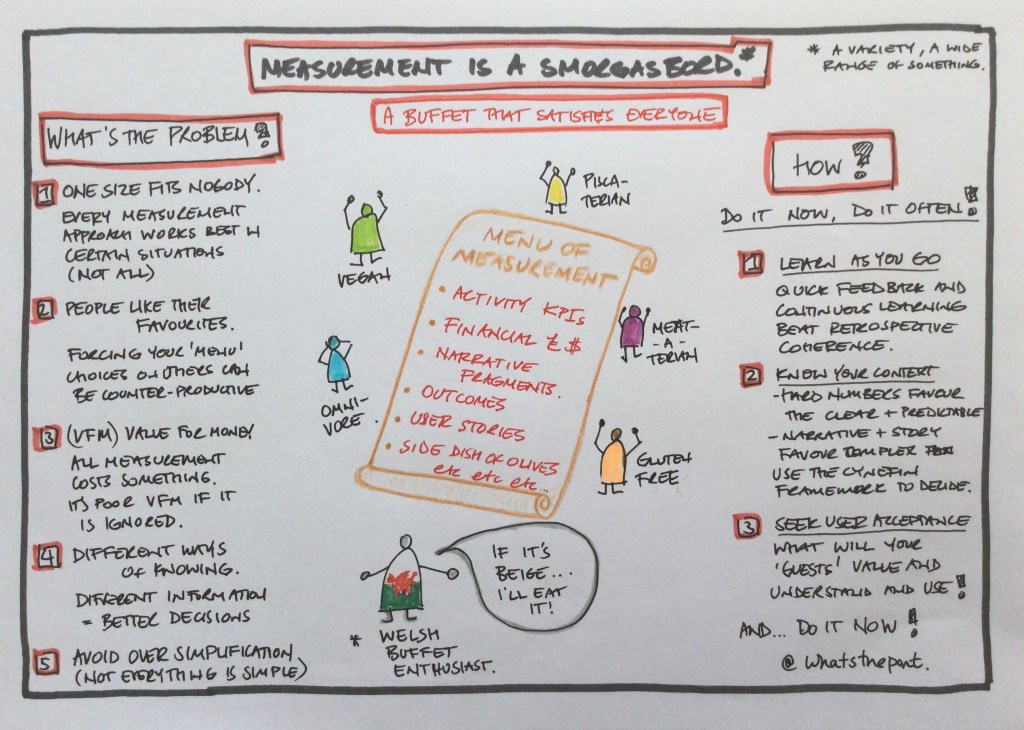
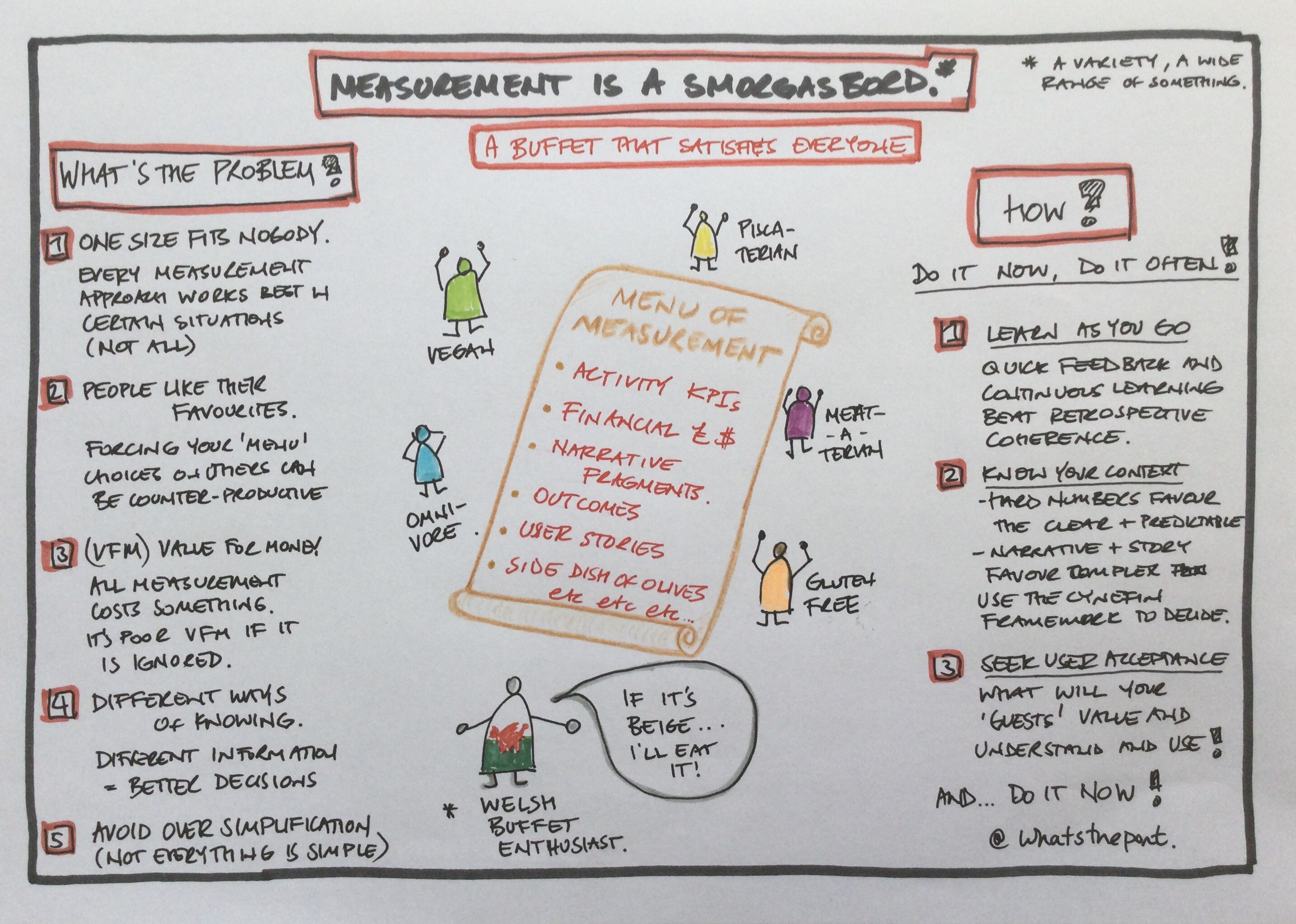
    The main point I want to get across is to treat measurement as a Smorgasbord. There are a variety of things you can measure (it’s a choice). So pick wisely and don’t shy away from trying something different. I’ve tried to capture it in this sketch note, which I’ll try to explain.

    So What’s the Problem?

    1. One Size Fits Nobody. Each approach to measurement will have been designed for specific purposes. Just because it works there, doesn’t mean it will work elsewhere. I know that sounds bleedin’ obvious, but it is worth stopping to think about it. Here’s something on OMI Loops (Obsessive Measurement Infinity Loops)I wrote which makes a case for stopping and thinking before measuring.
    2. Measurement has it’s own impact. Things like Campbell’s Law, Goodhart’s Law and Dave Snowden talk about how measurement changes human behaviour; it does. Not always in predictable ways and sometimes not in a way that is helpful. I’ve tried to capture a bit of that here in: Campbell’s Law and why Outcome Measurement is a Dead Cobra.
    3. People like their favourites. Another statement of the bleedin’ obvious, but it’s worth saying. People will stick with what they like, even when it comes to measurement. This can be a problem if the favourite approach they are using isn’t appropriate for the current situation. There’s also a challenge if you are asking someone to try something different. Offering a different approach to measuring something might not seem like a big deal, until you try to change it.
    4. Value for Money (VFM). There’s a cost associated with all measurement activities. They might be quite small if it’s some sort of digital transaction but it’s still a cost. The cost of an annual return for a bureaucratic grant award can be huge (a friend tells me). The VFM question needs to be part of deciding on any measurement activity. If nobody is going to use what is collected, or it is ignored because they don’t like it, where’s the value for money in that?
    5. Different ways of knowing. Ages ago I was introduced to the idea of ‘the Dangerous Olive of Evidence’, link here. The analogy goes along the lines of; measurement is like an olive. All of the evidence we could use is the actual olive. The hard wooden pip is just part of what is available. In lots of measurement we focus on the equivalent of just the pip. There are many reasons for this, but the result is that we ignore lots of things that could help us understand what is going on – different ways of knowing. From a decision making perspective, surely it’s got to be better to base your decision on a number of sources of information rather than just one?
    6. Over simplifying things. It’s just a fact of life that not everything can be simplified. Some things are complex. That’s all I’m going to say. If you want to know more, have a look at my reflections on Cynefin as a Novice Street Performer at a festival in Cardiff (there’s also a link to a serious explanation).

    So what do you do about it? I’m not and shouldn’t try to answer that question here. It’s up to you, and the situation you want to measure. But here are three heuristics (general principles) that might help you:

    1. Learn as you go.
    2. Know your context.
      • Use something like the Cynefin Framework to help you decide what approach to take.
      • A clear, structured, predictable situation might favour a numeric Key Performance Indicator (KPI) type approach,
      • A complex human situation with many variables and uncertainty might favour an approach using narrative fragments and the stories people tell each other.
    3. Seek user acceptance.
      • Find out what ‘works’ for the people you need to influence, and work with that.
      • Don’t force people into things they don’t like and don’t value.
      • It’s all about understanding your ‘guests’. If they like what you do, there’s more of a chance that they might accept your ideas when you offer them something different.

    Finally, for all of the above, DO. IT. NOW. and DO. IT. OFTEN. Hope that’s clear.

    So, What’s the PONT?

    1. Measurement is most useful when it is a mixture of different things; a variety, a Smorgasbord.
    2. Diversity and difference help. A range of different sources of information will help you to make a better decision.
    3. All measurement costs something. So from a Value For Money point of view, always keep this in mind before measuring anything. A measure that is ignored costs time, resources and emotion and helps nobody.
  • The Tell of Captain Walker…                              Mad Max, ‘Poxyclips’ and Tribal Stories

    You’ve gotta watch this. ‘The TELL of Captain Walker’… https://youtu.be/23SVHUPrUJ4

    Not just because it’s from Mad Max 3, and a vision of life in a post nuclear apocalyptic future (the poxyclips). But, for me, it’s the best way of getting my head around some complicated stuff. What people mean when they talk about things like; oral history, tribal storytelling circles and the idea of knowledge sharing by ancient (and possibly future) humans.

    Thunderdome Context. Just to put the scene in context. Mad Max has ended up in the middle of a ‘tribe’ of children who were rescued from a devastated city by Captain Walker (flying a 747). Captain Walker and a number of adults left the tribe some time ago, looking for a ‘better’ land. He’d promised to return. The remaining tribe recall the details of Captain Walker through the process of the ‘Tell’. A sort of tribal story-telling circle that Mad Max experiences.

    Mad Max (3) Beyond Thunderdome released in 1985, was written by George Miller and Terry Hayes. You can read a transcript by Scott Myers here on ‘Go Into The Story’. Almost 40 years ago I don’t think I appreciated just how good it was.

    The Power of Story. For once, I’d actually recommend reading the comments on You Tube. It’s clearly had an impact. Here’s an extract from the script that sets the scene…

    “This ain’t one body’s story. It’s the story of us all. We got it mouth-to-mouth, so you got to listen it and ‘member, ’cause what you hears today you got to tell the birthed tomorrow.” (tomorah in Aussie)

    If you’ve watched the scene as many times as I have, you might sense a few themes emerging:

    • Understanding the World. There’s a view that stories and storytelling evolved alongside humans as the way we understand, and make sense, of the world around us. The Tell of Captain Walker certainly plunges you into that possibility.
    • Oral History is History. Humans were telling stories as a way of ‘remembering’ and sharing knowledge a long time before we got around to writing things down. Just because its written down doesn’t mean it’s a more accurate or valid version of what happened. Have a read of this Parks Canada account of how Inuit oral history led to the discovery of the lost ships of the Franklin Expedition to discover the North West Passage. Oral history succeeded where modern technology struggled (thanks to Ray MacNeil for several conversations about this).
    • The Story is The Measure (#TSisTM*). In a ‘data driven’ world we aren’t very good (generally) at thinking about stories as a measure of what is going on. It tends to be ignored by the ‘MSM’ Mainstream Simplistic Measurement industry, or put in the ‘too hard to do’ box. I am building up writing something on this, in the meantime (if you fancy) you can warm yourself up on the following;

    One final thought. Over the last 2 years of the pandemic I spent a reasonable amount of time sitting around a fire pit (old dustbin) in the garden talking and telling stories with close family members (totally Covid rules compliant). I suspect a lot of people did this sort of thing. I’m wondering if the pandemic version of the tribal story circle has cemented a few new (and old) stories in family histories? We’ve got an explanation of how Wolves were domesticated with cheese & onion crisps (apparently), that will stick in my mind… but that’s another story.

    So, What’s the PONT?

    1. Stories and storytelling have been around a long time. They probably evolved alongside us and are part of what being human is about.
    2. Oral history is history. Just because it isn’t written down doesn’t mean it is less useful, it’s just different.
    3. We need to accept that stories are a measure of what is happening. If the story changes, there will be reasons and we need to pay attention. Stories are another, equally valuable, way of ‘knowing’.
    Domesticated with Cheese ‘n’ Onion Crisps
  • Every organisation needs a Historian (Cofiadur)

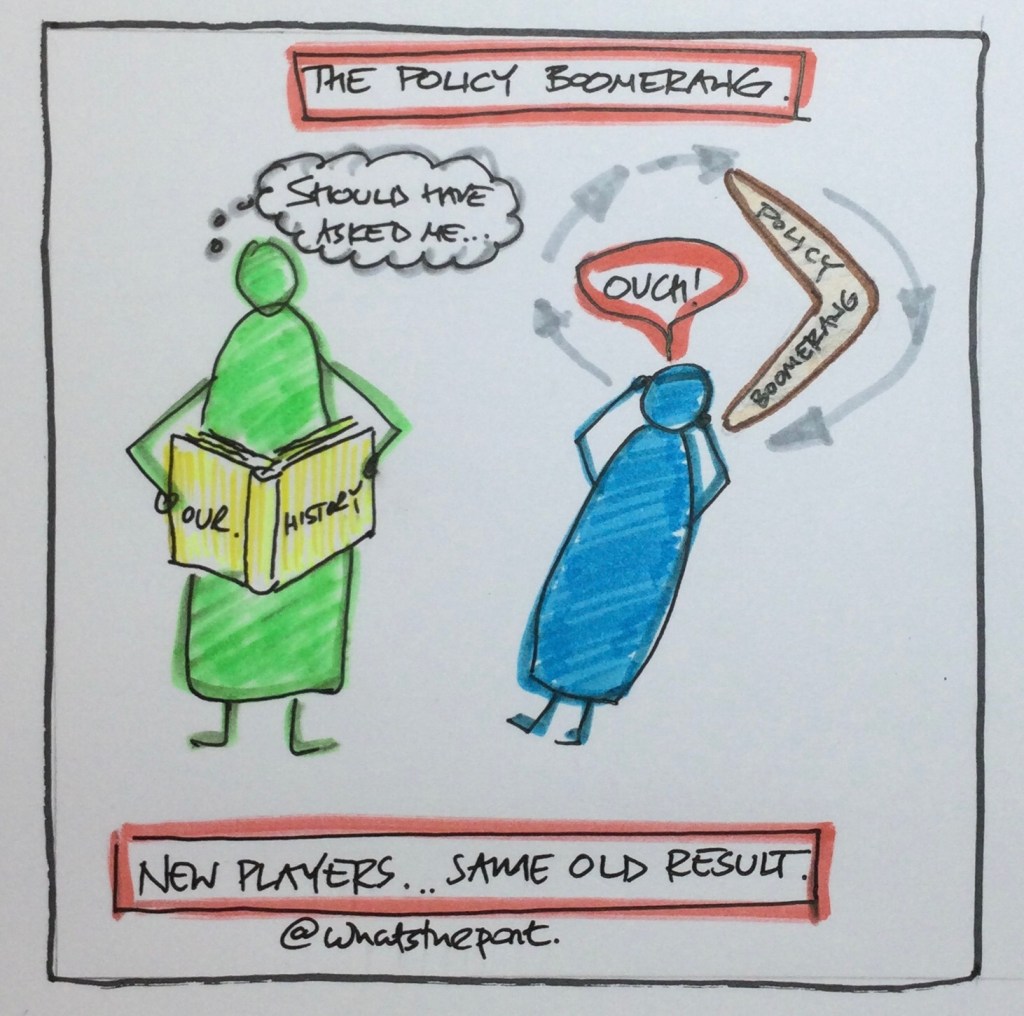
    Why do organisations need historians? In straightforward language, to avoid repeating the very obvious mistakes of the past. In addition, I’d suggest that it’s to help cope with ‘policy boomerangs’ and ‘faddism archaeology’. Organisational memory can be a fragile and ephemeral thing.

    So, if was in charge… every organisation of up to 150 people you would have someone with a designated, ‘formal’ role of historian as part of their job. A keeper of the memory; one who remembers; a chronicler or Cofiadur if you fancy the Welsh version.

    The Cofiadur/Historian would exist for every ‘unit’ of 150 people in the organisation. There is a reason for organising this around groups of 150 people; to do with Dunbar’s Number. The thinking behind Dunbar’s Number is that 150 people is the optimum number of people for an ‘organisation group’. It links to the number of social connections we can remember. There’s an explanation of Dunbar’s Number here, where Swedish Tax Inspectors and companies like Gore Tex have used it successfully in their organisations.

    But, I’m not in charge. So, I’m going to have to convince you with something else. How about the Museum of Failed Products, Policy Boomerangs and Faddism Archaeology?

    Policy Boomerangs and Faddism Archaeology. I need to thank Jack Shaw from the Bennett Institute for Public Policy who got my neurons firing with this Twitter Thread, reporting on the number of ‘Practicing Historians’ employed by Central Government.

    Image Source: @JackShawLPC https://twitter.com/JackShawLPC/status/1512016411396349960?cxt=HHwWkIC5_ci64fspAAAA

    The disappointing news is that the number of ‘Practicing Historians’, people employed formally in the role of ‘Historian’, is less than 40. Set against the context of over 460,000 Civil Servants this is a very small percentage! It would be over 3,000 Historians if you followed the logic of my 150 rule (another good reason why I’m not in charge).

    The low numbers of Historians and lack of objective institutional memory is effectively the point of the Thread from Jack. When it comes to developing policy, you ignore your history at your peril. The comments are just as enlightening as the post. Some people make the point that there are actually lots of Civil Servants that are qualified as Historians; but they don’t necessarily work formally in that role to help inform policy. There’s also a comment about the United States Government taking the role of Historian more seriously, which did remind me of the fact that the US Nuclear Regulatory Commission employed Historians, which I’ve touched on previously.

    I’d recommend a look at the Thread and comments, here are some of my main observations:

    • Policy Boomerangs. I did pick up some lovely concepts like “policy making is poorer without a better understanding of the ‘longue duree’ (the long term)”. I’d agree with that and the phenomenon where some policies keep coming back around, like a ‘Policy Boomerang’. Matt Wyatt talks about this in the Organisational Goldilocks Zone of a 4 year cycle (here). In straightforward terms institutional memory is necessary to help us solve long term problems. Which is where the Historians come in, pointing out the policy boomerangs and the recycling of things that never worked in the past. Which leads me onto…
    • Faddism Archaeology. There’s a lovely description in the Thread of ‘regeneration archaeology’ where economic regeneration policies from previous administrations are ‘rejuvenated’ despite any evidence of previous success. I’d argue that this goes well beyond the area of policy and is alive and well in the wider world of management practice. ‘Fads’ from the past are dug up, repackaged and ‘sold’ to the new generation of aspiring leaders and managers to help boost performance – or solve the latest problem. I really think we need Historians in this space to stop us wasting money, like we did in the past. Here’s something I wrote a while back on ‘Silver Bullet Syndrome and Richard Pascale’s Management Fads’.
    • The Museum of Failed Products. Ages ago I asked a question, Do we need a Public Services Museum of Failed Products? This was prompted by the fact that there is an actual Museum of Failed Products in the commercial world. People who read the post said “yes”, but others also pointed out that this sort of thing already exists in places like the National Archives and the reports of audit organisations. The point is that we don’t pay much attention to these records… There are a couple things going on here, sometimes Corporate Amnesia is a convenient practice if you’ve done things you want to deliberately forget. The other point is that if you don’t have formal Historians, there’s nobody around to do the ‘remembering’.

    You can’t keep living in the past… There is of course a negative side to ‘too much remembering’. Shiny Transformation Types will argue that living in the past is holding us back from a better future. I’d agree, up to a point, but we do need to remember what has come before us. Completely ignoring the past can very easily lead to repeating mistakes. If it helps, just think of ‘history’ as another source of ‘evidence’ or ‘data’ to support better decision making.

    So, What’s the PONT?

    1. There’s not much in the world that is totally ‘new’. There will be a history of something that leads up to the point where we are now.
    2. Understanding ‘what came before’ can help to make a better decision now and for the future. At the minimum it can help you avoid the obvious mistakes of the past.
    3. Taking a ‘long view’ backwards takes as much effort as thinking about the impact of today’s actions on future generations. We need to be deliberate and purposeful about doing both. We need Historians as well as Futurologists.
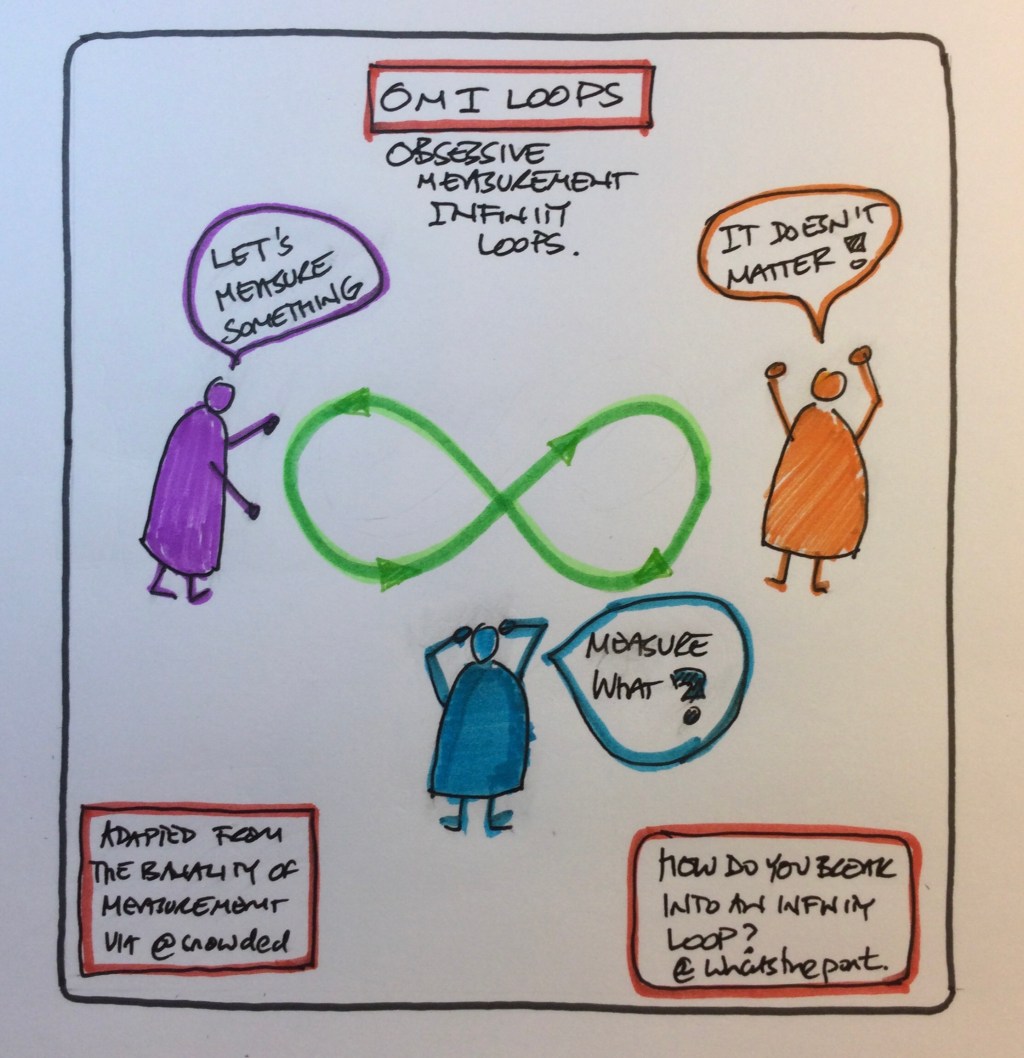
  • Obsessive Measurement Infinity Loops (OMI Loops)

    The Raspberry Jam Test. The recent post about The Duke of Wellington and failure to account for jars of raspberry jam, in a sandstorm (link here), seems to have struck a few chords. That’s given me a bit of confidence to open up about what I think is a terrible modern day curse, Measurement Obsession. We need to talk about OMI Loops…

    I did have a half-hearted attempt at describing a few questions we should ask ourselves before embarking on a measurement frenzy. The Raspberry Jam Test of measurement if you like: Does it help or hinder? Is it proportionate to the activity and risks? What does it cost, is it value for money?

    But, in the spirit of Root Cause Analysis (current ‘outil du jour’), what I really should be doing is asking Why? (5 Times)

    Why is there an obsession with measuring things in organisations? A really good place to start is reading Dave Snowden on, The Banality of Measurement. Dave suggests the following reasons for the obsession:

    1. “Most decision makers are distanced from the work of those they measure so the targets become a proxy for intimacy.”
      • I completely agree and would add a statement of the bleedin’ obvious; the bigger the organisation, the more measures you tend to get.
    2. “Fear of blame (not failure) encourages measurement as it allows blame to be deflected.”
      • I think this gets to the heart of what’s behind lots of measurement, a kind of ‘othering’. Deflecting the responsibility through the medium of measures. Blame avoidance is a massive influence on behaviour in many organisations.
    3. “Excessive transparency means there is no space for failure and therefore no space for learning.”
      • This is an interesting one. I do think there is such a thing as ‘excessive transparency’, particularly where there’s a tendency to micromanage in organisations. Measuring and controlling ‘everything’ does manage out the opportunity for innovation and failure from learning in my view.

    Here are a two additions from me:

    4. Faux Assurance. If something is measured and written down it bizarrely acquires the status of ‘the one truth’. People ‘charged with governance’ rarely seem to question how sensible KPI’s and other measures are in my experience. The warm comforting assurance they provide is ‘enough’. But that’s another story.

    5. Measuring stuff is easier than doing actual work. Apologies if this offends, but there are some people who prefer to do measuring than actual work. It’s in their interest to maintain a measurement system, regardless of how useful it might be. They also tend to be quite persistent and effective at keeping the measurement industry thriving. Possibly the ‘copy-boys and clerks’ referred to by Wellington…

    Goldilocks Zone Measurement. Before anyone starts… I’m not anti measurement. I’m just asking for a better way of doing it. A Goldilocks Zone that is proportionate to what is going on and not a burden, distraction, or part of a faux assurance industry.

    I don’t appear to be alone. Here’s a very pointed cartoon of ‘The Marketing Dashboard’ from a post on Data Driven Decision Making written by Tom Fishburn @marketoonist. Tom points towards research that 75% of Executives don’t have a high level of trust in their data.  Even Gartner reported a while back that 40% of data used in organisations is either inaccurate, incomplete, or unavailable. All is not well in the State of Denmark (to quote Shakespeare)… we can do better.

    Minimum Viable Measurement. Following the Duke of Wellington post I’m suggesting we ask WHY a bit more. You could use The Raspberry Jam Test of measurement; Does it help or hinder? Is it proportionate to the activity and risks? What does it cost? Is it value for money?

    Just getting the conversation going and encouraging people to stop and ask Why is progress in my books. But I’m not entirely daft, and I do realise that the language I use might not ‘speak’ to everyone.

    This is where ‘Minimum Viable Measure’ comes in. It might just be the perfect set of words for the people doing all sorts of ‘agile’ and ‘transformation’ things at the moment. Have a look at what John Cutler has to say about Minimum Viable Measures here in Powerful Ideas > Perfect Measures. I do like the proposition that; Powerful ideas, imperfectly measured are bigger than, perfect measures for not-so-powerful ideas.

    I can’t yet find any criteria for developing Minimum Viable Measures, but I’d suggest that they won’t be a million miles away from the Raspberry Jam Test. I’m willing to have a go.

    Obsessive Measurement Infinity Loops. Back to where this started. I don’t know if any of this is going to break the OMI Loop that exists in some places. But if it’s provoked some response, it’s a start.

    So, What’s the PONT?

    1. There is an obsession with measurement in some organisations. Not all of it is good, accurate or useful. But it’s still measured.
    2. Obsessive Measurement Infinity Loops also exist. Going around in the same continuous loop of measurement for measurement’s sake. An end in itself.
    3. Breaking out of the loop is hard. Maybe a conversation about Minimum Viable Measurement (or the Raspberry Jam Test) will provide the positive disruption needed?
  • Failure to Account for Jars of Raspberry Jam (in a Sandstorm)
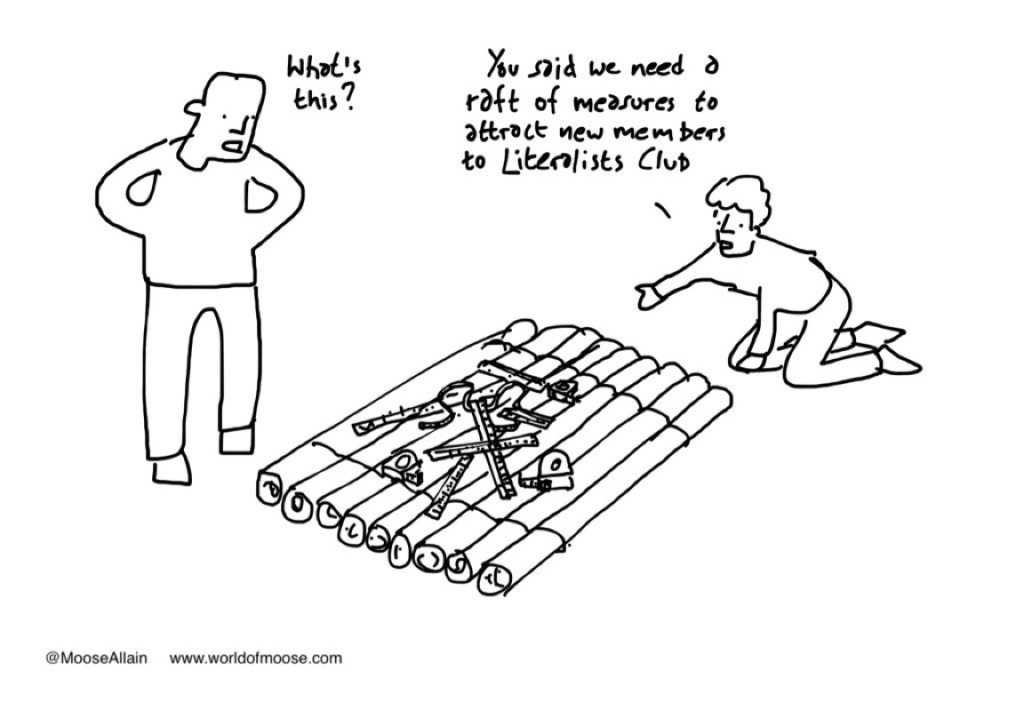
    We need a Raft of Measures. Source: Moose Allain https://www.worldofmoose.com/

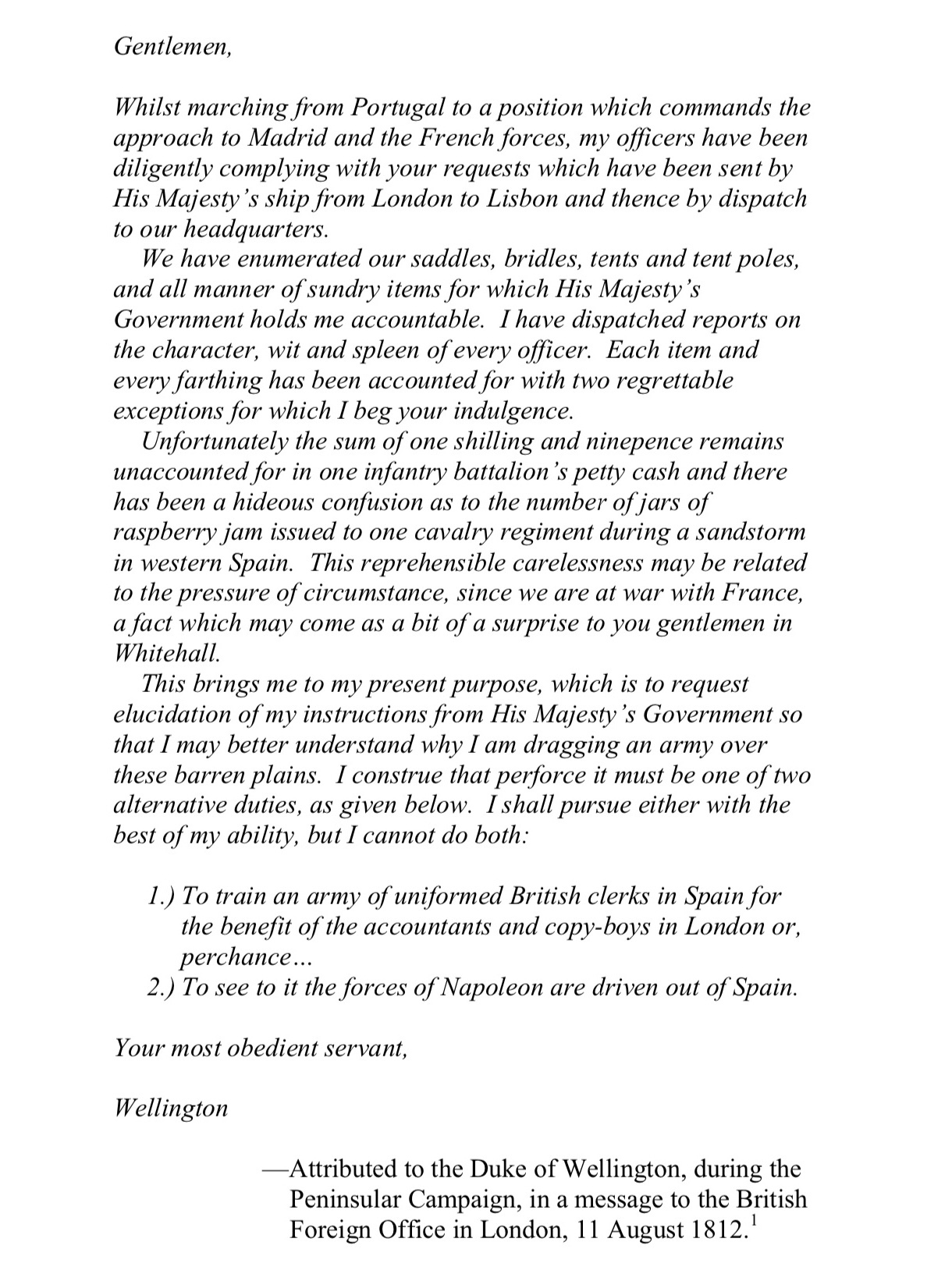
    Clerks and Copy-Boys or Winning the War? You can’t have both. A friend recently sent me a copy of a letter from the Duke to Wellington, August 1812, to the British Foreign Office, London.

    Just to put the letter in context. At the time, Wellington was on the way to Madrid, ‘dragging an army over barren plains’. Attempting to defeat Napoleon and remove the French armies from Spain. It wasn’t an ‘easy’ day at the office.

    In the midst of the warfare, Wellington was required to ‘account’ for the resources at his disposal. An audit if you like. The letter (see below) explains the challenges of carrying out such a measurement exercise, under difficult circumstances. Wellington specifically apologies for the ‘hideous confusion as to the number of jars of raspberry jam issued to one cavalry regiment during a sandstorm’.

    Wellington wraps up the letter with an important basic question. What do you want me to do? Measure things or win a war? I can’t do both!

    Source: Center for Global Development. Andrew Natsios 2010 https://www.cgdev.org/sites/default/files/1424271_file_Natsios_Counterbureaucracy.pdf

    You can’t have both. Depending on your point of view, Wellington’s letter could be; an entirely factual statement, mildly humorous or a deeply sarcastic dig at bureaucracy. Wellington does have a point though, which is why my friend “insisted” I read it. But, what if there is another viewpoint…?

    Chasing fraud during a pandemic. If you want to put ‘jars of raspberry jam’ into perspective, have a read of this from the Institute of Government: ‘Lord Agnew is right: Covid support write-offs merit more resources’. Some of the numbers quoted in the article are eye-wateringly large. But the thing to concentrate on is that almost £5 Billion of grants, business support loans and other handouts have already been written off to fraud and criminal activity. It’s also worth noting that ‘more could have been done’ to put a few checks and balances in place at the start of the system. It’s a sobering read, particularly if you are a tax payer, with the prospect of shouldering this burden for many years to come.

    I think it would be a fair assumption that even the Duke of Wellington might have asked for a few more Clerks, Copy-Boys, Accountants and Counter Fraud Specialists to do a bit of measuring in the circumstances…

    The Goldilocks Zone of Measurement. So where does this leave us? Measuring things is an extremely difficult pastime. I’ve spent more time than I’d ever imagined talking about it, observing it, trying things and going back to talking about it. I’ve even written things about it.

    • The Dangerous Olive of Evidence. This looks at the problem around what we actually measure. Evidence is just like an olive. There are many things we could measure (the green/black olive flesh) but we just tend to focus on the easily quantifiable, hard, generally money focused things (the woody olive pip).
    • Outcome Measurement is a Dead Cobra. This tries to unpick the challenges of creating measures (to hold people to account) for complex situations. The Dead Cobra is just a way of explaining how the act of measurement can lead to unintended consequences.

    The point for me in all of this is that it isn’t a binary choice where you can have one or the other, not both. Either ‘Copy-Boys or Winning the War’, not both. There has to be a happy medium around this, the Goldilocks Zone of not too hot and not too cold, but ‘just right’. Getting to ‘just right’ does of course take time and effort. But there are plenty of things that could help you down that path. From my perspective;

    • Will the measurement activity help or hinder them in delivering their objectives? (If it’s mostly hinder, expect some Duke of Wellington push-back)
    • Is it in proportion to the scale of activity and the risks? (Lost jars of Raspberry Jam in sandstorm, really?)
    • What does the measurement activity cost? Somebody is paying for this. (I always liked the example of a grant giving body that kept it’s administration fees at around the 2.5% mark).

    Co-creating the Measures. Finally, this might not be popular with some of the people who do measurement, but why not ask the punters?

    Most of them aren’t out to do bad stuff, and most of them are as concerned about the people committing fraud and doing bad stuff as you (and the rest of us) are. If you came up with a system that properly involved the ‘good honest people’ helping to shape the measurement, there might be a change in how they engage with it? It might even release some resources to do the measurement that really needs doing…?

    So, What’s the PONT?

    1. Measurement isn’t a neutral activity. It takes time, effort and usually has an impact. Time, effort and impact that could be diverting people away from the important stuff (Removing Napoleon from Spain).
    2. Measurement should have a ‘businesses case’ that is as robust as the business case for the things the measurement system intends to measure. Including a value for money assessment.
    3. How about getting the punters to help co-create the measurement systems?
  • Swapping a few ‘planks’ probably won’t change the identity of your organisational ‘ship’.

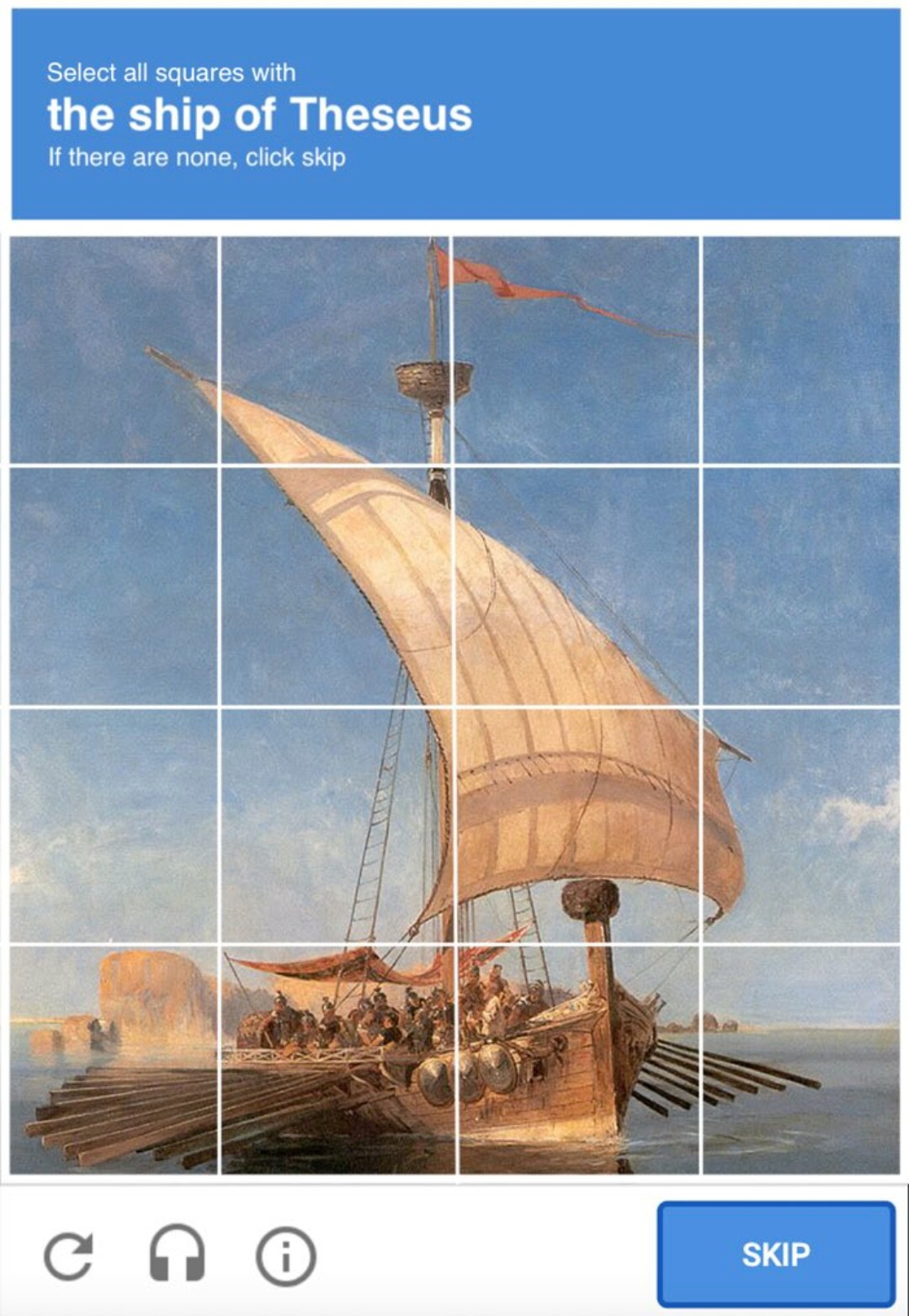
    This is all about the persistence of identity, at an individual human and organisation wide level. Something beautifully illustrated by; The Ship of Theseus, Triggers Broom, your Grandmothers Axe and dozens more examples you can explore here on TV Tropes, Theseus’ Ship Paradox.

    CAPTCHA memes are getting quite philosophical.
    Source: https://knowyourmeme.com/photos/2160540-captcha

    The new boss completely changed their identity*…in 6 months! I’m always a bit intrigued when I hear about this sort of thing. Especially when it relates to organisations of hundreds / thousands of people that have been around for decades with their own specific identity. How on earth has one person pulled off this Herculean task and changed the identity of such a big beast so quickly? That’s the stuff of ancient myths, surely…

    The Ship of Theseus. This is really ancient stuff. Written around 2,000 years ago by the Greek Philosopher Plutarch. It describes what has been used by people as a ‘thought experiment’ ever since. The basic gist:

    • Theseus, a young man from Athens, sails to Crete where he kills the Minotaur – a terrifying half bull, half man that had been terrorising the locality.
    • He returns to Athens on the ship, becomes King and goes on to do other amazing things.
    • The people of Athens are so grateful to Theseus that they decide to preserve the ship he returned on and re-enact the journey every year.
    • This happens down the generations for about a thousand years.
    • As the ship is mostly wooden, over time parts deteriorate.
    • What the Athenians do is replace the old parts, planks etc, with new ones to keep the ship afloat.
    • Eventually, there comes a point in time when none of the parts on the ship are original.
    • Theseus has never set foot on the ship, but it maintains it’s original identity as the Ship of Theseus.

    There has been a huge amount of debate about this topic over the last 2,000 years (have a look at the TV Tropes link above). If you want to dig a bit deeper I recommend this from The Marginalian (formerly Brain Pickings) The Ship of Theseus: A Brilliant Ancient Thought Experiment Exploring What Makes You You. Alternatively you can jump straight to the TED-Ed video, ‘Who am I?’ by Amy Adkins.

    Replacing a few ‘planks’. Back to where this started, how can changing the boss of an organisation change it’s identity? If you stick with the arguments in the Ship of Theseus example, the identity of the organisation is likely to remain persistent for a long, long time. It’s all linked how we retain our own individual identities.

    Why wouldn’t it be the same where lots of us are grouped together? Communities, villages, towns and cities seem to maintain their identities over time (generally). Why would it be any different for an organisation?

    Obviously, I do recognise that things like mass migration (in or out) and other catastrophic/large scale events can, and do, change the identity of a community, village, town or city.

    But what I’m talking about here is, in reality, fairly marginal stuff; on the scale of a few ‘planks’. And yes, new bosses often bring a few other ‘planks’ along with them as part of the frequently seen ‘shake up’ of the senior team. But at the end of the day that is still just a ‘few planks’. The opportunity to ‘change identity’ is limited, no matter what their LinkedIn profile says about their mythical powers to ‘drive transformation’.

    One of the articles I read about the Ship of Theseus says something along the lines of; as long as there is some sort of continuous connection between the old and new, the Ship of Theseus identity will persist. The scale and nature of this connection is of course the topic of philosophical debate – not something everyone finds interesting. What I would suggest though, is that it’s going to be a challenge for any new boss trying to ‘eliminate’ the old identity and build one in their own image. A Herculean task…

    Finally, Identity, not the C Word* I’ve deliberately focused upon identity here, and not mentioned culture. That’s because we all know that culture is an emergent property of complex human systems and not something you can ‘drive’ through road maps and a project plan (subject of a future post). Also, I didn’t want to muddy the waters.

    So, What’s the PONT?

    1. Our identity, who we are, is pretty persistent. It tends to stick with us over long periods of time. If that’s true for us as individuals, why not for groups of individuals in an organisation?
    2. The Ship of Theseus (and dozens of similar examples) illustrate how identity can persist when ‘everything’ has changed, several times. Trigger’s Broom was still Trigger’s Broom after 17 new heads and 14 new handles.
    3. Swapping a few planks in an organisation of 100’s/1,000’s of people, with an identity that has persisted over decades, is unlikely to change that identity. No matter how mythical their powers.
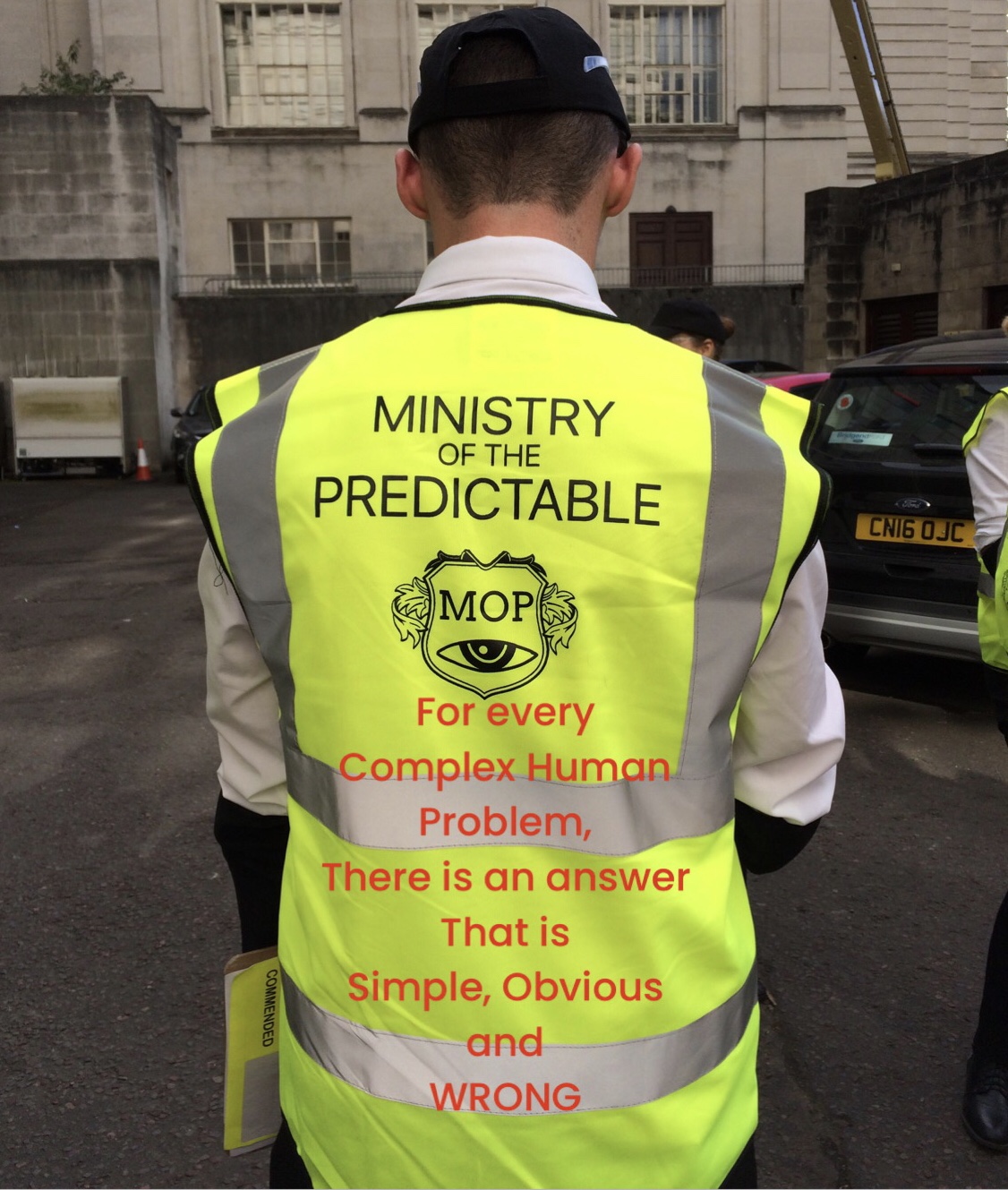
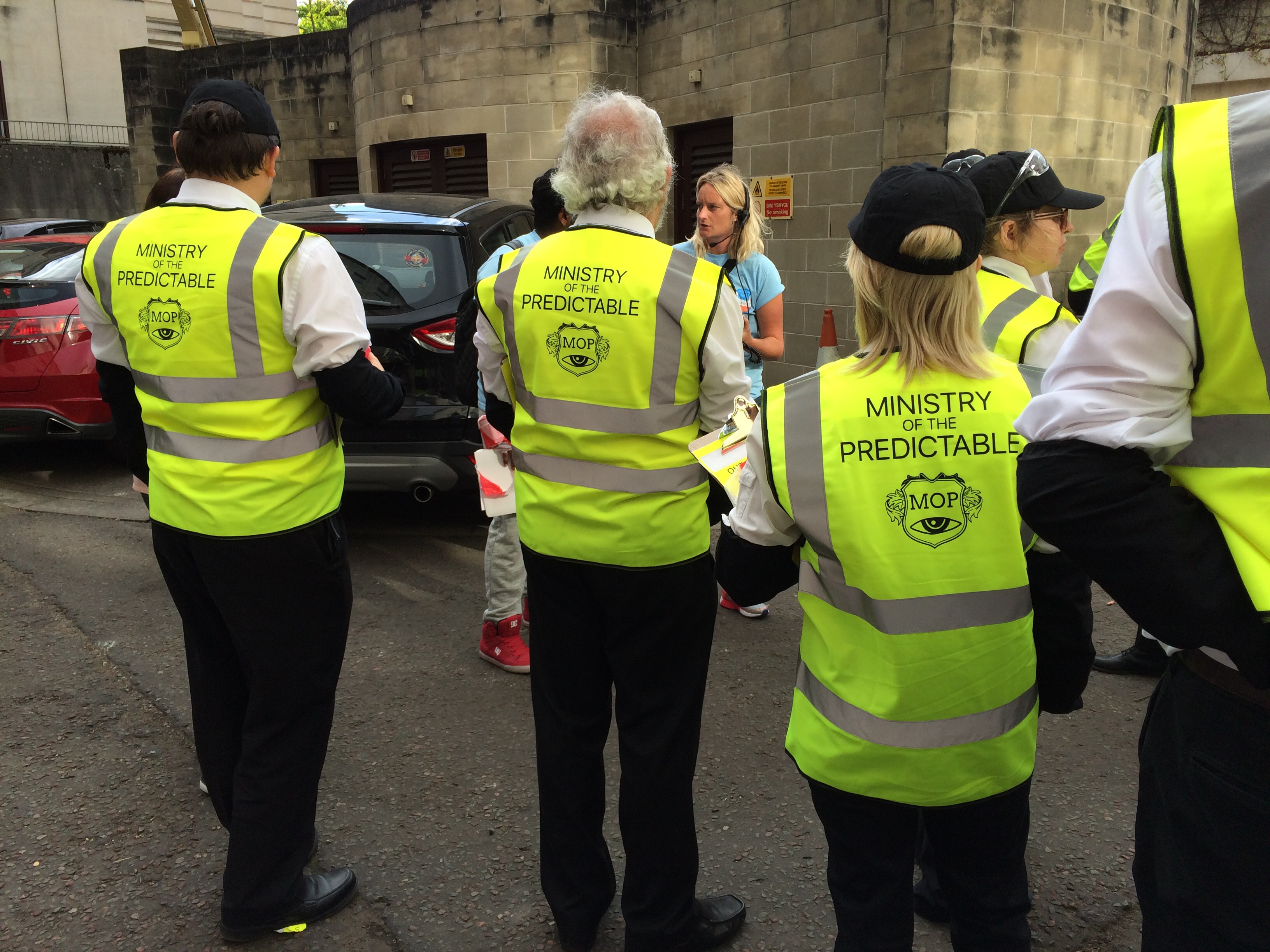
  • For every complex human problem, there is an answer that is simple, obvious and WRONG!* But it is the Standard Operating Procedure (SOP) of the Ministry of the Predictable (MOP).

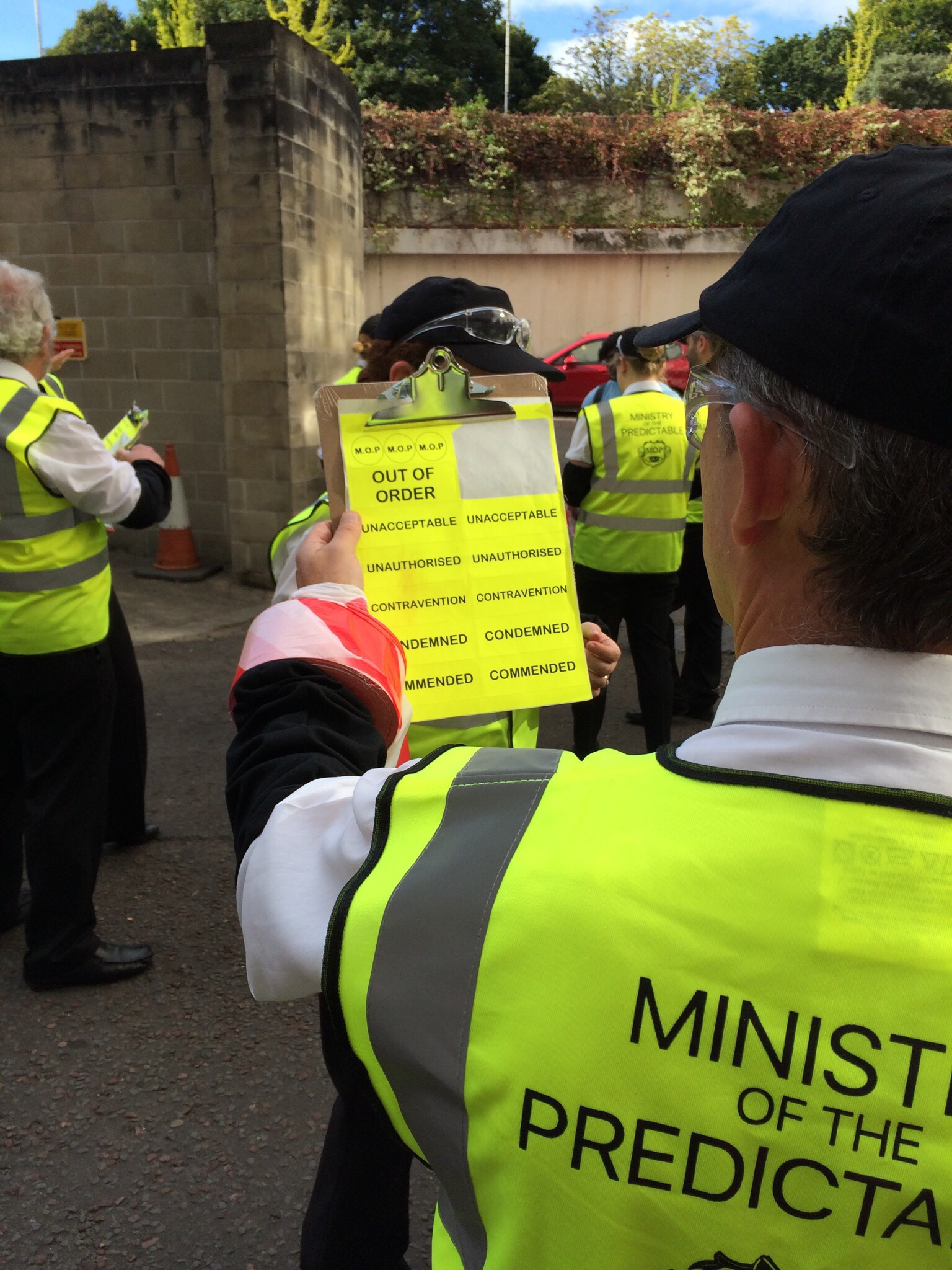
    The MOP work by; developing universal policies, providing conditional funding, linking funding to milestones in a project plan/programme and measuring your progress against the targets and KPIs. Because, in the MOP, all human life is predictable. Everything is ordered and can be understood and controlled through logical measures and incentives (pictures of MOP Operatives below).

    This post was going to be a massive dig at the MOP, but I think I’ve made my point. Yes, they probably are the root cause of all the wrong stuff, inertia, wasted opportunities and general irritations in life. But individually it’s probably not their fault. They are just doing a job as part of the system… or are they?

    But Life is; Simple/Obvious, Complicated, Complex and Chaotic. Life can be any of those things, and it can move dynamically between them. Bits of my own life have on occasions, moved from being obvious, simple and calm into chaos very quickly. Influenced by unpredictable events that happened ‘out of nowhere’. You see these sort of ‘fluctuations’ in organisations as well.

    Predictability is mostly an illusion. The main purpose of this post is to get across the point that predictability only works where things are predictable. Treating complex human problems as ‘predictable’, controllable or even understandable is not a reality and probably dangerous. To misquote, ‘the simple, obvious answer is … WRONG’.

    Here are two things to help us in this challenging space; two Medics talking about Statistical Fallacies and a Professor talking about Risk and Resilience. Go on… take the leap…

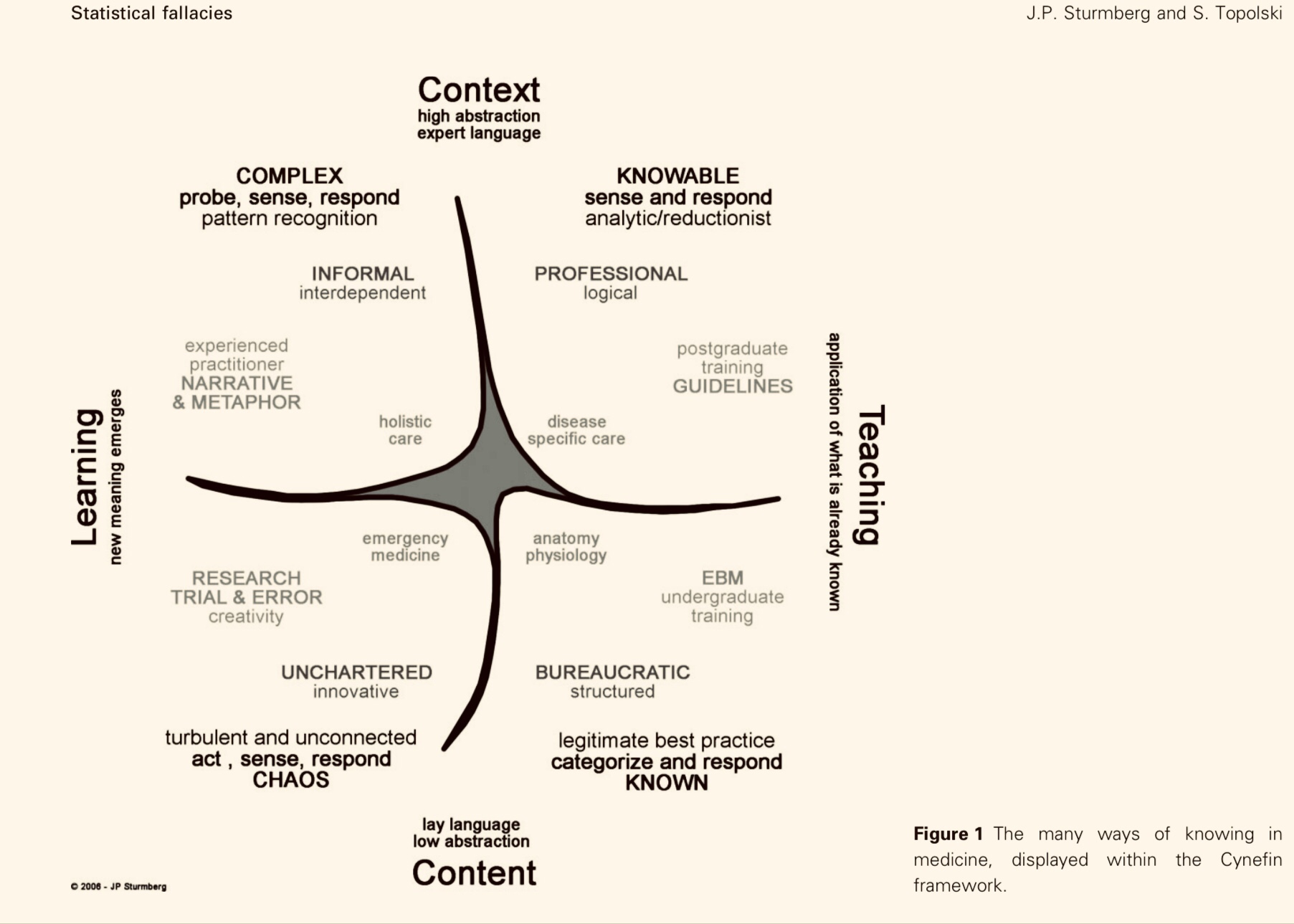
    Joachim Sturmberg & Stefan Topolski. For every complex problem there is an answer that is clear, obvious and wrong. And other aphorisms about medical statistical fallacies. Journal of Evaluation in Clinical Practice, May 2014.

    As the title suggest, this is about unpicking the mathematics and statistics commonly used in the world of Evidence Based Medicine. I’m very keen on using evidence to make decisions, but as Sturmberg and Topolski point out, there’s a lot more that we need to understand and recognise about the connections, patterns and deviations from (simple) predictions than just numbers. Human judgement is just as important as cold data. Something Matt Wyatt has written about here in ‘what is average’ and 43 quintillion ways to witness…

    It’s also a great summary of all those pithy observations that contain a general truth (aphorisms) you’ll have heard about statistics. The aphorisms are also helpfully explained with a medical illustration – words, not those gruesome anatomy drawings (just to be clear). The paper also uses the Cynefin Framework to illustrate how different types of medical knowledge can be used as part of sense-making and decision making. Helpfully this links us to Dave Snowden, who developed the Cynefin Framework.

    Source: Sturmberg & Toploski. For every complex problem, there is an answer that is clear, simple and wrong: And other aphorisms about medical statistical fallacies
    May 2014 Journal of Evaluation in Clinical Practice 20(6)

    Dave Snowden, Risk and Resilience. If you want something that’s a bit more accessible – I recommend this 10 minute video from Dave. It explains the difference between the world of predictability (where the Ministry of the Predictable live) and a more realistic view of life.

    A world where things don’t fit neatly within a ‘normal’ distribution curve; a place where we need to prepare ourselves for the ‘unpredictable’. I very much like what Dave describes as the ‘logic of hunches’. Nobody ‘knows’ the answer to a complex problem, so you gather fragments and ‘hunches’ from as diverse a group as possible to make sense of what is ‘possible’ (rather than predicted).

    The video was created in 2011, and in some ways its a prediction of where we are now. High Impact Low Probability (HILP) events actually becoming more plausible and more frequent. Something that needs to be reflected in corporate strategies and approaches. We need to focus on agility and resilience rather than reinforcing robustness.

    I’m not sure the Ministry of the Predictable is set up to deal with with agility and resilience. For me, the desire for risk minimisation, standardisation, consistency and measurement (where it isn’t appropriate) actually work against resilience.

    So, What’s the PONT?

    1. Life isn’t just, simple, complicated, complex or chaotic. It can be any one of those things at different times and it can move between them.
    2. Trying to apply simple and obvious and ‘one size fits all’ solutions to complex problems doesn’t work. And will probably end up doing more harm than good.
    3. Using numeric data to predict things, only works where things are predictable. That’s the specific part of the universe where the Ministry of the Predictable should remain.

    Quote Source. For every complex human problem… The origin appears to be with H. L. Mencken, although it’s also been attributed to Mark Twain and Peter Drucker. Details here.

    Ministry of the Predictable pictures. Mine. From when Cardiff hosted the City of the Unexpected event in 2016 to celebrate the birth of author Roald Dahl. I took part as a street performer, dressed as a bald witch. Yes I did – details here: https://whatsthepont.blog/2016/09/24/the-cynefin-framework-through-the-eyes-of-a-novice-street-performer/

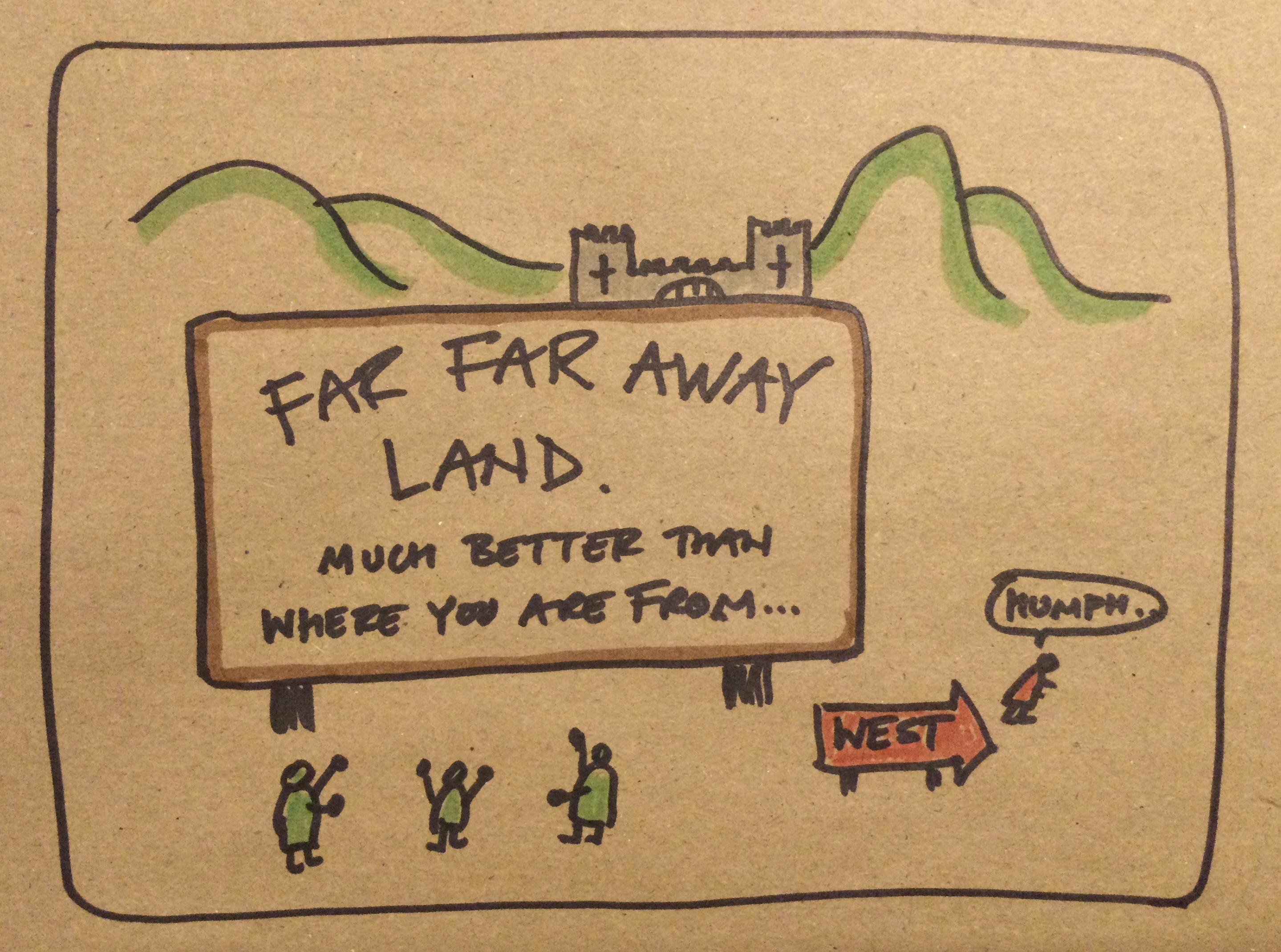
  • Life in Far, Far Away Land is so much better than here… I’ve been watching a lot of Shrek recently. I’ve also been attending seminars and learning about good practice through the medium of beautifully presented case studies.

    For anyone not familiar with Shrek, it’s your classic fairy tale. Everything we need in a good story. Good verses evil, love and rejection, body swaps, setbacks, magic and eventual triumph when love conquerors all. Then everyone has a good old sing along. The closing songs in Shrek really are epic – I’m a believer! I could say that a fairy tale like Shrek has a lot in common with a few good practice case studies I’ve seen. But I don’t want to bust any bubbles. What I want to talk about is Far, Far Away Land.

    I’m not really a believer… Far, Far Away Land seems to exist in most fairy tales, it might even be the mandatory opening sentence, “once upon a time in a land far, far away…” In Shrek, they hammer home the point that it exists, and it really is much better than wherever you are. The place you need to be at, or at the very least the place you need to aspire to being at.

    Far, Far Away Land Syndrome diagnosis is along the lines of: the further away a person, object or practice exists from your current position, the more desirable it appears*.

    This is where I start to wonder about those good practice case studies at the seminars. Are they just an extension of the fairy tales many of us a have been brought up on? An extension into adult life where we are seeking a ‘perfect solution, from a perfect place, with perfect people’ from Far, Far Away Land?

    There are plenty examples in the everyday workplace you might be familiar with. Please feel free to think of your own. Here are a few that trigger my ‘I’m a Donkey on the edge’ response;

    • Case Studies: Anything from the Nordics or New Zealand goes down well in Wales. They are definitely from Far, Far Away and almost anything, no matter how tangential, will get a welcoming smile of approval.
    • Procurement: Particularly when it comes to buying in consultancy advice. A sniff of one of the big US organisations and people think you are chocolate.
    • Recruitment: Don’t get me started on the bedazzlement that comes with “ooohh look, they’ve worked in London…”

    Is this just a Welsh thing? I used to worry that Far, Far Away Land Syndrome is a peculiarly Welsh thing. After a bit of modest research (asking my friends) I’ve concluded it’s far more widespread and may actually be a close cousin of Silver Bullet Syndrome. That desire to find the ‘one shot’ solution that will magically solve your problems. There might be a shared woodland path back to a childhood of listening to fairy tales? I wrote about it here in The Life Cycle of a Silver Bullet, and I re-read it occasionally to remind myself that, “if something looks like it’s too good to be true, it probably is”.

    West is Best. Just to confirm that Far, Far Away Land Syndrome isn’t a peculiarly Welsh thing I decided to have a wider look around, and cast both my eyes west, to where EVERYTHING is Best!

    What I encountered (very occasionally) is the opposite of Far, Far Away Land Syndrome… Not Invented Here Syndrome (NIH). NIH Syndrome appears to be a recognised thing, with a wikipedia entry and everything. NIH actually exists everywhere, now I know what I’m looking at.

    The basic idea behind NIH Syndrome is that people have a bias against ideas that come from outside their organisation, group or community. You may have observed it in a work setting? This can extend beyond ideas to things like physical products, services or sports teams. It can be motivated by objectives like trying to stimulate the local economy, that might have good ethical reasons. Or NIH might be driven by not so good reasons like jealousy, disputes, defensiveness or a general dislike of unfamiliar things. NIH is complicated.

    It’s all wrong. The bottom line is that both Far, Far Away Land Syndrome and NIH used to the extreme and for the wrong reasons are damaging.

    Looking and learning from things from Far, Far Away land is useful but don’t assume things from far away are always better. More importantly, don’t think you can just pick things up and plant them back at home. The NIH approach can have some usefulness, if used sparingly and for the right reasons. But if used in excess, you’ll probably end up unloved, and living in a swamp, ‘all alone and by myself’ (to misquote Donkey from Shrek). Don’t say you haven’t been warned.

    So, What’s the PONT?

    1. Far, Far Away Land Syndrome might be ‘hard wired’ into us from growing up on Fairy Tales. But the perfect solution from far away might just be a Fairy Tale the closer you get to it.
    2. Silver Bullet Solutions and Far, Far Away Land Syndrome are close cousins. The desire to have a magical solution that solves everything.
    3. Not Invented Here might be the opposite of Far, Far Away Syndrome, but that doesn’t mean it is right. What we need is more of a Goldilocks Approach (you know what I mean…)
    4. Question. Why is there no Goldilocks in Shrek? Seriously.

    Acknowledgement* Thank you to Sion Charles and Matt Wyatt for sparking my interest in Far, Far Away Land Syndrome. They might not have used those exact words, but it was definitely the sentiment.

    Update: Matt has reminded me of this post ‘Alaskan Deja Vu’, which is a lovely example of something else that we experience in Wales, IBWIH, It Bloody Was Invented Here, pronounced (eee-oob-hi). Which reminds me, I’ve always wondered where the inspiration for General Grievous in Star Wars came from. I’ll stick my neck out and say the Mari Lwyd, part of traditional Welsh Christmas and New Year celebrations, is a fair contender. Horses skull on poles and a sheet, draw your own conclusions, IBWIH.

    .

  • The Mystery Shopper job I always wanted.

    Do public complaints make a difference? I’m always intrigued when people take to Twitter or other social media platforms to complain about a product or service. Firstly I’m wondering, does this actually make a difference? Do things improve? Secondly, if that person is a ‘Big-Wig’ in an organisation, I’m led to thinking… ‘I wonder if they’ve ever actually tried using the services they are responsible for…?’

    A couple of things have triggered my interest. One involved a friend who was having a poor recruitment experience. Following a series of errors and ‘computer says no’, they ended up blurting out… “THEY SHOULD GET THE HR DEPARTMENT TO TRY APPLYING FOR ONE OF THESE JOBS… THAT WOULD WAKE THEM UP”. I like the suggestion, unfortunately I’m not sure it would make much difference.

    The second thing was the opposite of Mystery Shoppers. Not so long ago I wrote ‘Measuring the Muttering’ … Detecting ‘Weak Signals’. The basic idea was that people were providing feedback on services and products, via social media, for free. It might be ‘muttering’, barely audible complaints and grumbles, but it was something worth listening to.

    Unfortunately social media has amplified the ‘barely audible’ into what feels like yelling and ‘shouty rants’. Train travel brings out the worst in some people and last week I observed a few serial offenders:

    • Irritated of Radyr. “Why is the train from Pontypridd delayed, again! I missed my connection…”
    • Desperate of Cwmbran. “No buffet service between Abergavenny and Chester. I’m gagging for a cup of tea…”
    • Entitled of Llandaff. “Your conductor failed to bow deeply enough whilst perusing my billet…”

    Every Chief Executive should ‘Mystery Shop’ their Services. These prompts took me back to 2013. Specifically the post I wrote; Every CEO should try to access the services their organisation delivers using a mobile phone, at least twice a month. I used to be quite the enthusiast for Mystery Shopping. This post; 3 Mystery Shopper Tasks for; Executives, Non Executives, Directors and Chiefs even goes as far as suggesting the things that the Big-Wigs should have a go at:

    1. Apply for a job online
    2. Make a telephone enquiry
    3. Complete your expenses online (by yourself)

    Now I think about it, back then I was driven by a belief that people high up in an organisation ‘need’ to experience the reality and ‘feel the pain’ of being a Member of Staff, or Service User / Customer. Once that happens they will take action to make things better. At the time of writing those posts, getting the CEO and Board Members to do some Mystery Shopping felt like the perfect (simple) solution. I’m not so sure any more.

    Mystery Shopping has interesting roots. Some of my change of perspective comes from the fact that Mystery Shopping has its roots in the activity of ‘catching’ people doing bad things. This article, ‘The History of Mystery Shopping: A Timeline’ places its origins in the 1940’s. Apparently it stared out as a covert operation (using private investigators) to check on the integrity of staff involved in cash handling activities in banking and retail. From there it grew into the customer service and marketing activities we are more familiar with today. However, for me, those roots in a covert activity, to secretly check that people are doing the ‘right thing’ (and punish the guilty) casts a long shadow….

    If you have to rely upon an external agent to secretly check on people, it does raise questions for me. If it’s done badly, it can do a lot of damage to trust.

    The second area where I’ve changed my view is around the proliferation of social media. People are literally screaming what they think about services and products nowadays. Some of it good and helpful, lots of it bad. Why do you need ‘Mystery Shoppers’ when there is a vast army of whatever the opposite of Mystery Shopper is… doing the job for free? Perhaps we should get better at how we ‘listen’ to and understanding what these people are saying?

    My third shift in perspective around Mystery Shoppers is in relation to the role of Big-Wigs, Bosses and CEO’s in this space. I’ve become a bit more skeptical of the impact a CEO can have by doing the occasional bit of Mystery Shopping. If it’s driven by something like applying for a job, getting frustrated and having a tantrum with the HR department, it’s probably a waste of time. Things have gone too far in the wrong direction for a bit of Mystery Shopping to fix things, in my view.

    However, if the involvement of the Big-Wig is as part of a regular, transparent, walk through of services, with the approach of “what can we learn and improve together” I’m more inclined to think there’s a chance of lasting improvement. Think of it more like ‘continuous improvement’ than unannounced, intermittent, quality assurance inspection checks…

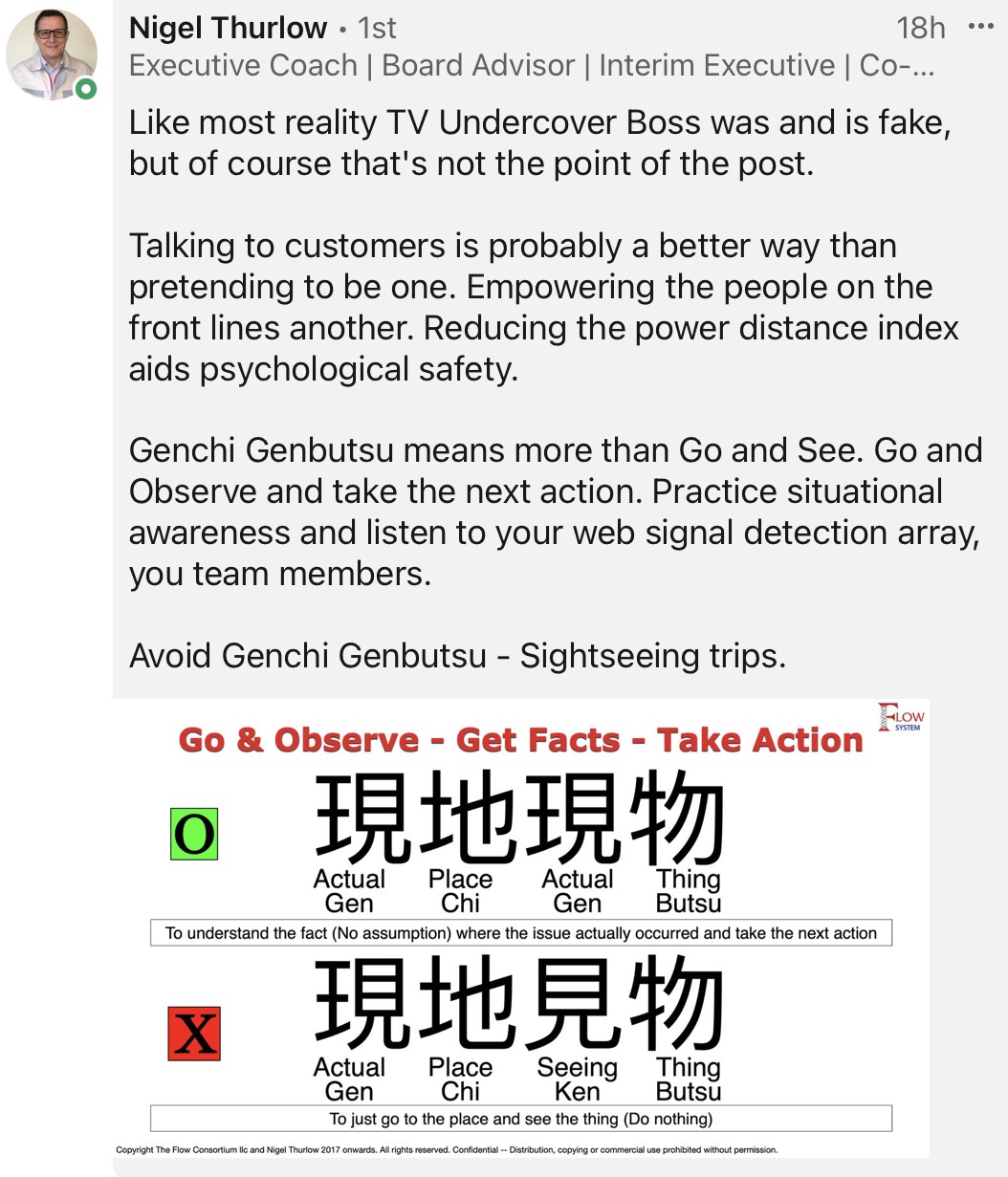
    I don’t know the answer to this but – do Toyota have the equivalent of Mystery Shoppers? I’d be interested to know.* (I’ve got an answer Genchi Genbutsu via Complex Wales, see explanation below from Nigel Thurlow, who’s written books about this sort of thing)

    Helpful as ever… So no definitive answer on Mystery Shoppers from me. There is a place for them I’m sure. In the right context and used for a specific purpose. But not as a universal approach, and if the Big Boss has a flash of inspiration and fancies a go, proceed with extreme caution.

    So, What’s the PONT?

    1. Mystery Shopping has it’s roots in covert operations, carried out in secret, to catch people doing bad things. It’s worth remembering that.
    2. With social media we have the ‘opposite’ of Mystery Shoppers. People telling us constantly what they think of products and services. We need to get better at ‘listening’ and understanding what they are saying.
    3. If a Big-Wig is about to embark on some Mystery Shopping – encourage them to think about the Why? How? and What? they are going to to do afterwards. It might be better to drop the ‘mystery’.
  • But, it depends… Whether or not a regulation process (including inspection, audit and any other ‘control’ method you can think of) actually ‘drives’ innovation depends on a lot of things. For me, the biggest influence is ‘purpose’.

    If your main purpose is to ‘enforce’ compliance with clearly defined rules or standards it could be a challenge. The challenge will be even harder if you’ve got a ‘sanctions’ mindset, “catch the guilty and punish them…” (said with wide staring eyes and a little bit of spittle… you know them!); the ‘Cruel by Fair’ dogma, applied by the Spanish Inquisition characters of Monty Python sketches. I touched on it in this post Regulation, Inspection and Audit. It really, really shouldn’t hurt…

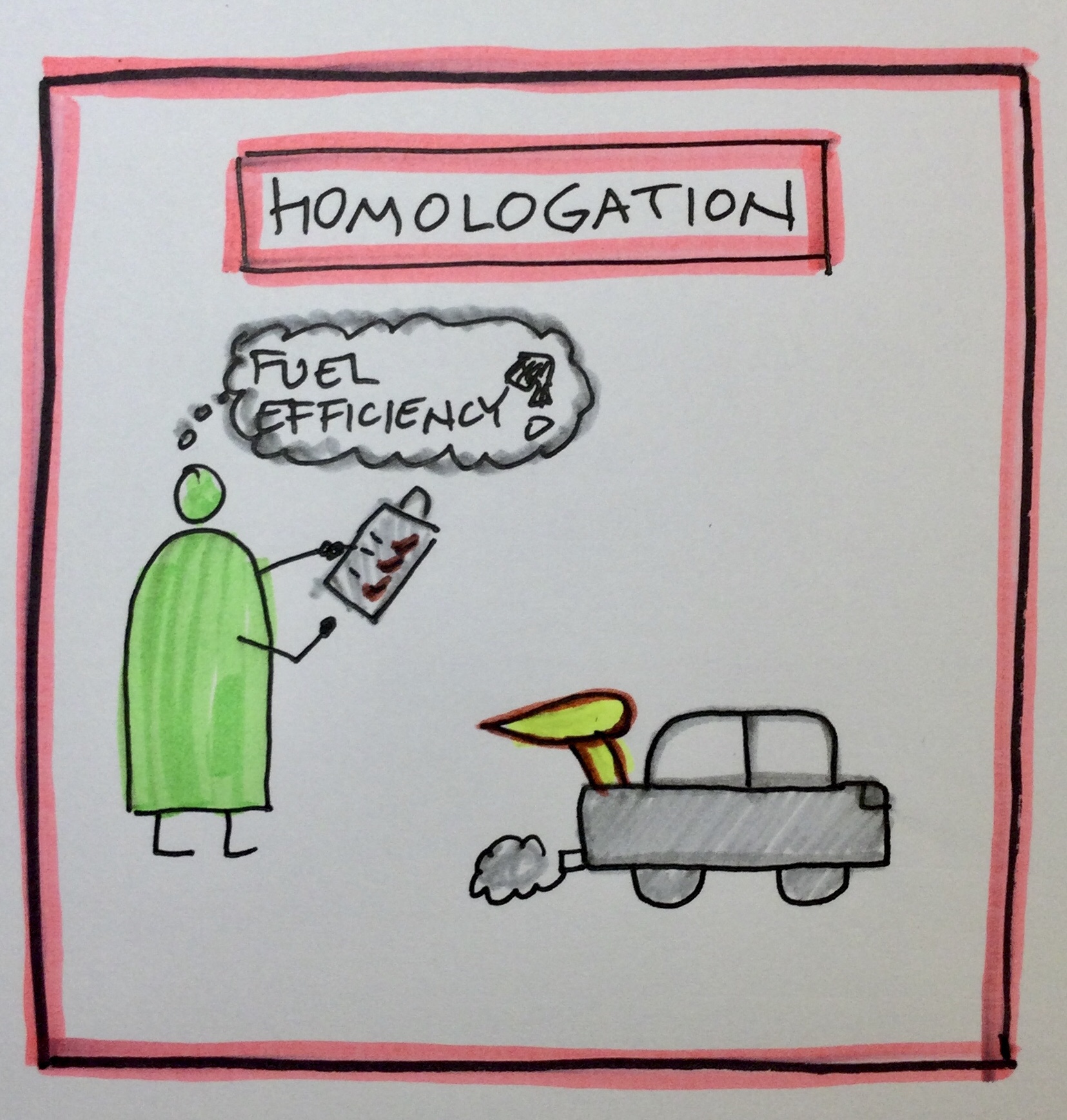
    What is Homologation? In it’s strictest sense homologation is simply about a set of rules (or standards) that describe how something should be done. The homologation process means that you comply with the rules, or meet the standards, and you are now approved to do whatever it is they apply to. It comes from the ancient Greek homologeo, “to agree”, apparently.

    It’s not a word commonly used much outside of sport as far as I can see, but it is useful. I particularly like an explanation around the use of Climbing Walls. There is a homologation requirement for representatives of the International Federation of Sport Climbing to approve climbing walls before events. If you’ve every seen or used a modern climbing wall you’ll probably understand why that is necessary.

    And what’s it got to do with innovation? This is where things get a bit sketchy. There’s a lot of discussion around vehicles designed for racing being approved (homologated) for use on the Public Highway (everyday roads). But I don’t want to go there.

    What I would like to steer you towards is a conversation around homologation and innovation in Formula 1 (F1). A while back I met some engineers (post here) who were very excited about homologation as the main driver of innovation in F1. The way they described it to me was along the lines of:

    • The Regulatory Body establishes a set of rules (tick)
    • They enforce those rules and everyone complies (tick)
    • Failure to comply (or cheating) gets you sanctioned (tick)
    • It all gets a bit boring.
    • All the competitors have designed engineering solutions up to the limit of the rules.
    • Everyone goes as fast as everyone else and there is virtually no difference between what the cars do on the circuit.
    • The Regulatory Body changes the homologation process (the rules).
    • This might be as technical as the ratio of how much energy needs to be used from batteries compared to petrol engines.
    • There’s a scramble to develop new solutions (innovation) that comply with the new rules (tick)
    • New engineering methods are routinely used on the racing cars (tick)
    • The Regulatory body enforce those rules and everyone complies (tick)
    • It all gets a bit boring.
    • REPEAT.

    Forced Innovation. The big point I wanted to make is that the Regulatory Body has deliberately forced (driven) innovation by changing the rules. The people on the receiving end of the change ‘rise to the challenge’ and come up with innovative solutions. In fact, the engineers I spoke to positively looked forward to Homologation changes. It’s what made F1 ‘interesting’ for them.

    It Takes Two to Tango. The other point I wanted to make is for this approach to work, it needs both parties to take place in the ‘dance’, enthusiastically. A while back I wrote that ‘Regulation is a Social Process. A Contact Sport… People Doing Things With Other People.’ It was based upon a review of the Health Regulator in England, the Care Quality Commission, carried out by the Kings Fund and Manchester University. The point that relationships absolutely matter, for me stands out in that report. If your ‘purpose’ is to do more than just ‘hold to account’ and ‘catch and punish’; you really need to work on the relationships. It does after all take Two to Tango.

    I did ask Twitter if there were any examples of ‘homologation, by another name (thread here) and I was pleasantly surprised by what I learned:

    • Building Standards – setting higher standards for things like thermal efficiency delivering warmer homes via @epistatcadarn
    • Health Care – changing the targets for things like waiting times led to local innovations via @joyfurnival
    • Cycling – differing views on how it would be useful versus avoiding giving advantage to people with better bikes via @Point1Athletic and @DyfrigWilliams
    • Sport Funding – changing criteria to encourage gender parity on governing bodies via @REDavidKnight

    What this has made me realise is that there is already plenty going on in the world of homologation. Regulation being used to ‘force’ innovation (and improvement). To misquote William M. Gibson, “the future is already here, it’s just unevenly distributed”

    Regulation *can* Drive Innovation. Getting back to where this post started I think Regulation can dive innovation, but it always ‘depends’ on a number of things. For me, ‘purpose’ matters most. The future might be already here, but the willingness to use the ‘power’ of regulation for the purpose of supporting innovation is a choice and habit. And like lots of habits, the more you practice it the easier it becomes…

    So, What’s the PONT?

    1. Regulation has a big impact upon what people and organisations actually do.
    2. Changing the ‘rules’ can force (or encourage) people to do different things like innovation,
    3. ‘Purpose’ and how regulators approach this challenge is important. The impact can be as stark as ‘opening things up’ or ‘closing them down’.
  • Template indicating the ‘useful bits’ you need from a tree to build a 1500’s Basque sailing ship. (my pic)

    Quite a lot as it happens. But first, consider this… Fleet Oaks. Fleet Oaks is the name given to oak trees that are planted with the sole purpose of providing the building material (wood, specifically oak) required for naval ships.

    Growing oak trees isn’t a quick enterprise. My interest was triggered by a recent Tweet from @animyer who shared… “After their defeat and loss at Copenhagen in 1807, the Danes responded by planting 90,000 oak trees toward the Navy’s rebirth. The Danish Nature Agency, successor to the royal forester, informed the Defense Ministry in 2007 that their trees were ready.”

    It’s fair to say that the statement generated a lot of interest (35.8K likes, 894 quote tweets and 6.4K retweets) and a long thread of illuminating comments. I’m no military historian but here are some points I’ve drawn out of the conversation.

    • Planting oaks to build future ships wasn’t a new concept the Danes invented in 1807. There are plenty of examples of the military planting forests of oaks, and some that still maintain them. For example the US Navy has foresters who manage a plantation of white oaks, specifically to maintain the USS Constitution. Details here; Why the US Navy Manages Its Own Private Forest
    • The practice of planting and managing trees to specifically build ships goes back to at least the 1500’s (possibly driven by demand and supply). I wrote about it in this post, Planting Oak Trees to Build Future Ships. This post talks about the practice of bending and shaping oak trees in the Basque Country. The idea is they will produce the structures suitable for future ships. The picture of the template shows this.
    • The law of unintended consequences. The practice of planting and maintaining oak forests will have an impact on things like; land use, biodiversity, carbon capture and other environmentally beneficial things. Did an action by the military in 1807 to resolve an immediate problem, have impacts that are proving to be extremely relevant in 2021?

    Why are the Military interested in Net Zero? Back to the point of this post. If I had to sum it up in a single sentence it would be, ‘they are part of the problem, but also part of the solution…’

    Two things stick in my mind from a generation ago (probably 25+ years), when I was working in the environment sector. We were thinking about the impact of global warming and climate change. My first memory from this time relates to scenario planning and predictions that climate change could lead to future wars. Wars brought about by water shortages and mass migrations. The second memory relates to some Military emergency scenario exercises I took part. They were desk based (at the Army Barracks in Brecon) and they left a lasting impression on me. The Military were really serious about scenario planning and thinking about how they would respond to whatever was ‘coming over the horizon’.

    Climate change threatens peace. The graphic above is taken from the Ministry of Defence publication, Climate Change and Sustainability Strategic Approach (March 2021).

    It’s quite stark to see what had been talked about 25+ years ago now featuring prominently a MoD document. Forming a large part of why the Military thinks it needs to address the issue. Climate change is as much of a threat to ‘peace’ as aggressor armies or enemy states. I never really thought I’d see the day when the Military and climate change were so closely linked.

    The military have a checkered history when it comes to the environment and climate change. To quote from the report, “the scale of what Defence is called upon to do, makes us a carbon emitter” (among other things I’d argue). The fact that they are responsible for 50% of the emissions from Central Government isn’t ducked. What is encouraging though is the desire to do something serious about it. I did have a chat with one of the report’s Co-Authors and to be honest I was staggered by the level of ambition.

    It is immense, and covers everything from using procurement to ‘stimulate the supply chain’ to do their bit around the circular economy, through to the use of MoD land to generate renewable energy and capture carbon. Apparently the MoD are the second biggest land owners in the UK, so there’s plenty of space for trees and other things. Maybe not Fleet Oaks though, unless the Navy is taking Net Zero to the extreme and going back to wooden sailing ships. Do read the report.

    When things go horribly wrong… and they do. In a recent conversation about stimulating the circular economy in Public Services we touched upon the role of the Military. The fact that when things ‘go horribly wrong’ the Military are the people society calls upon wasn’t lost upon us. This isn’t just for natural disasters (home and abroad) and pandemics (building field hospitals, running test centers/ giving vaccinations etc). It’s also for the ‘mundane’ stuff like driving HGV trucks to get food into the supermarkets and fuel into the petrol stations.

    Whatever is coming next, the Military will probably be there. When everything else has broken down (including civic order).

    Combine that with the fact that they do strategic planning and scan the horizon for breakfast (probably before most of us have had our breakfast). We should probably pay attention to what they are thinking, planning and work out how we might fit in. Oh, and doing things as well. The other big thing I have noticed about military types is that they tend to be ‘action orientated’ (they get stuff done).

    Planting forests of Fleet Oaks in 1807 might not have produced the military gains hoped for, but it might actually be contributing to ‘keeping the peace’ 200 years later. Who knows what else they are capable of?

    So, What’s the PONT?

    1. The Military are generally quite good at scenario planning and horizon scanning (it’s what they do).
    2. Climate change threatens peace. If the military are saying it in such bold language, it’s worth a look at what they say and what they are going to do about it.
    3. When it all goes horribly wrong… because it will. It’s worth building relationships with the Military now, because it might just pay off in unexpected ways when we ‘bump into’ each other in the future.

    *Picture Source: Climate change threatens peace. Page 6 Ministry of Defence. Climate Change and Sustainability Strategic Approach. https://www.gov.uk/government/publications/ministry-of-defence-climate-change-and-sustainability-strategic-approach

  • My friend Mishka. She frequently causes me pain and public humiliation. Mishka doesn’t care, and I’m grateful for what I’ve learned.

    We need ‘difficult’ friends. I think everyone needs a ‘difficult’ person in their life. That awkward git that won’t shut up and tells you exactly why your brilliant idea is doomed to failure. They aren’t afraid of offending or hurting your feelings, publicly embarrassing you, treading on your toes and causing a ‘stink’. Just what’s needed to ‘save you from your self’. Or maybe not.

    Apologies for the profanity in the title – sometimes you just need to say you really mean. For the rest of the post I’m just going to say ‘difficult’, so I get past the NSFW* filters, and don’t offend any puritanical LinkedIn types.

    At the moment I’ve got a few reasons for bringing up ‘difficult’ friends:

    • First of, I’ve been involved in a few recruitment interviews and I’ve been reflecting on how I would answer the question “how do you challenge yourself to make sure you are continuously learning and improving?”
    • Secondly, I’ve been listening to a friend talk about someone who has surrounded themselves with sycophantic ‘yes people’. The result has been they have made some bad decisions because nobody was prepared to challenge them, and
    • Thirdly, somebody has wound me up, by acting like an a**hole. Which made me think, do I actually need someone like this in my life?

    Feedback, the breakfast of champions. A while back I wrote about The Ladder of Inference. Climbing Down from Expert Bias. It was an attempt to explain the risks of not challenging assumptions or failing to seek feedback. There’s a lovely phrase in the original work on organisational learning by Prof Chris Argyris that says you need to, ‘climb down the ladder of inference’ to seek alternative views and evidence. Nowadays we might say something like ‘I need to be aware of confirmation bias’.

    This is great in theory but, it does require that you are willing to do the ‘climbing down’. You also need to have people around you that will directly tell you what they think. In reality, I’m not sure this happens as enthusiastically as we would like to admit. If you do have colleagues that are ‘brutally honest’, especially if you are their boss, and you are listening, well done you.

    Feedback for ‘free’! This is where the ‘difficult’ friend comes in. You don’t have to struggle through the hard work of deliberately ‘climbing down’ from anything to seek feedback, you are having it whether you want it or not. They have no problem offending you, or hurting your feelings so what you are getting will be brutally honest. If you are the boss surrounded by ‘yes people’ this is the ‘wake up and smell the coffee’ call you can’t ignore. How good is that. Even better, the service comes for free, but there may be hidden costs…

    The hidden costs of ‘difficult’ friends.

    Who are these people? Too much of anything can be bad for you – this applies strongly to ‘difficult friends’. So, in an attempt to understand what is going on I’ve bought a book that explains the theory. I haven’t finished it yet but I do feel compelled to share what I know so far.

    The first thing is that there are characteristics that define these people and their impact:

    • They have a huge ego and a view that they are ‘right’,
    • This leads to a sense of entitlement that ‘rules don’t apply’ to them,
    • Other people’s feelings are inconsequential,
    • The damage they cause is difficult to quantify and tends to be relatively moderate (hurt feelings etc),
    • But it does leave you feeling bruised, enraged and annoyed (they can ruin a sunny day).

    I’m sure you might be thinking. I know exactly who you are describing – the reason is because they are everywhere (we probably all have tendencies).

    The second thing I’ve learnt is that you don’t change this particular variety of ‘difficult person’ by pointing things out to them. According to the book this just reinforces their view that you are an idiot who’s not worth listening to.

    So, what do you do? I’m still reading the book, so I’ll get back to you on that. What I do think is that there are considerable benefits in having a ‘difficult friend’ in your life. For some people you may be blessed with having them as work colleagues – if so, harness that power to help you ‘climb down the ladder of inference’. If not, look beyond into your social groups or even your family connections. Use the power of the a**hole to help you make better decisions. Just don’t overdo your exposure to them.

    Finally. If anyone is thinking, ‘He’s written this about Me!’ You are wrong. That’s one of the tests. If someone thinks they might meet the criteria, they probably aren’t one. It’s the people who think none of this applies to me are the ones worth ‘befriending’, cautiously.

    So, What’s the PONT?

    1. Seeking honest feedback can be a chore. A ‘difficult’ friend can do that for you, proactively and robustly.
    2. If you are a boss surrounded by ‘yes people’ it is exactly the voice you need to listen to.
    3. Don’t overdo it and ration your exposure. This is why having them at ‘arms length’ might work best. If you sup with the devil, use a long spoon.

    NSFW* = Not Safe For Work

  • Definition – ‘to mutter’; “A barely audible utterance, especially in dissatisfaction or irritation”. In other words:

    • something spoken,
    • very quietly,
    • so quiet that you can hardly hear it,
    • it might not be exactly clear who or what it is about,
    • It’s not exactly a fully formed complaint,
    • it’s not written down (so it can’t be carefully examined),
    • It’s JUST THERE, and
    • It can be easily ignored.
    • A ‘weak signal’ of something that might not be quite right, or about to go wrong.

    Doing things differently. Last week I was at the excellent Research in Practice event focusing on how communities are coming together to do things for themselves. There were plenty of examples of Communities and Public Services doing things differently (and better) in response to things like the 2008/9 Banking Crash, Covid19 and preparing for whatever is coming next… The details of the event are available here: Considering resource beyond the graph of doom: Leaders’ Forum.

    There was also a Twitter hashtag you can look at (#LeadersForum21), which brings me on to the epic Tony Bovaird… Tony was there to close the event with a bang, and he did that. I’ve enjoyed seeing Tony speak many times, and every occasion I take away something different. This time it was ‘muttering’.

    Muttering, Twitter and Weak Signals. Tony was using an example of how one London Council had engaged with people on Twitter after snowfall. The point Tony was making is that people are ‘telling’ Public Services what they think – for free……Public Services just need to ‘listen’. He beautifully captured what was going on under the description of listening to the ‘muttering’. Tony is someone who can say ‘muttering’ in way that gets across the deeper meaning of what is going on.

    The key point for me is that ‘muttering’ represents things that are; quietly spoken, barely heard and easily ignored. Absolute classic ‘weak signals’. Indicators that something ‘isn’t quite right’, or is ‘about to go wrong’. The things that are so often ignored, just before a catastrophe. The ‘warning signs’ were there, and are gleefully pointed out afterwards by the ‘investigators’ (you’ve seen the film).

    So, should we be using social media to ‘Measure the Muttering’?

    But Social Media is a Nest of Vipers… Yes it is. But that doesn’t mean we can totally ignore it. My own history with social media, and how we might use it to ‘listen to the muttering’ is a bit complicated.

    Back in the early 2010’s I was a massive enthusiast. I became fascinated with a train company – London Midland Trains. Basically they were a social media pioneer among train companies and were engaging positively with travelers through Twitter. As I recall, there was even talk of Twitter posts (mutterings) informing train maintenance schedules. I was so enthusiastic that I wrote a number of blog posts, which 10 years on all feel a bit naive:

    Troll Farms and Astroturfing. By 2015 my enthusiasm for the social media bubble was quite deflated. Things like general ‘trolling’ and the rise of ‘troll farms’ (unscrupulous people ‘corrupting’ the environment to further their own agenda) worried me. One of the more alarming aspects was the idea of ‘astroturfing’. The deliberate creation of a false, ‘grass roots’ opinion through false social media accounts. Details below.

    Can You Really Trust Social Media in a Crisis? The Rise of Troll Farms. (September 2015)

    Astroturfing: Is Grass Roots Opinion Real or Manufactured? (February 2016)

    The idea that it would be possible to detect weak signals, or listen to the muttering with all of this going on was a challenge. If people chose to ‘ignore the muttering’ you could hardly blame them.

    And just to make things more interesting, the arrival of increased data protection requirements (GDPR) made ‘listening’ to people on social media – without their explicit permission – difficult. So, in some ways it felt like listen to the muttering on social media had gone in my ‘hard to do’ box. Tony made me think again…

    But were does this leave me? Well, I’m absolutely convinced that listening to the mutters is something we should try to do. As I said earlier they are classic ‘weak signals’. Measures of things being ‘not quite right’ or early indicators of things going wrong. It’s still a place where people say things, quietly that are not quite heard and easy to ignore. The worst thing we could do is to choose to ignore the mutterings because of the impact of the trolls, GDPR requirements (and the general hassle of poking around in the Vipers Nest). It’s often easy to make excuses not to do something.

    Easy to say, hard to do. So, in the spirit of being helpful, here’s what I suggest:

    • Go to where people are. Find the communities you should engage with, get involved and listen to the conversations they have – including the mutterers. This might involve ‘leaving the office’ and going out and being part of things (to quote Dez Holmes).
    • Triangulate. Do not rely upon single sources of information. Social media is not the whole world, and bubbles can become echo chambers. Diversity isn’t just a nice thing to do, it’s essential (in everything).
    • Really listen. The whole point of ‘muttering’ is that it is barely audible, so you’ve really got to listen (without judgement).

    So, What’s the PONT?

    1. ‘Muttering’ represents the things that people say which are: very quiet, barley heard and easily ignored. That doesn’t mean that they aren’t important. However quietly spoken or muttered, it probably means something.
    2. For anyone who thinks that ‘prevention is better that cure’, mutterings are classic weak signals that something might not be quite right. So best to to listen carefully.
    3. Social Media can be a Nest of Vipers. But ignoring it is as risky as jumping in with both feet. You need to be careful.
  • The (over) Enthusiasm of Youth. A long time ago (over quarter of a century), in a Galaxy far, far away (St. Mellons, East Cardiff) I learnt all about Root Cause Analysis (RCA), and my life was enriched. I was freshly equipped with a science degree, doing science based things at work and RCA fitted perfectly.

    A large part of my day job involved getting to the ‘root cause’ of the pollution that affected the rivers of South Wales. The basic principle of RCA and techniques like the Ishikawa Fish Bone Diagram approach were exactly what I needed. It provided a common understanding and a language to use with the skeptical Production Managers at the factories I visited. Places where diesel (or any other contaminant) was leaking into the river from an unknown source on site. Lovely! All rewarding detective work involving science and RCA.

    Hello 5 Whys. Imagine my excitement around that time when my wife introduced me to the 5 Whys (It’s one of the many reasons I love her so much). She was involved in heath care improvement and it was one of the ‘new’ techniques they were teaching to practitioners.

    Our joint enthusiasm for 5 Whys extended to dragging our kids around the Jefferson Memorial in Washington DC on holiday a few years later. The kids were incredulous as we searched for evidence of; midges, spiders, pigeons, pigeon poop and stone damage. They have never really forgiven us, details here in Busman’s Holiday. The Jefferson Memorial and Root Cause Analysis.

    A Struggling Padawan Learner. Fast forward a bit to the swamps of Dagobah (Star Wars reference, and possibly a good metaphor for some of the Audit rooms I’ve occupied). I’m now meeting challenges that aren’t as straightforward as ‘find the leaking chemical tank’. Problems can’t be easily reduced down into a single cause using the RCA tools I used to love. Let me explain a bit.

    The problems I’d previously encountered usually had defined boundaries – literally in some cases, like the factory fence. There were clearly identified assets; chemical storage areas, transport routes, production areas and points at which chemicals could run into the drains and the river. There was also the human operator side, people with clearly defined roles in the production system, who (should) know what they are doing.

    My root cause analysis tools were perfect for that environment.

    However, the challenges I was now facing were different. Some were far more complicated – there was a lot more going on. Many were actually complex; unpredictable, dynamic and driven by human behaviours. An entirely different ball game.

    This didn’t stop me trying to apply RCA methods though. This was not a good approach. Sometimes it didn’t matter too much, I’d just end up in a mess and getting nowhere. Sometimes it could have been a bit more damaging – coming to a ‘root cause’ conclusion that was actually wrong. Wrong in the sense that it was only one of many possible ‘root causes’ that could have contributed to the outcome I’d seen.

    You may have seen this yourself? The focusing down on one ‘answer’ because it ‘fits’ and is ‘convenient’ rather than looking closely at other possibilities? You see it everywhere if you are prepared to look.

    Luke… Use the Force… So, I felt like I was in a bit of a mess. At such times its always worth looking beyond your current ‘Universe’ to see what others do. One of the places I looked was at what Dave Snowden had to say. The early 2000’s session he used to do on the ‘Invisible Gorilla’ and Inattentional’ Blindness‘ changed how I thought about things.

    The idea of ‘sense-making’ became part of my thinking and is where the title of this post comes from… If a struggling Padawan learner was looking for advice – this is what I imagine a Jedi Teacher might say. Massive apologies to Star Wars enthusiasts…

    “Luke… Root Cause Analysis 5 Whys is not the method you are looking for… It’s fine in a controlled and predictable environment (like manufacturing). Be aware of it’s limitations when things get more complicated. But if the situation is complex, be cautious, look towards sense-making, and use the force…”

    RCA does have a place. Apologies if I’ve broken any Star Wars etiquette, I just wanted to make the point. I also wanted to say that I’m not against RCA in any way. A while back I even went as far as producing a sketch-note on it – above.

    RCA is a very useful tool in the right context, situations where the situation is Clear or Obvious from a Cynefin Framework perspective. Where things are Complicated, you run the risk of focusing too narrowly, when there might be several ‘root’ causes – not just one. That can be quite dangerous in the case of investigations where you are looking for ‘responsible parties’ (…who’s to blame?).

    If you want detailed examination of the limitations of RCA in healthcare I suggest looking at this article from the British Medical Journal Quality and Safety publication by Dr Alan J Card, The problem with ‘5 whys’.

    Some key points for me:

    • 5 Whys is a great teaching tool. But it is based on ‘idealised’ situations that are hard to repeat in real life. Worst of all – the Jefferson Memorial example isn’t actually correct! I’m gutted (wait till I tell the kids).
    • “…accidents are seldom the result of a single root cause. So focusing exclusively on one (or even a few) arbitrarily determined ‘root causes’ is not a reliable method for driving improvement—especially in a system as complex as healthcare.” (see my point above)
    • RCA and 5 Whys have come from vehicle manufacturing, often referred to as ‘High Reliability Organisations’. It is not applicable to use these techniques in much of healthcare (or many of the situations seen across complex public services). Have a look at what I’ve written about ‘Silver Bullet solutions’.

    Well, what does that leave us with? I did mention sense-making earlier… I am planning to follow up on this post and link to some ideas about how RCA can complement a sense-making process. It’s not about finding a ‘root cause’, but probing, learning and making sense of what is actually happening, and what might be possible.

    If I dare to still make Star Wars references, it might even be a trilogy (of four posts)…

    So, What’s the PONT?

    1. Root Cause Analysis and 5 Whys are useful methods – in the right context.
    2. No single method or tool will be useful in all situations. One size never fits all. Always consider what is the most appropriate tool for the job.
    3. Lifting a successful approach from one industry and dropping it into another is fraught with difficulties. Someone else’s ‘silver bullet’ is unlikely to work in your context.
  • Always check quotes you find on the internet.

    Hold on to your undergarments. I’m going to explain an Abraham Lincoln quote through the lens of Mean Girls. Yes, you did read that right. Mean Girls, the 2004 American teenage comedy film.

    At last, I understand Mean Girls. Last night I was watching Mean Girls (with my wife, who provided running commentary) and it all made sense. I’ve randomly seen fragments of it many times, but never end to end.

    The basic plot (just in case…)

    • An individual joins a new organisation (a school) as an unknown outsider.
    • They (Cady) are trying to make sense of things and fit in.
    • The first people to ‘help’ are also ‘Outsiders’, on the fringes of the mainstream.
    • The Outsiders warn Cady about the powerful ruling group, The Plastics.
    • The Plastics have a range of bad behaviours they use to maintain their power.
    • Under the cover of tackling bad behaviours, Cady successfully infiltrates The Plastics.
    • Through that process of ‘getting to know’ the The Plastics, Cady becomes ‘one of them’.
    • Cady eventually replaces The Plastics ‘Queen Bee’ and everything goes horribly wrong.
    • A document is made public (The Burn Book) exposing the bad behaviour of everyone in the school.
    • Mayhem ensues. Cady gets into massive trouble.
    • Out of the mayhem a new status quo is established.
    • Now people respect each other, value difference and diversity and don’t do the bad things they used to.
    • And… if someone does start behaving badly, there’s the option of pushing them in front of a bus!

    It’s a film worth watching, just so you can smile knowledgeably if someone in your social group uses one of its quotes. I now know the cultural significance of, “I’m kind of psychic. I have a fifth sense. It’s like I’ve got ESPN or something”.

    Old stories that never go away. The plot of Mean Girls might feel familiar? The theme of how the differences between people shape what happens between us has been around forever. And it happens everywhere. A high-school film is perfect to amplify behaviours and impact, but it is just as common in other places, like work. People are different, and some don’t like each other. It’s one of those ‘human’ things. This is where Abraham Lincoln comes in…

    “I do not like that man, I must get to know him better.” The quote is attributed to Abraham Lincoln, although I am struggling to find the actual source*. Just as relevant is “I do not destroy my enemies when I make them my friends”. You can find the sources in this article on Quote Investigator which talks about the power of redemptive love.

    Its also worth a look at this HBR article, Leadership Lessons from Abraham Lincoln. It describes some of the things he did to rebuild relationships after the American Civil War. One of his significant steps was to appoint people to Cabinet that were opponents and competitors for the job of President. A practice from over 150 years ago that is just as relevant today.

    From a very practical perspective I’m trying to embrace the advice from Lincoln. There are some people I encounter who I just don’t like. Lots of that will be my personal biases, both conscious and unconscious. Some of it will be down to things they have done to trigger me – actual bad behaviours.

    The point of the Lincoln quote is that one way for me to get over my dislike is to get the know that person better. If I understand them more deeply, the reasons for my ‘dislike’ should be more understandable. If it is my bias, assumption or ignorance on my part – by finding out more about them, I should be able to do something about it. It ought to be as straightforward as that. Easy to say, hard to do. It needs me to step beyond my comfortably held view that ‘I do not like that person…’. This stuff isn’t easy.

    There are however risks to talking this approach. What if you become ‘changed’ as part of the process, just like Cady in Mean Girls. What if these are genuinely badly behaved people, and you end up doing the same?

    You need to be aware of what is happening, which I wrote about ages ago in “If you sup with the Devil, use a very long spoon”. Like I said, this stuff isn’t easy, but essential in a world where everything seems to be getting more polarized. Sometimes it feels like the easiest thing to do is define your self by declaring the people you don’t like – just have a quick look at some Twitter bios.

    Make your enemies your friends. I think I might return to this idea, but in the meanwhile have a ponder on this – The Human Library (link here). This is a practice from Denmark where you can go to a library and instead of borrowing a book, you borrow a person. That person sits with you and tells you about their life, so that you can understand another persons perspective and life experience. This might not be totally radical if you enjoy a conversation with random strangers on public transport or in the pub. But, in these days of restrictions on social contact and global turmoil it might be a useful substitute for getting to know people better, and warming us up to make friends of our enemies? Worth a go I’d suggest.

    So, What’s the PONT?

    1. Why we dislike someone is a complex equation. Biases (conscious and unconscious), social pressure, what they do to others or have done directly to you all play a part.
    2. Getting a better understanding the person is a good first step. Work out why you feel that way, and what you might do about it. But it’s not an easy or instinctive step for most of us.
    3. Which is why I recommend watching Mean Girls, and immersing yourself in the quotes and practice of Abraham Lincoln (but try not to mix them up).

    Footnote*. This the best I can do on the source of the ‘I do not like that man. I must get to know him better’ – picture below. Apparently the quote is on page 28 of ‘The costs of administering reparation for work injuries in Illinois’. (1952) by Alfred Fletcher Conard. Well I had a look,and couldn’t find it. Which sort of proves that meme about not taking quotes you find on the internet at face value.

  • Hard on equipment. I’ve got a friend who has a habit of borrowing my tools, and bringing them back broken. It’s usually done with a cheeky smile and an infuriating comment along the lines of “…it’s busted butt; you need to buy better quality tools”. Despite this, I am still happy to call them my friend. Strangely, I continue fall into the same old trap of lending them a cherished tool (about once every 10 years.)

    What’s going on here you might be asking (I often ask that myself)? Apparently it might have something to do with a cognitive bias called the Benjamin Franklin Effect. It’s not just me being a complete sucker and desperate for friends…

    The Benjamin Franklin Effect. Basically it boils down to idea that you will like someone if they ask you for a small favour or help of some sort.

    The story behind it goes back to the time when Franklin was in the Pennsylvania State Legislature. He was standing for election when a powerful political rival (who didn’t like him), spoke against him in speech. Franklin won the election, but knew he would need to work with his opponent in the future. One of the steps he took was to write and ask the individual if he could borrow a rare book he had in his personal library. Franklin was known to be an enthusiastic reader. The individual lent Franklin the book, and received it back a week later with a note of thanks. From that point on the opponent became friendlier towards Franklin, a relationship that lasted for many years. The event is documented in Franklin’s biography and you can read more about it here.

    Cognitive bias or load of guff? There’s a lot written online about the Benjamin Franklin Effect. There’s even more on You Tube including some very dubious material suggesting it will help with ‘dating’ – don’t go there!

    This is what I’ve taken from the sources I’ve been looking at:

    • Some people don’t like other people; fact of life
    • The reasons can be straightforward (they have done you harm) or can be massively complicated; part of unconscious bias or reasons you’ll never understand.
    • Whatever the reason(s), you just don’t like that person.
    • That person then asks you for a small favour or help.
    • Something relatively easy to do / low cost.
    • You oblige…
    • At this point you’ve scrambled your brain, cognitive dissonance sets in (link here).
    • Basically you have done something that is contradictory to what your brain ‘believes’ to be the truth. ‘You don’t like that person, but you lent them that rare book!…’
    • The psychological stress from the cognitive dissonance is too much to cope with, so the brain re-scrambles itself to think, ‘I actually like that person – that’s why I lent them the book’.
    • So, you go from disliking someone to liking them, and from now on will now do kind things for them.
    • It’s as easy as that (or maybe not)!

    It’s all just manipulation and flattery. I did run my understanding of the Benjamin Franklin Effect past a trusted source. Someone with a massive ‘guff’ detector. She told me it was all just manipulation and flattery.

    In their opinion, The Benjamin Franklin Effect works perfectly on people with big egos who like to feel like they have ‘rescued’ someone by helping them out – flattery. Subtle flattery, but still flattery.

    On the part of the person asking for ‘help’, they are showing some vulnerability to the more powerful person. Not too much vulnerability that could lead to damage, but just enough to get a ‘foot in the door’ – manipulation in other words.

    When it was put like that it did seem a bit obvious and errr… manipulative. Especially when my trusted source said it often works perfectly on powerful people with fragile egos. Hmmmm… !

    The jury is out. I did mention that there is a lot that has been written on this subject. Here are a couple of links that might help you make your own mind up.

    Brain Pickings (Maria Popova) The Benjamin Franklin Effect: The Surprising Psychology of How to Handle Haters.

    Psychology Today. The Power of Merely Requesting a Favour.

    Effectiviology. The Benjamin Franklin Effect: How to Build Rapport by Asking for Favors

    Back to my friend and the broken tools. Logic tells me that my friend who breaks tools should not be my friend, and I should not continue to lend them tools. But I still do it. Even more weirdly I’ll often take the tool to them, and do the job, so that they don’t break my tool.

    There might be something even more weird going on there, ‘Olympic Medal Standard’ use of the Ben Franklin effect, mixed with a bit of malicious compliance. Now I’ve really got cognitive dissonance and my brain is totally scrambled.

    Best not to think too deeply about this. If doing favours for people makes me like them, I’m happy with that. The more friends I have the better. When I do get stressed about broken tools I take solace in music, and the fact I’m not alone. Here’s a lovely song by Canadian Country and Western singer Corb Lund, Hard on Equipment (Tool for the Job). Corb ‘knows’ my friend… enjoy.

    So, What’s the PONT?

    1. Doing favours for people and helping them out, unconditionally, is a good thing. The Benjamin Franklin Effect suggest you might like them more as a result of responding to a request for a favour.
    2. Asking for a favour suggests a degree of vulnerability, which might make people think differently about you.
    3. Whether you are asking for a favour or giving one, treat it as an unconditional thing. Don’t over think it and don’t try to exploit the other person or the situation. That’s not nice.
  • ‘Nose in, Hands Out’. A bee with with its head deep on a flower. Kate’s picture

    Governance isn’t one of those words you’d typically associate with ‘enthusiasm’ or dare we say it ‘excitement’. Strange as it may seem, governance is something that we (Kate and Chris) do get excited and enthusiastic about. We probably spend more time talking about it than might be considered reasonable.

    There are good reasons for this. We both have an interest in how we all create a decent, sustainable society for us now and future generations. How people make ‘good’ decisions (now and for the future), how we wisely use the resources we have available and how we create responsible, caring communities is all linked to good governance.

    One of the things we’ve become involved in (nudged by our good friend Diana Reynolds, link) is facilitating a Community of Practice. Somewhere for people involved in governance to share knowledge and do some peer to peer learning. It is deliberately low key, diverse and not the ‘usual suspects’. Something that links people who are involved in governance from as wide a range of perspectives as possible.

    Diversity (in it’s widest sense) is not just a ‘nice thing to aim for’, it is essential. We want to be part of a peer to peer Community of Practice that we hope, will help people keep learning, and open the door to others who would like to get involved.

    To explain some of what we’ve been talking about, we’ve written it down. Here are some of the questions we’ve been asking each other following our first attempt at some action learning and trying to support a Community of Practice.

    Chris to Kate:  There’s already lots of guidance available on how to organise Boards. What difference will a Community of Practice with action leearning make? 

    Kate: Board members are often seen as the “finished product”. Many are experts in their field with successful careers. And I wonder if this is why the role isn’t offered more support. Are we afraid to suggest someone at the top of their game still needs development? 

    Lots of people become Board members because they constantly seek new learning and challenges. Yet, induction, training and development for Board members is inconsistent. It’s usually around things like risk management – rarely on issues such as climate change or the impact of digital on future generations.

    In addition to this, the pandemic has really highlighted the need for something new. Organisations have been heroic in their response to keep good governance by bringing meetings online. In my view this has brought many benefits. But it has also made it harder to connect at a more human level as we miss out on the chats over coffee and the chance to get to know each other. And if there is one thing that good governance stands or falls by, it’s the quality of relationships. 

    For example, Board members rarely get to meet outside of formal structures and yet are juggling:

    • the relationship between the Board and the Executive. 
    • culture of the Board and relationship between members themselves. 
    • individual relationships

    Creating a space safe to explore and better understand human behaviours and the psychology of Boards, as well as the practical delivery of good governance, feels like something that’s urgently needed.

    A Community of Practice can connect people at all stages of their governance journey, across sectors. It can provide peer to peer support in effectively managing the challenges faced. And the Action Learning Sets offer a more focused space for two or three people to reflect on specific dilemmas and their own development. It has the potential to support knowledge-sharing by connecting people and letting them learn from each other. 

    It creates a network of support.

    Chris to Kate: There’s a helpful prompt for Board members along the lines of “nose in, hands out”. How do Board members know if they’ve got the balance right? 

    Kate: Oh, you’ll know! If you’re listening at all, you’ll know when you’ve got it wrong. 

    Has anyone worked out exactly how best to get the balance right? 

    It is tricky because what’s needed or expected varies so much from place to place. This becomes really apparent within the Community of Practice because it draws from organisations of all sizes. And it makes for a really rich and helpful conversation. For example; it makes sense within grassroots organisation with little or no resources, that Board members get stuck in to get stuff done. But the moment that organisation starts to realise an ambition for extending its reach and impact, you don’t want to be in the position of checking your own work. The boundaries can and do blur. Particularly as we’ve already highlighted that Board members are often appointed for their expertise. 

    Let’s face it, we’ve all had times where executive teams have pumped you for knowledge and information only to go in a completely different direction. Get comfortable with it, that’s the advice from people who’ve been in this position. Being a subject matter expert does not automatically make you best placed to know what’s best for an organisation. Executive teams should be in the position of having far better knowledge and understanding to know how things will play out. A good executive coach considers clients their own best experts, facilitates reflection and, when useful, introduces new concepts or tools. Good Board members can do the same, confidently holding a mirror up to the organisation, shining a light on what’s good and supporting healthy development. 

    Our job is to ask the questions that support that growth, strength-tests what’s in front of us and has the common interests of the organisation and the people it is intended to serve at heart. Because that, after all, is what community is about.

    Never remove a fence until you understand why it was put up. My picture

    Kate to Chris: Where do you think the balance lies between ‘following process’ and being flexible when it comes to effective Boards?

    Chris: The short answer to this is ‘it depends’. Sorry if that isn’t immediately helpful.

    What I’m trying to say is that you need both parts, process and flexibility, and it isn’t one size fits all. Some processes are absolutely necessary most of the time. Things like safeguarding policies, health and safety, financial regulations etc, they have all been created for very good reasons. There is a quote, apparently a favourite of President John F Kennedy, along the lines of “never take down a fence until you understand why it was put there in the first place” (link).

    I think the point is important. You need to understand why there are rules and processes in place before you do something different. This links to something I’m also quite enthusiastic about and that’s the idea of continuous learning and even the idea of looking at being involved in a Board as an ‘apprenticeship’.

    Learning how things work, carefully, sometimes even failing (safely) are all part of the process. At the risk of quote overload, the idea that you need to “learn the rules like a pro, to break them like an artist” (attributed to Picasso & others, link here) is something worth thinking about, and practicing.

    So, if you are going to pin me down; I think you need to properly understand why rules and policies exist (fences), before you start acting flexibly to work around them (like an artist). It’s all about hard work up front (your apprenticeship), being aware of context and recognising how things can be constantly changing. Easy!

    Kate to Chris: What role does the Chair have in getting that right?

    Chris: Thanks, another easy question. This is huge topic which I’m going to boil down to two things, which I hope doesn’t over simplify what is an important role. First is the role of a Chair as the facilitator. From my viewpoint, for any Board to function effectively there is a ‘process’ to follow. Basically, getting the business done.  Seeking assurance, providing challenge, setting the strategic direction, monitoring performance, providing support etc. All of these things need to happen and the Chair has a role in helping that to happen.

    Beyond this there are the relationships that help to make all of the processes function as effectively as possible. As you’ve said in your answers, people are appointed to Boards with all sorts of background and expertise that ‘add’ to the mix. This might not always be because they admire and ‘get on’ with each other.  I’m not suggesting the Chair needs to be everyone’s ‘best friend’, but knowing about people and what makes them tick is helpful. The Board is effectively a Team, and getting the best out of the team in large part is influenced by the relationships between the individuals.  I think a Chair has an important role in understanding the board members and helping to build those good working relationships. Sorry, no quote for this one, although, you might want to have a look at what I’ve written here on the importance of Beer Committees as a cornerstone of governance.

    We hope that gives an idea of the things we have been talking about, and maybe lights a small fire of excitement?

    You can be part of this Community of Practice; you can get in touch however works for you or by providing your email address here.


    Useful resources: Diana Reynolds has a number of ‘quick tips’ available on the Welsh Government Academi website, link here.

    A good one to start with is Peer-to-Peer Networks in Support of Wales Audit Action Research. (It’s what got us to here)