• Construction workers accessing one of the Cardiff Central Square (Gorsaf Newydd) buildings in 2017. Using a temporary, lightweight scaffold stairway and social distancing before it was a thing (my picture).

    I’m a bit of a sucker for metaphors. Which one of these descriptions works best for you?

    Option A. “To make this project something that will be a success for many years we need to put up the right sort of ‘scaffold’ to help it develop…”

    Option B. “To ensure the successful delivery of the project you need to put in place a time limited arrangement of; people, processes, tasks and KPI’s, all aligned with outcome objectives…”

    Personally, I’m more attracted to Option A. I like the idea of a scaffold. It’s a good metaphor for all of those ‘supporting’ things you need on any project.

    I know enough about scaffold(ing) to recognise that it provides the support (literally) needed to do a job. I also know it is temporary and gets taken away after the job has been successfully completed. The house, bridge, ancient monument or whatever you’ve been working on can now successful stand on it’s own – no need for support. Extending the metaphor, the scaffolding would probably have been too flimsy anyway to provide total support – it’s just assisting the ‘building/repair’ process. I told you I was a sucker for metaphors…

    Iain, Sam and Aristotle. I’ve recently been talking with Iain Phillips and Sam Williams about scaffolding, with the idea of us contributing to the Cynefin Scaffolding wiki (link). I was surprised to see that a blog I wrote after the 2018 Cynefin Snowdonia retreat (summarising my learning in 5 Tweets) had already been posted there. There’s also some more detailed thinking, outlining ideas around different types of scaffolding, posted which is well worth reading.

    The conversation with Iain and Sam has got me moving again – and hopefully there will be more added to the wiki. Some of that might relate to scaffolding for supporting how we work in the future. For example, how does a team develop when everyone is working remotely? What ‘scaffold’ would help to build the relationships and trust necessary to be an effective team? But I’ll leave those things to Iain and Sam – I want to talk a bit more about metaphors. The idea of metaphors has been around for absolutely ages.

    Aristotle (382-322 BC) once said… “The greatest thing by far is to have a command of metaphor… for to make good metaphors implies and eye for resemblances”.

    There’s a lot written about why we use metaphors, and the value they add. This article is from Psychology Today, ‘Why Metaphors Are Important’ is a useful summary. If you fancy a mental stretch have a look at this, ‘Representation – Got Forth’ from Matt at Complex Wales. I’m slightly worried that Matt is going to point out that I don’t know the difference between a metaphor and an analogy. To be honest, I’m not sure I do. But it all seems blurry enough for me to get away with it for the purpose of a blog post.

    I did read some of the papers cited in the Psychology Today article. Work by Thibodeau and Boroditsky in 2011 grabbed my attention. Their research looked at how people responded to a description of a city where there was a crime issue. For one group they used an animal metaphor to describe criminal gangs (beasts preying on citizens), and for the other, a disease metaphor (a plague on the town).

    When readers were asked to think of solutions to solve the crime problem, they came up with different things, depending on the metaphors used. The animal metaphors generated punishment and control approaches whilst those who had experienced the disease metaphors went for diagnosis and treatment approaches.

    Interestingly, the earlier research cited in that paper talked about analogies rather than metaphors – so, if smarter people than me are mixing up the metaphor and analogy I’m not going to stress about it. The thing I’d rather focus on is their impact and value. In summary, this is what I’ve learnt about metaphors:

    • We get used to words used everyday, to the point that they no longer have much meaning. Think about Options A & B above. A metaphor brings it back to life.
    • Metaphors go beyond the literal meaning of things. By doing that it can help people better comprehend ideas that are difficult to understand. Think about how a picture or drawing can sometimes help people understand and ‘get it’. A metaphor works in the same sort of way.
    • Metaphors influence how we think on an unconscious level (Thibodeau and Broditsky). This seems to fit well with lots of what we all know about marketing and the power of metaphors to ‘sell’ us something. Which brings me back to scaffolding…
    The scaffolders seemed to be really enjoying this one. It might be there a while… (my picture).

    Scaffold is / should always be temporary. This goes right back to where the metaphor of scaffolding landed with me at the Cynefin Retreat in 2018. I’ve always had concerns that for some projects the ‘scaffold’ becomes the ‘thing’. The thing you are helping to build or develop becomes less important that the ‘scaffolders working on maintaining the scaffold’. When the time comes to take away the scaffold, ‘the building collapses’, metaphorically…

    Lots of people like Cormac Russell and Paul Taylor have spoken about this happening in community development work, including this post from Paul, Communities Need A Different Model – And That Might Not Include Us.

    Just to extend that and provide a ‘hook’ for some further conversation I think the same thing can happen in organisations. People try to build things, and when they walk away it quickly collapses. Don’t get me wrong, I’m sure there are cases where these things work, but I’ve seen many examples where the ‘scaffolders are busily maintaining the scaffold’ and not building the actual thing. I did say I was a sucker for metaphors…

    If that hook hasn’t caught anything, the sort of things I’m talking about are Teams or Consultants that have any of the following as a prefix; Quality, Customer Focus, Employee Engagement, Innovation, Change and Transformation. Hopefully that will generate enough conversation for a follow up post…

    So, What’s the PONT?

    1. Metaphors engage people when everyday language no longer has any meaning. Management speak or metaphor? Give me a metaphor any day.
    2. A good metaphor will help to understand complex and complicated issues. It allows people to develop their own mental models that work for them.
    3. Scaffolding is a good utilitarian metaphor. Chiefly because it emphasises the point that it is temporary. If more projects recognised this, and stopped ‘maintaining the scaffold’, we might build more things that can stand up on their own.

  • A bramble root.
    This beauty fought till the last. It came out of the ground to the sound of screams (mine). Just like a ‘Mandrake’. There are plenty of others left behind. My image.

    Digging around the roots. If you’ve ever transplanted a tree, or spent time digging up deeply rooted brambles, you’ll get what I’m talking about here.

    If you haven’t, I’d recommend it. There’s a lot to be learnt from nature*, and a bit of ’17th century Peasant work’ as my son described it. It does a lot to focus the mind, and occasionally makes you long for a desk based zoom meeting. If anyone is looking for a bramble digging experience, I have opportunities…

    Carefully transplanting trees. The Japanese phrase Nemawashi has it’s origins in the activity of transplanting trees and literally means ‘digging around the roots’. Great care was taken to dig around the roots to avoid damaging them, and give the tree the greatest chance of survival in its new home. There’s even some talk of placing soil from the new location around the roots before you move the tree, so that it gets familiar with it. Its a serious business.

    Outside of tree transplanting enthusiasts, the concept of Nemawashi has been adopted in Japanese manufacturing culture, most notably by Toyota, details here. The basic idea is that you talk informally with people about and idea before a formal decision. The ‘talking’ is a social, human process where you shape the idea and build consensus. This helps make the formal approval literally a ‘formality’. I’ve tried to capture the concept in the graphic below.

    Sustainable change. For me, there’s a lot more to Nemawashi than just ‘socialising an idea’. It’s a more gentle and engaging approach to decision making. Done right you are involving lots of the people who will be affected by the idea or change. If you are willing to refine things as you go along, what you end up with might be different to the original concept. I think this is important. If you are seeking a large scale change, better to spend some time, ‘digging around the roots’ if you want it to be widely accepted and sustainable.

    Diana Reynolds talks about how real change is a two way thing. You need to be prepared to change yourself, not just change everyone else. It’s closely associated with co-production, explained in this ‘quick tip’, How do I start co-producing?

    The idea of changing your position might be a tough ask for people who are busy ‘driving through change’. However, I would argue that it gets a better result in the end. The view of many practitioners is that the time you spend on digging around the roots (talking) is amply paid back. Mainly by not having follow up meetings to put things right.

    Nemawashi Nemesis. Nemawashi works in Japanese manufacturing culture, but in other ‘cultures’ you may have seen something ‘alternative’? For example, meetings where people appear to agree, but go away and resist or do the opposite. Dealing with that situation takes time and resources – better to have spent time beforehand ‘digging around the roots’.

    Here are a few things that feel like the opposite of Nemawashi; (feel free to add yours).

    • Decisions made by a few people (central planing etc),
    • Driven through with ‘ruthless efficiency’ (often accompanied by a ‘road map’),
    • Arbitrary milestones and targets (to meet requirements higher up the hierarchy),
    • Broadcast communication (‘if we need to tell them 50 times, we tell them 50 times’), and
    • Lack of tolerance of questions or dissent (telling people they are ‘resistant to change’).

    Less ‘yanking’ more gentle digging. Nemawashi is a metaphor that keeps on giving. Whilst I was working on the bramble roots it occurred to me that successful transplanting wasn’t my objective. I wanted them out of my potato patch, never to return… No need for gentle digging, some brutal ‘yanking’ will work fine, just force those roots out of the ground.

    Unfortunately the ‘yanking’ doesn’t work, for a few reasons. First the bramble roots are powerfully anchored – to the point that you can bend the steel spikes in a heavy duty garden fork and nearly pass out in the process. Believe me! The second point is that ‘brutal yanking’ frequently damages the plant and leaves sizable chunks of root in the ground. I’ve learnt that these will come back to cause just as much trouble next year. Just like with transplanting – better to spend time digging around the roots. I’m sure there’s a useful metaphor somewhere in there about how the people who are labelled as ‘resistant to change’ are treated…

    Nemawashi has close cousins. If you know anyone from Silicon Valley you might have heard them use the phrase ‘socialising an idea’? It’s not unreasonable to expect that lots of cultures will have their own version of Nemawashi. From a Welsh perspective I’m looking at Cloddio’r Pridd – digging the soil. I’m checking with my historical advisors about links to the ancient tribe of Silurians who lived around South Wales. I know we didn’t respond well to the change the Romans tried to impose upon us…

    Keep talking – the bonus step. You might have noticed the ‘bonus step’ – Number 8, in the Nemawashi graphic? Lots of writing on Nemawashi suggest that talking and maintaining networks should be continuous. This left me wondering if the creation of informal networks really is an added ‘bonus’. Something that helps to build resilience into the organisations that practice it? The concept of informal networks, that can be activated at a time of crisis, is something Dave Snowden talks about in Managing complexity (and chaos) in times of crisis. A field guide for decision makers inspired by the Cynefin framework. Something else to think about…

    So, What’s the PONT?

    1. Informal conversations really work. It’s a social process where lots of things happen.
    2. Nemawashi, socialising a idea, co-production and cloddio’r pridd have lots in common. Its useful to find your cultural equivalent of ‘digging around the roots’ to create sustainable change.
    3. ‘Digging around the roots’ and carefully preparing for change is more effective in the long run than trying to ‘yank’ things out of the ground.
    Some more roots. I don’t just pick on brambles. My image.
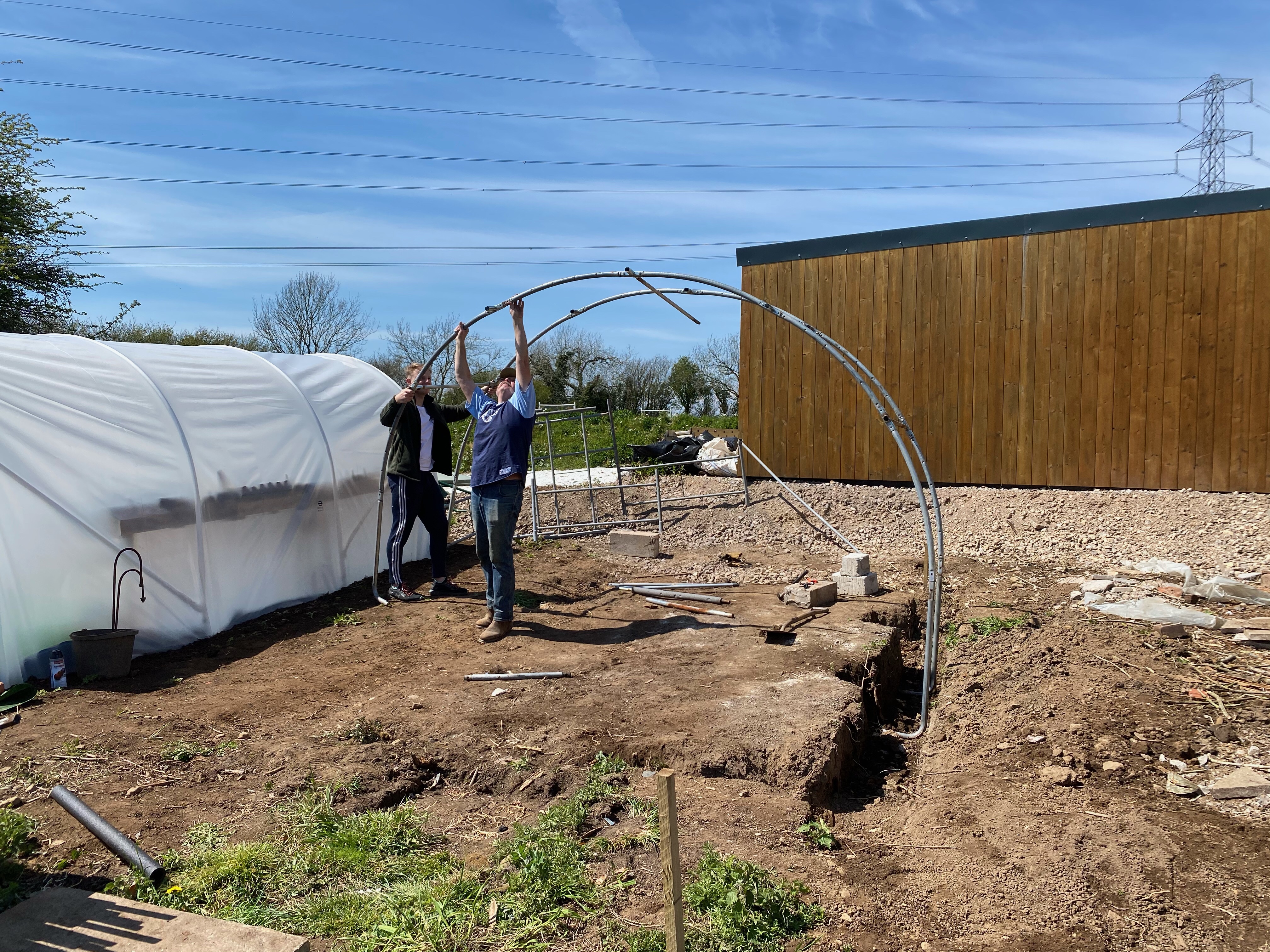
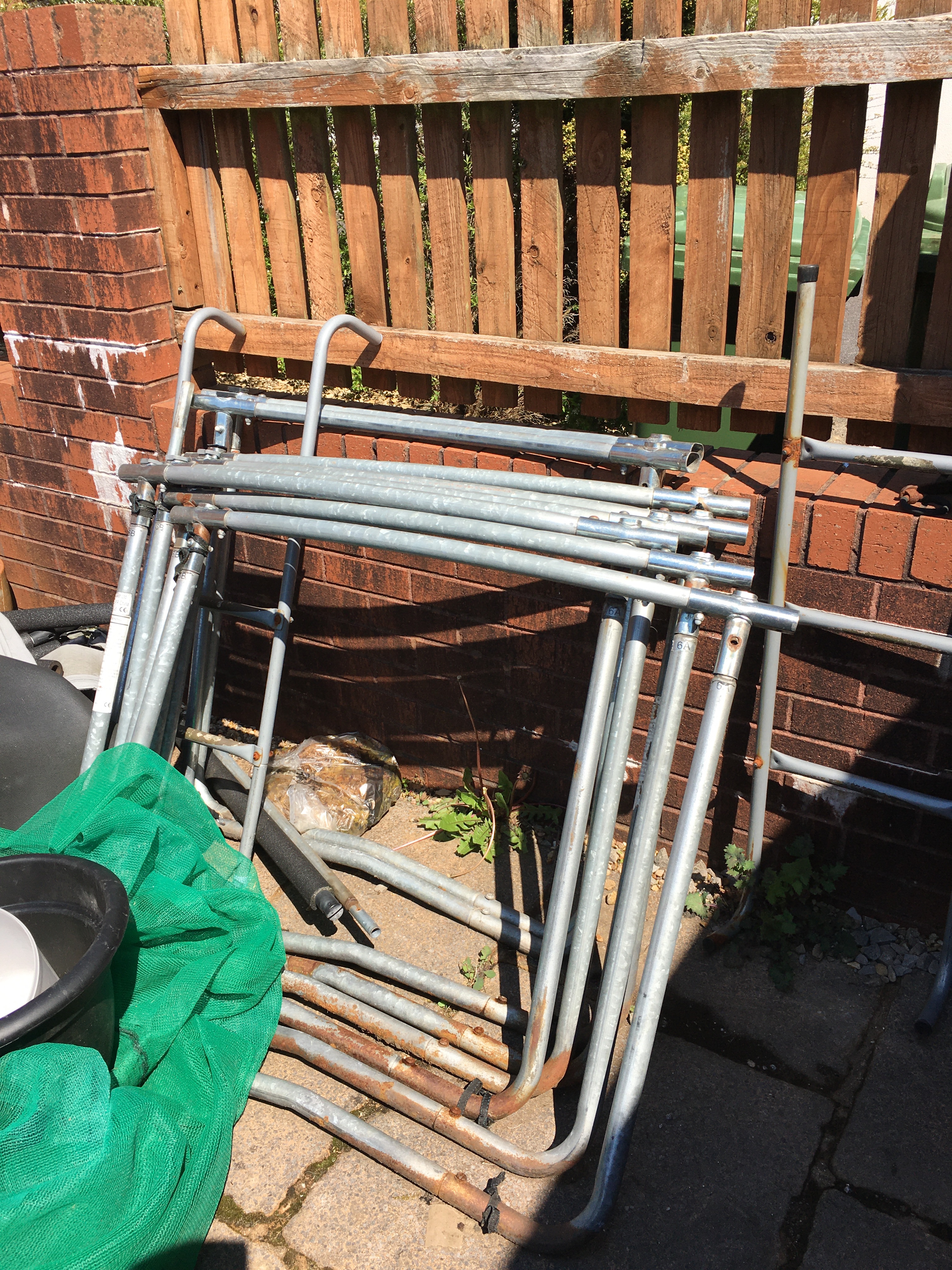
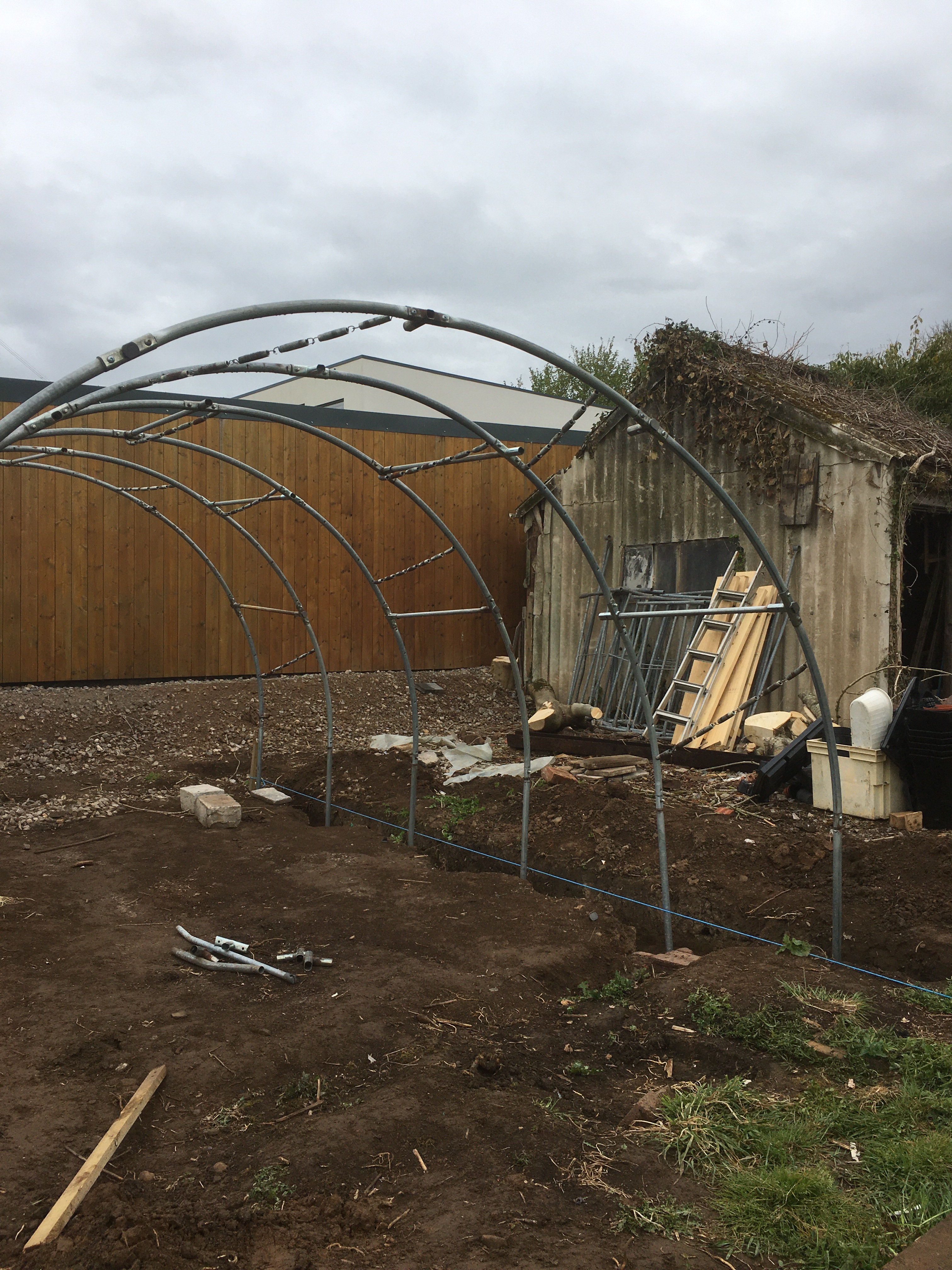
  • Not exactly MVP. More of a ‘trial & error’, ‘make it up as you go along’ approach to building a Poly-tunnel from recycled trampoline frames. My pic. Me & my “Dad, why don’t you just buy a new one?” son.

    I’ve no Idea what I’m doing. Here’s a a confession. Quite a lot of the time I don’t have a clue what I’m doing. I don’t know precisely how things are going to end up. I’ve usually got a rough sense of the direction where things are headed. I’ll be aware of the danger zones at the edges, and generally have plenty of enthusiasm to keep things moving forward. Its around the ‘bits in the middle’ where things can be a bit ‘messy’. I’m mostly OK with that. The picture above illustrates my most recent ‘messy adventure into uncertainty’.

    Oddly, my wife has complete confidence in my ability to do lots things. Based on my track record, I’ve no idea why she thinks this way. However, it has led to me developing a way of behaving that I recently learned is called ‘Pseudo Competence’. Basically its a description of the situation where someone has reached a position where they lack the competence to perform a task or do a job, and they fake it.

    Learning about Pseudo Competence came from a discussion about how organisations (and people) respond to failure. One specific observation intrigued me. What does this means for people who’ve been promoted rapidly or ‘fast tracked’ in an organisation? If they haven’t had time to ‘learn the ropes’ and develop ‘deep competence’ are they automatically in the zone of ‘Pseudo Competence’. If they aren’t comfortable with that situation, what does this mean for their state of mind? Interestingly, someone who had experience of this situation described its as, “standing on the edge of the abyss… knowing that you don’t know what to do, but people expecting you to know, because of your job title…”. That feels mildly terrifying.

    Possibly more on that in a future post. If you can’t wait, this post on the value of apprenticeships (Learn the Rules Like a Pro, So you can break them like an Artist) gives a clue about where I’m coming from.

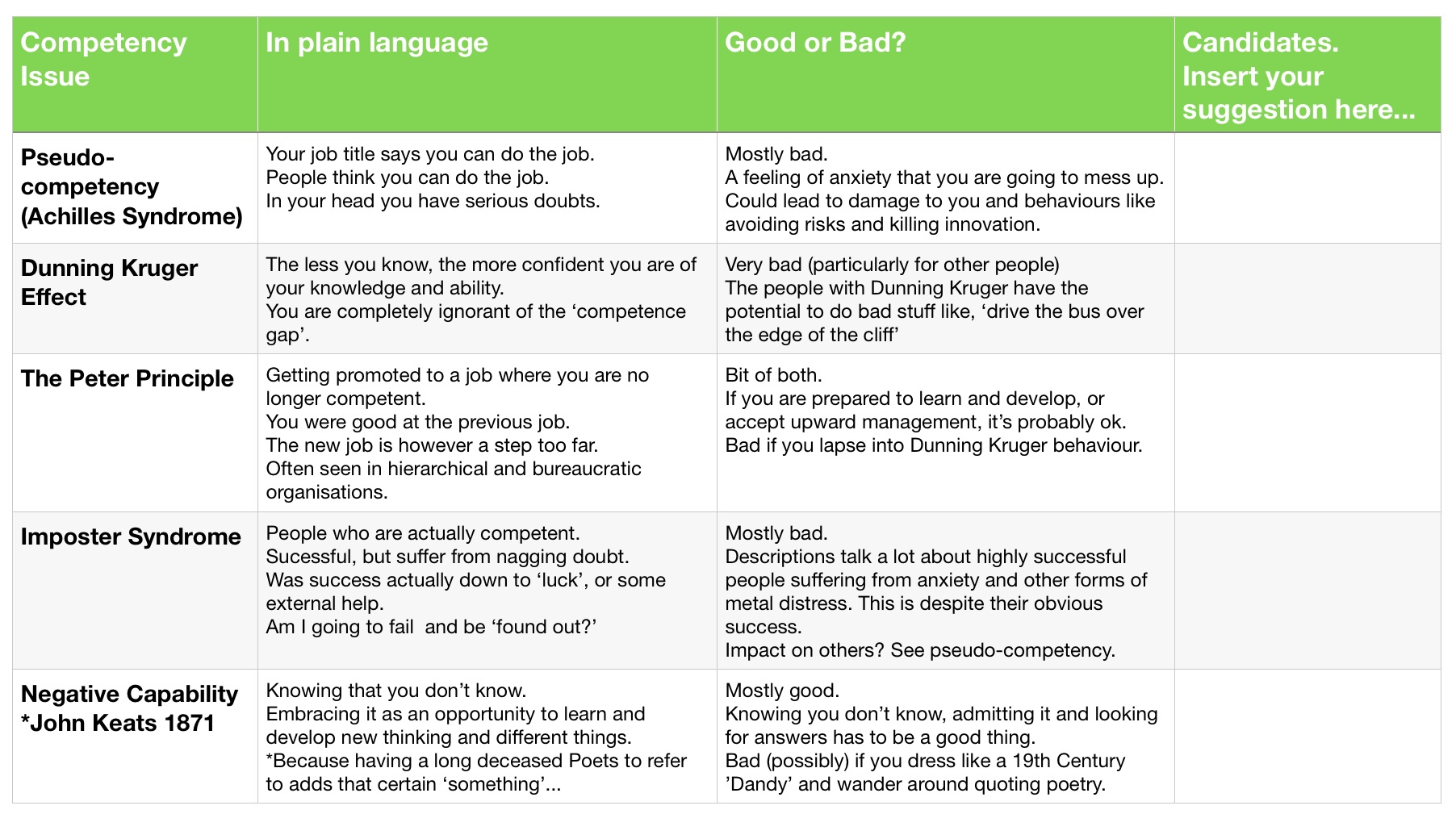
    Pseudo Competence has close cousins. I’m not going to dwell on pseudo-competence other than to say, there’s a lot of it about (it’s not just me), and it has some close cousins. I’ve taken the liberty of condensing some of the most commonly described examples of ‘competency issues’ into the table below. It’s a big subject area and I’ve just scratched the surface.

    You’ll notice is that I’ve created this as a handy ‘print out and keep’ version, with a column for you to insert those people in you life that my not be ‘fully competent’. I won’t make them any more competent, but it might help you think about coping strategies… You’re welcome!

    One thing I should have mentioned is that you might want to insert, ‘yourself’ in the candidate boxes. That’s fine (it works for me). If you want some helpful suggestions on how to cope with Pseudo Competence have a look at this article by Jane Alexander, Achilles Syndrome, Do You Feel a Fraud? Alternatively, you can try what I’ve been doing and talk about MVP… Minimum Viable Product.

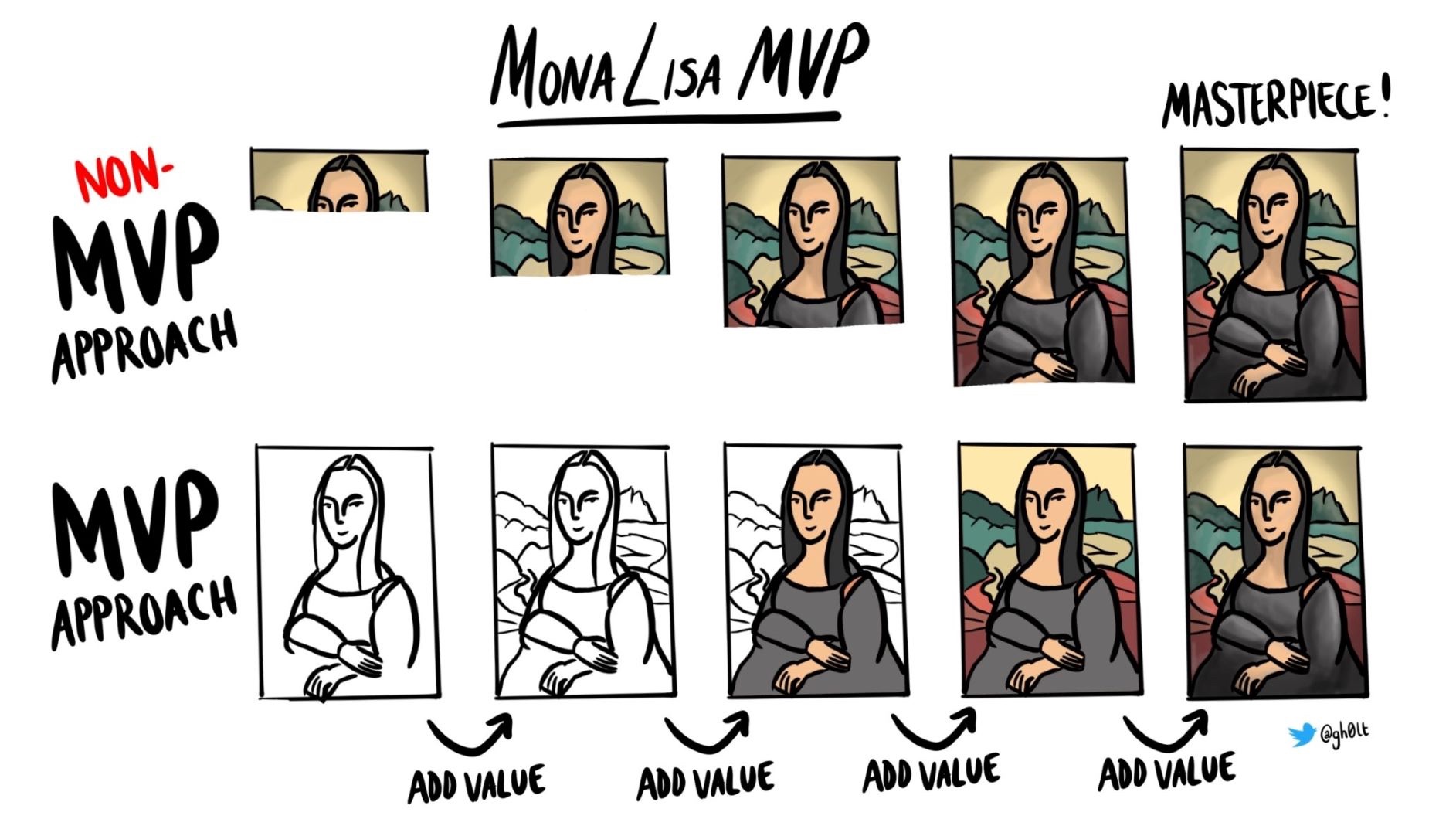
    Minimum Viable Product. I’ve written about MVP before in Minimum Viable Transformations; Change Should be Small and Imperfect. The basic idea is that you start small (the minimum version of what you are aiming for), get the users to test it, act on the feedback to improve what you’ve got, take it back to the users. Then repeat the cycle until you’ve got a ‘finished’ product. It’s beautifully illustrated in this graphic from Greg Holt (@gh0lt). I don’t think MVP needs any more explanation than this.

    Graphic by Greg Holt (@gh0lt). With kind permission, Thanks Greg.

    What’s this got to do with Trampolines and Soothing Balm? Glad you asked. In the ‘hot house’ of gardening round our place there are certain phrases that don’t go down well with my co-workers, my wife or the”Dad, why don’t you just buy a new one!!” son.

    Me saying; “we are approaching this through a series of ‘safe to fail’ experiments” or its all about “trial and error” just doesn’t help the situation. They foolishly believe I know what I’m doing. The ‘soothing balm’ that covers up my Pseudo Competence just happens to be MVP. It’s bizarre how a few simple words smooth away so such angst and uncertainty. I think I need to to use it in other circumstances…

    Its all about outcomes & impact. I need to point out that things worked out fine with the Trampoline to Poly-tunnel project. How do I know? Two critical performance measures;

    • The poly-tunnel is still standing after the recent storm with 48 mph winds, and
    • The “Dad, why don’t you just buy a new one?” son sort of complemented me… “fair play, that’s not too bad Dad. It wasn’t the ‘ball-ache’ I was expecting”. Feedback like that is better than winning the lottery! I’m very OK with that.

    So, What’s the PONT?

    1. Full competence to do something only generally comes from deep experience – practice and learning over a long time. Its what the apprentice model is based upon.
    2. Doing something different or new inevitably requires a lot of learning and an admission that you ‘don’t know all the answers’.
    3. It’s better to acknowledge that you ‘don’t know’ in my view. The language you choose to explore ‘unknown territory’ is up to you. For me, ‘we are using a Minimum Viable Product approach’ has worked quite well recently.

    Finally: here are a few pics of the Trampoline to Poly-Tunnel experience.

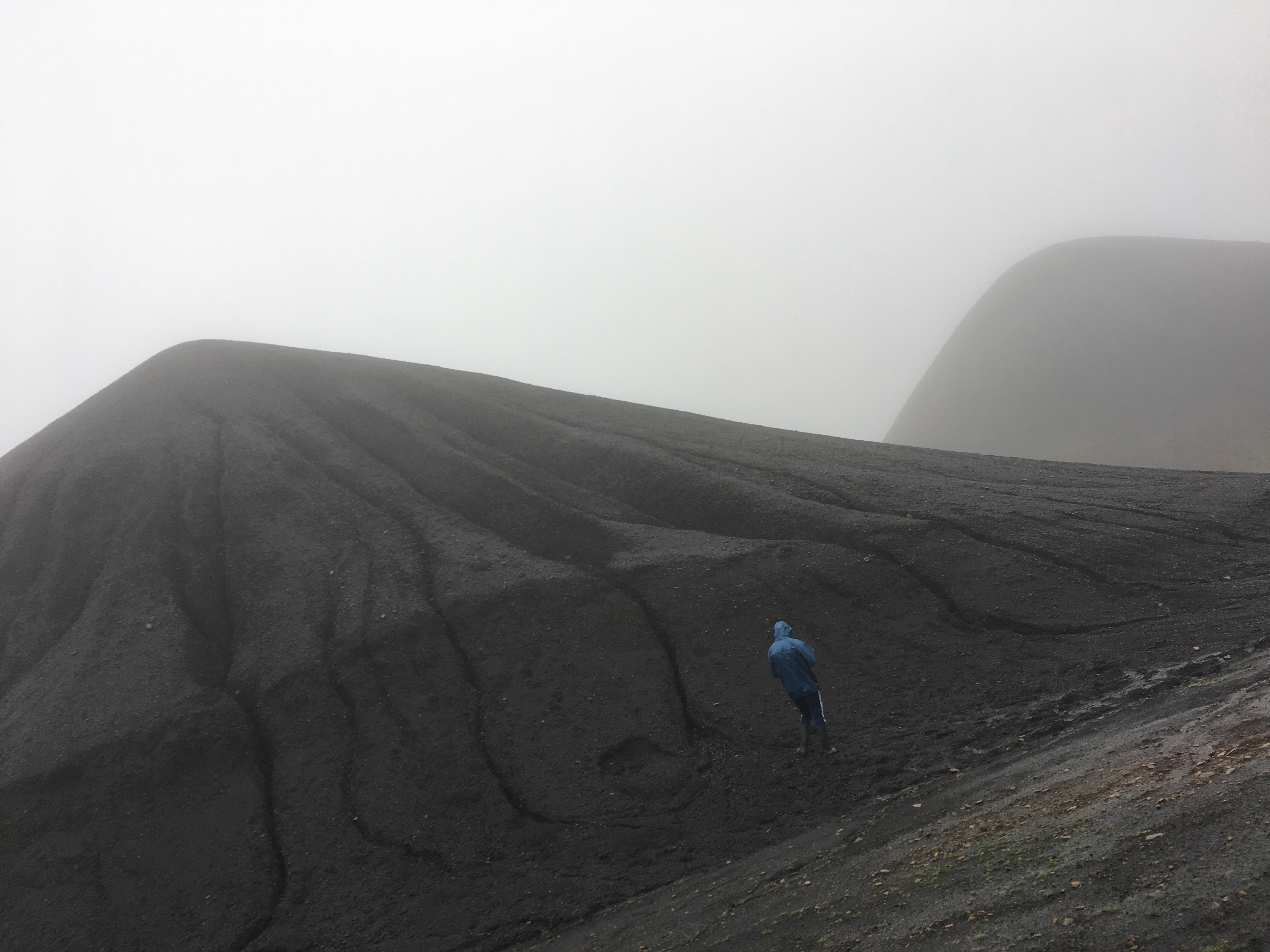
  • The ‘Black Run’ on the Coal Dust Cresta (my pic. Llanbradach Colliery Tips)

    The answer is… When we build our first Trojan Horse. I’ll explain why in a minute, but first a “lovely ramble down to an important point…”

    The Coal Dust Cresta Run. When I was growing up one my favourite playgrounds was the old quarry at the top of the street. It had been partially filled with colliery spoil. We used to spend hours sliding down the spoil tips on pieces of corrugated metal sheeting, ‘salvaged’ from a derelict garage. The search for the ‘perfect sledge’ – a Morris Minor car bonnet – occupied a disproportional amount of my childhood. It was a sort of ‘Coal Dust Cresta Run’. How nobody from our Village made it into an Olympic Bobsleigh Team is still a mystery to me.

    It was a dirty and dangerous playtime, where we experienced a fair bit of risk and danger, but we weren’t stupid! You learnt how to; take the nails out of the metal sheeting with a stone, bail out before the barbed wire fence, in addition to the physics of banking at high speed (with a mouth full of coal dust). What it also taught us to do was, never go to the ‘official playground’ that was located in the Miners Welfare Park, at the other end of the Village. Centerpiece of the playground was a terrifyingly high ‘Wickham’ metal slide with missing guard rails, and a landing on a bed of broken glass, scattered liberally on concrete (I’m not joking). We knew our limitations and learning from ‘beneficial accidents’ on the Coal Dust Cresta Run meant you NEVER went down the slide at the Welfare…

    Learning from Beneficial Accidents. The idea of a ‘beneficial accident’ feels like something fairly straightforward to get your head around. An accident that doesn’t cause ‘too much’ harm, but allows those involved to gain something useful or positive from it. You learn from the failure (accident).

    I was introduced to the concept a while ago by someone who worked in education and was an expert in learning from play. Foolishly I’ve lost touch with them. Since then I’ve replaced my quest for the perfect Morris Minor car bonnet with a quest to find some definitive guidance on the design of play facilities. Something that talks explicitly about beneficial accidents. I’m still searching…

    The best I’ve managed is this 2012 document from the Health and Safety Executive (HSE) Children’s Play and Leisure – Promoting a Balanced Approach. The guidance has some tantalizing ‘Key Messages’:

    • ‘Play is great for children’s well-being and development. When planning and providing play opportunities, the goal is not to eliminate risk, but to weigh up the risks and benefits. No child will learn about risk if they are wrapped in cotton wool’
    • ‘Those providing play opportunities should focus on controlling the real risks, while securing or increasing the benefits – not on the paperwork’.
    • ‘Accidents and mistakes happen during play – but fear of litigation and prosecution has been blown out of proportion.’

    So, if I’m interpreting the HSE guidance correctly. Accidents will happen, and they are good opportunity to learn and develop. In other words, we learn from failure. I have commented on this previously in connection with the Friedrich Nietzsche quote, ‘that which does not kill us, makes us stronger’.

    There’s a surprising amount of material published on the importance of ‘play’ as a source of learning. If you want something that’s going to stretch your grey cells have a look at what Complex Wales has to say in this post, ‘Representation, Go Forth’, neatly summarised with “Metaphors are our greatest tool for play, and play our greatest method for learning.”

    If you fancy less of a stretch, there’s always the inevitable Einstein quote; “Play is the highest form of research”. Apparently it is a (close) misquote, details here on Quote Investigator, but it’s too good to ignore.

    So, when does the learning stop? This is a bit of a contentious subject. When do we ‘stop’ playing and stop learning from beneficial accidents. A friend who has got experience of teaching said that it diminishes in the final years of primary school, and by the time kids arrive in secondary school its pretty much stopped.

    The challenge is neatly summarise by Prof Leo Buscagila, “It is paradoxical that many educators and parents still differentiate between a time for learning and a time for play without seeing the vital connection between them”.

    What I would say is that by the time we enter the world of work the idea of learning from play is definitely extinct. Along with this I would argue that the opportunity to learn from failure is also diminished. I’d also go as far as saying that you’ll know you’ve crossed the threshold and have left the idea of learning from failure well behind when you build your first Trojan Horse. Let me explain…

    Trojan Horses. I’m using the concept of Trojan Horses as a metaphor for the 100% guaranteed successful project proposal. The ‘recommended option’ that we put forward to the Business Case Approvals Committee. Many of us will have been there…

    The Trojan Horse is the proposal that you desperately want the Committee to approve. To get it across the finish line you will pretty much be promising heaven and earth and everything in between. There will be no suggestion of failure, no unmanageable risk and no chance of it not delivering.

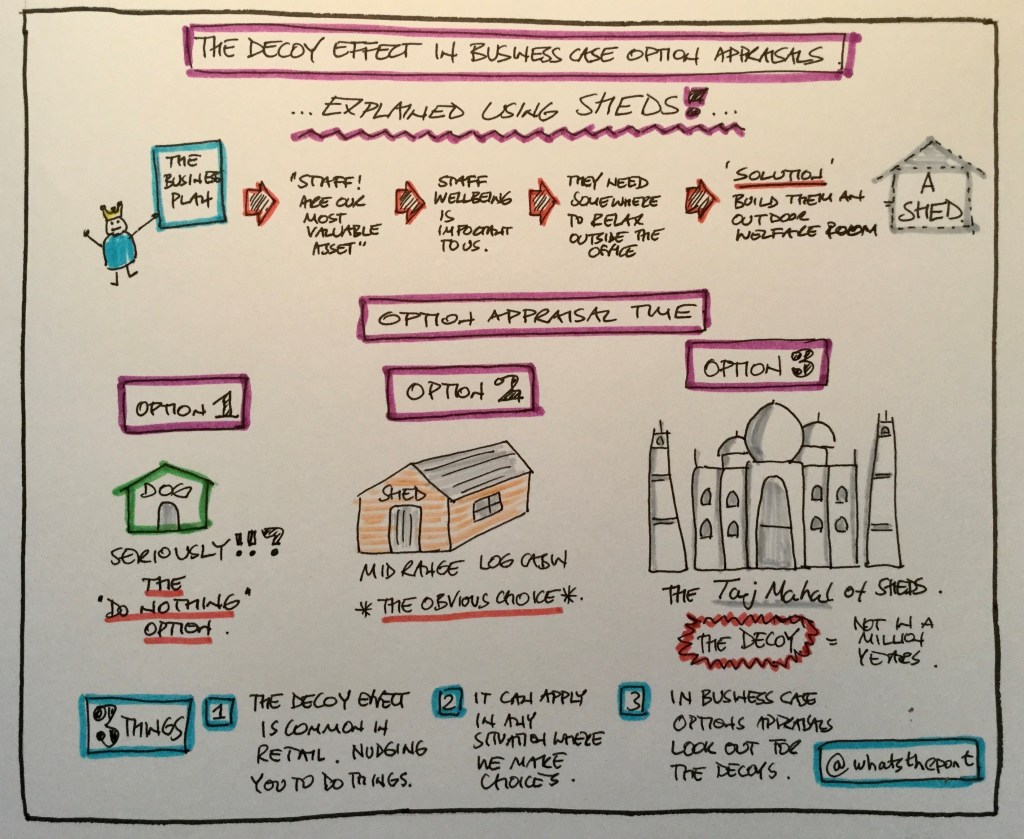
    A while back I suggested 5 questions (here) you could use to spot Trojan Horses, and more recently something on how to spot people using the Decoy Effect in business case options appraisals (here). Trojan Horses and the Decoy Effect come from the same ‘stable’ in my view. The point to remember is that they both reduce the opportunity to learn from failure. The promise of guaranteed success and emotional attachment to a ‘favourite’ option mean that anything less than success is a failure and is unlikely to be welcomed or recognised for it’s learning opportunity.

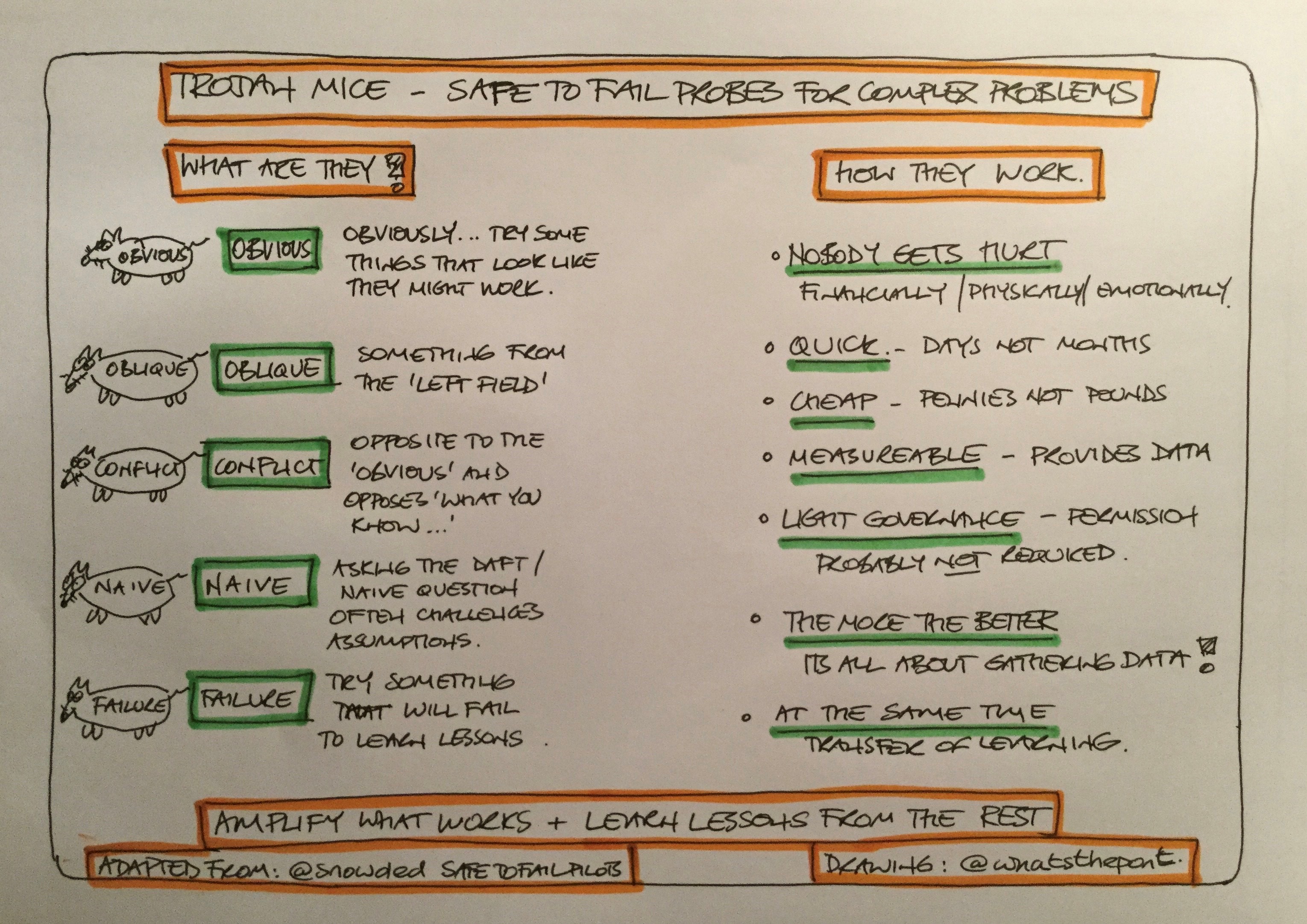
    Say Hello to Trojan Mice. I’d hate to finish this on a negative, so here’s some hope. The concept of Trojan Mice. Small, Safe to Fail ‘probes’ that allow you to test what might be possible. The idea is that you welcome failure as a learning opportunity and you make it ‘cheap’ and (relatively) painless. I’ve explained it in more detail in this blog post, Trojan Mice in 900 Seconds, and the graphic below.

    Back to the Coal Dust Cresta Run. Back on the spoil tip, Trojan Mice would have been the multiple ‘test runs’ we carried out. These involved a variety of different ‘sledges’, in different locations, in different weather conditions and with different ‘test pilots’. We were working things out before we launched the BIG ONE. It was learning from failure, through play, with beneficial accidents thrown in for free.

    When did I loose that part of my life..?

    So, Whats the PONT?

    1. Play, failure, learning and therefore doing something different or better are inextricably linked. It doesn’t make sense to keep them separate.
    2. Proposals that guarantee success will have a bias against learning from failure in my view. If we are not expecting it to happen, it’s unlikely we will recognise or welcome it.
    3. If you don’t ‘see’ the failures, you certainly aren’t going to feel the benefits of the learning that comes from them.

  • Beer Committees and Governance. A cornerstone of society.

    Beer Committees were an important part of the small community rugby clubs I grew up around. So important, that I think they are a foundation stone in the temple of governance essential to any democratic society. Let me explain…

    What are Beer Committees? In any small club or society there are two things that really matter. First, the ‘thing’ people get together to enjoy doing.

    And second, a bit of money to get ‘other things’ done. The money doesn’t need to be big, but it does help things happen.

    In the case of small community rugby clubs the rugby was the ‘thing’ that people got together. The Beer Committee was the ‘machine’ behind the money that helped facilitate the rugby.

    It’s a straightforward equation (algorithm in new money):

    Sell beer to the people who enjoy rugby.

    • Use the profits to pay for;
    • The clubhouse,
    • Changing rooms,
    • Transport to away games,
    • Physiotherapy bills
    • Subsidise missionary work (annual Easter tour to Devon), etc.

    Yes, membership fees (subs) and sponsorship all supplement the beer profits nowadays, but not so long ago beer profits were the main (sometimes only) source of income. If the Beer Committee got things wrong, it could be ‘end of sports’ for the club, literally!

    So, how the Beer Committee Members carry out their role on behalf of the club members; make decisions and monitor the impact of those decisions is critical. Basically it’s governance. But nobody ever says that.

    “They’ve put Carling up to £3.20 a pint!” This post was prompted by a conversation (a while ago) with a friend about rugby club beer prices.

    It started with them asking about my week. Fairly typically it involved some sort of ‘governance’ activity. Listening to a talk about “Elected Member Scrutiny Committees”, a workshop on “The Effective Audit Committee”, reading 2 million pages of Finance and Risk Committee papers, yadda yadda. You get the drift…

    Anyway my friend was rightly bored and after 2 minutes and blurted out “They’ve put Carling* up to £3.20 a pint!”. (*Carling / ‘cooking larger’ mass market beer sold in the UK)

    As blurted statements go it’s a bit of an attention grabber. Basically the rugby club Beer Committee had pronounced on beer choices, and prices for the coming season. Carling had indeed gone up to £3.20 a pint, blowing a hole in the ‘more you drink, the more you save’ policy of some club members.

    Additionally the Committee also decided to introduce craft beer from a local brewery, more expensive, but better (in my view).

    My friend complained that the craft beer ‘tasted like drain cleaner’ (he would know about that) which prompted me to ask, “but aren’t you on the Beer Committee?”

    The answer was perfect. “Oh, yeah I am. We talked about it for ages. Then we had a vote and putting up Carling to £3.20 and having craft beer won. So you’ve gotta go with it haven’t you. Democracy innit…. Fancy another pint?”

    Beer Committees as a Cornerstone. One of the things that sticks with me from that conversation was the disconnection between how I’d spend my week talking about governance and how my friend had actually been doing it.

    I think there’s a lesson here about the ‘professionalisation’ of governance. I do wonder if the efforts to make things ‘professional’ ignores the huge amount of activity that already exists within many communities?

    Also, does the use of a certain type of language and behaviour exclude the people who are actually very skilled in this area.

    Believe me, running the Beer Committee is a skilful and complex task. Getting it wrong can have very local and immediate consequences. I’m not sure if people on the Boards of massive organisations are quite as close to the consequences of their decisions.

    Transferable Skills and Lessons Learnt. Here are a few reflections that summarise our ‘Beer Committee’ conversation, potentially relevant to any governance forum.

    • Focus on what matters. The Beer Committee know exactly what their job is. Provide the right beer, at the right price so that people come to the club and drink it. Get that right you make a profit and support the ‘core mission’.
    • Understand who you are working for. The Beer Committee have a ‘vested interest’ in getting things right. They are committed to happy beer drinkers.
    • Be transparent. In a small community this is relatively straightforward. I’ve seen Beer Committee minutes pinned to notice boards. But the real communication and transparency happens at the bar where you can discuss the merits of something ‘that tastes like drain cleaner’ with a decision maker.
    • Checks and Balances. See above.
    • Continuous Review, Feedback and Improvement. See above

    Beer Committees, a Cornerstone of Governance. Getting back to the points I made earlier about the skills required to operate an effective Beer Committee. I think this is an opportunity. I also think the language used around ‘professional’ governance might be excluding, and ignoring the very people in communities we should be engaging? When people talk about diversity on boards perhaps they should be looking at what we already have?

    So, What’s the PONT?

    1. Governance exists in many forms all over society. Some of what happens in the smallest community clubs and societies is just as real as what you’d see in many professional Boards.
    2. The consequence of your decisions and feeling their impact can be far more real in community governance. The fact that you ‘stand alongside people’ means you can’t escape the impact of your decisions… literally.
    3. The ‘professionalisation’ of governance can introduce language and behaviours that exclude the people who can do the job. If we think we need ‘community governance’ the people best placed to do it might be already be there.

    Historical Footnote. Please do scroll down to the comments for an explanation by Matt (Complex Wales). Apparently our love of committees, beer and rugby in South Wales has deep historical roots.

  • Don’t remove a fence until you understand why it was put there. Chesterton’s Fence.

    Using a coat-stand to take down a fence. I once knew a Chief Executive who told me that the most important thing that came with their job was the office coat-stand.

    The reason? It was because the coat-stand allowed them to permanently wedge open their office door. They had wanted to unscrew the hinges and remove the door, but apparently that was a breach of fire regulations. So they used the coat-stand as a wedge, and every evening someone would return the coat-stand to the opposite wall. Like clockwork every morning the Chief Executive, without making a fuss, would wedge it back against the door. They were one of the most interesting people I’ve met.

    What that Chief Executive was doing was removing a fence. Taking down a ‘barrier’ that had existed for a few decades prior to them arriving. It was a carefully considered act. They even changed things in the outer office (previously as welcoming as a doctor’s reception area…) to help people feel like they could ‘drop in’ at any time.

    This happened in the days when open-plan offices were relatively uncommon. Chief Executives used to typically exist behind many layers of ‘security’ or ‘fences’, so it was a big deal. I was hugely impressed.

    Breaking down the hierarchy. The Chief Executive in question had previously been a high ranking officer in the military. One day I asked them “what’s the biggest difference you’ve seen between the military and public services?” Their answer surprised me. In the branch of the military where they had served, the junior ranks had no problem in talking with the senior officers, and the senior officers listened. In their view, public services (at that time and in that place) were far more hierarchical than the military!

    Opportunities for the people delivering services at the sharp end, to talk to the Chief Executive, were almost non existent. There were barriers and fences, both invisible and visible. The Chief Executive had done their best to remove just one of the many by wedging open the office door with a coat-stand. An act that was both physical and symbolic. They understood exactly why the ‘fence’ existed, and why they were taking it down.
    Now this is a ‘fence’ that demands a bit of thinking.

    Not everyone thinks about fences, or why they exist. I’ve been thinking about fences a lot recently. The last post I wrote was about ‘invisible fences’, the things that influence peoples’ behaviour for reasons they don’t understand. Frequently stopping them from doing something; like fences. The practice is often described by the phrase “because, that’s the way we’ve always done things around here…”.

    I’m quite keen on removing barriers and fences – but only if it does no harm or something positive. To understand that, you need to find out why the fence was put there in the first place. That seems like a sensible thing to me and apparently I’m engaging in some ‘second order thinking’. Not just thinking about the consequences of a decision, but the consequences of those consequences.

    Chesterton’s Fence. The source of ‘don’t remove a fence until you understand why it was put there’ is attributed to G K Chesterton, paraphrased from his 1929 book, The Thing: Why I Am a Catholic. It was apparently one of the favourite sayings of US President John F. Kennedy. Chesterton might have written it in the 1920’s but it feels very relevant now. Also, I wouldn’t associate JFK with ‘old school’ thinking or an anti-progress agenda. It’s just a sensible thing to do.

    I’d recommend a look at this article on the FS (Farnam Street) blog for a detailed explanation of Chesterton’s Fence: A Lesson in Second Order Thinking.

    A lesson for people driving change… The main point of this post is to encourage people to to stop, and think about the consequences of removing fences, breaking down barriers and smashing silos. The people who put those things in place weren’t stupid, weren’t deliberately setting out to cause problems and probably didn’t have the resources to create things, ‘just for the fun of it’. Before dismantling something stop and have a think… if I don’t understand how it got “here”, do I run the the risk of making things much worse? Think of it as an ‘investment’ or due diligence.

    Free tattoos for Silo Smashers. A Chief Executive who occupied the office before the ‘coat-stand wedger’ once offered me a free tattoo. The ‘offer’ was along the lines of… “If you mention ‘smashing silos’ once more I’m going to tattoo it on your forehead”. That Chief Executive fully understood why the barriers (silos) existed in the organisation and the consequences of recklessly removing them. I fully deserved the ‘offer’ of a tattoo. I was younger and a bit more stupid and reckless in those days, hopefully I’ve learnt a bit with age and experience.

    So, What’s the PONT?

    1. Putting up a ‘fence’ takes effort. People don’t do it without a reason.
    2. Think about the consequences of taking down a fence. If you don’t understand how it got there, you run the the risk of making things much worse.
    3. If you have decided to take down a fence, make a clear statement that its gone. Using a coat-stand to wedge open a door can be a very effective symbol.

    Pictures. Both mine. One from a French Atlantic Beach. The other one from somewhere warm.

  • An expression that is usually followed up with something along the lines of… “is the most dangerous thing you’ll hear”. You may have heard it quoted by serious people or even seen it on posters or painted on the walls of more ‘progressive’ organisations.

    It’s a powerful statement that has many layers of meaning, but what’s behind it?

    I’ll save you a lengthy explanation and suggest you have a look at this video. It’s a clip from The Contender, a film from 2000 about an attempt to appoint the first Female Vice President of the USA. In this clip, which was deleted from the final version, Jeff Bridges who is playing the role of the President is talking to two advisors. In his pajamas as far as I can work out – now that’s very 2020/21!

    Clip from The Contender via You Tube https://youtu.be/b4vJ8l2NfIM

    Just so you get the full effect I’ve transcribed the key points of what the President is saying:

    • You’ve got 5 Apes in a cage,
    • You’ve got a banana hanging by a string in the middle of the cage,
    • You’ve got some stairs going to the banana.
    • Now, pretty soon one of those Apes is going to go for the banana.
    • As soon as he hits the stairs,
    • You take a hose and spray all 5 Apes with freezing cold water for 5 minutes.
    • Now, some time passes.
    • And pretty soon another one of the Apes is going to make the same attempt (to get the banana) with the same result; all 5 Apes get sprayed with cold water.
    • Now, you turn off the cold water, you never use it again.
    • Time passes, and one of the Apes goes for the banana,
    • As he hits the stairs, the other 4 Apes pounce on him and beat the crap out of him.
    • OK, understandable.
    • Now, you replace one of those original Apes with a new Ape.
    • After a while that new Ape, well , he’s going to spy that banana.
    • And, when he goes for the stairs, the other 4 Apes are going to jump on him and beat the crap out of him.
    • Time passes and you replace another one of the original Apes with a new Ape, who is going to go for the banana.
    • The other 4 Apes beat the crap out of him, right?
    • Including, the first new Ape who has no idea why he is enthusiastically beating the crap out of this poor new guy.
    • Nor, why he himself had the crap beaten out of him.
    • OK?
    • Now, you keep replacing those original Apes with new Apes until finally you’ve got a cage filled with 5 Apes,
    • Who have NEVER had freezing cold water sprayed on them.
    • And never the less..
    • Not one of those Apes will ever attempt to climb those stairs again.
    • Why not?
    • Because, that’s the way we’ve always done it around here…

    You can’t base Human behaviors on what 5 Apes do. There is a bit of controversy around the story of the 5 Apes. Have a look at the comments that Matt from Complex Wales made on a 2015 post I wrote about it , ‘5 Monkeys, Bananas, Ladder, Water. Why do we comply with daft rules in organisations?’

    Matt knows about that sort of thing and points out that the story of the 5 Apes developed from a range of primate psychology experiments that stretch back to the 1920’s and up to the 1960’s. They might have been Monkeys, or Apes. It might have been ‘freezing cold water’ or it might have been a blast of air.

    What is important to note is that the new Apes were fearful of things that had happened to the original Apes. This was without having experienced those things and not knowing why they were fearful. This changed their behaviour and led them to do things because, “that’s the way we’ve always done it around here.” This might be a metaphor based on some old (slightly dodgy) science, but it makes a lot of sense, to a lot of people. It’s very relatable.

    Lessons for the Modern Day Corporate Culture, Change Programme. Here’s a question for anyone involved in any sort of activity that is trying to change the culture of an organisation.

    Do you actually understand what contributes to the existing culture? If the people who’s culture you are trying to change don’t know why they themselves do certain things in the first place, how are you going to convince them to do something different? Will the dazzling Vision, route-map and mile-stones help them to overcome the deeply embedded fear of being sprayed with cold water?

    Until you’ve understood the deep reasons behind ‘that’s the way we’ve always done it around here’ not much is going to change, even if you replace the old Apes with new ones…

    One Final Thing. In the comments on the 2015 post Matt said that the results of the tests were different between the female and male groups of Apes. I’m hoping for an update on that one.

    So, What’s the PONT?

    1. ‘The way things are done around here’ is a huge driver of peoples’ behaviour in organisations, communities and families. Its not just about Apes.
    2. The reasons for these ‘behaviours’ can be deeply embedded and go back many years. They aren’t necessarily good or bad, its just the ‘culture’.
    3. Trying to change ‘the way it is’ behaviours isn’t straightforward. It needs deeper understanding than a simple Vision, route-map and milestones.
  • Is it just me… or are there an overwhelming number of ‘bright idea schemes’ floating around at the moment? All of them searching for the big idea that will make life better after COVID.

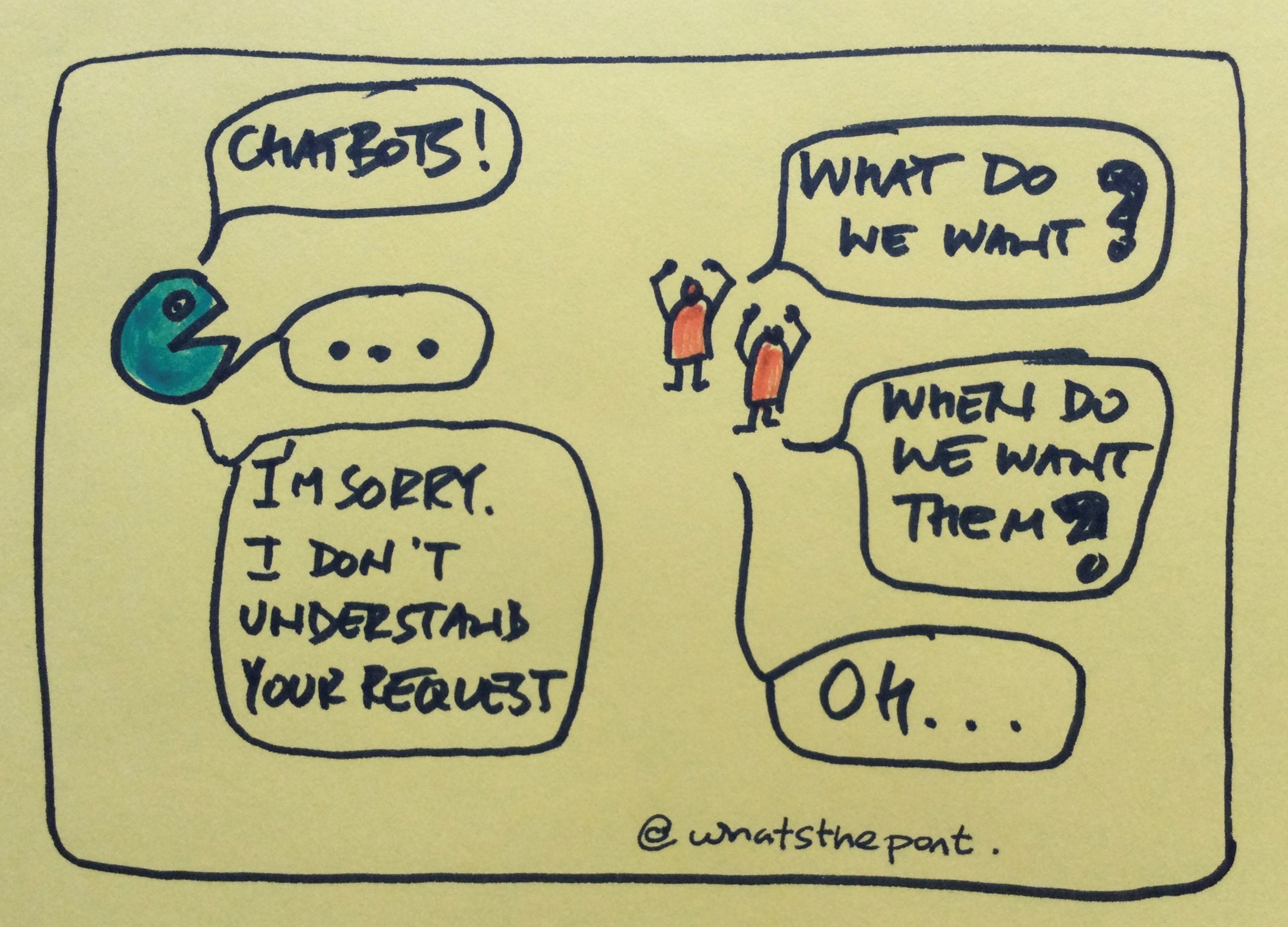
    A lot of what I’m seeing are versions of ‘crowdsourcing’. Ask lots of people a question, and they will eventually come up with ‘the’ answer… More on that later.

    The reason I’m asking is because this week I’ve encountered another two ‘bright idea schemes’. These were from highly respectable, well intentioned Third Sector Organisations. Both of them offered attractive ‘prize funds’ to help me implement my bright idea (once the Judging Panel of ‘Worthies’ had decided if it was ‘worthy’).

    When I put this activity alongside what’s going on in areas like the Public Sector, Universities and others, it adds up to a lot of activity. A lot of; uncoordinated, unstructured, unmeasured, quite messy and possibly quite expensive activity.

    Do I Panic and Scream? When I started to think about all these ‘bright ideas’ activities the logical, ordered, auditor part of my brain started to scream…

    “Oh no… it’s completely unstructured and uncoordinated. How do you know if people are doing the wrong (or right) things? What if some of the things that get funded are doomed to failure? How do they measure impact? What about consistency in the evaluation process for what wins the prize (gets funded)? What if the selection panels are biased towards things the judges like? How do they spread the learning afterwards? Arrggghhhh… Does not compute… Does not compute… activate the Panic Button!”

    At the point where my brain is ‘screaming’ I usually hitch up the Husky and go for a walk. It never fails.

    Do I Rejoice? After the initial panic and some Husky therapy I’ve come to the conclusion that, “I should rejoice”. The reason for this lies in my thinking around how to respond to complex situations.

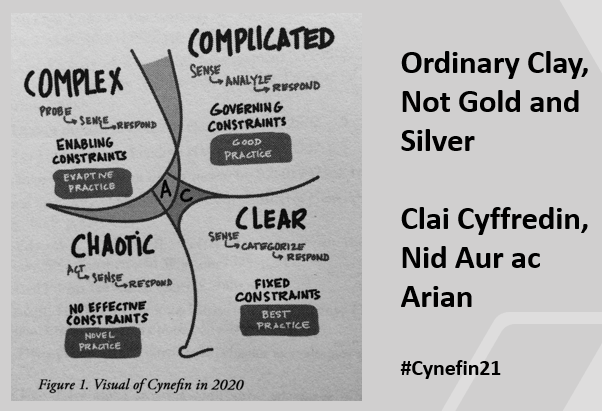
    Whatever happens after COVID is unknown and cannot be predicted with any certainty. There’s no ‘text book’ answer. We’ve never done this before. The ‘answers’ are not known. What works in one community may not be appropriate for another 10miles away. In the language of the Cynefin Framework the situation is Complex.

    What you do in a Complex situation is 3 things: Probe, Sense, Respond. Basically this means:

    • Probe. You do something to gather information about the situation. In the case of the ‘bright ideas schemes’, this is essentially what I think they are collectively doing. Lots of attempts to come up with a solution. A by-product of what they are doing is gathering information.
    • Sense. You use the information you’ve gathered to make sense of what is happening. Sense making. This probably won’t be a single answer, lots of options that look ‘sensible’, and there’s some data/information to suggest they might work.
    • Respond. You take the next step. This might be a process of ‘amplification’ to scale or spread what you’ve understood. It’s all about moving from an unpredictable situation full of unknowns (complexity), towards something that is a bit more predictable and known (complicated).

    Even More Rejoicing… the more I think about what’s going on with the ‘bright ideas schemes’ the more joyful I’ve become. Apart from the gathering of information there’s also the joy of diversity.

    Think of this like spreading a bet on a horse race. You don’t bet on just one horse winning a race, you bet on a few of them. The chances of you getting the winner, and 2nd and 3rd goes up the more you bet.

    By going for lots of bets (all the bright ideas schemes), you increase your chances of identifying ‘winners’. Perfect! Also, you’ve got some interesting diversity built in. Each one of the ‘schemes’ will have its own perspective on Life, COVID, the Universe and Everything. This will lead to some ‘right oddities’ being funded. The sort of thing that a formal, logical, bureaucratic ‘Central Approvals Panel’ (like my screaming logical brain favoured) wouldn’t touch with a barge pole.

    Surely, that’s the place to look for those innovative, creative, transformational ideas that everyone says they want?

    Crowdsource with Caution. Only one thing I want to mention here is Deepwater Horizon, the 2010 marine oil spill disaster.

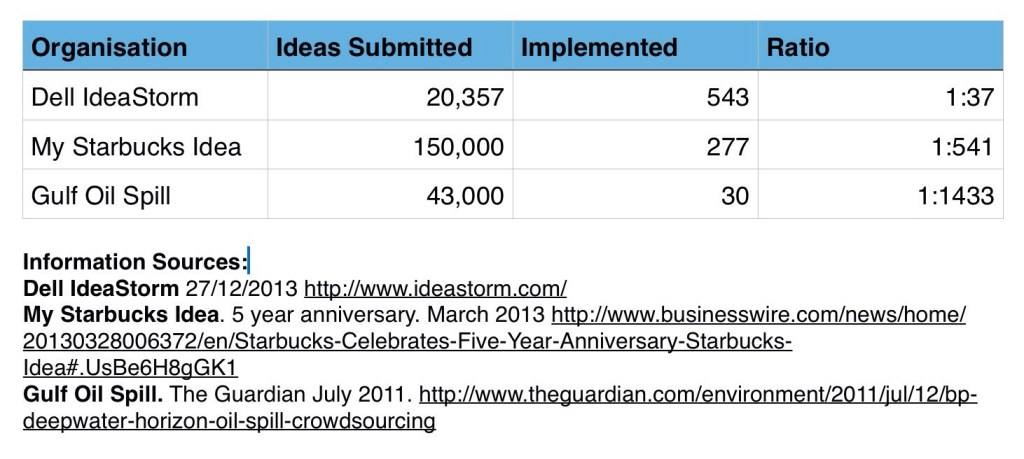
    Following the spill, the oil rig operators put out a request for ‘bright ideas’ on how to deal with it. Sound familiar? A fairly typical approach to crowdsourcing. The results (depending on what you read) was around 43,000 ideas submitted with 30 being implemented.

    A implementation ratio of roughly 1:1433. Not a great return on investment, for anyone. Maybe it would have been different if there had been lots of little schemes instead of something centrally administered? You can read more on this and my thoughts on crowdsourcing here; ‘You’ve got to move a lot of muck to find the golden nugget’.

    Even More Opportunities. Getting back the bright ideas schemes from a Complex situation perspective, I think there’s a next step…

    What I’m suggesting is to look at the individual idea schemes from a Meta Data perspective – take an overview. There’s a couple of things you could do here:

    • Look for things that worked and amplify them (obvious).
      • Look for things that didn’t work, and see if they might work in another situation.
      • Look for the things that weren’t funded first time around – maybe someone else can see opportunity in the application?
      • Just squeeze the data to try and make a bit more sense of it. With such a lot going on, there must be things visible at meta level that individual schemes just don’t see.

    Nice Idea, Shame About the Implementation. I’m not aware of anyone taking a meta view of all of the ‘bright ideas’ schemes. If there is, I’d love to have a look at what they are up to. In the meanwhile I’m off to pitch my idea to Dave Snowden at the Cynefin Centre and Ian Burbidge at the Royal Society of Arts. Maybe they will direct me to a bright ideas scheme…

    So, What’s the PONT?

    1. Having lots of ideas is like spreading your bets at a horse race. More ideas increase the chances of winning.
    2. Different and diverse ideas are necessary in a complex situation, where things are unpredictable and answers unknown. It’s part of probing to find the things you ‘didn’t know’.
    3. Taking a ‘meta view’ of all the small bright ideas schemes could identify opportunities that don’t work for the individual schemes, but could work elsewhere.
  • It’s Down By There… I had two experiences of Customer Services this week. One was a terrible grind, the other left me feeling joyful.

    The terrible grind is what you might expect when trying to cancel a conscription* with a massive global company. You don’t actually get to speak to anyone human. It’s just a lengthy exchange of messages where you have to answer infuriating questions, repeatedly, to the point where you almost give up. I’m fairly confident that it’s actually designed to be almost impossible (*meant to say subscription, but the typo works better).

    The other experience was a reporting a problem. The person I eventually spoke to (they too have that horrendous rigmarole of pushing buttons up front) was a delight. They sounded like me, and had a fair idea of exactly what I was talking about. “Oh, I know, its down by there… them lot with the orange writing on their trucks”. Aye, exactly! I’ve not much confidence that the problem will actually get sorted (it’s complicated), but I did feel a bit joyful after the experience. The warm glow of human contact with someone who sounded like me and sounded they cared.

    But why does this matter? Well, the experiences have got me thinking about how ‘customer service’ might work after COVID. The questions floating around my head include;

    • What actually makes a good ‘customer service’ person;
    • What working arrangements will exist after COVID; and
    • Can the skills and networks developed during COVID be used for other things?

    What makes a good customer service person. I realise that this amounts to far more than my delight at talking to someone who sounds like me and knows the local geography. There are serious people who have a deep understanding of this topic. One of the things that sticks in my head is a 2014 blog post written by Kate Bentham called Channel shift or Channel shove? The point made by Kate is that many services seem to have been designed to ‘shove’ people into things that work for the organisation (rather than the customer). This seems to be just as relevant 6 years on and ‘shoving’ is common practice across both public and private sectors.

    However, if you want to get a sense of what good customer services could look like, have a look at this. The BT Global Service Innovation Team white paper Botman vs. Superagent: Man vs. machine in the future of customer experience. I’ve heard the author Nicola Millard, BT Head of Customer Insight & Futures, speak a few times. I think the white paper is essential reading for anyone involved in customer services – especially if it involves the phone, video or anything digital (including pesky chatbots).

    Here are some key points from the white paper where I think we should pay attention:

    • computers (machine learning and artificial intelligence) have an important role to play in the delivery of customer service;
    • This works best where computers complement and support what humans do;
    • The machines deal with the ‘simple’ FAQ’s while the humans deal with the complex and emotive issues; and
    • The people who do this job have serious skills and generally work best as part of a wider Team or Network.

    That’s all I want to say about that for the moment, I suspect I will come back to ‘Botman v Superagent’ in the future. That might be for the excellent descriptions of machine learning and artificial intelligence. In the meanwhile, here’s a screen shot from the document which I’m sure / imagine / hope, is at the core of how every customer service function works (with or without computers).

    Digital or not, these points are relevant. Source: Dr Nicola J. Millard, BT Global Service Innovation Team Botman vs. Superagent: Man vs. machine in the future of customer experience.

    Will COVID change customer services? I’m old enough to remember the days when there were buildings that housed enormous ‘Customer Contact Centers’. There were even television programmes about them (remember Nev Wiltshire?). Well, COVID has changed all of that and people are now working (sucessfully) from home dealing with everything from how to get a mortgage to Pilates classes.

    The point I’m making is that people don’t need to be in a ‘central’ location to provide high quality customer service. In my mind this opens up the possibility for people from specific areas being able to provide customer services specific to that area (like what happened to me with my “Down by there” complaint).

    Technology should help this. About 10 years ago someone from Dubai told me that if you phoned the Dubai Police your call was always answered by someone who spoke your language. Apparently most visitors to Dubai had phones with sim cards from their ‘home’ country. The Police switchboard recognised these numbers and automatically transferred you to an operator proficient in the primary language of that country. Brilliant!

    This might be a wild fantasy, but why isn’t this possible at a more local geographic area level? Now that nobody needs to have people physically in a call centre, why not have people doing customer service jobs in every community? Local people making a phone call and getting to talk to a person who sounds like them / speaks their language? It would certainly help ‘kill the commute’. In my view, COVID has been a pretty good ‘proof of concept’ to demonstrate that this could work.

    The future is already here. Apparently there are about 3,100 people doing COVID Contact Tracing in Wales (Wrexham Leader, November 2020). From what I understand most of these people are; working from home and contacting people in the local area where they live. Local people talking to local people – sort of demonstrating the point I’ve made above…

    I do actually know a few people who work as Contact Tracers. One of the things they say is that the local knowledge they have, helps them to connect with people, and get a better result. The fact that there’s a common connection ‘we both live locally’, the nature of the conversation is going to be a bit different.

    So, what happens after COVID? If you jumble together all of what I’ve written here I think there might be an opportunity… All sorts of customer services have moved from offices to be delivered from people’s homes in local communities. Technology should just help to make the job easier and better in the future. We’ve also got a cohort of 3,100 Contact Tracers deeply connected with people in their communities.

    Human Sensor Networks. To borrow a phrase from Dave Snowden, COVID Contact Tracing in Wales has created a ‘Human Sensor Network’. I’m just wondering what this network could do after COVID? With organisations like the Institute of Welsh Affairs creating a Learning Partnership to listen to Citizens Voices, this might be the perfect network. It already exists and maybe they could join up? Just a thought… Here’s a link to Dave talking about Human Sensor Networks at the State of the Net conference and a link to the IWA Live Learning Partnership.

    I don’t know the answer to any of this but, I’m just hoping that after COVID the customer services I encounter will be; More Human, More Local and More Joyful.

    So, What’s the PONT?

    1. Humans are better at conversations with other humans than computers. Its not a competition, they can work together.
    2. COVID has shown that all sorts of customer service activities can be ‘distributed out into local communities’. People working from home means you could talk to a local person to discuss your local issues.
    3. Contact Tracers are effectively a ‘Human Sensor Network’, unlike anything that exists. What that network might be after COVID is an interesting possibility.
  • There’s so much I don’t know (about knowledge). I don’t feel particularly confident about writing this post. The more I’ve learnt about ‘knowledge’, the more I realise that I don’t know very much.

    However, sometimes I feel the need to speak out – in a helpful sort of way – to prevent others making the mistakes I’ve made. I might not know much, but what I do know is that trying to create an ‘All Singing and All Dancing’ Knowledge Management Database is probably doomed to failure. A “digital repository to hold all of your organisational knowledge, that will allow unprecedented access to deep insights with a few keyboard taps” is a fantasy that only exists in the minds of people selling you a Silver Bullet. If it was true, why hasn’t everyone got a brilliantly functioning one already?

    It’s like a Boomerang. I first took some serious interest in Knowledge Management about 15 years ago when I heard Dave Snowden speak. One of the things Dave said was things that had failed in the Private Sector typically get ‘recycled’ in Public Services about 10 years later. Knowledge Management Databases were one of those ‘things’.

    In a recent conversation with Dave he offered a variation on that ‘rule’. For Knowledge Management Databases it’s actually a repeating cycle, wherever the sector. Like a Boomerang; Knowledge Management Databases keep coming back around. The desire to ‘capture human knowledge’ and place it in a database keeps returning and currently the Boomerang is having a third loop around the Private Sector (you can quiz Dave on that).

    So what is Knowledge. This is where I’m starting to wade deeper out of my depth… Knowledge isn’t like; data, facts, scientific evidence or knowing how much something weighs. Knowledge is something that comes from humans. It’s that human ‘contact’ that makes it different. That’s all I’m going to say other than:

    • Facts will tell you that a Tomato is a soft red fruit.
    • Knowledge tells you that you don’t put Tomato’s in a fruit salad with the Strawberries.

    Knowledge is a bit messy. It’s like the difference between having a tin of magnolia paint and what happens after someone has applied it to their living room. The magnolia paint isn’t like it was before – or any other tin of magnolia paint. It’s been changed by some human interaction. Sorry if the paint based analogising has offended (if the analogy makes it past The Editor I will have had the thrashing I deserve). The point I’m trying to make is that human knowledge doesn’t come in neat packets or units that can be easily organised and ‘managed’.

    So what’s this got to do with Databases? Databases will hold just about anything you choose to put in them – as long as it can be represented by some numbers. I’ve no problem with databases. They are a very necessary part of how life is organised. The problem for me is where people claim they are THE ANSWER to human knowledge management. A database is great for counting and organising the tins of magnolia paint, but not so great at helping understand it once people have splashed it on their walls. I think I’ll stop now…

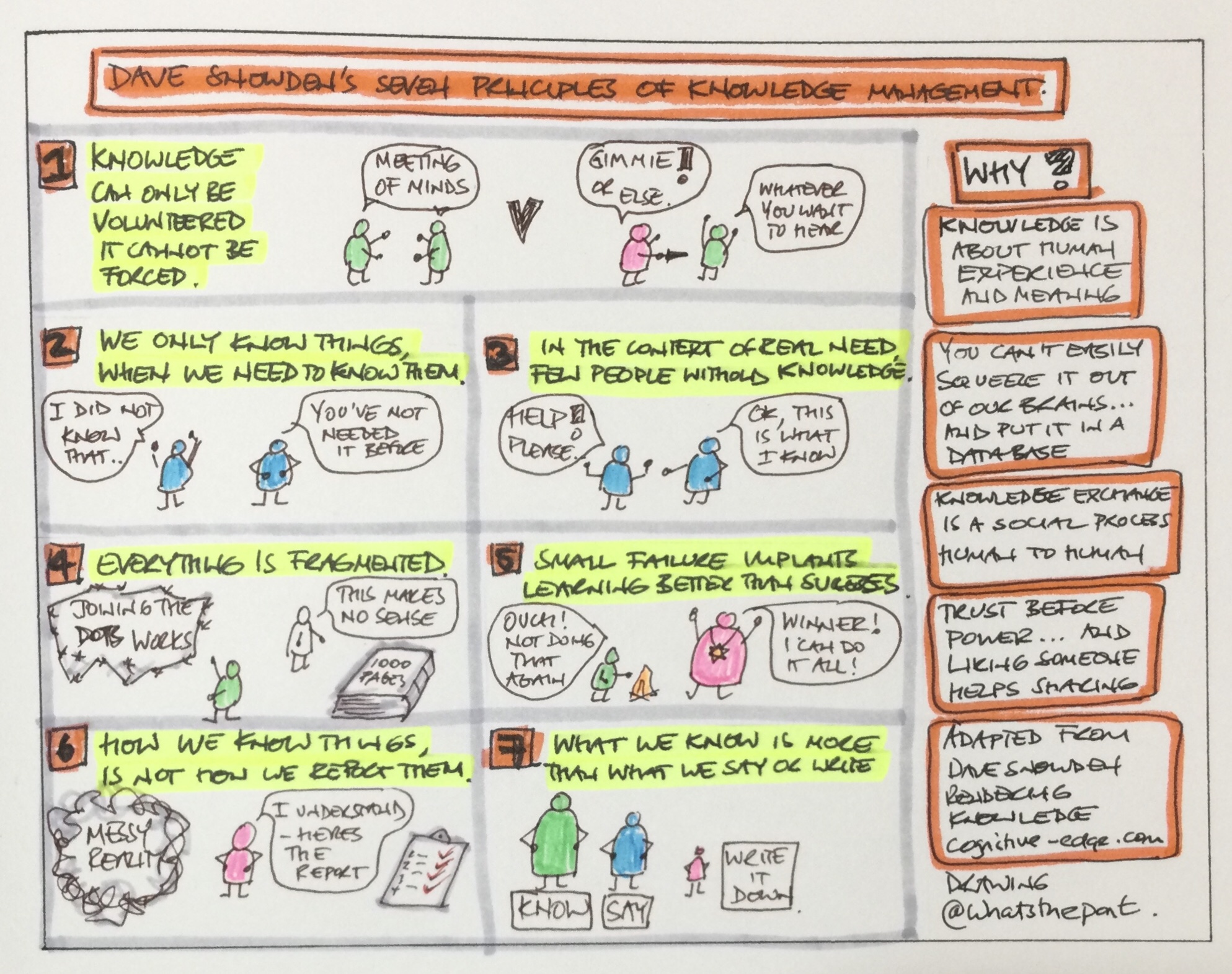
    The Seven Principles of Knowledge Management. The best thing I can suggest you do from here is have a read of what Dave Snowden has to say on the subject. Then sit back and have a deep think. This post, Rendering Knowledge describes Dave’s Seven Principles of Knowledge Management. It was written in 2008 and I keep coming back to it.

    The perpetually useful thing I find about the 7 principles is that they highlight the fact that human knowledge is unique and shaped by individual experience. It can not be squeezed out of people in an easy and standardised way. So, the idea of it then existing in ‘consistent packets’ in a database – that can be extracted ‘at the push of a button’ – is a bit a non starter. There are other points like the difference between how we make sense of things and report them which I’ve tried to capture in the drawing above.

    There’s plenty that has been written about Knowledge Management and huge conferences dedicated to it. It’s a massive and complex subject. All I’ll say is that if someone is suggesting a ‘simple and easy solution’ to Knowledge Management, go and read a few things and talk to some ‘KM Veterans’ before you say yes.

    So, What’s the PONT?

    1. Knowledge is largely about human experience and meaning. That’s going to be different for each person.

    2. Knowledge cannot be ‘squeezed’ out of people’s brains. People have to be willing to share what they ‘know’.

    3. Trust and congeniality help. If people like and trust you, they are more likely to share their knowledge.

    Resources and previous posts:

    Nick Milton is worth checking in on: Have a look at this post – Some addenda to Snowden’s 7 Knowledge Management Principles.

    Complex Wales -The Organisational Goldilocks Zone. How the system runs on 4 year cycles so things that go back 7 years are frequently ‘recycled’. Link here: https://complexwales.com/2019/05/12/less-fred-more-mary-and-the-organisational-goldilocks-zone/

    The Disconnected Jerk. One of mine that picks up on the idea that we don’t share knowledge with people we don’t trust, or like. Link here https://whatsthepont.blog/2012/08/23/the-disconnected-jerk-if-i-dont-like-or-trust-you-im-not-going-to-share-knowledge/

    Document Management is not Knowledge Management. Another one of mine trying to make the link with ‘The Knowledge’ required by London Black Cab Drivers. Link here https://whatsthepont.blog/2012/11/20/document-management-is-not-knowledge-management-ask-any-london-cab-driver-with-the-knowledge/

    Sliver Boomerangs and the lifecycle of a Sliver Bullet. Something trying to get underneath why management fads keep coming around… like Boomerangs. Link here: https://whatsthepont.blog/2017/05/29/the-life-cycle-of-a-silver-bullet/

  • Sneckdowns. The Ultimate; Desire Paths, Snowfall and User Centered Design Combo.
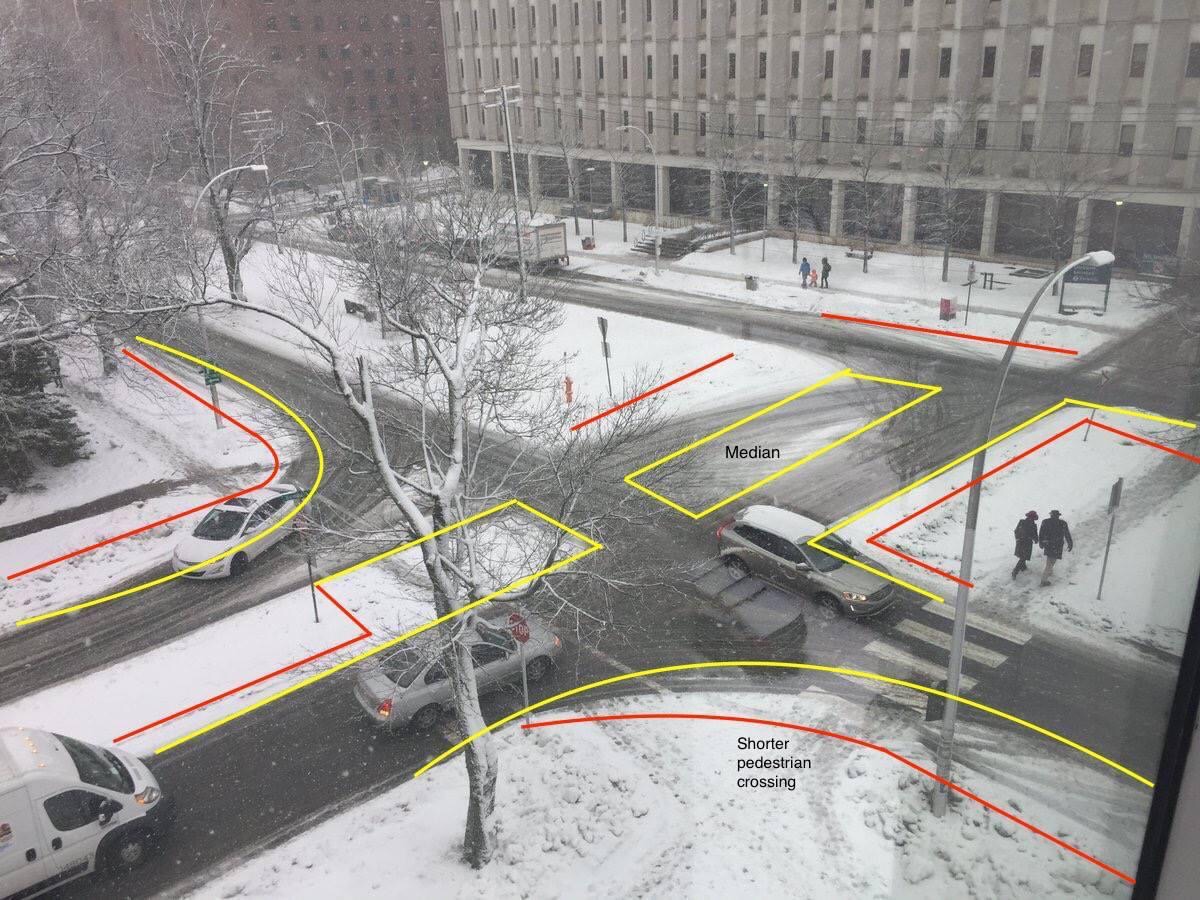
    Image courtesy of Halifax Sneckdown @BenWedge

    Desire Paths, and then some… You’ve probably heard of Desire Paths, the darling/nemesis of Urban Planners. The informal, beaten earth, muddy paths that pedestrians (people) create because they work for them. They are where the locals (people on the ground) have chosen to walk. Typically in different places to where the Architects, Engineers and Planners have decided people ‘should’ walk, and constructed the formal the paved paths.

    Desire Paths are a bit of a thing for me. Ages ago I joined the Reddit community, where we share photos of Desire Paths, and wrote this blog post about the importance of User Centered Design. In a conversation that followed, a Finnish friend told me how they go one step better. Apparently it’s common practice in Finland for developers to construct the final paths around developments after the snow has melted. The Desire Paths that people created during the snow act as the template – nice!

    So, you can imagine my excitement to see this happening on a grand scale. Imagine the opportunity to do user centred design on traffic management to improve safety for pedestrians and cyclists. Imagine it happening as a low cost safe to fail activity that gives you good data to make better decisions… Hello Sneckdowns.

    Just to explain the origin/meaning of Sneckdown:

    • Neckdown. A phrase used to describe the narrowing of a road / highway where the curb has been extended into the road. This creates a narrowing or ‘neck’ that serves a number of purposes. These include helping people to cross the road more safely and / or it slows down the traffic. If that’s got you interested have a look at this Urban Street Design Guide from the National Association of City Transportation Officials.
    • Snow. You all know about snow. The important point is that after it’s fallen it literally acts like a ‘whiteboard’. Whatever moves across it leaves an imprint. Vehicles and people leave their mark of where they have travelled, like tracing paper. I’m sure you get the picture. This shows you how things actually work on the ground, like Desire Paths.
    • Snow + Neckdown = Sneckdown. This is brilliant lateral thinking in my view. If you look at the Sneckdowns it gives you a good idea of where neckdowns could ‘naturally’ be placed once the snow has melted.

    Have a look at this video from Clarence Eckerson Jr, Director of Streetfilms that explains the concept of Sneckdowns perfectly. Its also worth a look at the Streetfilms site (here) for other examples of cyclist and pedestrian friendly street design.

    Experimentation and User Centered Design. You might have gathered I’m a bit enthusiastic about what’s going on with Sneckdowns. I’m struggling to express that clearly at the moment, but here are a few of the things that are rattling around in my head:

    • ‘Safe to Fail’ Experimentation. This has to be up there with the best examples of low cost, safe to fail experimentation. Have a look at this BBC article, Sneckdown: Using snow to design safer streets for some lovely quotes from Clarence Eckerson Jr. “It’s free. You don’t have to do a crazy expensive traffic calming study. It provides a visual cue into how people behave in transportation,” and others.
    • User Centered Design. Nothing much to say on this… although the vehicle based transport lobby might have a viewpoint?
    • Never Waste a Crisis. In the UK we tend to go into a panic whenever it snows heavily. I’m wondering if we should look upon snow as a ‘sustainable transport opportunity’. Using the advice from Dave Snowden, “In a crisis, you should always deploy an innovation team alongside the business recovery teams…to capture the novel practice” maybe people like Sustrans (UK Sustainable Transport Organisation) could deploy #SneckdownSquads? It looks like the clever Canadians have already done this and there’s a brilliant site on Facebook and Twitter called Sneckdown Halifax @sneckdownhfx. Thanks very much to Ben Wedge for letting me use some of his images. I particularly enjoy “Gather ye sneckdowns while ye may”, which is at the end of this post.
    • But, what if you don’t have snow? A very good point. What I can say is that people are creative, and it looks like some are using the Autumn leaf fall to look at the neckdown patterns they create. Of course, it’s developed #sleafdown as a description. There is also a claim (here) that in the 1980’s some Australian planners used cake flour to observe traffic movements at an intersection. I so want that to be true, if you know anything, please let me know.

    So, What’s the PONT?

    1. No matter how carefully designed, people will always find a ‘better’ way to do something. It’s a good idea to involve them in the first place.
    2. Like Desire Paths, Sneckdowns offer the opportunity to combine user experience and safe to fail experimentation to get outcomes that work for everyone.
    3. Never waste a crisis. After the ‘snow has melted’ the opportunity to see what novel practice people create will have gone. The chance will have been missed, so deploy a #sneckdownsquad.

    Finally – you might have noticed some common ground between sneckdowns and the principles of co-production. Here’s a useful quick tip on ‘What is Co-production’.

    Thanks to Halifax Sneckdown for permission.
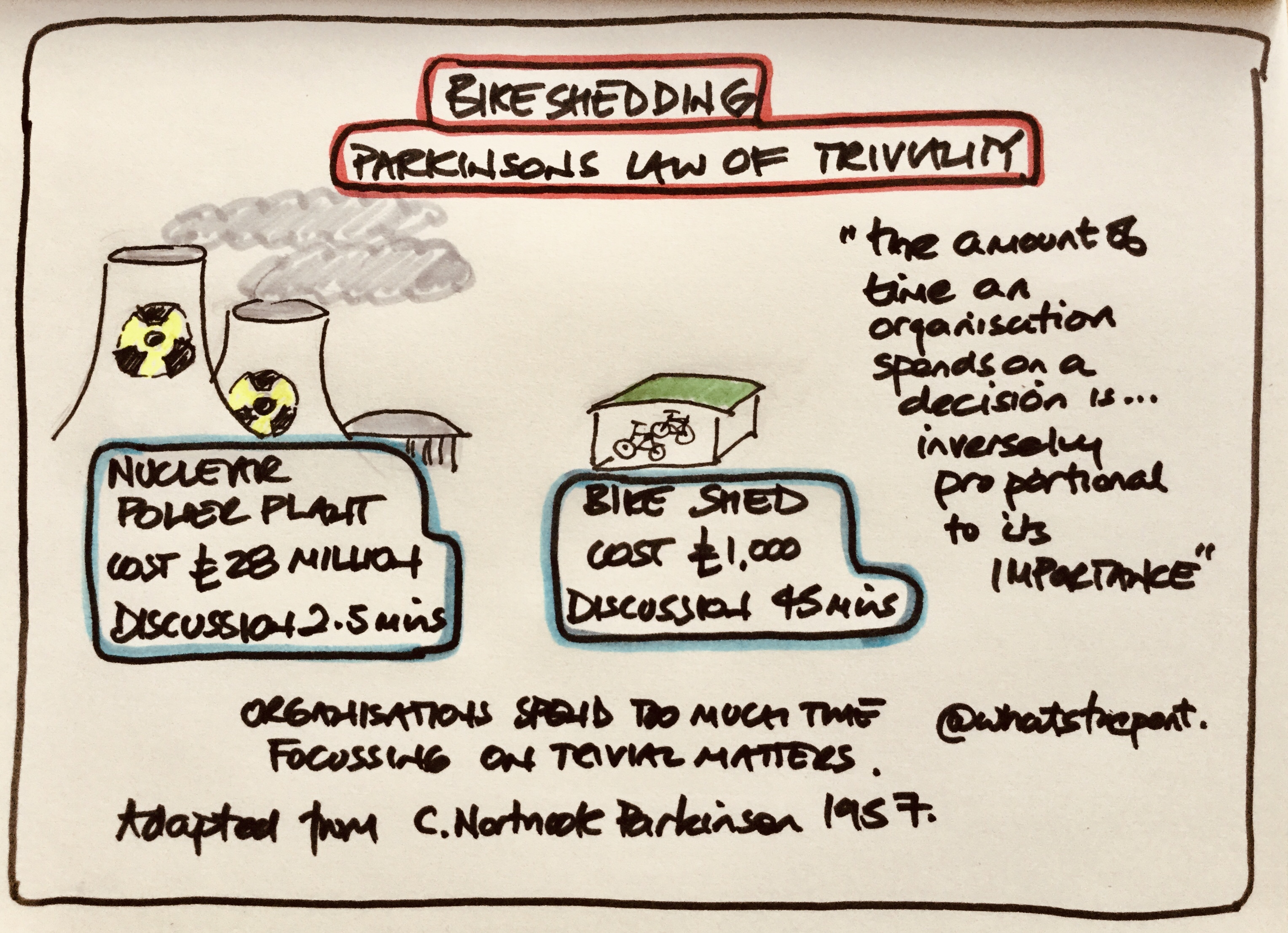
  • A Question… Have you ever been in a meeting where you spend an eternity discussing something relatively trivial, and then microseconds on something significant? If the answer is yes, the chances are you’ve been Bikeshedding…

    Bikeshedding is the common name for Parkinson’s Law of Triviality:  … ‘the amount of time a committee will spend discussing an item is inversely proportional to the importance of that issue’.

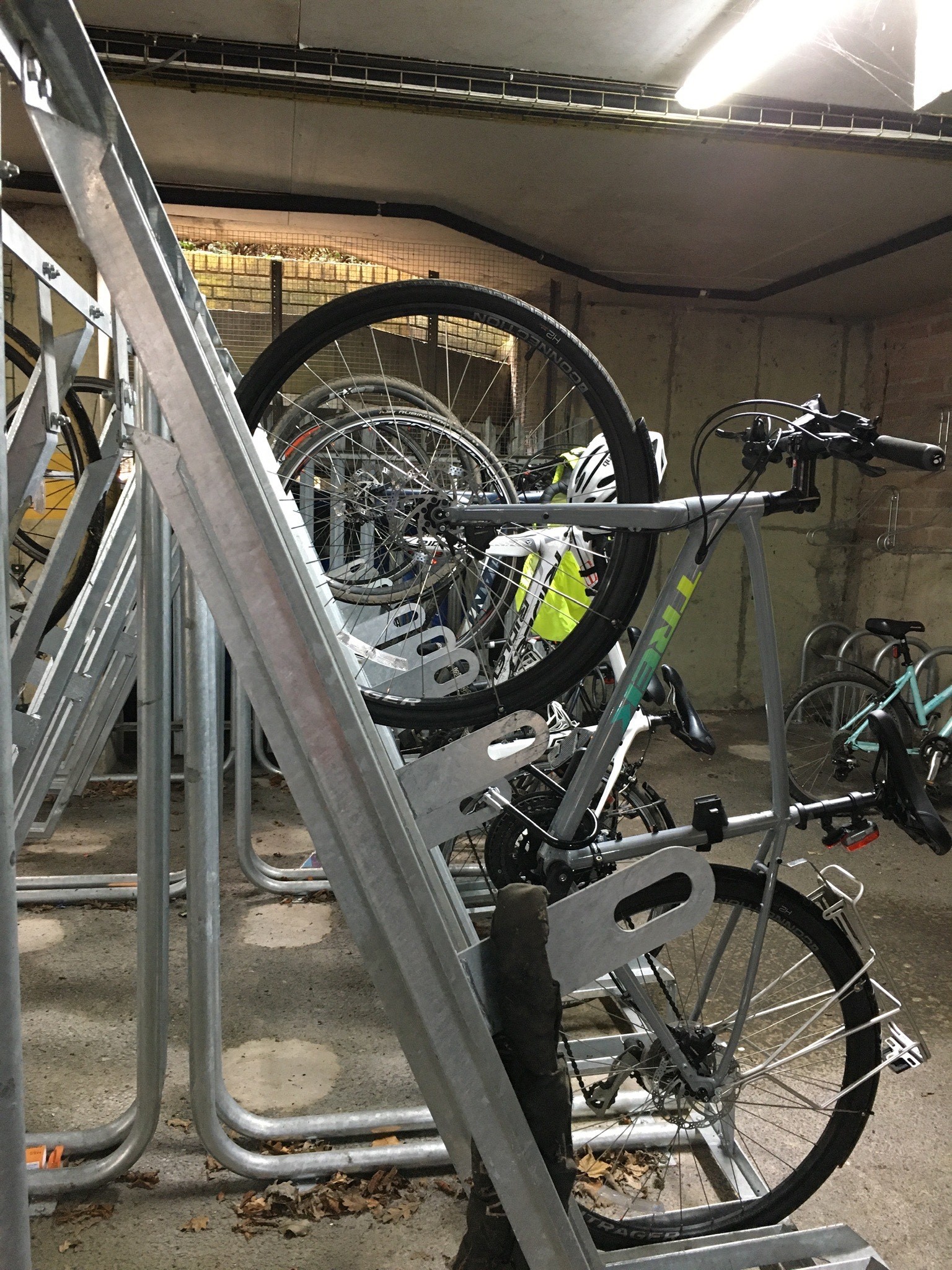
    So, if the issue is huge, complicated and really important, the meeting will spend far less time discussing it than something that is straightforward and less important. The classic example given by Parkinson was along the lines of a decision to build a Nuclear Power Station (costing many billions) being decided in 5 minutes. In comparison the discussion of where to build the employee bike sheds lasts 45 minutes. You can read more about the origins of Bikeshedding in this post.

    This post is a conversation between Sarah Prescott and Chris Bolton to try and ‘Fix the Bikeshed’. We’ve both been involved in committees and meetings for many years. We’ve seen enough Bikeshedding to make the Parking Attendant at the Utrecht Train Station Bike Parking Garage faint*. (* the biggest bike parking garage (shed) in the world!)

    What we’ve done is ask each other a few questions and have hopefully come up with some useful suggestions. Here goes…

    Sarah’s questions for Chris.

    1 – When did you first become aware of Bikeshedding? – Have you got a real-life example?

    I’ve been aware of Bikeshedding for over 30 years, I just never knew what it was called. During the 1990’s in one of my first jobs I used to get intensely frustrated about wasted time in meetings talking about trivial things. Part of the role involved taking the meeting notes of a ‘Fishery Bailiffs Protective Equipment Subcommittee’. They obsessed for hours about military specification equipment and camouflage clothing. I just couldn’t see the point.

    That frustration with endless discussions about trivia in meetings has persisted with me ever since. In about 2010 I remember complaining to my Father in Law about a frustrating ‘Community of Practice’ I’d attended.

    They were discussing ‘voting rights’ – for a group whose sole purpose was to share knowledge (in what circumstances would they need to vote… on what?)

    By the time we had ‘resolved’ that issue, there was no time left to share any actual good practice. The important work was relegated to “let’s do it by email”. Arrghhhh!  My Father in Law just said, “ah, a lovely example of Bikeshedding” A week later he gave me a copy of Cyril Parkinson’s 1958 book ‘The Pursuit of Progress’. Bikeshedding is beautifully explained in the book, which I cherish.

    2 – Are some kinds of decisions more prone to bikeshedding than others? What’s the relationship between bikeshedding and risk?

    I think that some decisions are more prone to bikeshedding than others. Parkinson makes the point that if the topic is; big, complicated and something we don’t understand, we will shy away from engaging with the detail. What we will do is focus on the ‘easy’ stuff. Things that are at a level we fully understand and are comfortable talking about.

    How this plays out in a meeting is that people will ‘defer to the experts’ and just accept whatever is in front of them, without questioning it too deeply. So, the complicated, huge impact issue (a new Nuclear Power Station) gets ‘nodded through’ in 5 minutes, whilst the design of the bike shed for the workers gets chewed over for 45 minutes.

    There are a number of things that influence this behaviour, the fear of looking ignorant or foolish in front of experts and others in the meeting. For me, this raises a big question. If people are there to make decisions, how can they be helped to feel confident and capable of asking questions about the big, complicated and important things?

    As far as risk is concerned, I think the practice of ‘Bikeshedding’ poses significant risks. Big and complicated issues are likely to have many risks associated with them. If the issue isn’t getting the discussion and scrutiny that as proportionate to that level of risk – that’s got to be a risk in itself.

    3 – Has anyone used the dark side of bikeshedding and how did you tackle it?

    I think it’s important to recognise that ‘Bikeshedding’ is exploited in lots of places, not just decision-making meetings. It can be as simple as someone ‘offering’ a distraction or a decoy that it’s easier to engage with than the ‘hard’ stuff.

    Using Bikeshedding for ‘ulterior motives’ does happen. Going right back to the start of my working life I used to support a committee on ‘technical’ issues. This involved attending the agenda setting meetings with the Committee Clerk and the Chair – both highly experienced individuals. 

    Their version of ‘agenda management’ definitely involved bit of creating the space for Bikeshedding. When the Chair wanted certain items passed as smoothly as possible, they were placed after the Bikeshedding opportunity. “Let them chew on something irrelevant for a bit” was the objective. Observing these ‘dark arts’ was an ‘education’.

    As for counteracting bikeshedding – the main points I would suggest are; avoid it in the first place, be constantly vigilant, and if you sense it’s happening, take steps to stop it.

    Like all the best advice, easier said than done, but awareness is a good place to start.

    Chris’s questions to Sarah:

    1- Do you think there are any ‘structural’ things that could be done to avoid Bikeshedding in the first place?

    Firstly I think there is a lot we can do to avoid Bikeshedding by structuring meetings. There will be a lot of familiar advice on how to run an effective meeting, setting a strong agenda, being clear on what outcomes are, and of course the need to get the right people around the table in the first place!

    These are all effective “hygiene factors” to avoid Bikeshedding, and I would argue that these are even more important in a remote working environment.

    Structuring the agenda is one of the key points – I personally favour putting the more meaty discussions at the beginning, shortly after a warm up, and before the energy is depleted. Don’t leave it until five minutes to go!

    But being intentional about the style and not just the formality of the meeting helps. Meetings and decisions don’t happen in a cultural vacuum and some cultures are more prone to Bikeshedding than others. Some organisational cultures more weight is placed on not losing face, for example, and this can drive people towards the Bikeshed.

    Nancy Kline’s famous book “Time to think” talks about creating a respectful meeting space where everyone can be heard effectively and a safe place for discussion, I think this helps.

    The other point for me is around governance is structured and how risks are managed. If decisions are not devolved effectively and the sheer number of decisions become overwhelming then Bikeshedding seems much more likely.

    Governance has to manage the appropriate risks – so the operational decisions need to be aligned to the operational teams and the operational risks. It sounds so easy when I write it like that!

    Systems of approval have to be carefully designed to achieve that though. Underpinning it is a keen and frank eye for the risks we are facing. There are questions we can ask ourselves to help with that – I’m a fan of getting under the skin of what’s bothering people, that nagging feeling. It usually leads away from the Bikeshed in my experience.

    2. What about the behaviours of key players, for example the Chair – do they have a role to spot it and stop it?

    Chairs absolutely do have a role to spot it and stop it (sounds like a good motto for a T-Shirt!)

    Chairs who; facilitate effectively, don’t get lost in the weeds, and don’t push their own agendas are a big defence against Bikeshedding. A good Chair must call out anyone playing at any of the dark arts  – I find a spot of humor can go a long way in doing this! A good Chair can also hold up a mirror to the room to point out ‘Bikeshedding without blame’.

    Another key role is the people presenting information to meetings. The “expert” has a critical role to present all the facts and context as best they can and avoid any “dark arts”.

    Awareness of their own biases and their ability to handle conflict / uncertainty is really important. They can also help guide the meeting back to where it needs to be.

    It takes courage and bravery for people to admit they don’t know everything. That awkward space, on the edge of knowledge, is where we need to be a lot of the time. There is definitely a link between being on the edge of comfort zones and seeking the Bikeshed to my mind.

    3 – Isn’t this everyone’s problem though? How do you work with that?

    It is of course and for me it’s about starting with the recognition that we all Bikeshed from time to time. Sometimes issues are difficult to face. That’s ok. Rather like mindfulness, it’s about recognising that we are off track and returning to the matter in hand. And maybe a spot of Bikeshedding in a meeting all helps build a social relationship (in small doses, of course).

    Processes of risk management and assurance also play a role in tackling organisational bikeshedding.  The lodestone is the risk matrix process. If nothing else this should be telling you what are the most important things to worry about – be afraid if it doesn’t tally with the “what’s bothering you” test.

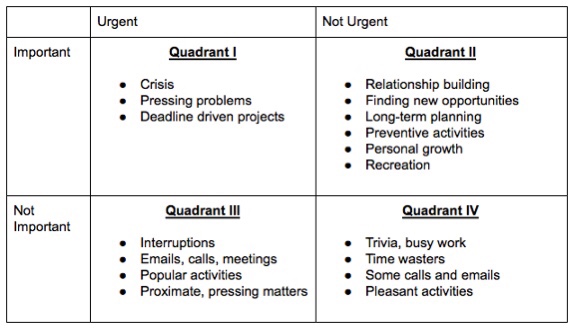
    How we get assured that everything is on track via audit processes can really help as part of the evidence we assess. I’m a fan of Stephen Covey’s four quadrants (or Eisenhower – who got there first on this) to help me make sure I am in the important areas. Bikeshedding as a concept is very similar to the “Urgent but not important” quadrant in Covey’s world.

    Adaptation of Stephen Covey’s Important v Urgent Matrix

    The other key area is creating a culture where we seek continuous improvement on our meetings. We’ve used feedback sessions at the end of Board meetings to good effect and as part of our Board annual appraisals for example. I think the same can apply to 121s on a more individual level. A good coaching and facilitation relationship is a good antidote to bikeshedding right from the shop floor to the Boardroom.

    Tackling bikeshedding is ultimately about being honest about what’s bothering ourselves, to my mind. Leaders have a particular role to play in encouraging and rewarding the behaviours which lead to productive debate and good quality thinking, and providing the feedback that things are going off course.

    Leaders can emphasise this about role modelling that behaviour and having the courage to admit when they are unclear or if they think they have gone off track. And, I think tackling Bikeshedding as a group behaviour becomes easier over time as new norms are established. We are all learning about new norms at the moment!

    Points to ride away on your Bike with :

    1. Think about how your meetings are structured and managed. Clear the agenda for what’s important and be clear on the outcomes.
    2. Develop a style that hears all voices and allows for strong facilitation.
    3. Build a team that is comfortable with being uncomfortable. The interesting and productive stuff is often just outside our comfort zones!
    4. Use tools like risk matrices, assurance and evidence to help guide you and back up the decision making.
    5. Adopt a continuous improvement approach to decision making and meetings.

    A version of this post can be found on Sarah’s blog here: https://sarahprescott.medium.com/fixing-the-bike-shed-e50e5b578314

  • Cynefin Image from the Cynefin 2020 Book

    Clai cyffredin nid aur ac arian. Being ordinary doesn’t feel like much of a goal does it. It’s certainly not aspirational in the sense of the ‘happy clappy’ vision statements you see in lots of corporate documents.

    But ordinary and mundane are essential. This is the stuff of everyday life, the fabric of society, the oil between the cogs, asking for help and knowing someone will be there. Part of how we make sense of it all.

    The mundane and the ‘ordinary’ are the things that really matter. Without them, nothing else would work.

    Last week I was at something that for me wasn’t ‘ordinary’. It was the Cynefin21 Book Launch. For some people a book launch might be fairly routine. For the amazing cat herder Marion Kiely it was her second book launch that day.

    But this book launch stood out because the Cynefin Community had written the book. 46 contributors, authors, illustrators, editors, cat herders… sometimes performing multiple roles – extra ordinary (extraordinary).

    Towards the end Dave Snowden who created the Cynefin Framework in 1999 was reflecting on what we had been saying. One of the points he made was that the Cynefin Framework was being used in places where ‘none of us, from this Community, had ever been…’

    There were people using the Cynefin Framework who had never been in contact with ‘us’,… this was the measure of something useful and sustainable. People can pick up the Cynefin Framework and quickly work out how to use it to make sense of their situations. They don’t need a manual, recipe book, training course or accreditation. It just works. This is where the ‘be like ordinary clay rather than gold and silver’ description fits.

    A Welsh Sentiment. I don’t want to irritate anyone by getting ‘too’ Welsh and sentimental about that statement, but it does resonate with me – deeply.

    Maybe it’s part of the Welsh psyche. Centuries of a difficult relationship with powerful neighbours, deeply embedded non-conformist religious practice, always being slight outsiders and the underdogs has shaped us. And, if the cap fits… wear it.

    There’s a tendency in Wales to be; low key, not flashy, and a bit understated. You don’t go around ‘shoving your ideas down people’s throats’. If you’ve got something good, practical and it’s going to help, people will work that out for themselves. Like the clay mugs you use every day, not the silver and gold goblets kept in display cabinets.

    So, ‘ordinary clay, not gold and silver’, ‘clai cyffredin nid aur ac arian’ is very Welsh sentiment, for a very Welsh Framework. Happy 21st Birthday Cynefin.

    Penblwydd hapus Cynefin yn 21 oed

  • The Decoy Effect. How options and choices get manipulated.

    Coffee Choices and the Decoy Effect. Have you ever bought a coffee and been ‘bedazzled’ into getting one bigger or frothier than you’d planned? “It seemed much better value to have the Maximo Grande…”. Basically you’ve had your behaviour ‘modified’ by the retailer using Decoy Pricing or the Decoy Effect. I’ve fallen for it, many times.

    You might now be thinking “that’s terrible, they are manipulating my behaviour to maximise their profits. Does it happens across the retail sector?” Sadly, yes it does.

    But Wait! Before you get too indignant pause. What if this is happening closer to home, at work?

    What if the Decoy Effect is embedded in PRINCE2 processes?

    What if the process of making the ‘right’ decisions in a business case is just another case of people using the Decoy Effect?

    Influencing the behaviour decision makers to get the answers project managers want?

    Shocking!

    Let’s Play the Business Case Options Appraisal Game. One way to spot a Decoy in business plans is to run through an example.

    The Scenario: You’ve gone through bureaucratic hell to getting a pilot project approved. You are now returning to the (insert name here) Committee for implementation approval.

    The Punters: The Committee need to feel like they have made the ‘right’ choice. They also need to look compliant with process. Make it easy for them to ‘do the right thing’.

    Player 1 (You): You just want your favourite idea approved so that you do what you think is important.

    Tactics: Use the Decoy Effect to get them to make the right decision. I’ve illustrated this in a handy guide below.

    How to Spot a Decoy. Apologies if anyone is feeling aggrieved I’ve suggested they might be ‘playing a game’ with carefully crafted business cases. I’m sure that most people are ‘straight down the line’ on options appraisals.

    Raising this is just about helping people make better decisions.

    Helping decision makers recognise that there might be some unscrupulous types in the world. ‘Messing with their heads’, and trying to get what they want by using the Decoy Effect.

    In the sprit of helpfulness, here are some pointy questions an Approvals Committee might want to ask about an options appraisal. You can do this if you suspect the Decoy Effect, or just make it routine practice.

    1. Just the 3 Options? Why aren’t there any more? (try to remove a bit of the asymmetry)
    2. Option 3 looks a bit extreme? If something looks like lunacy compared to the others – it’s probably a Decoy. Reject it and ask for something a bit more in tune with reality.
    3. Do we really need ‘Do Nothing’? Take it for granted that we can stop this project if we really need to. Replace ‘Do Nothing’ with a realistic ‘Do Something Useful’ option.
    4. Why are they all so ‘similar’? Why are the options all just increasingly more expensive versions of the same thing? Is this just adding ‘whistles and bells’? Are there any other possibilities?
    5. Were there any failures? Did you try anything that didn’t work? What did you learn from that experiment?
    6. (NEW) Who did you talk to? Give us a picture of the variety of experience and ideas that surfaced during the development of these options. What sort of Trojan Mice emerged? (More on Trojan Mice here) Thanks to Diana Reynolds
    7. (NEW) How wide was the thinking? What were some of the completely potty ideas you considered at the beginning of this? Gives a sense of how widely people have been thinking, or is it just a narrow favourite? Thanks to @ComplexWales.

    There will be plenty of other questions that people could ask, feel free to add them in the comments and I’ll include them on the list.

    Ultimately its about having a bit of healthy skepticism and keeping your nose open for the smell of ‘Trojan Horse Poo’. Is someone trying to roll their favourite Trojan Horse past you by deploying the Decoy Effect? Sorry to mention Trojan Horse Poo, but I have written about them and Trojan Mice previously (link here).

    Asymmetrical Dominance Effect. If you fancy a bit of a deeper dig into the world of the Decoy Effect you can have a look at the Wikipedia entry, here. If you want to go deeper still, there are plenty of research papers, try this: The asymmetric dominance effect: Re-examination and extension in risky choice – An experimental study from the Journal of Economic Phycology (August 2019).

    From a personal perspective I’ve gone for something a bit more relatable, Sheds.

    Here’s my attempt at trying to explain the Decoy Effect in Business Cases through the medium of Sheds.

    So, What’s the PONT?

    1. When we are faced with choices – the range of options available influences our choice. Beware of Decoys.
    2. Extreme options at either end of a range of choices can make some things appear more favorable. The ‘Decoy’ pushes us towards something we might not have chosen.
    3. The Decoy Effect isn’t limited to retail choices. Look out for it in Business Case Options Appraisals and ask pointy questions.
  • Hand sanitiser stations come in many shapes and sizes.

    Is anyone else thinking about Behavioural Nudges and Hand Sanitisation? If you’ve ventured to the supermarket since COVID-19 you’ve probably experienced some version of the ‘Hand Sanitiser Station’. The good, the bad and the ugly.

    My experiences have ranged from the pathetic – empty bottles of disinfectant spray lurking behind the crisps – through to the terrifying – being hosed down with disinfectant by someone in a hazmat suit. OK, I’m exaggerating a bit, but the staff in my local Aldi’s did take things very seriously during the peak of lock-down. I’m happy and grateful for that.

    But I’ve got questions… Did anyone sit down and thoughtfully design this plethora of sanitising experiences, or did they ‘just happen’? Were the multitude of changes and ‘step-down’ measures planned, or did they ‘just happen’? Above all, I want to know if the ‘Masters of Nudge’ that work for the retail companies had anything to do with the hand sanitiser stations – I suspect the answer is mixed…

    Behavioural Nudges and Choice Architecture. Before diving into the world of retail here’s a quick reminder of the behaviour change approach that has been christened ‘Nudge’. Nudge is based upon the the idea that people will always take the easiest option when they are presented with choices. The theory suggests that humans tend to avoid things that require too much effort; thinking included.

    One of the key principles underneath Nudge is ‘Choice Architecture’. This boils down to how things are arranged. The ‘architecture’ influences the choices people make. Generally in a ‘nudge’ it will require more effort to do the ‘wrong thing’ than is required to do the ‘right thing’. Calling it ‘Choice Architecture’ adds a layer of ‘scientific credibility’.

    That’s basically it. You design / control the choices people have available to them, so that the easy option is the ‘right’ one. One important point to remember is that people still have a ‘choice’. It’s just harder to do the things that the people who have designed the nudge ‘don’t want you to do’.

    I’ve written about this before in, Choice Architecture; how to avoid being a ‘Meeting Lemming’ (link here). Don’t be put off by the mention of Meeting Lemmings, the principles of using ‘Nudge’ to get people to do the ‘right thing’ are the same. I should also thank Paul Taylor at this point who’s post What Face Masks Teach Us About Behaviour Change got me thinking.

    Retail is full of Nudges. From what I’ve described I’m guessing it will be no surprise to hear that the retail sector uses Nudge extensively. For retail, getting you to do the ‘right thing’ means you buying their products.

    If you want to get an idea of the scale of this activity search the internet for something like; ‘Top 5 Behavioural Nudges in Retail’. The results are mildly depressing. There are dozens of reports, articles and blogs that champion the Nudge activities used daily by retailers. I’m going to avoid using the phrase ‘herding people like livestock’, but there was one sentence that sums up the whole retail Nudge approach for me:

    “…armed with these marketing psychology insights you can start optimising your store and increasing conversion rates one nudge at a time…”

    But what about Health on the Shelf? But it’s not all bad news. The Royal Society for Public Health have thought about how the retail sector can help to tackle obesity by using Nudge. The report Health on the Shelf (link here) is a useful practical guide to what can be done in a supermarket environment to help people make healthy choices, there’s also a video. This isn’t rocket science, it’s simple stuff to help people make better choices and do the ‘right’ thing for their health.

    So, why isn’t Hand Sanitisation being ‘Nudged’? I’m at a loss to understand this. The retail sector have the ‘Nudge Masters’, why haven’t they been universally deployed? I have asked around a few friends and a couple of reasons seem to surface:

    • The Nudge people are all working in the e-commerce field. That’s online shopping to the rest of us. With so much shopping being done online, the best Nudge brains are being deployed there. All trying to tackle things like the 80% shopping basket abandonment rates.
    • There’s no money in it for the retailers. Taking up floor space for people to sanitise their hands costs money. This is a space that could have been occupied by another ‘buy one, get one free’ offer (on Hot Cross Buns in September).

    But surely, this is an opportunity? I think the retail sector might have missed a trick here. They could be doing their bit to nudge’ Hand Sanitisation, whilst at the same time nudging their sales. It’s all about funneling people into a queue.

    Alongside my experiences at the Hand Sanitiser Stations over the last few months I’ve also done a fair bit of queuing outside shops. The objective of this queuing has been getting to the Hand Sanitiser Station, which is the entry point to the supermarket.

    This is what I’m thinking… While I’m in the queue I’m a captive audience. Nothing much to do other than wait my turn. If I was a retailer I’d be thinking about how I might use this opportunity to Nudge the living daylights out of the punters. Sell them more stuff they don’t need. By the time they have got to the Hand Sanitising Station they are putty in your hands… It might also improve the levels hand sanitisation.

    Of course some retailers might complain about the loss of retail floor space required to form an orderly queue. I’ve got an answer for this – create a ‘Social Distancing and Hand Sanitisation Arcade’ or something similar – outside the supermarket. Basically some sort to canopy people can queue underneath, where you can then sell them more stuff. I can’t imagine a single Local Planning Authority objecting to such a Public Health focussed initiative.

    A bit of Nudge around Hand Sanitisation could generate a ‘win – win’, for public health and the retail sector (even better if it happens to be the local high street).

    So. What’s the PONT?

    1. Behaviour change ‘Nudges’ work on the principle that humans will always take the easiest / least effort option when faced with choices.
    2. Choice Architecture is a way of arranging options so that it takes more effort to do the ‘wrong thing’. So people unconsciously do the ‘right thing’.
    3. The retail sector have been doing this for years. It’s worth remembering that, because sometimes, the things they ‘Nudge’ you towards aren’t in your best interest.

  • Spacewalking outside the Shuttle. Image via Pixbay

    Imagine you’ve made it to the International Space Station (ISS), left the ship on your spacewalk, then you go blind. What do you do?

    This is a guest post from my friend Sam Williams (@SamW112358 on Twitter). It’s Sam’s first post and is a prelude to him launching his own blog. Hopefully you enjoy it, if you do, please leave a comment for Sam.

    The content has been prompted by my recent post – Do Epidemiologists Play COVID-19 Computer Games After Work? Sam and I talk about this sort of thing a lot – and he’s got plenty of interesting things to share…

    Playing Computer Games After Work. Chris’ latest blog on gaming and simulations really got me thinking, as they are prone to do. In the post he poses 2 questions that I’m going to respond to

    1. Does playing a computer game help with your job? (Epidemiologists included); and
    2. Can the data generated by playing these games help create wider insight and learning?

    Job Simulation is an Old Idea. The idea of simulating things isn’t new. Back in 1969 the Apollo 11 crew calculated that they collectively spent 2,000 hours in simulators. This was in just 6 months between their selection in January and their flight in July. The details can be found in this NASA article [link to article].

    That’s an impressive number of hours in simulators. A bit of rough math for 3 people, building up 2,000 hours over 6 months, puts it at about 27 hours a week each. Just to put that in context, a recent survey, The State of Online Gaming 2002, identifies that gamers spent just over 6 hours a week playing games. For commitment, the average modern gamer doesn’t match the 1960’s Astronaut’s simulation time!

    Another interesting finding from the study is the claim that people aged 18-25 spend more time watching other people play computer games than they do watching sport. Think about that for a moment.

    As someone who plays games, I find watching players who are better than me fascinating. Some of my best learning has come through watching great players run through their thought processes. This could potentially be an interesting by-product of using simulators; learning by watching others play the simulation.

    No More Tears… This is a nice example around the use of simulations which also centres around space travel, and is the source of the title of this blog.

    Imagine you’ve made it to the International Space Station (ISS), left the ship on your spacewalk, then you go blind. Chris Hadfield recounts a brilliant story of his first space walk where he temporarily went blind.

    Hadfield mulls over the situation in several interviews, including this excellent Ted Talk.

    If you haven’t watched it, I’ll recount it quickly. On his first spacewalk Chris Hadfield got detergent in his eye. This is the material used to keep the inside of his helmet from fogging up, and its not something you want in your eye. The result, his eye “slammed shut”. As his eye started tearing up the water stuck to his face rather than running anywhere because of surface tension and the lack of sufficient gravity. He couldn’t just pop his helmet off and give his eye a wipe. Eventually the tears cross the bridge of his nose and totally blind him. Have a look at the video for the ‘matter of fact’ description of this.

    One of my favourite lines is Hadfield saying “…it could be a pretty terrifying moment if you weren’t ready for it…”.

    He describes how they had “done the training, all the visualisations they could think of”. In over 400 hours in underwater simulators, they had practiced incapacitation scenarios so, “when I went blind it wasn’t so bad, I can still talk and hear”.

    Staying calm in the situation was vital, and the simulations had prepared him. Although this situation was unique, he had things to work from. Hadfield describes that even in the worse case he could just get dragged back inside the ISS. From first having issues, to getting back to the task in hand, took about half hour. The solution they came up with was opening a valve and spurting some oxygen & tears into space.

    You could ask, why didn’t the simulation come up with this?

    This is a great question. I don’t know enough about the science to say with certainty why this scenario never got tested (being a weightless simulator rather than reduced gravity would be my best stab). Using what Hadfield had, the ability to hear and talk, demonstrates some of the value in simulation. It creating a level of familiarity. Hadfield does joke that after that incident the Astronauts used Johnson’s ‘No More Tears’ as the anti-fog detergent of choice. With the benefit of hindsight they should have used it before!

    This example does demonstrate the limitation of the simulation. You can’t simulate every possibility. However, they had worked with similar problems before. Hadfield was prepared. He stayed calm, used what he had available (talking/hearing) and worked out a fix for the new problem.

    So to answer Question 1. Does playing computer games make you better at your job? If the game is a simulation exercise, or something similar, I think the answer is yes. It helps to prepare you for unknown situations and problems.

    I’m not going to answer Question 2 at the moment, I’m saving that for the launch of my blog. What I will say though is that it involves more space travel. This time Apollo 12, more about simulations and the famous “SCE to AUX command”.

    Just to sum things up so far.

    • 2,000 hours of simulation training in 6 months is intensive. But, travelling to the moon is complicated! You need to be prepared to cope with unexpected situations rather than just having one plan.
    • 18-25 year olds spend lots of time time watching people play computer games. Is this becoming increasingly part of how people learn?
    • If simulations can help someone who goes blind in space, how could it help in more earthly situations?

  • Owning what you create. There’s a lot to be said for feeling real sense of ‘ownership’ of the things you build, manufacture, write, create or the service you provide. Ultimately it’s all about quality. If you care about what you are doing you should be prepared to put your name to it.

    By ‘signing’ whatever that is, you are giving a message to whoever is on the end of ‘shipping’. A message that, ‘this products has passed a quality threshold’. Depending on what you do, that could also mean, ‘I’m really proud of it’.

    Things you don’t see much anymore. Years ago I used to be fascinated by the little ‘QC’ stickers I’d find in new clothes. I’d busily remove the shop tags and then find a mysterious ‘QC’ sticker hidden on the washing instructions label, or in some other obscure location.

    It took me a while to work out these stickers were about Quality Control. The product had been checked and ‘certified with a sticker’, that it was of good enough quality to be shipped to the customer.

    Following this revelation I started to ‘notice’ QC stickers in lots of places. I was going to say I saw them ‘everywhere’, but that would just be another example of me falling for confirmation bias.

    One variation on the QC sticker I found particularly interesting was the ones with a signature, and often a date. So many questions…

    • Who is this person with the initials ‘BP’ ?
    • What else do they do in the distant factory that made my new sweater?
    • Where has my sweater been in the year since ‘BP’ signed it?

    All mildly interesting questions, maybe I had too much time on my hands to think about these things… But, what this did tell me was that someone cared enough about the quality of that sweater to sign a QC sticker and put it on the garment. ‘BP’ signed it and shipped it…

    A measure of engagement. I’ve been thinking about QC stickers and ‘signing before you ship’ and what this means in terms of employee engagement. The idea that employee engagement and high quality work are connected is common, people write books about it. My thinking was going along the lines of:

    1. Engagement means that I have ‘ownership’ of what I do.
    2. It is the best quality I can produce.
    3. I’m prepared to put MY name to it.
    4. I will be responsible for what happens once it’s been ‘shipped’.
    5. If it is faulty or below standard I will put things right.

    If I’m NOT happy to put my name to what I produce, points 1-5 above probably don’t apply.

    I’ll leave it up to you to ponder on what this might mean in your area of activity.

    Personalised measures of quality. Recently I’ve been trying to think about what I purchase, and the impact it has. There’s a another blog post in this about the Circular / Foundational Economy initiatives that are developing in Wales. All good stuff about being able to trace where things come from and having long term relationships with; local, sustainable and high quality providers of goods and services.

    My favourite example of personalised QC from recent months is a local artist in the Rhondda, BAGSY. This isn’t an advert for ‘The Clothing Brand for the Valleys’ (link here). I already have VIB Status (Very Important Butty) and Twitter recognition as a Cwm Parc T-Shirt model on @IamBagsy.

    What I really love about BAGSY was the personal note sent with the T-Shirts we ordered during the peak of the COVID-19 lock-down. Nobody was getting out and the parcel arrived with a lovely hand written note*. I’ve never met BAGSY, and the note brought a huge smile to my face.

    The other point is that the handwritten note was like the best QC ‘sticker’ I’ve ever seen. I can tell from the note that BAGSY is sending me a quality product he ‘owns’. The note has guaranteed quality and provided some helpful personal advice to ‘stay safe’. It also suggest staying ‘class’ … but that’s a Valley’s thing.

    So, What’s the PONT?

    1. Owning what you create should link to the quality of what you produce.
    2. Being prepared to ‘sign it before you ship it’ should be a mark of that ownership.
    3. If you are not prepared to sign it, you shouldn’t be prepared to ship it.

    * The note is addressed to Sian – who handles the financial stuff here. I’m just the clothes horse Twitter model.

  • I’m guessing that during a pandemic most Epidemiologists will barely have time to sleep, so time in-front of the X-Box will be limited. But this is a serious question.

    Nobody will be surprised to hear that a bundle of COVID-19 related computer games have emerged in the last few months. Most of them ‘shovelware’. But what I am wondering is:

    1. Does playing a computer game help with your job (Epidemiologists included)?; and
    2. Can the data generated by playing these games help generate wider insight and learning?
    Source: Plague Inc EVOLVED Computer Game You Tube Trailer.

    Lets start with some Gavin and Stacey (the much loved TV show based in Barry Island). There’s a memorable scene involving the group travelling between Barry Island and Essex, on Dave’s Coaches, driven by Dave. It’s a fair distance, so naturally they stop for a comfort break at a Motorway Service Station.

    When it’s time to get back on the road Dave is missing. Someone finds him sitting in the amusement arcade playing a racing car simulation game. Dave’s response, “I needed a break from the driving…”

    This is not as confusing as it seems. Apparently people will spend a day at work driving trucks, and the evening doing the same on a computer game called Euro Truck Simulator. I kid you not.

    There’s a computer simulation game for everything. Just to be clear, what I’m talking about here is simulation games. A simulation of the ‘real’ world where you; make decisions, do things and influence the outcome of events. This isn’t FIFA or X-box ‘shoot-em’ ups’ that kids spend their lives playing… just so their parents have something to moan about.

    These simulation games have been around for years and cover just about every topic you can imagine. A search of ‘simulation games’ on Steam (the ‘go to’ marketplace for serious computer gamers) returns over 13,000 results.

    Focusing on the ‘real’ world is what interests me; a few titles with a ‘public service improvement’ angle catch my eye:

    • Prison Architect – design, build and operate your own prison. I’ve written about this before, as an approach to improving sustainable decision making (link here).
    • Hospital Manger / Project Hospital / Two Point Hospital. There are a few of these. The basic idea is to design and manage your hospital to ‘maximise patient flow’ (and cure them).
    • Democracy 3. Testing your capabilities as a political leader. This one feels a bit more sophisticated. It requires players to handle the demands of several policy areas, finances and the voters.
    • Plague Inc Evolved. This is where it gets really interesting… The basic idea of the game is to use pathogens to destroy all human life. Public health epidemiology in reverse. I’d suggest you watch the video trailer above rather than have me explain.

    But Plague Inc Evolved is MASSIVE! Some statistics:

    • Over 130 Million players
    • 18,000 players per hour (peak time)
    • 30,000+ reviews on Steam. You need to have played a game for over an hour to leave a Steam review. That’s a lot of (mostly positive) engagement.

    Q1. So, does playing computer simulations help with your job? Just four words in response: AIRLINE. PILOT. FLIGHT. SIMULATOR.

    If anyone is a bit skeptical about this, it’s worth reflecting on the fact that the military take computer simulation exercises very seriously. OK, they don’t call them games, but everyone knows that lots of technology starts out on the military and then filters out into society. In my view the William Gibson quote “the future is already here, it’s just not very evenly distributed” applies. Computer simulation games as a requirement of your job are coming…

    Q2. Can the data generated playing these games help generate wider insight and learning? Instinctively, I’m saying yes.

    Think back to Prison Architect (link here) which has millions of players running millions of prisons. The prisons created range from the terrible to perfect, both deliberate and accidental. Among all of these simulations there should be enough data to work out what a good prison looks like.

    There must also be an opportunity to create a useful ‘decision support tool’ from all of this data. Something that helps players with any situation they encounter, “If I do the following, what sort of things could happen…?”

    The big question is, when rather than how. When will there be a version of Democracy 3 that Government Officials and Politicians can use to test their thinking, before they take a big decision?

    So, do Epidemiologists play COVID-19 computer games? I don’t have a definite answer on this. But, with 130 Million players of Plague Inc Evolved, from a statistical perspective the answer is probably yes – but maybe not at the moment.

    If you are still skeptical, it’s worth noting that some people in the Epidemiological community do take some computer simulation games seriously. In 2013 James Vaughan, the creator of Plague Inc Evolved was invited to the Centers for Disease Control Prevention facility in Atlanta, to talk about the game. You can read about (here) it in this Public Health Matters blog on the CDC website.

    So, What’s the PONT?

    1. Computer simulation exercises (aka games) are already used to help people improve how they do their jobs.
    2. Some people also do it for fun / relaxation.
    3. The data generated could (if we thought about it) support better decision making and improvement in public services.

  • Atoms and meetings are surprisingly similar. Just like in science, where atoms are the basic building blocks, for organisations meetings seem to fulfill a similar purpose. Organisations wouldn’t exist without them (apparently).

    Unfortunately many meetings aren’t as remotely useful (or interesting) as atoms, but there are startling similarities. Let me explain.

    Basically there are 3 main parts to an atom; the nucleus, the electrons and mostly nothing.

    • Nucleus. This the concentrated (dense) bit at the center of the atom. The nucleus is the thing around which everything else sits. In the context of meetings, you could think of this as PURPOSE. Why does the meeting exist?
    • Electrons. These ‘orbit’ the nucleus and contribute to the atom’s characteristics. In the context of meetings you can think of the people attending the meeting as being like electrons. ‘Orbiting’ the purpose (orbiting just means going around it). Another interesting point is that electrons are negatively charged and electromagnetic forces means they avoid each other. Anyone detect something similar here with meeting behaviours?
    • Nothing. The rest of the atom consists of nothing. Draw your own conclusions on how this might be similar to meetings. Mostly nothingness…

    Mental Models. Well, I don’t know about you, but that has cheered me up immensely. I’ve now got a mental model for what’s going on when I’m sitting in a meeting. “I am an electron, orbiting the nucleus through the vast nothingness”.

    However, beyond ‘knowing whats going on’ I do need something else. Just under the surface I’m still an applied scientist, desperate to solve problems.

    ‘Problem Meetings’ are a well trodden path. Recently Paul Taylor published ‘Death By Zoom: Have We Failed The Mass Home Working Experiment?’ This picks up on how the number of meetings has increased during the COVID-19 pandemic. Remote working hasn’t made meetings any better. In fact they are probably worse.

    From my own perspective I’ve agonised over this a lot, and I’ve even tried to come up with some things that could help. Here are three that are probably still relevant: forcing people to think about costs and benefits, taking an ‘anti-viral’ approach and some behavioural nudges.

    The Meeting Ticker (Costs & Benefits). This is a fairly simple idea. A counter that adds up the ‘cost’ of a meeting. The idea is to share this information so that people can make a judgement, ‘is the cost of the meeting worth the benefits?’

    Its a bit of a blunt tool, but sometimes you need that. You can find the detail of the Meeting Ticker in a post I wrote here: Make Meetings Count – Literally, with Meeting Ticker and Clockwork Meetings.

    Take an ‘Anti-Viral’ Approach. I was going to say ‘Appeal to Logic’ here, but talking about ‘anti-virals’ is much more in the moment. A while back I wrote; Meetings are a Viral Lifeform. How to Avoid Infection and Practice Sabotage. Most of this focuses on how you ‘break the chain’ of a meeting infection, with various suggestions like:

    • Avoiding meetings in the first place (prevention),
    • Ending when they are no longer useful (treating symptoms), and
    • Using sabotage to slow down replication (containment).

    From the ‘appealing to logic’ perspective, it’s worth re-surfacing this handy ‘Should I hold a meeting’ decision tree. It was published in the Harvard Business Review article; All the Charts, Tables, and Checklists You Need to Conduct Better Meetings in 2015.

    As lovely and logical as the decision tree is (and all the other charts in the HBR article), it does make me wonder why we haven’t got better in 5 (long) years… maybe we need some behavioural nudges?

    Should I Hold a Meeting Decision Tree. Source: https://hbr.org/2015/04/all-the-charts-tables-and-checklists-you-need-to-conduct-better-meetings

    Friends don’t let Friends have Rubbish Meetings. If appeals to logic and economic incentives don’t work, you can always turn to some behavioural science. Considering things like peer pressure and social practice theory, to help your work colleges avoid holding ‘nothingness’ meetings. I wrote about it in Friends Don’t Let Friends Have Rubbish Meetings. Peer Pressure to ‘Do The Right Thing’.

    This does reference some interesting things like the ‘Smokey the Bear’ campaign to prevent forest fires and ‘Friends Don’t Let Friends Drink Drive’. If it works for those, why not meetings?

    Success is not Guaranteed. I cannot say with confidence that any of what I’ve shared here will work. There’s some longstanding practice and deeply embedded behaviours that drive the ‘need’ to have meetings. Just remind yourself of what Paul Talyor had to say about how online video meetings have quickly replaced physical meetings during COVID-19.

    All I can say is that recognising we have a problem is the first step to dealing with it. This is where the Atomic Theory of Meetings might help.

    If you are in a meeting and start to feel, ‘I am just an electron, orbiting in a vast space of nothingness’, you might just start to think about doing something better…

    Thank you to my colleague Sam Williams for inspiring this post. Sam, I’ve included a link to a video tutorial on Atomic Theory at the end of the post – just because it says you can do chemistry with maths.

    So, Whats the PONT?

    1. Atoms and Meetings can be very similar. Mostly because they consist of a lot of nothing (*caveats apply, obviously some people have really great meetings).
    2. Reducing the amount of ‘nothing’ in meetings isn’t easy. It’s a complex challenge that involves changing deeply embedded behaviours. Just telling people, introducing a new process or appealing to logic won’t work.
    3. Having a mental model like, The Atomic Theory of Meetings can help people recognise there is a problem; the first step in trying to fix it.

    The History of Atomic Chemistry: Crash Course Chemistry #37

  • Amazon Virtuous Cycle. Adapted from the Jeff Wilke You Tube talk (see below)

    This is not as tenuous as it sounds. Have a glance at the image above and ponder on this. It was originally drawn in the early 2000’s by Jeff Bezos, on a paper napkin. Described as the ‘virtuous cycle’ its been at the heart of Amazon’s approach, and part of them becoming one of the biggest companies in the world (in less than 20 years). You might not like some of what Amazon does, but there has to be ‘something’ in this ‘virtuous cycle’.

    You might now be asking, “what has this got to do with learning and COVID-19?”. More specifically, what has it got to do with a Rapid Learning Engine? Let me try and explain.

    Never waste a good idea (even if it’s someone else’s). A few years back, over a beer, I was explaining the Amazon virtuous cycle to my friend Clover. We were in a relatively posh pub (Y Mochyn Du), with paper napkins, so I was busily scribbling away. Clover loves that sort of thing, and might have even kept the napkin. What I was pitching to Clover was along the lines of “we could adapt this Amazon approach to share good practice across Wales”. Well, that idea never got beyond the pub front doors, but I am persistent. I never like to waste a good idea – even if it is someone else’s.

    So what is the Amazon Virtuous Cycle? If you want a detailed explanation you can read ‘Amazon’s Virtuous Cycle in a Nutshell from FourWeekMBA.Com. Alternatively have look at the video below from Jeff Wilke, CEO of Amazon Worldwide Customer.

    The ‘paper napkin’ sketch I copied at the start of the post, is fairly self explanatory. This ‘simplicity’ is claimed to be one of the great benefits of the approach. Something that can be sketched on a napkin, easily understood and shared. Here’s my explanation:

    1. Start with Customers and give them a great experience.
    2. This will ‘bring them back’ and hopefully people they talk to.
    3. More customers (more traffic) will attract more sellers.
    4. More sellers, equals a bigger selection of things to buy, which helps improve customer experience.
    5. Repeat the cycle.

    This creates a ‘virtuous circle’ that continues to rotate with growth at the center of rapidly spinning ‘flywheel’. A consequence of growth is reduced costs of ‘running’ the flywheel, which can be passed on to further improve the customer experience. Other consequences have been the development of The Kindle and Amazon Web Services. It’s that simple!

    Jeff Wilke, CEO Amazon Worldwide Consumer 2012.

    So how could this apply to COVID-19 learning? Being able to clearly explain an approach always helps to get an idea off the ground. The Rapid Learning Engine hexagon below has emerged since this post, ‘is anyone deploying ‘Innovation and Learning’ people alongside COVID-19 Response Teams?’ There are a few assumptions that underpin this as a model of rapid learning.

    1. Useful knowledge exists in the world.
    2. This knowledge isn’t evenly distributed. Some people can’t access it because they are too busy, don’t know where to look, its too hard to get – lots of good reasons.
    3. Many people would find it useful to have access to this knowledge.
    4. Something that gathers together the ‘good stuff’ and provides some insight would ‘add value’.
    5. Provide this sort of knowledge and people will come back for more (they will also tell their friends about it).
    6. If people are engaging, you can also ask them to share what they know. This adds to the ‘knowledge store’.
    7. A bigger (and better) knowledge store attracts more people to engage and share.
    8. It’s as simple as that.
    The Rapid Learning Engine

    Thanks to Toby Lowe the approach has been given a name, Rapid Learning Engine. You can see explaining how it developed on this Northumbria University webinar about Human Learning Systems organised by Toby and Andy Brogan from Easier Inc.

    Easy to Say, Hard to Do. Inevitably I’m going to quote Dave Snowden here – it wouldn’t feel like a proper Whats the PONT blog post if I didn’t. In this post on Rendering Knowledge (The 7 Principles of Knowledge Management) the first rule is: “Knowledge can only be volunteered it cannot be conscripted.”

    Basically you cannot ‘squeeze’ knowledge out of people’s heads. They have to be willing to share what they know. You probably aren’t going to get a great deal of useful material if they don’t like or trust you.

    This can be a bit of a problem if you are trying to gather information to fuel your Rapid Learning Engine. In a low trust, low sharing environment the engine it isn’t going to ‘spin’ very effectively.

    Building trust and an open approach to sharing knowledge is a core requirement. Knowledge transfer is a social process, its a contact sport.

    Beware of Silver Bullet Syndrome. I’ve been a bit twitchy about writing a post on the Amazon Virtuous Cycle and the Rapid Learning Engine. Firstly, not everyone loves Amazon and secondly, Silver Bullet Syndrome.

    One of the things I’ve gone on about at length is the activity of picking up something that has been used elsewhere and applying it to your own situation, with the hope of similar success. You can have a read about it here in The Life Cycle of a Silver Bullet.

    On the other hand, I might just be practicing a bit of exaptation. Taking something that was developed for one purpose (selling things online) and using it for a completely different purpose (rapid learning). I’d like to think I’m in the world of exaptation, others might think differently.

    So. What’s the PONT?

    1. The paper napkin test is a useful measure. Is what you are trying to explain so clear and understandable that you can sketch it out on a paper napkin?
    2. Knowledge transfer is a social process built upon trust.
    3. The Rapid Learning Engine is built on trust. The greater the trust, the more rapidly we share knowledge.