• Good Enough is Good Enough. If you can show the receipts.

    “Good enough is good enough” is an adage that should be consigned to the cheap to say, mostly meaningless and rarely used bin; in my opinion.

    “Wooaaah, Slow Down” I hear you protest… “It’s a useful concept that has great utility in organisational and personal life. It’s the antidote to ‘perfection paralysis’, overcomes scope/quality creep and generally helps to get things finished”.

    “Good enough, is a useful safety barrier when you are doing unpleasant things like cutting back budgets or ‘re-sizing’. If you are thinking about innovation, the whole concept of prototyping has ‘good enough’ at its core. Where would MVP (Minimum Viable Product, which I’ve mentioned before) be without it.”

    “Think again oh Hasty One…”

    Yeah, but I don’t buy it. I’ve heard people use ‘good enough is good enough’ who; a) don’t really understand it, b) don’t actually mean it and c) had no intention of doing it.

    It’s like a soothing corporate balm. Something you apply liberally at a meeting to help things along. Warm words that provide comfort from an ‘irritating itch’. Instant relief so that everyone can go back to their desks and continue as normal.

    Show me the receipts. So, I’m proposing that from now on if anyone says ‘good enough is good enough’, I’m going to respond with… ‘show me the receipts’. And I encourage others to join in.

    Basically I’m asking for some evidence and commitment. Does the adage user / corporate balm applier; a)understand what it means? b) mean it? c) will make it happen?

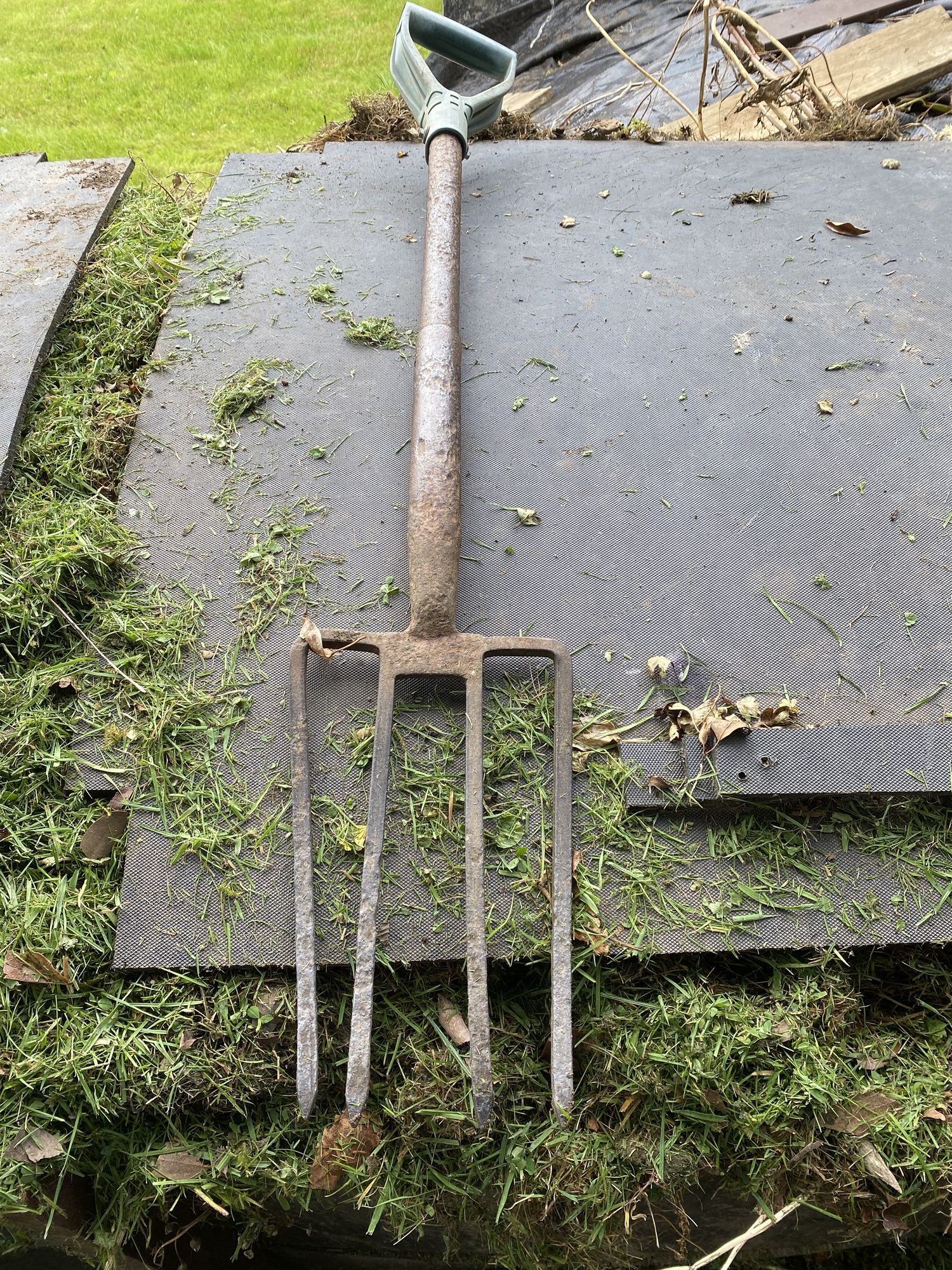
    Any ‘receipt’ will do. And just to prove I’m not one of those ‘do as I say, not as I do’ types, I’ve attached one of my own receipts at the end (The Bushfix Compost Fork)

    Voltaire knew his stuff. If you are looking for the origins of ‘good enough is good enough’ it’s mixed in with ‘perfect is the enemy of good’ (apparently an aphorism not an adage) that was used by Voltaire in 1770.

    Voltaire was quoting an earlier Italian proverb and people like Aristotle (the golden mean) and Shakespeare (Sonnet 103) also have some skin in the game. The idea has been around for ages. Which does bring into question why we still wrestle with it?

    What I really like in this space is the concept of wabi-sabi from Japan. It brings together the idea that while many things are both temporary and imperfect, they can have great beauty and be useful at the same time.

    There’s a lovely description from Andrew Juniper (here) that “if and object or expression can bring about within us, a sense of serene melancholy and a spiritual longing, then that object could be said to be wabi-sabi”

    I’m quite attracted to serene melancholy and have been known to feel a bit of spiritual longing.

    There’s a Welsh phrase that goes some way towards it, hiraeth – a sort of homesickness tinged with grief or sadness at being away from Wales.

    In the context of ‘good enough’, the Welsh translation digon da has a lovely ring to it. Unfortunately I haven’t been able to dig out any deep cultural meaning to digon da, yet.
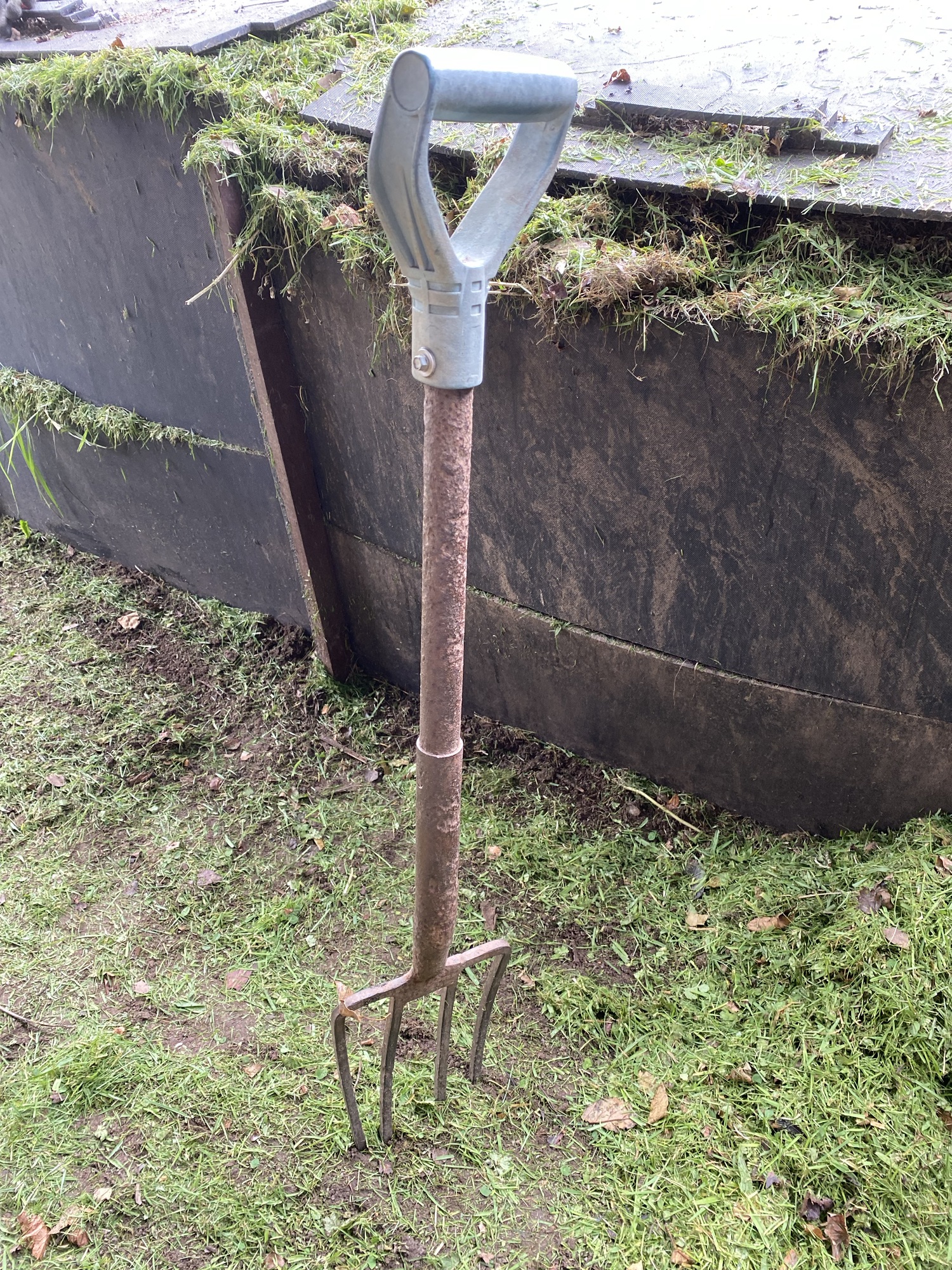
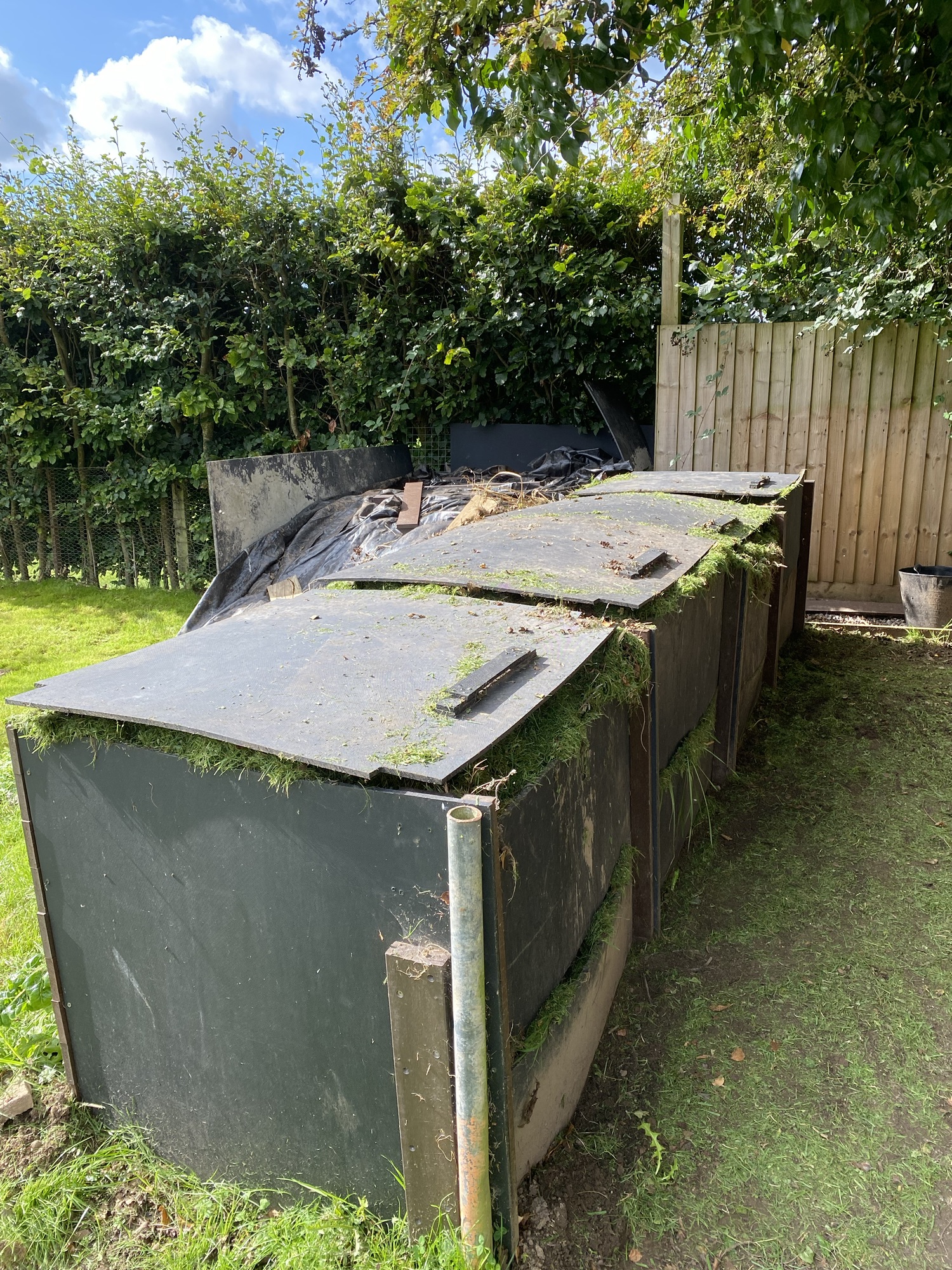
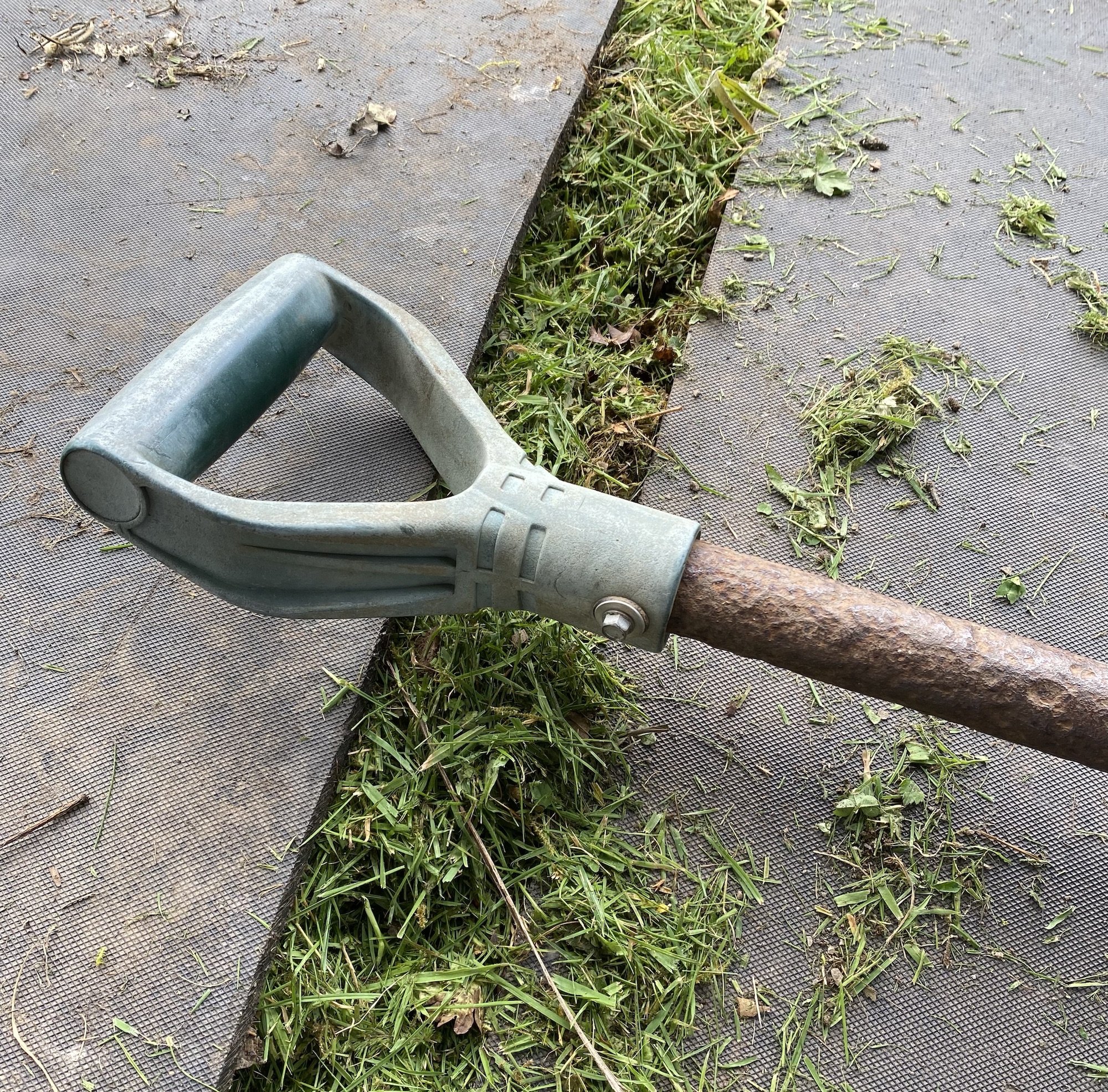
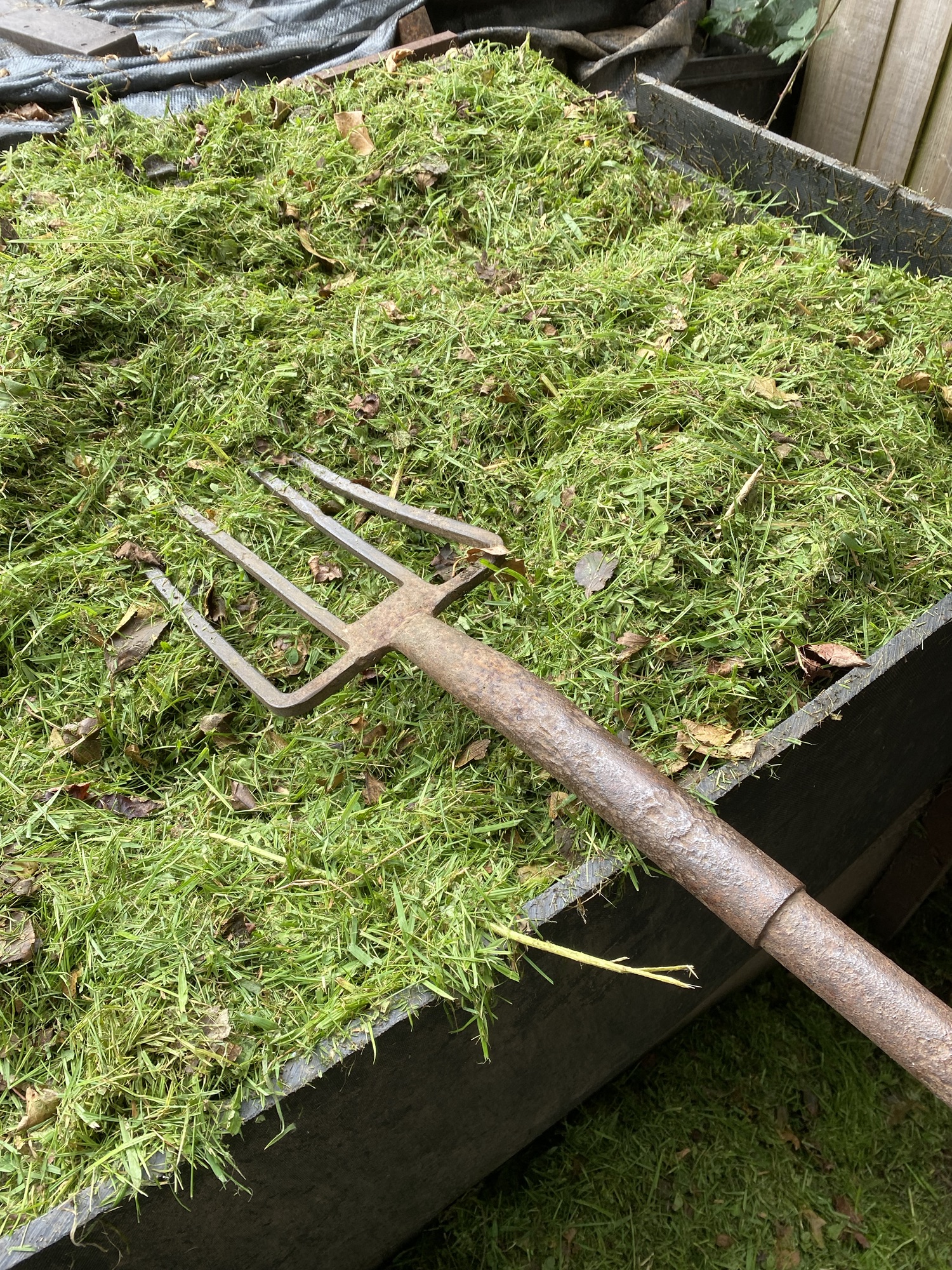
    The Bushfix Compost Fork receipt. This is the garden fork I use to move things around at my compost bins.

    Bushfix fork was quickly cobbled together from the iron body of garden fork I found in the ashes of an old bonfire. A plastic handle salvaged from a broken spade. And some self tapping screws left over from my reclaimed polytunnel project.

    It’s the ugliest garden implement you are likely to encounter. Bent out of shape, an ergonomic nightmare and not particularly easy to use. But it lives outdoors by the compost bins and does the job it is needed for. It’s absolutely good enough, digon da and I love it. Wabi-sabi baby!

    So, What’s the PONT?

    1. GEIGE (Good Enough is Good Enough) has many advantages from overcoming perfection paralysis through to innovation prototyping and minimum viable products.
    2. However GEIGE is a much misused term. People often use it as ‘corporate balm’. Something to sooth an annoying irritation, with no intention of actually accepting GEIGE in practice.
    3. I’m proposing that if you intend to use GEIGE, you need to be prepared to ‘show your receipts’. What’s the evidence that you know what it means and are prepared to follow through?

    Back in 2013 I wrote this: Good Enough is Good Enough, the law of diminishing returns. Thankfully it’s sufficiently different to what’s here for me not to be accused of recycling, or even composting.

    Here’s some more pictures of the Bushfix Fork. A monstrosity of a garden implement along with the compost bins it lives with.
  • I love ‘tribute bands’ because they try harder.
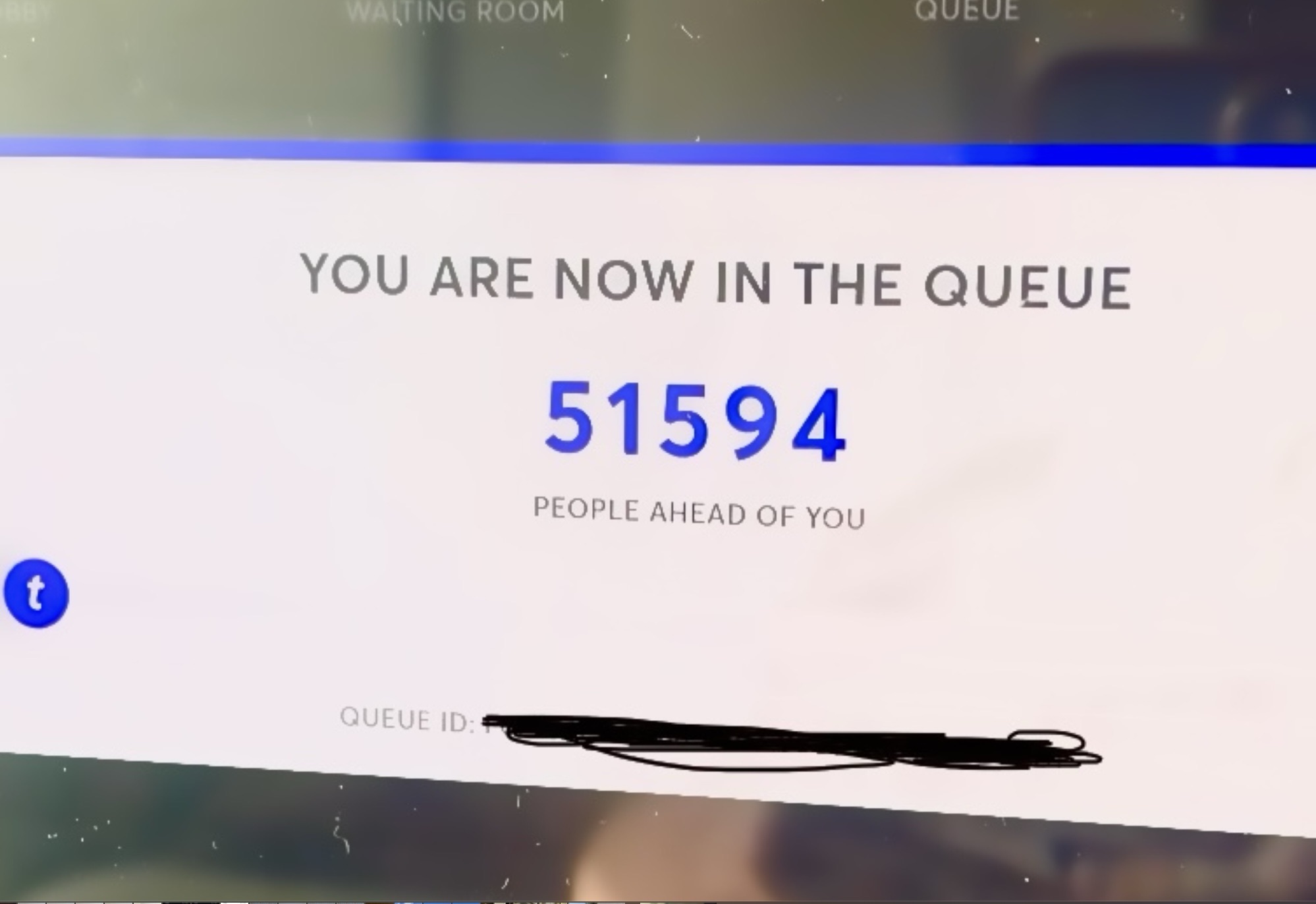
    Screenshot from someone who wasted their Saturday.

    A controversial statement but this isn’t just about me refusing to spend hours on an online ticket website; being too mean to pay huge ticket prices; queuing for hours in a massive stadium; standing ‘miles’ away from the stage or getting irritated by ‘johnny come lately super-fans’. Anyway, these (mostly) mega-rich musicians don’t actually ‘need’ my money.

    I think this is also about me being deeply unfashionable and proud of it. Going to see a tribute band brings me a lot of joy, mostly because they ‘try harder’. Let me explain…

    You are number 51,594 in the queue! The point at which you realise that ‘you are NOT going to see the Oasis reunion gig in Cardiff…’

    I have no intention of going to see the Oasis reunion, but I got caught up in the kerfuffle. Unsolicited screen shots of ‘position in the queue’ were sent to me until it became obvious – “you ain’t going son…”.

    At this point I offered some ‘sage dad advice’. “Well, why don’t you put the money to better use? Go and see a tribute band, I love tribute bands, they always try harder.”

    I’ll file that in the top draw of the ‘you know where you can stick your rubbish advice’ cabinet.

    There are many reasons I love a tribute band. This could be an extensive list. I may add to it over time, but here goes…

    • They try harder. I’ll pick up on this later. But there is a lot to be said for being ‘second place’. Where you can’t just sit back and bask in your glory.
    • Quality. Often tribute bands have excellent musicians. This might be a risky sweeping statement but… if you are there for just your musical skill, not the ‘name’, it can make a difference.
    • Access. They are easier to get to see. Tonyrefail Constitutional Club used to host some epic tribute bands. A highly accessible place (if you lived locally) but now sadly demolished.
    • Cost (and benefit). Cheaper to see, cheaper to organise and the money circulates more locally.
    • Recombinant Innovation. I’m using that phrase because Paul Stepczak used it this morning. Basically it’s mixing things up to create something new. I’m my view the finest band in this space is Hayseed Dixie. They play bluegrass versions of AC/DC songs. I’ve seen both live, and would choose Hayseed Dixie every time.
    • Sheer craziness. The local pub has an open mike night most Thursdays. One individual occasionally takes us through their favourite 1970’s prog-rock songs. He couldn’t look anything less like Gene Simmons from KISS – yet – when he thrashes through a KISS tribute, it’s the best night ever.

    We are Number Two. We Try Harder. This was the famous Avis Car Hire advertising slogan created in 1963. It boosted the companies fortunes and still features in what they do 60 years later.

    The story goes that Avis had for many years held ‘second place’ to Hertz Car Rental, who had a much bigger market share.

    An advertising company helped them take advantage of that ‘second place’ by saying ‘we try harder’. It was an inspired piece of advertising, implying higher standards of customer service which people could relate to. It did boost sales, though not to the point where they overtook Hertz.

    There’s an explanation of the history and current status of ‘We Try Harder’ on the Avis Website. However, if you fancy more than the corporate spin, have a look at this on the CarRentalBasics.com website. We’re Number Two. We Try Harder: The Little-Known Story Behind Avis’s Iconic Slogan. Obviously, I was going to direct you to something beyond the mainstream. What the article does include are some interesting links to the history of advertising at the time and how it changed so much.

    Finally. I was commenting on a post from Paul Taylor earlier about how Imitation Breeds Mediocrity. I agree with what Paul is saying about the act of ‘copying’ and standardisation in the business world. Yes, it does stifle difference, creativity and innovation.

    However, when it comes to some tribute bands, I think it actually helps. Perhaps I should extend Paul an invite to a Thursday open mike night in the local pub?

    So, What’s the PONT?

    • Copying, imitation and standardisation can be problematic. It can lead to mediocrity and a lack of ownership, creativity and innovation.
    • Solutions are often ‘sold’ as Silver Bullets. But they have a lifecycle and ultimately you are better off doing your ‘own thing’.
    • However, I’m all for Tribute Bands. Cheaper, more accessible, definitely more fun and quite often more creative. I see your ‘recombinant innovation’ Paul Stepczak.

    Picture Source: WordPress AI generated. Not as much fun as open mike night in the local pub.

  • ‘God Forgive Me’. Going too far with the corporate self-assessment?

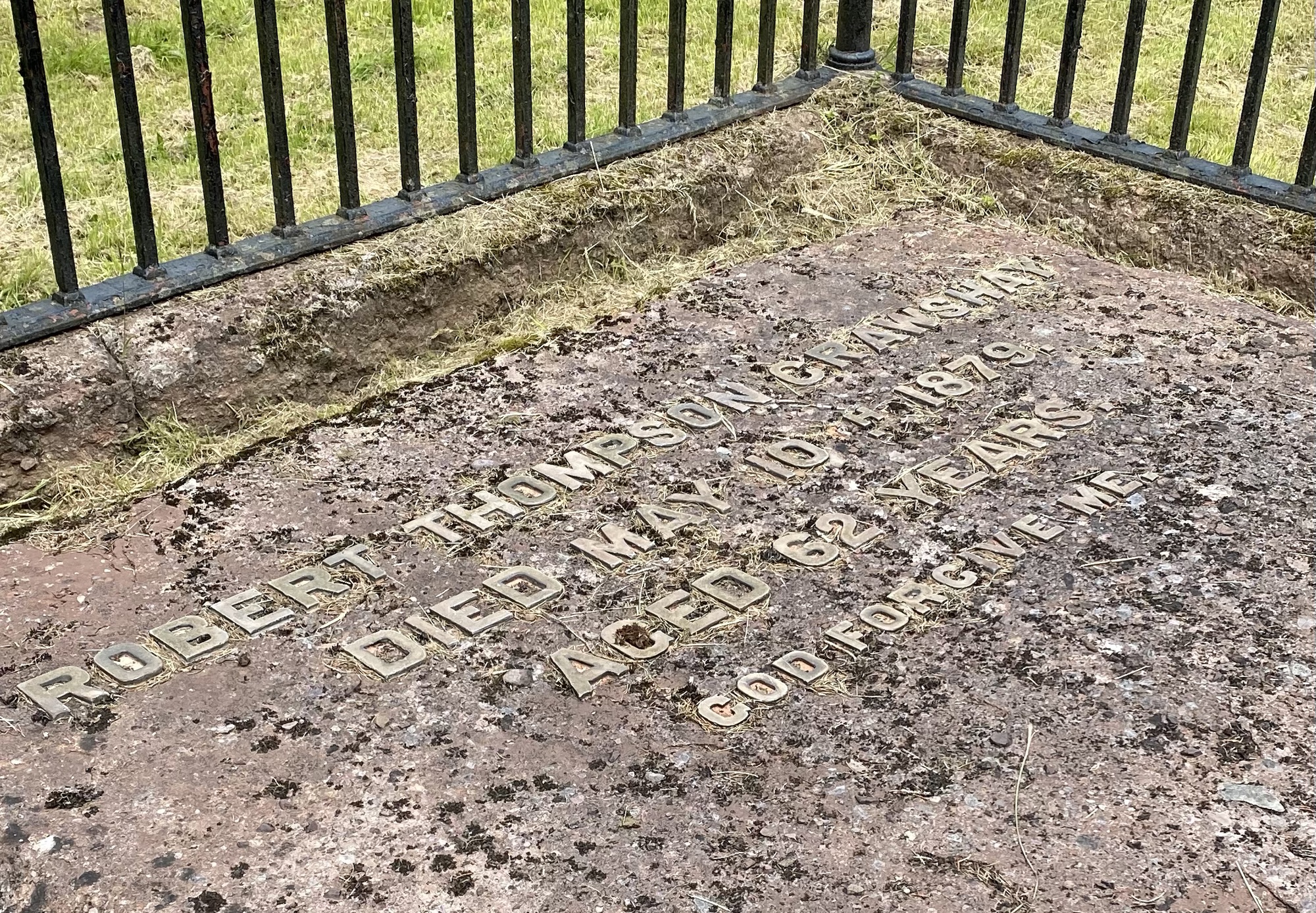
    GOD FORGIVE ME…the epitaph on the on gravestone of the last of the Crawshay ‘Iron Masters’ from Merthyr Tydfil.

    As a statements of ‘self assessment’ goes, it’s out there.

    I’ve been trying to remember if I’ve ever been on a; ‘increasing self awareness’ / ‘developing empathy ‘ / ‘the self-reflective manager’ / ‘how to give effective 360 degree feedback’ training course that’s ventured into this space?

    Something that had me doing an exercise along the lines of, “what would be the epitaph you would write on your gravestone?”

    It’s pretty strong stuff. I can’t immediately remember doing something like that so I probably didn’t, and for good reasons. Nobody quite has the fortitude to do it. Imagine the complaints to the HR Department and the lack of future training contracts.

    Anyway, enough of the morbid curiosity I’m here to talk about the Crawshays and the finest town in Wales, Merthyr Tydfil.

    Everyone should know about Merthyr. There’s more human history condensed into Merthyr Tydfil than seems reasonable for any town. Merthyr was literally a ‘cauldron’ of the industrial revolution. I hugely recommend having a look an The Melting Pot – The heritage and culture of Merthyr Tydfil for some detail. Be warned though, you could be there a while, its fascinating.

    The other thing I’m here for is the Crawshays and Robert T’s tombstone. Some facts and figures.

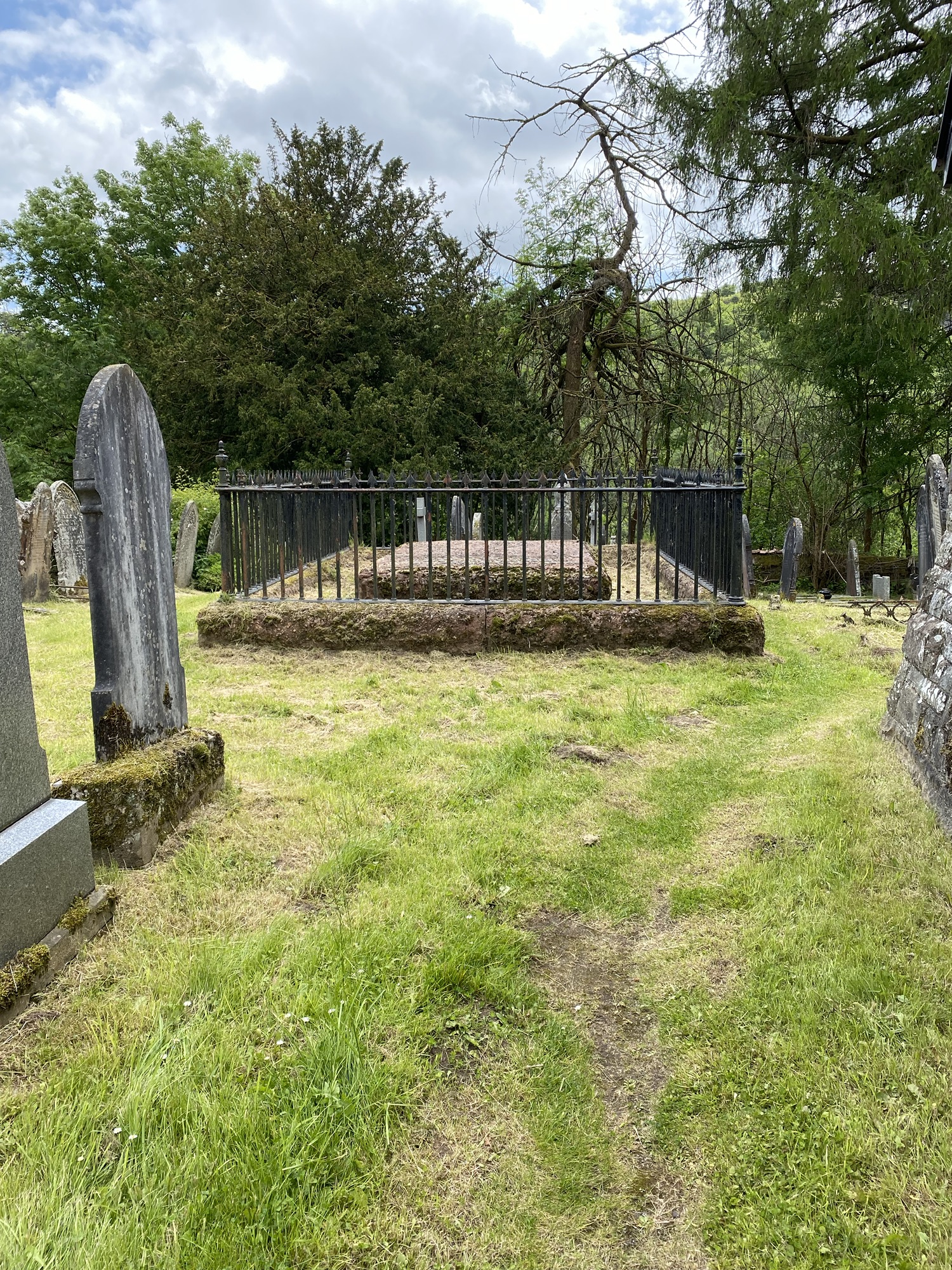
    RT’s tombstone measures in at 11ft 2in long (3.5m), 7ft 2in wide (2.1m) and 1ft 2in thick (36cm). Made from Radyr Conglomerate (not granite), it was chosen by Crawshay himself from Radyr Quarry near Cardiff. All of this was detailed August 1897 in the Merthyr Telegraph, shared by The Melting Pot.

    I’ve seen different estimates of it’s weight, ranging from 8 – 11 tons. It required a team of 13 horses to the pull the monolith to it’s final resting place at St Gwynno’s Churchyard, Vaynor. A tombstone of that size says a lot about a person.

    Why ‘GOD FORGIVE ME’? There’s a bit of speculation about why RT Crawshay chose this epitaph. Have a look at this article from Welsh Country Magazine. It describes life for ordinary people in Merthyr in the mid 1800’s, and the life of Crawshay.

    One suggestion for the epitaph is linked to the fact he disinherited his daughter and grandsons from the vast family fortune after she married against his will.

    Another potential reason; remorse for the pain, suffering and exploitation of the people of Merthyr? In 1875, through his mismanagement, Crawshay oversaw the final closure of Cyfarthfa Iron Works. Making 1000’s of iron workers (and their families) destitute. That’s a pretty solid reason for seeking redemption – if you possess the humility…

    Self assessment in corporate life. I’ve just been walking the dog and dredging up a few memories of ‘self reflection’. One that sticks with me is a senior person saying “at least I wasn’t as crap as most of them”.

    A curious statement that’s a combination of ‘being proud to be average’ with almost relief that they they weren’t a ‘high achieving CEO psychopath’. On another occasion someone reflected “I tried to do no harm”.

    That’s all pretty depressing stuff, but to be honest, I’m far more comfortable with that sort of ‘self doubt’ than vainglorious statements of wonderful achievements. Nobody is perfect.

    How do I raise the mood here? I absolutely think that self refection is a good thing, used properly.

    I was going to include a link to some serious evidence based research that says so, but there’s mountains of it out there; it doesn’t take much to find something that appeals.

    What I am going to do is suggest something for a self awareness training course. How about starting with a multiple choice question:

    “What would you chose have as your epitaph?”

    Pick any from the list that apply…

    • Performed wonders and spat out miracles.
    • Was feared and admired in equal measure.
    • Was loved and cherished by everyone.
    • God forgive me.
    • Did no harm.
    • Tired my best with what I had.

    I’m happy to take suggestion on things to add to this list. There’s probably a book of examples already out there.

    So, what’s the PONT?

    1. Self reflection is generally accepted as a good thing, but don’t let it get out of hand. Try to aim for the ‘goldilocks’ zone’. Not too much (immobilized by self-doubt), not too little (egotistical self praise). but just right…
    2. Thinking about your epitaph might be a bit morbid, but it does put things in perspective. Having an interest in what others have written on their tombstones shouldn’t just be a pastime for Goths.
    3. Everyone needs to know more about Merthyr.

    The pictures are mine. Taken on a visit to St Gwynno’s, Vaynor in 2022. There used to be a pub next to the churchyard. The railings around Crawshays grave were apparently there to prevent people ‘paying their respects’ to him after closing time.

  • Reclaiming Bricks

    Reclaiming Bricks

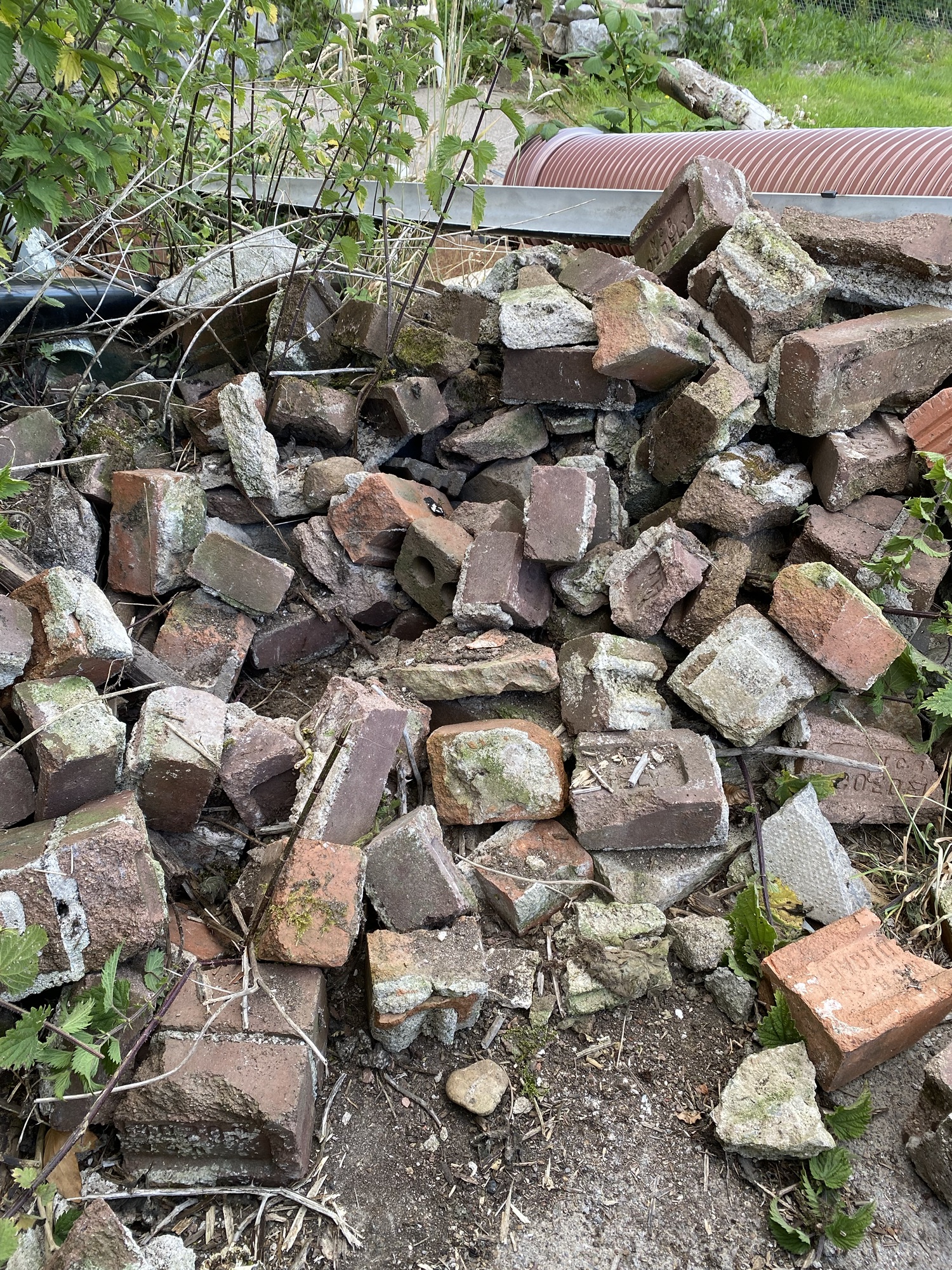
    I’ve been reclaiming some bricks from a pile of debris I dug up from the base of an old shed in the garden. It’s been fun.

    Then the inevitable questions were asked, “that’s lovely, but what are you going to do with a pile of old bricks?”

    Finding a useful purpose for some less than perfect bricks was a challenge, but here’s the story…

    It starts with a falling down old shed. Before anyone asks, yes, I did recycle the shed tin-sheeting. The cleared space now has bee hives.

    That yielded a pile of mostly broken bricks.

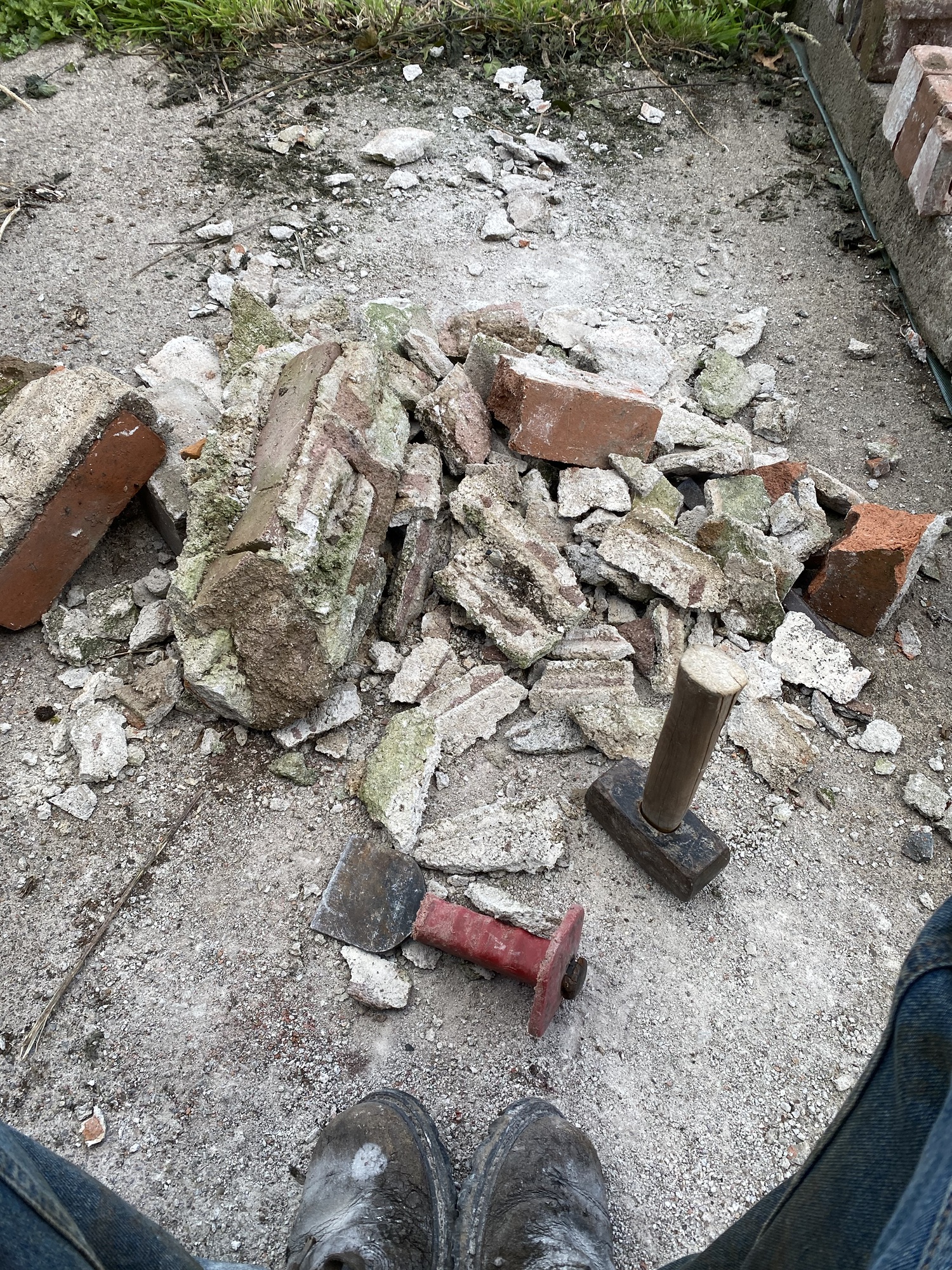
    Getting a decent(ish) reclaimed brick involves a fair bit of chiselling off lime mortar – these are quite old bricks I think. Chiselling lime mortar off bricks is a strangely soothing pastime.

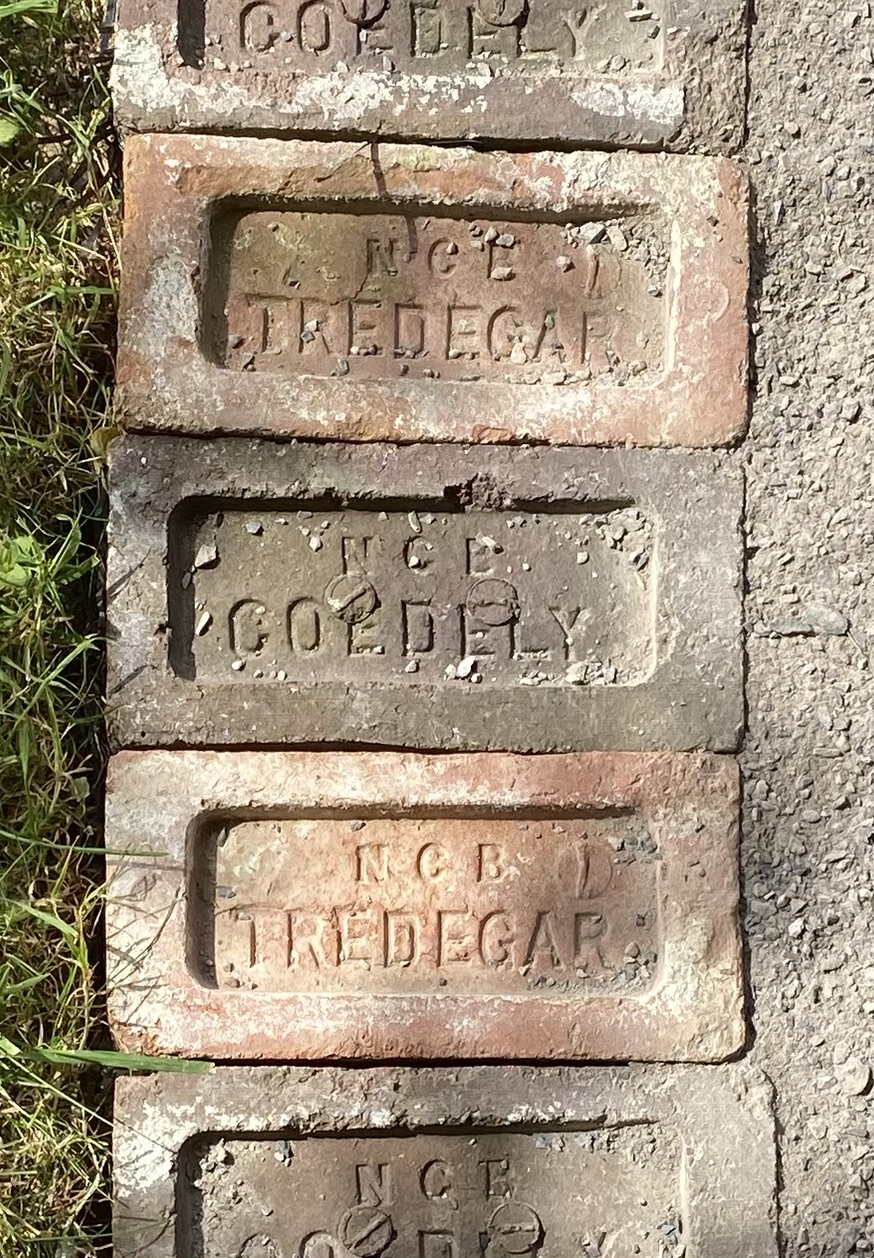
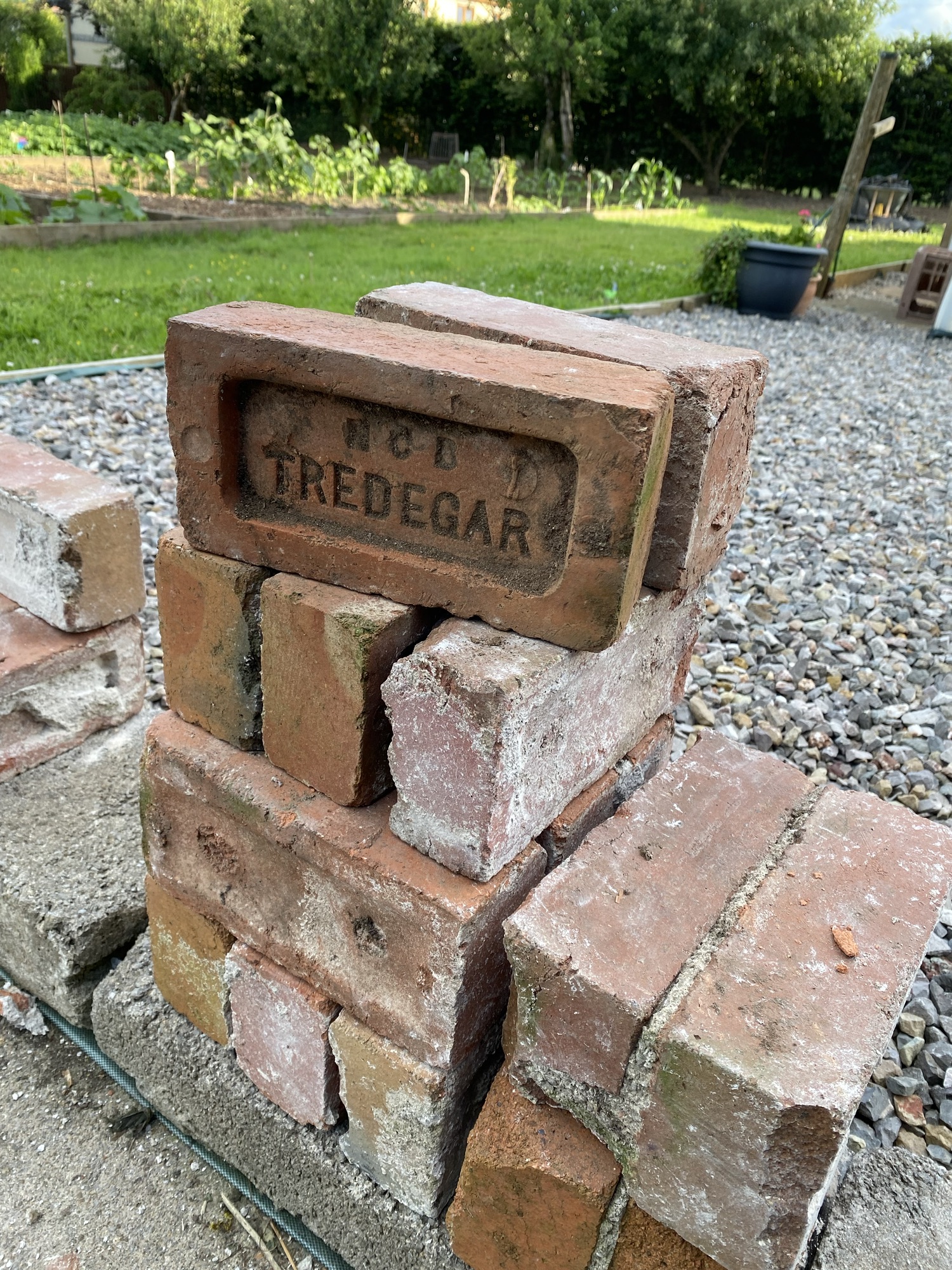
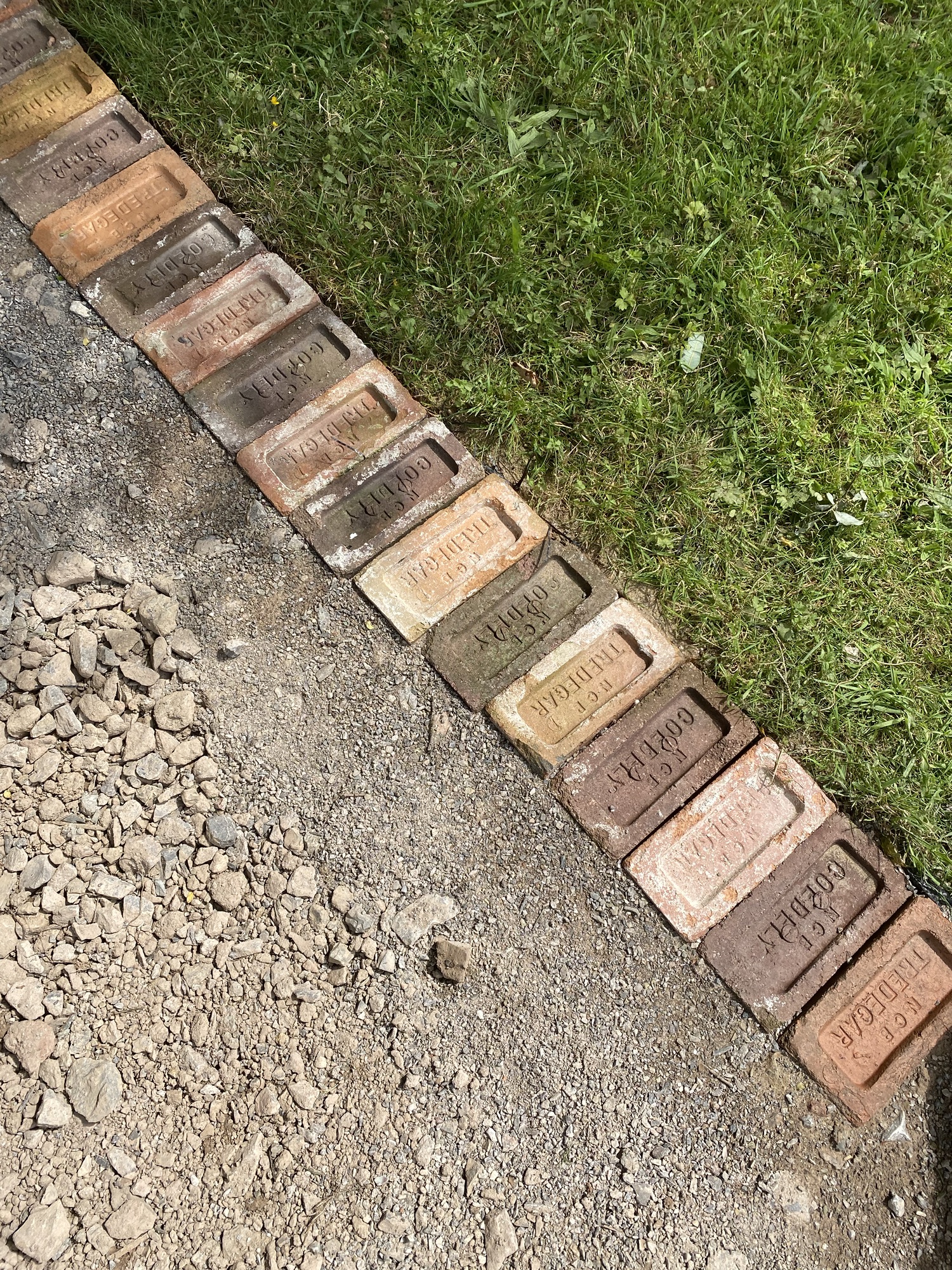
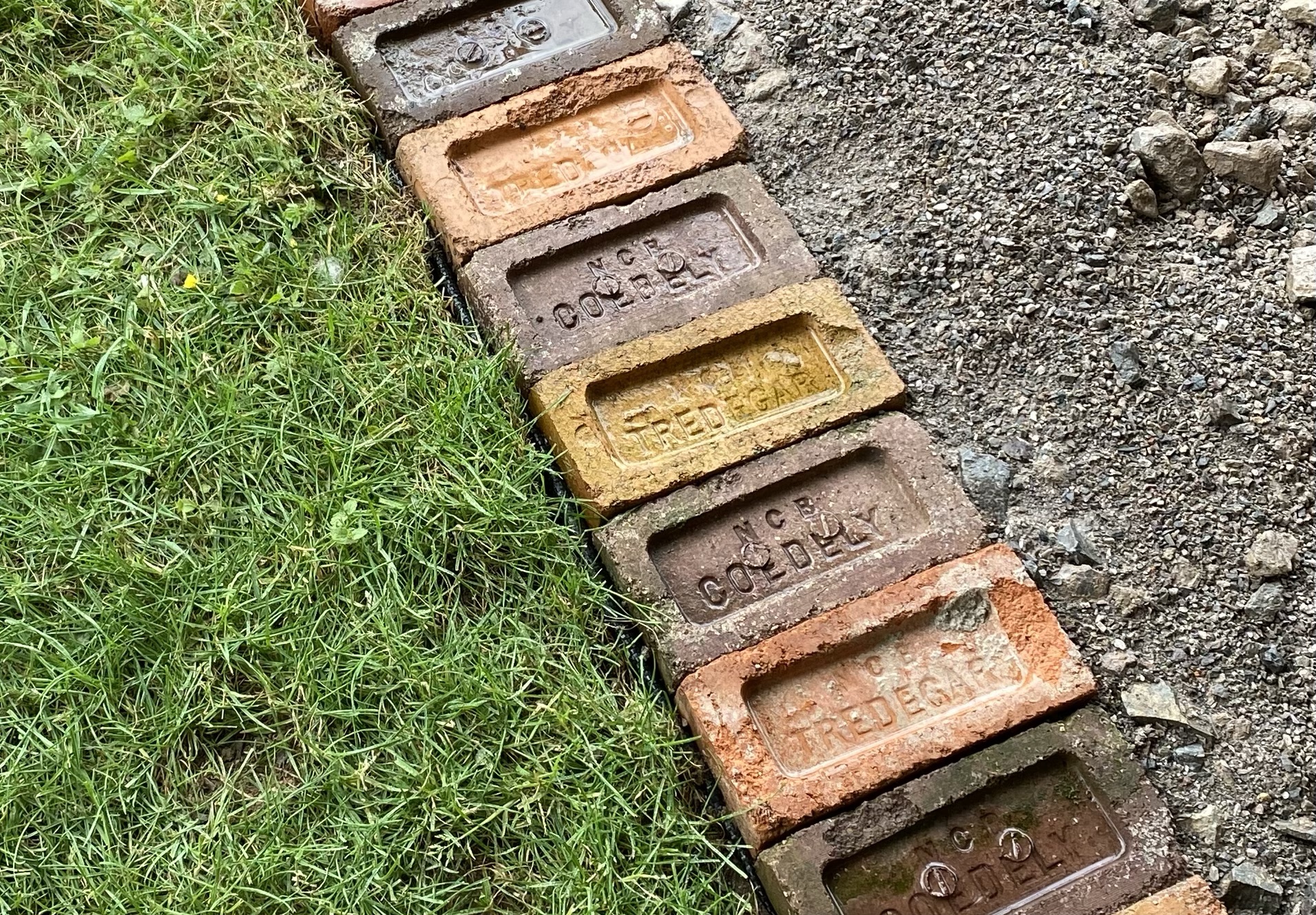
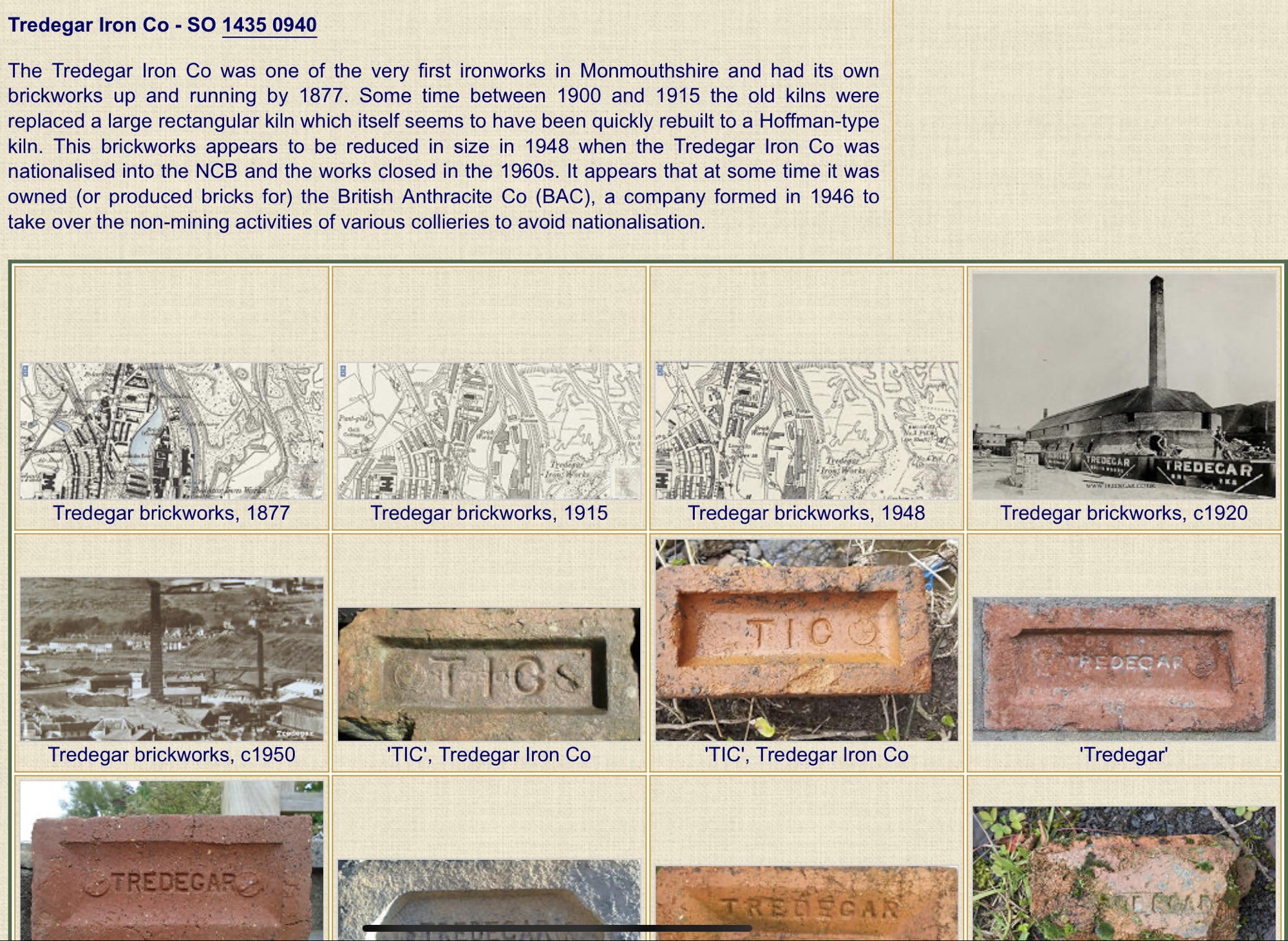
    Trahlaah! And your bricks emerge. Some lovely NCB TREDEGAR and NCB COEDELY.

    I’m no expert on brick quality, but the NCB TREDEGAR bricks felt like far better quality than the NCB COEDELY – possibly ‘seconds’ if there’s such a thing. NCB stands for National Coal Board. These bricks were manufactured at NCB Coal Mine sites, sometime between the 1940s and 1980’s

    So, what did I do with the bricks? There weren’t enough to build a pizza oven (a secret fantasy) and they probably aren’t the right type of brick.

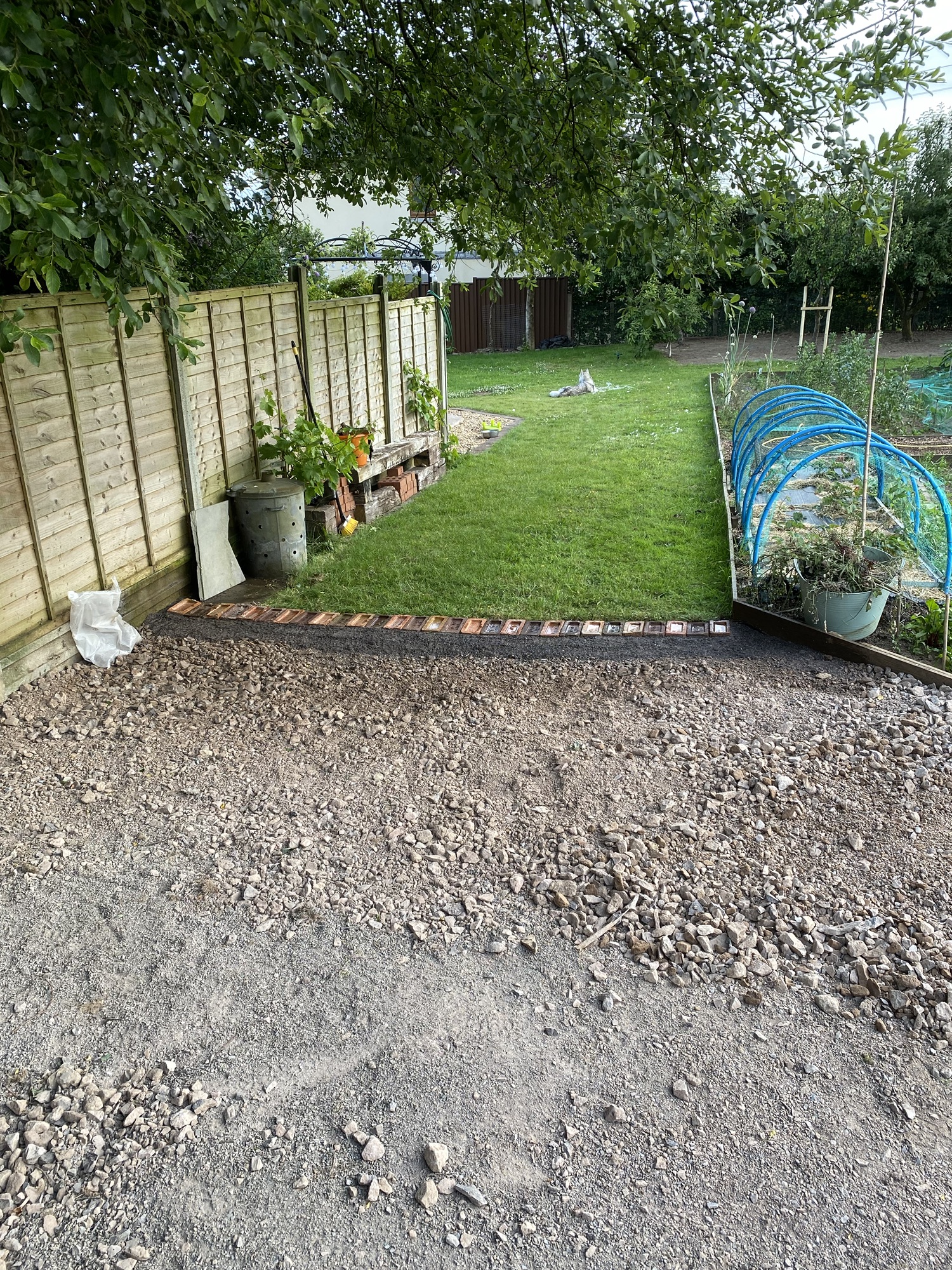
    However, there was a spot between a stone hardstanding and grassed area that needed a bit of tidying up. A brick border felt like the perfect solution.

    Here’s the 3m of reclaimed brick edging. Far more attractive than reclaimed concrete pavers.

    There’s a bit more to this than just bricks…

    I did mention that these bricks would have been manufactured at NCB Coal Mine sites. Historically in South Wales there was a lot of brick manufacture associated with coal mines. They had everything you need; clay, coal to heat the brick kilns, labour to do the work and things nearby that needed building.

    NCB Coedely was quite close to where I live, so I can understand those bricks turning up in my garden. NCB Tredegar on the other hand was about 30 miles away on the northern outcrop of the coalfield.

    The scale of brickmaking used to be huge in South Wales. Literally all that remains are ruins and the ‘timestamps’ of the bricks they produced.

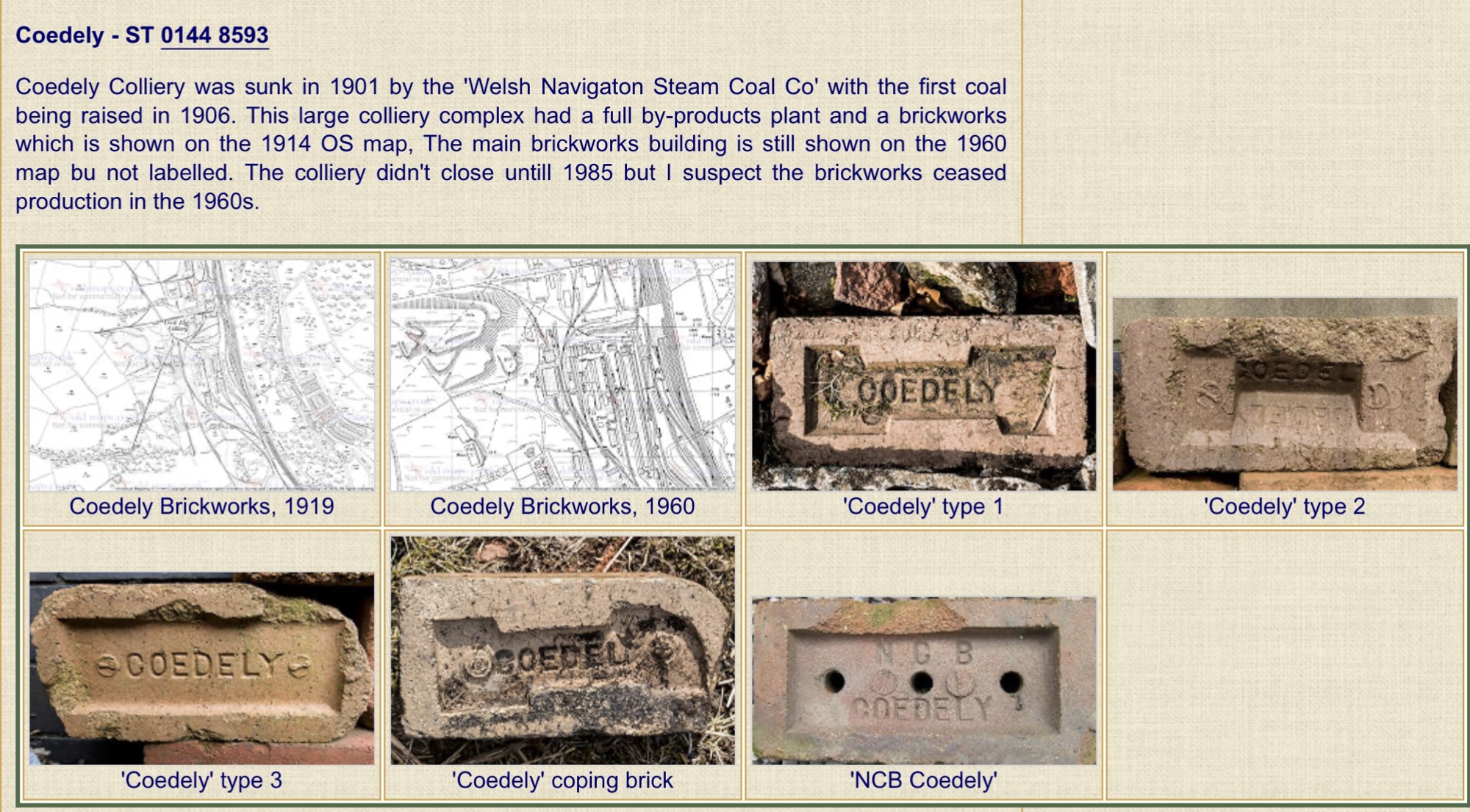
    If you are interested in this sort of thing I’d hugely recommend a look at the Brickworks of Wales website, curated by Phil Jenkins.

    Phil has given me permission to share these screenshots of the details of Coedely and Tredegar Brickworks.

    Finally. I’ve kept 3 of the best examples of the Tredegar and Coedely bricks for a future project (in safe storage). What that might be is currently undetermined… but I do have some vague ideas. It might also involve collecting a few more ‘interesting’ bricks…

  • How to solve an impossible problem. Eat Cake (or Pie).

    Why don’t you sleep on it… and the answer will be there in the morning. It’s one of those annoyingly wholesome bits of advice my Wife frequently gives me. And I accept. Maybe not always as graciously as I should…

    But the advice works, and generally I end up with my thoughts in a better place. So what is going on?

    ‘Sleeping on it’ could be one way to solve impossible problems. However, imagine suggesting that in the average organisation, “we all need a quick snooze to solve this problem.” I don’t think so…

    Obliquity and Oblique Strategies. For this sort of idea to ‘fly’ in organisations I’d suggest it needs an impressive name. This is where Obliquity and Oblique Strategies come in. There’s nothing ‘undersold’ about those words.

    Oblique Strategies is actually the name of a deck of cards developed by Brian Eno (yes that one) and Peter Schmidt in 1975. The idea was that the cards helped overcame writers block and encouraged creativity.

    I have written about them previously (link here) but what was really interesting were the responses. Matt Wyatt summed it up beautifully explaining that the essence of Oblique Strategies through cognitive science. Its all to do with System 1 and System 2 thinking. The Oblique Strategy cards just disrupt that.

    Quoting Matt “The cards are simply a method of reframing the usual patterns set up in your brain. The ambiguous phrases increase the cognitive load, so your brain has to look for all kinds of connections and literally opens your mind!“

    In terms of finding a solution to an impossible problem (eg writers block) that makes sense.

    Obliquity is another angle on the same theme. Also the title of a book by Economist John Kay: Obliquity. Why our goals are best achieved indirectly.

    In the spirit of obliquity (possibly) I’ve read most of the reviews on Amazon rather than the actual book. What I’m taking from this is that not focussing on the actual problem (i.e. coming at it from another angle) gets you a result that works.

    It’s all interesting stuff and fits with a conversations I’ve had with Dave Snowden over the years. Some things are complex or too difficult to resolve by confronting them ‘head on’. An oblique approach is far better at finding a way forward.

    I’d personally put parenting teenagers in this space, and a long car journey together, side by side as one method of getting into that space. Here’s a link to material from Dave explaining how to organise a party for your teenagers. The point on obliquity shines through.

    What has this got to do with Cake and Pie? Please excuse the self indulgence, but I do love lots of the dialogue in Men in Black films.

    Its the usual situation. Agent J (Will Smith) and Agent K (young Tommy Lee Jones) have an impossible problem…

    Agent K: “We need pie. My Grandaddy said that when you’ve got a problem you can’t solve, you need to get out of your head.”

    Agent J: “We’ve been doing smart stuff. Following clues, doing real police work. It might be time to do something stupid. Something that got nothing to do with nothing. Let’s get some dumb-ass pie”

    While eating the pie…

    Agent K: “The pie don’t work unless you let it. Ask me any question as long as it’s nothing to do with the case…”

    Inevitably, during the following random conversation, the ‘answer’ emerges. Here’s a link to the scene:

    Reflecting on my own oblique approaches I’ve got some examples:

    • Sleeping on it. A favourite. Approved by my wife, but unlikely to work in an everyday organisational context.
    • Oblique Strategies Card Deck. Something I’ve dabbled in. Again, not always welcome in an organisational context. I also worry I’ll end up regurgitating Coldplay lyrics.
    • Going for a walk in the park. In a previous job I used walk in the park with colleagues (Agents D & E). We solved most of our impossible work (and other) problems that way. I miss that and really need to find away to do it again.

    So, what’s the PONT?

    1. Confronting difficult things ‘head on’ often doesn’t yield the best results. Some things are better approached from a different (oblique) angle.
    2. There’s plenty of evidence that widening the scope of your thinking (opening your mind) does allow for alternative options to emerge.
    3. Methods of ‘reaching obliquity’ vary. It might not be acceptable to; eat pie, have a snooze or get out the Oblique Strategies card, but ‘going for a walk to clear your head’ might be acceptable. You can also play the health and wellbeing card.

    Picture: Mine. Possibly a pie, tart, cake or flan? Terra Nova Cafe, Roath Park Cardiff.

  • Plans are useless, planning is essential.

    I miss the Cold War. Back in the 1980’s everything seemed simpler. The main thing we worried about was nuclear annihilation. Nowadays it seems to be; everything, everywhere, all of the time. It can feel like perpetual anxiety – if you let it.

    One feature of Cold War angst was emergency planning and preparation exercises. I used to love going to these and learnt a lot about preparing for the unexpected.

    Fighting over a virtual digger. A favourite memory of these exercises happened during the scenario of a crude oil super-tanker sinking off the Welsh Coast.

    It was so dramatic that specialist facilitators came all the way down from London, to the nuclear bunker we used in West Wales.

    To be fair, the exercise was a disaster. It came to an abrupt end when highway engineers from two neighbouring Rural District Councils almost started fighting over rights to an imaginary JCB digger.

    The specialist facilitators soberly asked us to come back in two weeks for a lessons learnt session.

    A post-it note blamestorm. The session was ‘facilitation innovation technology’ back then; bog-standard stuff now.

    • “Everyone write on post-it notes things that went well during the exercise and things that could have been better”.
    • “Remember, one point per post-it.”
    • “Now put your post-its on the big sheet of paper”.
    • “Positives in the left hand side, and negatives on the right”
    • “Then stand back and see what it tells us…”

    The results we astonishing. The ‘negative’ side was like a forest of post-its. A proper ‘blamestorm’.

    The ‘positive’ side had a few post-it notes, but they all mentioned the same thing – The WRVS. The Women’s Royal Voluntary Service (now The Royal Voluntary Service).

    WRVS to the rescue. During the exercise the WRVS had done their usual stuff. Keeping people fed and watered and anything else that helped the day run smoothy. They went almost unnoticed until the question, “during the (disaster of an) exercise, what went well?”

    Afterwards I had a conversation with the ‘specialist facilitator down from London’. I asked about the positive view of the WRVS.

    The facilitator said they weren’t surprised, and positive views of the WRVS were common in these exercises. They went on to tell me the story of a real emergency. Here the WRVS had managed to divert a Bakery Delivery Truck off the M5 Motorway, to feed hungry emergency workers. Their point was that the WRVS had powers that transcended normal working arrangements.

    This was in the days before mobile phones, and the story might have been exaggerated, but I’m happy to believe it.

    During our exercise the WRVS might have been ‘ancillary’ to the main event. However, they were hugely important.

    One other thing that the facilitator said was not to worry that the exercise had been a disaster. The important thing was that we would learn from the mistakes and in their words, “it’s all about preparing…”.

    What’s the opposite of ‘prepared’? The obvious answer is ‘unprepared’. Which happens to be the title of a pamphlet from New Weather Institute a cooperative think tank. New Weather Institute look at ways to accelerate a rapid move to a fairer economy in the face of everything that’s happening around us.

    ‘Unprepared – why disaster planning needs to go local’ is well worth reading . It plays to my interest in the need to prepare, but also the idea that this needs to be local.

    Just like the WRVS knew how to get things done communities and local groups are very often best placed to respond quickly in an emergency. Many of us will have seen that during Covid. Local community networks were often active before statutory agencies had got their boots on. Do have a look at ‘Unprepared’ for some examples of what this means.

    To whet your appetite, here are three questions from Unprepared, that should get anyone thinking.

    1. In a disaster how would (your) communities co-ordinate to protect the vulnerable and keep essential services and basic needs met?
    2. If we were choosing systems that were most resilient to shocks, how would our energy, food, housing, care and transport systems be different?
    3. How would these systems be owned and managed?

    Plans are useless… The title quote of this post is attributed to US President Eisenhower. It’s provenance is discussed in this Quote Investigator article. I hope I’ve stuck with the meaning.

    So, What’s the PONT?

    1. Preparing really is essential. Look on it as an opportunity to test, fail, learn and get better.
    2. Emergency Planning exercises are an effective way to prepare for the unexpected and build resilience.
    3. Involving a wide group of people and local organisations helps. Diversity of thinking, networks and experiences can be invaluable. You never know you might get a Bakery Delivery Truck, just when you need it.
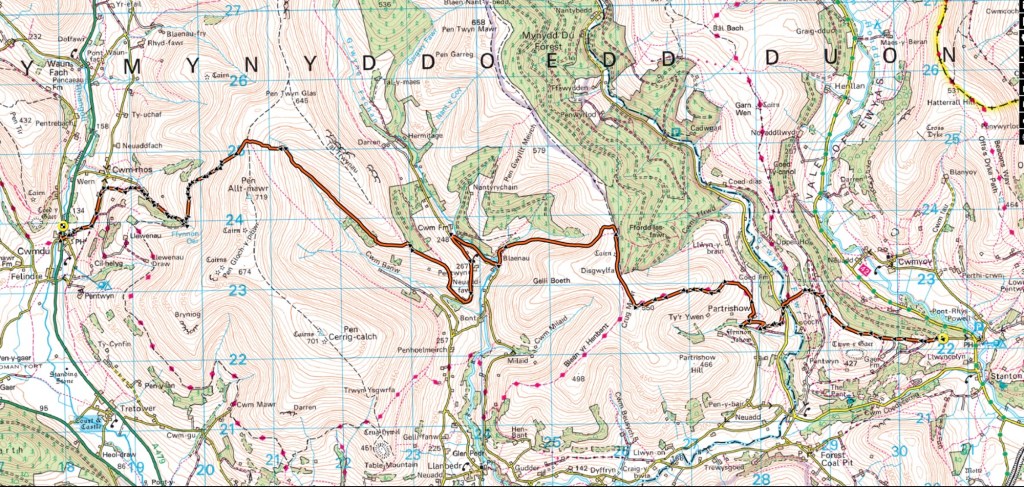
  • Black Mountains Routes. Queen’s Head Cwmyoy to Patrishow Church to Cwm Banw to Cwmdu.

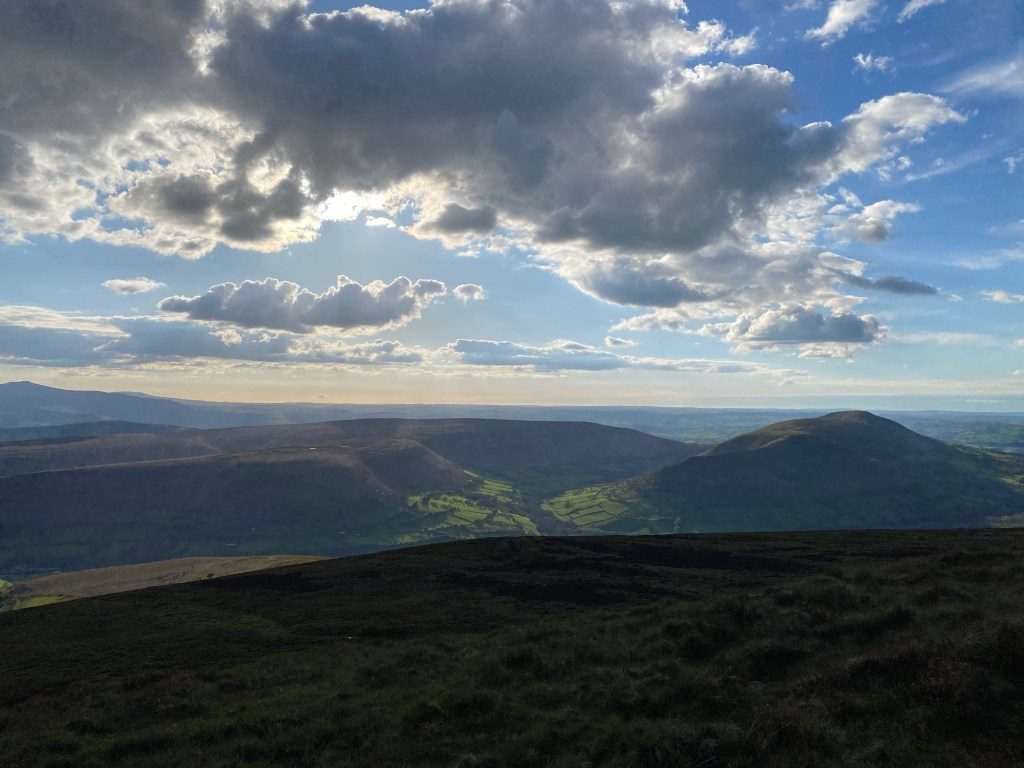
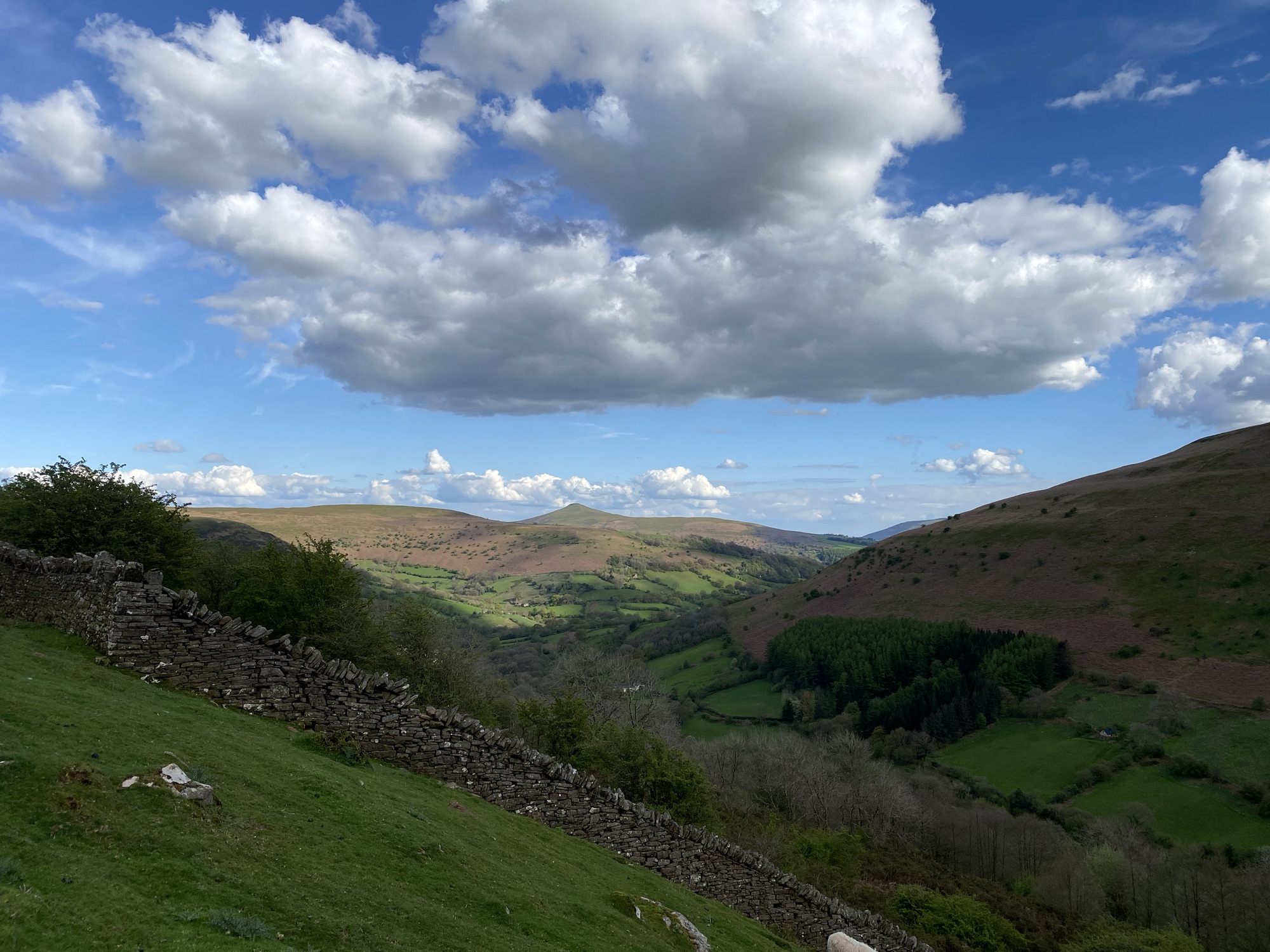
    Starting at the end. Evening view from above Cwmdu with Mynydd Llangorse ahead, Mynydd Troed to the right and on the horizon to the left, Pen y Fan. This is a post about SEEING, explained here.

    The Route. 20km / 12.4 miles and 1024 m / 3360 ft of climb. So a fair day out. Thank you to Paul for all the planning. This route picks up a few of the highlights on the Beacons Way. Also with a bit of obligatory ‘side route’ through bogs, bracken and heather. What’s the point in a compass if you aren’t going to follow a bearing.

    Tabernacle Baptist Chapel. Looking towards Patrishow Hill (446m). Gives a fair idea of the ‘up and down’ nature of the route.

    Tabernacle Baptist Chapel in the Grwyne Fawr valley. Built 1837. Chapel still in use.

    I can’t resist a #facesinthings photo opportunity

    I also love a big buttress. On the farm just below Patrishow Church.

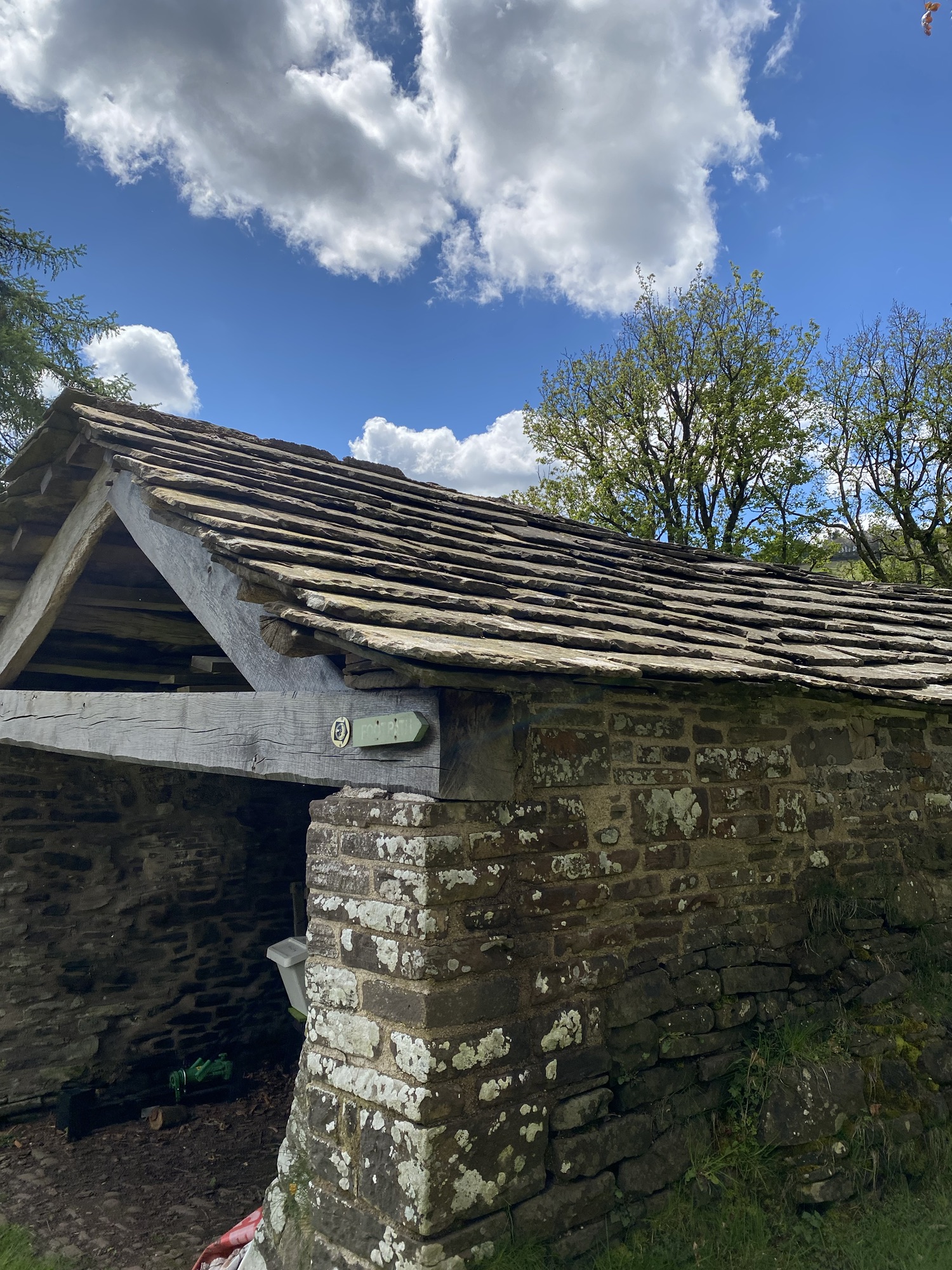
    With the weight of stone tiles on the roof, maybe not a surprise the walls needed buttress.

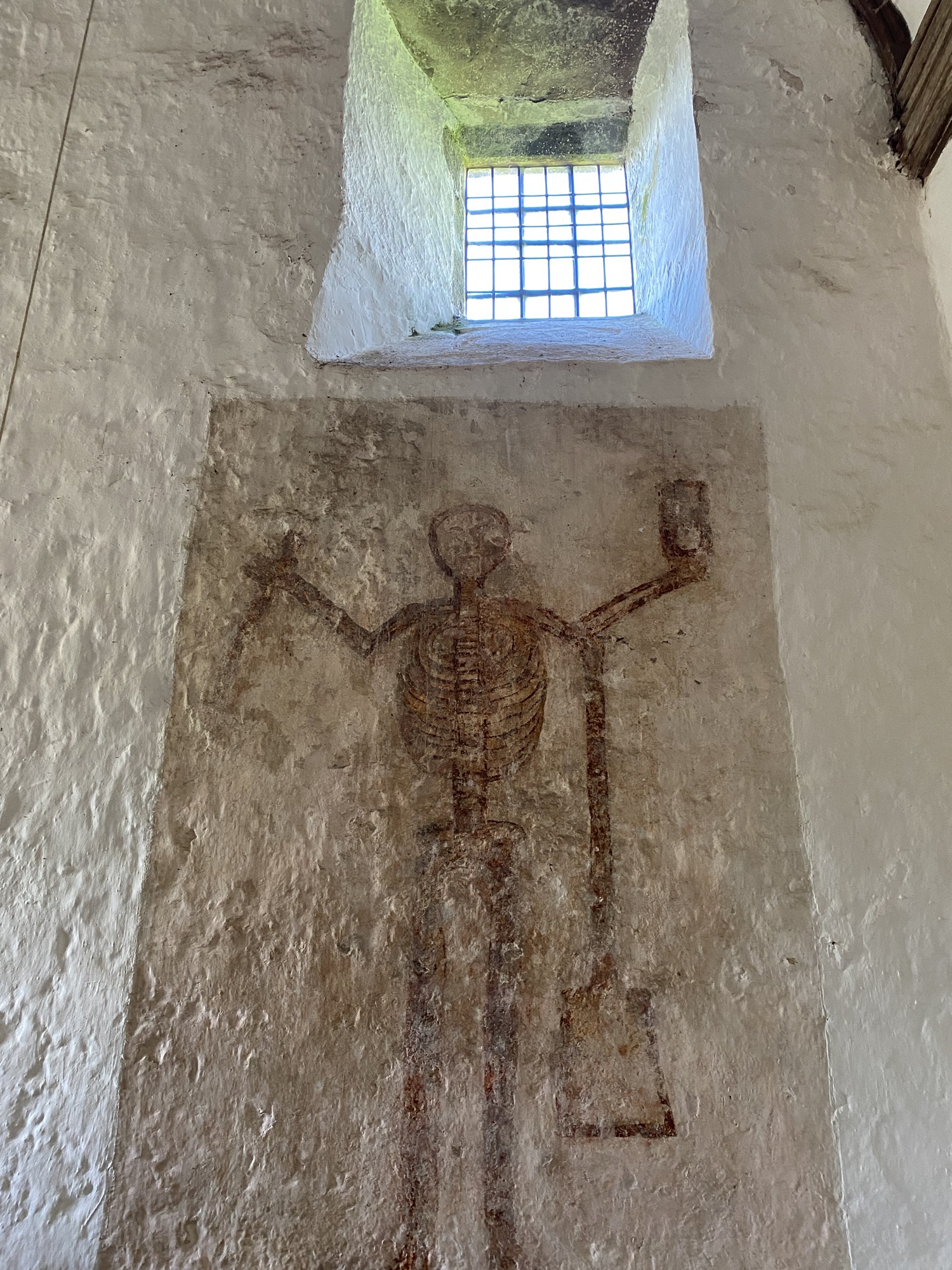
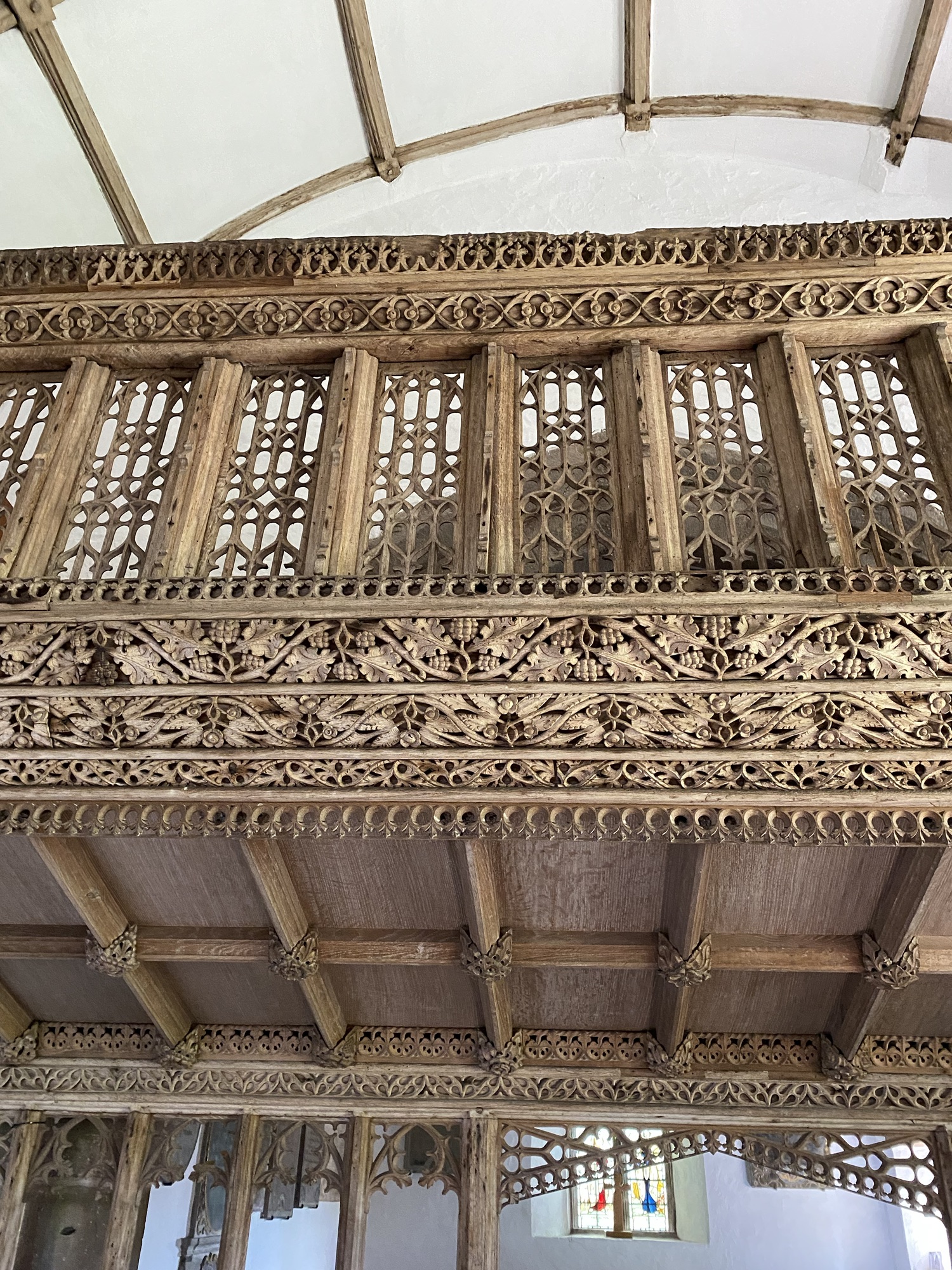
    Patrishow Church, St Issui’s. Hard to put into words how good this is. A Church Warden who was there said, “God visits other Churches, but lives here.” It’s not everyday outside of a museum you get to see Medieval paintings a rood screen and a frieze including a ‘dragon expectorating vines’. https://en.wikipedia.org/wiki/St_Issui%27s_Church,_Partrishow

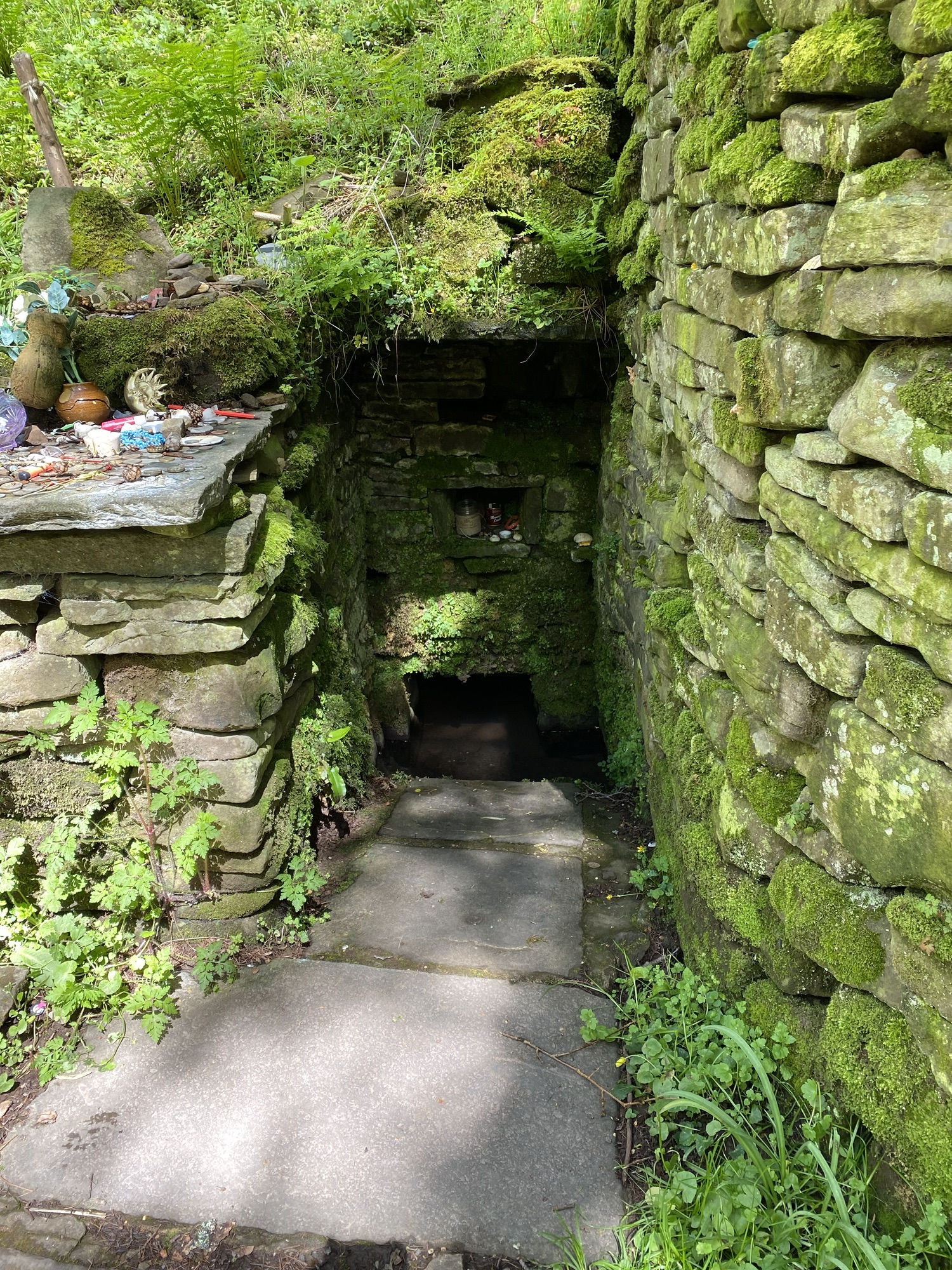
    Bonus Holy Well, Ffynnon Ishow. Established 6th Century.

    Back to the route. With a traditional Black Mountains barn. With some curious stonework above the extension – to divert rainwater?

    Typical ancient path. Plenty of these on the route.

    Cwm Banw. Looking back down Cwm Banw with the Sugarloaf in the background. But of a slog from here, over the top and down into Cwmdu.

    The end, looking over the Cwmdu Valley. Thanks to Brenda, Paul and Dave for being excellent companions and allowing me to tag along.

  • We’re Doomed. Doomed I tell ya. Again.

    Calm down, don’t panic! Enough of the Dad’s Army references. I haven’t joined a doomsday cult (unlikely) or become an obsessive ‘prepper’ (yet). However, I do think it’s worth paying attention to a few things…

    There’s always a threat. One of many Tommy Lee Jones lines I enjoy comes from the first Men In Black film.

    “There’s ALWAYS an Alien Battle Cruiser, Korilian Death Ray or Inter-Galactic Plague about to wipe out life on this miserable little planet. The only way these people get on with their happy lives is that THEY DO NOT KNOW ABOUT IT.”

    Knowing (and doing something) about potential threats that might ‘end civilisation’ is actually quite useful and important if you ask me. To misquote someone important, “planning is useless, but preparation is essential”. I’m keen on ‘being prepared’ for all sorts of eventualities (but I’m not a prepper…).

    And, it’s not like people haven’t been talking about this sort of thing forever.

    Detail on the threats to civilisation are fairly common, if you care to look. From ‘end of days’ predictions in religious writings through to the ‘history as science’ / ‘learn the lessons from history’ mantra (which we are woefully bad at).

    A few things have grabbed my attention over the last few years. Starting with Sir John Glubb’s ‘Fate of Empires and Search for Survival’ published in 1976.

    Empires last roughly 250 years. Thanks to Ray McNeil for pointing me in the direction of Glubb. I’d recommend reading the text (link here). Glubb spent a lot of time in Iran and Jordan and the paper does reflect the social norms of the times. Three key points for me:

    • Reviewing the rise and fall of empires (civilisations) over 3,000 years, Glubb concluded that on average they last about 250 years.
    • Glubb identifies 6 ‘Ages’ of an empire; Pioneers, Conquest, Commerce, Affluence, Intellect and Decadence – leading to decline of the civilisation. Any of this sound familiar?
    • Solution wise. Glubb is big on teaching history relating to the human race and ‘love’. Love in the sense of reducing hate and division. I’ll get back to this in a future blog post about ’36 Questions for Civic Love’.

    A Democracy lasts 200 Years. Alexander Tytler (1747-1813) was Professor of Universal History, Greek and Roman Antiquities at the University of Edinburgh . It’s worth reading this Twitter/X thread on Tytler’s theory by @thinkingwest.

    I’d recommend a good look at the Thinking West site. It’s got everything from the fall of ancient civilisations through to the risks of AI and ChatGPT.

    Getting back to Tytler’s theory on the 200 year lifecycle of Democracies. Three key points for me:

    • It’s a cycle of growth, affluence and decline – until the next version of democracy / civilisation. A bit like Glubb.
    • Democracies are doomed because people are selfish and work out they can vote for the politicians who ‘give them the greatest largesse from the public purse’.
    • Poor financial policies always feature at the end of a Democracy. Any of this feel familiar?

    Average Civilisation Lifespan is 336 years. Bringing things almost up to date this is taken from a 2019 BBC Future article by Luke Kemp, scholar of Catastrophic Risk at Cambridge University.

    Are we on the road to civilisation collapse? lays things out in pretty stark terms. Linking to the Glubb and Tytler it offers a slightly more optimistic 336 years duration.

    Again, I recommend having a read of the article but the key points for me are:

    • External threats feature more strongly. Obviously Climate Change and Environmental Degradation are high up the list.
    • Inequality and Oligarchy come next with the sheer complexity of the systems we’ve evolved as ‘advanced bureaucracies’ coming closely behind.
    • There is a ray of hope though. The final sentence of the article says, “We will only march into collapse if we advance blindly. We are only doomed if we are unwilling to listen to the past.”

    Are we Doomed – Again? I was going to put something here about the book Megathreats I’m reading by economist Nouriel Roubini but I’ll save that for the next post.

    I am wondering though if I should up my prepping game? Things are going to change. Thinking about this stuff, and doing a few things to prepare for ‘any’ eventuality might be a good strategy.

    So, What’s the PONT?

    1. Human Societies have always gone through cycles of growth and collapse. History tells us that.
    2. The current ‘state of the world’ might lead to a bigger, faster collapse than experienced previously. But ‘knowing it’s coming’ might help us prepare and mitigate some of the effects.
    3. But we also need to do something. Quoting Luke Kemp “We will only march into collapse if we advance blindly. We are only doomed if we are unwilling to listen to the past.”

    PS. I’ve previously written about the value of historians in; Every organisation needs a Historian (Cofiadur). On reflection I think everyone needs to be a historian.

  • Cutting the hedge for Kama Muta.

    I’ve done a fair bit of physical work with other people recently, mostly cutting back some very overgrown hedges. One thing I’ve observed (and very much felt) is that it seems to bring us much closer together, in an emotional sense. I’m not quite saying I’ve totally been ‘moved by love’, but there might be a bit of Kama Muta going on.

    ‘Moved by love’. Kama Muta is a phrase from Sanskrit, the classical language of Hinduism and Buddhism. It means ‘moved by love’ and is used to describe a variety of ‘heart warming’ emotions that can come from experiencing a connection with others. The concept seems to cross cultures with words and phrases describing it in several languages. You can find examples on the Kama Muta Lab pages.

    Part of Kama Muta is the idea that it happens when you observe or experience something that causes a sense of being equal with another person. There are also other components like a sense of openness and connection.

    One of the theories behind the current exploration of Kama Muta is that it had an evolutionary function. Something that helped with the process of devotion, commitment and connection that is part of forming social groups (the tribe).

    The bit I’m interested in is physical work with others, as equals.

    Is there love in hedge cutting? Did I mention I’ve been hedge cutting? This hasn’t been a solitary activity. Neither has it been anything as creative as hedge laying, it’s not that type of hedge, and none of us is that skilled.

    I’ve been doing it with my neighbour (and my wife, who I’ll get back to in a moment).

    A while back I spent some time building a fence with a neighbour, (physical labour) and wrote about ‘how shared action builds relationships’. Well, the same sort of thing happened this time with the hedge cutting.

    Through a process of doing a physical job, side by side, I’ve come away with a closer relationship to my co-worker. Closer to a person I’d shared a boundary with for over 10 years, yet hardly spoke.

    So what’s going on? Broadly there seem to be three things happening.

    • Positive Emotions. Working together and achieving a common goal definitely triggers emotions of satisfaction, joy and even a bit of pride. When I think back to my rugby playing days, shared victories (and defeats) is one of the things that still emotionally connects me to former Team mates.
    • Mutual Understanding. Working together gives you the chance to appreciate the skill and hard work of the other person. A process of recognition that develops empathy between you and deepens your relationship. As you understand the task, you better understand each other.
    • Shared Experiences. It’s not just about the work. The depth and breadth of ‘side conversations’ when you are working alongside someone can be amazing; particularly if it’s physical repetitive work. Once you’ve caught your breath there’s always space to share a yarn. It’s all part of that getting to know each other.

    Is hedge cutting the path to a better marriage? I did mention my wife has been a constant companion during hedge cutting. Truth be told she’s been the motivational driver, organiser and purchaser of shiny new tools. It wouldn’t have happened without her (like many things in my life).

    But the thing that really gets me ‘moved by love’ is the fact she totally gets stuck into the physical labour. Side by side, alongside each other in an act of equivalence and openness. The very definition of Kama Muta.

    I’ve been thinking about this in relation to a number of ‘homesteaders’ I watch on You Tube. Almost all of these people are couples, working side by side to build a better life. I’m truly inspired by what they do, and the fact they do it together, with such good grace. That might be for the camera, but it is a good lesson in how to behave nicely.

    Maybe working together, on physical stuff is a route to a good relationship and Kama Muta?

    So, What’s the PONT?

    1. Physical labour with another person can do a lot to help build a relationship.
    2. When it gets to the point of mutual respect, equivalence and trust it may go as far as Kama Muta.
    3. I’m not sure how you replicate this with online communities, but I’m interested to learn.

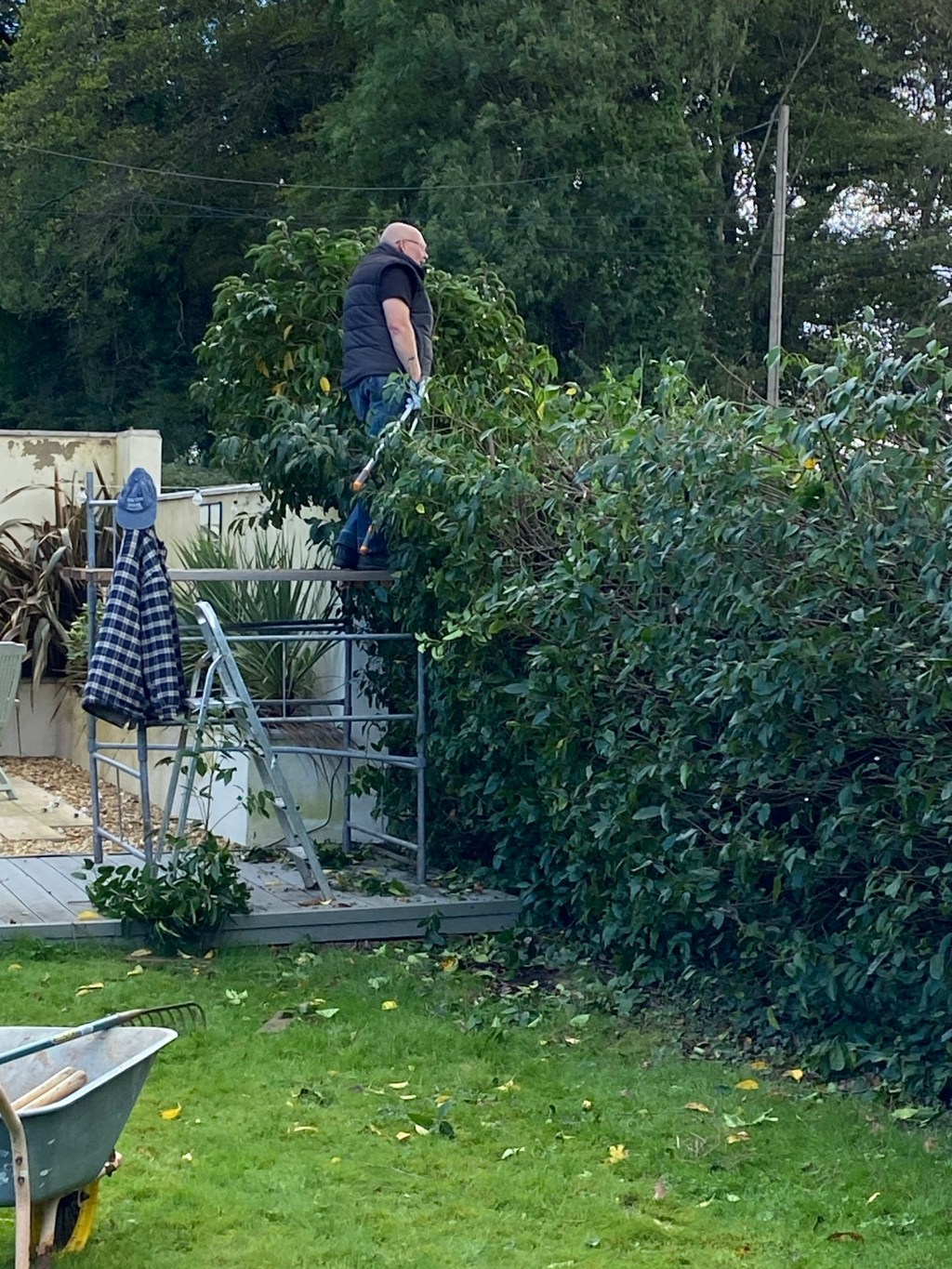
    Pictures, mine. Just for the record, I’m embarrassed that this hedge got into this condition. Fortunately Portuguese Laurel does seem to bounce back from a ‘vigorous pruning’.

  • Building a Polytunnel out of scrap Trampolines

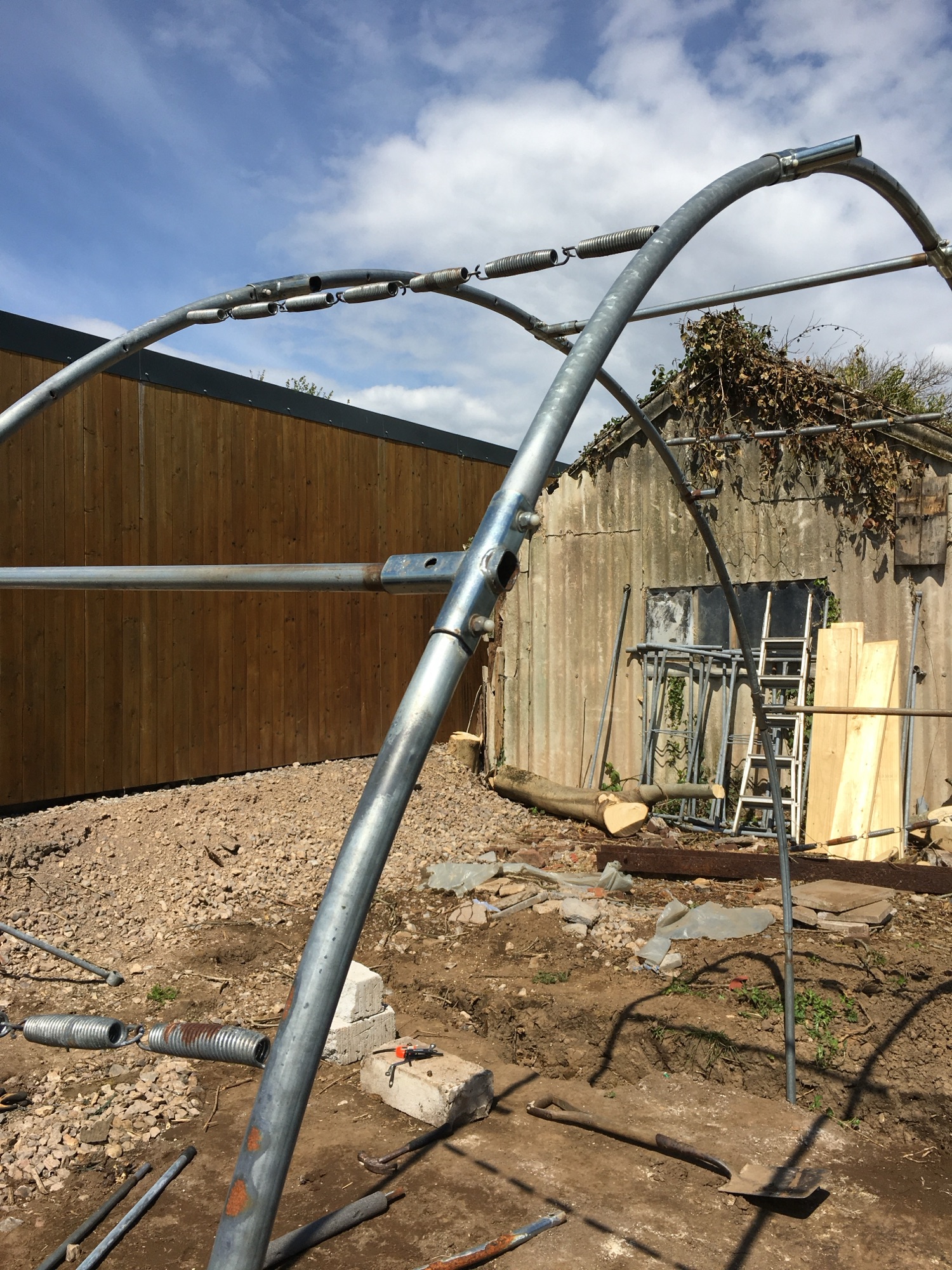
    Here’s something I’ve been DOING / have done. Building a polytunnel out of recycled / scrap trampolines. I promised myself I would recover some things I’d previously shared on Twitter and post them here.

    It’s in the space of DOING things which helps me make sense of the world (explained here). I also think this is something worth keeping a record of (even if it’s only for my own nostalgic reasons), but also something worth sharing.

    The nudge to get moving on posting this came from walking past a developing allotment where they are putting up an expensive looking polytunnel.

    Without offering unsolicited advice, here’s what I did (on a budget). The photo story of spring 2021…

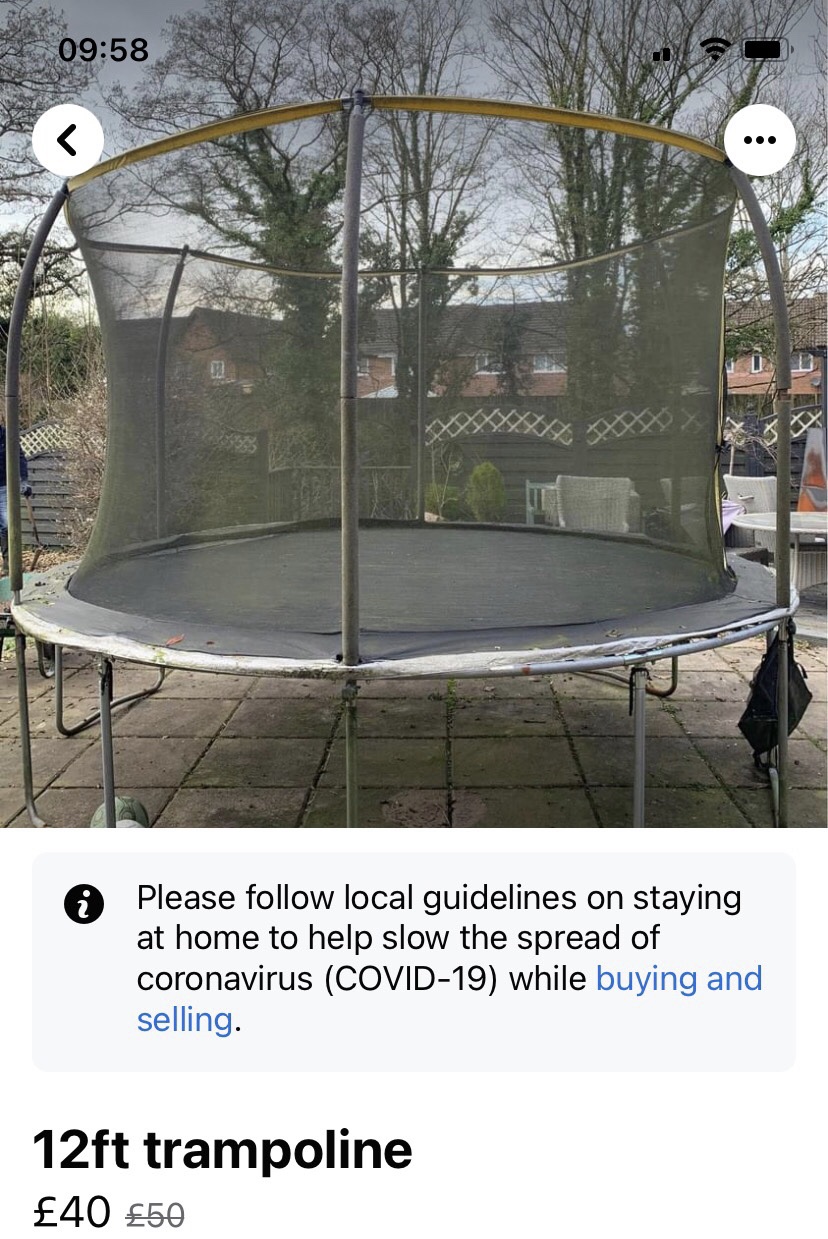
    Facebook Marketplace is a good place to go for ‘pre-loved’ trampolines. Especially after winter storms.

    I acquired three 12ft/3.6m Trampolines.

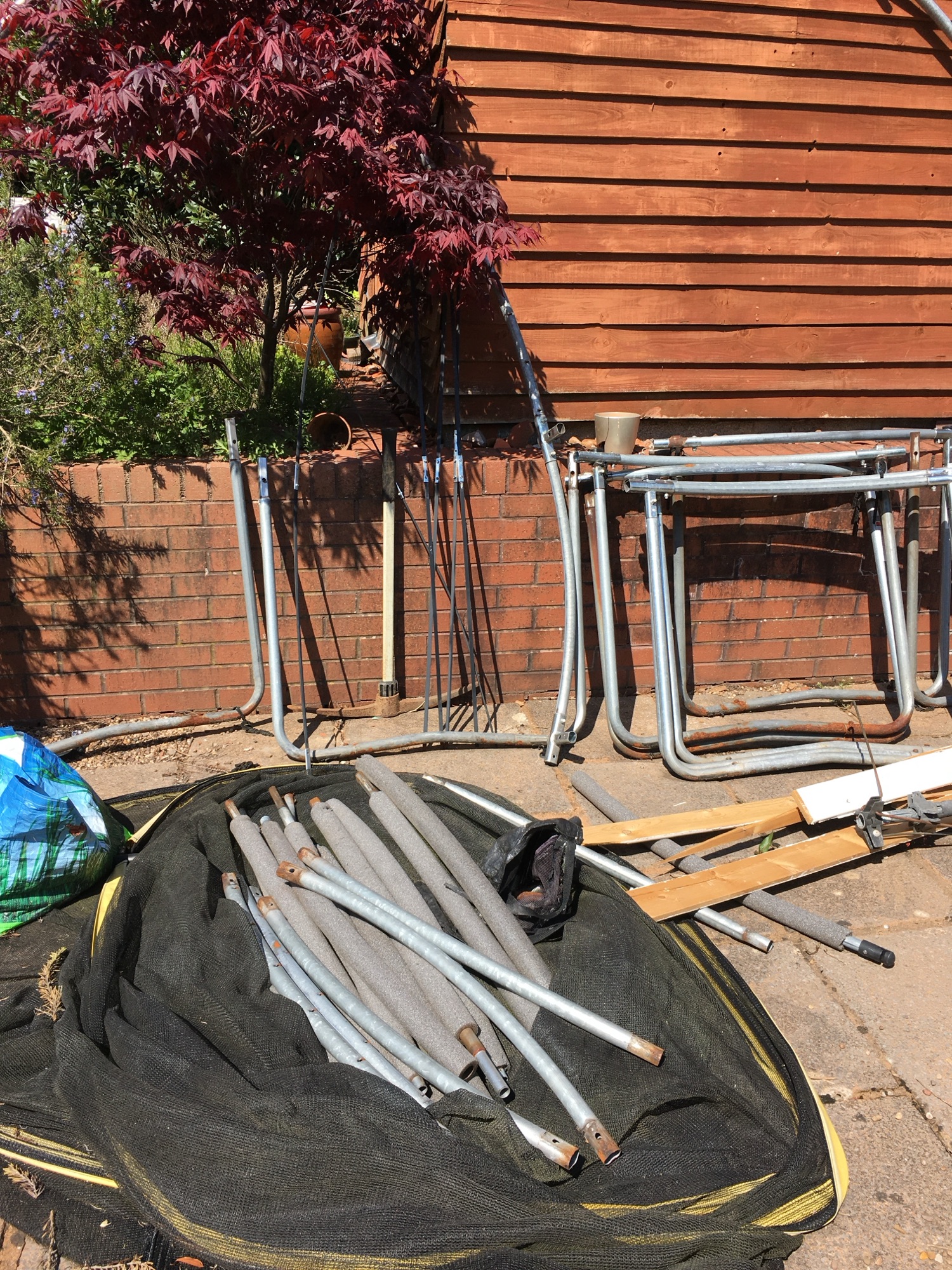
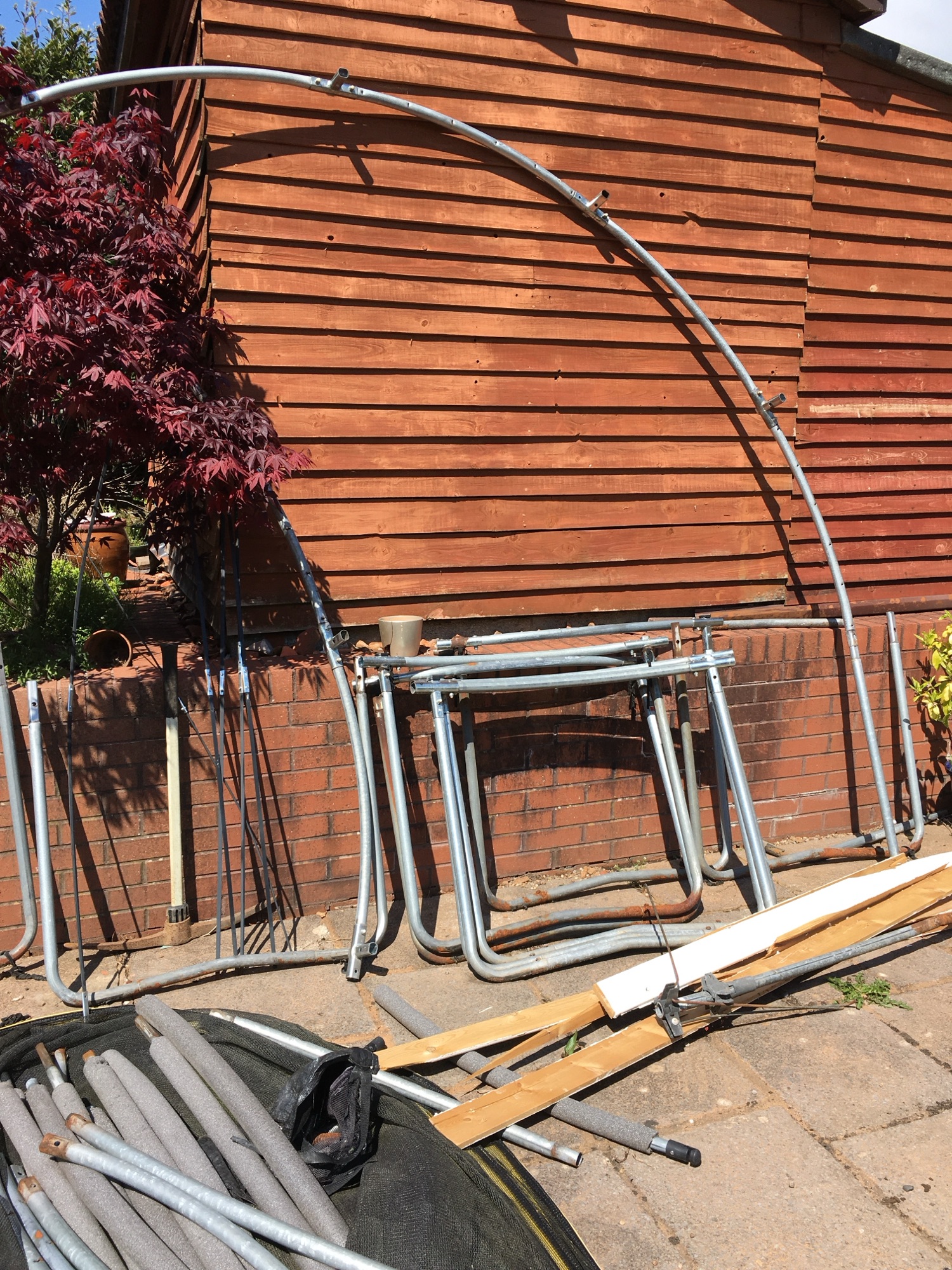
    The good news is that they all appeared to be pretty much the same construction, despite differences in age and brand. Probably all made in the same factory somewhere.

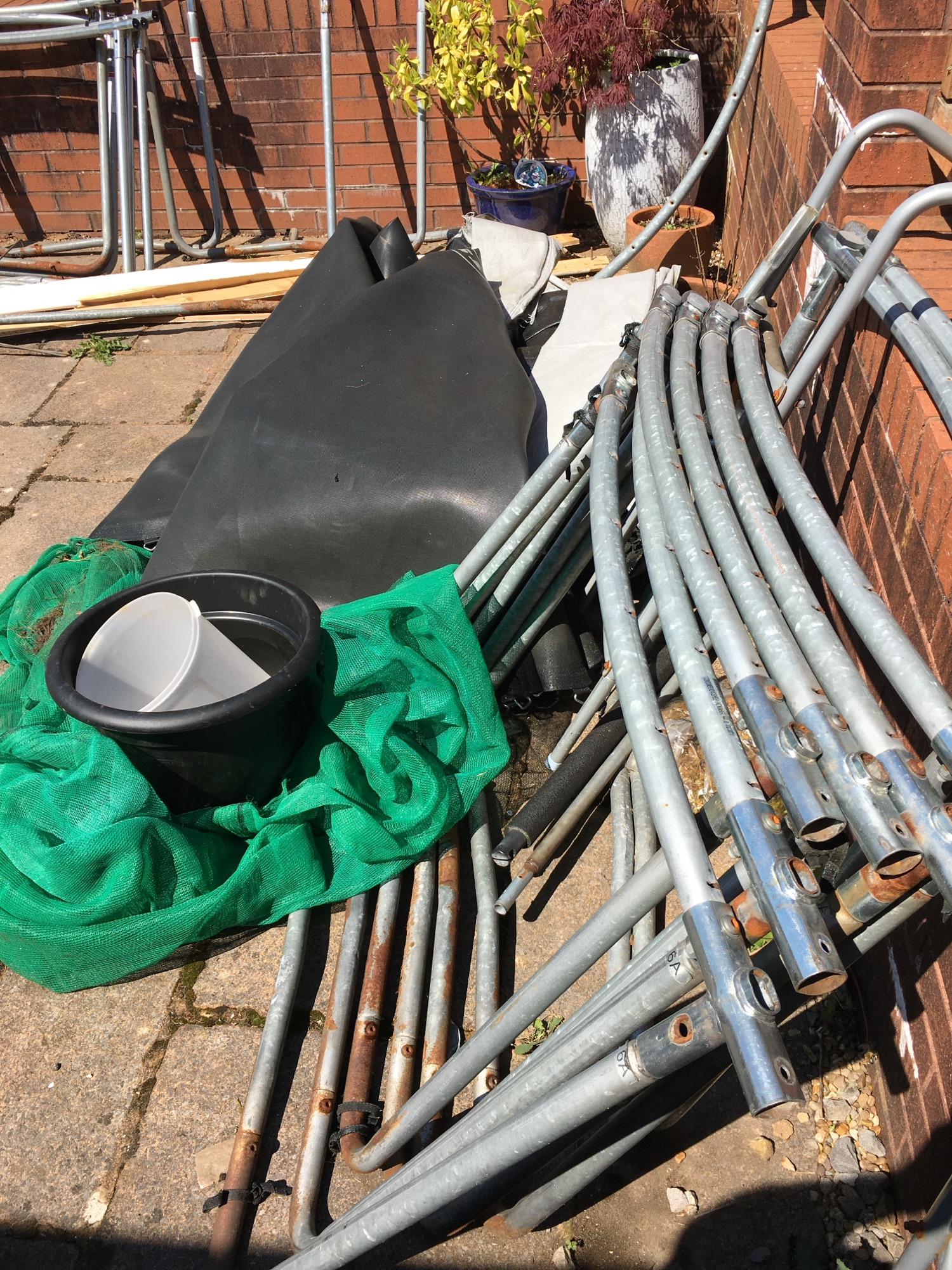
    Top Tip. When you collect them take a few spanners, a lot of WD40 and a hammer. It helps ‘persuading’ rusty joints to separate.

    Also, take bags for the bits and pieces you’ll need (nuts, bolts, washers). Also for the stuff you have to take away as part of the deal -literally hundreds of springs, the fabric from the trampoline bed and netting. Its the metal tubes and connectors you are after.

    I must admit to my excitement getting the better of me. Putting up a 12ft/3.6m diameter arch, supported on 3ft/1m legs didn’t serve any real purpose. Then I had to take it down and carry it to the build site.

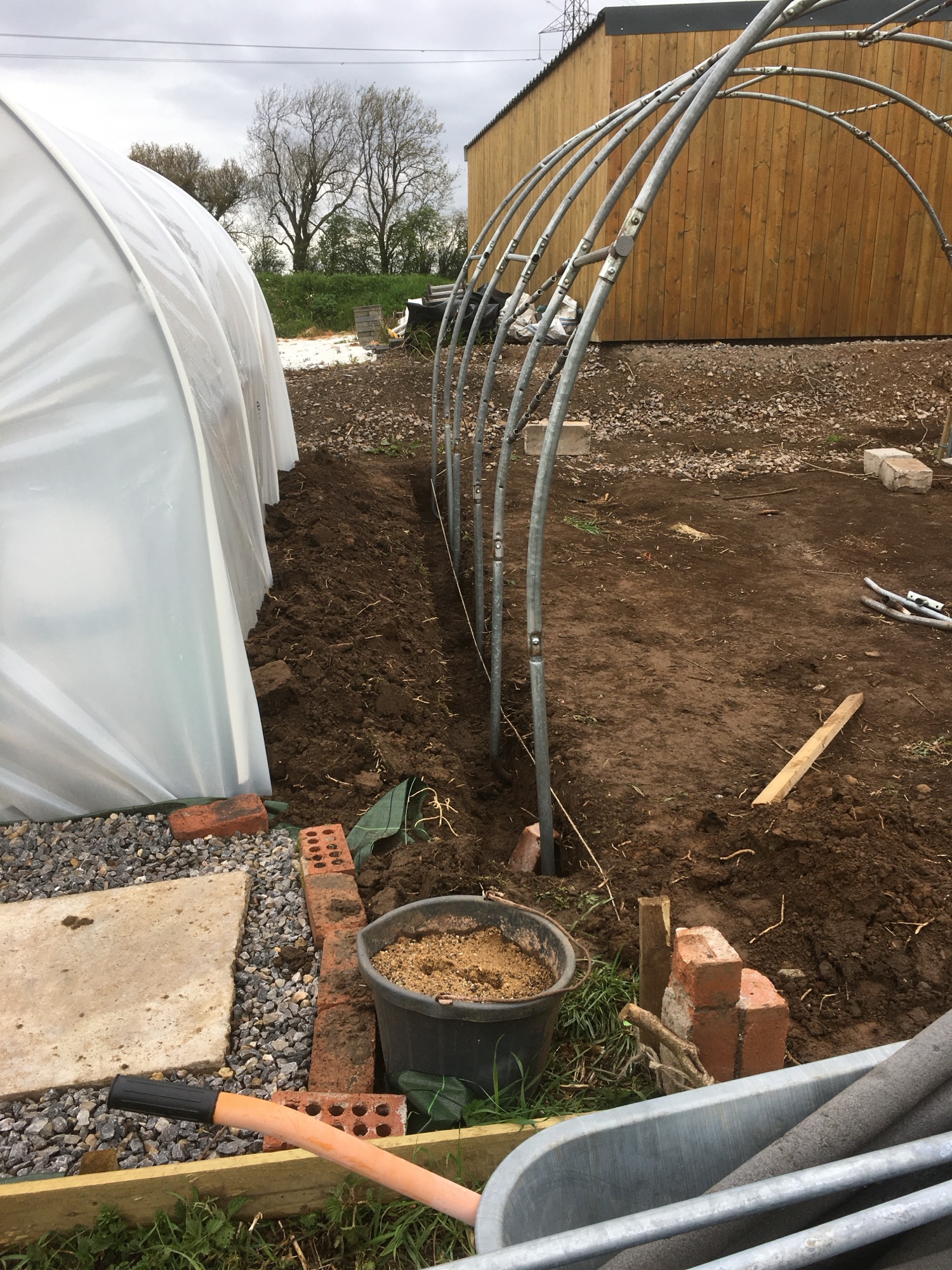
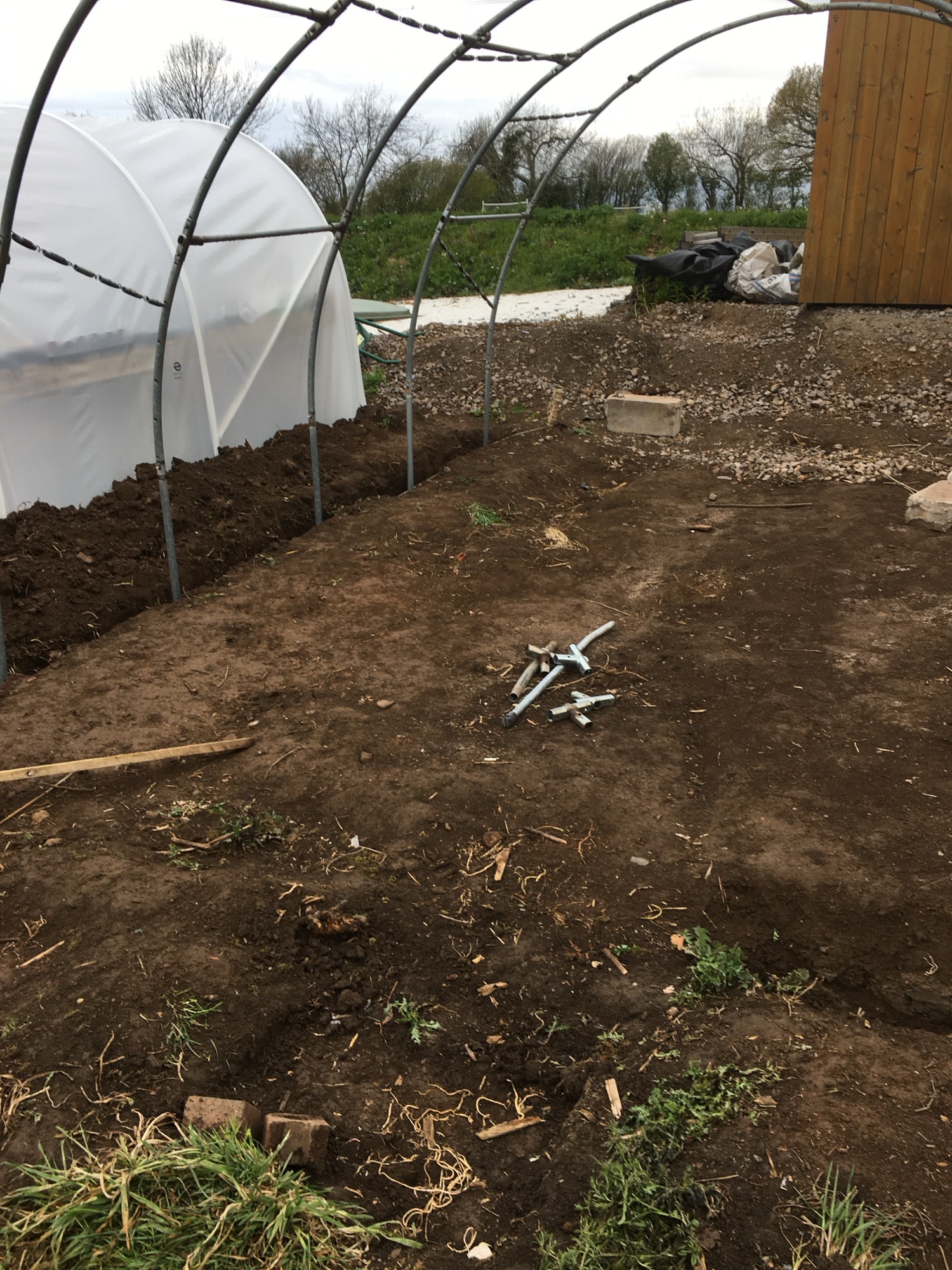
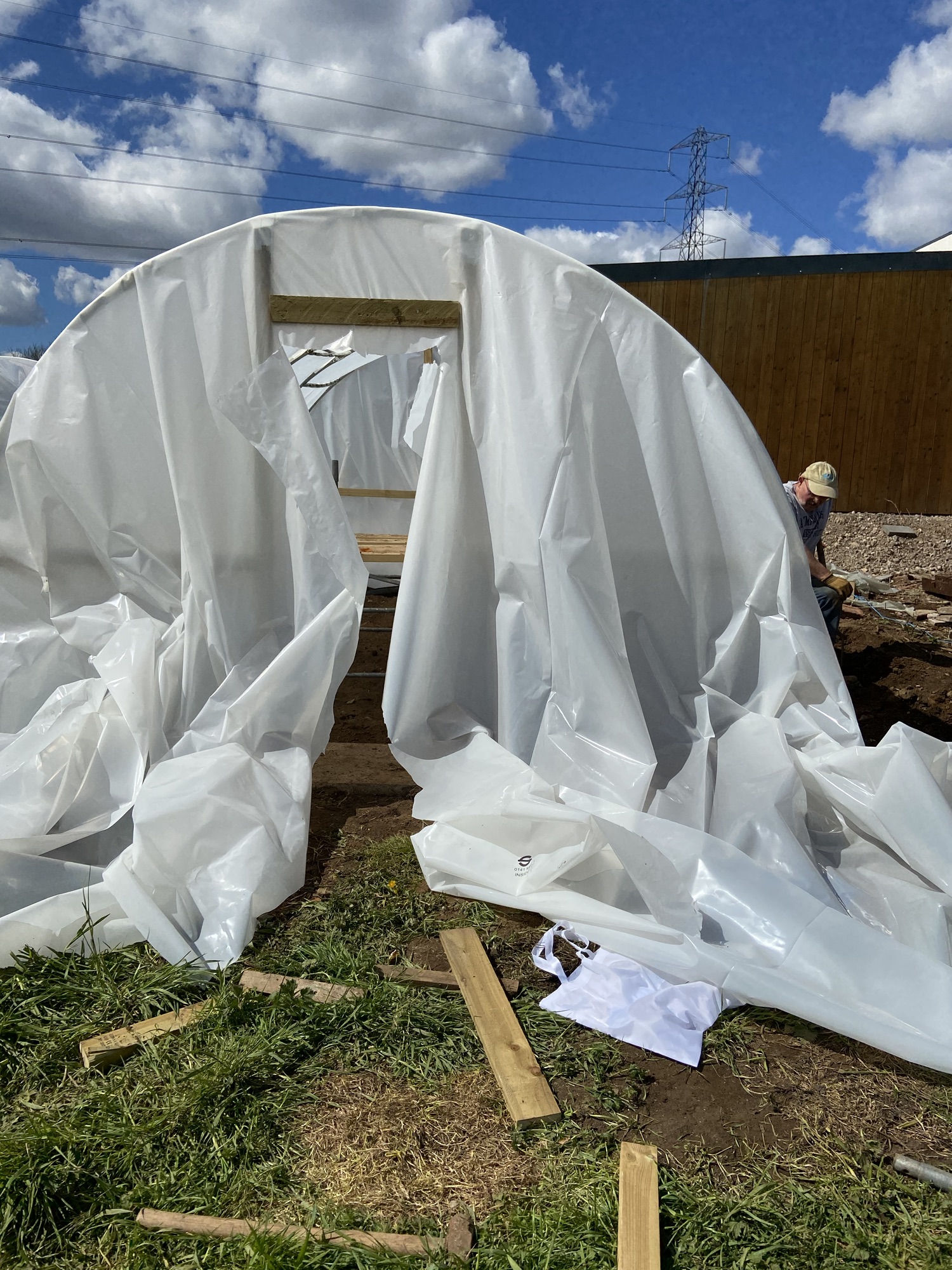
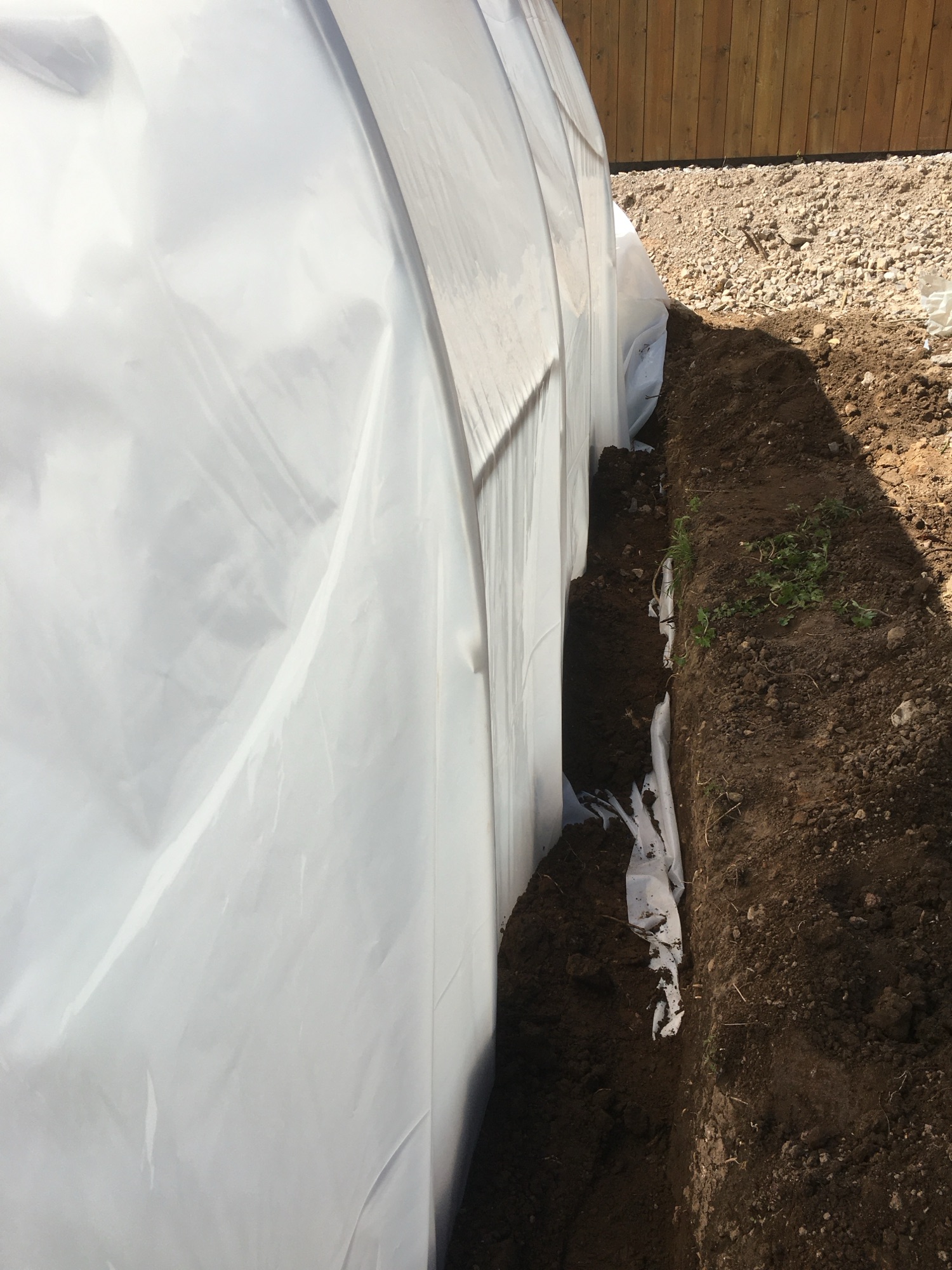
    The Build. Step 1. Dig two parallel trenches. The trenches were approximately 30cm wide and 40cm deep. Their purpose is to bury the polythene covering, so that the structure stays put. This is a position that is exposed to the wind, so I wanted to take precautions (some people just fix the polythene to a wooden base board).

    Step 2. Set out the ‘hoops’. This is where some of the things I thought I wouldn’t need came in handy.

    • ‘L’ shaped legs from the supports were pushed into the ‘inside’ wall of the trench. Helpful as temporary anchors while building.
    • The connector pipes used for safety nets helped join the hoops.
    • The springs (to my surprise) helped with some temporary fixes.

    You can see how it’s coming together now.

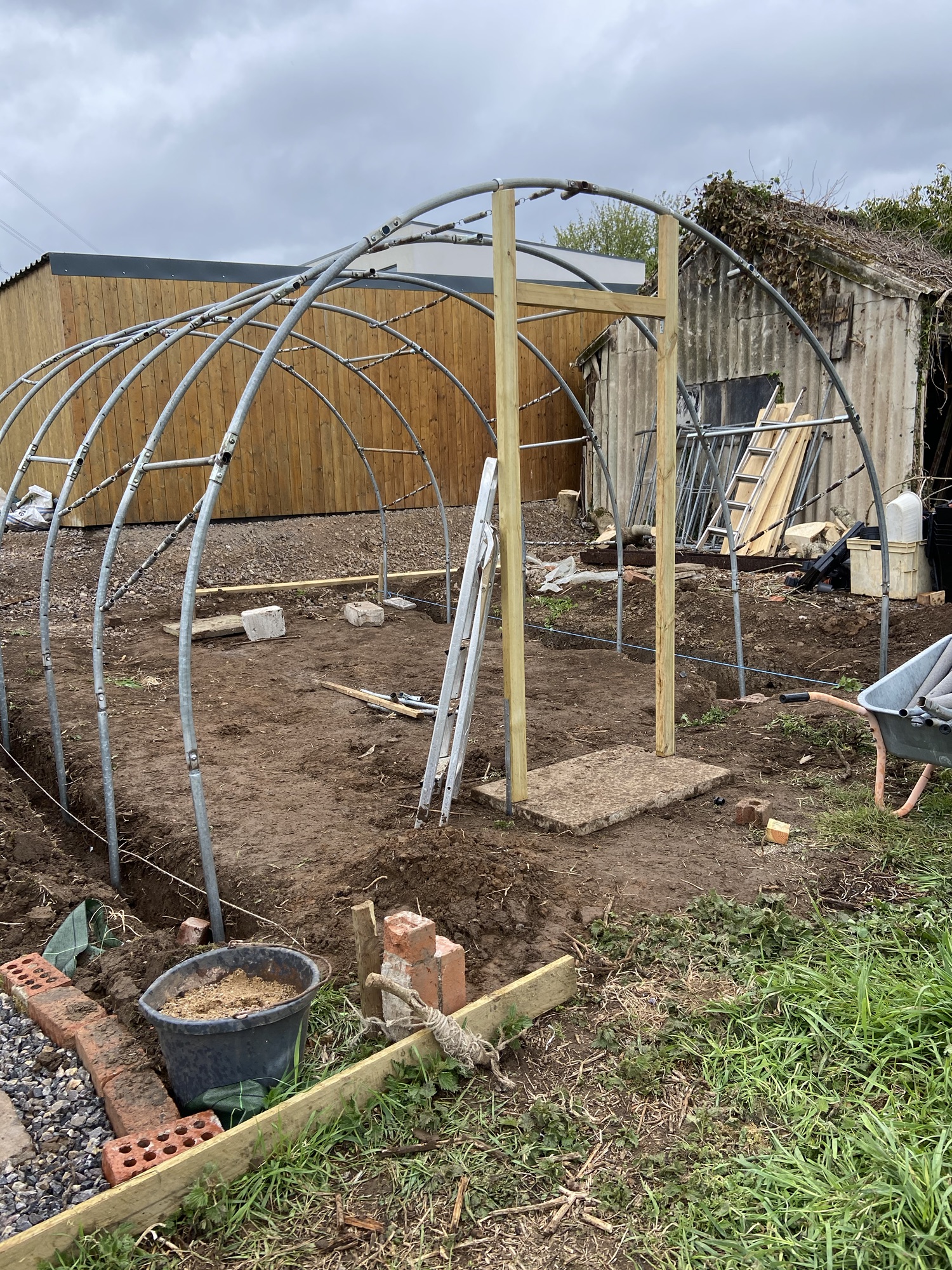
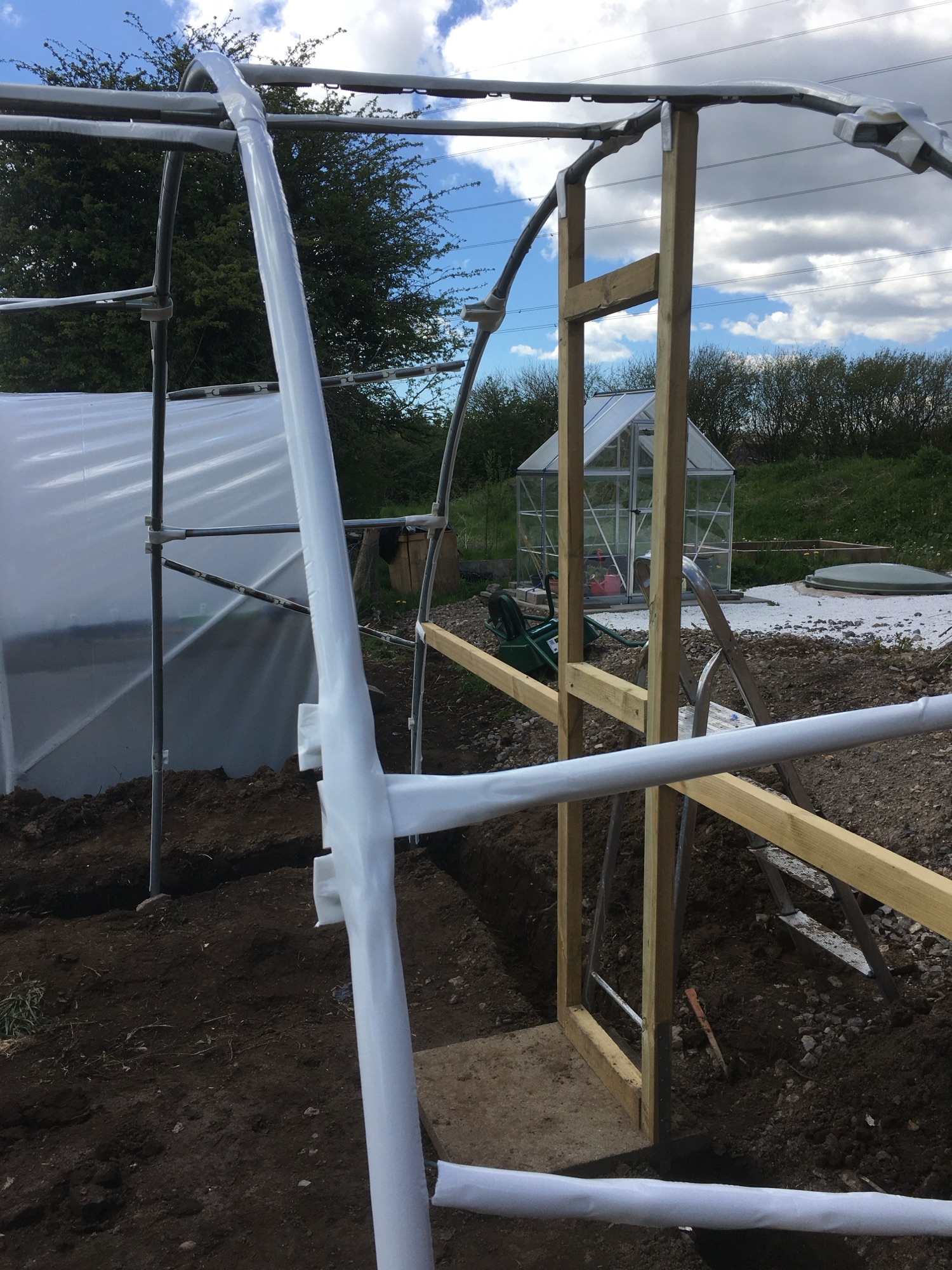
    Step 3. Build ‘end frames’. Basically the ‘ends’ of the polytunnel and include any door arrangement you fancy.

    Top Tip. At this stage I went around the structure with 20mm self tapping screws to fix everything together. Make sure the screw heads all face ‘inside’ the tunnel. You don’t want anything ripping the polythene.

    I’ve been told that the screws is ‘overkill’ as the polythene wrapping will hold everything together. But it doesn’t half feel good having the power to join two pieces of metal together (even if it is with a self tapping screw).

    Step 4. Wrap the hoops. This is with something called heat resistant tape. It stops the metal pipes damaging the polyethene on hot, sunny days.

    It also seemed to help the polythene ‘slide’ across the hoops when it was being fitted.

    Step 5. Fit the polythene. This can be tricky, so stay calm.

    Top Tips. There was an ‘inside’ and an ‘outside’ to the polythene we used. Make sure you get that bit right.

    And it probably goes without saying, but try and do this on a calm, windless day. The more the wind, the less calm the process (and individuals involved).

    Step 5. Fixing the polythene. This is more art than science. A combination of running around tucking the polythene into the trenches and quickly backfilling them with soil – before the wind picks up.

    The end frames are also handy at this point to temporarily fix the polythene while you coax it into a reasonably taught shape.

    Step 6. Backfill the trenches. It feels like things are coming together at this point.

    Top Tip. Look out for broken pottery and other sharp things in the soil. You don’t want anything ripping your lovely taught polythene.

    Step 7. Tidy up the end panels. This will depend on what you want. Some people will want wide doors and lots of ventilation. In retrospect, I wish I’d built a wider door at the back to let in more air.

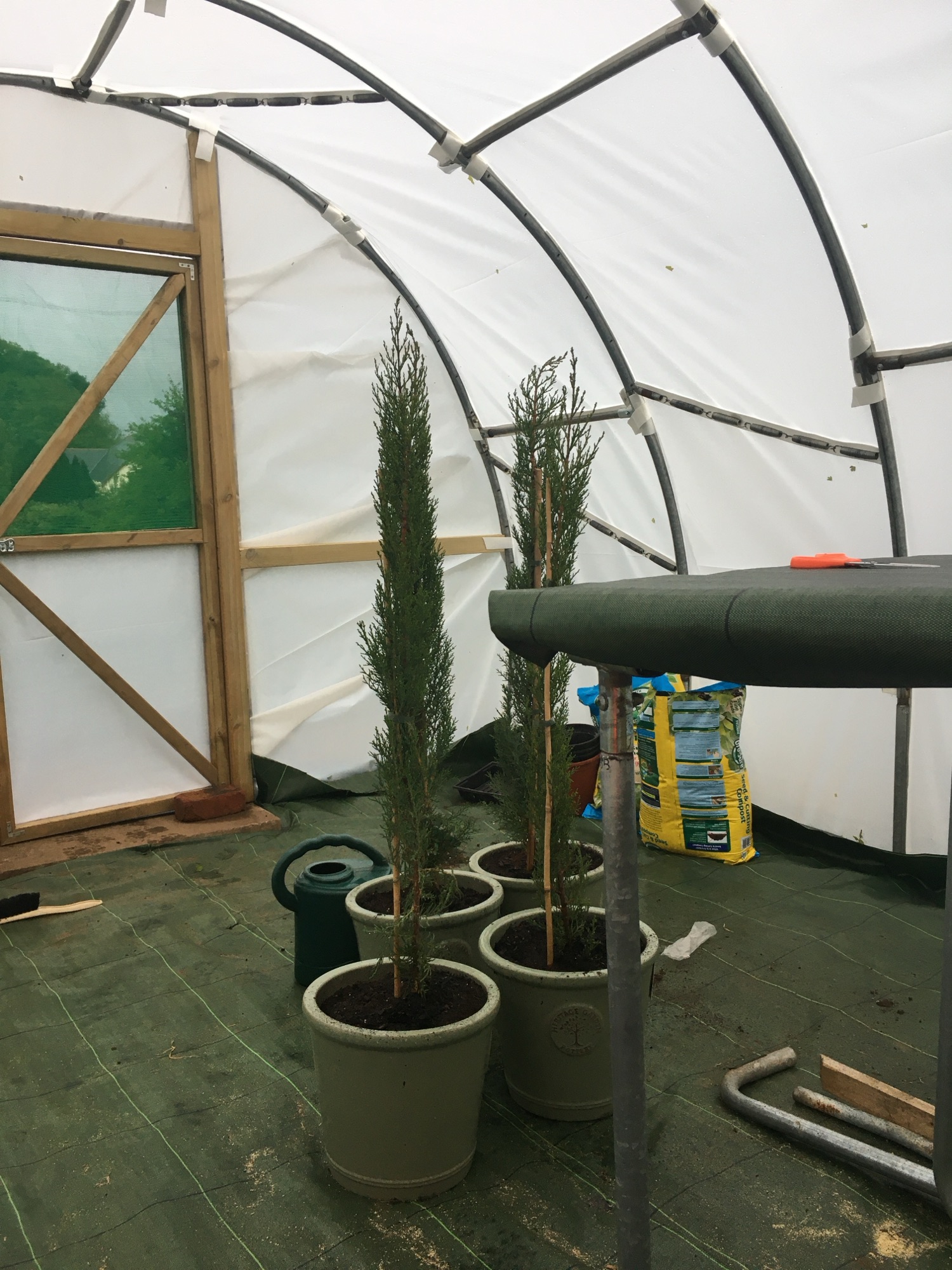
    You can also do whatever you fancy on the inside now. In the dry.

    Step 8. Use you polytunnel. For whatever you fancy.

    Postscript. The polytunnel has been standing for 3 years. It’s survived some significant storms and is doing the job I wanted it for.

  • A pencil is an instrument of optimism.

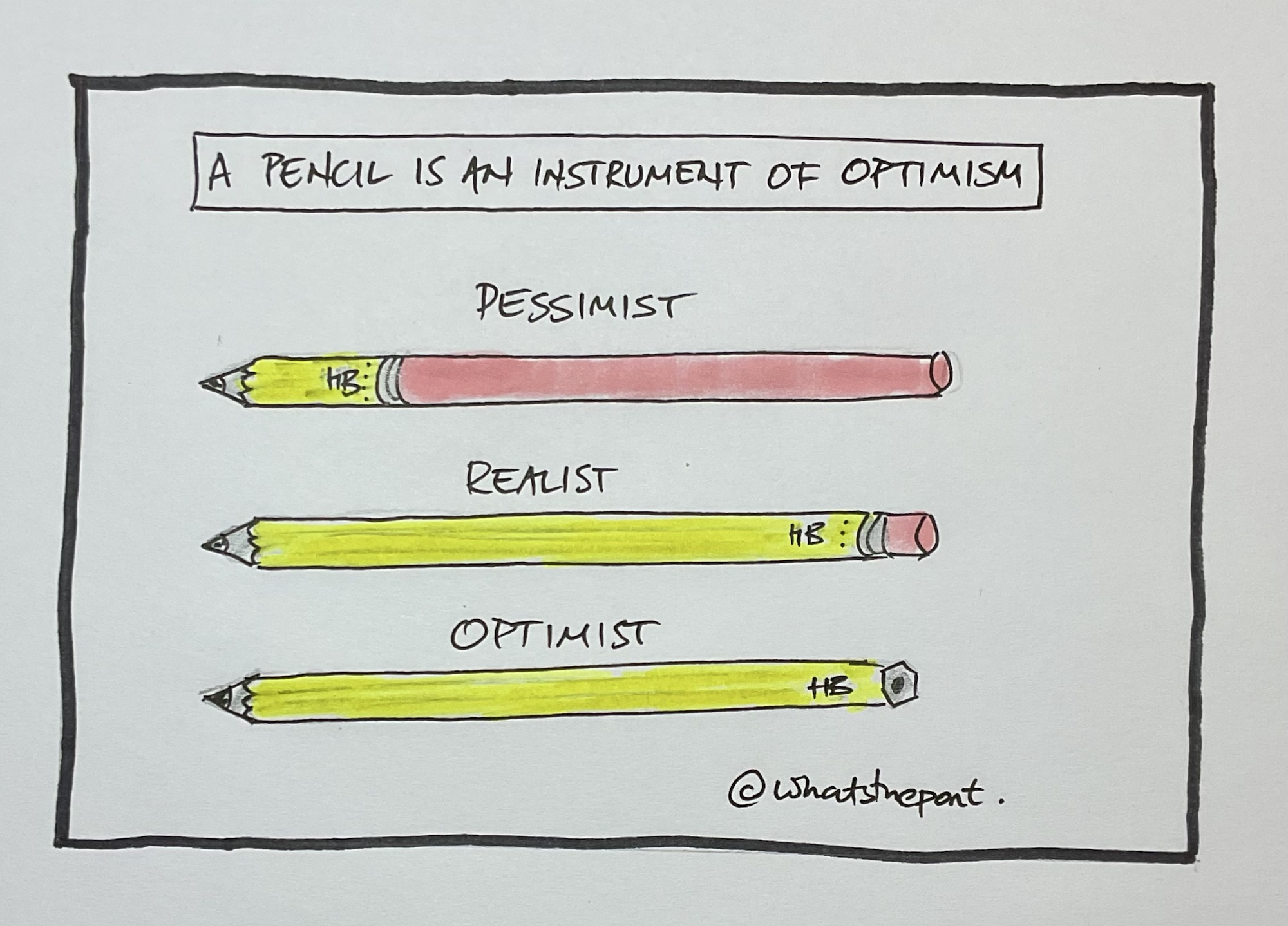
    Think about it for a moment. Your average ‘ box fresh’ pencil is over 95% writing material and less than 5% rubbing out / erasing material. If that’s not a instrument of optimism I don’t know what is.

    Pencils; optimists on your behalf. I was introduced to the idea of a pencil being a instrument of optimism by the Spanish Photographer Chema Madoz. His work photographing everyday objects from different perspectives makes me both think and smile.

    In this video Chema talks about how he was dissatisfied with his (pencil) sketches as he doesn’t have a “hand” for drawing. Then later he makes the statement that “pencils are an optimistic object…to me a few successes and many errors is more realistic.” (9.50 – 10.10 mins.)

    Chema has created one picture of a pencil comprising around 90% eraser and 10% pencil. This is possibly a more accurate reflection of the reality for lots of us. More time spent rubbing out the mistakes than actually creating something permanent on paper.

    Is rubbing things out tolerated failure? I’ve been thinking a lot about this. The idea of learning through trial and error is widely understood and accepted.

    Is then the pencil, eraser and a blank piece of paper the ‘starter pack’ for learning from tolerated failure?

    An activity where you can ‘learn’ by sketching, erasing and refining things. Learning from small tolerated / acceptable failures.

    Leaning from failure is something that can help us get better at a whole host of things, if we let it…

    I’ve written about it here in ‘that which does not kill us makes us stronger. All about the idea of beneficial accidents and survivable failure.

    The idea that ‘low cost’, tolerated failure embeds learning better that success is also something I’ve written about. The opportunity to learn how to try, fail and learn is something I think we should all seek out. Maybe just by picking up a pencil and paper and starting to draw? But do it while you can still get hold of a pencil…

    Digital ‘failure free’, perfect art. Someone I know is big into digital art. They spend a lot of time sketching on a tablet, creating all sorts of good looking art.

    I’m impressed when I see it, but left with a nagging doubt. Where is all the rubbing out? Would it be as good if they had used pencil and paper? Have they really learnt to sketch? Are they a ‘proper’ artist?

    Maybe I’m worrying about nothing. Research with artists using both analogue (pencils and paper) and digital tools to create drawings found no difference in the accuracy of what they produced. ‘To erase or not to erase…’ was published in the Journal of Art, Design and Communication in Higher Education in 2020.

    It does strike me though that the research was carried out with people with ‘some’ level of drawing skill. It also makes the point that pencil and eraser marks ‘leave a trace’ that a teacher can use to provide coaching and feedback. While the digital option removes everything.

    Maybe digital is fine for people with an existing level of skill, but where does it leave ‘ham fisted’ scribblers like me? Will I miss out on valuable feedback and learning from small tolerated, low cost failures?

    Is AI going to make it worse? If Artificial Intelligence does half of what the hype suggests we could end up with a world of perfect art; I really don’t fancy that.

    I quite like imperfections and the idea that learning from failure happened along the way. And just to prove that…

    The original sketch I drew for this post was on scrap paper, with limited drawing materials in less than perfect conditions. It was rough, but I liked it. ‘Good enough is better than perfect…’ Oh yeah, JDI!

    Then I spotted the massive spelling mistake. Optomism spelt wrong. I actually went to the length of looking up ‘optomism’. Surely the Americans spell it like that, I’ll get away with it. Nope!

    The Urban Dictionary defines an optomist as, “someone who thinks everything will be alright, even though they cannot spell.” Oh how I laughed. Enjoy the new (improved) sketch.

    So, What’s the PONT?

    1. Pencils are an instrument of optimism. Realistically most of us have more failures than sucesses.
    2. A pencil, eraser and sheet of paper is the learning from failure ‘starter pack’.
    3. Go and buy some pencils. Before it’s too late and AI hype tries to consign them to history.

  • Tin Sheds

    Tin Sheds

    I’m expanding what I post here on What’s the Pont. It’s all explained on the About page.

    This is something under the SEEING category. Tin Sheds.

    I have a deeply nostalgic feeling about Tin Sheds. When I was growing up they seemed to be everywhere in South Wales. Buildings made out of corrugated iron, relatively cheap and easy to put up and used for a huge number of purposes. Although a lot of them were places of worship – Chapels.

    The first ‘proper’ (not a prefab) house I lived in was on the site of a demolished Tin Shed Chapel (Corrugated Methodist), which might explain a lot.

    Anyway, please enjoy some pictures of Tin Sheds that have mostly disappeared from the Welsh landscape. I’ll add more as I encounter them.

    This is why I take pictures of Tin Sheds.

    To quote Donkey from Shrek, like “celebrity marriages, they just don’t last”.

    That’s a bit harsh, they will last for a decent amount of time if properly cared for, have a look at the pictures below of a few from the Museum of Welsh Life in St Fagans near Cardiff.

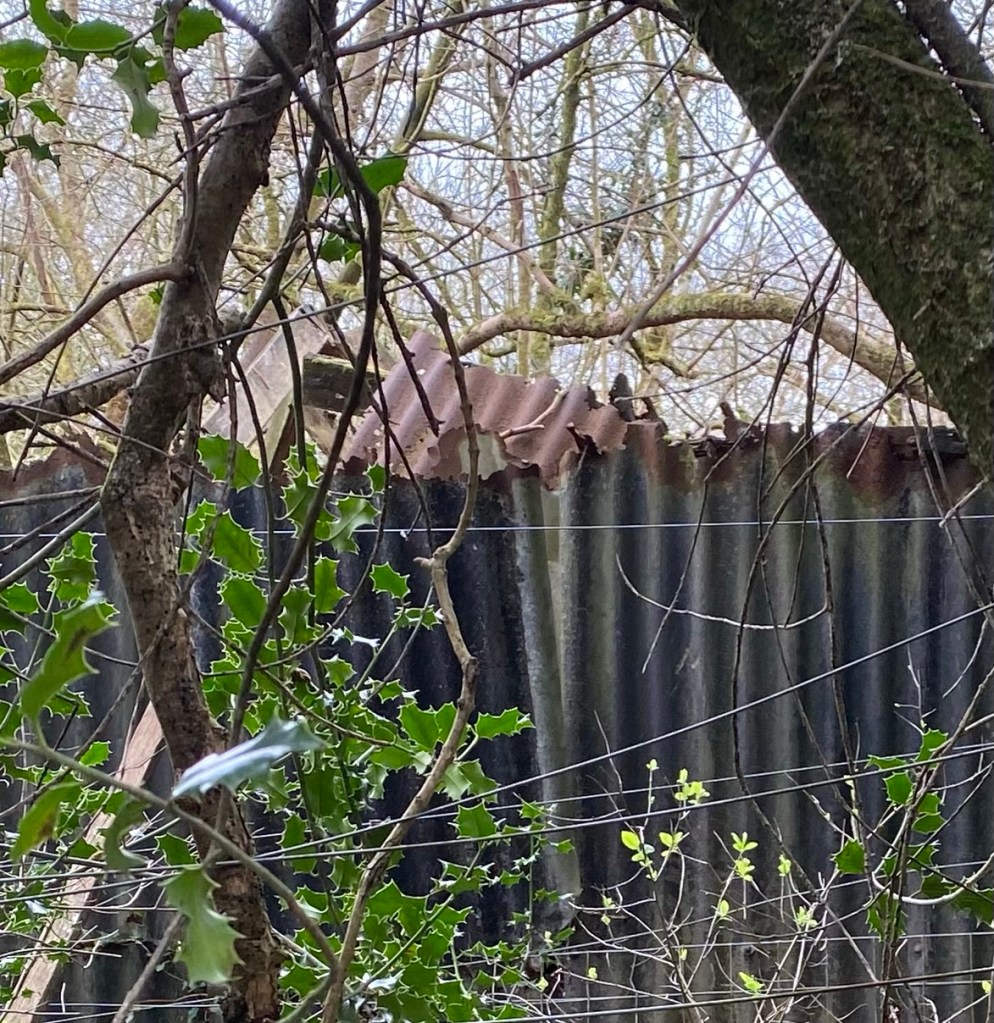
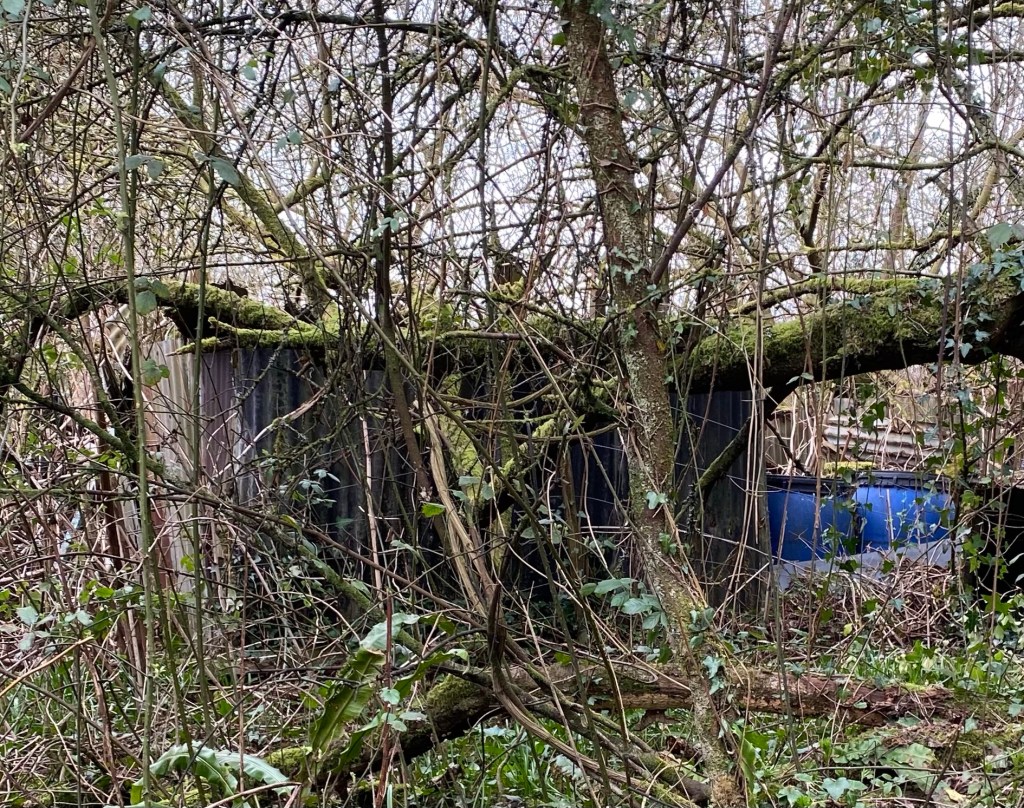
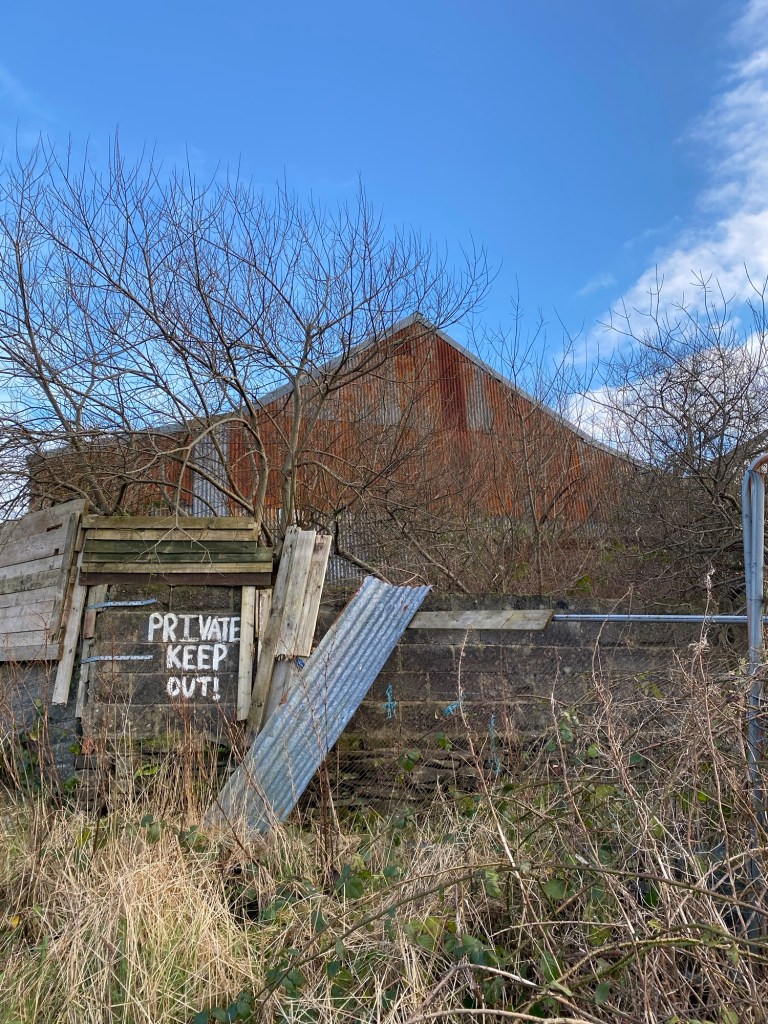
    Here are a few pictures of a decaying tin shed I walk past with the dog. I can only get a half decent picture of it during the winter when the vegetation has died back.

    And every year it’s a bit more decayed and there is less of it. But I still draws me towards it in ‘allure of ruins’ sort of way.

    A ‘proper’ Shepherd’s / Workmen’s mobile Tin Hut.

    In a world full of refurbishments and restorations, it’s good to encounter an authentic original.

    Dented, rusty, fully of patina (apologies I’ve slipped into Drew of Salvage Hunters off the Telly speak).

    But this one got my ‘shed love’ going again.

    I’m not going to say exactly where it is other than it’s in a small forest near Aberystwyth. If you need to see it, you will find it… Gorgeous!

    Tinshed Bach. Behind the Blacksmiths, St Fagans Museum. I’m not the sort of person who generally says ‘cute’. But, I’ll make an exception for this lovely little tin shed. It’s even got a smiley face if you look close enough. Cute!

    R.L.Jones and Sons Builders (also used to be an Undertakers) Bleanau Ffestiniog. An icon of Tin Sheds. My images, Feb 2024

    Bonus Painter Shed next to the main R.L.Jones Builders shed.

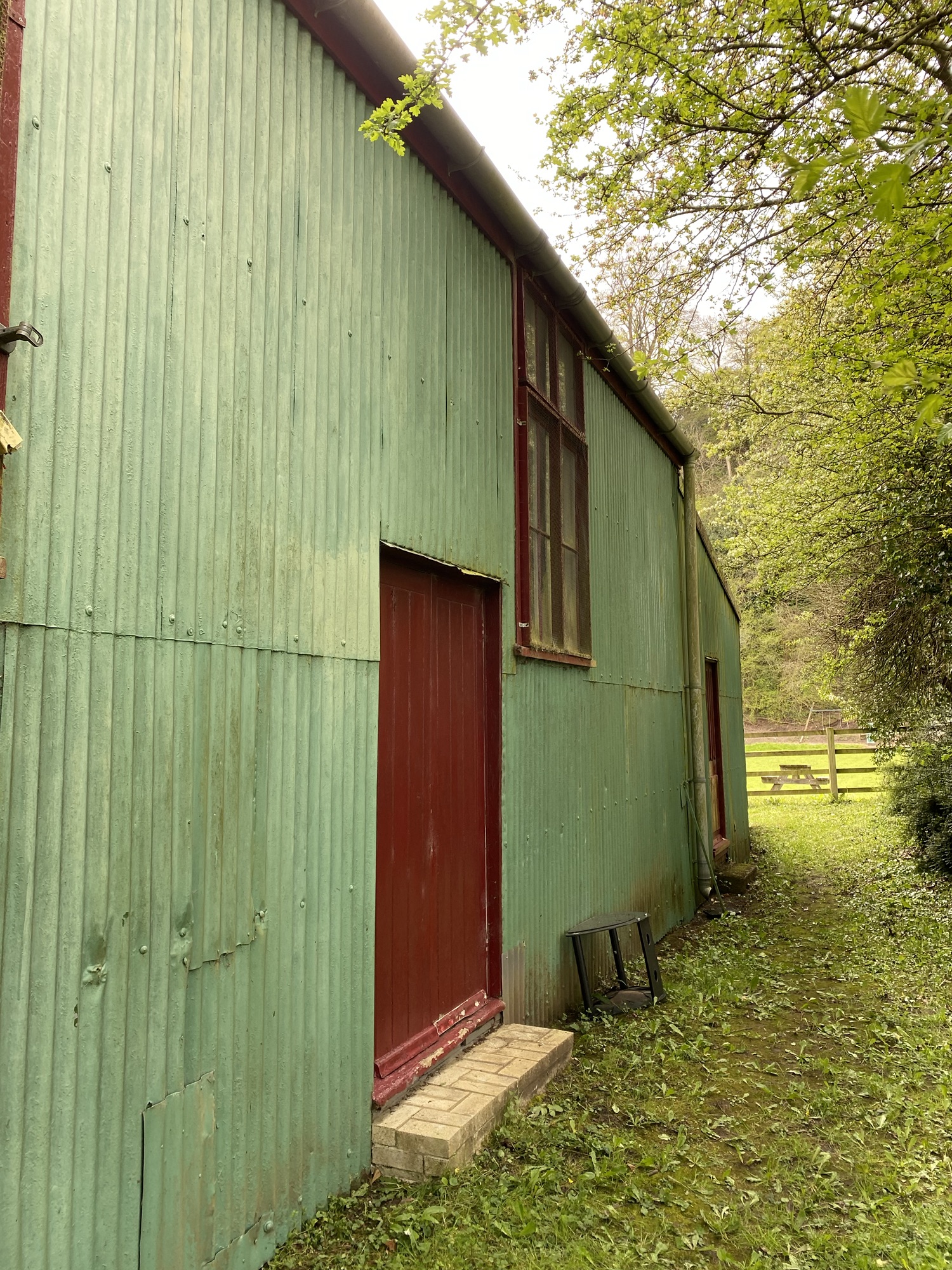
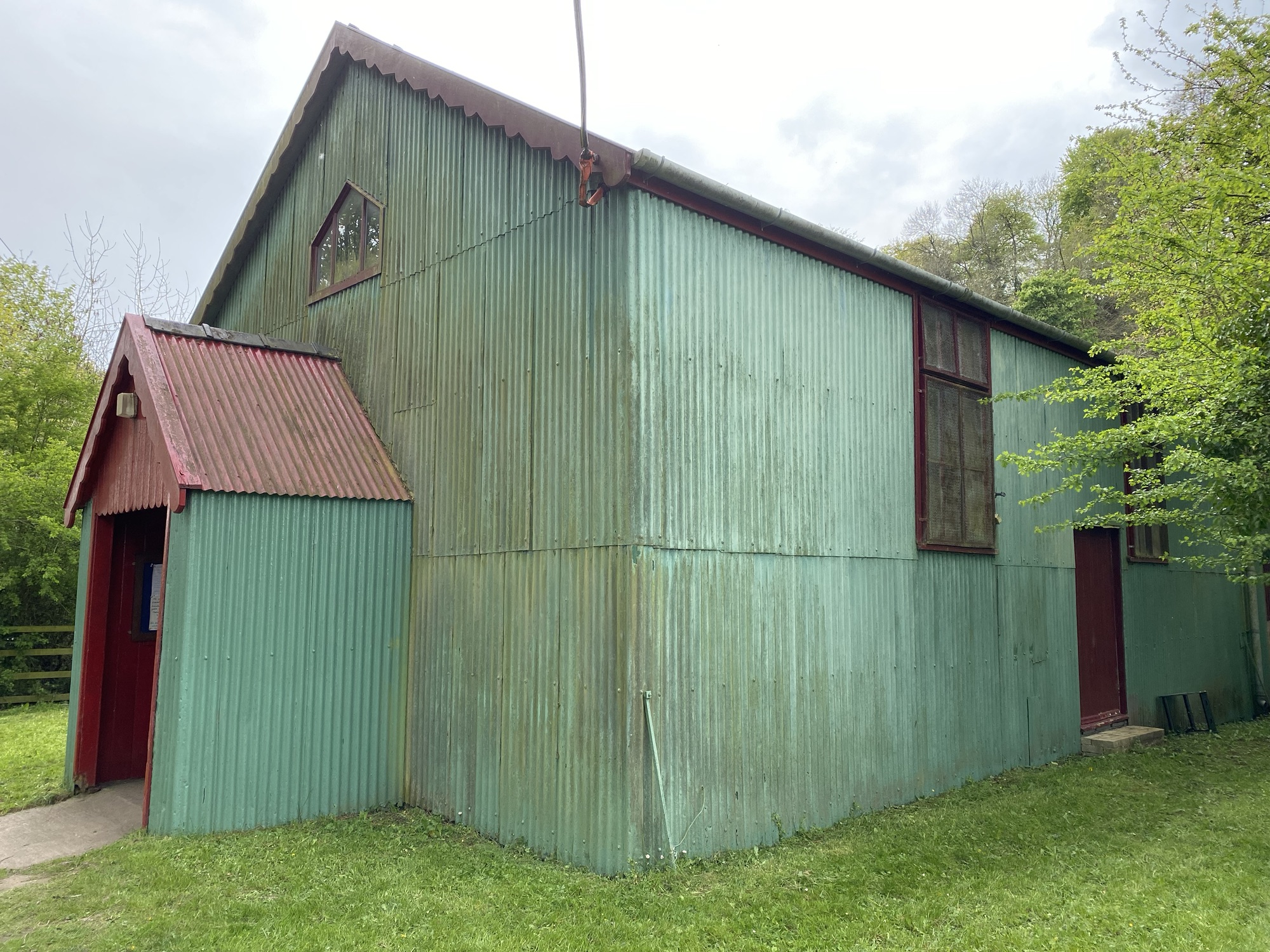
    Ganllwyd Village Hall, Gwynedd. On the A470 with convenient parking at a National Trust site opposite. It’s on the Coflein database of historic sites in Wales. My images. Feb 2024

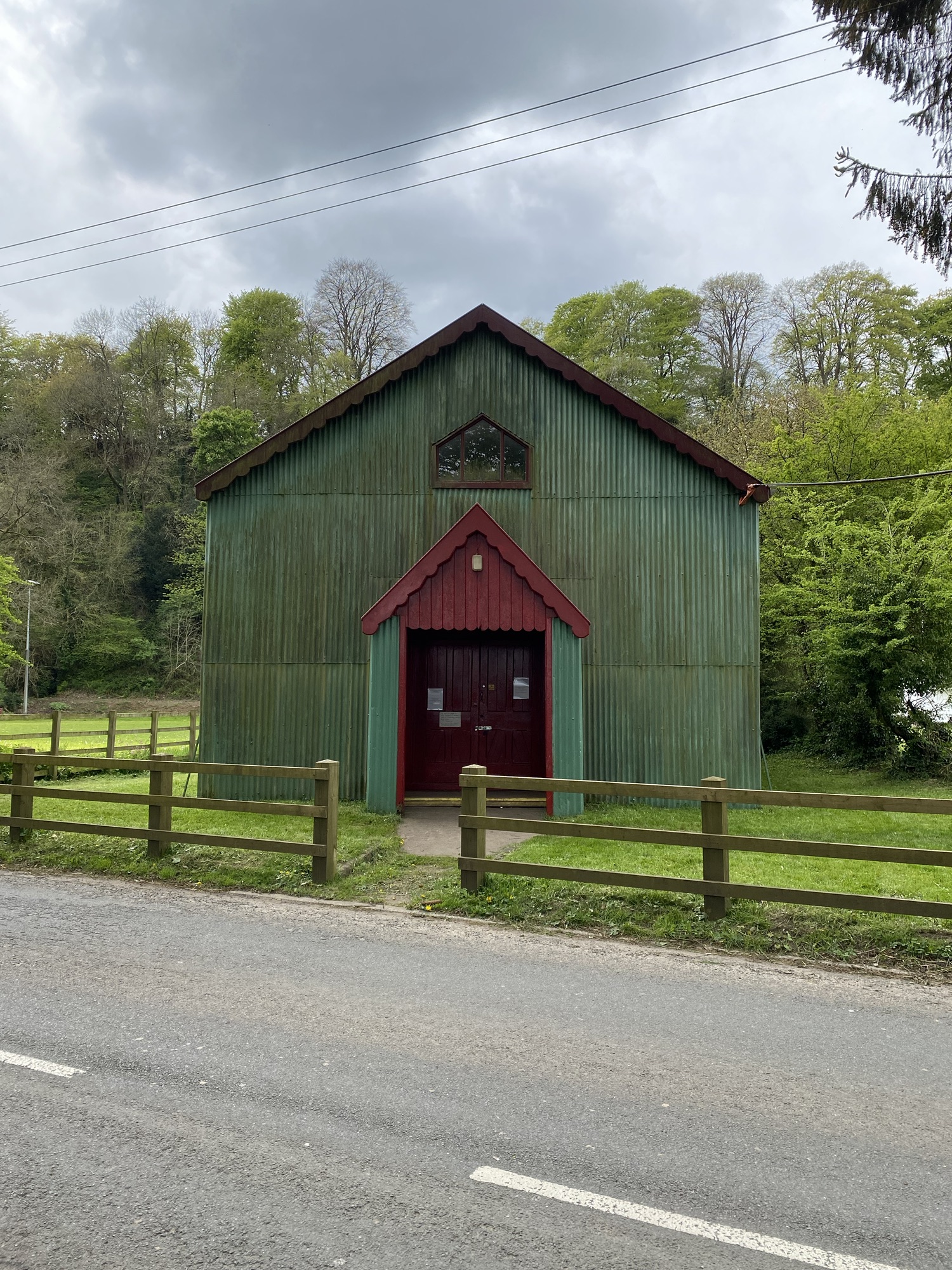
    Llanbadoc Parish Hall, nr Usk Rugby Club, Monmouthrshire. (pic April 2024). Thanks to @Smillie_Ella on Twitter who pointed me in the direction of the Red Shed, Usk.

    Obviously its green, but it used to be red. In the 1970’s the local council painted it green to stop people calling it the Red Shed – Llanbadog Parish Hall might seem a bit grander and more suitable. But (apparently) everyone still calls it the Red Shed. There’s a bus stop right outside if you fancy a visit.

    I particularly like the ‘extension on the extension’ approach at they rear. Looks like toilets might have been an afterthought.

    I do love the bent tin sheet to form a weatherproof corner.

    Extensions on the extension…

    Final pic from Llanbadoc Parish Hall / The Red Shed. A treat for the patina / peeling paint enthusiasts. Lovely!

    TODAY I WANT THE SKY shed. From Offa’s Dyke path Monmouthshire. Hatterall Hill Near Pentywn Iron Age Hill Fort. My image taken Sept 2019. Barely visible is part of the Edward Thomas poem, The Lofty Sky.

    Chicken Shed / Gaz Truck Hybrid. Not strictly a shed or in Wales, but I like it. My picture, taken April 2016. Somewhere south of Lake Ohrid / Pogradec, Albania. Soviet Gaz Trucks have been used for a multitude things, https://en.m.wikipedia.org/wiki/GAZ-51

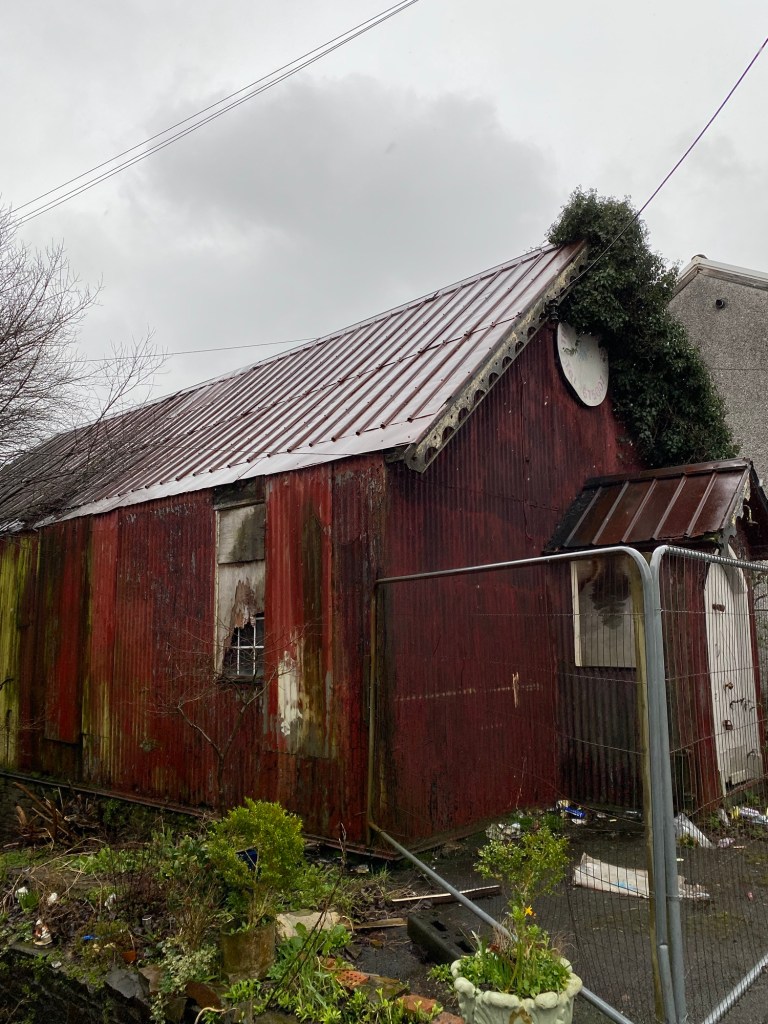
    Tin Tabernacle, Mill Street, Tonyrefail. (February 2024) The story of how Tin Chapels disappeared from Welsh communities is wrapped up here. Up for sale, with planning permission. Chapel off to the scrap heap… you can buy it on Rightmove.

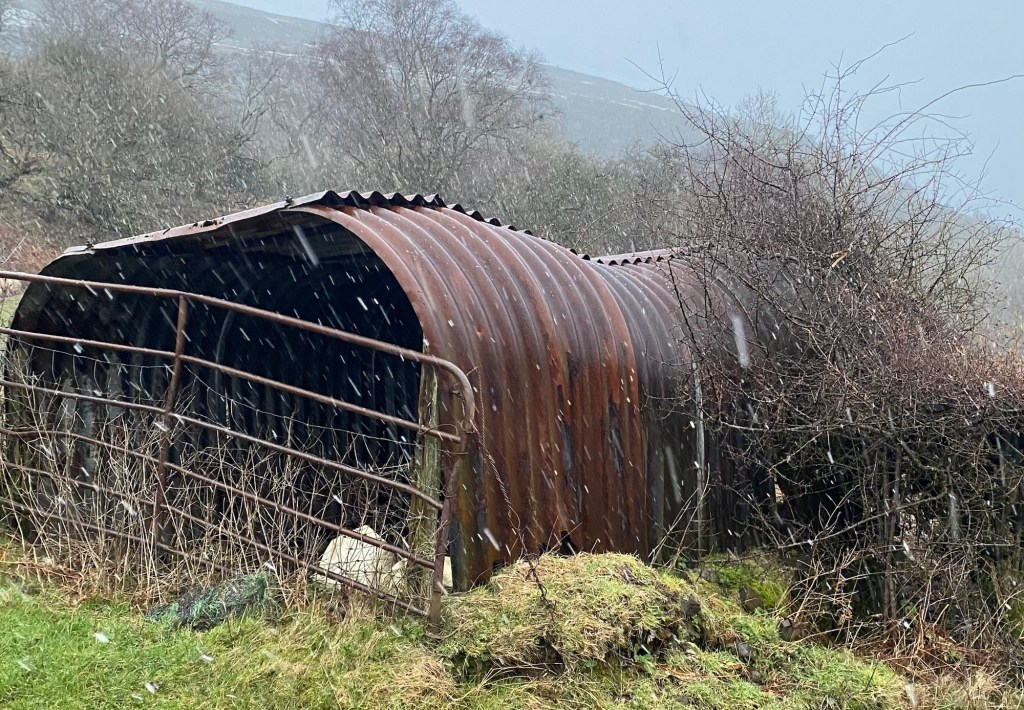
    Capel y Ffin, Barn/Livestock Shelter. (March 2024) On the road down from Twmpa, Black Mountains. Not all tin sheds are things of great architectural note. There’s a lot going on here. Built from reclaimed materials, possibly an Anderson Shelter, in the process of now being reclaimed by a hedge. Yes, it is snowing.

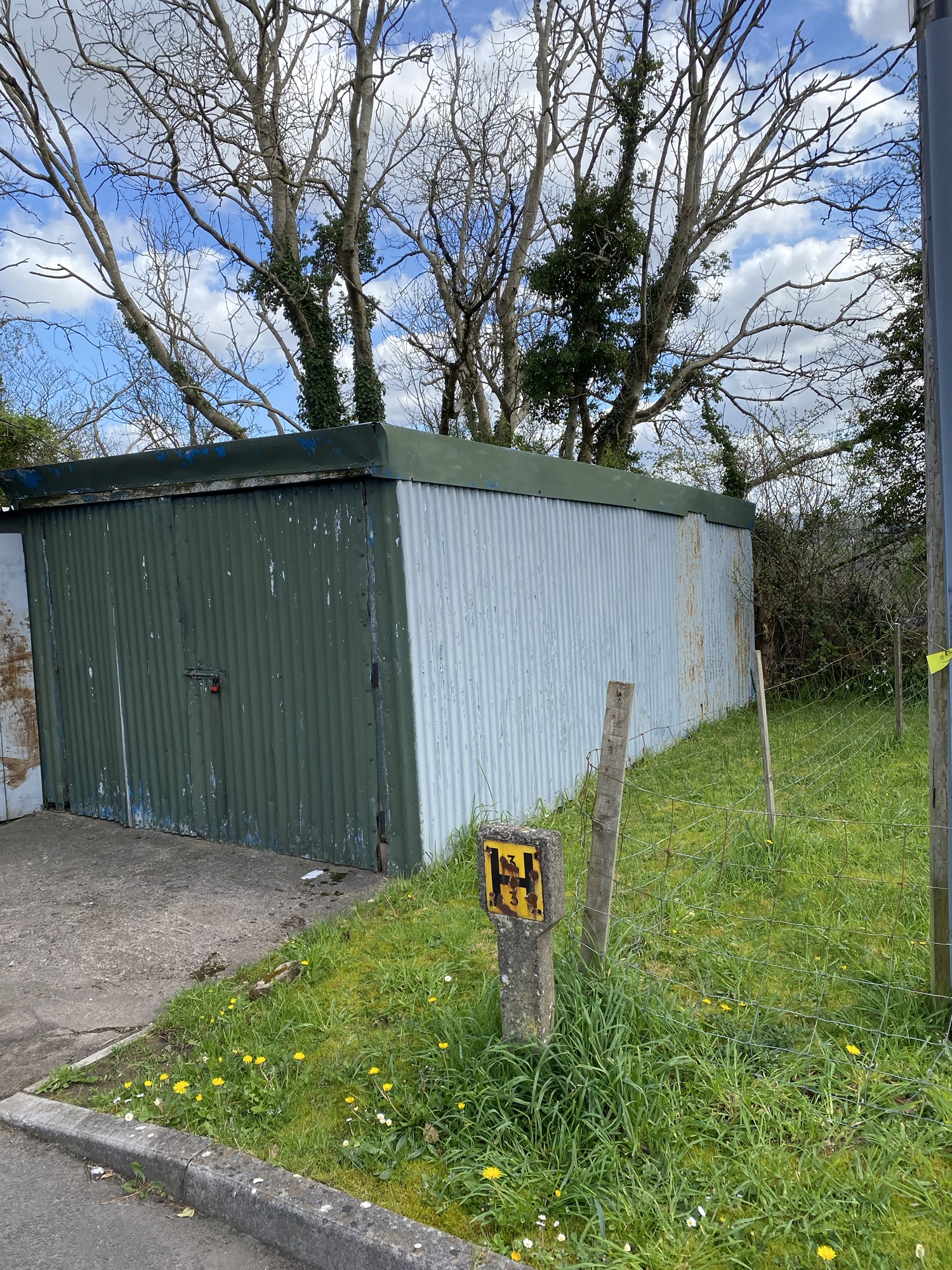
    Bog Standard Tin Garage, Llanharry, South Wales (April 2024) There used to be dozens of these in every village years ago. Mostly all gone. Low cost, often self build, utilitarian – they do the job of storing things (often a car) securely. Now almost gone.

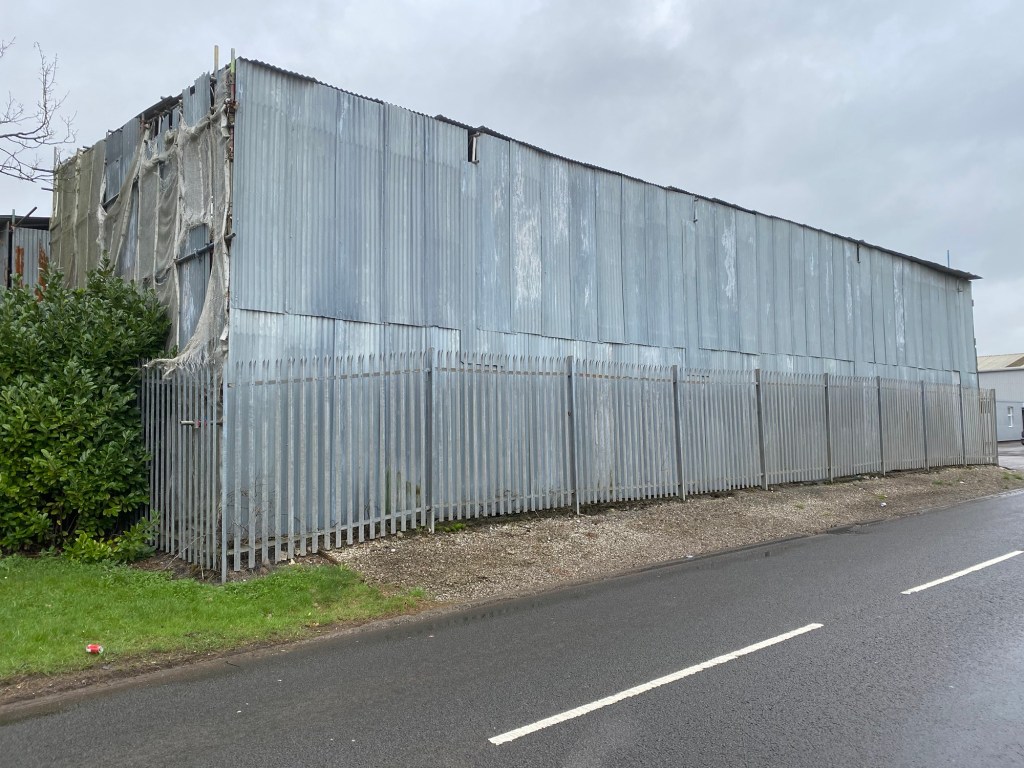
    Tin Shed Brutalism (or just plain ugly?) I have said before that not all tin sheds are things of beauty.

    This one won’t win any prizes for stunning architecture, but it does a job. Storing scaffolding materials, Bridgend Industrial Estate (February 2024).

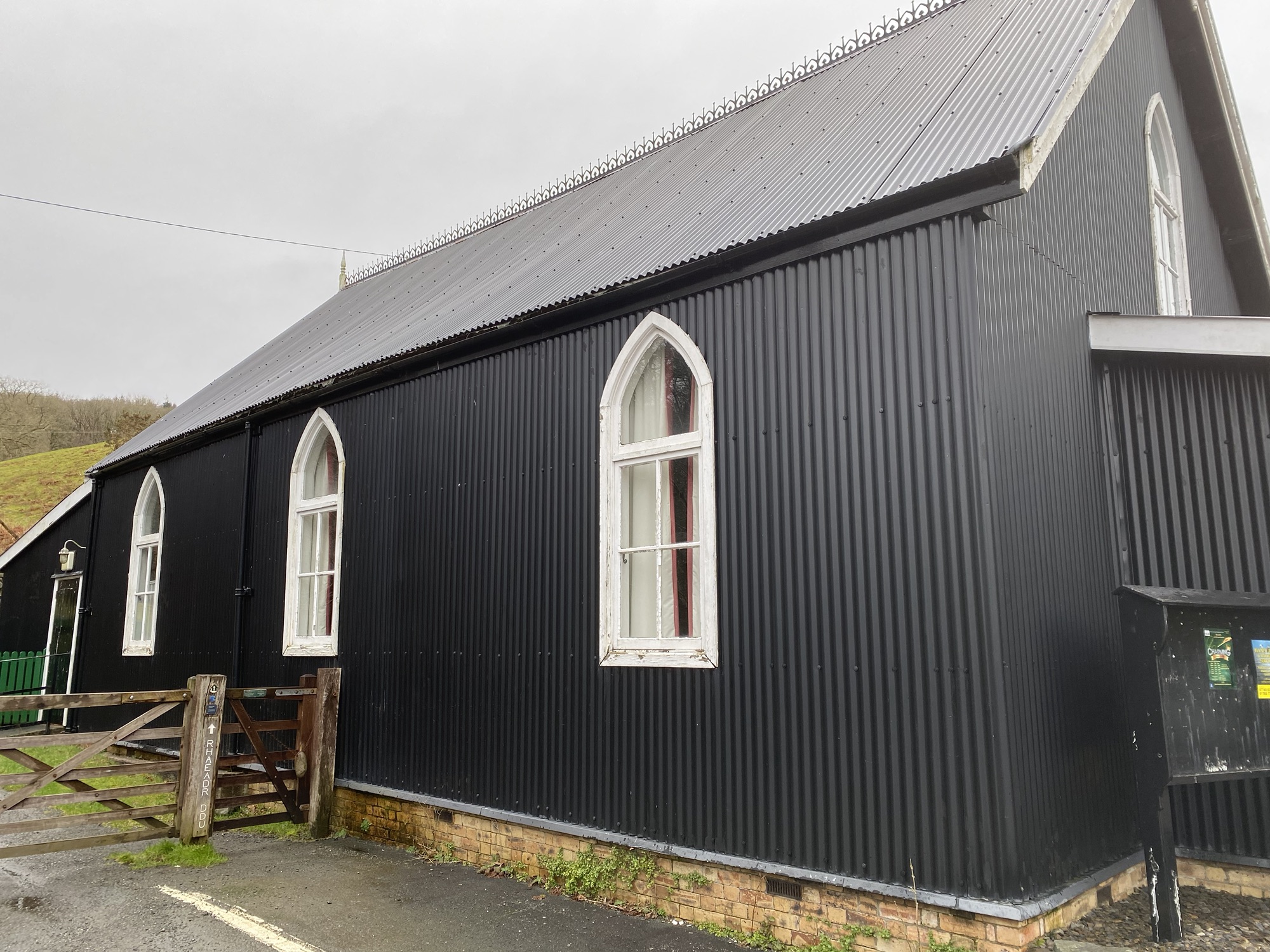
    Carmel (English Congregational Church). Trebanog Road, Trebanog, Rhondda.

    This is why I have days off from work. To drive around the local area looking for beauties like this. And getting quizzical looks from the locals as I take photos.

    It’s about 8 miles from home, I’ve gone past it 100s of times and never noticed it until yesterday.

    The back of Carmel looks more like a barn or industrial shed.
    Check out that patina (rust) and a bit of paint splatter
    Remembering Mount Zion English Baptist Church 1923 – 2009

    You can’t make a statement like ‘Remembering Mount Zion English Baptist Church’ and not expecting someone (me) to wonder, ‘what happened?‘

    Not surprisingly, it was another Tin Tabernacle that was just down the street. Demolished in 2009 and a house built on the site. Probably the fate of Carmel, which is the point of taking these pictures, and maybe why it called out to me yesterday…

    PS. Geograph is an excellent resource.
  • Innovation and the Slime of Bureaucracy

    I’ve had six conversations about innovation this week. Broadly summarised by the following quotes:

    “Necessity is the mother of invention” Plato (apparently)

    “Every revolution evaporates and leaves behind only the slime of a new bureaucracy” Franz Kafka.

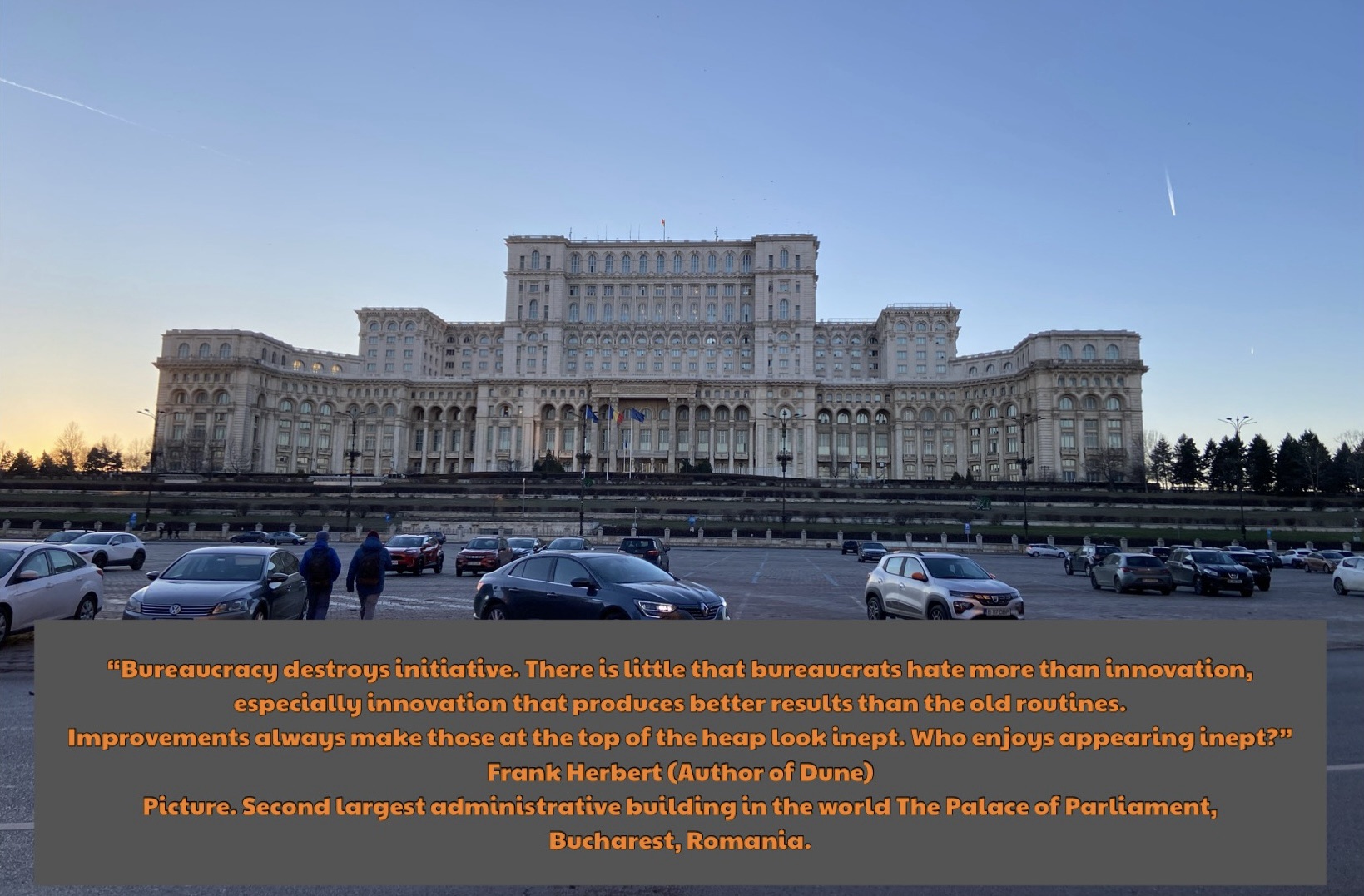
    “Bureaucracy destroys initiative. There is little that bureaucrats hate more than innovation, especially innovation that produces better results than the old routines. Improvements always make those at the top of the heap look inept. Who enjoys appearing inept?” Frank Herbert, Author of Dune

    Necessity is the mother of invention. I don’t want to dwell on this because it seems too bleedin’ obvious. Most people seem to recognise it as a truism which you can read about on Wikipedia. However, if you look into many bureaucracies the principle seems invisible.

    Dave Snowden introduced me to the concept of exaptation, people innovating by using things for a purpose they weren’t intended for. There are some brilliant examples of innovative uses of plastic bottles, bags and shopping trolleys on the Thai Flood Hacks. Link here if you’re interested.

    Revolutions that end up in Bureaucracy. This post was going to be about my recent experience of a cruise ship. The ‘house band’ were knocking out punk anthems and rock songs from my youth in a smooth jazzy style… (I kid you not).

    I was in a bit of a state of distress at spoiled precious memories but on the other hand, at least they were keeping them going. Which is where the Kafka quote comes in. Is this where everything ends up? From revolution to bureaucracy; order, standardisation, control and management (until the next revolution)? At one level it feels inevitable and part of the circle of life.

    Bureaucracy Kills Innovation. Getting back on track, I’ve been waiting a while to use the Frank Herbert quote, and I’m still not quite sure. I reckon that many (possibly most) bureaucracies do a pretty good job at killing innovation. Paul Taylor reminded me of a post I wrote over 10 years ago about Idea Antibodies. Something like an immune system that exists in organisations to ‘kill’ new ideas.

    The point in the Frank Herbert quote that “Improvements always make those at the top of the heap look inept. Who enjoys appearing inept?” rings true. But not everyone at the ‘top of the heap’ is insecure or frightened to look like they don’t have all the answers (I hope). But where does this leave us? Does being in a big / bureaucratic organisation mean that innovation is dead? 

    Tumbleweed moments. Just before I get to any resolution, here’s another quick story. Back in 2021 I was on the fringes of a group designing a new Innovation Strategy (bureaucratic process).

    I was asked for some thoughts and after carefully composing myself I said the following…

    “The six moths between March and September 2020 (Covid) we were the most innovative we’ve ever been. People have told me that their ability to successfully innovate was party driven by the need (necessity) and mostly by the fact that they weren’t over burdened by strategy, bureaucratic processes and regulation. Do you need to consider that learning in your strategy?”

    Anyway, there was a tumbleweed moment that lasted for what felt like 2 hours. Eventually someone piped up with a question about ‘how do we handle issues of intellectual property and commercialisation of innovations that are developed?’ Everyone got into the detail of discussing intellectual property (Process Stage 3, Step 6, Guidance Document 4, Paragraph 15.2), my question was forgotten and I was never invited to future meetings.

    Bureaucracy getting it right? Over the years I have seen examples of big organisations doing effective things around innovation. From creating an environment that supports people to develop ideas, share them and turning them into actual innovations. One of the area’s that often surprises people when I tell them about it is the UK Ministry of Defence. The MoD GEMs scheme open to over 250,000 MoD Staff generated innovations that had a ‘return on investment’ of up to £20million a year. So innovation can be delivered within a huge organisation (bureaucracy).

    My knowledge of GEMs is a bit dated, so I’m going to a session with IdeasUK on the 20th February (link here) to find out about the RAF Astra Scheme . An ideas / innovation scheme which aims to “unleash the ingenuity of our people to deliver meaningful change across the RAF”. I’m looking forward to seeing an alterative to the Dune World of Frank Herbert.

    So, What’s The Pont?

    1. Necessity is the mother of invention, we’ve known that forever.
    2. Revolutions (radical new things) can stabilise into order and control as new bureaucracies form.
    3. Bureaucracies do tend to kill innovation – unless there’s a conscious effort do something meaningful and effective that unleashes the ingenuity of people.
  • Perpetual Office Twixmas. My 2024 Hybrid Work Prediction

    Offices will continue to offer that Twixmas liminal feeling. Everyone loves to dabble in predictions at this time of year, so here’s mine; Perpetual Office Twixmas.

    A virtually empty office. Image by Adolfo Felix on Unsplash

    Twixmas isn’t just for Christmas. If anyone is wondering what Twixmas means, it’s one of those portmanteau words. A combination of the word ‘betwixt’, a bit of an old fashioned word which means between, and the word Christmas. It’s come to describe the period between Christmas and New Year. That strange liminal time when nobody knows what day of the week it is; haven’t worn anything other than pyjamas for days and probably haven’t ventured outside the house. Sounds familiar? There’s a lovely BBC article ‘Twixmas break: Why is it called Twixmas and what does Twixtmas mean?’ if you want some pointers on how to break the Twixmas lethargy.

    The Twixmas Office for serious work. Once upon a time, BC (Before Covid) I used to love going into the office during Twixtmas. It wasn’t just to hang out with the people who’d run out of annual leave or were avoiding their families, it was to get serious work done.

    I would store up a few bits of serious work for Twixmas and luxuriate in the opportunity to get things done properly, without interruptions and distractions. A virtually empty office provided that opportunity. Delivering something in the first week of January that I’d actually enjoyed working on felt like a great way to start a new year. But that was in the old days; BC.

    The future is already here, it’s just not evenly distributed. William Gibson.

    I do love this William Gibson quote and it happens to sit at the introduction of a book about the future of work written in 2013, REMOTE – Office Not Required, by Jason Fried and David Heinemeier Hansson the founders of 37 Signals / Basecamp. I got around to reading the book ten years after it made some bold statements about what working remotely could offer. Part of that is deliberate. I wanted to see how something written in 2013 stands up ten years later in 2023/4.

    It turns out that the William Gibson quote stands up quite nicely. The future was already ‘here’/’there’ at 37 Signals back in 2013. It just wasn’t very evenly distributed amongst the rest of us. Despite the very clear benefits described in Remote it took a pandemic for it to happen, literally overnight.

    I’d recommend reading the book. It offers some insights that are are worth reflecting upon. The leap to working from home was a massive, rapid and unplanned leap for lots of people. There’s nothing wrong with a bit of reflecting and retrofitting, particularly if hybrid working is here to stay.

    Bringing things up to date there’s the 2023 Rework Podcast, The Challenges of Remote Work (link). Here the authors reflect on 20 years of practicing remote working, some lessons from the pandemic and what the future might hold. Some of the key points for me:

    • Offices continue to be distraction factories for some people,
    • Trust is a huge issue. If people can’t be trusted to work remotely, they probably can’t be trusted in the office either,
    • Remote work is different from ordinary work. Doing 10 back to back Zoom meetings in a day isn’t what remote working (or effectiveness) is all about,
    • You need to think about the balance of office work and remote work if you want hybrid to work. You probably need at least 50% of people remote,
    • Time together face to face is a precious commodity and should be used with that in mind,
    • There are likely to be some places where a return to the office happens in 2024. That probably reflects the nature of the work, the people and the company. It’s not for everyone. Whatever you do make sure it’s for the right reasons…

    There’s a ton of other interesting things in the book and the podcast. Don’t just rely upon my reflections.

    Making Predictions – Perpetual Office Twixmas. Remote working as part of a wider approach to Hybrid working does seem to be with us to stay. The Gennie is out of the bottle. Twixmas Office works for people like me, for certain tasks, but not all the time. There is work to do to make sure the office (if you chose to have one) is effective for everyone otherwise we could end up with Perpetual Office Twixmas as people vote with their feet.

    So, What’s the Pont?

    1. People need different environments to do different types of work. The Twixmas Office suited me for certain things.
    2. Hybrid working looks like it’s here to stay. But ‘one size rarely fits anyone’. Be prepared to reflect, learn and change things to adapt to what is still a major change.
    3. The future has been with us for a while, unevenly distributed, but there if we are willing to look carefully.
  • Is the 4 day week the logical extension of Taylorism?
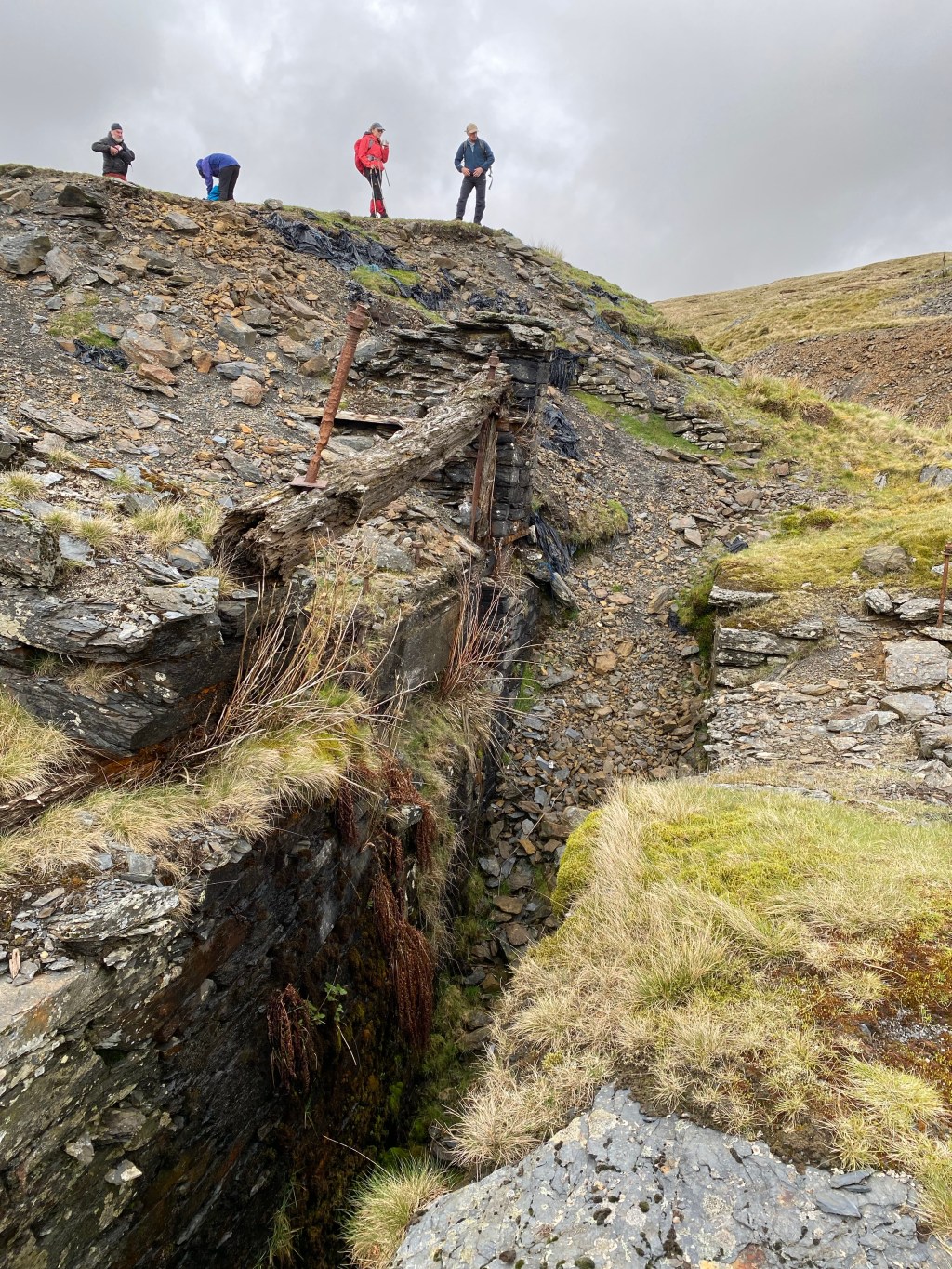
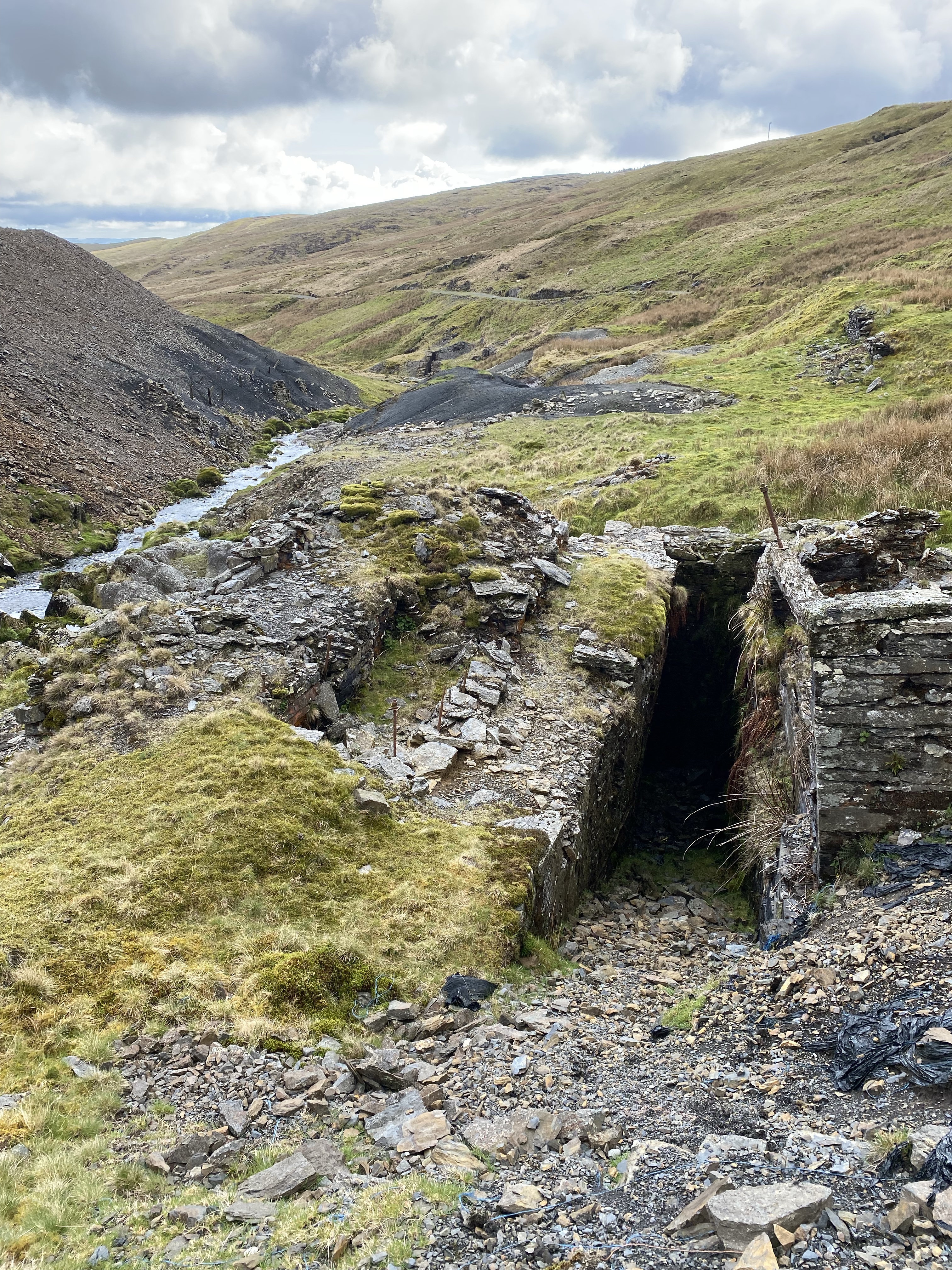
    Image: Abandoned mine spoil tips Plynlimon Lead Mine, Wales

    The answer is YES, and Frederick Winslow Taylor (1856 – 1915) would have approved. Even if it’s taken over 100 years to start seriously talking about it.

    If you’re happy with my assurances, please feel free scroll down to my ramblings about Plynlimon Lead Mine (pictured). If you’d rather find out why I’m making a bold claim about Taylorism, and the 4 day week, please let me explain.

    What is Taylorism? If you’ve done work, training or reading around the subjects of business improvement, performance management or indeed management/leadership development you’ve probably heard Taylorism mentioned.

    Taylorism and ‘scientific management’ in my experience are often described as an approach that:

    • ‘scientifically’ examines a work activity,
    • breaks activity down into specific ‘tasks’,
    • standardises the ‘best’ way of performing each task,
    • creates measures to manage the performance for workers,
    • uses bosses to organise / ‘manage’ the workers, and
    • maximises the productivity (efficiency) of the workers.

    Within this context, workers are seen as ‘units of production’. Little more that ‘machines’ if you’ve got a particular view of Taylorism. BUT THIS ISN’T EXACTLY TRUE.

    First Rate Workers. Thank you to Dave Snowden who recently described what Taylorism was originally about, and how Peter Drucker ‘helped’ him with his understanding.

    This 1976 paper by Peter Drucker; ‘The coming rediscovery of scientific management: Frederick Winslow Taylor may prove a more useful prophet to our times than we yet recognise’ explains the original principles of Taylorism. Here is my take on the key points.

    1. High wages for workers. Taylor was an advocate for high wages. This was linked to the idea of money as a motivator, but also recognised that there was more to productivity than money. Also, it wasn’t about maximising profits at the expense of workers.
    2. Decent working conditions. In the 1800’s many jobs were physically destructive to the human body. Taylor was in favour of rest periods to allow people to recover, which reduced the ‘destruction’ and helped productivity. Nowadays, where the physical nature of jobs has changed we might focus on wellbeing and mental health.
    3. Harmonious industrial relations. This is where the ‘first rate workers’ idea fits. Taylor believed that each person has the capacity to be a ‘first rate worker’, doing their best and being rewarded for it. The job of managers is to help people find the jobs where they can be ‘first rate’. That feels ‘achingly modern’ and has many parallels with things like ‘strengths based recruitment’. There is a lot in common with what I saw at GUREAK in the Basque Country; jobs designed so that people can be their very best. Explained here, GUREAK, A Basque social labour inclusion flagship (warning, I love GUREAK).
    4. Good Mangers. Taylor pushed the principle that bosses have a duty to support workers and ‘help them in all kinds of ways’. It’s less about ‘telling’ and ‘carrot and stick’ and bit more about what you might experience in a 21st century ‘how to be a modern leader’ workshop.

    So, that was Taylorism at the Midvale Steel Company, Pennsylvania in 1882, explained by Peter Drucker in 1976. I think it’s disappointing how far from the ‘path’ we’ve deviated and how mis-represented or ignored some of Taylor’s principles have become. The ‘future’ was already with us in 1882. If you want to know more, this British Library article, ‘Frederick Taylor, Father of Scientific Management’ is a good summary, with useful links to further reading.

    The 4 Day Working Week; another ‘achingly modern’ concept, or maybe not. One of the things I’ve taken from reading about Taylor was his commitment to workers receiving the benefits of their increased productivity. It wasn’t all about keeping the wages low and maximising the profits for the owners.

    The Drucker article specifically says; ‘the workers should receive the full benefit of higher productivity obtained through “scientific management”, whether in the form of higher wages or of shorter hours’.

    I think I’ll stop at this point. In my view, Taylor would have approved of the 4 day working week (providing productivity is maintained). Happy to discuss this.

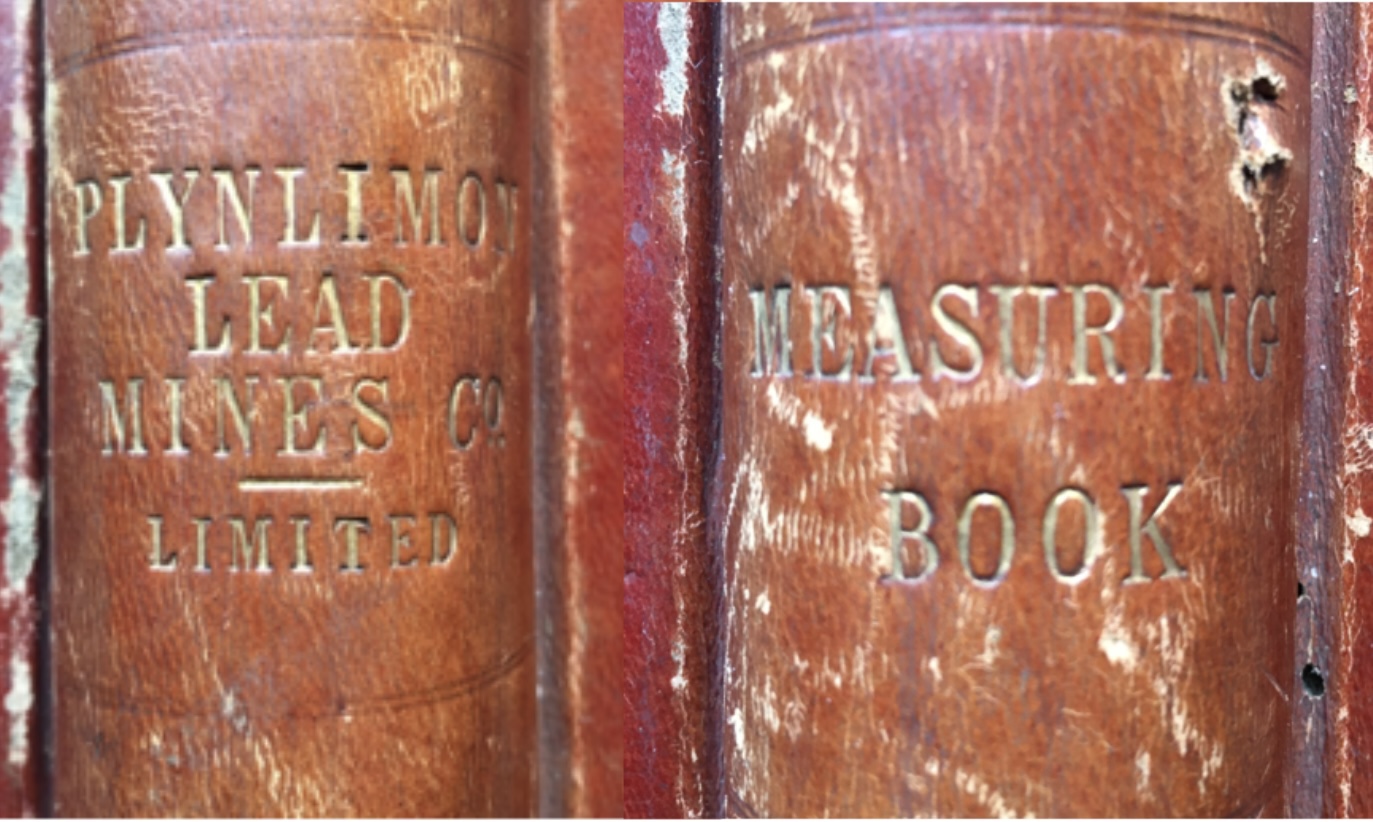
    Image: Plynlimon Lead Mines Co Measuring Book

    Plynlimon Lead Mines Company. Last weekend I went on a bit of a pilgrimage to Pumlumon Fawr and Plynlimon Lead Mine in the Cambrian Mountains, near Aberystwyth (operational 1865 – 1892). It’s a difficult place to get to, let alone mine and process lead ore. Described on the Royal Commission for Ancient and Historic Monuments in Wales Coflein website as ‘1800 ft above sea level is bleak in the extreme, with shocking weather for much of the year’.

    My interest revolved around the Plynlimon Lead Mines Co Measuring Book I’ve acquired. It was amongst my wife’s Grandparents things, and is somehow linked to relatives that worked in the lead mines. Deep down I was hoping for some examples of scientific management being recorded in the Measuring Book.

    You know the sort of stuff, the most productive ways of extracting lead ore and then processing it. Along with detailed accounts of the fair wages paid to my wife’s ancestors, recorded in lovely Cardiganshire Copperplate handwriting. Unfortunately there’s none of that, just a ‘bill of works’ for some work on her grandparents house and shopping list.

    I do however recommend Plynlimon Lead Mine as a visit, it’s a beautiful, bleak and inspiring place.

    So, What’s the PONT?

    1. Taylorism has it’s roots in fair work where people can be ‘first rate workers’. Yes it’s about increased productivity, but not at the cost of ‘destroying’ the worker.
    2. The role of managers and bosses is to help people become that ‘first rate worker’.
    3. Workers should receive the full benefit of higher productivity… whether in the form of higher wages or of shorter hours. An idea very in tune with the 4 day week.
  • “I have an opinion, and you are entitled to it”

    When does enthusiasm become a ‘wall of talking’? Some people love to share their knowledge, experiences and opinions. I’m all for it and I think I’m probably one of them. I also love to hear what other people have to say. However, when it becomes ‘one-way traffic’ I struggle. If enthusiasm for a subject overflows into a wall of talking, overwhelming the listener, with the speaker not even looking for a response, it’s gone too far. But what can you do about it?

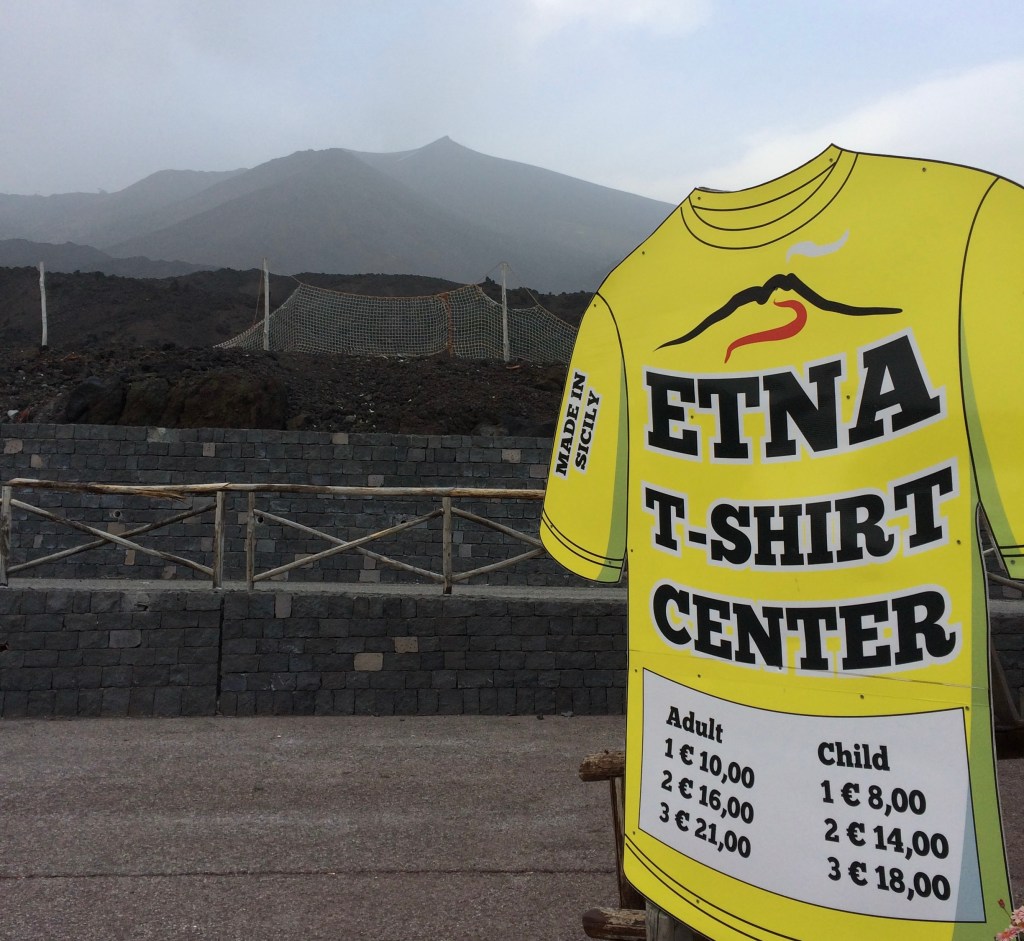
    Been there, Done that, Got the T-shirt. What has prompted this post is a recent experience with two experts. One of them I was paying to spend time with (who was excellent). The other person like me was a guest, but also ‘self identified’ as an expert. They did not shut up. It literally was, “I have an opinion, and you are entitled to it”. This was despite the attempts of the proper expert, and me. Although my attempts were rubbish, and mostly involved me walking away from the monologue, literally (I feel a bit guilty about that).

    What it did remind me of was a trip to a volcano a while ago (the T-shirt picture is a clue). I know very little about vulcanology, so for the hour long journey to the volcano I inserted myself next to to the tour guide / minibus driver; the expert. I was looking forward to soaking up some expert knowledge and the experience of someone who ‘did volcano’s for a living’.

    Unfortunately, the person who sat in the third front seat of the minibus was also an expert; but of the ‘self identified’ variety. What followed was the ‘self identified’ expert speaking relentlessly about their knowledge of a different volcano, in a different country and a vulcanologists I didn’t want or need to know about (I draw the line at Mr Spock).

    The actual volcano expert struggled to get a word in edgeways and eventually gave up and concentrated on driving safely on the twisting mountain roads. I wonder if this may not have been their ‘first rodeo’? Had they experienced a ‘wall of talking’ expert client previously? Was ‘checking out’ just the easiest way to cope with it? A bit like my own strategy, it was easier to metaphorically ‘go for a walk’, rather than try and change what was going on?

    Coping with the wall of sound… To my shame, I must admit that I’d never thought too deeply about why some people talk too much. I’d put a lot of it down to things like a lack of consideration for others, mansplaining, social anxiety or just good old rudeness and arrogance.

    Having a dig around, inevitably there are a whole host of things that count as talking too much, and reasons why they might happen. I’m no psychologist, but these descriptions from Crystal Raypole on ‘healthline’ (medically reviewed by Deborah Weatherspoon PhD MSN) help me to try and make sense of things:

    • Pressured Speech. Rapid, often forceful talking that is difficult to stop, even when other people try to get a word in (edgeways). People might talk at a faster pace than usual or even a higher volume. Possibly jumping from idea to idea so that listeners struggle to keep up. The article suggests that this behaviour can be linked to conditions like manic or hypermanic episodes. I’ve experienced some of what I now understand might have been Pressurised Speech. It leaves me thinking I could have been a bit more compassionate and thoughtful in my response.
    • Disorganised Speech. Often involves rapid switching between subjects, without any clear connection between the topics. Providing answers to questions that others consider entirely unrelated. Sometimes strings of random words that lack a clear connection. The article suggests that this might be linked to conditions like schizophrenia.
    • Rambling or excessive talking The article suggest that this can be linked to social anxiety. People fear saying the wrong thing or being judged by others, but end up talking more than they had intended in an effort to make up for the anxiety. A bit of a ‘vicious circle’ where the more you talk, the worse it gets. At the risk of ‘self diagnosis’, I think I can relate to this.
    • Hyperverbal. The article states that in this instance speech is is fast or of an increased speech which could be a symptom of ADHD (Attention Deficit Hyperactivity Disorder) or anxiety.
    • Excessive talking about self. Some people talk A LOT about their achievements, their plans, their experiences or whatever is in their head (views and opinions). This article suggest that this might be liked to things like bipolar disorder or even narcissism.

    As ever no answers. As usual I’ve ended up with more questions at the end than when I started thinking about this issue. It was easy to attribute a lot of the ‘wall of talking’ I’ve experienced as being due to pure rudeness or arrogance (possibly narcissism). Some of it will be. But it is inevitably more complex than that. What I’m left thinking is that I should be a bit more thoughtful and possibly kinder in the future – before I ‘go for a walk’.

    Finally. Mansplaining – I’m not sure there are any excuses for mansplaining. Do have a look at this BBC Worklife article by Kim Goodwin, explaining Mansplaining in a single chart . The chart might even been worth downloading as a ‘cut out and keep’ quick reference guide. If anything in the chart triggers any feelings or back of the mind thoughts, stop, pause and reflect. You’re welcome, I’m here to help.

    So, what’s the PONT?

    1. The ‘wall of talking’ that comes from some people might be happening for a multitude of reasons. Many of which they have little or no control over.
    2. How we respond needs to recognise that. It’s not always because they are rude, arrogant narcissists. So it might good to be a bit more kind and compassionate.
    3. Checking out and ‘going for a walk’, physically or mentally might be a reasonable coping strategy in a situation where you aren’t going to change what is going on.

    Picture Credit. Mine. The Mount Etna t-shirt stall.

  • Tolerated failure imprints learning better than success.

    The title is a quote from Dave Snowden, but first I want to talk about the Husky.

    For a while the Husky has been attending hydrotherapy sessions (all part of her rehabilitation after knee ligament replacement surgery). The Husky quite enjoys the hydrotherapy sessions, so do I, but for different reasons. One of us because of getting a nice bath and bit of a bouffant afterwards and the other one for cognitive stimulation. You can work out for yourself which benefit applies to who. We’ll probably continue with the hydrotherapy sessions after the treatment course is finished. We enjoy it that much.

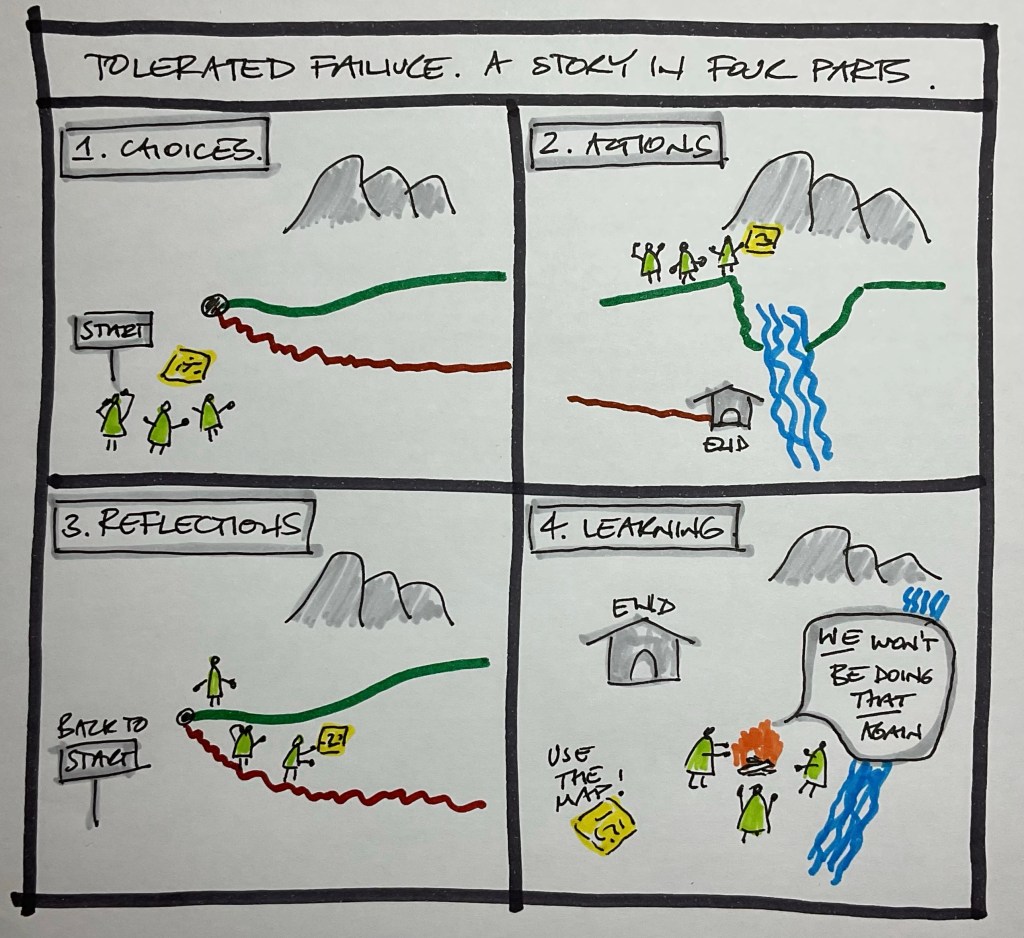
    Map reading training exercises. Yesterday the Hydrotherapist was telling us a story about when they had been a junior recruit in the miliary, and were doing map reading training. It went along the lines of:

    • The troop were on the Yorkshire Moors, with an Instructor.
    • They knew the end point they were heading for.
    • They had a map a compass and some basic instruction in map reading and navigation.
    • They were all required to take turns as Troop Leader and Map Reader.
    • At one point they had a choice of paths. A junction with both paths heading in the general direction of the end point, but one a bit easier than the other.
    • The Troop Leader chose the less hazardous path for the troop.
    • After a while it became clear that the troop were gradually gaining height.
    • This didn’t feel right as the end point was down in the Valley.
    • Shortly afterwards the Instructor called a halt and asked for a position check with the Map Reader.
    • At this point it became obvious the troop were very much off course.
    • What was more concerning was the ground ahead, some steep crags that would have prevented a safe descent down into the valley.
    • It was agreed with the Instructor that the best course of action was to return to the junction and take what had looked like the more hazardous path.
    • The troop did this, and soon passed the hazardous sections and made it safely to the end of the exercise.
    • Later that day with the Instructor the troop reflected upon what had happened and what had been learned.
    • The Instructor shared with the troop that the failure point in the exercise was deliberate, and 4 out of 5 troops made the wrong choice.
    • But that was OK, because the lessons they learnt from getting it wrong were far more valuable than what could be taught in any classroom exercise.
    • The troops that failed also learned better than those who had been successful (but that’s a different challenge)
    • This happened about 40 years ago, yet it was a vivid and important memory for the Hydrotherapist.

    What is Tolerated Failure? Coming back to that quote from Dave Snowden, I first heard him say it about 15 years ago, and it’s in this 2008 article Rendering Knowledge, about Dave’s 7 Principles of Knowledge Management – it’s a good one that I keep coming back to. I’ve even tried to draw it in Knowledge Management is like a Boomerang (apologies).

    The big point for me is that I don’t think that most organisations really get the point about learning from failure, let alone the idea of tolerated failure. They might say they do, but the practice is less common. Its worth having a read of this; Dealing with the architecture of fear by Chris Corrigan. The point that Chris makes is that fear (of losing your job) is a bigger motivator than the possibility of learning something interesting (or useful) from failure. However ‘tolerated’ the corporate machine says failure will be. I’ve seen enough in my working life to believe this is broadly true (but happy to have a chat if anyone has a different view).

    So, here are some things I’m thinking about that might give Tolerated Failure a chance of surviving in the wild. I’m thinking about; Training, Planning and Learning.

    1. Do Training Differently. A lot of training I’ve experienced has been along the lines of someone trudging through a slide deck – mostly talking to at me. Occasionally I’ve done things that have been an approximation to real life and what happens in the wild. Things like scenario or simulation exercises where you can try, fail and learn in a genuinely safe space. You might have picked up on my enthusiasm for the scenario / simulation exercise approach in previous posts like this one on the value of Space Walk Simulations. The other thing to note is that learning from failure is a key part of the ‘approximating’ stage of an apprenticeship (done properly).
      • My suggestion. Make it the default in all training to do practical things that allow for tolerable failures. Just like the Military have done for years with map reading training.
    2. Do Project Planning Differently. I’m mildly obsessed with this one. I’ve a view that lots of activities are planned to deliver a very narrow pre-determined end result. There are no ‘real’ options, and plenty of ‘decoys’ in business case options appraisals. The result is guaranteed success with no room for failure, let alone tolerated failure. The notion of prototypes and minimum viable products (MVPs) only really exists at the margins (or Tech Start-ups). Here’s something I wrote on Minimum Viable Transformation (big change in other words), where I think the need for multiple safe to fail experiments and tolerated failure is more needed than anywhere. Please don’t get me started on Trojan Mice.
      • My suggestion. Make it mandatory for every business case options appraisal to detail all the failures that happened as part of developing the favoured options. A proper detailed list of what went wrong and what was learnt. Guess what, I’ve written the questions to ask here in; How to spot the difference between a Trojan Horse and Trojan Mice.
    3. Do Learning Differently. At the risk of flogging a dead Trojan Horse, all I want to say is do the learning as you go along and don’t wait for the Project Post Mortem at the end. To be honest, it’s all a bit too late if your learning from failure is restricted to end of project reviews.
      • My Suggestion. Concentrate on the other two things I’ve mentioned, and push project learning back into real time. People do it already. It’s called things like quality control or continuous improvement.

    Feel the fear and… There’s a lot of behaviour in the world of work that is driven by fear. The article by Chris Corrigan highlights this. I’m not naïve enough to think that me or anyone else talking about tolerated failure being better at implanting learning than success is going to change much. For lots of people there’s too much at risk. However, there are organisations that have been doing it effectively for years. It’s got to be worth thinking about what they do and having a go.

    So, What’s the PONT?

    1. Tolerated failure is an important part of what we do to learn as we grow up. However, within the world of work it is less common and failure (in whatever disguise) is something to be avoided.
    2. Training activities that deliberately design in, failure ‘opportunities’, can help to develop the recognition and acceptance of tolerated failure.
    3. Likewise business case options appraisals. Options appraisals should include details of the prototypes or tests that were tried and failed, and what was learned. This should give the end product a chance of surviving in the wild.

  • Liminality. Two inevitabilities and one prediction.

    Liminality at the Dentist. I’ve a (possibly strange) observation to make. I quite like sitting in the Dentist’s waiting room.

    The Doctors Surgery waiting room isn’t bad either, as are the foyers and reception areas of some big municipal buildings, Newport Civic Centre is a good one. It doesn’t work in the waiting area of the Vets though. Big railway stations yes; bus stops not so much.

    Something unusual seems to happen to me sitting in certain places, particularly a visit to the Dentist. No mater what has happened before I arrive, I always feel a bit detached and disorientated in the waiting room. Almost like I’m outside of myself, just observing what’s going on. Time seems to slow down and the hassles of everyday life don’t seem so relevant. It also occasionally happens in a waiting room before something important like a big meeting or an exam.

    This of course might just be one of my weird personality traits. Alternatively it might also be my reaction to liminality. I’m still working it out.

    Neither one thing or the other. The word liminality comes from the Latin limen, meaning ‘threshold’. The general idea is that its a space where you are in between the ‘old’ and the ‘new’. At the threshold. These old and new states can be places, roles or even states of mind. Anthropologists describe liminality as things like ‘rites of passage’ where people move between different states like from being a child to an adult. Often rituals or initiation ceremonies are involved.

    I’m guessing that the idea of a bit of ‘tribal dancing’ and body painting might be springing to mind at the moment… But you don’t have to go that far. If you’ve ever started a new job and gone through the corporate induction process just pause and think for a moment. How ‘liminal’ was it? Did you exist in an ‘in-between’ space, neither the old or new, before you transitioned into the new job? Were rituals like a tour of the building part of it? I can relate to that. Other examples of liminality include weddings (in-between being single to married), going away to university (in between living with the family to living apart) etc etc.

    One example that sticks most strongly with me was going to play for a new rugby team. Despite lots of welcoming people it took a while and some initiation practices (like going on tour) to feel comfortable in the new space. Of course, we never spoke of liminality. Ever.

    There’s a a whole world of interesting things on liminality to explore. I’d recommend starting with the Wikipedia article (here). You can skip straight to section 5.5 on Liminal Spaces if you fancy. All sorts of places like crossroads, bridges, marshes,  hallways, airports, and streets get a mention, but not Dentists’ waiting rooms. Maybe I am a bit weird.

    First inevitability – Welsh Folklore.

    Image: Lleu rising from a liminal space as an Eagle. From Welsh Folklore, The Mabinogi. Source: https://en.wikipedia.org/wiki/File:Lleu.jpg

    Inevitably, Welsh Folklore nailed liminality and liminal spaces long before anyone had written an academic thesis about it or anthropologists had studied remote jungle tribes.

    Do have quick look at the story of Lleu Llaw Gyffes who’s rather convoluted story is told in the Mabinogion. To save you some of the mind bending twists and turns all you need to know is that Lleu was difficult to kill. He could not be killed during the day or night, nor indoors or outdoors, neither riding nor walking, not clothed and not naked, nor by any weapon lawfully made.

    That ‘in-between’ space of neither one thing or the other, qualifies as a pretty good example of liminality to me.

    If you are wondering how Lleu was eventually killed, try this:

    • At dusk (neither day or night – the perfect liminal time)
    • Wrapped in a net (presumably without clothes, interesting – I wouldn’t have got that one)
    • With with one foot on a cauldron and one on a goat (really? who wrote this stuff)
    • With a spear forged for a year during the hours when everyone is at mass (at least that makes sense).

    After Lleu was killed he transformed into an Eagle (now the picture makes sense). But not for long, and it all works out fine when he gets the throne of Gywnedd. With all these strange happenings in our Folklore I don’t think it should come as a surprise that lots of people in Wales are fairly comfortable with the concept and practice of liminality. Which leads me on to my second inevitability.

    Second Inevitability, The Cynefin Framework. Of course there was going to be a link between Cynefin and liminality.

    Image: Identity as an emergent property of role, through ritual and liminality. By LucaOrlassino Source: https://cynefin.io/wiki/File:Identity_as_emergent_property_of_role.png

    The best thing I can suggest you do here is have a look at Liminality on the Cynefin wiki.

    The main point I want to make is about the issue of boundaries and the transitions between them. Boundaries exist all over the place and are linked to liminality. As you cross the boundary you are neither in the old or the new.

    There is a boundary between a new job and an old job. People are generally helped with the transition through the liminal space with the induction process, a ritual. There are also boundaries and liminal spaces between old and new ways of doing all sorts of things, like change. The graphic above from Luca Orlassino on the Cynefin wiki is a good illustration of what is going on.

    If you’ve developed a different / better / more efficient way of doing something there will be a boundary between the old and the new ways of doing things, and a liminal space in between. How people cross that space will be different. If there are support mechanisms (rituals like training) it’s likely to be easier than having to find your own way.

    I think it could be useful to think about change and change initiatives in the context of liminality and liminal spaces.

    One final thing. A colleague who’d studied Anthropology once described things, like works’ social events, where roles are reversed and the bosses perform tasks like serving the workers a meals, as liminal spaces. Things are disrupted and ‘everything is reversed’. These are common in history and across societies, but the point they were making is that once things settle into a new space, it’s quite often exactly like it was before. Nothing has changed. Stepping into a liminal space didn’t lead to a transition into something new, it actually helped to cement the old way of doing things. It’s not a one way process.

    Something to think about. As I mentioned earlier, I wonder how many corporate change initiatives seriously consider liminality?

    One Prediction. So, here’s my prediction. I think the time has come when the corporate change machines will start to wake up to the relevance of liminality. The next 12 months will see a rise in the use of the language around liminality and some application. That’s fine, but my big worry is that it will become ‘industrialised’ and sold as a product like so many good things before it. Another example of Stage #8 of the Lifecycle of a Sliver Bullet, Standardisation and Superficial Copying, which I’ve written about before.

    I’ve not made any predictions before, but it is that strange liminal time between the end of the old and the beginning of a new year, so why not.

    So, What’s the PONT?

    1. Liminality has been known and understood for millennia. The threshold between the old and the new. The place where we transition between the two states. It’s in our Folklore and tribal rituals.
    2. Things like a corporate induction when you get a new job is essentially a ritual to help you transition across the liminal space of the old (job) to the new (job). Some rituals are better than others.
    3. Recognising that all change probably involves some liminality and transition might be helpful if you want your change to work.
  • Will exposure to heterotopic spaces get the fleas out of the jar?
    Me in a heterotrophic play space (no fleas).

    It’s been another one of those weeks where I’ve heard a lot about the enormous challenges we face, the need for big changes and big transformations. It all leaves me feeling a bit… meh!

    It’s all well and good telling people that they need to transform, but how exactly? Do we have the necessary skills? Do we have the motivation and imagination to do it?

    This is where heterotopia and heterotopic spaces comes in, a possible approach to understanding what you might do next. But first, the fleas.

    Getting the fleas out of the jar. In lots of workplaces (and society more widely) considerable effort goes into making sure things are standardised and compliant. Compliant not only with rules and regulations, but also processes to deliver the ‘best’ results and value for money. In some places there is almost as much effort put into compliance as there is put into doing the actual work. The stuff that matters to the customers, service users or stakeholders. If you have been in the ‘system’ for a number of years, there’s a good chance that custom and practice will have become embedded. Your behaviour (conscious and unconscious) will be focussed on delivering what the system requires.

    Is it any surprise then, that when we ask people to change or ‘transform’ it can be a bit of a challenge. Even if we tell them (passionately) that you are; ‘free to innovate’, ‘free to think differently’, ‘free to try new and risky things’.

    A while back I was prompted by Andy Middleton to write this post about ‘The Fleas in the Jar Experiment’. The basic gist is that a group of fleas will only move as far as the boundaries of their world (the jar). Even when the lid of the jar is removed, they don’t jump higher than the jar rim, because that’s what they have been conditioned to do.

    The fleas’ behaviour is fixed, even though they have been given permission (by removing the lid) to jump higher. Does that sound relatable? “You are free to be innovative / creative / transformational… just do it!”

    Foucault’s Heterotopic Spaces. I was introduced to this idea by Innovation Specialist, Dr Lisa Whitelaw at an Ideas UK conference. You can read Lisa’s PhD thesis here; Organising for disruptive innovation: everyday entrepreneuring efforts at an incumbent technology company The image below is from the thesis and identifies ‘heterotopian spaces for play’.

    Image from PhD Thesis. Dr Lisa Whitelaw http://etheses.lse.ac.uk/4204/

    If you do what you’ve always done, you get what you’ve always got. To be blunt, I wouldn’t get away with talking about Foucault, Heterotropia or Spaces for Play with most of the people I meet on a day to day basis. So, in very straight-forward terms this is why I think it is interesting and possibly useful.

    • Do what you’ve always done, get what you’ve always got; a truism.
    • We need to go into a different ‘space’ if we want to think and do things differently.
    • Foucault’s Heterotopia are spaces that are different.
    • The word heterotopia comes from Ancient Greek, meaning, ‘other or different’ and tropia meaning ‘place’, so they are literally an other or different place.
    • Foucault talks about these places as being in some way ‘other’ to the ‘normal’ world around them.
    • This leads to a feeling of being disturbed, intense, incompatible or indeed, transformed.
    • These spaces are around us in everyday life and can be things like libraires, cathedrals, cemeteries or ships.
    • They can also be social situations.
    • The point is that they are different from the ‘normal’, you are different as a result, so there is an opportunity for something different to happen.
    • In the context of what Lisa was doing (heterotopic play spaces), this allows people to come up with different / new / creative / innovative ideas.
    • Where I’m coming from is the idea of thinking about heterotopic spaces as something that will help people with the changes or transformation required by their jobs.
    • Use the heterotrophic spaces to stimulate different ways of thinking about things.
    • That’s it.
    • If you want more on Foucault’s Heterotopia as Play Spaces, have a look at this by Tom Hutchings and Jason Giardino in the International Journal of Role Playing.

    Great theory, but where’s the reality? Two things to mention here, nuclear fallout bunkers and journeys to north Wales

    Over the years I’ve spent many joyful hours travelling across Wales, I’ve even written about the glorious A470 highway that runs between Llandudno and Cardiff. If you are taking the trip for work purposes, whether you travel by train or drive, there is something heterotopian about it. It definitely feels like a different space to everyday work. If you have a work colleague along with you, for me, that feeling of ‘different’ is amplified. The nature of conversations is different in depth and scope. I wonder if there is an opportunity to solve all our problems by putting people on the Bangor to Cardiff train, on continuous loop, until they come up with some different ideas?

    The second point is about physical spaces. Years ago I used to take part in Civil Emergency Planning Scenarios. They were fascinating on their own but what sticks in my mind are the ones that were run in a redundant nuclear fallout shelter. This truly was a different space, with pin boards, maps, bakerite telephones and other paraphernalia. I think about it now and how differently lots of people behaved in that space, compared to when I’d met them in other settings. There might be a bit of mis-remembering on my part, but the space certainly did have an impact. I wonder if the choice of space was deliberate?

    Isn’t this just Liminal Spaces in disguise? Liminal space is a concept from Anthropology. It is the ‘space’ where there is a transition from one state into another. It’s neither one thing (the old space) of the other (the new space). Something in between. I think there is some common ground, but that’s the topic of a follow up post, just in time for the transition from the Old Year into the New Year. Apparently that is a liminal space, where all sorts of unusual stuff can happen.

    So, What’s the PONT?

    1. If you do what you’ve always done, you’ll get what you’ve always got. Something has to change if you want different answers to problems. That might be the space where you think about it.
    2. If you’ve spent years getting people to standardise and conform, behaviours are likely to have become deeply embedded. Saying that you are now free to ‘think differently’ and ‘transform’ is unlikely to change things overnight. Taking the lid off the jar might not get the fleas to immediately jump out.
    3. Heterotopic spaces (places that are ‘different’) are around us in everyday life. Recognising them for what they are, and what they do, could be useful. Holding a meeting in a nuclear fallout shelter might generate some interesting and different results?

  • The race for Second Place (and last but one, 7th)

    How vintage, you use a fax machine. I’m fairly sure I haven’t sent or received a fax in over 10 years. However… I recently handed out a business card, with a fax number on it! A long story, but it was all I had, and someone wanted my contact number. I found the ‘historical artifact’ next to some Roman Coins, buried deep in the lining of a jacket I hadn’t worn in years.

    Following examination of the fax number and a quizzical look from the recipient I burst into an embarrassing burble. I was trying to demonstrate I was totally modern, and actually an early adopter of the latest tech (apparently). I’d swung too far the other way. Fortunately the recipient was a generous soul and eased my embarrassment with the anecdote about ‘I wonder who was the first person to buy a fax machine…’. Oh how we laughed.

    The race to be second. That anecdote about ‘who was the first person to buy a fax machine’ was actually highly relevant. A short time later I was having a conversation about innovation and why being second often works. The second person to buy a fax machine (and everyone else after them) will at least have someone to exchange faxes with. Imagine being the first purchaser, hanging around waiting, and feeling stupid for winning first place in the race.

    Interestingly my other conversation was about the nuclear industry and radioactive materials. My companion was talking about how second place was a good place to be in that world. You don’t want to take on the risks of unknown, potentially expensive and potentially deadly mistakes that the ‘winners’ might make. You are free to exploit the benefits of being second. I very much understand (and appreciate) why this is a good approach in the nuclear industry.

    However, I also understand that things aren’t as clear cut as that for everything else. Things like patents, trademarks and company secrets make it possible for people to protect intellectual property, innovative ideas. They protect the benefits of taking risks and arriving in first place. It’s a fundamental part of how things work in business and commerce. But, it did get me thinking… I don’t often hear people talking about aiming to being second beyond that conversation. In fact it’s very rare.

    In many organisations there’s plenty of language that talks about ‘being first’, ‘best in class’ or ‘winners’. ‘Winning is in our DNA’ is one of those slightly depressing corporate slogans I encounter from time to time. I do wonder if anyone actually thinks about this language when they put together the corporate documents and business plans. Is second place actually the best place to aim for? Should organisations think more deeply and be explicit about aiming to be in second place? Especially if:

    • It might be a dangerous area of activity where you can’t risk getting things wrong;
    • It might be too expensive to try new things;
    • They might lack the expertise to know what to do;
    • They might lack the imagination to consider doing something differently; or
    • They might lack the will to bother trying (I’ll get to that later).

    I wonder if the expectations of lots of organisations are to instinctively aim to be ‘first’? This is without explicitly thinking about the negative consequences of first place and the benefits of aiming to be second.

    When you’re only No2, you try harder… As a palette cleanser this is mildly interesting. For 50 years (1962 – 2012) the Avis Car Rental Company made a huge virtues of being second in their advertising. They started out with a much smaller market share than the market dominators, Hertz. The point of ‘we try harder’ because we are in second place worked well for Avis over that period of 50 years. You can have a look at the details in this article We’re No 2!. We’re No2! by Seth Stevenson in the Slate. Although Avis did increase their market share, both Avis and Hertz lost out to Enterprise as the world and consumers changed. Avis are now 3rd, which doesn’t quite have the same ring to it as ‘we are second’; but it’s better than 7th…

    7th is OK, just don’t be in last place. One of the things I mentioned earlier about the things that might prevent an organisation from reaching first place was a lack of will. This intrigues me.

    There are organisations in the world that are all about cruising along, under the radar, not attracting any attention. You certainly don’t want to be in first, second or third place. You are still on the ‘podium’ in 2nd and 3rd and that attracts unwelcome attention.

    Using the Olympic 100m sprint example, 7th place (last but one) might be a fine place to be. You aren’t going to attract any attention as a winner or almost winner (1st, 2nd, 3rd) but you aren’t last either. Still in the race with the benefits that brings, but without any of the risks of being first or attracting any attention. And that might be just fine…

    So, what’s the PONT?

    1. Being ‘first’ involves risks as well as benefits. The risks might not be acceptable for many reasons and second place can be fine.
    2. Aiming for first place can be an instinctive behaviour. Stopping to pause and reflect on the reasons and consequences and being explicit about choices is a good step.
    3. 7th place might be a perfectly fine aspiration for some organisations. We can’t all be winners, and there are benefits to exploiting the mistakes and learning from the people driven to be first. There’s room for everyone in the race.